• Category Archives Tourist Attractions
  • Bronx Zoo

    Posted on by Brian Dubé

    Zoos have gone through numerous incarnations, a mirror of society’s relationships with and views of animals. From the early menageries in Europe, we have moved away from cages and entertainment to habitats and education. There was no hiding from the populace that the conditions in most zoos at one time was deplorable. Eventually, the cages themselves became more difficult to justify. The emphasis today is the conservation message – the graphic for the Wildlife Conservation Society gets equal time with the Bronx Zoo on all of the literature, merchandise, and entrance gates.

    The Bronx Zoo was founded in 1899 as the New York Zoological Park, with 843 animals in 22 exhibits. A group of beautiful Beaux-Arts buildings designed by Heins & LaFarge surround a sea lion pool (seen in the photo) at the main entrance, which also features beautiful gardens. This is the largest zoo in the United States, covering 265 acres with more than 4,000 animals, many of them endangered species.

    The transformation can be seen at locations such as the Lion House, one of the original Beaux-Arts buildings, which no longer houses the big cats. All have been moved to larger areas. Some exhibits, such as the World of Darkness, have closed due to budget cuts.

    Efforts have been made to place animals in as natural an environment as possible. Ultimately, however, the overriding feeling I have in any zoo is still one of exhibits of animals in confined spaces. Some argue that if conservation is the motive, money would be better spent in open wildlife sanctuaries and contributions made towards the animals’ native environments in their home countries.

    At one time, when the Bronx Zoo made the transition to habitats, everything seemed to be so dramatically large and the animals so free. As I have visited the zoos since that time, the habitats feel smaller. I can’t help but compare these environments to the areas which the same animals must inhabit in the wild.

    Many of the inhabitants of the zoo are rescued animals whose fate would likely have been grim had not the zoo adopted them. Endangered species are protected, bred, and some even reintroduced to the wild. And I am sure that the place is staffed with dedicated animal lovers who cannot be expected to argue for their own demise. But when I peer into the eyes of those gorillas, I always wonder how happy they are and what they are thinking…

    Related Posts: Feeding at the Zoo, Rain Forest, Red Panda
    Posted on by Brian Dubé

  • Big Bang

    Posted on by Brian Dubé

    I had not been to a Fourth of July celebration in New York City for many, many years, generally opting for seeing them on TV. This year, however, I was with a friend who had never been to a live fireworks display at all, so it seemed criminal not to take a short stroll to the river and let her witness the Big Bang, New York City-style.

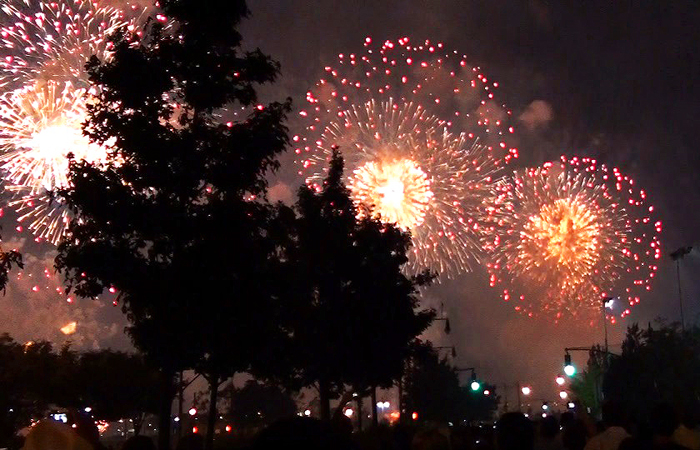
    The display, sponsored by Macy’s since 1958, was originally over the Hudson River. Since 1976, Macy’s fireworks became a tradition over the East River. This year’s display was back over the Hudson and better than ever. The display lasted 26 minutes, with 40,000 shells fired from six barges, located opposite 23rd to 50th Streets in Manhattan, where the West Side Highway was closed to pedestrians for the event. A Hudson River display also affords views from New Jersey, with the added eye candy of the Manhattan skyline as backdrop.

    However, getting a viewing location was not as leisurely as one would hope. Police barricades restricted entry to just a handful of crosstown streets; frustrated crowds were directed to streets which in turn had also been closed. We paced up and down 10th Avenue to find entry to the West Side Highway, at last getting in at 24th Street. After a little jockeying for a good position for viewing/photography, we settled in for a spectacular display, on time as always. At the conclusion, traffic was snarled beyond belief – masochism by auto. I recommend seeing the NYC Independence Day fireworks in person, but the only way it makes sense to see any event of this size is by using a combination of subways and walking…

    Posted on by Brian Dubé

  • Makes Me Stronger

    Posted on by Brian Dubé

    Generally speaking, steps are a means to an end, not an end in itself. But this is New York City, where the minutiae of life are often elevated to iconic status. New York is the most densely populated city in the United States, and Manhattan, being an island, is a place where every square inch is examined, coveted, utilized, and maximized. So when you have a place as important as the Metropolitan Museum of Art that occupies so much space, you know it will loom much larger than life in every way.

    The Met is the largest museum in the Western Hemisphere, with over 5 million visitors per year – that’s a lot of foot traffic. Add to the formula one of the best locations in the city (Fifth Avenue and Central Park) with an enormous set of steps, and what you get is the stoop of all stoops – the ideal perch or porch for relaxing and/or the watching of people and performers. The steps are legendary, and a sunny Sunday afternoon here is a classic way for a New Yorker or visitor to pass some very enjoyable time.

    For the performing artist, the streets are an ideal venue to hone his or her skills. Many well known entertainers have worked the streets and these steps early in their career. The streets, subways, and parks are ready for immediate work – no agents or bookings required.

    Of course, it is rough and tumble battling the competition, weather, ambient noise, hecklers, property owners, neighborhood residents, and law enforcement. Those who can weather these elements become much stronger performers. They have learned to earn and hold spectators against adverse conditions – no captive audience here.

    I once introduced a much younger coworker to a variety of country music, including some very old recordings of Roy Acuff from the 1930s. This coworker was a very open-minded and tolerant musician, but I feared that this genre, particularly Acuff, might be trying his patience, so I asked him if listening to this music was too irritating. He responded, with a smile, “Don’t worry, it just makes me stronger.” So it is with the steps of the Met – for museum patrons or stoop sitters, it can be a stairway to heaven; for performers, it is a place that just makes them stronger 🙂

    Related Articles: Street Magic, Artiste Extraordinaire

    Posted on by Brian Dubé

  • The Guggenheim

    Posted on by Brian Dubé


    What I find most fascinating about a place like the Guggenheim Museum is that it stands as a supreme example of how virtually anything can be defended, praised, or condemned intelligently with words. Conflicting arguments abound about works of architecture, art, film, music, dance, etc. I once asked an architect after seeing a particularly hideous structure what she would make of a building which every lay person hated but was lauded by architecture critics. The answer she gave: “Then architecture is a failure.”

    I have cited examples in this blog of things which have become iconic in spite of their being considered an abomination by many at the time of completion, such as the Eiffel Tower. The Guggenheim is one of those places – time has softened those aspects that perhaps have offended many.

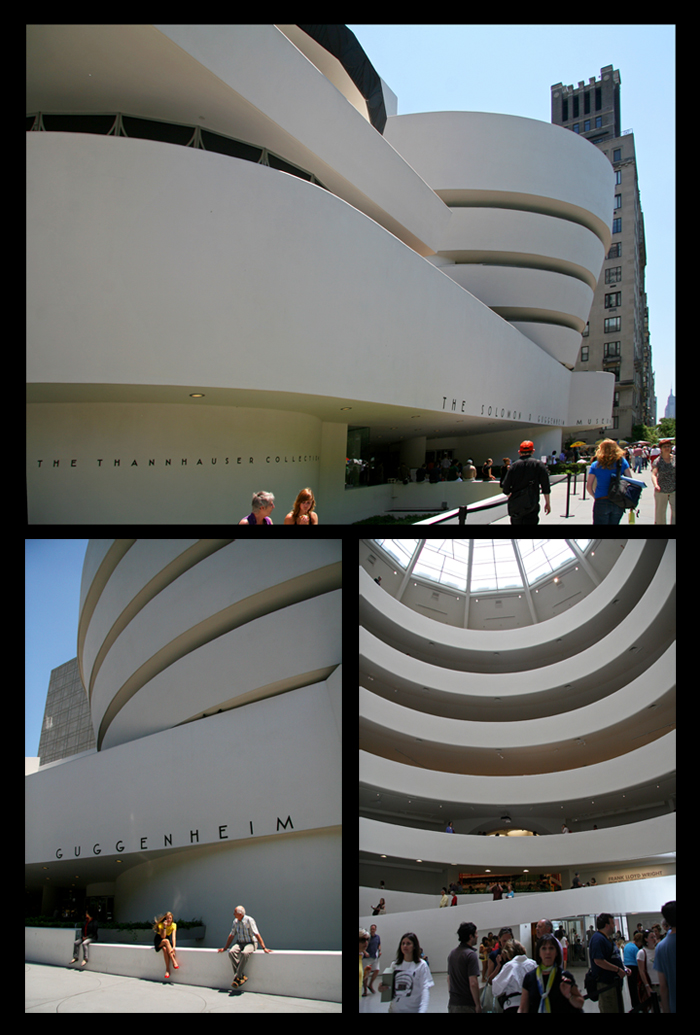
    The Solomon R. Guggenheim Museum, designed by Frank Lloyd Wright and completed in 1959, is considered one of the city’s major architectural landmarks. It is located on in Manhattan’s Upper East Side at 89th Street and Fifth Avenue, overlooking Central Park. Second photo here. It houses Impressionist, Post-Impressionist, early Modern, and contemporary art. The collection was seeded by Solomon Guggenheim, an art collector whose foundation funded the establishment of the museum.

    The building, which looks like a stacked white ribbon, was extremely controversial at the time of its completion. Inside, the main gallery is a helical spiral, rising from the ground level to the top, crowned with a skylit rotunda. Here are some of the conflicting reviews as reported in Time Magazine in 1959:

    “A war between architecture and painting, in which both come out badly maimed,” declared Art Critic John Canaday on Page One of the New York Times; “The most beautiful building in America,” retorted Critic Emily Genauer in the New York Herald Tribune. “A building that should be put in a museum to show how mad the 20th Century is,” editorialized the New York Daily Mirror. “Mr. Wright’s greatest building, New York’s greatest building.” said Architect Philip Johnson, “one of the greatest rooms of the 20th century.” “Frank has really done it,” snapped one artist. “He has made painting absolutely unimportant.”

    The criticisms revolve around several aspects of the building. One is that the museum design is a distraction from the art itself. The sloping ramp provides no level base for a viewer’s reference. The small exhibition rooms off the main spiral are small and windowless – the walls are angled and make hanging paintings difficult. Prior to its opening, twenty-one artists, including Willem de Kooning, signed a letter protesting the display of their work in the museum. Wright replied that the old rectilinear frame of reference was “a coffin for the spirit” and admonished them to wait and see. Paintings were to be tilted backward, “as on the artist’s easel.” Wright had proposed “one great space on a continuous floor.” “An atmosphere of the unbroken wave—no meeting of the eye with angular or abrupt changes of form.”

    When the building opened, Robert Moses said that it looked like “an inverted oatmeal dish.” Wright retorted, “It’s going to make the Metropolitan Museum look like a Protestant barn.” Others referred to it as a “snail,” “an indigestible hot cross bun,” and “a washing machine.”
    Snails, barns, coffins, oatmeal dishes, washing machines, ribbons, unbroken waves – The Guggenheim.

    Posted on by Brian Dubé

  • Please Be Gentle

    Posted on by Brian Dubé


    Yesterday, June 8, 2009, was the highly awaited grand opening of the High Line. All the top officials in city government were there for the ribbon cutting – Mayor Bloomberg; Amanda M. Burden, the city planning commissioner; Adrian Benepe, the parks commissioner; Scott M. Stringer, Manhattan borough president; and City Council speaker Christine C. Quinn.

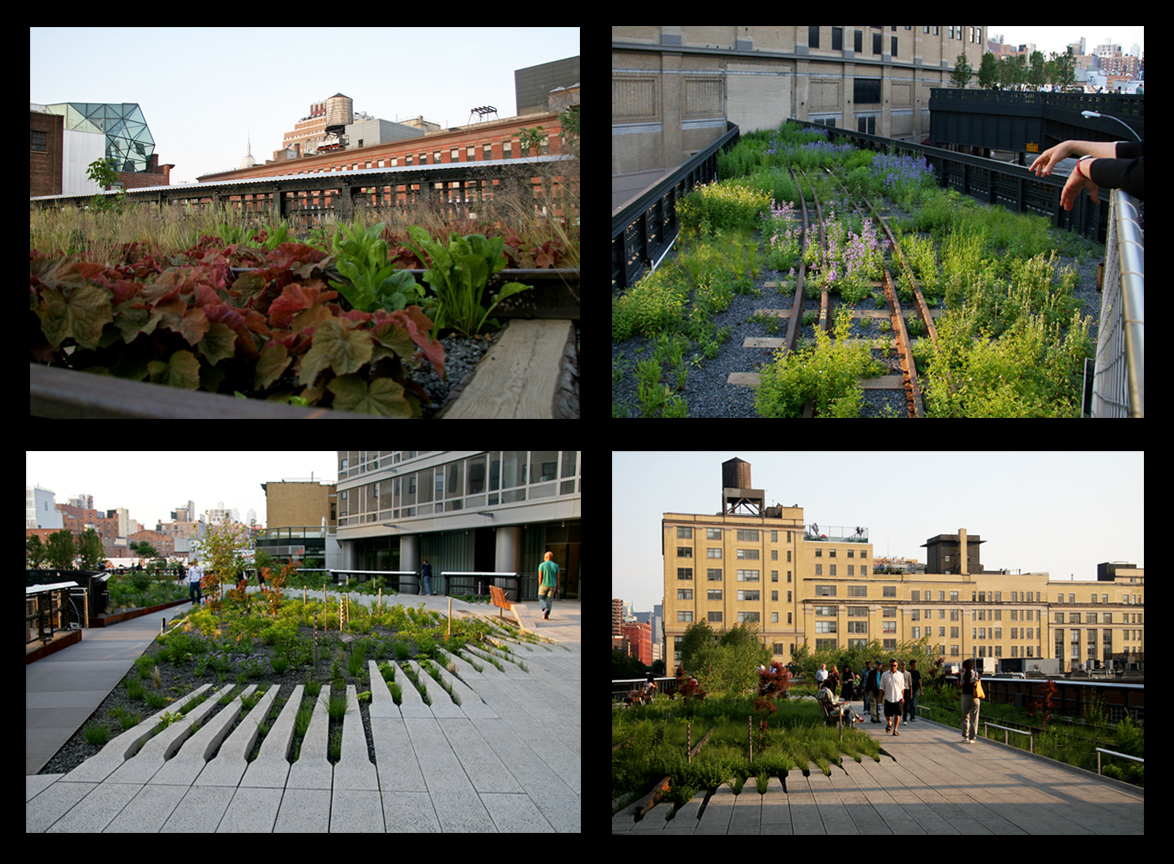
    This project was in the making for 20 years. The idea to save and restore the abandoned elevated freight railroad was first conceived in 1999 by Joshua David, a writer, and Robert Hammond, a painter. The project, named the High Line, broke ground in 2006 and is now an elevated park converted from a section of the West Side Line, built in the 1930s by the New York Central Railroad and unused since 1980. The railroad actually passed through several buildings – evidence of this still exists. See my entire photo collection here.

    The greenway is similar to the Promenade Plantée in Paris, a 4.5 km-long elevated park in the 12th arrondissement of Paris, France, constructed on an abandoned 19th-century railway viaduct. The High Line consists of three sections – the southernmost currently open runs from Gansevoort Street in the West Village to 20th Street. Upon completion, the entire park will extend to 34th Street.

    Over 30 projects are planned along its route, including a new branch of the Whitney Museum of American Art, designed by Renzo Piano.
    The design itself is the most artfully created public space I have seen in New York City. The High Line was designed by landscape firm Field Operations and architects Diller Scofidio and Renfro.

    Yesterday’s “soft” opening was pleasant, with a small number of visitors. Once its opening is generally known, there is a concern of overuse – the design work is beautiful yet delicate and rather fragile. The parkway is only 30 to 60 feet wide. If necessary, entry to the park may be limited. I recommend visiting – please be gentle…

    Posted on by Brian Dubé

  • Fleet Week 2009

    Posted on by Brian Dubé


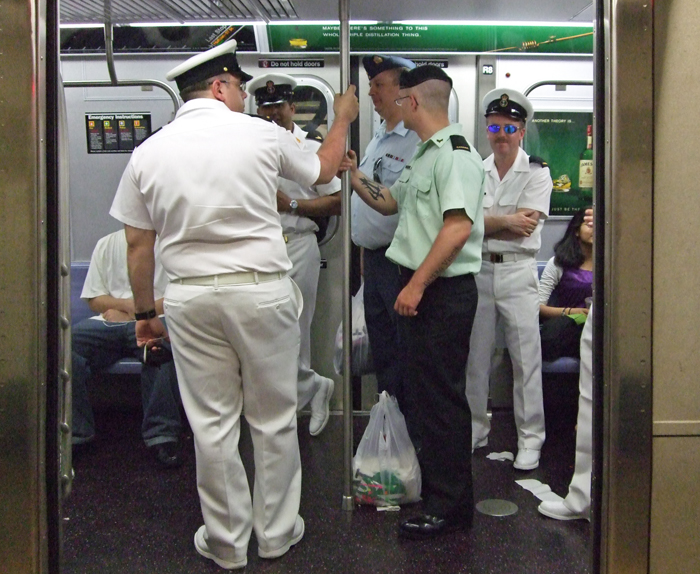
    If you have been in New York City in the last few days, you may have seen an unusual number of sailors on the streets of New York. This is Fleet Week New York City 2009, an annual event since 1984. Fleet Week is a celebration of the sea services – a United States Navy, United States Marine Corps, and United States Coast Guard tradition where active military ships dock in various major cities for one week.
    The event provides an opportunity for the citizens to meet Sailors, Marines, and Coast Guardsmen, as well as for the military to explore New York City.

    Fleet Week, which runs from May 20-27, includes dozens of military demonstrations and displays throughout the week. But the big attraction is the public visitation of the participating ships. The ships are docked in Manhattan at Pier 88 and 90 and in Staten Island. Here is the official site with all the details.

    This is a rare opportunity to board and tour these ships. If you are interested, get there early – the lines, particularly on Memorial Day, become hours long. See you there 🙂

    Photo notes: The Upper photo was taken on the B train in Brooklyn. The collage shows the ships which will be docked during Fleet Week NYC 2009.

    Posted on by Brian Dubé

  • Time Misspent

    A travel book I much enjoyed was Europe Through the Back Door by Rick Steves. It became popular enough to spin off a TV series. Rick has a listing of “Bad Towns & Tourist Traps.” He prefaces it by saying that he is reluctant to make such a list but feels that his readers/travelers likely have too little time, and his list will help avoid time misspent.
    There is merit to this argument, particularly when a place is prominent and likely to be seen by a visitor in his/her travels.

    The same applies to restaurants. There are only so many meals to be had in a day, and it is a shame when a visitor spends time and money only to be disappointed and a much better choice could as easily have been made, had he or she only been forewarned.

    Caliente Cab Co., at 61 7th Ave South, was established in 1984 (the company also franchises, so you may come across other locations). At the Yelp site, there were 65 customer reviews, including too many one-star reviews to dismiss as atypical or the writing of an eccentric. Those who loved the place tended to favor the oversized margaritas and party atmosphere. If you would like more particulars regarding this Greenwich Village Mexican restaurant, read the Yelp reviews here.

    Perhaps more interesting than the food or drinks is an incident in 2007 after the Gay Pride Parade, when a woman, Khadijah Farmer, was thrown out of a women’s bathroom by an employee bouncer who acted on a complaint that there was a man in the women’s bathroom. From the story in the New York Times (see it here):

    “He began pounding on the stall door saying someone had complained that there was a man inside the women’s bathroom, that I had to leave the bathroom and the restaurant,” Ms. Farmer said. “Inside the stall door, I could see him. That horrified me, and it made me feel extremely uncomfortable. I said to him, ‘I’m a female, and I’m supposed to be in here.’ After I came out of the bathroom stall, I attempted to show him my ID to show him that I was in the right place, and he just refused to look at my identification. His exact words were, ‘Your ID is neither here nor there,’ which means that my ID didn’t matter to him.” … “She said the bouncer followed her up the stairs and back to the table, asked her party to pay for the appetizers they had already eaten, and then made them leave the restaurant.”

    According to the article, Farmer experiences being mistaken for a man on a daily basis, but she has never needed to offer identification.

    So if your are lured by the large sculpture, colorful graphics, outdoor seating, the mustachioed 1950s Studebaker taxi, loud music with a party atmosphere, sports TV, and a happy hour with oversized margaritas, and you don’t need to eat or use a bathroom, Caliente Cab Co. may be for you 🙂

    Update: In May 2008, the Khadijah Farmer lawsuit was settled. Farmer was paid $35,000 in damages. $15,000 was also paid to the Transgender Legal Defense and Education Fund, which handled the case.


  • Eye Candy

    Posted on by Brian Dubé

    Business moves in mysterious ways, and there come times when forces seem to point one way. Right now, for many retailers, the merchandising road is pointing to Times Square, an area beleaguered and blighted for eons, improving in fits and starts, but always drawn back to some variant, displaying elements of its historic sleazy character. Rents are high, and even well-heeled retailers during its recent improvement phase have closed, such as the Disney and Warner Brothers stores.

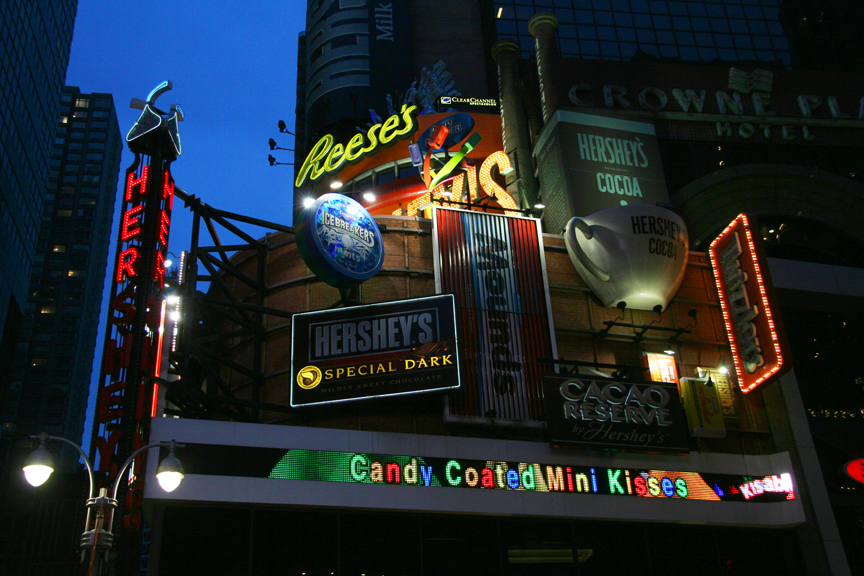
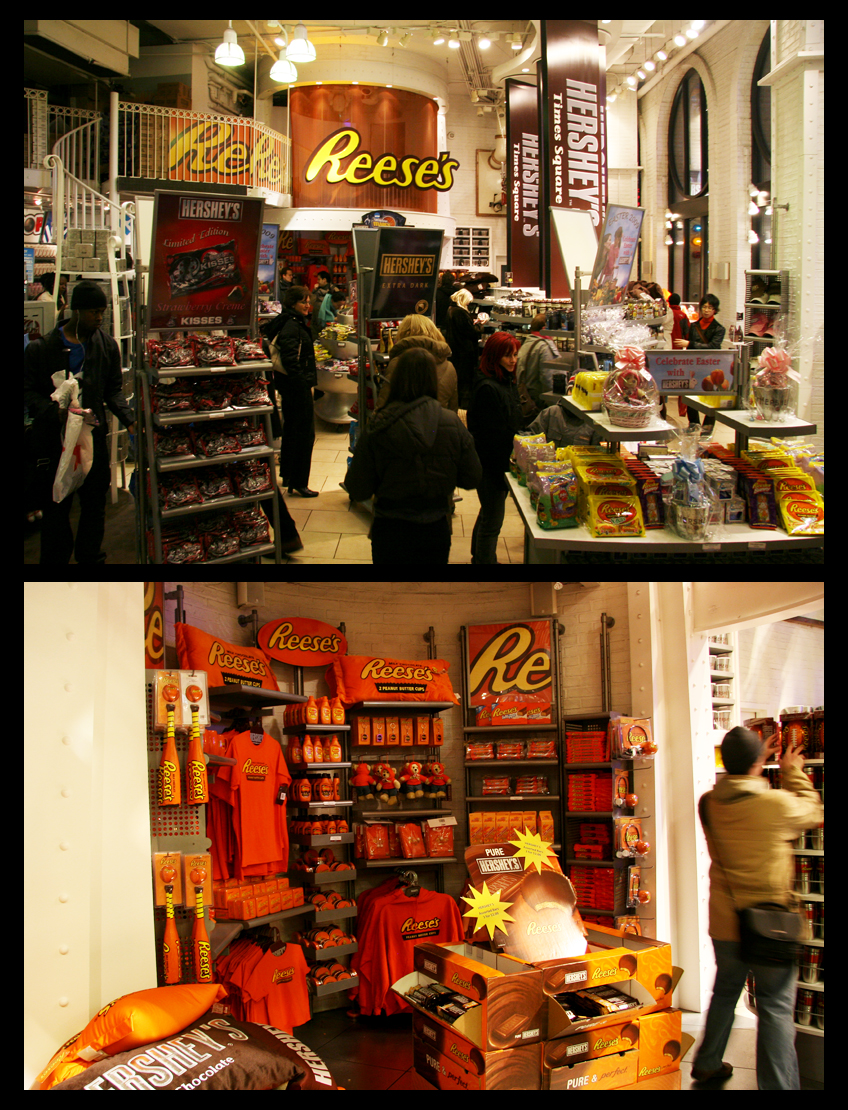
    I have written about the M&Ms Store at Times Square (see Branding Gone Wild and Let’s Have a Parade). Literally across the street at 48th and Broadway is competitor Hershey, with its own shrine to chocolate. This store is a much bigger experience on the outside – many visitors have been nonplussed by the inside. But the small one-floor interior space is certainly a place to get your Hershey’s chocolate fix and sample their extensive line. See my photos of the interior here. Unlike the much larger themed M&Ms store, however, it is not a total immersion experience or world.

    The thing to see here is the exterior, purportedly the largest permanent fixture ever built in Times Square. From their opening press release from October 28, 2002:

    HERSHEY’S spectacular — towering 215 ft. tall and 60 ft. wide, making it the largest permanent fixture ever constructed in Times Square — features a whimsical version of the original HERSHEY’S chocolate factory, complete with smokestacks, just like the one in Milton Hershey’s hometown, Hershey, PA. Thanks to 34 dimensional props, four steam machines, over 4,000 chasing lights, 30 programmable gel lights, 56 neon channel letters, 14 front-lit signs, and just about every other major signage technique utilized today, the chocolate factory spectacular will:

    Feature an over-sized HERSHEY(R)’S milk chocolate bar
    Light up a pyramid of HERSHEY(R)’S KISSES(R) with colors that change with the seasons
    Showcase a JOLLY RANCHER(R) candy wind sculpture
    Spout steam from the HERSHEY(R)’S cocoa cup
    Spin BREATH SAVERS(R) mints above the sidewalks of New York

    The Hershey Company is no longer just the chocolate company of Milton Snavely Hershey, who in 1907 created the Hershey’s Kiss. Read their history here. They now manufacture a myriad of chocolate and non-chocolate confections, including Reese’s, Milk Duds, Kit Kat, Krackel, Rolo, Skor, Cadbury’s, Almond Joy, Mounds, O’Henry, Mr. Goodbar, York Peppermint Pattie, Jolly Rancher, PayDay, Ice Breakers, Good and Plenty, and Twizzlers.

    I would not make the store a travel destination, but if you are visiting Times Square, take a look above you at 1593 Broadway at what (like the M&M’s display across the street) is literally Eye Candy…

    Posted on by Brian Dubé

  • Branding Gone Wild

    Posted on by Brian Dubé

    Let’s get the negatives out of the way. Neither M&Ms nor the MARS group needs to be promoted. We don’t need to market candy to children. Do we need a two-story shrine to M&Ms candy in Times Square? Is this another sign of the dumbing down of society? Why does a product like this need to be branded and line extended ad nauseum? Is this further evidence that shopping has now become America’s favorite pastime and that, as Reverend Billy has warned for some time, that we have excessive consumerism and a nation of shopaholics? Perhaps, but this is not the best economic times for anti-consumerist messages.

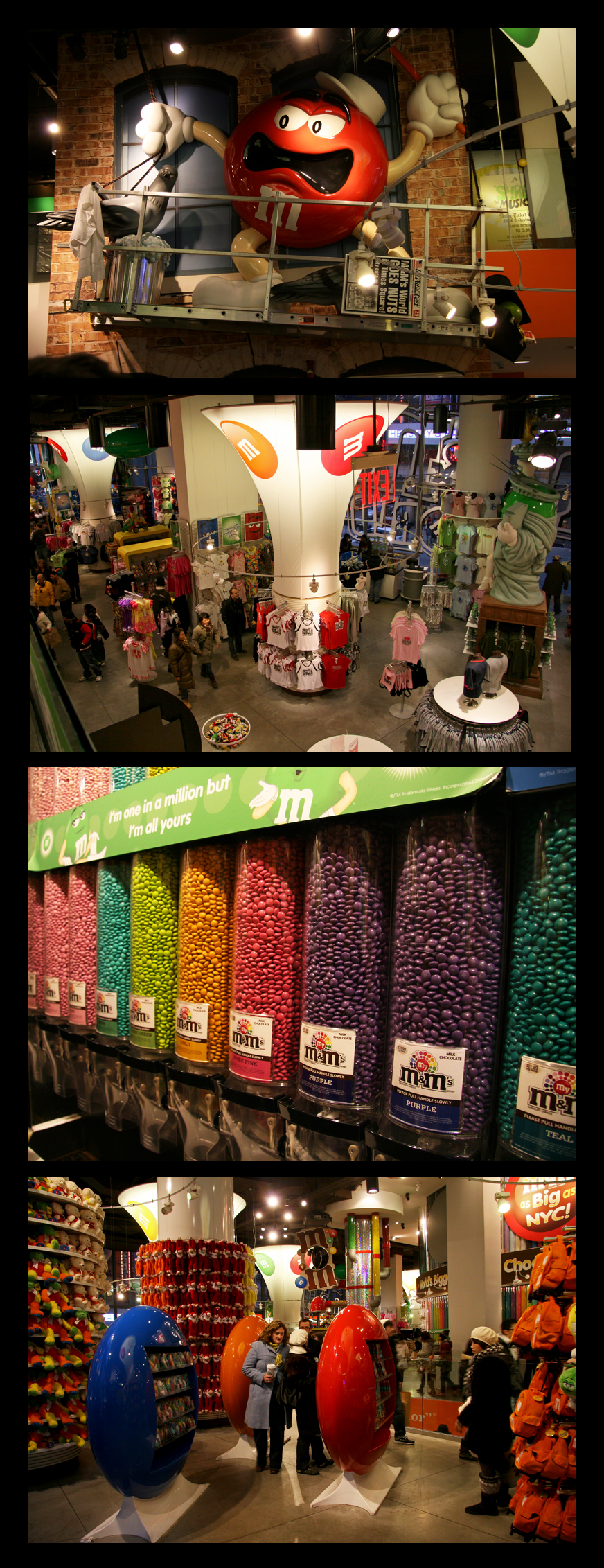
    The M&M Store, at 1600 Broadway in Times Square, like the Coca-Cola or Warner Brothers stores, is a quintessential example of branding merchandise and merchandising a brand. In this retail store, you will find application of the M&M iconography to every possible consumer item. And, of course, there is plenty of candy – self0serve M&Ms in large, transparent tubes in a staggering array of colors. For those who like blue, for example, you can get Blue, Dark Blue, Light Blue, Teal, or Aqua. See more photos of the interior of the store here. The exterior of the store has an enormous, spectacularly bright LED panel display, which I previously featured in Let’s Have a Parade.

    Technology is not the only thing in our world to see enormous advancement. Business and associated vocabulary have also become highly refined. Brand has become a buzzword in business marketing, and the term now goes beyond its original business usage. The meaning of brand at one time was much narrower and more specific, usually limited to consumer products such as food or appliances. Pepsi or GE was a brand.

    The first time I saw the word brand used in a broader sense was in a TV interview with Joseph R. Francis, the founder of Girls Gone Wild, a series of sexually explicit DVDs. In that interview, Francis referred to the Girls Gone Wild brand. I was surprised to learn that filming young, naked girls could be a brand or franchise, or at least referred to as such. Since that time, I have become very sensitized to the use of the words brand and branding as well as merchandising itself.

    But let us not forget another part of the picture, lest a curmudgeon squash all of life’s fun. These are M&Ms – one of the icons of our childhood which is virtually synonymous with pleasure. And they don’t melt in your hands 🙂

    Confession: I succumbed to the overwhelming presence of merchandise. 🙁 I bought an assortment of M&Ms and a nicely styled M&M glass. 🙂

    Posted on by Brian Dubé

  • Work and Play

    Posted on by Brian Dubé

    Everyone likes a discount, and theater tickets, which have always been pricey in comparison to other forms of entertainment, are one place where a deal is particularly welcome. Seeing a Broadway show is a virtual rite of passage for a visitor to New York City, so it should come as no surprise that TKTS, which offers up to 50% discounts on theater tickets, has been a huge success since its inception in 1973. The tickets at the Times Square location are sold on the day-of-performance only. This is a first come, first served operation. No sales online or offsite, so expect lines. The discounts are real. However, this service is for the flexible and patient; those willing to go to a show “last minute” choose from the shows available and wait in lines.

    In 2006, the original and rather primitive ticket booth closed to make way for a completely new, expanded booth and redesign of the plaza around it, Duffy Square. An illuminated bleacher-style glass stairway (fabricated by Eckelt Glass of Austria) has been installed above the white fiberglass booth, manufactured by boat hull manufacturer Merrifield-Roberts of Bristol, R.I. From a New York Times article on October 16, 2008:

    “the TKTS booth proper is topped by a sweeping cascade of 27 ruby-red structural glass steps, rising to a height of 16 feet 1 inch above the 47th Street sidewalk, where hundreds of people (as many as 1,500 if they squeeze in tight) will be welcome to congregate every day until 1 a.m.”

    The staircase is open to all for stoop sitting, eating, and, best of all, for great elevated views of the entire Times Square area.

    This was my first time atop these steps – I caught them at dusk. The glowing red glass steps are a magnet for everyone with plenty of frolicking and photography. I noticed a number of couples taking cell phone self portraits. I got into the spirit myself – taking a self portrait by hand holding a full-size DSLR camera is a little challenging, but I managed to get a couple of acceptable shots.
    The whole atmosphere was like the proverbial school day off for snow; the unexpected was a nice surprise for everyone and a pleasant diversion for the ticket buyer. All work and no play makes New York a dull city 🙂

    About TKTS: There are 3 TKTS locations in New York City: one in Duffy Square (north end of Times Square at 47th Street and Broadway), one at South Street Seaport in Lower Manhattan, and a third in downtown Brooklyn (Jay St. and Myrtle St. Promenade). There is also a location in London.

    Posted on by Brian Dubé

  • Light and Lights

    One of the best locations to enjoy vistas of Manhattan and the surrounding waterways is from the promenade in Brooklyn Heights. Here you will find postcard views of lower Manhattan, South Street Seaport, the Brooklyn Bridge, the East River, and many of New York City’s iconic landmarks – the American International Building, the Empire State building, the Chrysler Building, the New York Life Insurance Building, and the Met Life Tower.

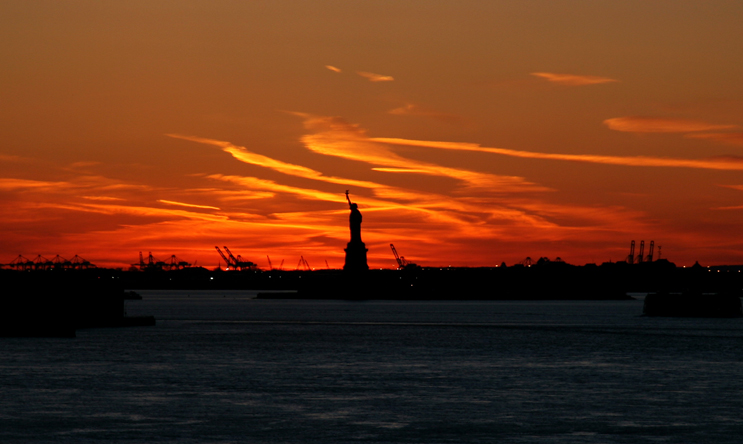
    An added bonus is that the promenade faces west, and that means sunsets. This is the time I would recommend visiting; during the evening, you have the best light and the gradual darkness coming over the city with a menagerie of lights. If you are fortunate, you will be rewarded with a sunset like this one – brilliant orange-red with streaks of yellow, all back lighting our Lady of Liberty. But I sell you no longer – I think the image speaks for itself…

    Note: If you look closely at this panorama, you will notice the silhouettes of container cranes, eerie and surreal. I have written before of the attractiveness that can be found in industrial landscapes in Hell’s Gate.


  • Remembering

    Imagine being 13 and not having seen much of the world at all.
    Imagine also living at a time when technology was on the cusp of the truly fantastic – with mainframe computers, transistors and integrated circuits, the Moog synthesizer designed by Robert Moog, and the A-11 aircraft, capable of sustained flight of 2000 mph being announced. And the biggest technological achievement of our time, as promised by JFK during his 1960 presidential campaign, was soon to come: we were going to the moon, literally.

    1964 was also the year of the British Invasion, with the arrival of the Beatles in the USA. In the world of civil rights, Malcolm X announced his break with the Nation of Islam, the formation of a black nationalist organization, and met Martin Luther King, who won the Nobel Peace Prize. President Lyndon Johnson signed the Civil Rights Act of 1964 into law, abolishing racial segregation in the United States. The Vietnam War was heating up and we saw the first demonstrations. Feminism and the sexual revolution were in full swing, and the Vatican condemned the birth control pill.

    So it was in this time that my family took our first trip to New York City to visit the 1964 World’s Fair. I remember only a little from that trip, but what I do remember was something that was truly fantastic, a spectacle larger and grander than I ever imagined possible. The exhibits were amazing and way ahead of their time. The audio-animatronics used by Disney are still in use today – Disney’s It’s a Small World was unveiled at the Pepsi pavilion. IBM displayed handwriting recognition. General Electric sponsored Progressland, where the audience was seated and revolved around an auditorium with numerous audio-animatronic presentations of the progress of electricity in the home. The General Motors Futurama had visitors moving on seats through an exhibition of the world of the future. The entire fairground was as large as a small city. Fountains were everywhere – it was true pageantry.

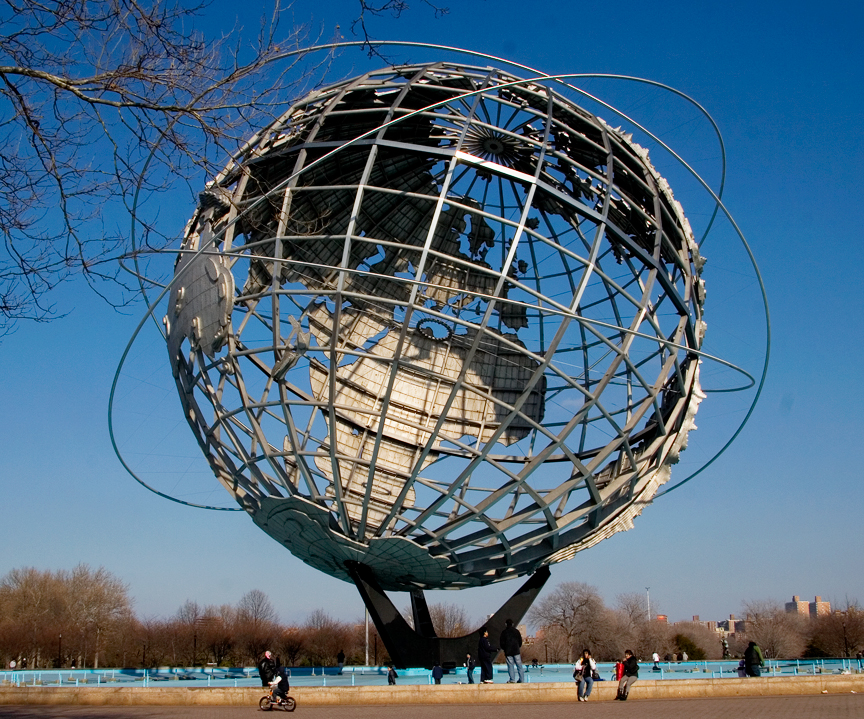
    The most memorable icon for this fair was the Unisphere, which is still standing in Flushing Meadows-Corona Park, the site of the fair (and the previous 1939-40 fair). The theme was Peace Through Understanding, and the Unisphere represented global interdependence. Built to celebrate the beginning of the space age, it was dedicated to “Man’s Achievements on a Shrinking Globe in an Expanding Universe.”
    The Unisphere was built in type 305L stainless steel by the US Steel Corporation and erected on the same structural foundation that supported the 1939/1940 New York World’s Fair’s Perisphere. At 12 stories (140 feet), it remains the world’s largest globe and has become one of the few permanent remaining structures from the fair and an unofficial symbol for Queens.

    I am sorry that those of you unable to attend will have to imagine and that I have the privilege of remembering …

    Note about the fair: The 1964 World’s Fair was actually mired in controversy. In order to be profitable, the fair organizers, headed by Robert Moses, decided that the fair would need to run for two 6 month seasons (1964 & 1965). However, the rules of the BIE (Bureau of International Expositions), headquartered in Paris, stated that an international world’s fair run for one six-month period only and only one exposition per 10-year period in a host country. The USA did not meet these requirements, and a visit by Moses to Paris was not successful. Moses made his disdain for the organization’s decision public. The BIE retaliated by requesting member nation’s not participate. Hence, the roster of participants was primarily smaller nations and a large number of industrial firms.


  • National Drama Queen

    There are some things so absolutely integral to this city that to write of them in a general way is to inform no one of anything. Who has not heard of the theater district or Broadway theaters?
    To take in a Broadway show in New York City is really one of the best uses of the phrase de rigueur. Trips to the city from surrounding areas to see shows often are a person’s first, if not only, experience in New York.

    Cable television and the Internet have dramatically changed our world; there is infinitely more knowledge and exposure to products and culture. And the character of the city itself has changed. Unfortunately, gentrification has homogenized the planet, and there really is less for many to visit in urban areas. Many of our unique businesses have disappeared, being replaced with large chain stores which can be found outside New York. This phenomenon has been written about for some time. In 1995, a New York Times article appeared which referred to “The Malling Of Lower Broadway.

    There are things, however, that do require population density and an artistic community to exist. One of those things is the theater district. Individual shows do travel to local theaters, but for breadth and depth, New York City is the place to go.

    Like retail, the theater has also suffered from rising costs. To survive, shows must be capable of supporting a large overhead, so, like film, there has been an aversion to risk. Shows are mounted which are much more formulaic, with elements that tend to give shows the “Broadway show” character that many newcomers to theater expect. We find a stable of old standbys, revivals, and shows which tend to be highly derivative of historical successes. And ticket prices are extremely high. There are always discounts available, however, and prospective theater goers would be well-advised to investigate the options.

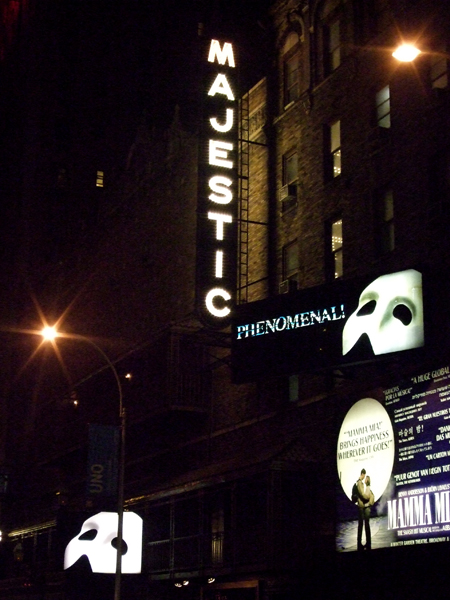
    Streets lined with marquees, like the one in the photo (Phantom of the Opera at the Majestic Theater at 247 West 44th Street), signals loud and clear that you are in New York City and nowhere else. Most of us do look for constants and anchors we can hang on to – the heart of nostalgia. When I pass through Times Square and the theater district, I am reminded of my first visits to New York and how different and exciting it was. The theater district is such a perfect icon for New York, a city which is itself so theatrical in character. I dub it National Drama Queen 🙂

    Note: The term Broadway theater refers to a group of 39 theaters defined both by size (minimum of 500 seats) and location in the theater district. Off Broadway and Off-Off Broadway theaters are also defined by size, not location – Off Broadway with between 100 and 500 seats, and Off-Off Broadway with fewer than 100 seats.


  • Watching Ourselves

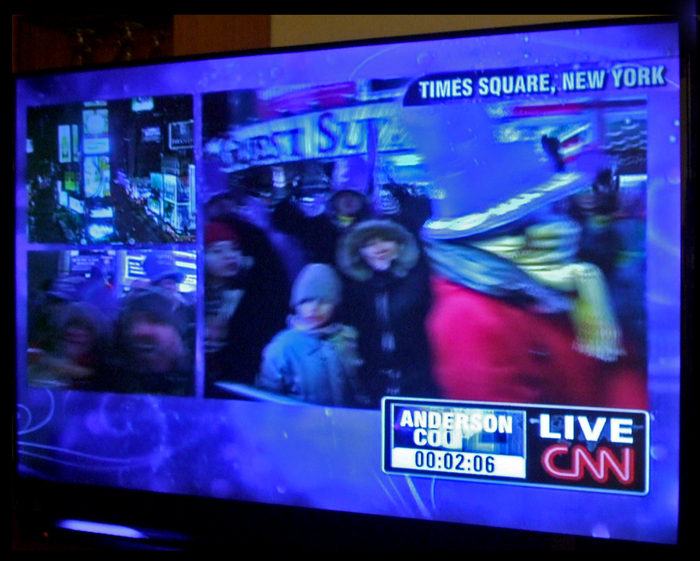
    There are many unique things about New York City, and one of them is how often we watch ourselves. This is most evident on New Year’s Eve, when the country, and much of the world, turns their eyes here for the greatest New Year’s party and the legendary Times Square ball drop.

    As I wrote yesterday in Devil Ups the Ante, the very popularity of the event also makes it a reason to avoid direct participation and watch it on TV like the rest of the world. It is a little strange, perhaps, knowing that the event is a subway ride away, but this really misrepresents the situation. At this point in time, there is no way to attend this event in a spontaneous way. People now wait at least 7 hours in the freezing cold, getting there well in advance to have a position where they can actually see the ball drop. I attended the millennium celebration in 2000, but even after arriving there hours in advance, the closest I was able to get was eight blocks away, near Macy’s. I experienced the spirit of the celebration but was able to see only people – no ball drop or confetti.

    Today’s photo was the scene at a friend’s party as we watched the revelry on a big screen TV and ushered in 2009 – watching ourselves and watching others watch themselves. Happy 2009 and thanks for watching 🙂


  • Devil Ups the Ante

    It would be fair to accuse me of wanting to have my cake and eat it too, but I would not mind attending the New Year’s celebration at Times Square without the crowds. Crowds are obviously part of the experience, but it’s an experience most New Yorkers can do without. I can’t recall anyone I know attending in decades. I have attended a few times, including the millennium celebration.

    New Year’s Eve is very much a partying holiday, and most activities are overpriced, overcrowded, and many fraught with logistical issues. This is one holiday that scares many who opt for a less stressed night at home, perhaps watching the ball drop at Times Square on TV and looking forward to another workday off.

    I hope today’s photo does give evidence that I am not the complaining curmudgeon. Last night, before going to sleep, I decided to get dressed, go back out into the cold, and make a trip via subway to Times Square to see and photograph the preparations. I was surprised to find the area packed and abuzz at a late hour. Broadway theater-goers leaving shows contribute to the crowd. The media was already there, setup in as central and prime a location as one could have.
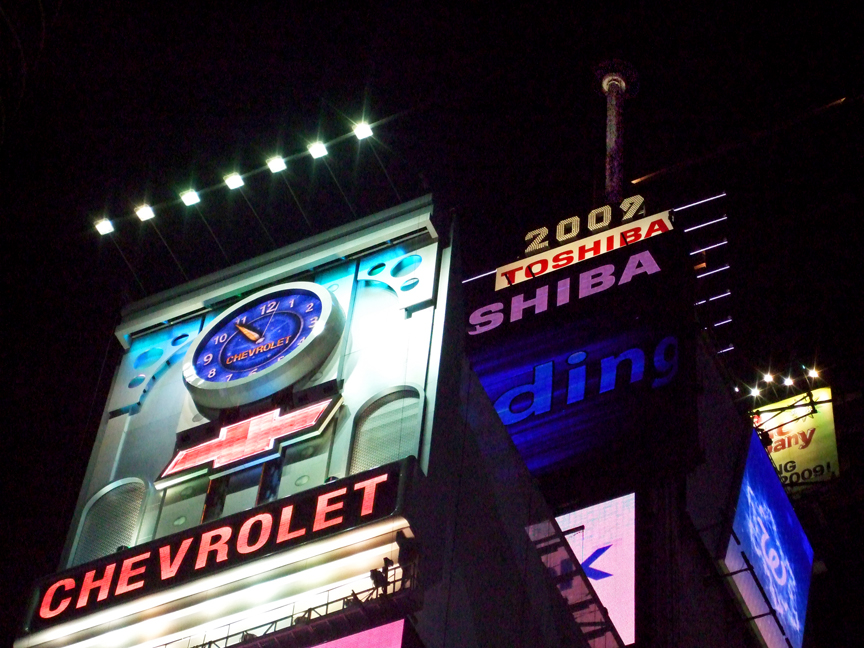
    The lighting in Times Square is now absolutely amazing, with an array of neon and state-of-the-art electronic displays. There is actually an ordinance requiring building owners to display illuminated signage.

    Whether visitor or resident, I recommend visiting this devil’s playground any night. The ante has been raised – even the devil needs plenty of new tricks to compete with so many other temptations…

    Photo note: This is the view looking south. Above the Toshiba display (where the count down appears) you can see the LED illuminated Waterford crystal ball atop a pole.

    Related New Year’s Postings: Times Square Ball Drop, New Year’s Day, Density and Intensity, Let’s Have a Parade, ArtKraft Strauss


  • dinamic_sidebar 4 none

©2026 New York Daily Photo Entries (RSS) and Comments (RSS)  Raindrops Theme