• Category Archives Tourist Attractions
  • Wake Up Call

    Posted on by Brian Dubé

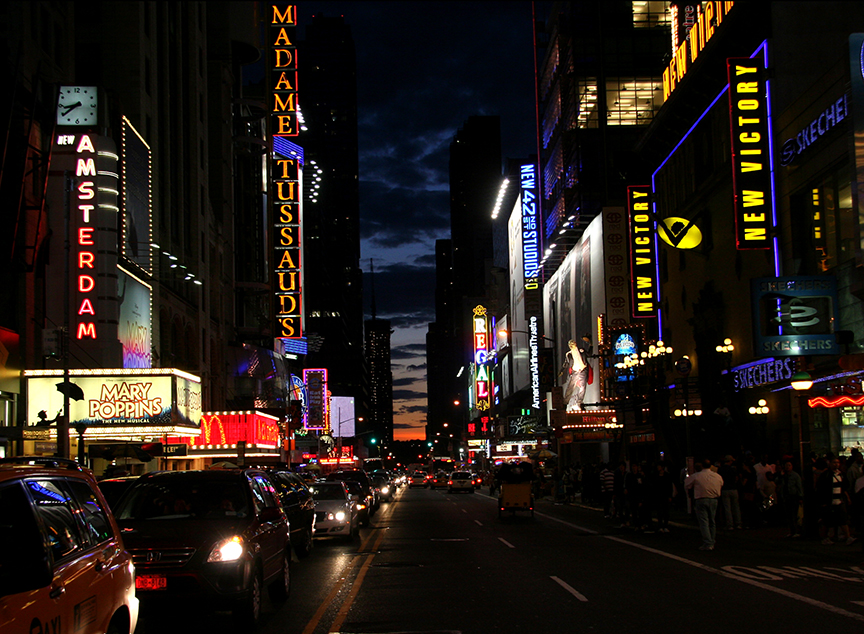
    Wow is all I could say as I stood at Times Square looking west along 42nd Street into one of the most amazing sunsets I have seen. This stretch of 42nd Street is already quite dramatic at dusk or at night. But this sunset was remarkable, with the heavily stratified clouds and beautiful color gradation of orange to deep blue. One could have easily seen the sky as part of the artificial spectacle. Drama added to drama. Perfect for a world that knows no bounds when it comes to sensory overload. It really looked like Batman’s Gotham City.

    One can easily live a lifetime in New York City without hardly a hint of the natural world. With the exception of the sky, occasional tree, squirrels, and birds, we live in a place that is almost entirely man-made. Some are fortunate and have park, river, or garden views. But for most, this is a life of concrete, stone, brick, steel, and glass. We look to other things – culture, business, restaurants, architecture, and human interaction.

    Some seek out nature in the city. It is can be found in promenades, parks, gardens, and waterways. And occasionally, when you least expect it, it slaps you in the face. A wake up call to nature…

    Posted on by Brian Dubé

  • Cuts One Way

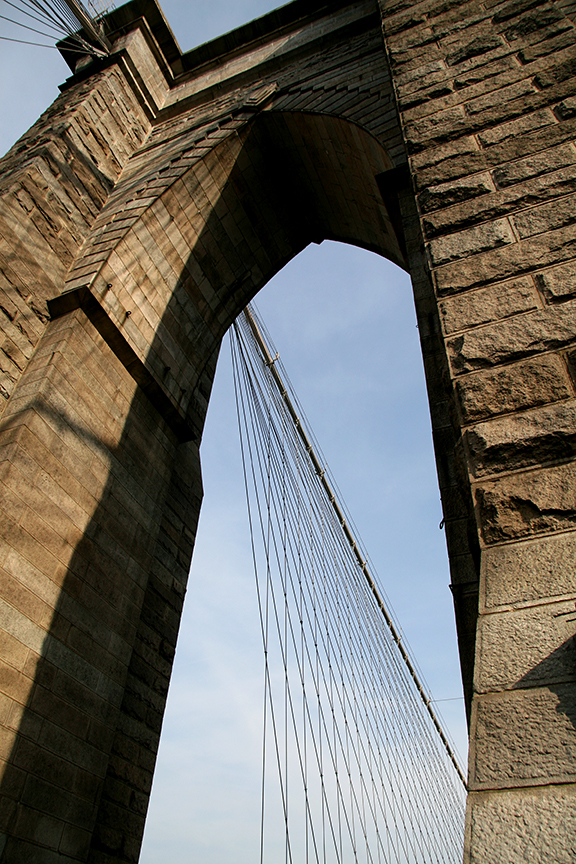
    The Brooklyn Bridge is one of the most important and recognizable NYC landmarks – an edifice literally in stone and one of its finest icons. I have done numerous postings where the bridge is a key element, but none on the bridge itself. See the list of related postings below and more photos of the bridge here.

    The bridge, completed in 1883 and connecting lower Manhattan with Brooklyn, has a walkway which is open to pedestrians and bicycles. I highly recommend this to any visitor (or resident) – it’s a must-do. It’s free and the vistas are great.

    There is no room and it makes no sense for me to synopsize here the history of the bridge or supply technical information – tomes have been written. The Wikipedia article is a good start and has a myriad of links (see here).

    The Brooklyn Bridge is quite special to me. I find the stonework so much more attractive than the steelwork of the Manhattan and Williamsburg bridges, although I have warmed up to these over the years. Traveling around the city, particularly by car, the Brooklyn Bridge is omnipresent, and with its image comes a plethora of feelings and impressions. Especially for a New Yorker. This is the bridge of book, film, and fable, known throughout the world.

    Visitors are frequently astonished that anyone would go through what we do just to get through basic everyday life. And many do leave after trying their hand at living here. Our town is a great one, but the knife that is New York City has two edges and cuts both ways. I, like many New Yorkers, have a love/hate relationship with many aspects of life here – it comes with the territory and every one of us living here knows it. But for the Brooklyn Bridge, the knife cuts only one way – I love that bridge 🙂

    Related posts: One Front Street, Loaded, The River Cafe, Gallery View, Sink or Swim, Dumbo, Bridge Cafe, Belle de Jour, Jet Ski, Twist and Shout, The Watchtower


  • frEAkSTER

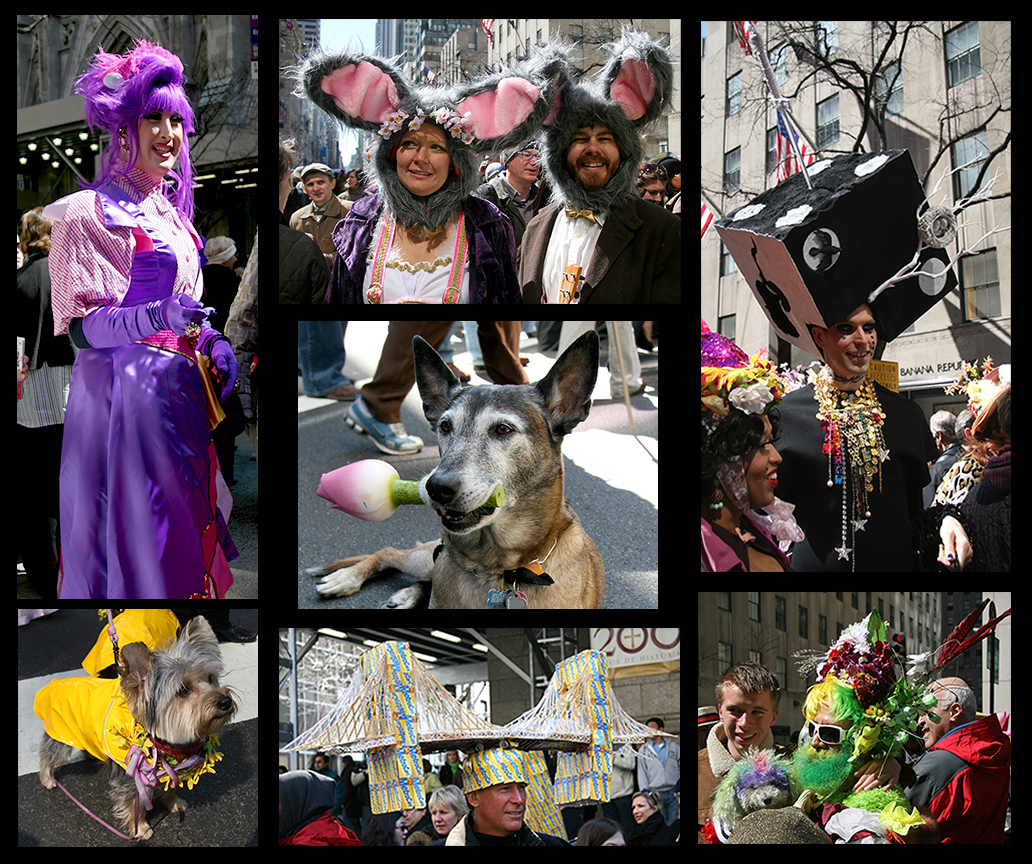
    What do you get when you mix the freakish, unusual, unconventional, and inappropriate with the beautiful, elegant, and traditional Easter wear? Why, a New York-style Easter Parade, of course. If you have any event in this city, you had better expect anyone to show up. There was no shortage of drag queens, transvestites, eccentrics, or the macabre – at various moments, I felt like I was at the Village Halloween Parade. In fact, the person at the lower right in the photo appears regularly at every parade, including the Halloween Parade and the Coney Island Mermaid Parade. It was quite a juxtaposition, with St. Patrick’s Cathedral as backdrop. I’m sure that many of the themes and wardrobes were not sanctioned by the Roman Catholic Church.

    This is my third year at the NYC Easter Parade, and I have featured the more unusual participants in the main photo. For a series of photos from the parade of the beautiful and floral, please go here.
    The parade itself is more of a gathering, with the epicenter at 50th Street in front of St. Patrick’s Cathedral. There are no barricades or precession. It is quite casual and relaxed. The turnout this year appeared to be somewhat smaller, likely due to the chilly (but sunny) weather. Dogs were well represented (also dressed for the occasion), as well as children, families, themed ensembles, and street performers. Here and there you could spot the occasional modest bonnet…

    Related Postings: Easter Parade 2006, Easter Parade 2007, Spring Madness, Peeps, Mermaid Parade 2006, Mermaid Parade 2006 – Part 2, Mermaid Parade 2007, Mermaid Parade 2007 Part 2, Halloween Parade 2006 Preview, Halloween Parade 2006, Halloween Parade 2007 Preview, Halloween Parade 2007, Halloween Parade 2007 Part 2


  • 23 Skidoo

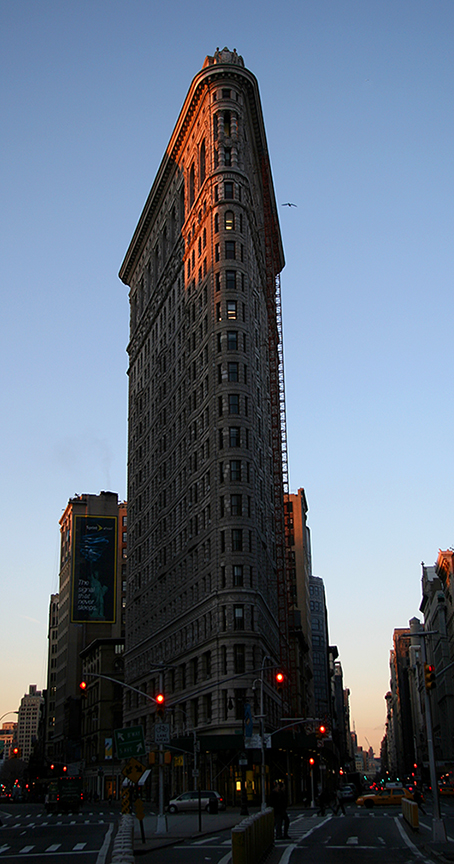
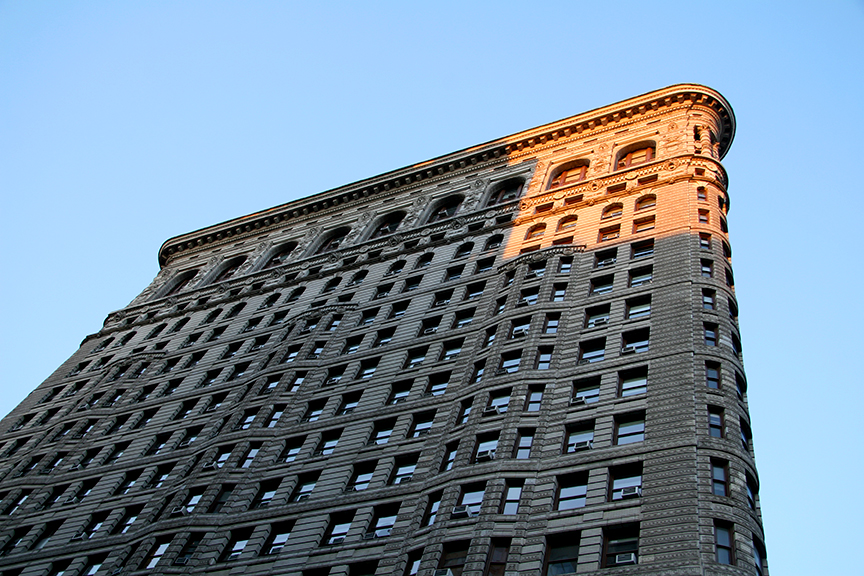
    When you have a structure that is a huge NYC icon, a National Historic Landmark, and is internationally recognizable, you have both a responsibility and a serious challenge. After all, not only has the Flatiron Building been photographed by millions, but the roster also includes some of the country’s most prestigious photographers, such as Alfred Stieglitz, Edward Steichen, and Berenice Abbott. The beautiful photos of Steichen and Stieglitz have done much to immortalize the Flatiron.
    This is why I have waited over two years to do a photo and piece on the Flatiron – it needs to have justice done. The perfect opportunity presented itself last Thursday, the day I photographed Ashley Alexandra Dupre’s residence on 25th Street after the Spitzer scandal.

    Being out before dawn in the neighborhood gave me an opportunity to swing around the corner and capture the building at sunrise on a magnificent, clear day. I felt like a serious photographer that morning, having chosen the conditions and made a pilgrimage at the appropriate hour. With little traffic, I was able to position myself anywhere with ease, including the middle of the streets. See a second photo here.

    The building owes its name to the triangular plot of land upon which it sits, which was called the Flatiron block. Contrary to urban mythology, this name predates the building’s construction. It was officially the Fuller Building, but from the beginning, it became popularly known as the Flatiron. One of the city’s oldest existing skyscrapers (22 stories, 285 feet tall), it was built in 1902, designed by Chicago architect Daniel Burnham in the Beaux-Arts style. The exterior is a rusticated limestone with glazed terra-cotta.

    On its own island block, it is circumscribed by 23rd Street, Broadway, Fifth Avenue, and 22nd Street, diagonally across Madison Square Park. The area neighboring it is known as the Flatiron District.

    Trivia Note: One of the competing stories for the origin of the expression “23 skidoo” is due to the wind tunnel effect generated by the siting of the building. In the early 20th century, men would gather on 23rd Street trying to get glimpses of women with their dresses being blown up by gusts of wind. The police would give them the “23 skidoo” to remove them from the area…


  • Shrine to Kitsch

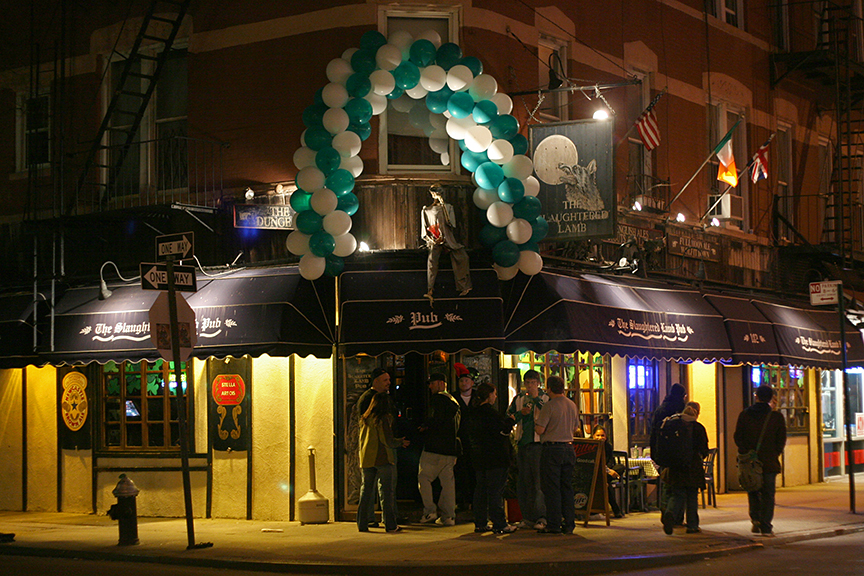
    Although New York City is not thought of as a locale for themed restaurants, we still do have our share, particularly in neighborhoods that see heavy tourist traffic. Uptown, we have places like the Hard Rock Cafe, Planet Hollywood, and the Harley-Davidson Cafe. In the Village, we have Jekyll and Hyde Pub and the Slaughtered Lamb. A horror-themed bar/restaurant is something you would expect in Disney World or Las Vegas, not in Manhattan.

    Being that it was St. Patrick’s Day, I felt some obligation to at least see if anything was blog-worthy. There was the Empire State Building in green, but I decided that some drunken revelry would be be a better capture. So, armed with cameras, my photographer friend and I took a short stroll down West 4th Street, which has a number of bars, restaurants, and adult shops like the Pink Pussy Cat Boutique. The Slaughtered Lamb, like most other bars, was in full swing, sporting the requisite green motif with people spilling into the street. The pub appears to be the haunt of primarily students and tourists. Inside, one can see various horror/gothic displays, such as a glass case with a werewolf biting a woman’s neck. The basement is a dungeon, where pool and darts are played.

    The Slaughtered Lamb was inspired by the British pub of the same name in the film American Werewolf in London. The owner, Donald R. Finley, graduated from Columbia University in 1986 with an MBA before forming Eerie Entertainment and opening his various establishments, which include Jack the Ripper, Jekyll and Hyde Pub, and his uptown extravaganza in a 5-story building, the Jekyll and Hyde Club.

    What’s absolutely amazing about places like this is the range of opinions about them. I spent the morning reading patron reviews that ranged from one to five stars. The most commonly used negatives were kitschy and tacky. Yet many loved the atmosphere, food, decor, and service, while others hated all the same things and saw it as a shrine to kitsch…


  • Bad Hair Day

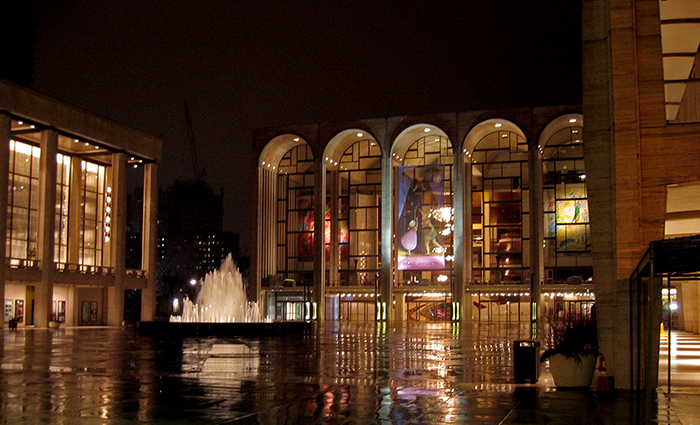
    Imagine a bad hair day when you are not looking so good, but unfortunately, you are on display for all to see in this way in perpetuity. This happens routinely to architects and is why today, you might reconsider being, or having wanted to be (as I have), an architect. You design something which becomes literally etched in stone and await accolades or public humiliation. The stain is hard to wash off, with dirty laundry always out on the clothesline. Want to see what I mean? Here are excerpts from a book written in 1979 by Paul Goldberger (then architecture critic for the New York Times) regarding Lincoln Center:

    “These are for the most part, banal buildings, dreary attempts to be classical that took the form that they did not out of any deep belief in the values of classicism, but out of fear on the part of the architects that their clients, the conservative boards of directors of the center’s constituent organizations, would not accept anything else.”
    “The Juilliard School is probably the best Building at Lincoln Center, but one says that reluctantly, because here, too, architecture is being graded on a curve.”
    “Harrison’s Metropolitan Opera House is merely a pompous and simplistic form, made tolerable by a pair of Chagall murals.”
    “What is wrong with these buildings is not that they are classicizing, it is that they are so bad at it – they are mediocre and slick classicism, with a heavy-handedness of form and vulgarity of detail.”

    Are you feeling better now? Fortunately, the quality of performances is top-notch, and the public enjoys the central plaza and its fountain, one of the most notable in the entire city.

    For a glimpse into my writing process, here is what I started to write today and abandoned, when any enthusiasm I had was lost after reading architecture critiques. I also planned to feature the fountain as one of the few major ones in NYC, contrasting that to Paris or Rome. The working title was The Sun Also Rises:

    Somethings loom so large or are so regular that we forget about them. Like the sun or Lincoln Center. This 16-acre complex of 8 buildings with nearly a dozen theaters is the prototype for cultural centers everywhere, and its tenants are like a who’s who of the arts: Juilliard School, The Metropolitan Opera, New York City Ballet, New York City Opera, New York Philharmonic, and the School of American Ballet. The “travertine acropolis of music and theater” was built in the 1960s and is located at one of the most strategic locations in NYC – between 62nd and 66th Streets near Broadway, Columbus Circle, and Central Park. You can read about it here or at the Lincoln Center website

    About the Photo: The New York State Theater is on the left, the Metropolitan Opera house in the center, and Avery Fisher Hall on the right.

  • Year of the Rat

    Chinese New Year is a two-week long celebration, and 2008 is the Year of the Rat. In most areas of the country, Chinese New Year goes by without notice, but in NYC, most natives are aware of the holiday, even if they do not participate. We have a very large Chinese American population and 5 Chinatowns, with the one in Manhattan being the best known (and largest in the Western Hemisphere).

    A friend and I decided to make a short pilgrimage to Chinatown and ran across a celebration in front of Pearl River Mart (click here for a previous posting on this large Chinese department store). We arrived just in time to see the traditional dragon and lion dance, accompanied by a snow shower.
    Our final destination was Mott Street, Chinatown’s central artery. Major festivities had just finished – the street was still closed with street cleaners sweeping confetti.

    After my reading today, I am rethinking my views towards rats. The rat is the first sign of the Chinese zodiac, and the list of attributes includes many traits not to be ashamed of: leadership, pioneering, conquerors, passionate, charismatic, practical, hardworking, organized, meticulous, intelligent, cunning, ambitious, strong-willed, energetic, and versatile. So perhaps when some business owners and landlords are characterized as rats, the inference is not as negative as what I had originally thought 🙂


  • Full Circle

    Times Square has never been able to fully shake off its tawdry, sleazy character. But if you missed it in the 60s and 70s, you ain’t seen nothin’. This area was a shrine to every negative stereotype of the city. I mean it was really bad. I once met someone in the 1970s who used to associate with people that hung out in Times Square, sizing up potential victims, assaulting them, and stealing their coats.

    You were cheated, mugged, or robbed on the streets. It wasn’t much better indoors, where many of the stores were essentially dens of liars, thieves, and hustlers. If you haven’t seen Midnight Cowboy starring Dustin Hoffman, I highly suggest that you rent this film. It’s not only a great work, but it also portrays very well this time period and gives an authentic look at and feel for the area.

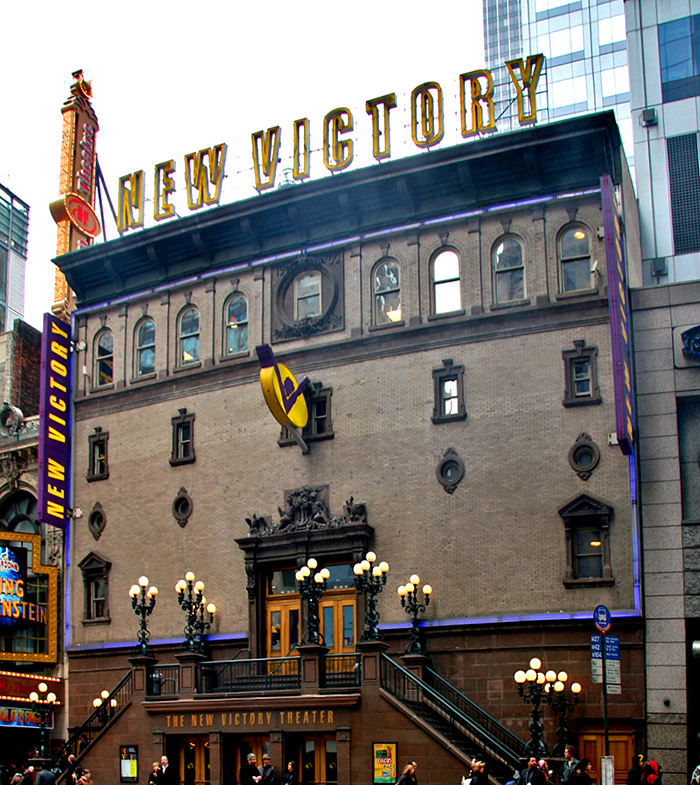
    Apart from the Broadway theaters and neon lights, the neighborhood has been best known for its porn – prostitutes, porn shops, peep shows, and porn theaters. Sadly, the Victory was part of this landscape. It’s hard to imagine the early days of this theater.

    Built for Oscar Hammerstein in 1900, it claims many superlatives and firsts, making it both famous and infamous. It is NYC’s oldest active theater and has gone through a truly remarkable number of incarnations. It became the Belasco Theater when David Belasco took it over in 1902, a burlesque house in 1931 when taken over by Billy Minsky until 1937, when burlesque shows were banned by Mayor LaGuardia, and a movie house (the Victory) through the 1970s, when it became the block’s first XXX-rated movie house.
    In 1990, it was taken over by the city as part of the New 42nd Street, Inc. in an effort to revitalize the area. It underwent an $11.4 million renovation headed by the architechtural firm of Hardy Holzman Pfeiffer Associates.

    In 1995, it reopened as The New Victory Theater, New York’s first theater for kids and families featuring theater, dance, circus arts, comedy, music, and puppetry. The theater is small (only 499 seats) affording everyone a good view and intimate connection with the performers. I highly recommend it. It’s a New York success story – rise, fall, and rise, making a Full Circle…


  • Ground Zero

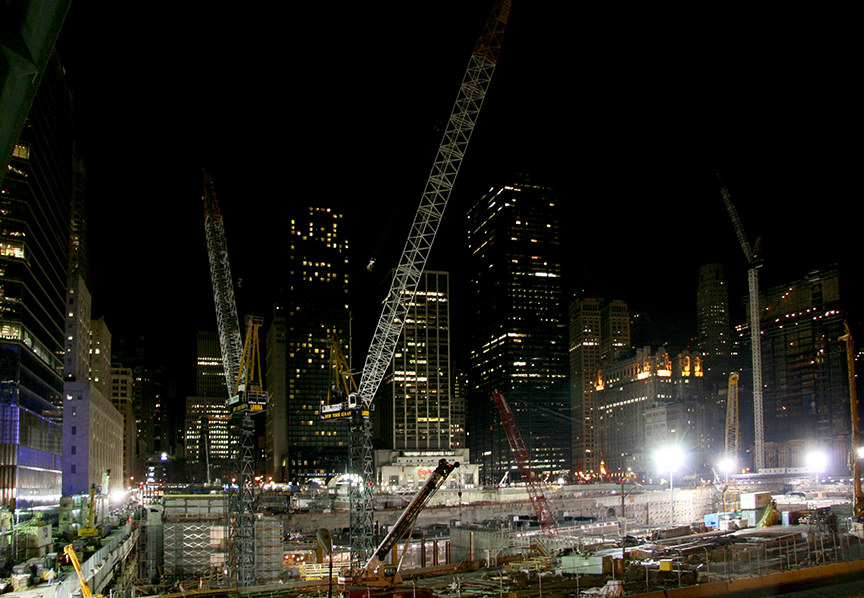
    People always ask me about progress at the site of the former World Trade Center, so here is Ground Zero in its current state. Mired in controversy since day one, the project is finally underway – steel should be rising above street level this year, 2008, seven years after 9/11, with occupancy anticipated in 2011. One tower or two?, Taller than the World Trade center?, How tall?, How much a part should the memorial play?, and Freedom Tower? are among the questions which dragged the process down. Of course, the design itself, won by Daniel Liebskind, has been the largest struggle. I originally saw the design competition presentations at the World Financial Center and went to a number of presentations. There were several extremely innovative designs by some of the top firms – I remember one design which called for floors of interior gardens.

    However, there have been many individuals and organizations with various controlling interests in this process: Port Authority of New York and New Jersey, who own the right to develop the site, the Lower Manhattan Development Corporation, who ran the design competition, Larry Silverstein, who had signed a 99-year lease for the World Trade Center site in July 2001, and architects Daniel Liebskind and David Childs. The original plans by Daniel Liebskind saw many changes, and now, David Childs (one of Silverstein’s favored architects) is in charge of the Freedom Tower’s design.

    In its final incarnation, the tower will rise from a cubic base with tapered chambered edges, forming a tall antiprism with eight isosceles triangles, which form a perfect octagon at its center. It will be capped with an illuminated spire containing an antenna. The total height will be 1776 feet (marking the year of the signing of the American Declaration of Independence).

    The name of the building itself has come into severe criticism. A number of articles have said the design is defined more by fear than by freedom; some have called it the Fear Tower. Understandably, many of the structural design considerations have been built around possible future terrorist attacks. In an article entitled Medieval Modern: Design Strikes a Defensive Posture by Nicolai Ouroussoff, architecture critic for the NY Times, Nicolai says, “The most chilling example of the new medievalism is New York’s Freedom Tower, which was once touted as a symbol of enlightenment. Designed by David Childs of Skidmore, Owings & Merrill, it rests on a 20-story, windowless fortified concrete base decorated in prismatic glass panels in a grotesque attempt to disguise its underlying paranoia.”


  • Wax

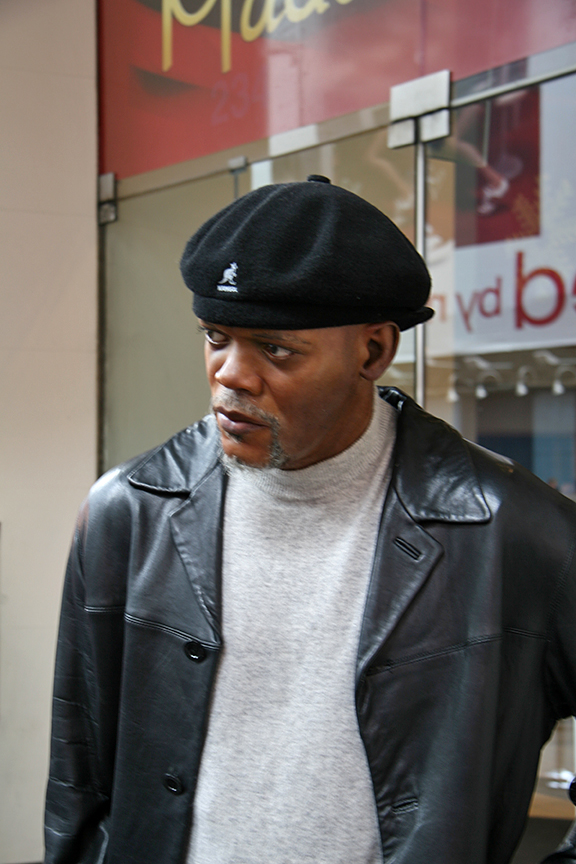
    I have previously voiced my feelings concerning those things which may be viewed by many as too touristy and that, in many cases, such as the Empire State building, offer much of value and warrant a visit. However, in the case of Madame Tussaud’s Wax Museum, I am guilty of not following my own advice and have never visited. In my defense, wax museums in the United States do have a poor reputation, and it is not so unreasonable to avoid them. And, of course, there is also the issue of artistic snobbery – that something merely representational is not worthy of serious consideration, even if it has been done with meticulous accuracy and the results are astonishingly real. This wax figure of Samuel L. Jackson was on 42nd Street outside the museum, a lure to get passersby to go in. It certainly was remarkably lifelike. In reading about these figures and the work, I was impressed at the level of artisanship, and the story of Madame Tussaud was equally fascinating.

    Marie Tussaud (1761 – 1850) was born Marie Grosholtz in Strasbourg, France. She learned her craft from Dr. Philippe Curtius, a physician who was skilled in wax modelling, which he used to illustrate anatomy. Marie lived for a time at Versailles. Suspected of possible royalist sympathies, she was actually in prison awaiting execution with her head shaved. She was saved by her sculpting talents and was employed to make death masks of those executed by guillotine, including Marie Antoinette, Marat, and Robespierre. A traveling showman (with the collection of wax figures left to her by Curtius), she finally settled in London and had her first permanent exhibition on Baker Street in 1835. Read the history here at the Tussaud Museum website.

    The New York incarnation of the famed London museum occupies a five-story building in the Times Square area on the exact site of Hubert’s Dime Museum and Heckler’s Trained Flea Circus (another amazing story). The roster of wax figures reads like a who’s who in themed environments. The figures are created at substantial cost and time, taking months for creation. Celebrities and notables typically pose for a few hours, and likenesses are then created from hundreds of intricate measurements along with photographs. Faces are made from 30-piece plaster molds; hair is inserted strand by strand. I think it’s worth a visit…


  • Big Deal

    Everything is a big deal in New York – big things and little things. Whether it’s the tree at Rock Center or doing laundry. But with the enormous, virtually unimaginable plethora of services, isn’t everything supposed to be more convenient? Well, yes and no. Only if you have the stomach for it. Because to live well and for your life to run smoothly here, everything requires navigation, negotiation, inside knowledge, strategy, stamina, persistence, attitude, contacts, resourcefulness, and a slightly masochistic streak (and yes, money doesn’t hurt). Plus, you have to want all that the city has to offer – it has to be worth it. Things we consider easy are only easy by New York standards. And if something truly easy actually occurs, then call CNN, because this is a Really Big Deal and merits celebration, conversation, and is newsworthy. Like a parking spot right in front of your apartment building when you need it.

    What does all of this have to do with ice skating? I think you know by now. There are only a few places in Manhattan where you can ice skate, and, of course, they are all a big deal – Rockefeller Center, Central Park, and this seasonal ice skating pond in Bryant Park (nice website here). When I arrived, the ice cleaning machine was just finishing up, and the kids were chomping on the bit to get on that ice. The New York City skyline and Bryant Park itself make a beautiful backdrop for the urban ice skating experience.

    NYC is a revolving door, and those who can’t keep up just get spit back out. I remember a woman who was a very aggressive, successful salesperson in the printing business from the south who relocated to the big city. She moved to my neighborhood, so I was looking forward to her becoming an addition to my (shrinking) circle of friends. After only a few months and before I could even visit her once, she was gone. In a phone conversation, I asked her what had happened. She said she didn’t understand why people would live here. Things were just too HARD. Not that she couldn’t handle it, but why would anyone want to? I was going to say it’s really no big deal, but then I realized that’s not exactly true. New Yorkers are a different breed, and we feed on big deals…


  • Times Square Ball Drop

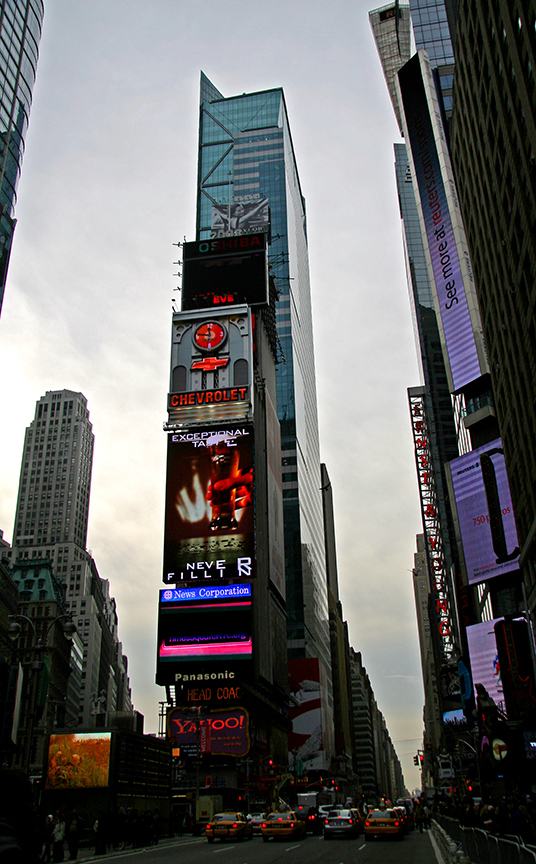
    Dropping the ball in Times Square is the world’s most well-known New Year’s Eve celebration. Nearly one million people attend in person, with millions around the world watching the televised event. The millennium celebration saw two million people – I was one of them. The photo was taken on Sunday afternoon, and preparations were already underway – television crews were setting up. (Note: click on the photo to enlarge it – if you look carefully, you can see the 2008 sign and pole for the ball above it.)

    The ball drop has been an annual event since 1907, making this year the 100th anniversary. The ball itself has gone through numerous incarnations over the last one hundred years. Its earliest construction was of iron and wood with 25-watt bulbs, weighing 700 lbs. In 1920, it was replaced with a ball entirely of iron (400 lbs) and then in 1955 with an aluminum ball weighing only 150 lbs. It remained unchanged until the 1980s, when red light bulbs and a green stem converted the Ball into an apple for the “I Love New York” marketing campaign (from 1981 to 1988). In 1989, the traditional ball with white light bulbs reappeared. In 1995, the Ball got an aluminum skin, rhinestones, strobe lights, and computerized controls. The aluminum ball was lowered for the last time in 1998, when it was replaced by an all-new geodesic design from Waterford Crystal with the latest lighting technology for the millennium celebration – 504 crystal triangles, 696 lights including 96 strobes, and 90 rotating pyramids. Read more about this remarkable, dazzling creation and the event here. This ball has been retired and is the property of the owners of the One Times Square building.

    An entirely new ball has been crafted for this year’s 100th anniversary by Waterford Crystal with 672 double cut crystal triangles. An all-new lighting design was created by Focus Lighting utilizing Philips LED technology (replacing the halogen bulbs of the previous design). With 9,576 Philips Luxeon LEDs, it is more than twice as bright with enhanced color capabilities – 16.7 million to be exact. The ball was unveiled in October and was on display at Macy’s until December 10th – sorry I missed it. Had it not been for researching this article, I would have been completely unaware of the anniversary and new ball. I look forward to watching the televised drop and hope you do the same. Happy New Year!

    Note: Time Balls actually date back to 1829, when the first one was erected in England by its inventor, Robert Wauchope, a Captain in the Royal Navy. These were used for sailors to check their chronometers. They became obsolete with the advent of radio time signals. Over sixty still remain worldwide.


  • Being There

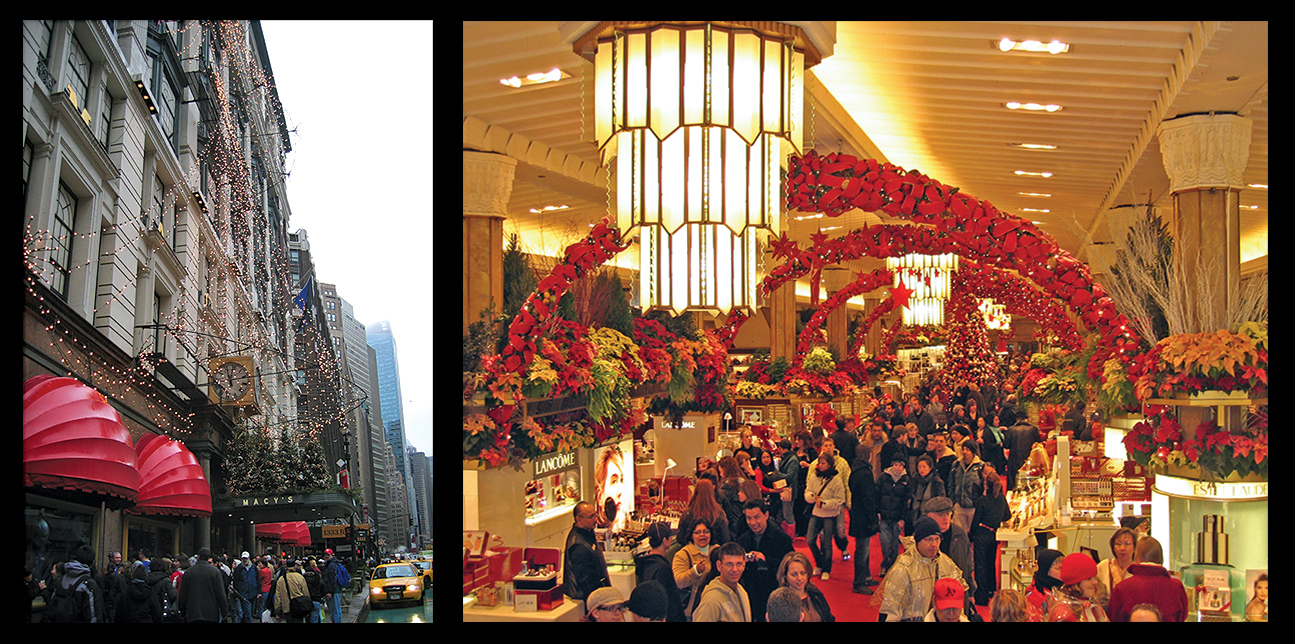
    Can you have too much Macy’s? Perhaps. But regular readers of this website know that I do bemoan the disappearance of so many NYC places and things which have given New York the character it is known for. As I wrote in my recent post Constant, many of the feelings that the best things and times have passed are nostaligic and a complaint of every generation. Championing a merchant may appear to be unnecessary – they do get paid already as a business. And I have complained about excess consumption in this country with an over emphasis on materialism.

    However, we do need merchants, and Macy’s is not an ordinary merchant. To lose them would be sad. Their sponsorship and historic relationship with the Thanksgiving Day Parade (over 80 years) and the July 4th fireworks set them apart. They are part of the physical and psychic fabric of the city. There is a security in knowing they are there, particularly as the world becomes more temporal, fragile, and mutable. We need anchors. It reminds me of a Woody Allen comment about why he needs to live in NYC – that there’s a restaurant in Chinatown where he can get a certain favorite dish at four o’clock in the morning. Not that he every has or will go there at that time. It’s just knowing it’s there. Macy’s is one of those places that whether you go patronize them or not, for a New Yorker, it’s important to know they are there, especially at Christmas…

    Posting Note: This posting will remain for two days (Monday and Tuesday) – I will be away with my family in New England. New postings will resume Wednesday. Happy Holidays.


  • Bleecker Street

    The problem with Bleecker Street is nothing new – a place being a victim of its own success. Over time, the South Village has gone through several incarnations. In the early 19th century, the area around Minetta Street became known as Little Africa. A large portion of the city’s black population was living within a few blocks of Minetta Street; these were freed African-Americans (New York State abolished slavery in 1827). The area saw the nation’s first black church, the first black theater (African Grove), and the first black newspaper (Freedom Journal).

    By the 1850s, the area just slightly east, where the Washington Square Village apartment complex now stands, became settled with an immigrant French community – in fact, the area was known as Frenchtown. By the 1870s, most of the French had moved uptown, tourists invaded, and the area became commercialized. Known as the Latin Quarter, it was populated with brothels and taverns.

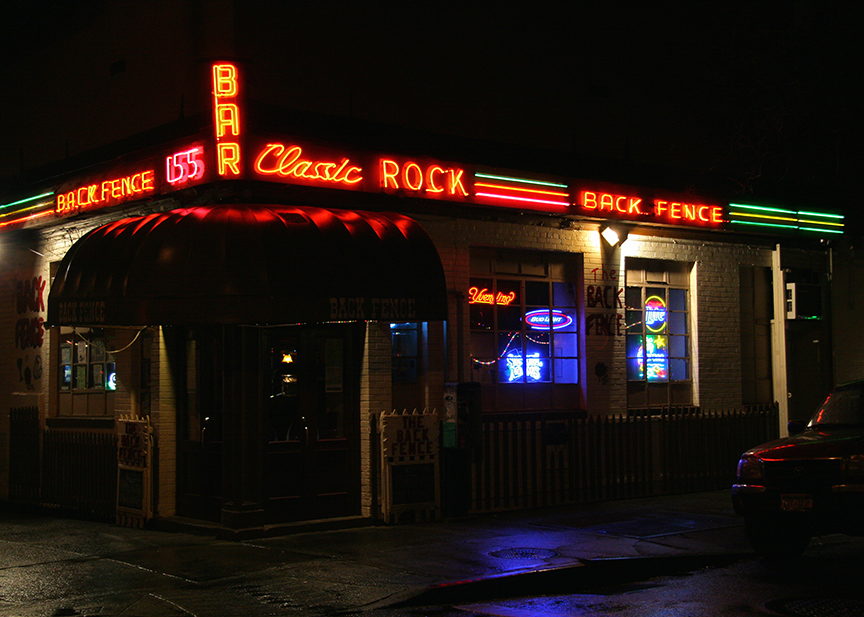
    Later, of course, from the early 20th century through the 1950s and 60s, the area became a renowned bohemian center and still has that reputation to this day. Where does that leave us? Well, it leaves me with very mixed feelings about a street that has had quite a run and been virtually synonymous with Greenwich Village. The few blocks just between 6th Avenue and LaGuardia Place has had many landmark establishments: the Village Gate, Bleecker Street Cinema, the Back Fence, Kenny’s Castaways, Terra Blues, the Little Red Schoolhouse, Le Figaro Cafe, the Bitter End, Peculier Pub, Cafe Au Go Go, and the Actor’s Studio Drama School.

    In fairness, I must say that there are still many quality business establishments on the street, such as Terra Blues. When a place has been beaten hard with an onslaught of tourists for over a century, you do the best you can. And on a quiet weeknight with a little drizzle in the air and the soft neon glow of the Back Fence’s neon signs, things don’t look all that bad…

    A note about the street name: Bleecker Street is named for Anthony Bleecker (1770–1827), a poet and friend of Washington Irving and William Cullen Bryant. The street ran through his farm, and in 1807, Bleecker and his wife deeded the land to the city.


  • Chelsea Piers

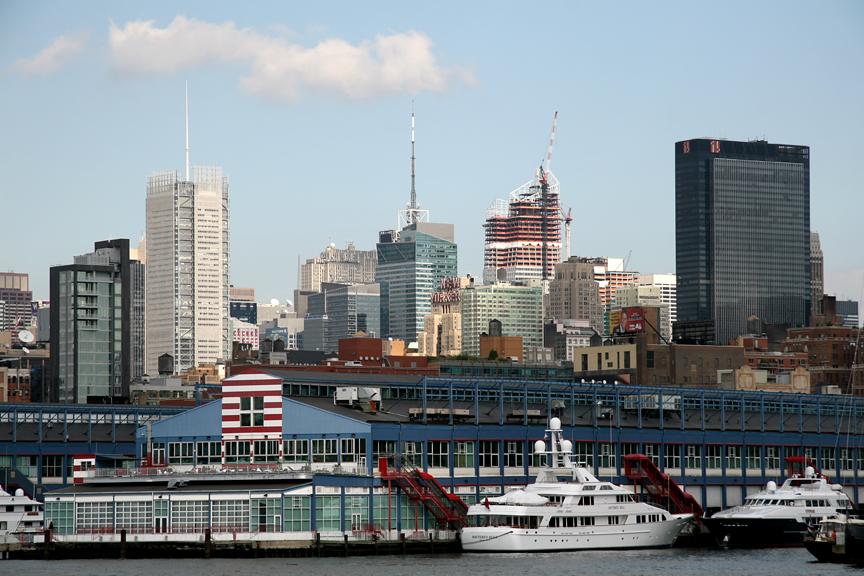
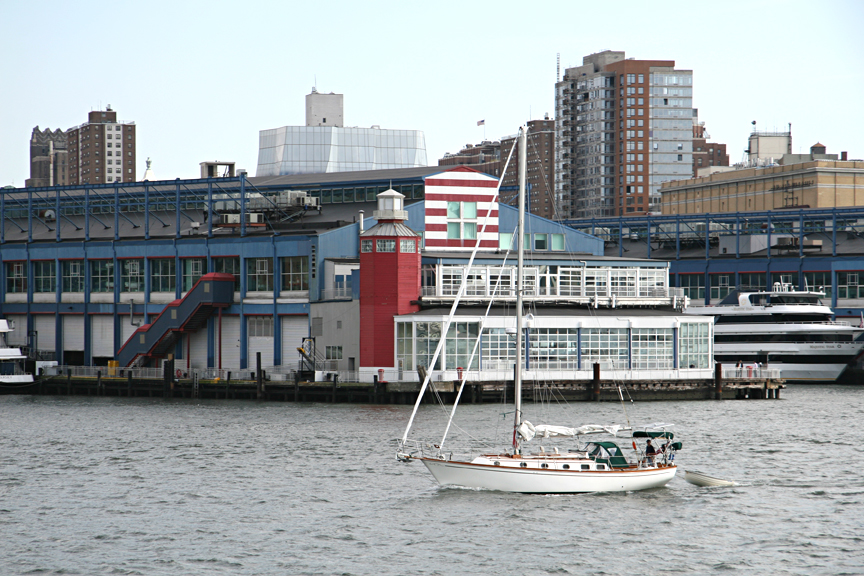
    The Chelsea Piers have a long history with many twists and turns, much of it paralleling the other NYC waterfront piers which saw their heyday, a sordid decline, and then an unexpected and greatly welcomed renaissance. In the early 20th century, the Chelsea Piers saw all of the trans-Atlantic luxury cruise liners, including the Titanic and Lusitania. In 1935, the luxury liner piers moved north and the Chelsea Piers became a cargo terminal. In the 1980s, there were plans for a new West Side Highway (Westway), which called for demolition of the piers. The Westway project never went through, and the piers survived. The new piers, designed by Warren and Wetmore (which also designed Grand Central Terminal), began construction in 1994.

    The huge, 28-acre complex of 4 piers between 17th and 23rd Streets in Manhattan are a sports-oriented facility with several venues: The Field House – soccer, basketball, gymnastics, baseball, dance and rock climbing; Golf Club – a four-tiered, year-round outdoor driving range; Sky Rink – twin indoor ice-skating rinks with hockey, general & figure skating, school; Sports Center Health Club; The Spa; a Bowling center; and the BlueStreak Sports Training facility. Click here for the Chelsea Piers website. There is onsite parking and restaurants. A nice plus is that the center is located along the Hudson River Greenway…

    Photo Note: the photo shows the vista looking towards midtown. Click here for a second photo with a view of Gehry’s IAC building.


  • dinamic_sidebar 4 none

©2026 New York Daily Photo Entries (RSS) and Comments (RSS)  Raindrops Theme