• Category Archives Secret NYC
  • FishBridge Garden

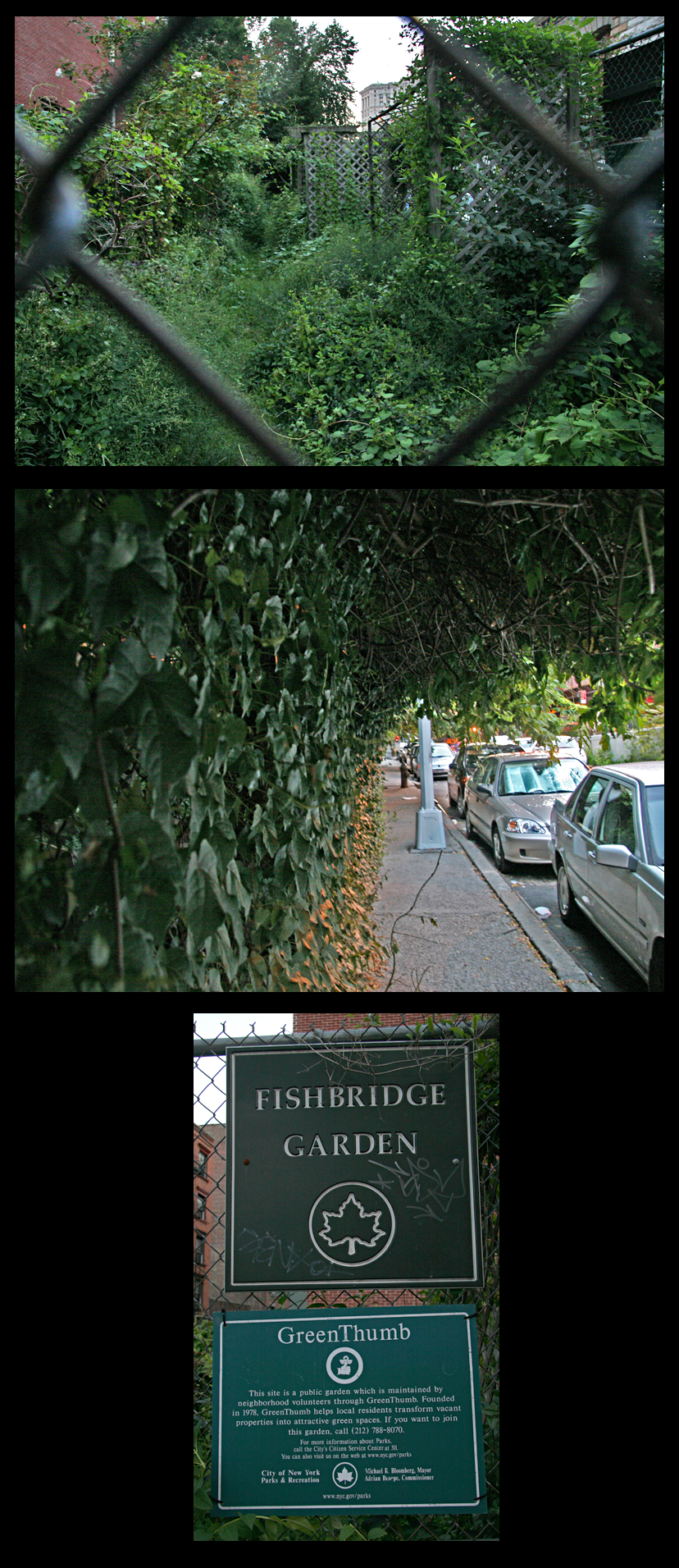
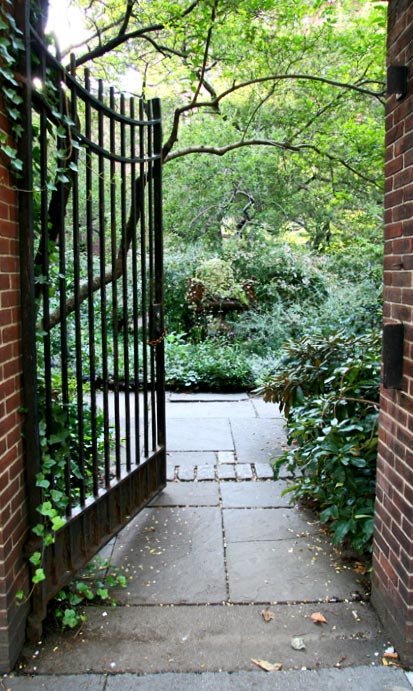
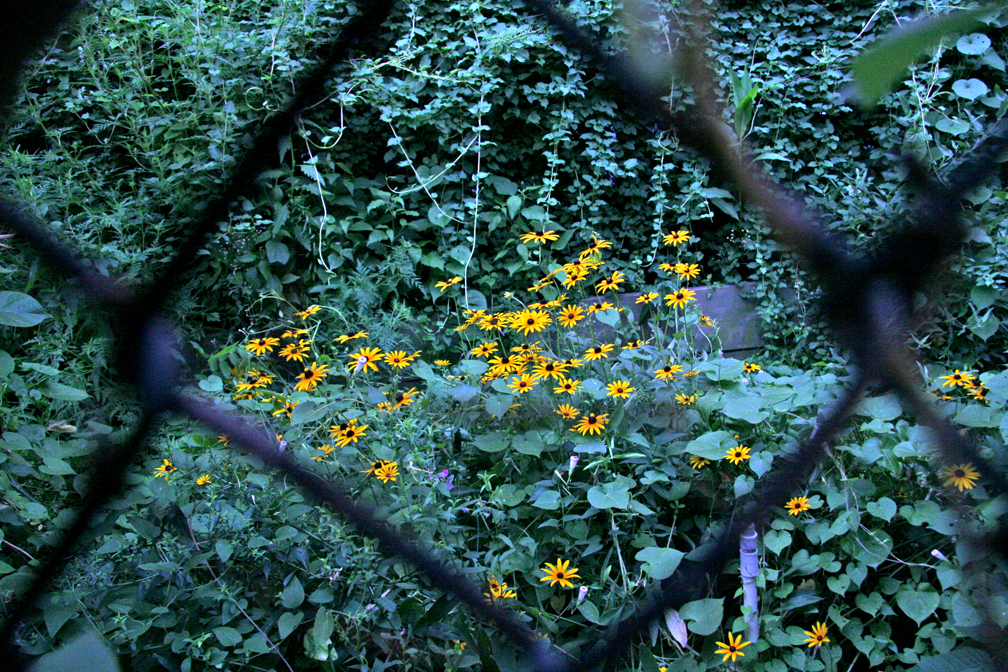
    Fishbridge Garden is REALLY off the beaten path; I did not find it in any secret or hidden New York sites or guides. Online, you will find a description on the Parks Department website (click here). A friend and I stumbled into this place while walking the South Street Seaport area on Front Street. At the Fulton Street end, you have shops, the Pier 17 complex, and ships, all well-known to tourists. This area was the home of the Fulton Fish Market, one of the country’s (and world’s) largest. It was also one of the last working areas of the Manhattan waterfront and one of the last of the city’s outdoor wholesale markets. Six days a week, from midnight until about 9 a.m., the Fulton Fish Market was a dynamic bedlam of rubber-booted workers cleaning, boning, icing, unpacking, and repacking fish from throughout the world. Walking away from Fulton Street along Front Street towards the Brooklyn Bridge, one is treated with impeccably restored buildings of the neighborhood; one can see many signs of former fish dealers. Some may find the area over-gentrified, with too many nationally known retailers at the street level. But we chose to enjoy the architecture of this area on a beautiful day and leave the nay saying at home.

    At the end of Front Street at Dover Street, one will find a tiny park/garden running a short block to Water Street. Click here for more photos. This park/garden was built between 1990 and 1992 on the site of a former parking lot and rat-infested garbage dump. Local volunteers cleaned up the site and built a garden, children’s play area, barbecue area, and dog run. Unfortunately, the garden was closed when we got there, so we only go to peer through the fence. Next time…
  • Lahore

    Posted on by Brian Dubé

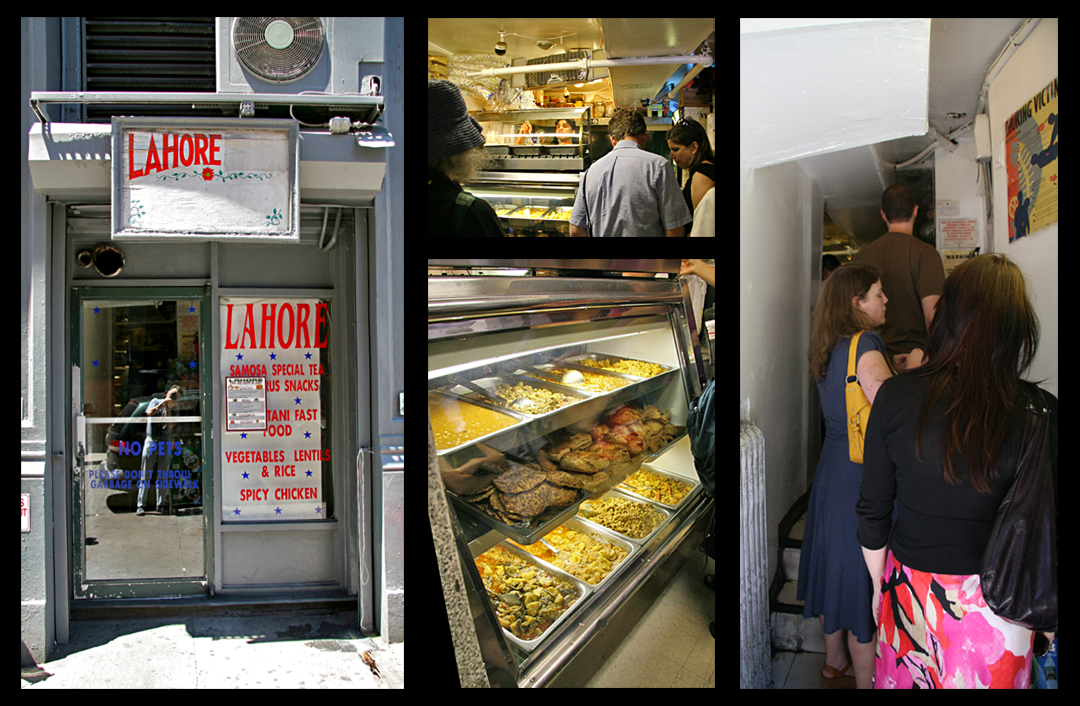
    There is a category of food you really won’t find outside a big city like NYC: that which might be referred to as Pakistani taxi cab cuisine (by and for Pakistanis). Cab drivers have a short list of requirements for their choice of on-the-job food: cheap, fast, and available all hours. In the case of Lahore, which meets these basic requirements, one could add authentic and quite good. For authentic ethnic food, it is safe to place your bets with taxi drivers; they know the entire city, have a vehicle which will take them anywhere at no cost, and are well-networked with other members of their community.

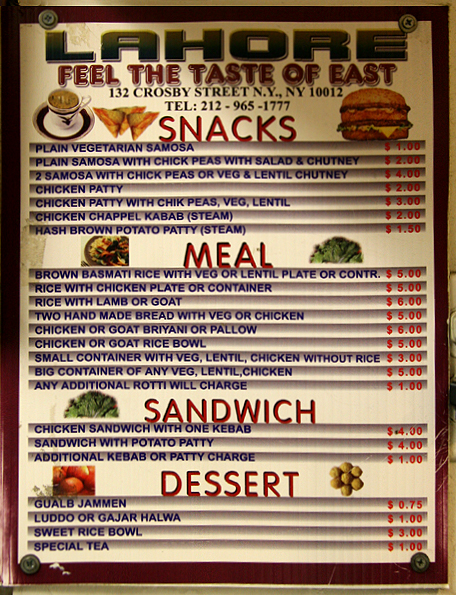
    Many New Yorkers have gone by 132 Crosby Street hundreds of times and not even noticed the place. Lahore is literally a hole-in-the-wall – narrow, cavernous, dark, funky – yet they come (and line up). As far as the atmosphere, for many, the word “scary” would come to mind, but I found the charm of the servers to quite quickly overshadow any misgivings about the roughness. This is primarily a take-out place, although there are a few stools and a tiny counter to sit at. Click here for a photo I took of their menu. Cash only, of course. I can’t say Lahore is a total secret – an online search will turn up a number of reviews (all positive), including one from the New York Times in 2000.

    BTW, I learned today that Lahore is the capital of the Pakistan’s province of Punjab (click here). With its beautiful preserved colonial architecture, gardens, and rich culture, it is sometimes known as the Paris of the East…

    Posted on by Brian Dubé

  • Arch Rebels

    Posted on by Brian Dubé

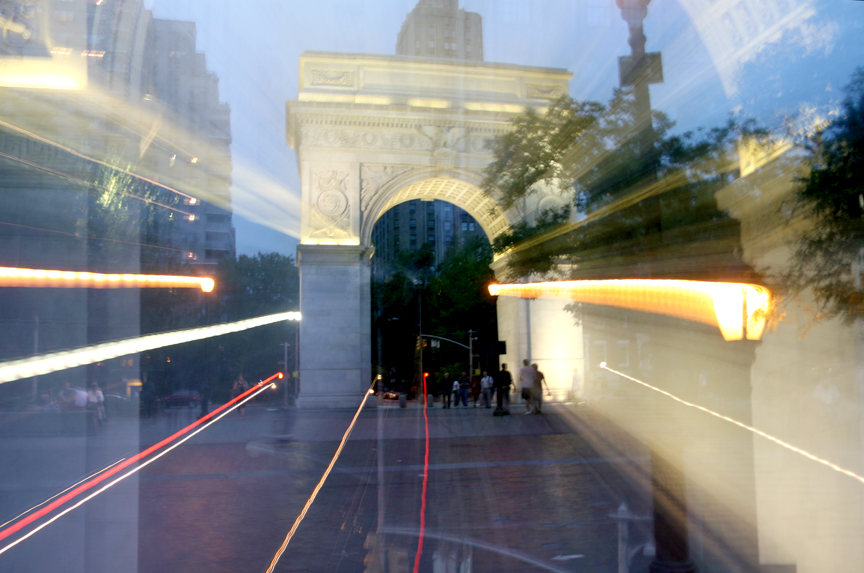
    The Washington Square Arch is one of my favorite subjects, and I have tried not to overuse it. However, I already have done at least 7 postings where all or part of the arch appears in the photo. Apart from the obvious – that it is one of just a handful of monuments in the city – it has gone through a recent restoration and is beautifully illuminated at night. This is is also the neighborhood where I live, so I see it numerous times daily. I have always been obsessed with monuments; as a child, my obsession was the Washington Monument. There is a small doorway in the west pier of the arch. Behind it is an interior stairwell there which ascends to the top, where there is a vacant chamber, and from there a trapdoor to the rooftop.

    One of the most often told stories is that of a snowy night in 1916, when artists Marcel Duchamp and John Sloan, along with 4 others (Gertrude Drick, Forrest Mann, Betty Turner, and Charles Ellis of the Provincetown Playhouse) snuck up to the top of the arch with Chinese lanterns, food, drink, balloons, and cap pistols. There, in a night of revelry, they read a declaration proclaiming the “free and independent republic of Washington Square.” They fired the toy pistols, let the balloons loose, and spent the night eating and drinking while a crowd gathered below. I have not done a posting on the arch per se because someday, somehow, in honor of those rebels, I will get inside and to the top. And when I do, there will be a proper posting and history with plenty of photos – inside, outside, staircase, chambers, rooftop with views – and you will see them here…

    More on the Washington Square Arch: Jeopardy, Nested Embraces, Cello, Singing Bowls, Evening Arch, One Fifth Avenue, Music for 9 Basses and 1 Cello

    Posted on by Brian Dubé

  • Paris in New York

    Posted on by Brian Dubé

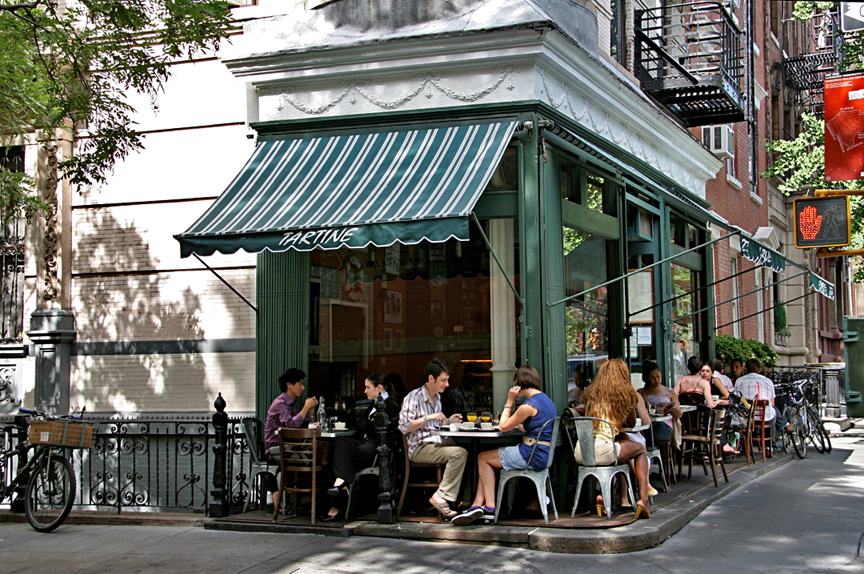
    One customer review complained of 1) a long wait, 2) a grossly small restaurant with people bumping into your chair every time they pass, 3) a rude and poorly trained staff with major attitude, and 4) a bus boy who thinks it’s okay to sweep and stack tables right beside you while you’re still eating. They take no credit cards, no reservations, have no liquor license (BYO), and yet they wait in line. Why? Many just love this place. NYC is a city of extremes, and this includes restaurant experiences and opinions. Tartine was started by Thierry Rorchard and Jean-Francois Bernard, two chefs who had worked several decades in large French restaurants.

    This wonderful small French bistro at 253 West 11th Street on the corner of 4th Street is probably in the most bucolic area of town – the West Village between 7th and 8th Avenues. I have written before of this neighborhood in 39 & 41 Commerce, Cherry Lane Theater, 17 Grove Street, and 121 Charles Street. Here, you will find the charm of being in the Latin Quarter of Paris. The stretch of West 4th Street from 7th to 8th has a number of restaurants discreetly hidden; these blocks are decidedly non-commercial, in part due to the Landmarks Preservation Commission, which has strict guidelines. I love al fresco dining, but I find most streets in Manhattan much too busy. Tree-lined West 4th street is the perfect place for a summer brunch. Be prepared to wait in line…

    Posted on by Brian Dubé

  • Harmonie Club

    Posted on by Brian Dubé

    Private clubs can really be private. Click here for the Harmonie Club’s website and you will see what I mean – no information of any sort, other than a few small photos and drawings. Read as I may and try as I did, I have no interior photos for you, no detailed history, no fascinating stories, and no idea about membership requirements. I have no idea what goes on there, who the members are, or what the dues are. In fact, until recently, they were so private that they did not want members who were open about their Jewishness. There was a book published in 1977, The Harmonie Club: One Hundred and Twenty-Five Years, 1852-1977 – a dealer’s description of the book says, “What is most interesting is that the words “Jew” and “Jewish” do not appear in this history.”

    The Harmonie Club is the second oldest private club in NYC. It was founded in 1852 as the Gesellschaft Harmonie by six German/Jewish immigrants (unable to gain admittance to the Union Club) for the purpose of “mutually beneficial social entertainment, occasional singing entertainments, lectures, etc.” The Harmonie distinguished itself from other all-men’s clubs by allowing women at dinner since its founding. Many of the members of the Harmonie Club were powerful Jewish families of the time, as chronicled in Our Crowd by Stephen Birmingham. The club building, a renaissance palace designed by McKim, Mead and White in 1906, is located at 4 W. 60th Street – just steps from Fifth Avenue, Grand Army Plaza, and Central Park. This location is probably the prime location in Manhattan. In 2001, prior to his campaign for mayor, Michael Bloomberg resigned from four private clubs, including the Harmonie Club. His reason was lack of diversity in membership. Not one of the 1200 members at the club was black…

    Posted on by Brian Dubé

  • Secret Society

    I am fascinated by the places that are prominently located yet rarely mentioned. The plaque at 77 MacDougal Street says Tiro A Segno, New York Rifle Club. This address is just south of one of the most touristy, trafficked blocks in the city – the Figaro Cafe and Bleecker Street are within eyeshot. This very exclusive, members-only club occupies three entire brownstone row houses. 3 flags hang in front – one American, one Italian, and one brandishing Tiro A Segno, which literally means “shoot the target” (Tiros date back to eighth century Italy’s bow-and-arrow groups).

    This is the oldest private Italian-American club in the U.S., founded in 1888 and in this location since 1924. And private is the operative word. You won’t find much about this place – I had to really dig for this one. Visit their website and you will get the idea. Prospective members must be nominated by a current member, and there is a quota on non-Italians. Members have included former mayor Fiorello LaGuardia, Enrico Caruso, and Garibaldi. What goes on in there? Wine, fine dining (dining hall seats 110), conversation, and rifle shooting in the basement gallery with three wood-paneled ranges and a choice of targets. And charitable work is done, e.g., in 2000, the Tiro a Segno foundation donated $500,000 to establish the Visiting Faculty Fellowship in Italian-American Culture at NYU. Apparently any vestiges of former members like convicted politicians Biaggi and Esposito are long gone…


  • Soot of Armor

    Posted on by Brian Dubé

    This is an archival photo taken on November 26, 2006 on East Third Street opposite the Hell’s Angels clubhouse, where I made several recent visits with the intention of a doing a post. I have been fascinated for years with the Hell’s Angels in NYC and their apparent ability to operate with virtual impunity regarding the law – members have been reported to perpetrate random acts of violence and engage in various criminal activities (click here for New York Times article), yet charges have frequently been dropped due to improper searches, lack of witnesses, etc. And they rule that city block. I had been warned of the potential danger of being caught shooting their building – they have six surveillance cameras. On a previous visit, I asked a block resident for his advice on taking a photo, and he said, “I wouldn’t do it. Don’t be a hero.”

    On my last visit with a friend, I approached a club member going into the building and asked permission to take photos (technically I didn’t need it). He let me know that they owned the building and the sidewalk and that he didn’t want to be on my blog (with a few expletives thrown in). I decided that is was not worth the risk to have a camera wrapped around my head by a Hell’s Angel, so I slunk back across the street where my friend was waiting and took the above photo. It’s interesting that all this occurred just before the recent major incident at the clubhouse – making all the news media (click here for Gothamist’s coverage). So, instead of the Hell’s Angels clubhouse, we have a miniature suit of armor with red horns in a window gate AC cage with skulls hanging from it. I have no idea if there is some hidden meaning here or visual pun. Any ideas?

    Posted on by Brian Dubé

  • Signs of Life

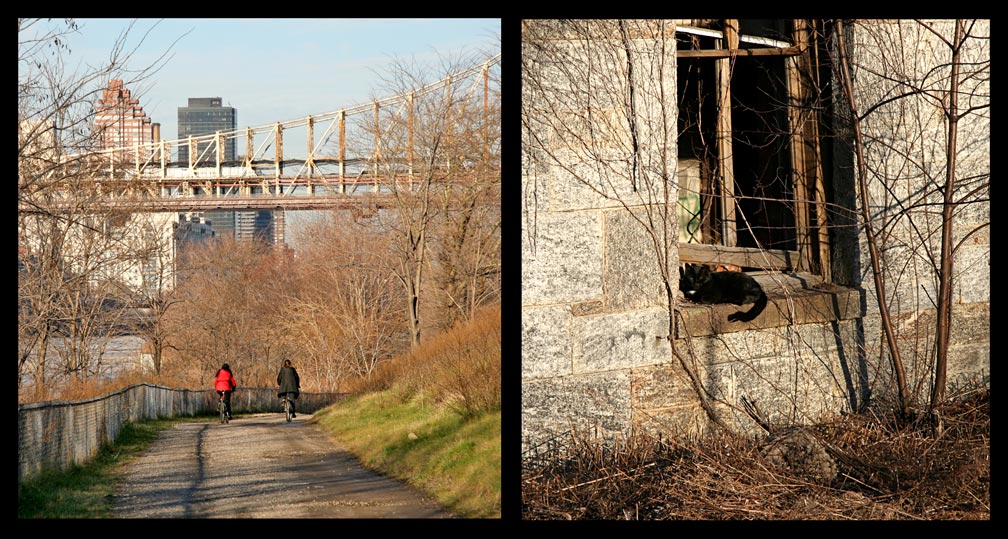
    These two images are from the south end of Roosevelt Island (the cat is sitting in the window of the infamous Smallpox Hospital, an abandoned Gothic ruin.) Technically part of Manhattan, Roosevelt Island is a two-mile strip of land in the East River with access by aerial Tram, subway, and auto (by bridge from Queens). Formerly called Blackwell’s Island and then Welfare Island, this place was home to many asylums, hospitals, and prisons. In the 1960s, a plan by Philip Johnson and John Burgee envisioned a pedestrian community, but the original plan never came to be.

    There is a variety of housing: subsidized and unsubsidized housing for low, middle, and moderate-income tenants. Luxury rentals and condominiums also exist. Hybrid electric buses provide transportation on the island; waste is collected by an underground Automated Vacuum Collection System (the only one servicing a residential complex in the U.S.). There was initially a lot of enthusiasm over the island’s development as a modern utopia. However, the population originally envisioned was never realized, and thus, there is a dearth of services on the island. One supermarket, one deli, one restaurant.

    For the visitor, there are a few spots worth a visit – the biggest draw are the vistas of the city. But I am sure that many residents like the quiet atmosphere – our black cat appears quite content…


  • Vintage Mural

    What started as a whimsical photo suggested by a friend as we were walking yesterday in Union Square turned out today to be a fascinating trip into the Crown Coat Front Company and the world of fading vintage murals. Most New Yorkers have noticed these signs all their lives here and find them to be remarkable surviving antiques providing a window into New York City’s rich history. Rampant construction covers some and uncovers others. And as I investigated this company (expecting nothing), I was surprised to find a few tidbits.

    Crown Coat was located at 105 E. 16 St. from 1947 to 1958. I also learned that a coat front is a “trade term for a built-up stiffening or shape-retaining interlining for the fronts of coats, made of stitched layers of haircloth, felt, and canvas.” (George E. Linton (The Modern Textile and Apparel Dictionary – 1973). A search on the company will return quite a few court documents – Crown Coat was involved in a 1967 Supreme Court case involving canteen covers supplied to the government in 1956. The most superb find of the day is Frank H. Jump’s website on his Fading Ad Campaign – a photographic project documenting vintage mural ads on building brickfaces in New York City spanning nearly a century. Click here to read his personal story and the background on the artist and this project


  • Hidden Cemetery

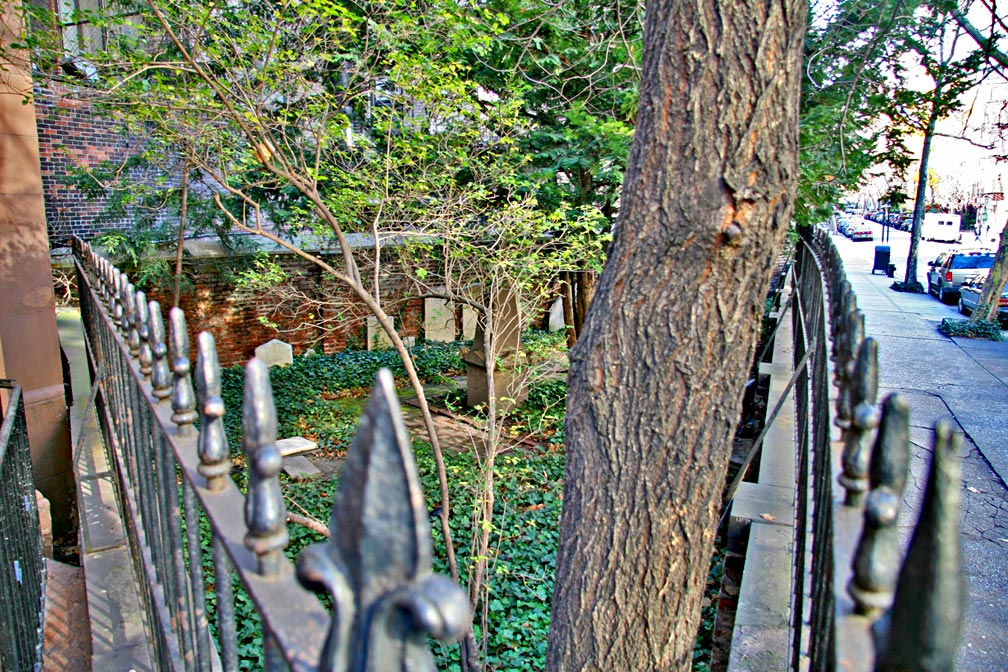
    Tucked in one of the Village’s nicest blocks, at 72-76 West 11th Street between 5th and 6th Avenues, is the tiny Second Cemetery of the Spanish and Portuguese Synagogue, Shearith Israel, in the City of New York (1805 – 1829). This is one of 3 cemeteries belonging to the synagogue. The original cemetery here was larger. However, in 1830 (after the commissioners’ plan of 1811 establishing a street grid), 11th Street was cut though, reducing the size to this small triangle. Disturbed graves were moved to the Third Cemetery on West 21st Street. Burials in Manhattan were outlawed in 1852, explaining why cemeteries here are so few and far between.

    This grim little plot has just a few simple, worn headstones. I shot this from several angles (click here for more photos). In the words of writer James Zug: “The cemetery has a sad appearance, especially in a downpour, this forgotten place, no one to come to tend to the graves, and no one alive who knows any of the people resting there.” I couldn’t have said it better…


  • Grove Court

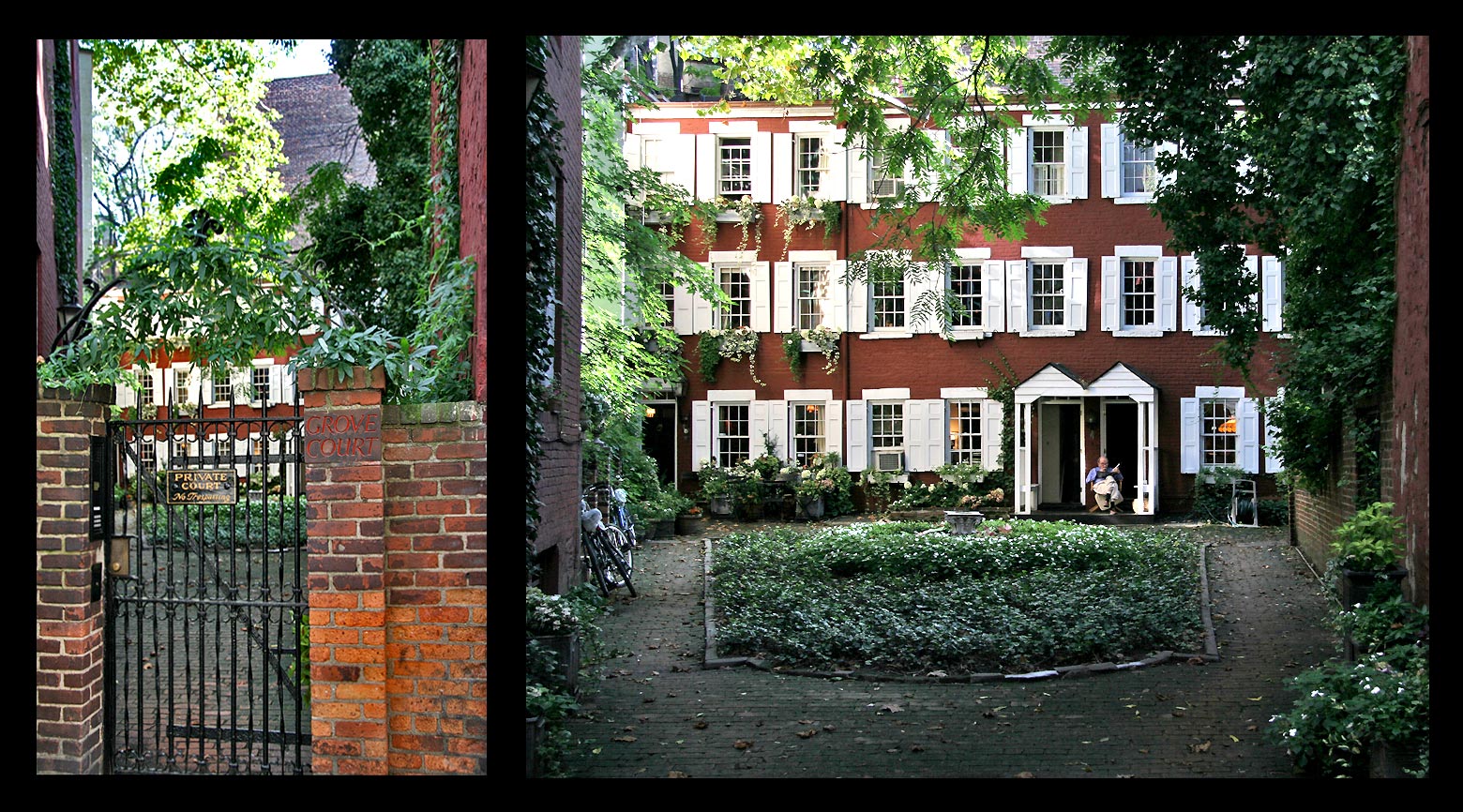
    On Grove Street in the West Village lies a narrow gate (left photo) leading to Grove Court. This private courtyard (right photo), with its row of 6 houses, is the quintessential NYC cul-de-sac, not that there are many contenders. The irregular property lines of early NYC left this parcel of land, and a passageway between 10 & 12 Grove Court gave access.

    So, in 1848, Samuel Cocks, owner of grocery store Cocks and Bowron at 18 Grove Street, decided to develop the property into backhouses for tradesmen and thereby improve his grocery trade. The properties were completed in 1854. At the time, it was nicknamed Mixed Ale Alley – ironic that a row of backhouses like this would be considered undesirable for those with money. Today, of course, it’s a “secluded court”; quite exclusive and rarely available…


  • Secret Rooftop Garden

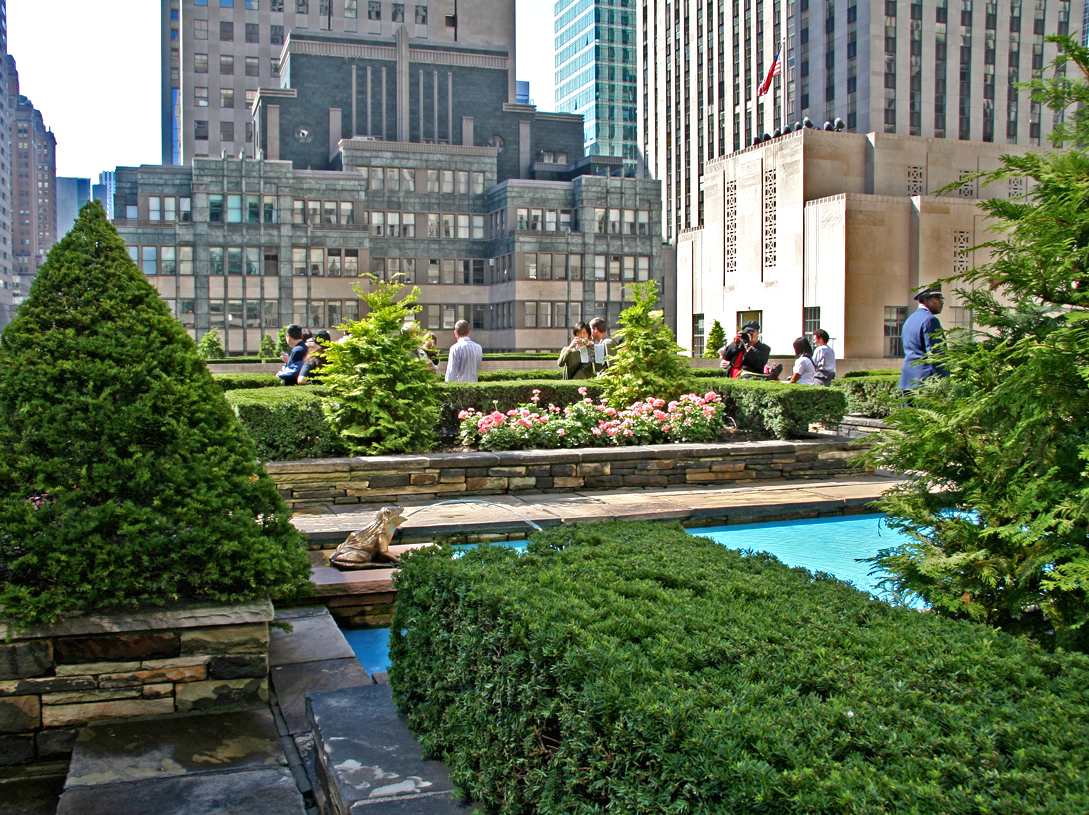
    For just 4 hours, as part of OHNY (Open House New York), the rooftop garden atop the British Empire Building at Rockefeller Center was open to the public. This private garden is rarely accessible, and a detailed online search returns very little information about it. According to the Rockefeller Center website: “Originally, the architects envisioned an even more elaborate network of roof gardens to be connected by aerial pedestrian bridges, which they compared to the hanging gardens of ancient Babylon.”

    At this point in time, the garden primarily functions as eye candy to those in nearby buildings who are fortunate enough to have views of the hedges, wildflowers, fountains, lawns, pools, and beautiful walkways. The rooftop overlooks Fifth Ave., St. Patrick’s Cathedral, Rockefeller Center, so, of course, the views are spectacular. I feel fortunate to have visited, as I am sure all the other visitors were. In a post 9/11 world, seeing special places in NYC is becoming more difficult or, in many cases, just not permitted. My thanks goes to OHNY for coordinating this great weekend and for making these places accessible…


  • The Garden at Saint Lukes

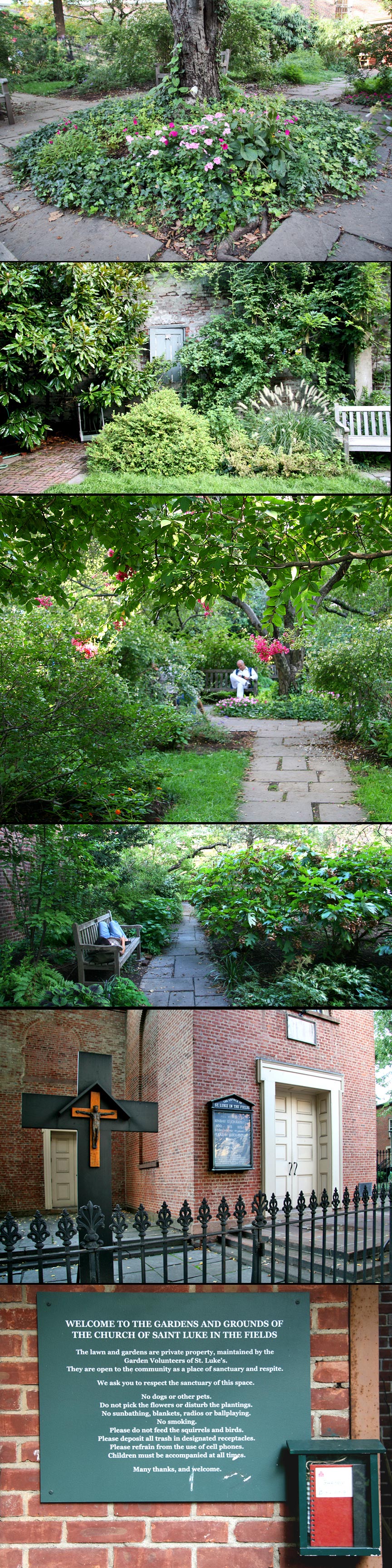
    This small, exquisite sanctuary in the West Village is virtually unbeknownst to outsiders. In fact, in doing this post, I found almost no information online – the official site for the church does not describe it, nor does the Wikipedia article. It was difficult to choose a photo, so please click here to see the entire series.

    Officially known as The Garden of the Church of St.-Lukes-in-the-Fields, the two acres of garden grounds surround the church, which was built in 1821, and are open to the public. Barbara Leighton created the Barrow Street Garden (the core of the garden complex) in 1950. It was expanded from 1985 to 1993. Because of its naturally protected setting and orientation, the garden area has become a microclimate with plants (flowers and fruit) rarely seen this far north. It also lies on the migration route of birds and butterflies.

    The Episcopalian church itself is actually quite unique and progressive, with a choir comprised of an impressive roster of professional singers. Behind the gate lies a real special oasis in the Big Apple…


  • Cherry Lane Theatre

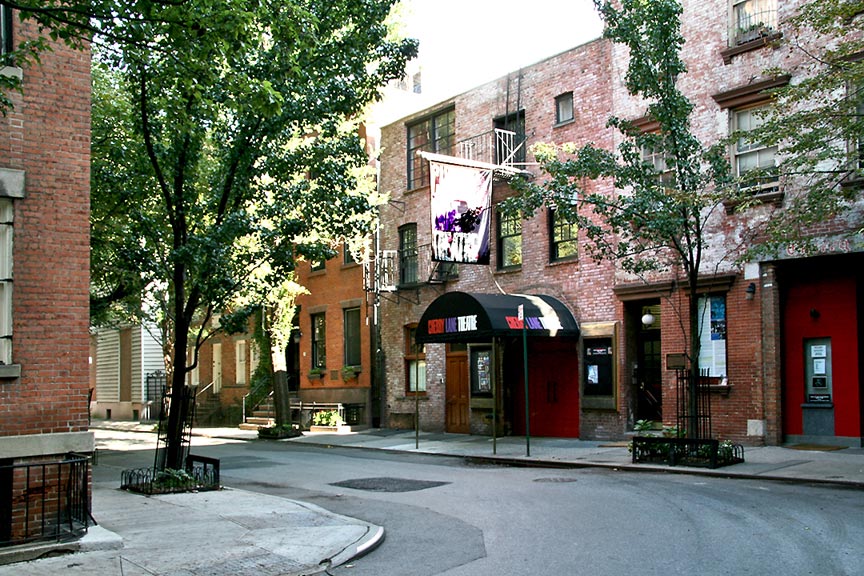
    On one of the most charming and bucolic streets in the city, you will find the Cherry Lane Theatre. This small, quaint theater at 38 Commerce Street in the West Village is, however, not small in reputation or impact. The building site was originally a silo on the Gomez Farm in 1817 – the building that now stands was first built in 1836 as a brewery and was later used as a tobacco warehouse and box factory. Click here for more photos.

    It was founded as the Cherry Lane Playhouse in 1924 by a group of colleagues of Edna St. Vincent Millay. The roster of playwrights and actors that have worked there is truly astonishing and voluminous: O’Neill, Beckett, Albee, Pinter, David Mamet, Sam Shepard, John Malkovich, Gene Hackman, Barbra Streisand, James Earl Jones, Rod Steiger, Dennis Quaid, Kevin Bacon, and Harvey Keitel, to name just a few. If you are not familiar with this theater, I suggest you peruse their extensive website and learn more about it.

    As a laboratory for theater with a groundbreaking heritage, it is quite fitting that New York’s longest running Off-Broadway playhouse is located on a street with a bend and left off the grid of the Commissioners’ Plan of 1811…


  • MacDougal Alley

    This is the second of the Village alleys I am featuring. Most of the small buildings on this charming gated cul-de-sac were built in the 1830s as stables for the larger homes on Washington Square North and 8th Street, much as those on Washington Mews. As the well-heeled moved uptown, however, this alley became quite seedy.
    According to an article by Christopher Gray, the alley was rescued by sculptor Frederick Triebel in 1902; by 1906, the street was already a fashionable art district. In 1907, Gertrude Vanderbilt Whitney had a studio there and later established the Whitney Museum on 8th Street. There is a longer roster of well-known artists and sculptors who have resided here.

    Originally the alley went from MacDougal Street to Fifth Avenue until the behemoth 2 Fifth Avenue was built in 1955 (the large building in the center of the photo). MacDougal Alley had the last remaining gaslights in NYC…


  • dinamic_sidebar 4 none

©2026 New York Daily Photo Entries (RSS) and Comments (RSS)  Raindrops Theme