• Category Archives New York at Night
  • Connections

    Bridges are typically very important structures, always providing that essential connection between here and there, but I can’t imagine any place where they are more critical than in Manhattan, an island in a city of islands ( 4 out of 5 boroughs are islands or on islands – only the Bronx is on the mainland). Our survival is absolutely dependent on bridges and tunnels. Perhaps this is one of the many reasons why bridges are so iconic here: we have many, they are well-known, and they are lifelines. Anything so essential that is simultaneously well-designed takes on an additional beauty – that classic weave of form and function. Add to the equation the vistas and lights at night, and you have a formula for the romantic.

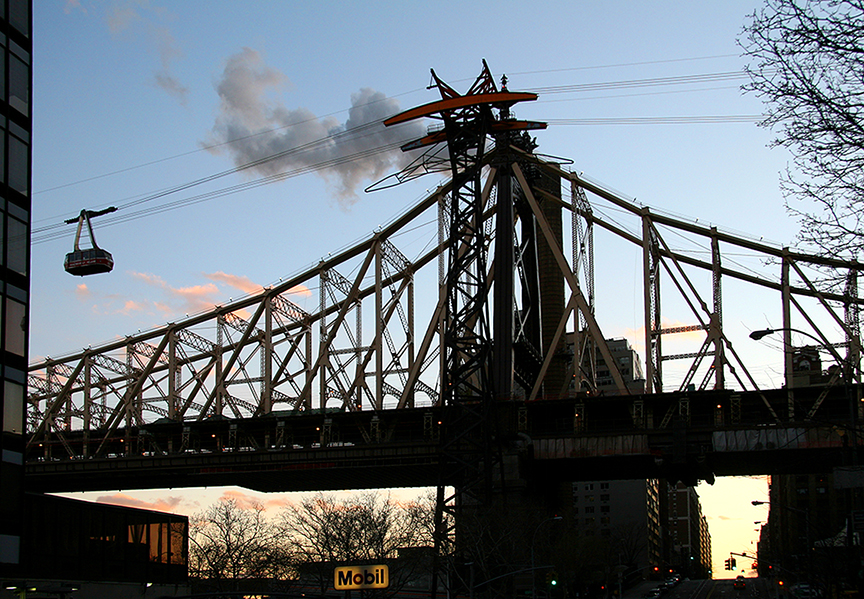
    The intricate steelwork of the cantilevered Queensboro Bridge (formerly the 59th Street Bridge) has an attractive quality. It was designed by Gustav Lindenthal in collaboration with Leffert L. Buck and Henry Hornbostel and completed in 1909. You can read about its history and construction here. It is an NYC icon – one of the most recognizable bridges in the city. Some of my feelings about the bridge, however, are tarnished by my initial experience of it during its decades of neglect (it went through a renovation in 1987). In those early years, I saw it primarily from a utilitarian perspective: to get in and out of Manhattan and to afford vistas of the city and the river. It was more a symbol of what it could provide than a thing of beauty.

    If you want to see a true love affair with new York City, I highly recommend Manhattan by Woody Allen. Its opening montage of city images set to Gershwin’s Rhapsody in Blue is wonderful, culminating with a fireworks display with NYC as backdrop (you can see the intro clip here). There is a scene in the film, used in posters for the film, of Woody and Diane Keaton sitting on a bench with a view of the Queensboro Bridge  click here).
    This image, enmeshed with Gershwin, is one of my strongest connections to the bridge…

    Note about the film: Be forewarned, however. Woody plays a 42-year-old who is dating a 17-year old high school girl. A little disturbing, almost foreshadowing his real life involvement with Soon-Yi Previn. Art predicts life again…

    Note about the photo: This photo was taken on East End Avenue looking south.

  • Hell’s Gate

    If you are driving in New Jersey on the Turnpike through the industrial corridor, passing through towns like Carteret, Rahway, and Elizabeth, you will see (and smell) many oil refineries. To most travelers, these are hideous. But if you are traveling at night, everything about them can become strangely beautiful because it’s so extremely different (I’m reminded of Paul Theroux’s fascination with travel in Northern Ireland because of its extreme nature). You have a really bleak landscape with no sign of humans, networks of lights, tall dark silhouettes of towers, and huge flames shooting into the night sky. It is surreal, like a fairy tale world.

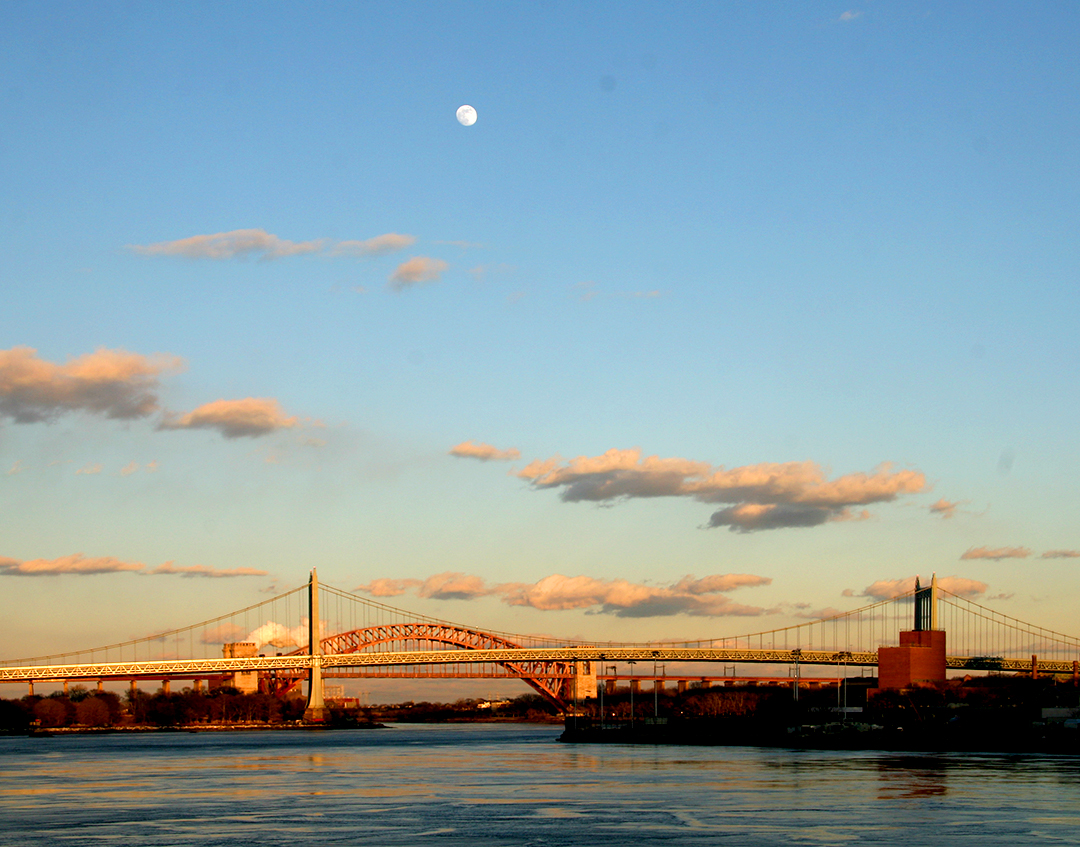
    The subject of today’s photo is certainly more readily likable, but I find it does share some things with the aforementioned landscapes (certainly, elements in this photo are not inherently beautiful, like the smokestacks from Con Edison’s power plant). To really like this vista, one does have to find beauty in the industrial or structural. Like the Eiffel Tower, designed by an engineer, it is loved by some and hated by many.

    The bridge in the foreground is the Triborough, and behind it is the Hell Gate Bridge (formerly the New York Connecting Railroad Bridge), a steel arch railroad bridge spanning Queens and Wards/Randalls Islands. In the foreground, you have the East River looking north (from Manhattan) as it splits around the islands.

    I found the scene beautiful – bridges, the river, golden evening light, clouds, and the moon. It’s about picking your battles and the right vantage point at the right time. For some there is beauty in these vistas; others have abandoned all hope, for they are at Hell’s Gate…


  • Constant

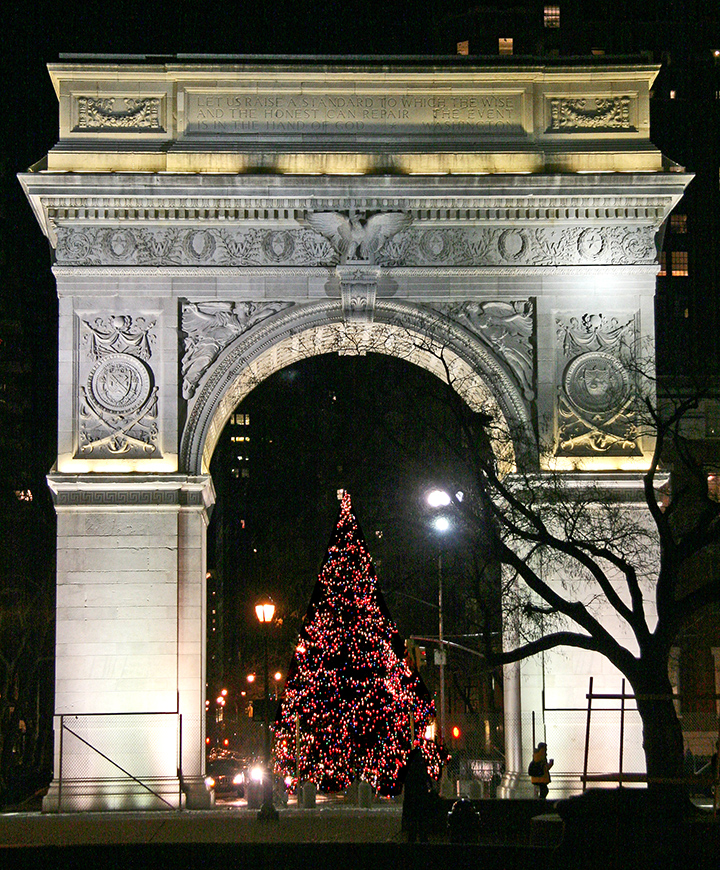
    In today’s assignment, I will briefly answer the question, “What does Washington Square Arch mean to me?” In the 60s – 70s, Greenwich Village had everything a young person wanted – freedom, excitement, diversity, the counterculture, permissiveness, liberalism, protest, and rebellion. Along with Berkeley/San Francisco, it was one of the preeminent areas in the country for the counterculture of the times. The stories read like a fantasy novel: music venues like the Electric Circus and the Fillmore East, Bob Dylan, seeing John Lennon and Yoko Ono at a local bike store, a friend calling Woody Allen from the dorm, Jimi Hendrix rehearsing down the block at Electric Lady Studios. Imagine coming to visit a place like this, never having been away from home or to the big city.

    One of my first memories of NYC (on a preliminary visit to NYU, where I had been accepted) was approaching this arch with musicians beneath it playing bongos and radicals distributing literature like the Berkeley Barb. And yes, there was sex, drugs, and rock and roll. But there were severe casualties for those who overindulged, as I wrote about in Summer of Drugs, a 40th anniversary reunion of the 1967 San Francisco Be-In. So this arch has a lot of meanings for me. I have lived in this neighborhood for nearly 4 decades, and the arch has been a constant in a world of change, symbolizing different things for different people and times. Recently, the arch was completely refurbished, with beautiful lighting installed. So now when I arrive at night, I know it’s home because I see the light has been left on for me…

    Other Postings on Washington Square Arch: Evening Arch, Singing Bowls, Cello, Arch Rebels


  • Danger and Caution

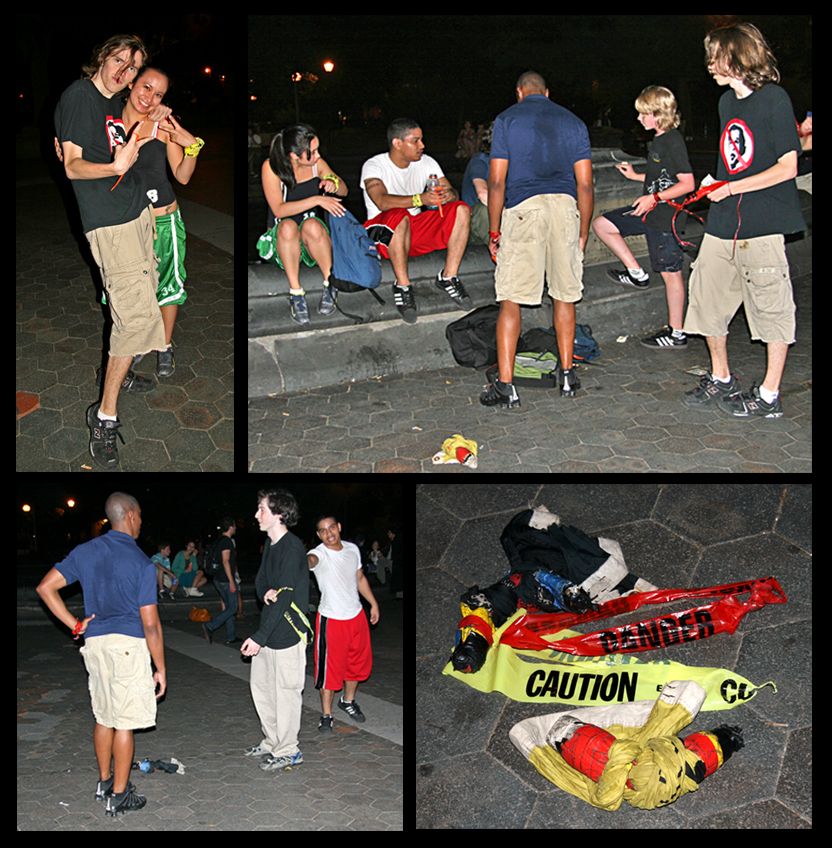
    The rules to Capture the Flag are incredibly simple (in theory): the goal is to capture the opponent’s flag, located at their team’s base, and bring it back to your team’s base. Yet to watch this game played in the city is to witness something bordering an anarchistic mêlée. Some players are running everywhere (nearly crashing into onlookers), and others are standing for no reason I can fathom. Some are chatting with the enemy, sometimes in jail, boundaries seem ill-defined or not at all, and the score is not announced.

    The members of the two teams – Danger and Caution – wear identifying plastic strips around their wrists. The flags are knotted rags, as seen in the photo. Thinking this was a new geek creation unique to the city, I was surprised to learn that this is an old game – I actually found reference to it in a Boy Scout manual from 1947 and that Robert Kennedy Jr. had been known to have 100 person games at his property in Mt. Kisco, NY. There are versions which incorporate areas of neighborhoods in Brooklyn.

    The photos show the game as played by NYU students in the evenings in Washington Square Park. Capture the flag is part of a trend in urban gaming, with others like Pacmanhattan and manhunt. I’ve discussed the game with a professor at NYU (with a PhD in physics) who frequents the park, has observed the game, and also is confused while watching. He agrees that it is only fully understandable by the young and wild spirited 🙂

    Photo Note: The photos are from from August 30, 2007. I intended to coordinate with the group of players and do a more extensive shooting with a flash system, but it never happened.


  • Beacon Of Hope

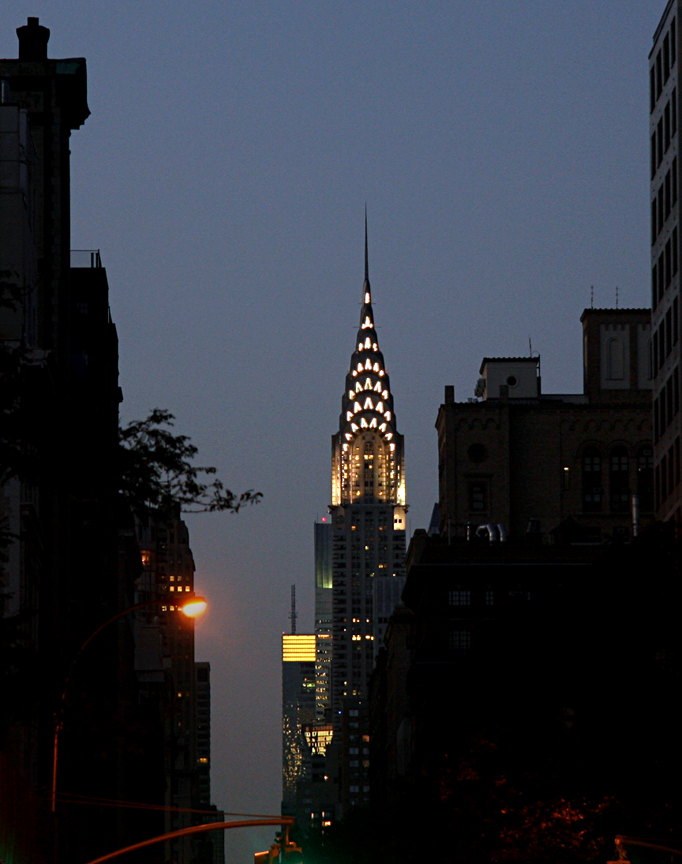
    I never tire of seeing the Chrysler Building, particularly in the evening when lit. I have posted numerous times on various aspects of the building, such as the gargoyles, elevators, lobby, murals, entrance, and the Trylon Towers. Since 9/11, most large office buildings have increased security, and in the case of the Chrysler Building (and Woolworth Building), they are off-limits entirely, unless one has specific business in the building.

    During Open House New York 2006, I was able to get into the lobby and stairwells and photograph at my leisure. For me, the Chrysler Building is many things: assurance that there is some permanence in a world of change, a link to old New York, a beautiful art deco masterpiece, a metaphor for our aspirations, dreams, and hopes with its gleaming stainless steel spire reaching upwards, and a reliable NYC icon, letting me know at a glance, without any doubt, of where I am…

    Chrysler Building Posts: Crown Jewel, Gargoyles, Stairwell, Back in Time, Mural, Going Up, Trylon Towers, Contrast


  • Zeckendorf

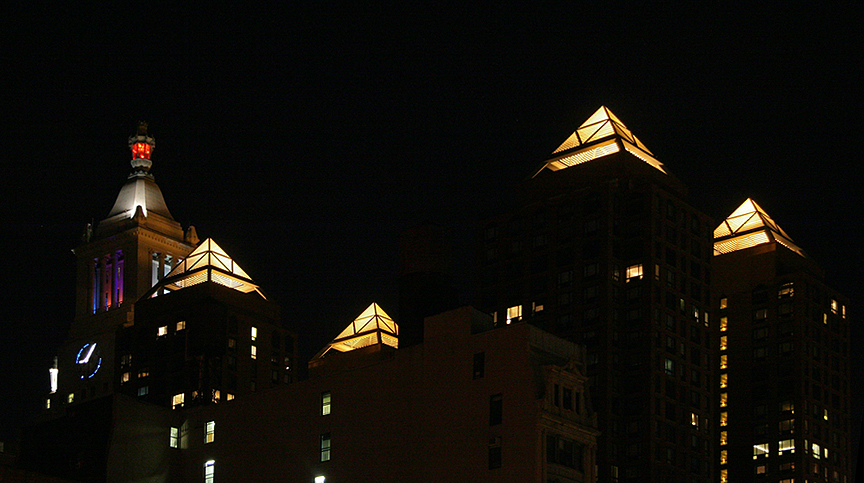
    Real estate developers, along with architects, define the look of a city, and the empire and legacy of William Zeckendorf Sr. (1905-1976), his son William Jr., and grandsons Arthur and William Lie continue to endure and impact New York. These are the Zeckendorf condominiums (read about them here) at One Irving Place, as seen from Union Square in the evening with the Con Ed tower. I have photographed these towers before for this website, but I have not shown all four in one photo. Real estate developers are typically not seen in a very positive light by the average citizen; rather, they are resented by many for their wealth and the power they have over the primary assets of a city – the land and buildings themselves. However, they are absolutely necessary to the city’s infrastructure, growth, and reconstruction, and when there is a good design aesthetic and sensitivity to appropriate architecture, they can be a force for the good.

    William Zeckendorf, Sr. is considered one of America’s foremost developers and has worked with architects I.M. Pei and Le Corbusier. He is credited with projects which were seminal in the redevelopment of troubled areas, such as these towers in Union Square and the Columbia at 96th Street on the Upper West Side. His most notable transaction was taking an option on 17 acres along the East River to build a dream city. Unable to exercise his option, and seeing the city about to lose the United Nations because it was unable to find a location for it, Zeckendorf called Mayor William O’Dwyer, who persuaded Rockefeller to buy the land for $8.5 million and then donate it to the U.N. In 1965, his company Webb & Knapp collapsed and went into bankruptcy. The family business was rebuilt with William Jr. at the helm.

    Style and personality also play a factor in the public’s view of a real estate mogul. Donald Trump, for example, is seen by many as a pompous, arrogant, egotistical media hound with a celebrity lifestyle surrounded by supermodels. Combine that with buildings known for their veneer, and one could understand why architecture critic Paul Goldberger once referred to his work as the “triumph of image over substance”…


  • Spiegelworld

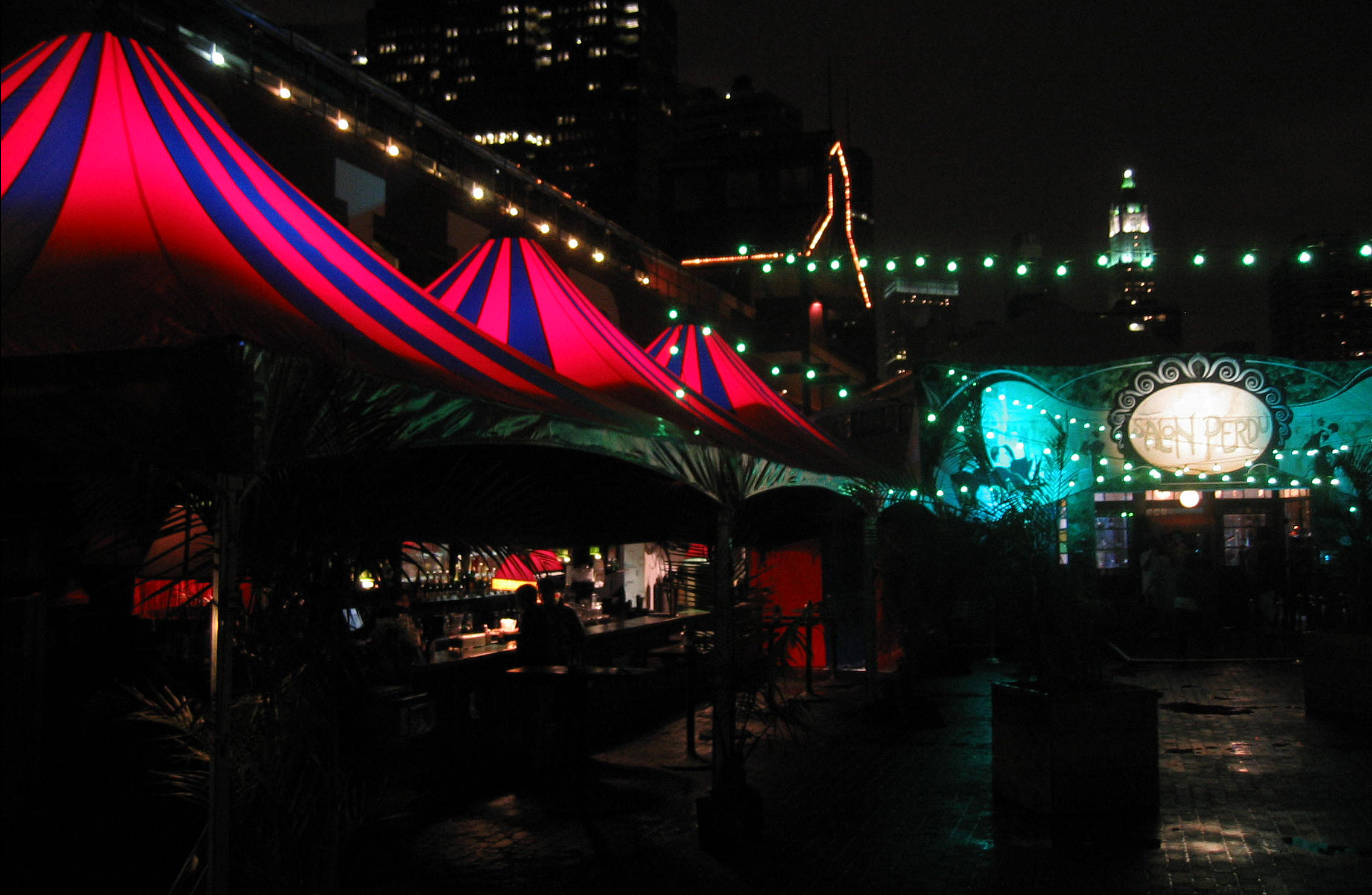
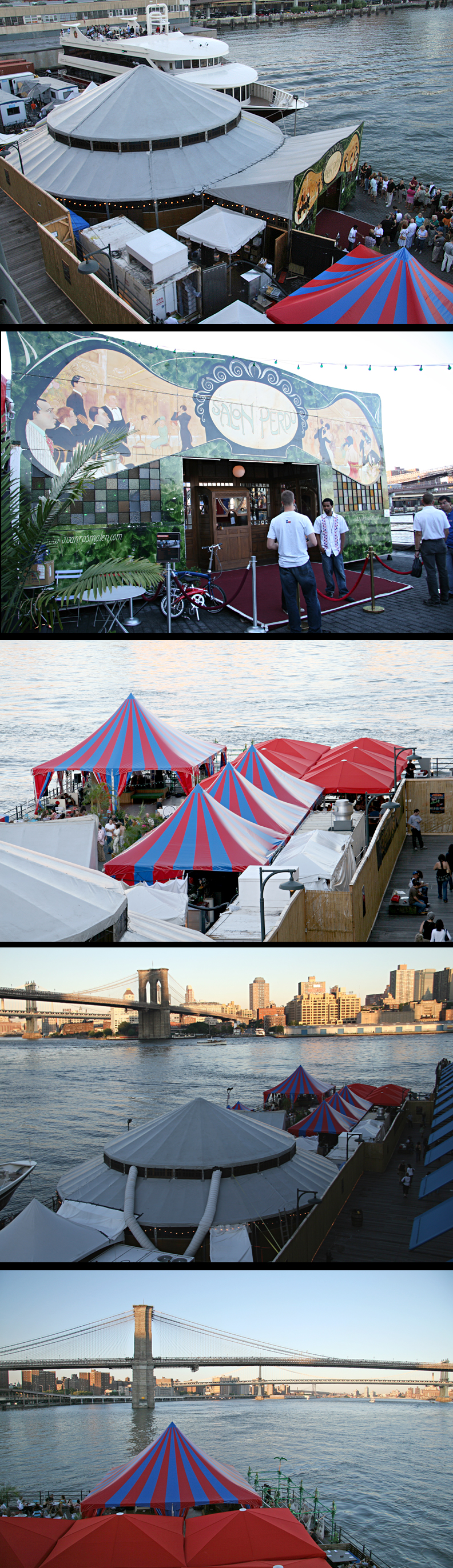
    Spiegelworld is a traveling venue currently installed on Pier 17 at South Street Seaport, running the summer through the end of September. Click here for more photos, taken during daylight. This is a small, European-styled circus meets burlesque/cabaret with acts that span the spectrum of variety arts entertainment at its best. I hate to use the word “circus” since this connotes many things to different people, most likely nothing like the two shows currently running, Absinthe and La Vie. The shows are quite edgy and erotic, with a a fair amount of sexual content – implicit and explicit, as well as some nudity (however, I found none of it gratuitous). There are hand balancing acts, an amazing diabolo act, various aerial acts, contortionists, cabaret singing, comedy, and juggling. In addition to the two shows mentioned, Spiegelworld features live music acts, dance parties (with DJs), an outdoor restaurant, and a bar (with tents for inclement weather). Click here for their website.

    The main shows are held in the antique Spiegeltent, the Salon Perdu, with its opulent decor of mirrors and brocade and intimate setting (only 350 seats). All with spectacular vistas of the cityscape, the East River, and the bridges. I attended with a friend for her birthday; we saw both shows back-to-back. I was thoroughly impressed – the shows were well choreographed, the acts are solid, and the talent and skill level was outstanding. The two shows are quite different – I wouldn’t want to choose between them. La Vie is performed by Montreal’s circus company The 7 Fingers. The acts are woven together with a story line involving death and purgatory. Absinthe resembles more closely a variety arts show. What is most remarkable about both of these shows is the depth and breadth of talents of the cast members, many of whom perform in different acts atypical in an age of specialization. Don’t miss these shows – see them both…


  • Full Moon

    Posted on by Brian Dubé

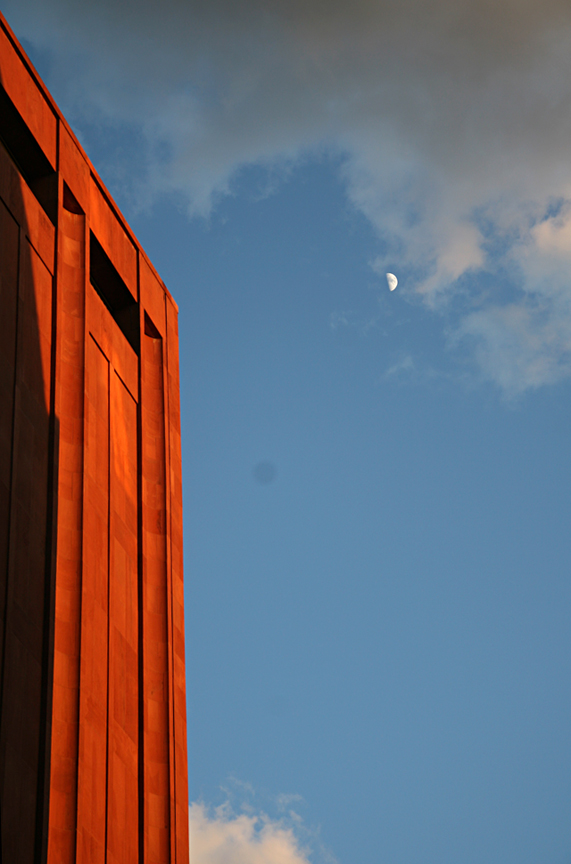
    With all the goings on and distractions of being in the city, why look up? Because sometimes you are rewarded with spectacular natural occurrences, like this moon. Although this was not a vista unique to New York City, seeing such a phenomenon in an urban setting always magnifies the experience. And frequently, the imposition of the moon in the right setting provides a nice counterpoint to various city structures, like this one.

    In various conversations over the years, I have been surprised to learn that many people are unaware that apart from moving through phases, the moon rises and sets daily like the sun, with its own timetable (there is one day each month with no moonrise and one with no moonset). Of course, due to atmospheric conditions, times when the moon is out during bright daylight, etc. the moon is not always as readily and consistently visible as the sun. Click here for a lunar calendar customizable for your location. Here, you will be able to see the times of the moonrise, moonset, sunrise, sunset, and the moon phase. I learned today that a full moon or new moon occurs when the earth, moon, and sun are in approximately a straight line – this conjunction is called a syzygy. I also learned that the full moon rises at sunset, sets at sunrise, and hence is visible all night…

    Posted on by Brian Dubé

  • Spinning

    Posted on by Brian Dubé

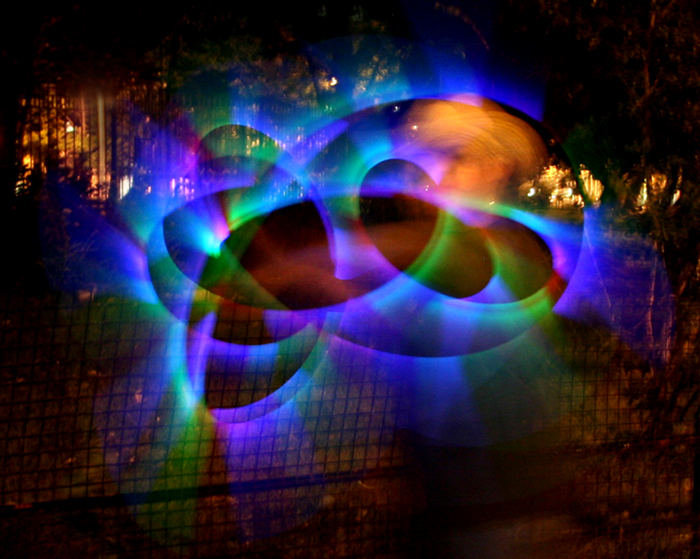
    The spinning of fire and light is everywhere. Of course, there is Burning Man, where twirling of light and fire have been done on a large scale for years. Recently in NYC, there was One Night of Fire, where revelers met on the Brooklyn Bridge to go on a roving street fest – spontaneously moving throughout the city by foot and subway to end up on the beach in Coney Island. This event was organized by the Danger (I did not go because it was the same night as the Sheriff Session).

    The fellow in the photo is Sage (I revealed last year in a comment to a posting my business involvement with the juggling community). The photo is a long exposure of him spinning color changing lighted poi, where the balls slowly change through the color spectrum. Poi, which traces its way back to the Maori of New Zealand, consists of a set of balls each tethered to a cord and finger strap. One is held in each hand, and the pair of objects is swung in various patterns. The balls themselves can be be made in any number of materials/designs, including illuminated or fire versions. Swinging and twirling of poi and other objects (fans, flags, juggling clubs, torches, meteors, glowsticks, ribbons, staff) can be seen in parks, rave parties, juggling festivals, and various planned and unplanned gatherings and events (such as Figment). Entire small businesses have been created which specialize in this type of equipment. The new big thing in the last couple of years: hula hoops – plain, brightly colored, lighted, or fire…

    Posted on by Brian Dubé

  • Sounds of Summer

    Posted on by Brian Dubé


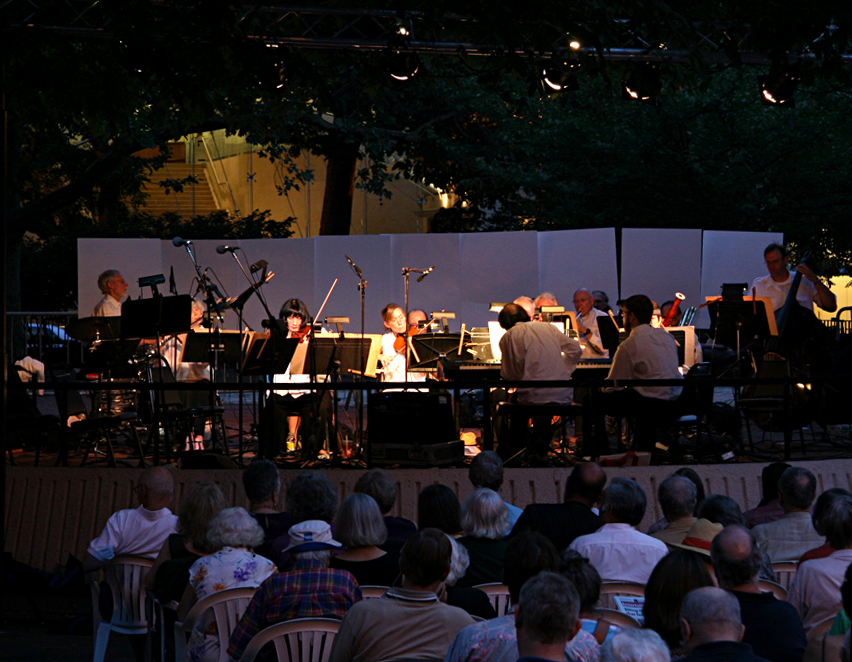
    For many of us who look forward to the summer, spending as much time as possible outdoors can become a preoccupation. Leaving the city is certainly a pleasant solution to heat and humidity, but for those who remain, there are a plethora of activities to enjoy, both physical and cultural and often with less crowding, owing to so many city residents being away. In order to maintain some continuity with indoor life and interests, many take their activities outside – writing, reading, and now with the ubiquitous WIFI, work/play on a laptop. And for music lovers, outdoor summer concerts are a wonderful perk this time of year, and NYC has no shortage, most of them free of charge. The two largest venues are Summerstage in Central Park and Celebrate Brooklyn ($3) in Prospect Park. Both of these get major talent.

    Greenwich Village has a summer series: the Washington Square Music Festival, with Peggy Friedman as executive director and Lutz Rath, music director. The concerts take place on four Tuesday evenings at 8PM. Temporary seating is installed, and music is played on a raised performance space called Teen Plaza (built for the Festival in the 1970s). The repertoire leans towards classical, although jazz and other types of music are featured. The festival was started in 1953 by the Washington Square Association (established in 1903) and Alexander Schneider, a Village resident, violinist, and member of the Budapest String Quartet. The musical talent has been of a high quality from its inception, with its share of luminaries such as Wynton Marsalis and Marilyn Horne. Last night’s theme was Music as Political Statement, with works by Gershwin and Weill. The upcoming (and last) concert of the series on July 31 features the Charles Mingus Orchestra…

    Posted on by Brian Dubé

  • Light on Bobst

    Posted on by Brian Dubé

    My recent interest in the evening and night sky prompted this photo. It is remarkable how out of touch with the natural world city dwellers can be – there is a serious dearth of knowledge in subjects like plants, animals, insects, astronomy, etc. Recently, I have noticed some very brightly lit heavenly bodies, however, I was not able to find anyone who knew what these objects were (by studying some online star maps, I was able to confirm my suspicion that Venus was one of them). The photo was taken at sunset of the Bobst Library, which houses over 3 million volumes and is one of the largest academic libraries in the US.

    This massive red sandstone edifice on Washington Square South was designed by Philip Johnson for NYU (New York University) and was completed in 1972. It has been steeped in controversy since its construction:
    1) To begin with, there were substantial delays in its construction.
    2) There has been much criticism of its bulky, monolithic form and how it towers over Washington Square Park. The work of Johnson himself has been the subject of much criticism.
    3) The library was named after Elmer Holmes Bobst, who made a $6 million dollar contribution. There was embarrassment for the University, however, when it was learned that Bobst was a Nixon supporter, had been accused of a corrupt contribution to Nixon, and made antisemitic remarks.
    4) In 2003, Bobst made big news with two suicides in one month – students jumped from the open-air catwalks to the marble floor below.
    5) Steven Stanzak, an NYU student unable to afford his housing costs, became homeless and took up residence in the basement of the Bobst Library for eight months from 2003-2004…

    Posted on by Brian Dubé

  • Etched in Stone

    Posted on by Brian Dubé

    One of the great things in the city is to happen upon a juxtaposition of architecturally and/or historically important structures. It is surprising that we can still be awed and not jaded, even when exposed daily to vistas and landmarks. I think most New Yorkers still really do appreciate the things they see daily, such as crossing a bridge by car or subway. I always enjoy being in a part of town I do not frequent; it gives me that sense of newness one has as a visitor.

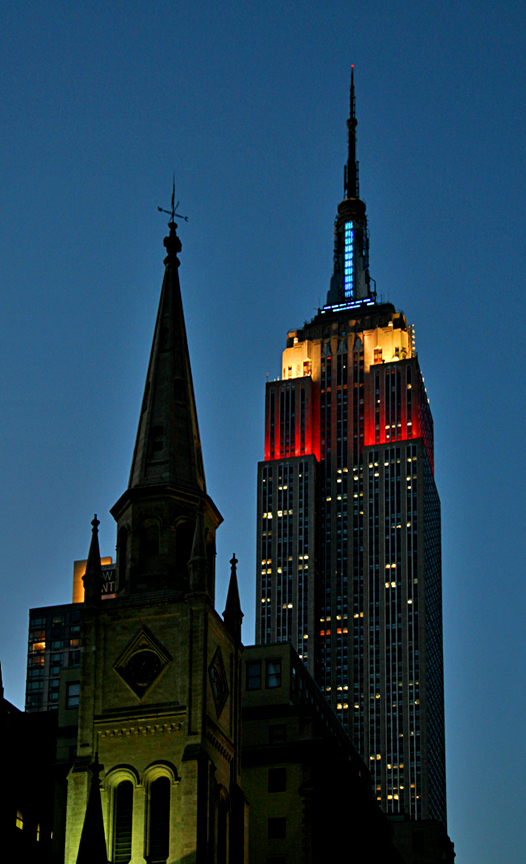
    This photo was taken on Fifth Avenue. In the background, we have, of course, the Empire State Building, clad in Indiana limestone and granite. In the foreground, at 29th Street and Fifth, you have the Marble Collegiate Church, a Romanesque/Gothic building constructed from white marble, a contemporary of Grace and Trinity churches (the term collegiate refers to the practice of churches sharing ministers as colleagues). Apart from having such a prime address with photo op potential, this church has a very interesting history. Marble Collegiate Church is the oldest Protestant organization in North America. The congregation was founded as the Collegiate Reformed Protestant Dutch Church in 1628; the building dates to 1854. Read about it here. The church is perhaps best known for pastor of 52 years, Norman Vincent Peale, the highly influential author of 46 books, including the bestseller The Power of Positive Thinking. Granite, limestone, marble – I love stone. And some things are just etched in it…

    Posted on by Brian Dubé

  • Towers

    Posted on by Brian Dubé

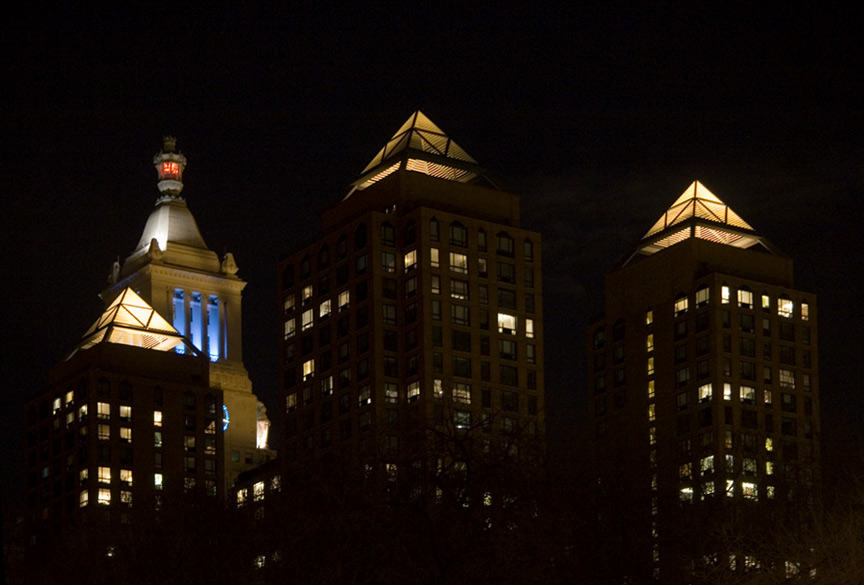
    This is a vista of Zeckendorf Towers and the Con Ed tower, seen from Union Square. Although this area is historically significant as a gathering space for labor and political events (once known as New York’s Speakers’ Corner), by the 1970s, it had seriously deteriorated and was home to drug dealers and considered extremely unsafe (click here for history). From 1983 to 1986, the park underwent an extensive renovation. New retailers moved in, such as Barnes and Noble, Virgin Records, and Circuit City. In 1987, the Zeckendorf Towers at 1 Irving Place, an enormous project encompassing a city block with 670 condominium apartments, was completed. To make way for this project, a small group of 19th-century buildings were leveled, including the Union Square Hotel and S. Klein’s on the Square, the renowned (and tacky) original discount department store. Many credit the Zeckendorf development as being one of the primary forces in the revitalization of the this area.

    There are four towers (only three can be seen in the photo), each with its signature floating pyramidal top. Along with the Con Ed tower, this is one of the most distinctive and identifiable illuminated group of buildings in the nighttime NYC skyline. Like Times Square, this area has had tremendous inertial resistance to improvement. In addition to Klein’s, it has been home to a parade of discount stores, both small and large (e.g. Mays and then Bradlees), particularly on 14th Street – the most resistant to improvement. With the recent opening of Whole Foods Market and a new residential condo at 14th and University Place, the transformation finally looks complete…

    Posted on by Brian Dubé

  • Gothic Night

    Posted on by Brian Dubé

    I find monuments so exquisite when illuminated at night – this is one of the great things about cities like Paris. New York City has its small share of night time beauties, and Grace Church at night is one of them. This night was the perfect Gothic experience, with a near full moon over the starkly lit contrast of the church spire. The illuminated world of New York at night gives residents and visitors a whole other window of opportunity for activities normally relegated to the daytime – sightseeing, strolling, biking, even socializing and sitting in parks. A city that never sleeps must keep its lights on…

    Posted on by Brian Dubé

  • Union Square

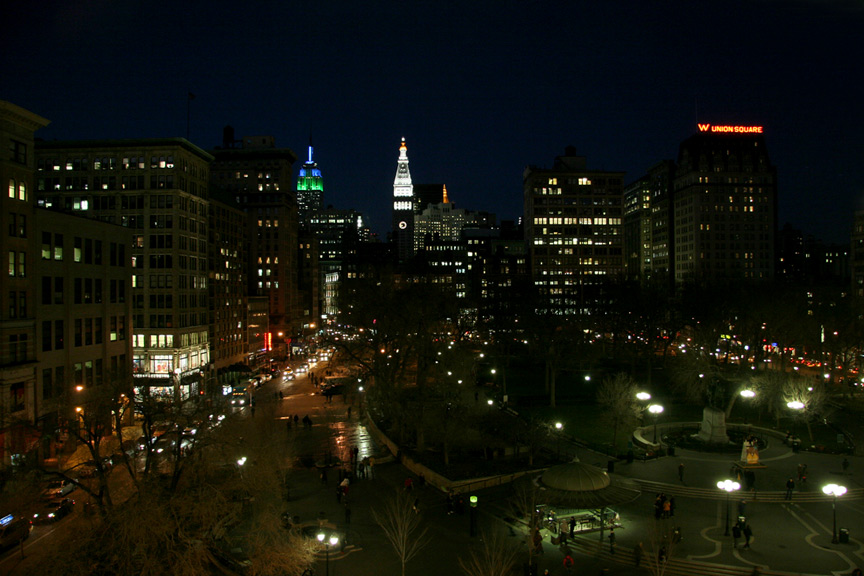
    This is Union Square at night from 14th Street looking north. Union Square is the nexus of Broadway, Park Avenue South, 4th Avenue, 14th & 17th Streets, University Place, and Union Square East and West, with Union Square Park as its centerpiece. It is a major subway station with 8 train lines (note the pagoda entrance bottom center).

    Union Square is its own neighborhood/district, with a breadth and depth of services that are hard to match. On the photo left, we have Union Square West, where you find various retailers and several notable restaurants such as Republic, the Coffee Shop, Blue Water Grill, and the Union Square Cafe (16th Street). The open area also on the left is the home of the famed Union Square Greenmarket, which operates three days a week.
    On the north side (photo top), there is the city’s largest Barnes and Noble superstore (occupying the entire 6-story, restored, former Century Building) and the W Hotel at Union Square. In the Park itself, we have the restaurant Luna Park, the Gandhi statue, dog runs, and playgrounds Just out of the frame on the far right is the first big development on the Square – Zeckendorf Towers.
    On the south side, from where the photo was taken, there is the Virgin Atlantic Megastore, Filene’s, a new behemoth Whole Foods market, and the public artpiece Metronome.

    A myriad of other retailers, services, and street vendors (such as Joe Ades) dot the perimeter of the park and the sidestreets. Check out the links throughout this posting to several of my posts on Union Square…


  • dinamic_sidebar 4 none

©2026 New York Daily Photo Entries (RSS) and Comments (RSS)  Raindrops Theme