• Category Archives New York at Night
  • Equinox

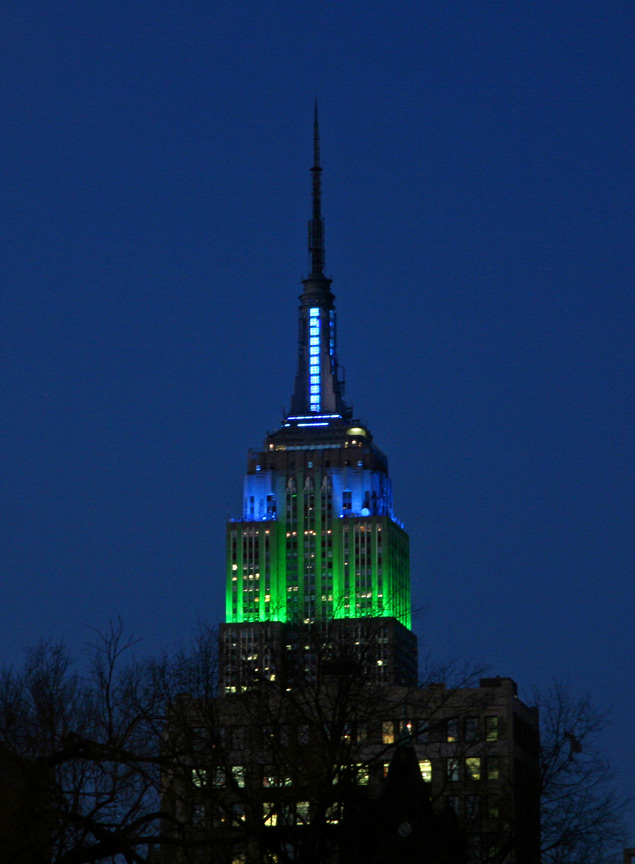
    This blue and green lighting at the Empire State Building last night was to celebrate Earth Day, which marks the exact moment of the Vernal Equinox occurs (the first day of spring in the Northern Hemisphere). This was last night at 8:07 PM EDT (on the equinox, night and day are the same length anywhere on earth). The idea of an international Earth Day was introduced in 1969 by John McConnell, and in 1971, UN Secretary-General U Thant signed a proclamation to that effect.

    There are actually two Earth Days – yesterday’s was the equinoctial Earth Day. The other Earth Day is on April 22. First celebrated in 1970, it started the environmental movement. The fact that there are two Earth Days can be somewhat confusing – if you would like to sort it out, click here for the equinoctial and click here for the April 22nd.

    The Empire State building has a sophisticated lighting system with hundreds of lamps and fixtures (see the site here). The building is lit in different color themes to celebrate various holidays, seasons, celebrations, and causes (it is lit white between color themes). Many wonder about the specific meaning of these themes – the official website maintains a schedule of tower light colors and their explanation. This photo was taken from 14th Street overlooking Union Square. I love night photography, tall buildings, blue, and springtime – this was the perfect photo op…
  • Impressionism

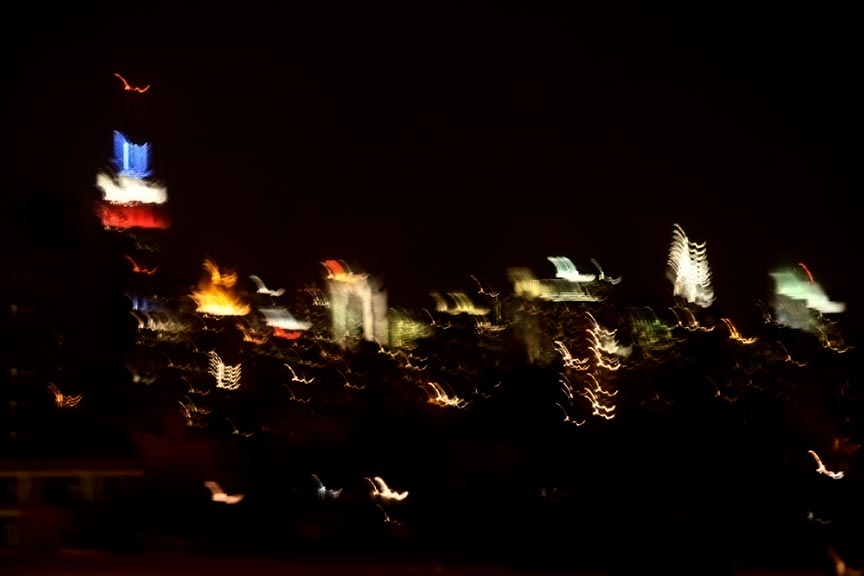
    The best views of the Manhattan skyline are from outside the borough – the Brooklyn Promenade, DUMBO, Queens, New Jersey, the Brooklyn-Queens Expressway, the Belt Parkway, and while traveling on the various bridges by car, subway, or on foot. A trip I often make is over the East River via the Manhattan Bridge. Coming from Brooklyn, there are several vantage points which offer spectacular views of many major building icons all at once – the Woolworth, the Municipal, the Empire State, the Chrysler, the Citicorp, the New York Life Tower, and the Con Ed, as well as the Statue of Liberty and the other bridges.

    Getting a photo is the challenge. I took this handheld at night while driving when traffic slowed to a halt. Even in this impressionistic view, many of the notable buildings can still be identified – the Empire State, Chrysler, Citicorp, and New York Life. In warmer weather, I plan to walk the East River bridges and do some photography. In the meantime, I recommend you take a trip across…


  • Prospect Park In Lights

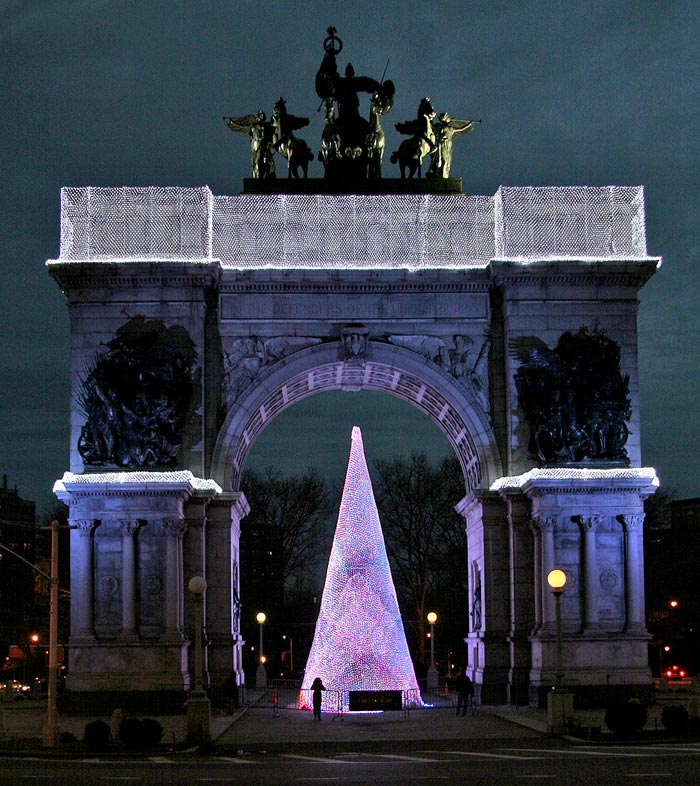
    I feel fortunate to have seen this wonderful display on the last night of its illumination. Prospect Park in Lights was funded by a gift from Mort Zuckerman, publisher of the New York Daily News, to the Mayor’s Fund to Advance New York City. The installation consisted of more than 600,000 LEDs decorating Prospect Park’s four major gateways (Grand Army Plaza, Bartel-Pritchard Circle, Park Circle, and Parkside/Ocean Ave). Click here for more photos.

    The illuminated displays, created by Brooklyn-based lighting designer Jim Conti who also teaches at Parsons, simulate and celebrate different aspects of nature: the look of snowflakes frosting the ledges of the Memorial Arch at Grand Army Plaza, wisteria vines atop the Pergola at Parkside and Ocean Avenues, animated waves for the Bailey Fountain, and, of course, the tree under the arch. Many of the LED lights changed colors and were synchronized with wireless animated controllers. It was stunning…


  • The Crown Building

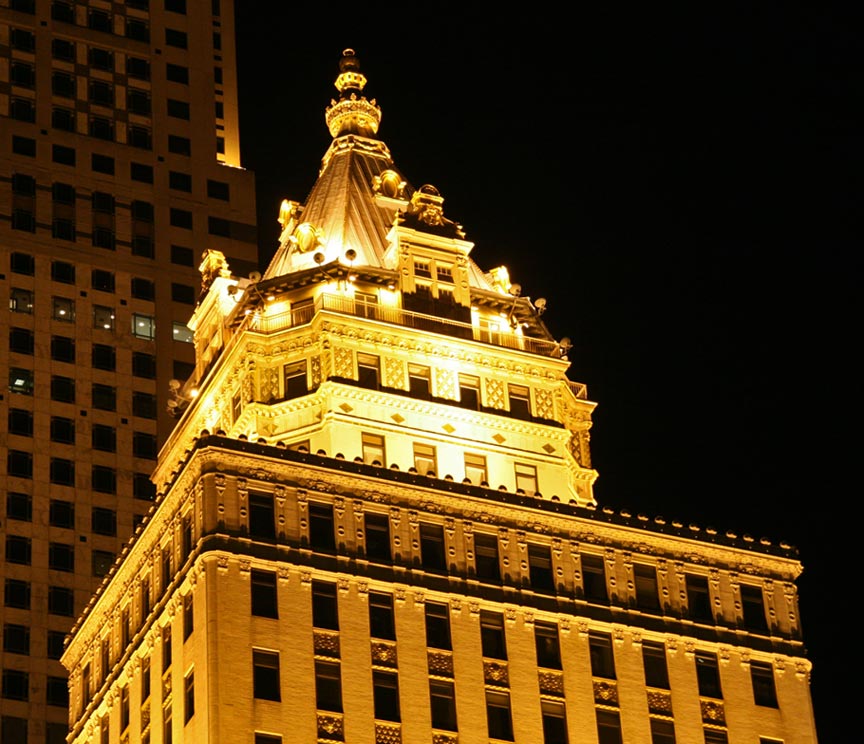
    The Crown Building, at 730 Fifth Avenue and 57th Street, has one of midtown Manhattan’s finest roofs. When seen at night, its illuminated, striking 416-foot high crown with gilded details truly gives it a regal quality, befitting of its name. The French Renaissance octagonal tower section is very striking, with stone/terra cotta, dormers, parapets, and a huge chimney stack. An original weathervane in the form of a rooster was removed in 1942 and melted down as part of the war effort. The best unobstructed view is from the north, where this photo was taken.

    Designed by Warren and Wetmore and built in 1921, it was one of the first buildings to go up after the setback provisions of the 1916 Zoning Resolution. It was originally called the Heckscher Building after its developer August Heckscher, a German immigrant (1867) who made his wealth from mining operations. In 1929, the Museum of Modern Art opened its first gallery here in rented rooms on the 12th floor. In the 1960s, it was known as the Genesco Building, was again renamed in 1983 as the Crown Building, and in the 1980s became one of the properties of the Marcos of the Philippines.

    One of the early commercial developments on the Vanderbilt’s former turf, Heckscher’s vision was quite prescient: “In the last analysis, whoever will not shop on Fifth Avenue and 57th Street will not shop anywhere.”


  • Dyker Lights

    There are Christmas tree lights, and then there is Dyker Heights. This Brooklyn neighborhood (between Bay Ridge and Bensonhurst) is known worldwide for its elaborate Christmas light displays (more photos here). PBS did a 2001 documentary detailing the phenomenon – apparently many of the displays have been motivated by various family events and crises. When I first visited this area in the 1980s, I had never seen anything remotely like it.

    The predominantly Italian neighborhood is quite affluent – many of the homes are mini-mansions. The premier block is 84th Street between 10th and 12th Avenue. Here, the traffic becomes bumper to bumper as gawkers cruise slowly down the block (click here for photo). In addition to the myriad of lights, you will find animated characters, motorized dolls, miniature villages, armies of illuminated soldiers and choirboys, live Santa, free toys, huge nativity scenes, synchronized music, and computerized displays like that of Robert DeLauro, who, with Light-O-Rama software, a programmable microprocessor, and a computer in his basement, controls 10,000 lights using 32 extension cords. Apparently, extravagant computerized displays are becoming more common nationwide – check out the home displays on planetchristmas.com.


  • Life at Night

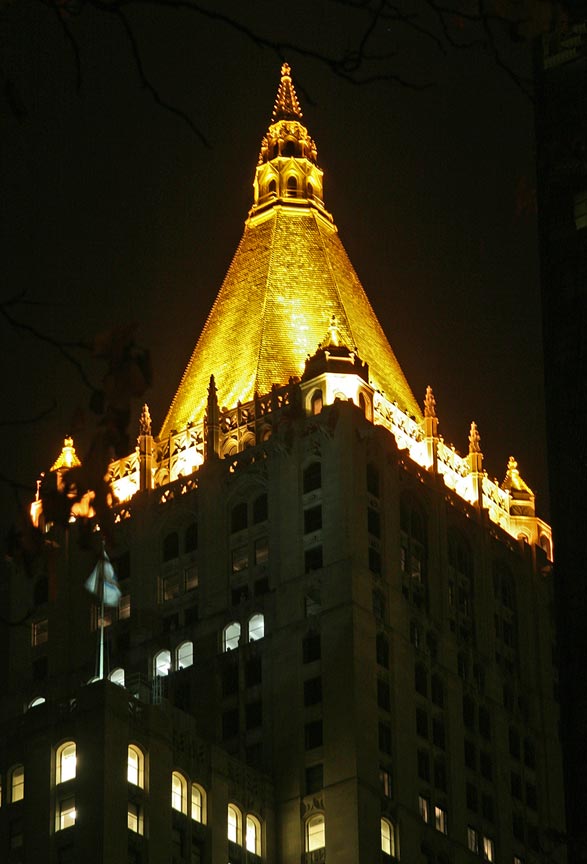
    The New York Life Insurance Building has been described as limestone renaissance at the bottom and birthday cake at the top. This 1928, 40-story structure, which towers over Madison Square Park at 51 Madison Avenue, was designed by Cass Gilbert, who had a love of pyramidal tops on his buildings, which you see in his Woolworth Building. The design is a fusion of Gothic (there are 72 gargoyles at the roof line) with more modern elements.

    The New York Life Insurance was founded in 1845 and is the largest mutual life insurance company in the U.S. The famed gold top was built in 1967 and has been illuminated since 1985 on the company’s 140th anniversary. In 1995, on the 150th anniversary, new gold leaf ceramic tiles were installed. The lit top is one of the major nighttime NYC icons which can be seen and easily identified from afar, along with the Empire State Building, the Con Ed Tower, the Met Life Tower, the Citicorp Building, and a handful of others.
    BTW, the site for this building has a fascinating history – Union Depot, Gilmore’s Garden, P.T. Barnum’s Hippodrome, and the original location for Madison Square Garden…


  • Nested Embraces

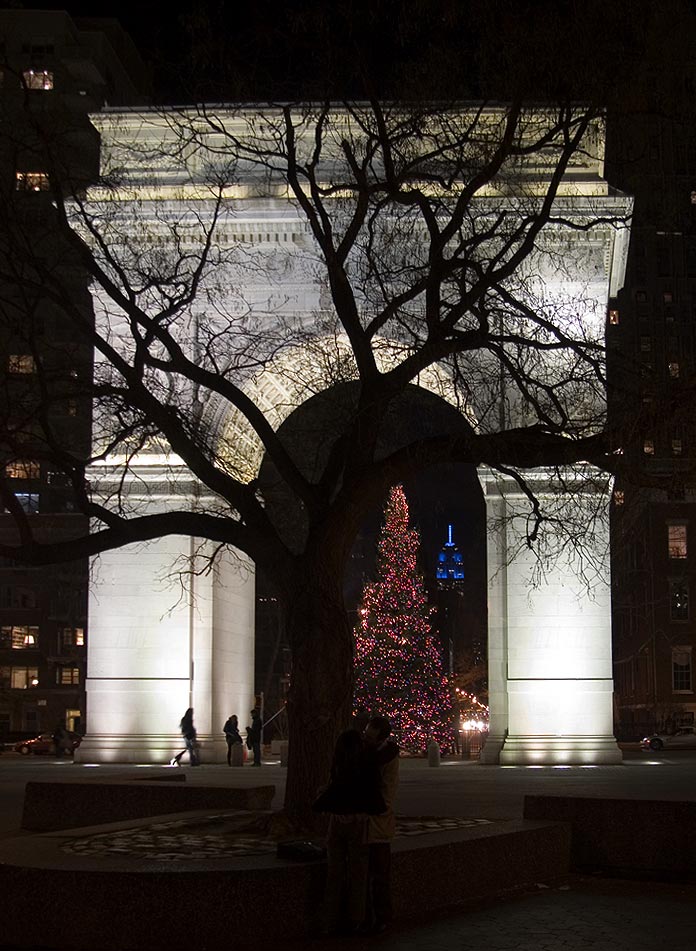
    With the large, spectacular tree in Rockefeller Center, it is easy for other trees to be left out of the limelight. Washington Square Park gets its own large, 45-foot-tall tree this year, delivered from a farm in Canada and installed centered under the arch. Click here for more photos.

    There was an annual tree lighting ceremony on Dec. 5th, led by Keith Borden with the Rob Susman Brass Quartet and sponsored by the Washington Square Music Festival and the Washington Square Association. The carol singing and music is repeated on Christmas Eve.

    If one is fortunate, as I was, you can see the Empire State Building lit in blue (60th anniversary of UNICEF) along with the Christmas tree, framed by the arch, with a silhouetted tree and two lovers kissing as foreground. It was a special moment to see these nested embraces…


  • Carlton Hotel

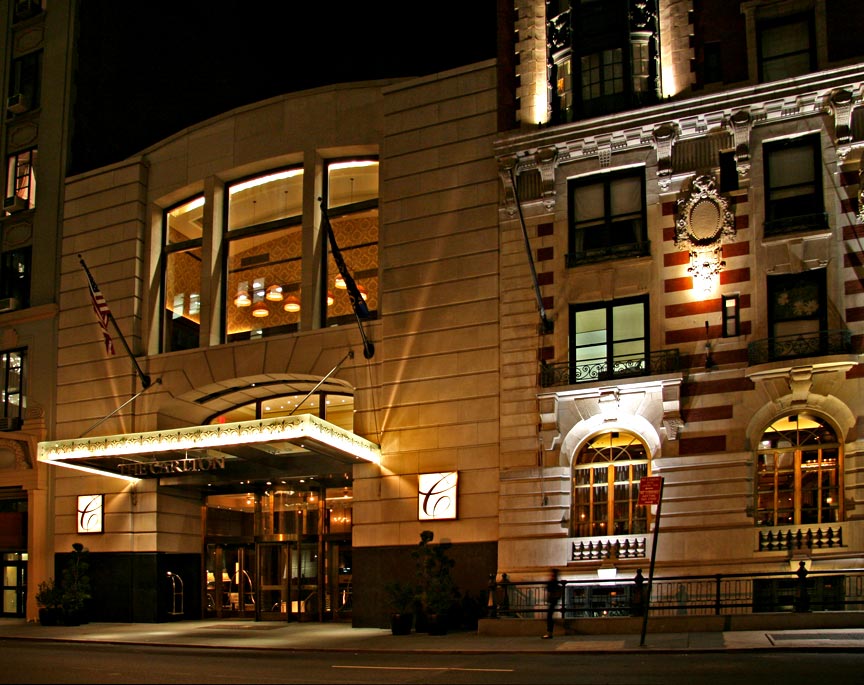
    This is the Carlton Hotel at 88 Madison Avenue at 29th Street. I had no plans to photograph this building, had never seen it before, and knew nothing about it. But walking by it at night, I found the lighting on this Beaux-Arts building quite spectacular.

    My research, both on and offline returned very little, so I really had to dig. I learned the most from the recent press – click here for the hotel’s website with these articles. Built as the Seville Hotel in 1904, it was in steady decline until it recently underwent a 5-year, $60 million renovation led by starchitect David Rockwell.
    One of the high points of the renovation was the discovery of a stained glass skylight dome (believed to have Tiffany glass) hidden above a dropped ceiling above an old barroom and severely blackened. This dome was restored and installed over the new restaurant Country, with chef Geoffrey Zakarian – a lot of positive buzz on this place. A new 3-story annex serves as entrance (click here for photo), with a limestone balcony, a turn-of-the-century curved staircase, and a waterfall. One of these days, I need to get in there and see that dome…


  • Met Life Tower

    This is the Metropolitan Life Insurance Company Tower at One Madison Avenue and 23rd Street. Click here for closeup. Designed by Napoleon LeBrun & Sons and completed in 1909, it reigned as the world’s tallest building (700 feet) until 1913, when the Woolworth Building surpassed it (792 feet). The building was modeled after the St. Mark’s Campanile in Venice, Italy, and is a National Historic Landmark. The tower itself was an add-on to the 1893 building, which encompasses a full city block. Click here for article.

    The tower lit at night is one of NYC’s most prominent and recognizable sights, along with the Empire State Building, the New York Life Insurance Building, and a handful of others. It can be seen from around the city and outer boroughs; one of the most spectacular views is coming into Manhattan from Brooklyn via one of the bridges. As part of a 3-year restoration completed in 2002, a computerized colored lighting system was installed – the system allows them to achieve any colors in the spectrum. The color schemes can be changed for holidays or special events…


  • I Am Legend

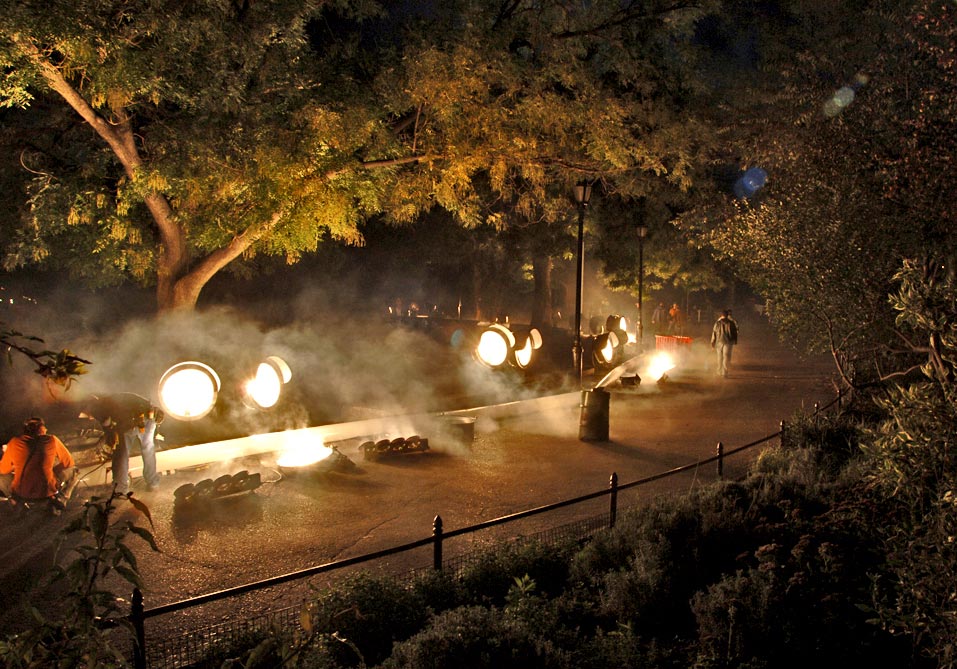
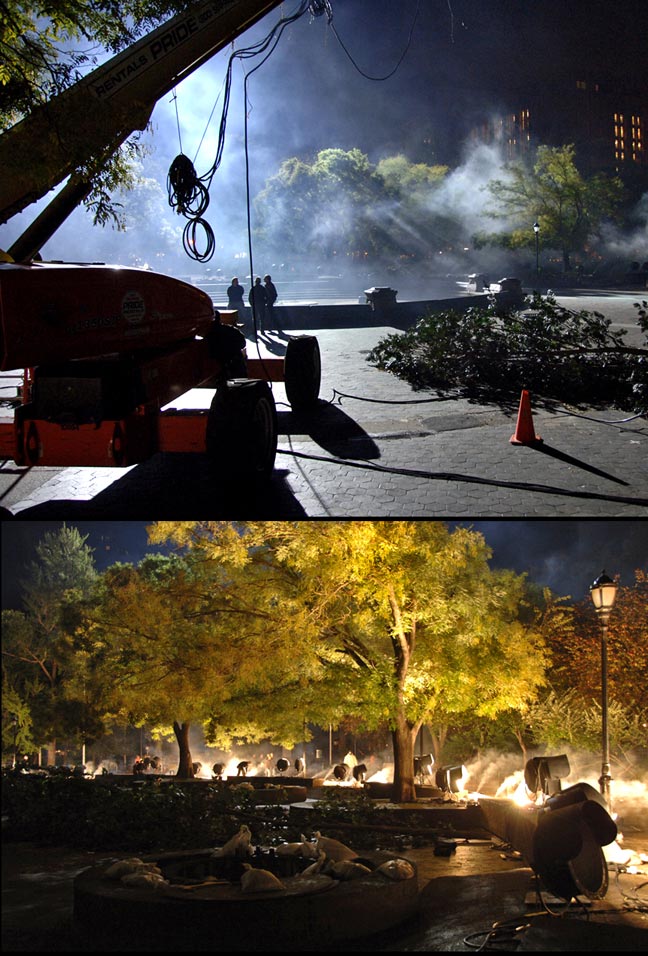
    No, this is not a war zone. For two weeks, there has been nightly filming in Washington Square Park of the 2007 film I Am Legend, starring Will Smith. You can read about the cast, synopsis, etc., here. This is the biggest production I have ever scene – 12-hour film days from 6PM to 6AM with cranes, stadium lighting, large felled trees, lit helium balloons to simulate moonlight, and, last night, the most impressive fog/lighting display. Click here for more photos.

    The film is based on the novel of the same name by highly acclaimed author Richard Matheson – some consider it one of the best horror novels written (the film The Omega Man was also based on the novel, but the new film is not based on the older film). This is a “last man on earth plot” with Will Smith trying to fend off the population, which has been transformed into blood thirsty, vampire-like hemocytes by a virus. The entire park set has been very surreal, with the various types of night lighting. And the film production crew has been extremely cooperative with the community – we have been enjoying the nightly entertainment.


  • 911

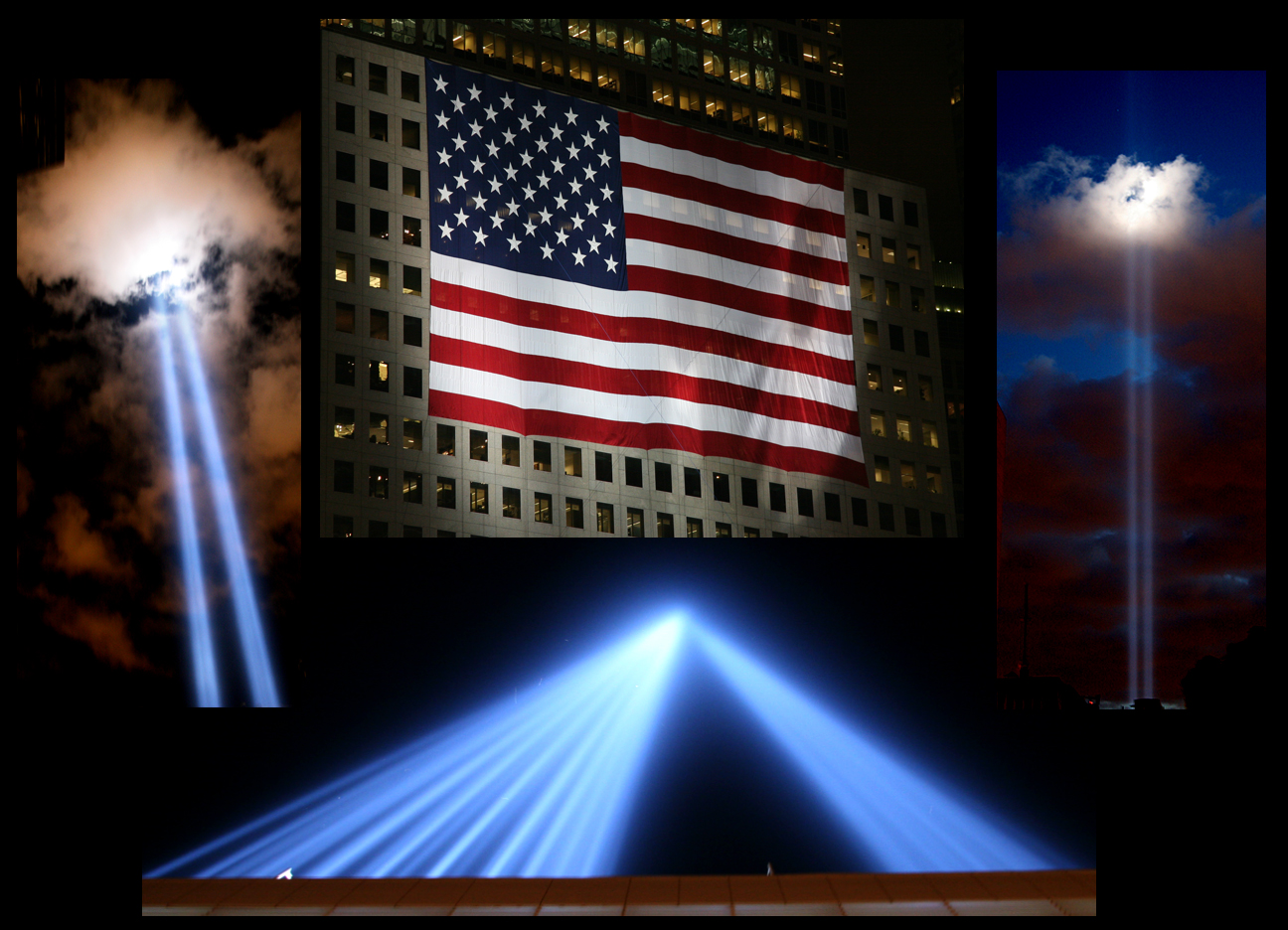
    A number of people asked why I put up no photos regarding the events of September 11 on Monday. I did take a number of photos and went to the actual site with a friend. However, I did not bring a tripod (an obvious mistake), and all the photos I took were handheld with long exposures. On reviewing the photos, I felt that they were too poor to post – there were thousands of great photos online – but friends who saw them (including three photographers) felt that I should post the better ones anyway, so here they are as a small collage.

    The illuminated clouds image on the right was taken from the Village. The other three were from the site itself. The two beams of light were visible from all over Manhattan, the boroughs, and New Jersey – they were not projected from Ground Zero itself but from the top of a parking garage just south, as seen in the bottom photo.


  • Park Night

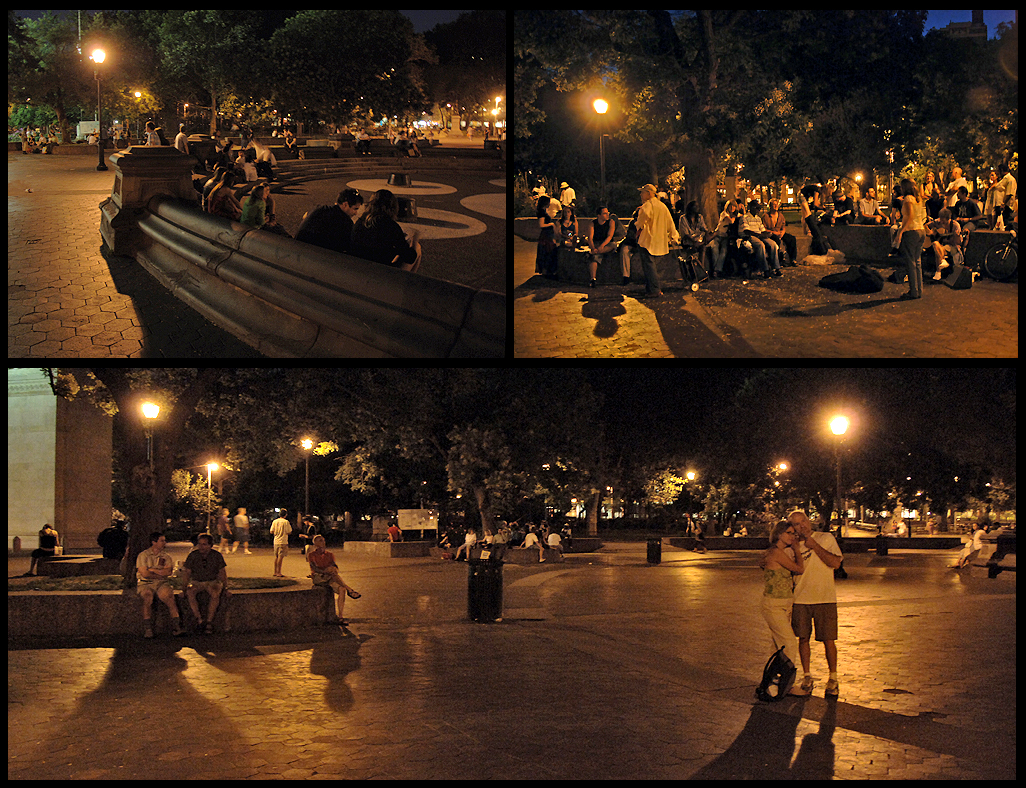
    This is a typical weekday night in Washington Square Park, where hundreds of people gather to enjoy the evening and local culture. On the upper left photo, we have the fountain area, with its stepped seating – this also forms a mini amphitheater for performers. On the upper right photo, we have a classic music scene with park regulars, many of whom have become virtual fixtures. The design of the park has eight islands in a center circle, forming coves where musicians play and audiences gather.

    The music styles and instruments (both acoustic and electric) vary considerably: guitar, keyboard, banjo, sax, drums, bass, violin, mandolin, harmonica, singers, etc. The experience is intimate and participatory more than that of street performance. Audience members frequently participate in the singing. It is not unusual on a good night to have several music groups going on at the same time. We make the rounds and sample the various groups.

    If you are in NYC, I recommend checking it out, particularly on weekend afternoons or evenings – if the weather is good, the crowds are large and the energy is high. On the bottom photo, we see about one-quarter of the circle. The couple on the right was watching music – apparently it was having a positive effect…


  • Singing Bowls

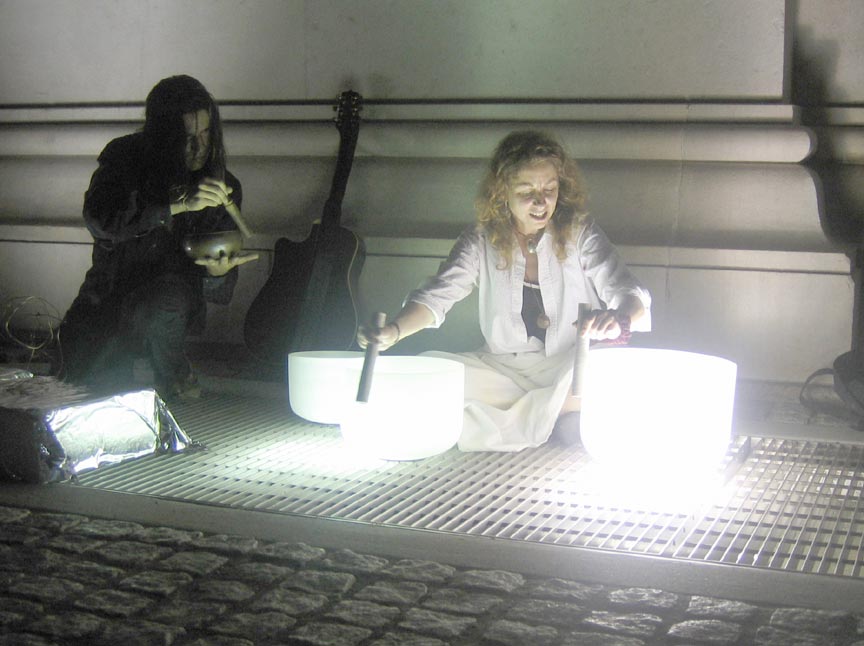
    Perhaps you have rubbed your finger around a wine glass and created a tone? There is an entire world and ancient history of “glass music” with a class of instruments called idiophones. These include musical glasses (Verrillon/Seraphine), glass harp, glass armonica, verrophone, etc. (if you are unfamiliar with these, I highly recommend reading some of the links – the entire world is just fascinating). Included are various types of singing bowls – Tibetan singing bowls are typically made of metal, but glass/crystal ones are also used.

    An entire renovation of Washington Square arch was recently completed, including the installation of some huge, high intensity ground lights. These create a unique environment for performers at night. I recently saw Wendy and Aaron performing there (using the name Dievolve). The illuminated crystal singing bowls created a beautiful effect.
    I have included a video; the first part is of Wendy on the crystal bowls and Aaron on a metal one, and the second part features Aaron playing guitar with an aggressive, angry style with Wendy producing her haunting tones. I thought the combo was quite nice in person – I hope it translates in the video clips I have provided…


  • Red Green

    Posted on by Brian Dubé

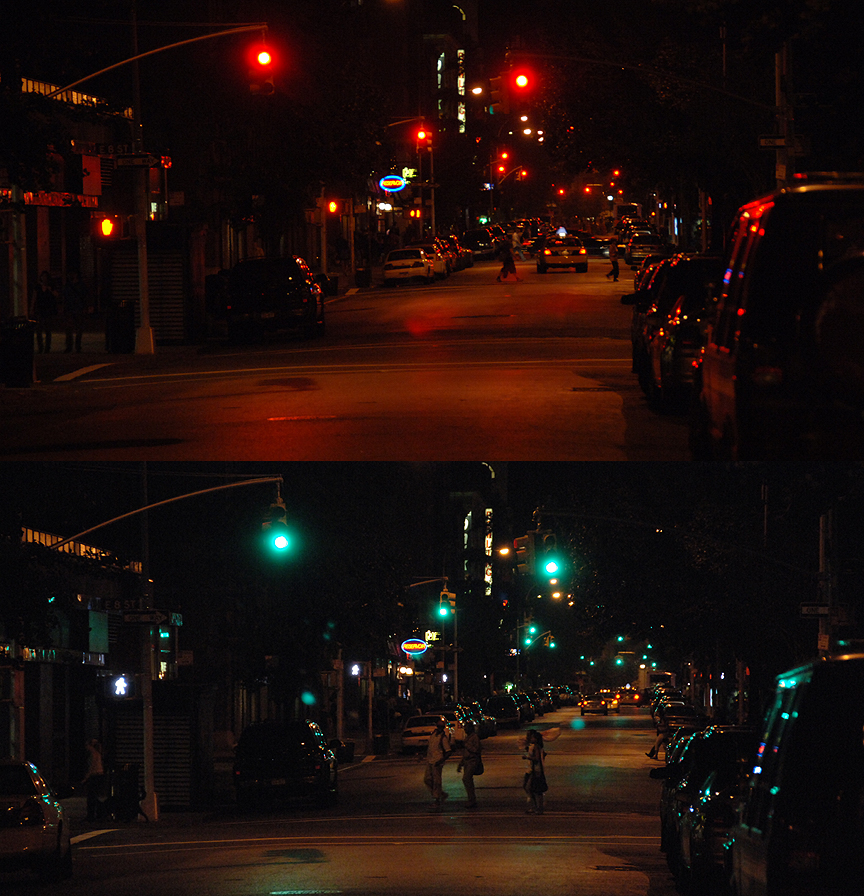
    I love night photography, but my current point and shoot is woefully inadequate for shooting at night without flash. However, last night, I met a recent acquaintance who has a lot of photo equipment and had just gotten a new zoom lens from Nikon (which he had on his D2X, for you equipment geeks). He offered me a trial run, so we swapped Flash cards and off we went.
    I was quite pleased with the low light capability, resolution, and all the other bells and whistles on a high-end camera (like Eric from Paris Daily Photo, I will also be upgrading cameras).

    This was shot on University Place. I was originally going to call this Stop and Go, but the traffic was light, and the most compelling thing about the scene when looking through the viewfinder was the effect of the color change…

    Posted on by Brian Dubé

  • Fire and Drums

    Posted on by Brian Dubé

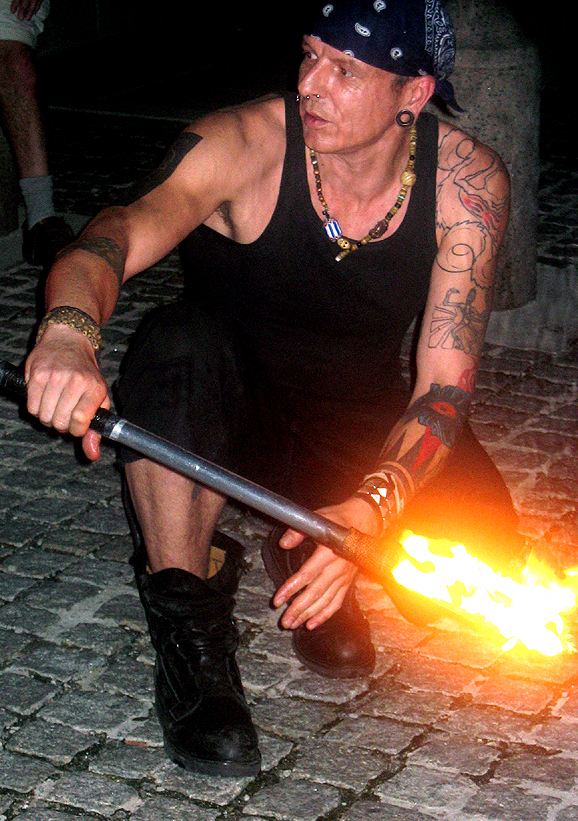
    Fire manipulation has become very popular in the last few years – fire eating/breathing, fire poi, fire meteor, fire staff, fire dance, fire fans, fire torch swinging, and fire juggling. In the photo, we have Lars (from Germany), well-furnished with body art, preparing to do fire staff. The highlight of this post is the short video, which shows his fire staff and fire eating skills while accompanied by Zafar, an urban drumming street band from Durham/Chapel Hill, North Carolina. An audience quickly assembled and responded enthusiastically. People are fascinated with fire and danger…

    Posted on by Brian Dubé


  • dinamic_sidebar 4 none

©2026 New York Daily Photo Entries (RSS) and Comments (RSS)  Raindrops Theme