• Category Archives Sports Games and Hobbies
  • Help From My Friends

    Wouldn’t you like a stadium or sports complex named after you or your company? Perhaps your immediate thoughts are, “At what cost?” In the case of Citi Field, the answer is $400 million dollars – $20 million dollars per year over 20 years. That’s a lot of money, but nothing to worry about with a little help from your friends – the U.S. Taxpayers in the form of a $45 billion dollar bailout.
    This is what prompted New York City Council members James S. Oddo and Vincent Ignizio to propose that the new park be named Citi/Taxpayer Field. The cheeky remark was circulated and commented online.

    The naming deal was made in 2006. However, by 2008, with the banking/economic crisis in full swing, Citigroup was in dire trouble as a result of heavy exposure to troubled debts in sub-prime mortgages. A government rescue ensued.

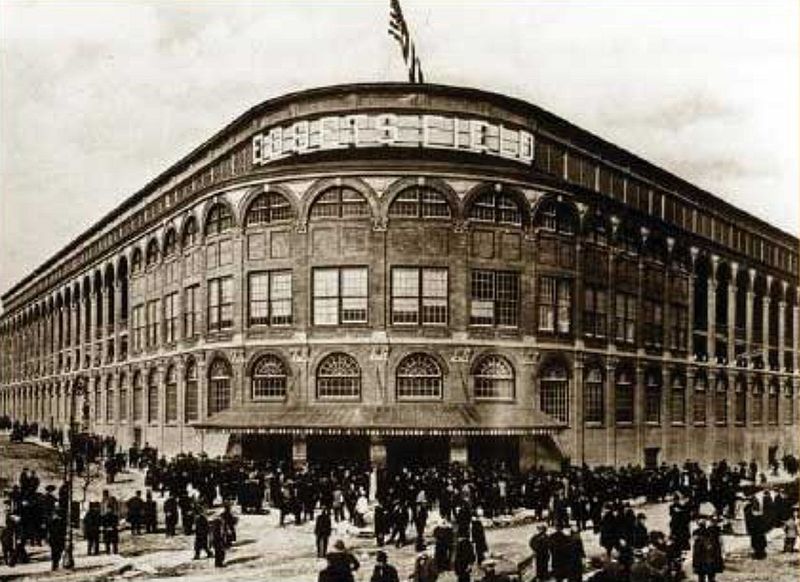
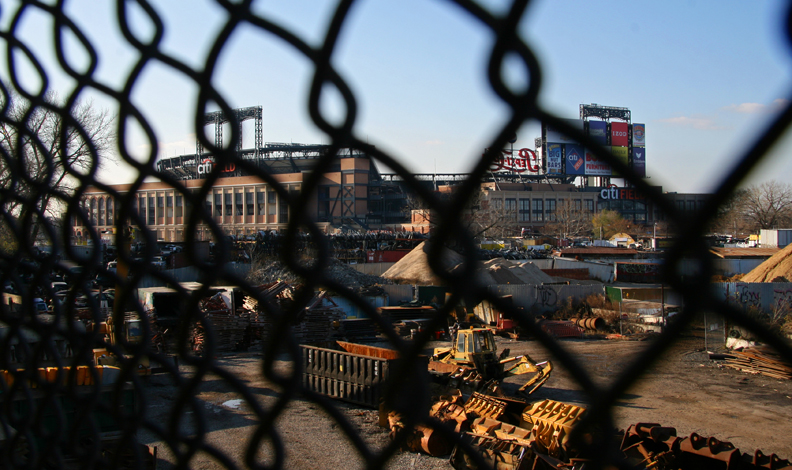
    Citi Field in Flushing Meadows–Corona Park was completed in 2009, built as a replacement for neighboring Shea Stadium as a new home for the New York Mets. It was designed by Populous and featured elements of the legendary Ebbets Field (1913-1960), located in Flatbush, Brooklyn, and home to the Brooklyn Dodgers. You can see the design influence here in the photo of the exterior entrance to Ebbets Field. See Citi Field here, as viewed from the Roosevelt Bridge overlooking Willets Point.

    Shea Stadium was built in 1964 (dismantled in 2008), funded primarily by the 1964 World’s Fair. It was used as a multi-purpose arena and had numerous rock groups and events. Pope John Paul II made an appearance there in October 1979. Perhaps its most legendary claim was the Beatles’ opening of their 1965 North American tour. Two years later, in 1967, the Beatles wrote With a Little Help from My Friends. Apparently someone from Citi was listening and later took their advice 🙂


  • Word Freaks

    One of the defining characteristics of New York City is the passion, fervor, and obsession of many individuals in pursuit of activities, some of which might not seem worthy of an adult’s time and effort.
    Most people understand that chess is a serious game – various pieces, each with its own special movement abilities and rules, make it somewhat formidable to the newcomer. And a number of its champions are known to the public, most notably Bobby Fischer.

    But Scrabble is a game that is seen by most as a past time, most often associated with their childhood. A game that can be easily learned and enjoyed by all. To see it taken seriously by adults may come as a surprise. Except in New York City, where nearly everything is taken seriously by someone or some group and where board games are no exception – the perfect activities for a city limited in free space.

    Stefan Fatsis, a former journalist for the Wall Street Journal, took time off from his job to investigate the world of top-level tournament Scrabble. He became obsessed with the game, and the book Word Freak emerged from his more than three years of nonstop Scrabbling. Published in 2001, the book became a New York Times bestseller.
    Fatsis describes the exotic subculture of characters he met in the Manhattan Scrabble Club and in the northwest corner of Washington Square Park, such as:
    G.I. Joel Sherman, a jobless, gastrointestinally challenged, full-time Scrabble player,
    Marlon Hill, an anagramming Malcolm X,
    Matt Graham, a pill-popping stand-up comic,
    Joe Edley, a nonconfrontational human-potential devotee who nonetheless irritates fellow players in his dual role as champion player and National Scrabble Association executive,
    Lester Schonbrun, an armchair Communist who began playing in the early 1960s.

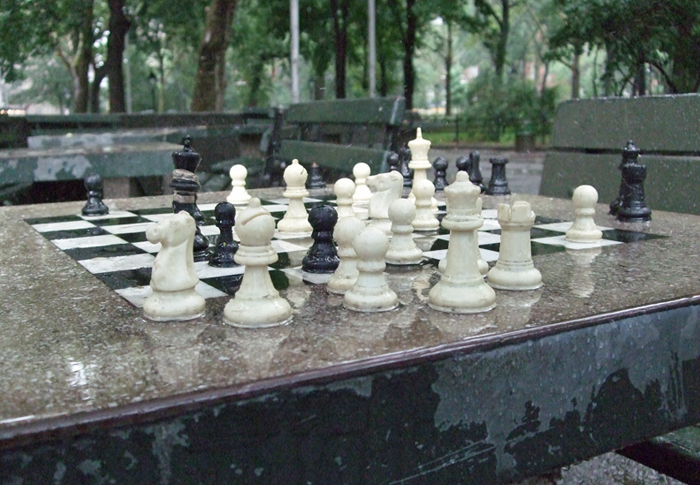
    The northwest corner of Washington Square Park, seen in the photo, has been the haunt of Scrabble players for years. In fact, this area’s use for Scrabble play was taken into consideration in the recent redesign of the park. Here, on the new enlarged stone tables, you will find serious Scrabble players with time clocks, Scrabble dictionaries, and score sheets. World-class championship players can be found among them.
    The Scrabble players in Washington Square Park were also featured in the 2004 documentary film Word Wars.

    What type of people take an ordinary game to the level of obsession? Johns D. Williams, Jr. of the National Scrabble Association says: “Scratch the surface of any champion in any individual sport and you’re often going to find an obsessed misfit who’s deficient in many parts of his life.”
    You have to give up something to be a world-class word freak 🙂

    Note: The Southwest corner of the park is the realm of chess. See Chess Monsters here.

    Related Postings: Good Fortune, Marshall Chess Club


  • Black Cowboys


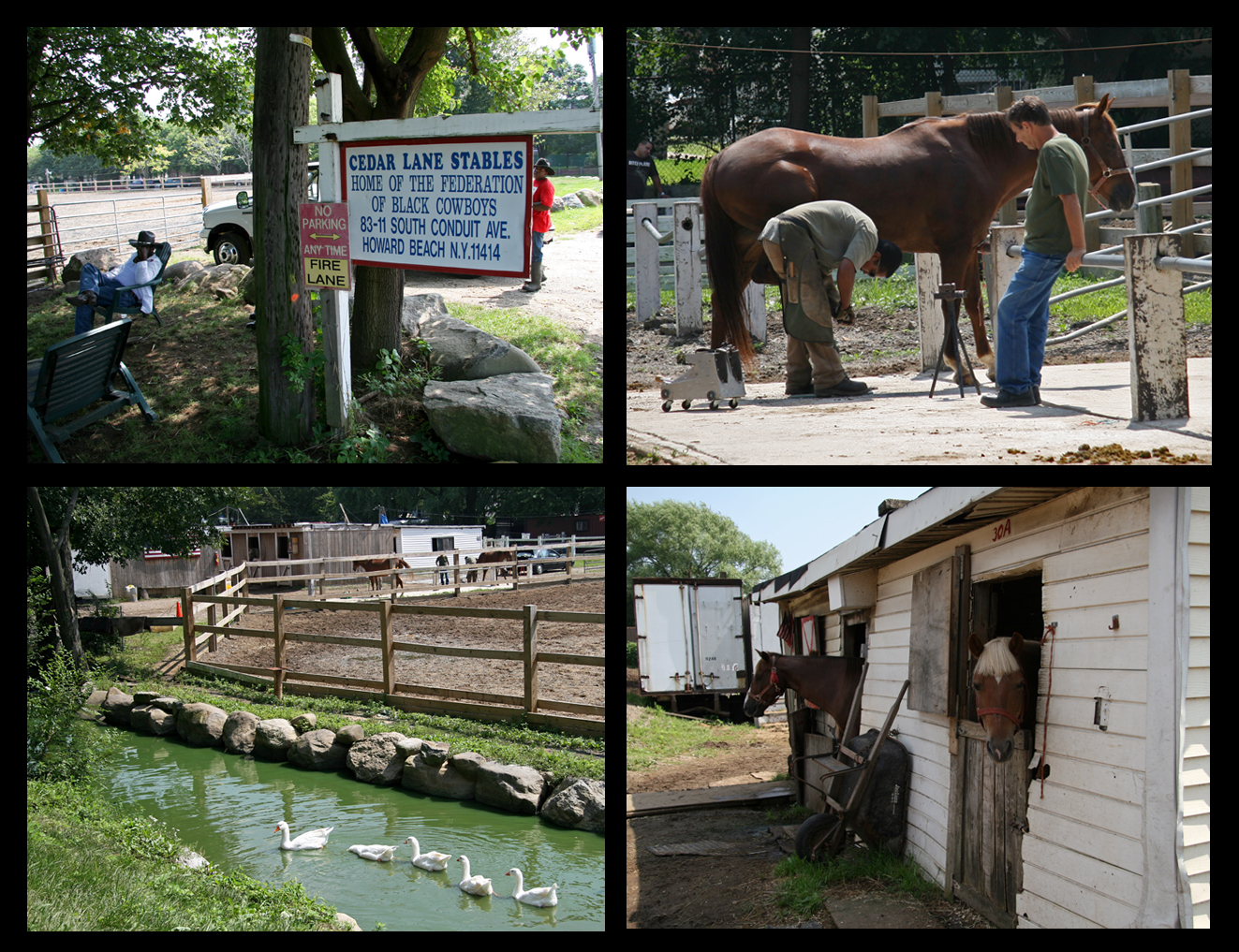
    If you are looking to visit the Federation of Black Cowboys in Howard Beach, Queens, be prepared for some circuitous circumnavigation. Even neighbors showed initial moments of puzzlement when I asked for precise final directions. The street address of 83-11 Conduit Avenue will not help you at all since the facility is on Cedar Lane, with one entrance on Linden Boulevard. (Update: A recent Google map search put the facility at 78-83 South Conduit Avenue.)


    I was quite elated when I finally found the entrance signs; I knew this would not be a typical Sunday afternoon in New York City. And it wasn’t. I was greeted by a handful of men in cowboy gear. Geese were wandering the property and a horse was being shod, while others were busy with various stable duties.

    The Federation of Black Cowboys currently has 34 members and 40 plus horses, stabled on 24 acres leased from the city since 1998. The ranch, Cedar Lane Stables, was part of a larger property, a vegetable farm owned by Herman and John Brockman. From the NYC parks website:

    The Federation of Black Cowboys was formed in 1994 when a group of diverse men came together out of their common love of horses and their desire to share the forgotten legacy of the Black West. African Americans played an immeasurable, yet often forgotten, role in the settling of the American frontier. Many African Americans made the journey west after escaping slavery, while others moved westward in wagon trains after emancipation.

    Many more moved during the exodus of 1879, when many African Americans, convinced that the end of Reconstruction meant the end of their chances for a successful life in the South, relocated to states such as Texas and Oklahoma. By the closing of the American frontier in 1890, there were 500,000 African Americans living in these two states alone. Many of these frontier settlers found employment as cowboys, a position essential to the economies of many western states.

    The non-profit organization, headed by Edward J. Dixon, has a primary goal to expose black children to the art of western horsemanship, the skills required to properly care for a horse, and the historical role of black cowboy in the old West. Read more here (updated 12/9/11). This is done through regular instructional programs, work release programs, prison visitations, parades, lectures, block parties, rodeos, and showdeos 🙂

    Note: I have a relationship with this world beyond photographs and a story. If you are curious about my friends in common, go here and here. My business activities are revealed here and here.


  • Xiangqi

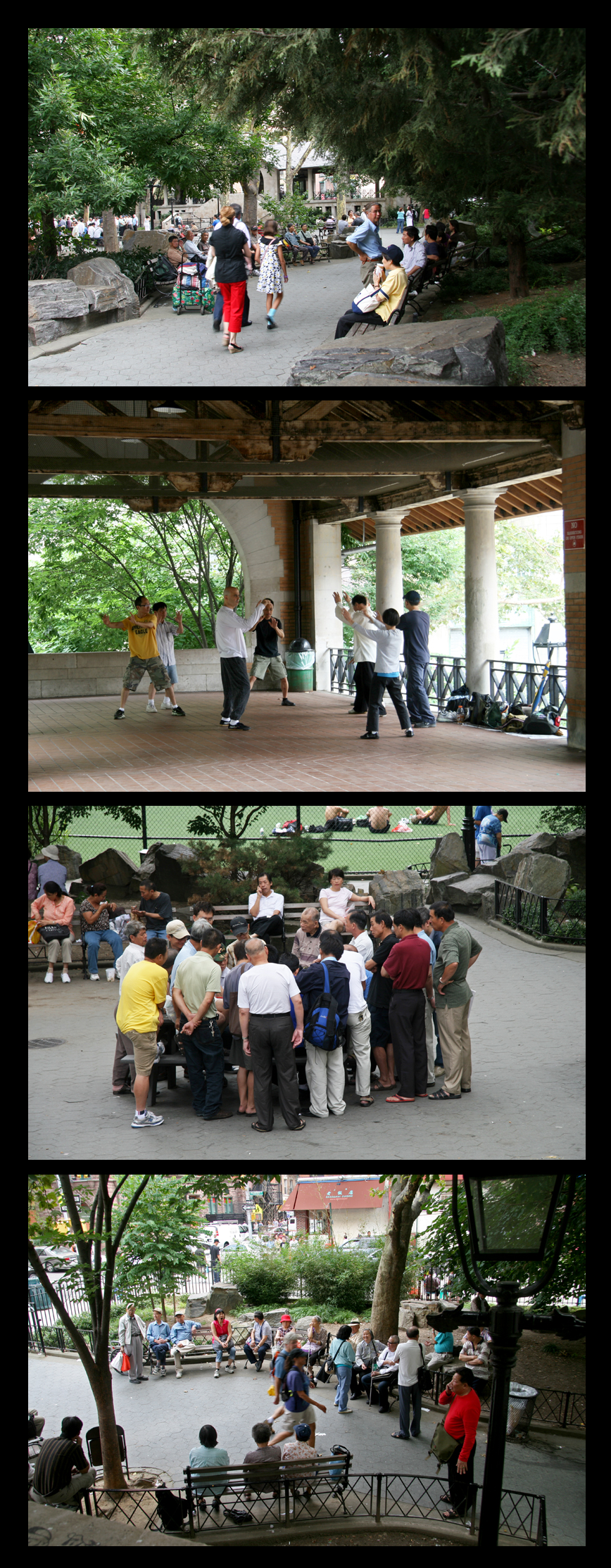
    If you want a full cultural immersion experience, head to Columbus Park on a Sunday in Chinatown. This tiny park is Chinatown’s playground, home to a wide gamut of traditional Chinese recreational activities. Here, you will find people doing Tai Chi or practicing martial arts in the pavilion, playing folk music, displaying caged birds, singing Peking Opera, women playing mahjong, and hundreds of men engaged in numerous games of Xiangqi (Chinese or elephant chess). You may find cobblers, watch repairers, and fortune tellers. There is also a children’s playground and basketball courts. See more photos here.

    Columbus Park is one of the city’s first major urban parks (the park has alternatively been named Mulberry Bend Park, Five Points Park, and Paradise Park). The 3.23 acre park was planned in the 1880’s by Calvert Vaux, co-designer of Central Park, and opened in 1897. It was named Columbus Park in 1911. Read more about Columbus Park at the New York City Parks Department website here. From their website:

    It is situated in the heart of one of the oldest residential areas in Manhattan. The southern end is adjacent to the infamous “Five Points.” Until 1808, the site for the park was a swampy area near the Collect Pond (now Foley Square) and hosted a set of tanneries. In 1808 the pond was filled and became Pearl Street. When the filling began to sink, a foul odor emerged which depressed the living conditions of that neighborhood. As a consequence, the area became host to one of the world’s most notorious tenements, known for its wretched living conditions and rampant crime, earning such names as “murderer’s alley” and “den of thieves.”

    This notorious slum, Five Points, was dominated by rival gangs such as the Roach Guards, Dead Rabbits, and Bowery Boys, a central subject of the book The Gangs of New York by Herbert Asbury, published in 1928. This, in turn, inspired the 2002 Martin Scorsese film, Gangs of New York.

    To survive in New York City, unless you have enormous wealth to buffer the harsh environment, you must learn to be resourceful. Ethnic immigrant groups find ways to import their cultures. Regardless of how inhospitable the city might be or incongruous the activity, New Yorkers improvise, adopt, and adapt. The Chinese have done that remarkably well…

    Location: Columbus Park is located one block south of Canal Street and one block west of Mott Street in Chinatown. It is bounded by Baxter, Mulberry, Bayard, and Worth Streets.

    Related Postings: No MSG, T?t, Big Buddha, Hallmarks and Earmarks, Durian, At Arm’s Length, Year of the Rat, Pearl River Mart, Buried Treasure, Tea Time


  • Chess Monsters

    The last great chess player I saw in Washington Square Park was Yaacov Norowitz; this was to be his story, as well as that of the other great players who have graced the southwest corner of the park. But I have not seen Yaacov playing in some time.

    On and off, for a few decades, I have spent many a Sunday afternoon watching the games of many masters, international masters, grandmasters, and blitz players. I never got to see Hikaru Nakamura, reputed to be one of the undisputed monsters of blitz chess. I did often see Israel Zilber, a former Latvian chess champion who was homeless during most of the 1980s and was one of the best players in the park.

    One of the wildest incidents I have witnessed in this area was a shooting. As all the players scurried for cover behind the low concrete wall which encircled the tables, one chess fan who had been watching the games actually made the rounds pausing everyone’s clocks. Once the smoke had cleared and the police had reestablished law and order, the players jumped backed and resumed playing as if nothing had happened. We were told that that the incident was motivated by a previous drug deal gone awry. On this day, one party encountered the other, pulled out a gun in broad daylight, and fired.

    One of the highlights for me was the regular appearance in the 1980s of Grandmaster Roman Dzindzichashvili, a two-time U.S. chess champion. He played blitz chess for money, as is common there. Blitz is speed chess, where each opponent is limited to 5 minutes total per game. Accumulated time for each player is tracked using a chess clock. A player whose time runs out loses (unless his opponent does not have enough material to win).

    There is a spectrum of playing styles here. Much of street or park chess played for money involves hustling, which can take the form of anything from the classic hustle (i.e. disguising one’s skill level) to outright cheating, which I have witnessed. Skills are honed specifically for speed chess, an aggressive style of playing and a mastery of all the tricks and traps of the game, along with distractions such as chess trash talk. Time odds are frequently offered to players of lesser strength. When played for money, games range from a few dollars and up – I have seen sessions played for as much as $100 per game. Side bets are also frequently made. Some regulars (such as Bobby Plummer, aka Sweet P) essentially set up office, staking out a good table early and barking the offer of a game to passersby. Some are able to eke out a subsistence living. This area is known worldwide to chess players, and many come here for a challenging encounter, prepared to lose some cash. Read article here.

    This corner of the park was the setting for the 1993 film Searching for Bobby Fischer, a story based on the life of chess prodigy and Village resident Joshua Waitzkin. Bobby Fischer was a player here in the 1960s – unfortunately, this was before my time in New York City, and I never got a chance to see this legendary chess icon play.

    The quality of player has gone down decidedly in the park, as has the physical environment in this area, which badly needs an update (scheduled as part of a future phase of the park renovation). I hope for a return of the chess monsters 🙂

    Notable chess players who have played in Washington Square Park:
    Joel Benjamin, Roman Dzindzichashvili, Kamran Shirazi, Joshua Waitzkin, Bruce Pandolfini, Vincent Livermore, Russian Paul, Hikaru Nakamura, Yaacov Norowitz, Luis Busquets, Bobby Fischer (early 1950s), Maurice Ashley, Asa Hoffman, and Israel Zilber. There are also regular games played in Union Square, Times Square, and Central Park.

    Related Postings: Good Fortune, Marshall Chess Club


  • Under the Sun


    When I saw the tip of a sail at a distance, darting to and fro, I was so excited. I knew what I was seeing: land sailing (aka land yachting or sand yachting). My first exposure to this activity was on television many years ago from the flats of Utah or Nevada. At the time I was fascinated – the whole thing looked so exhilarating and novel. However, I assumed I would never see this type of thing, lest I make a trip out west with a specific agenda to find a land sailing locale.

    Land sailing in New York City? Floyd Bennett Field, with all of its unused runways, is a natural for this, but it still caught me by surprise to see an activity that requires such a large amount of unobstructed space. Years of living in New York City conditions you to negating an activity like this from contemplation.

    It took some circumnavigating by car to find the runway being used. I was greeted cordially by the sole sailer at the time, Rick Honor, who had just done an interview for a piece on Floyd Bennett Field by the New York Times. Some would say it was another case of Morphic Resonance.
    Rick was extremely generous, answering whatever questions I had about the activity and the equipment. He showed me his car, which was packed with a variety of air-powered vehicles, including equipment for kite boarding. He told me that on many weekends, there were land sailers who would be happy to teach me and let me sail one of their rigs. Here’s a video of Rick land sailing:

    I was also surprised to learn that this activity was not born recently but had variations going back to China and Egypt. The modern precursor is credited to Flemish scientist Simon Levin in the 16th century (updated 12/9/11).
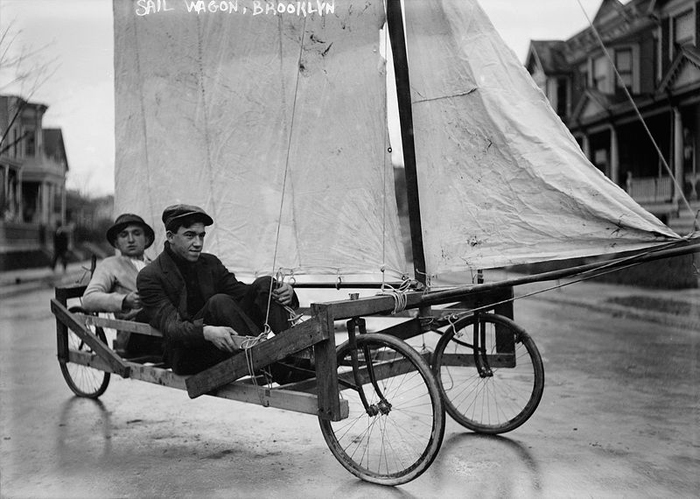
    In its current incarnation, land sailing equipment is high-tech, with eight classes of vehicles including kite buggying. The standard construction today consists of a tricycle buggy with a main sail. Land yachting competitions take place worldwide. I was astounded to find a photo of a sail wagon on the streets of Brooklyn from the early 20th century, circa 1910-15. There is truly nothing new under the sun…

    Related Posts: Floyd Bennett Field, Umbrella and Chevy


  • Plum Beach

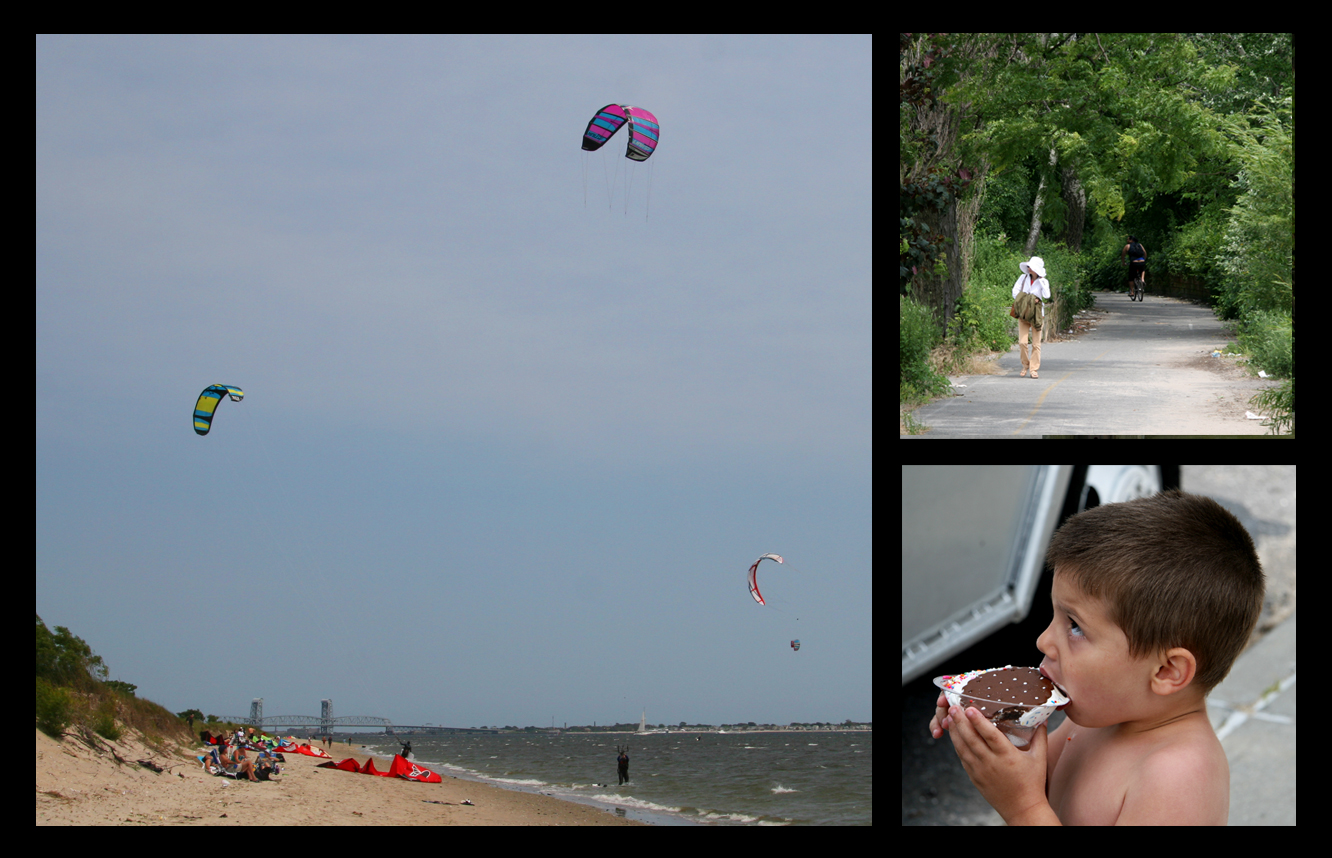
    The sight of kite surfers and the convenient access to Plum Beach from the Belt Parkway prompted a quick detour from my recent excursion to Floyd Bennett Field. Unfortunately, this convenience in a major metropolitan area, combined with relative isolation, has given Plum Beach a rather unsavory and spotted past.

    Older residents reminisce about days when Plum Beach was a lover’s lane. Since that time, it has become known as a gay spot. From a New York Times article from 2006, Deadly Days at a Lovers’ Lane:

    Decades ago, the beach’s parking lot was notorious as a lovers’ lane for the neighborhood’s besotted boys and girls. In recent years, the area has become better known as a gay trysting spot. The police say that the four men accused in the death of 29-year-old Michael Sandy of Williamsburg this month were aware of the area’s reputation when they lured him there.

    The incident refers to an attack by four men who lured the gay victim to Plum Beach using an Internet website. A planned robbery scheme derailed when the victim ran from his assailants onto the Belt Parkway, where he was struck by a car. Those familiar with the area also warn of drug use and needles on the beach. An article from Citynoise on Plum Beach in 2005 opens:

    Plum Beach is a grimy spit of sand that is just past Sheepshead Bay and part of Gateway National Park. It’s beautiful and filthy and therefore gloriously neglected, unkempt and various.

    The article goes on to discuss the various activities. Reading the comments, which span four years from 2005 to 2009, provides an informative history based on personal experiences.

    When I stopped at Plum Beach, I was not aware of any of this history or reputation. I also visited after a cleanup effort in April of 2009 by the American Littoral Society, so my visit was untainted by garbage, which apparently used to be a huge problem.

    The beach, named after the beach plums that grow there, is part of the Jamaica Bay Unit of the Gateway National Recreation Area, which includes the Jamaica Bay Wildlife Refuge (see here and here). There are many great beaches, along with great spots for nature and wildlife lovers in this area of Brooklyn and Queens. At Plum Beach, you will find kiteboarding and windsurfing – rare sights in New York City, and not what the average visitor is looking for. But, hey, we got the little stuff too* 🙂

    *This is my first use of a personal inside joke.


  • Umbrella and Chevy

    Had I known of Otto Lilienthal’s impressive early pioneering efforts in human flight, it may have inspired more serious and potentially successful efforts of my own as a child. But, having neither the funds, knowledge, or resources, my earliest attempts consisted of jumping off my father’s Chevy with an umbrella to obtain some type of gliding experience. Of course, there was none. Somewhat later, I learned to travel the forest canopy, moving from treetop to treetop ala Tarzan.

    As an adult, still desperate to become airborne, I took 10 hours of flying lessons in the 1970s. But I slowly realized what every aviator knows: flying is a hobby for the rich, or at least those with disposable income who are willing to make the sacrifice. And, down the road, some investment in a plane or high rental fees would be necessary. An interest in hang gliding was quickly curtailed with tales of accidents and spinal injuries.

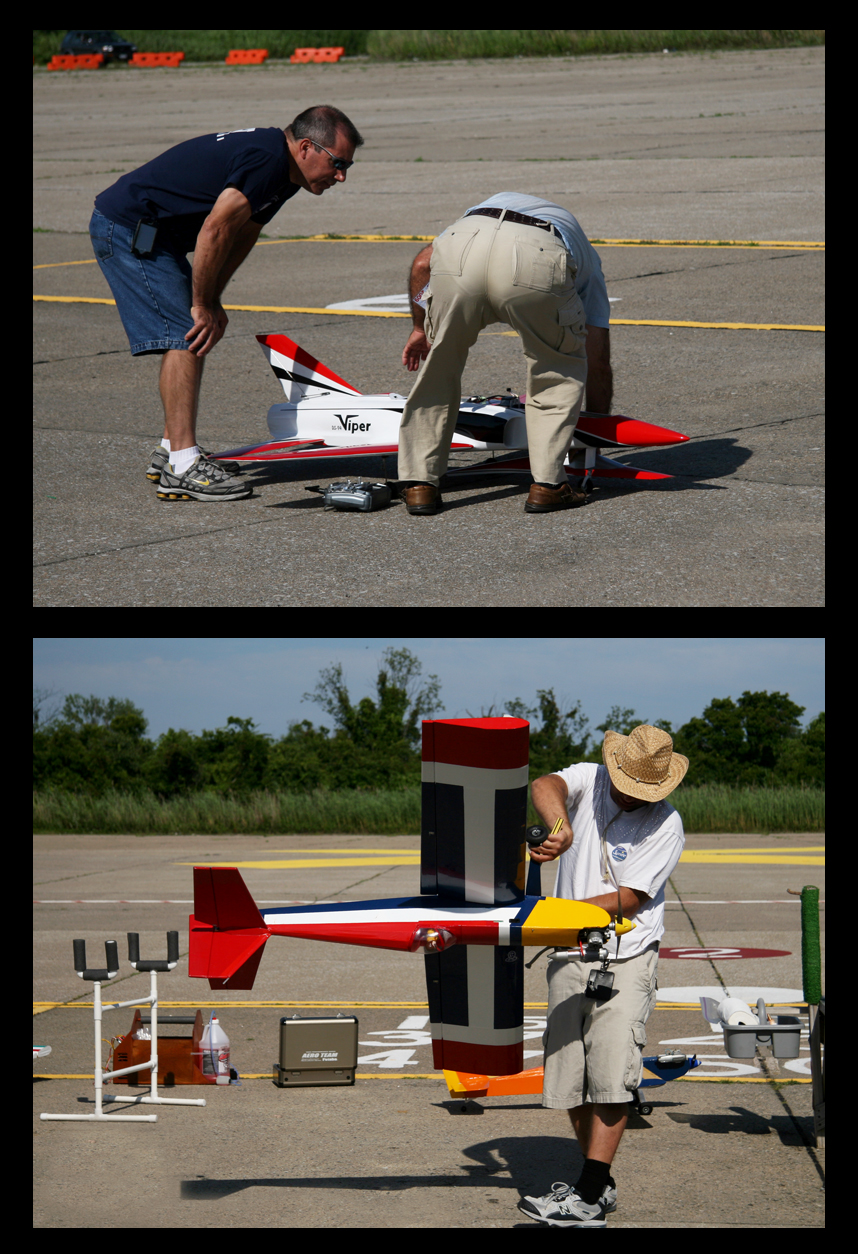
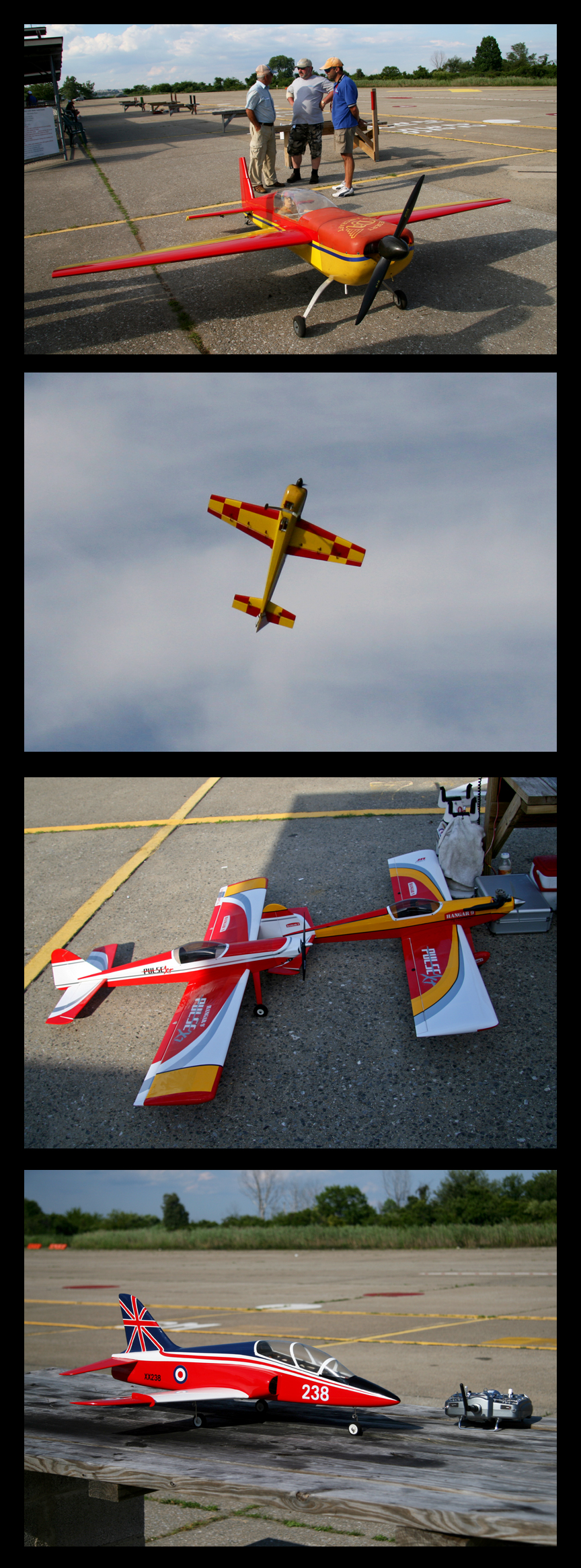
    Much later, while perusing magazines in a New York City shop that advertised itself as having an exhaustive selection of titles (over 3000), I was quite shocked to see a magazine on RC (radio-controlled) jets. As a child, I had seen tethered U-control planes with their operators circling in a dizzying affair. I had no idea that hobby aircraft had advanced to the point where there existed genuine ducted fan engines powering scale model jets.

    But where to see such a thing in New York City? Nowhere. Or so I thought. Yesterday’s second excursion to Floyd Bennett Field confirmed what I had read. There is an active club of RC Aviators operating on an unused runway at the decommissioned airfield. A number of enthusiasts were on hand and the displays of flying were very impressive, however, what I was seeing was exclusively propeller-driven planes. Secretly, I was hoping to see some jets. Soon, my wishes were fulfilled, and a couple of jet fliers turned up and flew their aircraft. See my photo gallery here.

    I also learned that not only did RC propeller planes exist in both fuel-powered engines but jets also were available with electric ducted fan turbine engines. Surprisingly, an entire setup, including the radio transmitter, can be had for a few hundred dollars. At the other end of the spectrum, some run into the tens of thousands. There are even RC Concordes; I was informed of one perfect scale model with a working hydraulic nose, real windows, etc., costing upwards of $30,000. Beats an umbrella and a Chevy 🙂

    Note: I will be posting a video of my excursions to Floyd Bennett Field and of the various activities there. Check back here in a few days.


  • Floyd Bennett Field

    One of the most amazing and interesting places I have ever visited in the five boroughs of New York City is Floyd Bennett Field. This enormous space, with huge undeveloped tracts of land, is startling for this city. Nearly all of the airfield is drivable, providing an easy way to explore for a first-time visitor. See the gallery of photos here.

    Knowing of my visiting friend’s interest in aviation and model planes, I recently investigated the details about Floyd Bennett Field, a place which I had been looking to explore for some time. In a replay of Morphic Resonance, the New York Times just happened to be running a feature article that very day (see it here).
    Unfortunately, my friend was not able to join me, so I made the visit without him. After my first visit, I know that I will be making other visits in the future.

    Completed in 1930, primarily on landfill, Floyd Bennett Field was New York City’s first municipal airport, later used as a military training and testing facility until the airfield was decommissioned in the early 1970s. Now it is a virtual playground. Weeds sprout from crevices on unused runways.  From the New York Times article:

    The Park Service has preserved the historic look and feel of the airfield while seeding an area larger than Central Park with things to do and see, from camping and gardening to bicycle races, kayaking, fishing, golf and indoor sports. There’s even an archery range and a cricket pitch.

    Add to that radio control jet aircraft flying and land sailing, which I will feature in later posts.
    The airfield also boasts a number of antique hangars. Hangar B houses a number of retired military planes – some can be boarded. (The photos in today’s collage were all taken in or immediately outside Hangar B.)

    The hangar is also home to the Historic Aircraft Restoration Project, a volunteer organization of aircraft enthusiasts, engineers, and pilots, who rebuild vintage aircraft and assemble full-size replicas. Fortunately, I was able to tour Hangar B and the workshop; it is only opened Tuesday, Thursday, and Saturday.


  • Not Going Anywhere

    This is the first time I have seen wrestling in a park in New York City. I found it an appropriate metaphor – living in New York City is often a contact sport, and in many respects we do wrestle our way through life here. Much of my life seems to be finding ways to navigate the shoals, looking for ways to soften the blows of the city. There are great conveniences living here; the depth and breadth of products, food, entertainment, and culture is perhaps unequaled. However, it does come at a price, and the population density both giveth and taketh away. A New Yorker I know, born and bred in Brooklyn, once said that New York City was the punishment for living. A bit harsh, perhaps. She now lives in California.

    Why do New Yorkers do it? What type of people would want to live here, bear the slings and arrows, and fight their way through daily life? Perhaps the individual’s T-shirt in the photo, which reads “Psych Ward,” offers a possible answer.

    I am reminded of a business owner who was asked the question, “Do you ever think of selling your business?” to which he answered, “Every day.” For those of us who are business owners, this is stating the obvious. I might speculate that on a similar note, I have often been asked, in response to my whining about some aspect of the city, particularly real estate costs and lack of space, “Do you every think of moving out of the city?” My answer is, I would guess, the same as that of many fellow residents: “All the time.”

    The number of times that I have “planned” to move from the city, fantasized, or looked at homes all over the planet are innumerable. Most residents I know speak of moving with a smugness about how easy it would be and often with an assuredness of how they will be doing this soon. I remember a Brooklyn resident who had returned from Santa Barbara, California. He was on a rant about why there was no good reason not to move there immediately. Except that he would not.

    But all this is just retelling the obvious, and although some move away and others retire elsewhere, the biggest obvious fact to many of us here about these whiners and malcontents is that like most dyed-in-the-wool New Yorkers, they are not going anywhere


  • Bowlmor

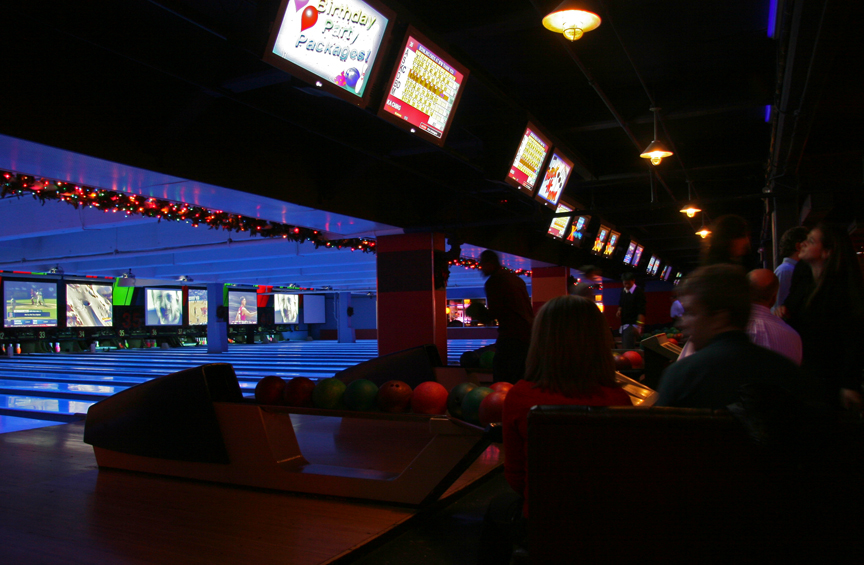
    I can’t think of anything that seems more antithetical to Manhattan than bowling. Firstly, it has a definite suburban cache. I realize that bowling is a serious sport requiring skill and discipline, but growing up outside the city, bowling was an act of desperation for bored and frustrated teenagers – one of the few activities sanctioned by adults.

    Also, bowling, like tennis, requires large amounts of space. In New York City, space is a luxury and is costly. Activities and usage of space always has to be considered, and like every business in New York City, usage is metered. To survive, you need to know the cost in dollars per square foot per hour. Bowling is not a particularly profitable use of space, which is why you don’t see many bowling alleys here – there are only four in the borough of Manhattan. They are typically low visibility, located off the beaten path like at Chelsea Piers or on upper floors like Bowlmor.

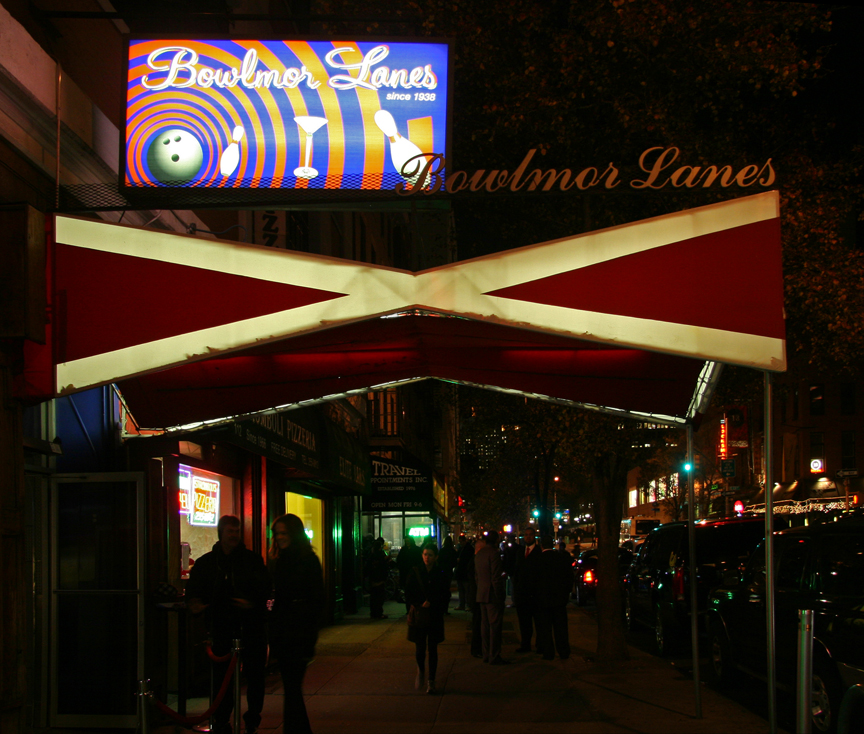
    Bowlmor is located at 110 University Place in the heart of the Village. Its bold bright signage can be easily overlooked, competing with a plethora of other attractions and Union Square nearby.
    I have been familiar with Bowlmor as long as I have lived in the city. It has been in business since 1938. Bowling was quite popular at one time in New York for 100 years, from the mid-1800s through the 1950s (Richard Nixon bowled there in 1955). The first lawn bowling grounds in the United States were built in downtown Manhattan (in an area still known as Bowling Green). But the familiar specter of rising rents and declining space put an end to many bowling alleys. Bowlmor is the only one remaining from those early days. However, it did go through its own near fatality.

    In 1997, Bowlmor was purchased and rescued by Tom Shannon, who reinvented it as a trendy, chic nightclub operation. Their website uses words like sexy, naughty, tasty, and cool to describe what is essentially a nightclub with bowling. The business occupies two entire floors, with a total of 40,000 square feet and 42 lanes. It features glow-in-the-dark bowling, big screen video walls, a thumping sound system, a full service restaurant serving lane-side food and drinks, and a sports bar. They expanded in 2001 to a third floor with Pressure, a high-end event space.

    So I finally decided to make a personal inspection. On my visit, I was welcomed and encouraged to take photos. There were several special private parties, including a function for Novartis Pharmaceuticals. The place was abuzz with balls, pins, and drinks. Bowlmor has been visited by many celebrities, evidence of its place on the A-list. You can see a showcase of autographed bowling pins here


  • Ice Blue

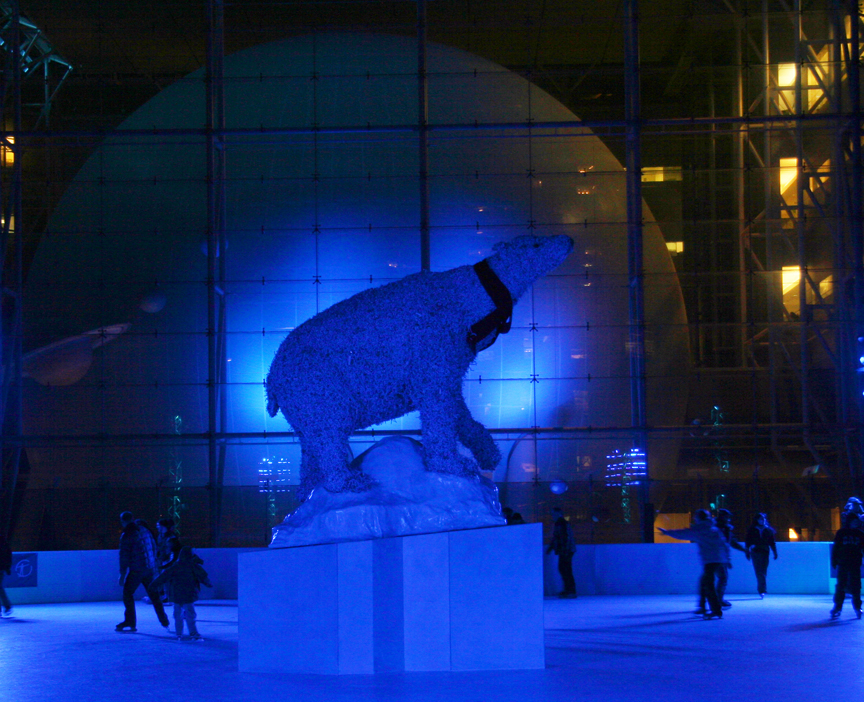
    This is the new Polar Rink at the American Museum of Natural History. I was invited to attend a press preview before the official opening on Saturday, November 22nd. The rink is beautifully situated on the Arthur Ross Terrace, with magnificent views of the Rose Center for Earth and Space glowing in blue and the surrounding Theodore Roosevelt Park. Skaters glide around a 17-foot-tall polar bear made of openwork stainless steel festooned with pine boughs and twinkling lights. And of course, access to the Rose Center (with the new Hayden Planetarium) and the Museum itself is just a stroll away. It is nice to see the museum make efforts and investments in modernizing to keep up with changing times and patrons who have become more used to an increasingly technological world.

    One thing that fascinated me was that the rink was using synthetic ice. Apparently, synthetic ice has been around since the 1960s (most using polyoxymethylene, i.e. Delrin), but widespread adoption has been held back by inherent limitations of the polymers – to glide on the surface as one can on real ice, there must be a regular application of a silicone compound. This compound builds up on the surface, collects dirt, and has been a source of much dissatisfaction among skaters. Also, joinery of the panels was an issue – earlier synthetic ice products used simple butt joints which could be felt by the skater. These shortcomings have been addressed by Perry Boskus, developer/inventor of the Super-Glide surface, which is being used at the Polar Rink and is manufactured by Florida Skating, Inc. The product is made in-house with their own technology. Lubricating ingredients have been injected into the core material to provide a surface which provides glide properties regardless of wear. A new joinery system (a variation of a dovetail joint) was also developed to hold the panels together to make the seams nearly undetectable.

    I had the privilege of meeting Perry at the ceremony. He was quite enthusiastic about the new installation and worldwide interest in his product. There are hundreds of commercial and residential installations around the world.
    I subsequently learned through my reading that Perry was North Atlantic Figure Skating Champion, Eastern Seaboard Speed skating Champion, a hockey player, and Professional Figure Skating Coach.

    I love blue, and the aura of the evening was decidedly blue. I was pleased to read the Super-Glide brochure this morning and find out that the latest incarnation of the product is called Ice Blue

    Note: Hours and additional information about the rink can be found here (update 1/9/12: Link no longer works). Skate rentals are available and included with the admission.


  • Love Affair

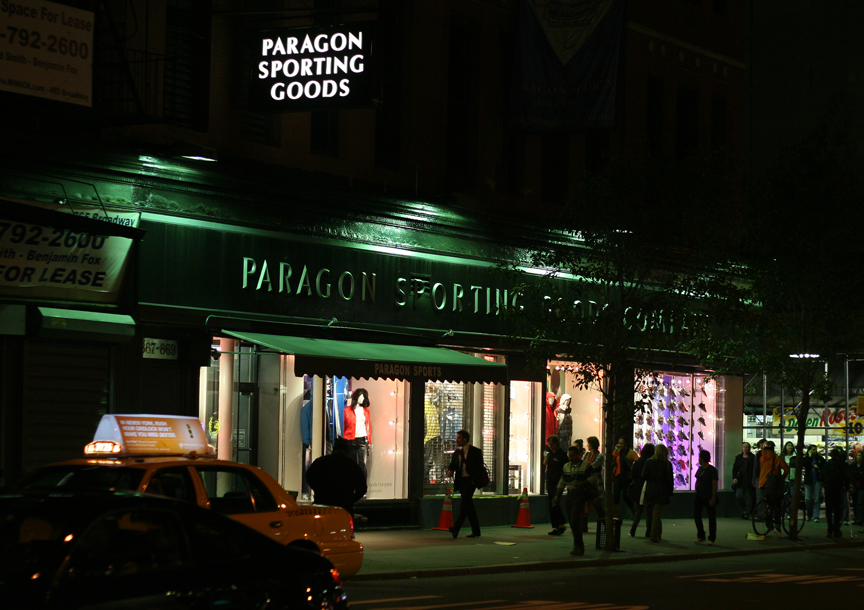
    Why would anyone have a love affair with a sporting goods store? It’s simple. Let’s say you just moved to NYC to go to college and it’s 1969. And let’s say you never left home before in your life – everything is new, exciting, and scary all at the same time. Winter is coming, and you need a warm coat. You have virtually no money, but fortunately, your mother gave you money to buy one. Where do you go and what do you buy?
    Those who know things say to go to Tents and Trails or Paragon.

    Tents and Trails was on Park Place, virtually no man’s land at the time. It was a real destination retailer with a virtual cult status and a quality reputation – I have purchased many things there. But it wasn’t that big. I needed a place that felt overwhelming, like the city itself. Paragon just felt like the right place. At the time, Northface was the brand of choice. So that is my first memorable NYC shopping experience: Northface at Paragon. That coat lasted for years, and I saw it and Paragon as responsible for providing protection from harsh conditions.

    There’s a wave of comfort that comes over you when you enter a place like this – a feeling of confidence that you need to look no further. After all, this is the leading sporting goods store in NYC, the preeminent city in the country. This is a no-nonsense New York place. All the quality brands with a experienced sales staff that can be brutally honest.

    Paragon Sports, 867 Broadway at 18th Street, has been in business since 1908. Many consider it to be the finest worldwide. It has an enormous product line (50,000 products), cutting-edge equipment, and clothing. Many products are unique, carried exclusively at this store. It has only one location, much like a handful of other unique, iconic, legendary NYC stores such as B&H Photo and J&R Music World. There’s an intensity about these stalwart, single-location shops – no dilution of expertise or product. Everyone and everything is under one roof.

    Be forewarned – if you visit, you may fall in love too 🙂

    Suggestion: If you visit, make sure to see all three floors and all the rooms on the ground floor. While in the area, visit ABC Carpet and Home and nearby Union Square. If you work up a hunger, grab a meal at Republic.


  • Heart Warming

    I remember one occasion where former Mayor Rudy Giuliani was chastising the press for asking questions he considered inappropriate at the time and focusing on the negative. Now although Giuliani was not seen as the poster child for warmth and tenderness, his point was well taken. The media and consumers of media are fueled more by the negative than the positive. Violence, infidelity, crime, tragedy, war, and crisis all certainly draw more attention than tales of goodness. Unless they are supreme acts of philanthropy in the league of Mother Teresa, some element of drama or sensationalism is needed to pique the interest of readers and viewers. Otherwise the story will be lost in the slush pile. People want to hear tales like that of former Governor Eliot Spitzer caught with a prostitute, not about a man who helps a disabled person across the street. Competition for people’s attention is fierce, and even extreme occurrences can become tiresome for many.

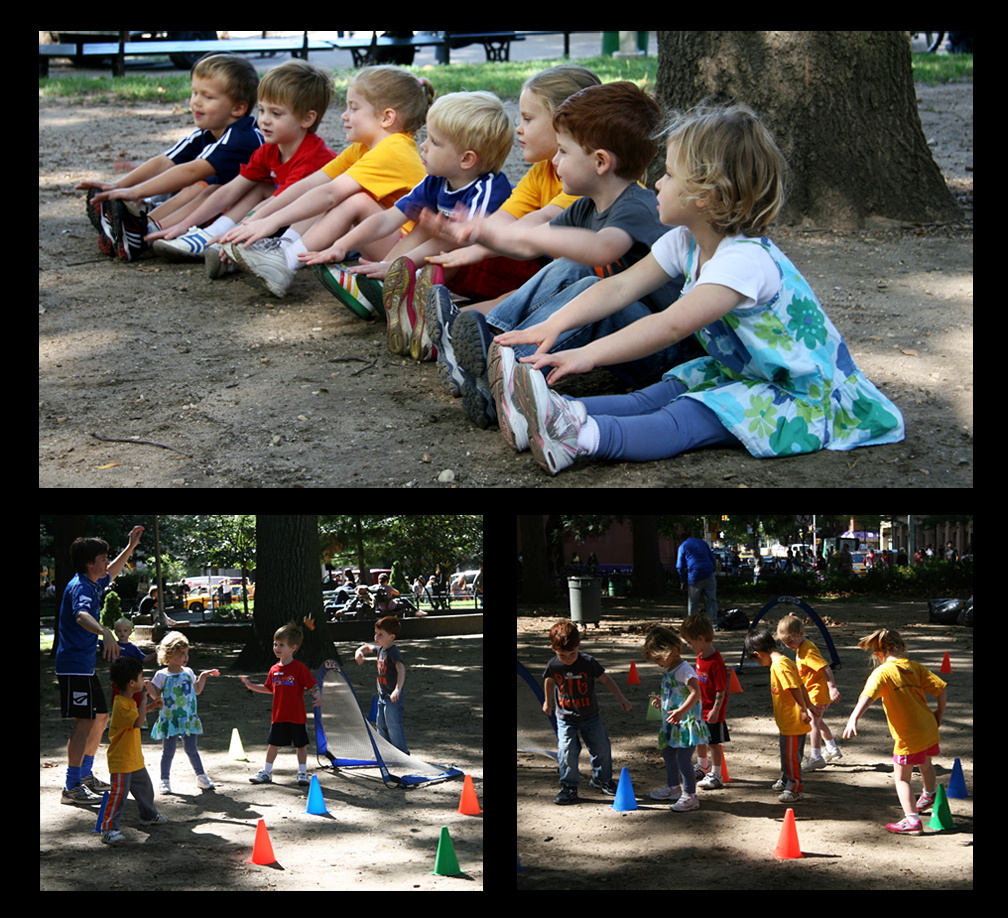
    Children do not immediately come to mind when thinking about New York City, particularly for the visitor or resident without children. But they are part of the fabric of the city along with their parents, all doing what parents, children, and families do, reconfigured for city life. Although soccer is big with kids in America, I was still surprised to see a group in training one morning in Washington Square Park. This group was part of a program called Super Soccerstars, “founded in the year 2000 by Gustavo Szulansky, a New York City father of three and native of Argentina. With futbol in his blood and having spent countless dollars searching for quality programs for his own children, he founded the program determined to build the best children’s program anywhere.” You can read more about them here at their website.

    The humanity of seeing children at play is a heartwarming experience – even more so in New York when it is so often unexpected. As I wrote about in Mary Celeste, schools and playgrounds pop up in the most inhospitable places, surrounded by the maelstrom of a frenetic city.

    But children will do what children do, city or not, having adapted to the environment. And one thing they will do, if you stop and let them, is warm your heart and soul…

    Related Posting: Little Burnt Out


  • OTB

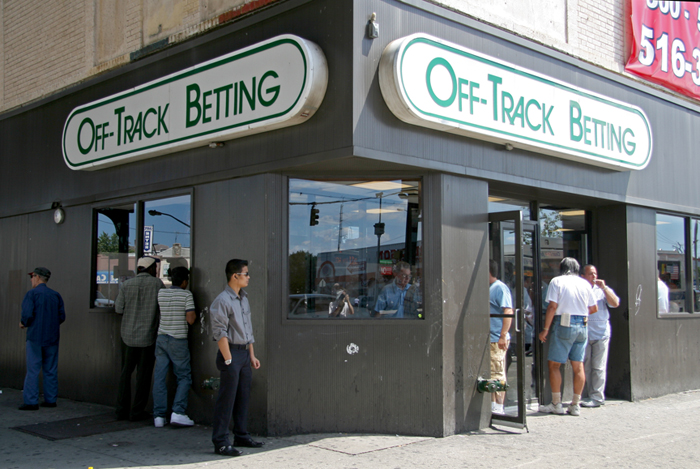
    OTB is a rather invisible enterprise, lurking in the underbelly of New York City. This is the type of place that caters strictly to a niche clientele, and those not seeking to place bets through the city’s Off Track Betting parlors will probably never notice their existence.

    This is one of the few things in New York City which I do not consider a must-see. In fact, the atmosphere is rather unsavory, perhaps seedy. Unlike racetracks themselves, which have the added elements of horses, paddocks, jockeys, and an outdoor environment, OTB is stripped of all these human and equine elements and has reduced horse racing to a betting experience. Although one can feel some excitement at the close of a race, there is the distinct sense that the excitement is largely predicated on winning money with a leveraged bet. Unfortunately, it is also the home to many disenfranchised hoping to hit it big with a longshot or perhaps a gimmick bet like the exacta or trifecta.

    At one time, these parlors were smoke-filled, adding insult to injury but certainly providing a sense of authenticity – a smoky haze conjures the right images for this type of place, evoking the feelings one might have in a pool hall or a dart area in the back room of a bar…

    History of OTB: Approved by voters in a 1963 referendum, the official history of the New York City Off-Track Betting Corporation began on April 22, 1970. NYCOTB was designated to operate as a public-benefit corporation, a relatively new form of governmental entity run along the lines of a private enterprise whose profits accrue back to the taxpayers in the form of public revenue. The mission given us was three-fold: to raise needed revenue for the City and State, to combat organized crime’s hold on gambling by providing a legal alternative, and to help New York State’s racing industry.

    Update: In December 2010, New York City’s OTB closed operations.


  • dinamic_sidebar 4 none

©2026 New York Daily Photo Entries (RSS) and Comments (RSS)  Raindrops Theme