• Category Archives Street Performing
  • Sieve of Darwin

    Have you ever seen a film about New York City that really plays up the artistic world of old? Where it seems that everyone is a writer, dancer, musician, or painter? Perhaps the sound of typewriter comes wafting out onto the street as an actor strolls down some charming Village lane. Or frenetic singers bump into each other in a hallway somewhere in the theater district on the way to an audition. And someone is banging on their ceiling with a broom because a neighbor is hammering away at their piano at some god awful hour.

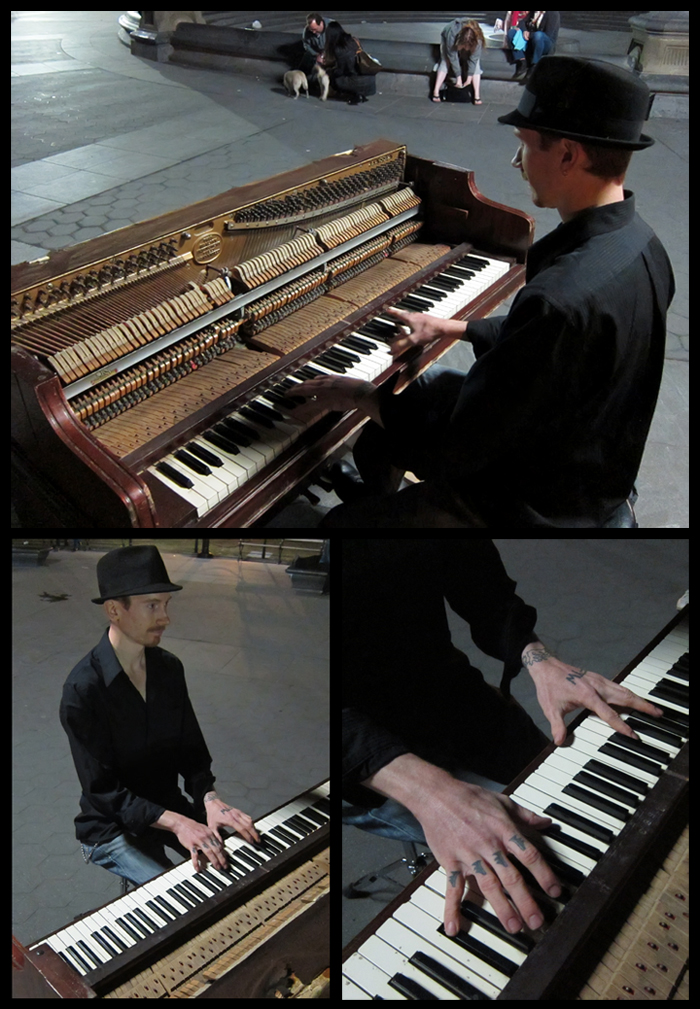
    Romantic folly and Hollywood nonsense? Not completely. Because as I was reading for this story last night after 10 PM, I could actually hear Colin Huggins in my apartment through my open window (see here and here), playing his piano in Washington Square Park.

    I can’t imagine anywhere else where I could enjoy this privilege – my hair stood on end. Some days the city really feels like the promised land – everything I had hoped for when I moved here. A place where I could find a man like Colin Huggins, dragging one of his many pianos onto the street using dollies.

    Colin is a classically trained pianist, has worked as a dance accompanist, and is music director for the Joffrey Ballet. He keeps his pianos at various storage facilities in Manhattan near his performance spots. I have seen him in Washington Square Park and Father Demo Square. He also can be found in the subway system. Huggins believes he is the only person to bring a piano to the subterranean depths – no small accomplishment (he uses a subway elevator – there are a handful of them in the city). In 2007, feeling he was getting a bit too much into a work grind, Huggins tried bringing a real piano into Washington Square Park. From Colin’s website:

    I’ve been a dance accompanist for five years in New York now. And even though I enjoy it, it started to make me feel like the old man behind the piano. When I began to lose sleep every night and found myself irritable everyday, I knew without a doubt, it was time to figure out how to feel like a rock star instead.

    So last summer (2007), for fun, I tried bringing a real piano into Washington Square Park, and honestly, I’d never felt so good about an activity in my entire life. I made money, played songs that I really enjoyed, and made a lot of other people happy too. No matter what age or cultural background the listeners were, I could figure out something to play that would make them smile. It’s a challenge I’m really excited about. So although it may seem like I’m going down on the totem pole of career choices and stability, I feel so much better about myself and so much more connected to the community here and the arts in general.

    When I asked Huggins for his contact information, he handed me his card, which said:
    Colin Huggins / Pianist Rock Star / World’s Happiest Man / www.thecrazypianoguy.com

    You will still find thousands of working artists in New York City. Although I do fear for their survival, as many are squeezed into the most inhospitable neighborhoods in the outer boroughs, I am hopeful that those with resourcefulness and tenacity (and perhaps day jobs) will survive the sieve of Darwin 🙂

    An inspiring note: As I write this, I am listening to the Chopin Nocturnes and Waltzes played by Artur Rubinstein, considered one of the greatest pianists of the 20th century. I am absolutely astonished reading about Rubenstein. A prodigy at age 4, Artur was fluent in 8 languages, had perfect pitch and a photographic memory, keeping most of his repertoire in his head. From Time Magazine:

    In 1903 he caused a sensation in Warsaw by performing Paderewski’s Sonata in E Flat Minor the day after it was published; he learned Cesar Franck’s complex Symphonic Variations on the train en route to a concert hall in Madrid. He can commit a sonata to memory in one hour, and he can play as many as 250 lieder. His friends used to play a kind of “Stump Artur” game in which they would call out titles—excerpts from symphonies, operas, Cole Porter scores—to see if he could play them. “Stumped Friends” would have been a better name for it. “Rubinstein,” says Conductor Edouard van Remoortel, “is the only pianist you could wake up at midnight and ask to play any of the 38 major piano concertos.”

    “When I play, I turn the pages in my mind,” he explains, “and I know that in the bottom right-hand corner of this page is a little coffee stain, and on that page I have written molto vivace.”

    But Rubenstein was not just a brilliant technician. He was the consummate artist:

    On stage, I will take a chance. There has to be an element of daring in great music-making. These younger ones, they are too cautious. They take the music out of their pockets instead of their hearts.


  • World of Gray

    If you want to experience the gritty side of New York City, ride the subway – the ultimate test of will, fortitude, and tolerance. Better yet, try it on a hot summer day, where the non-air-conditioned subway platforms are suffocatingly hot and virtually intolerable.
    And it is gray.

    You can spend your time waiting on the platforms by reading or, perhaps, observing your surroundings in various shades of gray – the concrete, chewing gum, or perhaps the charcoal gray of the subway tracks themselves and the occasional rat in camouflage gray.
    In this world of gray, we have brightly lit subway cars, each with its own captive audience trapped for periods of time in steel boxes, subject to all and any who want to sell goods, rant, beg, preach, or perform in any number of ways.

    The appearance of singers is met with a variety of responses. Some riders, bored with the everyday grind, welcome music as a pleasant break from the monotony. Others, perhaps engaged in reading, listening to music of their own, or just enjoying some “quiet” time, resent the intrusion, analogous to cigarette smoke in public/common spaces.

    And, of course, there is the issue of quality and selection. There is no standard of quality for subway entertainment, and unlike any other media delivery system, it can’t be turned off or the music selection changed.

    I found the a cappella group in the photo to have been much better than average. However, I had the feeling that I was in the minority who enjoyed this band of wandering minstrels, who timed their routine, moving from car to car after each number and collecting money. Perhaps I was just in the right mood at the right time, because for a moment, I found a little relief in a world of gray…


  • Street Poet

    If you were guiding a young person and making a list of things not to plan on doing for a livelihood, writing poetry would be somewhere near the top. So, poets must think out of the box and, in doing so, take it to the streets. There are many benefits to taking your writing to the sidewalks of New York City: no persuading agents of the merit of your work, you receive 100% of the proceeds, and payment is immediate.

    And often, skills and arts honed on the streets, for an audience of passersby who are cynical and jaded, will fare well in a more conventional venue. Many well-known performers worked the streets early in their careers. Their material is the product of sifting out the unsuccessful material, leaving that which grabs and holds an audience, frequently with many other options.

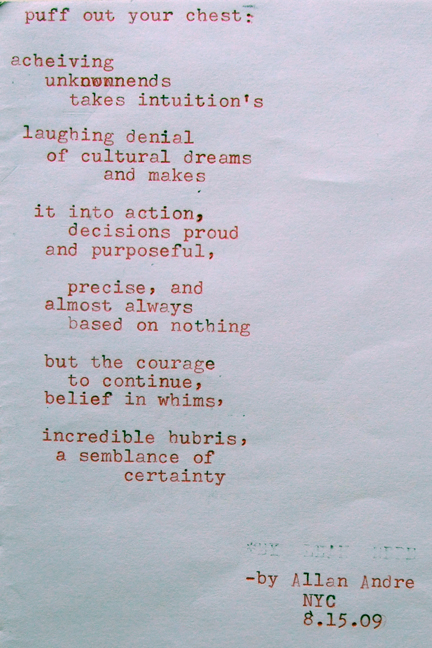
    Allan Andre hails from New York City. Online searches, however, find him plying his trade in other locales, including San Francisco. I met him in Washington Square Park and offered the subject “indecision.” Only some minutes later, typing away on a manual typewriter with a carbon copy, he offered me his poem. I made a contribution. See the text of my poem here.

    As novel as this enterprise may sound, Allan is not the first or only to try his hand at Poetry While You Wait. Only a few blocks away, on University Place near Union Square, is the Poem Shop of Anayvelyse. German poet William Chrome was also found on the streets of New York City.

    Outside of New York, Typing Explosion was a Los Angeles team of three who wrote poetry with the audience choosing titles. They worked regularly from 1998 to 2004. Zach Houston worked in San Francisco and inspired William Chrome to do the same in New York.

    I recall reading a quote by a former French President that he could not imagine going to bed at night without reading some Verlaine. Difficult to imagine this as de rigueur for many of our former White House residents. But perhaps the proliferation of street poets is a harbinger of times to come…

    Interesting Note: If you type “Verlaine” into Wikipedia, the search only returns Verlaine, the municipality in Belgium. To get the poet, you must enter Paul Verlaine. Is this the result of a poor search engine or commentary of the importance of poetry? 🙂


  • Mad as Hell, Part 2

    Posted on by Brian Dubé

    (See Part 1 here)

    Life does imitate art – the end of this story was remarkably like the classic scene in the Academy Award-winning 1976 film Network, where news anchor Howard Beale is so angry, he persuades TV viewers across the nation to stick their heads out of a window and scream, “I’m as mad as hell, and I’m not gonna take this anymore!” If you are not familiar with it, I suggest you see it here before you continue this story.

    Trust me when I tell you that in all the decades I have lived in this city, I have seen many hostile interventions during street performers’ acts. Very belligerent heckling, some nearly stopping the show. But I have never seen anything like this.
    An older woman appeared with her dog in tow, stood prominently in the center of the group, and began screaming “SHUT UP” repeatedly to the audience and the singers. The group, not to be upstaged, continued singing.

    This woman was SCREAMING at the top of her lungs – shrieking, clenching her fists, and shaking. I was genuinely concerned that she would have a heart attack and that her next battle with noise would be with an ambulance siren.
    She would not stop, and when audience members began responding that they were enjoying a quality performance, she screamed, “Take them home with you.” She vehemently stated that she was a neighborhood resident living across the street, facing the area where the singers and crowd were located. She further claimed that they had been singing for at least 6 hours per day for three days in a row and that she was at wits end – apparently she was mad as hell and was not gonna take it anymore.
    After some time, one of the singers apologized to her and the audience, stating that her wishes should be respected. Another one of the singers told her to calm down and assured her, “You win”.

    I spoke for a short time to this woman. I expressed my understanding of the dilemma and told her that I also was a long-time neighborhood resident living over a park and have had my own issues with noise. I, along with others, pointed out that this is New York City. Worse, it was Greenwich Village on Bleecker Street. If she lived on the Upper East Side on a side street, I am sure that she would have the quiet enjoyment she is entitled to. But this is Greenwich Village, and I would guess she chose this neighborhood for its iconoclastic nature, but with that comes a price. It is a mecca for culture, the arts, and entertainment, with clubs, restaurants, theaters, galleries, shops, and plenty of street life. This environment will attract both tourists and performers.

    There is also a lot of noise and a greater tolerance by all, including the police. I asked if she ever called the police. She said she has but nothing happens. My own personal solution is to plan around noisy events – I often will just leave my home. Principle and rights are one thing, but City Hall opens on Monday morning, and this is Saturday night. Accuse me of resignation or of being a man unwilling to fight for his rights. I’m a pragmatist, and being mad as hell will get me nowhere.

    Posted on by Brian Dubé

  • Mad as Hell, Part 1

    Posted on by Brian Dubé

    Occasionally, you can have it all, and Sunday was one of those days – perfect weather, a dinner better than expected (with no line where there usually is one), and then free, first-class entertainment on the street on a summer evening. Spontaneous and varied street life is one of the perks of living in New York City and is what many visitors have heard about and anticipate in their meanderings around the streets. Clear evidence that You’re Not in Kansas anymore.

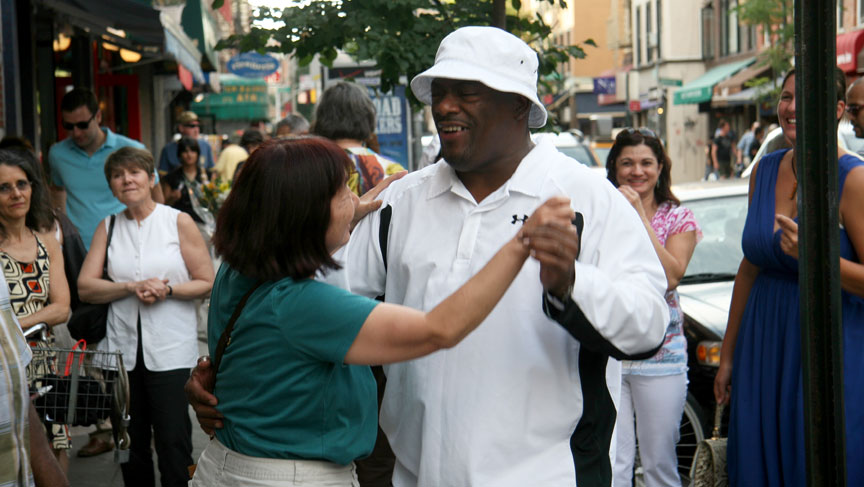
    The group of singers in today’s photo, calling themselves Select Blendz, was performing on Bleecker Street, accompanied by one acoustic guitarist. The songs were primarily 50s, 60s, doo-wop, and soul – all classics immediately recognized by the audience. Little encouragement was needed for any type of audience participation, whether rhythmic clapping or singing choruses. The crowd flowed off the sidewalk into the heavily trafficked thoroughfare. The vibe was absolutely infectious, and there literally was dancing in the street.

    At one point, one of the singers took a highly animated woman for a dance. Others were moved to shake, rattle, and roll. The tip bucket was brimming with bills – I saw one five dollar tip and even a $20 dollar tip being given. If the public votes with its dollars, these guys were clearly the consumer’s choice.

    I couldn’t help thinking about a juice bar I used to frequent on my way to my office on Houston Street called Lucky’s. A place just brimming with youthful enthusiasm, positive feelings, and a great affirmation scrawled on a chalkboard above the menu items which explained the name of the store: Lucky to be Alive.

    But not every story has a happy ending, and there was rain on this parade – stay tuned tomorrow (see Part 2 here), when I explain why, in the second and final shocking episode of this real-life mini soap opera, someone is Mad as Hell…

    Posted on by Brian Dubé

  • Makes Me Stronger

    Posted on by Brian Dubé

    Generally speaking, steps are a means to an end, not an end in itself. But this is New York City, where the minutiae of life are often elevated to iconic status. New York is the most densely populated city in the United States, and Manhattan, being an island, is a place where every square inch is examined, coveted, utilized, and maximized. So when you have a place as important as the Metropolitan Museum of Art that occupies so much space, you know it will loom much larger than life in every way.

    The Met is the largest museum in the Western Hemisphere, with over 5 million visitors per year – that’s a lot of foot traffic. Add to the formula one of the best locations in the city (Fifth Avenue and Central Park) with an enormous set of steps, and what you get is the stoop of all stoops – the ideal perch or porch for relaxing and/or the watching of people and performers. The steps are legendary, and a sunny Sunday afternoon here is a classic way for a New Yorker or visitor to pass some very enjoyable time.

    For the performing artist, the streets are an ideal venue to hone his or her skills. Many well known entertainers have worked the streets and these steps early in their career. The streets, subways, and parks are ready for immediate work – no agents or bookings required.

    Of course, it is rough and tumble battling the competition, weather, ambient noise, hecklers, property owners, neighborhood residents, and law enforcement. Those who can weather these elements become much stronger performers. They have learned to earn and hold spectators against adverse conditions – no captive audience here.

    I once introduced a much younger coworker to a variety of country music, including some very old recordings of Roy Acuff from the 1930s. This coworker was a very open-minded and tolerant musician, but I feared that this genre, particularly Acuff, might be trying his patience, so I asked him if listening to this music was too irritating. He responded, with a smile, “Don’t worry, it just makes me stronger.” So it is with the steps of the Met – for museum patrons or stoop sitters, it can be a stairway to heaven; for performers, it is a place that just makes them stronger 🙂

    Related Articles: Street Magic, Artiste Extraordinaire

    Posted on by Brian Dubé

  • Dance Parade 2009

    Posted on by Brian Dubé


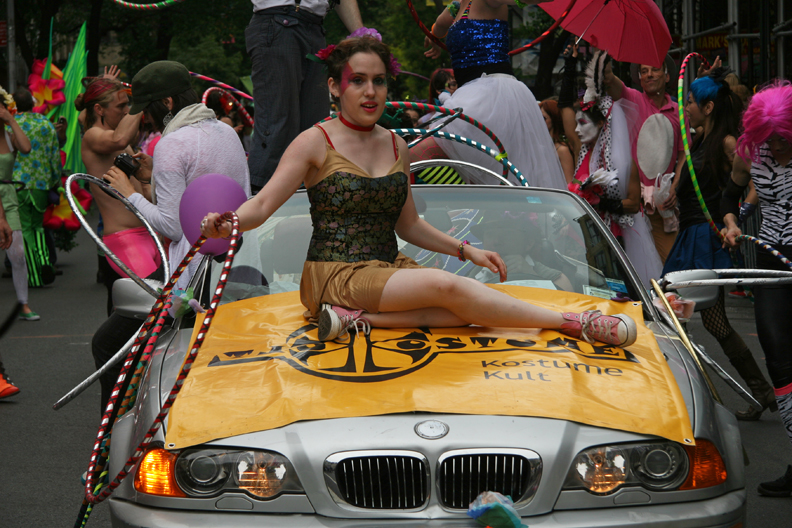
    Saturday was the 3rd annual Dance Parade. Many asked me the reason for the parade – they seemed perplexed. I answered, “to celebrate dance.” I’m not sure a parade needs more of a reason – perhaps so many are estranged from celebration and unmitigated fun that something of this nature grates against their being.

    The parade started at 28th and Broadway and headed south, finishing in Tompkins Square Park for the Dancefest from 3-7pm with continuous performances on stage. The other participants did plenty of milling and strutting along, with numerous spontaneous performances.

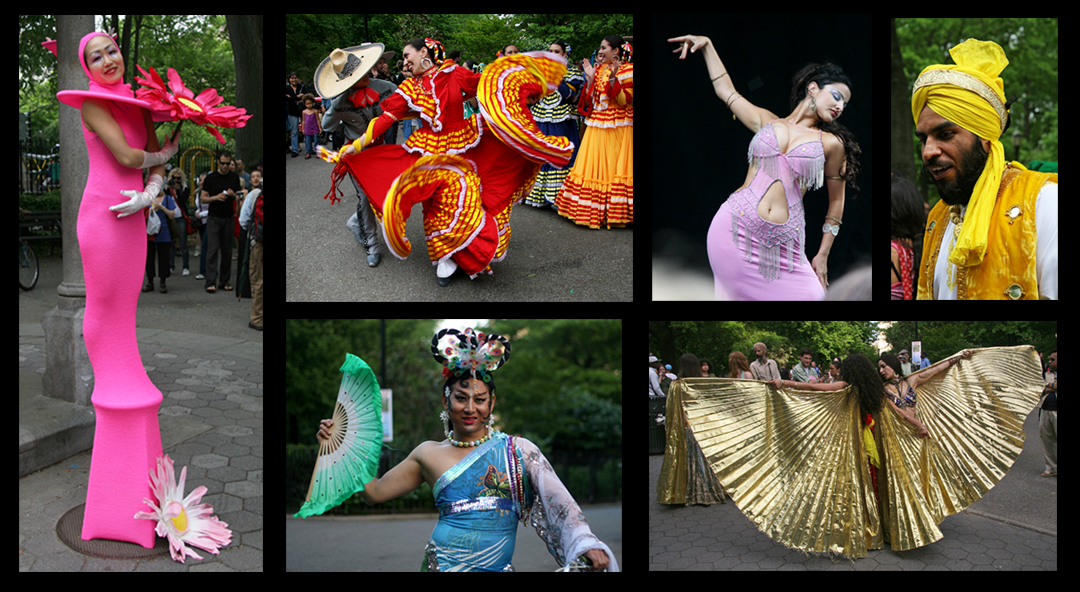
    Every imaginable type of dance was represented with broad ethnic diversity. There was Samba, belly dancing, swing, Korean traditional dance, Polynesian, Indian, Nepalese, Afro Latino, Mexican Folkloric, modern, tap, jazz, disco, ballet, plenty of hoop dancers, and other creative works. Dance lessons were offered, and after parties were thrown around the neighborhood.
    The parade itself had many participants who were not really dancers but, true to New York City style, no one was policing or jurying marchers. Only the desire to be involved was required.

    I thought one of the most striking ensembles was Shir Dance – see their website here. Four women did two living statue movement pieces – the colors and images were quite striking. You can see more images of them and others in my gallery of parade photos here

    Posted on by Brian Dubé

  • Famine and Feast

    Posted on by Brian Dubé

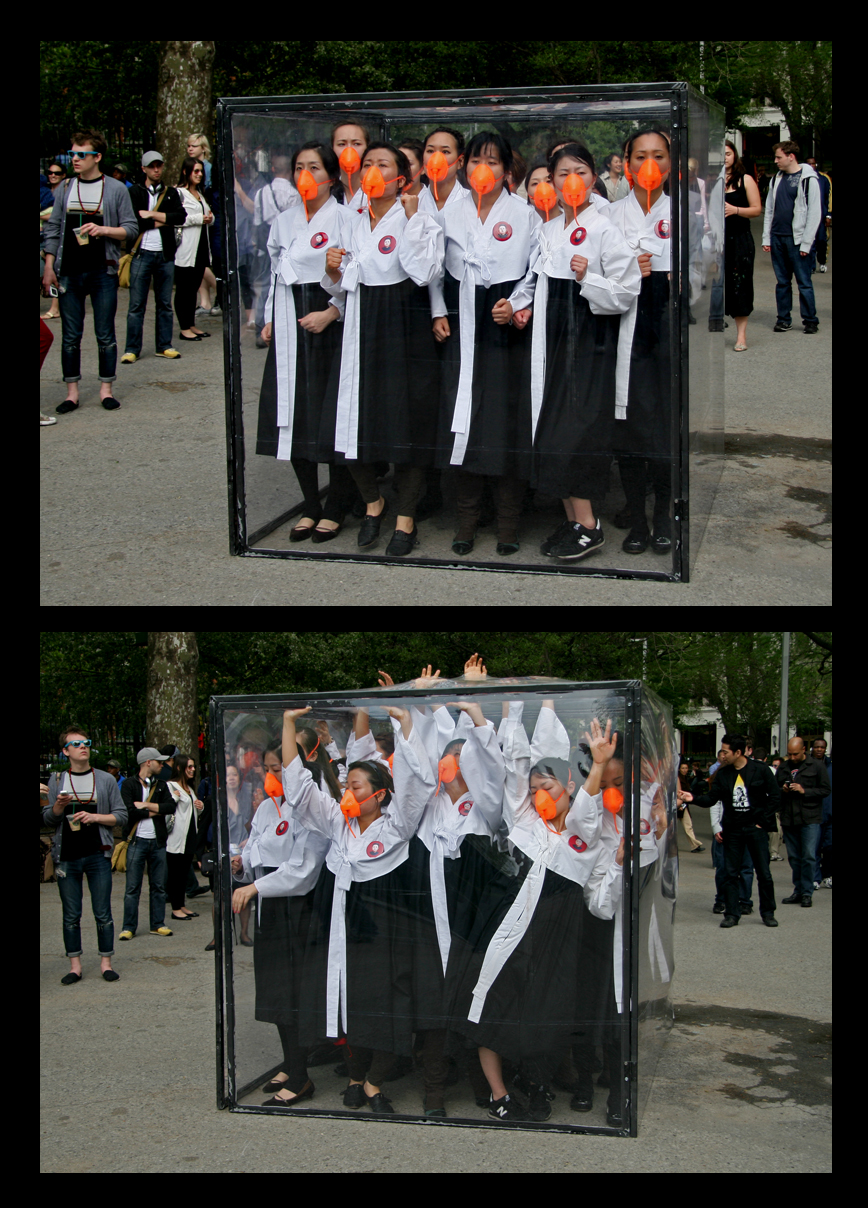
    On Saturday, I happened upon one of the four public performances of Bodies of Pyongyang by artist Yoonhye Park. See more photos here. This is the type of thing you don’t usually see in Kansas, and if you are looking to create public awareness, I am fascinated by North Korea – that in 2009 a regime like this can continue to survive. The statements regarding the treatment of women in North Korea contained in the press release of this public art performance come as no surprise:

    Most people know who is Kim Jong-il, the dictator of North Korea. However, women in North Korea are hidden and veiled in contemporary context. “Bodies of Pyongyang” is a public live visual art performance installation. Around thirty girls wearing North Korean schoolgirl uniforms are situated inside a (70″x70″x70″) clear plexiglass cube box, which is located off a street intersection. These tightly packed schoolgirls try to move about the enclosed cube box expressing their emotional pain and struggle. Red strings symbolizing their dual inner states of suppression and resistance entangle the girls further confining their freedom to move within their already limited and hermetic space.

    Of course, the sight of a large clear plastic box packed with Korean girls in school uniforms with bright orange respirators will attract plenty of attention, even in New York City. So there was plenty of gawking and photography – the freneticism around a photo opportunity, irrespective of its merits, often looks like famine victims faced with a feast. However, unlike many North Koreans, it is unlikely any performers or onlookers were faced with the prospect of famine…

    Note: You can read about the Bodies of Pyongyang here. The last public performance in New York City will be at Tompkins Square Park on Saturday, May 9, 2009 from 2:30-5PM.

    Posted on by Brian Dubé

  • Catch a Wave

    In the years I have lived in New York, I have witnessed a myriad of trends and fads. With many of these, it seemed that there was no end in sight and that it would become a permanent part of the city’s cultural landscape. And then as quickly as it came, it was gone – in some cases, it disappeared almost completely, while in others, varying degrees of vestiges remain.

    There was disco fever. I had a friend who took dance lessons with his wife at the very disco in Brooklyn (2001 Odyssey) where John Travolta performed in Saturday Night Fever. Disco roller skating became a popular spinoff, with skating circles in the parks (there is still one in Central Park). For a time, small roller skating clubs opened – skating was done ad nauseum in a circle to DJ music.

    During the same period, enormous boomboxes were toted and seen in the parks and streets. One of the few benefactors was Duracell – most of these required 8 D-cell batteries, which only lasted some part of one day. Supporting your machine became tantamount to a drug habit.
    There was the break dancing phenomenon, with many youths spinning on all parts of their bodies, including their heads, on makeshift stages – cardboard on the sidewalks.

    And then there were those “exclusive” clubs, such as Studio 54 and the Mudd Club, with lines of patrons hoping they were special enough to be chosen for admission by arrogant, power-wielding bouncers. Ironically, in many of these, the throngs on the street were more interesting than the scene in the clubs themselves.

    Even crime appeared trendlike. Graffiti on subway trains became a virtual icon for New York, as seen in movies such as The Taking of Pelham One Two Three and The French Connection. Heroin users graced the parks. Broken car windows for radio theft were daily occurrences.

    Puzzling was the rapid rise and fall of gelaterias. Many of these small shops were beautifully put together only to be dismantled in a short time. Most of the remaining shops (such as Café Dante) were there before the trend and after the dust settled.
    Other trends did become part of mainstream culture, such as skateboarding and the migration to “new” neighborhoods.

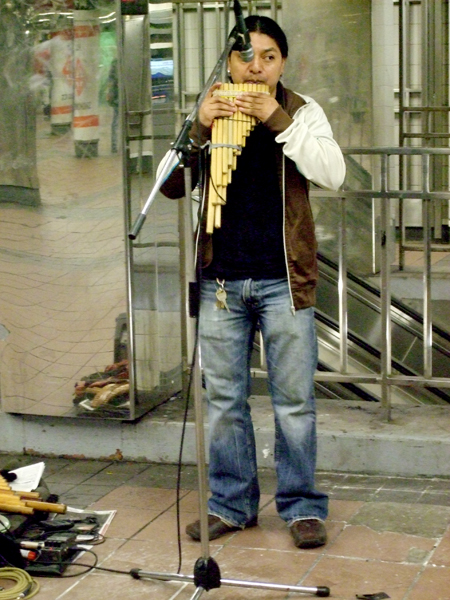
    The man in the photo is reminiscent of the rise of Andean street musicians in the late 1980s. The streets (and subway system) on weekends found many small troupes playing Andean folk music – mostly from Ecuador and Peru, with panpipes, flutes, and strings.

    One of the recent complaints worldwide about street musicians is the use of backing tapes and amplification systems, allowing a solo performer to play with recorded backup. Apart from the typically excessive volume is the rather “muzak” or schmaltzy character of the overall result. But the advantages to the musician are many – no need to organize a group or split tips, becoming a one-man band.

    Every corner of the planet has its trends, fads, and cultural movements, and many of these become global. But in New York City, with the chutzpah of the people, the large numbers of adopters, and the tolerance of the residents, these things take on a larger dimension and are frequently exported.

    Living here is like playing in the ocean. Sometimes I get caught in a wave, other times I just let it pass me by, waiting for the next one…


  • Color of Commerce

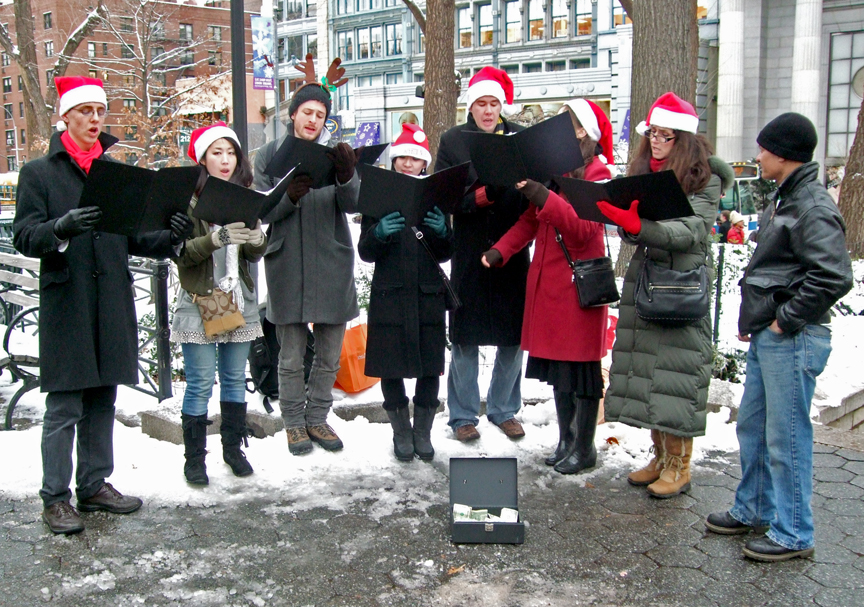
    Dr. Seuss was not part of my childhood. Certainly a lack of desire for reading was not a reason; Seuss’s books gained popularity somewhat after I grew up. But I love the storyline of How the Grinch Stole Christmas. There is no question that Christmas has become progressively more commercial every year, with retailers almost completely obfuscating its original meaning. It is easy to adopt a Grinch’s view of Christmas. Associated Christmas activities other than shopping have taken a back burner, and frequently these traditions are also marketed to death. And, of course, New York City is a true melting pot of ethnic and religious backgrounds – many do not celebrate Christmas, and for them, the commercial side is primarily what they see. It’s not necessary to share the worldview of Reverend Billy and his Stop Shopping Choir to see the devolution of Christmas.

    But I don’t want to be the Grinch that tries to steal Christmas or a 21st-century Scrooge – I have been accused of that. So I make an effort to seek out those things that are meaningful in the Christmas season, which at times feels like swimming against the tide. Trade is a necessary part of our world, and it makes no sense to completely shun anything that bespeaks of business as many do and be a purist who views the world through glasses that tint everything with the color of commerce. Perhaps if we take Dr. Seuss’s story to heart, we can all win back the true spirit of Christmas 🙂

    Photo Note: These carolers were in Union Square Park. I did not notice on first examination of the photo that they were collecting money for their efforts. Apparently I have lost or misplaced my tinted glasses 🙂


  • Barometers

    There are barometers and signposts. Things that tell you about a place. If you can find constants that you are familiar with, they can tell you much. Like independent bookstores or natural food stores. I used to visit as many as I could when traveling – the differences would tell me a lot about the people and the community.

    And then there are things which are unique about a place, like San Francisco’s cable cars. The New York City subway system is one of those places that lets you know without question where you are. Something virtually unique in the USA, certainly so extensive and heavily used and depended on by millions daily. Here, everything that is good and bad about the city is concentrated, literally and metaphorically. More of everything, whether rats, garbage, graffiti, people, hustlers, or opportunists.

    Looking over that list and reflecting on it makes me want to amend my former statement. In fairness, it really isn’t too accurate to say that all the good of New York is concentrated here. There are not an inordinate number of smiles or acts of kindness down below. This is really about the business of getting where you want to go, and like visiting a dentist, most patients just want to expedite the process.

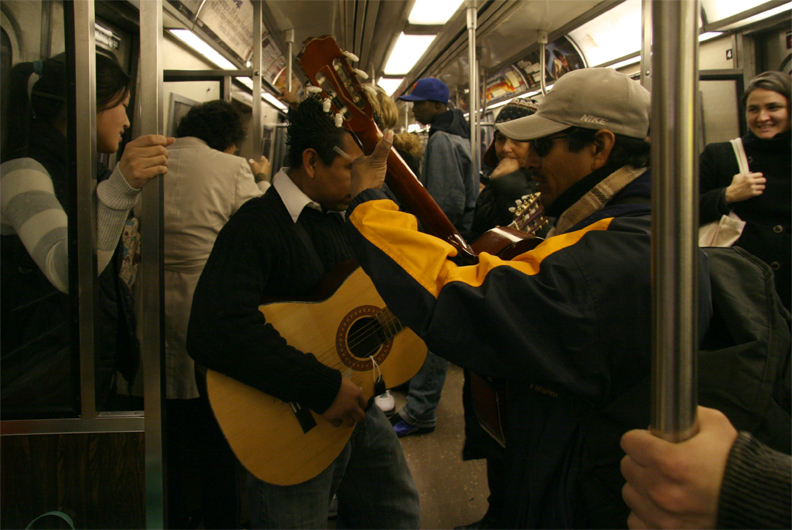
    So when a good thing happens, it really warms my heart. Melts the ice that separates us and brings a moment of humanity to an underground world of steel, concrete, and noise. What better thing than music to fit the occasion? Many see the wandering minstrels of the subway as an intrusion – a violation of space which is already a toxic overload of sensory stimuli. But for me, a little good music is a welcome break on a short ride.

    Perhaps if I was encamped (i.e. comfortably seated) with a good book on a long ride, as many commuters are, I would find the sudden appearance of musicians nearby to be an unwanted and unwarranted irritant, like secondhand cigarette smoke. And, of course, if you are a musical snob, there is the issue of quality – you will not find concert-level musicianship here, so your standards do have to be appropriately scaled.

    On this ride, I found the two Latin guitarists with their singing to be just the antidote for the crowded conditions. And my $1 contribution to the arts was well received…


  • Sieve

    Posted on by Brian Dubé

    New York is an international magnet. It’s like the whole world is on a tilt and anyone who isn’t tied down ends up in the city at one time or another. And for most musicians and performers, working in NYC is a right of passage.
    For a brass band from Marseille, I guess it would be de rigueur.

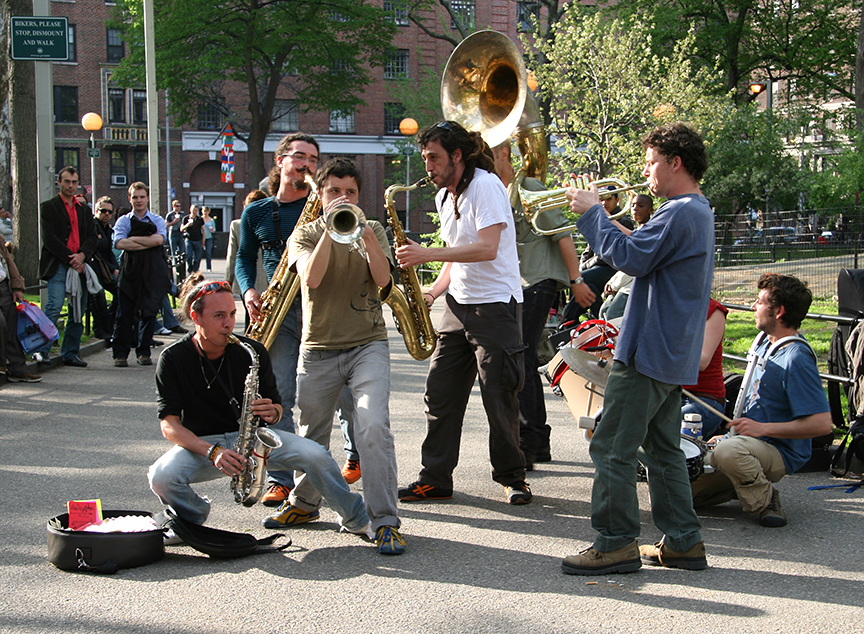
    On the same day that I met renowned Will Galison, we had this brass band from Marseille only a few hundred feet away. They called themselves Samenakoa and used a number of unique devices, including a megaphone for the singer.

    We are so spoiled in this city. We have one cultural tour de force after another. Even on the streets, we have extraordinary talent and, in some cases, people who work professionally on stages worldwide. I have seen Philippe Petit (who walked between the twin towers), David Blaine, and a plethora of others.
    The streets are a good training ground for performers. Unlike a theater, you do not a have a captive audience – they need to be gathered and held. A tough job in a city with so many distractions and so much talent. If your act is not immediately compelling, most will just walk away.

    Performers I have known who honed their craft this way have become extraordinary performers – not just showmen, but true entertainers. People like Penn and Teller. On the streets, an astute performer can easily ascertain what works and what doesn’t. That which doesn’t work is discarded. It’s liking working with a sieve, sifting for the nuggets of gold that remain after discarding the sand. Separating wheat from chaff.

    All those nuggets of gold and kernels of wheat – that’s why I love this city.

    Related Postings: One Man Band, The Naked Cowboy, Street Revival, Reverend Billy, Missionaries Meet Their Match, Fête de la Musique, Palehorse Productions

    Posted on by Brian Dubé

  • Only in New York

    Posted on by Brian Dubé

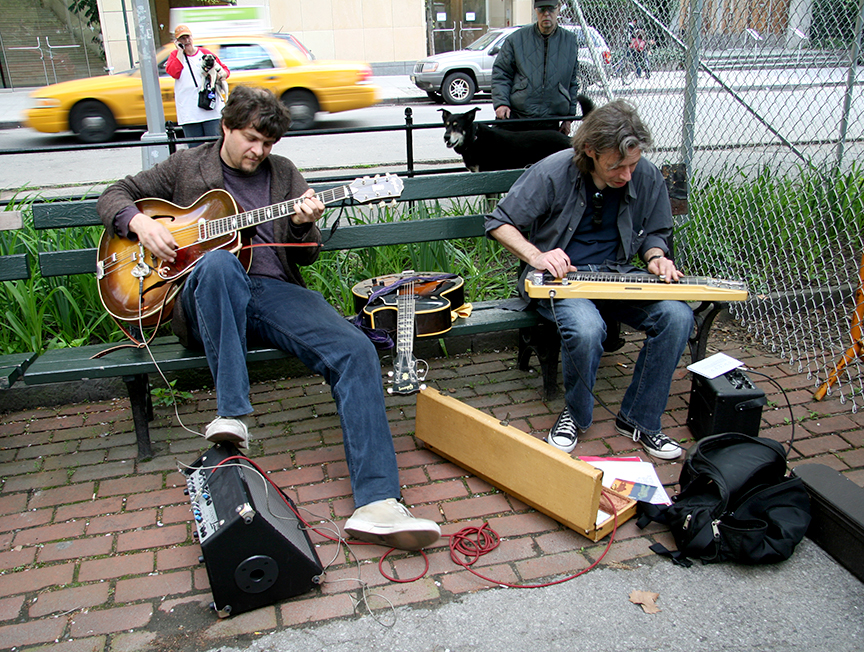
    Wow. That’s all I can say. I’m in the park watching these two guys play guitar. I learn that the person on the left is a harmonica player. I love blues harmonica, so I volunteer a couple of big names. He says he knows them.

    Someone pulls me aside and says, “Can I give you a tip about this guy”? I say, “Sure.” He also knows harmonica players and says that this guy is famous. Now, coming from someone in the park whom I do not know, I take this with a grain of salt. My informant tells me that he is probably one of the two best players on the planet and has played with the likes of Barbra Streisand. He doesn’t look like Barbra Streisand material to me. But I have met many successful individuals in NYC who do not look the part, especially in casual attire. Plus, he is a musician, and this is New York.

    I get his card and introduce myself. His name is Will Galison. So this morning I do an online search. I find that this man is much more accomplished than I ever imagined. Everything my informant said is true and more. This man has a several page entry in Wikipedia. He has worked with a range of musicians including Carly Simon, Sting, Chaka Khan, and Astrud Gilberto. He has also recorded soundtracks for Academy Award nominated films. He can be heard on a Sesame Street theme. He was trained at the Berklee School of Music and has performed at various New York City venues including The Village Gate, The Blue Note, and the Lone Star Cafe with jazz musicians Jaco Pastorius and Jaki Byard. He has worked on Saturday Night Live. See his website here.

    At one point, his companion, Sean Daly, tried his hand at the lap steel guitar. Undaunted, he appeared to pick it up with ease. Easy for a natural.
    And there they were, with four of us as audience. No one anywhere around suspecting. Only in New York…

    Posted on by Brian Dubé

  • Delivery

    There is a saying – let the music speak for itself. This makes sense, except that you need to hear it, which you can’t do here. And, of course, there are different languages, and the music may not speak to you. But for me, these guys are some of the best jazz musicians I have heard on the street. It’s such a treat to run across talent like this on the streets of New York City. Many street musicians are superb. Music is very competitive, and they work the streets for a number of reasons: sole source of income, part-time source, exposure, or just fun.

    The variety of musicians you find on the street can be just remarkable. I have run across Manhattan or Juilliard School grads and students, professionals playing cello, a traveling one-man band, punk rock concerts, rock festivals, swing musicians, blues slide guitar players, a Chicago brass band, a bluegrass reunion – it’s a menagerie out there. A number of us spend evenings in Washington Square Park listening to singing circles – on a good night, hundreds of spectators may congregate and participate in the choruses.

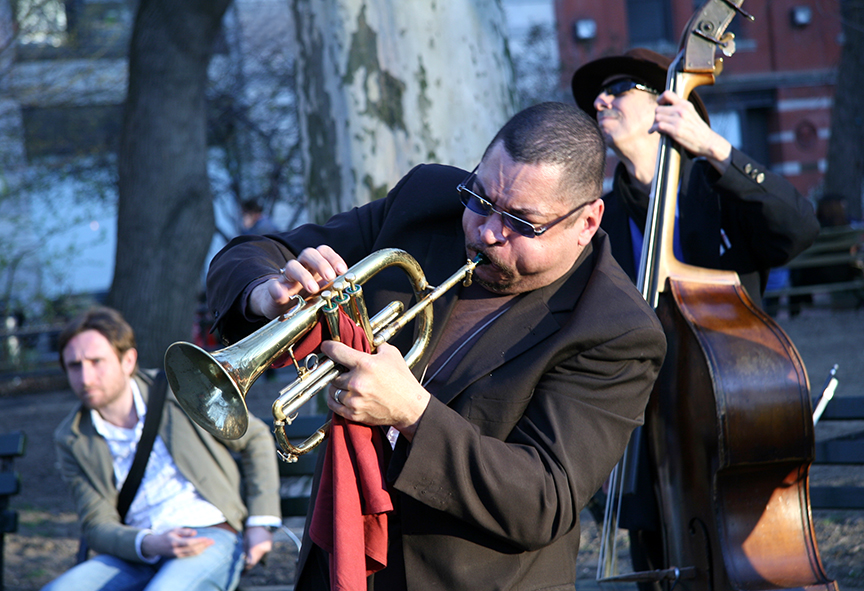
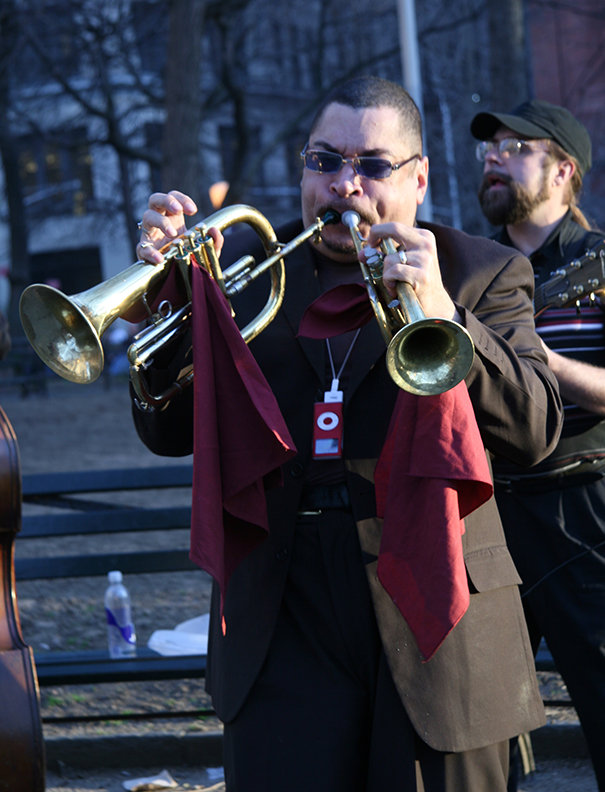
    The trumpet player, Rasheed Richard Howard, is superb. And he can play two trumpets at one time. He is part of a group called NuQ-Leus.
    This photo was taken when they were doing Georgia, a favorite with such a great melody (if you haven’t heard Ray Charles do Georgia, you must).

    Rasheed really delivers, which is good since New Yorkers are spoiled and quite used to delivery 🙂


  • Ziggy Plays

    I once read in a travel guide that Key West was home to the indolent and the indigent. I really liked the sound of those two words together – they have both two-letter alliteration and rhyme. Not to be upstaged by Key West, I think NYC can lay claim to top dog when it comes to the numbers of people where less-than-complimentary adjectives (that rhyme and have two-letter alliteration) apply: insolent, insouciant, incoherent, incompetent, indignant, insentient, insistent, indulgent, and, of course, indolent and indigent.

    But, however talented, driven, and ambitious one might be, I think one begins to realize, especially in a big city where the evidence is ubiquitous, that good fortune is an element in one’s life. Anyone can fall between the cracks. I remember a TV program where a son was admonished by his father that one should never speak ill of “man who was down on his luck.” It was said with such gravity that it has stayed with me to this day, making me realize that indigence and indolence do not always go hand in hand.

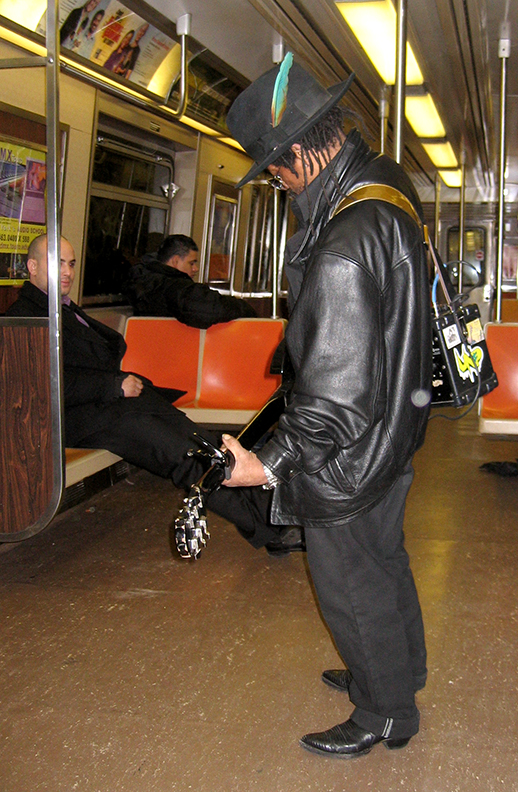
    These were the thoughts that came to mind when I entered the F train from Brooklyn last night and was accompanied by a musician who I had seen and heard before. He wanders from subway car to subway car (exiting and reentering the adjacent car at each stop) and plays a variety of songs with both his electric guitar and miniamp slung around his neck. I really like the feeling he brings to his music and the coarseness of his voice. I gave him a dollar. It suddenly occurred to me that this was a bloggable event, so with only seconds to act, I pulled out my point and shoot camera – all I had with me. As he was exiting the car, it also occurred to me to ask his name. “Ziggy” he replied. “Z, double i, double g, double y, dot com,” he added. I tried to confirm the dot com address with a fellow rider, but he was not sure. So, expecting an Internet fishing trip, as soon as I got home, I typed ziiggyy.com into a browser bar, and Voila! – Ziggy’s myspace site popped up. A feeling of comfort came over me now that he had not just a face but also a name and a place to listen to his music.

    I also started thinking that I should expand my vocabulary a bit. New words came to mind, such as misjudged, tenacious, and hopeful…


  • dinamic_sidebar 4 none

©2026 New York Daily Photo Entries (RSS) and Comments (RSS)  Raindrops Theme