• Category Archives Music and Concerts
  • Sieve of Darwin

    Have you ever seen a film about New York City that really plays up the artistic world of old? Where it seems that everyone is a writer, dancer, musician, or painter? Perhaps the sound of typewriter comes wafting out onto the street as an actor strolls down some charming Village lane. Or frenetic singers bump into each other in a hallway somewhere in the theater district on the way to an audition. And someone is banging on their ceiling with a broom because a neighbor is hammering away at their piano at some god awful hour.

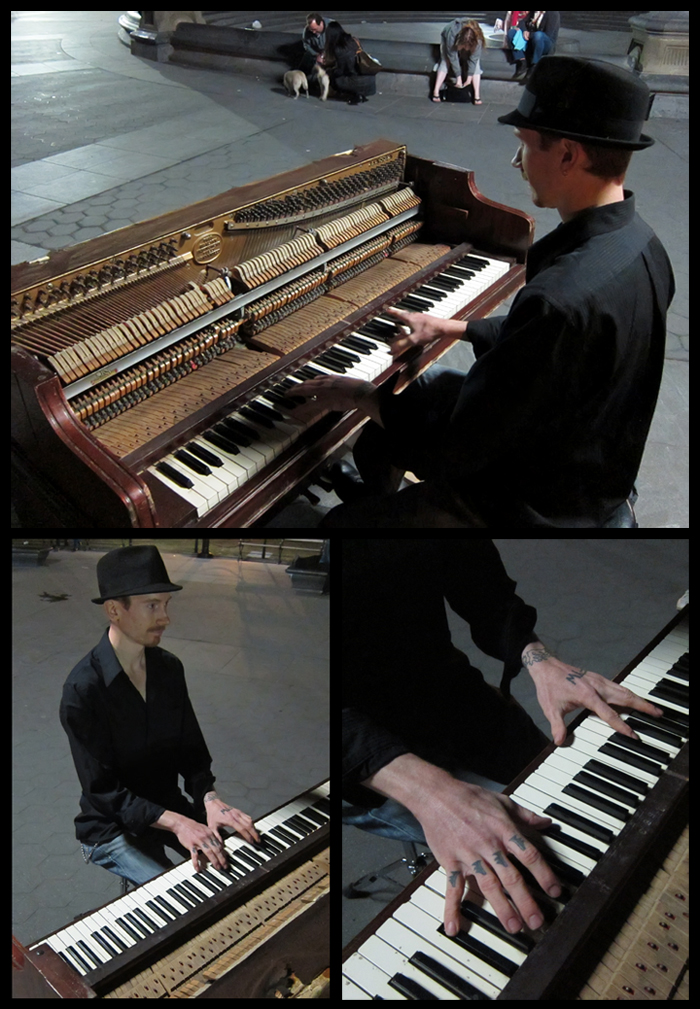
    Romantic folly and Hollywood nonsense? Not completely. Because as I was reading for this story last night after 10 PM, I could actually hear Colin Huggins in my apartment through my open window (see here and here), playing his piano in Washington Square Park.

    I can’t imagine anywhere else where I could enjoy this privilege – my hair stood on end. Some days the city really feels like the promised land – everything I had hoped for when I moved here. A place where I could find a man like Colin Huggins, dragging one of his many pianos onto the street using dollies.

    Colin is a classically trained pianist, has worked as a dance accompanist, and is music director for the Joffrey Ballet. He keeps his pianos at various storage facilities in Manhattan near his performance spots. I have seen him in Washington Square Park and Father Demo Square. He also can be found in the subway system. Huggins believes he is the only person to bring a piano to the subterranean depths – no small accomplishment (he uses a subway elevator – there are a handful of them in the city). In 2007, feeling he was getting a bit too much into a work grind, Huggins tried bringing a real piano into Washington Square Park. From Colin’s website:

    I’ve been a dance accompanist for five years in New York now. And even though I enjoy it, it started to make me feel like the old man behind the piano. When I began to lose sleep every night and found myself irritable everyday, I knew without a doubt, it was time to figure out how to feel like a rock star instead.

    So last summer (2007), for fun, I tried bringing a real piano into Washington Square Park, and honestly, I’d never felt so good about an activity in my entire life. I made money, played songs that I really enjoyed, and made a lot of other people happy too. No matter what age or cultural background the listeners were, I could figure out something to play that would make them smile. It’s a challenge I’m really excited about. So although it may seem like I’m going down on the totem pole of career choices and stability, I feel so much better about myself and so much more connected to the community here and the arts in general.

    When I asked Huggins for his contact information, he handed me his card, which said:
    Colin Huggins / Pianist Rock Star / World’s Happiest Man / www.thecrazypianoguy.com

    You will still find thousands of working artists in New York City. Although I do fear for their survival, as many are squeezed into the most inhospitable neighborhoods in the outer boroughs, I am hopeful that those with resourcefulness and tenacity (and perhaps day jobs) will survive the sieve of Darwin 🙂

    An inspiring note: As I write this, I am listening to the Chopin Nocturnes and Waltzes played by Artur Rubinstein, considered one of the greatest pianists of the 20th century. I am absolutely astonished reading about Rubenstein. A prodigy at age 4, Artur was fluent in 8 languages, had perfect pitch and a photographic memory, keeping most of his repertoire in his head. From Time Magazine:

    In 1903 he caused a sensation in Warsaw by performing Paderewski’s Sonata in E Flat Minor the day after it was published; he learned Cesar Franck’s complex Symphonic Variations on the train en route to a concert hall in Madrid. He can commit a sonata to memory in one hour, and he can play as many as 250 lieder. His friends used to play a kind of “Stump Artur” game in which they would call out titles—excerpts from symphonies, operas, Cole Porter scores—to see if he could play them. “Stumped Friends” would have been a better name for it. “Rubinstein,” says Conductor Edouard van Remoortel, “is the only pianist you could wake up at midnight and ask to play any of the 38 major piano concertos.”

    “When I play, I turn the pages in my mind,” he explains, “and I know that in the bottom right-hand corner of this page is a little coffee stain, and on that page I have written molto vivace.”

    But Rubenstein was not just a brilliant technician. He was the consummate artist:

    On stage, I will take a chance. There has to be an element of daring in great music-making. These younger ones, they are too cautious. They take the music out of their pockets instead of their hearts.


  • With All Due Respect

    Posted on by Brian Dubé

    On my last visit to Harlem on a Sunday, I witnessed huge numbers of people in fancy clothes getting in and out of vehicles. There were traffic jams in front of churches as vans and cars unloaded church congregation members.

    On January 4th, 2010, I wrote We Got Religion, but in Harlem, they really got religion. For years I have been threatening to see a gospel performance in a Harlem club. But gospel does not have its roots in night clubs. It is Christian-based music sung to express a spiritual belief and finds its home in churches. And in New York City, we find the most well-known in Harlem.

    There is a tourist industry built around visiting the various churches, with buses and groups visiting on Sunday mornings. Harlem is one of the top tourist destinations in New York City. Few New York City residents, however, venture there. Distance from Midtown, downtown, and other boroughs is somewhat a factor – for most residents, Harlem is a destination.
    As pointed out in a New York Times article, this whole phenomenon is controversial:

    A hint of annoyance is sometimes evident as church members complain that they are on display. One Harlem minister admitted to mixed feelings about visitors who tend to behave like members of an audience rather than as worshipers. Few bow their heads in prayer. Fewer still join in as the congregations sing from their hymnals. But, he conceded, language may be a barrier to participation.
    Others point to the reality of contributions from tour companies and individuals that help finance church-based community programs. And there’s some expression of begrudging respect for people who appreciate good music and are willing to venture uptown to find it.

    We have the classic dual-edged sword of tourism – welcomed income and unwelcomed impact that crowds of tourists have on a visited place.

    On my recent excursion to Harlem, I photographed the very striking Mount Neboh Baptist Church. Unbeknownst to me, this is one of the premier church venues in Harlem for gospel music. Others include the Abyssinian Baptist Church, the Canaan Baptist Church, and the Greater Refuge Temple. See article here.

    My understanding is that the church services are extraordinarily spirited and electrifying. I plan on going, with all due respect…

    Posted on by Brian Dubé

  • Really Smart Guys


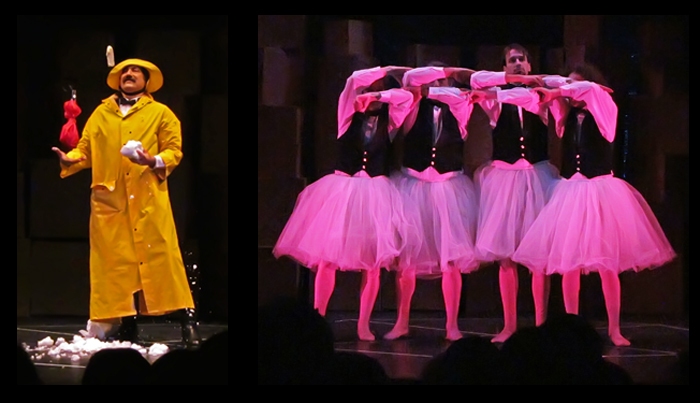
    The big secret about the Flying Karamazov brothers is they are a bunch of really smart guys. I am privy to many of their offstage accomplishments and academic achievements, because [disclaimer here] – they have been customers of mine for over 30 years (see my connection here and here.) Knowing this about them, it will come as no surprise to see an old tag line: “Juglito ergo sum” – I juggle, therefore I am.

    What is no secret is that they are also very talented performers. They are not brothers, they do not fly (only the objects do), and they have no connection to Dostoyevsky, although their character names are based on the novel: Alexei (Mark Ettinger) is their resident musician, composer and conductor. Pavel (Rod Kimball) is the master juggler. Dmitri (Paul Magid) is the writer, director, and founder. Maximov (Nick Flint) is media savant. Zossima (Stephen Bent) is exceptionally tall.

    The show is well-crafted, and the members are highly skilled jugglers as well as musicians/composers and writers. This has been the case throughout their long career, which has included a number of cast member changes.
    The troupe was formed in 1973 on the streets of Santa Cruz, California. Paul Magid is the only remaining original member. The other original members were Howard Patterson, Tim Furst, and Randy Nelson. Read more about them at their website here.

    The award-winning troupe has performed internationally, with credits too numerous to list here, including Lincoln Center, Broadway, the Brooklyn Academy of Music, TV, and film. They have produced a number of shows, all built around their juggling and musical skills. One show, built completely around music, Sharps, Flats and Accidentals, was performed at Lincoln Center.

    One routine which builds throughout the show is known as the Terror Trick. Over the course of the program, nine objects are introduced (a cleaver, a torch, a salt shaker, a ukelele, a skillet, a fish, an egg, a block of dry ice, and a bottle of champagne) and juggled as the finale – with the fish and the egg ending up in the skillet and the pouring of the champagne into glasses.

    The other perennial favorite is the The Gamble, in which “the Champ” (Dmitri) will attempt to juggle any three items provided by the audience. This challenge is well known to many attending their shows – they have seen just about everything, and the Champ is rarely stumped. The three objects are chosen by the audience’s applause from the collection on stage. There are rules, however. The object:

    Must weigh more than an ounce (28 grams)
    Must weigh less than 10 pounds (4.5 kg)
    Must be no bigger than a breadbox
    Must not be a live animal
    Must not be able to stop the “Champ” from being a live animal
    The Champ is also permitted to make up to three modifications to the selected items (in total). If The Champ can juggle the items for ten continuous throws (in three tries), he wins a standing ovation from the audience; if he fails, he gets a pie in the face.

    Their routines are peppered with wordplay and clever references, because, as we know, they are a bunch of really smart guys 🙂

    Note: The photos are from their current show, 4Play, which is playing at the Minetta Lane Theatre in the Village. It runs until March 7, 2010.


  • No Squares Down There

    I was so excited as I eagerly awaited my copy of City Planning According to Artistic Principles, by Camillo Sitte, to come up at the main branch of the New York Public Library. I must admit, however, that I really had no intention of reading the whole thing – it was not available for circulation. I just needed to see that it really existed, touch it, and peruse it.

    Sitte was an Austrian architect, painter, art historian, and city planning theoretician. He studied what made a place charming. In his book, he extols the virtues of the irregularity of the medieval city. I have had numerous thoughts and conversations about what makes a city or town interesting. One element for me was the lack of order in the street layout. Nooks and crannies to be discovered, like an old bookshop where, upon entering, you cannot determine its layout, and wandering through it becomes an adventure.

    I relish neighborhoods or towns with the lack of a grid. I love meandering the streets of Florence, Montmartre in Paris, medieval villages of France, or the streets of West Village. Sitte’s book was the validation for everything I loved in a town or city and gave the reasoning behind why I find Greenwich Village one of the most charming areas in the United States.

    The West Village is part of New York City predating the Commissioner’s Plan of 1811 (see here). The maze of streets defy any real order – there are angles, triangles, bends, streets once parallel that now intersect, and even a street that splits and retains the same name (Waverly Place). Perhaps somewhat vexing to the driver or visitor navigating, its character is one of the things which drew me to this neighborhood long ago.
    On top of all this, in 1917, the city cut a swath, 7th Avenue, through the existing neighborhood, shearing sections of over 200 buildings, leaving many triangular shaped structures (see Northern Dispensary and Zena for two examples of triangular buildings).

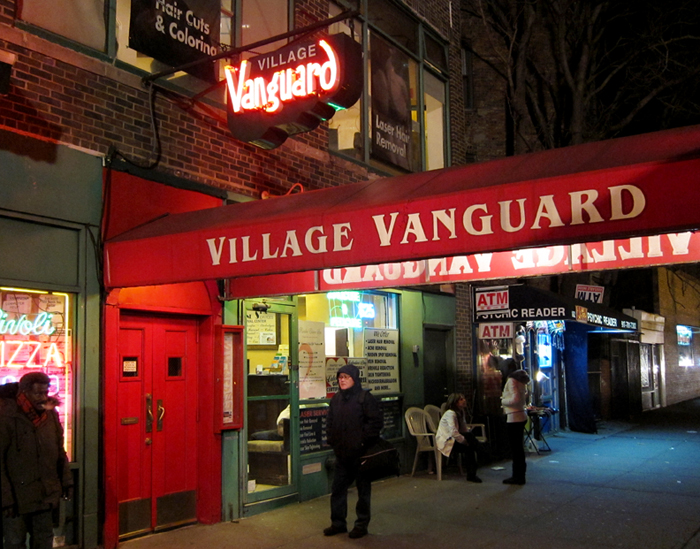
    We have become the benefactors of yesterday’s victims. In the case of the Village Vanguard, its superb acoustics have been attributed to the triangular space. Some recording engineers and musicians say it is the finest acoustic space they know of.

    The Village Vanguard is legendary and, on February 23, 2010, celebrates its 75th anniversary. The club was opened in 1935 by Max Gordon. Originally it featured many other forms of music and entertainment, such as folk music, comedy, and beat poetry. In 1957, it became an all jazz venue. All the jazz greats have performed there – Miles Davis, John Coltrane, Sonny Rollins, Charles Mingus, Keith Garrett, et al. The club is also noted for its Live at the Village Vanguard sessions. The Vanguard still enjoys a reputation as a place to hear the finest jazz in the world. Through the red door and fifteen steps down to the triangular basement space. No squares down there 🙂


  • Welcoming Committee


    There is no doubt that the ambiance of shops in New York City will not often be like that of the small rural or suburban town. Places where you are spoken to on a first named basis, your preferences are remembered, the owner is on hand, expertise looms large, and people really go the extra mile.

    However, I said not often, not nonexistent – I have featured many of these mom and pop establishments in this website over the last four years. You will find this type of place more often in the neighborhood shops in the outer boroughs where, with a few visits, you are treated like a valued regular. I seek them out – the extra level of humanity makes New York City so much more livable.

    Do you want that treatment as soon as you walk in the door? Head to the Mandolin Brothers at 629 Forest Avenue in Staten Island.
    The accolades for this place, from amateurs and music stars to major media, border on the unbelievable. Things like: “One of the best guitar shops in the world,” from The Boston Globe.

    I visited here recently because I had been hearing about the place for years. It was immediately clear on entering what all the fuss was about. Walking through the door, I had an experience of the welcoming committee. The shop was extremely well staffed with friendly, knowledgeable sales people at every turn. I was encouraged to hang my coat and peruse and sample the wares by the owner himself, Stan Jay, who started the shop in 1971. The inventory is amazing, and the roster of customers reads like a who’s who of music. Read more about them at their website here.

    You will find attentive staff at some of the chain stores with, however, two major differences – sales pressure and lack of expertise.
    From the Mandolin Brothers website:

    Widely known as one of the largest dealers in the world of vintage and new American fretted instruments, we are frequently recommended by Gibson Guitar Corp., Nashville, TN, when they receive inquiries about vintage and used instruments, and also by Martin, Fender, Guild, Gretsch, National, Taylor, Dobro, PRS and many other manufacturers …. We are recommended by many local music stores around the country and by manufacturers, libraries, museums, magazines, search engines and newspaper columnists. In business since 1971, we service the needs of over 225,000 players and collectors of American fretted instruments all over the globe.

    Visiting Mandolin Brothers’ showroom is like no other retail store experience you have ever had. It’s as comfortable as being home, if your home were stocked with many hundreds of exceedingly high quality, original condition fretted instruments. Your questions are answered accurately and completely — our greatest goal is to educate our customers to the differences between brands, models, styles, woods and appointments, so that they can make up their own minds based on having the information required to do so.

    We treat every customer like a friend of the company.

    It’s all true. Like moving to a small town and getting the welcoming committee 🙂


  • Cello Class

    Posted on by Brian Dubé

    Some years ago, I fancied to learn the cello. New York City has some of the finest music schools in the country, and they all offer alumni lists of musicians ready, willing, and able to teach (at very reasonable prices). So, it was with this in mind that I found a great teacher/professional cellist, walking distance from my home, to teach me. This woman was both a Juilliard School and Manhattan School of Music graduate and had extensive performing and teaching experience, both privately and in a well-respected school for children.

    I was, however, somewhat remiss in my studies, barely getting through the lesson material each week. Learning a classical stringed instrument as an adult is a daunting task – practicing as I did at night after a day’s work. On one particular lesson, my instructor was getting rather frustrated with me. She asked what a particular note was as she placed a finger on one of her strings. I said that I did not know. She then asked, if one knew a note on one string (she gave an example), what was the note on a neighboring string? I did not know. Backtracking further, she then asked what was the interval between the strings on a cello? Embarrassed and panicked, I just said I did not know that, either (answer: one fifth apart).
    At this point, she said, “If you were one of my student children, I would insist that you learn this material. However, being that you are an adult, I strongly recommend that you learn it, unless you would rather pay me $25 per hour to learn in class what you should be doing at home.”

    This story came to mind on Sunday afternoon, as I strolled down the tree-canopied sidewalk on Fifth Avenue, flanked on one side by some of the finest residential buildings in the world and abutting Central Park on the other side. A walk here is one of the most extraordinarily beautiful, bucolic, and genteel experiences you will ever have in this city. The extra-wide pathway is shaded by mature trees, arching overhead to form a tunnel of green. Dappled light falls on the cobblestone and hexagonal pavers.

    If you were one of my children, I would insist that on the next warm, sunny day, you accompany me as we promenade down Fifth Avenue. But since you are not one of my children and rather an adult, I strongly recommend that you do this, unless you just want to read about this now, when you should be doing your life lessons outside of class 🙂

    Photo Note: The photo was taken between 94th and 95th Street. The stretch between 96th and 89th Streets is one of the quietest on Fifth Avenue. Parades do not go north of 86th Street. It becomes much busier starting at 89th Street (location of the Guggenheim Museum), followed by the Metropolitan Museum of Art at 82nd Street.

    Related Postings: Free Lunch, Cello, Bargemusic

    Posted on by Brian Dubé

  • Kind Words

    As he stepped into my office, I recognized his gentle and polite manner. After exchanging how-are-yous, conversation quickly turned to his last show, Typo, some years ago in New York City at the New Victory Theater. I remarked how I had really liked it, to which he responded, “Yes, and you had kind words.”
    Kind words. Now that’s a phrase I don’t hear often in New York. Not that acts of kindness don’t exist. It’s just that his choice of words has a gentle courteousness about it that left the phrase rolling in my head for days.

    I have always contended that the cliche of a New Yorker stepping over a fallen body (rather than helping) is a bit of an exaggeration. Although New Yorkers can be perhaps harried or brusk, when there is genuine need, many will rise to the occasion. I have seen an attorney on Broadway draw a handgun on two individuals in a knife fight to keep if from escalating, while the crowd waited for the police to arrive.

    I am not, however, likening New York City to a small rural town, where friendliness and helpfulness can often be disarming. I have the privilege of meeting many performers from outside New York City, and their manner is often like a brief visit to another place and frequently a window to a more gentle world.

    Jamie Adkins is an internationally recognized talent with many awards and credits. He started his performing career at age 13 on the streets of San Diego. Jamie currently resides in Montreal, where he has worked with Cirque Éloize in the show Excentricus and with whom he collaborated to create Typo. He has worked with Cirque du Soleil in Wintuk.

    His new one-man show, which I saw Saturday afternoon at the Tribeca Performing Arts Center, is entitled Circus INcognitus. In this essentially silent work, he showcases his many skills – juggling, mime, clowning, hand balancing, slack-rope walking, and his routine with freestanding ladders. You can read more about him on his website here.

    Jamie’s affable character permeates his show, and I am not the only one to notice. From a review of Typo in the New York Times:

    “… throughout this pleasantly casual, mildly daffy homage to old-time acrobatics. The show, aimed at young audiences, gives Mr. Adkins a chance to show off an impressive array of juggling and ladder-walking and slack-wire balancing skills. Just as important, it gives him a chance to show off a breezy likability that can’t help but bring Charlie Chaplin to mind…. The show is so genial that you can’t quite tell if the occasional drop is intentional, and you don’t care anyway.”

    Yes, and those are kind words 🙂


  • Unpolished

    The best laid plans of mice and men often go awry. I am not against planning, nor do I fully embrace an unbridled, reckless, impulsive lifestyle. However, I do believe that, especially in New York City, being spontaneous can be rewarding and lead to some pleasant surprises. I highly recommend occasionally wandering this city with no agenda. Looking through the postings I have done on this website, the majority of the most interesting experiences were the unplanned. One of the most remarkable was my running into a major street healing with internationally renowned preacher Todd Bentley. Of course, planning the unplanned is itself a tricky proposition and can lead to forced spontaneity, with results perhaps as unsatisfying as overplanning.

    With none of these thoughts in mind, and just meandering the streets on a warmish evening, my steps led me to Terra Blues. I thought I would take a quick peek inside. It was after 11 PM. There is no cover charge at these times, so I walked right in. Typically, this club is quiet on a week night.

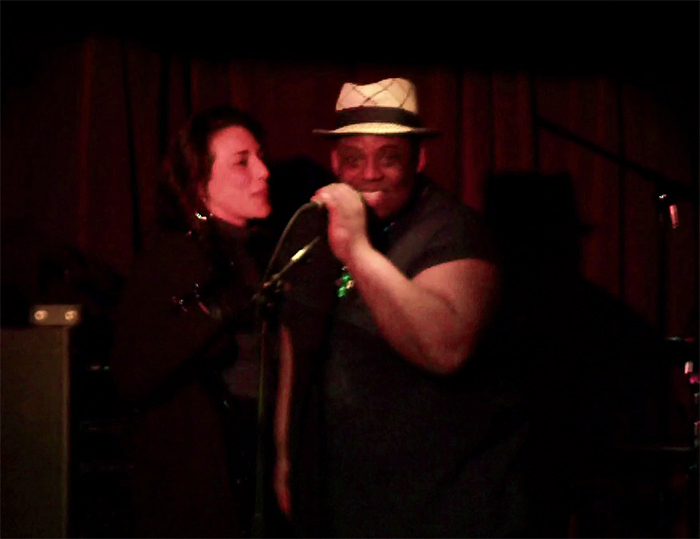
    I was rather shocked to find the place jammed, with the feeling of a religious revival meeting. The leader of the band, who I was later to learn was Slam Allen, was walking and working the audience, shaking hands and greeting everyone in the middle of his music set. Extremely amiable – Slam appears to make bonding with an audience the absolute center of his performances. At one point, a woman started singing to him in a voice which, if not trained, was startlingly confident. In New York City, any performer should be prepared for this – I have often seen talent in an audience which is greater than that of the performer.

    Many performers would give something like this a lukewarm reception and patronizing approval, perhaps feeling upstaged. But Slam was wowed, not threatened or competitive at all, and, without hesitation, insisted she join him onstage. They did a number together – the photo is a still image from a short video I took – you can see the one minute clip here. Be forewarned – the quality of the video is rather unpolished, as the spontaneous often is…

    NOTE: Slam Allen is a singer and guitar player who does a blues/soul fusion. His pedigree and career are quite notable, playing with greats like James Cotton.


  • Click of a Mouse

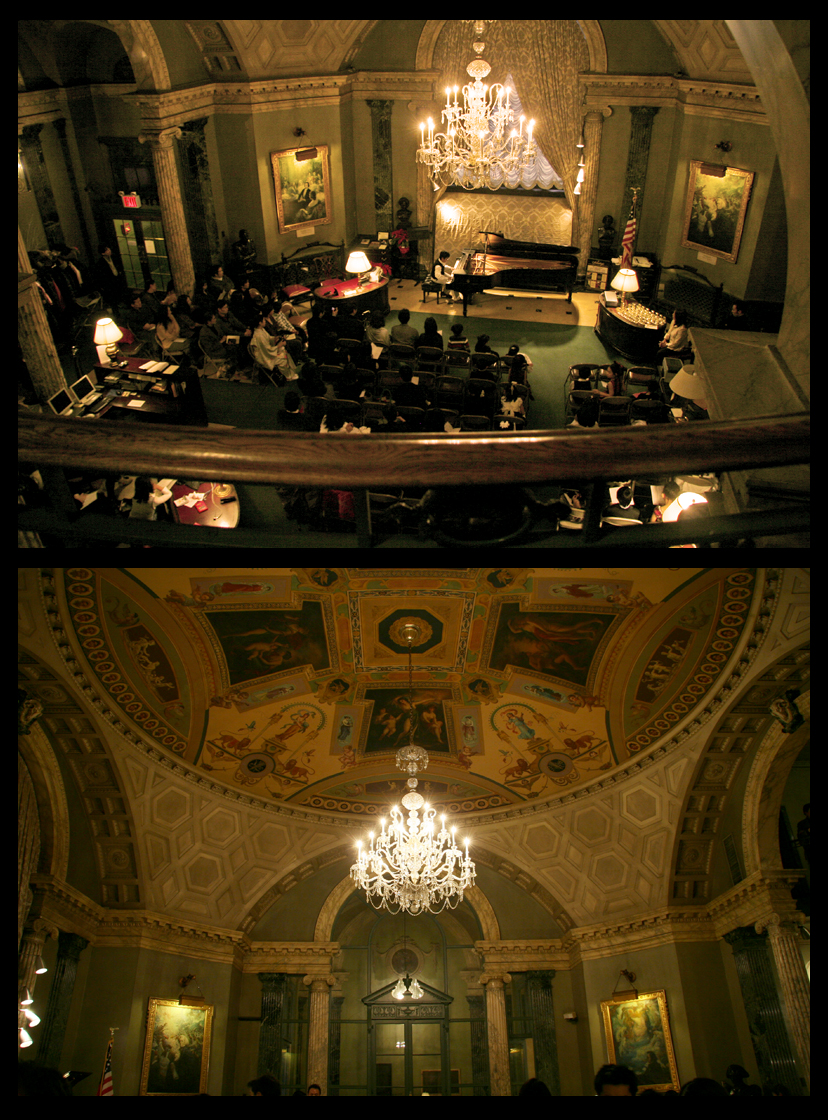
    I am always surveying and scanning for photo opportunities and stories as I travel this city. While driving across 57th Street on Sunday, my eye caught Steinway Hall at 109 West 57th Street. Looking more closely, it appeared that even though it was Sunday, there might be activity. My companion was unfamiliar with the building, so I now had a dual motive. However, as every student of the murder mystery knows, there must not only be motive but also opportunity. So the thought of us both investigating was purely academic, as the prospect of finding a legal parking spot at 57th Street and 6th Avenue is all but impossible.

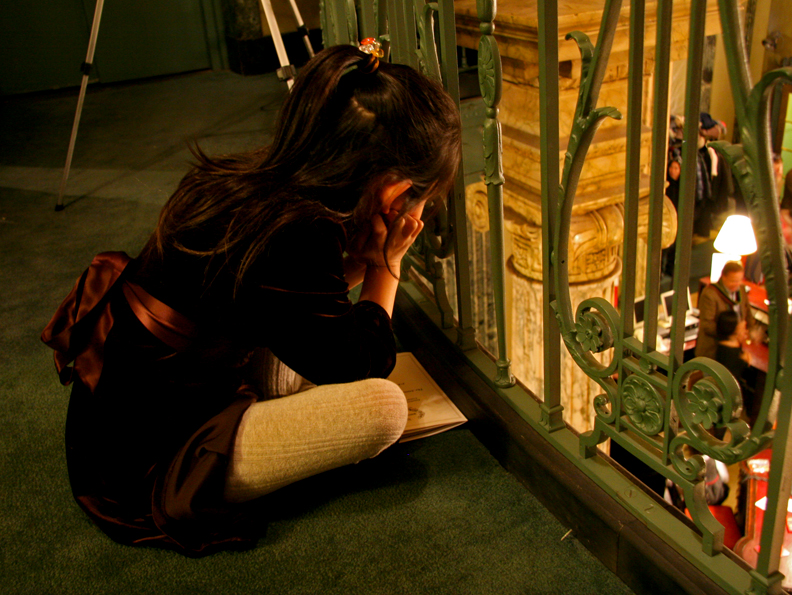
    I intended to make a quick jog across the street, leaving my friend to mind the car while I investigated. Forces were with us, however – there was a legal spot right across from Steinway Hall. I made a quick trip across the street alone and found a performance being held on the ground floor. A sign indicated that entry was allowed during breaks, so I ran back to my car, fetched my fellow traveler, and returned with perfect timing between music pieces, to enter the Steinway Hall rotunda. A flight of stairs took us to a balcony for an excellent view of the performers and audience. Various individuals were taking both photos and videos, so I snapped away (see here for some additional photos of this magnificent room).

    I learned that the Greenwich International Conservatory of Music had scheduled a recital on December 19, 2008 which had been cancelled due to snow and rescheduled for February 1, 2009. The director told me that Sunday performances were not typical here. Apparently I was being gifted with a fortuitous string of events to see this so easily.

    The place was abuzz with virtuosic children and their attentive, beaming parents. I have played some music off and on both as a child and an adult, and I am awed by the enormous talent and work needed by classical musicians to hone their craft. The competition is absolutely fierce, the standards are impossibly high and the nuances extraordinary.

    I only began listening to classical music very late in life – the genre was completely unknown to me growing up – so I am both surprised and pleased to see young children listening and observing so attentively, as did this young girl in today’s photo. The program had 39 student performers with a repertoire that included works by Mozart, Tchaikovsky, Bach, Beethoven, Fauré, Schubert, Smetana, and, of course, Chopin.

    Very few will join the ranks of professional musicians, but no matter. The focus and discipline learned will go far in any endeavor. Most importantly, children will learn that not all good things are subject to immediate gratification or can be had with the click of a mouse…

    Note: Steinway & Sons is one of the most remarkable businesses and fascinating stories in the history of New York City. Steinway pianos are still being made in their factory in Queens. I will do a story on them at a later time.


  • Visceral

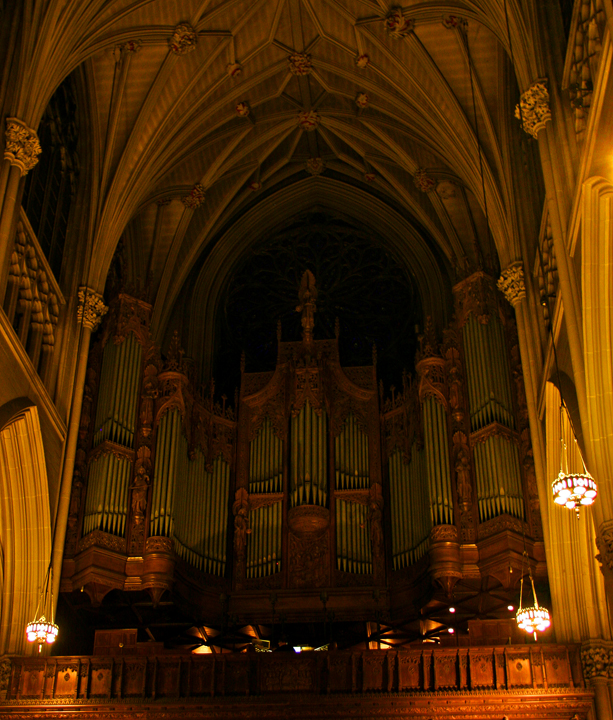
    I do not have any particular religious convictions – it would be fairest to say that I am an agnostic. But I do like inspiration, and the prospect of divine inspiration is extremely attractive if you have wandered in to St. Patrick’s Cathedral and unexpectedly run into an organ recital, as I did recently.

    The experience of listening to an organ like this is so visceral that only a person built of concrete would not be moved. Regardless of your religious preference (or not), I would highly recommend a visit to St. Patrick’s Cathedral, St. John the Divine, or Grace Baptist Church.

    One should be respectful, of course, but the volume of visitors is enormous, and anyone should feel quite comfortable visiting to admire the architecture and pipe organ.

    According to the New York City Guild of Organists :

    The original organ in Saint Patrick’s Cathedral was built in 1879 by Geo. Jardine & Son, one of New York’s organ builders during the later half of the 19th century. In 1926, Pietro Yon was appointed Organist/Director of Music, and plans were initiated to replace the Jardine organ. The St. Louis firm of Geo. Kilgen & Son was contracted to build two new instruments according to designs heavily influenced by Mr. Yon.
    In 1930, the Grand Gallery Organ, with one of the nation’s most glorious wood facades adorned with angels and Latin inscriptions, was completed.

    After more than six decades of continuous daily use, a complete restoration of the chancel and gallery organs was begun in 1993. The combined organs currently contain 12 divisions, 150 ranks, 177 stops, and over 9,000 pipes.

    In perusing the Guild of Organists site, I have found their website to be a tremendous resource. Organ concerts from the NYC metro area are listed for each day on their monthly calendar (see here). My organ concert experience has always been one of happenstance. It is nice to have listings like this available. This is a special time of year with many concerts.
    Bach’s Toccata & Fugue in D Minor or Mass in B Minor anyone?


  • Paddy Reilly’s

    I’m neither obsessed with free nor averse to paying admissions. Attending free events is a dual-edged sword like most things – although I find it to be a healthy antidote to a society where much is defined by the dollar, there is a danger of reducing your standards because something is free. No need to make contributions to dumbing down when the world is doing an adequate job already.

    So when I attend those things which are free in New York City, I do relax my standards somewhat, particularly regarding ambiance and other elements of the performance not related to the music itself. But, I try to not waste time on things that really are not very enriching when the city is brimming with quality entertainment. If you read my posting on the music conservatories, Free Lunch, I have written about free quality performances by sharp talents. Another great resource for entertainment are the various bars that have free music jams, frequently with no cover or minimum.
    In 2007, I wrote about the Baggot Inn (now closed) and the weekly bluegrass jams with Sheriff Bob. The energy at those sessions often built to frenetic level, as the musicians sometimes numbered over 20.

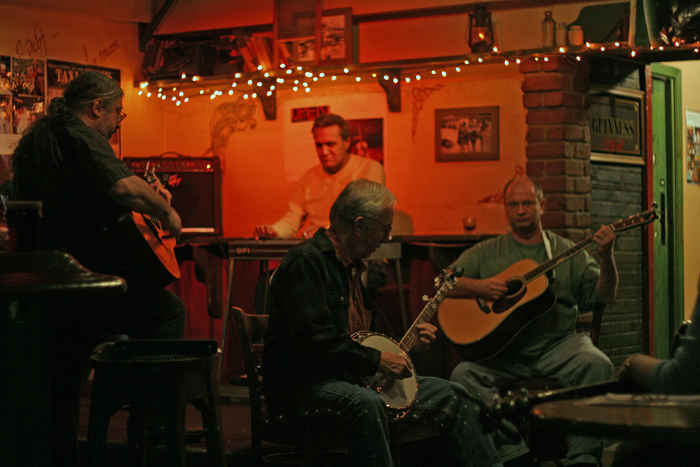
    Last night, I was invited with friends to Paddy Reilly’s Music Bar at 519 Second Ave. (bet. 28th & 29th Sts.). So we ventured out into the subfreezing weather on a Sunday evening. Sunday is a quiet night, so the audience was not large, which was to my liking. Over the evening, the jam had at least a dozen musicians/singers. The talent was excellent – it is always remarkable to see the level of artistic talent in this city. A jazz musician once told me that he has seen world-class jazz musicians play to empty rooms. Not unusual, particularly with less popular music genres such as blues, bluegrass, and jazz. I have written about the demise of blues clubs: Terra Blues is the last remaining one.

    Paddy Reilly is the owner of this music bar. Born in Dublin in 1939, Paddy Reilly is one of Ireland’s most famous Irish folk singers and guitarists, formerly a member of the group the Dubliners. I understand he plays at the bar from time to time. According to the bar, Paddy Reilly’s was the first and only all-Guinness draft bar in the world. There is a back room with darts and other activities.

    Check with the bar before you go because the music changes – some nights are traditional Irish, there are open mics, and on Sunday Night, from 5PM – 8PM. there is the bluegrass jam. And there are cover charges and minimums on Friday and Saturday nights…

    Related Posting: Only in New York


  • Boy Band

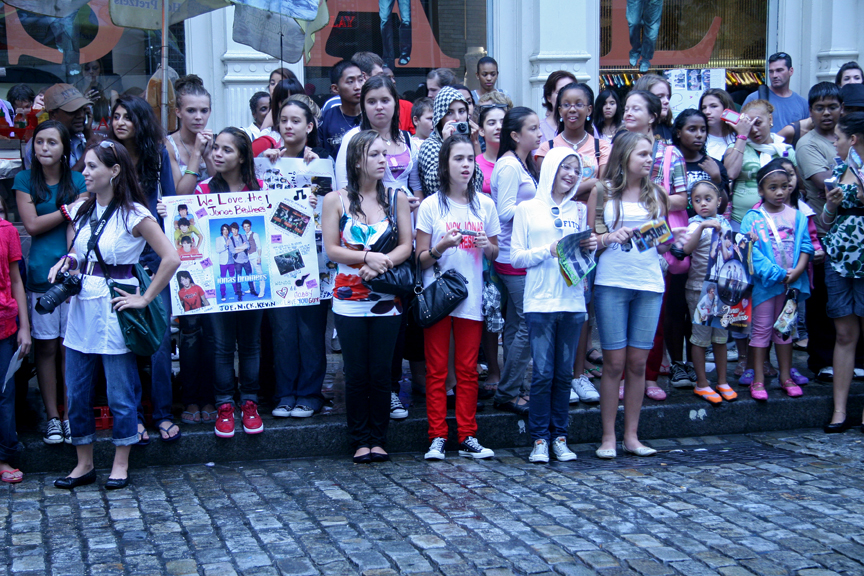
    I have not seen such a group of screaming, shrieking teenagers since the heyday of the Beatles. This was the crowd waiting to see the Jonas Brothers at the Apple store (see additional photo here). I’m sure there have been many groups that have induced such a fervor, but I have not witnessed it personally.

    The Apple store in SoHo has not only become a mecca for their products – they have also been involved in all manner of promotions and presentations. Most of these are product tie-ins, of course, but the store has been extremely generous in usage of their facilities. They provide Internet access on their stable of desktops and laptops with no time restrictions. And they have a great theater on the mezzanine with raked, upholstered seating. With air conditioning and bathrooms, you can see why this has not only become an Apple success but also a second home for many.

    With media becoming Apple’s central focus, popular tie-ins are easy – what doesn’t have an audio or video component? Virtually anything can be tied into an Apple computer presentation using anyone of their numerous software or hardware products.

    I do not keep up with popular music, but apparently the Jonas Brothers are huge with the teenage audience and were making an appearance at the shop. The streets were bulging with fans. There were a substantial number of police on hand. I was told that teenies can get wild and out of control with this group.

    The Jonas Brothers have tremendous media buzz and a promotion machine behind them. I did briefly examine their website and a YouTube video. I can’t say that their music was in the league of rock greats. What we have here is a boy band with a big cute factor 🙂


  • Leftöver Crack

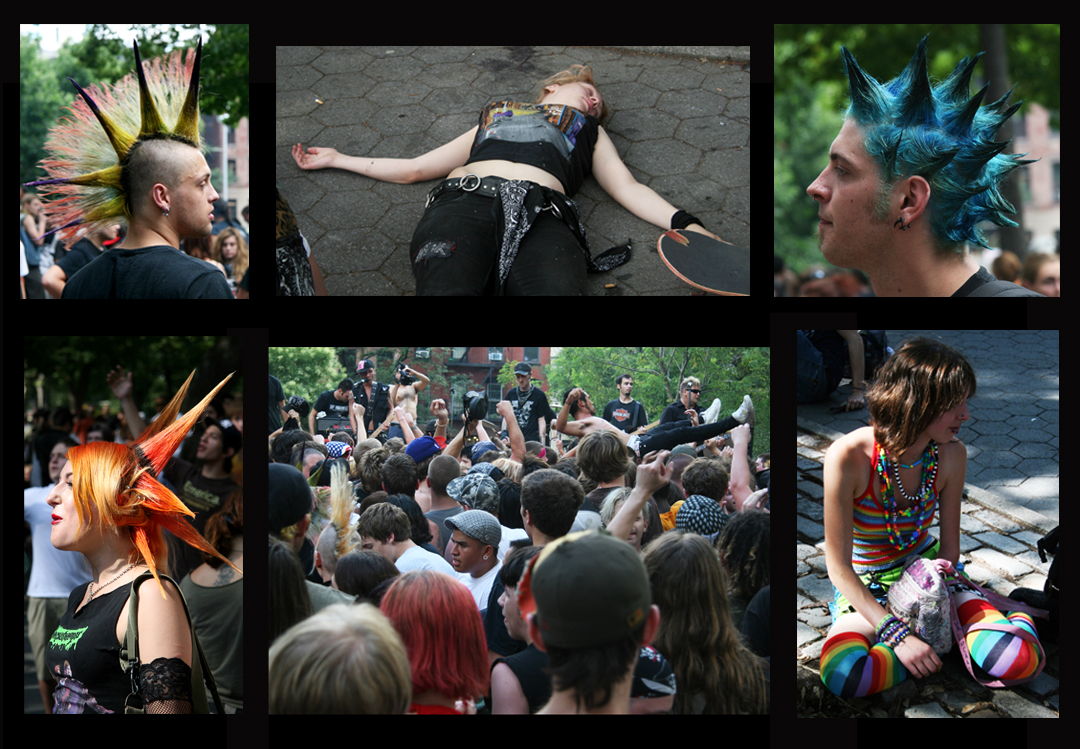
    Don’t you just love these names: Leftöver Crack, Witch Hunt, Team Spider, Disassociate, Death Mold, Hungry Marching Band? This was the group lineup for yesterday’s Police Riot Concert in Tompkins Square Park. I give them points for creative group names. This was my second year; see last year’s posting here with information about the event and photos.

    The concert finished with Leftover Crack, where the unbridled energy of youth reached its apex. There was, of course, the requisite moshing, as well as a flag burning. Given the nature of the concert, however, the attendees were quite well-behaved for a punk rock concert. Apparently there is decorum and protocol defined within the subculture; I witnessed a really young kid, who was extraordinarily drunk, being shunned and seriously reprimanded by everyone around. Sad – where do you get support from peers as a drug user if you are rejected at a punk rock concert?

    The extravagant dress and plumage is my personal favorite aspect of these concerts – it makes for great photo opportunities, and everyone seems to be very open to being photographed. No surprise – anyone adorned or styled with such outrageous hair, clothing, body art, and piercings is hardly shunning attention…


  • Tune Out, Tune Up, Tune In

    Posted on by Brian Dubé

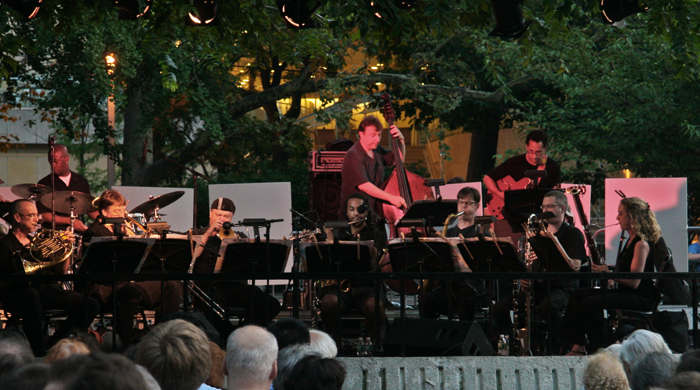
    This year was the 50th anniversary of the Washington Square Music Festival. Outdoor music festivals are one of the great summer pleasures, and we are privileged in New York City to have such stable of talented musicians who are willing to participate.

    The annual concert series is free and typically takes place over four Tuesday evenings in July. This year’s was five concerts, culminating in last night’s concert with a jazz program: the Charles Mingus Orchestra playing the jazz of Charles Mingus.

    Seating is provided on a first-come basis, but the music can be easily enjoyed standing or sitting in nearby benches. The atmosphere is informal.

    Of course, there are distractions, with many other people and activities nearby, but that is the remarkable thing in this city – how great things can coexist and people can selectively enjoy a particular activity.

    Tuning out and tuning in is a necessary and acquired skill. Outdoor and street activities are not for pampered individuals who want their culture in a more controlled environment; for those, we have wonderful concert halls and performance venues. So here’s to the streets and parks of NYC – tune out, tune up, and tune in…

    Posted on by Brian Dubé

  • Sieve

    Posted on by Brian Dubé

    New York is an international magnet. It’s like the whole world is on a tilt and anyone who isn’t tied down ends up in the city at one time or another. And for most musicians and performers, working in NYC is a right of passage.
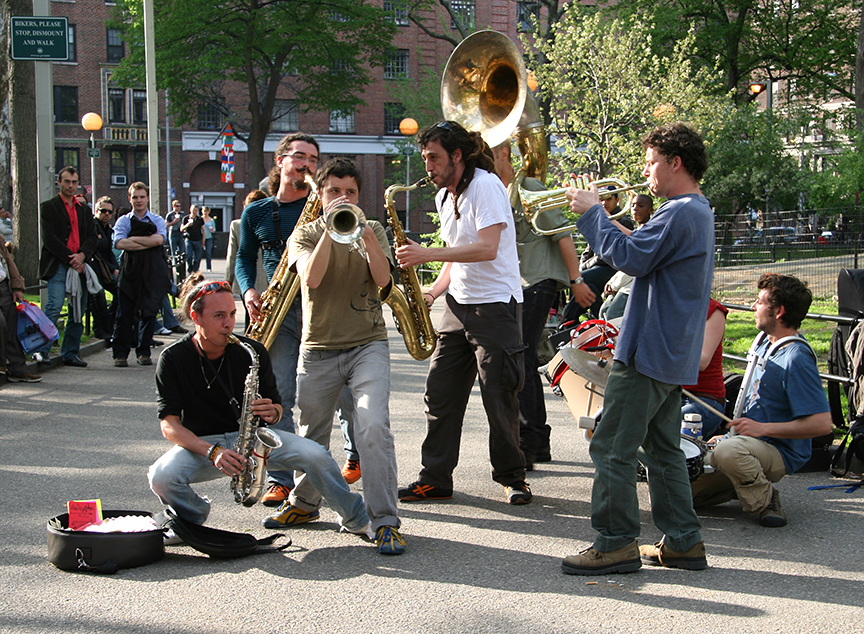
    For a brass band from Marseille, I guess it would be de rigueur.

    On the same day that I met renowned Will Galison, we had this brass band from Marseille only a few hundred feet away. They called themselves Samenakoa and used a number of unique devices, including a megaphone for the singer.

    We are so spoiled in this city. We have one cultural tour de force after another. Even on the streets, we have extraordinary talent and, in some cases, people who work professionally on stages worldwide. I have seen Philippe Petit (who walked between the twin towers), David Blaine, and a plethora of others.
    The streets are a good training ground for performers. Unlike a theater, you do not a have a captive audience – they need to be gathered and held. A tough job in a city with so many distractions and so much talent. If your act is not immediately compelling, most will just walk away.

    Performers I have known who honed their craft this way have become extraordinary performers – not just showmen, but true entertainers. People like Penn and Teller. On the streets, an astute performer can easily ascertain what works and what doesn’t. That which doesn’t work is discarded. It’s liking working with a sieve, sifting for the nuggets of gold that remain after discarding the sand. Separating wheat from chaff.

    All those nuggets of gold and kernels of wheat – that’s why I love this city.

    Related Postings: One Man Band, The Naked Cowboy, Street Revival, Reverend Billy, Missionaries Meet Their Match, Fête de la Musique, Palehorse Productions

    Posted on by Brian Dubé


  • dinamic_sidebar 4 none

©2026 New York Daily Photo Entries (RSS) and Comments (RSS)  Raindrops Theme