• Category Archives Homes and ‘Hoods
  • Indian Gold

    This photo of filigreed necklace sets was taken on 74th Street in Jackson Heights, Queens. The shop is one among many gold dealers in this neighborhood, where a proliferation has made it a gold district, visited by customers from around the country.

    Gold is big in the Indian community. It is purchased for the birth of a child and various holidays and is an important part of weddings. Of the Solah Shringar (sixteen adornments) that complete an Indian bride, many are comprised of gold jewelry. In Indian culture, there is jewelry for nearly every part of the body: anklets, bracelets and bangles, panja (which covers the back of the hand and held in place by an attached bracelet and rings), rings for fingers, toes, noses (nathni) and ears, tiaras, and tikkas (a piece of gold jewelry that hangs over the forehead and hooks into the hair). In India, Bangladesh, and Pakistan, the bride’s jewelry is an important aspect of the wedding process and is part of the dowry which the bride gets to keep in the event of divorce.

    However, traditions are changing, and as more young people in Asian communities in the U.S. marry here rather than in their home country, gold is becoming a less important part of the marriage. All the gold is 22 karat (91.6% pure), and pieces are sold by weight. When I asked the price of a necklace, the clerk promptly tossed the piece on a scale and took out a calculator…
  • Jackson Heights

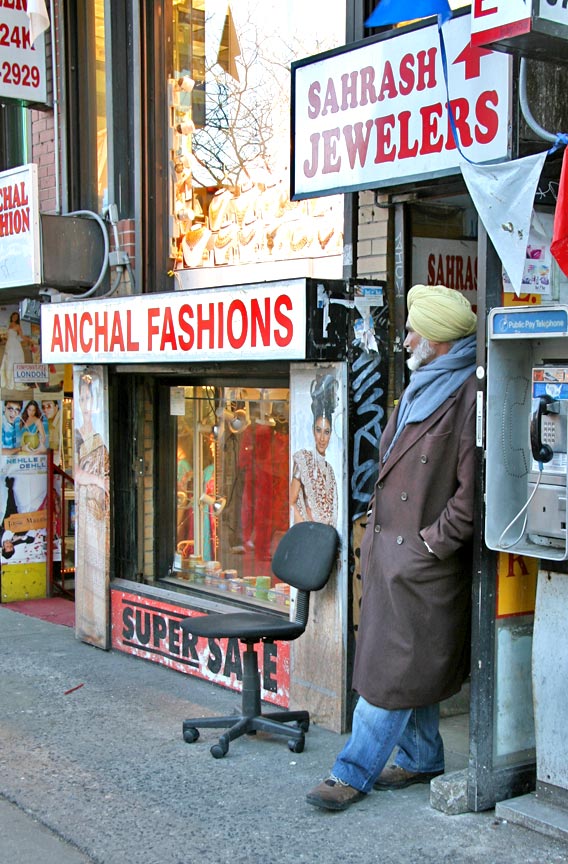
    Queens is definitely off the radar for the tourist or Manhattanite. Yet, for a real slice of New York life, this is the authentic NYC, where 46% of the population is foreign-born. I had heard of Jackson Heights for years, but yesterday I traveled there for the first time with a friend, also a long-time New York resident (Brooklyn) who had never been there. We were both astounded and are still reeling from the experience. Keep in mind, this is coming from New Yorkers who live in one of the most diverse cities in the U.S. We have Chinatown and Little Italy. But Jackson Heights is a whole other world. I have never seen such a ethnically and culturally varied neighborhood – it has been called a “utopia of diversity.”

    From the New York Times: “In the 2000 census report, fewer than 20 percent of the households reported that English was the only language spoken at home. More than half also speak Spanish. And Arabic, Chinese, French (including Cajun and Creole), Greek, Hindi, Korean, Polish, Russian, Urdu, and Yiddish were among the more than 30 languages tallied.”

    The neighborhood, much of it an historic district, is also unique, with its prewar buildings with huge private gardens. This photo was taken on 74th Street’s “Little India.” I will do a future post on our dining and shopping experience there…


  • The East 50s

    The East 50s have long been regarded as one of the most fashionable districts in Manhattan, with some of the most well-known establishments – residences, hotels (the Waldorf-Astoria), retailers, and restaurants, with addresses such as Park Avenue, Madison Ave, Sutton Place, and Beekman Place. From the luxury condominium Veneto’s website: “Since the early 1920s, the East 50s have attracted the most influential and prominent members of New York’s society, from the Vanderbilts to the Rockefellers.”

    In the residental section close to the river, known as Turtle Bay, there have been many influential journalists, writers, and actors as residents, including the writers Alexander Woollcott, John Steinbeck (330 East 51st St.), John O’Hara (230 East 51st St.), Edgar Allan Poe, early feminist revolutionary journalist Margaret Fuller, and publisher Horace Greeley. Their lives and work have given the area the ambiance of the quintessential urbane, sophisticated NYC district and were important contributors to creating the Manhattan mystique that has drawn people from all over the country and the world.

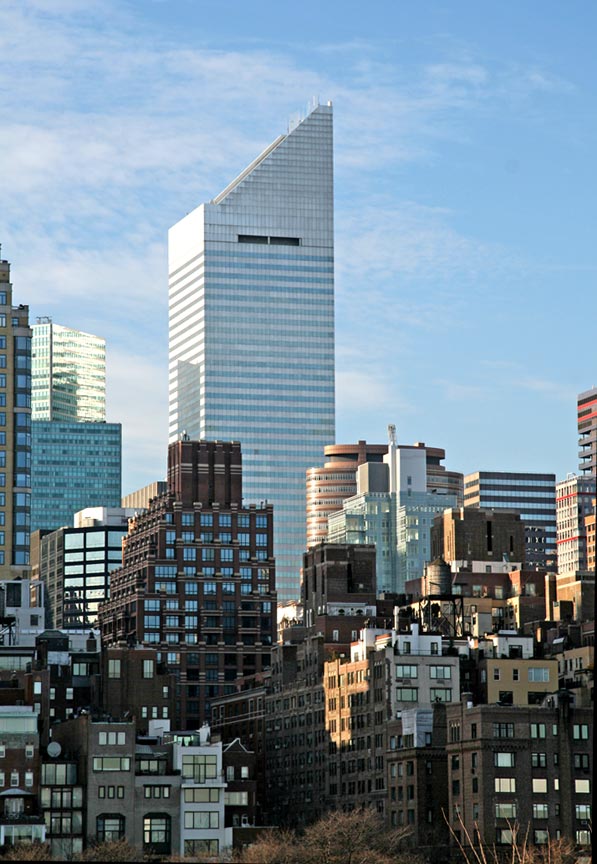
    In this photo: the Citicorp Building with its distinctive angular roof line; to its lower right the oval shaped Lipstick Building (Philip Johnson); and at lower left, the northern end of Beekman Place. I guess we must say to residents there, vive la difference…


  • DUMBO

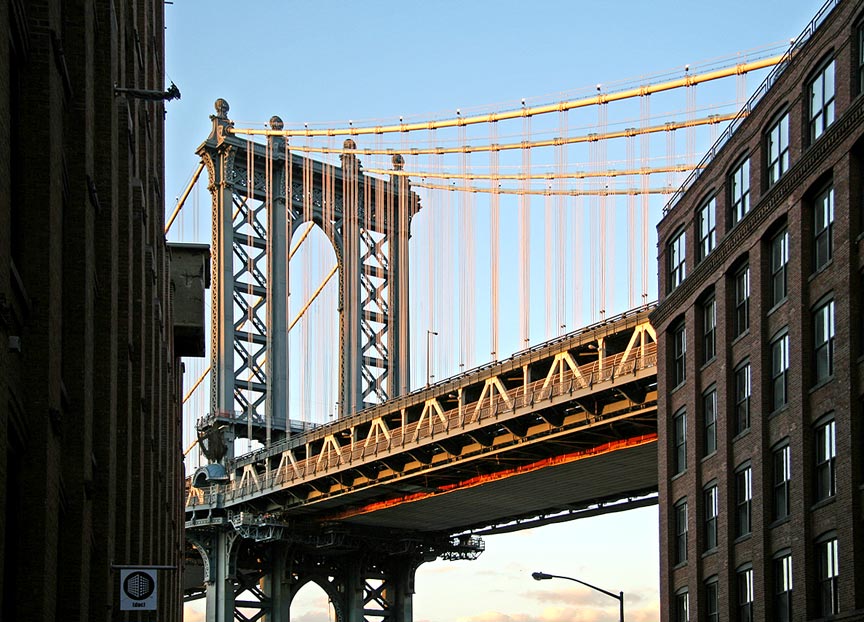
    This is a view looking towards the Manhattan Bridge from Washington Street in DUMBO (Down Under the Manhattan Bridge Overpass). This image gives some sense of the visual drama typical in this Brooklyn neighborhood. There are a number of elements which gives the neighborhood its unique atmosphere – vistas of three bridges with the Brooklyn and Manhattan bridges looming overhead, the omnipresent waterfront, the breathtaking views of Manhattan, the light, the architecture of the large warehouse buildings, and the cavernous feel of the streets. These elements, along with inexpensive rents and proximity to Manhattan, made it a natural choice for the migration of artists who began to inhabit the area in the 1980s. It still has a strong arts community, but gentrification has priced many out, a common scenario with most urban art communities.

    I posted on the annual Dumbo Arts Festival in October 2006 in Sink or Swim, Night in Bloom, Dumbo Arts Fest, and Gallery View. There are a number of businesses in the area worth visiting (many well-known): The Jacques Torres chocolate factory, Bargemusic, Grimaldi’s Pizzeria, the Brooklyn Ice Cream Factory, the River Café, galleries, etc. Click here for the DUMBONYC blog with extensive resource listings…


  • East from East

    This is Midtown East as seen from Roosevelt Island. The glass towers just left of center are One and Two United Nations Plaza, a group of buildings built over a span of several years (1976 and 1983), designed by Kevin Roche John Dinkeloo & Associates. The hotel/apartments/office building was completed in 1976 as a city/state/U.N. project. In 1999, the hotel was purchased by Millennium Hotels to become the Millennium UN Plaza Hotel – it has an indoor swimming pool and the only indoor tennis courts in a NYC hotel.

    To the left of the complex, we find the Empire State Building, and to the right, the Chrysler Building. In the lower left, you can see the United Nations General Assembly building with its domed roof. At the far right, you can see the Met Life Building (formerly the Pan Am Building), the subject of a previous posting


  • Beekman Place

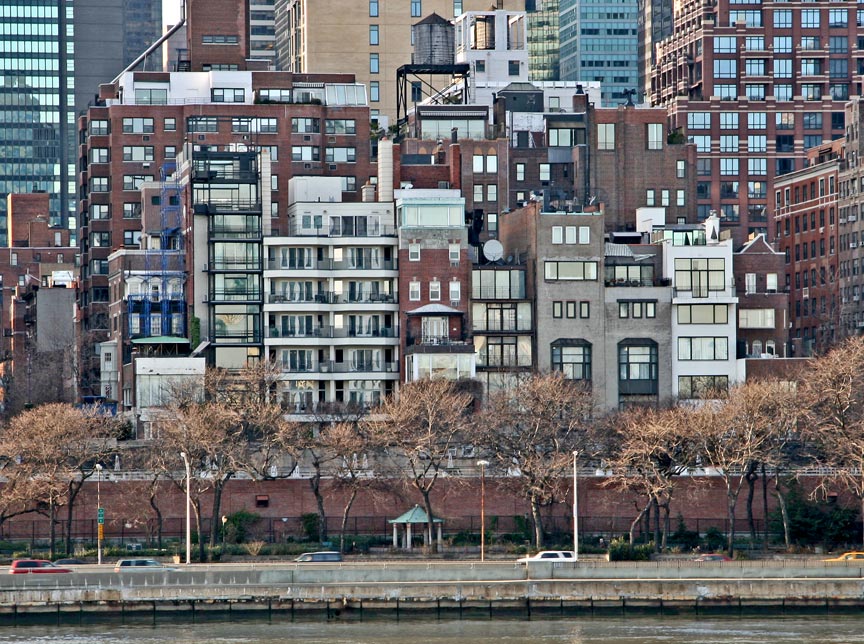
    This is Beekman Place as seen from the East River. From this vantage point, we see the backs of the row of houses of those lucky souls who have river views. This small enclave is an urban oasis – a two-block long street tucked in between 49th and 50th Street and east of 1st Avenue. The area is less well-known (particularly to outsiders) than its neighbor, Sutton Place, two blocks north.

    The Beekman name is one of NYC’s oldest – William Beekman came to America on the same ship as Peter Stuyvesant in 1647. James Beekman built a mansion here, Mount Pleasant, in 1764 (it was used as British headquarters during the Revolutionary War). Nathan Hale was hanged here as a spy in 1776. It was demolished in 1874 as the city’s grid plan encroached. By the end of the 19th century, the area had become a slum, with industry at the river’s edge.

    In the 1920s, the neighborhood started to turn around, eventually to become one of the most sought after addresses of the wealthy. The roster of current and former residents reads like a small Who’s Who, with names such as Rockefeller, Vanderbilt, Ethel Barrymore, and Irving Berlin. Note the building second from the left (in the row of nine) – it is the former home of architect Paul Rudolph (read about him here and here)…


  • Dyker Lights

    There are Christmas tree lights, and then there is Dyker Heights. This Brooklyn neighborhood (between Bay Ridge and Bensonhurst) is known worldwide for its elaborate Christmas light displays (more photos here). PBS did a 2001 documentary detailing the phenomenon – apparently many of the displays have been motivated by various family events and crises. When I first visited this area in the 1980s, I had never seen anything remotely like it.

    The predominantly Italian neighborhood is quite affluent – many of the homes are mini-mansions. The premier block is 84th Street between 10th and 12th Avenue. Here, the traffic becomes bumper to bumper as gawkers cruise slowly down the block (click here for photo). In addition to the myriad of lights, you will find animated characters, motorized dolls, miniature villages, armies of illuminated soldiers and choirboys, live Santa, free toys, huge nativity scenes, synchronized music, and computerized displays like that of Robert DeLauro, who, with Light-O-Rama software, a programmable microprocessor, and a computer in his basement, controls 10,000 lights using 32 extension cords. Apparently, extravagant computerized displays are becoming more common nationwide – check out the home displays on planetchristmas.com.


  • Milligan Place

    Of all the small alleys and courtyards in Manhattan, Milligan Place can perhaps be most easily missed, with its small gateway sandwiched between two buildings on 6th Avenue near 10th Street in the Village. The four buildings in this cul-de-sac were built in 1852 as second-class boarding houses for waiters (primarily Basque) working at the nearby Brevoort House hotel. The land was purchased from the large Peter Warren estate in 1799 by Samuel Milligan, who built a home here. After his death in 1852, the house was replaced by the four row houses which we now find here.

    Originally, Milligan Place was entered from Skinner Road (later named Christopher Street). In time, of course, these types of enclaves caught the fancy of the bohemian artists and later became gentrified. The cofounder of the Provincetown Players, George Cram Cook, and his wife, playwright Susan Glaspell, lived here from 1913-1917. Eugene O’Neill lived here as well. In 1963, an attempt to tear the buildings down (and those in nearby Patchin Place) was thwarted by a community group led by Ed Koch. Milligan Place is not so much charming for its architecture but rather for the peaceful oasis in the city it represents and that passersby may long for…


  • Park Slope Limestones

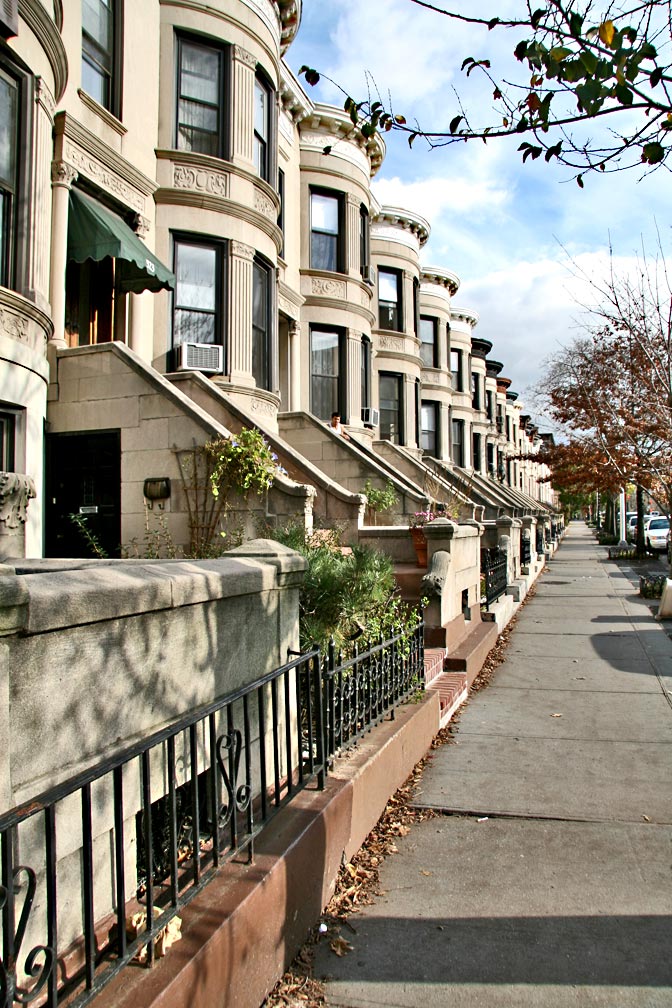
    This is 9th Street between 8th Avenue and Prospect Park in the Park Slope neighborhood of Brooklyn. Park Slope is much too large a topic to do any justice to in one posting, so click here for a Wikipedia article.

    Park Slope, along with Brooklyn Heights, is one of the premier residential neighborhoods in Brooklyn/NYC. The row houses here, as well as in other neighborhoods of New York, are frequently referred to as brownstones. This term is frequently used incorrectly – Park Slope has many buildings with elements of Romanesque and Beaux Arts architecture. This block of 9th Street is a good example, with a magnificent stretch of white limestone row houses from the early 1900s. These long rows of houses on wide tree-lined streets is fairly typical of many of the finer blocks in central Park Slope.

    Although the Slope has seen a period of decline, even with areas of widespread blight and abandonment with vacant buildings and lots, those days are long gone. Park Slope has been thoroughly gentrified – pioneers need not apply…


  • 17 Grove Street

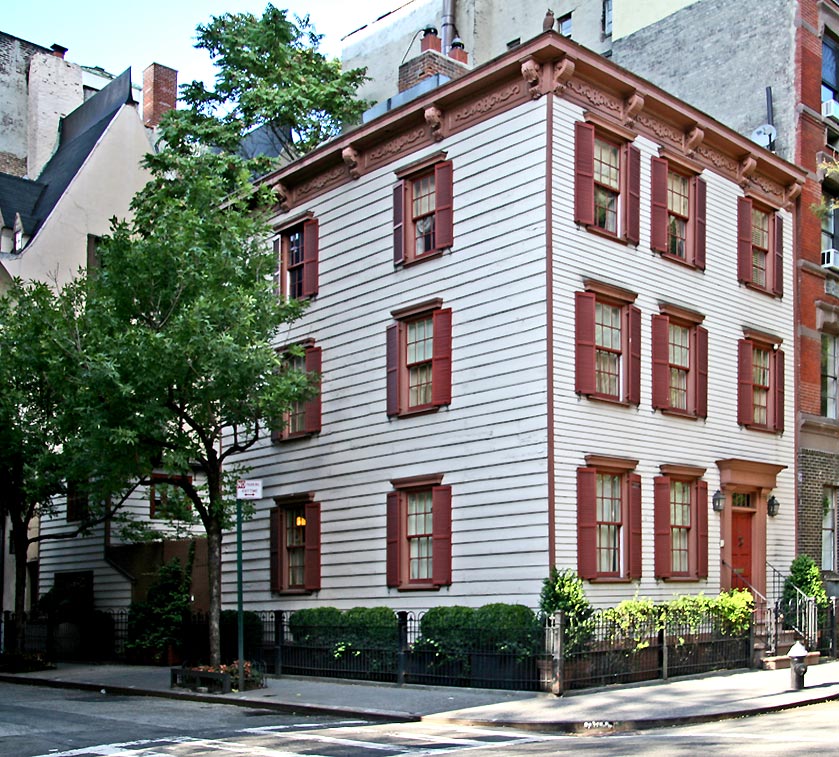
    This special clapboard residence at 17 Grove Street in the West Village was built in 1822 by William Hyde, a prosperous window-sash maker. This was the year that also saw an outbreak of yellow fever, which led many New Yorkers to find refuge in the rural area of Greenwich Village.
    What is unique here is that this dwelling is a wood frame structure – one of the few and the largest remaining intact wood frame buildings in the Village. Construction of wood-frame buildings was banned in the city in 1866 for fire prevention. In 1833, Hyde added a workshop out back – note the small building to the left of the main building (separated by a small courtyard) in the photo. This eventually became a single-family residence. A third floor was added to the main home in 1870.

    The building has since served many functions – even as a brothel during the Civil War. Of course the building has changed hands over the years. In 1987 both properties were sold for $1.1 million and meticulously restored. I love passing this corner – the bucolic setting and clapboard exterior really transports me in time and space …


  • One Front Street

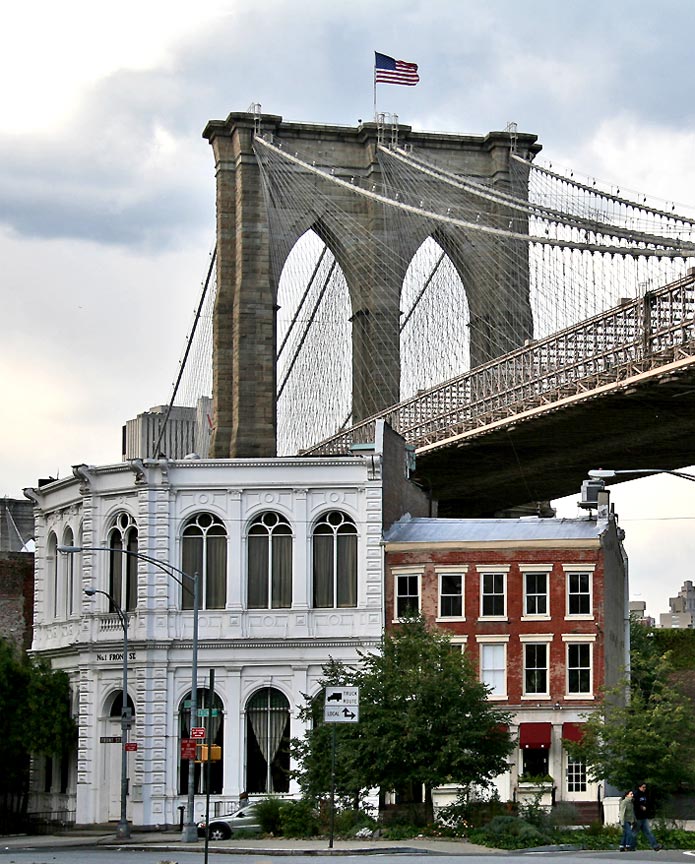
    The building at One Front Street sits at the junction of Front and Old Fulton Street in the Dumbo (Fulton Ferry) historic waterfront district of Brooklyn. This beautiful cast-iron Renaissance palazzo, built in 1869, was originally the Long Island Safe Deposit Company.

    From the American Institute of Architects Guide to New York City: “This monumental bank overshadowed its older neighbors in the prosperous post-Civil War era. The Brooklyn Bridge’s diversion of commuting traffic after 1883 forced the bank to close its doors in 1891.” Like many other structures in the neighborhood, the Brooklyn Bridge frames the architecture and provides an inspiring, quintessential NYC backdrop…


  • Grove Court

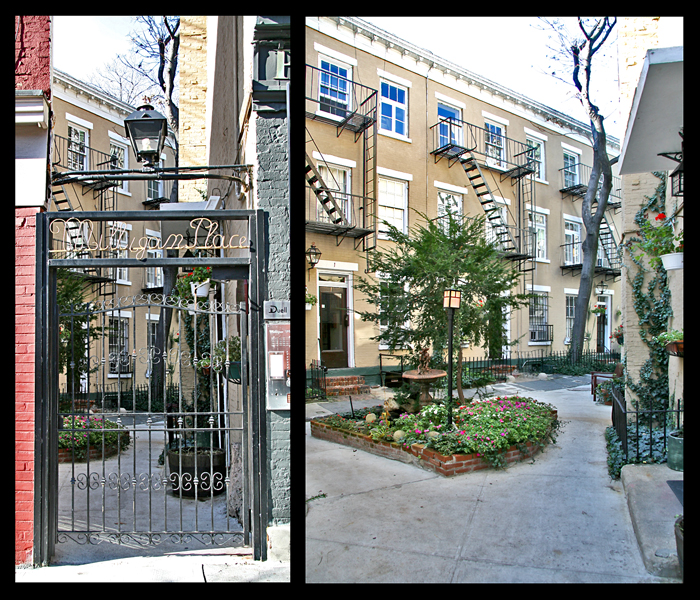
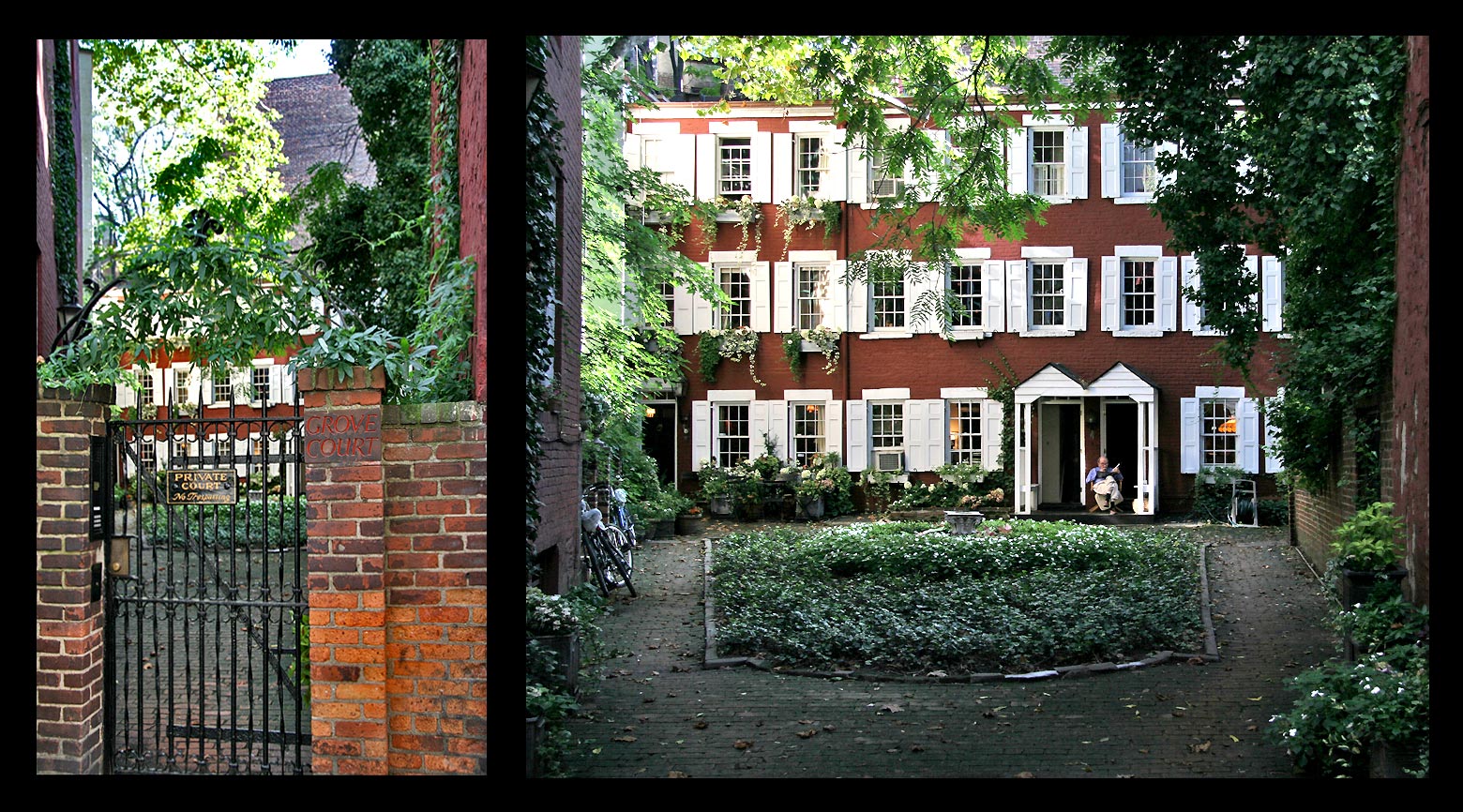
    On Grove Street in the West Village lies a narrow gate (left photo) leading to Grove Court. This private courtyard (right photo), with its row of 6 houses, is the quintessential NYC cul-de-sac, not that there are many contenders. The irregular property lines of early NYC left this parcel of land, and a passageway between 10 & 12 Grove Court gave access.

    So, in 1848, Samuel Cocks, owner of grocery store Cocks and Bowron at 18 Grove Street, decided to develop the property into backhouses for tradesmen and thereby improve his grocery trade. The properties were completed in 1854. At the time, it was nicknamed Mixed Ale Alley – ironic that a row of backhouses like this would be considered undesirable for those with money. Today, of course, it’s a “secluded court”; quite exclusive and rarely available…


  • Lockwood de Forest House

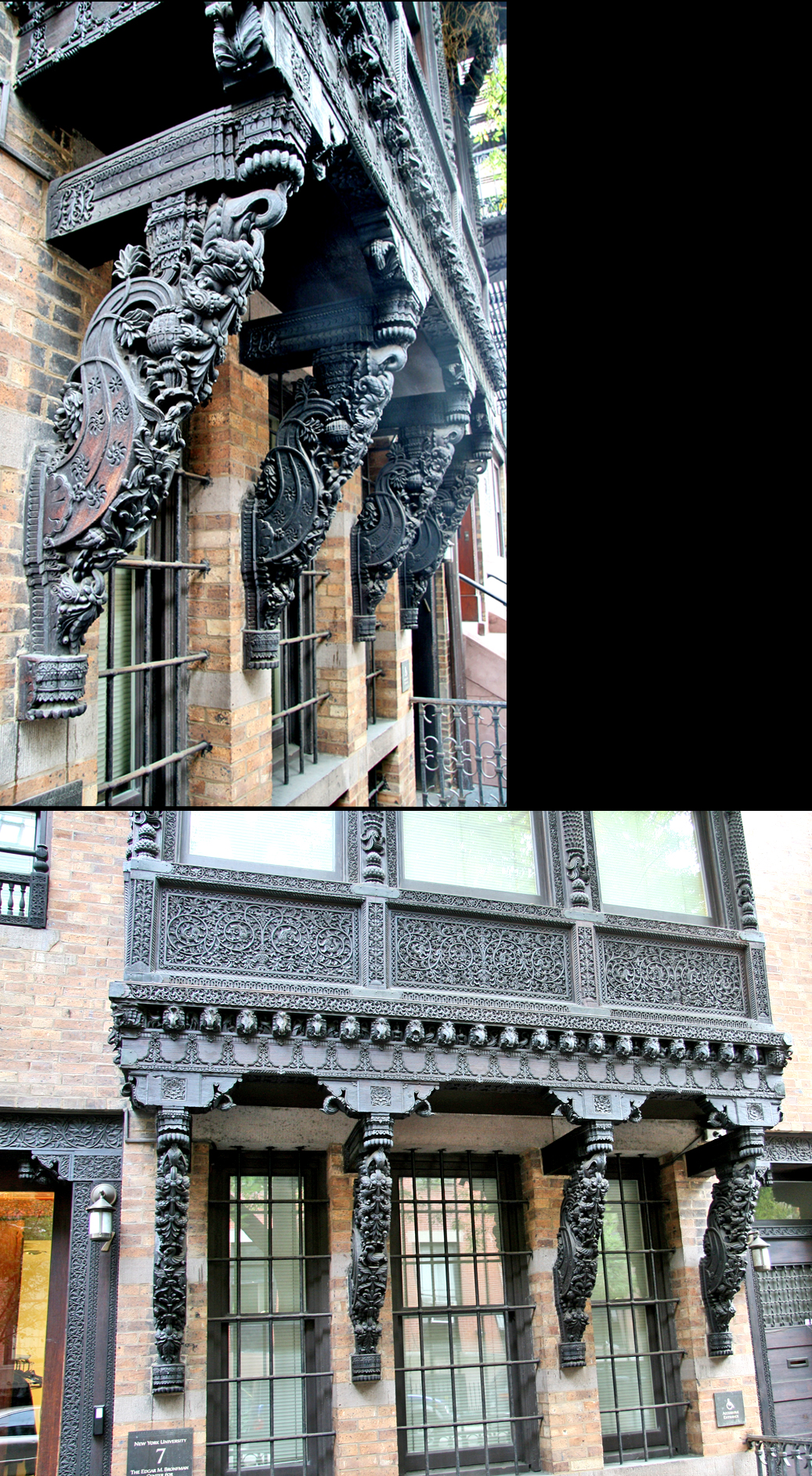
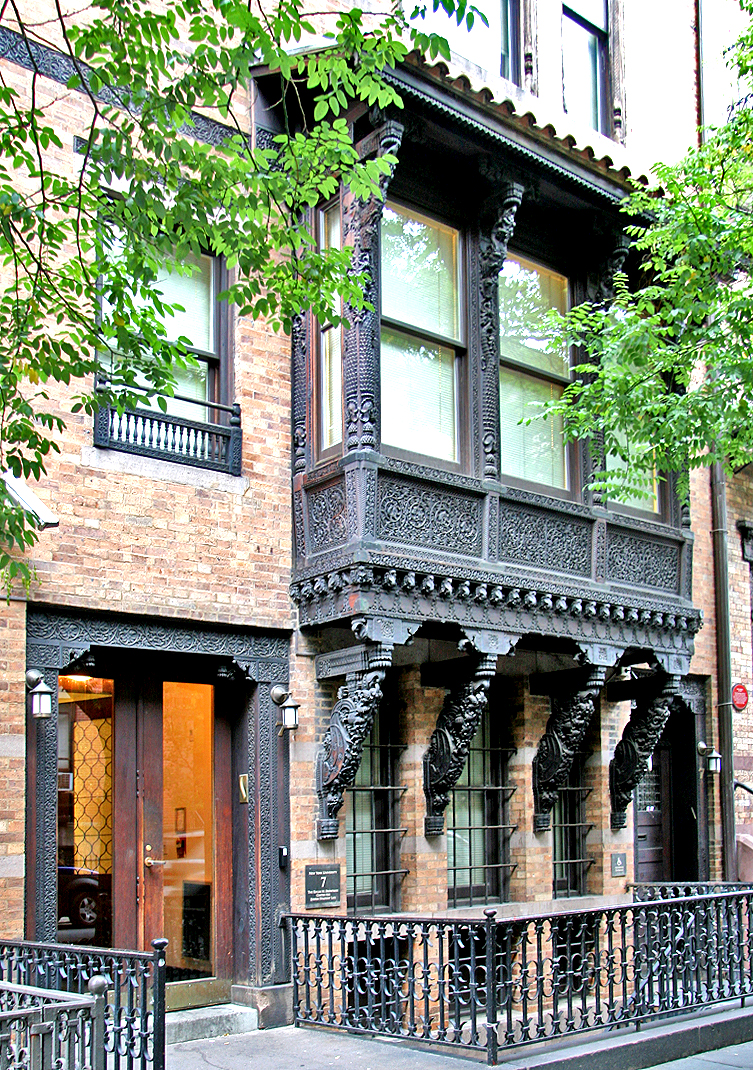
    The Lockwood de Forest house, at 7 East 10th Street, has to be one of the most unusual houses in NYC. Click here for more photos.

    Lockwood de Forest had interests in art and architecture – he studied with Frederic Church and with Louis Tiffany in 1879, and he co-founded Associated Artists, a very influential decorating company of the 19th century. He had this house built in 1887 – a relatively plain structure. It is the intricately carved teak exterior elements (provided by a woodworking factory he owned in Ahmedabad, India) that are so striking to everyone who passes by it – the doorways, cornice, and, most noticeably, the 2nd floor projecting oriel window with its intricate filigree and relief carvings of birds, flowers, and many other details. The interior had large expanses of teak paneling, Indian furniture, and a brass ceiling on the 2nd floor. In 1900, a writer for House Beautiful described it as “The Most Beautiful Indian House in America.”

    An interesting note: De Forest met Rudyard Kipling in India – Kipling stayed at 7 East 10th on at least one occasion. In 1922, the house was sold, and much of the interior was sold at auction. The house was purchased in 1994 by NYU for $2.5 million and was converted to the Edgar M. Bronfman Center for Jewish Student Life. Efforts have been made to preserve the exterior and remaining interior details…


  • Terrapin Chelsea Art Gallery

    This was Architecture Week with the Open House New York weekend. Terrapin Art Gallery was one of the few private homes in the roster and is the home of Pamela Harvey-Rath and Colin Rath, who, in 2000, transformed two floors of an 1853 Chelsea townhome in to a fantastic artist’s dreamscape.

    Their love of the sea is reflected in the undulating curved surfaces throughout the home. A lit glass stairway leads down to their main room, which features a 2-story-high dome ceiling with a stone fireplace and waterfall that empties into a replica of the Yangtze River in the floor stocked with Koi fish. A child’s bedroom has a reproduction of the sky from Van Gogh’s Starry Night done in marbles. The backyard has a garden, redwood hot tub, stairs with Adirondack style wood railings, and a 3-story glass green house. A brass firepole connects the two floors.

    The home also functions as art gallery and is available for private functions and photo or video shoots. Note that the Rath’s have purchased the building next door (seen in the lower right photo) and are in construction…


  • 39 & 41 Commerce Street

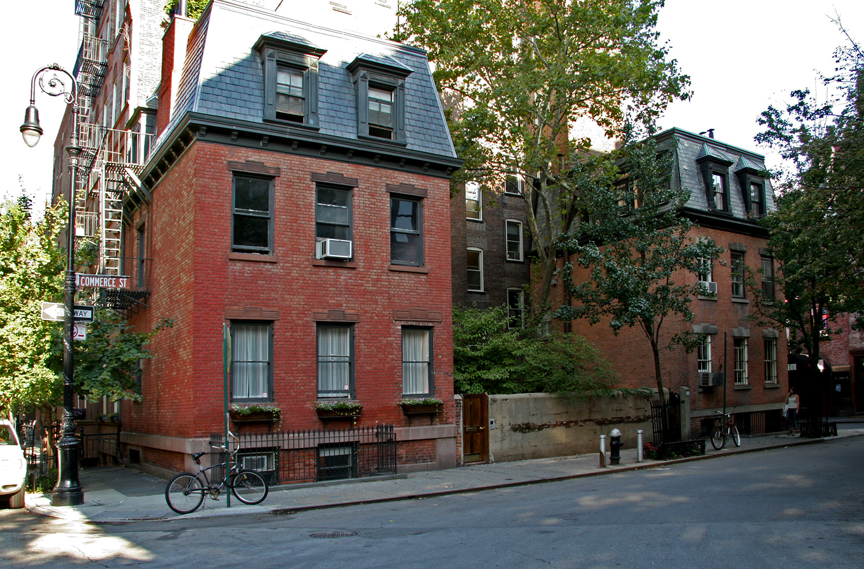
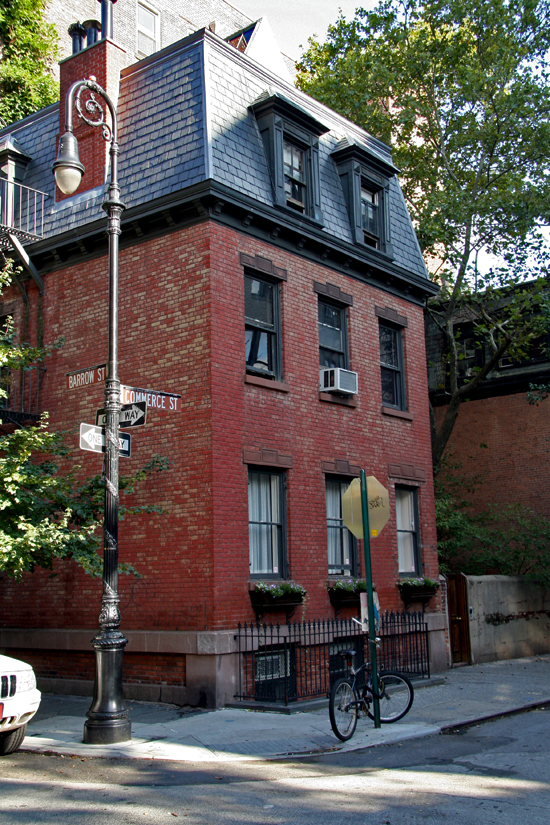
    On one of the most picturesque corners in the city, where Commerce Street meets Barrow Street, are a matching pair of buildings: 39 and 41 Commerce Street. Click here for 2nd photo. Folklore has it that these two buildings were built by a sea captain for his two feuding daughters. In fact, they were built in 1832 as an investment by Peter Huyler, a milkman from Hackensack, New Jersey. A full third story under mansard roofs were added in 1873. What’s unusual is that this pair of buildings shares a very large garden (the entrance doorways are through the garden). One must remember, however, that at the time these were built, Greenwich Village was still a suburb of the city and that most of the houses in the area had small adjacent plots – land did not have quite the premium that it has today.

    The origin of the street name is not clear, but there was never that much commerce – records show only a brewery, woodshop, and factory. Today there is the Cherry Lane Theatre, a restaurant and a bar. By the turn of the century, the area was already home to bohemians, artists, and writers. So, for those of us who bemoan having missed the boat regarding real estate opportunity, rest assured – the boat left quite some time ago…


  • dinamic_sidebar 4 none

©2026 New York Daily Photo Entries (RSS) and Comments (RSS)  Raindrops Theme