web analytics

  • Category Archives Stores
  • The Knell Tolls for Thee

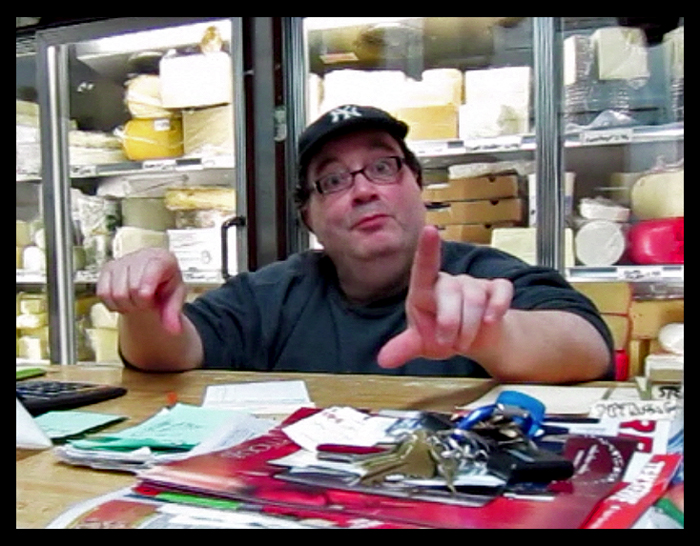
    The local news during the last several days could easily be called Ode to Joe’s Dairy as one publication after the next paid its respects to the passing of one of New York City’s icons. I felt so strongly about the importance of this small establishment that in February 2012, I made several visits, interviewed the owners, and made a short two-part video documentary – I have reposted them here.

    Joe’s Dairy, located at 156 Sullivan Street in this Italian area of the South Village/SoHo, is the type of place that gives New York its unique character. The real deal, a place family owned for eons. Although I referred to it as “stability in a world of change,” I knew full well that it was just a matter of time. The owner had told me, during my visit, that closure was inevitable. It’s a scenario replayed many times. Even when there are children, few wish to follow in their parents’ footsteps.

    The lure of money and everything NYC has to offer is much greater than spending long days making mozzarella. Often, parents want better for their children and discourage them from continuing the family business.

    Sometimes a detour is made, where, after a college education and work in the corporate world, a family member will return to continue the legacy of the family. This was the case with Nom Wah Tea Parlor. But this is the exception, not the rule.

    But let’s be fair. As Jill Eisenstadt so poignantly said, nostalgia is a heavy shovel. And, regardless of any romantic notions, who wants to slave over boiling vats trapped in a tiny kitchen, turning out over 1000 pounds of mozzarella, day after day? Watch my videos and tell me if you or anyone you know really wants to do this work. Nonetheless, as I passed by to photograph the shuttered storefront and read their letter of thanks posted on the window, I was saddened. It was, however briefly, a morning of mourning. Ironically, I had spoken to them only a year ago about the bells of St. Anthony’s across the street, how I had heard the sombre ringing for a funeral and had written a story, For Whom the Knell Tolled. And now, for Vincent and Anthony Campanelli, The Knell Tolls for Thee :(


  • Crazy Kid

    I was persuaded, by my readings in my youth when a vegetarian, that goat’s milk was far superior to cow’s milk. That it was more digestible and better utilized by the human body. That its mineral composition was more compatible with human needs. And goats were certainly cuter than cows, so in a short time, I became fixated on all things goat. I sought out every variant of goat’s milk products. Perhaps the pinnacle of goat dairy products is French goat cheese, which I love to this day. This was quite apropos, being of French ancestry, and a friend had said that she envisioned me in retirement in France, raising goats and making cheese. The proposition did sound rather idyllic.

    But alas, I was to learn that our hooved friends, although cute and often characterized in charming ways such as “crazy,” were not as innocent and benign as I had imagined. I once expressed my fondness for goats to an old college roommate and lifelong friend who had relocated to San Francisco. He was a nature lover – hiking, fishing, camping, canoeing, etc. – and much more savvy as to the real nature of barnyard animals. He had friends who had goats, and he suggested that I might want to reassess any dreams of goat ownership. Goats, he said, were VERY troublesome creatures to keep. They are intelligent, resourceful, and difficult to confine. They are quite destructive – there are many online video where goats can be seen standing on hind legs, stripping trees of leaves. If left unchecked, goats will strip trees of bark too, killing them.

    Nonetheless, I still have a fondness for our feisty, four-legged friends, and perhaps even believing that in some ways, I am little bit goat-like myself. I always take the opportunity to pet goats when possible and seek them out in farms and zoos. So, recently, while traveling through the hinterlands of Staten Island, at 2355 Arthur Kill Road, I was very excited to see Crazy Goat Feeds. I was to learn, however, that the business is not a mecca for goat feeds, although it is a feed store. From Staten Island Live:

    Over the last six years, an old volunteer firehouse in Rossville has become a magnet for Staten Island’s animal lovers. Crazy Goat Feeds – which looks as wild from the outside as its name would imply – is the borough’s lone remaining feed store and a one-stop-shop for local pet owners. With tin ceilings and wooden floors the building maintains its antiquated charm, but inside the gutted garage and upstairs loft, every amenity for four-legged friends is on display.

    “We’ve got a little bit of everything here,” said owner Debbie Accurso, who took over the former CG Feeds in 1995 when it was based in Charleston. “But we really focus on organic and holistic foods for pets. It’s not the type of stuff that you see in the supermarket.”

    Patronization from organizations like the Staten Island Zoo and the NYPD mounted police unit has allowed Crazy Goat Feeds – which was renamed by Ms. Accurso’s young nieces – to maintain a unique inventory that covers dogs, cats, rabbits, birds, fish and even horses.


    The business arrangement with the Zoo is a long standing one. It’s been in place for years and carried over after the purchase of the shop from former owner Clark Gabel, who founded it in the 1960s. The horse-riding police have been a recent addition to the customer list.

    I was a bit disappointed that Crazy Goat Feeds was not really a business built around goats, because deep down inside me, there’s a Crazy Kid :)


  • Self-Service, Part 1

    Does It Have to be a Juki?

    You know the scene, I am sure. You are in a store and can’t find something. You look for a salesperson. Finally, you find a GROUP of sales people, deeply engaged in conversation. Perhaps one of them even sees you and that you clearly need help. Apparently, however, their conversation is more important than helping you.

    It’s a form of customer service perhaps better called SELF SERVICE, but not the type of self-service that many of us like, where money can be saved and the check out process expedited. This type of self-service is self-serving.
    This type of self-service plays out in many ways, but the underlying operative is always the same – placing the needs of the business or salesperson ahead of the customer. Selling you what they have, even if it is something you don’t want or need. Upselling.

    In New York City, purchasing goods from suppliers to the trade often has its own flavor – one that I hate the taste of. It’s quite simple and goes something like this:
    You enter a business establishment knowing exactly what you want. It may be goods you have purchased for years. However, asking for what you want is followed by a question, something like – what are you making? This may seem extra helpful, trying to understand your needs, etc. But it’s not. Their question is really code for: How can I sell this person something I have rather than what they want. Infuriating if you know what you need. If you persist and are singular in your demand, a vendor will often resort to the more direct: Does it have to be ______ ?

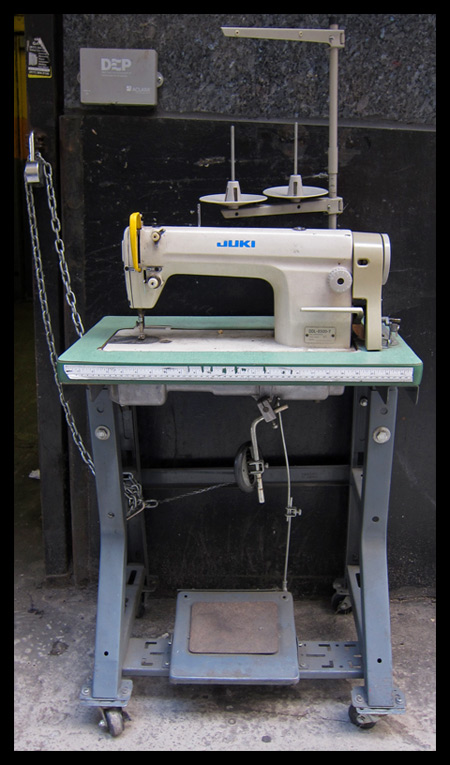
    In the 1980s, I was shopping for a commercial sewing machine. Every sewing factory I had been in was filled with Juki sewing machines – the industrial workhorse of the garment industry. Everyone I spoke to said that the Juki was the machine to get. So, I went to the sewing machine district – two city blocks in Manhattan (25th and 26th Street between 6th and 7th avenues) known for its innumerable dealers of industrial sewing machine dealers, parts suppliers, and service establishments. I recall an exchange with one dealer who apparently was frustrated with my insistence on Juki, which he either did not have or perhaps he did have but had something else he chose to unload on me. I should have seen his response coming when I asked for a Juki: “Does it have to be a Juki?” he said in a thick New York accent.
    Had I been more experienced, wiser, and BLUNT, I would have told him, “No. It does not HAVE to be a Juki. But that is what I want. I’m the customer. Are you here to serve me or yourself?” I did remain steadfast and found a Juki. I never used it much and sold it some years later.

    Recently, while purchasing goods on 39th Street in the Garment District, I spotted the machine in today’s photo. So perfect, a Juki sitting alone on the street beckoning me. “Come on,” it was saying. “Take a photo. You already have the story.” Yes, I had no choice. Because there was a second part to the story too, one that does not end with Does it Have to Be a Juki? :)

    Related Posts: Do the Right Thing 2, Do the Right Thing, War Against Disservice


  • Dogs

    Estimates of the number of dogs in New York City ranges from 500,000 to 1.5 million, depending on who is doing the counting. Not matter how you count them, that’s a lot of dogs, and for many in the city, particularly single households, dogs become more than companions – they are roommates and central to the lives of their owners. As with so many things here, the city imposes many many hardships on dog owners. Finding dog runs for socializing. Lugging dog food home. Keeping dogs on a leash. Daily walks for bathroom functions are necessary, not optional.

    One of the most difficult situations for the dog owner is going away without one’s pet. In the suburbs or country, a neighbor can often be easily recruited for looking after one’s dog or a short-term adoption. In the city, however, this is an unlikely scenario unless one is willing to pay for the service. Space is tight – the few backyards that exist are not used for keeping dogs.
    Doggy day care does exist – I once investigated this with a friend with dogs in the city. We visited a few personally, read online reviews, etc. Unfortunately, the owner found them to be depressing, and in the end, she never found one to her liking. Not surprising that many dog owners will never find any day care center adequately attentive and loving to their animals. Anyone going into this business has quite a wall to climb to gain approval of the dog owner. Some owners do have positive experiences with day care, with their dogs loving the social atmosphere of the many dogs at a facility.

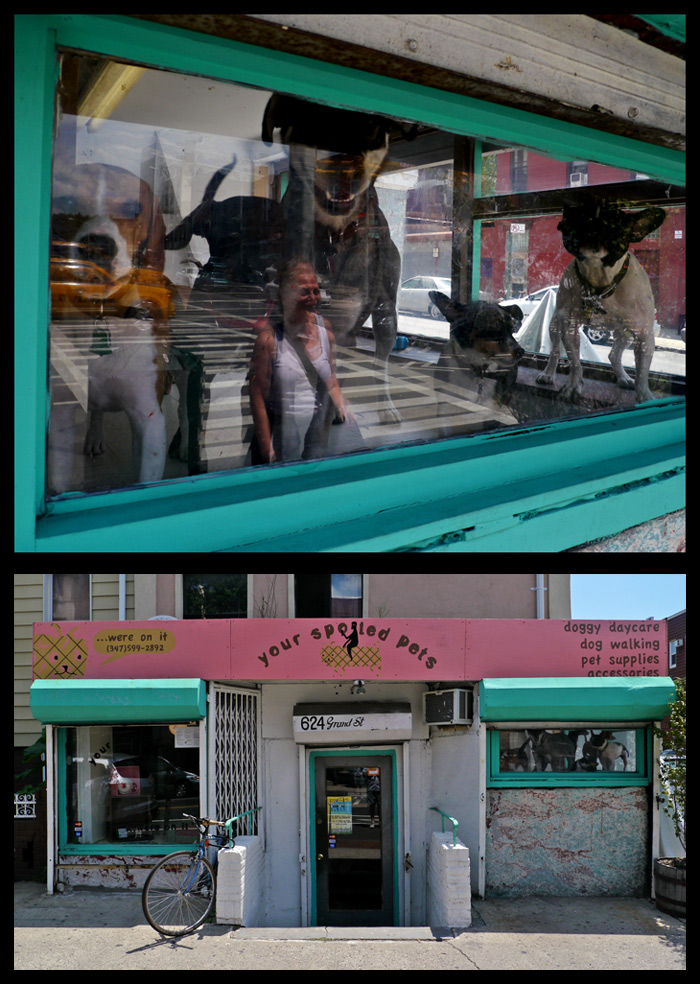
    Recently, while visiting the Willburg Cafe in Williamsburg, Brooklyn, I spotted Your Spoiled Pet directly across Grand Street. I have no direct experience with this place, nor do I know anyone who has. However, online reviews are extraordinarily and uniformly high. The proverbial doggies in the window were quite exuberant, as dogs naturally are.

    There are many sayings that express the sentiment that dog lovers have and perhaps no better one (or some paraphrasing or variant) than that attributed to Charles De Gaulle: The better I get to know men, the more I find myself loving dogs :)

    More dogs: Drooling and Slobbering, Water 4 Dogs, White by Desire, a la Chien, Dachshund Octoberfest, Wolfdog, Dog Dating


  • Giraffes in a Canoe

    There are places that are decidedly the other side of the tracks, and Grand Street in SoHo has been one of those places. As SoHo gentrified, Grand Street, only a block from the honky tonk Canal Street, retained a frontier feeling. Rents remained much lower than Prince and Spring streets – prime SoHo. It was here that Broadway Panhandler relocated when their prime SoHo rent became too onerous.
    Even today, Grand Street retains vestiges of a former time and businesses that service the working class and industry. At the corner of Thompson Street, one can still find John De Lorenzo & Bro., Iron and Sheet Metal Contractor.  Across from the French Culinary Institute at 458 Broadway was the previous site of the Singer sewing machine company’s first headquarters and showroom, built 1857. At 175 Lafayette and the corner of Grand Street was a supplier that I once frequented often: Rudolph Bass Woodworking Machinery & Supplies, founded 1918. At 183 Grand is the John Jovino Gun Shop, a sole survivor of the gun district near the Centre Street police headquarters. At 176 Grand is the home of Lendy Electric, a classic hard-core New York-style contractor’s supply house.

    The street bridges a variety of neighborhoods – SoHo, Little Italy, Chinatown, and the Lower East Side. The street is home to Ferrara’s Bakery and Kamwo Pharmacy. Heading east through Chinatown, there are numerous Chinese and Vietnamese supply shops and restaurants. Further east, once will find Kossar’s Bialys and the Doughnut Plant. The merchants are a smorgasbord – a worthwhile excursion for any urban explorer. For a virtual walk down Grand Street and as a guide, I recommend NY Songlines.

    Tuesday night, a group of us discovered Loopy Mango at 78 Grand Street, strictly by happenstance. This quirky, eclectic retailer came as a very pleasant surprise. The shop sells home goods, furniture, antiques, textiles, clothing, gift, specialty yarns, and knitting and crocheting supplies. The owners, Waejong Kim and Anna Pulvermakher, met in a fabric painting class at New York’s Fashion Institute of Technology. Loopy Mango was founded in 2004 in a tiny storefront on Avenue B in the East Village. They moved to DUMBO and in 2010, they moved back to Manhattan to their current 2000-square foot shop at 78 Grand Street.

    Original 1880 Victorian shutters enclose four dressing rooms and are complemented by a tin ceiling detail. Continuing through the boutique to the backroom, one is greeted by a 15-foot skylight and purpose-built partition encased by replica ionic Roman columns. The interior of the space was designed and built by Waejong and her husband, Eric Schultz, an antiques dealer from Massachusetts. The shop also offers knitting classes and workshops.

    For an urban jungle safari, take a long walk down Grand Street. After all, where else do you find a place called Loopy Mango with seven Giraffes in a Canoe?


  • Makin’ Glass

    As a child, I had once inserted house keys into a power outlet, as I wrote in Electrical Outlets. When I was a bit older, I had upped the ante and was being hit with a stick on my butt for blowing a fuse, the first and only time I received that kind of punishment. I don’t recall any real serious pain, only humiliation at being a little too old to be whooped.

    This time, I was trying to make glass. It was another failed experiment. I had found instructions on building a arc furnace using carbon rods from dry cell batteries, a clay flowerpot as a crucible, and a train transformer as a power source. Unfortunately, I knew nothing of the proper power requirements, and my only result was a blown fuse and a bruised butt.

    The fact that common sand could be melted in a homemade arc furnace to make glass was nothing less than amazing to me. It still is. Later in life, I built a stained glass Tiffany-styled lamp from a kit. However, I never did venture into glass making, forming, or blowing.
    I love glass. I respect plastic, which I work with every day in the manufacture of products. However, glass is virtually antithetical to plastic which, in spite of all the remarkable manmade resins, remains a metaphor for all things cheap. Everything about glass is extraordinary – its amorphous non-crystalline structure, its ability to refract, reflect, and transmit light, its chemical resistance, cleanability, and its tremendous versatility.

    Last night, after a very good meal on Indian row in the East Village, a friend and I happened upon a mecca for colored glass. A brand new shop, Mosaic Lamps at 208 East 6th Street, features an array of handblown glass lamps decorated with mosaics. The lamps are imported from Turkey, where centuries of tradition go into the making of these beautiful works. I met the owner, Melissa Benovic, who with her boyfriend Ilker Arslan, were inspired by the grand bazaar in Istanbul where Ilker once worked.

    To my surprise, although these lamps are common in Turkey, they are virtually non-existent in New York City, until the opening of Mosaic Lamps. I wish them the best of luck. I’m pleased to see that somewhere in Istanbul, rather than blow fuses, someone is good at Makin’ Glass :)


  • The Special is More Special


    One of the special things about New York City is its architecture – a visual treat, particularly in a young nation defined largely by suburban sprawl. Wonders abound in the city, however, since 9/11, security has become much tighter, and buildings with extraordinary interiors, such as the Woolworth Building, are often, sadly, off-limits to the visitor. Sometimes, events are held in such a space or the building serves a public function, affording the attendee with a special treat – seeing the interior while going about one’s business. Places like Grand Central Station or the New York Public Library, both of which are worthy of a visit just for admiring the architecture.

    On October 20, 2010, I wrote Brooklyn’s Got Magic about the Williamsburgh Savings Bank Tower at 1 Hanson Place (and its conversion in 2008 to luxury condominium apartments). It is one of the borough’s architectural icons and can be seen from afar. I have used it as a landmark for as long as I have lived in New York. It was once the tallest building in the borough – 37 stories and 512 feet tall. The clock faces, 17 feet in diameter, were the world’s largest when they were installed and remain among the tallest four-sided clock towers in the world.

    Although the structure itself and exterior warrants accolades and superlatives, it is the interior that really shines. And, remarkably, until a week ago, I had never been inside. While in Brooklyn, a friend suggested that we drop in to visit the Brooklyn Flea Market, which has occupied the lobby of the building for the last few years. I was astounded. Apart from perusing the merchandise, attending the market affords a rare glimpse of an amazing interior space. Everyone is aglow at the opportunity to visit. Here is what the New York Times had to say:

    One of the great urban experiences New York offered this winter was the Brooklyn Flea in exile. When the weather turned cold, the market moved indoors to One Hanson Place, bringing along its motley host of antiques dealers, artists, designers, vintage-workboot purveyors and–let’s get to the point here–food vendors.
    One Hanson Place is an almost deliriously lavish setting for a flea market. Shoppers trying on old Borsalinos and inspecting new art prints huddle beneath spectacularly rich mosaic ceilings in a crazy, echt-New-York mishmash of Byzantine, Romanesque, Art Deco and who knows what else. … The food now is found downstairs in the vaults, behind the kind of enormous heavy doors banks had when robbers still stole things like cash and bars of gold.

    Who knows the accessibility of such a space in the future? The savvy visitor or resident who loves architecture will put places like this on their must-see list because now, more than ever, The Special is More Special.


  • Closed Forever

    Change is typically incremental, even radical change. But often, there is that moment or day that PUNCTUATES a transformation. An unmistakable, inarguable sign that times have changed by technology. I saw the long, slow shift from vinyl to CD. And one day, the change was complete – the vinyl section in Tower Records was closed completely, supplanted by music CDs.
    Recently in my business, we made the decision to give away our entire inventory of VHS tapes. The decision to divorce ourselves completely, even from viewing legacy video tapes, was also made. We will be uninstalling our video monitor and VHS tape player. DVDs are threatened as well. We recently converted all of our video media to electronic form and uploaded them to a touch screen computer. This showroom kiosk now replaces monitor, VHS tape player, and DVD player.

    The future of printed books is unclear. Ebooks have been heralded for eons, but print continues to live on. The adoption of electronic books over print is a much greater hurdle – unlike video, where the form of delivery media is not so consequential, print is tactile and the difference between paper and electronic imaging is still huge for most individuals. Ultimately, I believe technology will force its hand as costs, storage, and distribution of electronic media win easily over paper.
    Bookstores have closed here and there. At one time, 8th Street in Greenwich Village was a virtual mecca for book lovers, with numerous bookstores, befitting its literary and bohemian roots. Many have anguished over the encroachment of the large chains into New York City, particularly Barnes and Noble. Personally, although I understand the sentiment, I always welcome a bookstore. I also have a sentimental attachment to Barnes and Noble, as I wrote about in World of Waiting.

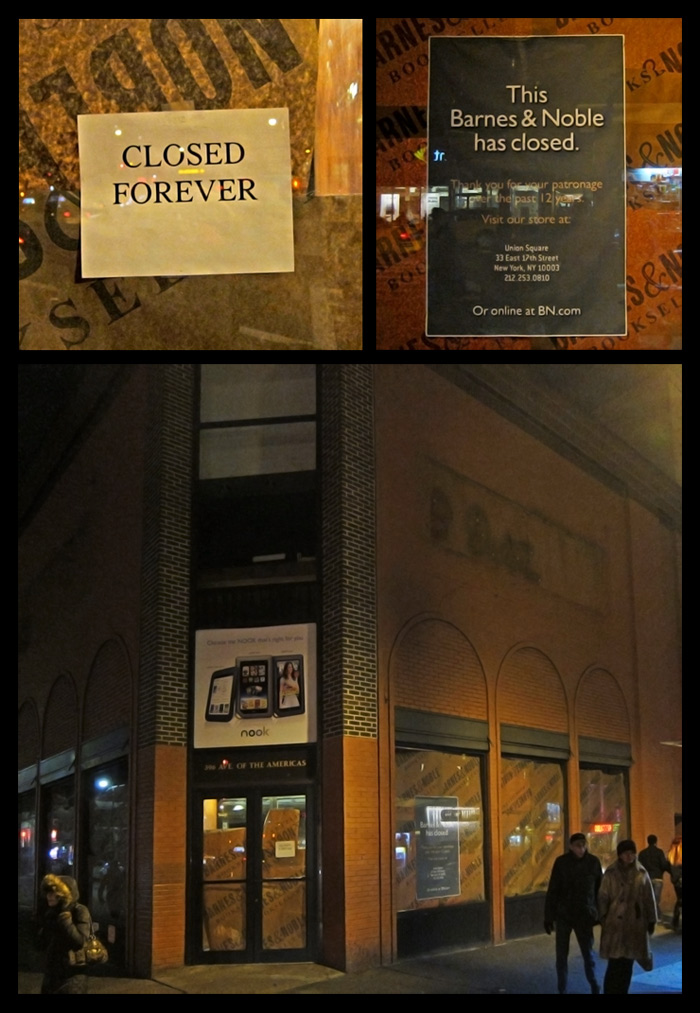
    It had been announced that the Barnes and Noble at 8th Street and 6th Avenue would close. The store is an anchor for the block – it occupies the corner and the entire two-story structure. It has had numerous incarnations. In the 1960s-70s, it was a popular late night watering hole and home to Nathan’s and an Orange Julius. I paid little mind to the store closing announcement, as many things can be said and stays of execution are common in business. However, last night en route home, the death knell tolled again. The windows were papered and a sign on the door said it all. Closed Forever.


  • Fashion’s Night Out

    If you’re the type of person who likes a party and trusts the advice of Justin Bieber, Taylor Swift, and Kendall Jenner, campaigners for the event, Fashion’s Night Out might be to your liking. Over 700 stores throughout New York City participate in this annual, international event. Here, in SoHo, the streets were overflowing and abuzz with fashionistas.

    Participating stores are open late – it’s an opportunity to shop of course, and there are also musical performances, free drinks, special deals, and fashion designers and celebrities like Kanye West, Kim Kardashian, Kate Spade, and Cyndi Lauper. From Manhattan to Milan, Atlanta to Australia, the after hours shopping extravaganza celebrated its fourth year. With stores in over 500 cities nationwide, FNO was bigger and better than ever before. Their mission statement:

    Fashion’s Night Out is an unprecedented global initiative created in 2009 to celebrate fashion, restore consumer confidence, boost the industry’s economy during the recession, and put the fun back in shopping! In the United States, the program is a collaboration between American Vogue, the Council of Fashion Designers of America, NYC & Company, and the City of New York.

    New York City, along with Paris, Milan, and London, is one of the world’s principal fashion capitals. New York is headquarters to more than 900 fashion companies and hosts one of four major Fashion Weeks. It is home to many Creative Experts and top fashion design schools, such as Pratt Institute, Parsons School of Design, and FIT. Fashion is a major part of the city’s economy – fashion manufacturing is 31% of all manufacturing jobs in New York City. The garment district is one of the few remaining manufacturing industries left in New York. The city’s fashion retail market is the country’s largest, generating over $15 billion in sales annually.

    Personally, I do not partake in the event, but for those that do, it’s the biggest party in town. Fashion’s Night Out…


  • My Religion is Kindness

    Have you ever repeated a word or phrase until it loses meaning? I imagine you have and, perhaps like most, discovered this as a child, marveling, sharing, and testing the phenomenon with your peers. It’s been studied and is called semantic satiation. Today, for me, I am experiencing this with the word kindness.

    I had been in Phurpa Lama’s shop a number of times before and on my last visit, agreed with the owner to return to do a story with photos and a short video interview. Last night, I walked to the shop with camera in tow. As I arrived and examined his window display, I noticed a sign for the first time which said, “My Religion is Kindness.” I was sunk. I became fixated on the word kindness, which began running through my head as I entered the shop, spoke with Phurpa, videotaped him, walked home, contemplated this story, and drifted off to sleep, recalling Jamie Adkins’s use of the phrase Kind Words

    This morning, kindness was still on my mind. The power of words reminded me of a television segment I saw with John Lennon and Yoko Ono, calling someone at random on the phone to tell them “I love you” and encouraging the listener to do the same, eventually creating a chain of love. This, they averred, would spread love and peace throughout the world. Perhaps a bit of youthful naiveté, particularly if one allows for how much callers may indulge John and Yoko, as opposed to you or I.

    Phurpa Lama’s aspirations are much less ambitious, or at least not fueled by celebrity. I learned that Phurpa was born in the small village of Ganggyul in the Hyolmo region of Nepal. At age 7, he became a Buddhist monk. It is as a monk that he emigrated to the United States and New York City. He now owns the small shop Padma Tibetan Handicrafts at 234 Thompson Street in the Village for the last two years.

    To enter the shop is to feel an extraordinary wave of peacefulness and calm in the eye of the storm called New York City. He told that many visitors to his shop also spoke of the incredible soothing ambiance. The merchandise is a riot of color – beautiful fabrics, jewelry, and other Himalayan artifacts. I was fascinated by the brass singing bowls, something I am compelled to listen to on each visit. These bowls are hand hammered bronze. They are played by rubbing a wood mallet around the rim of the bowl to produce a continuous ‘singing.’ The unique sound, accompanied by harmonic overtones and vibrations, is remarkable to experience first hand. Phurpa is always happy to demonstrate. He told me that the singing can be used as a meditation, a practice he does daily with the frequent lulls in business in his small shop.

    Phurpa is is occasionally assisted by his wife, Pema Yeba, who I have yet to meet. Her presence there is now more infrequent, owing to her care for their newborn child. Phurpa works 7 days, 11AM to 11PM.
    Our conversation turned to kindness and its value in a world of hostility, anger, and conflict. He affirmed the importance in his life of the words I had seen in the window, made famous by the 14th Dalai Lama, Tenzin Gyatso: My Religion is Kindness


  • Joe’s Dairy, The Movie, Part 2

    Vincent and Anthony Campanelli were extremely cordial throughout my initial encounter (see Part 1 here). I asked if I might be able to film the mozzarella-making process. They only requested that I return on a day less busy, so on Wednesday, February 1, at 11 AM, I came armed with cameras.

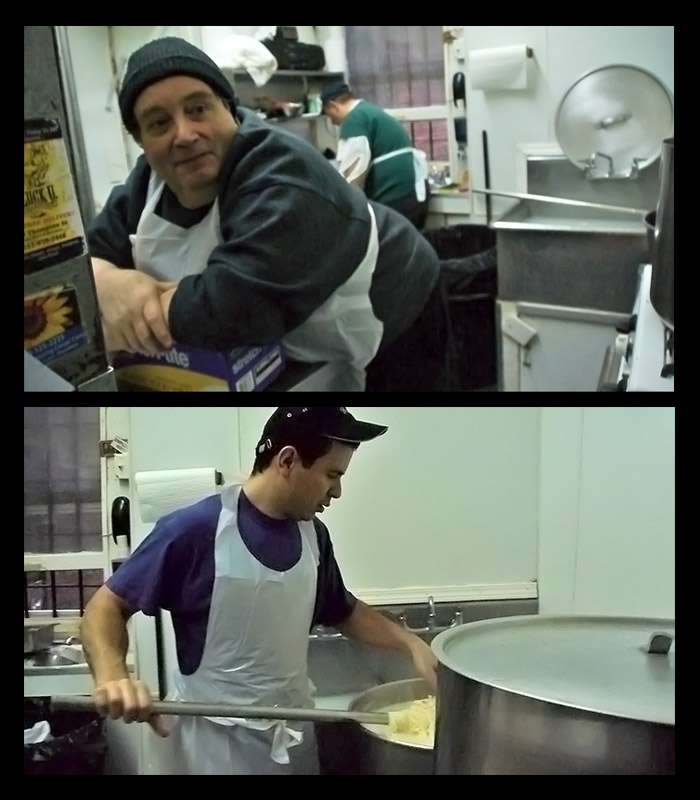
    A moment in the kitchen quickly explained why they do not entertain drive-by shootings. The cooking area is miniscule, with barely enough workspace for two people and the cooking equipment. I was most impressed by their cook, who toils 10 hours per day making only a handful of movements. I told him that he should be sainted for his ability to do this daily for over 5 years.

    Everything is done by hand – very old-school. When I saw the cook drain water by hand, one small pot at a time, I asked why they might not install a small pump. I was told that nothing was going to be modernized in any way. If you’re looking for stability in a world of change, visit Joe’s Dairy.

    Enjoy the Movie :)

    Related Posts: At the Door, For Whom the Knell Tolled, Donato, Nativity, Raffetto’s, Secret Society, Vesuvio


  • Joe’s Dairy, The Movie, Part 1

    On September 16, 2008, I wrote a story about Joe’s Dairy, located at 156 Sullivan Street. In this Italian area of the South Village/SoHo, we have Pino’s Prime Meats as well as St. Anthony’s Church (see here and here), both on Sullivan Street facing Joe’s Dairy. Just across Houston Street, there is Raffetto’s, Delmonico’s, and Tiro a Segno. Trattoria Spaghetto lies just a few short blocks away. These are the final vestiges of the Italian neighborhood – places such as Vesuvio and Zito’s Bakery, neighborhood icons, are now closed.

    However, the full experience of Joe’s Dairy – meeting Vincent and Anthony Campanelli, grandpa staking out the front retail area, and the making of mozzarella cheese in that tiny backroom – is something which only video or film can capture.

    I made two additional visits. During the first, on December 15, 2011, I chatted with Vincent and his father. I captured the conversation on video as Vincent shared his views on retailing, the changes in the world, the value of family, and many pearls of wisdom. He is very intolerant of mass merchandising, chain stores – anything not done the old-fashioned way. Joe’s Dairy is an example of the Slow Food movement.

    Today, I will feature my initial conversation with Vincent and grandpa in the front room. I was invited back to see and film the actual making of mozzarella cheese in the tiny back room kitchen. With Part 2 on Monday…

    Related Post: One Short Block


  • At the Door

    Being a butcher has little allure, and today, like most jobs that involve physical labor, there is no appeal for the young, restless, and upwardly mobile. At one time, butcher shops dotted the city, but now, a shop like Pino’s Prime Meat is rare and noteworthy, the subject of articles that bemoan their loss and extol the pluses of getting one’s meats from a skilled, multi-generational specialist, like Pino Cinquemani of Pino’s Meat Market.

    Supermarkets, case-ready meats, the increasing costs of retailing in New York City, and the glamourlessness of the job have all conspired to make the old-fashioned butcher shop a rare commodity. To visit a place like Pino’s is truly an opportunity to step in the past and experience old New York. The shop, located in an Italian area of the South Village, has been in existence since 1904, taken over by Pino in 1990. From an article in Food and Wine Magazine:

    Pino has been carving up sheep, pigs and cattle since he was a teenager in the Sicilian town of Castrofilippo, and you might say that meat is in his blood. When I asked him about his family, this was his answer: “My grandfather was a butcher. My father was a butcher. My brothers are butchers. My brother-in-law. My sister-in-law. My nephew and my other nephew—butchers. My son is a butcher.”

    I had passed by this shop for decades, but, not being a meat eater, I had neither stepped in the door nor met the owner. I recently made a visit, photographing and filming my encounter and recording our conversation. Pino was quite cordial and accommodating. We discussed Italy, my travels there and love of small Italian hill villages, and his home in Sicily:

    I am no judge of meat quality, cuts, or the skill of butchers, but everything I have read about Pino indicates that he is the ne plus ultra in his business. This is old school, where the skill of the trained artisan triumphs over the mass merchants. Here at Pino’s, genuine, authentic European tradition lives on in a small shop in SoHo, encroached by a wave of high-end merchants that have essentially engulfed the entire area, if not the entire borough of Manhattan.

    I have a number of close friends and acquaintances who are vegetarian, as I was for 30 years (I now eat fish). Decisions whether to eat meat or not are highly contentious, and I have stopped debating such subjects long ago. Here, at Pino’s, to understand and appreciate the man and his family tradition, it is perhaps best to leave dietary preferences At the Door :)

    Related Posts: Pork and Power, Mystery Meat, Shrine to Beef, Fisherman’s Widow


  • Foolish World of the Fiscally Frivolous

    There is nothing more irritating for some men than the occasion when they feel the need to buy their girlfriends flowers. This obligatory event may be a minuscule effort yet looms larger than anything conceivable. And then there is the terror of Valentine’s Day, where a last-minute purchase in New York City is tantamount to lunacy.

    Adding insult to injury is the perception of wastefulness – buying something whimsically that is decorative and perishable is antithetical to the nature of the practical man. Flowers are a waning asset, so why invest?

    However, having established that everything should not always be reduced to the Very Practical and that whether wasteful or not, there is reason on occasion to the cry, Let’s Have a Parade, the prudent man sees the merit of the flower, the message it will send, and the profound effect it will have on his better half.

    Ironically, the very nature of a gift of flowers being fiscally frivolous is one of the keys to their appeal. Symbols of life and beauty, flowers make a woman feel special and beautiful, particularly when done spontaneously and not for any special occasion.

    In New York City, flowers can feel out of character in a world of steel and concrete that is fast-paced and where utility often rules. After all, the streets of New York do not evoke images of the Monet’s Gardens at Giverny, Boboli Gardens of Florence, or the gardens of Versailles. However, not to be outdone, New York City does have its own spectacular displays and like many good things here, they just have to be sought out. The Brooklyn Botanic Garden (see here and here) and the Conservatory Garden are worthwhile visits for anyone who favors nature’s floral extravagance. There are numerous other smaller and lesser known gardens, such as St. Lukes, which, for those in the know, provide respite from the city.

    There are also numerous flower shops throughout the city. University Floral Design, a Village landmark and neighborhood icon, is family owned and operated since 1928 with daily delivery of fresh Dutch flowers. It’s not that long a walk or that big an effort to go through the doors of a flower shop like that at 51 University Place and enter a world guaranteed to soften even those who see it as the Foolish World of the Fiscally Frivolous :)

    Related Posts: Joe Plourde, La Vie En Rose


  • A Sharp Focus

    I once was expressing my interest in traveling to Singapore to a friend, born in Taiwan and knowledgable regarding Asia. It seemed to be a beautiful destination – both tropical and pristine. However, said friend said that she would never go to any country that did not have an art museum (there is at least one art museum now). This reminded me of conversations in my early days in New York City – an echo of the sentiment against the well-manicured lawn and gentrification.

    Puzzling, because I have always liked a beautiful lawn, as well as bonsai, topiary, and clean and tidy places. And conversations in my youth about gentrification also left me perplexed – I would always be pondering, what is wrong with an improved neighborhood?

    Appreciation and patronization of very unique businesses that could only survive where rents were low began to give me a clue as to why people would vehemently object to gentrification. But it would be many decades and the loss of some of my favorite iconic businesses, such as Vesuvio’s Bakery, before I would finally understand how the march of “progress” would typically mean the loss of not only the bad old things but also the good old things. Gentrification also means increased cost of housing, leaving neighborhoods all but unaffordable to virtually everyone except the super affluent. Soon, neighborhoods defined by ethnicity and their culture become defined by economics.

    I began to see that clean and tidy in Manhattan usually came with sanitization, conformity, upscale tenants, and the closing of the small independent merchant in a niche market, unable to afford rising rents. So I have run to see the last of these best of breed. A number of the places I have written about in the last six years have already disappeared – Space Surplus Metals, Vesuvio, National Wholesale Liquidators, Ray’s Pizza, etc. Others on my to-do list have closed before I had an opportunity to visit for photos and a story, such as Grand Machinery Exchange.

    A handful of special, unique businesses still survive, many of which I have written: Joe’s Dairy, Raffetto’s, Schoen Trimming and Cord, Jim Murnak, Alidoro, il Laboratorio del Gelato, Cones, Faerman Cash Register, the Music Inn, and Matt Umanov Guitars.

    I try to keep a keen eye out for those which I have not written about before it is too late, some renowned in their niche, such as Henry Westpfal & Company. Westpfal is located in the garment district at 115 West 25th Street. With a decor hearkening back to the 1950s, the place typifies the best of Olde New York where content is king. They have been in business since 1874 and have been managed by Cam Weinmann for the last 50 years. It is considered one of the best places (and few remaining) in New York City where virtually anything that has a blade can be sharpened – scissors, knives, straight-edge razors, and other tools. According to Cam Weinmann, “If you can’t cut a tomato, you know your knife needs sharpening.” At Henry Westpfal, for 137 years, the secret to small business success has been a sharp focus :)


  • dinamic_sidebar 4 none

©2013 New York Daily Photo Entries (RSS) and Comments (RSS)  Raindrops Theme