• Provocateur

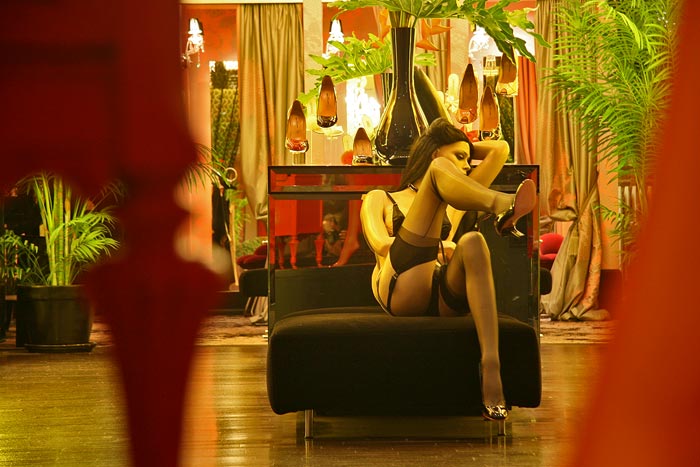
    This photo was taken through the shop window of Agent Provocateur at 133 Mercer Street in SoHo. I have gone by here many times, but walking with a camera changes things – I become much more attentive to the usual in my life, subconsciously looking for that photo op.

    What struck me here was that at first glance I thought that this was a real person, not a mannequin. I also did not realize until doing this post that Agent Provocateur is a well-known lingerie brand started in SoHo London in 1994 by Joseph Corre and Serena Rees (Corre is the son of British fashion designer Vivienne Westwood and the Sex Pistols’ ex-manager Malcolm McLaren.) They now have a number of stores worldwide featuring upmarket goods and a coterie of celebrity patrons. They are also known for their over-the-top controversial ads, such as the one in 2001 featuring Kylie Minogue riding a bull in lingerie to punk music (you can do your own youtube search). They “introduced their vision of lingerie avoiding the British prudery that insists on categorising anything to do with sex as sleazy or smutty.” You can read their vision statement here


  • Murray’s Cheese

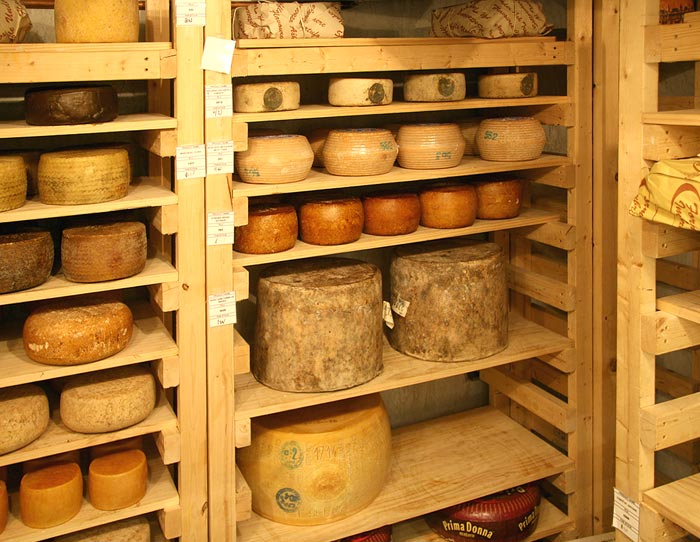
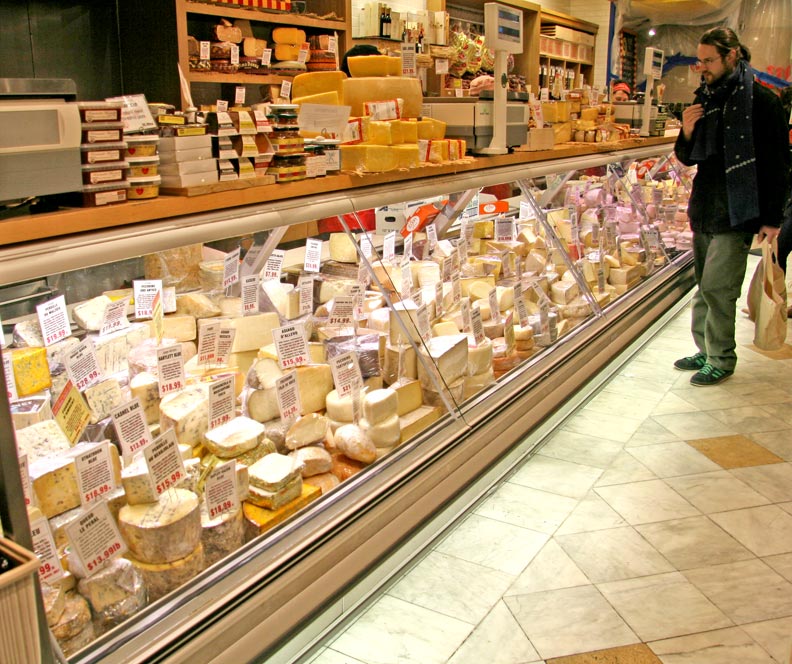
    This is Murray’s Cheese Shop at 254 Bleecker Street in the Village (click here for second photo). It’s the type of place that New Yorkers brag about – a real institution, a place serieux where the ownership and management is obviously obsessed with what they do and have a tremendous drive to be the best. In a city as large as New York, these specialized niche retailers can really thrive. Murray’s was founded in 1940 by Murray Greenberg, starting as a wholesaler of butter and eggs. Rob Kaufelt, the current owner, bought the business from Louis Tudda in 1991. In 2004, they moved from a much smaller cramped location across the street to their current space, where they purchased the building. They lease adjoining retail spaces to other high-quality food retailers (Amy’s Bread and Wild Edibles.)

    Murray’s retails over 250 varieties of cheese and wholesales to 75 restaurants, including many of the city’s finest. I was fascinated to learn of their authentic underground cheese caves where affinage (the art of aging) is practiced (Murray’s was one of the first cheese retailers in the U.S. to do this) – French affineur Herve Mons was consulted in their construction. Kaufelt travels the world to acquire cheese, has forged relationships with many artisanal cheese makers, and is able to introduce these special cheeses to their American customers. They have received many accolades and awards. Kaufelt has received France’s prestigious Garde et Jure medal from the Guilde des Fromagers. In addition to the cheeses and gourmet products sold, classes are taught and books are published…


  • East from East

    This is Midtown East as seen from Roosevelt Island. The glass towers just left of center are One and Two United Nations Plaza, a group of buildings built over a span of several years (1976 and 1983), designed by Kevin Roche John Dinkeloo & Associates. The hotel/apartments/office building was completed in 1976 as a city/state/U.N. project. In 1999, the hotel was purchased by Millennium Hotels to become the Millennium UN Plaza Hotel – it has an indoor swimming pool and the only indoor tennis courts in a NYC hotel.

    To the left of the complex, we find the Empire State Building, and to the right, the Chrysler Building. In the lower left, you can see the United Nations General Assembly building with its domed roof. At the far right, you can see the Met Life Building (formerly the Pan Am Building), the subject of a previous posting


  • Colossal Missbehavior

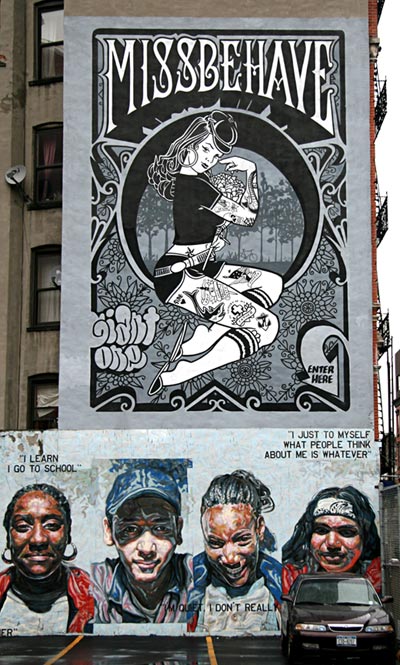
    The hand-painted mural has all but died. In the last two years, Colossal Media has revived the art, with dozens of their signs appearing around the city. According to the NY Times, Colossal Media is “a two-year-old Williamsburg company that is trying to revive the labor-intensive, near-obsolete craft of hand-painted signs.” Cofounders Adrian Moeller and Paul Lindahl had their hands in graffiti before starting Colossal, along with graphics and sign painting experience.

    The company has long-term leases on a number of building walls in the city. It takes a few days for the art to go up, with painters working 12-14 hour days. The mural in the photo was for a boutique on the Lower East Side called Missbehave at 231 Eldridge Street, which was opened by Samantha Moeller, who now is publishing Missbehave Magazine and managing her multimedia website (now closed). 


  • Pepsi-Cola in Neon

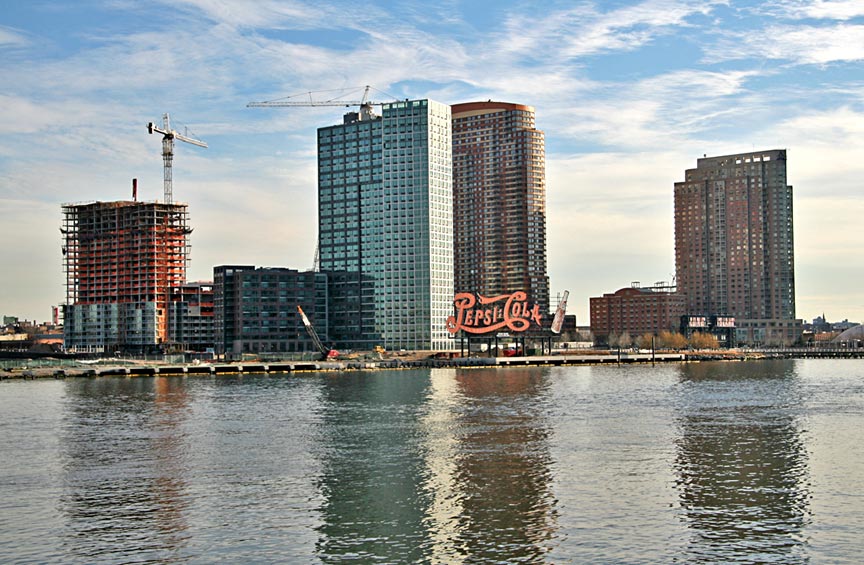
    This red neon Pepsi-Cola sign is a major player in NYC’s landscape and a familiar sight to any who travel the east side of Manhattan, such as on the FDR drive. The sign is located on the Queens waterfront in Hunters Point – the site of PepsiCo’s former bottling plant (which was moved in 1999).

    The multi-tube red sign, visible by day or illuminated at night, has been there for over 70 years. It was built in 1936 and rebuilt in 1994 by Artkraft Signs (now the Artkraft-Strauss Sign Co.), the oldest and last-surviving subsidiary of the original Claude Neon Co., headed by Frenchman George Claude, who held the patent for neon. In 2003, the Rockrose Development Corporation purchased the land for a $1 billion residential and commercial project. Click here for photo. The 120-foot Pepsi Cola sign was preserved – it was dismantled and re-erected 300 feet south to its current permanent location. It is nice to see that the value of a historic icon like this is appreciated and preserved by a real estate development company…


  • First Snow

    It’s true – today we get our first snow for the winter in NYC. Click here for more photos of Washington Square with this morning’s new fallen snow. For quite some time, we have been deluded into believing we would never see winter again – that El Nino, along with global warming as a contributing factor, was turning New York into a subtropical zone. After all, two weeks ago, we were sitting in parks with T-shirts in 72-degree weather.

    2006 has been the warmest year ever recorded in USA history. And NYC broke a 129-year record for the latest date for the first snowfall. Places outside the US, such as Sweden and Russia, have not yet seen snow. But as I write this in the early morning, the snow has already stopped and the sun is shining – spring is just around the corner…


  • The Bitter End

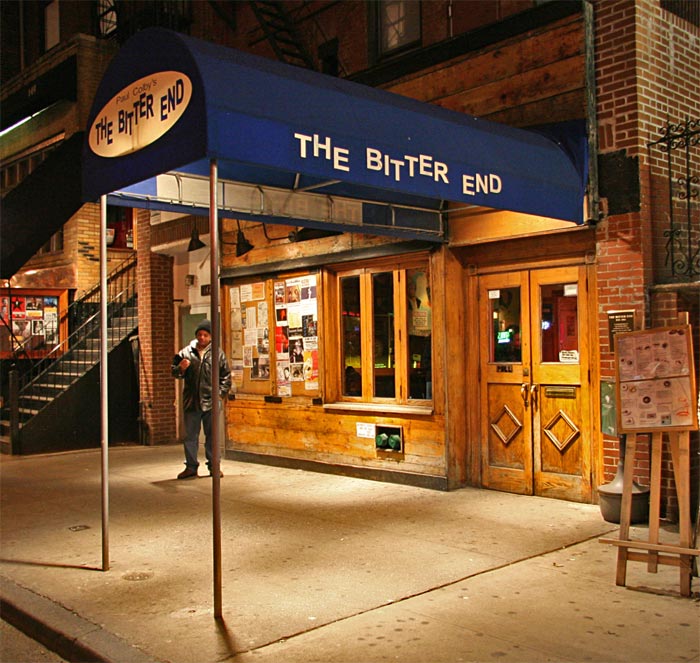
    This is the Bitter End at 147 Bleecker Street, one of the classic heavyweights in NYC music clubs. With the demise of many legendary clubs (CBGB, The Bottom Line, Village Gate), only a handful of older clubs remain, and this is one of them. It is now the oldest rock club in New York, established in 1961 by Fred Weintraub. The current owner, Paul Colby, has been involved with the club since 1968.

    The club is located on a strip of Bleecker Street with a number of music clubs: The Back Fence, Kenny’s Castaways, Terra Blues, and The Red Lion. At the Bitter End’s website, you can see a partial list of the roster of people who have played there (e.g. Bob Dylan, Billy Joel, Neil Young, The Indigo Girls, Joan Baez, Van Morrison, Joni Mitchell, Odetta, Bill Cosby, Woody Allen, George Carlin) – click here for a history. Typically several groups perform each night – last night I caught Girls Don’t Cry.

    Small clubs which showcase new talent are absolutely critical for the music world, so for patrons and musicians alike, the closing of clubs is often seen as a benchmark of the negative impact of over-gentrification, and the survival of older (and newer) clubs is fiercely defended…


  • Smallpox Hospital

    These are the ruins of the Smallpox Hospital on Roosevelt Island (Blackwell’s Island at the time), designed by James Renwick, Jr. and completed in 1856. Click here for more photos. The building is faced with gray gneiss, quarried on the island and built using prison labor from the neighboring penitentiary at the time. Smallpox was deadly and highly contagious – at the time, 25% of those afflicted died, and survivors were frequently left blind or pockmarked. Although vaccination was common in the 19th century, many were fearful of the procedure. Prior to building of the hospital, cases were treated in shacks on the bank of the river. Unfortunately, the new hospital became mired in scandals – spoiled food, patients not cleaned were spreading disease throughout the city, building in disrepair, workers (some convicts) extorted money from patients, etc.

    In 1875, after a new hospital was built on North Brothers Island, this building became a home for nurses and a training hospital. In 1904-05, North and South wings were added. By the 1950s, it was abandoned and has been vacant since. Read more about it here. In 1975, it was granted landmark status. As it sits behind a chainlink fence, its current state is still being debated, but there is hope that it will preserved and accessible for visitation…


  • Little bite To Eat

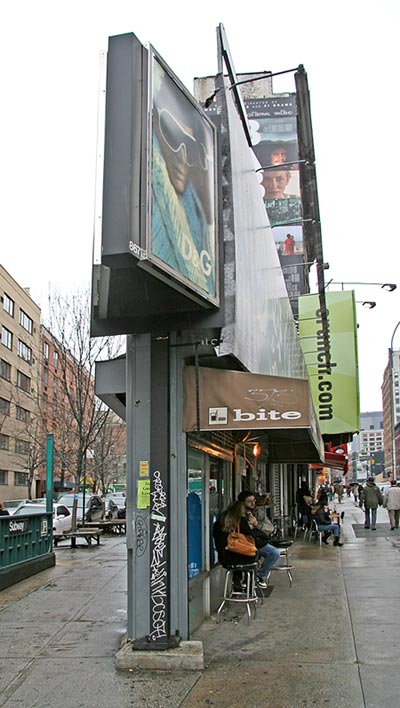
    Described as a “sliver-sized Noho snack bar redefining fast food”, bite, at 335 Lafayette, has to be the city’s skinniest restaurant. I have always been intrigued with this bizarre wedge of a retail space that is so thin, it is barely one person wide (click here for more photos. It is located in NoHo (North of Houston), a neighborhood between the Central Village and East Village.

    Considered by many to be a real gem of a sandwich shop, bite claims that the sandwich makers “work like monkeys on speed to bring you pleasure in bread.” Bite goes the extra distance to use premium ingredients (organic greens, Holland tomatoes, extra-virgin olive oil, ciabatta, panini), many from neighbors, such as breads from Balthazar and mozzarella from Joe’s Dairy. Most find the food excellent – click here for reviews and their menu. Some have found the lines to be long at times, but, like many things New York, the extra good usually costs more in one way or another…


  • FusionArts Museum

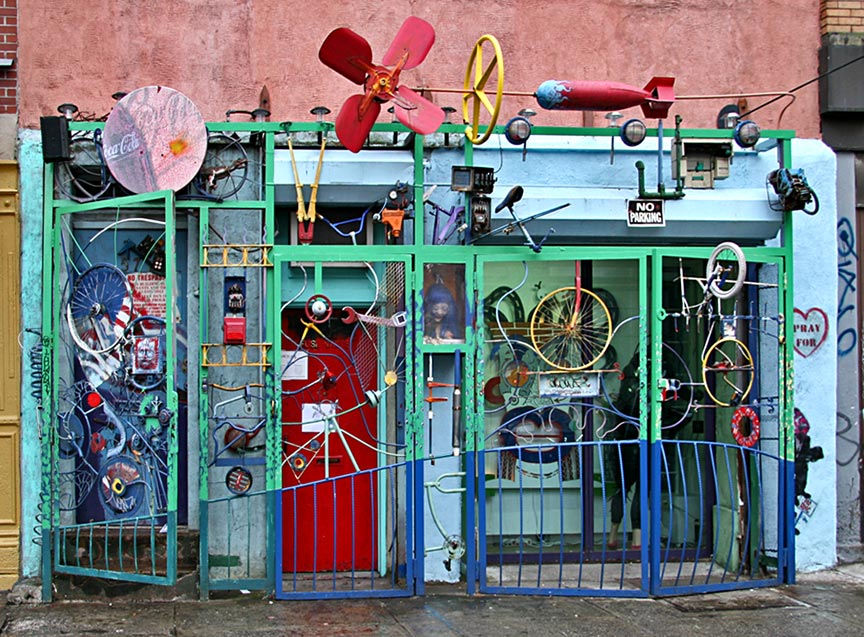
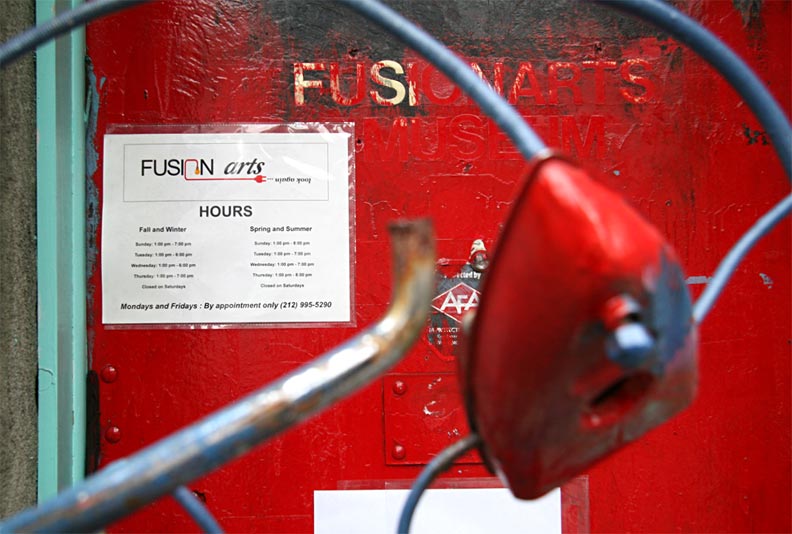
    Strolling through the Lower East Side with a friend, we came upon this unusual storefront at 57 Stanton Street (click here for 2nd photo). Unfamiliar to me and my friend (who is an artist), we learned that this was the FusionArts Museum: “FusionArts Museum is the only contemporary art space in New York City that is exclusively dedicated to the exhibition and archiving of fusion art – art that goes beyond the terms assemblage, mixed media, and multimedia.” Unfortunately, it was closed, but their website shows their works in the various galleries.

    Judging from the location and frontage, one would assume an iconoclastic, edgy art scene, so their manifesto did not come as a surprise. Many sources credit Bob Orsillo from the 1960s for starting the Fusion Arts Movement in the U.S.A. (I did not see him referenced on the FusionArts Museum site). Orsillo himself traces it back to the 14th century. I am not an art critic or historian, so I will leave it to you to sort this out…


  • il Laboratorio del Gelato

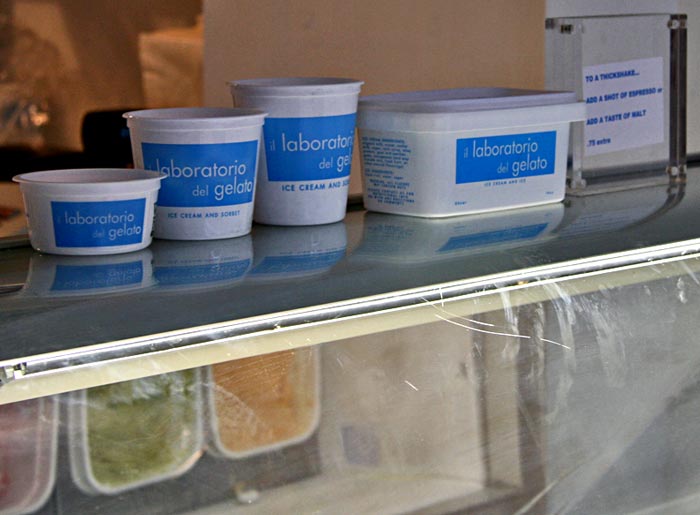
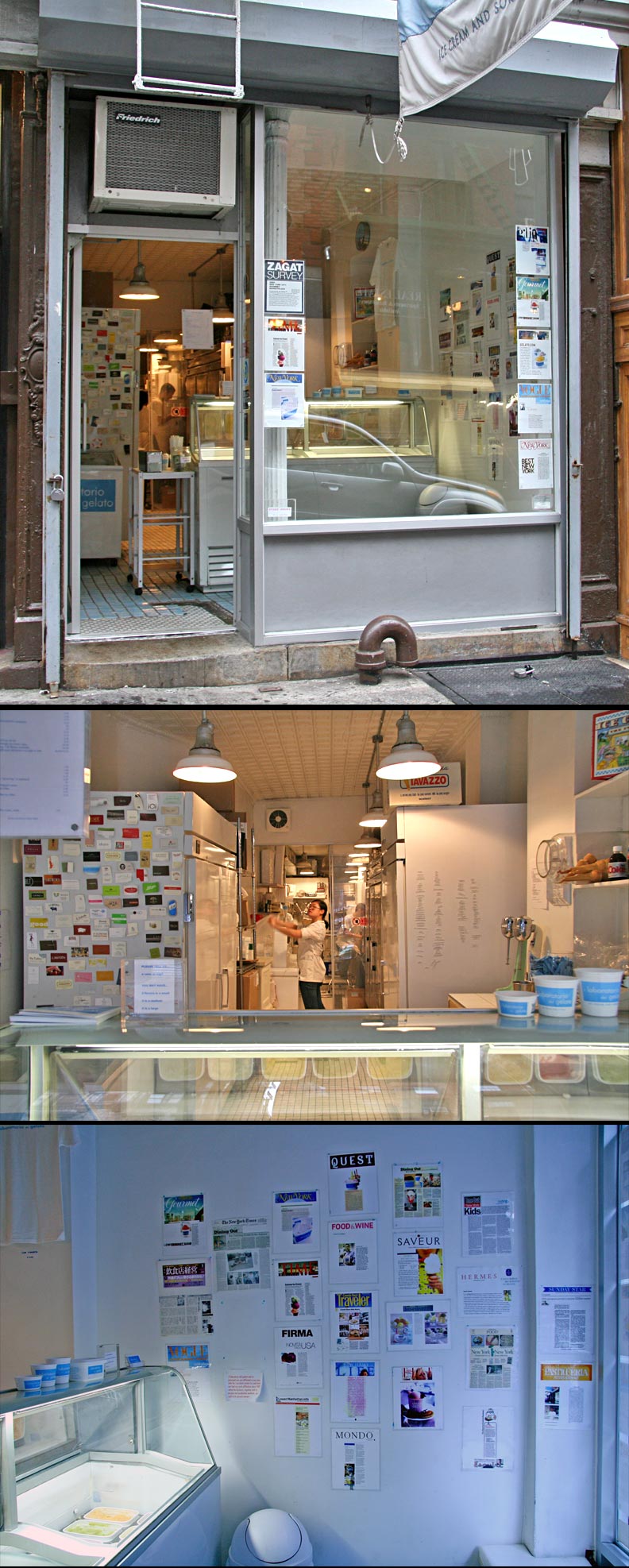
    A coworker recently introduced our office to the gelato from il Laboratorio del Gelato. We were immediately impressed with this premium ice cream – it’s the best I’ve had in the city. So I decided to make a personal visit to their shop at 95 Orchard Street on the Lower East Side. Click here for more photos. The small shop has a stark white, clean, lab-like feel with an open kitchen. They feature 12 of their 75 flavors daily. In addition, they provide customization of flavors for restaurants and events, hence the term “Laboratorio.”

    The owner/founder, Jon Snyder, does not just have a passing interest in ice cream. He is 3rd generation – his grandfather designed Carvel franchises. Snyder started in the ice cream business at age 19, when he founded Ciao Bella (a premium gelato). The company was sold in 1989. After getting an MBA at Columbia and working in Wall Street, Snyder decided to get back into the ice cream business and opened il Laboratorio. The story of the owner, his passion for gelato, and the history of his ice cream ventures has been told by many magazines and newspapers. Click here for il Laboratorio’s press page, where you can read the articles. And don’t forget to visit and enjoy…


  • Signs of Life

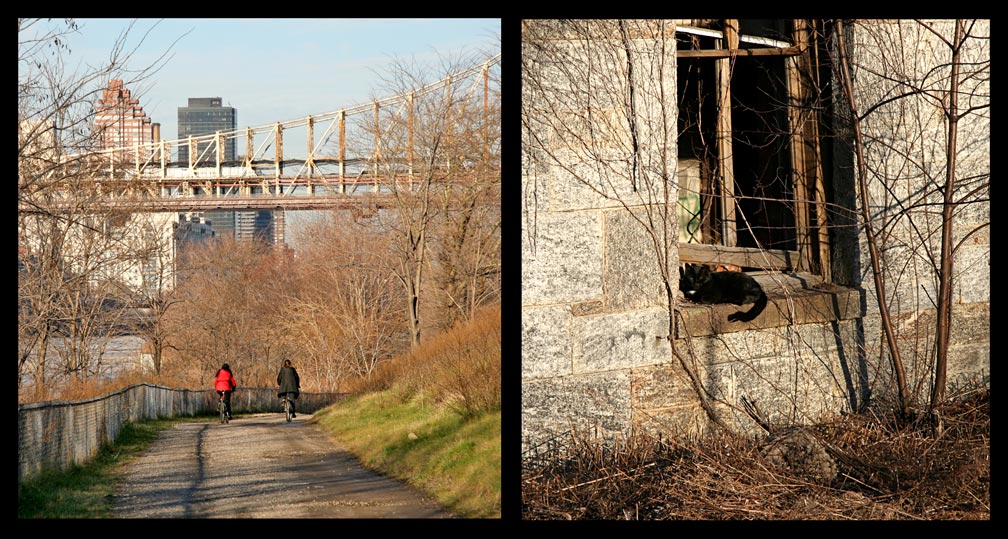
    These two images are from the south end of Roosevelt Island (the cat is sitting in the window of the infamous Smallpox Hospital, an abandoned Gothic ruin.) Technically part of Manhattan, Roosevelt Island is a two-mile strip of land in the East River with access by aerial Tram, subway, and auto (by bridge from Queens). Formerly called Blackwell’s Island and then Welfare Island, this place was home to many asylums, hospitals, and prisons. In the 1960s, a plan by Philip Johnson and John Burgee envisioned a pedestrian community, but the original plan never came to be.

    There is a variety of housing: subsidized and unsubsidized housing for low, middle, and moderate-income tenants. Luxury rentals and condominiums also exist. Hybrid electric buses provide transportation on the island; waste is collected by an underground Automated Vacuum Collection System (the only one servicing a residential complex in the U.S.). There was initially a lot of enthusiasm over the island’s development as a modern utopia. However, the population originally envisioned was never realized, and thus, there is a dearth of services on the island. One supermarket, one deli, one restaurant.

    For the visitor, there are a few spots worth a visit – the biggest draw are the vistas of the city. But I am sure that many residents like the quiet atmosphere – our black cat appears quite content…


  • Big Allis

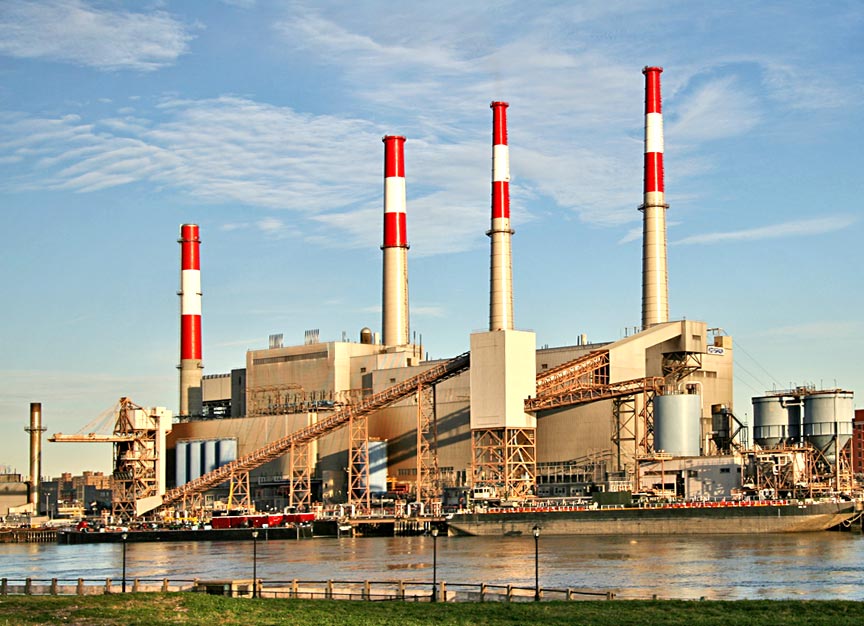
    These smokestacks, which are prominent on the NYC skyline, are part of the power-generating facility Ravenswood No. 3, also known as Big Allis (named after the turbine manufacturer Allis-Chalmers Corp.) The power plant sits on the shore of the East River in Queens on Vernon Boulevard, in a neighborhood known as Ravenswood in Long Island City. It was the world’s largest generating facility when it went into service in 1965, capable of producing 1 million kilowatts. It was sold by public utility Con Edison to KeySpan Energy in 1999.

    In 2004, the facility was expanded with new state-of-the-art technology amid community concerns over pollution. It is now capable of generating 25% of New York City’s power requirements. A New York Times article referred to the plant as the “Death Valley of New York City” – temperatures can reach 160 degrees Fahrenheit on the floor of the turbine room…


  • Working Harbor


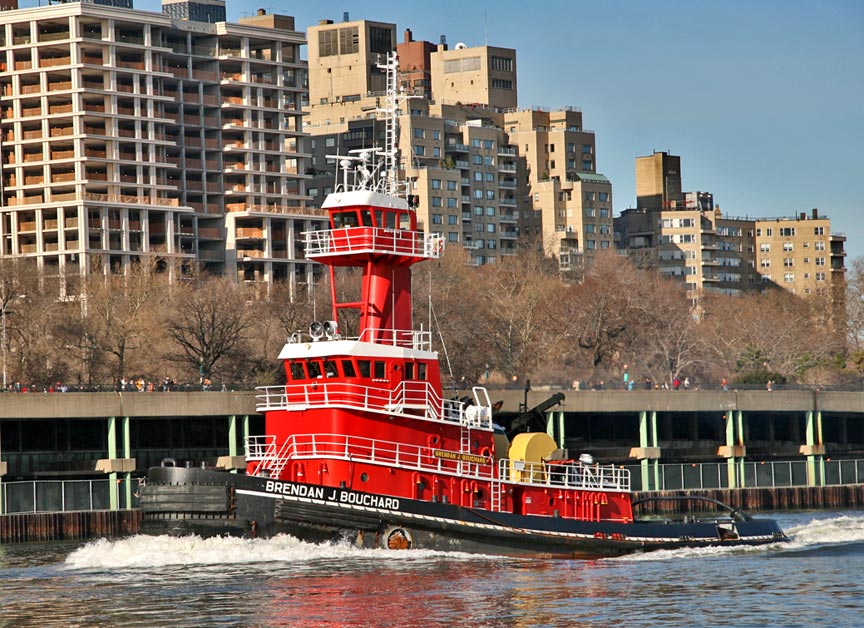
    It is easy to forget New York City’s role as an important port and that the waters around NYC are still a working harbor with an enormous amount of maritime freight and traffic (over 12,000 ships per year). In researching for this post, I am always reminded of how much goes on behind those things which most of us know little about. Like tugboats and barges. But there is a world and a history here, even with tugboat buffs and websites.

    The tug in the photo navigating the East River, the Brendan J. Bouchard, belongs to the Bouchard Transportation Company of Melville, NY, an oil barging company. Most barges are not self-propelled and need tugboats to move them. And tugboats are highly maneuverable – they help make the sharp turns necessary to negotiate shipping channels and harbors such as that of New York’s. McAllister and Moran virtually dominate the tugboat business in the New York waters. Click here for an interesting story about the recent efforts of tugboats to move the Intrepid to New Jersey for refurbishment – an initial failure followed by success…


  • Beekman Place

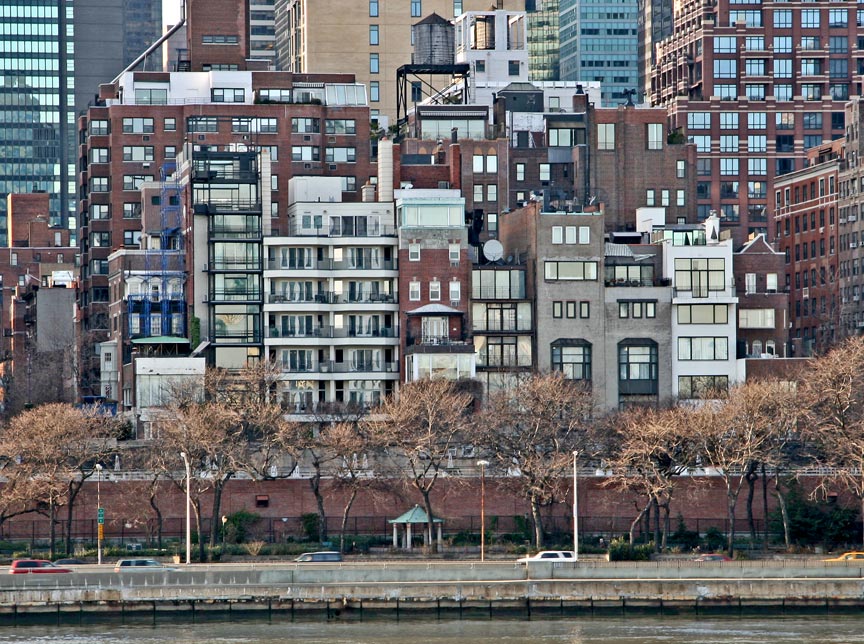
    This is Beekman Place as seen from the East River. From this vantage point, we see the backs of the row of houses of those lucky souls who have river views. This small enclave is an urban oasis – a two-block long street tucked in between 49th and 50th Street and east of 1st Avenue. The area is less well-known (particularly to outsiders) than its neighbor, Sutton Place, two blocks north.

    The Beekman name is one of NYC’s oldest – William Beekman came to America on the same ship as Peter Stuyvesant in 1647. James Beekman built a mansion here, Mount Pleasant, in 1764 (it was used as British headquarters during the Revolutionary War). Nathan Hale was hanged here as a spy in 1776. It was demolished in 1874 as the city’s grid plan encroached. By the end of the 19th century, the area had become a slum, with industry at the river’s edge.

    In the 1920s, the neighborhood started to turn around, eventually to become one of the most sought after addresses of the wealthy. The roster of current and former residents reads like a small Who’s Who, with names such as Rockefeller, Vanderbilt, Ethel Barrymore, and Irving Berlin. Note the building second from the left (in the row of nine) – it is the former home of architect Paul Rudolph (read about him here and here)…


  • dinamic_sidebar 4 none

©2026 New York Daily Photo Entries (RSS) and Comments (RSS)  Raindrops Theme