• Africa

    I was standing on the base of a light post on Broadway, looking for breaks in traffic to get a good photo of the Cable Building (see here), when a man driving in the rush hour traffic shouts out to me. It took a few moments to place him. It was Michael Ahuja, the owner of Shona Gallery, a SoHo business owner whom I had befriended and written about with a shop selling African art objects and furniture. On my way home from my office, I would often drop into his shop and chat, usually about Africa.

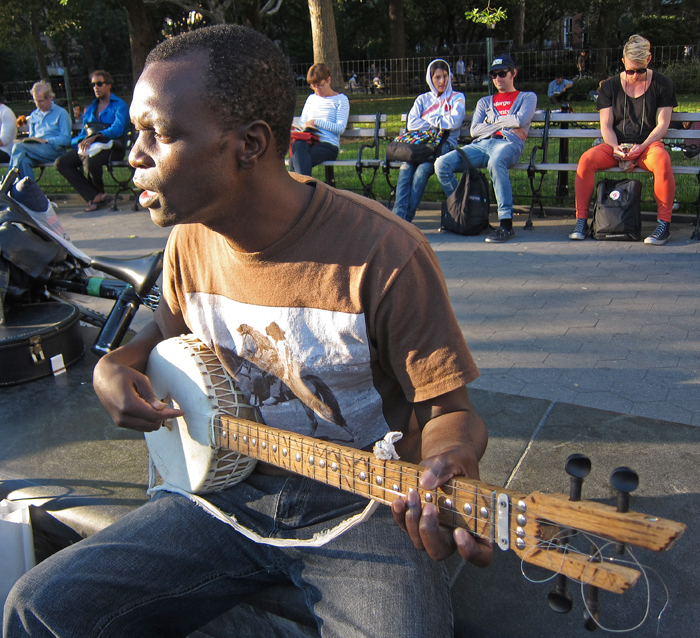
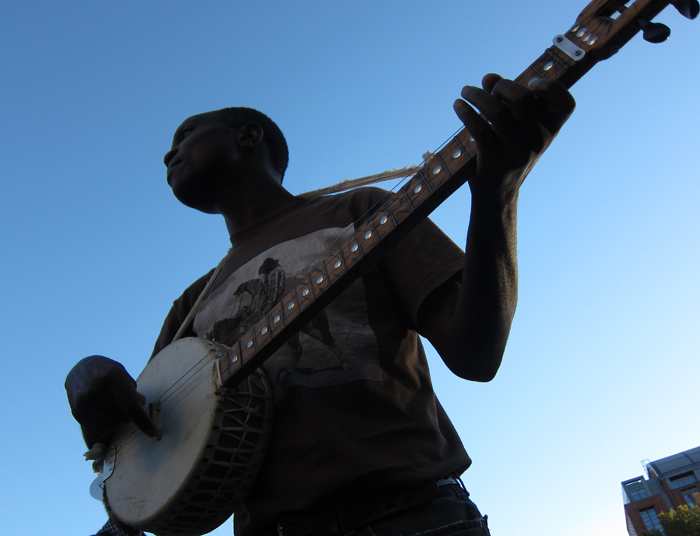
    When I met Essau Pwelle and found out he was from Tanzania, I was quite excited and eager to tell him of my passions for Africa. Essau, who hails from Yenzebwe Village, has been a resident of the USA since 2003 and currently resides in New York City. He is a 4th generation banjo maker and, in conversation, told me of the African roots of the banjo. He has played banjo since he was 14 and is also a singer, songwriter, performance artist, and event organizer.

    Even in a place as large as New York City, it never ceases to amaze me how many acquaintances in common there are between people that I encounter. In conversation, I found out Essau knew Michael Ahuja. I told Essau that all with all this passion, it was still unlikely that I would ever go to Africa. “Why?,” he asked. “Fear of the known and unknown,” I answered. There is an aura of mystery surrounding Africa, fueled by books with titles like Heart of Darkness and phrases like Henry Stanley’s “Dark Continent.” He assured me, as did Michael Ahuja, that I would find Africa to be to my liking.

    When I had occasionally spoken to Michael in our chats about any of my business difficulties or stresses, he suggested that I liquidate and move to Africa. Surely this was insanity, but he assured me that I would find it the palliative I needed. He described an idyllic life in various places, as did Essau, who spoke of those he knew who found great joy in Tanzania and made their residence there.

    When I asked to photograph Essau, he was quite accommodating, moving into various positions. Unsatisfied with the various conventional shots I was getting (see here), I crouched down, shooting upwards for a silhouette. After all, as I told Essau and others around us, we need some drama – this is not a man from New Jersey, this man is from Africa 🙂
  • Waiting to be Sold

    The door-to-door salesman has never been a welcome visitor, but somewhere around 1963, a knock on my family’s door changed my life. Whoever and wherever he is, I thank that salesman for selling and my parents for being either too easy, very astute, or both, and for buying.
    He was selling the World Book Encyclopedia – a big thing for a family with essentially no books and little money. I have no recollection of the event, really, only the result. As a promotion, we were given a mechanical learning device. This is how I learned to play chess, a game I still enjoy to this day.

    I devoured those books as a child. There were, of course, school books and an occasional jaunt to the public library. But nothing could compare to that mountain of information. It felt that I had all the world’s knowledge at my fingertips. 

    As an adult around 1980, living in New York City, I made a phone call and invited a Britannica salesman to my home. I had no idea that unless you are ready to buy, that man is not leaving your house. It was quite an evening. I did eventually buy a copy – the cost for the 30 volumes was nearly $1000, a major investment. But I did love those books, and until the Internet became commonly used, the Britannica was my primary source for research. I also purchased the CD-ROM version. I recently gave the printed set away.

    Until recently, at most trade shows, somewhere in the last rows where fees were cheapest, there was typically a nondescript booth, a spartan table, and a hungry Britannica salesman with no prospects. Who would voluntarily subject themselves to an encyclopedia salesman or even walk closely enough to be ensnared? Whether the show theme was conducive to selling encyclopedias was no matter. There was always a Britannica booth – an outpost in the far reaches of the trade show tundra.

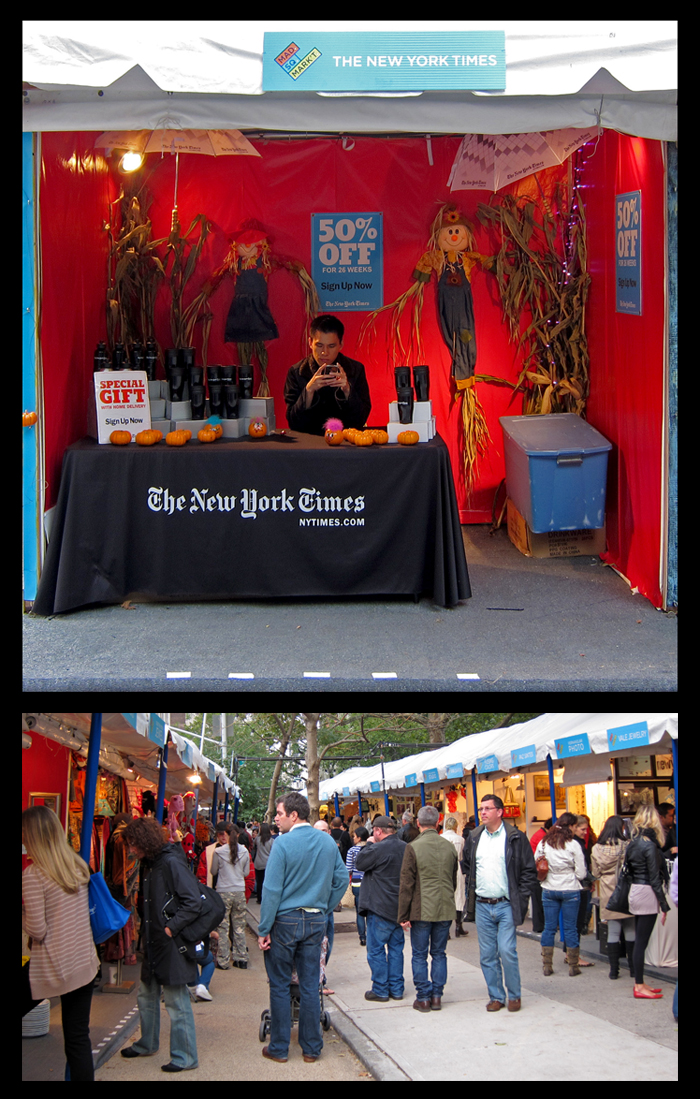
    I now see the same phenomena with The New York Times. Their booths can be found at trade shows and street festivals all over the city. The Internet boom has had an expected impact on all print media. Many are worried about the survival of the New York Times. This would be quite sad to lose them. They also have a special place for me, as I wrote about in New Yorkers Gone Wild. The publisher, Arthur Sulzberger, announced in September: “We will stop printing the New York Times sometime in the future, date TBD.” Revenue will come from their online version. In 2011, the Times will begin charging for some content based on a metered model.

    On a recent visit to the Madison Square outdoor market, I came across a New York Times booth. It was a beautiful day and the other vendors were quite busy with shoppers (lower photo). Transfixed with his smartphone, the lone salesman did not notice that before him stood his best hope for the day. A dinosaur. A man with a love of print, just waiting to be sold 🙂


  • The Dark Side

    One of the biggest problems with the Internet is cut and paste journalism. The ease of which information can be copied and recycled is unprecedented, whether it be general information, reviews, press releases, or buzz. In the case of online news content, as in print media, there is always competition to cover any new event, product, service, or retailer. But with online content, the ease and temptation is just too great.

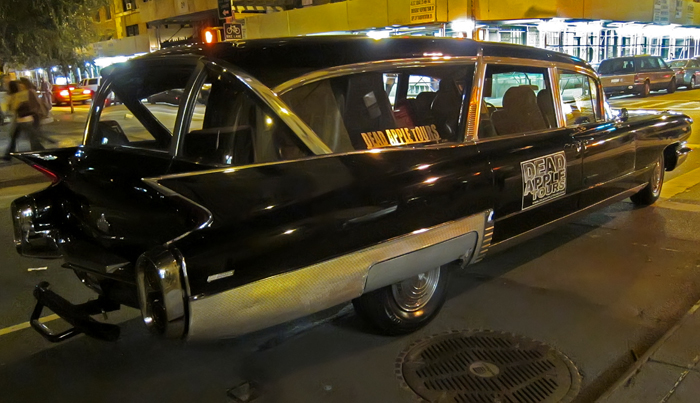
    Dead Apple Tours is certainly a clever concept. Started in 2010 by Drew Raphael, the 2-hour tour of the macabre is conducted from a 1960 Cadillac Crown Royale hearse (at $45 per person). From their website: Witness the final address of Heath Ledger, Keith Haring, Sid Vicious, “Crazy Joe” Gallo, Thomas Paine, and more. Learn the dark secrets of iconic landmarks: Empire State Building, Washington Square Park, and the Brooklyn Bridge.

    In going through pages of early reviews, however, apparently none of the reviewers in the major media had actually taken the tour or availed themselves of reviewers who had. All of the reviews appeared to essentially parrot back the buzz and tour information provided by the tour operator.

    The most useful reviews were those at Yelp.com, by three individuals who took the tour and reported their experiences:

    The narrative descriptions of dead locations were read from a book by our guide in a flat monotone, with all the enthusiasm of an MTA announcement.

    Many times we drove up to an approximate area but not to the actual site of the morbid event.

    A nice touch would be to drop people off at the train station at the end of the tour, at Fulton Street. The 3 stranded tourists had to ask us for direction to the train in the dark.

    There are a staggering number of things to do in New York City, and before spending time and money doing any of them, I would highly recommend looking at the reviews or talking to those who have actually been there and done that. Filtering the reviews and reading them closely is an important part of the process to ascertain why a review is actually positive or negative and relevant to you or not.

    If someone is marketing the dead, it’s fair to examine not only the light side but also the dark side of the dark side 🙂 🙁


  • Unconditional Love

    There are subjects which easily ignite controversy, and graffiti is one of them. To read an article about the subject along with its comments is to witness a war of words. In 2009, the New York Times ran an article, A Sociologist’s Look at Graffiti, which reviewed a book, Graffiti Lives: Beyond the Tag in New York’s Urban Underground, by a Professor of Sociology in New York City at Baruch College. The book author was crucified by some of the readers in the comments area. Most see the problem as vandalism, pure and simple. My story, Scrap Yard, was one of my most commented, with all the classic arguments and positions on the activity.

    What complicates the matter, however, is that like anything else, there is a spectrum of quality – some of the work is extraordinary. See this group of images of graffiti in Long Island City. However, if I owned a building, I would not be pleased to have it painted without my permission. Some of the buildings are in industrial neighborhoods, have stood unoccupied for decades, and are dreadful looking – drab architecture, no exterior maintenance, and a dismal setting. And often they are vastly improved by aerosol paint. But, nonetheless, these buildings are not “public” property.

    However, many building owners permit the work to be done. This seems to be a growing trend. And, in Long Island City, 5Pointz Aerosol Art Center, Inc., “The Institute of Higher Burnin’,” is an outdoor art exhibit space which is considered to be the world’s premiere “graffiti Mecca,” where aerosol artists from around the globe paint colorful pieces on the walls of a 200,000-square-foot factory building. The founder says, however, that “Graffiti is a label for writers who vandalize. Aerosol art takes hours and days. It’s a form of calligraphy.”

    The building in today’s photo is the home of Gratz Industries at 1306 Queens Plaza South. I spoke to someone today at Gratz (a fascinating business in itself) and was told that this is an instance where artists asked the owners for permission. Certainly cooperation is best for all, allowing more time for better work and even working with the owners for things like incorporation of company signage elements.

    To meander around Long Island City and suddenly happen across something like this is quite stunning. For those who enjoy the finer works of graffiti but suffer pangs of guilt knowing how they got there, take a trip to 1306 Queens Plaza South, 5Pointz, or anywhere else where cooperation is at play, and enjoy a new world of unconditional love 🙂


  • Blessing of the Animals

    Where would you expect to see llamas, cows, pigs, turtles, snakes, iguanas, horses, rabbits, goats, geese, donkeys, raptors, sheep, ferrets, dogs, and cats walking or being carried down the center aisle of a Gothic cathedral? At St. John the Divine’s annual Blessing of the Animals. Unfortunately, I missed this grand daddy celebration – I only became aware of it after its occurrence, when told by a friend who correctly assumed that this would be something I would not miss and would share with readers here.

    When New Yorkers decide to embrace something, they pull out all the stops, for an over-the-top, quintessential, nonpareil event. The huge population of the city in tandem with a no-holds barred spirit virtually guarantees this. The old adage applies to New Yorkers quite well – If you’re going to do something, you might as well do it right.

    Blessing of the Animals honors St. Francis of Assisi, patron saint of animals. This is celebrated by many Catholic and Episcopalian churches on the Sunday on or about his feast day, October 4th. Legend has it that St. Francis spoke to birds, tamed a wolf that was terrorizing a small village, and on his deathbed, thanked his donkey for carrying and helping him throughout his life, and his donkey wept.

    St. John the Divine has been celebrating Blessing of the Animals since 1985. The highlight is the procession of the animals, with as many as 4,000 creatures making the journey down the aisle with their owners for a ritual blessing. Every imaginable species is represented. One year, an 8,000 pound elephant from Ringling Brothers Circus made the walk.

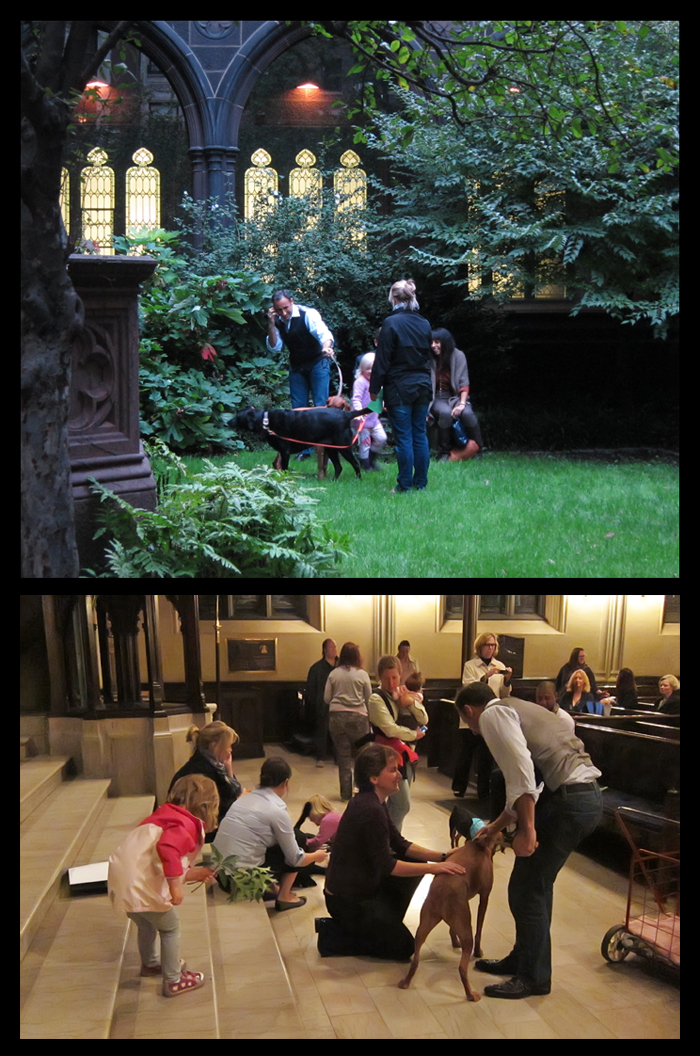
    I did discover, however, that a local church, the First Presbyterian at 12th Street and Fifth Avenue, was conducting a ceremony on Wednesday the 6th, affording me the opportunity to attend a ceremony for the first time. It was quite a surprise to see our furry friends sharing the pews. The number attending was much smaller, of course, than St. John’s extravaganza, but for those attending with their beloved pets, blessings do not come in sizes 🙂


  • Pyramid Power

    New York City is no stranger to the occult or new age practices and beliefs. Samuel Weiser Books, established in 1926 on book row, is the oldest and probably the most famous occult bookstore in the United States. It moved a number of times and is no longer a retail operation. However, I did visit their shop many times in the 1970s, when they were located at 734 Broadway in the Village.

    In the early 1970s, pyramid power became the rage. Claims were made about their paranormal properties – pyramids were said to preserve foods, maintain the sharpness of razor blades, improve health, function “as a thought-form incubator,” trigger sexual urges, and a myriad of other effects. Models were made and sold in a variety of materials. I had one myself.

    One of the seminal forces in this phenomenon, was New Yorker Max Toth, born in 1937. He a background in electroneurophysiology and was one of the first neurosurgical technicians. He built high-gain amplifiers for research purposes for neurosurgeons.
    While living in Bellerose, Queens, Toth began manufacturing foldable cardboard pyramids. In 1976, the highly influential book Pyramid Power, authored by Toth, was published. An estimated 1 million copies have been sold. Other books and other pyramids were manufactured in a variety of materials, becoming a virtual mini-industry.

    Frenchman Antoine Bovis, a pendulum dowser in the 1930s, originated the idea that pyramidal shapes can preserve food. Karel Drbal, a Czech radio engineer, patented a razor blade sharpening pyramid based upon the earlier paranormal experiments of Bovis.
    Sheiler and Ostrander, authors of Psychic Discoveries Behind the Iron Curtain Authors, published in 1970, had met Drbal and devoted a chapter of their book to pyramid power.

    Today, pyramid power and pyramidology are all but forgotten and considered pseudosciences. But whenever I see pyramids, particularly those sitting atop the Zeckendorf Towers (or even the Gothic spire of Grace Church), I can’t help but be reminded of Pyramid Power…


  • Caught in the Riptide


    Have you ever been caught in a flow of traffic so strong that you feel you cannot exit? And to do so would not only be dangerous, but you also fear the ire of those who may be inconvenienced and slowed down by your exit, even for a nanosecond? Or perhaps you have avoided swimming at a beach where dangerous riptides exist.

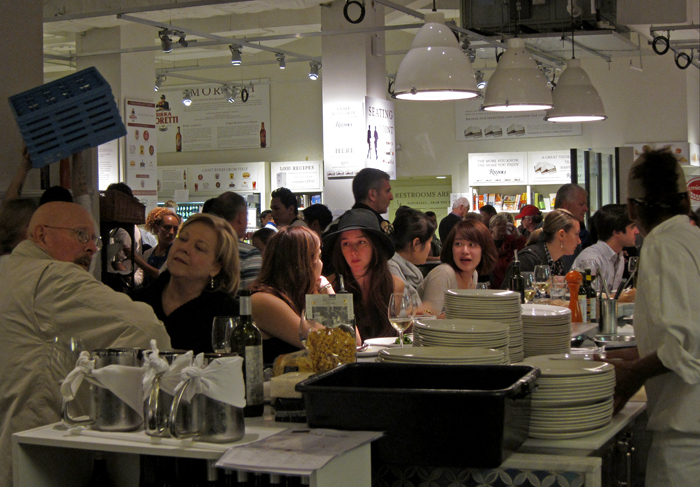
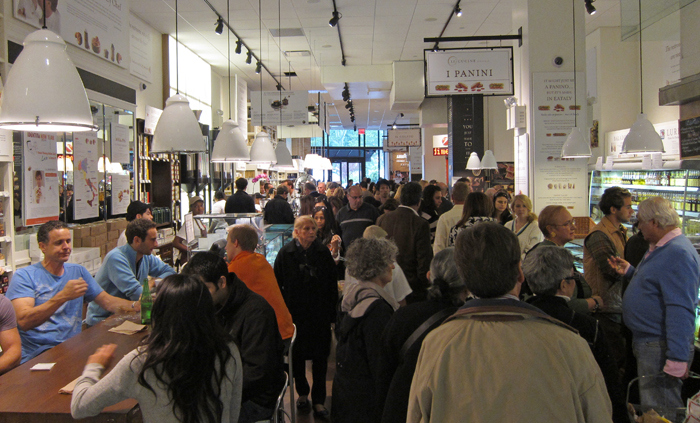
    Unfortunately, I am very narrow-minded when it comes to mob scenes. And there are plenty of mob scenes in New York City, driven by the buzz of the powerfully connected. It is a deal breaker for me. So, regardless of how wonderful and amazing Eataly may be, I can not tolerate being in a place that is like being on a freeway with no exits. I am not afraid of traffic – I have driven in New York City for my entire life here and was a taxi driver for nearly 2 years when I first moved to the city. But I try to avoid crowds and find a little respite when it comes to food shopping. This is why I also tend to visit Whole Foods Market in the city infrequently.

    Eataly is the brainchild of restaurateurs Mario Batali, Joe Bastianich, Lidia Matticchio Bastianich, and Eataly founder Oscar Farinetti, who created the Eataly food emporium in Torino, Italy, opened in 2007. You can read more about them here at their website.
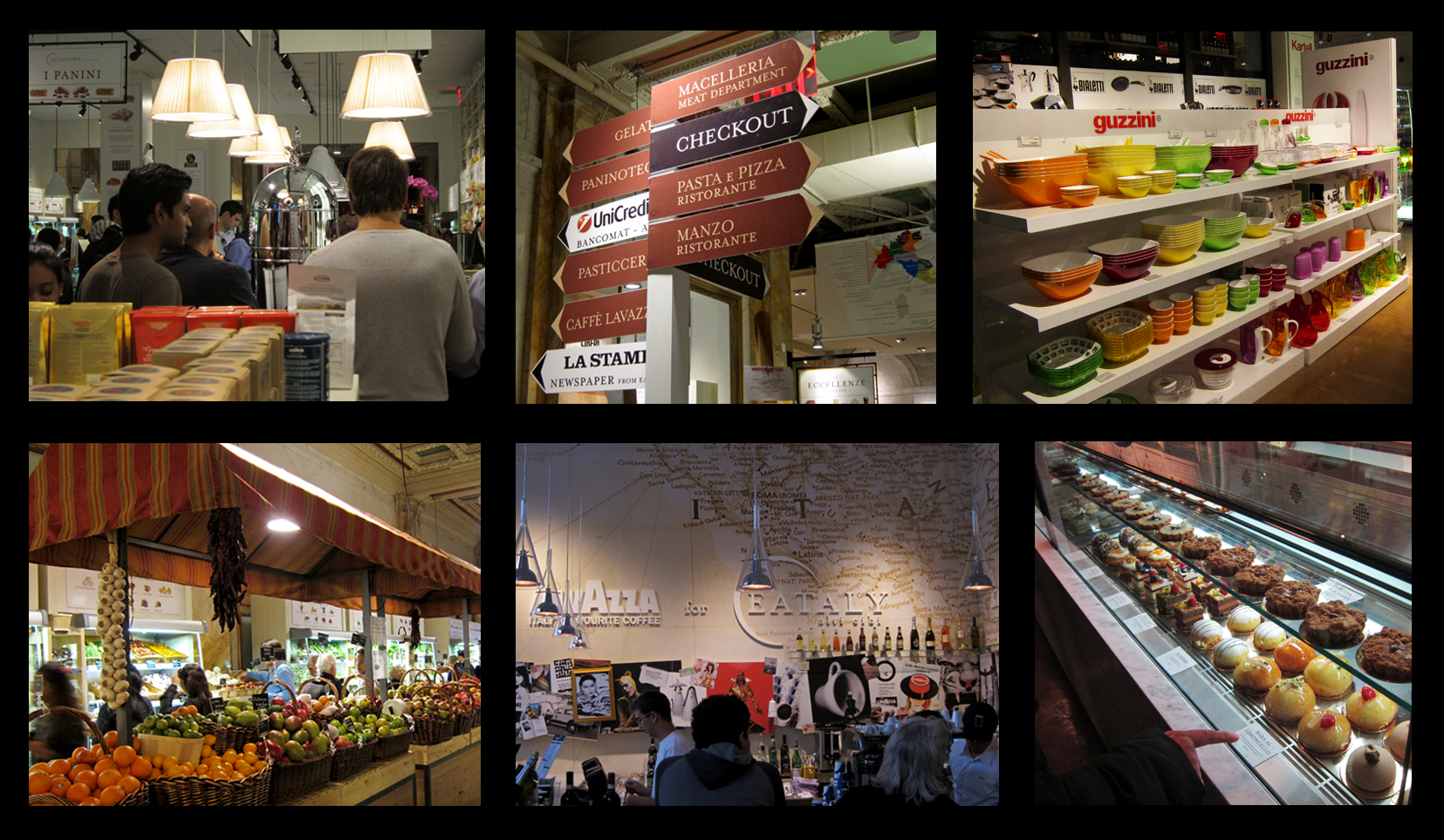
    Eataly in New York City occupies 52,000 square feet on the ground floor in the toy center at 200 Fifth Avenue at 23rd Street. It features multiple restaurants, a Neapolitan pizzeria, and retail shops featuring every imaginable food item from Italy, along with Italian housewares and a cooking school. There is a year-round rooftop beer garden and microbrewery.

    Mario Batali is no poser. He knows his food, and his tremendous success is not smoke and mirrors. I did not examine any of the goods, but I am confident that everything is as represented as far as foodstuffs for sale. The philosophy here is not only to bring in the finest goods direct from Italy, but also to embrace the Slow Foods concept on which the original Eataly is based and which I heartily support.

    Restaurants are, of course, another story entirely. Good service is not a given, particularly in a place overwhelmed with patrons. There are so many negative online restaurant reviews regarding the places in Eataly that I would have to assume, at best, that the experiences here will be uneven.

    However, I do plan on going back to look a little more closely, brave the crowds, and give the place a chance. See you there, caught in the riptide 🙂


  • Vigil


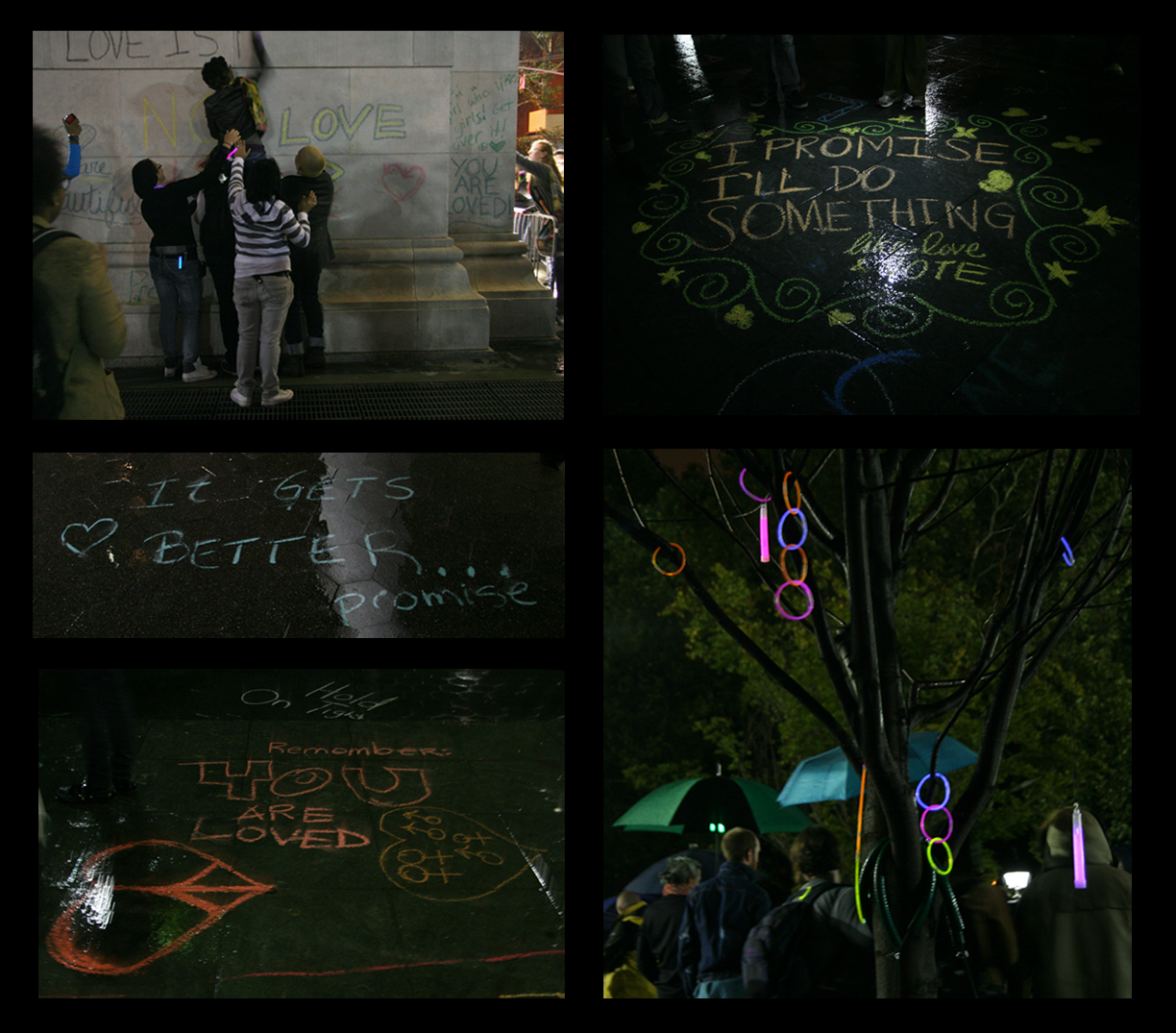
    NYU students held a “You are Loved” Glowlight Vigil in Washington Square Park on Sunday night, October 3, at 9PM. In the wake of six recent suicides nationwide* provoked by anti-gay acts, the vigil was organized by the NYU chapter of a national fraternity created by gay men, Delta Lambda Phi, and NYU’s LGBTQA Office to honor ‘all of those we have lost due to hatred and bigotry.’

    The latest suicide was that of Tyler Clementi, an 18-year old Rutgers University freshman who jumped from the George Washington Bridge on September 22 after an intimate encounter with another man was streamed via hidden webcam to the Internet. Tyler’s Facebook page on the day of his death said: “Jumping off the gw bridge sorry.” Clementi’s roommate, Dharun Ravi, and another classmate, Molly Wei, have been charged with invasion of privacy.

    The glowlight vigil segued into the 2nd annual ‘You-Are-Loved Chalk Messaging Project’:

    The You-Are-Loved Chalk Message Project is an annual, nationwide suicide-prevention awareness project that combats hateful rhetoric toward the LGBTQ community through the use of positive, uplifting chalk messages.
    Words are powerful. Speak with love.

    The legal issues, culpability, and appropriate punishment in regards to this incident of anti-gay cyberbullying of Tyler Clementi are very troublesome – I recommend this article by John Schwartz of the New York Times. I will not recount the details of this event, as there are better sources than this website for those interested. My condolences to all those affected by the tragedy, and thanks to NYU students for the vigil.

    *The six who have died from suicide as a result of anti-gay bullying are: Asher Brown (age 13), Seth Walsh (age 13), Justin Aaberg (age 15), Billy Lucas (age 15), Tyler Clementi (age 18), and Raymond Chase (age 19).

    Other Vigils on New York Daily Photo: Virginia Tech, Pawns, Can’t Argue With That, Free Laura and Euna


  • Going Through Rehab


    One of the most disappointing features of a post-war “modern” apartment is that in most cases, when you enter, you are typically dumped right into a living room with an an immediate sense of the lay of the land. Cookie cutter and boxy, no foyers, no “frivolous” use of space. There are no surprises around the corner, because there are not many corners or ways to meander.

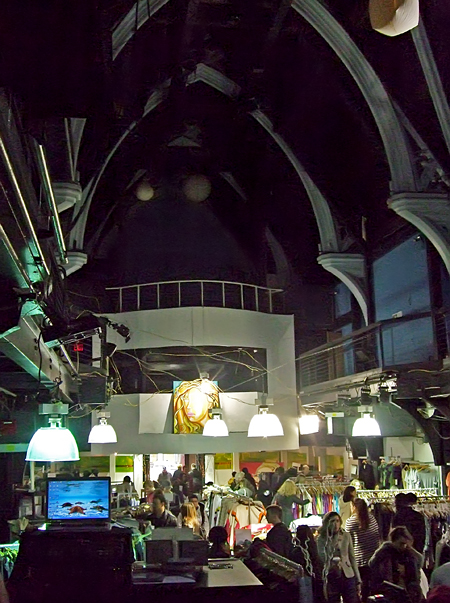
    If you like a labyrinthine experience in a Gothic environment, you may enjoy the Limelight, previously a church built in 1846 and, after 1973, used as a rehab center, various night clubs – most notably The Limelight – and now a shopping emporium.
    A nightclub in a Gothic church should be a dramatic, exciting experience. But it was not. I neglected to mention that some had nicknamed the club “Slimelight.” I visited once in the 1980s, and the novelty of crawling through the maze of chambers in low light wore off quickly. Slimelight it was. I wrote about the sorry state of the Limelight on May 30, 2008 in Model for Decorum.

    Its various reincarnations were not much better. On March 14, 2009, I visited again and found a large flea market of sorts – very disappointing. The photos I took remained unused. You can see an interior photo here.
    After a $15 million dollar renovation, the building reopened in May 2010 as the Limelight Marketplace, a assemblage of over 60 upscale shops, eateries, and outdoor cafe. See my photo gallery here.

    Although some critics are not particularly enamored with this incarnation, and I do not champion the view that commerce heals all wounds, it certainly is refreshing to see the cleanup after going through rehab…


  • Curse of the Mouth Trumpet


    It was September 25, 2005, and and I had the good fortune to be told about the first annual Bluegrass Reunion in Washington Square Park.

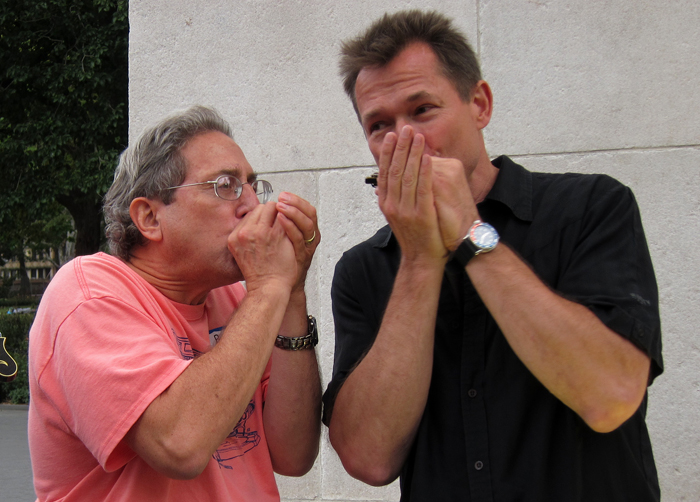
    I was astonished to see the “mouth trumpet” technique of Bob Gurland. As an added bonus, I learned that, unbeknownst to me, the woman he began to engage with in a duet was Maria Muldaur. Conveniently, my point and shoot digital camera at the time had video capability. What an opportunity to capture a bit of spontaneous music history! Or so I thought.

    I noticed just before they had nearly completed their duet, that I was not recording at all. I immediately enabled the video recording but only got 15 seconds of them together. This was also the total video footage of Bob :

    I did get to chat with Bob and complemented him on his unique and amazing skill. He told me he had performed and recorded with a number of music bands, including one of the earliest heavy metal groups, Blue Cheer. His name appears on the credit list for their album Oh! Pleasant Hope.

    I am, however, very tenacious, and I never forgot my aborted video. So it was with great pleasure that after 5 years, I saw Bob again at the recent 6th Bluegrass Reunion. Here, I was quite confident. I had much more experience with photo equipment and had several cameras, including a Sony HD camcorder, which I did not bother bringing. The video function of today’s point and shoots is excellent, and I was lazy, sure that I was adequately prepared with my new Canon S90. Or so I thought.

    I was very relaxed, shooting Bob in a number of segments, and even introduced myself and got him to do a short video clip alone. However, there appeared to be a peculiar tinting to all the video. No time to research this now, as I was sure it was a screen display issue. It was not. In making this Canon camera very user friendly, some functions are much too easily changed by brushing against a small function wheel. I had accidentally changed the mode from standard to color accent and color swap. In my panicky state, I tried to find the functions settings for video, to no avail. Once I was home, I learned how childishly simple the mode change is. Too late.

    So, if you would like to enjoy Bob and his fellow musicians in a variety of lurid skin tones and other color abominations, here is my video montage:

    Next time, I am determined to prevail over the Curse of the Mouth Trumpet 🙂

    Photo Note: Bob Gurland is on the left with Trip Henderson on harmonica on the right. Both are New York City residents.

    Related Posts: Izzy and Art, Bluegrass Reunion


  • Sukkah City


    I have found it remarkable that everyone I have spoken to, including those who grew up outside the United States, has participated in what appears to be one of the most universal past times of children – the building of makeshift structures to hide and play in. An amalgam of anything available – sheets, cardboard, etc. are utilized to make a mini-home or fort. Perhaps it should be no surprise, owing that shelter is such a primal need of every human. Also no surprise that George Costanza of the TV series Seinfeld, in order to impress a woman, lies about his work, claiming that he is an architect.

    Architecture is certainly an endeavor where the ingenuity, brilliance, resourcefulness, and creativity of the human mind can be seen. One needs no further evidence than the recent international design competition, Sukkah City. There were 624 entries from 43 countries.
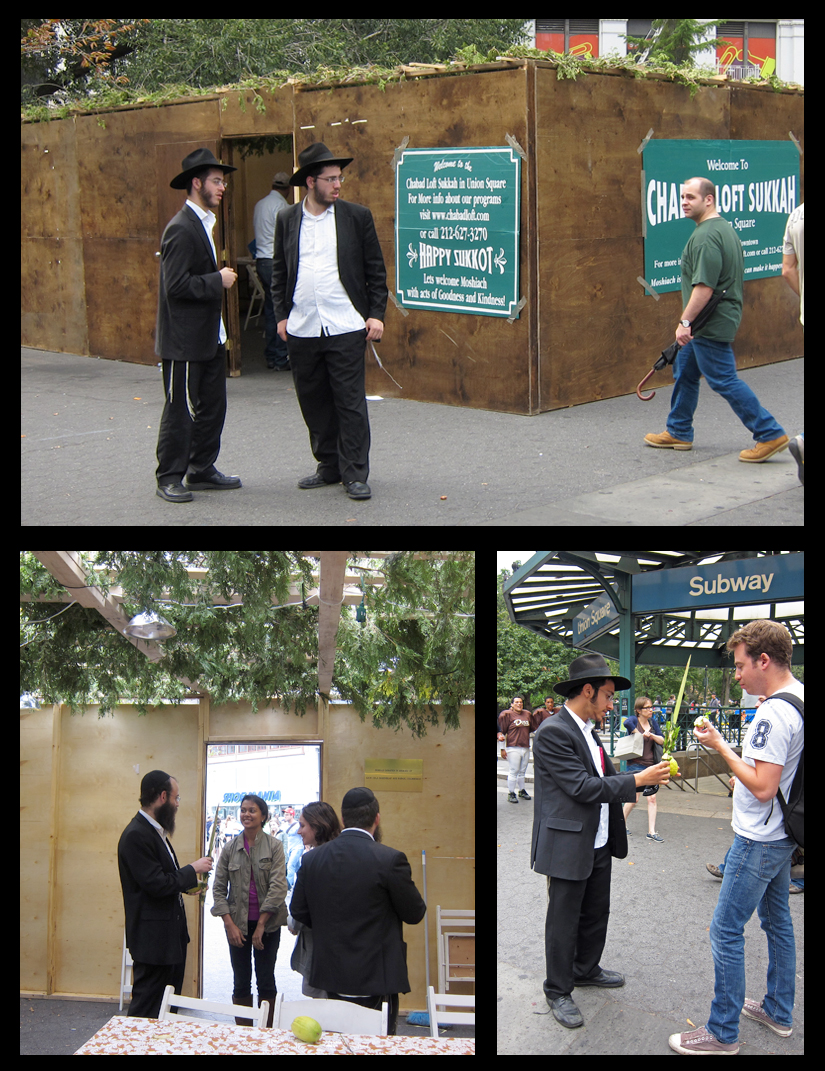
    Every imaginable material and fabrication method was used to build Sukkahs*, as long is they conformed to the rules of construction. Twelve of the finalists were displayed in Union Square for two days (September 19 & 20), and the finalist, shown in today’s top photo, remains there for the entire week of Sukkot. See second photo here.

    The designs are beautiful, evocative, and inspiring. All twelve sukkah finalists are on sale, with proceeds benefiting Housing Works, an organization fighting AIDS and homelessness. For the Jew or non-Jew, those with a home and those without, all can find inspiration in Sukkah City 🙂

    *A sukkah is a temporary “booth” (the Hebrew translation) to live in during Sukkot, a week long festival that commemorates the forty-year period during which Israelites lived in temporary shelters while wandering in the desert after their exodus from Egypt. There are many rules governing the construction and use of the sukkah: It must have two and a half walls (two full and one partial). The roof needs to be made of organic materials and sparse enough to let rain in and preferably to let the stars be seen from inside. Although Jews are required to eat all their meals and sleep in the sukkah, they do not need to do so if they are uncomfortable or during rain. See my photos here of a traditional sukkah typically found during this holiday in various locations around the city.

    Note: The event was sponsored and organized by a number of firms, including the AIA center of New York City, located at 536 LaGuardia Place. A Sukkah City exhibition is on view from September 22, 2010 – October 30, 2010.


  • Urban Night Climbers


    Texte alternatif
    For a full night climbing experience, click and play audio link to accompany your reading.

    Many years ago, in a conversation with a customer, the subject somehow turned to my childhood love of tree climbing. My customer was VERY pleased to hear this, and encouraged me to rekindle this interest, embrace some trees, or perhaps even join him and his friends in their nocturnal sojourns. He was a night climber. Of buildings.

    New York City is a city that never sleeps. We are known for our night clubs, night life, and night people – but night climbers of buildings? I was not aware that there was an underground fraternity of those who practice buildering, aka urban climbing, stegophily, or structuring.

    The press has covered the various climbing spectaculars of the city – Philippe Petit’s legendary walk between the world trade towers on August 7, 1974. George Willig, a mountain-climber from Queens, New York, United States, climbed the South Tower of the World Trade Center on May 26, 1977. Alain Robert is a French rock and urban climber who in 1994 scaled the Empire State Building and on June 5, 2008, climbed the New York Times Building (later that day, Renaldo Clarke also climbed the building). Dan Goodwin, using suction cups and a camming device, climbed the North Tower of the World Trade Center on May 30, 1983.

    But recreational buildering goes back much further than might be expected, at least to Victorian times in England, where students had been climbing the architecture of Cambridge University. Geoffrey Winthrop Young was roof climbing there in the 1890s and published The Roof Climber’s Guide to Trinity in 1900. In 1937, The Night Climbers of Cambridge was written (under the pseudonym Whipplesnaith) about the nocturnal climbing on the town buildings and colleges of Cambridge, England in the 1930s.

    In the United States, two men, George Polley and Harry Gardiner, both nicknamed the Human Fly, pioneered buildering as early as 1905. In 1920, George Polley climbed 30 floors of the Woolworth building before being arrested. Not much, however, is written about current recreational nighttime buildering in New York City, for obvious reasons. In 2008, the New York Times published an article with a little on the activity.

    Apart from legality or prudence, I do understand the lure of urban climbing. Much as the alpine areas of the world are magnets for rock climbers, the buildings and skyscrapers of New York City provide the same challenges and draw in masonry, steel, and glass. Perhaps I may yet get to witness the activities of these urban night climbers…

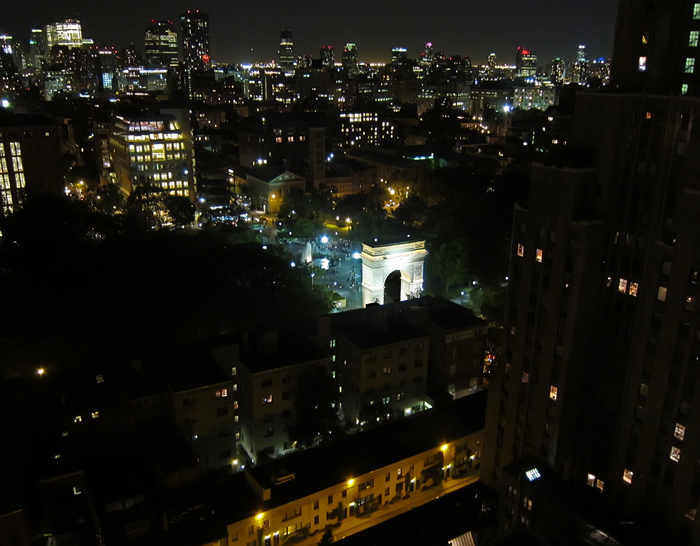
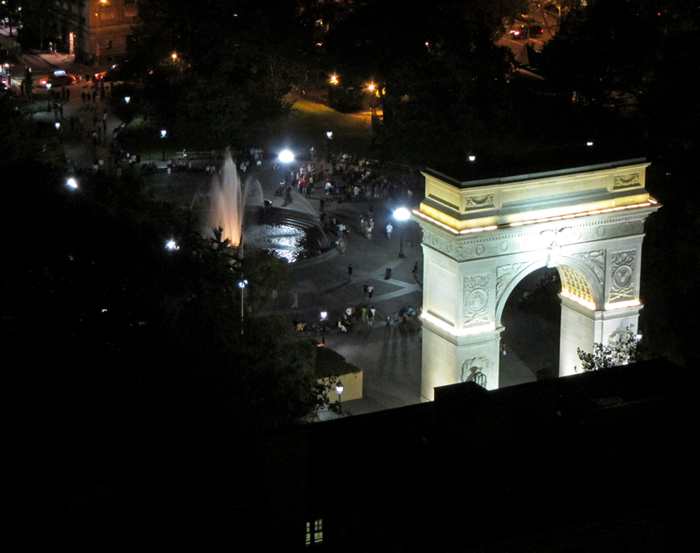
    Photo Note: I was recently privy to access to one of the very few rooftops in the Village affording a direct view of Washington Square Park. The building and friends kind enough to invite me to share the view, will, in the spirit of buildering, remain a secret 🙂


  • New York is Bluegrass Country

    I was once discussing prominent blues musicians struggling to make a living with a jazz musician, who concurred and told me that he had often seen world-class jazz musicians playing to near empty bars. So, if you like meeting and mingling with life’s movers and shakers in music, just shift your interest from mainstream popular genres.

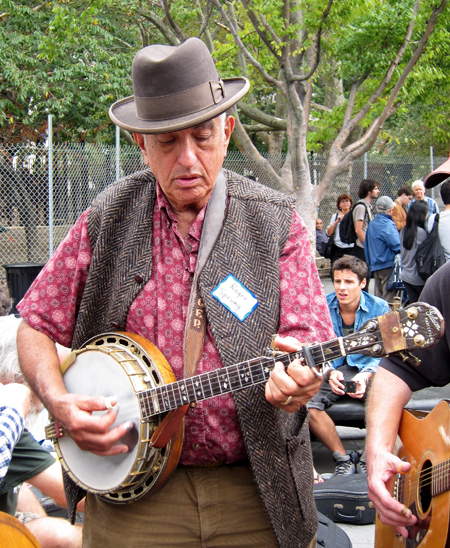
    In rock music, a man like Roger Sprung would be most likely layered with security and screeners with little hope of a meeting. At the 2010 annual bluegrass reunion on Sunday, September 26, in Washington Square Park, Roger was easily approachable between sets.

    Roger was born in Manhattan in 1930. A pioneer and the father of Newgrass banjo, he is credited with introducing authentic banjo music to the North. He was introduced to piano at age seven by his nanny and took lessons at age 10. Subsequently, his interest turned to guitar and then banjo, which he taught himself by listening to recordings of legends such as Earl Scruggs.

    Starting in 1947, Roger was introduced to the folk country scene in Washington Square Park by his brother George. In 1950, he made the first of what was to be many trips to bluegrass country, starting in Asheville, North Carolina. In Folk Songs of Greenwich Village in the 1950’s and 1960’s, bluegrass historian and performer Ralph Lee Smith wrote, “Banjo player Roger Sprung almost single-handedly introduced Southern bluegrass music to New York through his playing in Washington Square.” Roger has performed with a myriad of legendary musicians in a number of venues as well as on television. He is currently a resident of Connecticut, and his website can be found here.

    Interest in bluegrass music has been growing in New York City with local players like Sheriff Bob, who has run the weekly bluegrass jam for years (formerly at the Baggot Inn, now at the Grisley Pear), Gene Tambor of Minetta Creek, and guitar virtuoso Scott Samuels, who in recent years has added more bluegrass to his repertoire. New York City is ripe with bluegrass activities in various clubs, bars, parks, and outdoor festivals. Classes can be readily found, along with equipment in various shops.

    Bluegrass aficionados, performers, and enthusiasts abound, and for those who want a taste or a full meal of bluegrass music need not look further afield than than this city. With a feather in your cap like Roger Sprung, it is easy to aver that, along with all the other great things about this city, New York is bluegrass country 🙂

    Postings featuring Bluegrass: Sheriff Session, Bluegrass Reunion, Paddy Reilly’s, Pockets of Joy


  • Impossible

    There are people who are so hypercritical, so persnickety, so picky, so cynical, and such perfectionists, that to see them at dinner, whether it be fast food or haute cuisine, will result in a virtual forensic investigation of the dish’s ingredients. Rather than embrace life, they appear to have a disdain for it, because it almost never meets their standards. Their negativity fills the air like a heavy cloud. Laughter itself is carefully meted out, only at worthy moments. I have met such people, and perhaps you have also.

    There are people who have a joie de vivre that permeates everything they see and do. For them, life is wonderment, and their love is absolutely infectious. Most who are fortunate enough to be around them are happy to be infected. They befriend everyone, and most welcome the friendship. They are truly alive and easily become the life of the party. Laughter is their signature, and they are perpetually signing life’s events.

    I have met such people too, and although some may find their unbridled enthusiasm wearing, better a night spent with the life affirmer than walking on eggshells and having your balloons deflated by the disgruntled life disdainer. Although personalities and people are complex mixtures and do not fit these two boxes so conveniently, those at the polar ends of the spectrum do approach these characterizations rather well.

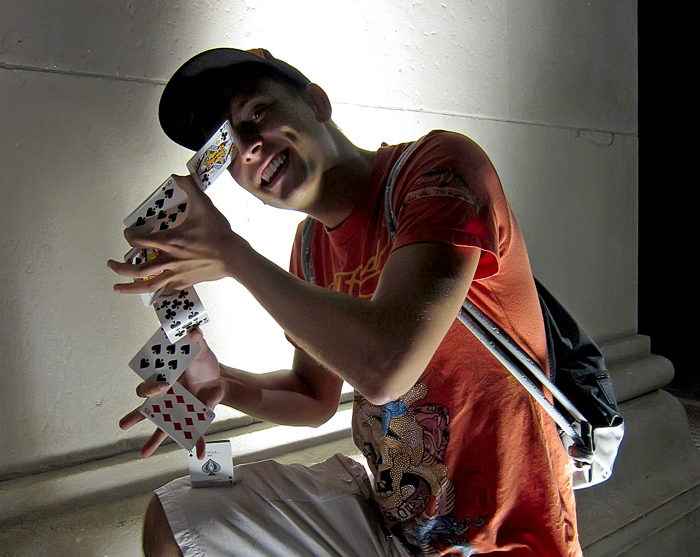
    Constantin is from the Ukraine and is currently performing at Webster Hall in its Saturday night show, Circus. He approached us unexpectedly while sitting in Washington Square Park and asked if he could demonstrate some magic. Fortunately for him, he had just approached a group of life affirmers and had an audience poised for applause. We were hungry to show our love and appreciation.

    I have seen a number of professional magicians, but Constantin’s presence and speed was something to behold. A member of our group, JoSsS, is one of the world’s great life affirmers, and you can see him in the video I shot that night (look for the man with the curly white hair). 1 minute and 20 seconds into the video, you will see his ebullient, effusive, effervescent reaction to a particularly amazing trick, where, incredulous at the outcome, he repeats, “Impossible!” over and over, with his charming manner and Argentinian accent. I know he loves that word, and it is so appropriate, because for a life affirmer, a day without love, hugs, and laughter is like a day without critical examination for the life disdainer – impossible 🙂


  • Tools of the Trade

    In the 1980s, I frequently came home to spent whippet* cartridges on the stoop of my building. In the parks, used needles were not an uncommon sight.

    Most activities have their requisite equipment. Users range the gamut, from those who take a strictly utilitarian view, often fashioning their own tools when possible, to those for whom the tools can become an end in itself, some taking on a near fetish quality.
    Most users strike a middle ground – buying a reasonable number and quality of tools, typically without the time, interest or skills to enter the world of DIY. Some pursuits lend itself to the do-it-yourself or makeshift approach, other fields such as photography being near impossible to fashion one’s own equipment, barring pinhole cameras. Photography is a classic field for equipment hounds, aka “shutter bugs” or “camera bugs.”

    There are other activities where the coveting and collecting of tools rarely becomes an end in itself, i.e. where the pleasure in use vastly outweighs any possible pleasure of ownership, such as the world of hedonistic indulgences of sex, drugs, and food. Cameras maybe purchased, admired and unused, and books maybe collected and unread, but I have never heard of anyone buying scales or bongs to sit idly on a shelf.
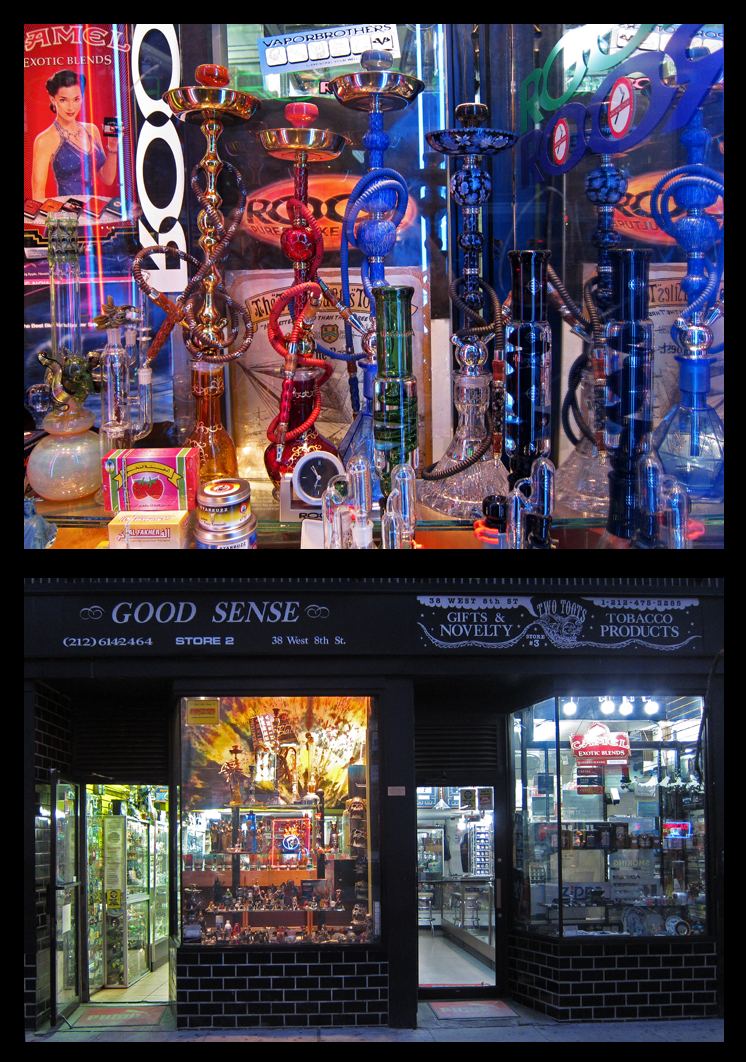
    New York City, particularly the East and West Village, has been home to the head shop for as long as I came remember – many decades. Head shops carry all manner of drug paraphernalia, such as bongs (water pipes), roach clips, glass pipes, coke spoons and mirrors, pipe screens, vaporizers, rolling papers and machines, scales, and legal substances such as whippets.

    Head shops have varying legal statuses worldwide. In the United States, they exist in a gray area, since the items sold can be used for illegal and legal substances. In the 1990s, the Giuliani administration made efforts to crack down on these shops with numerous raids and confiscation of goods. However, with a mix of merchandise and many of the items not specifically drug related, this was a short-lived campaign.

    The ones in today’s photos were taken in the West Village on 8th Street and 6th Avenue. The names of the stores themselves often obfuscate or hint at the real uses for the products sold. In the photo, you can see Two Toots, a play on a cocaine user’s word toot, while Good Sense is a play on sensimilla – a very strong and high-quality breed of marijuana that produces no seeds.

    With the decriminalization of marijuana in many states, head shops are making a comeback. Like alcohol, drugs are here to stay, and for those that indulge, there will always be sellers of tools of the trade

    *Whippets are nitrous oxide cartridges used in refillable whipped cream canisters. They can also be used as a drug for getting high through inhalation.


  • dinamic_sidebar 4 none

©2026 New York Daily Photo Entries (RSS) and Comments (RSS)  Raindrops Theme