• Stemming the Tide

    There is a nervousness in this country like nothing I have ever seen. Worry runs deep, and New York City, with all its wealth, has not escaped. It is difficult to find places where all feels well, and even in affluent neighborhoods, many retailers do not look or feel well. Even the Haves worry about the plight of the Have-Nots, because, perhaps, for the first time, some of the Haves see a possibility of joining the ranks of the Have-Nots.

    Yesterday was Inauguration Day, and President Barack Obama takes the helm at one of the worst times in this country’s history. In spite of a renewed hope fueled by a new, young administration, the markets plunged over 4%. There had been an expectation of a nice bounce, but the realities outstripped any false euphoria. Everyone realizes that this is a very grave situation. Today’s New York Times headline reads “After a Day of Crowds and Celebration, Obama Turns to Sober List of Challenges.” Sober is the operative word.

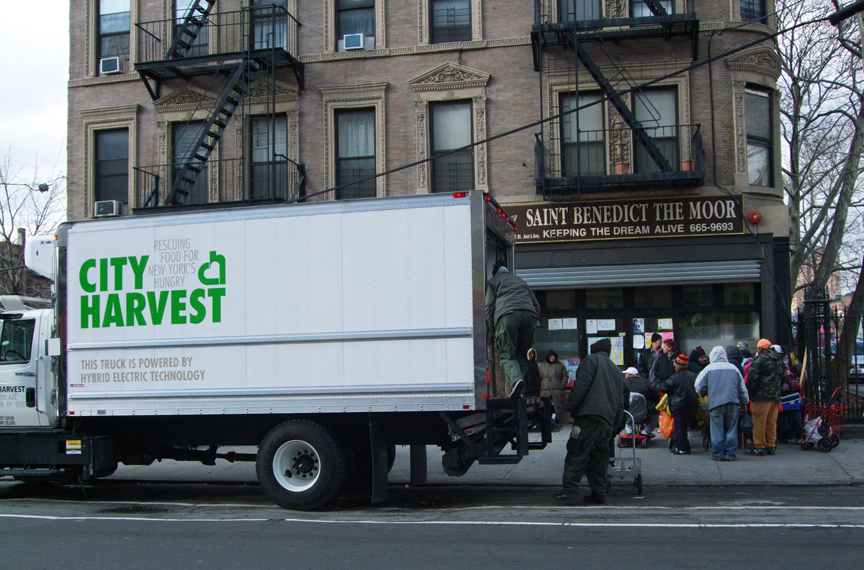
    City Harvest, founded in 1982, is the world’s first and New York City’s only food rescue program. The organization rescues 60,000 pounds of food per day, delivers to more than 600 community food programs throughout the five boroughs of New York City, and serves over 260,000 people weekly.
    Even the soup kitchens and food pantries themselves have problems – a shortage of donations of food supplies and an increase in the numbers of people using food services. An article in the New York Times last November reports a steep rise of between 20-40% of demand for food aid nationwide.

    I do believe, however, in the resourcefulness of humankind as well as our ability, when inspired and focused, to achieve the unexpected and stem the tide. A president can only do so much, but a good leader goes a long way to provide impetus. Let us hope that President Obama is that man…

    Photo Note: This photo shows a City Harvest delivery of food to the soup kitchen St. Benedict the Moor Center at 283 St. Ann’s Avenue in the Bronx.
  • Wild Ride

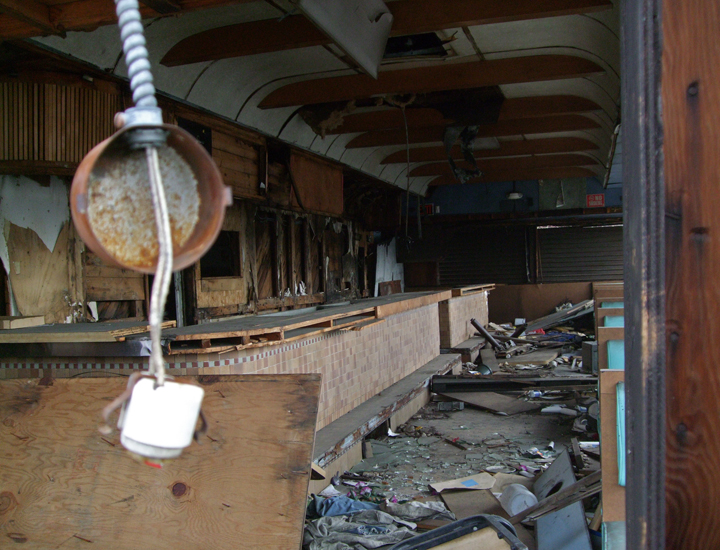
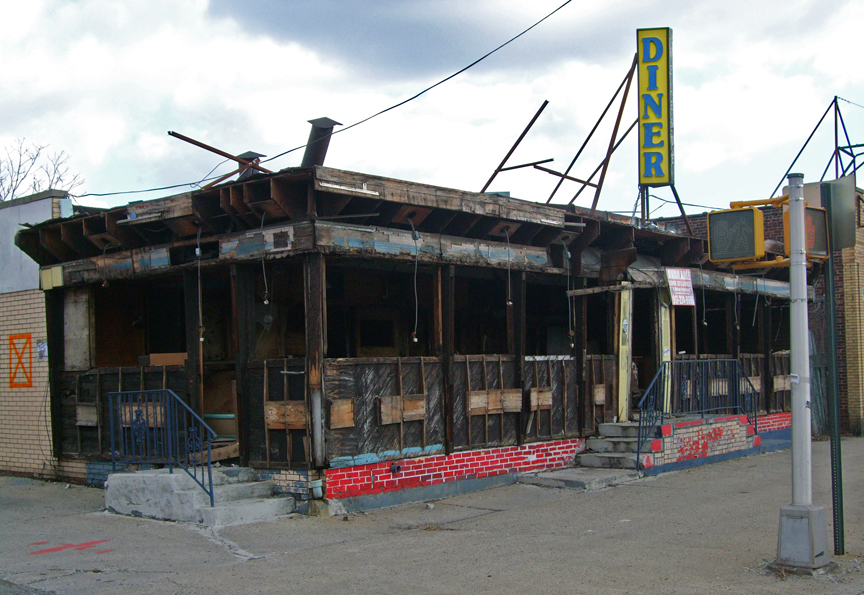
    On my recent excursion to Hunt’s Point in the Bronx, I saw many incredible sights, and this diner was one of them. My friend’s immediate comment was that this must be an insurance wreck – i.e. arson for insurance money. In the 1970s, areas such as the South Bronx saw a wave of arson. I have no idea if this was the case with this diner; I was just dumbfounded to see something like this completely open to the public. Nothing was cordoned off. I was able to walk freely through the rubble amidst broken shards of glass and metal framework while avoiding electrical conduit hanging from the ceiling. See here for a photo of the inside.

    Hunt’s Point is not typical of the Bronx, and I will do that borough justice in time. But it has had its disproportionate share of urban blight and is one of the poorest areas in the United States. Areas such as the South Bronx have been virtually synonymous with urban decay. Like most areas in the city that have seen decline, the South Bronx has more recently experienced revival and renewal.

    There is a wide variation of urban environments and neighborhoods in the Bronx, some quite affluent, like Riverdale, and others with strong cultural and ethnic roots, like the Italian district at Arthur Avenue. The borough has a large amount of parkland – Van Cortlandt Park, Woodlawn Cemetery, the Bronx Zoo, Pelham Bay Park, Crotona Park, Claremont Park, and the New York Botanical Gardens. With the exception of the zoo and botanical gardens, the Bronx is not a destination, so most residents or visitors to New York City will never see much or any of the borough.

    I expect that most readers of this website will not make a pilgrimage to Hunt’s Point or other neighborhoods like it. For a wild ride through the five boroughs, jump on this train…


  • True North

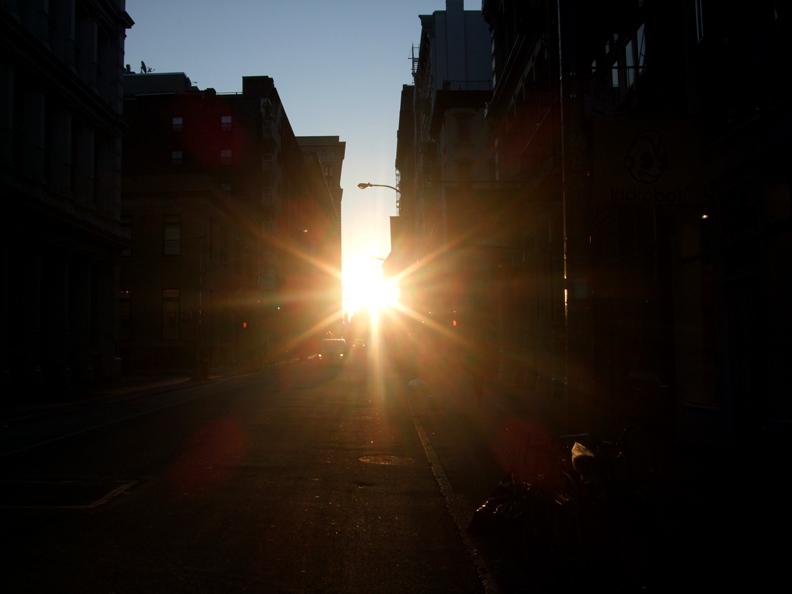
    I am usually up before sunrise, but I am not typically on the streets until somewhat later. With sunrise even earlier much of the year than it is mid-winter, I rarely see a site like that which I witnessed heading east on Prince Street Saturday morning at 7:47 AM.

    Something few New Yorkers know is the angle at which Manhattan deviates from north-south (or that it deviates much at all). New Yorkers believe Manhattan’s avenues run north-south and crosstown streets run East-West, but there is only a casual relationship between true north and the avenues. It is extremely useful, however, to think of orientation in Manhattan in that way.

    With the establishment of the Commissioners’ Plan of 1811, which established an orthogonal grid north of 14th, avenues were run parallel to the long axis of Manhattan, not actually north-south. The deviation from true north is significant: 29 degrees to be exact (read the New York Times article here). This, however, does not prevent seeing sights such as that in the photo. One of the most interesting phenomena in the city is the occurrence of Manhattanhenge, a biannual occurrence where the setting sun aligns with the crosstown streets of Manhattan’s main grid. On these days, the sun fully illuminates every cross street from river to river during the last fifteen minutes of daylight, with the setting sun’s center exactly on the street’s center line. I saw this for the first time on May 28, 2007 (see my photos and article here).

    If you are familiar with View of the World from Ninth Avenue, you know how extraordinarily ethnocentric New Yorkers are. How important is magnetic north really? Perhaps what we have is 29 degrees of irrelevance and we should more correctly say that magnetic north deviates from Manhattan’s center line which, as every New Yorker knows, points true north. 🙂


  • Hunt’s Point

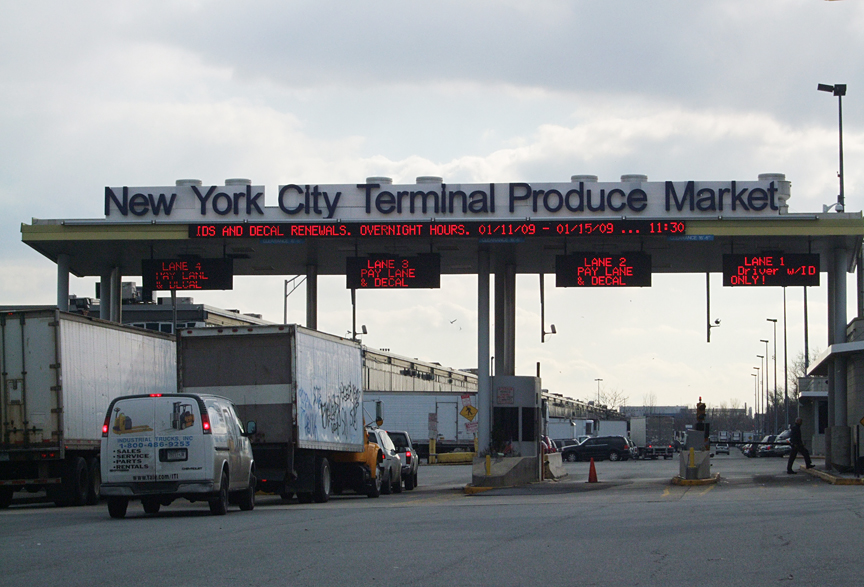
    Do you want to see food distribution on a gargantuan scale? I had no idea that the Hunt’s Point markets in the Bronx were that big. What I envisioned was a large building with open stalls. What I saw was something the size of a small town.

    Hunt’s Point is the largest food distribution center in the world. It occupies 329 acres and is broken up into three primary large distribution centers, each handling different commodities: New York City Terminal Market (fruits and vegetables), Hunts Point Cooperative Market (meat and poultry), and the New Fulton Fish Market.

    I expected to visit an open produce market brimming with fruits, vegetables, and merchants frenetically shopping and trading. Instead, I was greeted with an entrance like that of the Holland Tunnel. No fruits or vegetables were to be seen. I saw chain link fences and many grim and amazing sights – I will feature a few of these in the coming days.

    I was a little naive, perhaps – after all, this is BIG business, not a place to expect the charm and ambiance of a farmers market. For that, you go to Union Square

    A Note about Hunt’s Point: These markets and other smaller ones occupy a large portion of a peninsula in the Bronx neighborhood known as Hunt’s Point. There are over 800 businesses employing 25,000 workers. Hunt’s Point is also a residential area with over 40,000 residents. However, it is a low-income area where over half live below the poverty line – this is one of the poorest districts in the United States. Crime is rampant, with drugs and prostitution. Although crime rates have fallen, Hunt’s Point reports the highest violent crime rate in New York City.

    Related Post: Union Square


  • Unconditional Love

    I made an assertion in yesterday’s posting about the Temple of Dendur at the Metropolitan Museum of Art concerning harsh critics. Look at some of the following excerpts from Paul Goldberger, architecture critic for the New York Times. This is from an article which appeared in 1990 at the end of a 23-year construction program with the Museum working with architect and master designer Kevin Roche.

    “Now, 23 years later, Mr. Roche’s work, one of the longest-running and most ambitious construction programs of any museum, is finally done. … It’s not news that most of these efforts have ranged from disappointing to downright awful. Somehow, Mr. Roche and the museum have never quite brought out the best in each other; their relationship has been like one of those marriages that don’t end but don’t soar, either.”

    His critique included the new American Wing and courtyard and the Temple of Dendur. You can read the entire article here. You see what we are dealing with here in New York City?

    I am not a trained architect or critic, but these seem like very harsh words for spaces which everyone I know seems to love, including many educated in the arts.

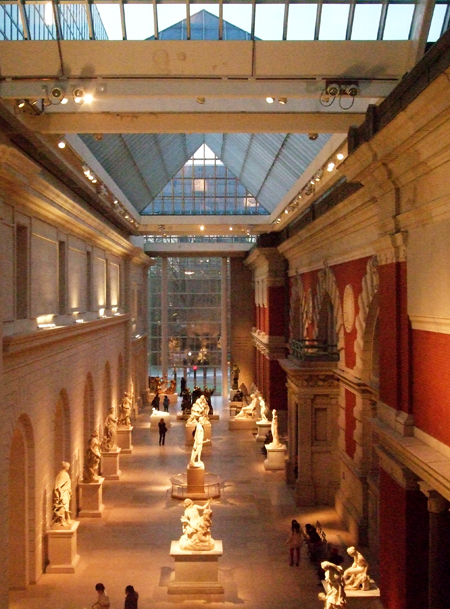
    Today’s photo is one of my favorite spaces in the whole museum – the Carroll and Milton Petrie European Sculpture Court. This also did not escape Mr. Goldberger’s article, but he seemed to love this space:

    “But now, at the end of it all, comes at last an occasion to celebrate. The brand-new sculpture court is an oddly likable place, as close to a magnificent folly as the Metropolitan has ever produced.”

    Of course, compliments from an architecture critic must be filled with caveats, reservations, conditions, and qualifications, so we also find:

    “The sculpture court is rather too tall and narrow, and these wrong proportions make its success all the more fascinating: few things in architecture are more pleasing than watching an architect get away with breaking the rules.”

    How about just an unequivocally good review? A joyous celebration with unrestrained applause? Ok, I don’t have a critic’s reputation to maintain, so, I am not afraid to say that I love that space and all the others in the museum. It’s a joy to walk through the Met and see all the works of art, sculpture, and antiques in the variety of environments created for them. And I say this with unconditional love 🙂


  • Space

    One of the most valued things in a city is space, and in New York City, to have it is to have one of our most precious commodities. Indoors, when arranging things in an office, retail store, or home, we often speak of taking up or using valuable real estate. We mean it literally. In many cases we jockey and maneuver things to gain inches. Parking, laundromats, parks, retail shops, sports, recreation, the arts, universities – everything here has a crucial space component. The success or failure of most small enterprises is largely a function of overhead costs, with space rental as the biggest element. When leaving the city, one of the most pleasant things is the relative ease of so many of life’s activities and chores, with space as a primary reason.

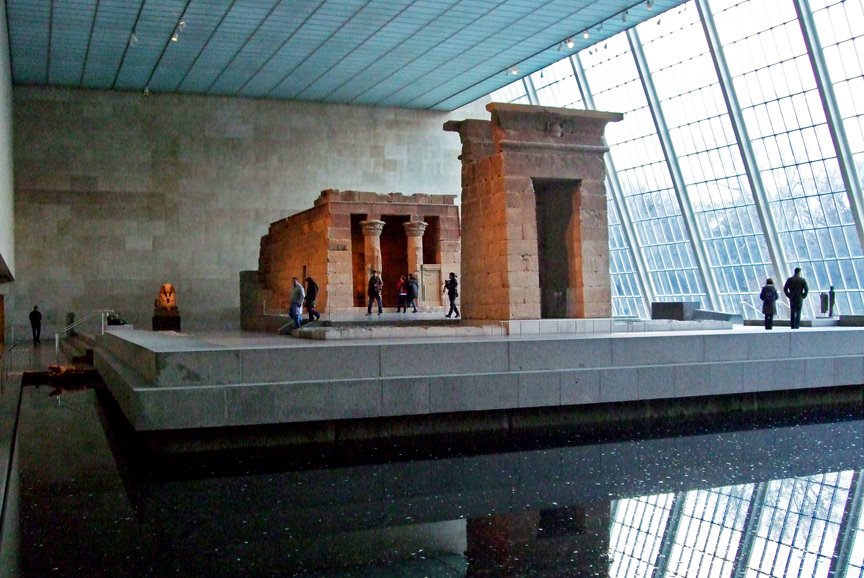
    So for me, and I am sure many others, one of the most striking things when entering the Sackler Wing at the Metropolitan Museum of Art is the enormous amount of open space indoors. At the risk of sounding like a rube, this amount of space almost feels like an indulgence, a luxury, a sin against those of us who parse our world and value every parcel.

    At some level, the use of personal space in New York City must be justified, or one risks being grouped with our porcine friends. With public space, one must answer to harsh critics, including a body of individuals trained in architecture, design, and urban planning. The larger the space, the greater the justification and good design needed. With an enormous place like this, you had better have a great reason and design for so much space – something, perhaps, in the order of an Egyptian Temple, which is just what we have.

    So there is an inner sense of relief when your eye sees and mind realizes what has been done here: the Temple of Dendur has been moved stone by stone from Egypt to the USA and reassembled in this room built exclusively for it. Unquestionably a worthy candidate for its own wing in the Metropolitan Museum of Art at Fifth Avenue and Central Park. A reflecting pool in front of the temple and a sloping wall behind it represent the Nile and the cliffs of the original location. The stippled glass on the ceiling and the north wall diffuse the light and mimic the lighting conditions in Nubia.

    The temple had to be removed from its location in Egypt; it otherwise would have been submerged by the rising waters of the Nile behind the new High Aswan Dam. The government of Egypt offered the temple to the United States in 1965 in recognition of the aid America had provided toward saving a number of Nubian temples doomed to be permanently flooded by the construction of the High Dam. A competition for its location included the Smithsonian in Washington, DC and Boston’s Museum of Fine Arts. In 1967, the temple was awarded to the Met. More than 800 tons of stone were moved and shipped in over 600 crates. The temple was installed in the Sackler Wing in 1978. You can read more about the temple here.

    From the Museum website:

    “On the outer walls–between earth and sky–are carved scenes of the king making offerings to deities … This king was actually Emperor Augustus of Rome, who, as recent master of Egypt, wisely had himself depicted in the traditional regalia of the pharaoh. Augustus had many temples erected in Egyptian style, honoring Egyptian deities. This small temple, built about 15 B.C., honored the goddess Isis and, beside her, two deified sons of a local Nubian chieftain, Pedesi and Pihor.”

    The temple is a majestic sight indoors or out at any time. It is a popular photography subject, particularly at night, when it is illuminated and can be viewed from Central Park (where the museum and Sackler wing sit).

    Sometimes the human spirit just needs a little extravagance, not defined in practical terms. All the better when done in an appropriate way, as befits the Temple of Dendur. Sometimes we need a parade, and sometimes we need some space…

    Related Post: Gratuitous in Nature


  • Pierogi

    I have written often lately of diners and comfort food. And for pure classic comfort, it’s hard to beat the Ukrainian/Polish/Russian diners in the East Village, with names such as Ukrainian East Village, Kiev (closed), Polonia, Little Poland, Odessa, Teresa’s, B & H Vegetarian (formerly B & H Dairy), Stage Restaurant, and Neptune.

    Honestly, I am no longer a big fan of food like this. This cuisine’s popularity with young people is built around bulk and value. At one time, I went through a phase, which many New Yorkers do, where the lure of inexpensive and large quantities was irresistible. But over time, the appeal of food based primarily on value loses its appeal.

    Inexpensive starchy foods fit the bill for the hungry, cost-conscious diner. And a virtual necessity with a visit to any Eastern European diner is the pierogi (or pirogie, as well as other spelling variants).
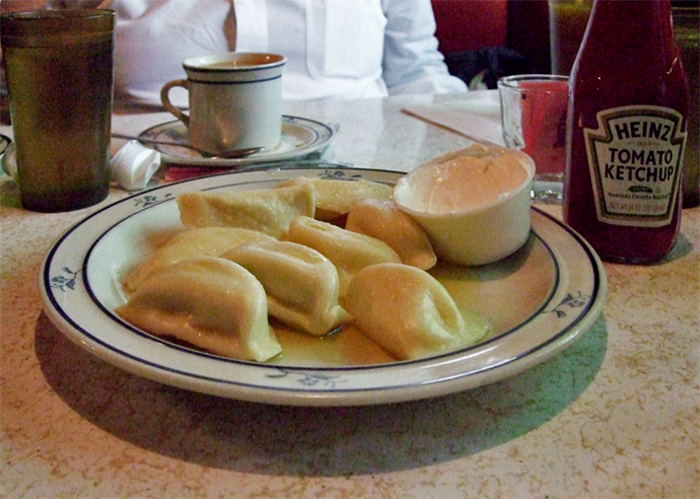
    So, with a number of friends, I recently went on an excursion to Odessa’s, a Ukrainian diner at 119 Avenue A between 7th St & St. Marks Pl in the East Village, with the pierogi as an unarticulated, assumed part of the brunch mission. One of my compadres ordered plates of both boiled and fried pierogies. I only had one in stages of halves – that was adequate to satisfy my appetite.

    For those unfamiliar, the pierogi is an Eastern European dumpling made of unleavened dough, served boiled or pan fried and filled with any number of items – potato and cheese is very popular, served with butter and sour cream. They are eaten by the Polish, Ukrainians, Russians, Belarusians, Lithuanians, Latvians, and Slovaks, with the pierogi sometimes going by different names.

    The menu also features items  such as kasha varnishkas, blintzes, potato pancakes, and challah bread. If you want to wage war on the dietary guideline of no more than one starch per meal, head for Odessa or one of its kin and you can make a meal of nothing but starches 🙂


  • Small Achievements

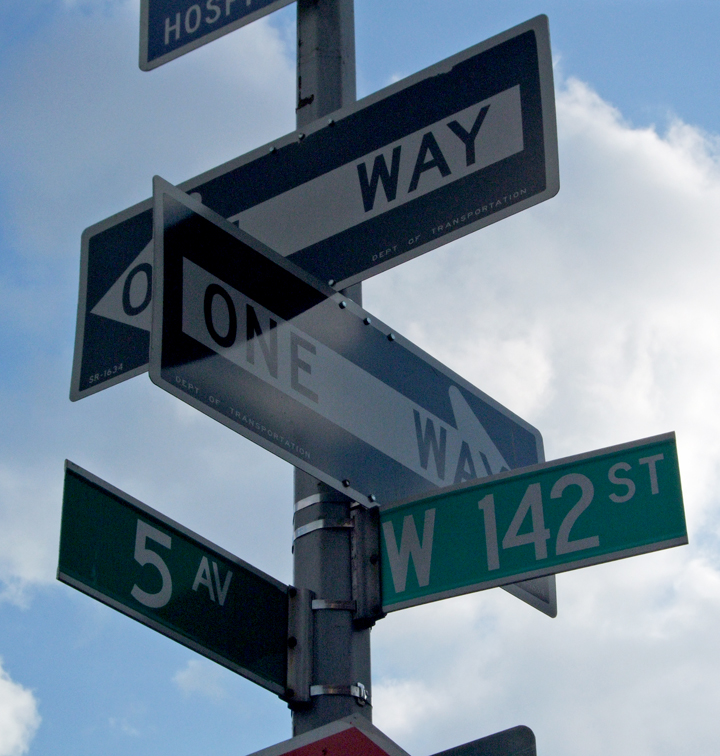
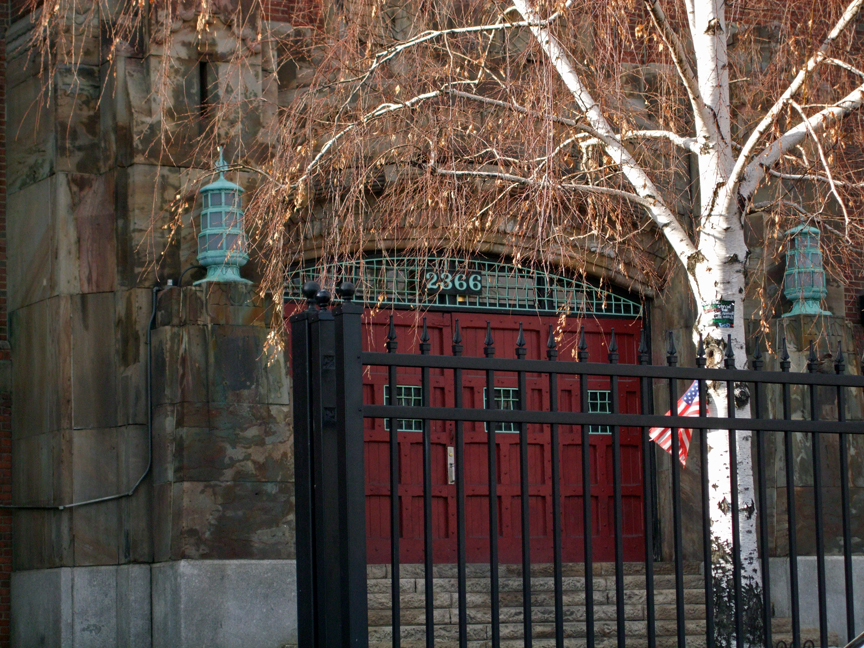
    Perhaps I have spent a little too much time confirming that 2366 is the last street address on Fifth Avenue and that this sign is the last intersection with Fifth Avenue signage. But it is something that I really wanted to know, so on my recent excursion to the Bronx, we circumnavigated this area.
    I examined street signs and subsequently did online address lookups and map analyses. I am reasonably sure that 2366 Fifth Avenue is the end of the line. Apparently, this factoid is of little interest. I found nothing written anywhere – no articles at all regarding the fact that 2366 is the last numbered address.

    Fifth Avenue is arguably the most important street in Manhattan. It runs north-south in the center of Manhattan. It originates at Washington Square Park, with the first numbered address at 1 Fifth Avenue. The avenue runs to 142nd Street (#2366) and the Harlem River Drive. Where Fifth Avenue intersects crosstown streets, they are designated East or West at Fifth Avenue, which serves as the zero point in crosstown street address numbering – numbers get larger as you move east or west of Fifth, at 100 per block (with some exceptions and large block divisions such as Madison and Lexington Avenues). In its long trajectory, Fifth runs through a variety of neighborhoods: the Village, midtown with its iconic flagship retailers, the gold coast along Central Park, and finally, Harlem.

    For most of my adult life, I have lived near the beginning of Fifth Avenue, so its end was always a distant small mystery, perhaps more accurately a small curiosity. A mirage just out of view. Not compelling enough to really pursue. But these little things can nag and, in time, reach a critical mass where it is better to get closure and put it to rest.

    The Fifth Avenue “mystery” reminds me of Sudoku. One reason for the popularity of the game is the appeal of a puzzle, just challenging enough, that is a discrete task with exactly one clear solution. Completion gives a person the satisfaction of a perfect, small achievement. Let’s toast to small achievements 🙂

    Note: What’s at 2366 Fifth Avenue? The 369th Regiment Armory, NY National Guard, built in 1923 and designed by Van Wart & Wein. See photo here.


  • Arthur Avenue

    I will admit that I have been very remiss in my treatment of the Bronx. In nearly 3 years doing this website, I have never done one posting on the Bronx. However, the Bronx really has much less interest to the outsider than Queens, Brooklyn, or Manhattan. But it is one of the five boroughs of New York City, and it has things which are worthy of a visit.

    If you read this blog regularly, you know I have a close friend from my college days who grew up in Brooklyn and relocated out west. I look forward to his periodic visits – he is always game for nearly any adventure and is knowledgeable about virtually every corner of the city.
    With no agenda, I proposed the Bronx Zoo. However, it was before lunch, and food was our prime consideration. Both confident that we could forage our way to a meal, we headed to the Bronx as tourists on a frigid, windy, winter day in his rented car.

    As we navigated the maze of highways, signs for the Bronx Terminal market at Hunts Point appeared, and I mentioned that this was on my hit list for New York Daily Photo. Undaunted by the suggestion, he immediately obliged.
    So, off we went to explore an area that no one visits for recreational purposes. This area has all the charm of the commercial freight area at an international airport, and there is no reason on earth why anyone (without specific business there) would want to visit on a day off. Which is exactly why we chose to go there. I will feature a number of our discoveries next week.

    However, something was nagging me the entire trip. I had read and been told about one particular area of interest in the Bronx, but I could not recall what or where it was. Food was now more of a priority, and my friend said that there was an Italian area in the Bronx. Uninterested in combing an entire borough, I suggested that we ask two police officers in their vehicle. Embarrassed (after explaining that I was a seasoned New Yorker, only lacking in my city knowledge of the Bronx), I asked for areas of general interest, and voila – they were very accommodating and immediately volunteered Arthur Avenue, which I immediately recognized as the area I had been told about and which turned out to also be the Little Italy district my friend was looking for. Comforted knowing that both our exploration needs had been met, we were off to Arthur Avenue for lunch.

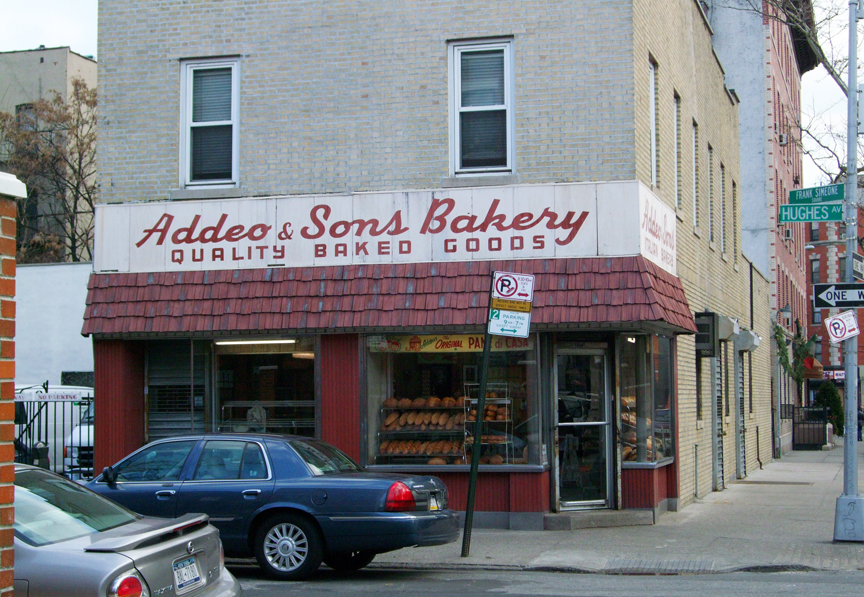
    Arthur Avenue is a district centered around Arthur Avenue and 187th Streets (read more about it here). We were quite pleased with our initial impressions – the area looked very authentic, particularly on a winter weekday where the only inhabitants appeared to be locals. We parked in front of Addeo & Sons Bakery on Hughes Street, which runs parallel to Arthur Avenue itself. My friend purchased some cookies while I asked a customer if he recommended Umberto’s Clam house, which we had just driven by, prominently located at Arthur and 186th Street. Instead, he steered us to Tra Di Noi, located at 622 East 187th Street. Our fellow diners appeared to be Italian, and the menu was in Italian with no English translations – a good sign. Lunch was great. I hope to visit again when the weather is more inviting to explore the Arthur Avenue Market…

    Previous posts of Adventures with a Mad Man: New York Moment, Partial Remission, Hot Dogs and Fries, The Unexpected, It Behooves One


  • National Drama Queen

    There are some things so absolutely integral to this city that to write of them in a general way is to inform no one of anything. Who has not heard of the theater district or Broadway theaters?
    To take in a Broadway show in New York City is really one of the best uses of the phrase de rigueur. Trips to the city from surrounding areas to see shows often are a person’s first, if not only, experience in New York.

    Cable television and the Internet have dramatically changed our world; there is infinitely more knowledge and exposure to products and culture. And the character of the city itself has changed. Unfortunately, gentrification has homogenized the planet, and there really is less for many to visit in urban areas. Many of our unique businesses have disappeared, being replaced with large chain stores which can be found outside New York. This phenomenon has been written about for some time. In 1995, a New York Times article appeared which referred to “The Malling Of Lower Broadway.

    There are things, however, that do require population density and an artistic community to exist. One of those things is the theater district. Individual shows do travel to local theaters, but for breadth and depth, New York City is the place to go.

    Like retail, the theater has also suffered from rising costs. To survive, shows must be capable of supporting a large overhead, so, like film, there has been an aversion to risk. Shows are mounted which are much more formulaic, with elements that tend to give shows the “Broadway show” character that many newcomers to theater expect. We find a stable of old standbys, revivals, and shows which tend to be highly derivative of historical successes. And ticket prices are extremely high. There are always discounts available, however, and prospective theater goers would be well-advised to investigate the options.

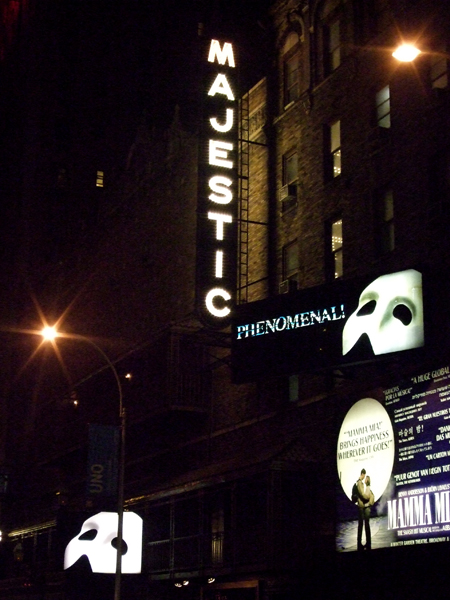
    Streets lined with marquees, like the one in the photo (Phantom of the Opera at the Majestic Theater at 247 West 44th Street), signals loud and clear that you are in New York City and nowhere else. Most of us do look for constants and anchors we can hang on to – the heart of nostalgia. When I pass through Times Square and the theater district, I am reminded of my first visits to New York and how different and exciting it was. The theater district is such a perfect icon for New York, a city which is itself so theatrical in character. I dub it National Drama Queen 🙂

    Note: The term Broadway theater refers to a group of 39 theaters defined both by size (minimum of 500 seats) and location in the theater district. Off Broadway and Off-Off Broadway theaters are also defined by size, not location – Off Broadway with between 100 and 500 seats, and Off-Off Broadway with fewer than 100 seats.


  • When They See It

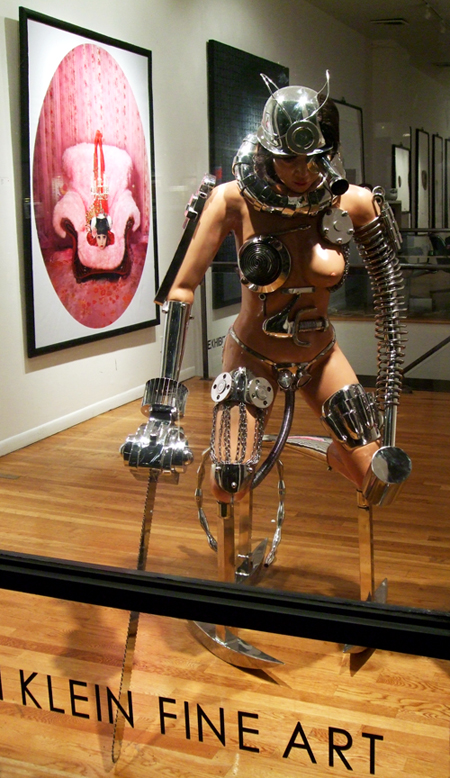
    This is the image that greets me many days on my way to and from work when I pass by the window of Eli Klein Fine Art at 462 West Broadway in SoHo. For those who are unfamiliar, West Broadway is the prime artery through the center of SoHo, where many of the area’s galleries were located during the neighborhood’s renaissance. Most have closed owing to escalating rents, but a few remain.

    I am not a student, connoisseur, or critic of art, so I leave assessment of this sculpture to others. However, this does illustrate one of the dilemmas I have wrestled with over the decades I have lived in this city: the apparent contradiction in what constitutes good and bad art.
    My experience is that most in the art world are very reluctant to say that there is any objective standard for art. Criteria such as personal appeal are cited as valid ways of judging art. Yet, in practice, most artists and critics are quick to make a qualitative judgement about any art and whether it is good or bad. Inherent in that judgement is the implication that this is an educated opinion, implying some standards. To the unschooled in art, one is left with the feeling that there are standards but that they are either difficult to define or perhaps only known to the critics’ secret society. A feeling of art snobbery lingers in the air.

    I am reminded of what is considered to be one of the most famous phrases in the history of the Supreme Court. In 1964, a United States Supreme Court decision, Jacobellis v. Ohio, involved whether the state of Ohio could, in light of the First Amendment, ban the showing of a French film called The Lovers (Les Amants) which the state had deemed obscene. Very disparate opinions were given by the justices at the time, but the most well-known was that of Justice Potter Stewart, who said that the Constitution protected all obscenity except “hard-core pornography.” He went on to say that he could not define it but “I know it when I see it.” Perhaps this is the secret for the trained critic or artist: they know good or bad art it when they see it…

    About the Gallery and sculpture: “Eli Klein Fine Art is committed to presenting important exhibitions of new Chinese art.” Their website is here.


  • Stain Your Soul

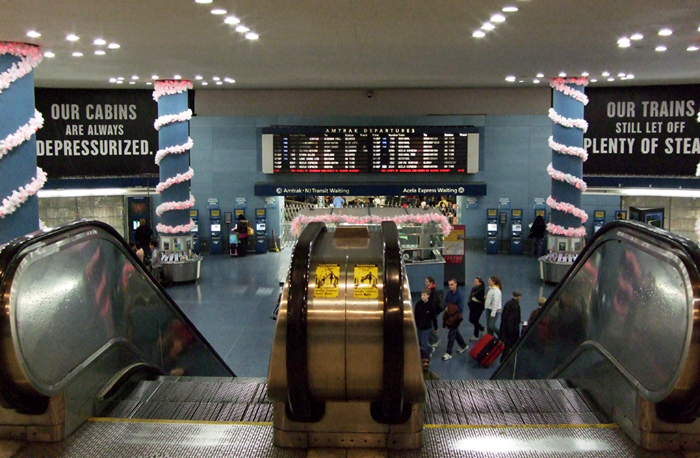
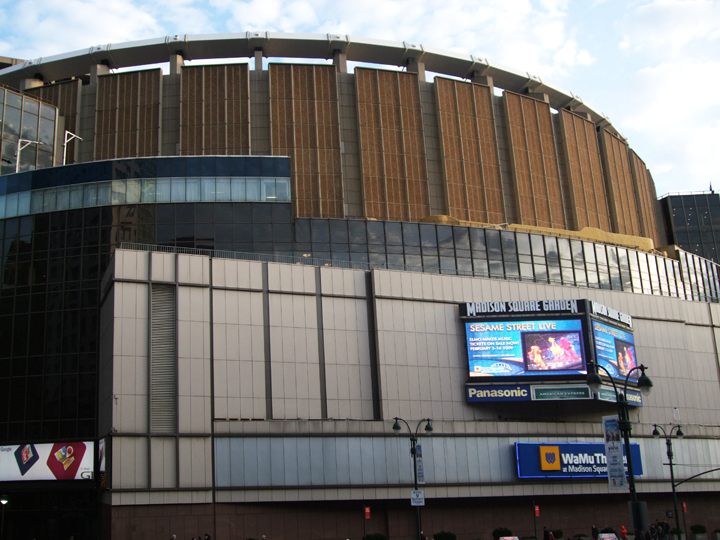
    If you find anything about this photo of Pennsylvania Railroad Station attractive at all, then I am pleased, because this place is one of the least liked in New York City. Perhaps you have to be a native New Yorker or architecture critic to really appreciate this. And I have misled you by using a photo of the interior – the exterior is what really is a visual blight on New York City’s canvas (see here).

    Now, take a look at these photos of the previous magnificent Beaux Arts structure by McKim, Mead & White which was torn down in 1964 to make way for the new building complex. Be forewarned – you will find the experience upsetting and will ask why. Look here if you dare.

    Now you see why New York Times architecture critic Nicolai Ouroussoff calls it the “greatest crime in architectural history.” In an article in the Times, “New York City, Tear Down These Walls,” Ouroussoff says:

    “No site in New York has a darker past than this one. The demolition of the old Pennsylvania Station, the monumental McKim, Mead & White Beaux-Arts gem that stood on this site until 1964, remains one of the greatest crimes in American architectural history. What replaced it is one of the city’s most dehumanizing spaces: a warren of cramped corridors and waiting areas buried under the monstrous drum of the Garden.”

    Ouroussoff’s statements are hardly an exaggeration. In a city like this, it is rather shocking to have a major nexus used by millions to be so underwhelming, particularly since it is many visitors’ first impression of the city. I imagine the utilitarian function of a train station and immediate impact provided by the city around it suffice to distract visitors from the appearance of the Penn Station / Madison Square Garden Complex. Some may feel that it is no worse than many train stations worldwide, which are unattractive and are located in some of the least desirable locations. But this is a world-class destination city. We have standards and options.

    Plans have been made for rebuilding. From the New York Times article:

    “Over the years the city has entertained dozens of proposals to improve the station, but none have amounted to much of anything. A decade ago Senator Daniel Patrick Moynihan unveiled a multibillion-dollar plan to relocate the entrance at the grand old Farley Post Office Building, a McKim, Mead & White treasure on Eighth Avenue which would free up more space underground. But the plan became entangled in New York’s byzantine development politics and fizzled.”

    I certainly share sentiments with Ouroussoff to have this place torn down. If you visit the area, I suggest you do like I do and avert your eyes from what is worthless, lest you damage your eyes or stain your soul…


  • Uggly or Not

    For some time now, I have been fixated on capturing the Uggly phenomenon in New York City. In fact, I have made general announcements to friends and coworkers just last week that I was waiting for an opportunity – perhaps a group of young women.

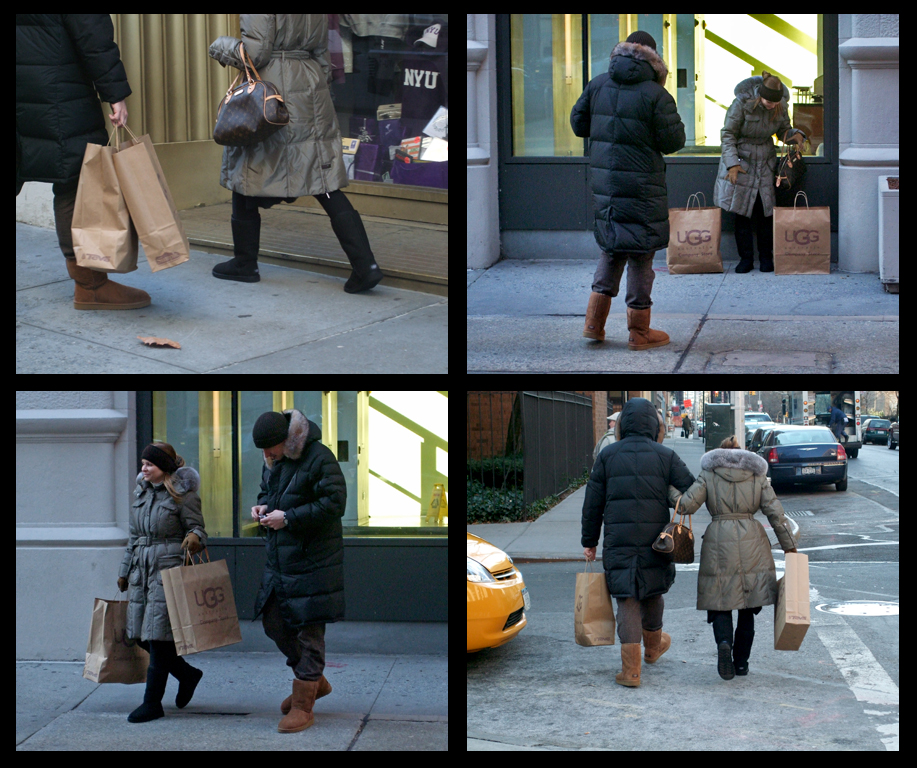
    Imagine my elation as I witnessed what appeared to be a made-to-order event. On Saturday morning I noticed a couple not only both wearing Ugg boots but also toting Ugg-branded bags. It felt like I was seeing the smoking gun after a crime. This couple obviously had just purchased a pair of boots in complementary colors – the classic beige for him and black for her. This case was His and Hers Uggs, and they were quite happy. In a bizarre, fortuitous twist, the woman actually posed for a photo with an Ugg bag on each side of her (photo upper right). Quite pleased with the results of the photo session (lower left), the couple went off stepping proudly down Mercer Street.

    The story of Uggs is a long and sordid war story. The sheepskin boot goes back millennia, and their use in Australia is attributed to the fact that they are the world’s largest producer of wool. Popularity of sheepskin boots rose with their use in World War I & II by aviators to keep their feet warm in non-pressurized cabins. They were popular with surfers since the 1960s for keeping their feet warm while out of the water.

    In 1971, Shane Stedman registered the term Ugh-boot, as well as other terms, with the Australian Trade Mark Registry. In 1999, the Ugg name was purchased by Deckers Outdoor Corporation, which began aggressively pursuing Australian manufacturers using variants of the Ugg name. However, the terms ug, ugg, and ugh have been used generically by the Australians since the 1950s. Blue Mountain Uggs go back to 1933. In 2006, Uggs-N-Rugs (an Australian manufacturer) was successful in having ug, ugg and ugh boots removed from the Australian Trademarks Registry. Read a history here.

    Ironically, ugg boots were never intended as street wear but rather for short term and/or indoor use (recommended to be worn sockless for maximum warmth – ugh). That stops no one, of course, from unintended use, much as we see Land Rovers driven in Manhattan. (See my story, Different Bummer, on shuttershades.)

    So after half a century, why the sudden interest, in spite of the fact that some consider them quite hideous? I have read reports by doctors warning of foot problems owing to their lack of support. Many reasons have been given for their boom in popularity, including the purchase of 350 pairs for $50,000 by Oprah for her staff, and its listing on Oprah’s Favorite Things show. Adoption by celebrities such as Kate Moss, Sienna Miller, Sarah Jessica Parker, Gwyneth Paltrow, Jessica Alba, Brad Pitt, Jennifer Anniston, and a myriad of others has also been cited.

    But for our couple, all that matters is that they procured the latest rage in fashion in the USA and wore their his-and-hers pair proudly in the streets of New York City, Uggly or not…

    More about the companies: Decker (publicly traded DECK) was founded in 1973 and is headquartered in California. Sales in 2008 were $580 million. The bulk of their sales comes from Ugg boots. Although still branded Ugg Australia, shoes are now manufactured in China. Copies can be found everywhere, of course, and can be had for a fraction of the price of the Ugg brand.
    Companies like Blue Mountain, Nganjo, Jumbo Ugg, and Uggs-N-Rugs do manufacture in Australia and have campaigned for consumers to patronize their brands, which they claim as not only more authentic but also higher in quality and a better value.


  • Mania

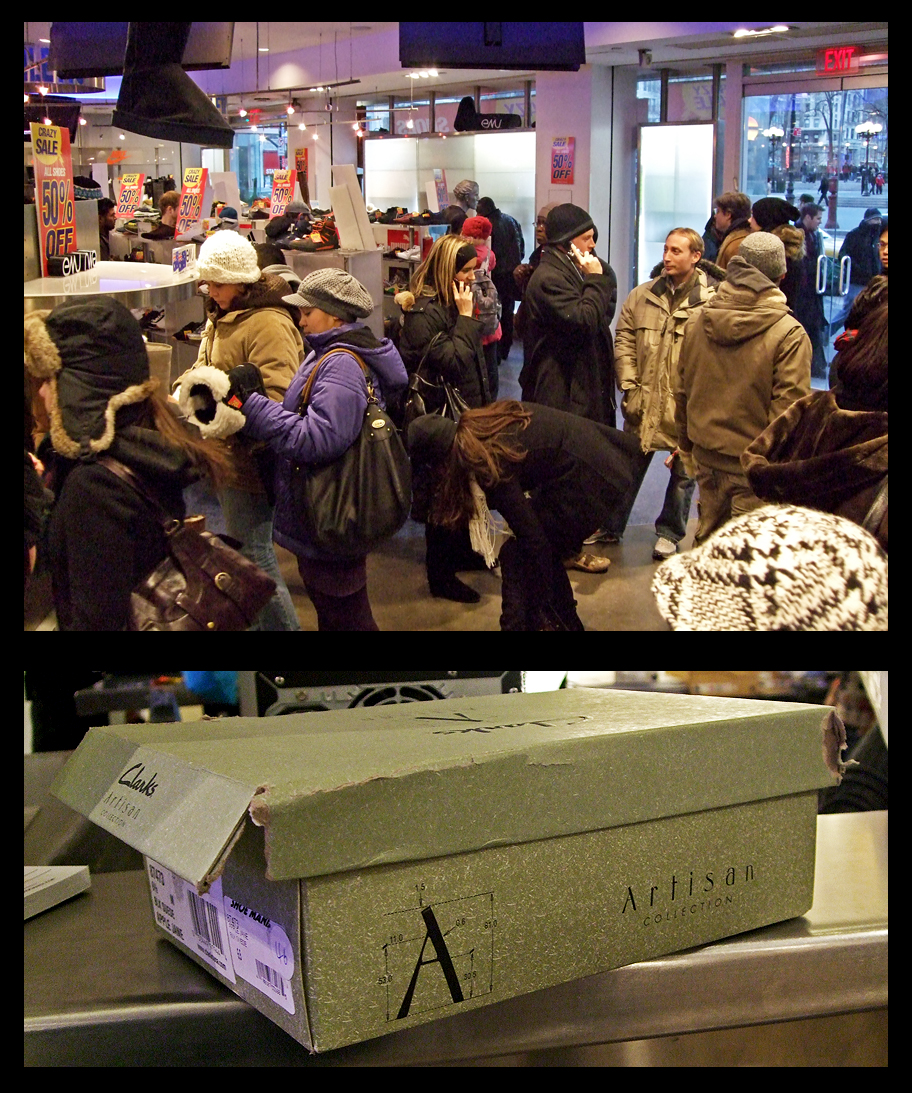
    Perhaps you’ve wondered what it feels like to actually shoot yourself in the foot. Would you like to find out without undergoing any actual physical injury? Then take a trip to Shoemania. Better yet, go on New Year’s Day, when half of America is at home sleeping or watching TV and the other half is desperate for something to do. And what do most desperate Americans do? Go shopping – shop ’til you drop and other colloquialisms summarize the recreational desires of many.

    Shoemania is on 14th street / Union Square, one of the busiest areas in the entire city. They were open on New Year’s Day with a 50% off everything sale. I don’t know if there was any monkey business with pricing prior to the sale or whether these were all discontinued models, but brands that never go on sale were at 50% off: Bruno Magli, Arche, Mephisto, Merrell, Clark’s, et al.

    So now you have the formula for true mania: 14th Street/Union Square, a workday off for most, people getting cabin fever, too cold to do anything outdoors, nothing much open except retail stores (and most of them closed), a prominent location at 14th Street and Broadway with frontage and entrances on both streets, and a post-holiday 50% sale with an inventory of most major shoe brands.
    Shoemania is the type of store that is quintessential New York style and delivers on all the negative stereotypes people have of New York and more. I found brusk service, overcrowdedness, sample shoes strewn everywhere in complete disarray, inadequate seating to try shoes, salesmen barking requests to the back room in their wireless headsets, and, after a selection is brought out from the stock room, customers and salesmen trying to find each other like lovers separated after a world war.

    The cashier is truly an ice princess and must be a finalist on Make Me Laugh. She truly had no sense of humor and was unflinching with any attempts to melt her. A customer before me who had a problem was dealt with the unfeeling efficiency of a seasoned executioner.
    On the positive side, they do have a broad selection, good pricing, and little sales pressure – it is just too chaotic to effectively wage a war of sales terror.

    And the pièce de rĂ©sistance? Our selection was brought to us in a box with a cover that was destroyed and literally over 1 inch longer than the box itself. The salesman did apologize and say that it was the best he could do. But amidst all the mania, we did procure a nice pair of black suede women’s pumps made by Clarks for $49. Not bad at all…


  • Watching Ourselves

    There are many unique things about New York City, and one of them is how often we watch ourselves. This is most evident on New Year’s Eve, when the country, and much of the world, turns their eyes here for the greatest New Year’s party and the legendary Times Square ball drop.

    As I wrote yesterday in Devil Ups the Ante, the very popularity of the event also makes it a reason to avoid direct participation and watch it on TV like the rest of the world. It is a little strange, perhaps, knowing that the event is a subway ride away, but this really misrepresents the situation. At this point in time, there is no way to attend this event in a spontaneous way. People now wait at least 7 hours in the freezing cold, getting there well in advance to have a position where they can actually see the ball drop. I attended the millennium celebration in 2000, but even after arriving there hours in advance, the closest I was able to get was eight blocks away, near Macy’s. I experienced the spirit of the celebration but was able to see only people – no ball drop or confetti.

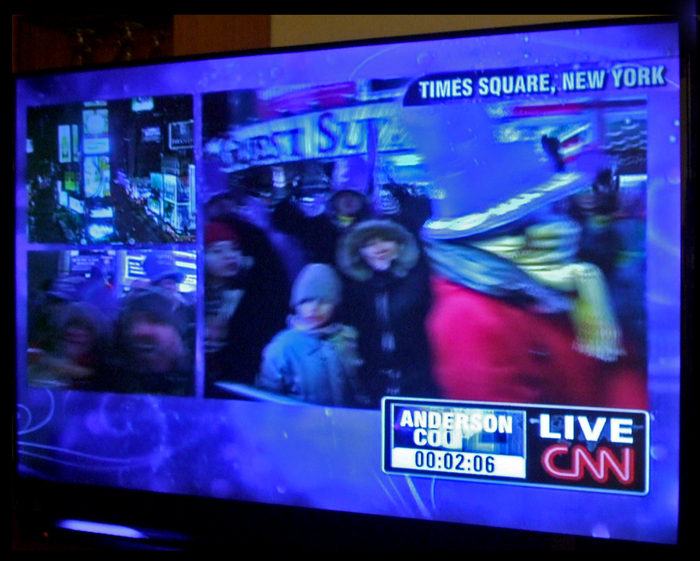
    Today’s photo was the scene at a friend’s party as we watched the revelry on a big screen TV and ushered in 2009 – watching ourselves and watching others watch themselves. Happy 2009 and thanks for watching 🙂


  • dinamic_sidebar 4 none

©2026 New York Daily Photo Entries (RSS) and Comments (RSS)  Raindrops Theme