• Bygones be Bygones

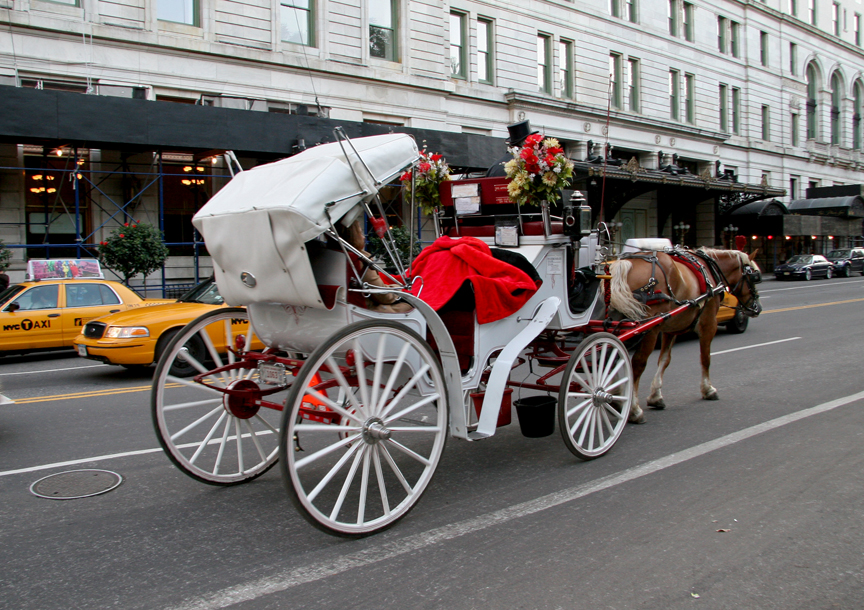
    Horse-drawn carriages in Manhattan have been the center of controversy as of late. The COALITION TO BAN HORSE-DRAWN CARRIAGES has spearheaded a campaign to put an end to what they and many others consider an outdated concept that no longer is appropriate. From the Coalition’s website:

    “Carriage horses are out of place in midtown’s congested streets and belong to another century when there were far fewer vehicles and pedestrians. When hansom cabs are mixed with cars, taxis, buses, pedestrians, bikes and emergency vehicles – fire trucks, ambulances and police cars – they are a recipe for disaster.”

    Business is involved here, and where there’s money at stake, there’s bound to be bitter conflict. The carriage industry and owners paint a different picture, stating that the the animals are well cared for, have a long life, and are happy. Investigations have shown conflicting reports. An audit by the City Comptroller in 2007, however, did show some horses being maintained in substandard conditions. The fate of the 68 licensed carriages in the city is still in limbo. Mayor Bloomberg defends the industry and the continuation of the carriages. Some have proposed a stabling area inside the park, which seems like it would be a good compromise.

    The romance of the past is a powerful force, and of course, visitors love the idea of a horse-drawn carriage ride through Central Park. This is one of those New York City signature activities that many feel compelled to do at least once in their life. But unfortunately, history and romance, no matter how compelling, do not alone justify the continuation of a practice. The circumstances and standards of a society change, and I think we all like to believe that our consideration of other humans and animals improves over time. In the final analysis, we may have to let bygones be bygones…

  • In My Book

    I remember hearing someone once say that there is an illusion that everything in the past was better, with the quality of antiques cited as evidence, and that this perception is because we only save the best and discard the rest. There was plenty of junk made.

    Occasionally, we even champion the junk, to be sold and seen as charming kitsch, somehow better than today’s kitsch. I have heard the same type of thing said about books from those who have a good historical knowledge of the world of publishing – that plenty of crap has been written and published, but only the classics remain.

    Certainly, looking at the landscape that is New York City, I would be hard pressed to romanticize the 1970s. I am not a fan of over-gentrification or the encroachment of chain and big box stores, but I also have no fond memories of graffiti-covered trains, Bowery squeegee men insistent on washing car windshields, “no radio” signs in cars adorned with broken glass, or running for your life in the East Village. I had a friend who was actually mugged three times in one week in the vestibule of his East Village flat.

    There were good things too, of course, especially the affordability which allowed virtually anyone with desire and intestinal fortitude to get a foothold in this city and stake out his/her claim. Apartments could be had cheaply (in relative dollars). You could work yourself through a private university and support yourself in your own place.

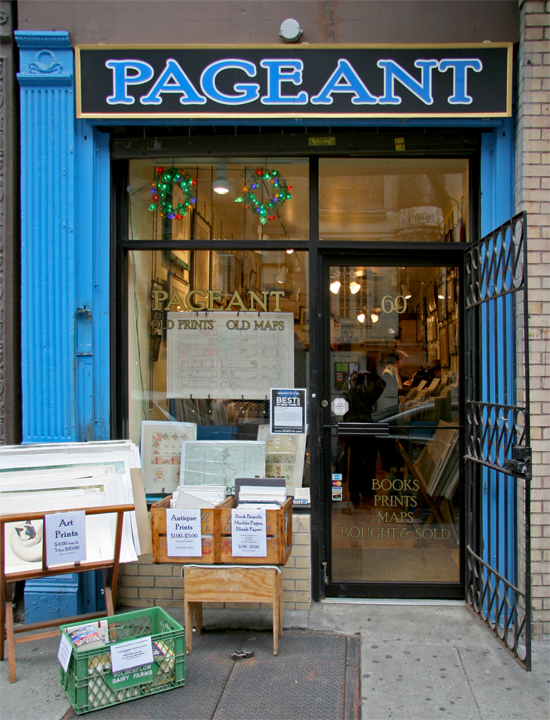
    This environment really allowed all manner of things to survive and flourish. One of those things were the booksellers along 4th Avenue, a row of 30 used book dealers in the space of 6 blocks from Astor Place to Union Square, known as “the book row of America.” I love books, and perusing the wares of those dealers on a Sunday afternoon was one of my pleasures and pastimes. The Strand, still operating today on Broadway, had its roots there. The other survivor is Pageant Book Shop, founded in 1946 by Sidney B. Solomon and Henry “Chip” Chafetz as a used and rare book shop in New York City. Sidney’s daughters Shirley and Rebecca Solomon now run the shop. Pageant had its home in several locations along Fourth Avenue for 35 years before moving around the corner to East 9th Street. In the 1990s, it moved to West Houston Street. Recently, it moved to its current location at 69 East 4th Street.

    The current shop is much smaller than previous incarnations and, unlike its predecessors, sells primarily antiques prints and maps with a smaller selections of books. I can’t say that this place exudes that rustic charm with musty smells of the early 4th Avenue booksellers. But no matter, because it is a book store, and in my book, that is always welcome…

    Film buffs: The shop and its books have appeared in numerous movies filmed in New York City, including Neil Simon’s “Chapter Two” with James Caan and Marsha Mason and Woody Allen’s “Hannah and Her Sisters,” where Michael Caine and Barbara Hershey went browsing for a copy of e.e. cumming’s poems.

    Related Post: Better When


  • The Day’s Work

    As I wrote in Being Trumps Doing, when I leave my home on a beautiful day for a stroll in the city, I frequently have some small agenda. For the workaholic, this helps justify recreation, turning fun into something of a small task, in keeping with the Protestant work ethic of my New England background. After all, play is for children, not adults.

    The problem with this approach to life is that a small agenda item, if planned for a later part of the day, can become a nagging irritant. And so it was on Sunday, when, after a few errands, I intended to take a walk to Tompkins Square Park, see what activities may be at hand, and procure some fruit from the small farmer’s market there.

    However, while walking down Broadway, I come across a block party. The barricaded street had Park Rangers, children’s activities including rides on a shetland pony, re-enactments, cavalry horses, bales of hay, a Gatling gun, and Hotchkiss gun. I had unknowingly stumbled upon the 150th birthday celebration of Theodore Roosevelt, 26th President of the United States. Unbeknownst to me, Roosevelt was born in a NYC brownstone at 28 East 20th Street in Manhattan. The home is now open to the public as a museum. It is a National Historic Site and is administered by the National Park Service, U.S. Department of the Interior.

    The home, typically not open on Sundays, was having a free open house as part of the celebration. This was a great opportunity for my first visit – visitors were allowed to roam the property at will. Typically, period rooms can only be seen via guided tour. The staff is quite accommodating. From their website, we learn:

    Not all Presidents were born in log cabins. One was actually born in a New York City brownstone! Visit the birthplace and boyhood home of Teddy Roosevelt and see what it was like to grow up in the “gilded age.”

    Forty percent of the furnishings are original. One that caught my eye was a beautiful original gas-illuminated lamp with panels known as lithophanes. A lithophane is a translucent porcelain, etched or molded, with varying degrees of thickness. The result is a three-dimensional image which changes depending on the light source. It disappears and reappears when backlit or not. It is typically credited to Baron Paul de Bourging in France in 1827, although evidence indicates that similar work was done in China one thousand years before in the Tang Dynasty.

    A swing through Union Square provided other distractions – what appeared to be a Christian rock group and an assault by some variant on the Zombie Con, which I witnessed last week. It soon became clear that it had become too late for Tompkins Square Park. A shame in a way, because although it had been a great afternoon punctuated by a surprise landmark event, somehow I felt that the day’s work had not really been done 🙂


  • Moveable Feast

    There are healthy measures (and medicines) one should take. But most are not enjoyable – they all involve some degree and elements of deprivation, denial, restriction, discipline, and holding one’s nose. One of the great joys of living in this city is that many of the things one should do or see are very enjoyable. It’s like waking up one day to the New York Times and reading that the American Medical Association has just found that the healthiest thing you can do is eat Häagen-Dazs chocolate ice cream every day.

    Here is why we do it – the answer to what is so perplexing to many visitors – why we would endure such hardship to live here, where ordinary tasks can become such large endeavors. The answer is that living here can be like being a boy or girl in a candy store, with its plethora of culture and activities, all so convenient, typically a walk or short subway ride away. And, like any good shop, there are new products and the old standbys.

    Visiting Palm Court at the Plaza Hotel is to sample one of those delectable confections New York has to offer. As many an old standby (the Plaza dates to 1907), traditions remain, and one is the afternoon tea, which has been recently been brought back to the Palm Court – a magnificent room with a European flair.
    Welcome to a world with harp and classical guitar, tables with the finest linen, crystal, Bernaudaud-Limoges china, Christoffle silver, outstanding floral arrangements, high-backed blue velvet upholstered chairs, and memories of fictional character Eloise (who lived in the hotel). Ellen Easton serves as tea consultant, and pastries are made by Executive Pastry Chef Nicole Kaplan, named as one of the top ten pastry chefs in the USA.

    Dine under the Palm court’s recently recreated stained-glass laylight while surrounded by palm trees. The Palm Court tea menu will set you back $60, so if you don’t have a desire to finance a meal here, at least drop in and feast your eyes…

    Related Posts: The Plaza, Stairway to Heaven


  • It Behooves One

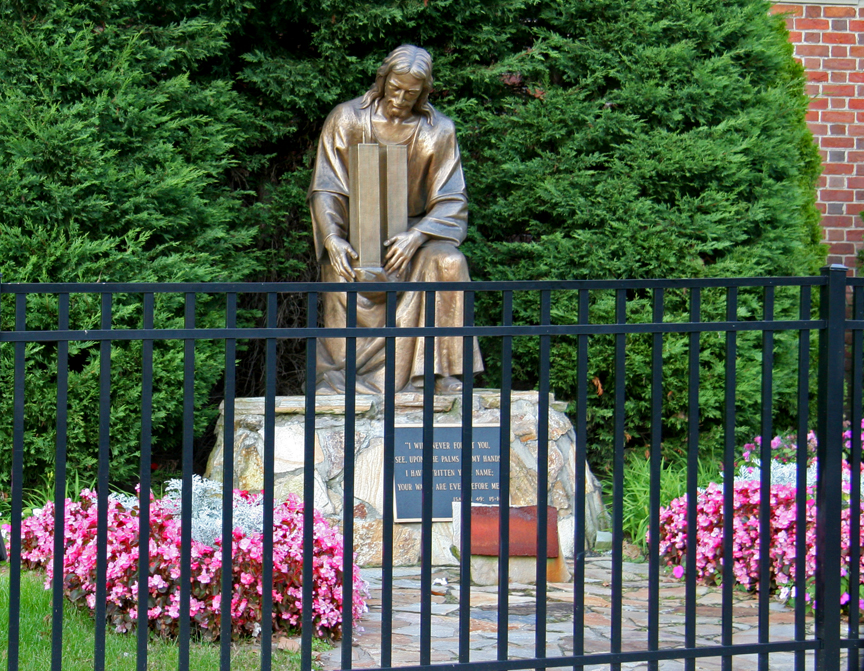
    When we passed this statue of Jesus holding the Twin Towers, we were quite surprised – we brought our car to a halt, reversed, and parked briefly to get a real good look, lest our eyes had deceived us the first time around. But they had not. Jesus was holding the Twin Towers in front of St. Ephrem’s Church at 929 Bay Ridge Parkway in Brooklyn. On a plaque below the statue, there was a passage from Isaiah in the Bible:

    “I will never forget you.
    See, upon the palms of My hands
    I have written your name;
    Your walls are ever before me.”
    Isaiah 49:15-16

    I am not adequately schooled in the Bible to explain the meaning of this passage and its relationship to Jesus holding the Twin Towers. Also, the word order of this biblical passage appears differently everywhere else I have read it.

    There was a realization that this sculpture was not a casual or whimsical thing – it was obviously planned, commissioned in some way, designed, created, and installed. And it is not hidden from view at all but rather prominently placed in front of the church on a major thoroughfare.
    It certainly has created controversial remarks by those who have seen the statue live or in photos. A photo featured in the Gothamist, which was posted on Flickr, shows a broad range of sentiments in the comments.

    The Twin Towers disaster of 9/11 is a very delicate subject. I believe that it behooves the prudent person to leave the subject alone if at all possible – I had reservations in doing this posting at all. On this one, I am just the messenger…

    Personal Confession: I love the word behooves and find it underused, and I am always looking for an opportunity to use it.


  • Enigma

    The butt of many comedic jokes is the cliched man who is afraid to ask for directions or information. I am not that type of man – perhaps lax at times to ask if it is inconvenient to find someone. I certainly value the process of discovery and doing things for oneself, but how far does one want to go to learn things which are already known? How many wheels do you really want to reinvent?

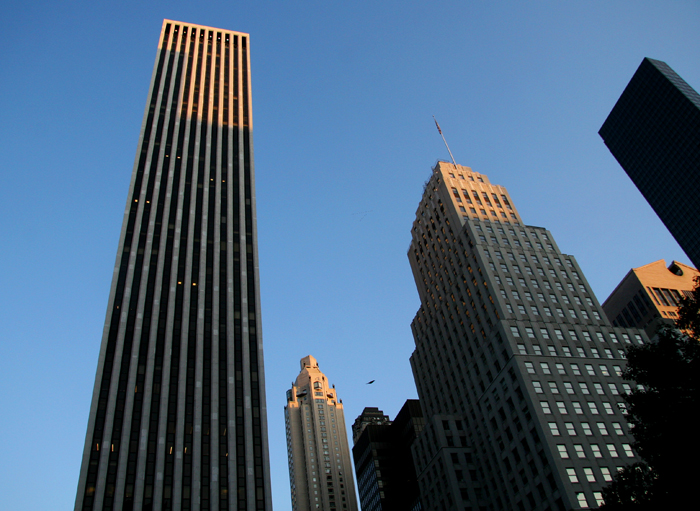
    The building in the center of the photo with the distinctive top has been an enigma for some time. I have an older photo which I wanted to use previously on this website, however, I tired of trying to identify it using online searches and printed references in my library. I resigned myself to a future trip where I would just visit the building itself rather than ferret out its name via GPS or triangulation.

    So I forgot about it until my recent jaunt to the Plaza Hotel, when I saw it haunting me in the distance once more while chatting with the doorman, who had worked there for two decades. This type of person can be a great source of information in the city – seasoned doormen and older taxi drivers have the luxury of meeting thousands of individuals from all walks of life over years of time. They also become acquainted with the details of places and things, with nuggets of info and insider gossip. So as I walked away, it occurred to me that a quick jog back to the doorman and a quick query might easily settle the identity of this building. And it did.

    The Four Seasons Hotel at 51 E. 57th Street was completed in 1993 and designed by world-renowned architect I.M. Pei and Frank Williams. Pei’s resume includes projects such as the glass pyramid at the Louvre museum in Paris. This 54-story building is the city’s tallest hotel. It is clad in French sandstone and capped with the spectacular Ty Warner penthouse, a nine-room suite with 25-foot ceilings and cantilevered glass balconies, which occupies the entire top floor with wraparound 360-degree views of the city. Amenities include a butler, fabrics woven from platinum and gold, a personal trainer, and a private chauffeur with a Rolls Royce Phantom.

    The lobby has marble floors and a soaring, back lit translucent onyx ceiling. If you are in the neighborhood, drop in for a peek…


  • Curriculum Vitae

    Intellectually, I understand the consumption and love of hot chili peppers. I have read that the ingredient responsible for a pepper’s heat, capsaicin, will release endorphins, explaining the euphoria that many pepperheads have attributed to the consumption of chills. And I imagine, like any drug, one can develop a tolerance and desire for a stronger drug.

    But at a gut level, I cannot understand how people actually enjoy peppers so hot that they can entirely numb one’s mouth and lips or require special handling. There are cases where unchewed chilis have been known to perforate the bowel.

    There is a Scoville scale that rates the hotness of peppers by the level of capsaicin (based on parts per million) from 0 to 15,000,000 units (pure capsaicin). Habanero peppers are extremely hot and have a Scoville rating of 100,000 to 580,000 units (Red Savina Habanero).

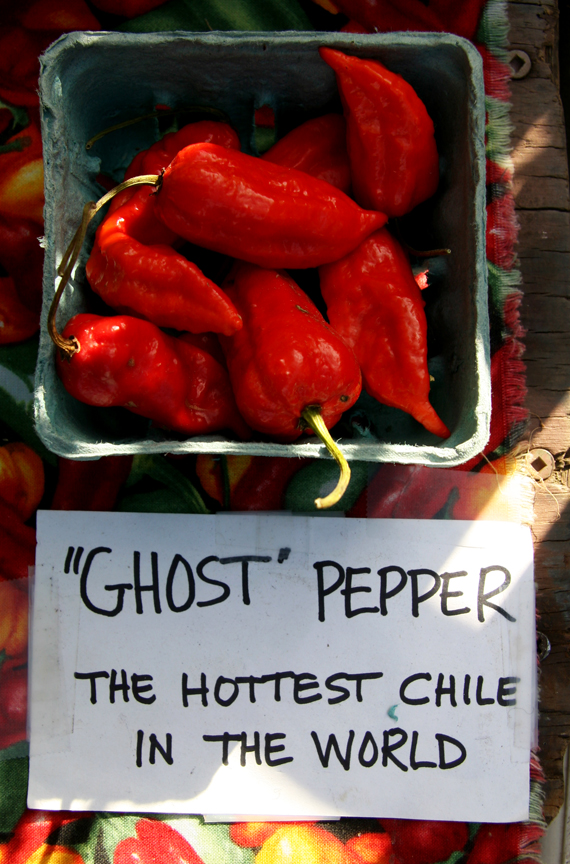
    In 2006, the Ghost Pepper (Naga Jolokia or Bhut Jolokia) was discovered in India. Testing revealed a Scoville rating of over 1,000,000 units, making it the hottest chili pepper in the world.
    This is fascinating, but does any one need a chili pepper three times as strong as the average Habanero? In a country that loves to quantify, and where bigger is better, I suppose it would be a badge of honor to have this chili in your curriculum vitae…

    Photo Note: This photo was taken at the Union Square Greenmarket at the Eckerton Hill Farm produce stand – they always have a tremendous array of chili peppers. See more Union Square Greenmarket links in my posting on Heirloom tomatoes.


  • Zombiecon

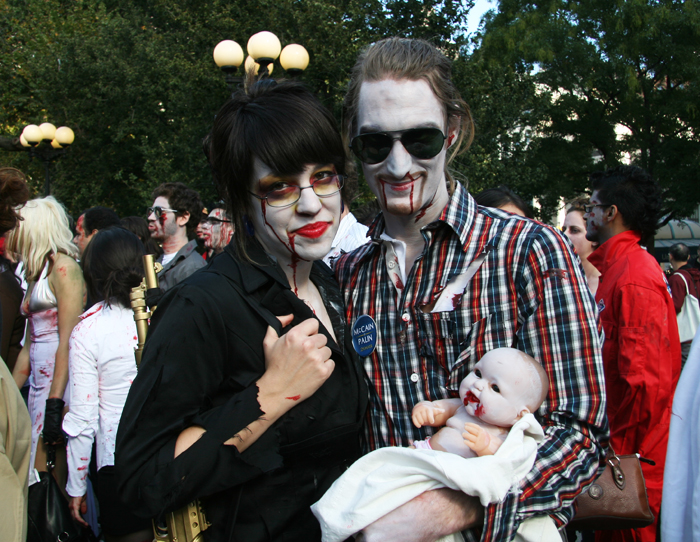
    This was the fourth annual Zombiecon, a celebration of the living dead. There is very little information about the event on the official website. The dearth of info, either pre- or post-event, is reminiscent of a Flash Mob. One observer called Zombiecon a “weird hybrid of flash mob, pub crawl, and “Thriller” video.”

    However, it is not truly a flash mob because of its spontaneous, unplanned nature, but the loose structure of this event does give it the feel of one. I wrote about flash mobs and smart mobs in my articles on the International Pillow Fight and the Silent Rave (Part 1 and Part 2). To be notified and involved in these events, you will need to be in the loop or connected, and the same appears to be true with Zombiecon.

    The New York Times said, “This loosely organized spectacle will roam the streets of Manhattan, dressed in their best grave-defying fashions and gaping wounds, spending the afternoon scaring children and shopkeepers and hunting for brains (and beer)”

    It appeared that Zombiecon 2008, which is a loosely structured “parade” around Manhattan, terminated in Union Square, where I happened upon it by accident. The group was hard to miss. As typifies many NYC events of this nature, there were many creative, clever, and inventive costume concepts. I used one of the more benign participants for my photo choice; most were much more ghoulish and bloody, and the thought of a photo starting the week on a Monday morning (not to mention being on this site in perpetuity) was not an appealing prospect. For more photos of the macabre, you can see hundreds of galleries on Flickr.  For me, I prefer a milder image before lunch…


  • Rhinelander’s Dream

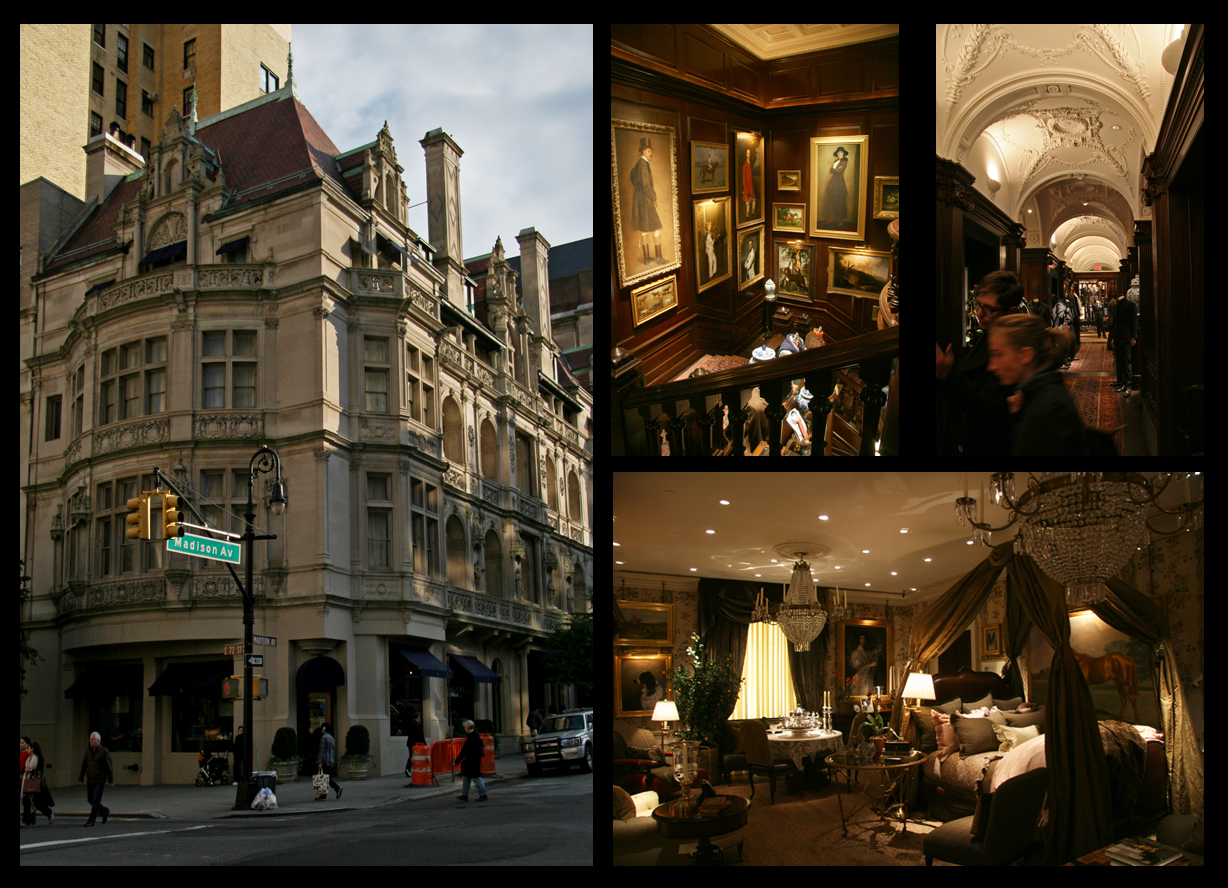
    This is easily the most exquisite and elegant retail interior space in New York City. It’s a must-see for any visitor with a little extra time. Located at 867 Madison Avenue on the southeast corner of 72nd Street, it has been occupied by Ralph Lauren/Polo since 1986.

    I was shocked to learn that this huge neo-French Renaissance limestone palace was actually unoccupied in the first 23 years of its existence. It was designed by Kimball & Thompson and built in 1898 for Gertrude Rhinelander Waldo, a wealthy socialite who dreamed of a French Loire Valley chateau. Rumored that she ran out of money before completion, the property was first occupied in 1921. Since that time, it has had various tenants: the auction house Christie’s of London, Zabar’s, the Olivetti Brothers, and photographers Edgar de Evia and his partner Robert Denning. De Evia’s mother, pianist Miirrha Alhambra, also resided there.

    By the mid-1950s, de Evia and Denning had formed Denvia Realty, which held the net lease on the entire building. The top three floors were used as their studios and residence; offices were rented to the interior decorators Tate and Hall, and street-level shops were rented to various merchants, including a corner pharmacy and Rhinelander Florists.

    It was purchased in the 1960s by a nearby church. In 1983, Ralph Lauren acquired the net lease. The building’s ownership has changed hands numerous times as well. TMW bought the building for $36 million in 1997, and in 2005, it was sold to an Irish investment group (Sloan Capital) for $80 million.
    The gothic tile-covered mansard roof is spectacular, with oriels, dormers, and chimneys.

    I know it is fashionable to bemoan the hegemony of large retailers on the American landscape, but one needs to give credit where it is due, and Ralph Lauren has done the Rhinelander mansion justice with a $14 million dollar renovation. Absolutely everything in the interior is just perfectly appointed. Even members of the sales staff are impeccably dressed and groomed – I actually mistook one for a haute couture mannequin.

    The interior is an architectural masterpiece complemented with superb interior design. Crackling fireplace, sculpted vaulted ceilings, a magnificent stairway graced with paintings, antiques, furniture upholstered in cashmere, Lalique paneling, Persian carpets, and Baccarat chandeliers. To enter this place is to really leave the city behind and enter another time and place and one woman’s dream…


  • Stairway to Heaven

    Carrying a professional-looking camera can be either an asset or a liability, depending on time and place. It is an asset when in a situation where being a photographer is either a rite of passage or, perhaps, when it offers credibility that you are a pro and belong there – important if you are looking for stairways to heaven.

    However, there are many situations, especially post-9/11, where having a large camera is a real problem – a virtual branding where you will be observed, supervised, and forewarned that there is “no photography.”

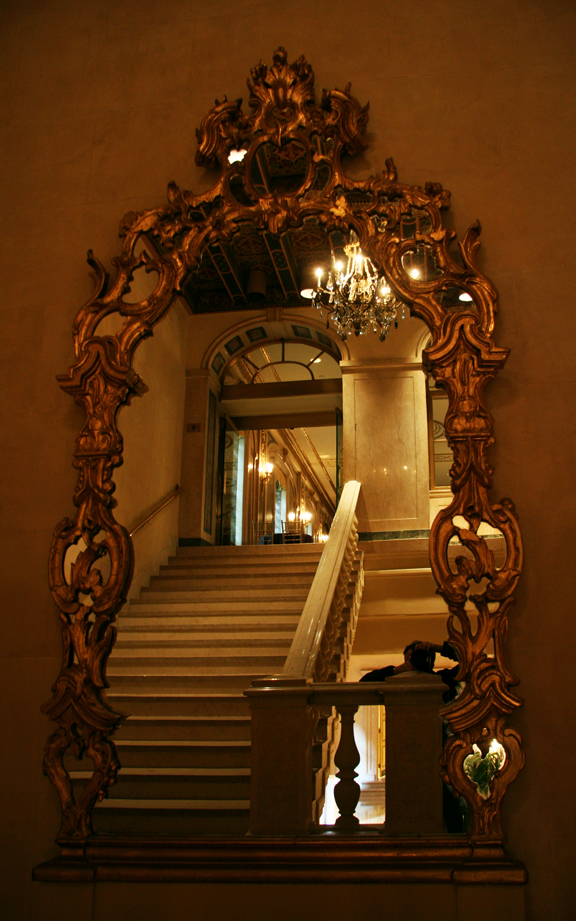
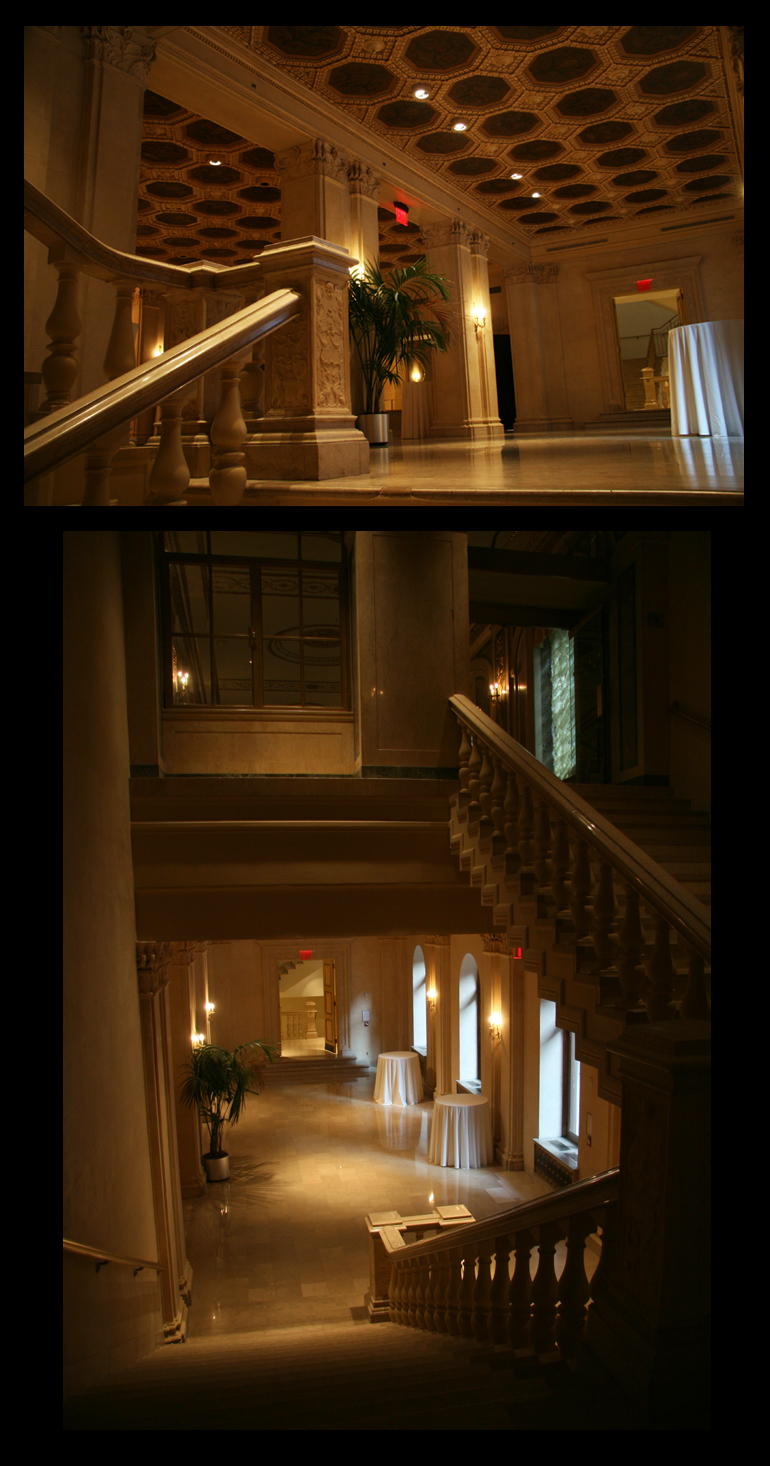
    So I was extremely surprised in my last visit to the Plaza Hotel to get free access to a stairwell and various adjoining rooms. See here for photos of the stairwell. It appeared that a rehearsal was taking place; camera and video crews were scattered about (see photo here). Perhaps I was seen as one of the crew. When properly outfitted and with an attitude that you belong, even security will frequently let down their guard.

    I have been to the Plaza numerous times, and this was the first time since it was newly renovated. The public rooms on the ground floor have been beautifully done. Around the perimeter of the central Palm Court, there are many small boutiques. In touring this area, I was startled when I came across this huge ornate mirror in a stairway. The reflection actually afforded one of the best views and ways to capture the stairway photographically. So if you act like you belong, and with a little luck, you may find a stairway to heaven…


  • The Unexpected

    You do expect the unexpected in New York City, but when I overheard a conversation about waterfalls which were built and installed in the NYC waterways, I was quite astounded.

    On my recent excursion to Coney Island, we took the back roads and ran across a pair of these waterfalls unexpectedly. I had completely forgotten about their existence. The lighting conditions were awful – shooting into direct sunlight in the afternoon is generally a photographic taboo, but duty called, and I was fortunate that one of these photos actually added to the drama of the situation.

    The setting for this waterfall was the Brooklyn waterfront; with the metal framework, the entire scene had a very industrial tone. Not a touch of humanity or dramatic nature one would expect from a waterfall. I did not dwell there long – my compatriots were waiting in a car as I jockeyed into the best position for this photo op.

    This is one of four waterfalls along the East River ranging from 90 to 120 feet tall – a $15.5 million art installation by artist Olafur Eliasson. New York City Waterfalls was done in collaboration with the Public Art Fund. They are on from 7AM to 10PM and are illuminated after sunset. You can read more about them at the official website here (update: no longer works; ran until October 13, 2008) – there is video as well as photos of the falls, with an interview with the artist. When visiting or living in this city, the unexpected will happen, and it’s more fun when you are not expecting it…


  • Hot Dogs and Fries

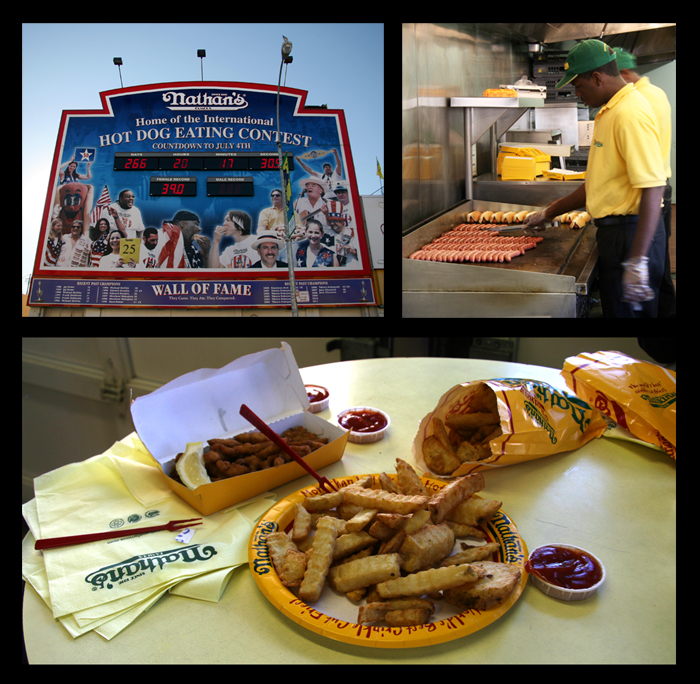
    As a child, I loved hot dogs. In fact, were it not for dietary concerns, I would still be eating them. And as you descend the slippery slope of fast food and stratospheric calories, you might as well throw in some French fries. On my recent pilgrimage to Coney Island, which I wrote about yesterday, four of us decided to stop by the original Nathan’s Famous on Surf and Stillwell Avenues in Brooklyn, started in 1916 by Nathan Handwerker. I wrote of Nathan’s in 2006 (see here).
    We had decided to snack only and ordered French fries and fried clams. For myself, since I eat fries so infrequently, there are only good fries or very good fries.

    What’s more American than hot dogs and fries? Eating to excess, so a hot dog eating contest is the perfect American sport. Since 1916, Nathan’s has been sponsoring a hot dog eating contest. In 2007, the Japanese hegemony was finally broken by Joey “Jaws” Chestnut, eating 59 dogs in 10 minutes, beating Takeru Kobayashi, who had held the record for 6 years straight.

    I learned today that competitive eating is actually an official sport with an organization: International Federation of Competitive Eating (IFOCE). They sponsor more than 100 international eating events. Personally, I find eating contests rather disturbing. At a time where health consciousness, obesity, and food-related illnesses are paramount, I do not see embracing a sport like this as sending the right messages to society. But perhaps if it were found that eating large amounts of French fries or ice cream was actually a health benefit…


  • Partial Remission

    If you want to taste neglect over a period of decades, New York City has a good menu selection. I imagine that many beaten-down areas have resistance to change, and wholesale renovations do not necessarily see the type of lasting transformation that was initially planned. There just is enormous inertia when it comes to areas which have had a long history of decline. However, NYC has not really put quality of life or beautification at a priority. Managing this large city and just getting things (such as the subway system) to work is an achievement, and most residents learn to be satisfied with this.

    We have many areas that have deteriorated for decades. Times Square is a perfect example. Although substantial improvements were made, the immediate surrounding area still has a seedy feel to it. It’s just like a cancer with only a chance of partial remission – we irradiate the problem, but cancer just creeps back.

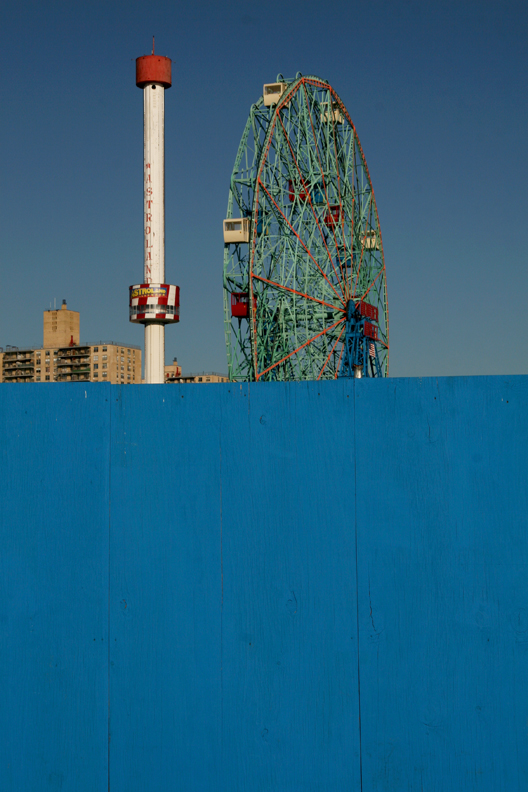
    Time will tell whether we will see the same effect at Coney Island; 2008 saw the final closing of Astroland and other amusements, with big plans for redevelopment.
    Coney Island was a world-class resort at one time, with millions of visitors annually. It was the world’s largest amusement area between 1880 and World War II. There were numerous competing amusements parks – the three largest were Luna Park, Dreamland, and Steeplechase Park. I recommend viewing photos and films of these parks in their heyday; they are shockingly beautiful and spectacular. Luna Park burned down in 1944.

    In my visits over the last several years, I have found Coney Island rather depressing, excepting for the annual Mermaid Parade. This last Saturday, however, I found it pleasant – absolute perfect weather, spectacular blue skies, and good company with three spirited friends, including a former NYC (Brooklyn) resident, all conspired in a great day. See the series of photos here.

    A stop at Nathan’s required a greasy snack – we shared French fries and fried clams. Chain link fences and vestiges of former rides and games made for good photo ops. The boardwalk was pleasant, particularly with the few isolated merchants. They were actually attractive set against wood, sky, and sea. Partial remission?


  • New York Moment

    Sometimes, everything just clicks.
    My best friend from college called me earlier this week to let me know that he would be in NYC at 5:30 AM, today, Friday. I cleared my day for him – he is fun incarnate and is usually up for doing just about anything. This man is one of those people who is immediately likable.
    He was my first friend and college roommate in New York City – a Jew from Brooklyn. He taught me the ins and outs of this town and how to bankface my money. I learned what bagels, delis, egg creams, and greasy spoons were.

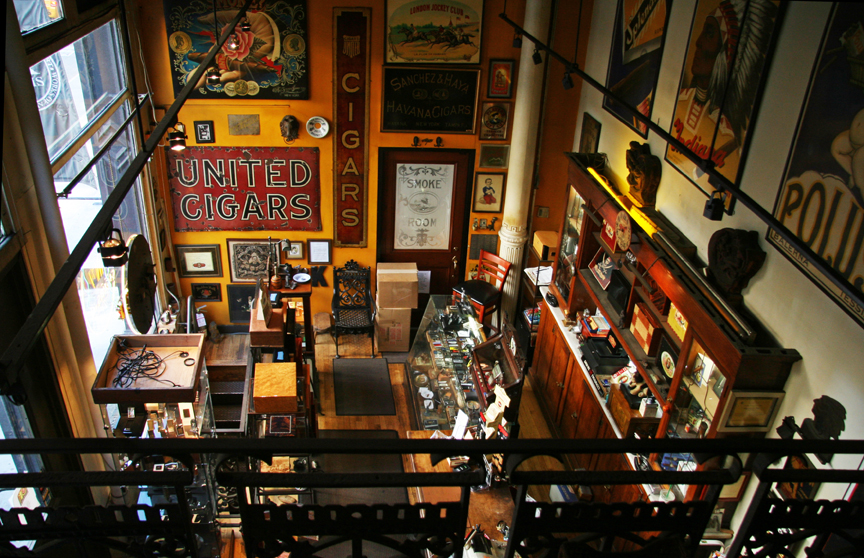
    With no specific agenda, we started with breakfast at a diner – Joe Jrs. He said he wanted to visit OK Cigars at 383 West Broadway in SoHo. Perfect, because he has a rental car, we are both ex-taxicab drivers, and we love an adventure. I don’t smoke, but a cigar store sounds like an interesting visit. The weather is absolutely perfect.

    But we arrive 30 minutes before this shop opens. As we ponder what to do, the owner, Len Brunson, arrives early and welcomes us in. Our luck just seems to be getting better. I ask about his policy regarding photography, and he just loves the idea, which is not the case with every store. We both agree how puzzling it is to have such restrictions and how antithetical it is to a business venture.

    There is a loft in this small, wonderful shop. Am I allowed to go up the treacherous ladder to take photos from the small loft area? A resounding yes. I find some great vantage points for shooting from above while my friend makes a purchase of $288. It certainly was worthwhile for the owner to open early.

    Ok Cigars, opened in 1997, is a high-end cigar retailer. They also have an extensive selection of one-of-a-kind antique smoking accessories. The shop has a tremendous woodsy, antique ambiance and is worth a visit, even if you are not a smoker. You can take a virtual tour of the store at their website. Len Benson is one of the nicest, most congenial, and accommodating stores owners I have met.

    The whole experience was a New York moment, and at 11 AM, the day is just starting. We are going out to Brooklyn and will investigate Coney Island in its current state. Stay tuned for a recap next week of this outing 🙂


  • Jungle Gym

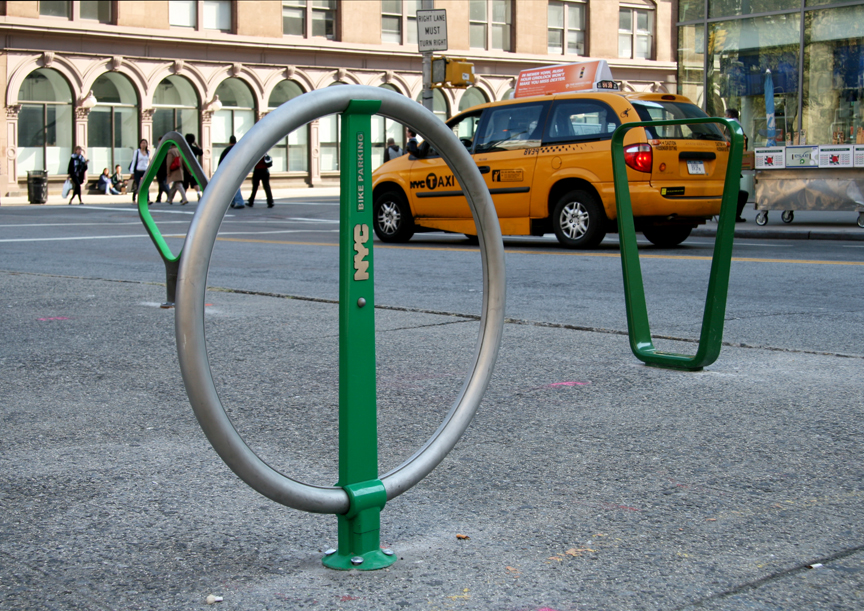
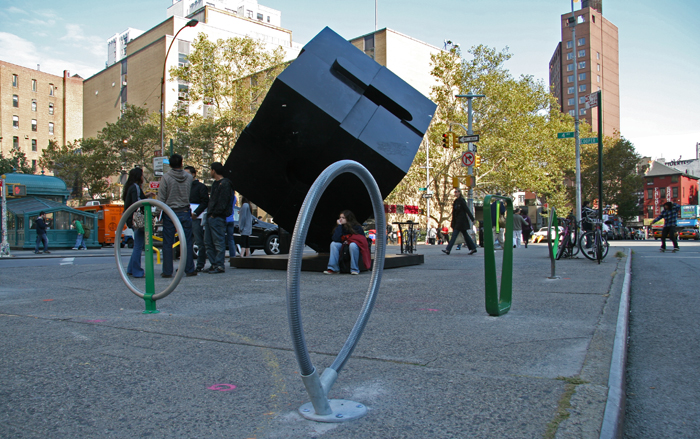
    What I love about this city is the adventure and discoveries. New York is like a real jungle, and walking though the dense thicket of things and people is like a safari, revealing surprises at every turn. While walking through the East Village and passing by the island that is home to the Astor Place cube, I discovered a jungle gym with an assortment of unusual steel forms (that appeared to be bike racks) anchored to the ground. My immediate thought was to get a photo, my focus primarily about composition and other photographic concerns. See second photo with cube here.

    It never occurred to me to question why these objects were here or why the collection was so disparate. The extreme variety of shapes and sizes should have tipped me off that there was more than meets the eye.
    I had essentially forgotten the photos; a quick scan of them on my flash card made me question whether this motley crew of bike racks was blog-worthy. However, the forms were rather attractive, and a quick online search revealed a pleasant surprise – these were the nine finalists in the “CityRack” Design Competition for New City Bike-Parking Standard by the New York City Department of Transportation. See the nine designs and information about the competition here.

    The competition drew over 200 entrants from 24 states and 26 nations. An international jury of six will decide the first, second, and third place winners. The winning design will be announced at the Cooper-Hewitt Museum during National Design Week (October 19-25, 2008). The first place winner will receive $10,000 and transfer design rights to the City of New York, which intends to use the winning sidewalk bike rack design as its new prototype for bicycle parking. There are currently more than 5000 racks throughout the city with a design that is over 10 years old.

    As I have written about before in Very Practical, the overriding consideration in this city for things in public spaces is their ability to withstand vandalism, abuse, and heavy use. For better or for worse, these things supersede all others and utility rules.
    What I love about these designs is that it is clear that the entrants really understood the harsh NYC environment; all of the designs are minimalist and look like they would survive.

    I am sure it will be quite an honor and a thrill for the winner to stroll the jungle that is New York City, discovering his or her design on the streets…


  • dinamic_sidebar 4 none

©2026 New York Daily Photo Entries (RSS) and Comments (RSS)  Raindrops Theme