• Category Archives Curiosities of NYC
  • Ready or Not

    Ready or not, here I come. The popular chant of children playing hide-and-seek could perhaps be the official slogan of some technologies which were begging to be made but were a failed concept, such as Motorola’s Iridium Satellite phone, a debacle which costed them billions.

    A myriad of other reasons have been responsible for the failure of products and/or services which once seemed like a great idea. Wrong time, wrong place, not enough support services, not enough content, not scalable, not monetizable, too expensive, or other competing technologies. Betamax, Apple Newton, Qube, ebook readers, Urbanfetch, and other dot com failures.

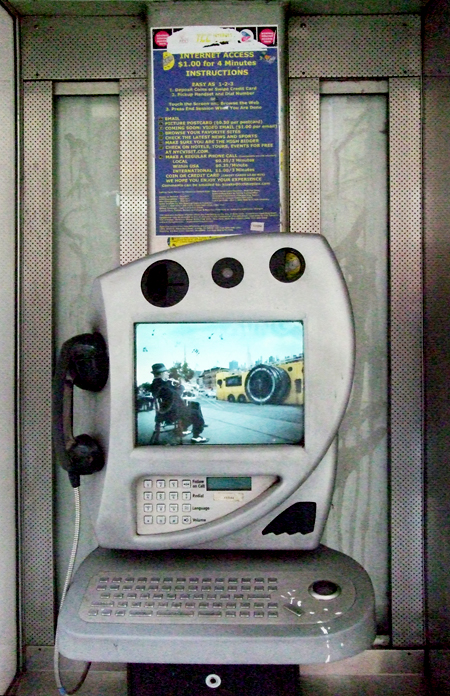
    I don’t wish them ill, but the Internet phone (on the streets here since 2002), which I saw recently on West Broadway in SoHo, seems like something that, for many, would only be useful in an absolutely desperate situation. Of course, that does not doom them to failure. Many a business model has been built around urgent needs. However, handheld Internet-capable devices are ubiquitous and may have the impact on this technology that cell phones have had on regular payphones themselves.

    The Internet phone, the Neptune 800 web phone, was developed by Marconi Corp. a London-based company (now owned by Ericsson). Initially, over 100 phones were installed city-wide for the NYC payphone company, TCC Teleplex, headed by Dennis Novick. Starting in 2002, British Telecom had very ambitious plans to roll out tens of thousands of these internet phone kiosks in the UK.

    As I have written before, anything on the streets of New York City will be subjected to wartime conditions – various combinations of vandalism, abuse, and misuse. The Neptune phone has a die-cast aluminum chassis, a 10 millimeter toughened-glass touchscreen, an armored cash box, and a metallic, sealed keyboard to withstand vandalism and tolerate adverse weather conditions and humidity. It has a trackball and color touch-sensitive screen.

    Services include email, video email, picture postcards, high-speed web browsing, or local information. Hot buttons give access to news, sports, shopping, games, weather forecasts, local maps, and information about shops and restaurants.
    Ready or not for wide adoption, it has come…


  • Wild West

    There are phenomena in New York City which are the result of the unique confluence of numerous factors – population density, large ethnic groups with their cultural traditions, and what I perceive as a certain lawlessness and laissezfaire attitude regarding victimless crimes in New York.

    It’s really a question of numbers. Any densely populated city affords opportunities not found elsewhere. For example, there is always some need for emergency umbrellas with the onset of an unexpected downpour, but only a place like Manhattan will offer enough potentiality to actually buy umbrellas, set up on the street, and make it a venture, as I wrote about in Opportunity.

    For some time, there were the squeegee men – individuals, particularly in the Bowery area, who worked washing the windows of cars stopped at traffic lights. What started in New York as a annoying “service” eventually became tantamount to blackmail – the windshield washing was done hurriedly without asking permission and was followed by demands for payment. Mayor Rudolph Guiliani effectively eliminated the squeegee men as part of his Quality of Life campaign.

    One activity that remains and can be often seen around the metropolitan area is the sale of flowers on highways. This is obviously a dangerous activity for both the vendors and motorists. Arrests are occasionally made and fines collected. According to a New York Times article, many of these flower vendors are Ecuadorean – you can read the story of one man’s trials and tribulations here: Hard Way to Sell Flowers: Dodging Cars and the Police.

    Turning corners and not waiting for pedestrians, double and triple parking, jay walking, counterfeits of luxury products sold openly on the street, known drug dealers chatting with police officers – all somewhat surprising activities in a first-world city in the 21st century.
    But Americans don’t really like rules. I often think of the wild west as symbolic of the American temperament, with New York City keeping that tradition alive 🙂


  • Survival Guide

    Posted on by Brian Dubé

    I intended to tell you what I knew for sure. However, after reflection, I realize that it would only be what I thought I knew. So, I will tell you what I saw.

    What am I talking about? I was drinking a juice on the second floor of Whole Foods Market on Union Square at 10PM. The second floor has tables and has been designated as a space for eating food purchased by customers. It is a very casual cafe type of atmosphere.

    The place was abuzz with nearly every table occupied, even at that late hour. A man who had two overfilled bags knocked into my table while stepping on my foot. His canvas bags were stuffed with all manner of goods, including what appeared to be an empty paper coffee cup.

    The most noticeable thing about this man was his enormous bulk from his layers of coats. He removed his large outer coat and went off briefly, leaving his bags unattended. He returned rather quickly with a paper plate of pasta. However, it felt too quick for him to have gone through the Whole Foods line. So this is where I started to pay attention.

    He took his plate of food to the microwave provided by Whole Foods for reheating of food. I say reheating because a sign was clearly posted that the microwave was for reheating only. After pondering this for some time, I realized that due to the volume of people and with what appears to be no one policing the floor, the space and services offered are most likely used by the homeless – warm places to sit, water fountains, and bathrooms – with some perhaps preparing meals from foods brought from outside.

    The mechanics of survival of the homeless, quasi-homeless, and severely disadvantaged are seen by most of us in sight bites. I am sure that there is an undocumented survival guide known by many of the have-nots who enumerate the soup kitchens, public bathrooms, and best places to pass time, such as bookstore cafes and public spaces (libraries, bus and train stations), places to sleep, and how to get or recycle food. I am reminded of stories I have read of the old Horn & Hardart automats of New York City, where poor writers often made tomato soup from ketchup and hot water or bought tea with bread and made pickle relish sandwiches.

    The man ate and left as quickly as he came. I have made an assumption about him – I could be very close or very far from the truth. I have seen him frequently in public parks. Knowing the source of that pasta would have told me much more…

    Note: The 2nd floor at Whole Foods at Union Square is a superb place to have a snack with great vistas of Union Square Park, all the activities in that area, the Empire State Building, and the Met Life Tower.

    Posted on by Brian Dubé

  • Buddies

    I’m reminded of a classic episode of the TV comedy hit Seinfeld, where the two main characters, Jerry and George, are mistakenly taken as a gay couple. In order to express their rejection of the characterization but not appear homophobic, the writers came up with the brilliant response, “Not that there’s anything wrong with that.” The implication, of course, is that there is something wrong with that, even though the show is set in New York City, a place known for its extremely liberal population and large gay community.

    And so it is that even in 2009, many men feel they must justify and defend, even without accusation, any activities or relationships that could be perceived as gay. A male friend(s) is a potentially dangerous association.

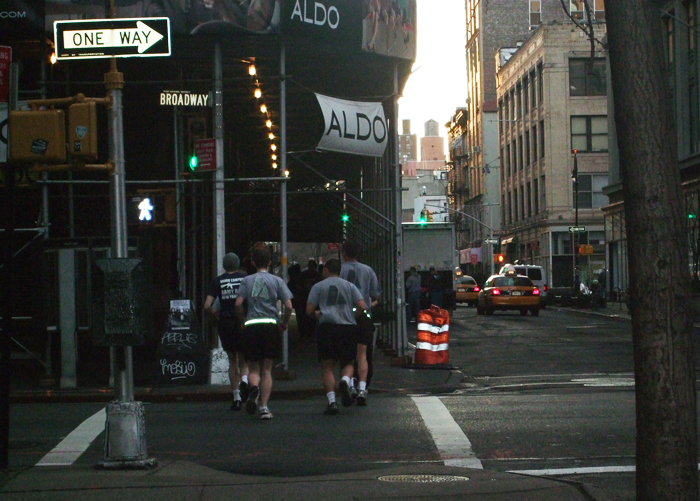
    Group male activities on the streets on New York are not a common sight, and when I saw the men in today’s photo jogging together, the first word that came to mind was “buddies”, a word often used when I grew up. For many men, using the word “buddy” carried with it enough machismo to deflect any homosexual inferences in advance, “friend” perhaps being a little too personal.

    Male friendship activities are pretty well delineated as to what can and can’t be done. Touching, for example, is very taboo – removing lint from another’s hair has to be done very carefully with just the right posturing. Perhaps safer just to say, “Hey, you have some junk in your hair.”
    The safest male activities are, of course, group involvement in sports. A sport immediately legitimizes the manliness of its participants, and a group best assures that there will be no private/suspicious activity. An announcement to the wife that one is going out with some buddies to play ball carries with it the clearest affirmation.

    To this day, men fear being gay or being seen as such, and gay slurs are still used by some men as the ultimate insults. I find homophobia rather silly. Women don’t labor under these constraints. Displays of affection, walking arm in arm, and reciprocal preening are all well accepted without stigma attached. Women realize that mere association with gays or displaying sensibilities which may appear gay has no effect on one’s sexual orientation. I have associated with many gays socially, hired them, and worked with them professionally.

    Personally, I think most gay associations and stereotypes are complementary and positive in nature, such as appreciation of finer things, fashion, the arts, etc. Things such as the Seinfeld comment and TV shows like Queer Eye for the Straight Guy have helped build a more positive image for gays.

    Now if I were accused of being gay because my mannerisms were highly affected like those of a flaming queen, perhaps I would be a little more self-conscious. Then I may feel the need to contact a few buddies for some male bonding – not that there’s anything wrong with that 🙂


  • Jump for Joy

    One area where a huge city like New York can fall down is service. We have lip service, of course – the beatitudes and platitudes recited by employees as instructed by policy manuals from the corporate office. But I mean real service, where the salesperson puts him or herself on the other side of the counter, sees another human who has a need, and, within reason, does what is required to satisfy that need without attitude.

    I often find myself in a retail store looking for a salesperson, eventually to find a number of them congregated for what appears to be happy hour. Any effort to intrude is seen as an annoyance, taking them away from what appears to be more important matters to render service begrudgingly. A customer starts to feel guilty for disturbing the sales staff.

    One can find good service in New York City, but it is just not like the experience of being in a very small town, where it feels like politeness and great service are universal. You have a sense that it is assumed that this is the normal human condition. I yearn for these signs of humanity in New York City, and when I find them, I jump for joy.

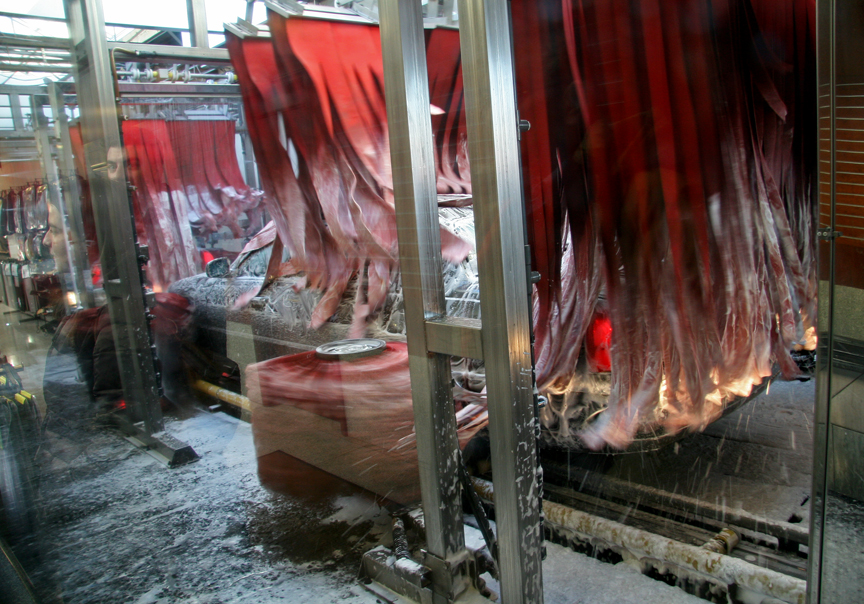
    Saturday I jumped for joy at the LMC Car Wash & Lube at 36-21 21st Street in Long Island City. The first thing I noticed was how clean this place was, particularly in light of traveling many blocks on a very blighted stretch of road. My car was in dire need of a was. Like many, the inconvenience of a few minutes and a few dollars usually seems too much to bear, spoiled as I am with the extraordinary conveniences of the modern world.

    At LMC, after prep work, the car goes through its wash and dry cycles unoccupied – customers get to watch the entire process from behind the glass wall of their retail shop, which is stocked with all manner of auto supplies and accouterments. There were bottles of many hued liquids with the afternoon sun shining through them. Everything was in its place with a place for everything. Tidy, clean, and efficient, with good service and entertainment – watching your car get scrubbed clean is so much fun. All of this may be the standard for retail establishments outside the city, but in New York, people will tolerate some very rough edges.

    Perhaps many would consider my exuberance over a car wash to border on lunacy, and maybe it is. Call it what you may, but when I find a place like LMC, I want to jump for joy…


  • Itching and …

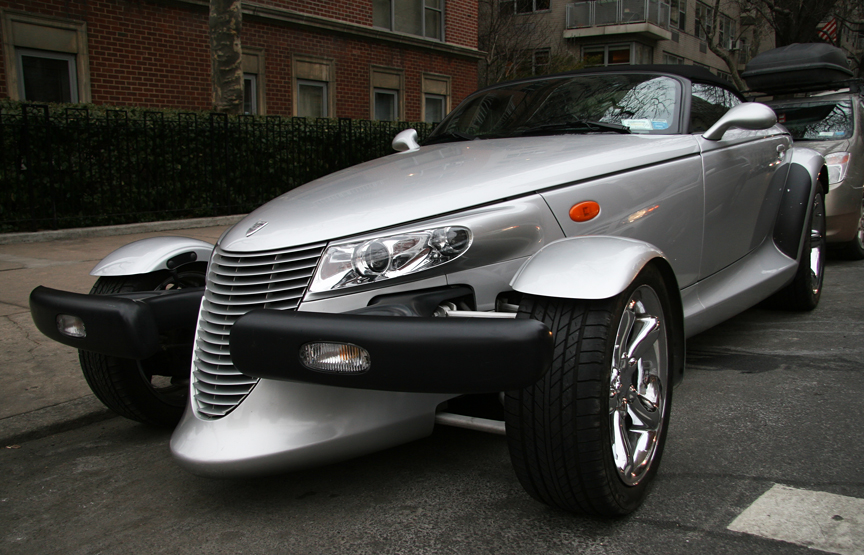
    Two things about this car parked in the streets of Manhattan stand out: it really looks out of place, and it is so pristine.

    There are many unique considerations about owning an automobile in New York as opposed to owning one outside the city. They generally are used less frequently by owners, so the occasions to flaunt them are fewer, and there is no opportunity to display them in your driveway in front of your McMansion. They are often street parked – either on an occasional or permanent day-to-day basis – so they are vulnerable to whomever and whatever. They are much more expensive to maintain here, with parking that runs several hundred dollars per month as well as high insurance costs. And except for the extremely wealthy who may have drivers, a car will still only meet some of your travel needs – trains, buses, taxis, and walking will still be the staple transportation diet around town for residents even with cars. Most will use their automobiles to leave the city. Hence, for most, automobiles in New York City take on a much more utilitarian role – a car here is really a luxury, an indulgence, and a sports car even more so. So a sight like this Plymouth Prowler will turn heads (read more about this car here). When I took this photo, I waited for a group of tourists to finish their photo opportunity.

    When you park a car like this on the streets of New York City, like it or not, you are taking a risk and making a statement. There are chances of dents and dings from parkers and pedestrians. Auto theft. Vandalism. Park a Lamborghini on the streets of New York City, and you are saying you have money to burn.

    And then there is something that I have seen before and is difficult to erase from my mind. That surface is so smooth and shiny, it’s just itching. I don’t want to say it or even think it, but everyone knows what every itch is saying and what Mom always told you not to do – scratch it…

    Photo Note: Cars make a great photo subject – it’s hard to go wrong with a gleaming vehicle like this. I have done a number of postings related to cars and bikes: Hoopmobile, Who See the Red, Machine, Extreme Cadillac


  • Stemming the Tide

    There is a nervousness in this country like nothing I have ever seen. Worry runs deep, and New York City, with all its wealth, has not escaped. It is difficult to find places where all feels well, and even in affluent neighborhoods, many retailers do not look or feel well. Even the Haves worry about the plight of the Have-Nots, because, perhaps, for the first time, some of the Haves see a possibility of joining the ranks of the Have-Nots.

    Yesterday was Inauguration Day, and President Barack Obama takes the helm at one of the worst times in this country’s history. In spite of a renewed hope fueled by a new, young administration, the markets plunged over 4%. There had been an expectation of a nice bounce, but the realities outstripped any false euphoria. Everyone realizes that this is a very grave situation. Today’s New York Times headline reads “After a Day of Crowds and Celebration, Obama Turns to Sober List of Challenges.” Sober is the operative word.

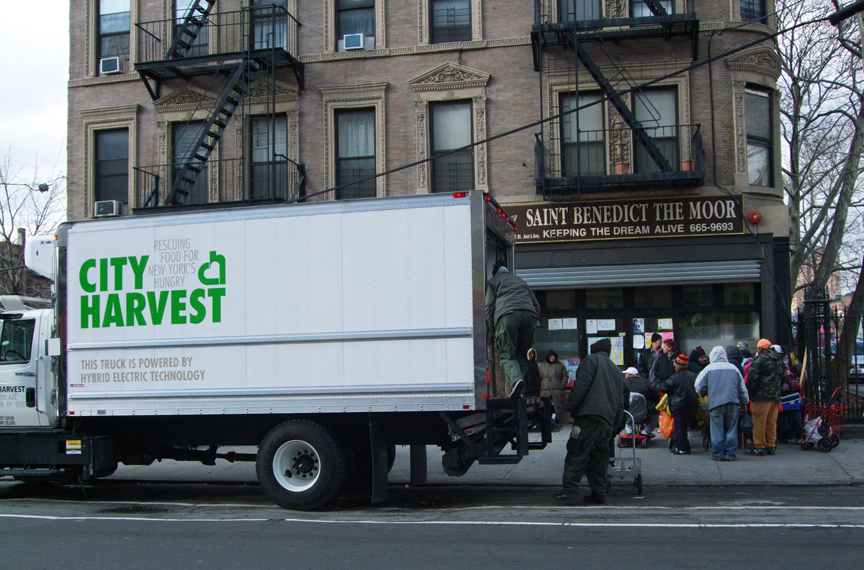
    City Harvest, founded in 1982, is the world’s first and New York City’s only food rescue program. The organization rescues 60,000 pounds of food per day, delivers to more than 600 community food programs throughout the five boroughs of New York City, and serves over 260,000 people weekly.
    Even the soup kitchens and food pantries themselves have problems – a shortage of donations of food supplies and an increase in the numbers of people using food services. An article in the New York Times last November reports a steep rise of between 20-40% of demand for food aid nationwide.

    I do believe, however, in the resourcefulness of humankind as well as our ability, when inspired and focused, to achieve the unexpected and stem the tide. A president can only do so much, but a good leader goes a long way to provide impetus. Let us hope that President Obama is that man…

    Photo Note: This photo shows a City Harvest delivery of food to the soup kitchen St. Benedict the Moor Center at 283 St. Ann’s Avenue in the Bronx.


  • Hunt’s Point

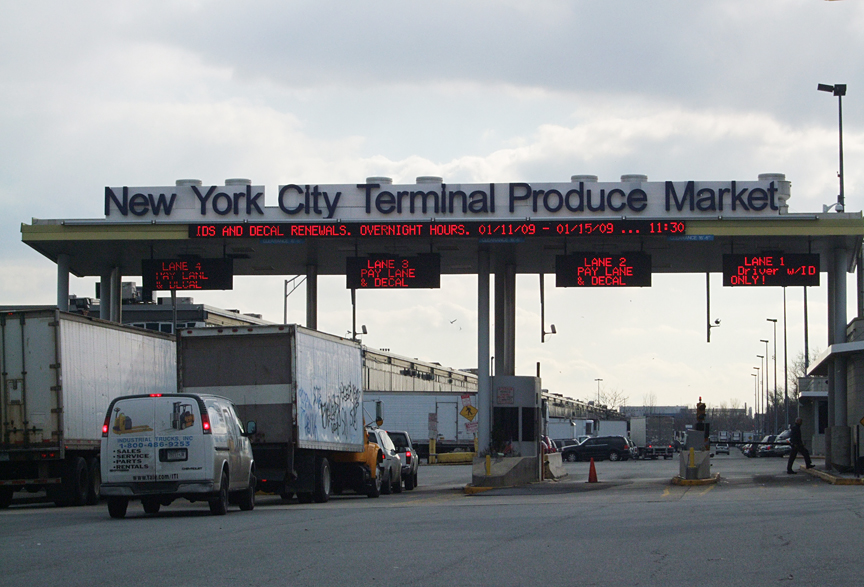
    Do you want to see food distribution on a gargantuan scale? I had no idea that the Hunt’s Point markets in the Bronx were that big. What I envisioned was a large building with open stalls. What I saw was something the size of a small town.

    Hunt’s Point is the largest food distribution center in the world. It occupies 329 acres and is broken up into three primary large distribution centers, each handling different commodities: New York City Terminal Market (fruits and vegetables), Hunts Point Cooperative Market (meat and poultry), and the New Fulton Fish Market.

    I expected to visit an open produce market brimming with fruits, vegetables, and merchants frenetically shopping and trading. Instead, I was greeted with an entrance like that of the Holland Tunnel. No fruits or vegetables were to be seen. I saw chain link fences and many grim and amazing sights – I will feature a few of these in the coming days.

    I was a little naive, perhaps – after all, this is BIG business, not a place to expect the charm and ambiance of a farmers market. For that, you go to Union Square

    A Note about Hunt’s Point: These markets and other smaller ones occupy a large portion of a peninsula in the Bronx neighborhood known as Hunt’s Point. There are over 800 businesses employing 25,000 workers. Hunt’s Point is also a residential area with over 40,000 residents. However, it is a low-income area where over half live below the poverty line – this is one of the poorest districts in the United States. Crime is rampant, with drugs and prostitution. Although crime rates have fallen, Hunt’s Point reports the highest violent crime rate in New York City.

    Related Post: Union Square


  • Small Achievements

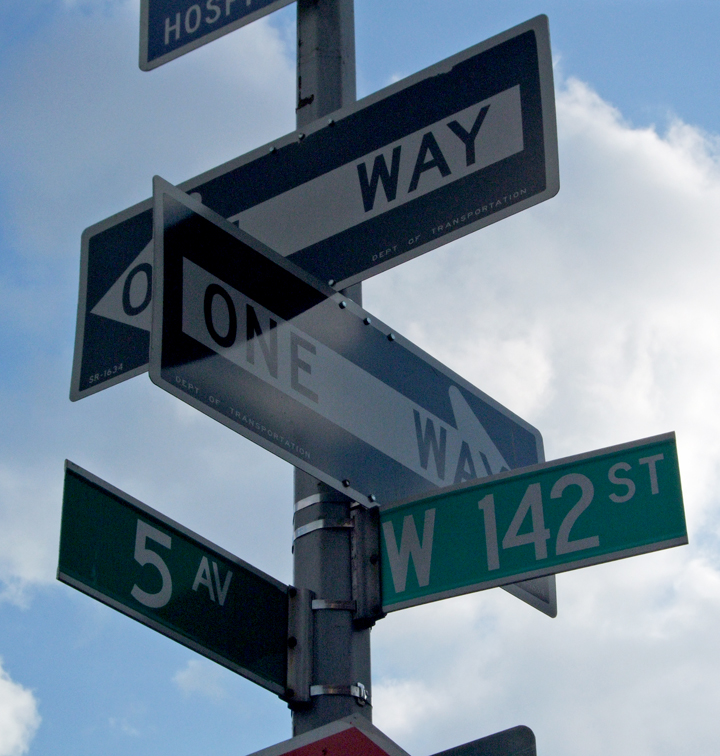
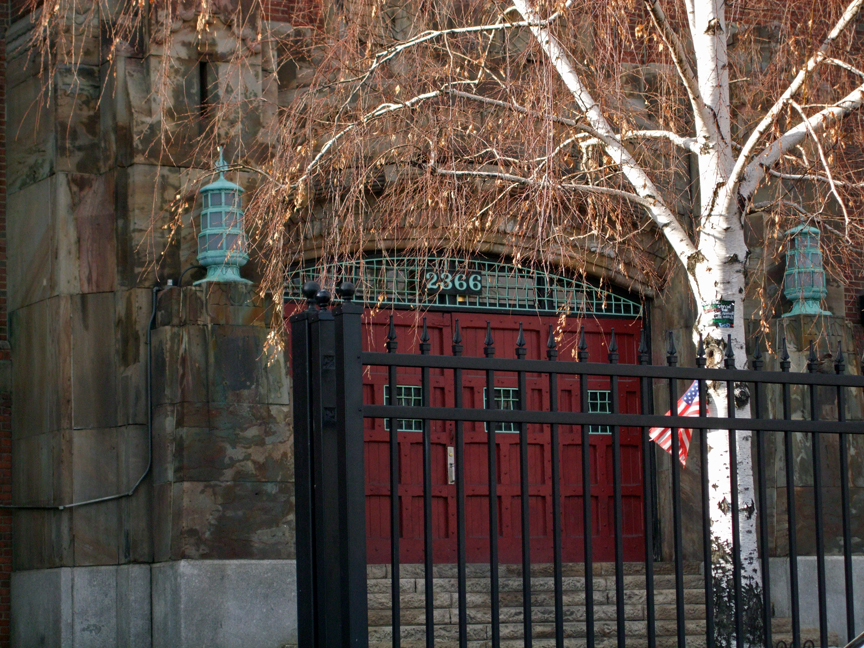
    Perhaps I have spent a little too much time confirming that 2366 is the last street address on Fifth Avenue and that this sign is the last intersection with Fifth Avenue signage. But it is something that I really wanted to know, so on my recent excursion to the Bronx, we circumnavigated this area.
    I examined street signs and subsequently did online address lookups and map analyses. I am reasonably sure that 2366 Fifth Avenue is the end of the line. Apparently, this factoid is of little interest. I found nothing written anywhere – no articles at all regarding the fact that 2366 is the last numbered address.

    Fifth Avenue is arguably the most important street in Manhattan. It runs north-south in the center of Manhattan. It originates at Washington Square Park, with the first numbered address at 1 Fifth Avenue. The avenue runs to 142nd Street (#2366) and the Harlem River Drive. Where Fifth Avenue intersects crosstown streets, they are designated East or West at Fifth Avenue, which serves as the zero point in crosstown street address numbering – numbers get larger as you move east or west of Fifth, at 100 per block (with some exceptions and large block divisions such as Madison and Lexington Avenues). In its long trajectory, Fifth runs through a variety of neighborhoods: the Village, midtown with its iconic flagship retailers, the gold coast along Central Park, and finally, Harlem.

    For most of my adult life, I have lived near the beginning of Fifth Avenue, so its end was always a distant small mystery, perhaps more accurately a small curiosity. A mirage just out of view. Not compelling enough to really pursue. But these little things can nag and, in time, reach a critical mass where it is better to get closure and put it to rest.

    The Fifth Avenue “mystery” reminds me of Sudoku. One reason for the popularity of the game is the appeal of a puzzle, just challenging enough, that is a discrete task with exactly one clear solution. Completion gives a person the satisfaction of a perfect, small achievement. Let’s toast to small achievements 🙂

    Note: What’s at 2366 Fifth Avenue? The 369th Regiment Armory, NY National Guard, built in 1923 and designed by Van Wart & Wein. See photo here.


  • White Christmas

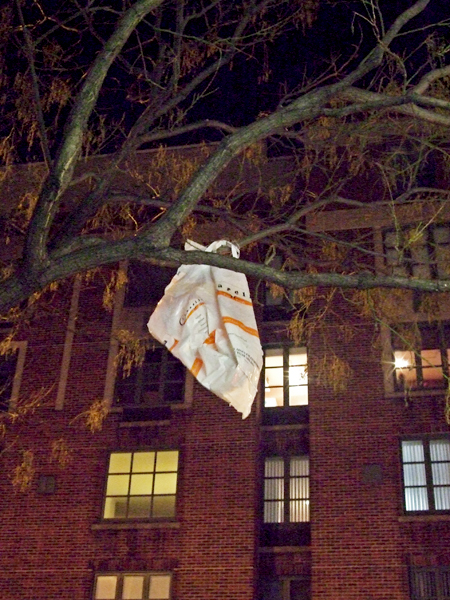
    Decorations of white for the holiday season? Hardly. Plastic bags being blown into trees is a serious problem worldwide. See how extreme it can become in this gallery of photos here. Astounding, isn’t it?

    New York City has more than 500,000 trees – candidates as bag magnets. As Clyde Haberman points out in his New York Times article NYC; In Winter, Trees Bear Plastic Fruit: “In summer, leaves obscure snarled plastic. The leaves are also splendid, parks people say, at repelling the polymerized intruders before they can land.” Like chewing gum on the streets, once you start looking for these “plastic fruit,” you start to notice them more.

    There is a global movement to reduce/eliminate the use of plastic bags, particularly for grocery checkout. The only really effective way to change behavior with issues such as this one appears to be a financial disincentive. City or country bans on plastic shopping bags usually involve a tax, unfortunately. In Ireland, a €0.15 levy on plastic shopping bags was instated on March 2, 2002 – there was a subsequent 90% reduction in use of plastic bags. China has banned the use of ultra-thin plastic bags. San Francisco has banned non-compostable bags. Much of Europe has various tax levies or bans. Mayor Bloomberg is proposing a $.06 tax on plastic shopping bags. However, this move is controversial – many see it primarily as a revenue-raising scheme disguised as a green effort.

    Plastic bags are such a complex issue – any simple assertions concerning their use usually miss some key points. The lists of pros and cons of paper versus plastic are quite long. Paper is not a clear winner – apart from trees, energy is require to produce paper bags, dioxins are released in production, and they do not decompose in landfills. Also, many reuse the bags for trash at home or cleaning up after their dogs, so reduction of plastic shopping bags may result in an increase in the purchase of plastic garbage bags. The best solution is a reduction in the use of bags to begin with.

    The reusable shopping bag is a good idea, however, in New York City, this is a problem due to the general lack of use of cars for shopping. Carrying reusable shopping bags is not realistic for most residents, and unplanned shopping also precludes their use.

    I think in the end, a real net reduction of energy and materials will require a wholesale change in behavior and habits regarding bags and trash. In years to come, I hope this is not a new interpretation for Irving Berlin’s I’m Dreaming of a White Christmas

    Photo Note: This tree was on Waverly Place near 6th Avenue. The bag was from Citarella, a gourmet food market. At least our tree trash is first class 🙂


  • ArtKraft Strauss

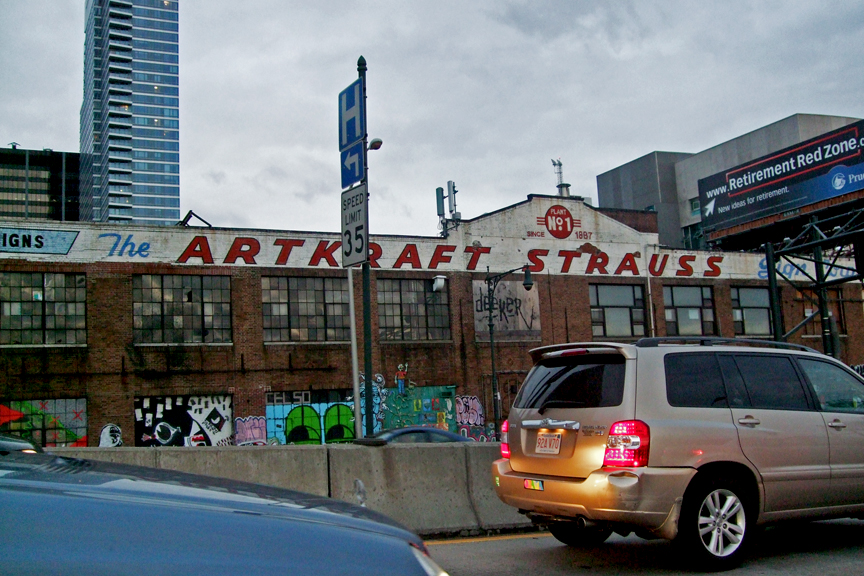
    Occasionally, something absolutely jumps out at me and screams. Seeing a weathering sign like this on a ramshackle industrial building is in itself interesting. And perhaps if I was familiar with every square inch of Manhattan and possessed a photographic memory, sightings like this one of the ArtKraft Sign Company would only be a short review class and not a major event.
    I have ridden by this location hundreds of times over the decades but never really made any note of it. However, in January 2007, I had written of this company in my article on the iconic Pepsi-Cola sign flanking the East River. So the name ArtKraft Strauss was somewhere in my subconscious mind, waiting to be triggered. The photo required some multi-tasking;  I only had seconds to find and grab a point-and-shoot camera, open a car window, and shoot while driving in slow-moving traffic on the West Side Highway.

    ArtKraft Strauss is the most important signage company in the history of New York City. They are responsible for signs known internationally, like the Camel cigarette man who puffed smoke rings over Times Square from 1941 to 1966. Signs like this were virtually de rigueur for visitors. Coca-Cola has had a sign here since 1907 and has gone through several iterations, with a 1992 spectacular, 42-foot model of a Coke bottle utilizing state-of-the-art electronic technology. For 87 years, this is the company that was responsible for lowering the ball at Times Square on New Year’s Eve. See a history of ArtKraft’s signs with photos and videos at their website.

    ArtKraft Strauss was founded in 1897 by Benjamin Strauss as Strauss Signs. This company merged in 1931 with Artkraft-New York, founded by Jacob Starr, a former employee of Strauss Sign. ArtKraft has dominated the signage in Times Square through the era of neon and since the 1980s with electronic displays such as that of Coca-Cola.

    Until 2006, ArtKraft Strauss utilized this space (40,000 square feet on two floors) at 57th Street and 12th Avenue for their manufacturing. They have since divested of manufacturing operations and now operate as a design, consulting, and project management sign company. The space is now occupied by the not-for-profit arts organization chashama and hosts over 24 visual artists in walled, open studios on the 1st floor, as well as rehearsal space on the 2nd floor for theater companies. I hope they keep that sign…


  • Lost and Found

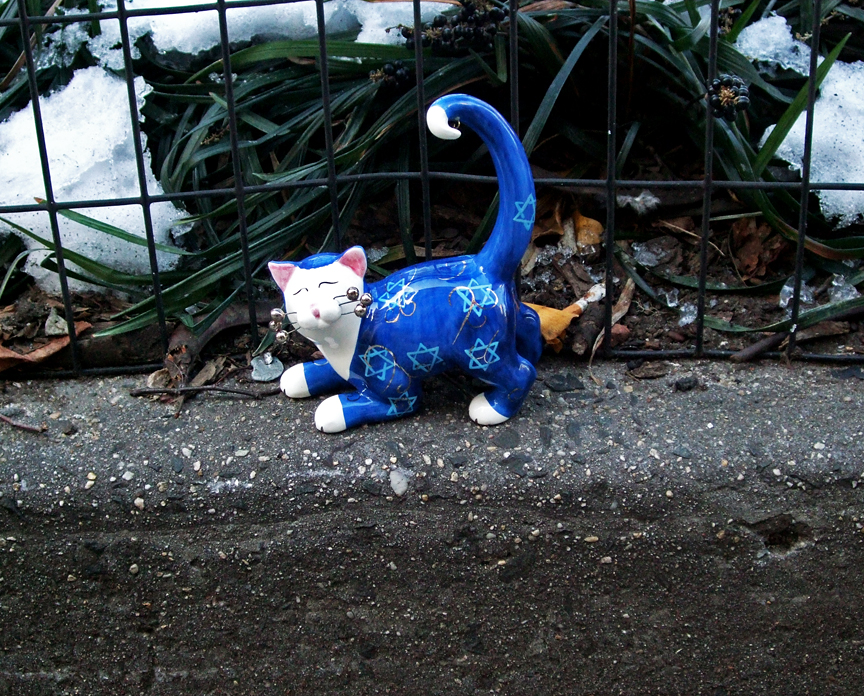
    I will never know for sure why this ceramic cat was perched so carefully on a sidewalk curbstone. Many may ask, why do I care? Initially, its bright colors made it jump out on a bleak winter day – so unexpected. However, what really piqued my interest was that its placement there was so obviously deliberate – there had to be some original intention. Was it an artistic statement, a discarded possession, or some act of rebellion? And since this occurred in New York City, such an occurrence also had a huge element of vulnerability. An object will only remain like this for a short time, and to witness it is a privilege with a very small window of opportunity (see Small Gestures here).

    Am I making too much of such a small thing? Perhaps, but the devil is in the details, and often, things like this can say a lot and also take one in unknown directions. I have an idea as to why it was there – an idea I want to believe.

    When I was in Paris once, strolling with a friend, we noticed a glove on a window ledge. In the same way as this cat, it had been obviously placed there deliberately; it was hard to imagine that it could have gotten there by accident. We also had the sense that it was intentionally undisturbed. These things were so curious that we indulged in conversation about it for some time and concluded that this glove was lost and was placed there for its original owner to be found.

    Speaking to others, we subsequently learned that we were correct and that this was a common practice in Paris. In all likelihood, the owner of an item will pass the same way again and find his or her lost personal belonging. We were so elated to learn that this small act of humanity had become common practice. How wonderful to learn of a variant on lost and found that required both the honesty and thoughtfulness of many by the thousands of passersby who participate in this act.

    Perhaps this explains the mystery behind the cat. For me, however, there is a greater gift than finding a lost possession. Like many New Yorkers who have become untrusting and cynical through years of living here, I have lost faith in the goodness of people. But I found it again in these acts of kindness…


  • Deep Freeze

    As one of the readers of this website commented on a previous posting, New York City has a climate tempered by its coastal location. I got quite absorbed this morning reading about climate classification systems, with names like Köppen, Strahler, and Thornthwaite. I was somewhat shocked to learn that according to the Köppen climate classification system, New York City is considered humid subtropical (a subclassification of the Temperate group), which is the same classification as most of Florida. Others say this classification is debatable, and some say the term subtropical is a misnomer and a mistranslation of the original German.

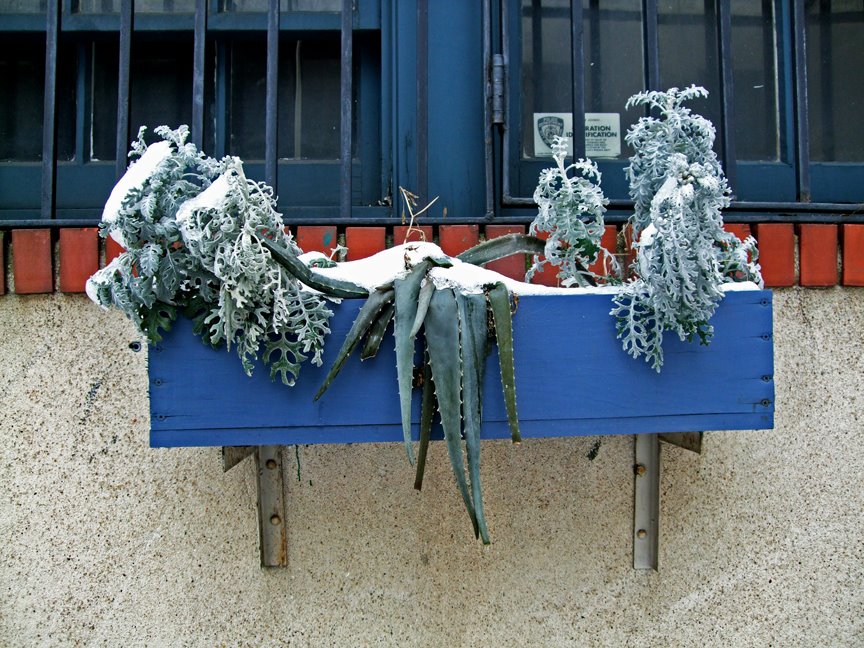
    The classification as temperate is a stretch for me. With summer days often in the 90s and winter days like today of 14° F (without windchill), temperate is not the word that comes to mind. Today’s photo was taken in Washington Mews with what appears to be frozen aloe vera – I have no idea if these plants survive a winter like this.

    Many New Yorkers spend a significant part of their work commute on foot to and from public transportation, or, like myself, have the privilege of walking to work. On non-work days, most of us will find the majority of our needs met and errands to be done in a walking distance within our neighborhoods. So the weather in New York City really affects lifestyles, habits, and decisions regarding activities.

    In my case, I have a 3/4-mile, 15-minute walk to my office. I appreciate this luxury, which on most days is a pleasant way to both exercise and enjoy the city streets. However, in the case of a driving rain or frigid weather with a howling wind, that 3/4 mile can be an unpleasant trek. Juggle some packages and an umbrella simultaneously in a rainstorm, and you can easily become envious of the comforts of suburban car culture with automatic garage door openers. Certainly preferable to a deep freeze…


  • Goin’ To Jersey

    If you live in New York City long enough, you will eventually hear something along the lines of “I’m goin’ to Jersey” or “I was in Jersey” or “They live in Jersey.” Most New Yorkers see the state of New Jersey as a grouping of bedroom communities to the city – there are over one half-million commuters from New Jersey to Manhattan daily.

    The state nickname is the Garden State, and one of the major highways is the Garden State Parkway. Now, in fairness, there are some nice areas of New Jersey, but if you have seen any of the well-known gardens in the UK, France (the Gardens of Versailles, e.g.), Italy (Boboli, e.g.), Japan, or the U.S., you would agree that to call New Jersey the “Garden State” is perhaps a bit disingenuous. This is the only state in America where every county has been designated as urban by the Census Bureau’s Combined Statistical Area. New Jersey is the most densely populated state in the USA, with 1,134 people per square mile.

    Whether you like New Jersey or not, it is an important part of the psychic makeup of a New Yorker’s mind (see View of the World here). In this classic image created by Saul Steinberg in 1976 for New Yorker magazine, New Jersey is depicted as one of a small handful of geographical landmarks. Ever present, looming in our minds, New Jersey is like background noise for the city. It is frequently the object of jokes by New Yorkers.*

    This small state is a place of extremes. It has the second highest median income in the United States, yet Camden is one of the poorest cities in America. It is the home of Princeton University. The state has a strong presence in chemical development and oil refining. The Port Newark-Elizabeth Marine Terminal is one of the world’s largest container ports. You have the Jersey shore with Atlantic City.

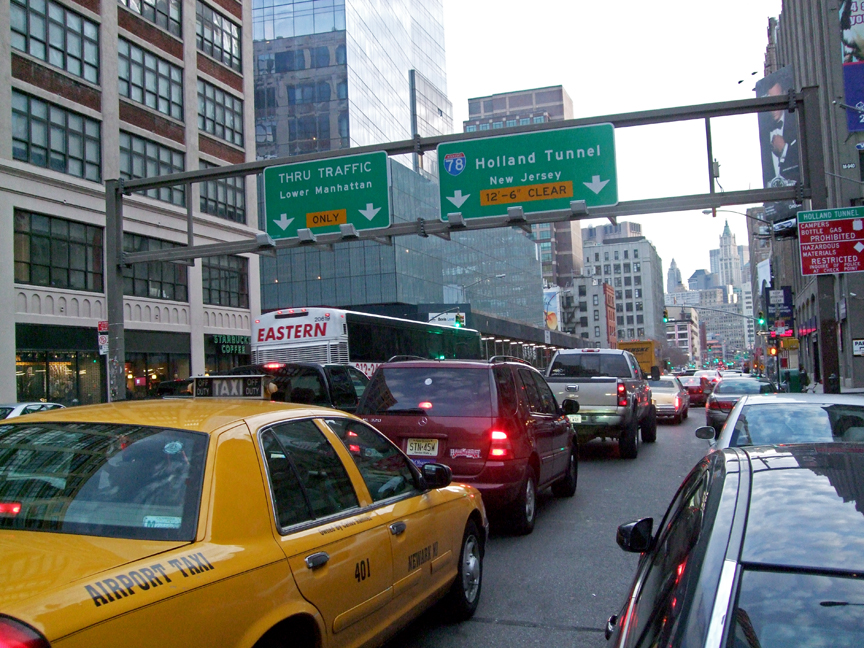
    There are only three ways to drive directly from Manhattan to New Jersey: the George Washington Bridge and the Lincoln and Holland Tunnels. So congestion is the rule of thumb. There is heavy traffic even at times that would be unexpected anywhere else – the photo was taken Sunday afternoon. Jersey anyone?

    *Why are New Yorkers so depressed? Because the light at the end of the tunnel is New Jersey!


  • Poor Whores

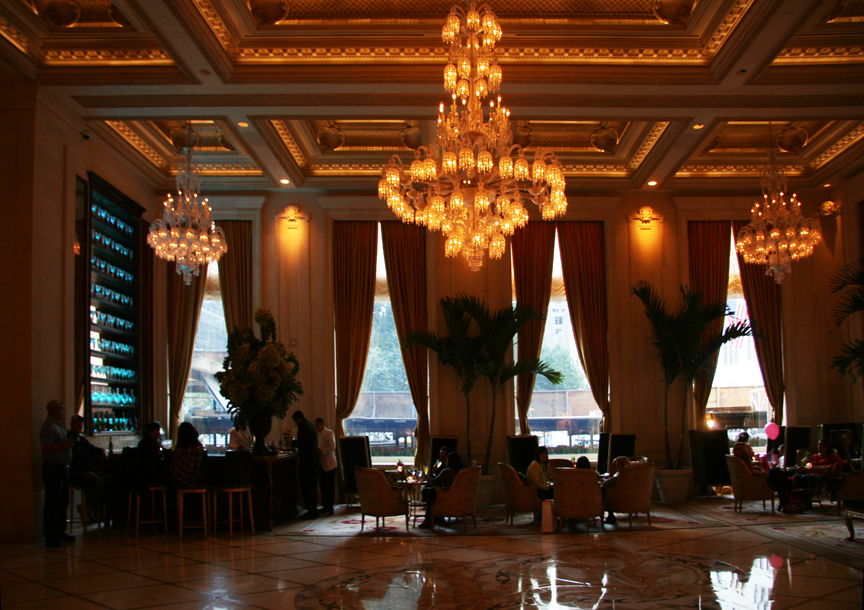
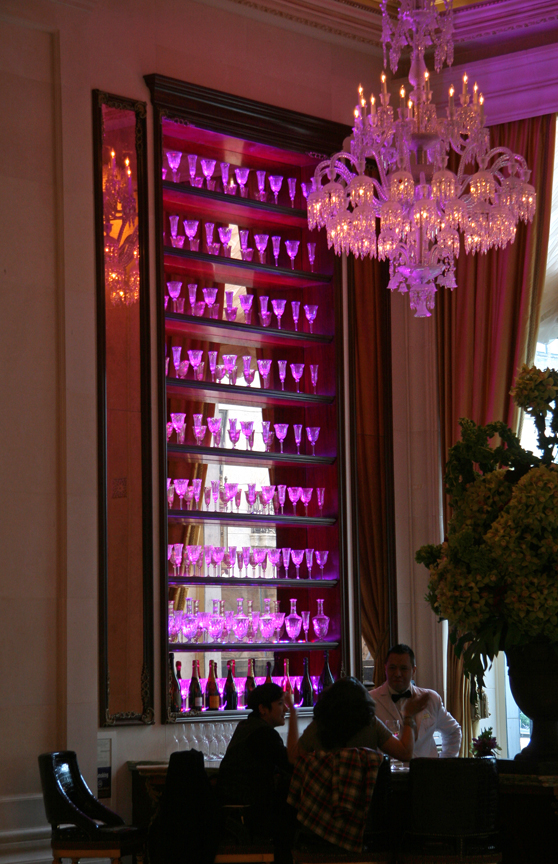
    It occurred to me while reading about the Plaza Hotel that, except to individuals such as Warren Buffet and Bill Gates and to sovereign nations, A BILLION BUCKS IS A LOT OF MONEY. That is what the total cost of the Plaza Hotel was: $675 million to purchase and $400 million to renovate. How do you make a return on that kind of money? Easy in New York City with a landmark property on Central Park. Start by renting rooms at $1000 per night. Sell off 182 rooms as condos (only 80 are now rented as hotel rooms). Read my story about the hotel here. The photo is of the corner lobby and its champagne bar with color-changing glassware display.

    I am perplexed by wealth. I have met wealthy individuals, and they are not all extraordinary individuals like Steve Jobs of Apple, Muhammad Yunus, or Sergey Brin and Larry Page of Google. Successful individuals appear to some combination of skills, instincts, and personality traits – I think pure chutzpah is one of them. And then there are the elements of luck, opportunity, and willingness to act on that opportunity.
    Some may feel that a love of money and a complete lack of scruples is all that separates them from success.

    Selling out is the key phrase. That if they adopted the mindset of a whore, riches would flow towards them, but their honesty and goodness keeps them in the middle or under class. I don’t think that is really true – I have met many who are willing to do anything for money, and their lives are a testament to bungling failure. So for me, the mystery remains, because although there are dishonest, unscrupulous businessmen and rich call girls, there are also many honorable millionaires/billionaires and poor whores…


  • dinamic_sidebar 4 none

©2026 New York Daily Photo Entries (RSS) and Comments (RSS)  Raindrops Theme