• Category Archives Curiosities of NYC
  • Crime Scene

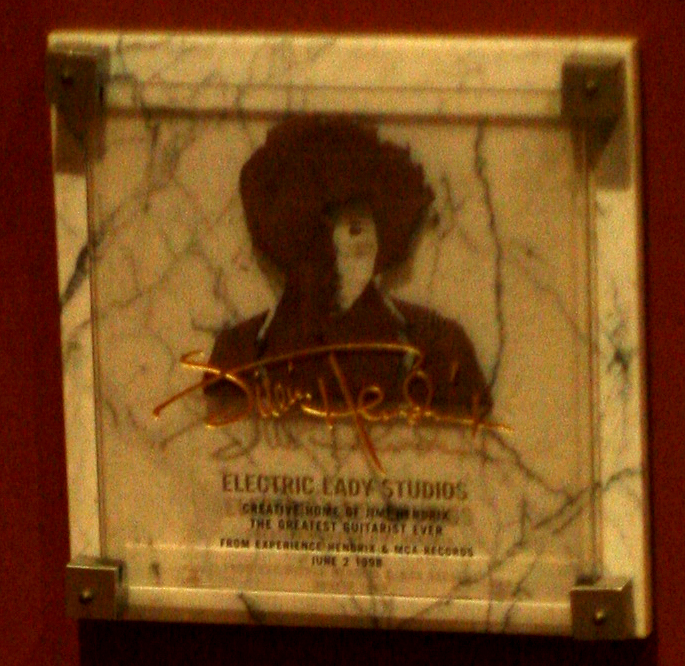
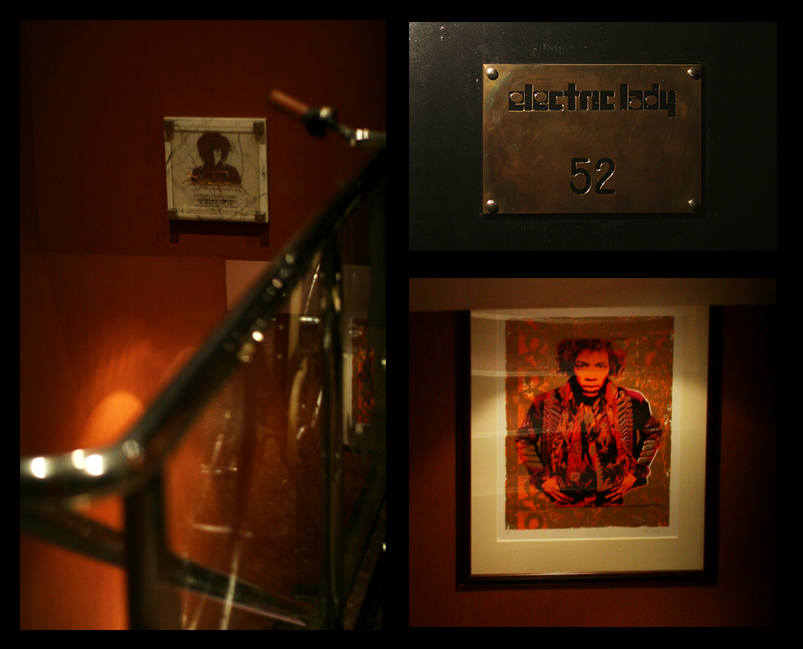
    I have a very special relationship with this place, Electric Lady Studios at 52 West Eighth Street. A regret of what could have been and what should have been. If you were here with me in person, I would hold my forefinger and thumb as close together as humanly possible without actually touching, leaving the tiniest sliver of light to pass through. And I would tell you, “That is how close I came to meeting Jimi Hendrix.” Not just meeting him, but spending a night with him and one other jamming on guitar.
    Now these were college days in a time of recklessness and excess. Everything from that period was chaotic and disjointed. Some of the details are foggy in my mind, so the story goes something like this:

    It was 1969. A winter’s night at approximately 4 AM, with a snowstorm blowing outside. A fellow NYU dormitory resident whose name I do not remember (perhaps not even a resident – it could have been an interloper, common at that time) said he was heading over to Electric Lady Studios to jam with Jimi and did I want to go? A stunned yes was the proper response, and with an electric guitar slung over his neck, we walked from the dorm down Eighth Street in the snowstorm. He buzzed when we arrived, announced his identity via intercom, and asked if Jimi was in. The response was that he was not. He typically was. So, disheartened, we made the short trek back.

    The following day, I asked someone who knew this man well and asked if my friend really knew Hendrix and played with him before and whether we would have actually been admitted to jam with Hendrix had he been at the studio. The answer was yes, yes, and yes. I was assured that my friend did know him and, had Jimi been there, we would have been admitted.

    Now this may not seem like much, but consider that this was an opportunity missed to have spent some hours with a living legend, James Marshall Hendrix. Not to see him in a concert or perhaps see a fleeting visage on the street, but to spend time with him in a private setting. These were days when legends and gods were approachable, a time when things and people did not become so overexposed, hyped, and marketed as to make them completely inaccessible. I missed other opportunities to see Jimi in concerts at the Fillmore East and his jams at a small club called Ungano’s.

    I have wanted to do a piece on Electric Lady Studios since the start of this blog, but the exterior is rather plain and uninteresting. But last night an opportunity made itself available. I saw someone leaving the studio and, for the first time, realized that the door to the entrance vestibule is not kept locked. Opening this door afforded a shot of the brass plaque in the photo. However, upon stepping into the vestibule, I was immediately warned that photography was not allowed.

    I also never realized that the studios were in the basement, accessed by a stairway which can be seen from the street if you peek through the crack in the curtains just right. I was able to see a marble plaque and a framed poster of Jimi in the stairwell. I was surprised to be able to get a couple of decent photos by squeezing my camera and head against a wall and shooting through a glass window at night into a dimly lit stairwell. If you go here, you can see an enlargement of the plaque and poster – the text of the plaque is actually legible.

    The history of this studio is just amazing, and rather than retell it here, I suggest you read it here at the Electric Lady Studios website. The studio was established in 1970, designed by John Storyk. It is still considered one of the finest recording studios in the world, and the roster of clients who have recorded there has to be one of the most astounding who’s who in music.

    Now I really want a tour of this place. And I had better do it soon, lest it becomes the second of life’s major regrets around the same place – like two crimes at the same scene…
  • Enigma

    The butt of many comedic jokes is the cliched man who is afraid to ask for directions or information. I am not that type of man – perhaps lax at times to ask if it is inconvenient to find someone. I certainly value the process of discovery and doing things for oneself, but how far does one want to go to learn things which are already known? How many wheels do you really want to reinvent?

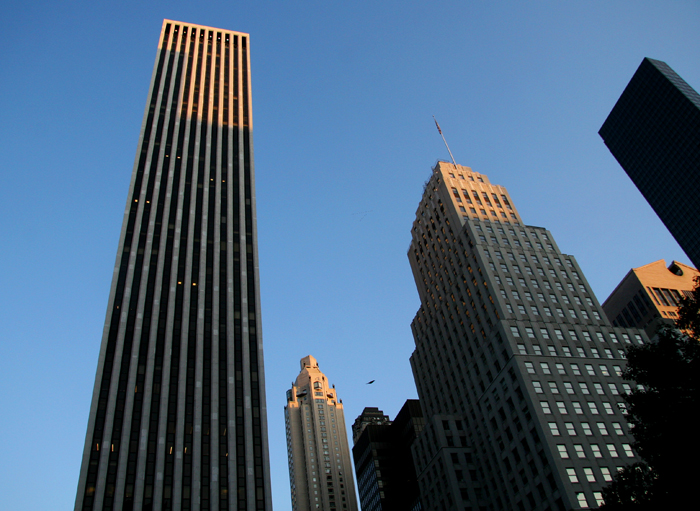
    The building in the center of the photo with the distinctive top has been an enigma for some time. I have an older photo which I wanted to use previously on this website, however, I tired of trying to identify it using online searches and printed references in my library. I resigned myself to a future trip where I would just visit the building itself rather than ferret out its name via GPS or triangulation.

    So I forgot about it until my recent jaunt to the Plaza Hotel, when I saw it haunting me in the distance once more while chatting with the doorman, who had worked there for two decades. This type of person can be a great source of information in the city – seasoned doormen and older taxi drivers have the luxury of meeting thousands of individuals from all walks of life over years of time. They also become acquainted with the details of places and things, with nuggets of info and insider gossip. So as I walked away, it occurred to me that a quick jog back to the doorman and a quick query might easily settle the identity of this building. And it did.

    The Four Seasons Hotel at 51 E. 57th Street was completed in 1993 and designed by world-renowned architect I.M. Pei and Frank Williams. Pei’s resume includes projects such as the glass pyramid at the Louvre museum in Paris. This 54-story building is the city’s tallest hotel. It is clad in French sandstone and capped with the spectacular Ty Warner penthouse, a nine-room suite with 25-foot ceilings and cantilevered glass balconies, which occupies the entire top floor with wraparound 360-degree views of the city. Amenities include a butler, fabrics woven from platinum and gold, a personal trainer, and a private chauffeur with a Rolls Royce Phantom.

    The lobby has marble floors and a soaring, back lit translucent onyx ceiling. If you are in the neighborhood, drop in for a peek…


  • Curriculum Vitae

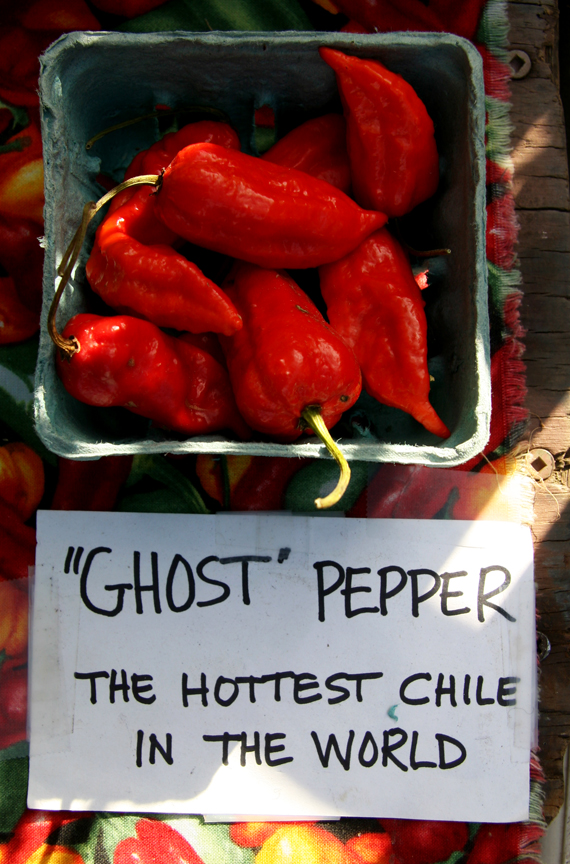
    Intellectually, I understand the consumption and love of hot chili peppers. I have read that the ingredient responsible for a pepper’s heat, capsaicin, will release endorphins, explaining the euphoria that many pepperheads have attributed to the consumption of chills. And I imagine, like any drug, one can develop a tolerance and desire for a stronger drug.

    But at a gut level, I cannot understand how people actually enjoy peppers so hot that they can entirely numb one’s mouth and lips or require special handling. There are cases where unchewed chilis have been known to perforate the bowel.

    There is a Scoville scale that rates the hotness of peppers by the level of capsaicin (based on parts per million) from 0 to 15,000,000 units (pure capsaicin). Habanero peppers are extremely hot and have a Scoville rating of 100,000 to 580,000 units (Red Savina Habanero).

    In 2006, the Ghost Pepper (Naga Jolokia or Bhut Jolokia) was discovered in India. Testing revealed a Scoville rating of over 1,000,000 units, making it the hottest chili pepper in the world.
    This is fascinating, but does any one need a chili pepper three times as strong as the average Habanero? In a country that loves to quantify, and where bigger is better, I suppose it would be a badge of honor to have this chili in your curriculum vitae…

    Photo Note: This photo was taken at the Union Square Greenmarket at the Eckerton Hill Farm produce stand – they always have a tremendous array of chili peppers. See more Union Square Greenmarket links in my posting on Heirloom tomatoes.


  • Stairway to Heaven

    Carrying a professional-looking camera can be either an asset or a liability, depending on time and place. It is an asset when in a situation where being a photographer is either a rite of passage or, perhaps, when it offers credibility that you are a pro and belong there – important if you are looking for stairways to heaven.

    However, there are many situations, especially post-9/11, where having a large camera is a real problem – a virtual branding where you will be observed, supervised, and forewarned that there is “no photography.”

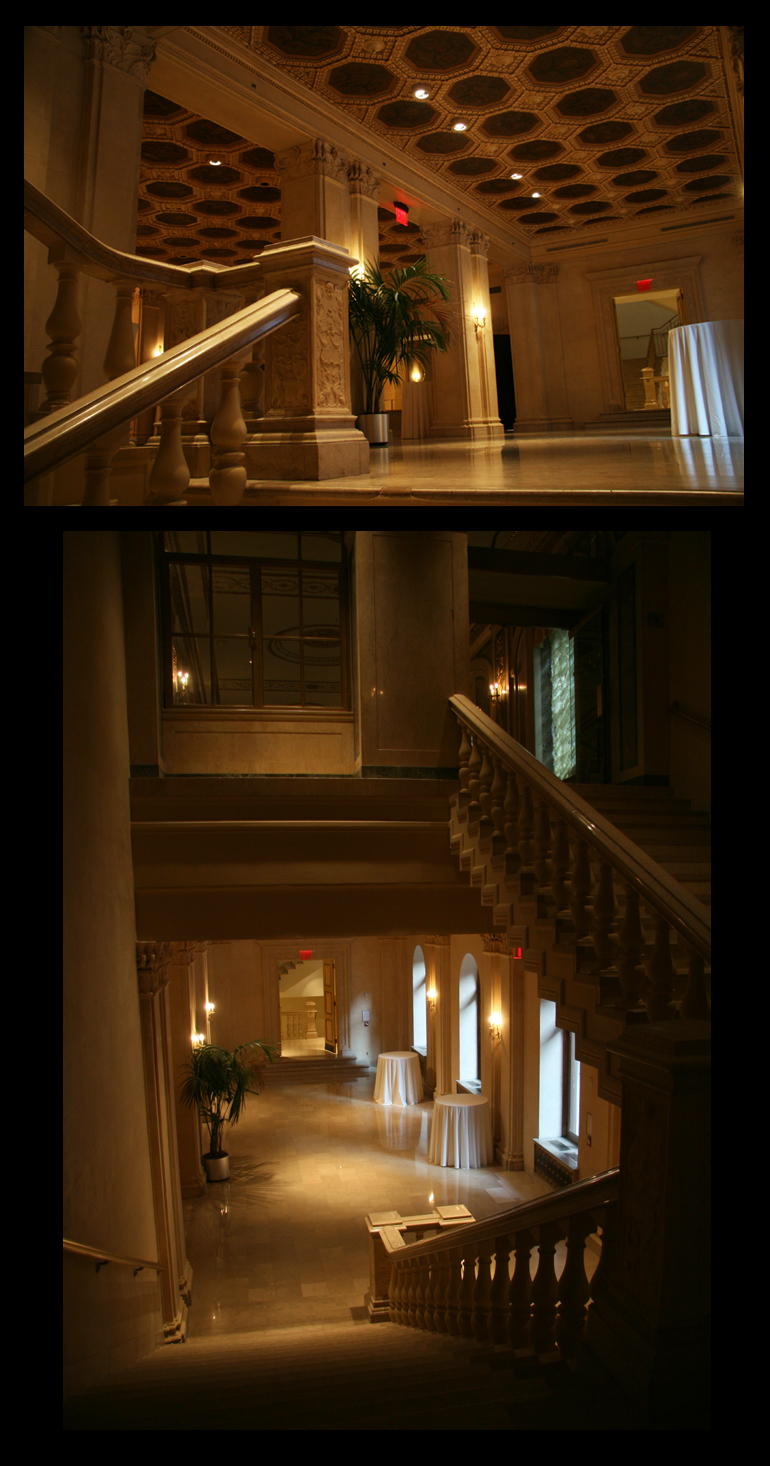
    So I was extremely surprised in my last visit to the Plaza Hotel to get free access to a stairwell and various adjoining rooms. See here for photos of the stairwell. It appeared that a rehearsal was taking place; camera and video crews were scattered about (see photo here). Perhaps I was seen as one of the crew. When properly outfitted and with an attitude that you belong, even security will frequently let down their guard.

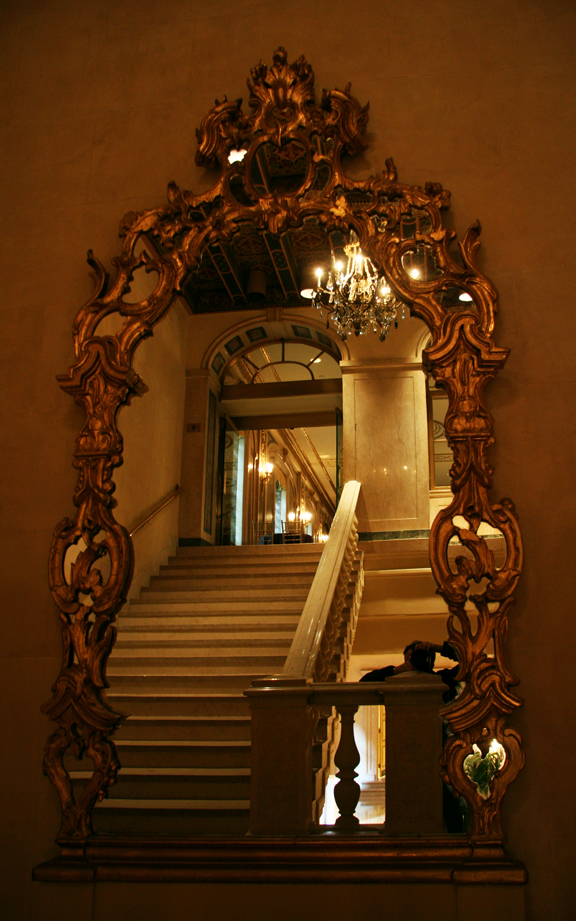
    I have been to the Plaza numerous times, and this was the first time since it was newly renovated. The public rooms on the ground floor have been beautifully done. Around the perimeter of the central Palm Court, there are many small boutiques. In touring this area, I was startled when I came across this huge ornate mirror in a stairway. The reflection actually afforded one of the best views and ways to capture the stairway photographically. So if you act like you belong, and with a little luck, you may find a stairway to heaven…


  • Jungle Gym

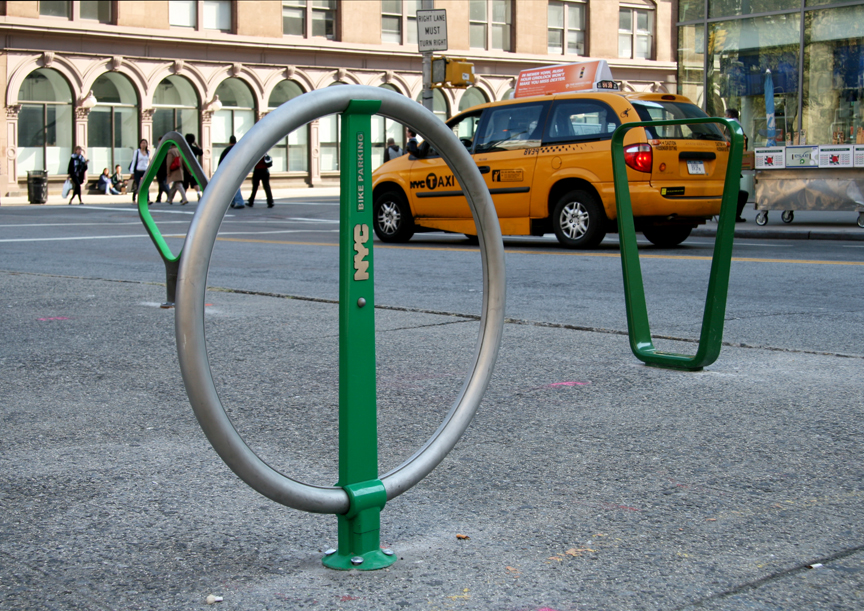
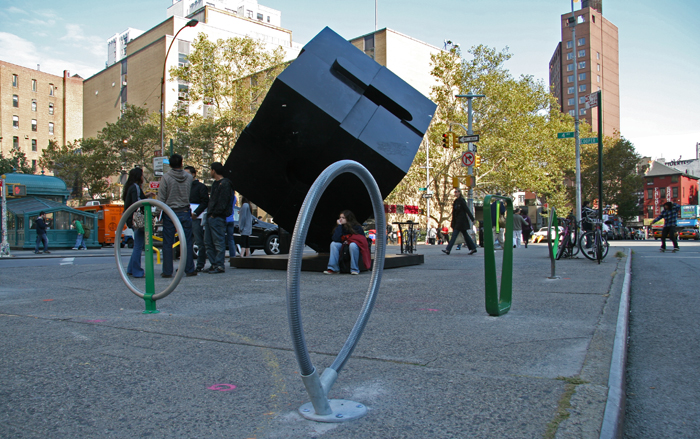
    What I love about this city is the adventure and discoveries. New York is like a real jungle, and walking though the dense thicket of things and people is like a safari, revealing surprises at every turn. While walking through the East Village and passing by the island that is home to the Astor Place cube, I discovered a jungle gym with an assortment of unusual steel forms (that appeared to be bike racks) anchored to the ground. My immediate thought was to get a photo, my focus primarily about composition and other photographic concerns. See second photo with cube here.

    It never occurred to me to question why these objects were here or why the collection was so disparate. The extreme variety of shapes and sizes should have tipped me off that there was more than meets the eye.
    I had essentially forgotten the photos; a quick scan of them on my flash card made me question whether this motley crew of bike racks was blog-worthy. However, the forms were rather attractive, and a quick online search revealed a pleasant surprise – these were the nine finalists in the “CityRack” Design Competition for New City Bike-Parking Standard by the New York City Department of Transportation. See the nine designs and information about the competition here.

    The competition drew over 200 entrants from 24 states and 26 nations. An international jury of six will decide the first, second, and third place winners. The winning design will be announced at the Cooper-Hewitt Museum during National Design Week (October 19-25, 2008). The first place winner will receive $10,000 and transfer design rights to the City of New York, which intends to use the winning sidewalk bike rack design as its new prototype for bicycle parking. There are currently more than 5000 racks throughout the city with a design that is over 10 years old.

    As I have written about before in Very Practical, the overriding consideration in this city for things in public spaces is their ability to withstand vandalism, abuse, and heavy use. For better or for worse, these things supersede all others and utility rules.
    What I love about these designs is that it is clear that the entrants really understood the harsh NYC environment; all of the designs are minimalist and look like they would survive.

    I am sure it will be quite an honor and a thrill for the winner to stroll the jungle that is New York City, discovering his or her design on the streets…


  • Pumpkins Too

    The display in this photo may appear to be somewhat early, but that is the state of the current retail environment. Business is so much more sophisticated and competitive. The general increase in foreknowledge of holiday sales has lead to an enormous expectation on the part of businesses. So now, retailers extend holiday periods as much as possible in hopes of driving more sales. Historically, the Christmas season has begun on Black Friday, the day after Thanksgiving. However, we now see many retailers with Christmas displays and ornamentation well in advance of Thanksgiving.

    For many retailers, profit or loss for the entire year depends on Christmas sales, so I am sympathetic to a degree. But on the other hand, the overly aggressive marketing, advertising, and promotion can become distasteful, turning holidays into nothing but commercial events. Soon we risk having a perennial Christmas. I am not against celebration, but one must be careful, or the spirit and meaning of holidays can be easily lost.

    Autumn and Halloween are very much times defined by nature and the outdoors. Pumpkins and straw are visual treats for city dwellers, much-needed reminders that there is a world apart from concrete, asphalt, glass. and steel. The city has to put its own spin on many holidays, keeping as many key elements as we can and improvising the rest. Trick-or-treat at Halloween is one holiday activity that is severely curtailed.

    But we have pumpkins – wonderful eye candy for triggering memories of shuffling though fallen leaves or the excitement of making the neighborhood rounds on Halloween…


  • Being Trumps Doing

    One of the best things about this city is the plethora of extraordinary and unusual people and things. I have spoken to a homeless person who graduated from Columbia University. Street musicians who go to Julliard. Physics professors. The editor of the Paris Review. And many who are not renowned in any way but who are absolutely brilliant in either a mainstream interest or some obscure niche.

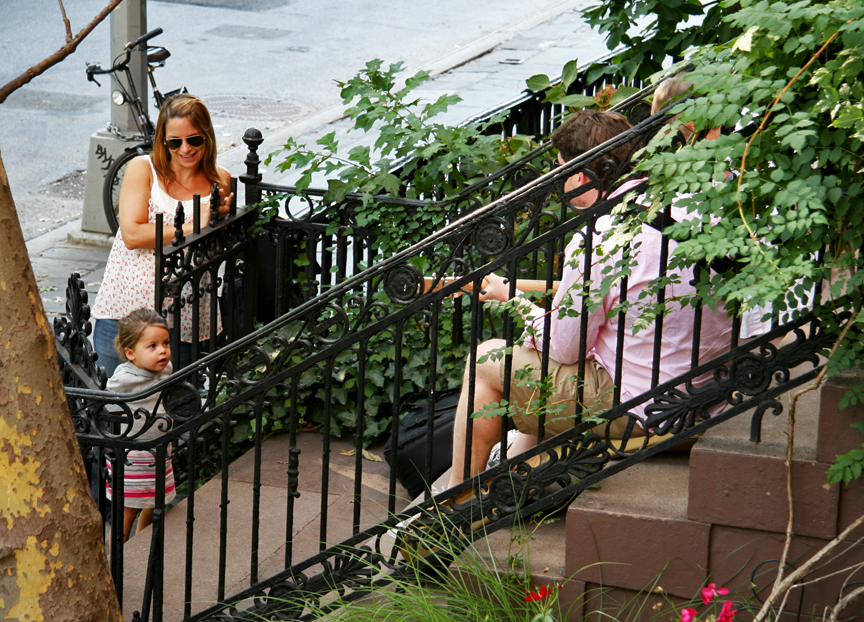
    Those of you who read this blog regularly know that I am in the throws of a renovation in my NYC apartment. It is frustrating to spend beautiful days indoors hammering and painting, particularly on a Sunday with blue skies and warm air in late September. In sampling the air with my head out my window before leaving my home, I noticed two guitarists playing on the stoop of my building, not a typical occurrence at all.

    When I exited my home, already late afternoon, my intention was to go do my doings. However, after a polite interchange of hellos, it occurred to me that I had no real doings to do apart from going out to enjoy the day. Perhaps I should spend a moment and see what these two guitarists had to offer. As it turned out, they played some of the best original music I have heard. They were quite accommodating, with Eric improvising a tune for a 2 1/2 year old girl. I learned that they both play publicly. We exchanged emails, and I learned that Ian Gittler and Eric Silverman will be playing back to back on October 4th at the Ace of Clubs on Great Jones Street.

    In the act of going to do, one can easily overlook things much more interesting at hand. I frequently observe people in this city rushing by a major happening with great fervor and intention, perhaps part of an agenda.

    It behooves anyone in this city, resident or not, to really slow down and observe, as difficult as that may be in a fast-moving world and a faster city. Never make assumptions based on appearances or be afraid to engage in conversations. I have so frequently missed remarkable people and things, right under my nose, only to be told later by a friend. Don’t miss the extraordinary, rush to the ordinary, or let doing trump being


  • Sense of Humor

    I had a small inkling that Judson Memorial Church was atypical and involved in community works. But I had no idea of the extent of this involvement nor the radical nature of the social programs it has supported. In fact, I am puzzled as to how some of the causes they have supported are even congruent with the tenets of the Protestant Church. Christian churches do have a history of outreach and social programs, but Judson really takes it much further and in unexpected directions.

    Founded in 1890 by Baptist preacher Edward Judson, the church was established form the beginning to serve the growing immigrant community in lower Manhattan (the Church is located on Washington Square South, immersed in the NYU “campus”).

    They ran a free medical/dental clinic and a settlement house at 179 Sullivan Street. At times, they allowed homeless men to sleep on their pews. Beginning in the mid-1960s, Moody and associate minister and composer Al Carmines (1962-81) brought Judson first a city-wide and then a national reputation, opening the church to experimental, avant-garde artists from many genres such as dance, painting, and theatre. They have organized politically around issues of civil rights, free expression, abortion rights, and the decriminalization of prostitution (in the 1970s they established a Professional Women’s Clinic for women engaged in prostitution). Judson Church trains future clergy in public ministry and has taken a leading role in the New Sanctuary Movement for immigrant rights. They are “gay-friendly.”

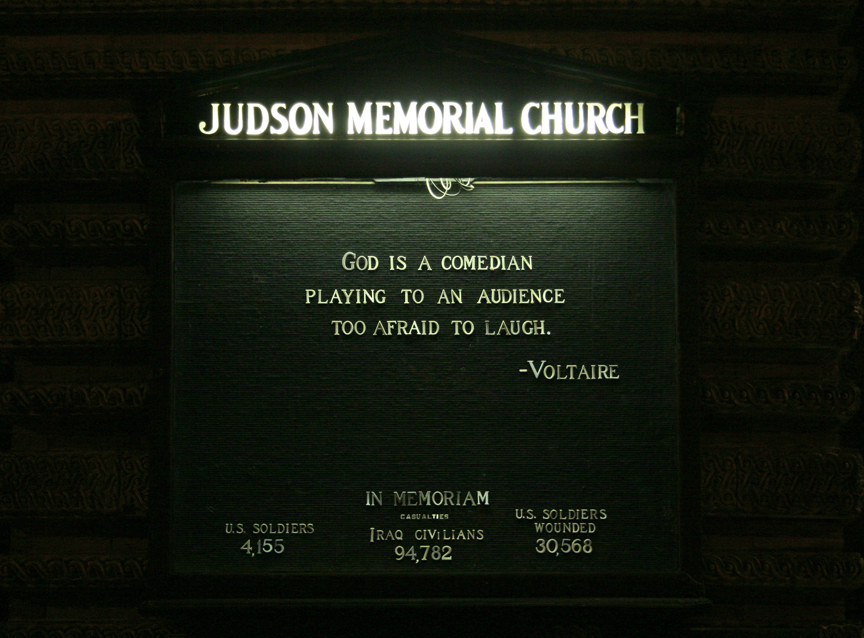
    Regarding the quote currently displayed outside the church: Voltaire was a major figure in the French Enlightenment, and his works are a huge subject matter – he was a prolific writer, having penned over 20,000 letters and over 2,000 books and pamphlets. He took many controversial positions and was exiled from France a number of times. Voltaire distrusted democracy, which he saw as propagating the idiocy of the masses.

    Voltaire is often mistaken as an atheist – some attribute this view to a quote from one of his poems that translates, “If God did not exist, it would be necessary to invent Him.” Actually, Voltaire was a leading Deist – his criticisms were more of organized religions than of religion itself.

    I’m not being evasive, but space on this blog does not allow for a proper distillation of the various thoughts about Voltaire’s quote, “God is a comedian playing to an audience too afraid to laugh.” Suffice it to say that many feel it has been misinterpreted and taken too literally. Any theologians or philosophers who want to posit an interpretation of God’s sense of humor?


  • Balsamic Vinaigrette


    This scene was so evocative of childhood summers – bathing suits and sprinklers. This woman was, of course, not running through these sprinklers, but sunbathing at 10 AM on a weekday with lawn sprinklers in the background was both unusual and suggestive – the scene begged for a photo. Soon, sunbathing will be a distant summer memory. Although it is technically still summer, the collective mindset changes greatly after Labor Day and the start of the school year. The reality of summer’s end is further reinforced by cool clear days, a presage to autumn.

    I am surprised at how universal the practice of cooling off by running through a sprinkler is. I always assumed that only the desperately poor resorted to this summer heat cooling solution. But in speaking to many people over the years from different social strata and countries, running through sprinklers appears to be a play activity that transends class and nationality. Children will generally eschew concerns regarding image or status. The size of a pool or the particular location of a summer house is not of much concern to a child on summer break. Of course, there are exceptions – children who have been raised at an early age to appreciate the “finer things,” which frequently translates as snobbery. I find that this can be quite disturbing.

    Children should be taught about quality and not be brought up as classless boors, but one must be careful to not end up with children intolerant of the ordinary – the world is comprised predominantly of ordinary people and ordinary things. Arrogance, snobbery, elitism, and one-upmanship are not endearing qualities in children, and all should remember that the world is populated with haves and the have-nots, primarily have-nots.

    I am reminded of a frightening occurence in a restaurant. A young child was essentially having a temper tantrum. The reason? His preferred salad dressing was not available: balsamic vinaigrette…


  • Big Buddha

    If you are looking for surprises, head to Manhattan’s Chinatown, generally considered the largest or one of the largest (depending on whose counting and how) outside China. The main attractions here are primarily restaurants, indoor and outdoor food vendors, and shops carrying Chinese tourist items and heavily discounted consumer goods, including copies of brand-name merchandise.

    So I was quite startled while walking by the ticket office to the Fung Wah bus company to find the Mahayana Buddhist Temple, an enormous place with a faux pagoda front and lions, prominently located at 133 Canal Street and the Bowery – in no way an out-of-the-way location. Yet I have been by the intersection hundreds of times and never noticed this place.

    Whimsically, I entered the place with no expectations. I was even more surprised to find a huge room with this 16-foot-tall Buddha, the largest in the city.
    Until 1995, this building was occupied by the Rosemary Theater. In 1996, it was converted to the Mahayana Buddhist Temple by Annie Ying, who established the first storefront temples on the East Coast and a temple/retreat on a 114-acre site in South Cairo, New York. Her husband, James Ying, operated a chain of gift shops in Chinatown and the neighboring suburbs.

    But the most interesting twist is that their son, Dr. Nelson Ying who runs the temple, has a Ph.D in nuclear physics and is adjunct professor at the University of Central Florida. He was the first Buddhist preacher to perform Buddhist weddings in New York State. He is not a priest, however, as he does not meet the requirements of being vegetarian or unmarried. He and his parents hail from Shanghai, which they left in 1955 to come to this country. Only in New York…

    Related Postings: Ridiculous, Hallmarks & Earmarks, Tea Time, Durian, Pearl River Mart, At Arm’s Length


  • No Radio

    I have a very strict policy of only using photos taken of or in the 5 boroughs of New York City. And being away on vacation is no excuse to use photos of another locale. I prepare for this in advance.
    However, the mini-event that occurred on Saturday was so outrageous to me, from a New Yorker’s perspective, that I have to break my rules and tell this tale.

    While away this weekend, my two nephews and a friend decided to go for a short canoe ride in a river at my parents’ gated condo community. They asked if I suggested wearing shorts rather than pants in the event that they get wet. My response was that if they were to fall into a river, shorts versus pants would not be a consideration. But I DID highly recommend emptying their pockets of valuables, particularly knowing that they were affluent boys and that the value of the contents of their pockets was probably greater than that of many 3rd world countries. They saw the sense of this and immediately concurred.
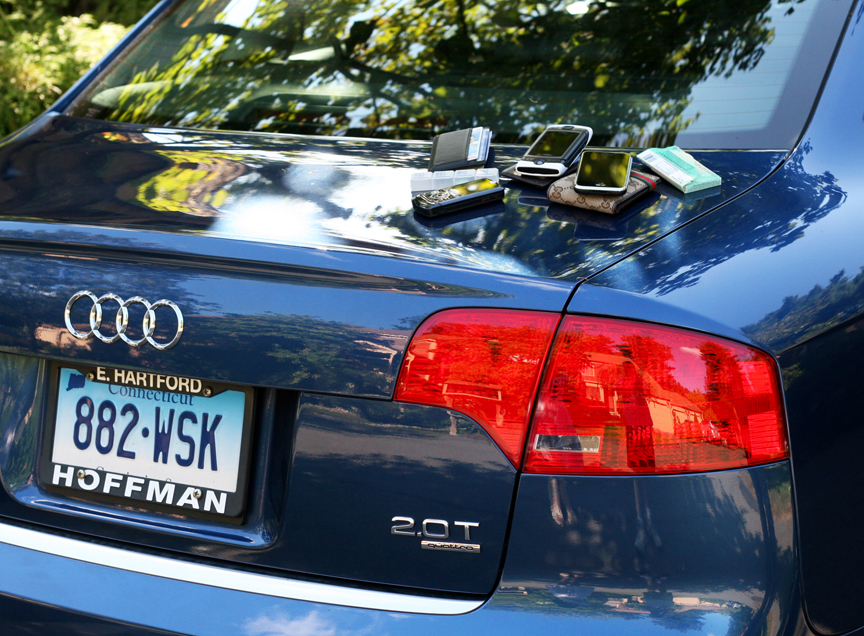
    So out came the iPhones, cellphones, a wallet with credit cards visible, and a Gucci wallet. They placed all of these items on the BACK OF THE CAR IN PLAIN VIEW (appropriately on the hood of one boy’s Audi). I was incredulous. “You guys are going to leave all this outside in plain view?” I asked. They responded, “Whose going to take it? There’s only a bunch of old people here.” That was not strictly true, and I am still absolutely floored by this occurrence.

    Now admittedly, this cavalier attitude was largely due to a lifetime of privilege and never knowing need. And it was a gated community. But there was also an element of TRUST that is just nonexistent in New York City. You cannot leave anything of value unattended. I have heard stories of thefts that are unfathomable; a UPS driver once told me of a man who ran down the street with a large projection television stolen from his truck! The driver was unable to catch him in the ensuing chase.

    In New York City, a vehicle should always be locked, and nothing of value should be in plain view. This process is so automatic to me that it has become a reflex action – I even lock my car in the driveway of my parents’ home in the suburbs.

    Every seasoned New Yorker remembers a time when auto break-ins for radios were common. At one time, I recall seeing broken glass somewhere on the streets on nearly a daily basis – a telltale sign of a recent break-in. Soon the ubiquitous “NO RADIO” signs in the windows of cars started to become a common sight – a plea to the would-be thief that a particular car was not a worthwhile target.

    We live in a time where disposable income seems to be greater with youth, a generation that would never grasp the idea of placing a sign in the window of their car that says “NO RADIO”…


  • Work

    Labor Day is celebrated as a day off for the working class. We live in a country where entrepreneurism is extolled and promoted in media to the extent that to be a member of the working class almost implies failure in the American dream. But society only needs a very small number of chiefs, and very few have the unique combination of skills and temperament to be one. So an appreciation and recognition of those soldiers who are the foundation and engine of the economy is welcome.

    I come from a working class background and from an extremely austere area in a part of the country synonymous with the work ethic: New England. In my family’s case, northern Maine. In my family, work defines a person, personal wealth much less so unless acquired through very hard work.

    In such an environment where survival is virtually the only concern, the need for every able body to work imposes an egalitarianism. In a way, women’s rights were old news for us – no time or place in this world for sexism. In fact, most families were quite matriarchal, with wives controlling the finances and major decisions. My father was taken out of school at age 12 to work full-time as a woodcutter in the north woods of Maine in winters with temperatures as low as -40 degrees. Potato picking was the only other industry – grueling work with 12-hour days. Workers lived in camps onsite for the duration of the the picking season – everyone picked, even children. The school year was adjusted to accommodate this important time, one of the few opportunities to make money.

    So I have been indelibly stamped with the importance of work, and it has become part of the fabric of my being. As I grow older, the importance of work has become greater. Try as I may, I cannot shake my intolerance for lack of ambition and hard work in others.

    I am reminded of a family trip to Versailles, one of the most remarkable testaments to lavish, opulent excess in the world. We entered one of the King’s bedchambers with woodwork which had been exquisitely and painstaking hand-carved. My father’s comment should have come as no surprise (although it did at the time) and left a lasting impression of how a man like him sees the world. After scanning the room and reflecting on it, he said, “There’s a lot of work in here.”


  • Nuance

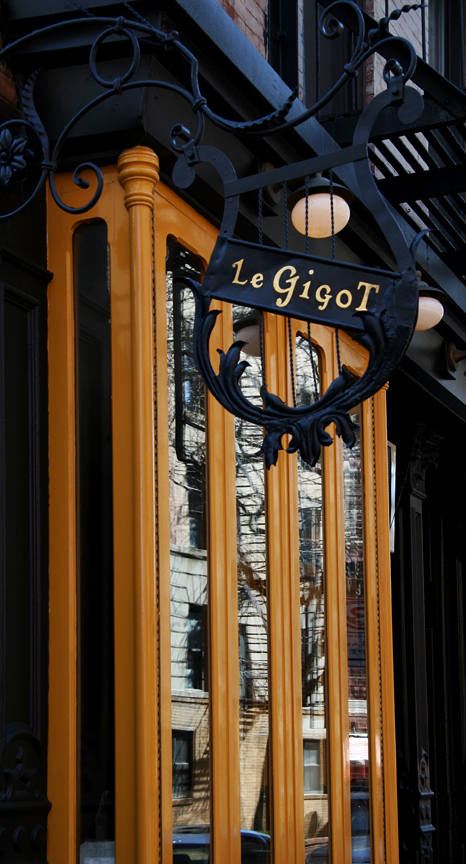
    Today’s posting is more about a personal frustration than something that is strictly related to New York City. I have had this photo for quite some time – I always loved this small, elegant sign hanging outside this fine tiny French restaurant, Le Gigot on Cornelia Street in the West Village.

    But how to use this photo? There really isn’t anything about it which is particularly remarkable, but it is quite elegant. Ah, there’s the source of my irritation – subtlety, nuance, and understatement.

    I recall years ago having a conversation with an acquaintance regarding the perpetual debate regarding Apple vs. Windows-based PCs. Ease of use, graphics, or music professionals do not explain much of the large user base – there are plenty of scientists, business people, attorneys, and computer geeks who use Apple.
    At one point, I stated that many of the differences were due to nuances in the interface, such as subpixel font smoothing, and that customers are willing to pay for that difference. My friend concurred and made the statement that subtlety and nuance were things all too underappreciated in this country. But nuance is the very thing that typically separates the ordinary from the finer things in life, whether it is clothing, food, wine, cameras, or furniture.

    So in light of a culture dominated by bigger is better, deep discount big box stores, reality TV shows, gratuitous violence, and other extreme, in-your-face manifestations of a utilitarian, dumbed-down world, let’s celebrate nuance today…


  • The Bottom of Things

    Now you know there has to be a story behind an “ordinary” drinking glass that you find in so many NYC restaurants. I see this heavy duty glass with the five-sided base everywhere. I was a math and science person, so the pentagonal base always appealed to me. And I have spent years looking at them while waiting for a meal and admiring the style and heft while drinking from it. Rather attractive for something so common and utilitarian. Like the Chinese soup spoon. So I could stand it no longer.  I needed to know – who makes them and where? Is there anything special about them?

    The problem is that no one really cares about a heavy duty commercial drinking glass, so to find information, one has to really dig. Dig deep. An online search really isn’t going to be easy. You are going to have to look at hundreds of images of beverage glasses for the restaurant industry and hope to get lucky or find your treasure through pure tenacity.

    But find it I did, after downloading and skimming a 124-page catalog. I believe our subject is made by Libbey Glass and is one of their Inverness Duratuff Tumblers. They make this style glass in a number of sizes. They also make a number of paneled (faceted) tumbler styles which are very recognizable. I feel so much better now after finally locating my quarry.

    I never see these glasses break. From the Libbey literature, you find, “DuraTuff treatment is a special thermal after-process for “pressed” tumblers and stemware that produces durable glassware with prolonged service life for the foodservice industry.”

    However, there is plenty more to know – the company (established in 1888), the history, the inventor, a timeline, and why the base is five-sided. The pentagonal bottom is not even addressed in the Libbey catalog. Most things are forgotten except by a few. If I was doing a major story, I would call Libbey and find those few. In fact, I would GO to their factory in Ohio, do some interviews, and really get to the BOTTOM of that five-sided glass…


  • Ridiculous

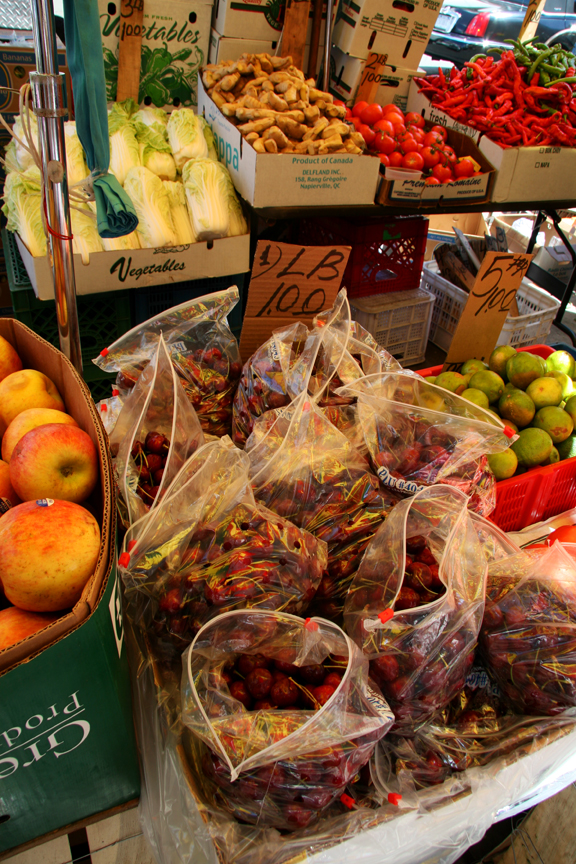
    There are discounts, sales, deals, and competitive pricing. And then there is RIDICULOUS pricing. And if you want to see the ridiculous, go to Chinatown. The Chinese sell and consume a lot of produce, much of it sold on the streets from carts and open air shops. On my last visit, I was absolutely stunned with the pricing on their goods. Can you really sell produce with differences of 200-500% from other vendors? I purchased bing cherries at $1.00 per pound! Mangoes and papayas were being sold in cases of 9 for $9. Nineteen kiwis for $2? I felt like I was buying stolen merchandise. The quality is typically excellent – the turnover is high and everything is quite fresh. Things don’t linger at the bottom of a pile for days.

    Perhaps the issue is not so much that Chinatown discounts so heavily, but that everyone else marks up so much. I have lived in Manhattan for many years and have become accustomed to high prices. I typically never compare with pricing outside the city.*

    In defense of the merchants, rents in Manhattan are extraordinary, and food sellers do not get any particular special treatment. One green grocer I patronize saw their rent go from $38,000 per month to $45,000 several years ago. And their electric bills are $18,000 per month. Unfortunately, the costs need to be passed onto the customer. Outdoor markets and food carts have minimal overhead.

    I once recall being at a New Years Eve party, thrown by a friend who lives in a loft in Chinatown. At one point, we ran out of orange juice, and I was asked to go on a search mission. It was late and I was not shopping for bargains. I made my purchase in the first Chinese deli I came across. I was stunned by the pricing, which was about 50% less than what I saw elsewhere in Manhattan for the same exact item and brand. When I returned and expressed my amazement, my friend only commented in a matter-of-fact way: “When it comes to price, you can’t beat Chinatown.”…

    *Note: I just called my mother, who lives over one hundred miles from the city in a rural area. She confirmed current pricing of cherries at the local supermarket at $4.99/lb and kiwis at 2 for $1. She was flabbergasted at the pricing I gave her. Chinatown rules.


  • dinamic_sidebar 4 none

©2026 New York Daily Photo Entries (RSS) and Comments (RSS)  Raindrops Theme