• Category Archives Curiosities of NYC
  • 17 Monitors

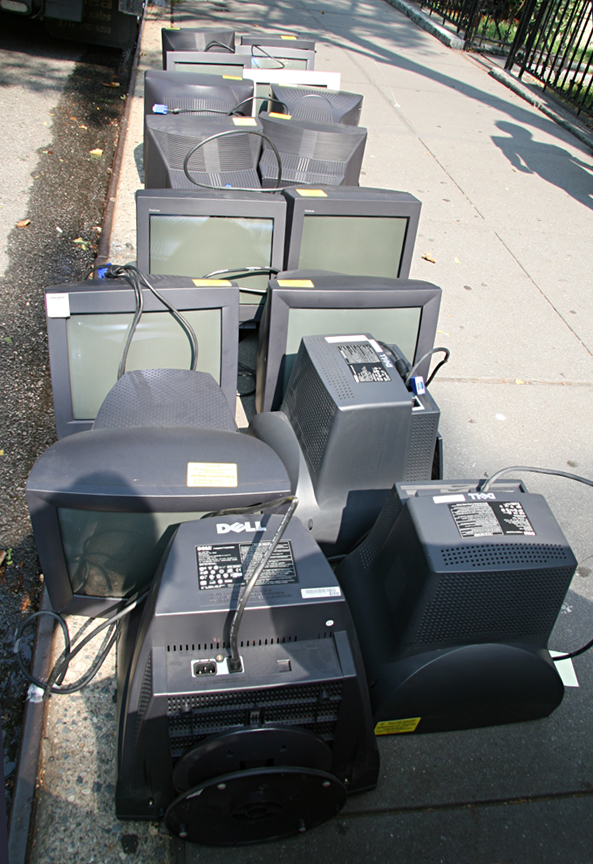
    I really wanted to try and grab all these monitors and find homes for them, but their time on the street (outside an NYU office) was short – they were being loaded on a truck for recycling. I spoke to one of the truckers and asked about their condition. He was fairly vague and non-specific. My gut feeling, though, was that these were being tossed and replaced by flat-screen LCD monitors, a common scenario nowadays. After all, what is the likelihood of 17 virtually identical monitors failing at the same time or failing over time and being stored? I have acquired many CRT monitors recently for free, including high-end graphics models – many excellent quality monitors are being given away or being sold very cheaply (check out craigslist in your area) as people replace them with more compact LCDs.

    Disposal of electronics in NYC is a huge problem. In my office, it took us at least a year to find a way to dispose of our computers, printers, etc.. Our first choice was to donate the working items for reuse (many of the items still functioned.) No luck at all – our computers were even rejected by an agency that donates computers to the underprivileged in Africa because they were too old for them to accept. When the reuse approach was clearly not viable, we decided to recycle them. We still had difficulty – we tried non-profit organizations and private for-profit companies.

    The city does have a recycling program, but it requires dropping off, has infrequent recycling days, and limits individuals to one item at a time – impractical for a business with many items to dispose of. We finally found a wonderful non-profit organization to work with (Per Scholas) that even arranged to pick up. However, we did have to pay per component to get them recycled…


  • Lunch Limbo

    This is a trend for which I have been waiting a long time: better street food vendors. Hot dog and pretzel carts don’t do the job anymore, certainly not for lunch. Most people I know of buy most of their lunches out. The plethora of options and convenience of delis and other takeout venues in NYC wears down one’s resistance, and soon the idea of bringing lunch to work becomes a charming notion and dim memory. But we get spoiled here, and soon even the absolutely incredible selection of foods in a deli or green grocer is not enough – we still feel that there is “nothing to eat,” and one graduates to small takeout restaurants. But the best of these become quite expensive on a regular basis (sandwiches at $8-$10), and one is left in lunch limbo – what to eat. What we really want is a prepared, cooked MEAL that is excellent and inexpensive. Enter the high-quality street food vendor, where $5 will go a long way. I wrote of this already in my story about NY Dosas, a Vendy Award-winning Sri Lankan food cart on Washington Square South.

    But now we have a new problem: lines (I understand that NY Dosas gets as many as 60 people waiting in line). New Yorkers are suckers for “the best,” and there are always many willing to wait in line to get that special thing, best thing, get something first (iPhone, Harry Potter book), blah blah blah. We tried Calexico yesterday, a Vendy Award finalist. We had been trying for some time, but unless you phone them in advance by 11:45 AM (they have a cellphone) or get there by noon, you’re looking at huge lines. The food was good, but I’m not sure it was worth strategic planning in our office for a week to score a meal without waiting for an hour…

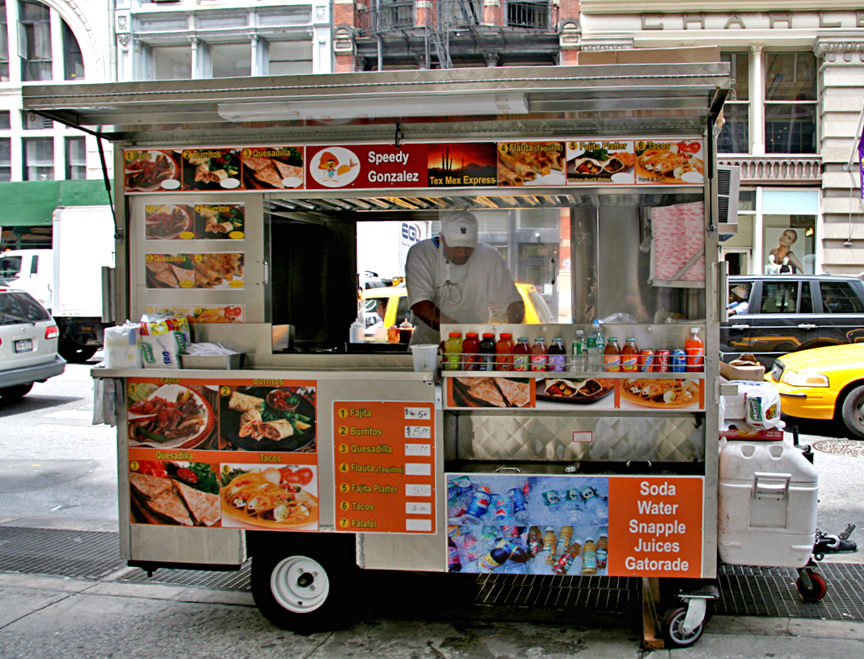
    NOTE: The cart in the photo is Speedy Gonzalez, specializing in TexMex and is located on Broadway in SoHo – good food, no lines (the last time I was there).


  • Window Washer

    Posted on by Brian Dubé

    Unfortunately, I do not have a photo of a window washer on a skyscraper, but you get the idea. This is window washing in NYC – a job that has a lot of perks but is not for the faint of heart.

    I have learned a number of things about window washing. It is dangerous. It’s a good job for voyeurs. Stories and cliches abound about the things window washers see, propositions from the wife home alone, and the access washers have to the homes of the wealthy. There are various ways to access windows, such as scaffolding, window hooks, and belts, as seen in the photo. Some windows are accessed strictly by walking on a ledge with no safety equipment, just holding on with one’s hands – this is how the windows of my office are cleaned.

    The squeegee is the tool of choice – most nonprofessionals are inclined to use paper towels or rags, which just moves the dirt around. The squeegee goes back to the squilgee of the middle ages used by fishermen to clean boat decks. The modern single-bladed version of today was invented by Italian immigrant and window washer Ettore Steccone in 1936. It continues to be manufactured and is the choice of pros. The composition of the rubber is still a closely guarded secret and apparently continues to give the Ettore the edge over the competition. The future of window washers, however, does not look that bright. Many innovations in windows have made washing easier, such as telescopic and water fed poles. Most new windows tilt in a way that they can be cleaned from the inside. And then there are windows made from self-cleaning glass developed by Pilkington of the UK and also made by PPG, Asahi Glass Co., and Saint Gobain. The glass is manufactured with a special titanium dioxide photocatalytic coating – dirt is broken down by UV light and washed away by the rain…

    Posted on by Brian Dubé

  • Salat

    Posted on by Brian Dubé

    The temptation to use the word juxtaposition is particularly great in NYC. I was surprised that a search of this blog returns only two uses since its inception. So, I use it again – if there is need for the word juxtaposition, the scene in the photo (taken in Prospect Park, Brooklyn) has to be one of those times. In many decades living here, this is the first time I have witnessed this act in public in NYC.

    Islam, like all major organized religions, has many rituals and laws, and the daily prayers, or salat, are one of the pillars of the faith. The purpose, number, times of day, place, preparation, dress, movements, and positions are all prescribed. These prayers are required of every adult Muslim and are performed on a traditional prayer mat, or musalla, five times a day: 1. Fajr – Before sunrise, 2. Zuhr – After the sun begins to decline from its zenith, 3. Asr – Mid-afternoon, 4. Maghrib – Just after sunset, and 5. Isha – night. The supplicant faces qibla (Arabic for the direction faced when praying), which is towards the Kaaba in Mecca.

    I found the scene encouraging to see such a group together – Islamic women praying, Hispanic families having a picnic, Caucasian children and an older woman in the playground, and two black children fishing in the lake behind me…

    Posted on by Brian Dubé

  • Garment District

    Posted on by Brian Dubé

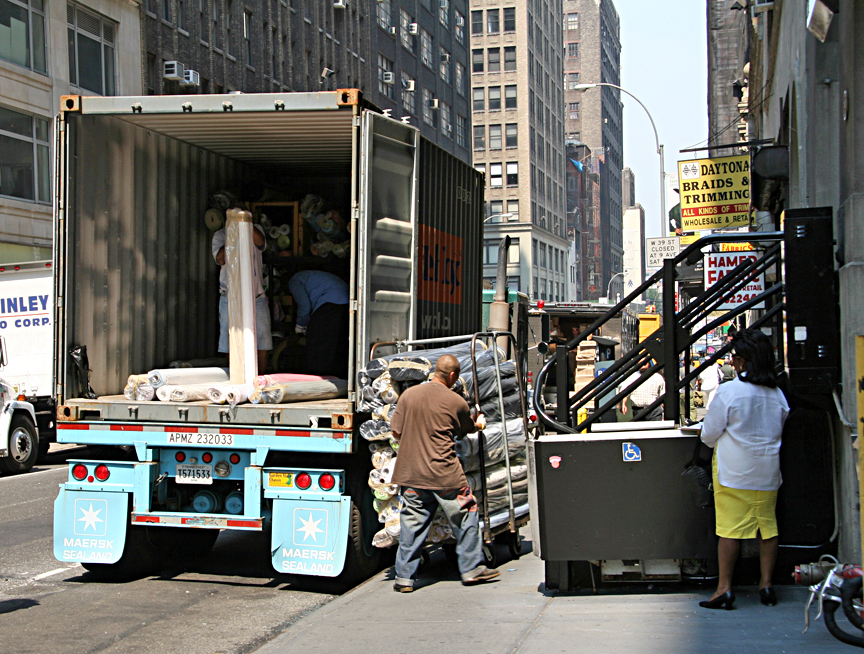
    New York City’s population size and Manhattan’s density has given rise to something unique: business districts. I’ve put together a list: diamond, flower, lighting, restaurant supply, photo, meatpacking, financial, fur, and the garment districts. I am distinguishing these from residential neighborhoods, as they are primarily business to business vendors. Most smaller cities have, perhaps, a downtown business district, but here we have concentrations of suppliers to specific industries occupying substantial geographical areas. The now defunct sewing machine district, e.g., used to occupy the city blocks between 24th and 27th streets between 6th and 7th Avenues – on some blocks, virtually every retail space was occupied by a sewing machine dealer.

    Today’s photo was taken in the Garment District, an area located roughly between 34th and 42nd Streets from 6th and 9th Avenues. The dominance of NYC in this industry goes back to production of clothing for slave owners of Southern plantations. With the invention of the sewing machine in the 1850s, production of clothing became industrialized, with NYC as the center. Although garment manufacturing in Manhattan has declined, there are still many small sewing manufacturers in this district (and Chinatown). The area is now dominated by fabric and notions wholesalers, clothing designers, and showrooms. New York City is the center of fashion in the United States, with names like Donna Karan, Calvin Klein, Liz Claiborne, and Betsy Johnson located here. We are home to trade shows and Fashion Week, a major annual industry event. The area is sometimes referred to as the Fashion District (there is a Fashion District information kiosk at 39th and 7th with a huge sculpture of a needle threading a button).

    Interesting note: Many are puzzled by the fact that competitors will cluster together, as dramatically demonstrated by NYC districts. This counter intuitive phenomenon is explained by Nash Equilibrium and Hotelling’ s Law…

    Posted on by Brian Dubé

  • Nice and Olds

    Posted on by Brian Dubé

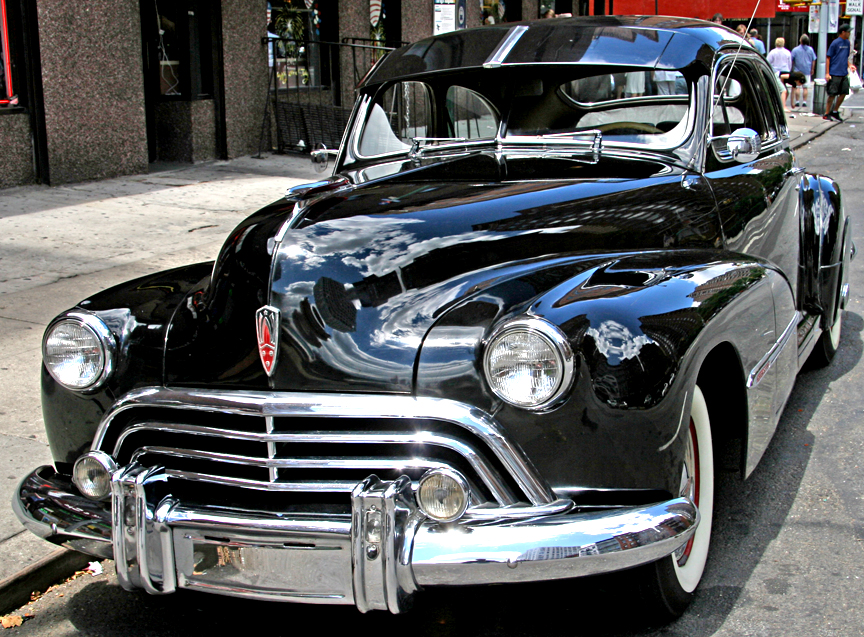
    Here’s a new twist. While walking up to B&H Photo with a photographer friend, we came upon this antique 1947 Oldsmobile on 9th Avenue. The owner, Brian Atkins, was taking photos of passersby (for a small charge) who wanted to pose with the vehicle. In conversation with him, we agreed that cars make great subjects for photography. I recently shot a number of autos in an antique car show I happened upon in Connecticut, but I have not posted them here since they were not in NYC.

    I am not a car enthusiast, but I love the chrome, sweeping curves, shiny lustrous finish, reflections, interiors, and overall design work of many of these classic American icons. The beauty of the designs of these antique autos is not strictly a romantic passion for all things past. Many antique automobiles were some of the finest examples of industrial design. Raymond Loewy (1893-1986), for example, was probably the greatest and well-known industrial designer of the 20th century. His prolific career involved a long relationship with the U.S. automaker Studebaker. If you are not familiar with Loewy and his work, I would highly recommend some reading about him and his work – you’ll be amazed. He was responsible for everything from the Hoover logo to NASA Skylab interior…

    Posted on by Brian Dubé

  • Gummed Up

    Posted on by Brian Dubé

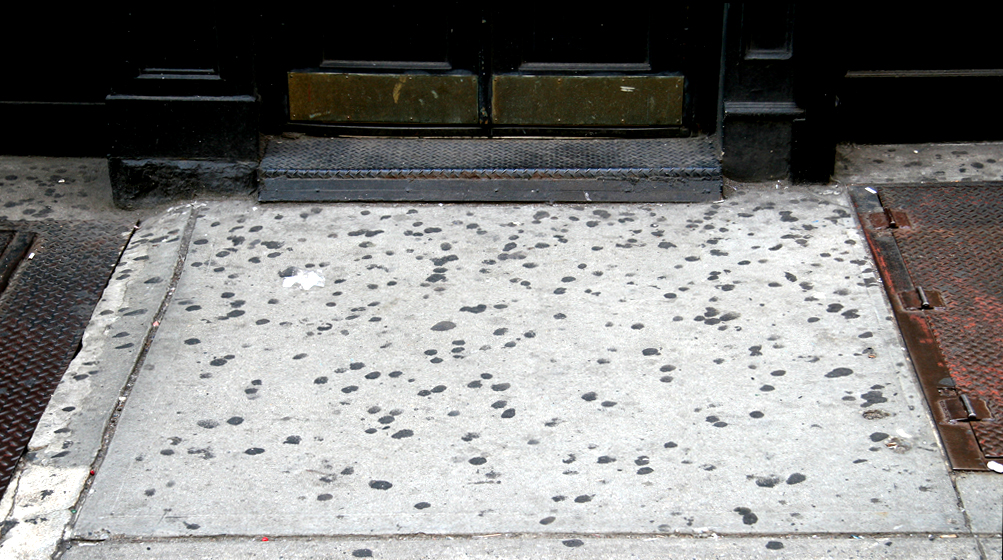
    I’m embarrassed to admit that I had lived in the city for many years before realizing what all those black splotches on the sidewalks and subway platforms were. I’m feeling a little better learning that this is the case with other New Yorkers I have spoken to; in fact, many whom I questioned were still not aware, thinking that the splotches may be part of the concrete, asphalt, etc. Gum on the streets is not a new problem; Mayor Fiorello LaGuardia ran an anti-gum littering campaign in 1939 with the slogan “Don’t Gum Up the Works” and pressured gum manufacturers to print requests on the wrappers that they be used for proper disposal of the gum. The NYC problem is particularly interesting in that New York is home to invention of the chicle-base chewing gum by Thomas Adams and the world’s first chewing gum factory, circa 1876, on Vesey Street: Adams Sons & Company.

    In spite of the fact that throwing out chewing gum on the ground is a violation of the littering law and costly to remove, I think the problem is one of those quality of life issues which is very low on the priorities scale. Many do not notice or find it a problem, and the rest of us become inured. On an encouraging note, GumBusters International B.V., a Netherlands-based company, has developed technology – steam equipment and a benign solvent – that easily removes the gum in seconds. They have divisions and franchises worldwide. The franchisee in New York, Gumbusters of NY, has been busy cleaning the streets for a myriad of businesses and was featured on the Discovery Channel’s Dirty Jobs. Perhaps we should adopt the thinking of Lee Kuan Yew, former prime minister of Singapore, where chewing gum is banned (precipitated by gum vandalism), who remarked, “If you can’t think because you can’t chew, try a banana.” 🙂

    Posted on by Brian Dubé

  • PDA

    Posted on by Brian Dubé

    Many years ago, I became acquainted with the acronym PDA – no, not Personal Digital Assistant, but Public Display of Affection. According to the 17th revised edition of Emily Post’s Etiquette (which is up to date with sections on cell phone behavior, Internet behavior, drugs, etc.), “In public, holding hands and exchanging pecks on the cheek with your significant other can be charming, but prolonged and passionate embraces and soul kisses are always inappropriate.” Although views of this behavior vary considerably across various cultures (in France we have “démonstration publique d’affection”), generally it is frowned upon. In some countries, it is outlawed.

    Although some are OK with this behaviour, most of my reading on the subject saw words and phrases such as yuck, ick, disgusting, tacky, not cool, and the ever popular suggestion “get a room.” This couple in the photo was going at it for a minimum of 2 hours, barely coming up for air (Click here for a previous post of a different romantic encounter). I had reservations of posting this photo and opted for a deliberately processed photo to minimize recognizability of our two lovebirds. I hope you like the result…

    Posted on by Brian Dubé

  • Book Country

    Posted on by Brian Dubé

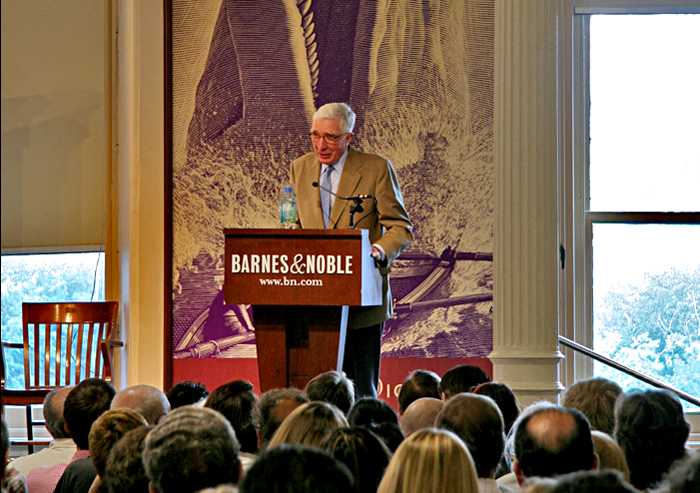
    New York is book country. This is not only an accurate metaphor but also the name of a major street fair which was held annually for several years along Fifth Avenue. New York City is widely perceived as the center of publishing in the United States, home to numerous major publishers of books, newspapers, magazines, and electronic media, with all the service providers – editors, literary agents, graphics, advertising, etc. We also have a huge number of bookstores, with many renowned independents such as the Strand, Gotham Book Mart, Shakespeare & Company, St. Mark’s Bookshop, Three Lives & Company, Labyrinth Books, and Bluestockings (the book superstore chains have had a serious impact, and the number of independents is fast declining. Time will tell whether this trend threatens the American literary future as many predict). Book signings and readings are also a big part of the NYC literary landscape, although signing tours of major authors mean that these events are not so unique to New York itself.

    33 Last night at the Barnes and Noble superstore at 17th Street on Union Square, John Updike was doing a reading from a new book (Terrorist) with signed copies available. The event was well attended. Updike is a renowned novelist, poet, literary critic, and essayist who has won numerous literary awards: PEN/Faulkner Award, National Book Award, National Book Critics Circle Award (twice), and the Pulitzer Prize (twice). His writing credits are many (read about him here)…

    Posted on by Brian Dubé

  • Parasol

    Posted on by Brian Dubé

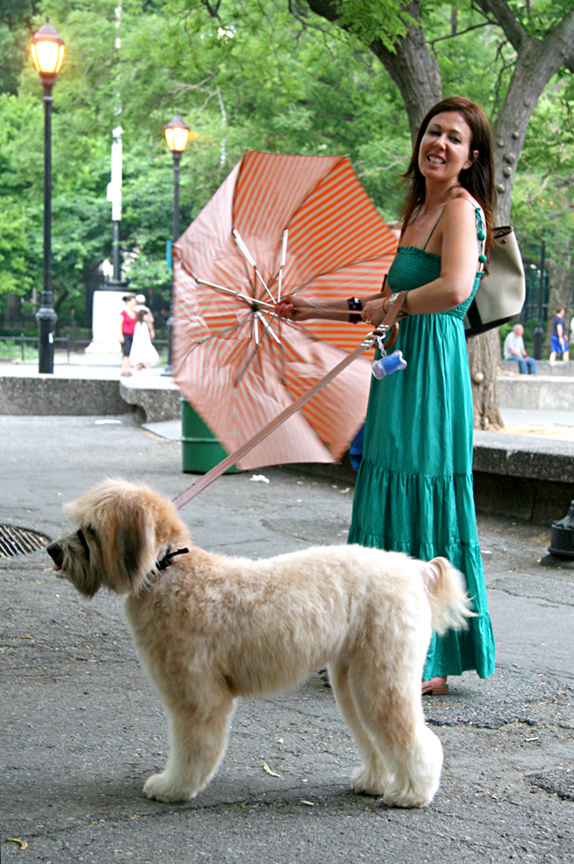
    In order to make this photo and story work, I wanted to make a case for the resurgence of the parasol. Perhaps a little spin on the facts. Certainly the use of parasols makes the utmost sense, since avoidance of the sun is now of paramount importance with ozone depletion, skin cancer, sunburn, and freckling. Plus, hats don’t shield enough and can lead to the dreaded hat hair. And then there is the sun-shunning goth crowd. So in a way, I’m surprised that parasols aren’t HUGE, since they can also be a fashion statement. I did uncover an article in 2005 from the Village Voice that proclaimed the parasol’s emergence from the 1920s, citing two shops in the city that are seeing a renewed interest: Rain or Shine and Brella Bar (Update 1/30/12: Now closed).

    The collapsible umbrella/parasol is of Chinese origin, dating back nearly 2000 years. They are still produced in large numbers with a variety of colors, patterns, and materials, so Asian product stores such as Pearl River are great places to go for selection and pricing. I do occasionally see more women with parasols on sunny, hot, or hazy days. (BTW, the dog in the photo is a Wheaten Terrier). In 2001, there was a photo that rocked the world: personal assistant Fonzworth Bentley holding an umbrella over P. Diddy’s head in Saint Tropez. Perhaps the male parasol is not too far away…

    Posted on by Brian Dubé

  • Manhattanhenge

    Posted on by Brian Dubé

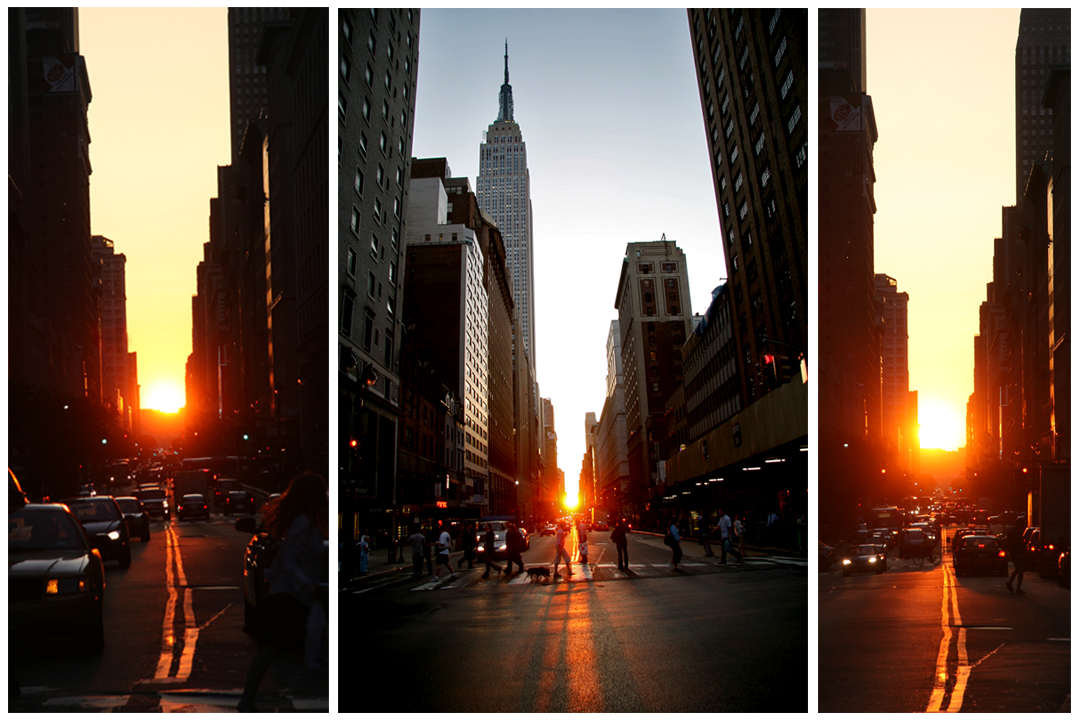
    Depending on your source, either yesterday or today is Manhattanhenge, a biannual occurrence where the setting sun aligns with the east-west streets of Manhattan’s main street grid (14th Street and farther north). Manhattan has two such days, generally cited as May 28th and July 12th, with some small yearly variation (there are also two days when the effect can be seen at sunrise: December 5 and January 8).

    The term Manhattanhenge was coined in 2002 by Neil deGrasse Tyson, an astrophysicist at the American Museum of Natural History, and is based on an analogous occurrence at Stonehenge, where, on the summer solstice, the sun rises in perfect alignment with several of the stones. On the Manhattanhenge days, the sun fully illuminates every cross street on the grid during the last fifteen minutes of daylight. The sun’s center sets exactly on the street’s center line, with the sun 50% above/below the horizon. The effect can be seen from river to river (and from Queens). The effect is good for a day or so on either side.

    Many people question the idea that this effect takes place simultaneously at every crosstown street in the grid, regardless of location. This may be counter intuitive, but it is true. The sun’s distance from the Earth at 93 million miles, in comparison to the length of the city’s grid of only a few miles, means that the sun’s rays are essentially parallel once reaching the earth – the deviation from parallel is too small to make a perceptible difference. Also note that Manhattan is rotated 29 degrees from geographic north. If the island’s grid was perfectly aligned with geographic north, Manhattanhenge would occur on the spring and autumn equinoxes.

    Viewing recommendations and photo notes: You still have time to see this effect in the next day or so. Recommended viewing is as far east as possible. However, keep in mind that many streets do not go clear through or have obstructions on the west side, the slight hilliness of the city may limit the view from First Avenue, and the actual horizon cannot be seen due to various buildings on the skyline in New Jersey. Queens or Roosevelt Island would also be good viewing areas. The photos were taken at 34th Street and Park Avenue – there was a fairly good crowd for the event. We dodged traffic, standing in the center of the street between changing lights.

    Posted on by Brian Dubé

  • Fantasies

    Sex shops, tattoo parlors, body piercing – these are not the things which first come to mind regarding NYC in 2007, when gentrification and reduced crime have become the hallmarks of the city. But in the Village, there has been a proliferation of these types of shops in the last few years, making the strip along 6th Avenue in the Village (shown in the photo) feel more like the old Times Square, to the displeasure of many residents. Many feel that the extremely permissive, “anything goes” spirit of the neighborhood has largely been responsible, particularly with some tourists who see the Village as a place to party (e.g. weekends have seen motorcycle gangs from out-of-town descend on the neighborhood, or gay youths at Christopher Street Pier).

    There have been many efforts to close these shops and reduce their numbers. In 1998, a “60/40 law” was passed during the Giuliani administration. The law required a minimum of 60 percent non-X-rated merchandise for a store to operate outside adult entertainment zones. Of course, stores find loopholes, displaying racks of non-X-rated videos and other products alongside their porn. Aggressive efforts are made by the city to find health code and fire violations, but store owners are resourceful and tenacious, always finding ways to comply and stay open. Neighborhood residents are tolerant – those who object to these shops do so not so much because of the content but more due to the number of them clustered together, their garish lights, and their explicit window displays. Older shops, such as the Pleasure Chest (with a much more discreet window) and even the Pink Pussycat Boutique, have done well to coexist with residents…


  • Standpipe

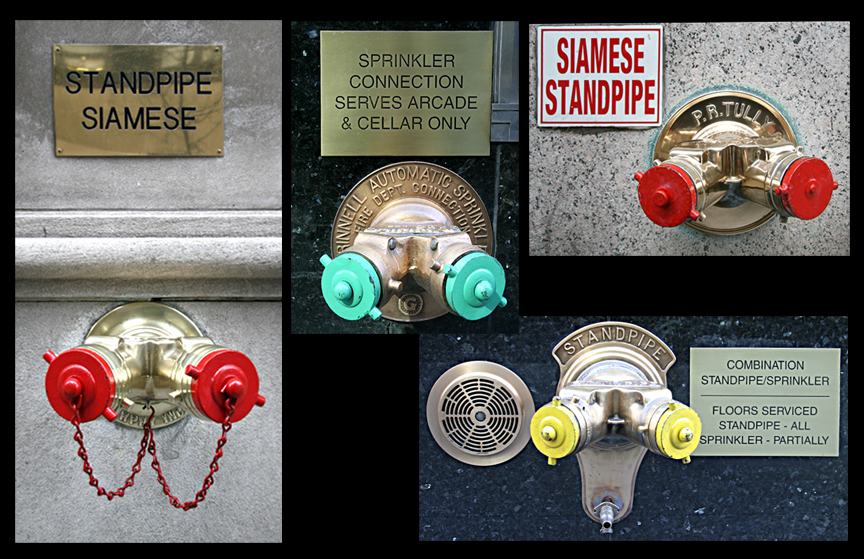
    Standpipes are everywhere in New York City, yet very little attention is paid to them. And what do we really know about them? A standpipe is a rigid pipe which supplies water under pressure to a water supply and/or sprinkler system in the event of a fire. And why do we need them? Because it is not feasible to run hoses from the street up stairwells to upper floors of a tall building in a fire (there are over 1,000 high-rise buildings in NYC). With a standpipe system, water is fed from the street through the vertical piping – hoses are attached from outlets at each floor.

    There are dry and wet types – wet systems contain water at all times, while dry systems contain no water and may have their own source of water or be supplied by a firetruck in tandem with a fire hydrant. Water can be supplied via water tanks, city main, and/or hydrants and fire pumps. Siamese connections (shown in the photo) allow two hoses to be attached for increased capacity and provide backup if one is jammed or malfunctioning.

    There are a variety of styles, of course. Conversation about these between myself and a photographer friend eventually inspired him to go on a photo quest (click here for his collection). A Siamese connection provides ideal seating, but beware of standpipes with sawtooth type projections on top, which I assume acts as a deterrent. BTW, standpipes are needed not just for tall buildings but also for anywhere there is no access to firetrucks or where there is excessive distance to stretch hose lines: shopping malls, theaters, stadiums, arenas, parking garages, bridges, tunnels, highways, piers…


  • Minutemen

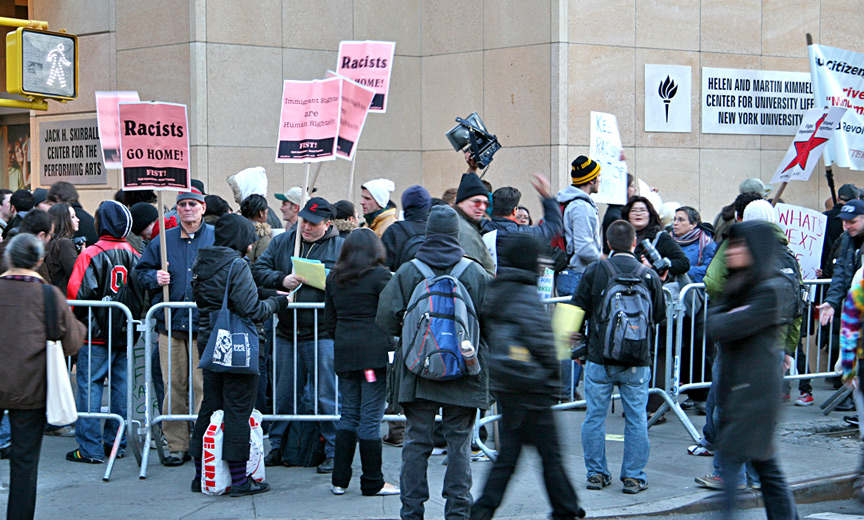
    On Monday evening, Chris Simcox spoke at NYU, an event sponsored by the NYU College Republicans. This was a follow up to their February 22 event, “Find the Illegal Immigrant,” a mock hunt for a student posing as an illegal immigrant. The event drew more than 300 protesters and 12 participants. Chris Simcox, himself mired in controversy, is the cofounder of the Minuteman Civil Defense Corps, an organization of individuals who patrol the Mexico-US border for illegal crossings. The organization states that they do not confront anyone directly but only report incidents to law enforcement. Critics say they are a racist vigilante hate group and claim that they have been charged with various crimes.

    The protest, shown in the photo taken in front of NYU’s Kimmel Center, was sponsored by various groups (College Democrats, the ACLU, etc.). As reported in an article in NYU’s newspaper, one person who came to protest was put off by what she called “the extreme right versus the extreme left.” Others found too many protesters who were not students championing their own causes, such as older socialists. And inside, Simcox’s attempt to speak was also was also a scene…


  • Caravan of Dreams

    Posted on by Brian Dubé

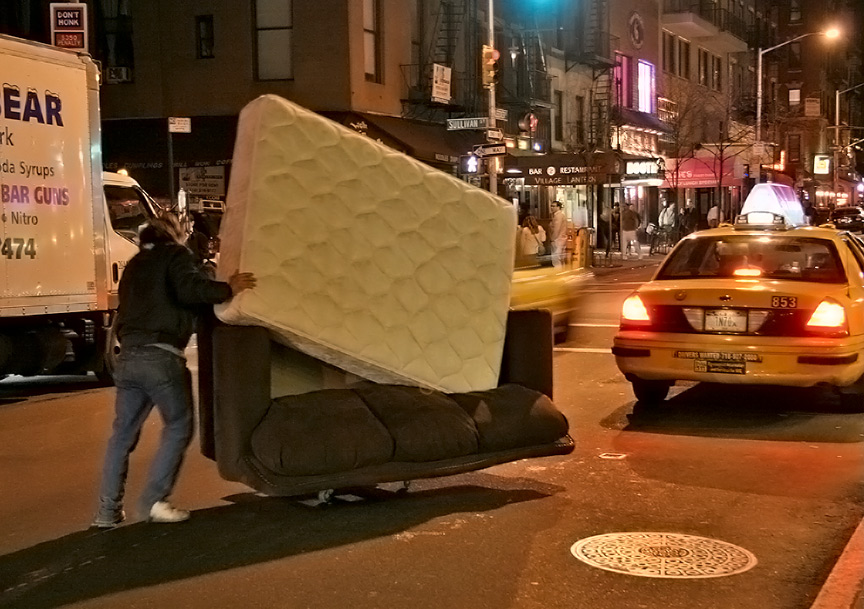
    From time to time in the city, we witness the homeless with caravans of STUFF – sometimes taking on mammoth proportions. On one occasion, I witnessed someone with at least 8 enormous hamper carts filled with things. He was systematically jockeying them to go on some unknown journey. They were parked for an entire night on Washington Square North, taking up a sizable portion of an entire city block. In many cases, they are bottles accumulated for redemption. I imagine that when you are homeless, one can achieve a certain sense of security and identity by accumulating things.

    Taking photos of these occurrences can be dangerous. A friend and I have been threatened several times just walking by with a camera hanging at our sides or photographing something else in a completely different direction. I suspect there’s a feeling of exploitation by many of them, with subsequent outbreaks of rage. In the photo, you can see what a couple friends and I witnessed – a very unusual move on Bleecker Street in the middle of traffic. It’s still not clear to me what we saw – a homeless person, someone looking to furnish his place from things scavenged from the street, a budget mover, or moving on a budget?

    Posted on by Brian Dubé


  • dinamic_sidebar 4 none

©2026 New York Daily Photo Entries (RSS) and Comments (RSS)  Raindrops Theme