• Category Archives Curiosities of NYC
  • Who Can Believe It?

    Posted on by Brian Dubé

    Many cling to the remnants of things whose lives are fast diminishing or have diminished – technologies made obsolete and things that technology has made obsolete. We look for stability in a world of change, and as physical beings, we like physical things – it gives us comfort. We are tactile, and for many a reader, the feel of paper and the benefits of print are still preferable.

    One area in transition is that of books, newspapers, magazines and other printed matter. Perhaps it is a small act of defiance or display of iconoclasm, but the avid readers I know have all stated a preference of print over ebooks or other electronic versions of print media.

    This year it appears that ebooks are having a serious impact on the print business. According to the Association of American Publishers, in February 2011, ebook sales in the United States for the beginning of 2011 were up over 200% over the same period in 2010 and were the top selling format in all categories for the first time in publishing history. This one-month surge is primarily attributed to a high level of strong post-holiday ebook buying, or “loading,” by consumers who received the devices as gifts. However, industry experts now feel that it is no longer a matter if ebooks will overtake print, but when. The shift may not occur as dramatically or as completely as did vinyl records to CDs. The tide will turn when critical mass is achieved, or the tipping point, as Malcolm Gladwell may have it.

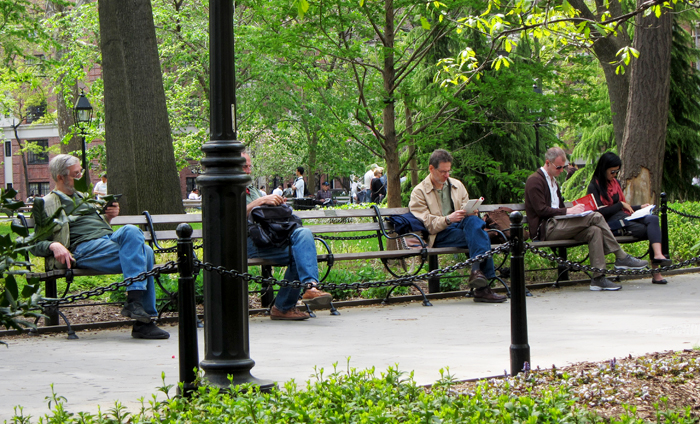
    Coming on the heels of this trend, my recent foray into ebook publishing (along with a purchase of a Kindle and Nook) and given the relative affluence of many New York City residents, it was ironic to see the row of book readers in today’s photo with not an ereader in sight (or was there one being used by the man behind the tree?).

    For the avid reader, a library can be a source of pride and show that a lover of books and reading is near, with the selection as a barometer of interests. Guests can peruse and discussions are inspired. Works of non-fiction and those that are photo heavy can be shared and circulated. A work like Ulysses on the shelf makes a strong statement as well as lively discourse.

    I feel great comfort and security surrounded by books. A library is an arsenal, with books as firearms and words as ammunition, all serving well to protect and defend against ignorance. What are we to do now? If I tell you that I have an enormous library all on a tiny electronic device on a coffee table and that I have read most of the books loaded on that ereader, will that be adequate evidence? Will you trust me or will you see me much like the huckster selling strawberries, whose refrain now you will repeat – who can believe it? 🙂

    Posted on by Brian Dubé

  • Timbuktu, Guam and Siberia

    If you are going to dine in New York City restaurants, it is best that you are tolerant and flexible. New York City is edgy, and, like all edges, some are sharp and others, like New York’s, are rough and uneven. Even if you pick your battles carefully, there are too many elements beyond a person’s control in a big city, buffeted about by whim, chance, and circumstance. Like the service you get in a restaurant or the location of your table.

    There are numerous metaphors for the remote. As a child growing up, the household refrain was forever Timbuktu. I did love the sound of it. It was so befitting – its very sound was exotic and remote, somewhere in darkest, mysterious Africa. It only occurred to me recently that I had no idea of where Timbuktu was or why it was such a well used metaphor for the faraway place.

    In 1988, New York Magazine ran an article entitled: Table Envy. The Best Seats in Town, Who Gets Them – And How To Avoid Siberia. Siberia – another apt metaphor for the poorly located and very undesirable. The article even contained floor plans of some of the city’s more exclusive restaurants, showing the placement of tables with a description of those deemed to be in Siberia (as opposed to the “Golden Coast.”)
    I am told by a friend, who attended Elwood/John Glenn High School on Long Island, that Guam was the universal label for all things remote and that the word was used liberally. Thus, we have a trinity of metaphors, showing a nice geographical distribution, perfect for every occasion to cover the various conditions where remoteness needs to be underlined.

    I have sat many times at the table at the top of the short staircase at the entrance to Olive Tree, a Middle Eastern restaurant on MacDougal Street in Greenwich Village. I do love the ambiance of this place, but although not remote, this table for two can at times qualify as a variant on Siberia, particularly with continuing severe drafts from the doorway in the winter. Last night’s affair was like dining in the jet stream. A woefully inadequate curtain was forever billowing, acting as a poor windscreen and was left open from each customer that had last arrived. We shall see in tomorrow’s story (see Part 2 here), however, that there can be pleasant surprises and warming trends, in Timbuktu, Guam, and even in Siberia…

    *Timbuktu is located in the West African nation of Mali, located on the Niger River at the edge of the Sahara desert. At its peak in the 16th century, Timbuktu was a thriving center of commerce and intellectual activity which drew Islamic scholars from around the world. It has been a popular metaphor for a remote or mysterious place and used this way in film, literature, and conversation for over a century.


  • Please Rub Off on Me, Just Like Steve Mills

    In the mid-1970s, Steve Mills, a young juggler from New Jersey, was creating quite a stir nationwide in the juggling community with his amazing skill set, even eclipsing seasoned long-time professionals. People were waiting for him in California at his first appearance at a national juggling convention.

    I met Steve in 1975 at a free juggling workshop in the financial district of Manhattan. When I began to manufacture equipment for juggling, Steve became one of my very first customers, and his use of my products and introduction to working professionals was instrumental in my early success. He came to the city to street perform as well as for the weekly workshop. I got to know him personally and, as a Village resident, helped familiarize him with good spots for street performing, such as Father Demo Square and Washington Square Park.

    One day, about that time, I received a letter that really stood out and which I still remember and often quote. It was a hand written order from a young boy in San Diego, California. He described the juggling clubs he wanted made with the size, weight, color and decoration scheme. But his real desire was made quite clear in one short sentence: “I want clubs just like Steve Mills.” Anyone familiar with idol worship can make the correct translation – “I want to be like Steve Mills.” Or, perhaps more correctly, “I want to be Steve Mills.”

    I saw the same phenomenon close at hand in the 1980s, when an employee of mine began to frequent all the hottest clubs in the city. She was a social butterfly with a serious case of celebrity worship syndrome. Because of her extensive networking, I was able to get into these clubs, all notorious for their difficult admission practices. It was through her that I also met Keith Haring, with whom we licensed his imaging for a new product line.

    There are many analyses of the psychological mechanisms operating in the fascination and obsession with celebrities. We chase them, examine them, dissect them. We do it for inspiration, to fill a void or for entertainment. Medical research has found that the desire to follow the leader and become like them is programmed into our DNA. In some however, this can become an unhealthy obsession. One aspect I saw with my friend, was a belief that somehow, merely associating with celebrities would have their greatness or achievements rub off on them.

    Of course this is illusion and delusion, because no amount of contact with super celebrities will bring you closer to their world or give you what they have. Skills, achievements and fame cannot be transferred like electronic data, transfused like fluids via IV or absorbed through osmosis. I think I need to print a T-shirt (and wear it myself) that says: Please Rub Off On Me, Just Like Steve Mills 🙂

    Photo Note: This is a capture at Spring and Crosby streets of celebrity chef Mario Batali with his signature red hair and orange Crocs (see Very Resilient here). He is the owner of Babbo (see here and here), involved in other restaurants and food establishments such as Eataly, and has had TV shows on cooking and food. Within seconds of my sighting, another photographer with a pro camera and massive lens asked to take a closeup, to which he happily obliged. A perfect set for Mario, bathed in a sea of oranges 🙂


  • Meal of Myth-Information

    I have an uncle who is the quintessential cynic, skeptic, pessimist, elitist, and oh, did I mention that he is also quite negative? He is extremely well read, so it puzzled me that with this bundle of character traits, he was not argumentative. We discussed this once, and his response, although a bit caustic, befit his character: “Brian, I never argue because you will find that most people don’t know much about anything.”
    Wow. But that’s my uncle.

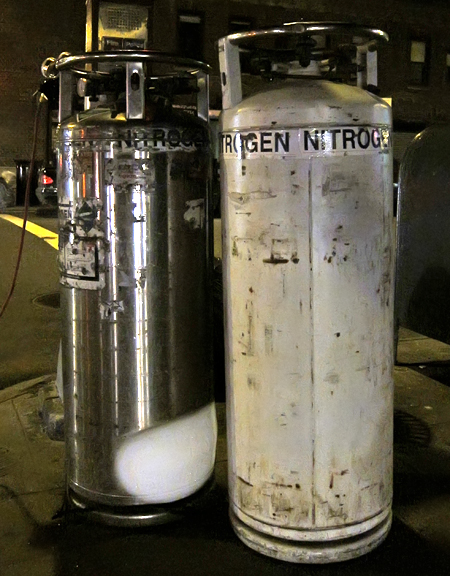
    I must say, however, that there is an extraordinary amount of misinformation – bits of facts are blended with plenty of fiction and fabrication. In reading various online websites and forums, much of the speculation and conjecture as to the raison d’etre for tanks of nitrogen on the streets of New York City is hilarious and hysterical. It took quite a bit of digging to get nearer to the bottom, but the process of reading was fun.

    Areas of science such as chemistry and physics are particularly mired in myth-information. Ionizing and non-ionizing radiation are conflated, as are chemicals with common elements but completely different chemistry and properties. Extrapolation goes wild too. For example, in reading about the street side nitrogen tanks, many were concerned that there was a warning against suffocation. However, this is not due to any toxicity but would only occur if someone were in an enclosed area and the nitrogen were to displace the air and, hence, the oxygen. Many were alarmed at the prospect of nitrogen being released, but ambient air is already 78% nitrogen.

    All the confusion, speculation, and misinformation is compounded with the monumental mistrust of governmental agencies or corporations, so reading statements from Verizon does little to pacify. A source of information on matters of trivia, urban legends, and myths is the Straight Dope, a syndicated question and answer column by Cecil Adams, published in The Chicago Reader since 1973. Collections were published in book form and are also archived on the Straight Dope website. Adams has a history of digging deep to research questions. I did some reading there, but did not get a completely satisfactory answer.

    Because moisture can damage cables, Verizon uses nitrogen to dry out its voice and data cables. Nitrogen is delivered via a small rubber cable fed through a manhole cover. But even many of the technical explanations appear incomplete. Most say that nitrogen is used to keep the cables dry. So why are these tanks only used temporarily, and what happens when they are removed? I found a more complete explanation from a former Verizon technician:

    Verizon pressurizes the cables to keep moisture out and air flows through them constantly. What happens is this; as the air flows through a section of cable that is being heated by a steam leak, it rapidly heats. When the heated air passes by the heated section it rapidly cools, which in turn creates condensation INSIDE of the cable. Condensation inside of a cable with paper or pulp insulated wires will cause service outages. Verizon calls this a “steam section” or a “steamer”. The tanks are filled with liquid nitrogen, but Verizon uses the nitrogen in the form of gas because it is almost perfectly dry. This dry nitrogen is forced into the cable and through the section that is in trouble thereby absorbing the condensation in the process. At the next accessible point of the cable, beyond the steam section, a “bleeder” is placed to allow the moistened nitrogen to escape and not travel through the remaining length of the cable.

    We are overwhelmed with an onslaught of information and resources. The online world of cut and paste research along with the viral proliferation of data has added to the confusion as well as clarification. Digging through it and sorting it out is challenging and exhausting. Why work harder than the rest? Just select the items you prefer from the a la carte menu of facts and fiction, and offer your own meal of myth-information 🙂


  • Sidewalk University


    Many years ago, a number of us were on the street in the East Village talking to a bookseller. In one of many spontaneous outdoor forums on the streets of New York, the conversation was nothing less than extraordinary. When I volunteered how impressed I was with the evening’s classroom, the bookseller showed little surprise. He pointed out that this was not just any place, it was in fact the streets of New York City, aka Sidewalk University.

    Not a substitute for the institutions of higher learning, but, for those unable to attend or perhaps as post grad work, nothing beats the streets of New York City as a place to learn. Not to suggest that every person or conversation will be one of erudition, but with some discrimination, a person can ferret out some worthy engagements.

    Saturday, my family was en route for a weekend stay in the city and was, however, delayed due to traffic. Learning of this when I was already outdoors on my way uptown to their hotel, I now had some free time – why not spend it in Union Square before jumping on the train? The farmer’s market is always a pleasurable stroll and opportunity to grab a healthy snack and/or beverage.

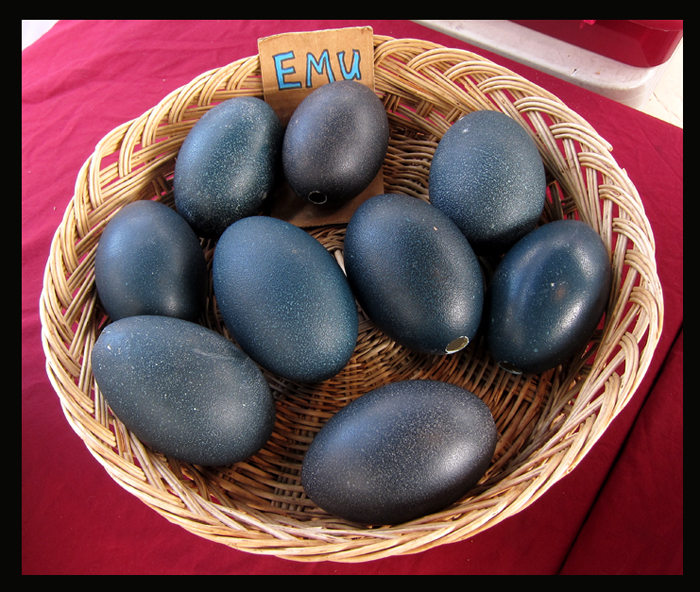
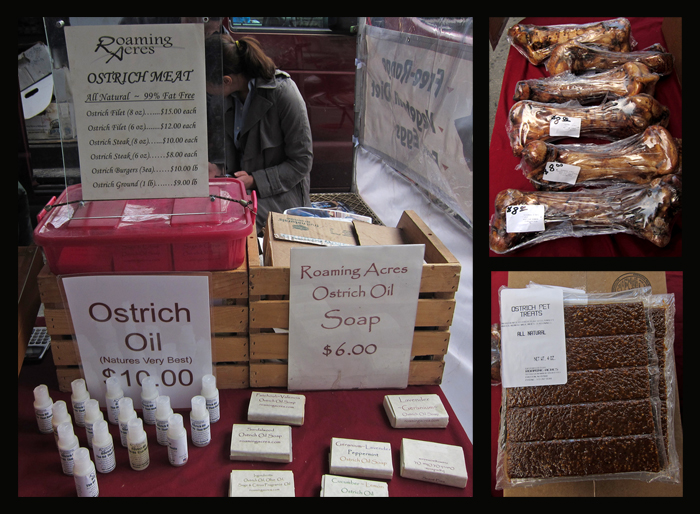
    On this excursion, I was particularly drawn to a table of enormous eggs – some filled, some empty to be used decoratively. The stand was run by Roaming Acres, an ostrich farm in Andover, New Jersey. Todd Applebaum pointed out to me that the farm made use of nearly 100% of the ostrich – its eggs, meat, bones, skin (as wallets).

    However, the eggs whose color and size drew my attention were that of the emu, an Australian relative. Todd gave me a short lesson on the emu – my appetite was so whetted that, like any good student, I followed up the lecture with reading. I learned that the emu was a remarkable bird, with some of the best design features I have seen in any animal. They can go a day or two without water, weeks without food, sprint at over 30 mph if necessary. A nail on their toes serves as a knife to kick away predators and other emus. They thermoregulate and can tolerate a wide range of temperatures. Their legs are among the strongest of any animals and can tear down wire fences. Their eyes, as would be expected, are equipped with a translucent secondary eyelid. Read more here.The eggs are highly prized – the emu only produces one every few days.

    When I asked Todd why I saw no emu meat or products, he smiled and said that you don’t kill the goose that lays the golden egg. We joked and I suggested that perhaps the emu knew its coveted status and was rather a diva. And so it was, on Saturday, March 12, 2011, that I was privileged to another tuition-free seminar on the streets at New York’s Sidewalk University 🙂


  • No Negativity

    In 2006-7, a friend and I were regulars at Think Coffee (see here). Looking to vary our cafe experience, one evening I suggested that we try Cafe Dante. He readily agreed. We knew that unlike Think Coffee, Dante was not self-service, the atmosphere would not be quite as casual, and certainly there would be some time limit on how long one could park without continuing to buy food or drinks.
    We were not, however, prepared for the sign in the window: NO LAPTOPS. This was not a problem for us, since we did not have laptops, but nonetheless, it certainly did emit a rather negative vibe for a Village cafe.

    Thoughts and conversation turned to the new realities of laptops in cafes and restaurants and how their use can lead to hours spent at a table, with the financial impact and new policy considerations for owners and management. Some cafes now impose limits or ban the use of laptops during certain hours. Think Coffee, on the other hand, was extraordinarily liberal, and I pondered what their official policy was regarding time versus money spent to occupy a table or seat.

    On my next visit to Think Coffee, I told the counter person of our Dante experience. I asked if there was any policy at all regarding purchases necessary to spend time in the cafe. For example, since Think offers free water, could I pour myself a cup and spend the day without making any purchase? Her response surprised us and became an inside joke and an oft repeated catchphrase: “Let’s just say the management has a policy of No Negativity.” Wow. So essentially the policy is anything goes.

    Last night in a Village restaurant, I witnessed what to me was a rather egregious act. Two women were sitting at a table. One pulled out a laptop. The other moved her chair into the aisle to share the screen. She then folded her knees, bringing them up towards her chin, and put both of her feet on the seat of the chair. I am not talking about crossing legs – she had the soles of both shoes squarely planted on the surface of the chair seat which was covered in fabric. This seemed so inappropriate, I countered by pulling out my camera and taking a photo. However, she moved her legs, so I did not catch the offending act specifically.

    But it is no matter. We are in a different world now. Business is very competitive and must extend very liberal policies to keep customers. There is no need to buy anything in a cafe, and perhaps you can even put your feet up on the table in a restaurant. We have one new policy now – No Negativity 🙂

    Note: Since this photo was taken in a restaurant, I have processed it to protect the privacy of the individuals.


  • Take It

    Payback, payola, quid pro quo, freebies, gratuities – New York City is mired in the various forms of “free” or discounts. The small business owner should express gratitude to the regular customer in some way. In the world of restaurants, policy and practices span the gamut in New York City, from one extreme to another. I am currently experiencing both extremes. In one case, a restaurant I have frequented weekly for over ten years has never offered me anything free other than the requisite water. Nothing. At the other end, a new restaurant I am currently frequenting has been offering me free appetizers and/or desserts at every visit for nearly a year. The owner is rolling out the red carpet, and I am being treated like family.

    Free, however, may not always be the best thing for either party. I have given a lot of thought to this because of a very poignant incident that happened when I was much younger. At the time, I was making handcrafted items, and a close friend told me that he wanted to buy one of my products. I was pleased, and in the conversation that ensued, I mentioned that I would, of course, give him some sort of discount. To which he replied that he wanted no discount, but insisted on paying full retail. I was very perplexed by this and asked why. Isn’t a discount to be expected with business between friends? His answer still lingers in my mind today, decades later. No, he said, if you are truly a friend, then you want to see your friends do well and succeed. A friend should be the most willing to pay full price and refuse a discount. Of course, the individuals’ affluence relative to one another needs to be taken into account also.

    This philosophy was echoed many, many years later, when another friend, who was a consultant and on the board of directors for a small performance group, told me that he paid for admission to all of the group’s performances. This appeared to be insane to me. When I asked why, his reasoning was the same as my aforementioned friend – he was a patron of the arts and wanted them to succeed. He pointed out that the idea of refusing freebies also serves the customer or patron – helping a business survive provides a continued source of a product or service.

    The issue of freebies in restaurants, however, poses a dilemma with regards to all these issues of showing customer appreciation and the customer’s reciprocal support. Once an owner or staff member surprises with free food, such as an appetizer or dessert, it would be insulting (and perhaps wasteful) to refuse it. Insisting that it be added to the bill will most likely be met with refusal. And leaving an unusually large tip does not compensate the ownership, where ultimately, the act of generosity lies. So, in the case of restaurant offerings, I follow the advice of someone who once suggested: if someone offers you a gift, take it 🙂

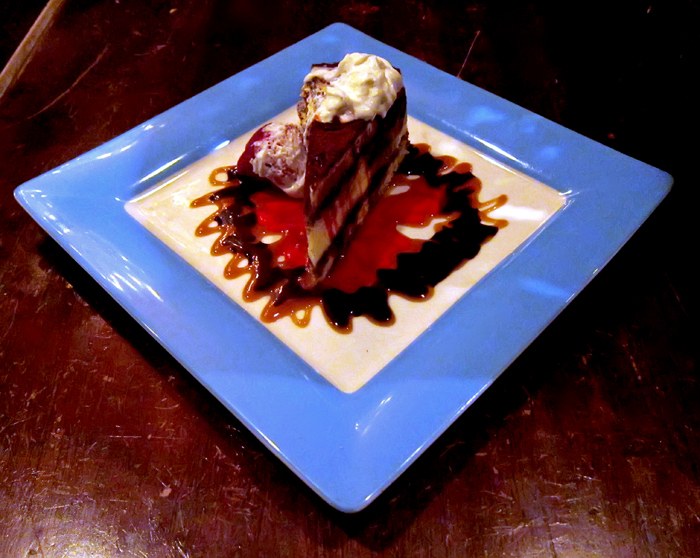
    Photo Note: This free piece of Tiramisu was offered to my dining companion and myself last night at Boyd Thai, a great little place that I wrote about in 2007.


  • Twinship

    Their first names seemed to be only a formality – they were always the twins. They lived in the same house and seemed to be forever destroying the same things, banging on the same drums, or involved in equally uninteresting things. They were identical twins and, to me, identical. They were my first cousins on my father’s side and about my age. However, the truth of the matter is that I had little desire to know them well enough to tell them apart or know them as individuals.

    I have a large extended family of aunts, uncles, and first cousins. My twin cousins had three other siblings. On the occasional visit to their home, invariably there were other families and cousins as well, so I had many options for socializing. I barely knew the twins.

    Twins have a unique bond and relationship that most of us will never know. Many older school identical twins saw themselves as a unit even through adulthood, living together, wearing identical clothes, etc. My twin cousins were not that extreme, however, they were addressed and treated as a unit for as long as I can remember.

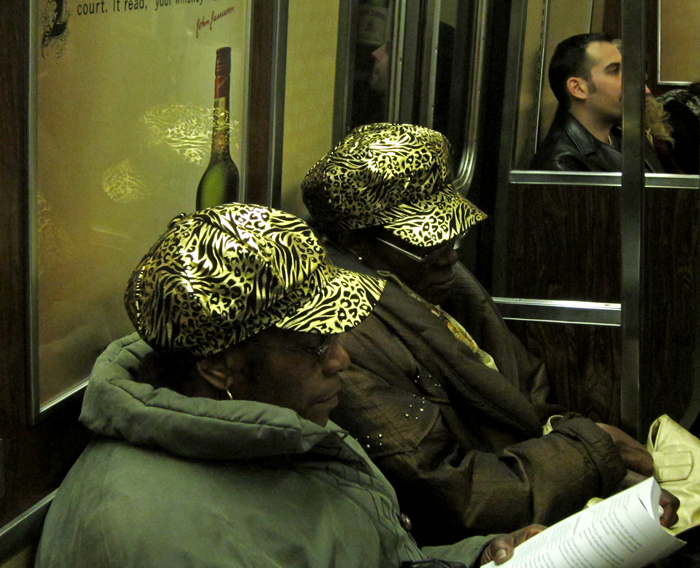
    Recently on my way to a taping session of the Ferris Butler Program (see here and here), I was taken aback by two women who just exuded twinship. I loved their hats – they were so striking. They both had very similarly styled full-length down jackets, one brown, one green. Everything was bathed in a yellow/green light. I did not get the opportunity to chat with these women on my short subway ride and learn about their relationship. We share a twinship on this one, because your guess is as good as mine 🙂

    Note: I am very happy to report that I have begun to know the twins better as adults. I recently spent an afternoon chatting with one and found him to be one of the nicest, most thoughtful people I have met. Now that I think about it, I’m not absolutely sure which one it was and also, I think his brother might be really nice too 🙂


  • Urban Elephants and Hydraulic Tusks

    We have many many sounds in the city, some unique and some we share with our suburban and country brethren. For those whose apartments face the street, there is the unabated sound of street traffic, less or more depending on where one faces and the time of day. There are also birds, dogs barking, or the occasional screams and shouts of children at play. At night, there is the sound of taxis dropping off passengers – usually identifiable by the longer time between opening and closing of doors and the conversations that sometimes ensue between passengers and driver. There is the walk of the lone and confident woman with every step of her hard heels clearly audible. 

    Then there is the occasional late night revelry, screaming, or fighting of the severely inebriated. The sounds of these individuals getting into vehicles is not a pleasant prospect. The vehicle often jettisons away with squealing tires.

    In the early morning we have the trumpeting of urban Elephants, i.e. garbage trucks, and the crunching and groaning of debris caught in their hydraulic tusks.
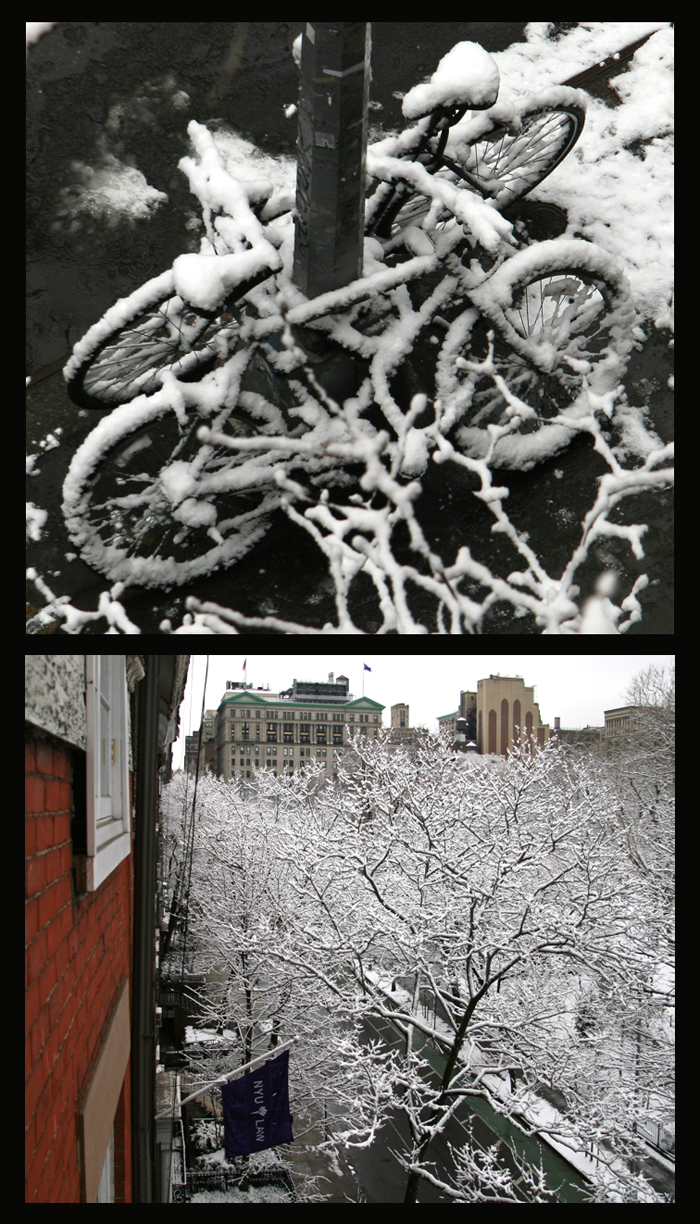
    In the case of new, substantial snow, there are giveaway sounds – the reduced frequency of cars, the telltale echo of snow shovels, and the unmistakable grind of the snowplow against the pavement. In the event of rain, I can hear the spray of water against tires and the roadway.

    I have windows facing a park which I have featured in the four seasons: Spring (Enchanted April), Signs of Summer, Fall (Wood, Glass, Brass and Trees), and Winter (White By Design 2). In the mornings, however, I often rise before sunrise and immediately go to my laptop, typically without even looking out the window. Instead I rely on the sounds of the city. – perhaps for any number of reasons, including a growing reliance on the Internet and also being out of tune with the outdoors and nature from living in such a high urbanized environment. This morning, I had no idea we had another in a series of snowstorms until I heard a snow shovel.

    On an Apple computer, the F4 key immediately displays the dashboard, a group of widgets which can be custom configured. I currently have mine to include the weather which displays the current conditions and the week’s weather forecast. I can see if the sun is shining without turning around.

    But not everything can be experienced through the Internet, the F4 key, or even the sounds of the city. You’ve got to look out your window if you want to see the snow, and you have to step into the streets and follow the trumpeting if you want to see Urban Elephants and their Hydraulic Tusks 🙂


  • Ride to Hell

    You think you know tenacity? You do not know tenacity until you are acquainted with the Hands On A Hard Body competition and men like Benny Perkins and Philip Calhoun. I do hold tenacity in high regard (see my story Perfect Attendance here) – but the Hands on a Hard Body competition is horrifying and extreme.

    In 1997, a documentary film was made about this annual endurance contest in at a Nissan dealership in Longview, Texas, where 24 contestants see who can keep one hand on a Nissan pickup truck for the longest time. No leaning, no crouching. There are five minute breaks every hour and fifteen minute breaks every six hours. The last one standing wins the truck. There are many repercussions, including hallucinations and worse.* The record was 92 hours and 40 minutes in 1998 by Calhoun.

    Benny Perkins won in 1992. I first heard of Benny and this contest in a radio program and interview. A person that wins a contest like this is much more than just tenacious, perhaps a little frightening. This is best illustrated by Benny’s remark to one remaining competitor:
    “I told Dan, the guy I was with, I said, ‘You’re standing next to the devil and this is the ride to hell. I’ll stand here ’til the day you die, so you might as well drop out now.”
    When I heard him say this in his own voice, along with things like “You go slowly insane. Your mind has got to rest – the body can work 24 hours a day, but your mind has got to rest,” I had many thoughts, including just give him that truck.

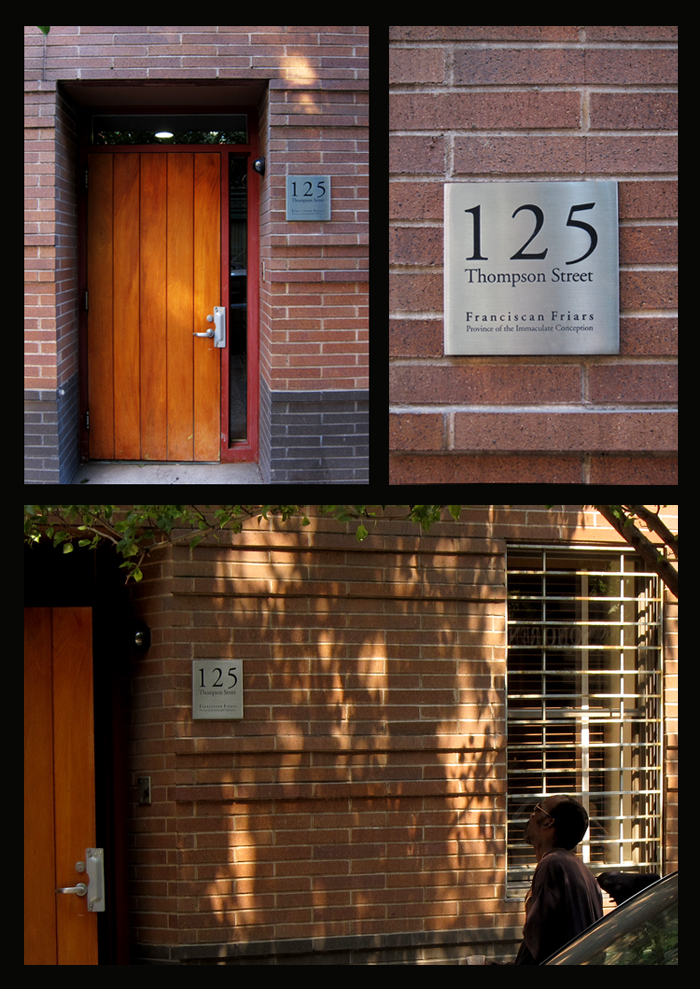
    If I had the tenacity of Perkins or Calhoun, perhaps I could have waited outside 125 Thompson Street with my hands on the door until someone came or left. For decades I have walked by this large nondescript building in SoHo, hoping for some human activity but only seeing the small brass plaque: 125 Thompson Street. Franciscan Friars. Province of the Immaculate Conception.

    Some, who love a good mystery or conspiracy, might imagine something like the Illuminati, with a covert masterplan for a New World Order. Others, like my mother, would feel that I am wasting my time and that There’s Nothing Here. A phone call confirmed the more reasonable – that 125 Thompson Street serves as a monastery and offices for the local Franciscan congregation, who have been in the area for 150 years. The Franciscan Brothers are a tenacious group, working hard and quietly, living a life in the manner of Francis of Assisi to bring their ministry around the world and, like Benny’s admonition, trying to save others from the ride to hell…

    *The contest was discontinued in 2005 because one contestant, Richard Thomas Vega II, crossed a street, broke into a Kmart store, took a gun from a case, and shot himself. His wife sued and settled in 2008 with Patterson Nissan of Longview. His wife alleged that the dealership was negligent in organizing and conducting the contest and likened the stress and sleep deprivation to “brainwashing.” She said the Nissan dealership failed to provide a safe environment for contestants who “temporarily lost their sanity.”


  • Number 1

    The title of the book was so unusual, that I still see the words on the spine sitting in my library: Horary Numerology of the Turf.
    For the gambler or, if you prefer, the person who enjoys the occasional wager, New York City has not been devoid of betting opportunities, licit or illicit. Off Track Betting was legalized in 1970, and in time, hundreds of betting parlors dotted the city (in December of 2010, the entire business operation closed). And although not on the hit list of most tourists or residents, the city is also home to a major race track: Aqueduct in Ozone Park, Queens, serviced by its own subway stop on the A train. It is a convenient, affordable, and pleasant way to spend a sunny afternoon.

    For a brief time I became very interested in horse handicapping, driven by my interest in mathematics and lured, like others, by the “easy money.” I foolishly believed that somehow the entire endeavor could be stripped of any horse hide and reduced to numbers, akin to the dream of many investors with approaches like Elliot Wave theory, Fibonacci series etc. I was never a gambler at heart, so my interests remained more academic, driven by the challenge of finding a credible method to gain some advantage. My attendance at the racetrack was very infrequent and betting even less so.

    My library of books on handicapping horses ran the gamut, but certainly the most intriguing and arcane was that volume, Horary Numerology of the Turf, by Rosajo, published and printed in 1979 in India. The book had a look and feel of biblical authority. I am sorry to report, however, that Rosajo’s treatise was not a key to the promised land, and I soon learned that although a beatable game, betting horses was far from easy money, and the few that were successful invested their lives. Andrew Beyer was one of these.*

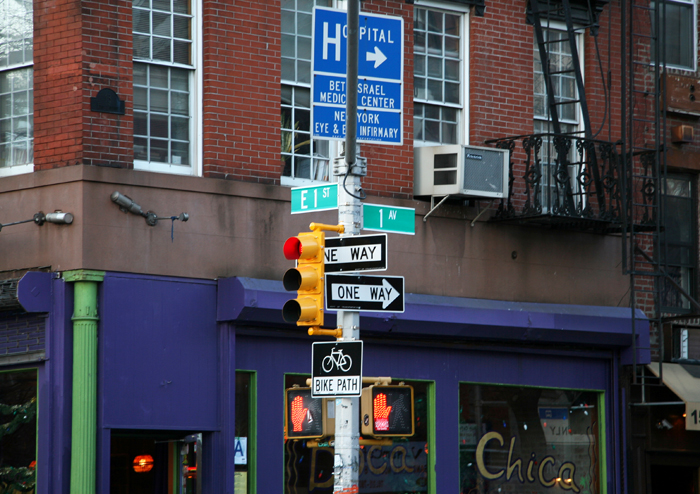
    My interest in numbers has become eclipsed by other life concerns and much more casual, piqued at idle moments, most often when confronted with the numbers of New York City, such as subways lines or the streets. There are only 12 avenues in Manhattan, hence, there are 12 possibilities of intersections where the number of an avenue and street could be the same. And, in fact, there are only two such intersections: 1st Avenue and 1st Street and 2nd Avenue and 2nd Street.

    I normally hate waiting for traffic lights in the city – I feel like each one steals 60, 90, or 120 seconds of my life. But here, at 1st and 1st, I can spend the time pondering the meaning or usefulness of the number 1. The unitary, solitary, and primary significance of the number one always makes me pause and take notice when I am at this intersection. Let’s see – both the first letter of Aqueduct and the A train stopping there share the first letter of the alphabet. Perhaps I should look at the the first race for horse number 1 🙂

    *In 1975, Beyer authored Picking Winners: A Horseplayer’s Guide.
    Beyer, a Harvard graduate and syndicated columnist since 1978, was, however, not a man with a casual interest in racing. He became interested when he was 12 years old. Many consider him to be the most important and best handicapper in America, with a rare, if not singular, ability to have profited consistently betting on the ponies using numbers. His once proprietary edge, now the Beyer Speed Figures, have become an industry standard, are incorporated into the odds – they are no longer adequate for beating the races.


  • Anywhere You Go

    Perhaps my sister should have understood that getting in a car with me means that you had better have your body function requirements taken care of, or be met with a very disagreeable man when requests to stop are made. Actually, it would have been better had she not stepped into a car with me at all. But alas, that was not the case, and in 1998, five family members found ourselves crammed together in a small car for a 10-day road trip to France. On November 12, 2009, I wrote about this family trip in Montmartre and Peillon.

    One day while driving, I heard the usual cry from the bathroom admiration society. However, this was France, not the USA. I was on a divided highway. I saw a petrol station some distance ahead on the opposite side of the road with no apparent way to get there. Or let us fairly say that there was no great motivation to get there. I pulled over and contemplated the logistics of crossing this roadway and the unpleasant prospect of making an unnecessary detour and stop.

    While evaluating the situation curbside in our idling vehicle, a woman in a nearby private residence came out of her home and asked if we needed help. In the best French we could muster, we told her thanks, but we needed a bathroom and wanted to know if the petrol station had public bathrooms and how to get there. Unbelievably, this woman offered her home and escorted my mother and two sisters in.

    We were stunned, and to this day, I retell this tale often. Where were the rude, impolite French we had heard about? Answer: The same place they are anywhere – lying inside reasonable people, only to surface when provoked by someone rude who does not understand their culture and etiquette. Americans often behave quite badly, expecting everything to be like home, as I wrote in So Where’s David?
    This was not an isolated event. Even in Paris, I had people battling to give me the right directions. Everywhere I went, when approaching others with respect, I was treated respectfully.

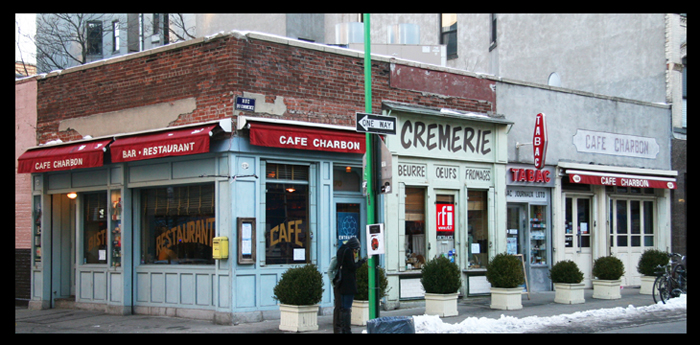
    When I saw Cafe Charbon-Epicerie at 170 Orchard Street in the Lower East Side of New York City, I was immediately charmed by the recreated Parisian street scene with faux storefronts, including a Cremerie and Tabac. This French bistro’s reviews, however, are as mixed as the travel experience to France. I skimmed hundreds of patron and food critic reviews which range the extremes of the spectrum. There were some extraordinarily negative experiences – many said that it was the worst service they have had in a New York City restaurant.

    After nearly a decade, Cafe Charbon is closing, a place where perhaps rudeness came naturally or fuses were short. Some people are just more polite or have a higher tolerance for abuse, like our friend Winnie (see here and here). But rather than seek out places or people where rude service comes naturally, like our friend in So Where’s David?, sharpen your skills provoking people, and you can find rude service anywhere you go 🙂


  • None For Me, Please

    When I came to this city, there were so many things new to me. 24 hour delis, bagels, ethnic foods other than Italian, tall buildings, subways, men who were openly gay, pizza by the slice, egg creams, Macy’s, and all the other icons I had seen on TV now come to life.

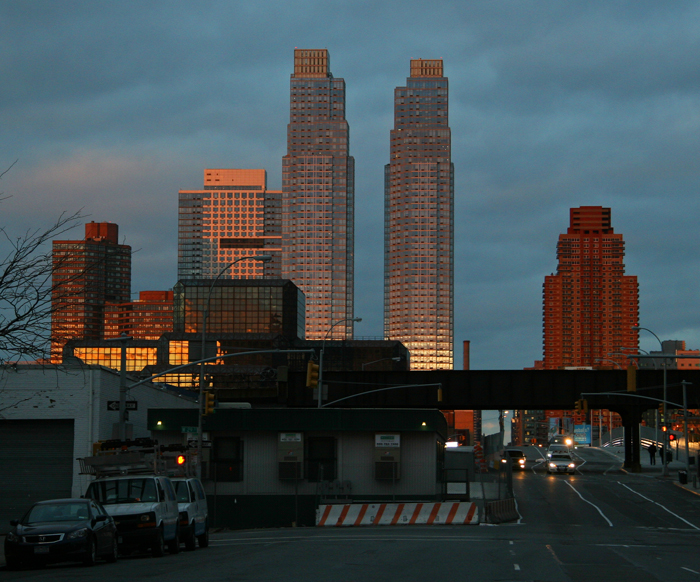
    And prostitutes. This was a big curiosity for me and other friends. That women would openly flaunt their bodies and market their wares on the streets for all to behold. In the desolate area around the Lincoln Tunnel (shown in the photo), street walkers could be seen any evening, openly soliciting and discussing specifics and pricing.

    Sex for money has now moved off the streets of the city. Targeted by the Guiliani administration and contained by Bloomberg, little can be found on the streets. I have been told there is some activity in Hunt’s Point, Bronx, and recently there has also been trafficking in child prostitution. But most activity has gone online to places like the erotic services on Craigslist, escort services websites, Facebook, and Twitter.

    In spite of having lived in a city where such services were readily available, I have never sought out the services of a prostitute. Even though New York City is extremely liberal and permissive, the idea of being with a woman, even a consenting adult, in such an act of intimacy for money has always been disturbing and not right to me and everyone I know. I never have forgotten the one scene in the film Klute where Jane Fonda plays a prostitute. While faking an orgasm, unbeknownst to the man she is with, she looks at her watch – the ultimate graphic depiction of the harsh reality of prostitution and the business of sex.

    On the streets or online, neither arena has been a temptation. Nor have the transgressions of former New York governor Eliot Spitzer with Kristen served as any fuel for justifying this behavior. None for me, please…


  • Afraid of Snakes

    If you have read my story Jungle Lovers, you know how I feel about the importance of guidance and influence of children and how disappointing my own experience was growing up in a blue-collar town, where New York City was feared likes snakes are, the streets were said to be riddled with pitfalls every step of the way, and con men could be found around every corner.

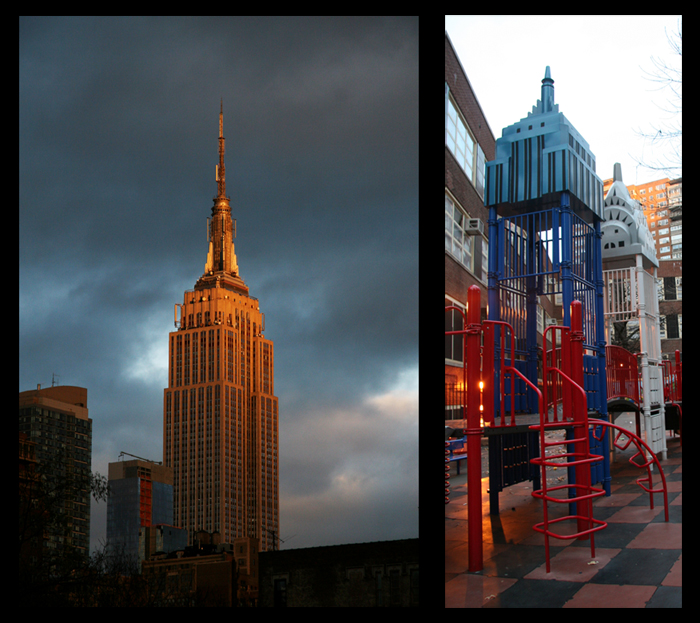
    I do not regret moving to New York City, I have not fallen into any pits that were too difficult to climb out of, and vistas like that in today’s photo are in fact what I have more often seen around many corners. And I like snakes. 

    Icons such as the Empire State and Chrysler buildings are visible from nearly everywhere. From 1931 until 1972, the Empire State Building was the tallest in the world. Although no longer the tallest building even in the United States, the Art Deco skyscraper still has icon status and is a metaphor for TALL (it is now the 3rd tallest in the USA and 15th in the world).

    After a time, any resident or visitor to the city can become inured to the vistas and architecture of New York. However, along with the people, the structures of the city define our metropolis. Interest in architecture itself is often eclipsed by the dynamism of New York’s many other attractions – restaurants, shops, clubs, bars, theater, parks, festivals, and street life. So, it was very uplifting to see this school playground in Chelse,a where models of the Chrysler and Empire State buildings are connected by bridges, decks, ladders, and slides and serve as part of the school’s outdoor recreation area.

    This children’s playground becomes a place to develop a familiarity with and appreciation of the architectural icons of New York City. And to learn that, at least in this jungle, if you’re careful, there is no reason to be Afraid of Snakes 🙂


  • Not Moving to Florida

    I recall an uncle extolling the virtues of living on Eagle Lake in Maine in the winter, telling me how wonderful it was, about ice fishing, and how you had the entire lake to yourself. Not to offend and retort aloud, I thought to myself – of course you have it to yourself, who would want Eagle Lake in the winter?

    Although not as extreme, the seasons of New York City are never pleasing to me (see Weather Means Whether). I look forward to the spring, the harbinger of all good things to come, but it is always a disappointment. It is often too wet, colder, and windier than I would like. Flying kites or trying to sit on a park bench seems to be an exercise in hand rubbing.

    But not to worry, summer is on the way, certainly the season we wait for and celebrate. Until we have a few unseasonably warm days in late spring and I realize that summer in the city will be oppressive and crowded with tourists and that there is no respite from the heat without leaving – autumn and winter look very appealing now. After all, the solution to cold is quite simple, is it not? Just add more clothing. Summer arrives, and all my worst fears and memories are realized. The teaming masses mixed with high humidity and relentless sun make New York City in the summer virtually unbearable. But summer is actually quite short, and autumn is just over the horizon.

    Autumn, however, is just a tease for what a perfect world might feel like (see Quito here) and a clear reminder that what nature giveth, it also taketh away. Days are often too cool to spend extended periods outdoors, and we now have more of the hand rubbing of spring. Leaves are falling, things are dying, and I am already fearful of the death grip of winter, which is fast arriving.

    Winter arrives, and although we are blessed with little snow in the city, it is more uncomfortable than I remembered. The respite from the heat I wished for in July and August looks foolish now – what was I thinking? The holidays do provide a much needed distraction before the bleak stretch of winter starting in January. Soon I am looking to spring again, only to reflect and reprimand myself for not enjoying what I had last year.

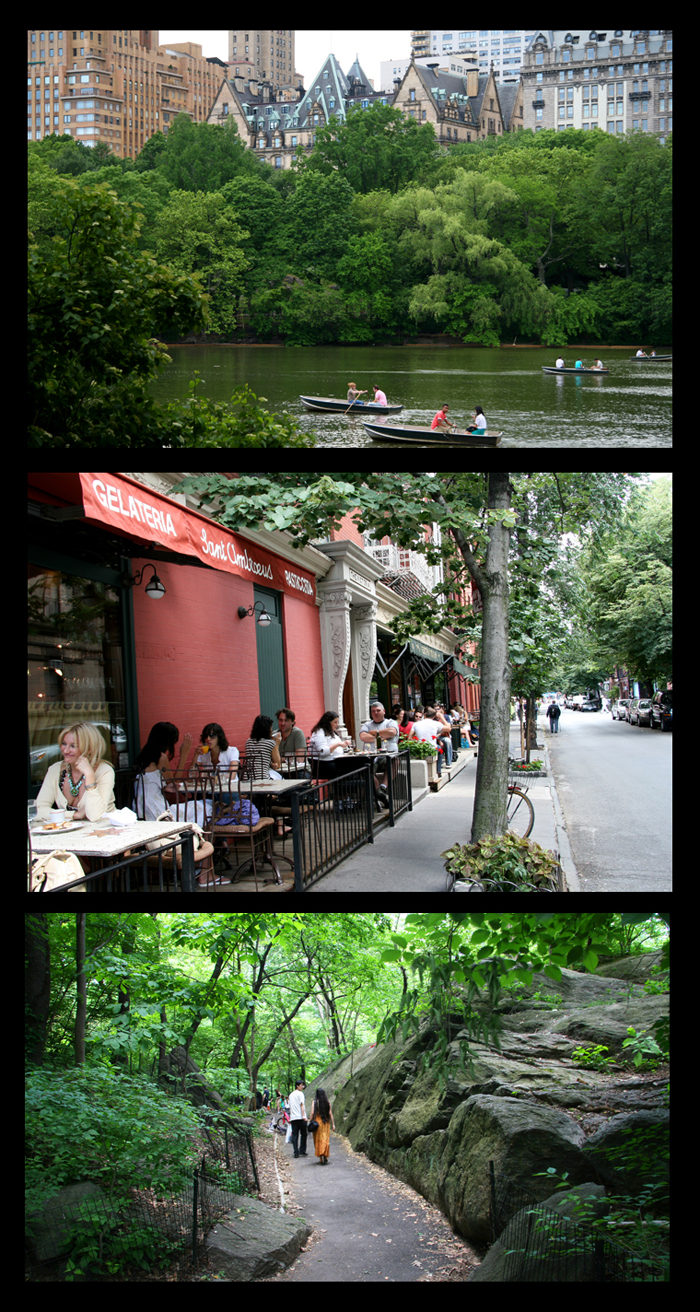
    As winter closes in and I realize that every season in New York City has its shortcomings, the thought of other, perhaps better, places, rather than other seasons, rears its head. But I am a little wiser now. I have been down that road too. No, best I enjoy images of a foliated New York in summer, because, at least for now*, I’m not moving to Florida 🙂

    *Interestingly, my aforementioned uncle, steadfast in his commitment to Maine and its hard winters, eventually became a snowbird and moved to Florida late in life where he lived out his life.

    Photo Notes: Top – The Dakota as seen from the Lake in Central Park. Center – West 4th Street. Bottom – the Ramble in Central Park.


  • dinamic_sidebar 4 none

©2026 New York Daily Photo Entries (RSS) and Comments (RSS)  Raindrops Theme