• Category Archives Curiosities of NYC
  • Woody Was Right

    Don’t you see the rest of the country looks upon New York City like we’re left-wing, communist, Jewish, homosexual pornographers? I think of us that way sometimes and I live here. –Woody Allen as Alvy Singer from his 1977 film Annie Hall

    A 2008 study by the New York City health department found that more that one-fourth of adult New Yorkers are infected with Herpes Simplex Virus-2, the virus that causes genital herpes.

    An estimated one million New Yorkers are Jewish – the largest Jewish population in the world, outside of Israel. That’s 12% of our city population (8,363,710), 15% of the number in the United States, and 7% of the world’s total.

    4.5% of New York City’s population (272,493) is estimated to be gay.

    The Communist Party USA headquarters is based in New York City at 235 W. 23rd Street.

    A study found that over two-thirds of New York City residents regularly hear their neighbors having sex.

    Looks to me like Woody was right 🙂

    Photo Note: Sex and the City is a cable television series. Two films based on the series have been made. Sex and the City 2 was recently released – the photo was taken just before the release.


  • CYA

    I was visiting a New York City doctor once, and I queried him as to why a specialist I had been referred to had ordered a number of tests which seemed unnecessary. He quickly and casually responded, “Probably CYA.” Embarrassed that I did not know the meaning of this acronym, which apparently was common knowledge, I was forced to ask what it meant, to which he responded: “Cover Your Ass,” i.e. order the obligatory tests to protect oneself from possible malpractice. CYA is practiced by many organizations and professionals, notably in banking and journalism.

    Eleventh Avenue is one of the twelve numbered avenues in Manhattan.
    The Commissioners’ Plan of 1811 established a grid In Manhattan, between 14th and 155th Streets. As part of this plan, sixteen numbered and lettered avenues were created, running north/south, parallel to the Hudson River: First through Twelfth Avenue. Where Manhattan bulges outward in the East Village, avenues A, B, C, and D (Alphabet City) were created. On the the Upper East Side, Sutton Place/York Avenue was originally an extension of Avenue A.

    Later, two avenues were sandwiched in between originals to the plan: Madison Avenue (between Fifth Avenue and Park Avenue, formerly Fourth Avenue), and Lexington Avenue (between Park Avenue and Third Avenue).
    It is unlikely that the visitor to New York City will ever visit Eleventh Avenue, apart from the Meatpacking district, where Eleventh Avenue starts, or the Jacob Javits Convention Center.
    What’s happening on Eleventh? At one time, it was popularly known as “Death Avenue,” owing to a section where the West Side Line of the New York Central Railroad ran directly along the avenue.

    Today, there are a number of commercial establishments: the CBS Broadcast Center, Comedy Central studios, car washes, but, most notably, the largest concentration of auto dealers in Manhattan. If you are in the market for a Lamborghini, BMW, Jaguar, Mazda, Nissan, Acura, Lexus, Bentley, Rolls-Royce, Spyker, Porsche, or Lotus, this is where to go. There are a couple of architectural gems, such as the striking Gehry-designed IAC building at 18th and Eleventh (see my story Gehry in Gotham here).

    Why, you might ask, would I do a posting on such an innocuous and essentially nondescript thoroughfare which few will visit when there is so much more of inherent interest in Manhattan? Because there are things we must all do, and, although this is not Wikipedia, I would be somewhat amiss if I did not do at least one posting in these pages on Eleventh Avenue. Or, simply, just a case of CYA 🙂


  • Train of Thought

    New Yorkers can become obsessed in the minutiae of this city. Where and why else would you find a nine-page article on the typeface used in subway: “The (Mostly) True Story of Helvetica and the New York City Subway” (see story here)? The use of Helvetica is now the official typeface for the New York Subway system, but only recently. In 1966, the subway’s design group, Unimark International, headed by Milanese graphic designer Massimo Vignelli, originally chose Standard (aka Akzidenz Grotesk) as the official typeface. Helvetica later crept into the system for technical reasons.

    To any curious individual riding a New York City subway, it does not take much time at all before they will begin to wonder about the letter and number designations for the numerous lines. Are they all used? Which are, which are not, and why?
    As one might expect, many have gone into great depth of study over these questions. However, I was shocked to learn that every letter and number in use in the NYC subway system has its own individual Wikipedia page. A separate page discusses unused New York City subway service labels. Currently, 17 letters of the alphabet are being used, and nine letters are not in use: H I K O P T U X Y.

    How technical or nerdy do you want to be? By making a distinction that some of the unused letters do appear on the flipdots/rollsigns of the R32/R38 subway cars or the side signs of the R44/R46 cars (they may not be officially used, but they could be displayed and may occasionally be by accident)?

    Recently, on a trip back from Brooklyn, in a fortuitous moment, I saw the F and G trains pass by (albeit in reverse alphabetical sequence). So I have begun to wonder, what is the longest string of trains one could see in alphabetical sequence without riding?
    The West 4th Street station services the A, B, C, D, E, and F. One could, with a fair amount of stair sprinting, see and photograph all six trains in letter sequence. Or try to ride all the New York City trains in letter and/or number sequence. A noble mission for Sesame Street, perhaps, but my ride on this train of thought ends with the F and G 🙂


  • Lowriders and High Riders

    When friends of mine once returned from the Southwest, I was astounded to first learn about Lowriders – vehicles outfitted, some with all manner of hydraulics, to be lowered as much as possible. There are High Riders too. But why would anyone go through all the work to do such things?

    There are many profound mysteries yet to be solved, but on Sunday, my questions were rather mundane. Why were these particular men together? Were they all widowers? What were they chatting about – women, the sorry state of the world, how things used to be better, or how the mores of youth have declined? Why was there one rebel who wore shorts and sported khaki instead of pants and the requisite gray and white?

    Other mysteries abound, particularly, why do so many old men wear their pants so high? Online forums give a myriad of intriguing and plausible reasons with no consensus. The best answer seems to be that the men shrink in old age but continue to wear the same size pants, necessitating that they hike them up to fit. Others cite osteoporosis and the decline of hips, increasing waistlines, and diminishing buttocks. Of course, these men may rightly retort, why are so many wearing their pants absurdly low? Is there something more inherently fashionable about Lowriders than High Riders?

    Amidst all the glam and glitter, the presence of many ordinary things can be easily overlooked in New York City, such as poverty and the aged. Examining the demographics of New York City in the census report reveals how atypical the city population is from the country at large in many respects. In race and ethnicity, 44% of New York City is white (75% in the USA), 27% black (12% US), 10% Asian (3.6% US), and 27% Hispanic (12% US).

    Other statistics, however, show little variation from the United States population – particularly age. About 12% of both New York City (and the United States) is over 65 years of age. That’s a lot of older people – about one million people.

    Many New Yorkers, like myself, have never had a desire to live in Florida. One can never be sure of how the future will unfold and how desires might change, but I also do not aspire to retiring in Miami Beach. Fortunately, if I want to see retired old men congregating near the ocean, I only need to make a trip to the Brighton Beach boardwalk. And if there comes a day when I want to wear my pants real low or I have to hike my pants up, I know I can do it right here 🙂


  • Asbestos Sticks

    I have seen this sign innumerable times, as have millions of New Yorkers, while traveling on the F Train from Brooklyn. I am usually lost in thought, transfixed by the vista of the skeletal structure superimposed over the Manhattan skyline.

    There is much more story behind this sign, however, than one might expect. Kentile Floors was founded in 1898 by Arthur Kennedy, with factories in Queens and Long Island, before they built this plant on 2nd Avenue and 9th Street along the Gowanus Canal in Brooklyn. At one time, the 8-story sign was illuminated in neon. From the Municipal Arts Society of New York website:

    In the post war period, Kentile’s business boomed as Americans expanded into newly-constructed suburban homes. Ads from the 1950s in national magazines such as Popular Science and Life marketed Kentile flooring to the American suburban housewife and encouraged them to save money by installing their own flooring. In these ads, typical housewives, like “Mrs. Richard Lansing” and “Mrs. William A. Loock, Jr.,” demonstrate how they easily installed Kentile flooring with the help of only the instruction booklet.

    The Kentile factory in Gowanus employed over 400 people at its peak in the 1960s. However, many of the company’s floor tiles included asbestos, and this led to the company’s eventual demise. Kentile originally celebrated its vinyl asbestos tiles, bragging that they “won’t scuff” and were “greaseproof” and “a dream to clean.” Growing research on the carcinogenic dangers of asbestos resulted in Kentile phasing out the use of the material by 1986, but this did not stop asbestos lawsuits from financially ruining the company. Kentile filed for bankruptcy in 1992 and ceased all business operations a few years later. Today, the Kentile building is occupied by several different manufacturing businesses, and the sign remains a beloved part of Brooklyn’s industrial heritage.

    New York City’s industrial past has not been immune to the type of problems that have plagued many companies in the United States. Asbestos has not been kind to many a company’s finances or its workers’ health. New York is often seen as a place where big money and slick lawyers can get someone or a corporate entity out of anything. But whether it is fibers in lungs or lawsuits from the injured, asbestos sticks…

    Related Post: Unkindest Etch of All 


  • Respect 2

    Visiting the battleships during Fleet Week in New York City is enormously popular, and in previous years, I have made spontaneous visits on Memorial Day. This is a big mistake – docking of the ships at the city’s piers is a well-known event, and if you intend to board one, it behooves you to plan ahead and go early.

    Lines are long, often resulting in cutoffs for boarding that day. To date, I had never been successful boarding any of the ships during Fleet Week.

    So, early Saturday morning, I headed to Pier 88 at West 46th Street. There were no lines at all, and I breezed through the entry cue area and boarded the USS Iwo Jima.

    Tourists were allowed to board virtually all the various craft – tanks, amphibious vehicles, and aircraft. On the flight deck, children were busy in cockpits. Part of one deck was set aside for displays of weaponry – little boys, big boys, and men were all busy engaged and engrossed handling the various guns. A bit unnerving – guns are not toys, and war is not a video game. Soldiers know this, and all was well supervised by the Marines on board.

    This ship is, of course, enormous, and as always, the sailors are extremely accommodating, patient, and untiring, happy to answer any and all questions. I am sure many of the same questions are asked repeatedly throughout their duty with the service.

    The city is awash with sailors during Fleet Week, who are very approachable either on the streets or aboard the ships.

    What has always stricken me is the respect military persons always show a complete stranger when approached and addressed. The dialog always conveys a sense of subordination, with you as a figure of authority. Responses are often appended with “yes, Sir,” something I rarely experience.

    Although I do not relish or live in a world so predicated on chains of command and authority, I must admit that the respect paid is a very welcome thing indeed in a place like New York where, although not the norm, there is always plenty of rudeness to go around…

    Related Posts: Fleet Week 2009, Kearsarge, Men in Uniform, Fleet Week (2006), Post-9/11 World


  • Obsession Will Pass

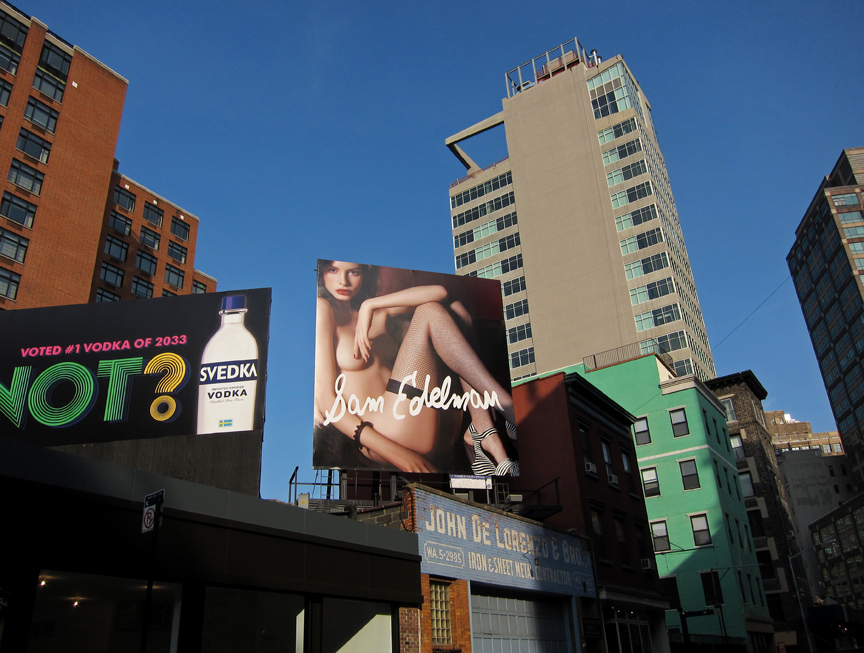
    I do not recall my specific needs, but some years ago, I visited John De Lorenzo & Brothers at 43 Grand Street in SoHo. The iron and sheet metal company, formed in 1907 and closed in 2008, had been recommended to me for welding. I never imagined that at some future date, the rooftop would support a huge billboard of a nude model (nearly nude with a strategically placed index finger). See more photos here and here.

    The ad is for Katrice wedge sandals by designer Sam Edelman, modeled by Charlotte Kemp Muhl. The 22-year-old model/singer is signed with top agency Elite Model Management and has appeared in many national ad campaigns. She is currently the girlfriend of Sean Lennon. Together they have formed the company Chimera Music.

    In America, there is an enormous amount of attention paid to exposure of the female breast. Laws govern very special anatomical limits – the requirement of pasties to cover nipples in bars, etc. However, unbeknownst to many, in 1992, women in New York State won the right to go topless anywhere a man is permitted: The People &c., Respondent, v. Ramona Santorelli and Mary Lou Schloss, Appellants, et al., Defendants. Many are unaware of this ruling, including police officers – quizzing them will get varied and interesting responses.

    The amount to which female breasts are exposed in public is like a societal time marker – as time passes, we move towards more exposure, with the nipple being the final and ultimate revelation. While some see this as a sign of a society in decline, others, particularly in Europe, see American views regarding the topless woman as being quite Victorian and concern to be over zealous. I am not sure what will happen if nudity becomes very common in advertising and television – whether society will implode or the obsession will pass 🙂


  • Watch the World

    On January 12, 2010, I wrote of my first apartment in New York City in Diner Be Aware of the Diner. Living on West 22nd Street in historic Chelsea was a unique privilege, one which I grew to appreciate more and more in hindsight. This was truly a case of you don’t know what you’ve got ’till its gone.

    One of the great pleasures of my short time there was sitting on the stoop on a summer evening with friends and chatting amongst ourselves, with passersby and with neighbors. We had no idea that we were reenacting an historic activity, something New Yorkers have done in many neighborhoods across five boroughs for ages.

    I frequently sit on the stoop of my current residence, a townhouse in Greenwich Village (see Being Trumps Doing here). Unfortunately, my neighbors rarely do the same.

    Stoop sitting still exists in some neighborhoods. In many, however, they have become resting spots for loiterers, visitors, and drug users. Many buildings have installed wrought iron gates as a deterrent. Even though these gates are not locked, most nonresidents will avoid opening a gate.

    The benefits of stoop sitting are many. It provides entertainment, socializing, becoming acquainted with neighbors, crime watch for improved safety, and some fresh air. I have met celebrity chef Mario Batali on a number of occasions taking a break and stoop sitting across from his restaurant, Babbo, on Waverly Place.

    Stoop sitting in New York City was common by the early 19th century. New York City is a place where one finds a lot of running and chasing of people, places, and things. But the savvy urban dweller or visitor will find that much can be seen and learned and people met by just staying in one place (see Taste here). Like the café habitués of Europe have found, people watching is a pleasurable activity unto itself. Find a spot on a park bench or stoop and watch the world go by 🙂

    Photo Note: The stoop on the left is on Washington Square North, as viewed from my stoop (see it here). The stoop on the right is my first NYC apartment residence, located at 431 West 22nd Street. I believe the building may have remained a rental, accounting for its poorly maintained condition – such a pity.


  • White by Desire

    I can’t say that New Yorkers have an exclusive on making impractical choices, but examples do abound that give evidence that it is at least a worthy contender in any competition for foolish choices. Trends and fads drive residents of this city as much as anywhere else, where it often seems that displays of extreme lack of sensibility is its own form of rebellion.

    And what better way for some to display that defiance by sporting a large dog with roots from a climate completely antithetical to that of New York City? Breeds inappropriate in any number of ways for city life, or ones requiring extreme maintenance.

    I recall the 1980s, when the Shar Pei, with its heavily wrinkled skin, was all the rage. Rapid breeding resulted in many health problems, such as allergy-induced skin problems. Many required eye surgery, with some owners seeking the skills of a eye surgeon for people. I rarely see the Shar Pei here any longer. Akitas were also quite popular at one time. Now I often see the Shiba Inu, a small hunting dog from Japan with a cute, foxlike appearance.

    On Sunday, I met Sofie, a beautiful, cheerful, friendly Samoyed – a breed originating from Siberia that is a nomadic reindeer herder. They have a dense double coat, which means lots of hair shedding. They are very youthful, energetic dogs with a desire to pull sleds and a love of the cold. Perfect for the Manhattan apartment resident, n’est-ce pas?

    Their cheerful nature and beautiful white coat, for many, outweigh any practical considerations. The breed’s ear-to-ear smile has given the Samoyed its alternate name, “smiling sammy.”

    In fairness, after speaking to the owner, I found that Sofie is very well cared for. It is possible to keep a dog like this healthy and happy in a New York City apartment with work, and many pet owners are ready, willing, and able to do whatever is necessary.

    Samoyeds are extremely well-insulated. Sofie actually loves sleeping in the snow. In their native environment, Samoyeds kept their owners warm at night by sleeping on top of them. The dog’s owner told me that once it begins to get warm at all, she runs her air conditioning 24/7.

    I was surprised to learn that early Samoyeds also came in black – white has become dominant due to popularity. If not for the constant care and responsibility, I could easily fall for the cheerful charm of the Samoyed. I, like many others, do love that white color, and the Samoyed that we see today, more than White by Design, is White by Desire 🙂

    Note: For lovers of white, see my stories White by Design, White by Design 2, and White by Design 3.


  • Color of Money

    This appears to be a case of color by number, but no one appears to know what the numbers are.
    One of the most commonly asked questions regarding the Empire State Building is the significance of the lighting colors and how the color schemes are decided. I wrote about the lighting schedule on March 27, 2007 in Equinox. The color schedule and meaning of the colors is easily found at the official ESB website.

    In celebration of the NYU commencement, the color scheme was purple/purple/white (NYU’s school colors are purple and white). The special lighting was further enhanced by the fact that the building could be seen looking up Fifth Avenue from Washington Square Park, NYU’s de facto “campus.”

    The process as to how the decision is made, however, is shrouded in mystery. According to the New York Times, a spokesman for the Empire State Building said that the building “doesn’t discuss the intricacies of the lighting approval process.” Out of curiosity as to what is involved in having your choice of colors for lighting, I downloaded the Empire State Building Lighting Partner application. It is quite simple and straightforward. In the first paragraph, you are told:

    Selection as an Empire State Building Lighting Partner is at the sole discretion of the ownership and management of the Empire State Building Company L.L.C. The Empire State Building is a privately owned building—not owned by New York City or the State of New York—and, therefore, has its own policies. Selection as a Lighting Partner is a privilege, not an entitlement.

    There is, however, no discussion of money, but the phrase “Lighting Partner” would lead one to believe that there is a cost. No crime there – after all, the building is a private enterprise.
    There was some outrage recently when the building was lit red/yellow/red from September 30 through October 1, 2009, to commemorate the 60th anniversary of the People’s Republic of China. Many speculated that it was strictly a decision based on what China was willing to pay.

    NYU certainly has a lot of influence, clout, and its share of controversy (see Gorillas and Cookies here). It also has a lot of money. And, at least for the NYU commencement, purple is the color of money 🙂


  • A Stop for Complainers

    Posted on by Brian Dubé

    New York City’s extreme nature leads to a plethora of love/hate sentiments and conflicted feelings. Many threaten to leave and never do – I wrote about this phenomenon in Not Going Anywhere. Having to commute daily using the New York City subway system is, for many, one of the greatest pains they have to endure.

    When under fire, however, the transit system is often defended by its very detractors – just another example of the love/hate relationship New Yorkers have with this city.

    The city’s transit system has much to defend. It is one of the world’s busiest and most extensive. In tandem with the bus system, one can get to virtually any destination within the five boroughs using public transportation alone.
    The subway system runs 24/7, making maintenance and repair an extreme challenge. All track work has to be done while the system operates and thus necessitates frequent service suspension, disruptions, and changes. This is a necessary evil and way of life for the underground rider.

    I have traveled by this train yard numerous times, always by car on the Belt Parkway, and I have been amazed at this vast sea of subway cars. On this particular occasion, traffic was very heavy and gave me an opportunity to take photos while driving, reaching across the passenger side, and bracing the camera as well as I could against the passenger window frame.

    This is the New York City Transit Complex at Coney Island – one of the largest transportation facilities in North America. Opened in 1926, the Coney Island Complex occupies 75 acres of land in the southern part of Brooklyn, New York.
    There are three storage yards which have the capacity for storing nearly 1,800 subway cars. The Coney Island Tower serves as a command center coordinating the moves of subway cars. The car wash cleans the exteriors of over 1,000 cars approximately once a week for a yearly total of 50,000 washes.

    The complex consists of a number of shops:
    Overhaul & Repair Shop. The overhaul shop also works on maintaining and restoring the cars in the fleet of the New York Transit Museum. Within the Overhaul Shop, there are four 30-ton cranes capable of moving entire subway cars from one work station to another.
    There is also: Paint Shop, Wheel, Truck, & Axle Shop, Maintenance/Inspection Shop, Pneumatic Shop, Traction Motor Shop, Small Motor Shop, Shoe Beam Shop, Battery Shop, and training facilities.

    New York City is full of surprises. With all of its miscreants, vandals, abusers, and users, it really is a miracle that all our systems work so reliably – power, water, sanitation, transportation – all managed by civil servants, a group popular for bashing. Perhaps the MTA should make the Coney Island Complex a subway stop for complainers 🙂

    Related Posts: Unkindest Etch of All, The Subway, The El, Subway Art

    Posted on by Brian Dubé

  • Look at Them Go


    Please click and play audio link to accompany your reading.

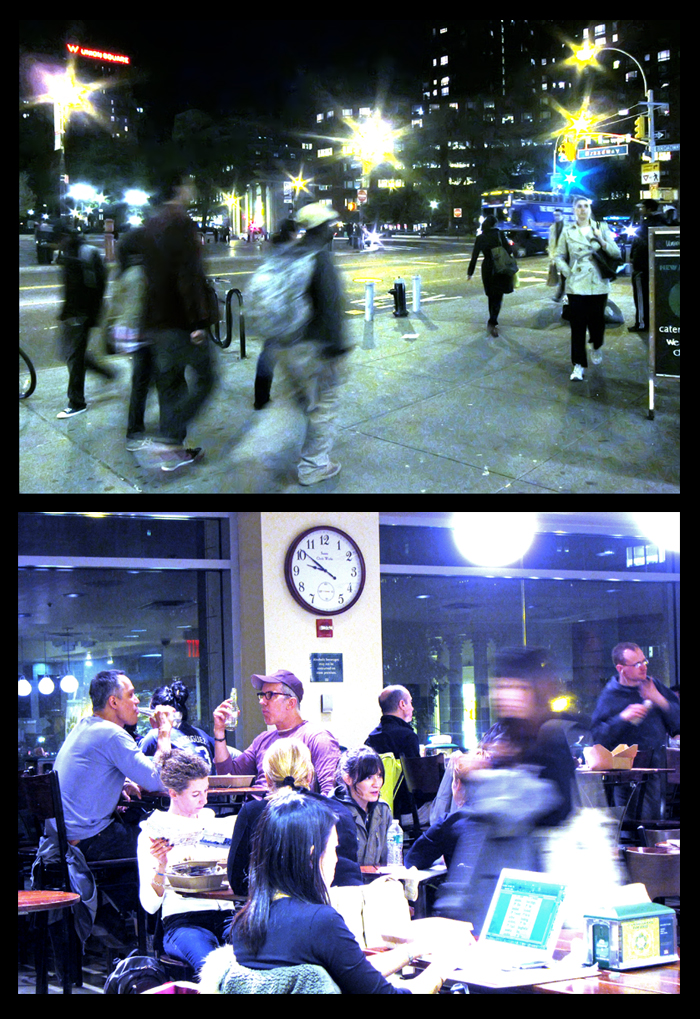
    One of the most startling differences between New York City and most other places is the life at night. It is late at night, you are alone, and perhaps you are in need of some human companionship. Step out into the streets of New York City and see signs of activity everywhere.

    My family loves the city and has visited on a regular basis. At one time, they would camp out in my living room. My mother was fascinated with all the activity. She would stand, stare out my window, and exclaim, “Look at them go. They don’t stop going. They go all night.” As if it was one person or one group with insomnia who patrol the city 24/7, perhaps to die of exhaustion. The city never sleeps, however, individuals do – but why tell her that when she was having so much fun?

    Visiting my family in Bristol, CT, and driving the streets on a Sunday or especially on a Saturday evening before returning home, I was astounded as to how dead this suburban town of over 60,000 could be – it was a virtual ghost town with nary a person in sight.

    Two hours later and back home, particularly in the summer, I would find Manhattan mobbed. In the Village, I would encounter bumper-to-bumper traffic jams. Reflecting back on the town I had just left, it was impossible to fathom – after every trip, I would question my memory of the town I had left.

    Of course, I realize that it is unfair to compare the two places, but nonetheless, it was the extreme contrast that to this day still astounds me. Driving through that suburban town where almost no one walks the streets and there are no cafes and no signs of life at all at night, minus perhaps a gas station or all night convenience store. That is why the discovery of the Tangerine Dream coffee house in high school was nothing short of a miracle.

    I was once discussing all these matters with a friend, now living in the city, who for a time lived in a neighboring town in CT. He can be rather caustic and blunt with his opinions – in this case, his response was that the “suburbs are death.” Dislike of the suburbs is one of the most commonly shared feelings you will find in this city.

    If you are a visitor, you may never be privy to this sentiment. A polite person will show due respect, and a reasonable person is aware that there are different strokes for different folks and that the city is not to everyone’s liking. And, admittedly, there are tremendous conveniences of living in the suburbs. See my story of Dwanna here.

    My parents no longer live in Bristol, but from time to time, I still like to pass through for nostalgic reasons. On a bleak winter night, I am intrigued by the deadly quiet. Soon I will be home, where, if I want to see human activity, I will only need to step out onto to the streets or even just peer out my window, and any time, day or night, I can Look at Them Go

    Photo Note: The photos were taken at 10 PM at Union Square – a major subway hub, a nexus of streets, and a major shopping district. The area is active day and night. The lower photo is of the mezzanine cafe at Whole Foods Market.


  • Urban Safari

    I do love a good mountain or two, however, New York City is a place for Jungle Lovers, not mountain lovers. Many cities like San Francisco are not only known for their exquisite natural beauty but also are virtually defined by it. San Francisco’s hills, like the Twin Peaks at over 900 feet, offer extraordinary vistas of the city and surrounding seascapes. See my story here about Hill People and Valley People.

    The majority of Manhattan is relatively flat. As one travels north from lower Manhattan, the topography does become somewhat hillier, with the highest altitudes in the northernmost areas in Washington Heights and Inwood. The Cloisters in Fort Tryon Park is known for its sweeping views of the Hudson River. The highest point in Manhattan is 265 feet above sea level, in Bennett Park.

    For most New Yorkers and visitors, the necessity of building a viaduct to span a valley may come as a surprise. The reality will be abundantly clear if you are traveling north on the number 1 train and suddenly find yourself breaking out from the tunnel into daylight on an elevated train track.

    When New York City began building its subway system in 1900, a decision had to be made regarding Manhattan Valley – tunnel under the valley with steep grades at either end, or build a bridge over it. A viaduct made more sense. The viaduct, 2174 feet long, spans the valley between 122nd Street to 135th Street, with a subway station at 125th Street and Broadway on the number 1 train. The steel arch spanning 125th Street is 168.5 feet long and 54 feet above the street. The 125th Street station opened in 1904. The viaduct was designated a landmark in 1981 by the Landmarks Preservation Commission. Read more here from the New York Times.

    Every day the trains are busy, transporting Jungle Lovers, Hill People, and Valley People through New York City. Join us on an urban safari 🙂


  • Get Your Doing Done

    I had a close friend who was extremely neurotic and driven. Often, when discussing options for plans with others, one could see his impatience and edginess growing. Once, I recall speaking to him on the phone in the early evening. He was already finished with his plans for that night. When I expressed surprise, he said that if he was going to do something, “I like to get my doing done.” He appeared to be turning recreation into a job guided by an efficiency engineer.

    This website was inspired by Eric Tenin, who started Paris Daily Photo in 2005. The original concept was to share daily life, one photo per day. New York Daily Photo, however, has metamorphosed over time. 

    There is merit to the original concept, however, everyday life is filled with routine, and I did not want this site to become a tribute to the mundane without some special or personal ingredient added. The TV series Seinfeld, which purported to be a show about nothing, was really quite more than that. Although, on the surface, many of the plot elements were about the trite and trivial, without cleverly crafted comedic writing, plot twists, surprises, and great characters, a show that is truly about nothing would bore audiences to tears and never survive. 

    Today, I left home for the office earlier than usual. For those who are early risers, the streets in the early morning are a special and pleasant time. There is the freshness of a new day, construction workers toiling away. In New York City, this is also a time where photo shoots and filming can often be seen on the streets – there is good light and the streets are less crowded. And best of all, for those who are so inclined, there is comfort in knowing that by starting the day early, there will be plenty of time to get your doing done 🙂


  • The Hamptons

    Passion for living in New York City is perhaps only bettered by the passion of many residents to get out come summertime. At one time when I was taking music lessons, I was forewarned by my teacher (a Manhattan resident) that she refused to be in the city in the summer – if I really wanted to, I could travel to her summer cottage outside the city. She had stressed that it was not fancy at all, but it was out of the city.

    I have heard many extol the benefits of being in New York City in the summer – that it is easier to get tickets to many activities, things are less crowded, and there is an enormous number of summer events throughout the 5 boroughs. This is all true – I have spent most summers here, many without the occasional weekend getaway.

    But there comes a time when it is so hot and humid that all this chatter about the benefits of summering in the city seems like cheap talk. I recall one summer night after an opera performance standing on a subway platform. It was so sticky that it made my skin crawl, and clothes just seemed to be an insult to injury. Yes, I had procured great New York City opera tickets easily and inexpensively, but those who were enjoying ocean breezes certainly must have made a better decision.

    Getting away for the summer is not unique to the city – our suburban and rural brethren often take to the hills or the beach. And summer homes for the urbanite is a practice going back in time around the world. A good case in point are the Medici villas around Florence, Italy.

    In New York City, the Hamptons (along with Montauk and Fire Island) are virtually synonymous with summer getaways. However, having made a decision where to go and the financial means to do so is only part of the solution. Getting there becomes another hurdle. For those who have selected the Hamptons, traveling 100 miles from Manhattan is now the challenge. There are a number of travel options: car, bus, train, plane, or helicopter. Few can afford flying, and traffic congestion on the limited number of roadways out can be a nightmare.

    In 1974, Hampton Jitney was founded with a single van by James Davidson, a resident of the Hamptons. Train service was and still is available from New York City but has limited frequency, with delays and service complaints. On the other hand, the Hampton Jitney has service as frequently as every half hour, leaving from multiple locations on the Upper East Side. I have never summered on the East End, but if I did, I think the Jitney or train would be the way to the Hamptons 🙂

    Note: The Hamptons are a group of villages at the east end of Long Island. The area is a long time seaside resort known for its affluent residents and celebrities from New York City and around the world. You can read more about them here.


  • dinamic_sidebar 4 none

©2026 New York Daily Photo Entries (RSS) and Comments (RSS)  Raindrops Theme