• Category Archives Stores
  • The Patel Brothers

    Posted on by Brian Dubé

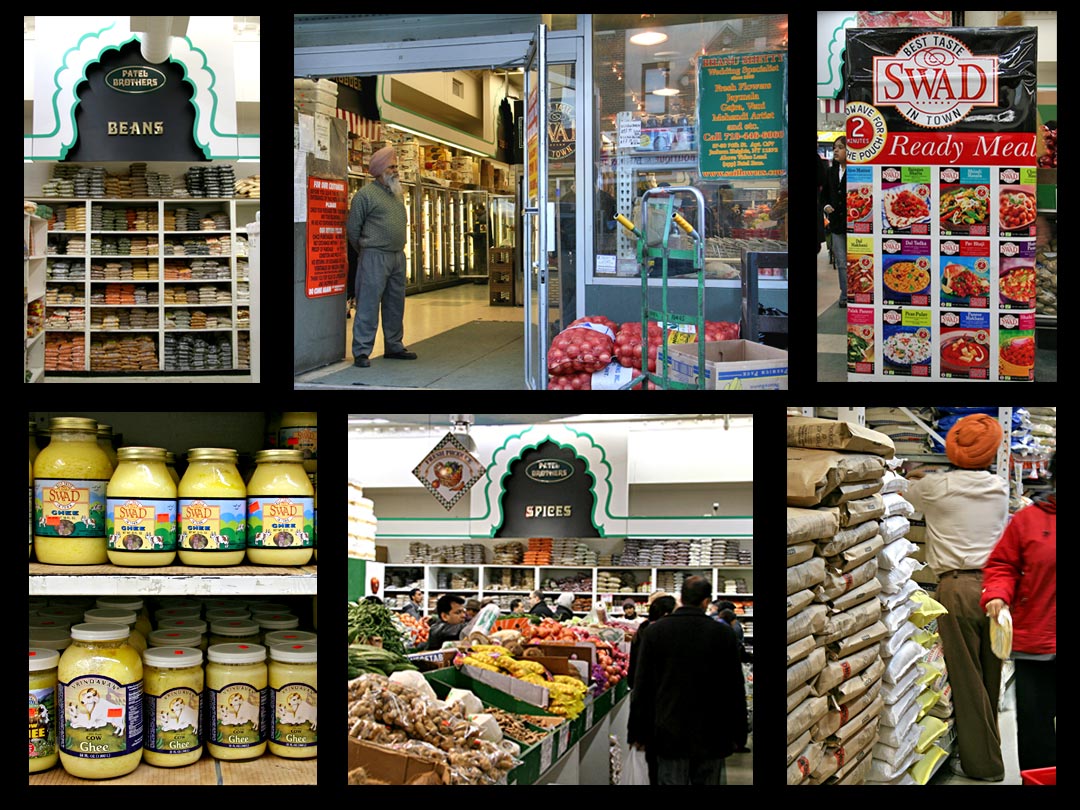
    Welcome to the only Indian food chain in the United States. The Patel Brothers now have 35 stores across the US, primarily along the eastern seaboard, with stores also in Detroit, Houston, and Indianapolis. They distribute Raja Foods and Swad (“taste” in Hindi). In total, they are doing $140 million in sales annually. The business was started in 1974 by Talashi and Mafat Patel when they bought a small Indian store on Devon Avenue in Chicago. Mafat came to the U.S. on an engineering scholarship and worked for Exxon as an electronic engineer, a position he kept until the late 1980s. I always thought of this type of store as unique to NYC, so it is surprising to learn that the Indian community has grown to such an extent to support all these retail locations.

    Indians have been very successful in this country. They are the second-largest Asian group after the Chinese, the second most prosperous group after the Jewish-American, and highly educated – according to the 2000 census, 64% have a bachelors degree or more. The photo is of the Patel Brothers grocery on 74th Street in Jackson Heights, Queens. With 90% of the product line from India or Pakistan, a location in an Indian Neighborhood, and a staff and customers dominated by Indian-Americans gives one an immediate sense of a seriously AUTHENTIC ethnic atmosphere when entering this store. With an entire aisle of rice – more brands than I knew existed – a section devoted to ghee, and, of course, enormous sections for spices and beans, these guys have no competition…

    Posted on by Brian Dubé

  • Indian Gold

    This photo of filigreed necklace sets was taken on 74th Street in Jackson Heights, Queens. The shop is one among many gold dealers in this neighborhood, where a proliferation has made it a gold district, visited by customers from around the country.

    Gold is big in the Indian community. It is purchased for the birth of a child and various holidays and is an important part of weddings. Of the Solah Shringar (sixteen adornments) that complete an Indian bride, many are comprised of gold jewelry. In Indian culture, there is jewelry for nearly every part of the body: anklets, bracelets and bangles, panja (which covers the back of the hand and held in place by an attached bracelet and rings), rings for fingers, toes, noses (nathni) and ears, tiaras, and tikkas (a piece of gold jewelry that hangs over the forehead and hooks into the hair). In India, Bangladesh, and Pakistan, the bride’s jewelry is an important aspect of the wedding process and is part of the dowry which the bride gets to keep in the event of divorce.

    However, traditions are changing, and as more young people in Asian communities in the U.S. marry here rather than in their home country, gold is becoming a less important part of the marriage. All the gold is 22 karat (91.6% pure), and pieces are sold by weight. When I asked the price of a necklace, the clerk promptly tossed the piece on a scale and took out a calculator…


  • Barbie

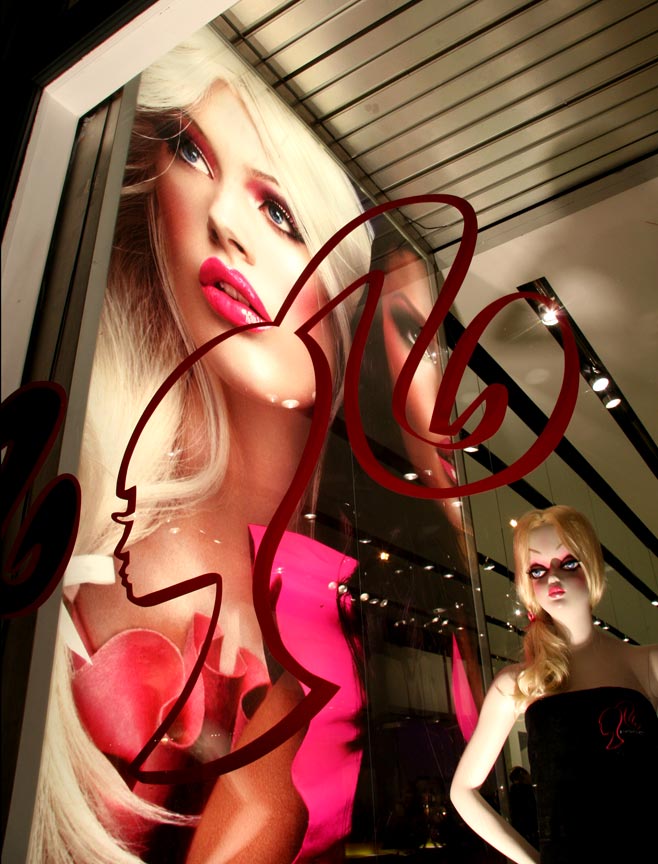
    Barbie has apparently changed her look. When I saw this striking window display at the MAC cosmetics store at 113 Spring Street in SoHo, I felt a little foolish. I went inside and asked a salesperson what the theme was, and she said incredulously, “Why, it’s Barbie!” Barbie Loves MAC is one of the looks they are now featuring. Barbie is big right now – the current March 2007 Vanity Fair has a Q&A interview with the new MAC Barbie doll.

    I’m fascinated with this country’s fascination with Barbie – she is a major icon with her share of controversy. This is way too large a subject to get into here – Barbie is a doll, a collectible, an idol, a role model, an industry, and a syndrome (Barbie Syndrome). She has a full name (Barbara Millicent Roberts), a birthday (3/9/1959), a birthplace (Willows, Wisconsin), a fascinating history, different looks and wardrobes, plenty of ethnically diverse friends, occupations, pets, and cars. And, of course, there have been parodies and lawsuits. There are Black and Hispanic Barbies. And pink is her color. For the first time, it appears she has some competition – Bratz is closing in…


  • The Strand

    Everyone in New York knows the Strand Bookstore at 12th Street and Broadway. With the slogan “18 miles of books,” the Strand is a contender for the largest used bookstore in the United States (along with Powell’s Books in Portland, Oregon). Independent and family-owned, it was founded by Benjamin Bass in 1927 on book row – an area on 4th Avenue between 9th and 14th Streets which at one time had over 30 used book stores. In 1956, it was taken over by son Fred Bass; in 1957, it was moved to its current location. Under the stewardship of Fred’s daughter and owner Nancy Bass-Wyden, the Strand appears to be trying to come of age; I notice that they now have an online presence. The second floor has been renovated. However, it still is a browser’s store. The size and inventory is overwhelming – the store with its 3 floors is a virtual maze (if you go, visit their rare book room – the largest collection in the city).

    Its inventory is not organized like a typical bookstore. Most find it daunting. Click here and browse these very entertaining reviews, and you’ll get an idea of what you’re in for. Here was one of my favorites: “Holy mother of GOD is this a huge bookstore. Never in my life have I seen this many books in one place. When I went in, it was daytime. When I left, it was dark. The Strand is like a black hole…it sucks you in, devours time, and never lets you leave empty handed. I found books here that I didn’t even know I wanted. I spent far more than I could afford. It’s EVIL! Be careful when you enter this place…it will steal your mortal soul!”


  • The End Of History

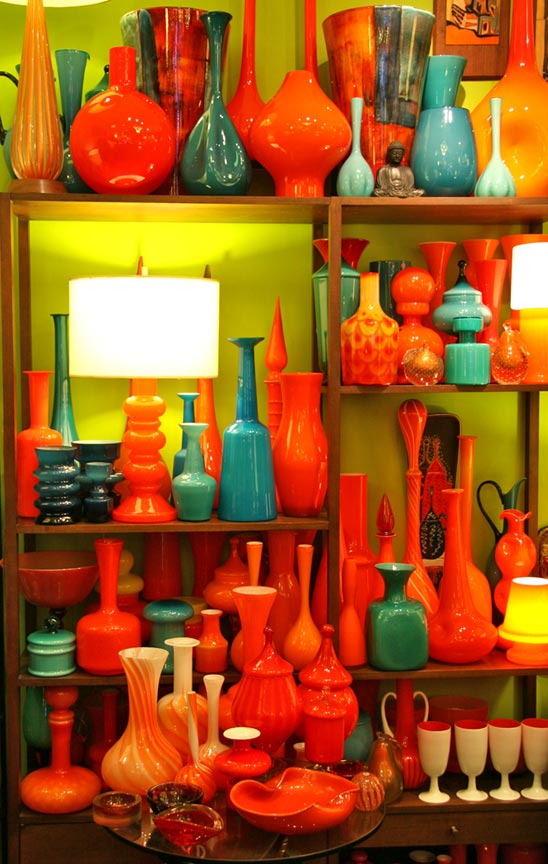
    The End of History is a small shop at 548 1/2 Hudson Street that sells vintage glass, ceramics, and furniture. Their tag line is “the world’s largest collection of 1950s & 60’s glass. Also selling furniture, lighting, and ceramics of the same period.” Owner Stephen Saunders describes his shop as “very Ice Storm” and says that ”Venetian glass is my big love.”

    I immediately was taken by the visual impact – the sun coming through all the varied colors has a striking effect and drew me into the store. The Italian, Scandinavian, and American glass objects are arranged by color, rather than price, origin, etc. See this additional photo showing some other color groupings of glass. This is one of those very specialized shops which exists only in NYC. These artifacts may be, as the store name implies, the pinnacle of accomplishment in this area of glass art, and they really do signify the End of History…


  • Seize sur Vingt

    It is not very often that one finds an automobile parked in a small retail shop in Manhattan. Groupe16sur20 at 267 Elizabeth Street in NoLita is a fashion cooperative started by James and Gwendolyn Jurney, founders of high-end clothing label Seize sur Vingt (meaning 16 out of 20 – a French school grade which equals an “A”), which is sold here along with their other line, Troglodyte Homunuclus. Apparently, something artsy is happening on Elizabeth Street.

    Similarly to the post I did recently on the Elizabeth Street Gallery (across from 11 Spring Street), fusion again rears its head. In this case, clothing meets art, performances, and autos. From a January 8, 2007 article in the New York Times: “Groupe 16Sur20, a cousin of the NoLiTa store Seize sur Vingt that is perhaps New York’s only gallery/clothing emporium/used car lot, even has its own curator, who’s put together shows by the likes of Nan Goldin and Larry Clark. They share space with the stock of men’s polo shirts, soccer jerseys, and a Lamborghini.” Currently, a yellow 1987 Ferrari Testarossa (shown in the photo) is being offered for $90K…


  • Jacques Torres

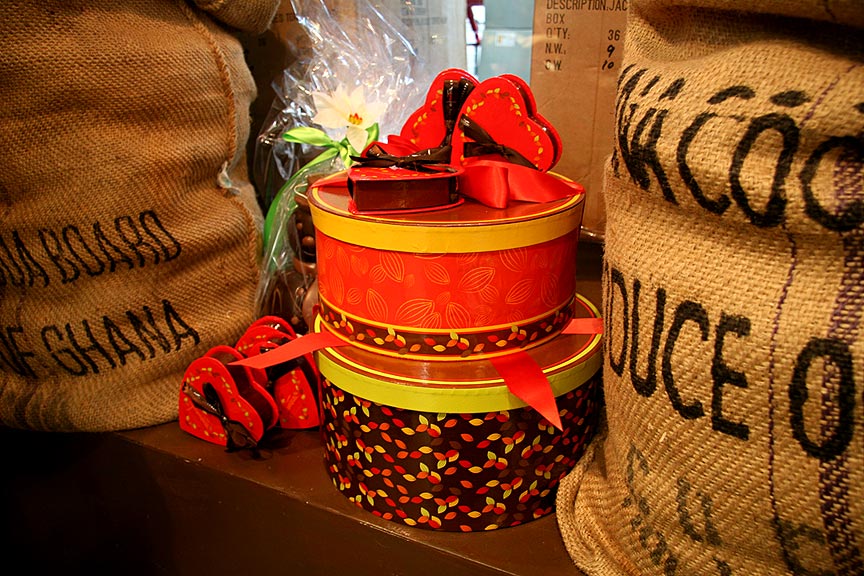
    What is more universally loved than chocolate? Claims have been made that chocolate consumption releases serotonin, producing feelings of pleasure. And recent studies suggest that there may be health benefits to dark chocolate.

    Jacques Torres Chocolate at 350 Hudson Street was opened in 2004 (his original factory is in DUMBO, Brooklyn, opened in 2000). It is one of the few places in the country that actually manufactures chocolate, and they do it on site, in Manhattan, behind glass, where the process can be viewed from the street or the interior of his shop. French chocolatier Jacques Torres has quite a pedigree with extensive culinary awards and a history of work in top restaurants worldwide. His website is excellent; there are several videos available for viewing, including ones that show the making of chocolate and various products.

    I learned that the chocolate-making process is quite extensive. Beans arrive dried and fermented from Ghana, the Ivory Coast, and Ecuador; the beans are cleaned, roasted at 160 degrees for 30 min (in a vintage roaster) and cooled, and sent to the winnower to remove shells. The heavier interior nibs (the core ingredient) are ground twice; sugar is then added, and the mixture is sent to the the mixer. It then passes to the refiner (to break down particles into a smooth mixture). It passes twice – the particles are now less than 20 microns in size. Then off to the conch (the most time-consuming process), where two granite stones grind the mixture against a granite wall for 12 hours to remove any bitterness. Cocoa butter and lecithin are added. A tempering machine (processing at various temperatures in stages) brings it to a crystalline form. Finally, the chocolate is injected into bar molds.

    The shop itself is a pleasure to visit – there is a bar where an array of hot chocolate and coffees are served. Above the bar, there is a statue of Quetzalcoatl, the Aztec god of cacao. And, of course, their entire selection of chocolate confections is available for purchase. Click here for more photos. A must-stop for any visitor to or resident of New York City. And by the way – Happy Valentine’s Day!


  • Zoomies

    In the West Village at 434 Hudson Street, I stumbled on Zoomies, which turned out to be a chic Parisian boutique for dogs owned by Angelique M. Graux and Susan Bartholomew. Angelique, a restaurateur from Paris, combines her expertise in French cuisine with Susan’s background in fashion (she was Vice President of retail for Christian Dior Couture). They feature custom-made beds, collars, accessories, apparel, toys, and, of course, treats – homemade biscuits and decorated treats displayed in an antique patisserie case at the 1st Biscuit Bar for dogs in NYC.

    This type of place seems to be part of an increasing trend towards indulging and pampering one’s pet: Brooklyn opened the first bakery just for dogs – Buttercups’ Pawtisserie, where pupcakes are made; there are rumors of a line of puppy couture called Ruff Love…


  • ABC

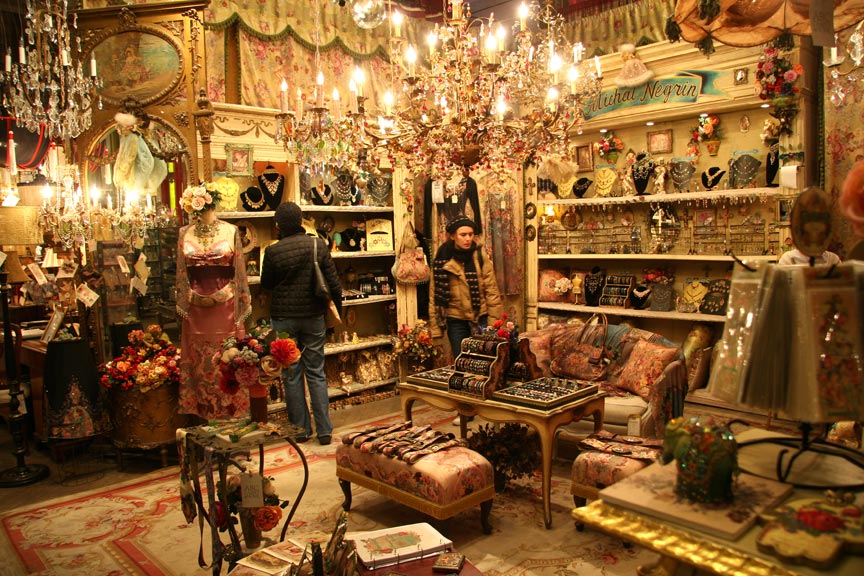
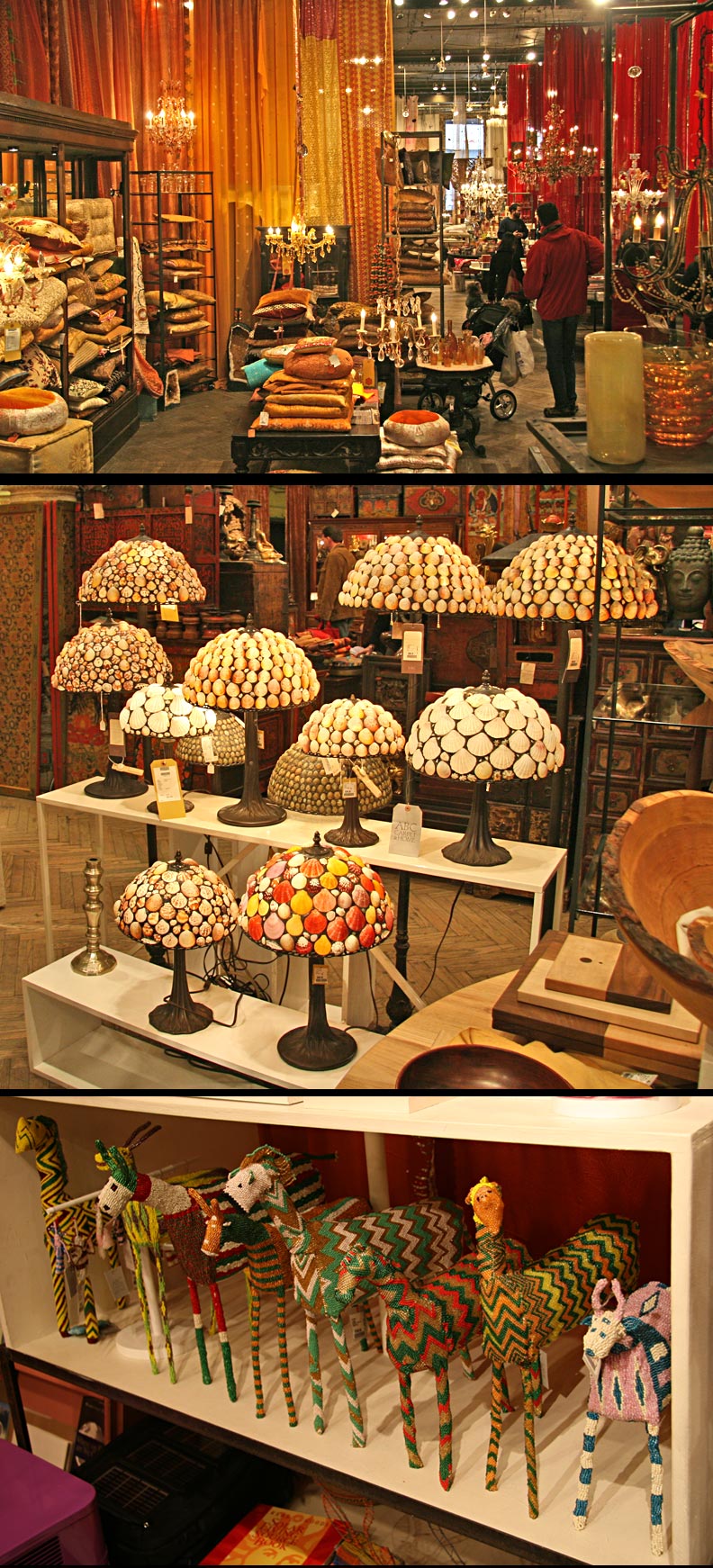
    Photos do not do justice to the experience of being in a place like ABC Carpet and Home, with its enormous loft-like floors and the look and feel of a Victorian emporium. Some floors have separate boutiques. There are even restaurants, a bakery, a cafe, and a French chocolatier. The stores sells an enormous variety of home furnishings featuring furniture, antiques, jewelry, bed & bath, lamps, chandeliers, fabric and drapery, baby and children’s goods, gifts, collectibles, etc. Click here for more photos.

    This is another one of those “only-in-New York” type of places with a unique feel. An amalgam of quality goods in a historic space that is slightly worn – not the very immaculate, sanitized type of place you would find elsewhere for merchandise of this quality and price. Not that long ago, ABC was a relatively drab, utilitarian carpet outlet. From the New York Times article: “ABC has come a long way since 1897, when Sam Weinrib, an Austrian immigrant, began pushing a cart loaded with used carpeting and linoleum around the Lower East Side. Sam’s son, Max, abandoned the cart for a store under the Third Avenue El at 29th Street, and Max’s son, Jerome, moved it to the current site in 1961.” The business occupies the 7-story building (which it now owns) at 888 Broadway and 19th Street, as well as the building across the street at 861 Broadway. Read more about it here. I highly recommend visiting if you are able…enjoy the atmosphere…


  • Vegan Chic

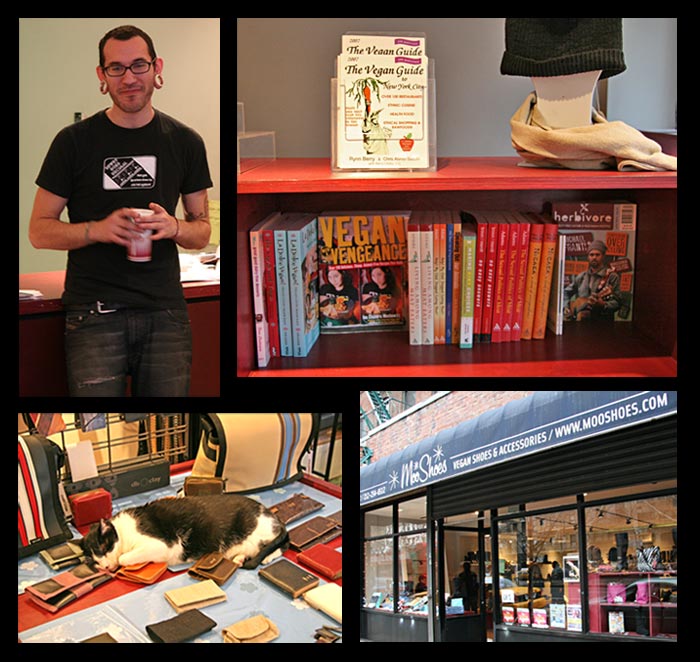
    There has been a spate of articles recently covering the growing vegan movement and its fashionability. The New York Times alone has run two articles in just the last few weeks (one on vegan chef Isa Moskowitz). There are several stores in Manhattan catering to the movement, such as Organic Avenue, Mooshoes, Kaight, and NY Artificial.

    Vegans have been around for a long time – the Vegan Society (and the word itself) originated in 1944. The philosophy involves dispensing with all products derived wholly or partly from animals. This includes more than the obvious – purists eschew animal products, including meat, poultry, seafood, eggs, dairy products, fur, leather, wool, pearls, and mother of pearl, by-products, such as gelatin, lanolin, rennet, and whey, and items derived from insects, such as silk, honey, beeswax, shellac, and cochineal. Some even avoid items which use animal products in the manufacture even though none is in the product itself (cane sugar that has been filtered with bone char; beer or wine clarified with albumen, animal blood, or isinglass).

    What’s new in all of this is the new chic ethic surrounding the whole movement. It’s being embraced by a number of groups – the fringes (punks, goths, etc.), college students, and an upscale market with celebs such as Natalie Portman, Alicia Silverstone, Woody Harrelson, Joaquin Phoenix, and Stella McCartney.

    The collage of photos was taken at Mooshoes, a new shop on the Lower East Side featuring vegan shoes, clothing, cosmetics, books, and videos/DVDs. In a way, I am not surprised at all, since everything seems to be about pushing the envelope, thinking out of the box, and living on the edge. Things are just getting more and more extreme. But there is still a little ways to go – I actually have a few older books on fruitarianism and breatharianism


  • The Scholastic Building

    This is the Scholastic Building at 557 Broadway in SoHo’s cast iron district. The project was designed by celebrated Italian architect Aldo Rossi, described as a “poet who happens to be an architect.” He died in an auto accident before construction began.

    Scholastic, established in 1920, is the world’s largest publisher of children’s books. They have a large presence in this area, occupying a number of buildings. This was Rossi’s first and only project in NYC. The structure was built from scratch on a site which was home to a parking lot and a one-story building (Broadway Lumber), taking six years to complete. The design, with its white half-columns, spandrels, and rust-red I-Beams, is quite striking; “the building’s columnar Broadway facade, in steel, terra-cotta, and stone, echoes the scale and the formal, Classical character of its commercial neighbors.”

    The property extends one city block through to Mercer Street, where the building sports its own similar but more industrial facade. Most critics love the design, while some, of course, do not. The building expands Scholastic’s previous headquarters next door at the Rouss Building (circa 1889) at 555 Broadway (photo left) – the floors are contiguous between the two buildings. The land itself is leased from the Blechman family, with an option to buy it in 2013. Read the story here. The new building serves as the primary entrance to Scholastic; the ground floor and mezzanine is a retail store with their line of books, videos, games, puzzles, and toys. Do visit…


  • Bluestockings

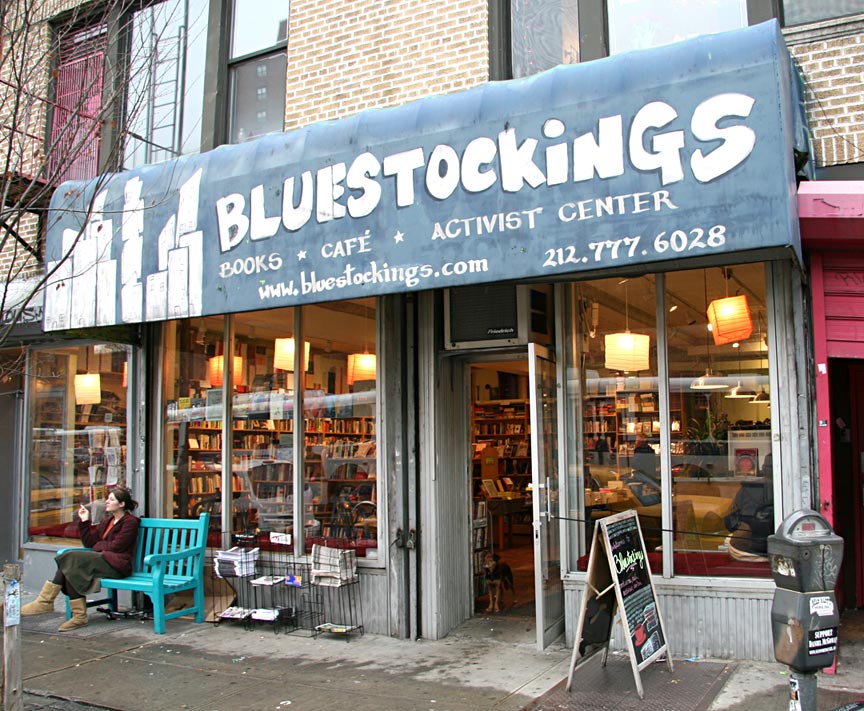
    One has to look harder these days to find places like this. The edges of the city have found the few remaining nooks and crannies in areas with quasi-affordable rents. This strip of Allen Street on the Lower East Side has a handful of countercultural and vegan establishments, including Bluestockings, which was opened in 1999 by Kathryn Welsh as a bookstore by and for women.

    Their website and my visit there does appear to indicate that the original concept has been expanded, with a broader range of subjects and activities (including readings): “Bluestockings is a radical bookstore, fair trade cafe, and activist center in the Lower East Side of Manhattan.” Click here for their mission statement and website. The term bluestocking itself is fascinating, hearkening back to the 18th century British bluestockings, a women’s literary movement which found its origins in the French literary salon movement. The term became used in a pejorative way to describe a literary or intellectual woman…


  • End of an Era

    From time to time, technology makes major, sweeping changes to our lives. The Internet is certainly one of the largest transforming technologies in recent history, with fallout, of course, like the CD/record business, which is being eliminated.
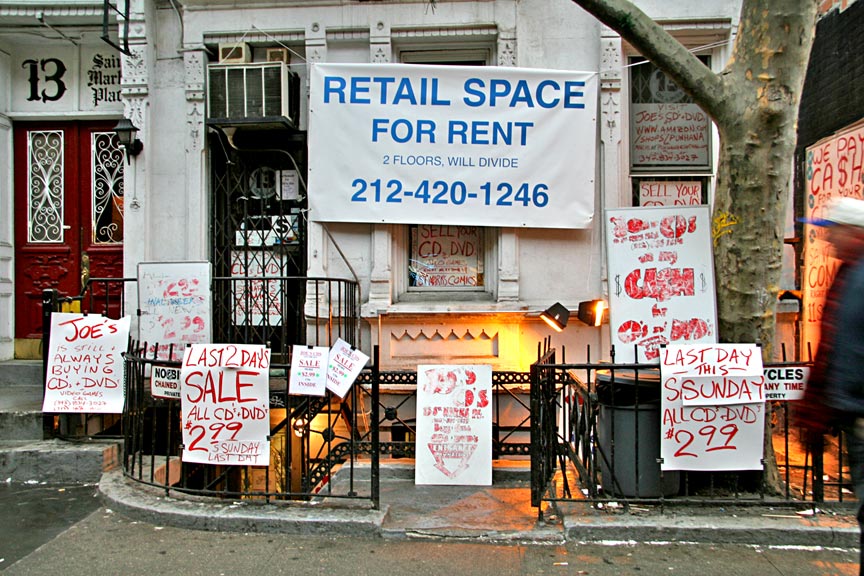
    Just recently, Tower Records closed – when it opened in the 1980s, it was the largest retailer of records in New York. Its impact was huge, with many stores affected in a large radius. CDs were a significant new technology – I remember when CDs started being introduced in a small section at Tower. The transition from vinyl records to 100% CDs was remarkably rapid. And now, with digital audio files such as mp3s, the iPod etc., the era of physical media for audio and video is coming to a close – at least seeing large retailers dedicated to these media. The demise of DVDs appears to also be on the way. Netflix has just announced the start of movie downloads – Instant Viewing – by June of this year.

    The photo was taken on St. Marks Place in the East Village. Although businesses go out for many reasons, I imagine that declining sales of CDs was a major factor in this place’s demise…


  • Provocateur

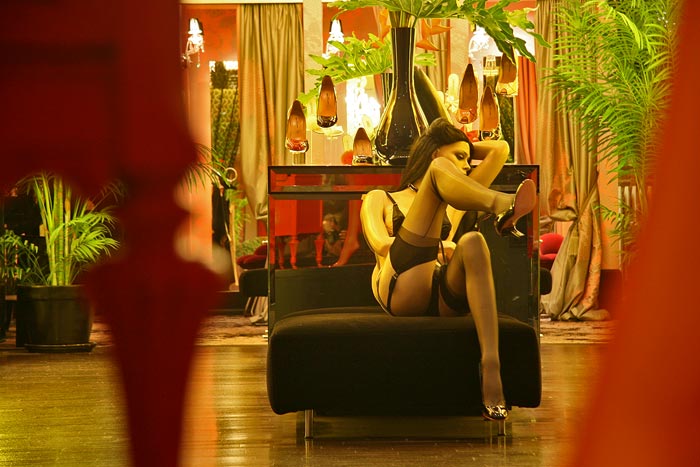
    This photo was taken through the shop window of Agent Provocateur at 133 Mercer Street in SoHo. I have gone by here many times, but walking with a camera changes things – I become much more attentive to the usual in my life, subconsciously looking for that photo op.

    What struck me here was that at first glance I thought that this was a real person, not a mannequin. I also did not realize until doing this post that Agent Provocateur is a well-known lingerie brand started in SoHo London in 1994 by Joseph Corre and Serena Rees (Corre is the son of British fashion designer Vivienne Westwood and the Sex Pistols’ ex-manager Malcolm McLaren.) They now have a number of stores worldwide featuring upmarket goods and a coterie of celebrity patrons. They are also known for their over-the-top controversial ads, such as the one in 2001 featuring Kylie Minogue riding a bull in lingerie to punk music (you can do your own youtube search). They “introduced their vision of lingerie avoiding the British prudery that insists on categorising anything to do with sex as sleazy or smutty.” You can read their vision statement here


  • Murray’s Cheese

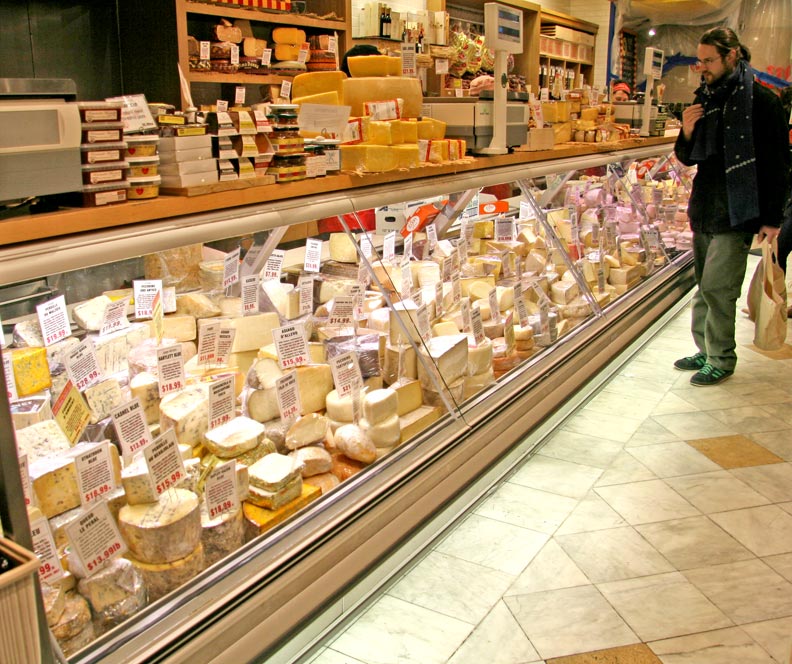
    This is Murray’s Cheese Shop at 254 Bleecker Street in the Village (click here for second photo). It’s the type of place that New Yorkers brag about – a real institution, a place serieux where the ownership and management is obviously obsessed with what they do and have a tremendous drive to be the best. In a city as large as New York, these specialized niche retailers can really thrive. Murray’s was founded in 1940 by Murray Greenberg, starting as a wholesaler of butter and eggs. Rob Kaufelt, the current owner, bought the business from Louis Tudda in 1991. In 2004, they moved from a much smaller cramped location across the street to their current space, where they purchased the building. They lease adjoining retail spaces to other high-quality food retailers (Amy’s Bread and Wild Edibles.)

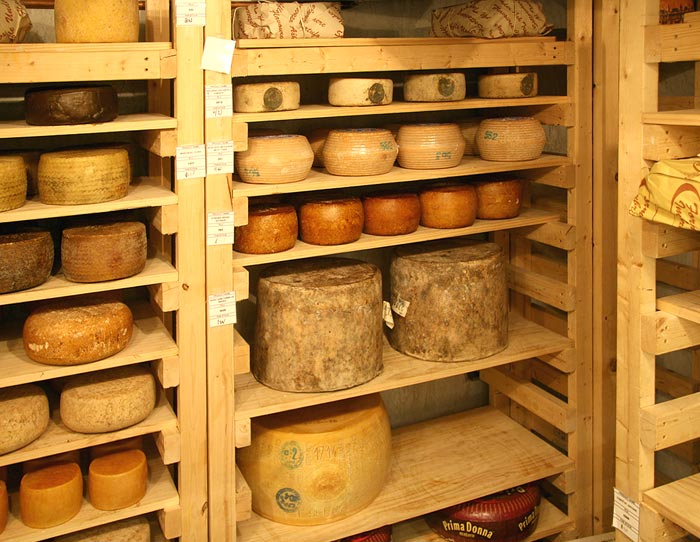
    Murray’s retails over 250 varieties of cheese and wholesales to 75 restaurants, including many of the city’s finest. I was fascinated to learn of their authentic underground cheese caves where affinage (the art of aging) is practiced (Murray’s was one of the first cheese retailers in the U.S. to do this) – French affineur Herve Mons was consulted in their construction. Kaufelt travels the world to acquire cheese, has forged relationships with many artisanal cheese makers, and is able to introduce these special cheeses to their American customers. They have received many accolades and awards. Kaufelt has received France’s prestigious Garde et Jure medal from the Guilde des Fromagers. In addition to the cheeses and gourmet products sold, classes are taught and books are published…


  • dinamic_sidebar 4 none

©2026 New York Daily Photo Entries (RSS) and Comments (RSS)  Raindrops Theme