• Category Archives Stores
  • Pomp and Circumstance

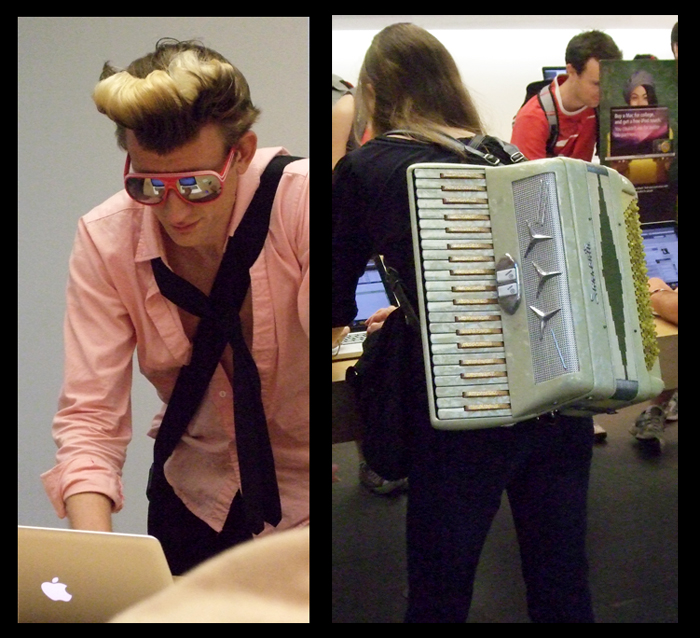
    I have a number of questions when I see people like this, particularly the man with the quiff – questions such as “Where are you going to go looking like that?” and “Where do you work?” Yes, on a Saturday night out or while shopping at the Apple store, you do look cool as hell, but once the novelty wears off at the workplace, who wants to be looking at this day in and day out? Even as a freelance associate or fellow artist, this is going to get old pretty fast. Are you going to be able to hold a conversation with this man and not be distracted by pink glasses, a pink shirt, and a blond-tipped pompadour that looks like the surf’s up at Malibu Beach?

    Now an accordion on your back is much more of a temporal and transitory thing. It’s really just an unusually large accoutrement which is likely not worn this way at home or at the workplace. There is a very good reason this woman is using an Apple computer with an accordion on her back; I just don’t know what it is. She probably was just playing her instrument or will be playing it soon. Or, perhaps she can’t afford a case. Perhaps she doesn’t want a case and finds it more convenient to carry on her back. Perhaps she wants people to know she is an accordionist.

    There are few stores in New York City with as self-assured an attitude (both from the staff and customers) like that of the Apple Stores. Some may bristle at the cult-like atmosphere – there’s a smugness of Apple users as being in the know, using the tool of choice, and willing to pay a premium for it. Iconoclasm has historically been a defining characteristic of both the company and its core adherents.  Apple has had a dominant role in the art community from early on. Under the circumstances, pompadours and accordions fit right in 🙂

    Photo Note: These photos were taken at the Apple Store in SoHo. Both individuals were in the store at the same time. Apple has an extremely liberal attitude regarding use of their computers. All have high-speed Internet access, and no restrictions are placed on use or time. Many stop here to check email or for any other variety of uses.

  • Entombed

    Posted on by Brian Dubé

    Either you wear shoes without socks or you don’t. We had quite a discussion about this in my office. Some find the prospect disgusting while others love it. I enjoyed reading a long forum online where opinions ranged the gamut. There is not only the practical/convenience issue of wearing no socks, but the no-sock look is also seen favorably as a style.

    I am not talking about sandals or flip-flops – there, we have aeration and more likely candidates for hand cleaning. I am talking about regular closed shoes, including deck shoes or top siders. The blackened soles of your feet from the accumulation of soot and grime after a good day’s walk sockless in New York City should be a clear warning.

    There are many solutions for those who prefer to go au naturel, including Odor Eaters and foot powder. There are other options. For the style-driven, no-show or low rise socks are available.
    But the habits of the wearer are all unknowns with someone else’s shoes. Buying used shoes in New York City requires some thought and a reputable dealer.

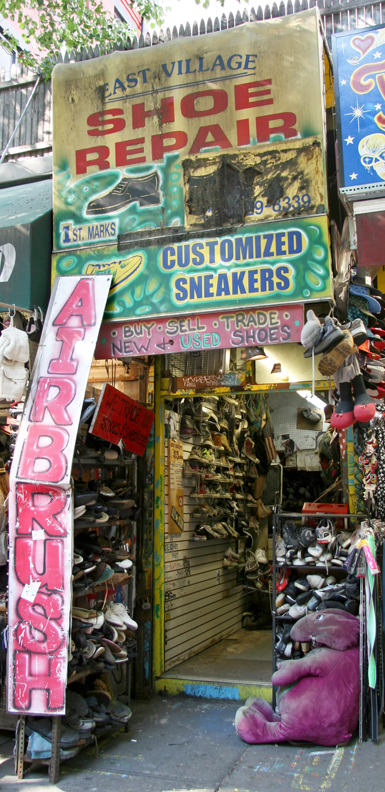
    East Village Shoe Repair is located at 1 St. Marks Place. This tiny place, crammed with goods, has been a cobbler’s shop since 1985. Boris Zuborev took it over with his nephew, Eugene Finkelberg, 14 years ago. Both hail from Belarus. They sell used footwear, customize sneakers and make shoes. From an article in The Villager:

    They also make cowboy boots, sandals and high heels. They’ll dye your pumps hot pink, spray-paint pictures on your sneakers or raise your heels up 17 inches. In the ’90s, one could witness Zuborev’s creations on the feet of certain well-known musicians and dancers. In his platform shoes, clubbers he designed for rose above others.

    It’s a hole in the wall, the place itself showing little evidence of fine design. The yellow awning has been spray-painted green and white, and signs hang by old shoelaces. Graffiti surrounds the door. Industrial metal shelving stuffed with thick-soled boots, multicolored pumps, sneakers and roughed-up ballet slippers obscures the entrance.

    The place gets rave reviews from customers who purchased shoes or had customizations or repairs done. Perhaps one day I will try them for repair. I have purchased used/vintage clothing before, but as far as buying used shoes go, I’ll pass for now. I can’t help but think about the perspiration which may be entombed 🙂

    Posted on by Brian Dubé

  • One Short Block

    One of the most interesting and eclectic group of retailers in New York City lives on Bleecker Street between 6th and 7th Avenue. On this one short block, you will find a surprising number of legendary businesses, several of which I have previously written about. Here is a brief highlights walking tour:

    At the corner of 6th Avenue, Carmine Street, and Bleecker Streets, you have Father Demo Square, Trattoria Spaghetto, and the beautiful Our Lady of Pompei church. Starting on the North Side of Bleecker, we have the vinyl (& CD) music emporium – Bleecker Street Records, a kind of bookend to Bleecker Bob’s just across 6th Avenue. Then we have Rocco’s Pastry, L’Occitanea Provence, and Oliviers &Co, an olive oil store.

    At 259 Bleecker lies the former home of Zito’s bakery, a legendary local business for 80 years (1924-2004) that many say fell victim to the anti-carbs movement (along with rising rents). At 269, we have the Neighborhood Church, and at 273 Bleecker Street, we have Matt Umanov Guitars, opened in 1965 and known worldwide with world-class clientele. I personally met Richie Havens there (who opened the 1969 Woodstock Festival). Finishing the block on the north side is Ottomanelli’s Butcher Shop (specializing in wild game).
    Crossing over to the South Side at 7th Avenue, there is Caliente Cab Co – subject of a controversial incident.

    The south side of Bleecker has a number of fish and seafood establishments. Appropriately named, Fish is an excellent restaurant which also retails fish. I have eaten there twice and highly recommend it. At 278 Bleecker, we have John’s, one of the most legendary pizza places in the city. You won’t be able to miss this place with its perennial lines. It was founded in 1929 by John Sasso, and some say this thin crust, coal-fired brick oven pizza is the best in the city (or even the world). Others find it overrated.
    At 272, there is Cones (an artisanal ice creamery), and at 270, there is the Risotteria restaurant, a specialist in Risotto. Aphrodisia is an amazing shop, a survivor since 1967 with a huge selection of herbs, spices, and oils. Next is Trattoria Pesce & Pasta followed by two more vintage operations: Faicco’s Sausage Shop – since 1927 – and Murray’s Cheese Shop – since 1940.

    Rounding out the block is Amy’s Bread and The Lobster Place, seen in today’s photo. The Lobster Place, at 252 Bleecker, was started in 1974 by Roderick and Joan MacGregor, who were inspired to bring the Downeast (Maine) seafood experience to Manhattan. Now retired to Maine, the business has been taken over by their son Ian. I’m looking forward to the whole smoked trout I purchased there on my last visit.

    Don’t be dissuaded by any naysayers who allege the destruction of Bleecker Street through gentrification. Nearly all of the stores on this block are still single location, mom-and-pop type operations. Of course, there have been several newer upscale retailers who have moved to the block. But the impact is nothing like the malling of many areas in the city, like on Broadway in SoHo. You would be hard pressed to find such a varied collection of shops like this (including many legacy businesses) in one short block anywhere in the world…

    Related Postings: Murray’s Cheese, Matt Umanov, Time Misspent, Father Demo Square, Our Lady of Pompei, Donato, Bleecker Bob’s, Bleecker Street, Le Figaro Cafe


  • Mother Teresa

    Posted on by Brian Dubé

    When you start to hear things like “You can’t make everyone happy” or “There will always be people who complain” in reference to a business, I start to worry that these words may be those of defenders of a place with problems. Because there are differences, and some places are just better or worse than others.

    It’s a question of fundamental attitude with a customer problem or complaint. Is the customer guilty until proven innocent or innocent until proven guilty? Where is the burden of proof placed?

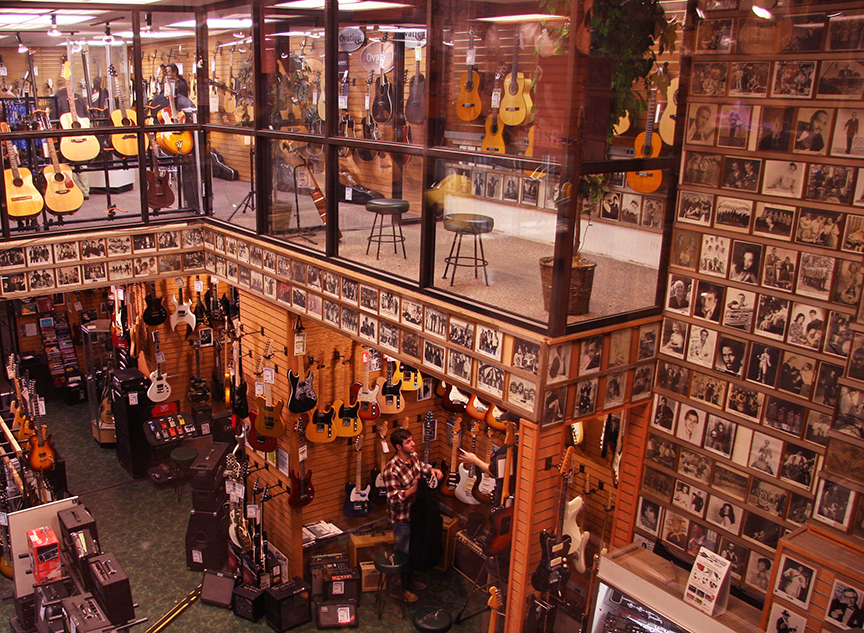
    Admittedly, industry profit margins and product lines probably do make a difference. If you are selling high-priced musical instruments, you cannot be as cavalier about returns as, perhaps, clothing retailers with larger markups. With expensive products, the dealer and/or manufacturer must deal with returned products. However, you have a similar scenario at B&H Photo, where margins are razor-thin on high ticket items. But you are not put through the inquisition on a return. You can return delicate products costing thousands of dollars with no trouble.

    In reading about Sam Ash, I did see an inordinate number of negative reviews. Even Mother Teresa has her detractors (notably Christopher Hitchens), but certainly not as many as Benito Mussolini. I also acknowledge that individuals are perhaps more inclined to publicly complain rather than praise, and the Internet has made this process infinitely easier, but customer reviews do count for something. There are only so many of these complaints; it is hard to dismiss them as being part of the normal state of affairs in a retail business. At some point these complaints and admonitions have to be seriously examined.

    My visit to Sam Ash was pleasant. I had a brief conversation with some of the staff about how businesses like theirs are often seen as the evil empire pitted against the small mom-and-pop stores such as Manny’s Music. We agreed that it would be interesting to see the how customers would view Sam Ash in the future. Perhaps some blend of those bemoaning the disappearance of “real” places like Manny’s and other, younger customers who, with no experience of the past, have just adapted.

    When I was there, a teenage boy was in the midst of a guitar purchase. The boy was busy coveting his possession to be while his parents were embroiled in how the finances were to be handled. For the time being, no one seemed concerned with the past, the future, customer reviews, Benito Mussolini, Christopher Hitchens, or Mother Teresa 🙂

    Note: Sam Ash is a national chain of musical instrument retailers, founded in 1924, with over 50 locations in the USA. The one photographed is located on music row, i.e. West 48th Street, across the street from Manny’s Music.

    Posted on by Brian Dubé

  • Times Are A-Changin’

    Posted on by Brian Dubé

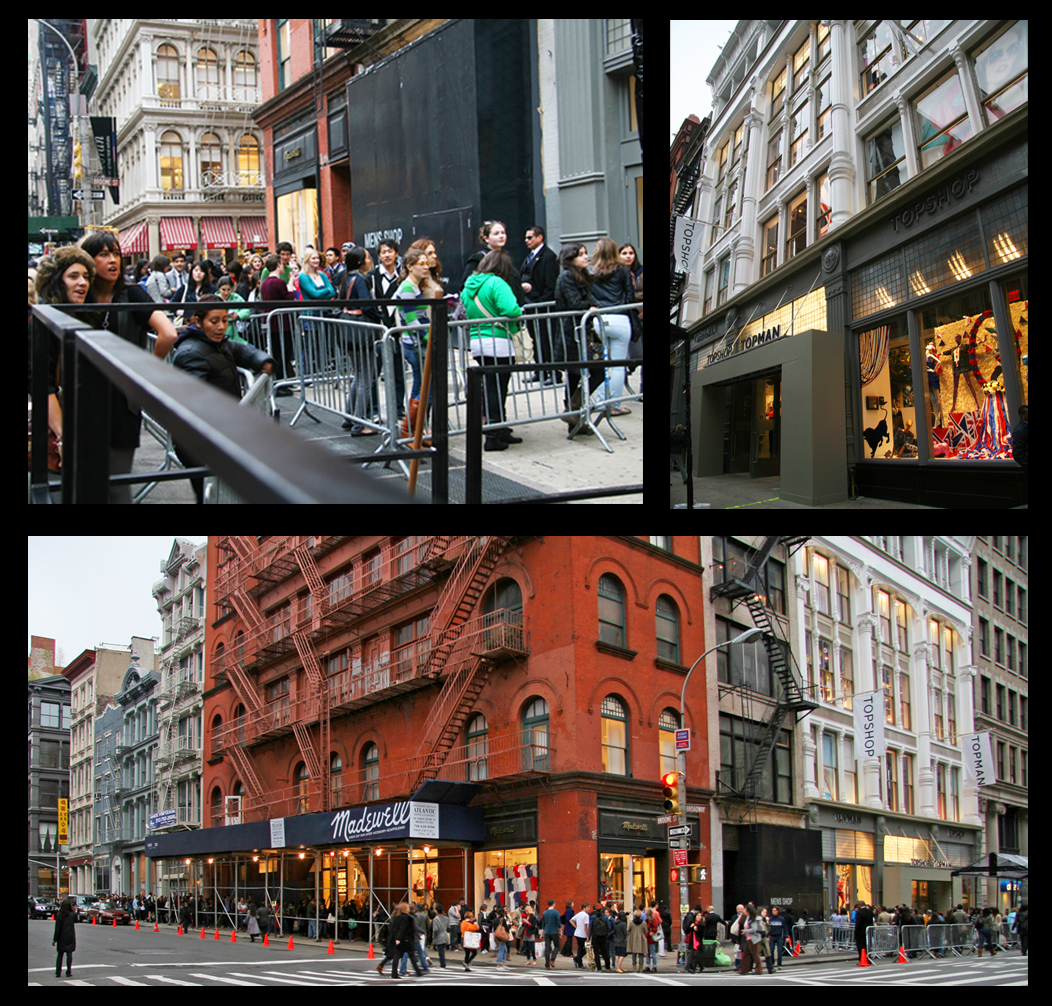
    Yes, in NYC, stores openings are occasionally media events. Topshop, a British-based clothing chain of over 100 stores, opened its first US store yesterday at 478 Broadway (south of Broome Street) in SoHo. What we have here is where buzz meets the American passion for shopping. The awaited opening was covered by every local media group. For over a week before the opening, a pink Topshop van had been busy giving out free tote bags which included gift cards worth up to $500.

    Model Kate Moss, Jennifer Lopez, and Marc Anthony were at the ribbon cutting on Thursday, April 2, as was owner Sir Philip and Lady Green. Kate Moss, who has been doing a fashion collection with Topshop since 2006, will be introducing her spring line with the opening of the SoHo store. I arrived in the evening. A tented press area with seating had been installed. Evidence was still on hand of a media event, with network TV, professional video cameras, photographers, and security. Customers were being corralled through gates. Lines wrapped around three sides of a block – Broadway, Broome, and Crosby Streets.

    Topshop’s flagship store is on Oxford Street in London and is the world’s largest fashion store – 90,000 square feet on four floors with as many as 30,000 visitors per day. The New York City store occupies 25,000 square feet on four floors.

    The store is only two blocks from Canal Street, which is remarkable since Broadway is decidedly rougher the closer one gets to Canal and historically has been rather downscale and most immune to gentrification. The arrival of Topman, with Citibank flanking one side, a new J. Crew coming soon on the other side, and Bloomingdales less than one block away, certainly heralds a new age for this immediate area, extending the boundaries of SoHo chic and stamping out the last vestiges of industry along these blocks of Broadway just north of Canal.

    Canal Street and the area around it has been known for many things: industrial supplies such as Space Surplus Metals (gone), Canal Rubber, Industrial Plastics (gone), and Tunnel Machinery (gone); Chinatown and the Manhattan Bridge going East, the Holland Tunnel, and discount shops with fake designer products. Adjectives such as cheap, tawdry, seedy, and dirty would all apply. But the times they are a-changin’…

    Posted on by Brian Dubé

  • Eye Candy

    Posted on by Brian Dubé

    Business moves in mysterious ways, and there come times when forces seem to point one way. Right now, for many retailers, the merchandising road is pointing to Times Square, an area beleaguered and blighted for eons, improving in fits and starts, but always drawn back to some variant, displaying elements of its historic sleazy character. Rents are high, and even well-heeled retailers during its recent improvement phase have closed, such as the Disney and Warner Brothers stores.

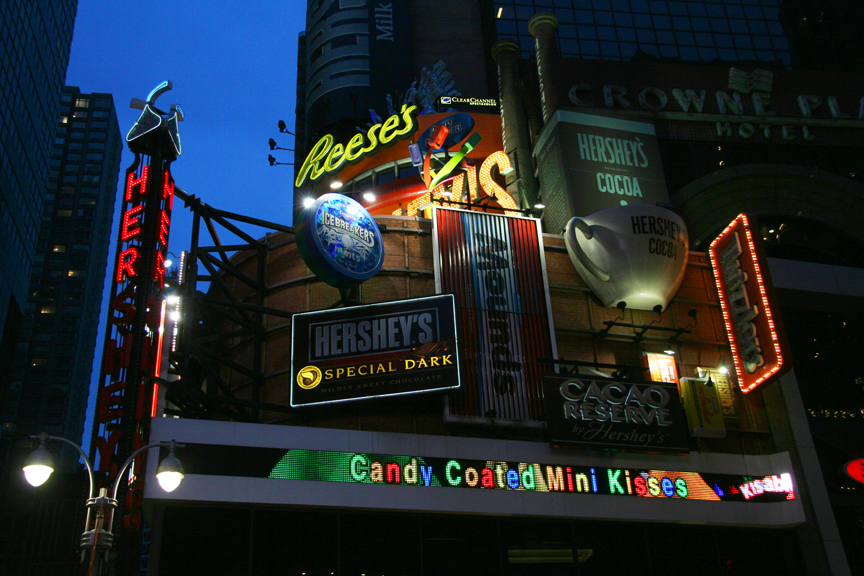
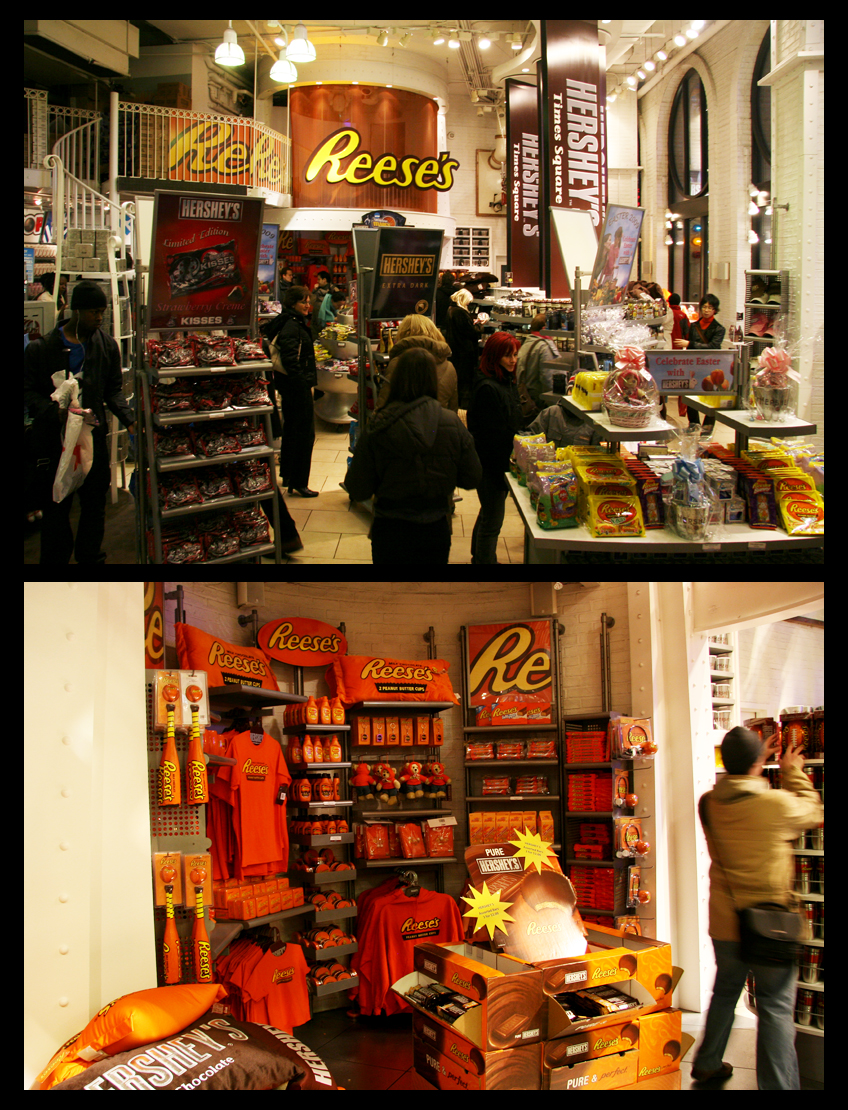
    I have written about the M&Ms Store at Times Square (see Branding Gone Wild and Let’s Have a Parade). Literally across the street at 48th and Broadway is competitor Hershey, with its own shrine to chocolate. This store is a much bigger experience on the outside – many visitors have been nonplussed by the inside. But the small one-floor interior space is certainly a place to get your Hershey’s chocolate fix and sample their extensive line. See my photos of the interior here. Unlike the much larger themed M&Ms store, however, it is not a total immersion experience or world.

    The thing to see here is the exterior, purportedly the largest permanent fixture ever built in Times Square. From their opening press release from October 28, 2002:

    HERSHEY’S spectacular — towering 215 ft. tall and 60 ft. wide, making it the largest permanent fixture ever constructed in Times Square — features a whimsical version of the original HERSHEY’S chocolate factory, complete with smokestacks, just like the one in Milton Hershey’s hometown, Hershey, PA. Thanks to 34 dimensional props, four steam machines, over 4,000 chasing lights, 30 programmable gel lights, 56 neon channel letters, 14 front-lit signs, and just about every other major signage technique utilized today, the chocolate factory spectacular will:

    Feature an over-sized HERSHEY(R)’S milk chocolate bar
    Light up a pyramid of HERSHEY(R)’S KISSES(R) with colors that change with the seasons
    Showcase a JOLLY RANCHER(R) candy wind sculpture
    Spout steam from the HERSHEY(R)’S cocoa cup
    Spin BREATH SAVERS(R) mints above the sidewalks of New York

    The Hershey Company is no longer just the chocolate company of Milton Snavely Hershey, who in 1907 created the Hershey’s Kiss. Read their history here. They now manufacture a myriad of chocolate and non-chocolate confections, including Reese’s, Milk Duds, Kit Kat, Krackel, Rolo, Skor, Cadbury’s, Almond Joy, Mounds, O’Henry, Mr. Goodbar, York Peppermint Pattie, Jolly Rancher, PayDay, Ice Breakers, Good and Plenty, and Twizzlers.

    I would not make the store a travel destination, but if you are visiting Times Square, take a look above you at 1593 Broadway at what (like the M&M’s display across the street) is literally Eye Candy…

    Posted on by Brian Dubé

  • Run

    Walk Quickly, Hurry, Run – I am running out of unique words and phrases to convey the urgency to you if you want to see Olde New York before it disappears completely.
    Vesuvio has just closed. This was my first posting on March 17, 2006. The choice of making it a first posting was not whimsical at all – Vesuvio was emblematic of the quintessential small, family-run business. Its images were used everywhere to represent New York City.
    There are many places which have closed since I started this website in 2006. Some I captured before closing, some immediately after, and some I did not get the opportunity to photograph at all.

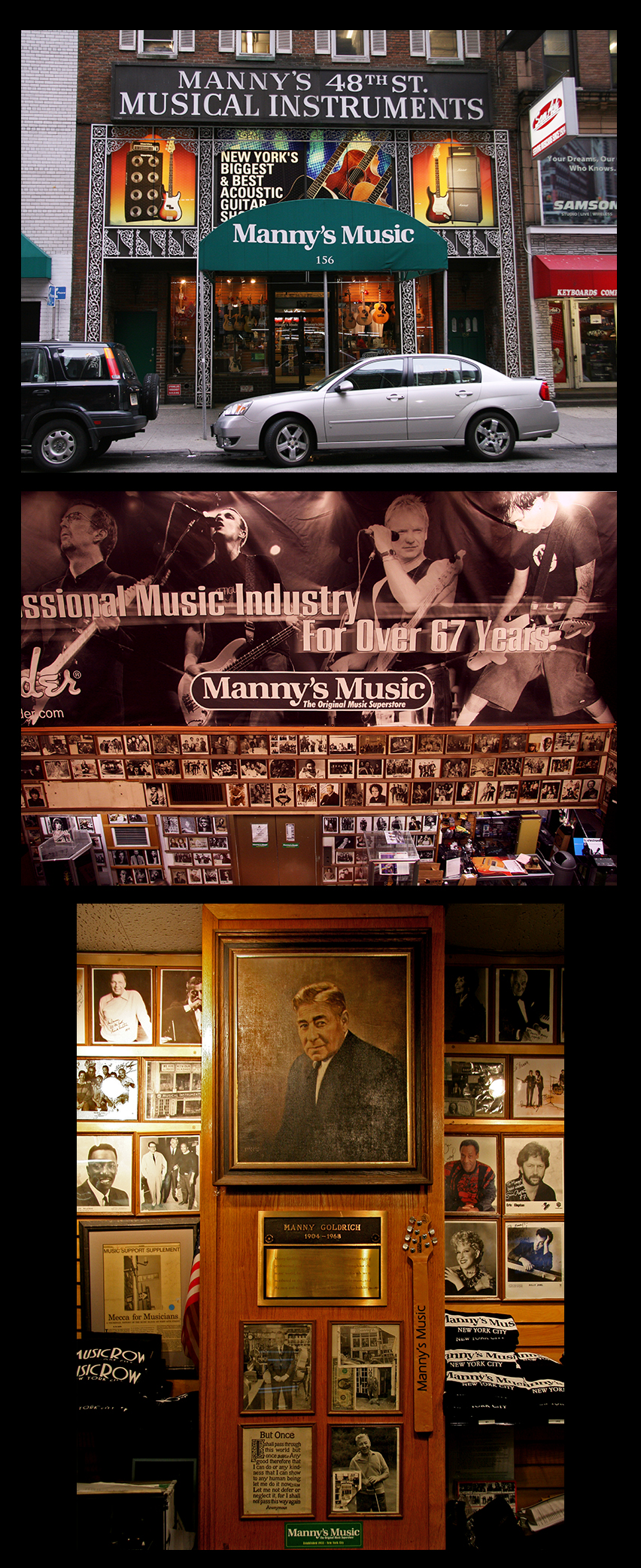
    Manny’s Music at 111 West 48th Street is one of those places that goes beyond nostalgia and providing a basic service. This is a business that had an influence and provided musicians the tools of their trade for 74 years. The business was started by saxophone salesman Manny Goldrich in 1935. He passed it on to his son Henry, who then passed it on to his two sons in 1998. In 1964, Manny died at the age of 64. See more photos of the store here.

    Manny’s is not just a great mom-and-pop store – this establishment is a legacy business with a unique heritage. Over the course of many decades, hundreds of legendary musicians have passed through their doors. Their signed photos cover the walls – Jimi Hendrix, Duke Ellington, Chuck Berry, Buddy Holly, the Rolling Stones, the Beatles, Michael Jackson, Eric Clapton, U2, and Nirvana are just a few among the crowd. This display, known as their Wall of Fame, has been documented by in a book by the same name.

    In 1999, Manny’s was sold to rival Sam Ash, located across 48th street on the block known as music row. The word is, however, that larger business interests are slowly accumulating all the properties on the street and that Sam Ash will also meet its demise.

    So if you have been making a checklist of places to see and things to do in New York, add Manny’s, which is scheduled to close at the end of May 2009. And don’t walk, run…


  • Lights on Broadway

    Posted on by Brian Dubé

    [LightsOnBroadway700.jpg]The city daily photo concept was started by journalist Eric Tenin of Paris in March 2005 with Paris Daily Photo. The original idea was to show a daily slice of life in Paris. The idea spread to now include hundreds of cities worldwide. The idea is a noble one, but most readers do not want to be privy to all the mundane chores of everyday living, so Eric’s site, like most of the others, show a side of daily life of interest to outsiders, which includes a spectrum of the more known to the lesser-known.

    There are many things which are both unique and so commonplace in many locales that they are part of the fabric of that city or town but perhaps not blogworthy or worthy of inclusion in a travel guide. The establishments every resident knows and uses. One of those places in New York City is Duane Reade, a local chain of stores that dominates the pharmacy business and is part of the love-hate relationship many New Yorkers have with this city.

    At one time, there were only TWO all-night drug stores in Manhattan. A late-night pharmacy was a huge deal. Now Duane Reade is ubiquitous and New Yorkers are spoiled; we all just assume that a Duane Reade is a few steps away. And they are, with over 240 locations throughout the five boroughs and nearby suburbs, 59 of which are open 24 hours (5 with a 24-hour pharmacy). Two locations offer walk-in medical care.

    However, although on paper these places seem like a godsend, many tend to fall down in service and overall management. Like many discount operations in New York City, getting good help at low wages who will take their jobs seriously is difficult. The experience in this chain tends to be uneven. There is even a blog, I Hate Duane Reade.
    But the situation is really quite similar to the arrival of big box behemoths such as Home Depot or Kmart. While many bemoan their presence, complaining of service and quality of product, many secretly appreciate the pricing, selection, and hours.

    One of the big factors in this equation is the walking nature of the city. In the suburbs, most customer patronage of retail stores is not so much a function of proximity to one’s home or neighborhood. Bad service or better pricing, and customers will just drive elsewhere.
    But in NYC, neighborhood delis and drugstores have virtual captive audiences – most residents will shop at the most convenient location to their home or office. Add competitive pricing and late hours to the mix, and you can see why service is overlooked.

    The quality of the Duane Reade establishments themselves vary quite a bit – some are newer and more spacious than others. I was surprised with this one in the Times Square area, appropriately (but atypically) with neon-framed windows. Quite visible to the person in need, but invisible to the visitor awed by the other lights on Broadway…

    NOTE ABOUT THE NAME: Duane Reade was named after their first location in 1960 on Broadway between Duane and Reade streets.

    Posted on by Brian Dubé

  • Walk Quickly

    Posted on by Brian Dubé

    This is not a story of vanishing New York, fading New York, forgotten New York, lost New York, or the End of an Era. This is the survival of tradition. Olde New York. It does exist. And you can find it at Colony Records. See photos inside here.

    Colony Records was founded by Harold S. Grossbardt and partner Sidney Turk in 1948. Born in Brooklyn, Harold started work after the seventh grade. He was a salesman at Melody Music Shop in Brooklyn and Colony Sporting Goods, located at 52nd Street and Broadway in Manhattan.
    When Colony closed for business, Grosshardt took it over and renamed it Colony Records. In 1970, they moved to their current location in the Brill Building, at 1619 Broadway at 49th Street.
    The Brill Building is its own story. Built in 1931, the building became a center for music publishing. By the 1960s, there were an estimated 165 music-related businesses in the building. Colony Records became a central fixture of Tin Pan Alley. Located here in the heart of the music and theater districts alongside nightclubs such as the Copacabana and Birdland, it was convenient to concertgoers and musical artists. Colony has seen a parade of legendary artists through its shop, including names such as John Lennon, Michael Jackson, and Frank Sinatra.

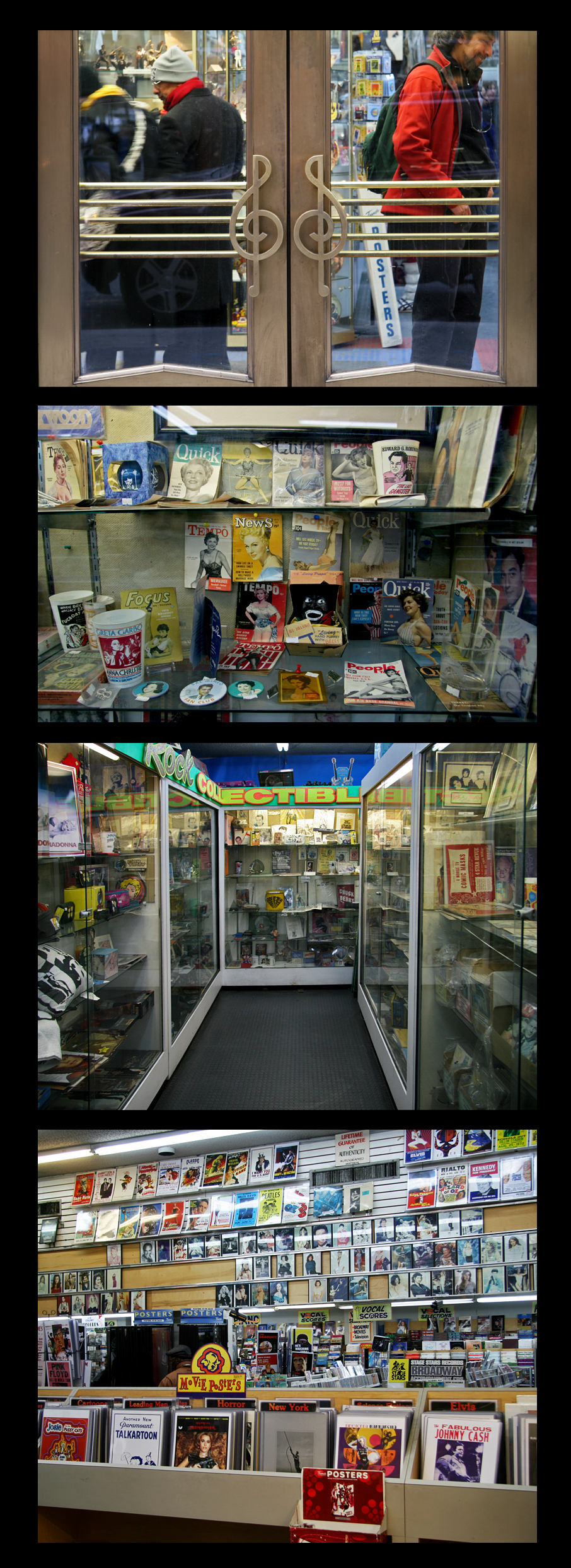
    I was impressed by Colony’s enormous selection of sheet music – reportedly the city’s largest. They also sell vintage vinyl records, CDs, and karaoke and have an interesting memorabilia selection. They also have posters and photos for sale.
    Of course, the survival of these emporiums is never guaranteed. So if you want to see them, I would not say that you have to run, but perhaps you should walk quickly...

    Note: Obituary from the New York Times: “Harold S. Grossbardt, a founder of Colony Records, the famed collector’s store now on Broadway at 49th Street in Manhattan, died on June 10 (2001) at his home in Aventura, Fla. He was 85. He is survived by his wife, Estelle; two sons, Michael J., of Roslyn, N.Y., and Alan R., of Great Neck, N.Y., who is an owner of Colony Records; a brother, Jerome, of Manhattan; a sister, Dorothy Capobianco, of Delray Beach, Fla.; and a grandson.”

    Posted on by Brian Dubé

  • Branding Gone Wild

    Posted on by Brian Dubé

    Let’s get the negatives out of the way. Neither M&Ms nor the MARS group needs to be promoted. We don’t need to market candy to children. Do we need a two-story shrine to M&Ms candy in Times Square? Is this another sign of the dumbing down of society? Why does a product like this need to be branded and line extended ad nauseum? Is this further evidence that shopping has now become America’s favorite pastime and that, as Reverend Billy has warned for some time, that we have excessive consumerism and a nation of shopaholics? Perhaps, but this is not the best economic times for anti-consumerist messages.

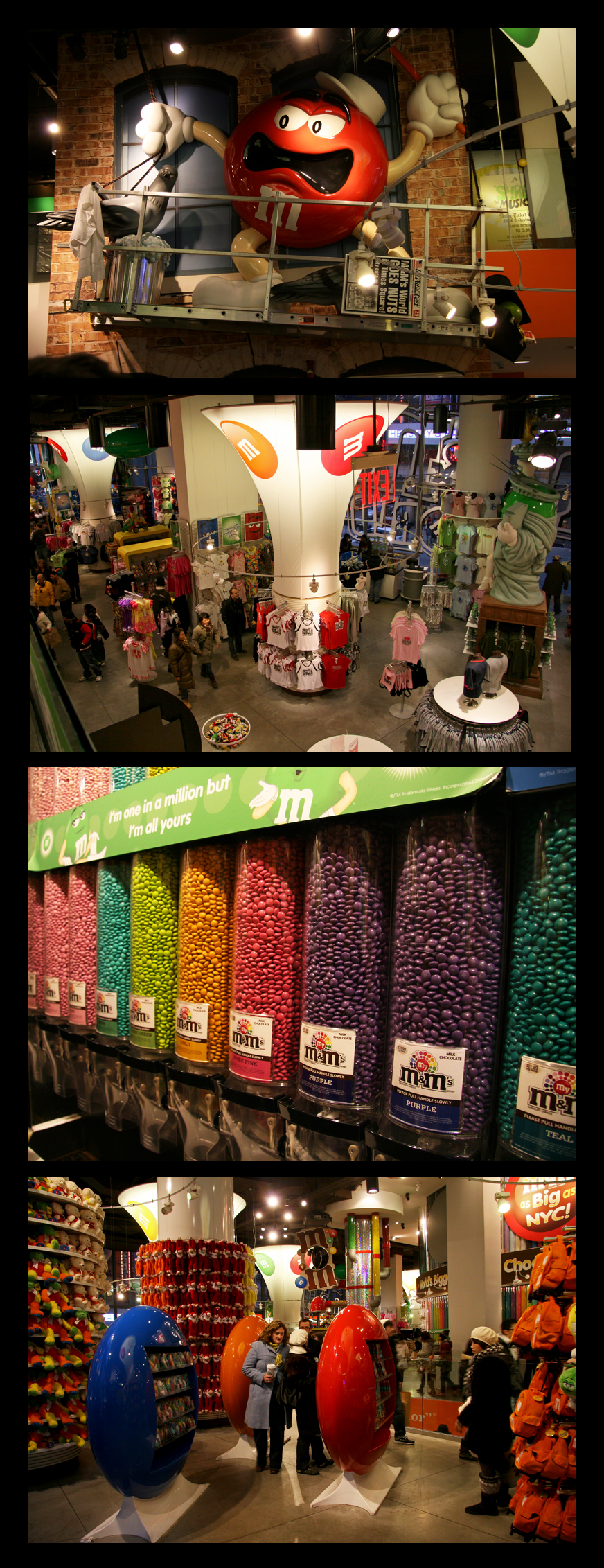
    The M&M Store, at 1600 Broadway in Times Square, like the Coca-Cola or Warner Brothers stores, is a quintessential example of branding merchandise and merchandising a brand. In this retail store, you will find application of the M&M iconography to every possible consumer item. And, of course, there is plenty of candy – self0serve M&Ms in large, transparent tubes in a staggering array of colors. For those who like blue, for example, you can get Blue, Dark Blue, Light Blue, Teal, or Aqua. See more photos of the interior of the store here. The exterior of the store has an enormous, spectacularly bright LED panel display, which I previously featured in Let’s Have a Parade.

    Technology is not the only thing in our world to see enormous advancement. Business and associated vocabulary have also become highly refined. Brand has become a buzzword in business marketing, and the term now goes beyond its original business usage. The meaning of brand at one time was much narrower and more specific, usually limited to consumer products such as food or appliances. Pepsi or GE was a brand.

    The first time I saw the word brand used in a broader sense was in a TV interview with Joseph R. Francis, the founder of Girls Gone Wild, a series of sexually explicit DVDs. In that interview, Francis referred to the Girls Gone Wild brand. I was surprised to learn that filming young, naked girls could be a brand or franchise, or at least referred to as such. Since that time, I have become very sensitized to the use of the words brand and branding as well as merchandising itself.

    But let us not forget another part of the picture, lest a curmudgeon squash all of life’s fun. These are M&Ms – one of the icons of our childhood which is virtually synonymous with pleasure. And they don’t melt in your hands 🙂

    Confession: I succumbed to the overwhelming presence of merchandise. 🙁 I bought an assortment of M&Ms and a nicely styled M&M glass. 🙂

    Posted on by Brian Dubé

  • Absolutely

    I was recently at the Barnes and Noble Bookstore at 8th Street and 6th Avenue on the second floor, some minutes before closing. A woman, somewhat harried, was looking for a book – something along the lines of “How to Talk to a Republican.” She was apparently involved with one and was distressed about the prospects. Standing next to her was Whoopi Goldberg, to whom she asked rather frantically, “Can I date a Republican?”

    One of the greatest pleasures of being in this city are the talents and surprises lurking around corners. I try to make no assumptions about people based on appearance. Talent comes in many flavors here; there are the occasional obviously well-known figures, some who just look the part, and others who travel incognito. See my story Only in New York.

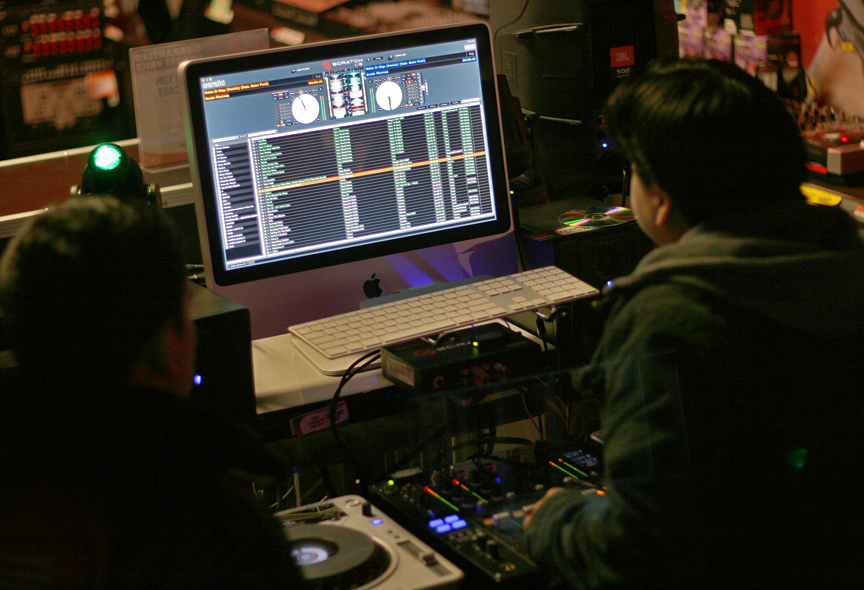
    I recently stopped into the Guitar Center on 14th Street with a friend who was unfamiliar with the place. My tour included a room I had never entered which was filled with DJ gear. Three Latino men were playing with a CD player with a pressure-sensitive scratch disc interfaced with an iMac. The equipment allows the manipulation of digital media as one would manipulate vinyl LPs. Fascinated, I watched them test the gear. I took some overhead “hail Marys”* and got a few acceptable photos.

    They appeared to be friendly, so I introduced myself with a New York Daily Photo business card. I learned that two were professional DJs, Juan and Albert. Juan Pablo was from Cuenca, Ecuador. I told him I would feature them on this website. As I wandered the store, Albert caught up with me to give me his card.

    And Whoopi’s response to “Can I date a Republican?” She answered, without hesitation or equivocation, “Absolutely!”

    *Hail Marys are photos taken blind, without using the viewfinder, typically overhead. The term “hail Mary” is used owing to the idea a prayer is needed to get a good photo.

    Related Postings: Crime Scene, DeliveryZiggy Plays, Singing Bowls


  • Perfect Attendance

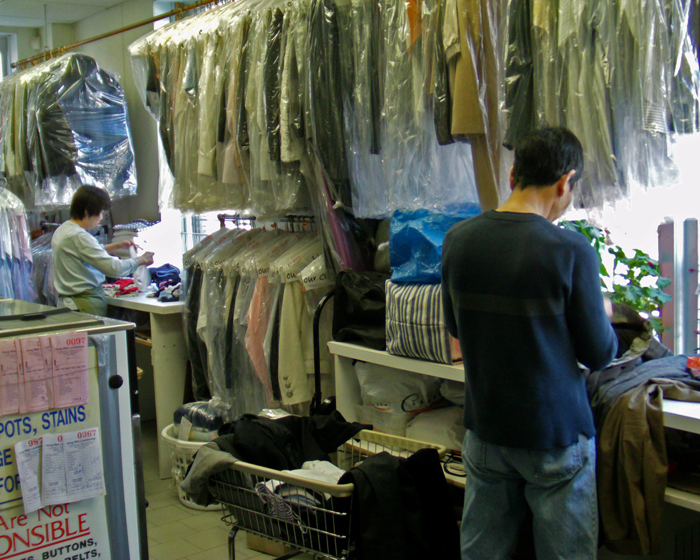
    Hong, the owner of Hong Wah Laundromat at 176 MacDougal, and I share very significant near misses. Let me explain.

    As I have grown older, I find myself doing more creative work. Product design and graphics in my business, and, recently, writing and photography for this website. But when I was younger, I always considered myself a numbers man. I loved math in high school and majored in math in college. I tried to quantify most things. Otherwise, how could one make any objective evaluations without measuring and numbers? One way to satisfy this thirst for all things numeric is setting records and noting the numbers. Like days attended in school.

    Very few students are awarded perfect attendance for 4 years of high school. I did, nearly. Yes, I did get sick with flus and colds, but I attended, under all conditions, every school day for four years. One day, I left early in the afternoon for a dentist appointment. I assumed, however, that I would get a perfect attendance award and was shocked on graduation day to find that I had been slighted. Apparently, leaving 2 hours early is not perfect attendance. Too late to protest at graduation ceremonies, and to this day, I still feel cheated.

    I don’t want to get into a pissing contest about who works hardest or competitive tales of hardship – everyone has one or more. But New York City is not a prison camp or the third world, and even though many New Yorkers are workaholics, there is always some accommodation made for holidays and time off. With some exceptions.

    Hong is the first and only person whom I personally have met that takes no time off from work. By work, I mean going to a place of work and putting in a full day.
    Hong Wah Laundromat is open seven days per week from 8AM to 9PM (Sunday until 8PM) -that’s 13 hours per day. He and his wife are there every day, all day. Some time ago, I asked Hong if he took vacations. He appeared mortified and just bristled at that concept. His immediate response was that he had to work every day.

    And by no time off, I don’t mean very little time off, I mean none. Or should I say nearly none, because recently, I learned a dirty little secret. Hong does close one day per year: New Year’s Day. So, like me, he misses that award by one day. But, unlike me, he has an easy solution to his near miss. I’d just work that extra day and give myself perfect attendance 🙂


  • No MSG

    At one time in New York City, MSG and its avoidance were big dining concerns. In April 1968, Robert Ho Man Kwok wrote a letter to the New England Journal of Medicine and coined the term “Chinese restaurant syndrome.”
    In 1969, an article appeared in Science Magazine which linked the syndrome to MSG. Many symptoms were attributed to the Chinese Restaurant Syndrome, such as numbness, chest pain, headache, nausea, rapid heartbeat, drowsiness, and weakness. The whole issue is extremely contentious – glutamate is an amino acid which occurs naturally in many foods. Scientists are divided, and no definitive studies have linked MSG specifically with these symptoms.

    In NYC, we have the largest Chinatown in the USA, and Chinese food has been one of New York City’s most popular cuisines. So, understandably, amid all this, concern for MSG reached a fever pitch particularly when eating Chinese food – consumers were worried and waiters were interrogated about the presence of MSG in meals. Restaurants responded, and soon the phrase “No MSG” appeared on Chinese restaurant windows and menus everywhere, a counterpoint to the ubiquitous “No Radio” in automobile windows on the streets (see my story here).

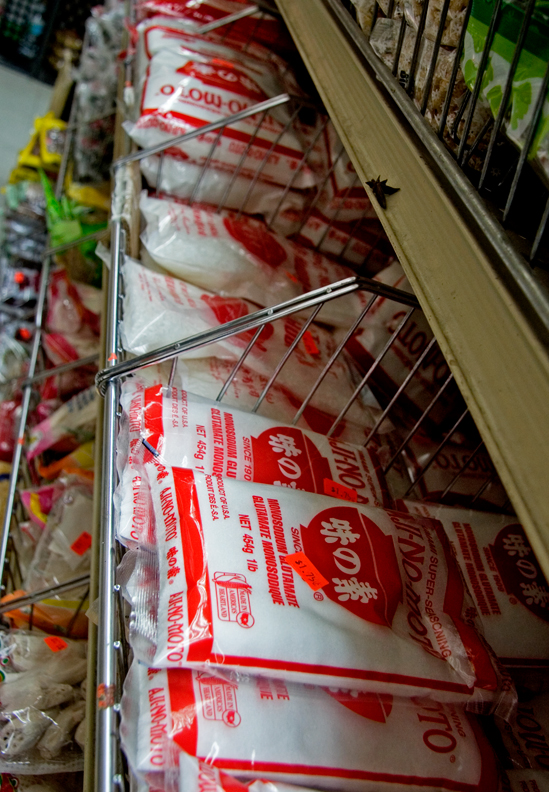
    But there is an unbridled audacity here in New York City, and even with heightened sensitivity to many issues, many will act in opposition to prevailing attitudes and practices. I once saw a woman in a vegetarian restaurant wearing a full-length fur. So I should not have been surprised that even after 4 decades of anti-MSG sentiment, I would walk into a store in Chinatown in 2009 and find a virtual MSG section. This store is apparently completely unfazed by any concerns about MSG. It was not a small inventory of a branded version like Accent or a few containers hidden discreetly.

    No, here at Tan Tin Hung at 121 Bowery, you could find a long shelf of the white powder in clear plastic bags with generic type in bright red prominently displayed in the first aisle. There were variants in granular size and bag weights. You can buy it by the pound here.
    This is America, and although it is getting more difficult to poison ourselves and others, we still have the right to have headaches if we want 🙂


  • No Frills

    You wake up one morning, and something or somethings are different, like the morning of 9/11. I’ve been through recessions, but not like this one. I recently spoke to one of the suppliers for my business – Quebecor World, the second largest printer in the world. Sales were down 35% in 2008, and they owe $735 million on revolving credit. We have a wave of bankruptcies – Circuit City closing 155 stores, Sharper Image, Linens ‘n Things, etc. These are household names and really big numbers are involved – stores closing, percentage of sales down, money owed.

    Certainly the media does not help, and I don’t want to add fuel to the fire. But you make assumptions. Like the assumption that National Wholesale Liquidators would be there forever. I thought bankruptcy lawyers and discount retailers were supposed to be the survivors in a faltering economy.
    But the New York Times reported in November 2008 that National Wholesale Liquidators was filing for bankruptcy and closing nearly all their stores. So I was shocked this week to find closing signs with announcements of a 90% off sale. Now these kinds of discounts are frequently touted but rarely to be seen, but the 90% off was real – $2.99 items selling for 29 cents. It was a real fire sale, by the time I got there, nearly an entire store was stripped clean. See the interior here – amazing.

    This store served the needs of many. Everyone I know had been in at one time or another to purchase something from the inventory of 120,000 items. They carried many brand name closeouts. Food could be found, along with hardware, electronics, housewares, clothing, paper goods, etc.
    There was no charm in this store or ambiance whatsoever. In fact, a spokesman for the company said:

    “Contrary to most chains, the store pays no attention to presentation, or to customer expectations, but only to what can be bought on the world market most cheaply. ‘We buy closeouts, end runs, overruns, imports,’ [chain spokesman] Pidgeon said. “When someone makes 5,000 cases too many of a product, we buy it. Those cases end up in piles on the concrete sales floor.”

    Yet somehow the complete lack of charm was their charm. No chills, no thrills, no frills…

    About the Company: National Wholesale Liquidators is based in Hempstead, New York. It was founded in 1984 by Eva Rosen and remained a family-owned business (Carl, Eva, and their children). The company had over 50 stores in 12 states with nearly 2000 employees. Reasons for closing were a cut in their credit line ($15 million cut by General Electric) and declining consumer sales.


  • T?t

    One of the unique advantages of being in a very large melting pot such as New York City are the cultural events and celebrations. Today is the lunar new year – T?t for the Vietnamese and Chinese New Year.
    Yesterday, on the eve of the lunar new year, an annual parade was held in Chinatown, but I opted for the Lunar New Year celebration and Flower Market at the Brooklyn Botanic Garden to experience a broader range of Asian cultures, particularly Vietnamese. DVL Dance Vietnam was doing a presentation in the Palm House, however, an enormous line had formed well in advance, and no seats were available.

    All events were indoors, and most of the programs were family-oriented. My understanding was that T?t is an enormous celebration in Vietnam – the largest of the year with preparations weeks in advance. You can read more about it here.

    Lunar New Year celebrations are spread out over a period of time here – calendars show activities for at least another week. Today there is a Firecracker Ceremony & Cultural Festival in Chinatown. Sunday, February 1st is the annual Chinatown Parade. Saturday, January 31, 2009 is the Lunar New Year Parade. There are many more activities this week.

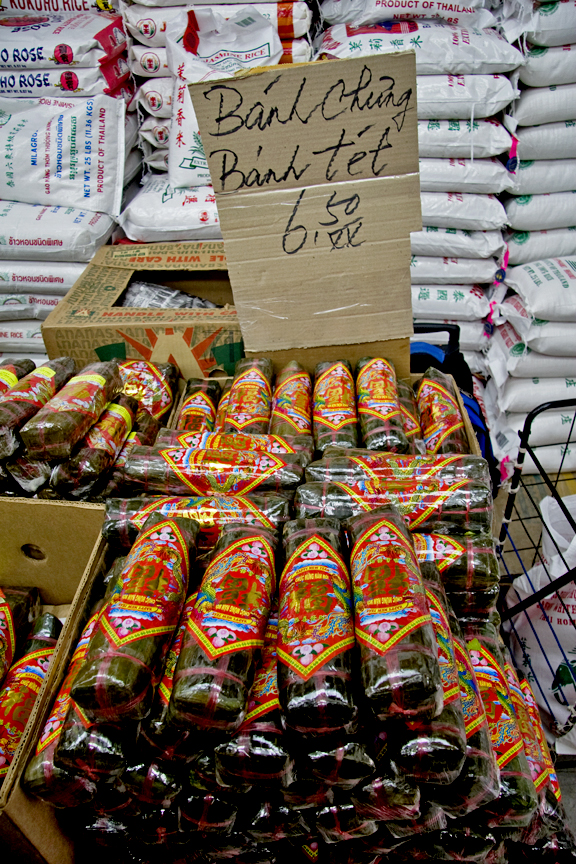
    I also took a trip to Tan Tin Hung, 121 Bowery in Chinatown, which carries the largest range of Vietnamese groceries in the city. Prominently placed right at the entryway was Banh T?t and Banh Chung. These are Vietnamese cakes with sticky rice wrapped in banana leaves (Banh Chung is wrapped in dong leaves), eaten during the Vietnamese Lunar New Year. The sign in magic marker on cardboard in Vietnamese was a badge of authenticity…


  • dinamic_sidebar 4 none

©2026 New York Daily Photo Entries (RSS) and Comments (RSS)  Raindrops Theme