• Category Archives NYC’s History
  • Secret Tunnel

    Did you ever have a nagging thought revolving around something unresolved? I recall reading in a secrets of New York City book that there was an underground tunnel in Chinatown, now some sort of shopping arcade. However, no one I knew had heard of such a place.

    I do love to find secrets in New York City. This is increasingly hard to do, so this mystery would typically make the prospect of search and discovery all the more exciting. However, in this case, all of the individuals I queried, including a long-time resident of Chinatown for 30 years and a few members of the Chinese community, had no idea as to what I was referring to. I began to seriously question whether such a thing existed.

    Some digging did finally uncover the existence of a tunnel on Doyers Street in Chinatown, but no address or precise location was given. I made an excursion to Doyers Street, a one-block alley between Pell Street and Chatham Square. This street, which makes a sharp 90° turn, was once known as the Bloody Angle, owing to the numerous shootings that took place there at one time. From the New York Times:

    Doyers Street, a crooked, one-block street off Pell Street in Chinatown that was near the Bowery and the notorious Five Points intersection, offered an ideal place for ambushes during the wars between the On Leong and Hip Sing tongs in the late 19th and early 20th century. Tabloids of the day christened the angle in the street, and the police said that more murders occurred on that spot than in any other place in an American city.

    I canvassed the entire street. There are many hair cutting salons on the street – it is sometimes known as “hair alley.” At 5 Doyers Street, mid-block, I found a staircase leading down below ground. It did not have the charm of a secret historic tunnel at all, but it was an underground passageway. I learned that this was known as the Wing Fat shopping arcade – a maze of quite nondesrcipt passageways with fluorescent lighting and acoustic tiled ceilings. A variety of merchants line the arcade: acupuncturists, dentists, a philatelic shop, and the office of Tin Sun metaphysics. The tunnel winds it way underground, leaving Doyers Street to exit in the lobby of the Wing Fat Mansion building at Chatham Square.

    This tunnel was apparently the main artery in a network of tunnels used by members of the Tong gangs as escape routes. It is interesting that there is no signage or advertising of this historic tunnel. In a way, it remains undiscovered…


  • Mulberry Street


    I so looked forward to my visit to Aix en Provence in the South of France. Everything I had read spoke of it as the quintessential cafe society experience. In New York City, there is a limited amount of quality street side cafe or restaurant seating. In most cases one must suffer the slings and arrows of anything and everything that passes by. Often, tables are placed on sidewalks much too narrow for adequate separation; the sense is that you really are eating on the street. Diners are often accosted by panhandlers and the like.
    So for a New Yorker, Aix was paradisaical – wide sidewalks and a clean environment. However, this is Mulberry Street in the heart of Little Italy. Beginning in 1996, three blocks from Broome to Canal Streets are closed to vehicles during the summer months, turning the street into a pedestrian mall. In September, the street is closed for the annual Feast of San Gennaro festival.

    Outdoor seating for restaurants and cafes line Mulberry Street. Restaurant barkers solicit business from passersby. Add heat to the equation, and it will take a certain je ne sais quoi to enjoy eating in this zoo-like atmosphere.

    A visitor to the area will also find the surrounding area dominated by Chinese merchants. Neighboring streets (such as Mott Street, one block east of Mulberry) have seen the encroachment of Chinatown. Little Italy has become essentially a small pocket of nostalgia, a virtual postcard snapshot of this historic neighborhood.

    I cannot heartily recommend any particular restaurants here (or eating on the street). If you choose to try something on the street, I recommend eating guides such as the Zagat Survey or Yelp. Many residents pan the eating establishments here, but there are endorsers – in 2004, Mayor Rudy Giuliani cited Da Nico as his top pick for Italian in Little Italy. And yes, there has been Mafia mob presence on the street, as well as scandals.

    If you have not been down Mulberry Street during the times it is closed to traffic, I do recommend a summer evening stroll where you can walk among the teeming masses. For an online virtual walking tour of Mulberry Street, go here to New York Songlines…

    Photo Note: There is a very enjoyable book, New York Then and Now, which shows specific New York City locales using two photos, one earlier in time and one taken at the time of the book’s publishing. In this spirit, today I have added a second archival photo showing a stretch of Mulberry Street, circa 1900.


  • Under the Sun


    When I saw the tip of a sail at a distance, darting to and fro, I was so excited. I knew what I was seeing: land sailing (aka land yachting or sand yachting). My first exposure to this activity was on television many years ago from the flats of Utah or Nevada. At the time I was fascinated – the whole thing looked so exhilarating and novel. However, I assumed I would never see this type of thing, lest I make a trip out west with a specific agenda to find a land sailing locale.

    Land sailing in New York City? Floyd Bennett Field, with all of its unused runways, is a natural for this, but it still caught me by surprise to see an activity that requires such a large amount of unobstructed space. Years of living in New York City conditions you to negating an activity like this from contemplation.

    It took some circumnavigating by car to find the runway being used. I was greeted cordially by the sole sailer at the time, Rick Honor, who had just done an interview for a piece on Floyd Bennett Field by the New York Times. Some would say it was another case of Morphic Resonance.
    Rick was extremely generous, answering whatever questions I had about the activity and the equipment. He showed me his car, which was packed with a variety of air-powered vehicles, including equipment for kite boarding. He told me that on many weekends, there were land sailers who would be happy to teach me and let me sail one of their rigs. Here’s a video of Rick land sailing:

    I was also surprised to learn that this activity was not born recently but had variations going back to China and Egypt. The modern precursor is credited to Flemish scientist Simon Levin in the 16th century (updated 12/9/11).
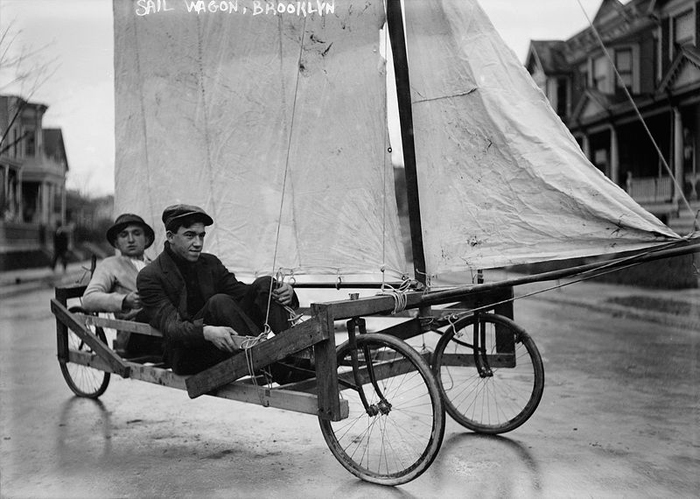
    In its current incarnation, land sailing equipment is high-tech, with eight classes of vehicles including kite buggying. The standard construction today consists of a tricycle buggy with a main sail. Land yachting competitions take place worldwide. I was astounded to find a photo of a sail wagon on the streets of Brooklyn from the early 20th century, circa 1910-15. There is truly nothing new under the sun…

    Related Posts: Floyd Bennett Field, Umbrella and Chevy


  • Floyd Bennett Field

    Posted on by Brian Dubé

    One of the most amazing and interesting places I have ever visited in the five boroughs of New York City is Floyd Bennett Field. This enormous space, with huge undeveloped tracts of land, is startling for this city. Nearly all of the airfield is drivable, providing an easy way to explore for a first-time visitor. See the gallery of photos here.

    Knowing of my visiting friend’s interest in aviation and model planes, I recently investigated the details about Floyd Bennett Field, a place which I had been looking to explore for some time. In a replay of Morphic Resonance, the New York Times just happened to be running a feature article that very day (see it here).
    Unfortunately, my friend was not able to join me, so I made the visit without him. After my first visit, I know that I will be making other visits in the future.

    Completed in 1930, primarily on landfill, Floyd Bennett Field was New York City’s first municipal airport, later used as a military training and testing facility until the airfield was decommissioned in the early 1970s. Now it is a virtual playground. Weeds sprout from crevices on unused runways.  From the New York Times article:

    The Park Service has preserved the historic look and feel of the airfield while seeding an area larger than Central Park with things to do and see, from camping and gardening to bicycle races, kayaking, fishing, golf and indoor sports. There’s even an archery range and a cricket pitch.

    Add to that radio control jet aircraft flying and land sailing, which I will feature in later posts.
    The airfield also boasts a number of antique hangars. Hangar B houses a number of retired military planes – some can be boarded. (The photos in today’s collage were all taken in or immediately outside Hangar B.)

    The hangar is also home to the Historic Aircraft Restoration Project, a volunteer organization of aircraft enthusiasts, engineers, and pilots, who rebuild vintage aircraft and assemble full-size replicas. Fortunately, I was able to tour Hangar B and the workshop; it is only opened Tuesday, Thursday, and Saturday.

    Posted on by Brian Dubé

  • Williamsburg

    Posted on by Brian Dubé


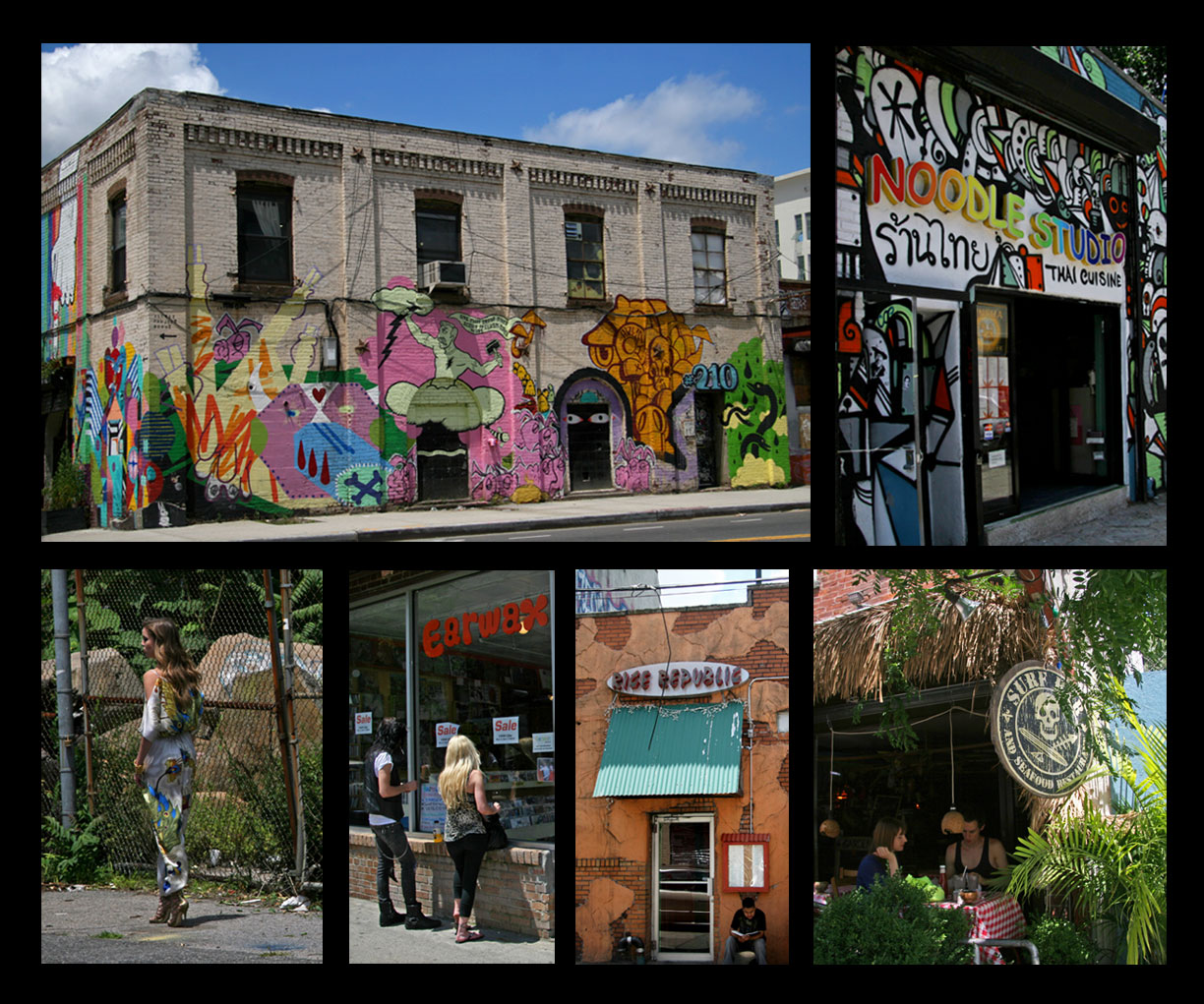
    If you live in New York City, Williamsburg, Brooklyn, as well as its resurgence as a vibrant community, comes as no secret. The press/media and its readers love stories about the next SoHo, the Next Neighborhood, the American version of Le Marais, and other analogies intended to drive sales of newspapers, magazines, and real estate properties.

    Many changing neighborhoods have been over-hyped, later to miss the mark on the predicted trajectory. Williamsburg, however, appears to be living up to its expectations. Domination of conversation about these new burgeoning neighborhoods should not be interpreted to mean that prime real estate in New York City’s finest neighborhoods are now out of favor and can be had for a pittance. There’s just little excitement and buzz about neighborhoods whose future have long been a fait accompli and where prices are now stratospheric. Everyone is looking for the next new place.

    It would be difficult to overstate Williamsburg’s importance; its history is quite remarkable. The neighborhood was once home to Corning Glass, Pfizer Pharmaceutical, Esquire Shoe Polish, and the iconic Domino Sugar factory.

    From 1827 to 1855, Williamsburg became its own incorporated town/village/city, later annexed into the city of Brooklyn. It was home to mansions owned by Vanderbuit, Fisk, and James Pratt, who founded Pratt Institute. The area became an American industrial powerhouse, and at one time in the 19th century, it had 10 percent of the wealth in the United States. This is an enormous subject – read more here.
    The area is also very ethnically diverse, with many groups including Hispanic, Italian, and Hasidic Jews – over 70,000 Satmar Hasidic Jews live in Williamsburg.

    Since the 1970s, as rents escalated in SoHo and the East Village, Williamsburg became a magnet for a growing community of artists and musicians. The trend has continued, but as to be expected, the cost of real estate has forced those shopping for less expensive alternatives to look further afield. According to a New York Times article, Old Europe and New Brooklyn in Williamsburg, there has been an enormous influx of Europeans to the neighborhood, with shops to service their needs.

    One feature of the neighborhood has always been convenience; Bedford Avenue (the heart of the area) is only one subway stop from Manhattan. However, it should be noted that this stop is serviced by the L train, which only travels crosstown on 14th Street in Manhattan.

    There is a enormous number of shops, clubs, cafes, restaurants, and galleries catering to the wave of newcomers in the last few decades. To anyone unfamiliar with this neighborhood, I would highly recommend a visit to Williamsburg…

    Posted on by Brian Dubé

  • Fresh Meat

    Posted on by Brian Dubé

    I was told that meat hanging on hooks streetside in the Meat Packing District was a thing of the past. However, many things are said, not all of which are true, so this morning at 6AM, I left my home with camera in hand to find the truth. I rarely venture out in the morning to shoot for a posting on the same day, but it seemed appropriate that fresh photos accompany fresh meat. Questioning a number of delivery men in the area produced the same answers: I would not find meat hanging on hooks.
    Still not believing what I was told, even by local workers, I began to wander the neighborhood. Sure enough, I arrived to see Weichsel Beef at 525 West Street unloading a delivery of pigs from a refrigerated truck. The owner, Sam Farella (top center in the photo collage), was on the scene and informed me that a large trailer of beef was due to arrive and that I was welcome to take photos, but no photos inside the warehouse. I returned a little later to a huge truck full of beef being unloaded.

    The neighborhood is lined with warehouses – nondescript 2- and 3-story windowless concrete buildings. Most have metal awnings which use conveyor systems, hand pulleys, and hooks to move meat from the trucks to the warehouse. When warehouses in the area are converted for retail use, the distinctive metal awnings are typically restored, but without the hooks.

    Sam was quite congenial and accommodating. He told me of other photographers who have shot around his place – the harsh and edgy look of raw beef is often used for photos with models and advertising where the juxtaposition creates a harsh contrast. He allowed me to step briefly inside his warehouse, an enormous, cold room filled with all manner of hanging carcasses and men at work.

    Weichsel Beef has been in business for over 70 years. Sam started his career as a butcher and has been in the meat packing district since 1957. He has owned Weichsel Beef for over 33 years. The company butchers meat to be resold to shops, restaurants, and retail customers. He also told me that he was a member of the Gun Club on MacDougal Street – a fascinating and curious place that I wrote of in 2007 (see Secret Society here).

    The Meatpacking District is officially known as the Gansevoort Market. By 1900, it was home to over 250 slaughterhouses and packing plants. In the 1980s, it was a center for drug dealing and prostitution (particularly transsexuals), as well as sex clubs such as the Hellfire Club, the Anvil, and the Mineshaft.

    Since that time the area has been gentrified – only a handful of meat processors survive. Weichsel is the last place to get deliveries with full-size carcasses delivered using a hook and conveyor system. Clothing boutiques, nightclubs, bars, restaurants, and other retailers started began to establish themselves in the area in the 1990s. Diane von Furstenberg, Christian Louboutin, Stella McCartney, and numerous others line the Belgian block-cobbled streets. Popular spots include the bar Hogs and Heifers and the restaurant Pastis. One of the most famous area establishments was the French diner Florent, the first restaurant in the area, opened in 1985 by Florent Morellet and closed in 2008.

    The Gansevoort Historic District was established in 2003. If you are looking for action, the neighborhood is teeming with live humans at night. Early morning is the time for fresh meat…

    Note: See Photo Collection Here

    Posted on by Brian Dubé

  • That Color

    Before this site was launched in March of 2006, I had already decided to feature Vesuvio Bakery as my very first posting. There were a number of reasons.
    This place was so absolutely iconic – it had history and charm and was family-owned by a member of the Italian community surrounding it. And it carried a good product. In short, I could think of nothing that could better represent an aspect of the city that New Yorkers love. Its image graced many brochures, along with my business card for this website. Today it becomes the first establishment I feature twice, as an obituary of sorts – Vesuvio closed in February 2009.

    Vesuvio Bakery was opened in 1920 by Nunzio and Jennie Dapolito. Their son Anthony was born the same year on nearby Houston Street. He was the oldest of five boys and began delivering bread from a horse-drawn bread wagon (in 1937, the family acquired a truck). Anthony ran the bakery until 2002, when he sold it to Lisa and Christine Gigante (his sisters-in-law), who reopened it as a bakery/cafe, adding a few tables and small menu. Their bread continued to be baked in their coal oven.

    Anthony became a well-known political activist, carrying the unofficial title “Mayor of Greenwich Village.” His bakery became an informal meeting place for community members. He served on the community board and fought for numerous causes, including work with Jane Jacobs against the highly controversial NYC urban planner Robert Moses.
    Anthony died at age 82 in 2003.

    And I must admit one of the many secret reasons that I (and many others) love this place: that color…


  • Catch a Wave

    In the years I have lived in New York, I have witnessed a myriad of trends and fads. With many of these, it seemed that there was no end in sight and that it would become a permanent part of the city’s cultural landscape. And then as quickly as it came, it was gone – in some cases, it disappeared almost completely, while in others, varying degrees of vestiges remain.

    There was disco fever. I had a friend who took dance lessons with his wife at the very disco in Brooklyn (2001 Odyssey) where John Travolta performed in Saturday Night Fever. Disco roller skating became a popular spinoff, with skating circles in the parks (there is still one in Central Park). For a time, small roller skating clubs opened – skating was done ad nauseum in a circle to DJ music.

    During the same period, enormous boomboxes were toted and seen in the parks and streets. One of the few benefactors was Duracell – most of these required 8 D-cell batteries, which only lasted some part of one day. Supporting your machine became tantamount to a drug habit.
    There was the break dancing phenomenon, with many youths spinning on all parts of their bodies, including their heads, on makeshift stages – cardboard on the sidewalks.

    And then there were those “exclusive” clubs, such as Studio 54 and the Mudd Club, with lines of patrons hoping they were special enough to be chosen for admission by arrogant, power-wielding bouncers. Ironically, in many of these, the throngs on the street were more interesting than the scene in the clubs themselves.

    Even crime appeared trendlike. Graffiti on subway trains became a virtual icon for New York, as seen in movies such as The Taking of Pelham One Two Three and The French Connection. Heroin users graced the parks. Broken car windows for radio theft were daily occurrences.

    Puzzling was the rapid rise and fall of gelaterias. Many of these small shops were beautifully put together only to be dismantled in a short time. Most of the remaining shops (such as Café Dante) were there before the trend and after the dust settled.
    Other trends did become part of mainstream culture, such as skateboarding and the migration to “new” neighborhoods.

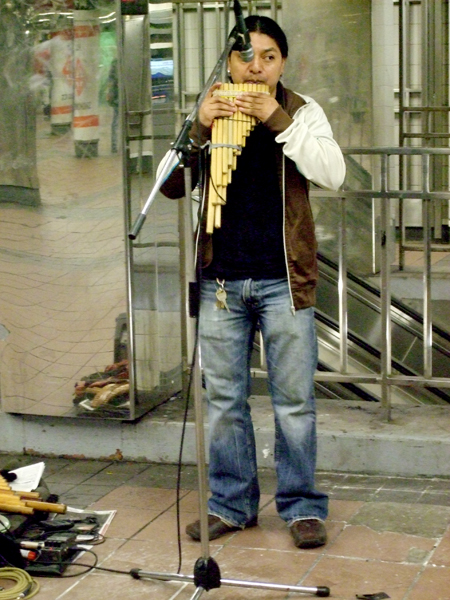
    The man in the photo is reminiscent of the rise of Andean street musicians in the late 1980s. The streets (and subway system) on weekends found many small troupes playing Andean folk music – mostly from Ecuador and Peru, with panpipes, flutes, and strings.

    One of the recent complaints worldwide about street musicians is the use of backing tapes and amplification systems, allowing a solo performer to play with recorded backup. Apart from the typically excessive volume is the rather “muzak” or schmaltzy character of the overall result. But the advantages to the musician are many – no need to organize a group or split tips, becoming a one-man band.

    Every corner of the planet has its trends, fads, and cultural movements, and many of these become global. But in New York City, with the chutzpah of the people, the large numbers of adopters, and the tolerance of the residents, these things take on a larger dimension and are frequently exported.

    Living here is like playing in the ocean. Sometimes I get caught in a wave, other times I just let it pass me by, waiting for the next one…


  • Itsy Bitsy

    In the time I have lived in this city, I have looked off and on at many real estate properties for sale, both apartments and small buildings. In these travels I have been privy to see many places, most of which were only available for tiny windows of time in decades.

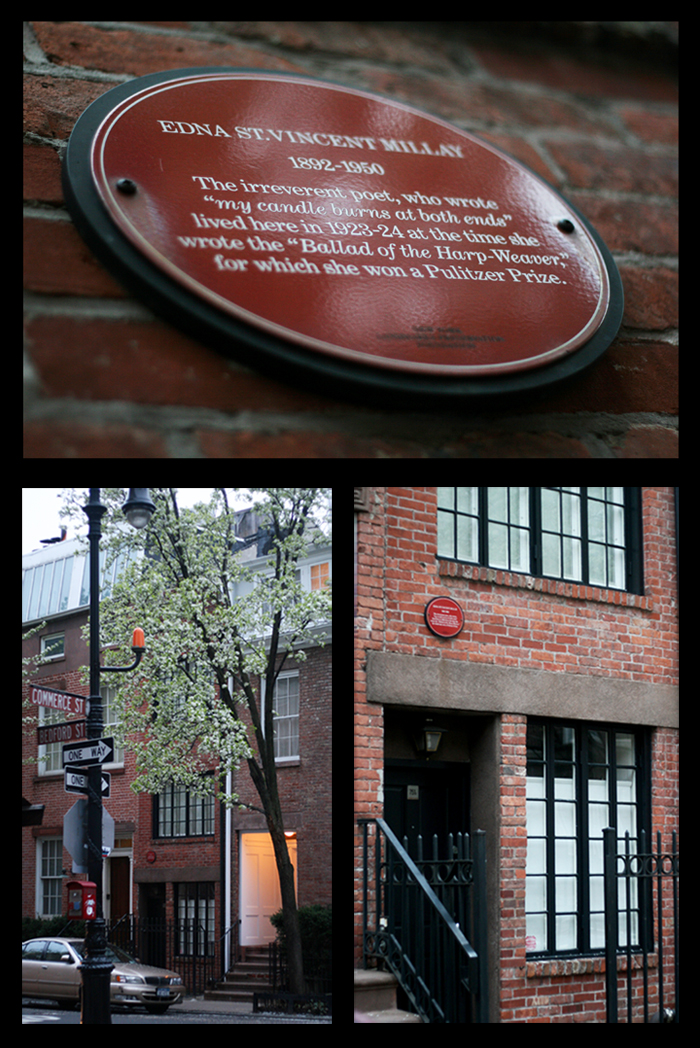
    One of them was 75 1/2 Bedford Street, known as the “Narrowest House in the Village” (or alternately, the narrowest in New York City). The three-story building with its stepped gable roof line was built in 1873, squeezed into a carriage between the neighboring buildings. Its most well-known occupant was Edna St. Vincent Millay, who lived there from 1923 to 1924 – it has often been referred to as the Edna St. Vincent Millay building. Other past occupants include anthropologist Margaret Mead, actor John Barrymore, and cartoonist William Steig. The property has had an interesting cast of occupants and owners – read about it here in Christopher Gray’s article in the New York Times.

    This property is so often written of and included in tours and books that I have left it on the back burner until today. But it is a worthy candidate for this website, and if you have not seen it, you should, sitting as it does in one of the most charming areas in the entire city, around the bend from one of my favorite spots: Commerce Street (an ironic name for one of the quietest streets in the city).

    The building sports a plaque, one of many in this neighborhood, proclaiming its historic heritage. These plaques or medallions are always a worthwhile read, even for the seasoned New Yorker. The former residents of these homes are frequently household names, as are many of the historic facts.

    There are places whose charm, quaintness, and uniqueness do not supersede their problems, and this is one of them. Unique in its size, its width of 9 1/2 feet is the fact always included in even the shortest descriptions. However, being the narrowest building in New York City is not a desirable feature for living, and in fact this property was on the market at one time for a decade before someone could see it as a habitable place. It was at this time that I visited it, and my memory of it is of a horrid, squalid place that was an absolute mess and so claustrophobic as to be uninhabitable. I had been warned by the broker but still expected a place that, with vision, had potential.

    There are several peculiarly proportioned, scaled, and shaped properties in New York. Wedges, slivers, and itsy bitsy places. See the following links for some of them: SkinnyBite, Vilequebrin, 121 Charles, Bomb Factory, 23 Skidoo, Seven Deadly Sins, Tongues and Flames


  • Finest

    Posted on by Brian Dubé

    New Yorkers have grown accustomed to a litany of superlatives regarding many facets of human endeavor and achievement in this city. Best, largest, first, oldest, most…
    Conveniently, the NYPD fits right in – the New York Police Department is not only the largest in the United States, it was also the first, established in 1845.
    And here, in today’s photo, we have, appropriately, the 1st precinct, located in lower Manhattan at 16 Ericsson Place at Varick Street. This precinct is also one of the few that stables horses – see my article with photos here.

    The city has used various nicknames for groups of uniformed city employees. New York has the Finest (police), Bravest (fire), Strongest (sanitation), and Boldest (corrections), and recently, a marketing campaign to recruit teachers has asked them to “Join New York’s Brightest.” The use of Finest for the NYPD is, according to etymologist Barry Popik, probably the oldest:

    Several sources claim that it was coined by police chief George W. Matsell. “Finest” probably started life as “Best” and probably dates from 1874. The comedian Gus Williams starred in the play One of the Finest in the early 1880s. I believe that “the finest police in the world” is meant to be a similar phrase to Civil War General Joseph Hooker’s “finest army on the planet.”

    Popik gives many other references from this time period – you can read them at his site here, along with the origins of Bravest, Strongest, and Boldest and their earliest usage in regards to uniformed workers. These terms, including New York’s Finest, are primarily media terms. Citizens rarely use these words, most often just referring to the police as the “cops.”

    Of course, whether or not the NYPD lives up to its nickname given to them 135 years ago is another question. Certainly the NYPD has had its share of scandals, perhaps to be expected allowing for such a large police force, large city population, the number of crimes committed, and the violent nature of America.

    I am sure that working in an environment where an individual is constantly exposed to the dark side has an impact. Also, being in situations which are potentially life threatening means that serious judgements have to be made, often with only a moment to make them, and of course, some of these decisions will be flawed.

    And, of course, there are always the bad apples in the barrel who give others a bad name. Many of them are the raison d’être behind the big public scandals of New York’s Finest…

    TIDBIT: When registering the domain name for this website, New York Daily Photo, I noticed that the initials NYDP used the same four letters as the NYPD. This would make a very short and simple website address. Excited by the prospect of using NYDP.com, a little research turned up the fact that it was, of course, already taken 🙁

    Posted on by Brian Dubé

  • Ray’s

    There are subjects which are complex and extremely difficult to understand, such as theoretical physics and abstract mathematics. And some have taken the already difficult a step further, like Wittgenstein, Hegel, and Jacques Derrida – try fathoming their writing and you can see why they have been accused of deliberate obscurantism.

    Mix the already complex with deliberate obscurantism, and what do you get? The saga of Ray’s Pizza. Residents know, and visitors quickly become aware of the endless parade of Ray’s Pizzas and their variants in this city: Ray’s Original Pizza, Famous Ray’s Pizza, World-Famous Original Ray’s Pizza, and even Not Ray’s Pizza.

    I have dug into this story, giving myself adequate time to study the details. It does appear that Ray’s Pizza at 27 Prince Street (in Little Italy) is the first NYC pizzeria bearing that name. It has been in business since 1959, and according to an investigative article in the New York Times in 1991, Ray’s Pizza was first listed in the 1960 Manhattan telephone book. On my recent visit, a red banner strung indoors proclaimed their 50th anniversary. A faded photo of Joe DiMaggio hung near a framed, yellowing front page from the New York Times, all in the understated style characteristic of Cuomo’s pizzeria.

    Ray’s was opened by Ralph Cuomo, the 22-year-old son of immigrants from southern Italy, using his mother’s recipe. Problems began when Rosolino Mangano began opening Ray’s around town. According to the 1991 article in the New York Times:

    “In the early 1960’s he [Ralph Cuomo] briefly had another Ray’s Pizza at 1073 First Avenue near 59th Street, but he sold that, and in 1964 it ended up in the hands of . . .
    A Ray Named Rosolino. The expansionist era began with Rosolino Mangano, an immigrant from Sicily, who used that First Avenue Ray’s to found an empire which now includes a dozen Famous Original Ray’s pizzerias in Manhattan, each adorned with a coat of arms featuring tomatoes, wheat and a cow.”

    And then there was a Ray named Gary:

    “In 1981 Mr. Mangano sold a Ray’s pizzeria at Second Avenue and 51st Street to Gary Esposito, who grew up in Floral Park, Queens. Mr. Esposito opened five more Original Ray’s pizzerias on Long Island and in New Jersey, but he showed one remarkable bit of restraint. ‘I have never said that I am Ray,’ he declared last week. ‘That’s my claim to originality.’ “

    For more of this fascinating story, see the original Times article here.

    The pizza? Excellent and one of my favorites in New York City, along with Two Boots. I love the pesto…

    Ray’s features six types of pizza: Pesto with Basil and Black Olives; Fresh Tomato, Garlic & Ricotta; White Pie with Spinach Mushrooms & Ricotta; Black Olives & Tomatoes, Pepperoni & Ricotta, and Ray’s Special – Pepperoni, Mushrooms, Sausage, Onions, & Peppers.


  • Walk Quickly

    Posted on by Brian Dubé

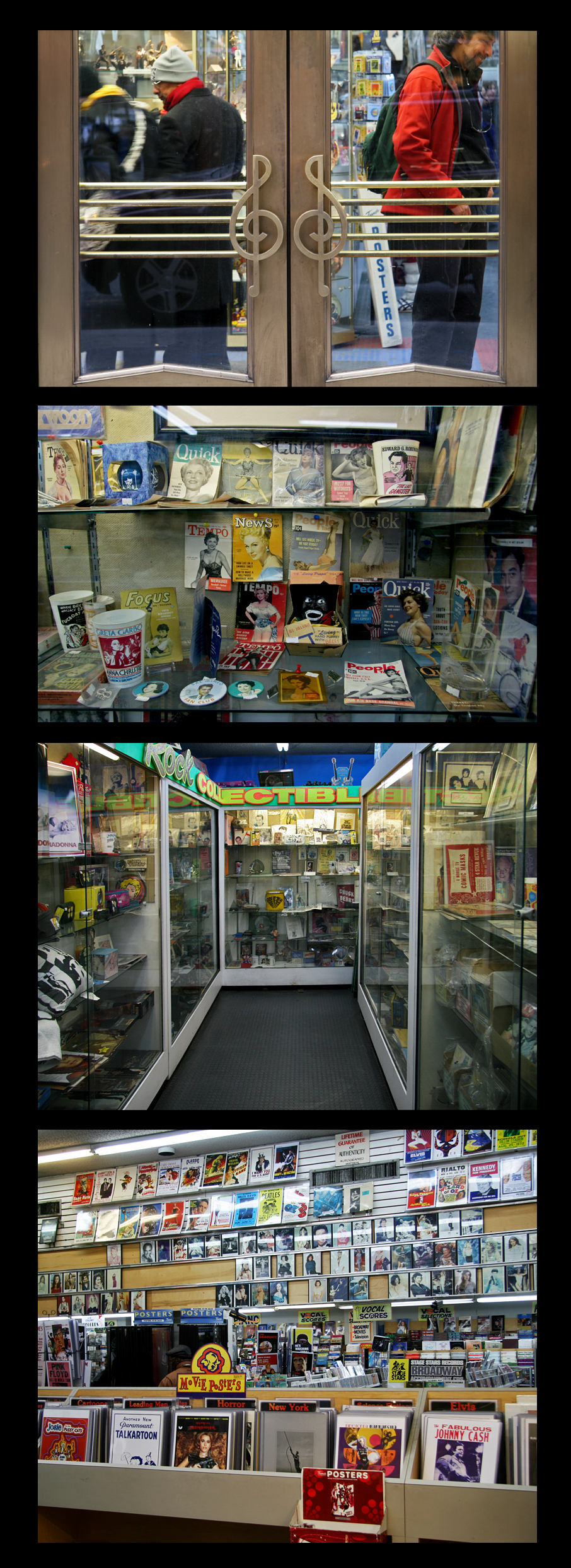
    This is not a story of vanishing New York, fading New York, forgotten New York, lost New York, or the End of an Era. This is the survival of tradition. Olde New York. It does exist. And you can find it at Colony Records. See photos inside here.

    Colony Records was founded by Harold S. Grossbardt and partner Sidney Turk in 1948. Born in Brooklyn, Harold started work after the seventh grade. He was a salesman at Melody Music Shop in Brooklyn and Colony Sporting Goods, located at 52nd Street and Broadway in Manhattan.
    When Colony closed for business, Grosshardt took it over and renamed it Colony Records. In 1970, they moved to their current location in the Brill Building, at 1619 Broadway at 49th Street.
    The Brill Building is its own story. Built in 1931, the building became a center for music publishing. By the 1960s, there were an estimated 165 music-related businesses in the building. Colony Records became a central fixture of Tin Pan Alley. Located here in the heart of the music and theater districts alongside nightclubs such as the Copacabana and Birdland, it was convenient to concertgoers and musical artists. Colony has seen a parade of legendary artists through its shop, including names such as John Lennon, Michael Jackson, and Frank Sinatra.

    I was impressed by Colony’s enormous selection of sheet music – reportedly the city’s largest. They also sell vintage vinyl records, CDs, and karaoke and have an interesting memorabilia selection. They also have posters and photos for sale.
    Of course, the survival of these emporiums is never guaranteed. So if you want to see them, I would not say that you have to run, but perhaps you should walk quickly...

    Note: Obituary from the New York Times: “Harold S. Grossbardt, a founder of Colony Records, the famed collector’s store now on Broadway at 49th Street in Manhattan, died on June 10 (2001) at his home in Aventura, Fla. He was 85. He is survived by his wife, Estelle; two sons, Michael J., of Roslyn, N.Y., and Alan R., of Great Neck, N.Y., who is an owner of Colony Records; a brother, Jerome, of Manhattan; a sister, Dorothy Capobianco, of Delray Beach, Fla.; and a grandson.”

    Posted on by Brian Dubé

  • The New Yorker

    When you find at a place with a name and location like this, you assume that it has a rich history and many a story to tell. However, as is typical with many things in New York City, a little investigation will reveal much more than you ever imagined.

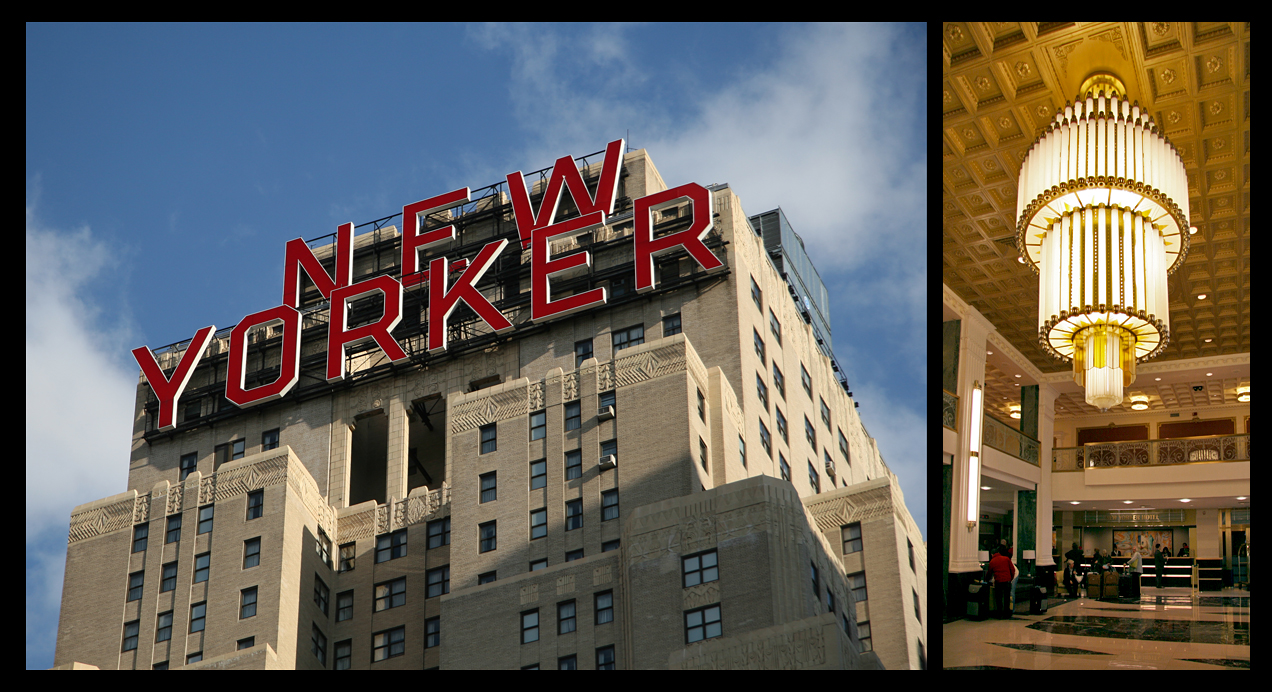
    The New Yorker Hotel, 481 Eighth Avenue at 34th Street, clearly outdid my expectations. The exterior signage in the photograph looked much too new to be original to the structure – some reading confirmed my suspicions and led to some fascinating reading. Designed by Sugarman & Berger, the New Yorker opened in 1930. The building’s art deco architectural style with tower set backs resembles the Empire State Building (which lies 3 blocks east and was completed in 1931).

    Names, dates, and figures, the bane of many a history student, are often necessary to give a true feeling for a place. Many specifics are easily forgotten, but hopefully the impression remains that this was quite a place – the facts about this place are truly amazing. Of course. its central location in midtown is a big plus – walking distance from Port Authority Bus Terminal, Macy’s, and the Javits Center, with Penn Station across the street.
    The New Yorker Hotel, a marvel of its day, was the largest hotel in New York with 2,500 rooms. In addition to the ballrooms, there were ten private dining “salons” and five restaurants employing 35 master cooks. The barber shop was one of the largest in the world, with 42 chairs and twenty manicurists.

    There were 92 telephone operators with 3200 phones and 150 laundry staff washing as many as 350,000 pieces daily. This was all supported by America’s largest private power plant, which the New Yorker had installed down in the sub-basements. There was a ten-room hospital, a theater ticket office, and a transportation department. Some of the rooms had private sky terraces or roof gardens.

    With the arrival of the Big Bands, the stage was set for the “heyday” of the New Yorker Hotel. The famous bands of the day played at the New Yorker, including Benny Goodman, both of the Dorseys, and Woody Herman. This atmosphere not only drew in business travelers and tourists but also attracted the elite of society, as well as political figures and business leaders. The Brooklyn Dodgers, with Manager Leo Durocher, headquartered here for the 1941 World Series, and Joe DiMaggio lived here when the Yankees were in town. The 1950’s – 60’s did not turn out to be as prosperous as previous years, and the New Yorker closed its doors in 1972.

    A less savory piece of history is its decline and closing in 1972 and purchase by Sun Myung Moon’s Unification Church in 1975. The building was used by the church until 1994, when it reopened as a hotel (since 2000 it has been part of the Ramada franchise) and has gone through extensive renovations. It will maintain the classic Art Deco style but will see many upgrades to bring the hotel up to contemporary standards, with amenities such as flat-panel HD televisions and free Wi-Fi.

    Its roster of residents included one of my personal favorites: the eccentric electrical genius Nikola Tesla, who spent his last 10 years in near-seclusion in Suite 3327, largely devoting his time to feeding pigeons and meeting dignitaries on occasion. He died there in January 1943…

    *If you are not familiar with Tesla’s life and work, I would highly recommend reading about this cult figure. Tomes have been written both off and online. Here is a good starting point.

    NOTE ABOUT THE PHOTO AND SIGN: The iconic, bright red “New Yorker” sign on the top of the hotel is part of the New York City skyline. Even though the New Yorker Hotel is currently undergoing a $65 million renovation, the red sign will remain a fixture of the New York City skyline, preserving the impressive view, far into the future. The sign was installed in 1941 and went dark in 1967. The new bright red sign is a six-story LED banner and the largest of its kind in North America. It is also the highest off the ground for any LED sign, as it is affixed to the top four floors of the New Yorker Hotel facing the West Side of New York. It can easily be seen from as far away as New Jersey, as it stands out in midtown New York.


  • Crime Scene

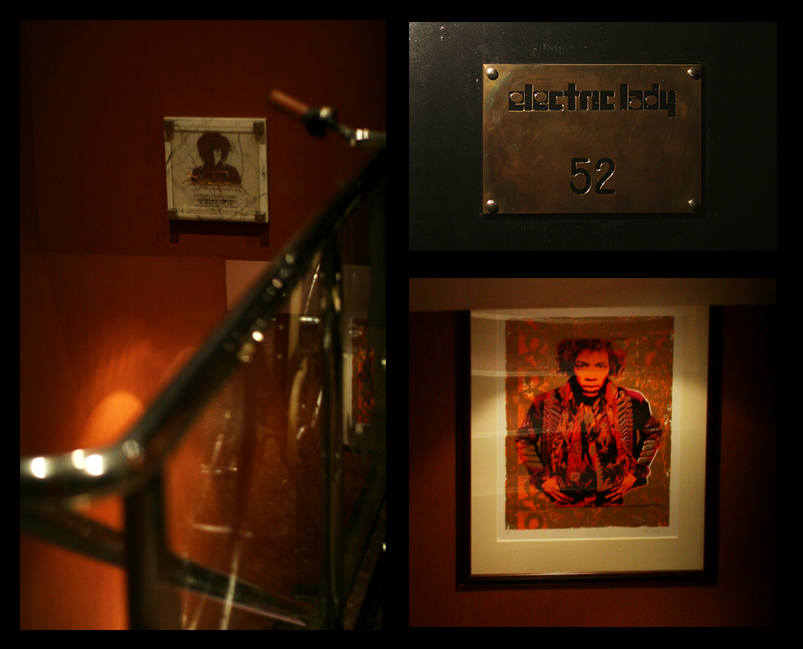
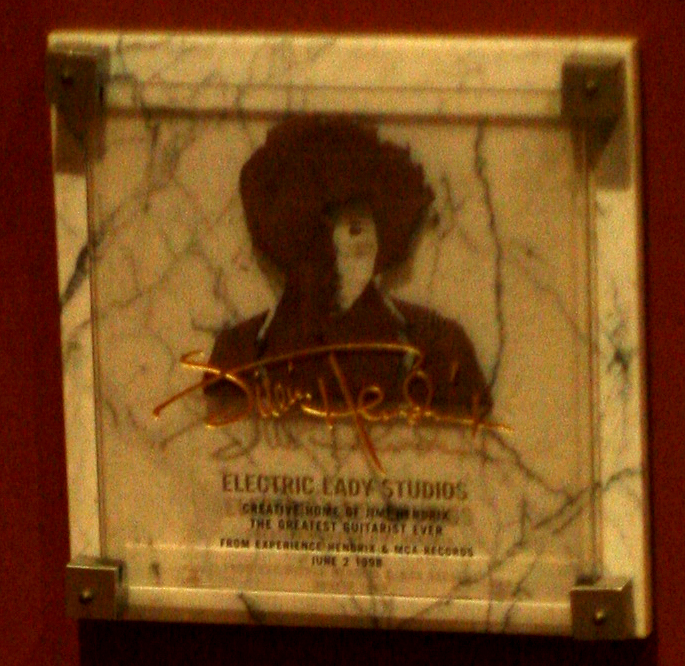
    I have a very special relationship with this place, Electric Lady Studios at 52 West Eighth Street. A regret of what could have been and what should have been. If you were here with me in person, I would hold my forefinger and thumb as close together as humanly possible without actually touching, leaving the tiniest sliver of light to pass through. And I would tell you, “That is how close I came to meeting Jimi Hendrix.” Not just meeting him, but spending a night with him and one other jamming on guitar.
    Now these were college days in a time of recklessness and excess. Everything from that period was chaotic and disjointed. Some of the details are foggy in my mind, so the story goes something like this:

    It was 1969. A winter’s night at approximately 4 AM, with a snowstorm blowing outside. A fellow NYU dormitory resident whose name I do not remember (perhaps not even a resident – it could have been an interloper, common at that time) said he was heading over to Electric Lady Studios to jam with Jimi and did I want to go? A stunned yes was the proper response, and with an electric guitar slung over his neck, we walked from the dorm down Eighth Street in the snowstorm. He buzzed when we arrived, announced his identity via intercom, and asked if Jimi was in. The response was that he was not. He typically was. So, disheartened, we made the short trek back.

    The following day, I asked someone who knew this man well and asked if my friend really knew Hendrix and played with him before and whether we would have actually been admitted to jam with Hendrix had he been at the studio. The answer was yes, yes, and yes. I was assured that my friend did know him and, had Jimi been there, we would have been admitted.

    Now this may not seem like much, but consider that this was an opportunity missed to have spent some hours with a living legend, James Marshall Hendrix. Not to see him in a concert or perhaps see a fleeting visage on the street, but to spend time with him in a private setting. These were days when legends and gods were approachable, a time when things and people did not become so overexposed, hyped, and marketed as to make them completely inaccessible. I missed other opportunities to see Jimi in concerts at the Fillmore East and his jams at a small club called Ungano’s.

    I have wanted to do a piece on Electric Lady Studios since the start of this blog, but the exterior is rather plain and uninteresting. But last night an opportunity made itself available. I saw someone leaving the studio and, for the first time, realized that the door to the entrance vestibule is not kept locked. Opening this door afforded a shot of the brass plaque in the photo. However, upon stepping into the vestibule, I was immediately warned that photography was not allowed.

    I also never realized that the studios were in the basement, accessed by a stairway which can be seen from the street if you peek through the crack in the curtains just right. I was able to see a marble plaque and a framed poster of Jimi in the stairwell. I was surprised to be able to get a couple of decent photos by squeezing my camera and head against a wall and shooting through a glass window at night into a dimly lit stairwell. If you go here, you can see an enlargement of the plaque and poster – the text of the plaque is actually legible.

    The history of this studio is just amazing, and rather than retell it here, I suggest you read it here at the Electric Lady Studios website. The studio was established in 1970, designed by John Storyk. It is still considered one of the finest recording studios in the world, and the roster of clients who have recorded there has to be one of the most astounding who’s who in music.

    Now I really want a tour of this place. And I had better do it soon, lest it becomes the second of life’s major regrets around the same place – like two crimes at the same scene…


  • In My Book

    I remember hearing someone once say that there is an illusion that everything in the past was better, with the quality of antiques cited as evidence, and that this perception is because we only save the best and discard the rest. There was plenty of junk made.

    Occasionally, we even champion the junk, to be sold and seen as charming kitsch, somehow better than today’s kitsch. I have heard the same type of thing said about books from those who have a good historical knowledge of the world of publishing – that plenty of crap has been written and published, but only the classics remain.

    Certainly, looking at the landscape that is New York City, I would be hard pressed to romanticize the 1970s. I am not a fan of over-gentrification or the encroachment of chain and big box stores, but I also have no fond memories of graffiti-covered trains, Bowery squeegee men insistent on washing car windshields, “no radio” signs in cars adorned with broken glass, or running for your life in the East Village. I had a friend who was actually mugged three times in one week in the vestibule of his East Village flat.

    There were good things too, of course, especially the affordability which allowed virtually anyone with desire and intestinal fortitude to get a foothold in this city and stake out his/her claim. Apartments could be had cheaply (in relative dollars). You could work yourself through a private university and support yourself in your own place.

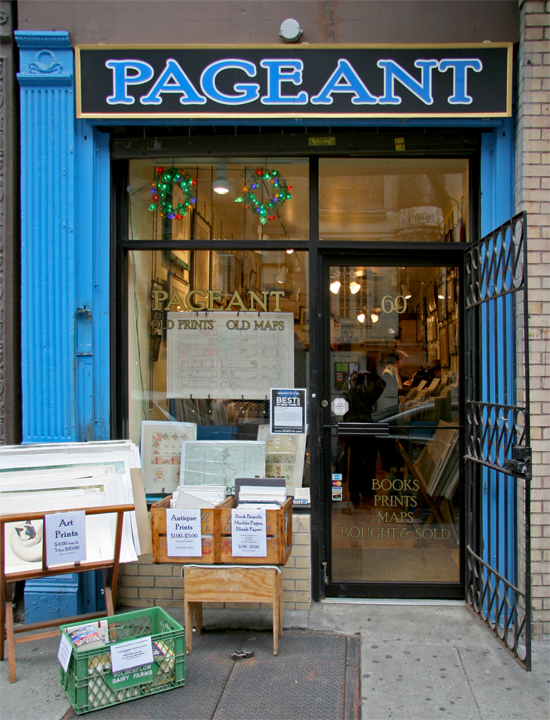
    This environment really allowed all manner of things to survive and flourish. One of those things were the booksellers along 4th Avenue, a row of 30 used book dealers in the space of 6 blocks from Astor Place to Union Square, known as “the book row of America.” I love books, and perusing the wares of those dealers on a Sunday afternoon was one of my pleasures and pastimes. The Strand, still operating today on Broadway, had its roots there. The other survivor is Pageant Book Shop, founded in 1946 by Sidney B. Solomon and Henry “Chip” Chafetz as a used and rare book shop in New York City. Sidney’s daughters Shirley and Rebecca Solomon now run the shop. Pageant had its home in several locations along Fourth Avenue for 35 years before moving around the corner to East 9th Street. In the 1990s, it moved to West Houston Street. Recently, it moved to its current location at 69 East 4th Street.

    The current shop is much smaller than previous incarnations and, unlike its predecessors, sells primarily antiques prints and maps with a smaller selections of books. I can’t say that this place exudes that rustic charm with musty smells of the early 4th Avenue booksellers. But no matter, because it is a book store, and in my book, that is always welcome…

    Film buffs: The shop and its books have appeared in numerous movies filmed in New York City, including Neil Simon’s “Chapter Two” with James Caan and Marsha Mason and Woody Allen’s “Hannah and Her Sisters,” where Michael Caine and Barbara Hershey went browsing for a copy of e.e. cumming’s poems.

    Related Post: Better When


  • dinamic_sidebar 4 none

©2026 New York Daily Photo Entries (RSS) and Comments (RSS)  Raindrops Theme