• Category Archives NYC’s History
  • The Day’s Work

    As I wrote in Being Trumps Doing, when I leave my home on a beautiful day for a stroll in the city, I frequently have some small agenda. For the workaholic, this helps justify recreation, turning fun into something of a small task, in keeping with the Protestant work ethic of my New England background. After all, play is for children, not adults.

    The problem with this approach to life is that a small agenda item, if planned for a later part of the day, can become a nagging irritant. And so it was on Sunday, when, after a few errands, I intended to take a walk to Tompkins Square Park, see what activities may be at hand, and procure some fruit from the small farmer’s market there.

    However, while walking down Broadway, I come across a block party. The barricaded street had Park Rangers, children’s activities including rides on a shetland pony, re-enactments, cavalry horses, bales of hay, a Gatling gun, and Hotchkiss gun. I had unknowingly stumbled upon the 150th birthday celebration of Theodore Roosevelt, 26th President of the United States. Unbeknownst to me, Roosevelt was born in a NYC brownstone at 28 East 20th Street in Manhattan. The home is now open to the public as a museum. It is a National Historic Site and is administered by the National Park Service, U.S. Department of the Interior.

    The home, typically not open on Sundays, was having a free open house as part of the celebration. This was a great opportunity for my first visit – visitors were allowed to roam the property at will. Typically, period rooms can only be seen via guided tour. The staff is quite accommodating. From their website, we learn:

    Not all Presidents were born in log cabins. One was actually born in a New York City brownstone! Visit the birthplace and boyhood home of Teddy Roosevelt and see what it was like to grow up in the “gilded age.”

    Forty percent of the furnishings are original. One that caught my eye was a beautiful original gas-illuminated lamp with panels known as lithophanes. A lithophane is a translucent porcelain, etched or molded, with varying degrees of thickness. The result is a three-dimensional image which changes depending on the light source. It disappears and reappears when backlit or not. It is typically credited to Baron Paul de Bourging in France in 1827, although evidence indicates that similar work was done in China one thousand years before in the Tang Dynasty.

    A swing through Union Square provided other distractions – what appeared to be a Christian rock group and an assault by some variant on the Zombie Con, which I witnessed last week. It soon became clear that it had become too late for Tompkins Square Park. A shame in a way, because although it had been a great afternoon punctuated by a surprise landmark event, somehow I felt that the day’s work had not really been done 🙂
  • Rhinelander’s Dream

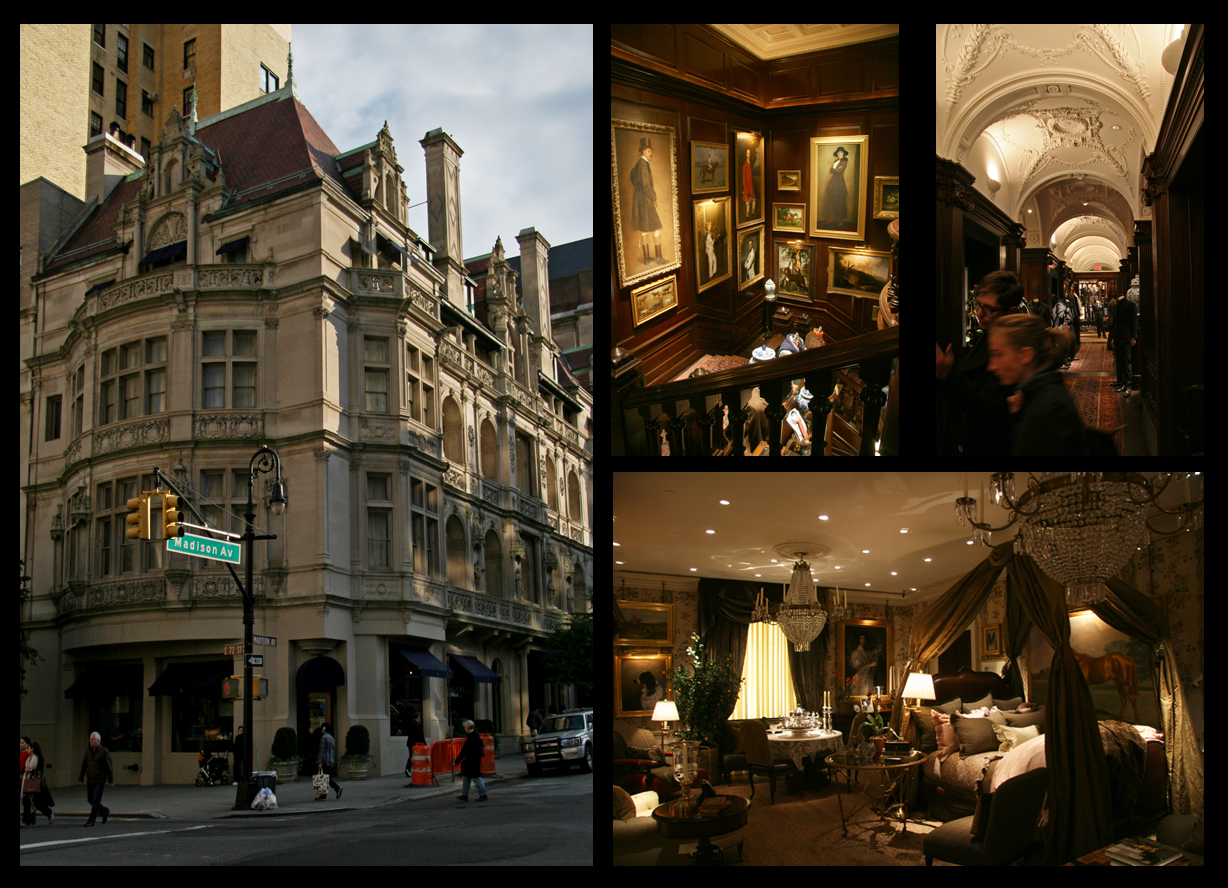
    This is easily the most exquisite and elegant retail interior space in New York City. It’s a must-see for any visitor with a little extra time. Located at 867 Madison Avenue on the southeast corner of 72nd Street, it has been occupied by Ralph Lauren/Polo since 1986.

    I was shocked to learn that this huge neo-French Renaissance limestone palace was actually unoccupied in the first 23 years of its existence. It was designed by Kimball & Thompson and built in 1898 for Gertrude Rhinelander Waldo, a wealthy socialite who dreamed of a French Loire Valley chateau. Rumored that she ran out of money before completion, the property was first occupied in 1921. Since that time, it has had various tenants: the auction house Christie’s of London, Zabar’s, the Olivetti Brothers, and photographers Edgar de Evia and his partner Robert Denning. De Evia’s mother, pianist Miirrha Alhambra, also resided there.

    By the mid-1950s, de Evia and Denning had formed Denvia Realty, which held the net lease on the entire building. The top three floors were used as their studios and residence; offices were rented to the interior decorators Tate and Hall, and street-level shops were rented to various merchants, including a corner pharmacy and Rhinelander Florists.

    It was purchased in the 1960s by a nearby church. In 1983, Ralph Lauren acquired the net lease. The building’s ownership has changed hands numerous times as well. TMW bought the building for $36 million in 1997, and in 2005, it was sold to an Irish investment group (Sloan Capital) for $80 million.
    The gothic tile-covered mansard roof is spectacular, with oriels, dormers, and chimneys.

    I know it is fashionable to bemoan the hegemony of large retailers on the American landscape, but one needs to give credit where it is due, and Ralph Lauren has done the Rhinelander mansion justice with a $14 million dollar renovation. Absolutely everything in the interior is just perfectly appointed. Even members of the sales staff are impeccably dressed and groomed – I actually mistook one for a haute couture mannequin.

    The interior is an architectural masterpiece complemented with superb interior design. Crackling fireplace, sculpted vaulted ceilings, a magnificent stairway graced with paintings, antiques, furniture upholstered in cashmere, Lalique paneling, Persian carpets, and Baccarat chandeliers. To enter this place is to really leave the city behind and enter another time and place and one woman’s dream…


  • Main Street

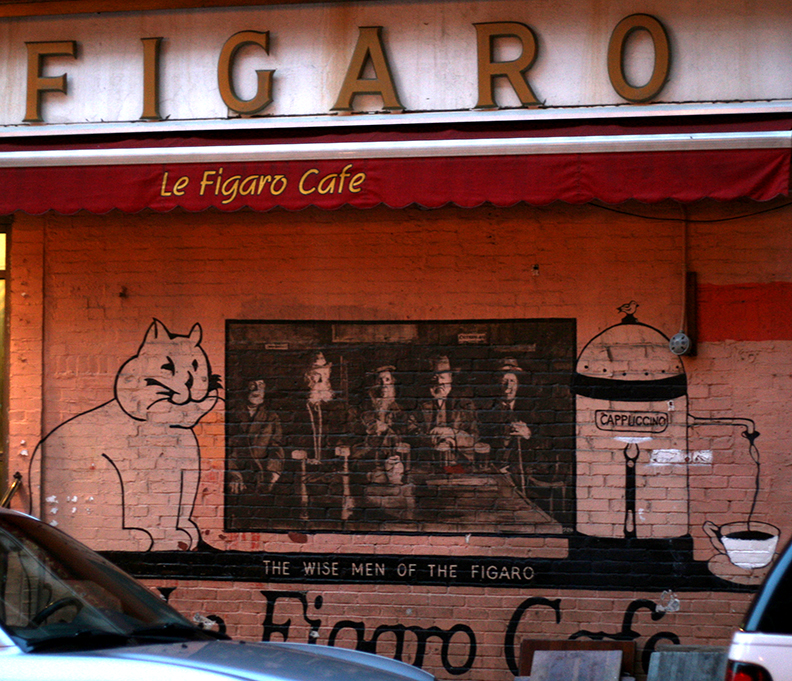
    I don’t go to cafes often. In over two and a half years of writing for this blog, I have never done a real cafe. The reason? Because there are virtually no “real cafes.” And it is not so much that all the good ones have gone out of business – there were really very few good ones in the many years in which I have lived in New York City. The Figaro Cafe, for example, (recently closed) was never all that great – it certainly was not intimate, charming, or romantic. I would imagine that it was an interesting haunt when it opened over 50 years ago. Most places have been quickly over run by a stampede of tourists. So a person always had to either know of places or hunt and forage.

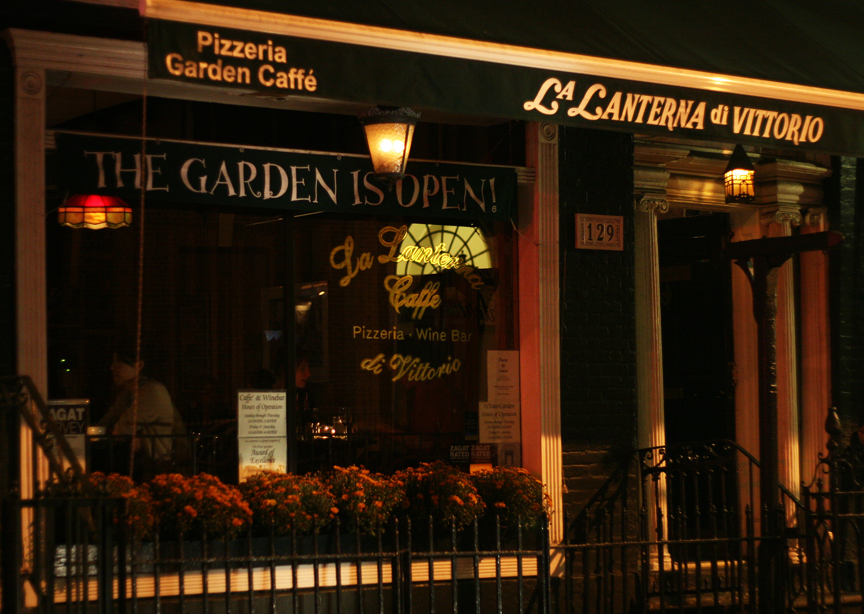
    For me, ambiance is a necessary condition for a cafe, and La Lanterna is one of the most atmospheric cafes I have been in. Two floors each with a fireplace, dark woods, low lighting, and a beautiful year-round garden. Reviews characterize it as frequented by students from neighboring NYU. I cannot attest to this, however, Lanterna is not a real inexpensive place, and the cafe is extremely well-maintained. La Lanterna does not attract a boisterous crowd, and any student traffic is well behaved. Contrast to a place like Think Coffee, for example, which is essentially under assault by students.

    La Lanterna di Vittorio at 129 MacDougal Street was opened in 1976. It offers an excellent selection of pastries, gelato, the requisite coffees, and a wine list. The menu also has a pretty extensive selection of food, enough for a light meal – pizzas, bruschetta, salads, soups, panini, crostini, calzone, carpacci, fish, and cheese. See their website and menu here.

    My only disappointment is that I can not tell you that it dates to the 1800s with a history like that of Les Deux Magots in Paris, or that it is on a wonderful romantic sidestreet like Commerce Street (don’t be put off by the name) or Grove Street. It is certainly not in a secret, off-the-beaten-path location. Ironically, it is located on MacDougal street, a block north of MacDougal’s primary commercial block between West 3rd and Bleecker Streets (if you venture on that block, be prepared for to enter one of the most conspicuously unattractive and touristy streets in the Village.) Perhaps this is one reason that it is often overlooked.

    It’s fine to look in the nooks and crannies, corners, and crevices of New York City for the undiscovered gems – I love that. Just don’t miss Main Street…


  • Universal Impact

    I lived in New York City during the 9/11 disaster. In fact, my apartment had unobstructed direct views of the Twin Towers. I viewed the impact of the first Tower minutes after the first plane struck it. I live and work in lower Manhattan in close proximity to Ground Zero, and like other downtown residents, elements of the aftermath lingered for months. Smoke, fumes, restricted areas, emergency vehicles, vigils, and memorials were part of everyday life.

    I have a series of photos taken during that period, none of which I have posted before. There has so much coverage, imaging, and activity surrounding the disaster that I have limited my participation. Any contributions sometime feel virtually gratuitous.

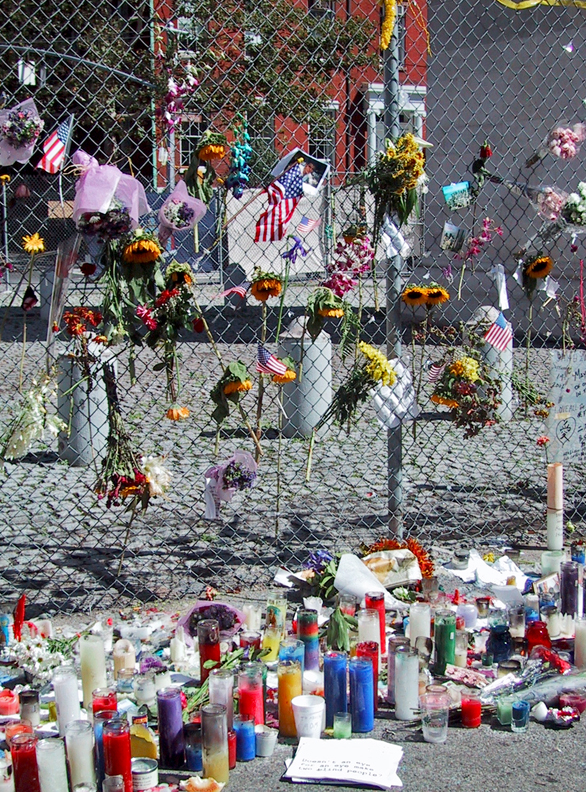
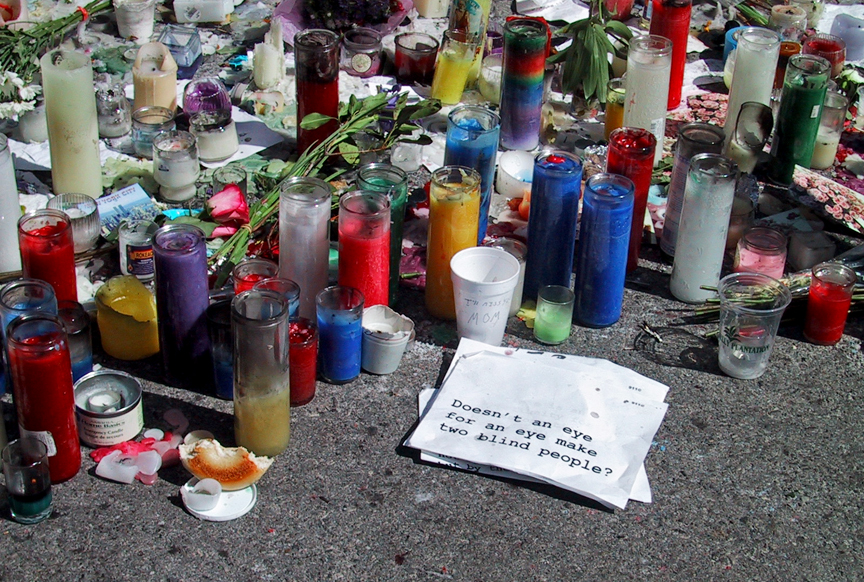
    Today I have opted to post one of my original photographs of a memorial site against a fenced-in area surrounding Washington Square Arch in the Village, taken in 2001 (see second photo here). This site was one of many spontaneous occurrences throughout the city. One remarkable thing about all of these sites was the universal regard they were shown for the long periods of time that they remained. Like the ghost bikes around town, these displays of candles, flowers, and personal notes were left unprotected but remained unaltered.

    There were a small number of sales of inappropriate 9/11 “memorabilia” immediately after the event, but most of this was squashed quickly and mercilessly by mayor Giuliani. There was zero sympathy for anyone trying to capitalize in such a heartless manner.

    No graffiti or vandalism, and little exploitation – extremely rare in this city to have an event of such monumental impact that it is paid such universal respect…


  • The Pieman

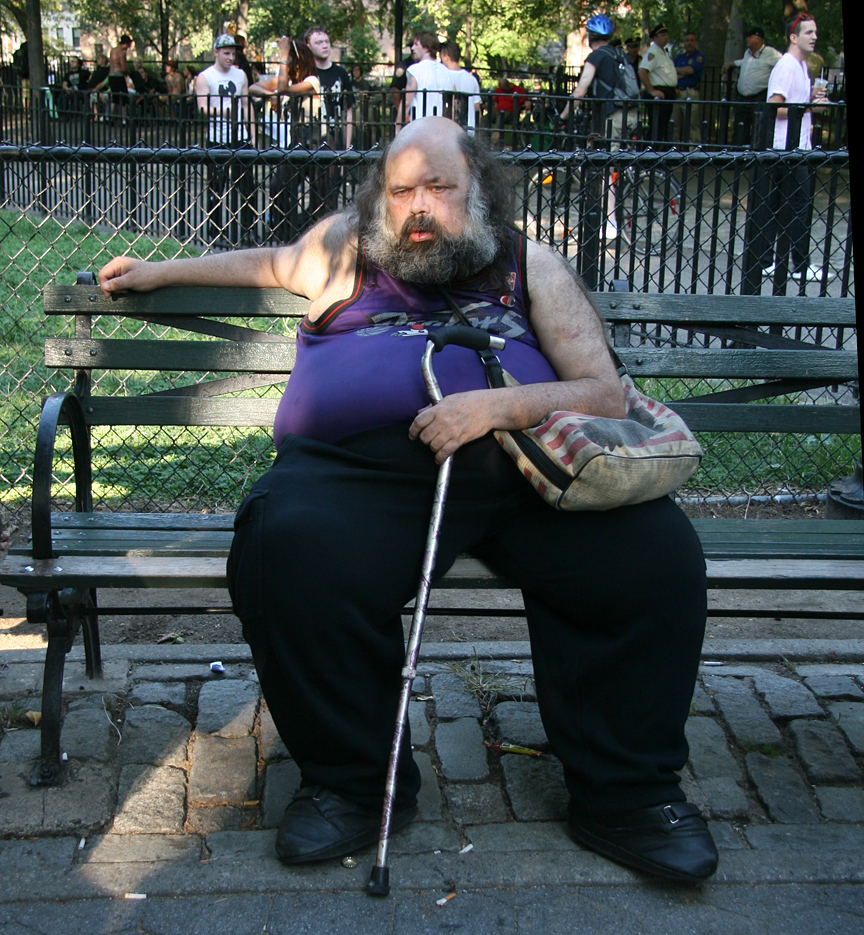
    Looming large in the photo, but rather innocuous live in the setting, is a character who is famous and infamous, depending on who is telling the tale or hearing the story or on one’s political alliances.

    This is the Pieman, aka Aron Kay, a Brooklyn resident. Pieing, the act of throwing a pie in someone’s face, was originally a common gag in slapstick comedy. Kay considers the Three Stooges the true fathers of pie throwing. Pieing as a political statement originated in the USA with the Yippie movement in 1970. (If you are not familiar with the Yippies, see my posting here.) Kay has thrown pies at conservative author William F. Buckley, NY Senator Daniel Patrick Moynihan, former New York City mayor Abe Beame, the Nixon Watergate operatives G. Gordon Liddy and E. Howard Hunt, William Shatner, Andy Warhol, and Jerry Brown Jr., the former governor of California. His last target (in 1992) was Randall Terry, former leader of anti-abortion group Operation Rescue.

    Belgian artist Noel Godin began throwing cream pies in 1968. Perhaps a more poetic interpretation of his actions, Godin refers to himself as an enterteur. He considers his actions non-violent and uses a tarte classique, filled with whipped cream (and perhaps chocolate). At least the receivers get a free gourmet dessert. Among the luminaries who have been his victims are Bill Gates, Bernard-Henri Lévy, Jean-Luc Godard, and Nicolas Sarkozy.

    Although I am not an advocate of violence or pieing, there are many individuals who are extremely incendiary and have built careers setting fires and fanning the flames. One who comes to mind is Ann Coulter, who has been pied. Watching an individual like this in interviews and debates, with her sneering and snide remarks, gives one an understanding of how someone can be incensed enough to throw a pie. Others who are extremely arrogant (William F. Buckley Jr, e.g.) or hold articulate, extreme right wing views, such as anti-gay-rights activist Anita Bryant, also ruffle the feathers of pie throwers.
    Bon Appetit?


  • Nostalgia

    Posted on by Brian Dubé

    One must be careful in making condemnations of contemporary culture and claims regarding the degradation of society and romanticizing the past. There is no dearth of criticism regarding the “malling” of New York City and the invasion of big box retailers into the NYC marketplace. And, certainly, many of the criticisms are valid.

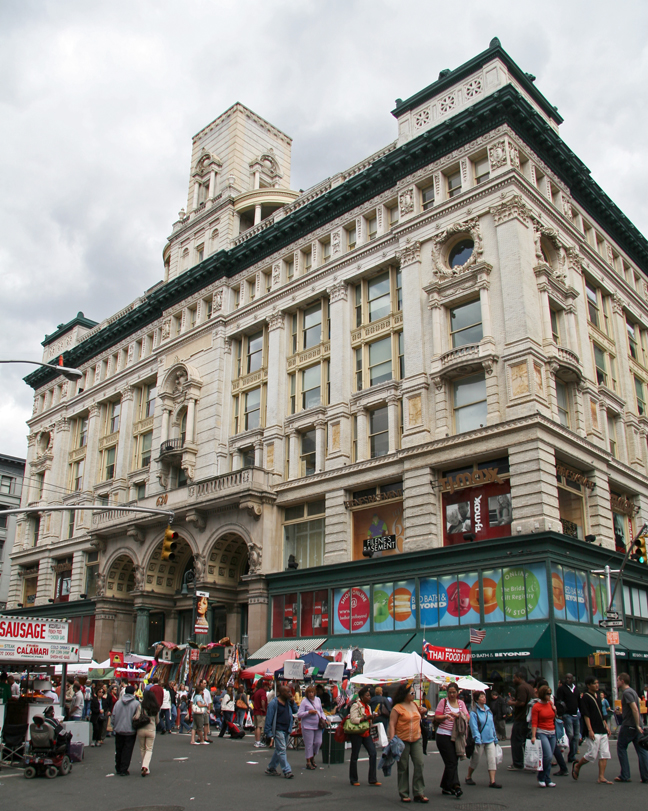
    At first glance, when looking at this magnificent Beaux Arts building at 632 Avenue of the Americas, my first reaction was how inappropriate it was that this building would house Bed, Bath and Beyond, Filene’s Basement, and TJ Maxx.

    A little research will reveal that this stretch of 6th Avenue (from 18th to 23 Street), replete with enormous architecturally wonderful buildings, was once known as the Ladies’ Mile and that the beautiful structures lining this avenue were originally built as department stores.

    The most opulent was the Siegel-Cooper, originally designed by DeLemos & Cordes and built in 1896 as a discount department store for Siegel, Cooper & Co., who were based in Chicago. The New York store became a mecca for shoppers.

    There was a fountain in the center of the lobby, which became a meeting place in New York. Jets of water cascaded over multicolored lights onto a marble and brass statue of The Republic.

    So the large stores on the former Ladies” Mile should can be seen more as a reincarnation than invasion. I am reminded of various interpretations on nostalgia which I have heard – that the past always seems better than the present because we only remember the good parts…

    Posted on by Brian Dubé

  • Steps From Paradise

    Posted on by Brian Dubé

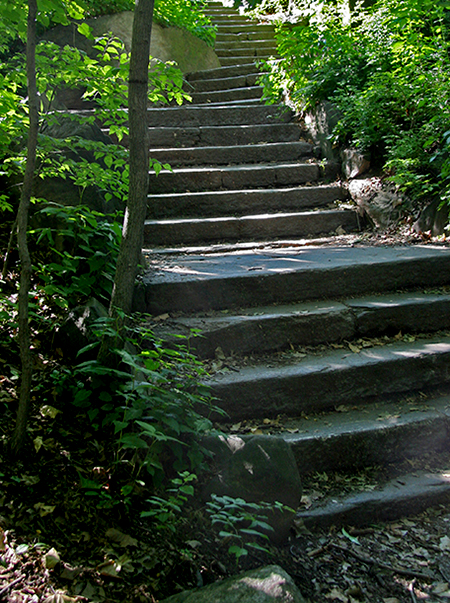
    Do you want to find one of the most idyllic, bucolic areas in Manhattan? One where you feel virtually removed from the city itself? Then step into the Ramble, a 38-acre “wild garden” in Central Park (in the words of Park designer Olmsted) with rocky outcrops, secluded glades, and a tumbling stream called The Gill.

    The designers of the Park literally sculpted the Ramble out of a wooded hillside. One of the first parts of the Park to be built, the Ramble is totally artificial except for its bedrock base. Even the water running in the Gill is turned on and off with a water tap.

    What is extraordinary about the Ramble is how one can be completely secluded in a heavily wooded environment in the center of Manhattan with no visual sense of being in an urban setting. You have to look hard in New York City to find spots of nature which are capable of really acting as a retreat and providing a respite from city life. Some of my favorite spots are the various community gardens (see Shangri-La).

    The Ramble is a major bird-watching area due to its location on the Atlantic flyway (the migration route that birds follow during the spring and fall). It is one of the top 15 birdwatching sites in the entire United States – 230 species have been spotted.

    One aspect of the Ramble, which has kept some visitors away, is its use since the early 20th century for gay encounters. The heavily wooded seclusion which the Ramble affords has made this an ideal location in the city for outdoor gay sex. However, I have been to the Ramble many times over the years, and personally I have never witnessed anything of this nature, so I would not let any of this deter you from visiting this area.

    I am frequently surprised at many people I meet who are unaware of the Ramble’s existence. If you are in Central Park, always remember – you are only a few steps from paradise…

    Posted on by Brian Dubé

  • Dead or Alive

    Posted on by Brian Dubé

    I thrive on holdouts. And this website is slowly becoming a tribute site to many of them, a commemorative site for legendary businesses, both present and past. As time passes, I am accumulating a growing number of postings on places which are no longer with us – tombstones in the graveyard of NYC.

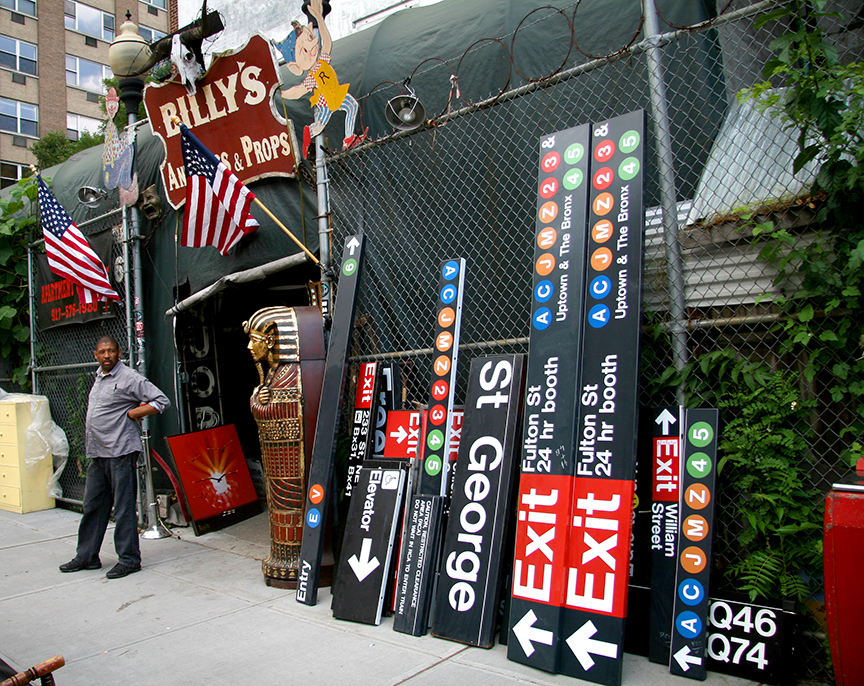
    Billy’s Antiques is one of those places. What kind of place? The kind that is the raison d’etre to be here in the first place and that you won’t find anywhere else. The kind you expect to read about on this website and visit in person.
    Billy Leroy is as iconoclastic as the business itself. Growing up on the Upper East Side, he attended boarding schools and studied at the Art Institute of Boston. Here, at Billy’s Antiques and Props, you can find all manner of things: meteorites, subway signs, furniture, paintings, etc. It’s a place the New York Times referred to as a “green circuslike tent whose lineage seems equal parts flea market, carnival midway and antiques shop.”

    From Billy’s Antique website:

    “The strange green tent that has been at 76 East Houston Street since 1986 is the last eclectic antique and prop store on the Bowery. Billy’s first incarnation was called Lot 76.In those days the Bowery was like the Wild West. Only the adventurous came downtown. As the sun would set on East Houston the junkies and alcoholics would lurk around like Zombies, asking for handouts.
    The creator of lot 76 was Rob Fennick a forward thinking antique dealer from Detroit. The tent has provided countless objects to thousands of New Yorkers. All walks of life have passed through the doors: movie stars, rock stars, artists, junkies, hookers, gangsters entrepreneurs, hipsters, and today there is a new breed on the Bowery; the metro-suburbanites. But the spirit of old New York is still alive at Billy’s, a good deal at a fair price. All the people involved in the operation of Billy’s have been down the boulevard of broken dreams and take their jobs seriously. We treat people the way they treat us. Ask a silly question get a silly answer. We at Billy’s want to thank our customers for keeping this tradition alive.”

    These types of businesses are disappearing fast; I love them and I will continue to chronicle them, dead or alive…

    Also wanted dead or alive: Space Surplus Metals, CBGB, Gotta Go, The Bitter End, Bowery Poetry Club, Kristal Palace, Claremont, Hurry, Canal Rubber

    Posted on by Brian Dubé

  • Le Figaro Cafe

    Posted on by Brian Dubé

    I remember reading a long time ago in a book that “what draws and keeps so many in California is not so much what the state has as what it suggests.” When I quoted this to a friend at the time who was a recent transplant from New York to the West Coast, he bristled. There certainly are wonderful things about this remarkable state, but I still think that quote still makes a valid point.

    In the same way, I think this has been the case with Le Figaro Cafe for many years, if not decades. The location and place itself has been a mecca more for what the Village represented than what it has been in recent years. And Le Figaro Cafe was certainly not a window into the history of this neighborhood, steeped in bohemian history – once a hangout for Bob Dylan and Beatniks.

    Recently, Le Figaro Cafe, at 186 Bleecker Street, closed shop after over 50 years in business. It was a bittersweet announcement, but for most, I think their recent Figaro Cafe experience was more bitter than sweet. Many complained of bad service and mediocre food. The place had basically been a tourist draw for eons. This is not surprising, being located at Bleecker and MacDougal Streets.

    The saddest thing about a place like this closing is that we lose a piece of history. And the replacement will most likely be a place that is part of our new, temporal world…

    Posted on by Brian Dubé

  • Model for Decorum

    Posted on by Brian Dubé

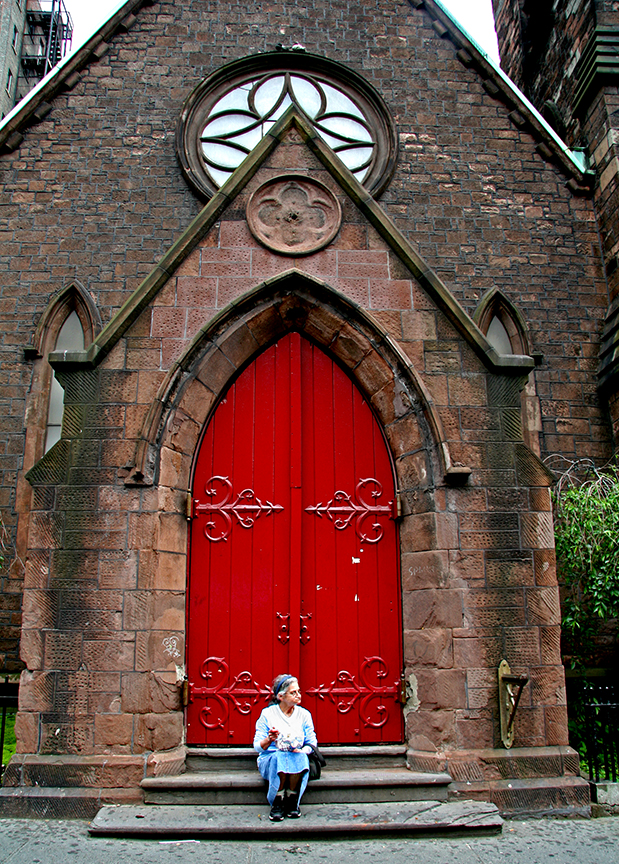
    Gothic meets drugs, sex, and rock and roll. Not such an unusual mix, actually. It’s just that we generally don’t think Gothic church. This place has actually been a neighborhood problem and has had a sordid history. It has been a nightclub since 1983, when it opened as The Limelight, owned by Peter Gatien and designed by Ari Bahat. Gatien owned a number of Limelight nightclubs (read about it here).
    The space benefits, of course, from the incredible architecture – huge rooms, soaring ceilings, stained glass windows, and a labyrinth of chambers.

    In 1996, club attendee Michael Alig was arrested and later convicted for the killing and dismemberment of Angel Melendez, a drug dealer based at The Limelight (read about it here). Opened and closed in the 1990s for drug trafficking, it was reincarnated in 2003 as the club Avalon.

    The brownstone structure, at 47 W. 20th Street and 6th Avenue, was built in 1846 as the Church of the Holy Communion for an Episcopalian congregation. It was designed by renowned architect Richard Upjohn, cofounder and first president of the AIA (American Institute of Architects). Upjohn, a British immigrant, was most well known for his Gothic revival churches. Trinity Church is one of his best-known works.
    This church building was saved in the 1960s when it became designated as a landmark. It was subsequently sold and used as a drug rehabilitation center.

    It’s not the idea of a church being converted to a den of debauchery that is so disappointing. It’s the state of decay that graces the exterior. I thought the lone figure of an older woman eating her lunch on the steps of the church was an appropriate statement.

    Its such a shame for an important historic structure to deteriorate this way. But then again, a rock and roll club can’t be expected to be a model for decorum…

    Posted on by Brian Dubé

  • Good Fortune

    Posted on by Brian Dubé

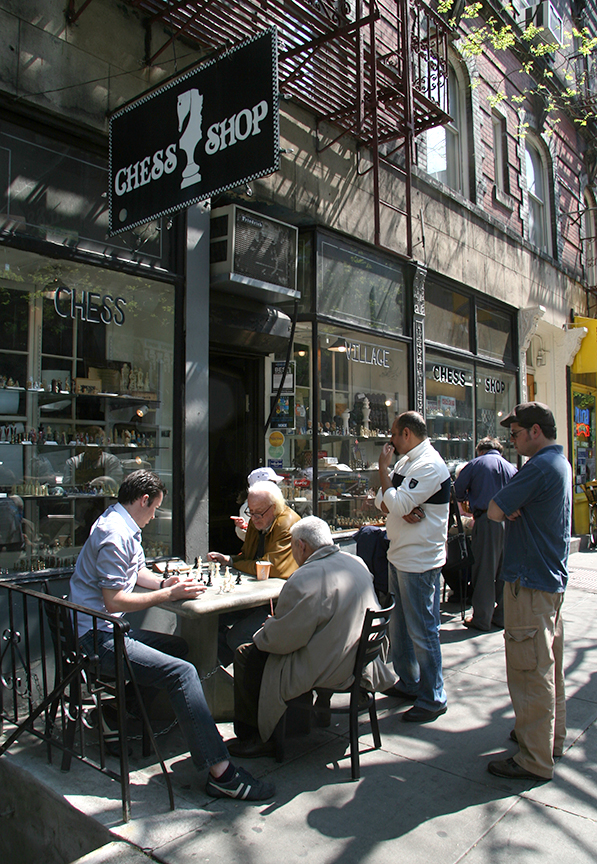
    What a fortuitous occasion. I have waited 2 years for the right day for shooting this chess shop. Chess is special to me – I played on a chess team in high school and spent many Sundays over the years watching masters and grandmasters playing in Washington Square Park – chess legend Bobby Fisher himself was a habitue at one time. I have posted previously on the Marshall Chess Club.

    When I took this photo, I had no idea that one of the players was the original owner, George Frohlinde (the white-haired player in the photo). When I went inside to discuss my intentions for this blog, I coincidentally met and spoke with the new owner, Lawrence Nash, Frohlinde’s nephew.
    We spoke of real estate and the precarious position a place like this is in. And, he confided, this place may not be around much longer.

    I have done many stories which I consider part of a an “end of an era” series. Unfortunately, the Village Chess Shop may be added to the fatality list some time in the not-so-distant future. I found Lawrence extremely likable and sensible. We both agreed that the problem is market forces as a result of the tremendous improvement and desirability of NYC, not, as is frequently alleged, any overt conspiracy by landlords. Most landlords do ask for market rents which do force many tenants out, but some landlords, as is the case in the Chess Shop, do give preferential rents to long-term tenants. But it is still very challenging for a small niche business like this to survive, even with undermarket rent.

    The Chess Shop was opened in 1972 by George Frohlinde. In the 1960s, he ran a shop owned by International Grandmaster Nicholas Rossolimo. At the time, there were a number of chess shops in this area. Sometimes referred to as the “Chess District”, only two shops remain: the Chess Shop at 230 Thompson Street and a new competitor across the street, the Chess Forum, opened in 1995 by one of Frohlinde’s employees, Imad Khachchan. The Chess Shop is opened 365 days from 11AM to midnight and provides a place for playing at a nominal hourly fee. They also are known for their selection of a myriad of unique-themed chess sets, many of which can be seen in their windows – eyestoppers for most passersby. See them and learn more about the shop at their website. I suggest you visit soon…

    Posted on by Brian Dubé

  • Sunshine Makes You Happy

    Here is where New York really shines: the arts, particularly ones that need brick and mortar establishments, like live music, opera, theater, art, and indie or art films. Art house films on the big screen are things you can’t squeeze down the internet pike. And you need a big audience to support a place like Sunshine Cinema.

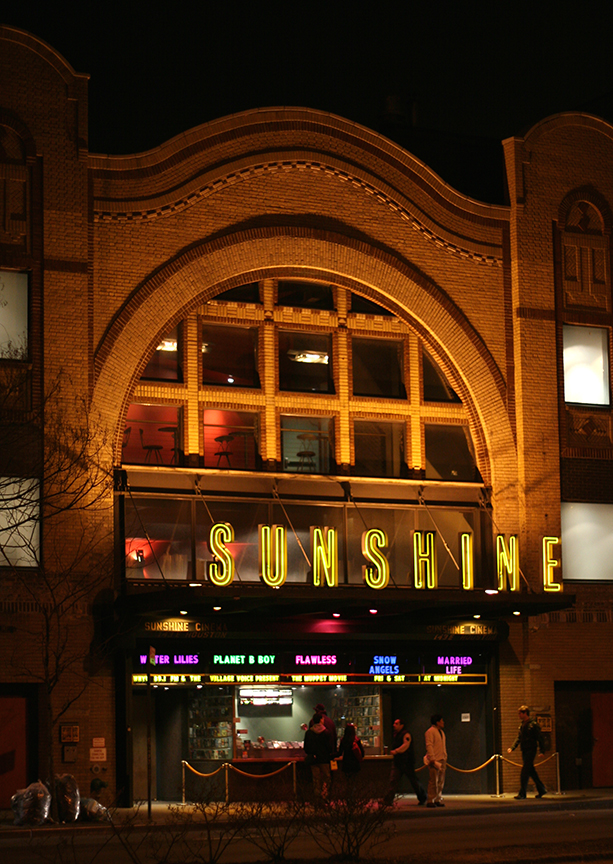
    Located in the now fashionable Lower East Side at 145 East Houston Street, Sunshine is one of a handful of premiere houses featuring art films, along with Angelika, Quad Cinema, Film Forum, IFC, Village East, and Lincoln Plaza.

    Rather than rewrite history, here it is from Landmark Theatre’s website:

    “Built in 1898, the Sunshine Cinema building was formerly the Houston Hippodrome motion picture theatre and a Yiddish vaudeville house but for over 50 years it had been shuttered serving as a hardware warehouse. Landmark has restored the theatre back to its artistic roots and now offers the art-house film lover five brand new state-of-the-art screens dedicated to first-run independent and foreign film as well as non-traditional studio programming. The Sunshine Cinema has exceptional presentation and amenities including stadium seating, Dolby Digital Surround EX sound and gourmet concessions. The theatre also offers attractions such as a Japanese rock garden and a viewing bridge that offers breathtaking city views from the third story spectacular glass annex. The restoration was a team effort—floor plans by TK Architects and interior design by architects Tony Pleskow and Tom Rael of Pleskow + Rael.”

    I have been to Sunshine and can heartily recommend it. It is also in an interesting neighborhood with plenty of things to do. You can’t miss it – with its beautiful facade, especially when lit at night, it’s like a beacon letting you know that if you like film, Sunshine will make you happy…


  • Key Privileges

    Posted on by Brian Dubé

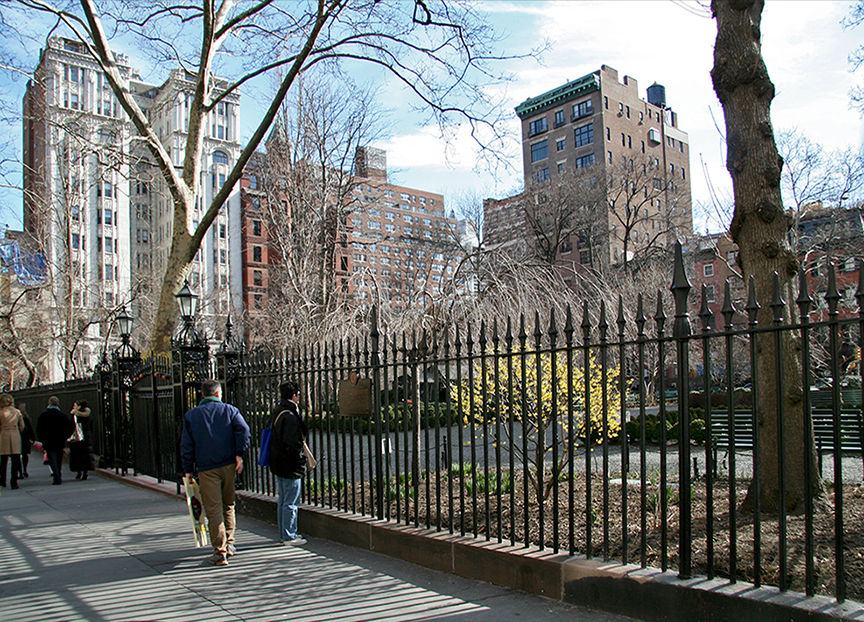
    Unless you stay at the Gramercy Park Hotel or are extremely well-connected, this is as close as you will get to enjoying Gramercy Park, from this side of the fence. Well-known to city residents, Gramercy Park is the only private park in the city. To gain access, one must have a key – these are available only to residents in the buildings surrounding the square, who own the park in common. Although NYC has its share of money and exclusivity, private outdoor space is an anomaly in the city, and the park’s privacy comes as a surprise to many.

    Originally, this park was swampland. The name Gramercy is from the Dutch ”krom moerasje,”for ”little crooked knife.” In 1831, Samuel Bulkley Ruggles bought and drained the land and divided into 108 lots. The park occupied 42 of the lots, and homes were built on the remaining 66 (these are the buildings which have keys to the park.) This area was located unfashionably north at the time, so Ruggles built a private park to attract residents and buy properties.

    The square is surrounded with magnificent row houses and prewar buildings. The immediate area is rather quiet, with only a few business establishments such as O’Henrys. The neighborhood, known as Gramercy, is surrounded by tree-lined streets. Not far away, however, is the bustling Union Square, as well as the Village to the south.

    But I do not pine for access, and neither should you. There are many extraordinary parks in the city – Central Park, Prospect Park, Washington Square Park (under construction), Union Square, the Conservatory Garden, Brooklyn and N.Y. Botanic Gardens, Van Cortlandt, Riverside, Carl Schurz, City Hall, et. al. These urban oases dot the city, and the privilege of entry requires no key…

    Posted on by Brian Dubé

  • Holdout and Holdup

    Posted on by Brian Dubé

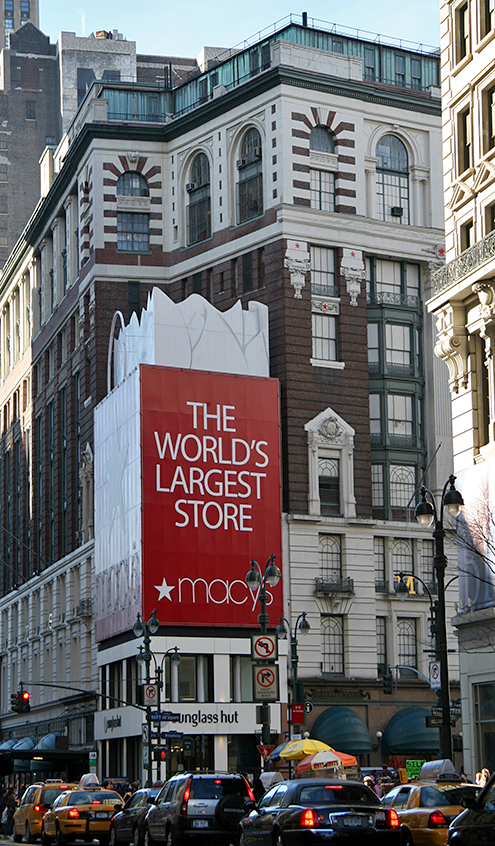
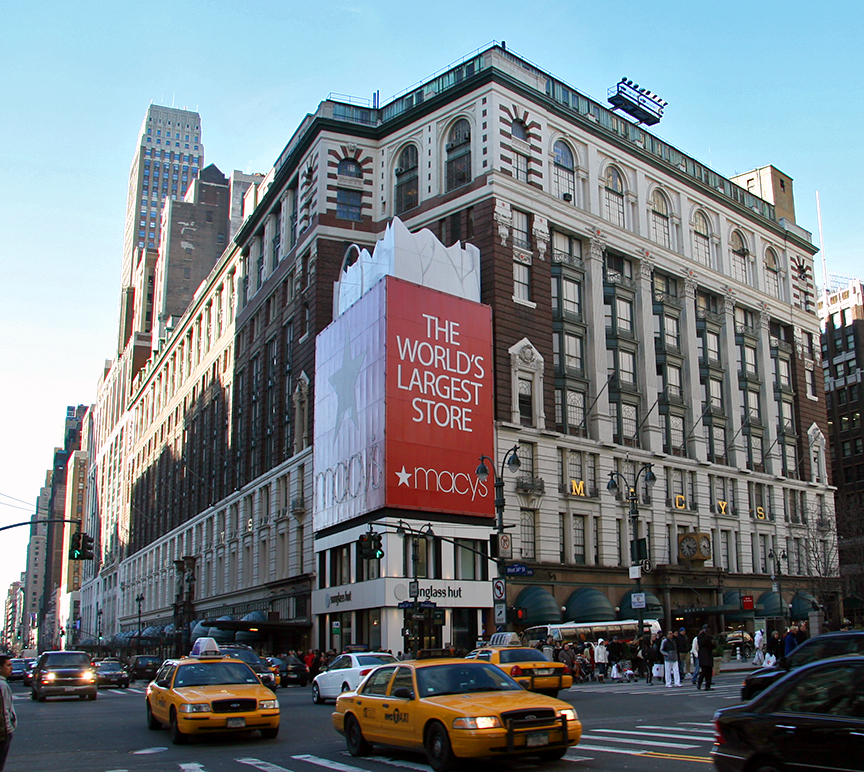
    The story of the notch in Macy’s has been told before, but to find it, you need to know that there is a story to be told. Most pass by this intersection at Herald Square, one of the busiest in the city, never suspecting that the enormous sign proclaiming Macy’s to be the World’s Largest Store is the subject of a small drama. See a photo of the entire block here.

    The strange tale is about the quintessential Holdout – in real estate parlance, someone unwilling to sell a key property standing in the way of development. ‘Tis the dream of many that through pure happenstance and good fortune, one has an apartment or property which is crucial to a large project and holds out for an enormous sum of money, securing one’s financial status ever after.

    In the late 1890s, Macy’s decided to expand from its 14th Street location to 34th Street. It secretly began buying property there, but word leaked out. Robert Smith snatched the property for $375,000. Escalating from holdout to holdup, the hope was to use this property to negotiate with Macy’s and get occupancy of their 14th Street location (and some of the Macy’s original customers).

    However, Macy’s did not take the bait. It built around the building and continued to hold the 14th Street property vacant until the end of the lease.

    They opened at Herald Square in 1902. The following year, the corner building was torn down and replaced with a new 5-story structure – the one you see here today (it was first leased to the United Cigar Store Company for $40,000 a year).

    Much later, after 1945, Macy’s started to rent advertising space, covering the entire building. Although there have been opportunities to buy the property, to this date, Macy’s has not. They continue to rent advertising space for the 70-foot sign. Sadly, many of the retailers at this corner building have been tacky, unattractive establishments. Currently there is a Sunglass Hut – a step up in appearance.

    So if you dream of holdouts and holdups, keep in mind, they may only be pipe dreams…

    Posted on by Brian Dubé

  • Hurry

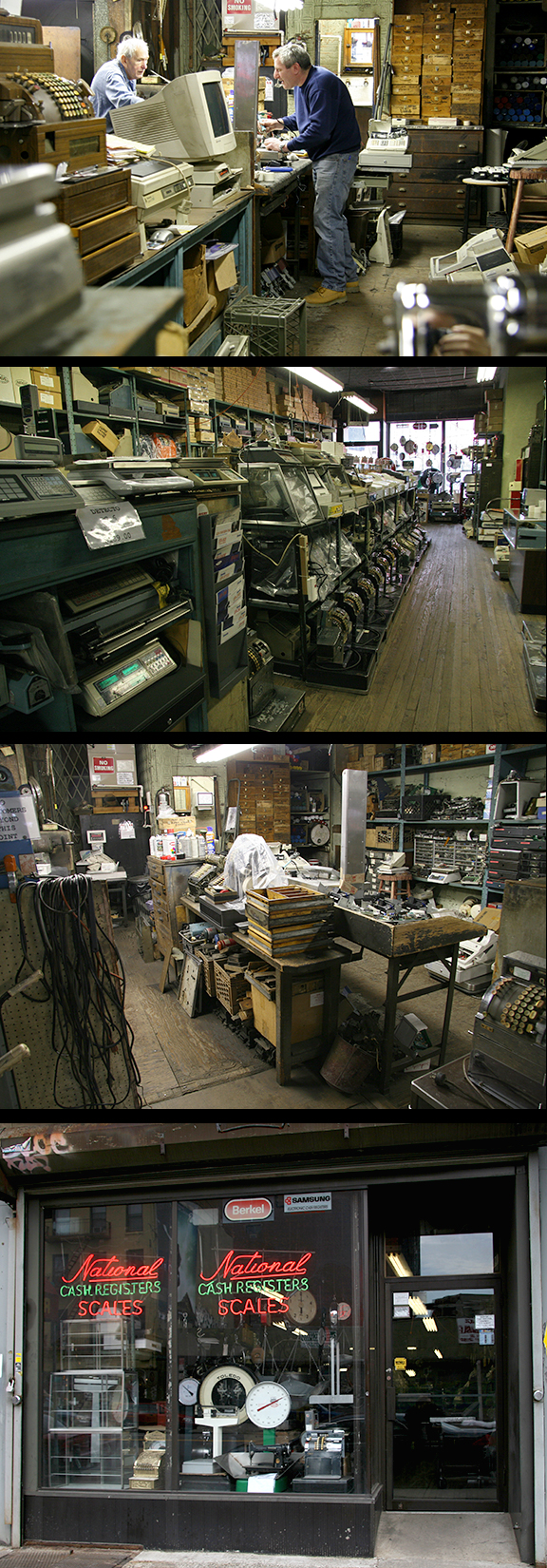
    I have done business with places like this for decades. They were always just places. Get in, get out. Get your business done. Maybe a friendly chat. Nothing much to admire. Could really use a little sprucing up, actually.
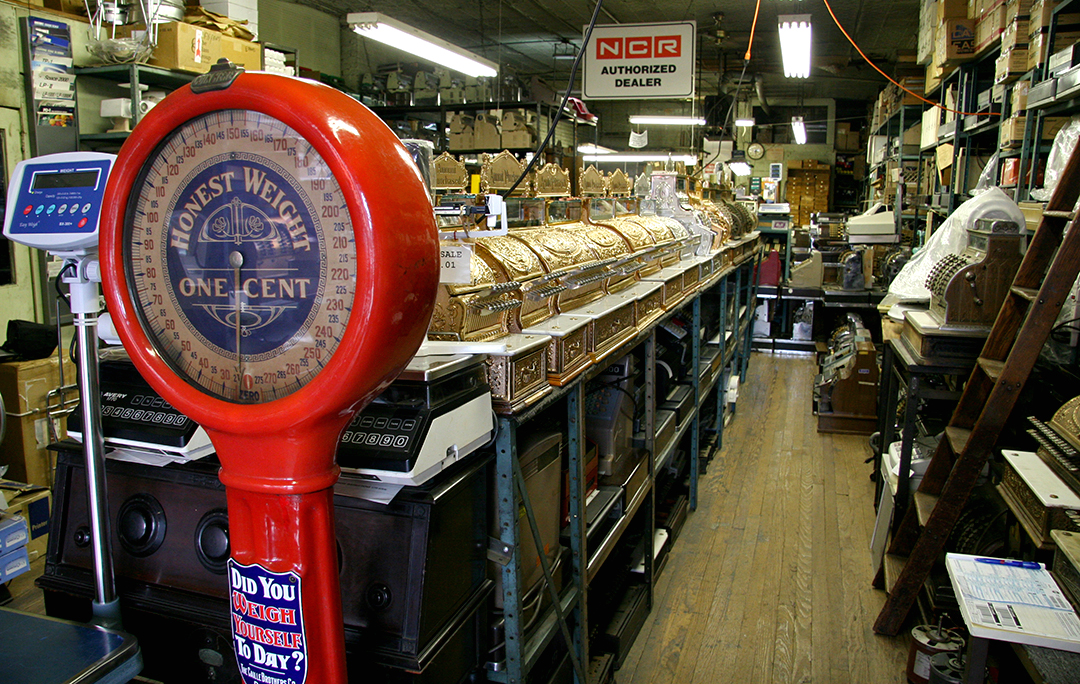
    Times have changed. Now I realize that this really is the end of an era – right here at 159 Bowery. Real, living history. You don’t have to read about it or travel to Europe. You can walk in now and meet Brian and his father tinkering in the back. Two generations of a three-generation business started in 1910 by Brian’s grandfather. More photos here.

    Faerman’s offers good, knowledgeable service, New York Style. What does that mean? Well, it means we’re busy, perhaps a little harried (we’re not overstaffed with incompetents), and we need to get to the point quickly. Like a surgeon in ER. Competent, quick. Cut to the chase. No graduates from charm school here. No frills or slick corporate beatitudes like “How may I serve you today?” which, unfortunately, is typically code for “I can only recite this line and not really do much to help you.”

    When you go to a place like Faerman Cash Register, you are dealing with the quintessential New York family-run business. People who know what the hell they are doing and talking about. The same people answer the phone. No layers between you and tech. A place that’s real. And I love the humanity of it all – I miss that.
    Of course, you can get all manner of scales and cash registers, both new, used, and antique at Faerman. But I imagine you’re not reading this for scale- and cash register-buying recommendations 🙂

    Am I over romanticizing? Not at all. Go see for yourself. Tell Brian I sent you. Don’t overstay your visit – they’ve got work to do. And hurry, because I can really feel history slipping right between my fingers and it’s a little sad…

    Footnote: In the time I have started this website, I have already seen some disappearing acts. CBGB was just down the street from Faerman and is now closed. Space Surplus Metals is out of business.
    Related: See my stories on Economy Candy and Eileen’s Cheesecake.


  • dinamic_sidebar 4 none

©2026 New York Daily Photo Entries (RSS) and Comments (RSS)  Raindrops Theme