• Category Archives NYC’s History
  • Sheridan

    Posted on by Brian Dubé

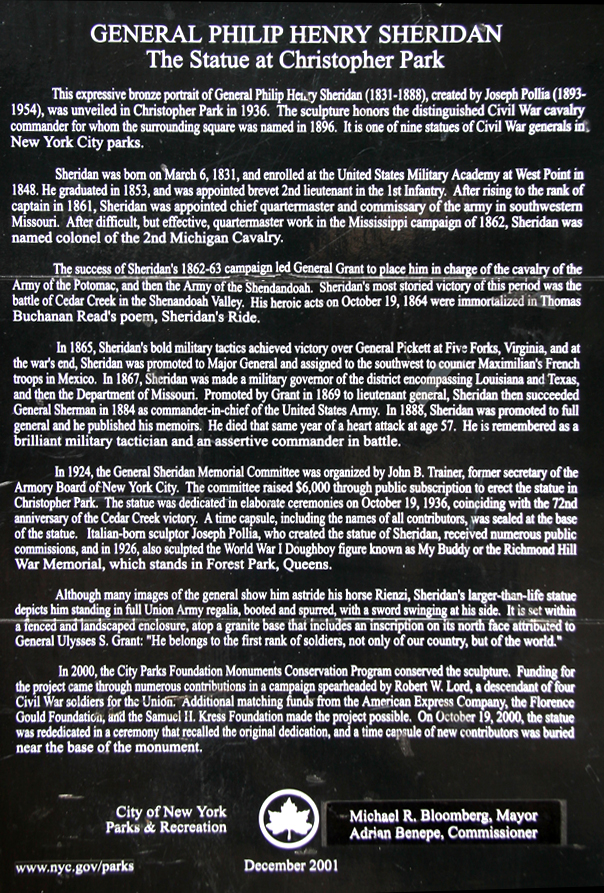
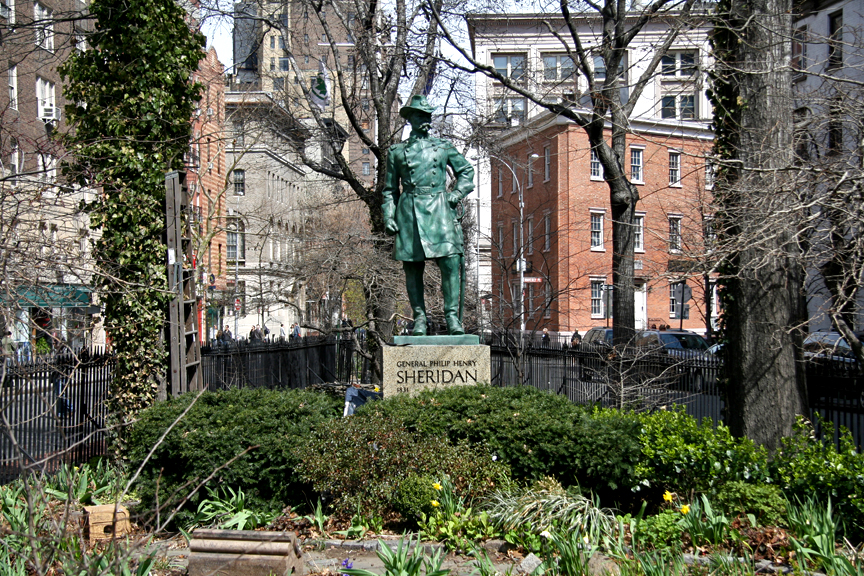
    I am not a Civil War or military buff, but I have been going by this statue of General Philip Henry Sheridan (1831-1888) and the park it is in for decades, and I should really know more about him. This man, who rose from near obscurity to the highest rank in the military (Major General) very quickly, is a controversial figure, especially when viewed from our own time. A Civil War cavalry commander, Sheridan graduated from West Point and went on to a myriad of military achievements – Cedar Creek in Shenandoah, Appomattox, etc.

    In my readings for this post this morning, I found it very interesting to compare writings about him with information on the plaque in the park (click here). A quote from General Ulysses S. Grant appears on the pedestal: “He belongs to the first rank of soldiers, not only of our country, but of the world.” Grant ranked him with Napoleon and Frederick the Great. The plaque describes him as a “brilliant military tactician.”

    However, he has also been described as a brutal, violent, and very prejudiced man. After the Civil War, Sheridan became commander of the Army of the West and led the campaign against the Indians of the Great Plains, seen by some as near-genocidal and thereby tainting Sheridan’s reputation. The pejorative “The only good Indian is a dead Indian” is a common variant on a quote attributed to Sheridan during his encounter with Comanche Chief Tosawi during the Indian Wars in 1869. “Me Toch-a-way, me good Indian.” Sheridan reportedly smirked and replied, “The only good Indians I ever saw were dead.” The bronze statue was created by Italian Sculptor Joseph Pollia in 1936.

    Note: This statue is actually in Christopher Park, often mistaken for Sheridan Square, which is around the corner, previously a traffic island which was converted into a beautiful viewing garden in 1982. It is interesting to note that Sheridan was only 5 feet 5 inches tall. Abraham Lincoln once described him as “a brown, chunky little chap, with a long body, short legs, not enough neck to hang him, and such long arms that if his ankles itch he can scratch them without stooping.”
    Posted on by Brian Dubé

  • The Question Mark

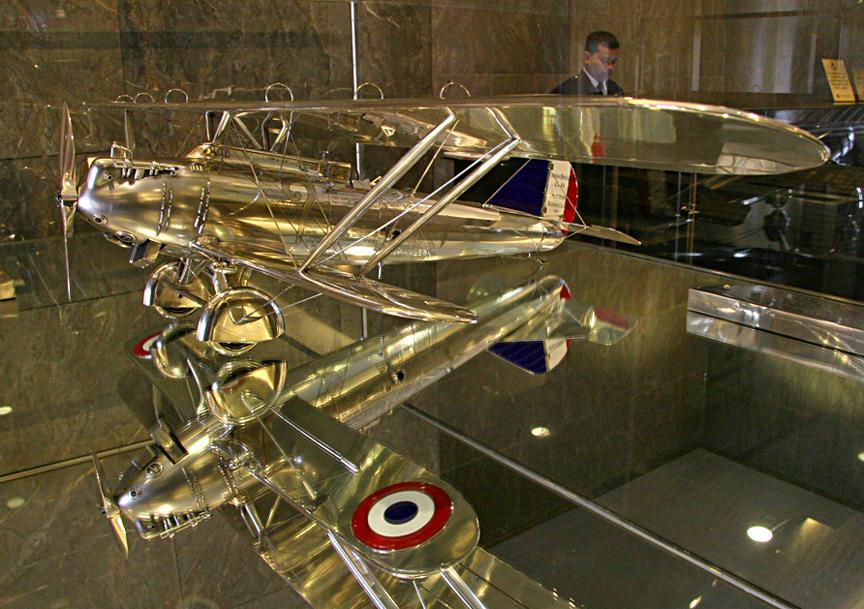
    If you enter the lobby of the French Building at Rockefeller Center from the side entrance (off the central channel gardens), you will find a showcase with a reproduction of a plane in sterling silver made by Cartier. There is a plaque with an inscription which reads:

    REPRODUCTION IN STERLING SILVER OF THE
    “QUESTION MARK”
    WHICH MADE THE FIRST NON-STOP FLIGHT FROM PARIS TO NEW YORK
    IN SEPTEMBER 1930, PILOTED BY THE FRENCH AVIATORS
    COSTES AND BELLONTE
    THIS GOOD-WILL FLIGHT WAS THE RETURN VISIT OF
    LINDBERGH’S HISTORIC FLIGHT TO PARIS IN 1927
    THIS REPRODUCTION, WHICH IS SCIENTIFICALLY CORRECT IN
    EVERY DETAIL, IS THE GIFT OF THE FRENCH GOVERNMENT TO
    ROCKEFELLER CENTER FOR LA MAISON FRANCAISE
    PRESENTED ON NOVEMBER 8, 1933
    BY THE FRENCH AMBASSADOR TO THE UNITED STATES.
    HIS EXCELLENCY MONSIEUR ANDRÉ LEFEVRE DE LABOULAYE
    EXECUTED BY CARTIER


    The plane was a variant of the Breguet 19, a Super Bidon single-engine biplane, which was built specifically for transatlantic flight. On September 1-2, 1930, Capt. Dieudonne Costes and Lt. Maurice Bellonte flew from Paris to New York City (3,852 miles) in 37 hours and 18 minutes, the first non-stop westbound fixed wing aircraft flight between Europe and America. The conclusion of a message to American president Herbert Hoover from French President Gaston Doumergue read, “…in forming one more tie between France and the United States, will contribute greatly to the development of their friendship of centuries.” I guess those were better times as far as American/French relations…


  • Secret Society

    I am fascinated by the places that are prominently located yet rarely mentioned. The plaque at 77 MacDougal Street says Tiro A Segno, New York Rifle Club. This address is just south of one of the most touristy, trafficked blocks in the city – the Figaro Cafe and Bleecker Street are within eyeshot. This very exclusive, members-only club occupies three entire brownstone row houses. 3 flags hang in front – one American, one Italian, and one brandishing Tiro A Segno, which literally means “shoot the target” (Tiros date back to eighth century Italy’s bow-and-arrow groups).

    This is the oldest private Italian-American club in the U.S., founded in 1888 and in this location since 1924. And private is the operative word. You won’t find much about this place – I had to really dig for this one. Visit their website and you will get the idea. Prospective members must be nominated by a current member, and there is a quota on non-Italians. Members have included former mayor Fiorello LaGuardia, Enrico Caruso, and Garibaldi. What goes on in there? Wine, fine dining (dining hall seats 110), conversation, and rifle shooting in the basement gallery with three wood-paneled ranges and a choice of targets. And charitable work is done, e.g., in 2000, the Tiro a Segno foundation donated $500,000 to establish the Visiting Faculty Fellowship in Italian-American Culture at NYU. Apparently any vestiges of former members like convicted politicians Biaggi and Esposito are long gone…


  • Grand Central

    Posted on by Brian Dubé

    This is the place whose very name is synonymous with busyness and crowdedness – I grew up outside of the city yet always heard that popular refrain about a place being like “Grand Central Station.” Not an inappropriate reference, since Grand Central is the world’s largest train station.

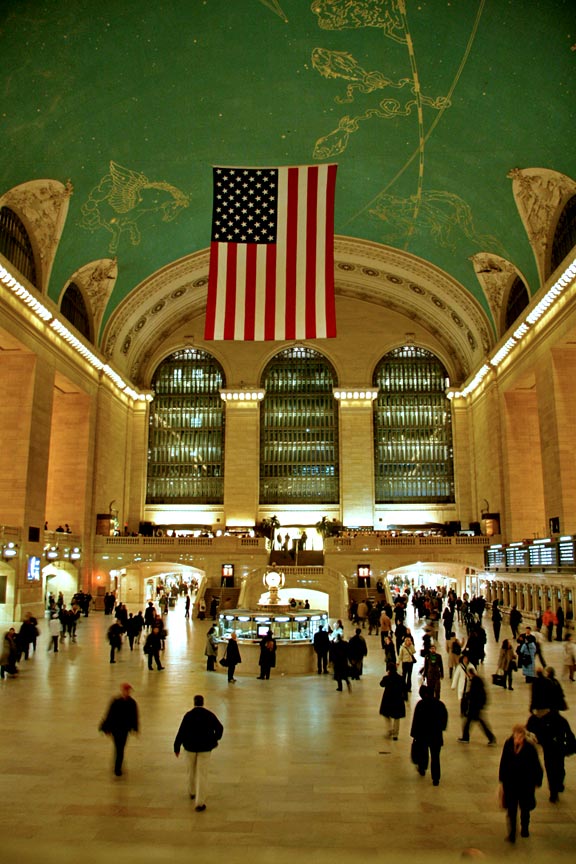
    Officially Grand Central Terminal, the site has seen three different incarnations of the station, going back to Grand Central Depot in 1871. Amazingly, Grand Central was actually under real threat of various demolition proposals by Penn Central – a decade-long legal fight, with efforts of many including Jacqueline Kennedy Onassis and a United States Supreme Court ruling, succeeded in preservation. In 1976, Grand Central was designated as a National Historic Landmark. In 1998, the terminal completed a restoration, including the renowned ceiling mural with its constellations and beautiful cerulean sky, originally painted by Frenchman Paul Helleu. The large American flag was hung after 9/11. These are in the main concourse as seen in the photo.

    This is much too large a topic to do any justice to in a daily photo blog, so I would recommend various sites for more reading. Click here for the official site, which gives not only a complete history but also provides links for food (restaurants and menus), shops, tours, and events. Here are three previous posts I have done on the terminal: the exterior sculpture, the iconic clock, and the Oyster Bar

    Posted on by Brian Dubé

  • Passing Time

    Posted on by Brian Dubé

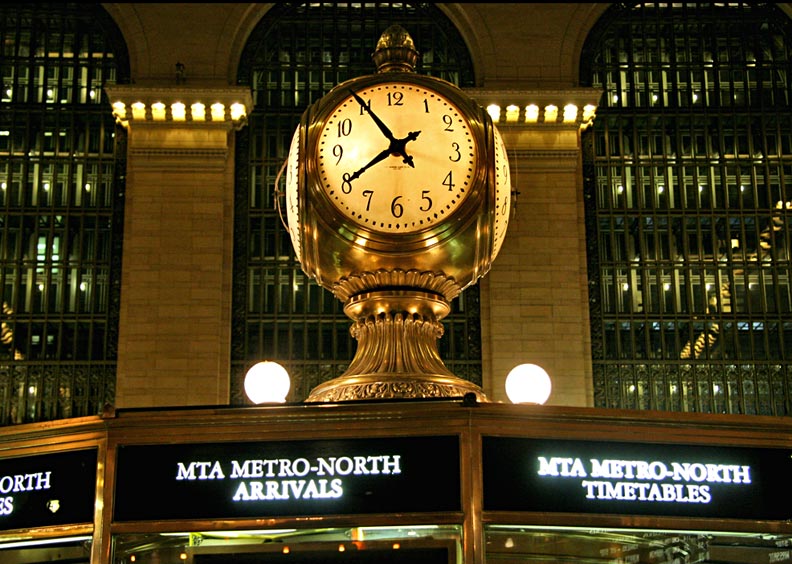
    This is probably the most well-known clock in the U.S. – the ball clock above the information booth at Grand Central Station. Many have used it not only to tell time – its most important function – but it has also served as a meeting place for travelers for nearly a century. The four faces of the brass ball clock are solid opal – Sotheby’s and Christie’s have valued it at between $10-$20 million. It was built in 1913 by the Self Winding Clock Company, a firm started by Charles Pratt (oil tycoon and founder of Pratt Institute) and engineer Henry Chester Pond in a Pratt-owned building at 205 Willoughby Street in Brooklyn, New York (later moved to Varick Street in Manhattan).

    From 1886 to 1957, the company built 50,000 clocks. These clocks were self-powered by dry cell batteries and automatic spring winding and synchronization. When properly maintained, they were highly accurate. Their clocks were used everywhere around the world: the Metropolitan Tower clock, the House of Representatives, battleships, NYC and London subways, railroads, airlines, the Strategic Air Command, stock exchanges, hospitals, schools, hotels, universities, department stores, and broadcasting systems. Over time, however, maintaining accuracy of all these historic clocks was a problem, so recently, all of the more than 55 clocks have been synchronized to a continuous satellite signal sent from an atomic clock at the U.S. Naval Observatory. The clocks are now accurate to within two microseconds. Everything is controlled by the terminal’s master clock, located behind locked doors near Track 117 on the lower level…

    Posted on by Brian Dubé

  • Lighthouse Legends

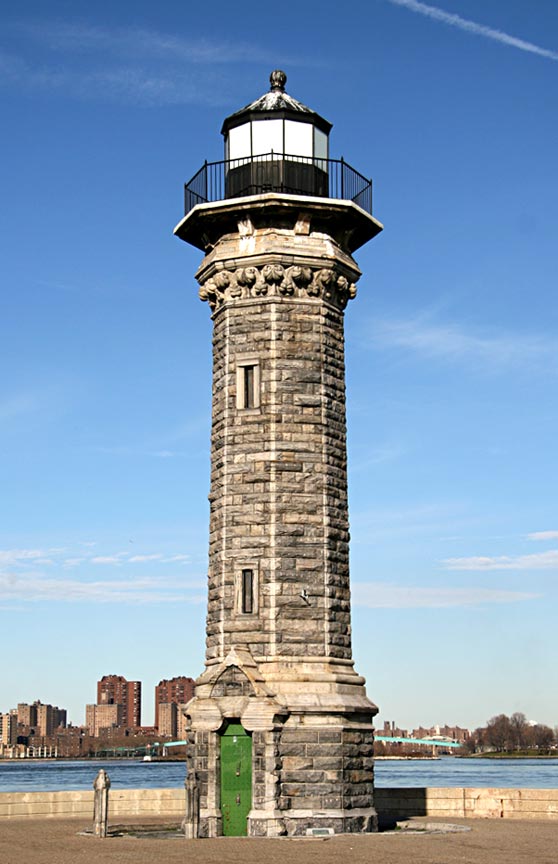
    The Lighthouse on Roosevelt Island is one of the island’s best known landmarks – it is readily visible from Manhattan and Queens. This 50-foot-tall structure built of gray gneiss was designed in 1872 by James Renwick Jr., one of the most successful architects of his time – he designed the Smallpox Hospital on the island as well as many major New York City buildings, such as St. Patrick’s Cathedral and the New York Public Library.

    The Lighthouse, which is not an official Coast Guard lighthouse, is steeped in legend. Lore has it that the lighthouse (likely built by inmates from the neighboring prison) replaced a small clay fort made by a patient from the lunatic asylum who feared a British invasion. The legends and mysteries involve the names John McCarthy and Thomas Maxey (a plaque crediting McCarthy for the building of the lighthouse disappeared in the 1960s.) Read the story here from the Roosevelt Island Historical Society website.

    The Lighthouse sits in Lighthouse Park, a serene spot to perhaps picnic or just enjoy the NYC vistas…


  • The Police Building

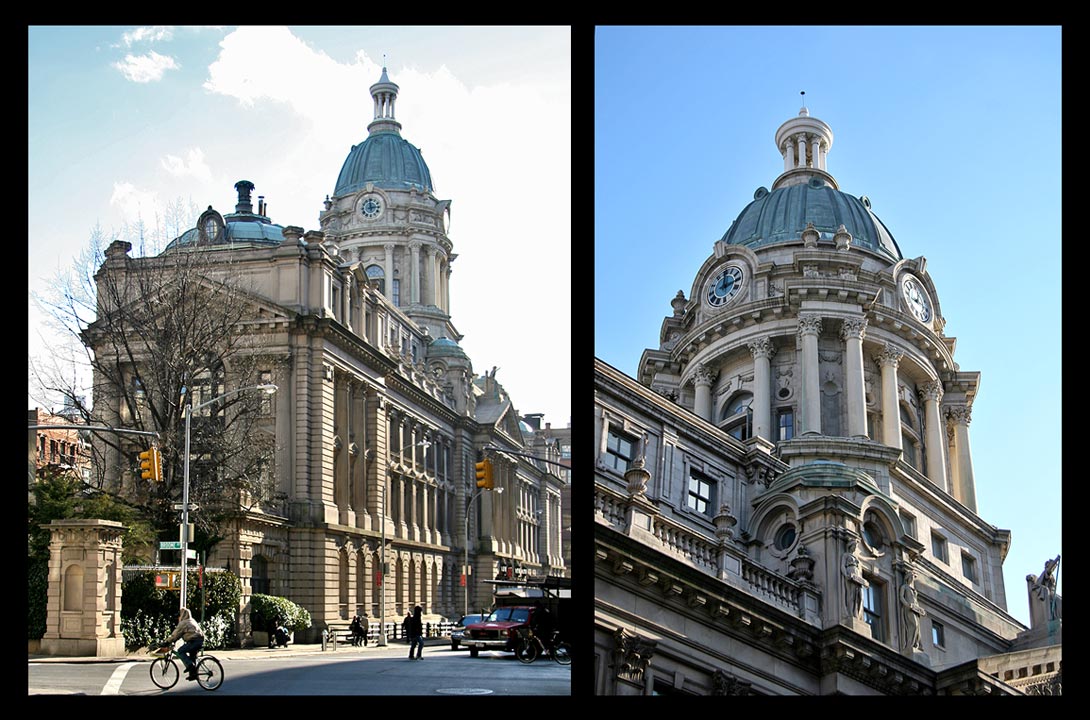
    The Police Building at 240 Centre Street: a “five-story Beaux-Arts palace, designed by the firm of Hoppin & Koen, is a dramatic heap of Baroque- and Renaissance-inspired domes, cupolas, colonnades, pilasters, and pediments, caked with carved ornament and wedged into the narrow block once occupied by the butcher stalls of Centre Market.” That’s a mouthful, but pretty accurate. This place is reminiscent of a Parisian Hotel de Ville, although I think the comment I saw during the sales of units there that it’s something like “finding the Invalides in the middle of the Marais” is a bit of a stretch – this area of Little Italy/upper Chinatown is nothing like the Marais.

    The way this palatial building is tightly integrated into the streets does make it rather startling. The 1909 building was vacated by the police department in 1973. In 1987, it was converted to 56 luxury condominiums. The spaces were newly created – the original interior layout was not suited to residential conversion. Four apartments occupy the central dome (the former radio room, commissioner’s office, and a gymnasium), including a triplex. Steffi Graf owned a tower apartment, which was sold to Calvin Klein in 1998. This is one of the grandest residences in the city, on par with the Dakota. A very unique living experience, I am sure…


  • Pepsi-Cola in Neon

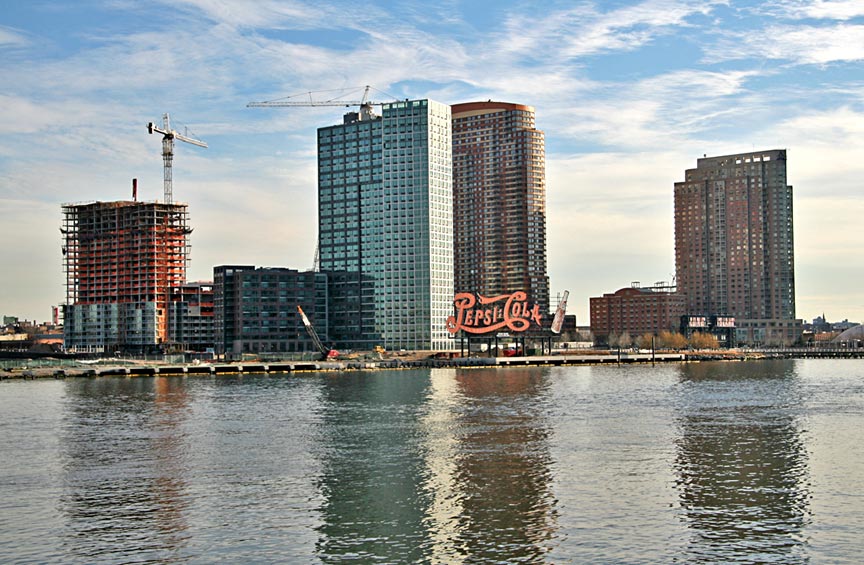
    This red neon Pepsi-Cola sign is a major player in NYC’s landscape and a familiar sight to any who travel the east side of Manhattan, such as on the FDR drive. The sign is located on the Queens waterfront in Hunters Point – the site of PepsiCo’s former bottling plant (which was moved in 1999).

    The multi-tube red sign, visible by day or illuminated at night, has been there for over 70 years. It was built in 1936 and rebuilt in 1994 by Artkraft Signs (now the Artkraft-Strauss Sign Co.), the oldest and last-surviving subsidiary of the original Claude Neon Co., headed by Frenchman George Claude, who held the patent for neon. In 2003, the Rockrose Development Corporation purchased the land for a $1 billion residential and commercial project. Click here for photo. The 120-foot Pepsi Cola sign was preserved – it was dismantled and re-erected 300 feet south to its current permanent location. It is nice to see that the value of a historic icon like this is appreciated and preserved by a real estate development company…


  • The Bitter End

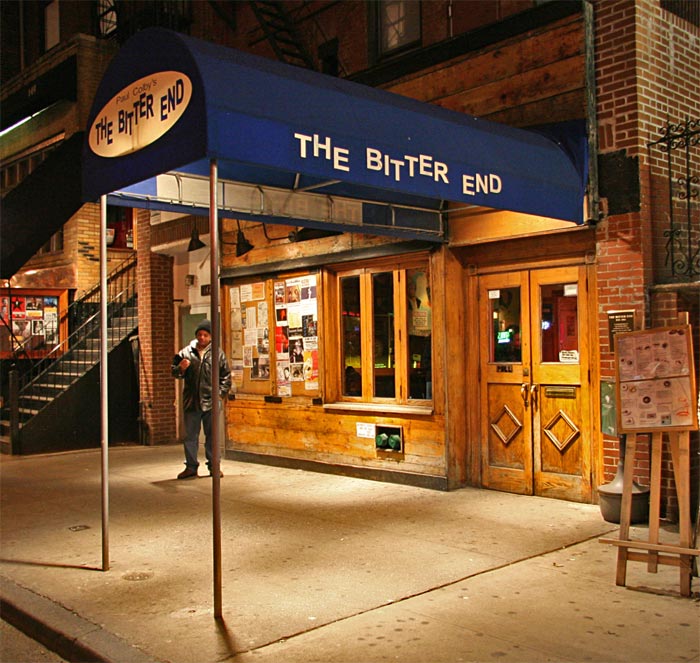
    This is the Bitter End at 147 Bleecker Street, one of the classic heavyweights in NYC music clubs. With the demise of many legendary clubs (CBGB, The Bottom Line, Village Gate), only a handful of older clubs remain, and this is one of them. It is now the oldest rock club in New York, established in 1961 by Fred Weintraub. The current owner, Paul Colby, has been involved with the club since 1968.

    The club is located on a strip of Bleecker Street with a number of music clubs: The Back Fence, Kenny’s Castaways, Terra Blues, and The Red Lion. At the Bitter End’s website, you can see a partial list of the roster of people who have played there (e.g. Bob Dylan, Billy Joel, Neil Young, The Indigo Girls, Joan Baez, Van Morrison, Joni Mitchell, Odetta, Bill Cosby, Woody Allen, George Carlin) – click here for a history. Typically several groups perform each night – last night I caught Girls Don’t Cry.

    Small clubs which showcase new talent are absolutely critical for the music world, so for patrons and musicians alike, the closing of clubs is often seen as a benchmark of the negative impact of over-gentrification, and the survival of older (and newer) clubs is fiercely defended…


  • Smallpox Hospital

    These are the ruins of the Smallpox Hospital on Roosevelt Island (Blackwell’s Island at the time), designed by James Renwick, Jr. and completed in 1856. Click here for more photos. The building is faced with gray gneiss, quarried on the island and built using prison labor from the neighboring penitentiary at the time. Smallpox was deadly and highly contagious – at the time, 25% of those afflicted died, and survivors were frequently left blind or pockmarked. Although vaccination was common in the 19th century, many were fearful of the procedure. Prior to building of the hospital, cases were treated in shacks on the bank of the river. Unfortunately, the new hospital became mired in scandals – spoiled food, patients not cleaned were spreading disease throughout the city, building in disrepair, workers (some convicts) extorted money from patients, etc.

    In 1875, after a new hospital was built on North Brothers Island, this building became a home for nurses and a training hospital. In 1904-05, North and South wings were added. By the 1950s, it was abandoned and has been vacant since. Read more about it here. In 1975, it was granted landmark status. As it sits behind a chainlink fence, its current state is still being debated, but there is hope that it will preserved and accessible for visitation…


  • Signs of Life

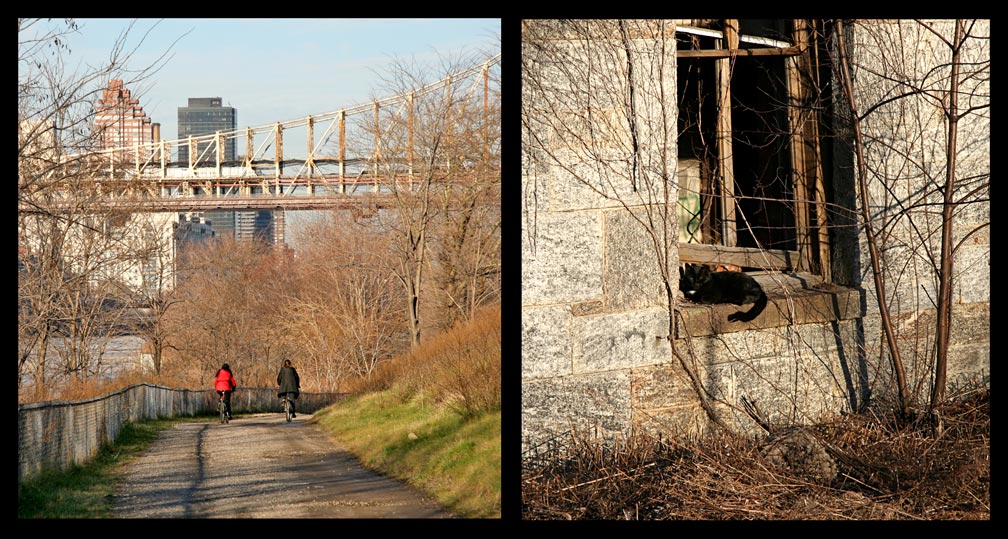
    These two images are from the south end of Roosevelt Island (the cat is sitting in the window of the infamous Smallpox Hospital, an abandoned Gothic ruin.) Technically part of Manhattan, Roosevelt Island is a two-mile strip of land in the East River with access by aerial Tram, subway, and auto (by bridge from Queens). Formerly called Blackwell’s Island and then Welfare Island, this place was home to many asylums, hospitals, and prisons. In the 1960s, a plan by Philip Johnson and John Burgee envisioned a pedestrian community, but the original plan never came to be.

    There is a variety of housing: subsidized and unsubsidized housing for low, middle, and moderate-income tenants. Luxury rentals and condominiums also exist. Hybrid electric buses provide transportation on the island; waste is collected by an underground Automated Vacuum Collection System (the only one servicing a residential complex in the U.S.). There was initially a lot of enthusiasm over the island’s development as a modern utopia. However, the population originally envisioned was never realized, and thus, there is a dearth of services on the island. One supermarket, one deli, one restaurant.

    For the visitor, there are a few spots worth a visit – the biggest draw are the vistas of the city. But I am sure that many residents like the quiet atmosphere – our black cat appears quite content…


  • Beekman Place

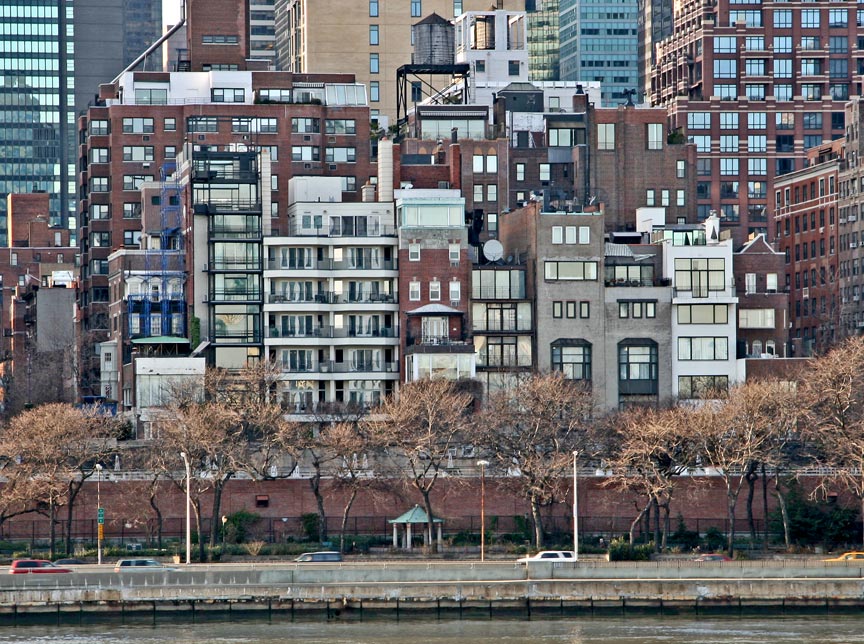
    This is Beekman Place as seen from the East River. From this vantage point, we see the backs of the row of houses of those lucky souls who have river views. This small enclave is an urban oasis – a two-block long street tucked in between 49th and 50th Street and east of 1st Avenue. The area is less well-known (particularly to outsiders) than its neighbor, Sutton Place, two blocks north.

    The Beekman name is one of NYC’s oldest – William Beekman came to America on the same ship as Peter Stuyvesant in 1647. James Beekman built a mansion here, Mount Pleasant, in 1764 (it was used as British headquarters during the Revolutionary War). Nathan Hale was hanged here as a spy in 1776. It was demolished in 1874 as the city’s grid plan encroached. By the end of the 19th century, the area had become a slum, with industry at the river’s edge.

    In the 1920s, the neighborhood started to turn around, eventually to become one of the most sought after addresses of the wealthy. The roster of current and former residents reads like a small Who’s Who, with names such as Rockefeller, Vanderbilt, Ethel Barrymore, and Irving Berlin. Note the building second from the left (in the row of nine) – it is the former home of architect Paul Rudolph (read about him here and here)…


  • Vintage Mural

    What started as a whimsical photo suggested by a friend as we were walking yesterday in Union Square turned out today to be a fascinating trip into the Crown Coat Front Company and the world of fading vintage murals. Most New Yorkers have noticed these signs all their lives here and find them to be remarkable surviving antiques providing a window into New York City’s rich history. Rampant construction covers some and uncovers others. And as I investigated this company (expecting nothing), I was surprised to find a few tidbits.

    Crown Coat was located at 105 E. 16 St. from 1947 to 1958. I also learned that a coat front is a “trade term for a built-up stiffening or shape-retaining interlining for the fronts of coats, made of stitched layers of haircloth, felt, and canvas.” (George E. Linton (The Modern Textile and Apparel Dictionary – 1973). A search on the company will return quite a few court documents – Crown Coat was involved in a 1967 Supreme Court case involving canteen covers supplied to the government in 1956. The most superb find of the day is Frank H. Jump’s website on his Fading Ad Campaign – a photographic project documenting vintage mural ads on building brickfaces in New York City spanning nearly a century. Click here to read his personal story and the background on the artist and this project


  • John Jovino Gun Shop

    Even the most seasoned NYC residents are frequently surprised to learn that there is a retail gun shop in Manhattan. The John Jovino Gun Shop, at 183 Grand Street in Little Italy, is the city’s oldest, established in 1911 (their sign claims to be the oldest in the U.S.A.). Click here for more photos.

    At one time, there were more gun shops in this neighborhood, owing to the proximity of the Police Building at 240 Centre Street (now a residential condo but police headquarters before 1973). The old Frank Lava Gunsmith & Firearms Shop at 6 Centre Market Place, around the corner from Jovino’s current location, was established in 1850 and sported the large hanging gun motif, which John Jovino later adopted. Click here for vintage photo and article.

    The shop is owned by Anthony Imperato, who also owns the Henry Repeating Arms factory in Brooklyn. The existence of a rifle factory in NYC surprised me even more. The clientele for the shop is primarily law enforcement, but it is open to anyone with the proper permits. Articles I have read report that there has been a steady rise in gun sales since 9/11, so I guess the future of this shop looks good…


  • Charles Scribner

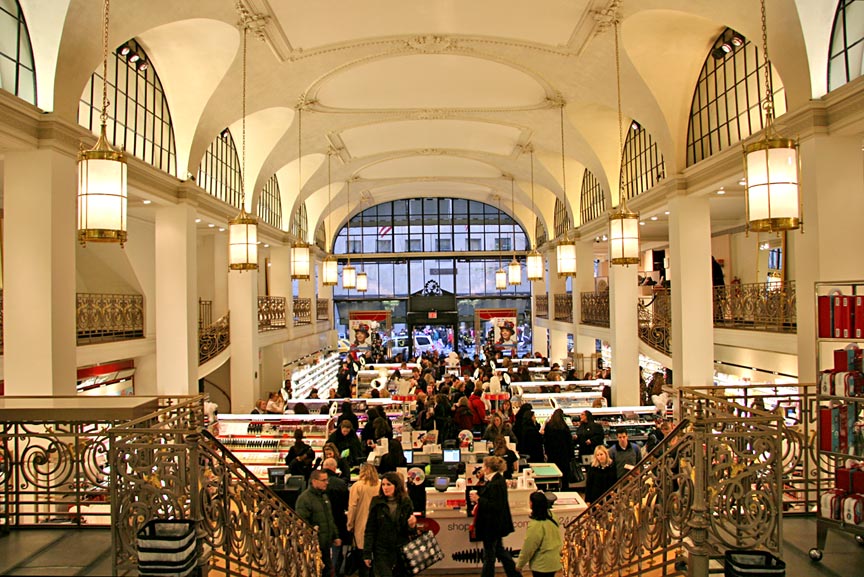
    This Beaux Arts masterpiece and designated NYC Landmark at 597 Fifth Avenue was designed in 1912 by renowned American architect Ernest Flagg. It is a 10-story, French-inspired building with a limestone and ironwork facade. Click here for more photos. Flagg, who was married to Scribner’s sister, received this design job as one of his first major commissions from Charles Scribner, who owned the publishing house Charles Scribner’s & Sons. At the time of the building of the 5th Avenue structure, Scribner had reached the summit of publishing with authors such as Edith Wharton, Henry James, Robert Louis Stevenson, Rudyard Kipling, Theodore Roosevelt, Thomas Wolfe, F. Scott Fitzgerald, and Ernest Hemingway. Scribner was friends with many of these authors and brought out many of their seminal works.

    The space was occupied from 1984-88 by Rizzoli, then by Brentanos Bookshop. In 1996, Benetton took over the space and opened its first U.S. flagship store, completely restoring the space to its former glory with renovations of spiral staircases, Caen stone finishes, glass brick flooring, Carrera marble grand staircase, skylight, etc. It is now occupied by Sephora. The interior vaulted space (with ceilings as high as 30 feet) was designed to feel like a small library. It’s really one of the grandest interior spaces in NYC. Many do miss the bookstore – it was such a grand space for a noble pursuit. I suggest a visit…


  • dinamic_sidebar 4 none

©2026 New York Daily Photo Entries (RSS) and Comments (RSS)  Raindrops Theme