• Category Archives Architecture
  • Rhinelander’s Dream

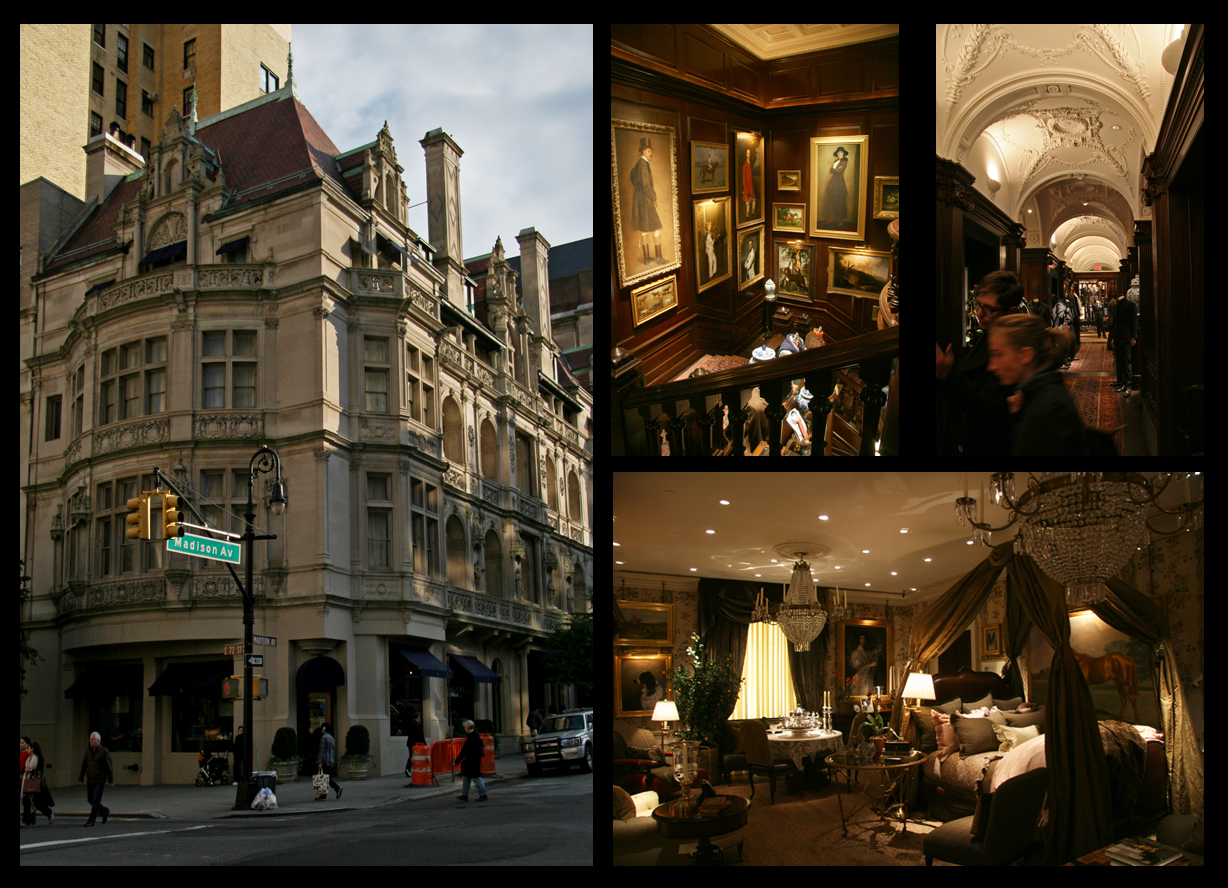
    This is easily the most exquisite and elegant retail interior space in New York City. It’s a must-see for any visitor with a little extra time. Located at 867 Madison Avenue on the southeast corner of 72nd Street, it has been occupied by Ralph Lauren/Polo since 1986.

    I was shocked to learn that this huge neo-French Renaissance limestone palace was actually unoccupied in the first 23 years of its existence. It was designed by Kimball & Thompson and built in 1898 for Gertrude Rhinelander Waldo, a wealthy socialite who dreamed of a French Loire Valley chateau. Rumored that she ran out of money before completion, the property was first occupied in 1921. Since that time, it has had various tenants: the auction house Christie’s of London, Zabar’s, the Olivetti Brothers, and photographers Edgar de Evia and his partner Robert Denning. De Evia’s mother, pianist Miirrha Alhambra, also resided there.

    By the mid-1950s, de Evia and Denning had formed Denvia Realty, which held the net lease on the entire building. The top three floors were used as their studios and residence; offices were rented to the interior decorators Tate and Hall, and street-level shops were rented to various merchants, including a corner pharmacy and Rhinelander Florists.

    It was purchased in the 1960s by a nearby church. In 1983, Ralph Lauren acquired the net lease. The building’s ownership has changed hands numerous times as well. TMW bought the building for $36 million in 1997, and in 2005, it was sold to an Irish investment group (Sloan Capital) for $80 million.
    The gothic tile-covered mansard roof is spectacular, with oriels, dormers, and chimneys.

    I know it is fashionable to bemoan the hegemony of large retailers on the American landscape, but one needs to give credit where it is due, and Ralph Lauren has done the Rhinelander mansion justice with a $14 million dollar renovation. Absolutely everything in the interior is just perfectly appointed. Even members of the sales staff are impeccably dressed and groomed – I actually mistook one for a haute couture mannequin.

    The interior is an architectural masterpiece complemented with superb interior design. Crackling fireplace, sculpted vaulted ceilings, a magnificent stairway graced with paintings, antiques, furniture upholstered in cashmere, Lalique paneling, Persian carpets, and Baccarat chandeliers. To enter this place is to really leave the city behind and enter another time and place and one woman’s dream…
  • The Plaza

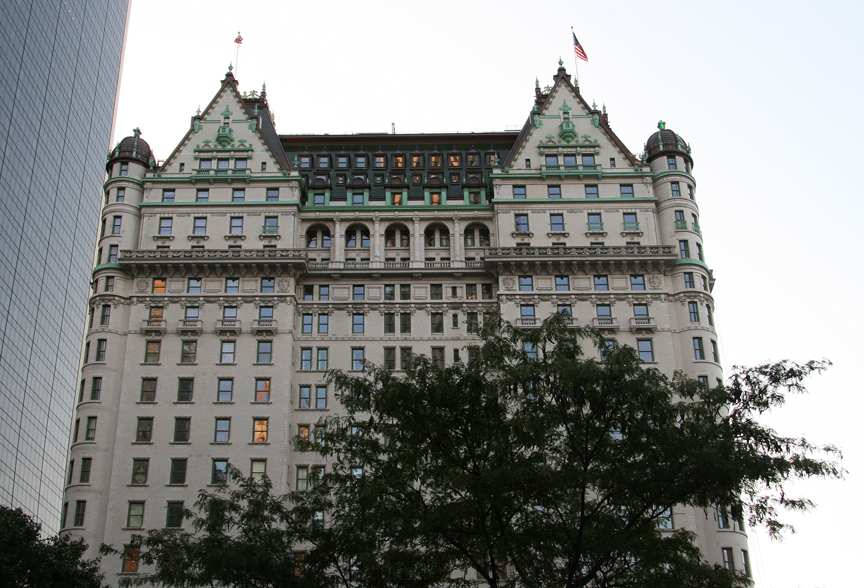
    A number of readers have inquired why I have not done a posting on the Plaza Hotel in the two and a half years I have done this site. It may come as a surprise to those who know this city, and it should – the Plaza is one of the most important landmarks in the entire city.

    So why I have I waited? The primary reason has been the ongoing construction with exterior scaffolding since 2005. This property has changed hands a number of times, briefly owned by Donald Trump (from 1988-1995). It was then purchased by the current owner, El Ad Properties, for $675 million. $400 million has been invested in renovations. All the rooms along Central Park are now residential condominiums. It has been designated a National Historic Landmark; the only other hotel with this status is the Waldorf Astoria.

    It is difficult to do this hotel justice and communicate the importance of this structure. Its stature is enormous, both physically and symbolically. The Plaza sits at the crossroads of two of the most important thoroughfares in New York City: Fifth Avenue and Central Park South.  Any property located on Central Park immediately gains importance and caché. The same is true for Fifth Avenue, particularly where it flanks Central Park from 59th Street to 110th Street.

    The current property is the second to be built on the site; the first was built in 1900, and the second was rebuilt in 1907, designed by Henry Hardenbergh in the style of a medieval French chateau. The name derives from Grand Army Plaza, the public space adjoining the front entrance of the hotel along Fifth Avenue. The plaza is the site of Pulitzer Fountain, Abundance, by Karl Bitter.

    At one time in the 1950s and 60s, half of the hotel rooms were occupied by residents living there full time, such as Frank Lloyd Wright and Marlene Dietrich. Many clebrities have graced its rooms: F. Scott Fitzgerald, Alfred Hitchcock, Truman Capote, the Vanderbilts, et al. The Beatles performed there on their first USA visit in 1964.

    One could name drop all day, and certainly there may be “better” hotels or rooms in the city, but for any New Yorker, one name says it all: the Plaza


  • Guilty Pleasures

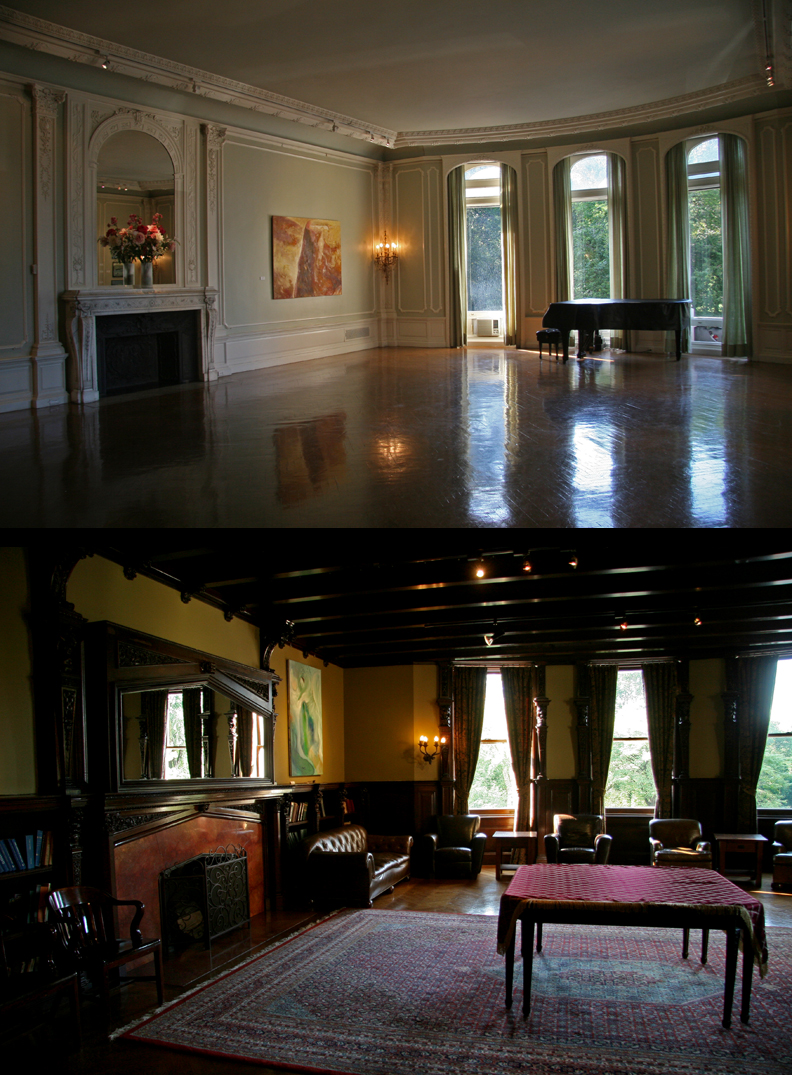
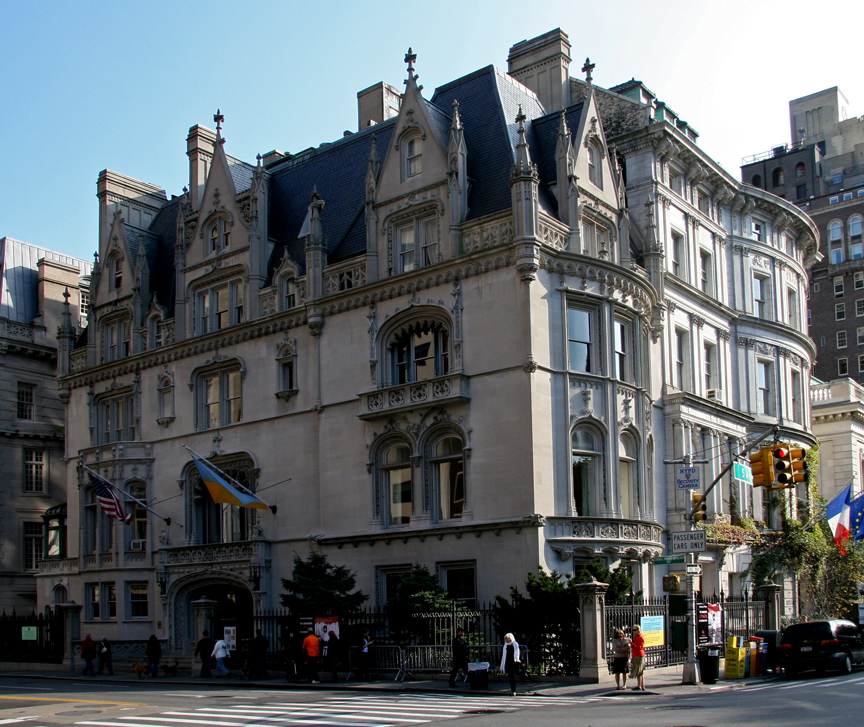
    This past weekend was the 6th annual Open House New York. I have been very enthusiastic about this event and have attended the past three years. This year, I decided to take a journey to the Ukrainian Institute, owing to its description as an “ornate, French Renaissance-style mansion, once owned by oil tycoon Harry F. Sinclair…” After all, who doesn’t like to visit a mansion? See photos of the interior here.

    The French Gothic house, known as the Fletcher-Sinclair mansion, was built in 1898 by Isaac D. Fletcher and designed by architect C. P. H. Gilbert. Read about it here in an article by Christopher Gray of the New York Times.

    At one time, there were a myriad of mansions in Manhattan. Those who find displays of opulence disturbing because they may have been built on the backs of others will perhaps find comfort that most of these were abandoned as private residences. I must confess that, for me, mansions are guilty pleasures.

    According to the aforementioned article by Christopher Gray:

    “‘Death and Taxes’ in Fortune magazine of July 1939 remarked that the Fifth Avenue mansions had become ”symbols not of power but of decay” — of the 72 private houses then left on Fifth Avenue, 33 were closed. The article reported that even a moderate-sized house required 10 servants at a yearly payroll of $14,000, with $4,000 alone in food for the staff. The bare minimum for keeping a house open was $30,000 a year.”

    These mansions have been converted to other uses, such as embassies, museums, institutions, and high-profile retailers. Whether one sees these uses as more socially acceptable is one issue; certainly it is nice that most of these can now be used and enjoyed by the populace.

    The Ukrainian Institute of America took over this property in 1955. Their function is to develop, sponsor, and promote through activities a greater awareness, understanding, knowledge, and appreciation in the United States of the art, literature, music, culture, history, and traditions of Ukraine.
    Their current usage of the mansion allows me to better enjoy a guilty pleasure 🙂

    Related Postings from previous Open House New York weekends: Masonic LodgeSecret Rooftop GardenTerrapin Chelsea Art Gallery, Stairwell, Cold Stone


  • Safety in Numbers

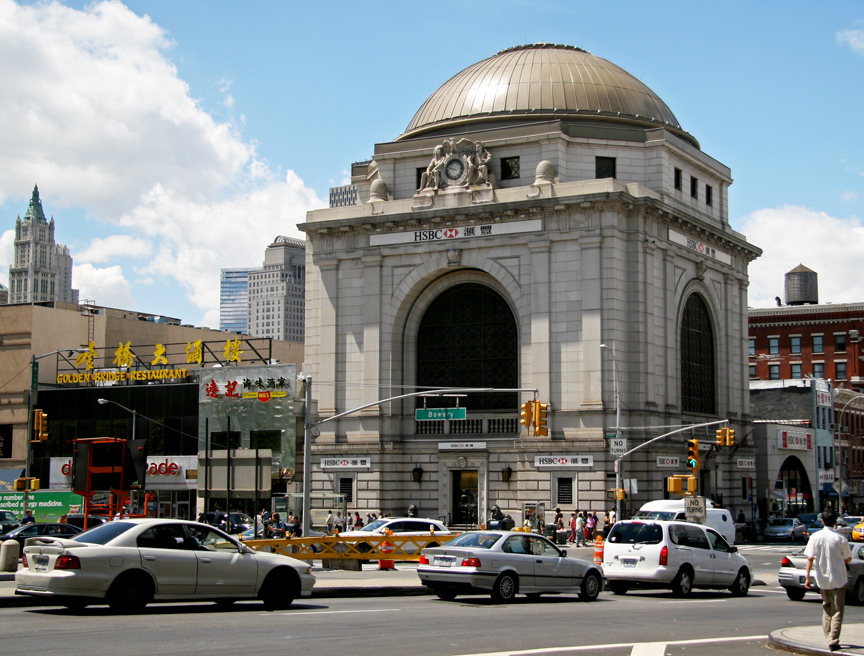
    There are 21,000 safe deposit boxes in this bank. Why so many? It’s in the heart of Chinatown, and the Chinese are savers – savers of cash. This bank, like others in the neighborhood (Commerce Bank, Bowery Savings, e.g.) all have had to accommodate the Chinese community’s tradition and customs, where boxes are used for storage of cash and other valuables. There is a large cash economy in Chinatown.

    The use of safe deposit boxes is an accommodation that requires space and building considerations. When the Chinatown branch of Commerce Bank was built (it opened in 2005), an entire floor was added for safe deposit boxes – 7,500, as opposed to 500, which would be typical in a Commerce Bank elsewhere. And the HSBC Bank at 11 East Broadway has 12,000 boxes.

    This landmark neo-Byzantine building at 58 Bowery was built in 1924 and designed by architect Clarence W. Brazer. Graced with an enormous bronze dome, this building is still very easily missed amid the hubbub that is Chinatown. And architecture does not particularly shine in this neighborhood and is typically the last thing an individual looks for when here. The best viewing is from some distance – see it from a vantage point across the Bowery towards the Manhattan Bridge.

    Many Chinese who bank in Chinatown no longer live there but continue to bank and use safe deposit boxes in the neighborhood. Familiarity, frequent visits for shopping, visiting relatives. Amid a banking crisis, old traditions of cash in mattresses and boxes are starting to look like a smart idea. Maybe there is safety in numbers…


  • Nostalgia

    Posted on by Brian Dubé

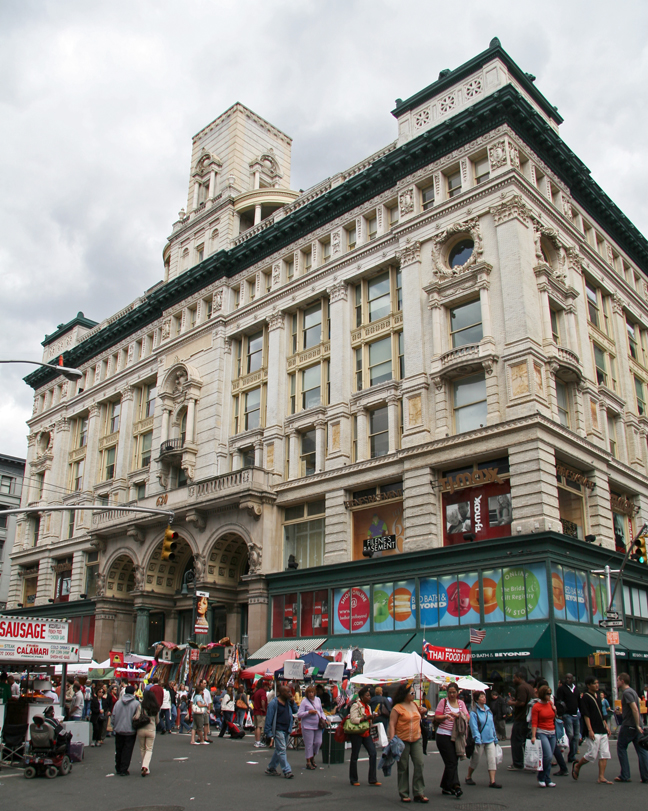
    One must be careful in making condemnations of contemporary culture and claims regarding the degradation of society and romanticizing the past. There is no dearth of criticism regarding the “malling” of New York City and the invasion of big box retailers into the NYC marketplace. And, certainly, many of the criticisms are valid.

    At first glance, when looking at this magnificent Beaux Arts building at 632 Avenue of the Americas, my first reaction was how inappropriate it was that this building would house Bed, Bath and Beyond, Filene’s Basement, and TJ Maxx.

    A little research will reveal that this stretch of 6th Avenue (from 18th to 23 Street), replete with enormous architecturally wonderful buildings, was once known as the Ladies’ Mile and that the beautiful structures lining this avenue were originally built as department stores.

    The most opulent was the Siegel-Cooper, originally designed by DeLemos & Cordes and built in 1896 as a discount department store for Siegel, Cooper & Co., who were based in Chicago. The New York store became a mecca for shoppers.

    There was a fountain in the center of the lobby, which became a meeting place in New York. Jets of water cascaded over multicolored lights onto a marble and brass statue of The Republic.

    So the large stores on the former Ladies” Mile should can be seen more as a reincarnation than invasion. I am reminded of various interpretations on nostalgia which I have heard – that the past always seems better than the present because we only remember the good parts…

    Posted on by Brian Dubé

  • Promises

    Posted on by Brian Dubé

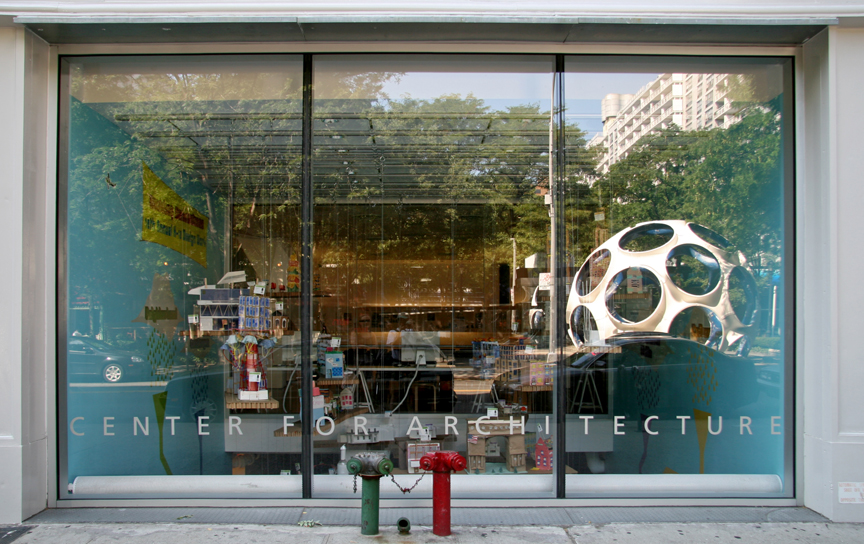
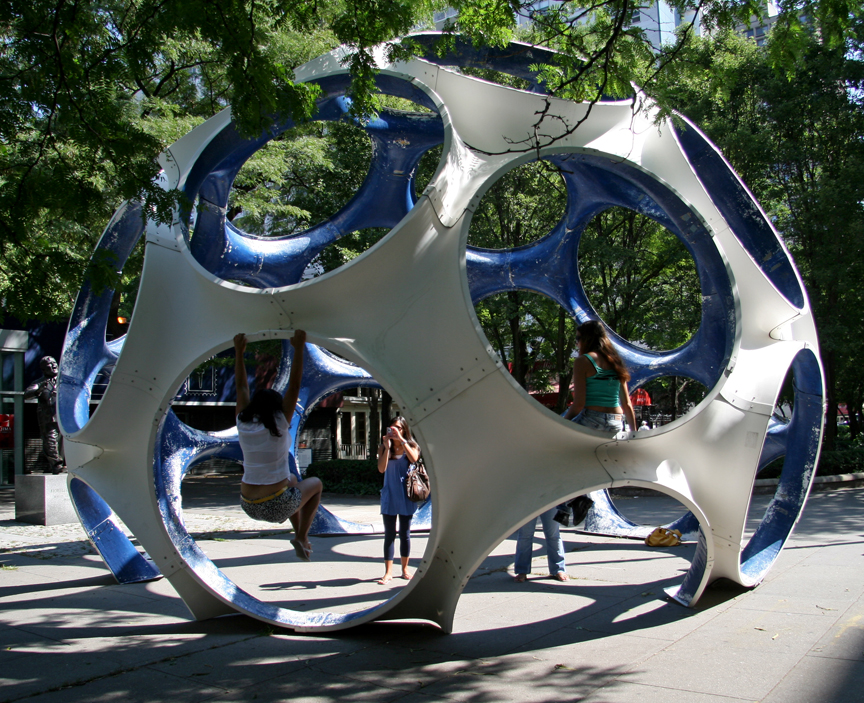
    The 1960s held promises, many which did not live up to expectations, such as drug-induced insights, free love, and geodesic domes. Domes captured the imagination of the youth at the time, as did most things that broke with tradition. In the case of geodesics, the break was visually very obvious. Built from a network of triangles, the resultant structure was aesthetically pleasing. Many were the advantages and benefits. And many were the disadvantages and problems, largely unspoken of at the time but obvious to those who made a commitment to this type of structure for a home.

    Geodesic domes were popularized by R. Buckminster Fuller. They were promoted for their efficiency, strength, stability, light weight, and ability to be built quickly. There was hope that the geodesic dome would become a housing solution. But many problems surfaced – curved rooms with attendant difficulty in design and furniture placement, many seams prone to leaking, higher window costs, triangular panels resulting in more material waste, etc. Their success has now been primarily in its adoption for specialized commercial applications, such as pavilions, auditoriums, weather observatories, and storage facilities.

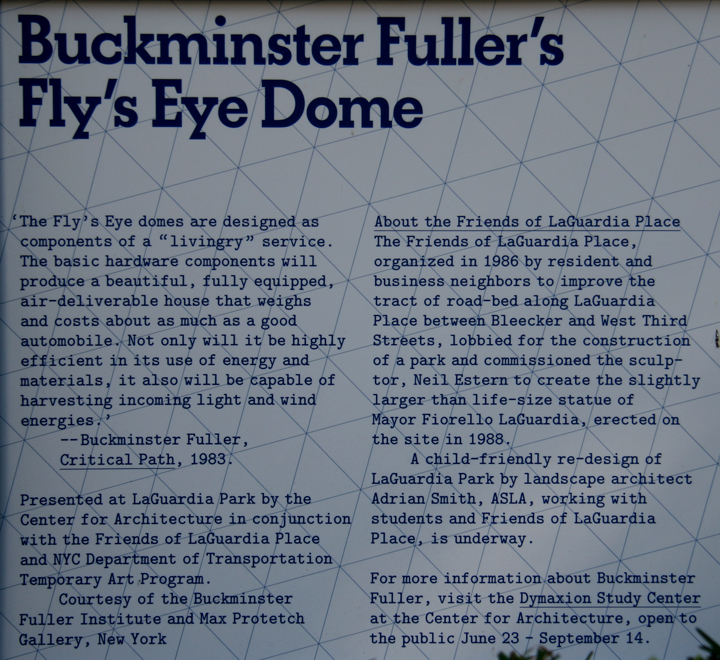
    The one in the photo that can be seen in the window reflection is Fuller’s Fly’s Eye Dome, which has been erected in LaGuardia Park across from the AIA center. Read about the sign here.  See here for photo of dome with a few visitors climbing the structure.

    The window is that of the Center for Architecture, the New York chapter of the American Institute of Architects. Buckminster Fuller and his work is an enormous subject. Read about him here. There is also more information about Fuller at the Dymaxion Study Center at the AIA Center at 536 LaGuardia Place from 6/23/08-9/14/08.

    Posted on by Brian Dubé

  • Cooperation

    Posted on by Brian Dubé

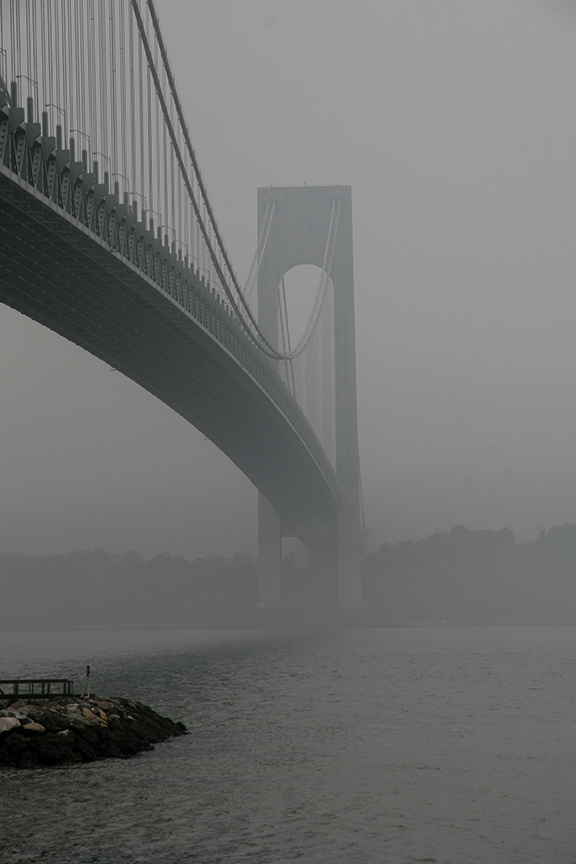
    What an easy and enjoyable thing photography can be when the subject cooperates. I have been planning to do a posting on the Verrazano Bridge for some time, but this requires a special trip and is quite some distance from my home in Manhattan. And one must find a good vantage point, negotiating around the Belt Parkway (a major highway with some limited parking) and the many other thoroughfares: 4th Avenue, Shore Road, Route 278 to the bridge, and a cloverleaf of highway ramps.

    However, I could not have picked a better day. A heavy fog had settled in, just occluding the more distant tower. See here for a series of photos.

    The Verrazano-Narrows Bridge is a relatively modern bridge, only completed in 1964. I have always found its lines rather clean and elegant. The bridge is omnipresent in the NYC skyline and is visible from every borough of the city. It connects Brooklyn and Staten Island. Although controversial during its construction, it is a lifeline, providing a roadway not only to Staten Island but also a connection between New Jersey, Brooklyn, and Long Island.

    At the time of its construction, it was the longest suspension bridge in the world (4,260 feet (1,298 m) and held that position until 1981. It still remains the longest suspension bridge in the United States. You can read more about it here.

    Every opportunity and subject element presented itself – a cargo ship, sailboats, fishermen, jellyfish in tidal pools, rocky outcroppings, a cruise ship, and, of course, fog. Everything just working together in a paradigm of cooperation…

    Posted on by Brian Dubé

  • Belvedere Castle

    Posted on by Brian Dubé

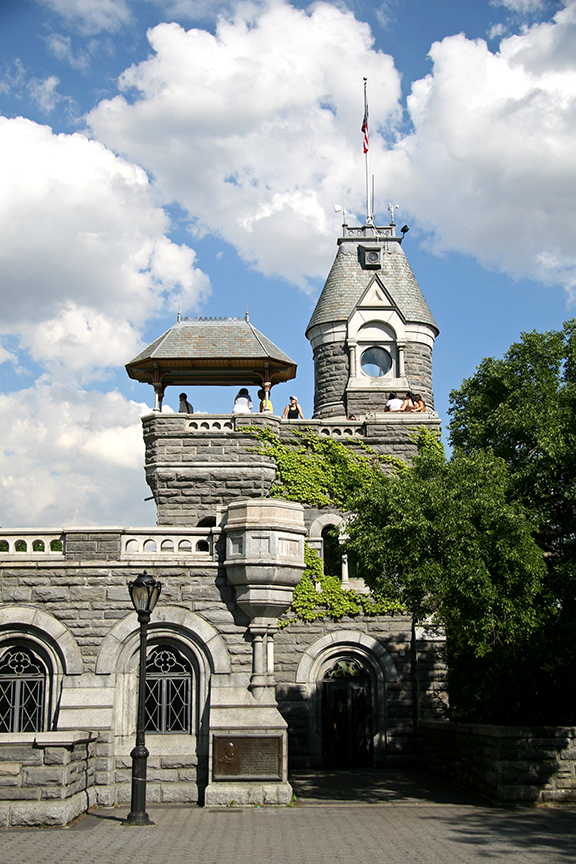
    Yes, we do have castles too, albeit small ones. This is not one of the most well-known or often visited spots in the city, but given good weather, I would put Central Park and Belvedere Castle on a must-do list. The castle, built from Manhattan schist, is in a secluded area near the Ramble. Two narrow staircases each bring you to an observatory level. There are excellent vistas, greenery, the Shakespeare Garden, the Duck Pond, and the Great Lawn. For those of you interested in the Castle’s history and purpose, read this description from the official Central Park website:

    In 1867, Central Park designer and architect Calvert Vaux (1824-1895) created an observation tower atop Vista Rock to overlook the old reservoir that is now the Great Lawn. The Gothic-style Castle was designed as a landmark for the pedestrian park visitor. The castle’s United States flag could be seen from the Mall, drawing the walkers down to Bethesda Terrace, over Bow Bridge, and through the Ramble to the castle itself.
    The original plans for the building included another elaborate two-story structure on the site of today’s pavilion, but financial concerns halted construction and left the castle in its present state. Portions of the castle are made from the same type of schist as the Vista Rock, creating the illusion of a castle rising out of the park itself. Its light colored stone trim is made of granite quarried from Quincy, Massachusetts. Its roofs are made of colored slate from Vermont, Virginia, and New York.
    Belvedere Castle was once an open-air structure, with no doors or windows. This changed in 1919 when the United States Weather Bureau moved the Central Park Observatory to the castle. Until that time, weather measurements were taken from the Arsenal at Fifth Avenue and 64th Street where Dr. Daniel Draper founded a meteorological observatory in 1869. The Weather Bureau took over the operation in 1911, and moved it here eight years later, enclosing the castle and altering the turret’s shape to accommodate their scientific instruments.
    In the early 1960s, the Weather Bureau replaced the lab with automated instruments and closed the castle offices. The empty building was left to deteriorate until 1983, when the Central Park Conservancy replaced the original turret, rebuilt the pavilions, and converted the castle into a visitor’s center. The Henry Luce Nature Observatory in the castle, created in 1996, provides interactive nature exhibits inside the castle as well as bird-watching kits, which can be used throughout the park.

    Note: Belvedere is an architectural term from the Italian “beautiful view”, referring to any architectural structure sited to take advantage of such a view.

    Posted on by Brian Dubé

  • Underscore

    Posted on by Brian Dubé

    You could spend your life just admiring and learning about NYC architecture. Before moving to this city, I had essentially no knowledge or appreciation of buildings. But architecture is one of the greatest things about New York, and to not make an effort to really learn about the great structures here is to miss out on one of this city’s greatest assets. On nearly any block or at every turn, there is something of merit – row houses, skyscrapers, art deco masterpieces.

    Evening light is the best time for photography, and when you have a building which is readily enhanced by yellow-orange hues, you have the ideal subject. See here for another magnificent example.
    When I photographed this from the west side of Manhattan, I had no idea what this building was or its exact location, so ferreting out this information based on visuals and a guess at location is always challenging.

    The building in the photo, One Worldwide Plaza, turns out to be somewhat more than the average skyscraper. It was built in 1989 on the site of a former (the third) incarnation of Madison Square Garden. Designed by David Childs of Skidmore, Owings and Merrill, it is a part of a three-building complex with mixed commercial and residential use. It is one of the worlds tallest buildings, at 49 stories, 778 feet (238 m). You can read more about it here.

    In spite of all this, it is easy to not notice, and most will pass it by. So even here, with this beautiful tall building, its brick exterior and copper roof, all bathed in golden light – just to assure it will be noticed, it still needs an underscore…

    Related Posts: Hell’s Gate, Sink or Swim, Evening Arch

    Posted on by Brian Dubé

  • Model for Decorum

    Posted on by Brian Dubé

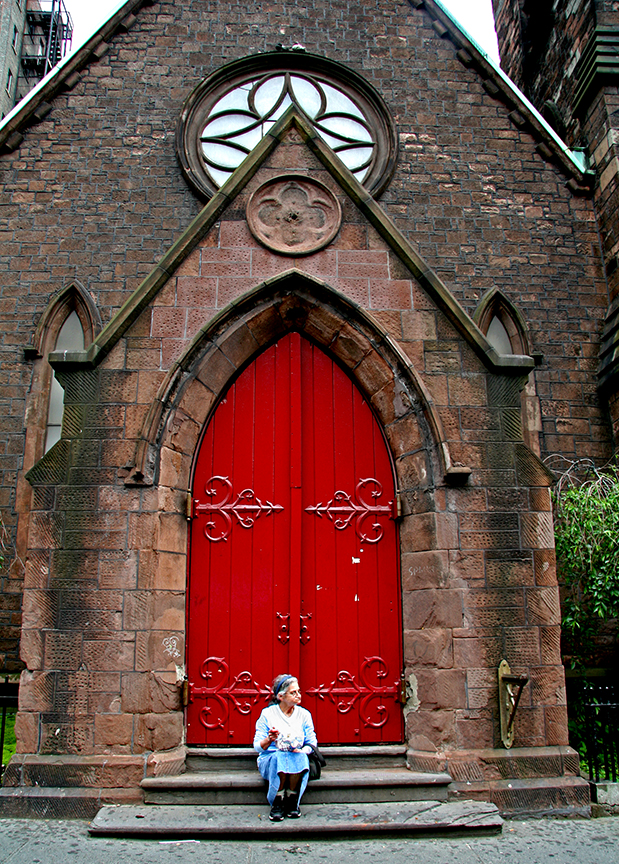
    Gothic meets drugs, sex, and rock and roll. Not such an unusual mix, actually. It’s just that we generally don’t think Gothic church. This place has actually been a neighborhood problem and has had a sordid history. It has been a nightclub since 1983, when it opened as The Limelight, owned by Peter Gatien and designed by Ari Bahat. Gatien owned a number of Limelight nightclubs (read about it here).
    The space benefits, of course, from the incredible architecture – huge rooms, soaring ceilings, stained glass windows, and a labyrinth of chambers.

    In 1996, club attendee Michael Alig was arrested and later convicted for the killing and dismemberment of Angel Melendez, a drug dealer based at The Limelight (read about it here). Opened and closed in the 1990s for drug trafficking, it was reincarnated in 2003 as the club Avalon.

    The brownstone structure, at 47 W. 20th Street and 6th Avenue, was built in 1846 as the Church of the Holy Communion for an Episcopalian congregation. It was designed by renowned architect Richard Upjohn, cofounder and first president of the AIA (American Institute of Architects). Upjohn, a British immigrant, was most well known for his Gothic revival churches. Trinity Church is one of his best-known works.
    This church building was saved in the 1960s when it became designated as a landmark. It was subsequently sold and used as a drug rehabilitation center.

    It’s not the idea of a church being converted to a den of debauchery that is so disappointing. It’s the state of decay that graces the exterior. I thought the lone figure of an older woman eating her lunch on the steps of the church was an appropriate statement.

    Its such a shame for an important historic structure to deteriorate this way. But then again, a rock and roll club can’t be expected to be a model for decorum…

    Posted on by Brian Dubé

  • Responsibilities

    Posted on by Brian Dubé

    I recently served jury duty. I was not pleased, but it is my civic obligation. This is New York Daily Photo – if you come here to see this great city and truly know it, I feel like I have some responsibilities and you do too, like learning about the city’s architecture and perhaps what that building is in the photo. And if you commit a crime, there are consequences. We all must take our medicine when needed.

    So here at 60 Centre Street is where obligations, responsibilities, and consequences meet. A rather serious matter and not the type of characterizations compelling to the tourist or visitor. I think courthouses connote obligations, responsibilities, and consequences more than justice.
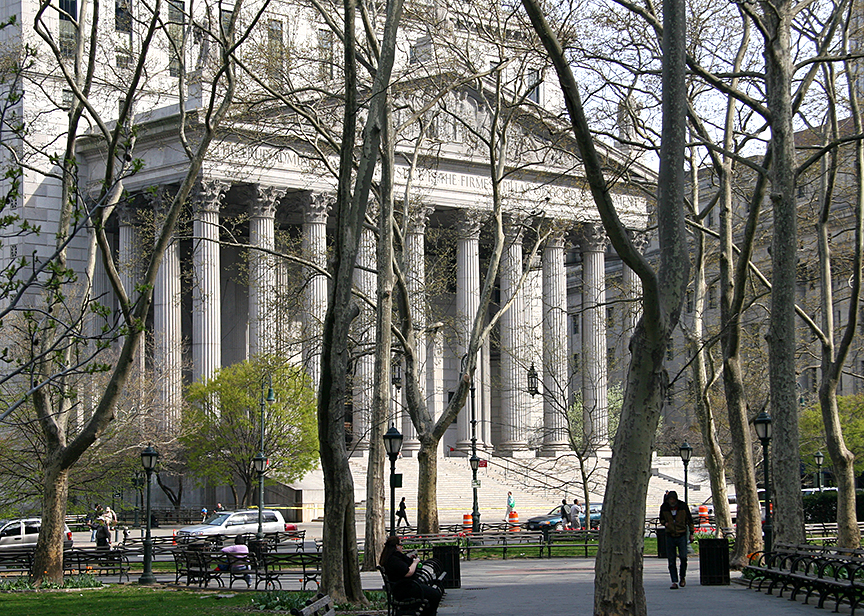
    This is the New York County Courthouse, aka the New York State Supreme Court building at 60 Centre Street. It was designed by Guy Lowell and was completed in 1926. The 10 granite Corinthian columns support a portico where the words of George Washington are engraved: “The true administration of justice is the firmest pillar of good government.”

    One of the outstanding features of this edifice is the 100-foot wide staircase. There is a great article by Paul Goldberger, architecture critic for the New York Times. In it, Goldberger bemoans the fact that great staircases will no longer be built: “…equal access for the handicapped and the elderly has become a determining factor in architecture. If everyone cannot partake equally in an architectural event, the argument goes, it should not exist at all. No one can argue with this goal, of course, but it is unfortunate that so much has been lost in its pursuit.” So, with new construction, everything is being flattened for equal access – it is our responsibility…

    Photo note: The vista here is from Thomas Paine Park at Foley Square. A unique feature of this building is that it is hexagonal, something best seen from above.

    Posted on by Brian Dubé

  • Cuts One Way

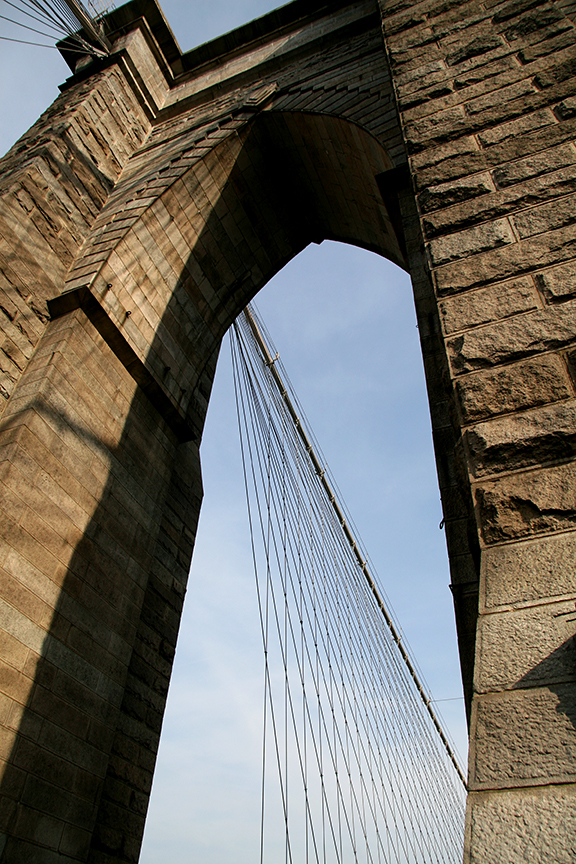
    The Brooklyn Bridge is one of the most important and recognizable NYC landmarks – an edifice literally in stone and one of its finest icons. I have done numerous postings where the bridge is a key element, but none on the bridge itself. See the list of related postings below and more photos of the bridge here.

    The bridge, completed in 1883 and connecting lower Manhattan with Brooklyn, has a walkway which is open to pedestrians and bicycles. I highly recommend this to any visitor (or resident) – it’s a must-do. It’s free and the vistas are great.

    There is no room and it makes no sense for me to synopsize here the history of the bridge or supply technical information – tomes have been written. The Wikipedia article is a good start and has a myriad of links (see here).

    The Brooklyn Bridge is quite special to me. I find the stonework so much more attractive than the steelwork of the Manhattan and Williamsburg bridges, although I have warmed up to these over the years. Traveling around the city, particularly by car, the Brooklyn Bridge is omnipresent, and with its image comes a plethora of feelings and impressions. Especially for a New Yorker. This is the bridge of book, film, and fable, known throughout the world.

    Visitors are frequently astonished that anyone would go through what we do just to get through basic everyday life. And many do leave after trying their hand at living here. Our town is a great one, but the knife that is New York City has two edges and cuts both ways. I, like many New Yorkers, have a love/hate relationship with many aspects of life here – it comes with the territory and every one of us living here knows it. But for the Brooklyn Bridge, the knife cuts only one way – I love that bridge 🙂

    Related posts: One Front Street, Loaded, The River Cafe, Gallery View, Sink or Swim, Dumbo, Bridge Cafe, Belle de Jour, Jet Ski, Twist and Shout, The Watchtower


  • Lone Voice

    Posted on by Brian Dubé

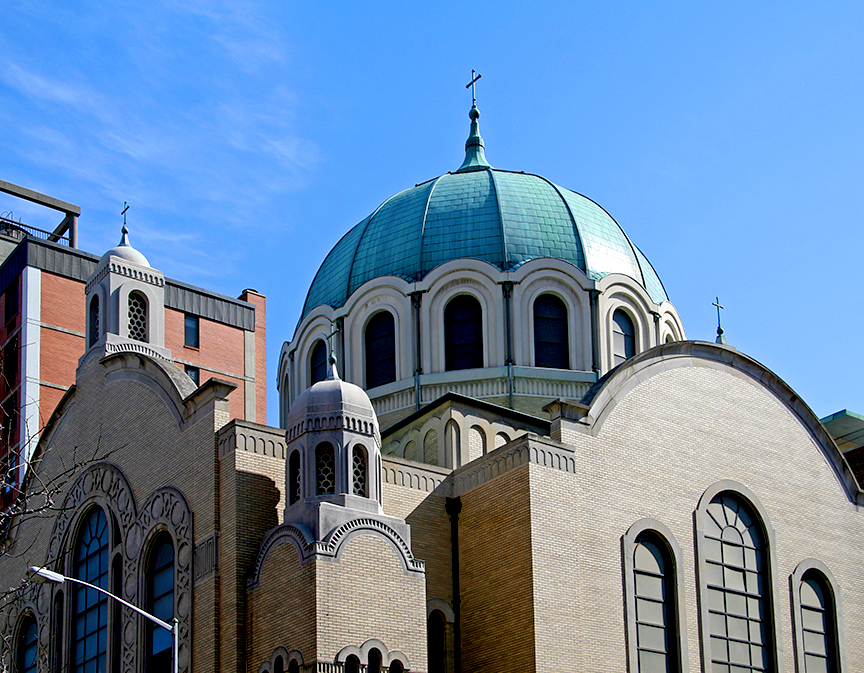
    I was surprised to learn that this structure is actually quite new – construction dates back only 30 years to 1978. This is St. George’s Ukrainian Catholic Church at 20 East 7th Street at the corner of Taras Shevchenko Place. The Byzantine church with its large dome, designed by Apollinaire Osadca, is a landmark in this area of the East Village, which has a large Ukrainian community. The church stands out particularly in contrast to the surrounding low-rise, tenement buildings. It replaces an earlier church (read the history here).

    A neighboring project across the street has been quite controversial: the short two-story Hewitt Memorial Building, belonging to Cooper Union, has been torn down and is being replaced with a 9-story building (equal in height to a 16-story residential building) to be completed in 2009, in time for their 150th anniverary. The new building is the NYC debut of architect Thom Mayne, a Pritzker Prize laureate and a principal of the Los Angeles firm Morphosis. There has been some community acceptance owing to the new building’s transparent features permitting light and views. Cooper Union (and others) have recently been involved in a number of building projects in the area – this is not the first recent neighborhood controversy.

    People resist change, and opposition to new construction is the norm, unless the thing being torn down is absolutely egregious and the replacement is very much in keeping with surrounding architecture. Otherwise, in NYC, get ready for a community battle. I’m not saying that all new construction is good; to the contrary, I am a devout preservationist and love historic architecture. However, new construction is a reality anywhere. It’s the design process and site considerations that make it such a thorny, contentious matter.

    I recall a recent community meeting where there was heated debate over a large-scale project. An older, calm, and reasonable gentleman stood up and stated that he was a 50-year resident of the neighborhood and, of course, had seen this type of opposition repeatedly with a consistent outcome: people eventually warm up to the new construction and make it their own. He thought that the newly proposed project had been well-designed and should be embraced. But he was a lone voice…

    Street Note: Taras Shevchenko Place is only one block long, between 6th and 7th Streets. Originally it was named Hall Street and then Hall Place. Ukrainian residents got the street renamed in 1978. Taras Shevchenko (1814-1861) was a Ukrainian poet, artist, and nationalist.

    Posted on by Brian Dubé

  • Seven Deadly Sins

    New York City is an ideal place to commit any or all of the seven deadly sins – temptation looms around every corner. In learning about this cupola and its conversion to residential use, I have to admit that I have committed at least one: envy (which I have been guilty of before).

    This building’s rooftop dome is one spot where it would be easy to commit all seven sins in one place (perhaps with the exception of sloth – I can’t imagine the occupants being particularly slothful. Perhaps if a rich child inherits the place.)
    There are many of these magnificent, grand Beaux-Arts buildings around town with cupolas, and there is a growing trend to develop and occupy the small handful of these domes available. See my posting here on the Police Building, a dramatic structure with an enormous dome (also converted to residential use).

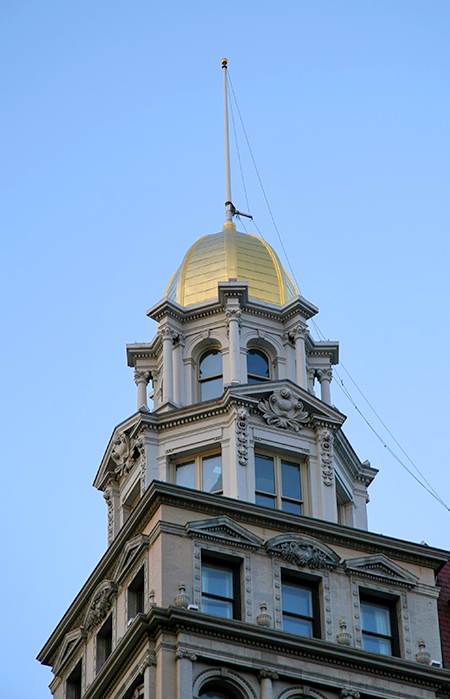
    The photo is of the two-story, octagonal, gold-leaf cupola atop the Sohmer Piano Building at 170 Fifth Avenue in the Flatiron/Chelsea District. Designed by Robert Maynicke and built in 1896 by developer Henry Korn, the 13-story landmark Beaux-Arts building was once a piano showroom. After residential conversion, the cupola was was purchased in 2001 by Gregory C. Carr, former chairman of Prodigy.

    In reviewing the seven deadly sins, it occurred to me that the optimal way to commit them would be to split them up – some before and some after acquisition of a dome home. Before, we have Envy and Wrath. After hitting the Lotto and buying said property, one can envision a den of sin for indulgence in the pursuits of Pride, Gluttony, Lust, and at the end of a “hard” day, Sloth. That leaves Greed, a sin easily committed anytime – before, after, or throughout. Your choice 🙂

    NOTE: For your reference, the seven deadly sins in Latin are:
    Luxuria (Lust), Gula (Gluttony), Avaritia (Greed), Acedia (Sloth), Ira (Wrath), Invidia (Envy), Superbia (Pride). Each sin has an opposite among the seven holy virtues; in parallel order, they are chastity, abstinence, temperance, diligence, patience, kindness, and humility.


  • 23 Skidoo

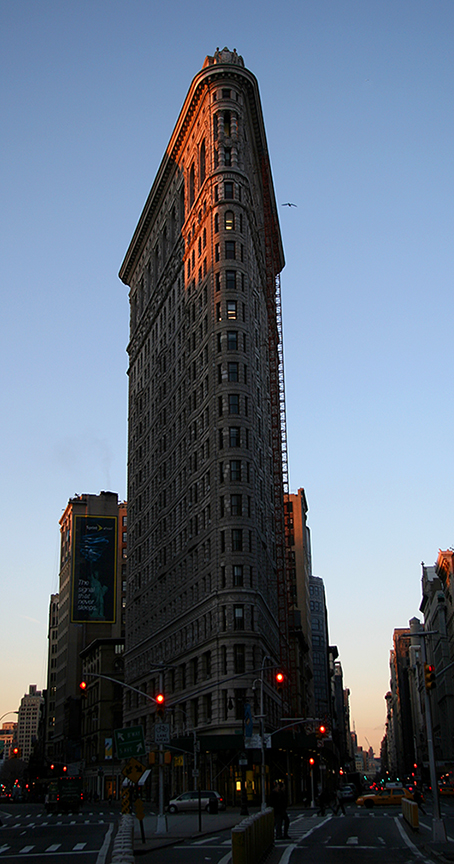
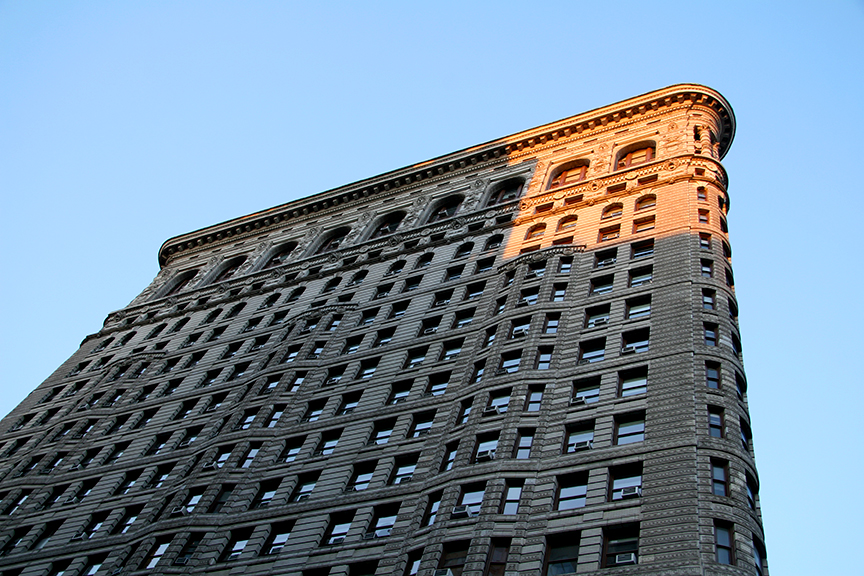
    When you have a structure that is a huge NYC icon, a National Historic Landmark, and is internationally recognizable, you have both a responsibility and a serious challenge. After all, not only has the Flatiron Building been photographed by millions, but the roster also includes some of the country’s most prestigious photographers, such as Alfred Stieglitz, Edward Steichen, and Berenice Abbott. The beautiful photos of Steichen and Stieglitz have done much to immortalize the Flatiron.
    This is why I have waited over two years to do a photo and piece on the Flatiron – it needs to have justice done. The perfect opportunity presented itself last Thursday, the day I photographed Ashley Alexandra Dupre’s residence on 25th Street after the Spitzer scandal.

    Being out before dawn in the neighborhood gave me an opportunity to swing around the corner and capture the building at sunrise on a magnificent, clear day. I felt like a serious photographer that morning, having chosen the conditions and made a pilgrimage at the appropriate hour. With little traffic, I was able to position myself anywhere with ease, including the middle of the streets. See a second photo here.

    The building owes its name to the triangular plot of land upon which it sits, which was called the Flatiron block. Contrary to urban mythology, this name predates the building’s construction. It was officially the Fuller Building, but from the beginning, it became popularly known as the Flatiron. One of the city’s oldest existing skyscrapers (22 stories, 285 feet tall), it was built in 1902, designed by Chicago architect Daniel Burnham in the Beaux-Arts style. The exterior is a rusticated limestone with glazed terra-cotta.

    On its own island block, it is circumscribed by 23rd Street, Broadway, Fifth Avenue, and 22nd Street, diagonally across Madison Square Park. The area neighboring it is known as the Flatiron District.

    Trivia Note: One of the competing stories for the origin of the expression “23 skidoo” is due to the wind tunnel effect generated by the siting of the building. In the early 20th century, men would gather on 23rd Street trying to get glimpses of women with their dresses being blown up by gusts of wind. The police would give them the “23 skidoo” to remove them from the area…


  • dinamic_sidebar 4 none

©2026 New York Daily Photo Entries (RSS) and Comments (RSS)  Raindrops Theme