• Category Archives Scenic NYC
  • A Second Look

    There are many perks in doing a website like this, such as discovering things I never knew and learning new things about those I was familiar with. The most exciting are the big surprises – unexpected stories behind things which appear to be rather ordinary. In a city absolutely saturated with people and things, looking over and overlooking are standard fare.

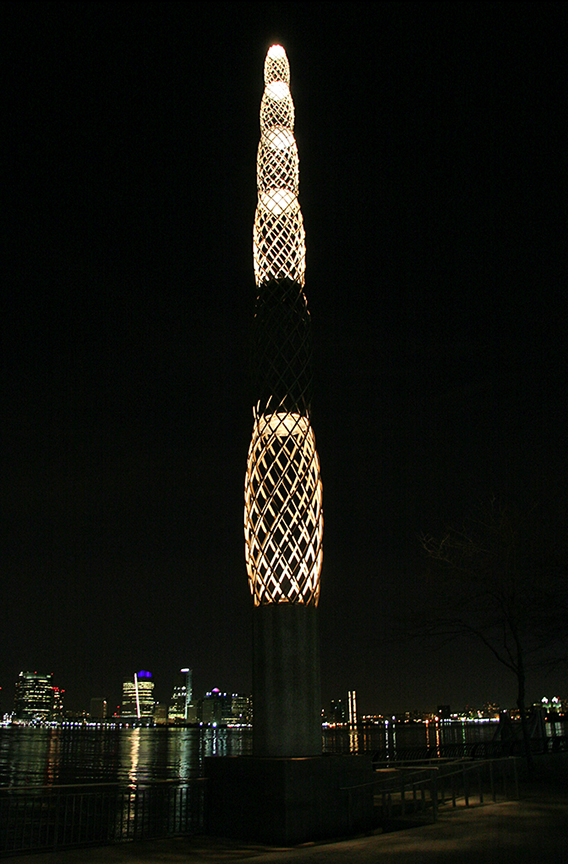
    When I ran across this striking sculptural light form at North Cove Yacht Harbor behind the World Financial Center, I assumed that it was just an above average ornamental light. I thought it would be difficult to identify this sculpture and glean any information about it and its creator. Not at all. This piece and its mate in granite, entitled North Cove Pylons, was created by renowned sculptor Martin Puryear. Read this article in Sculpture Magazine about the work. Puryear has all the makings, training, education, experience, and accolades of a major artist, with feature articles (The New Yorker) a MacArthur grant, and major museum shows such as the 30-year retrospective of his work at the Museum of Modern Art (here is a YouTube video of the exhibit).

    Puryear, who is African American, studied native crafts while serving in the Peace Corps in Sierra Leone, and later studied woodwork and design at the Swedish Royal Academy of Art. On his return to the US, he studied at Yale University, where he received an MFA in sculpture.

    I am finding that works of public art in NYC which I assume are perhaps whimsical, casually placed, and/or created by unknown individuals are often by major artists and go relatively unappreciated.
    So take a second look at the obvious. Or come here and let me do it for you 🙂

    Related Postings: Koons Balloons, Asaf and Yo’ah, Sky Mirror, Sfera con Sfera, Knotted Gun, 11 Spring Street, Sylvette, Night in Bloom, Subway Art, Sink or Swim
  • Sin of Omission

    I’m always looking for nooks and crannies, but like Italian hill towns, finding hidden gems in a densely populated and/or heavily visited place is extremely difficult. Most often, the hidden or undiscovered in NYC is remote, literally at the ends and edges of the boroughs, far from where any resident or visitor would typically go.

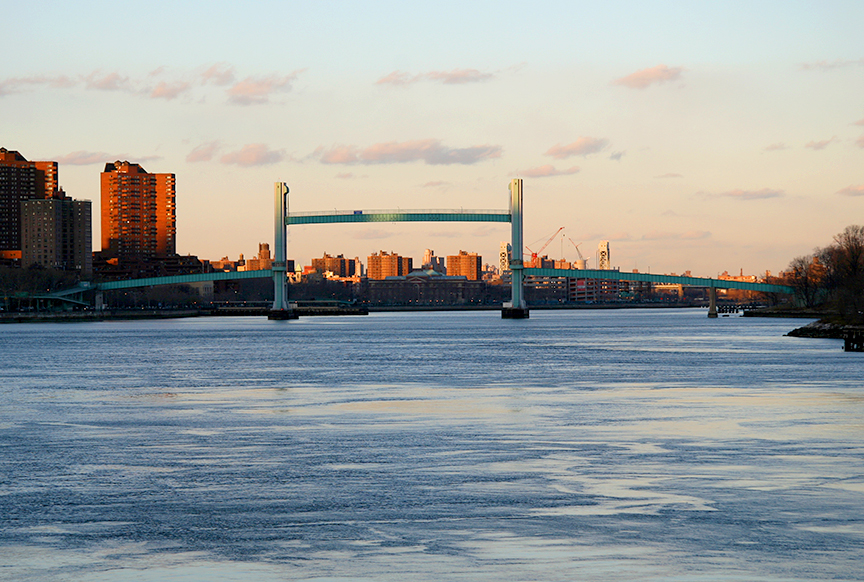
    This is the case with the Ward’s Island Bridge, which spans the Harlem River between East 103rd Street in Manhattan and Ward’s Island, giving access to Ward’s Island Park, with wonderful views, biking paths, and athletic facilities (the island is also home to a psychiatric center, homeless shelter, and a wastewater treatment plant). Read more about the island here.

    The bridge is unique – it is the only bridge in NYC, spanning a major river, which is open to pedestrians only (bicycles are also permitted). Only 12 feet wide, it is a lift bridge – the center section (100m) lifts to accommodate tall ships. A wooden drawbridge spanning the river was built in 1807 by Bartholomew Ward to aid his cotton business on the island. It was destroyed by a storm in 1821. Ward’s Island Bridge was built in 1951 and designed by Othmar Hermann Ammann. The bridge is closed during the winter months (November through March), when it is left in the raised (closed) position.

    I love the colors of this small bridge – a pleasant improvement on the typical gray. In 1976, it was painted brighter colors – blue-violet towers, vermillion trim, and yellow walkways. It was later repainted to its current, more subdued scheme, with a blue span and blue and green towers.

    I admit to a sin of omission; I’ve never been to Ward’s Island or taken the Ward’s Island Footbridge. I plan to redeem myself soon and go there one it opens in the spring…


  • Ray of Light

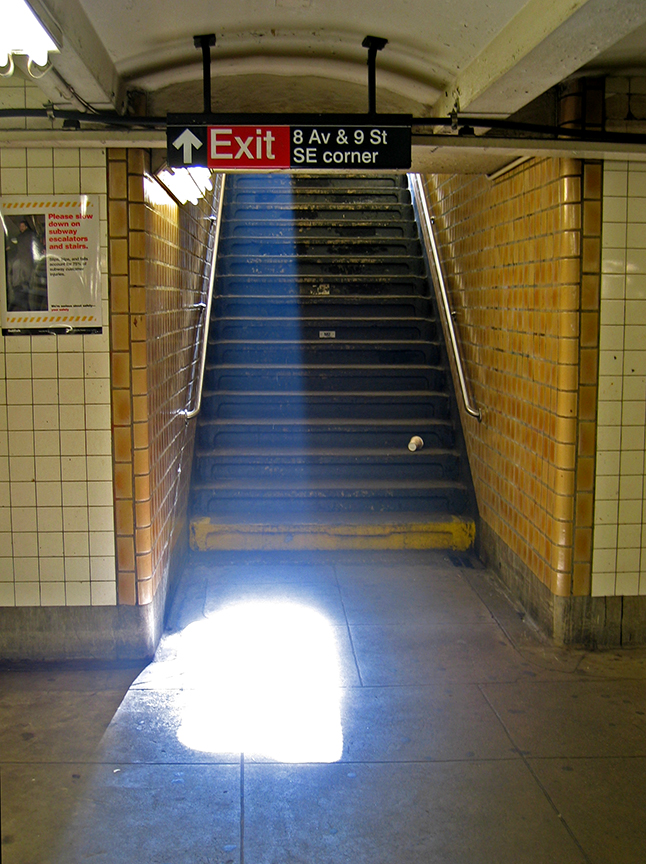
    I just tore my camera out on this one – it was like a religious experience. A friend who lives in Park Slope says that she has been up and down that stairwell hundreds of times over many years and has never seen anything like it. If you have ever really watched the sun or moon closely, you know how quickly conditions like this change. I think there was a tiny window of opportunity at this stairwell and I was there.

    But the larger point here is that the opportunity to find beauty and joy is ever present. If you have ever spent time around an eternal optimist, then you have witnessed this first hand. Many individuals indulge in the dark side and equate this with being real. They see people who are very positive as fluffy. But I think they do secretly wish they had the ability to live an easier and happier life. There is a great scene in Woody Allen’s Annie Hall where Alvy (played by Woody) runs across a beautiful, happy-looking couple on the street:

    Alvy Singer: Here, you look like a very happy couple, um, are you?
    Female street stranger: Yeah.
    Alvy Singer: Yeah? So, so, how do you account for it?
    Female street stranger: Uh, I’m very shallow and empty and I have no ideas and nothing interesting to say.
    Male street stranger: And I’m exactly the same way.
    Alvy Singer: I see. Wow. That’s very interesting. So you’ve managed to work out something?

    At the end of the day, being a cynical, skeptical, overly serious individual can be wearing. There are a lot of whiners in the world, and New York City has plenty of them. Life here is very hard and stressful, and it is a very easy place to get into the trap of being negative and thinking that things would be better somewhere else or with different means or circumstances. Most of us have all the preconditions for happiness here and now. A sense of humor helps. At the risk of being preachy or new-agey, I would suggest looking for that ray of light. Happiness is more a choice than a condition…


  • More or Less

    I’ve always loved tall buildings and big cities. My first experience was Washington, D.C., on a family trip, where I immediately became obsessed with the Washington Monument, memorizing its important facts (like its height, of course). You can easily guess my first stops in Paris (Arc d’Triomphe and the Eiffel Tower). NYC was overwhelming – I knew I had found my home.

    It’s not that I don’t appreciate nuance or subtlety or realize that bigger isn’t necessarily better and that less can be more. But these monuments are architectural assertions of what we can do. As I wrote in Beacon of Hope, a tall building, for me, is an inspiration and a metaphor for our aspirations, dreams, and hopes, frozen in time and space.

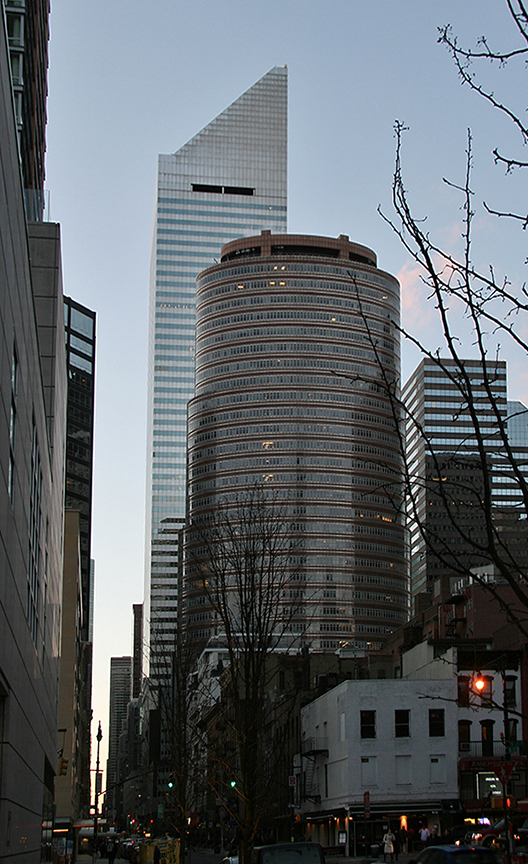
    In this photo, looking west along 53rd Street, we have the Lipstick building in the foreground and the Citicorp building behind. The Lipstick Building (1986), at 885 3rd Ave. was designed by John Burgee Architects with Philip Johnson. The building acquired its epithet Lipstick owing to the elliptical shape and telescoping tiers. The Citicorp Building has a fascinating story.

    Of course, not everyone is enamored with tall buildings, Here is a caustic condemnation I ran across online written by a Londoner:

    “My impression, based on experience of living in New York and Chicago among other things, is that tall buildings generate extra street traffic, create shading problems and downdraughts, increase the nocturnal light levels, create problems of social sustainability, tend to fall foul of planning guidance, are constructed without proper regard for the needs of existing residents, compromise the built heritage and historic fabric of the city (in London’s case, sites like St Paul’s, the Houses of Parliament and Tower Bridge), and are obvious targets for terrorism.

    Moreover, they are often built for reasons of status rather than with much regard for architectural quality and development efficiency. The aesthetic of many tall buildings is corporate and brutalist; today’s aesthetic preference may be tomorrow’s aesthetic nightmare. Expensive tall buildings also have a marked impact on the demographic of an area.”

    Ouch…


  • Connections

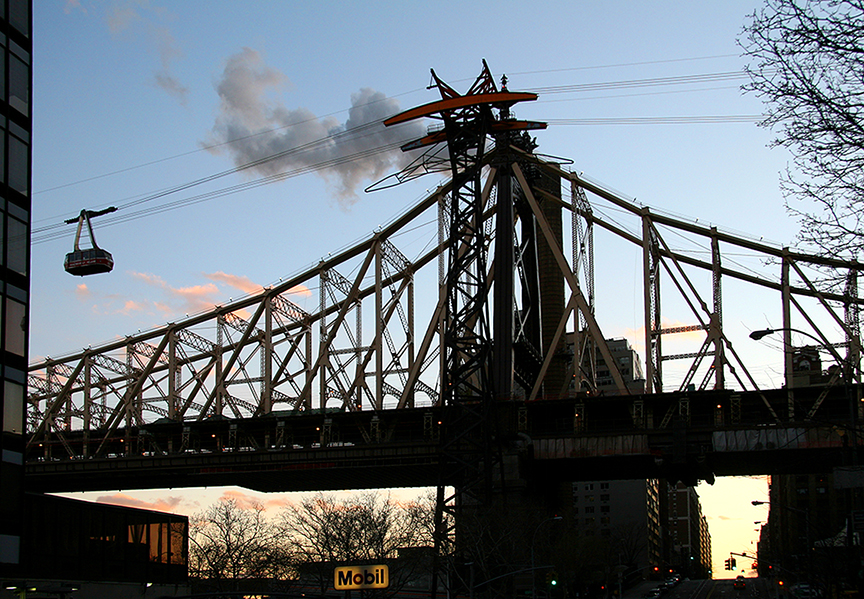
    Bridges are typically very important structures, always providing that essential connection between here and there, but I can’t imagine any place where they are more critical than in Manhattan, an island in a city of islands ( 4 out of 5 boroughs are islands or on islands – only the Bronx is on the mainland). Our survival is absolutely dependent on bridges and tunnels. Perhaps this is one of the many reasons why bridges are so iconic here: we have many, they are well-known, and they are lifelines. Anything so essential that is simultaneously well-designed takes on an additional beauty – that classic weave of form and function. Add to the equation the vistas and lights at night, and you have a formula for the romantic.

    The intricate steelwork of the cantilevered Queensboro Bridge (formerly the 59th Street Bridge) has an attractive quality. It was designed by Gustav Lindenthal in collaboration with Leffert L. Buck and Henry Hornbostel and completed in 1909. You can read about its history and construction here. It is an NYC icon – one of the most recognizable bridges in the city. Some of my feelings about the bridge, however, are tarnished by my initial experience of it during its decades of neglect (it went through a renovation in 1987). In those early years, I saw it primarily from a utilitarian perspective: to get in and out of Manhattan and to afford vistas of the city and the river. It was more a symbol of what it could provide than a thing of beauty.

    If you want to see a true love affair with new York City, I highly recommend Manhattan by Woody Allen. Its opening montage of city images set to Gershwin’s Rhapsody in Blue is wonderful, culminating with a fireworks display with NYC as backdrop (you can see the intro clip here). There is a scene in the film, used in posters for the film, of Woody and Diane Keaton sitting on a bench with a view of the Queensboro Bridge  click here).
    This image, enmeshed with Gershwin, is one of my strongest connections to the bridge…

    Note about the film: Be forewarned, however. Woody plays a 42-year-old who is dating a 17-year old high school girl. A little disturbing, almost foreshadowing his real life involvement with Soon-Yi Previn. Art predicts life again…

    Note about the photo: This photo was taken on East End Avenue looking south.


  • Hell’s Gate

    If you are driving in New Jersey on the Turnpike through the industrial corridor, passing through towns like Carteret, Rahway, and Elizabeth, you will see (and smell) many oil refineries. To most travelers, these are hideous. But if you are traveling at night, everything about them can become strangely beautiful because it’s so extremely different (I’m reminded of Paul Theroux’s fascination with travel in Northern Ireland because of its extreme nature). You have a really bleak landscape with no sign of humans, networks of lights, tall dark silhouettes of towers, and huge flames shooting into the night sky. It is surreal, like a fairy tale world.

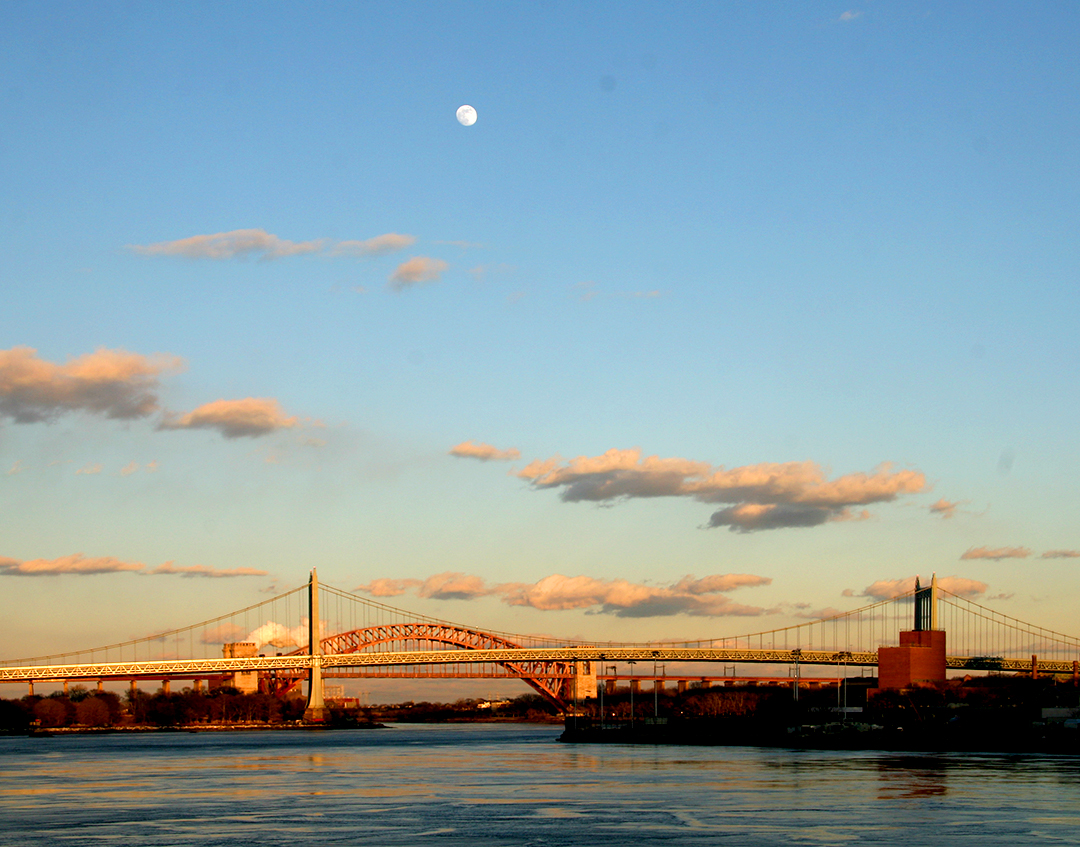
    The subject of today’s photo is certainly more readily likable, but I find it does share some things with the aforementioned landscapes (certainly, elements in this photo are not inherently beautiful, like the smokestacks from Con Edison’s power plant). To really like this vista, one does have to find beauty in the industrial or structural. Like the Eiffel Tower, designed by an engineer, it is loved by some and hated by many.

    The bridge in the foreground is the Triborough, and behind it is the Hell Gate Bridge (formerly the New York Connecting Railroad Bridge), a steel arch railroad bridge spanning Queens and Wards/Randalls Islands. In the foreground, you have the East River looking north (from Manhattan) as it splits around the islands.

    I found the scene beautiful – bridges, the river, golden evening light, clouds, and the moon. It’s about picking your battles and the right vantage point at the right time. For some there is beauty in these vistas; others have abandoned all hope, for they are at Hell’s Gate…


  • Dead Moths

    Regular readers have by now observed my escapist preoccupations. Someone who knew me well once remarked, regarding my urban searches for the bucolic, that what I needed was a place in the country. This may or may not be true; the conversation reminds me of a dialogue between Alvy Singer (Woody Allen) and a friend, Robin (Janet Margolin), in a scene from Annie Hall:

    ROBIN: I’m too tense. I need a Valium. My analyst says I should live in the country and not in New York.
    ALVY: The country makes me nervous. You got crickets and it-it’s quiet…there’s no place to walk after dinner, and…there’s the screens with the dead moths behind them, and…uh, yuh got the – the Manson family possibly…

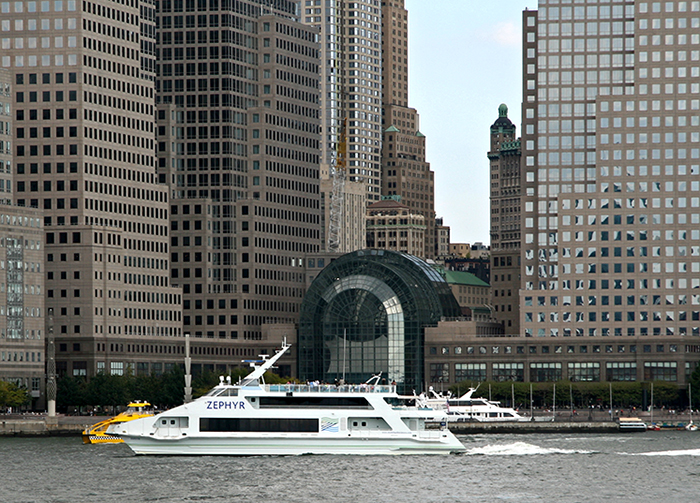
    So, indulge me as I ferret out the natural in NYC without the dead moths. I’m not sure how these urban oases are perceived by a visitor with ready access to nature – a quaint novelty or perhaps a display of horticultural ingenuity. For city dwellers, these spots are well-liked and heavily used.
    The photo, taken in the Autumn of 2007, shows the rear of the Winter Garden Atrium as seen from the Hudson River with the North Cove Yacht harbor. The atrium, wedged between 2 and 3 World Financial Center buildings, is a 10-story glass vaulted structure designed by Cesar Pelli, completed in 1988 and rebuilt in 2002 after 9/11. Read my previous posting about the Winter Garden here. I love palm trees, and the atrium has many, so it’s one of my (semi) tropical oases in the city. But the real deal and my favorite is in Brooklyn


  • American Radiator

    Many young people hated history class in my high school days – all the memorizing of facts. Even if your memory was quite good, why waste it leaning about things and events long gone, most with no remaining vestiges whatsoever? And things that seemingly had no relevance to our young lives.

    Growing up in a blue-collar factory town, there wasn’t much history to pique a young person’s interest anyway. Oh, I had plenty of interests: math, rocketry, German language, chess, origami, Africa, adventure, music, and books (and girls). I belonged to plenty of clubs. But history was not part of the agenda at all. Things started to change when I started traveling to Europe and when I moved to NYC. Here, history is alive and well – it’s with us everyday, everywhere you walk or look. To fully understand a building or place, one has to know the history, and it’s not long before one wants to know the history and likes history. Soon, you’re watching the History Channel (I wish my history teacher was alive to witness the success of this network).

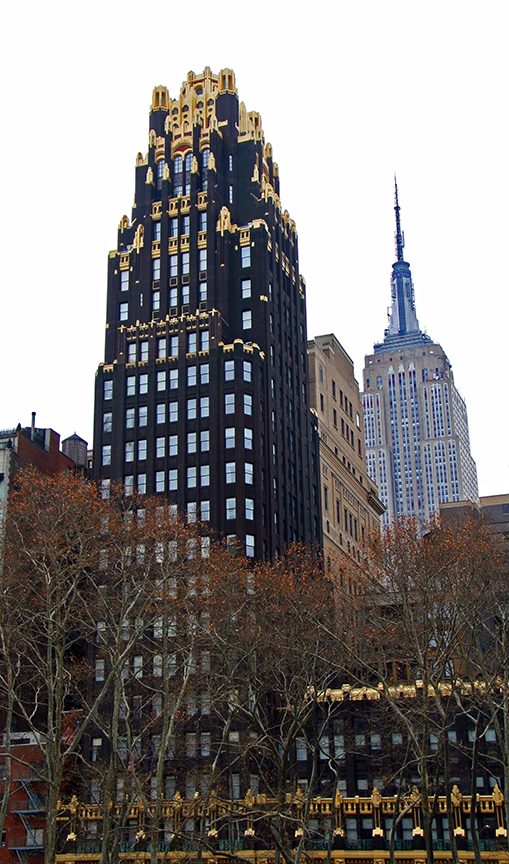
    Today’s photo is a great illustration of all this. The American Radiator Building, now the American Standard Building, was
    designed by architects Raymond Hood and John Howells and built in 1924 for the American Radiator and Standard Sanitary Company. It is based on the Chicago Tribune building. The building is located at 40 w. 40th Street on a block with many brownstones and Renaissance club facades from the turn of the century. It is on the south side of Bryant Park, thus affording unobstructed views of it from some distance. The stark contrast in colors is a distinguishing characteristic and a remarkable sight, well-known to city dwellers who frequent the area. The brick is black – Hood wanted the appearance of a large mass, unbroken by dark windows in a building typically constructed using lighter-colored stone. The building is topped with Gothic style pinnacles and terra-cotta friezes covered in gold. The design was to recall the furnaces of the time, with their black iron and glowing embers.

    Another important feature of this building is that it is set back from the lot line – unattached on all four sides. This freestanding construction permits architectural treatment all around and allows more natural light into the interior. The base is black granite with bronze plating, the lobby black marble. The building is landmarked and listed on the National Register of Historic Places. In 1998, it was sold and later converted to the Bryant Park Hotel. When you are in the neighborhood, make sure to take a look. This history serves us well, does it not?


  • It Shines For All

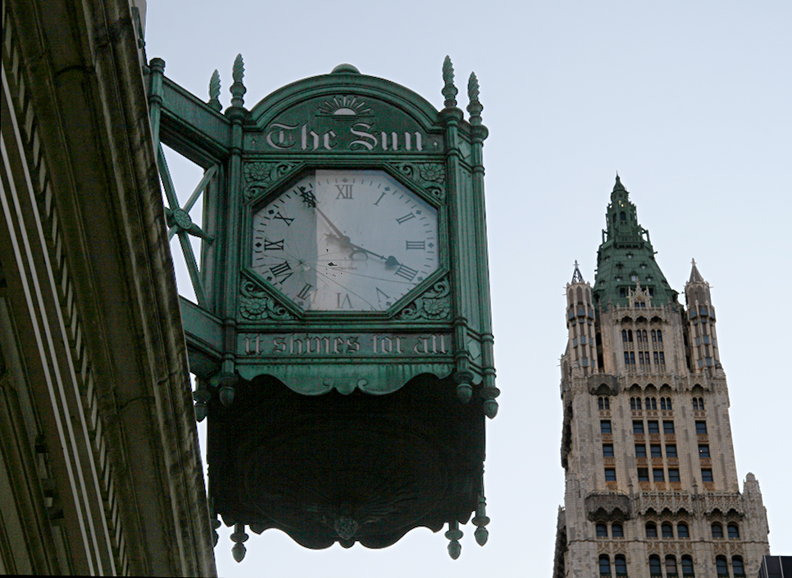
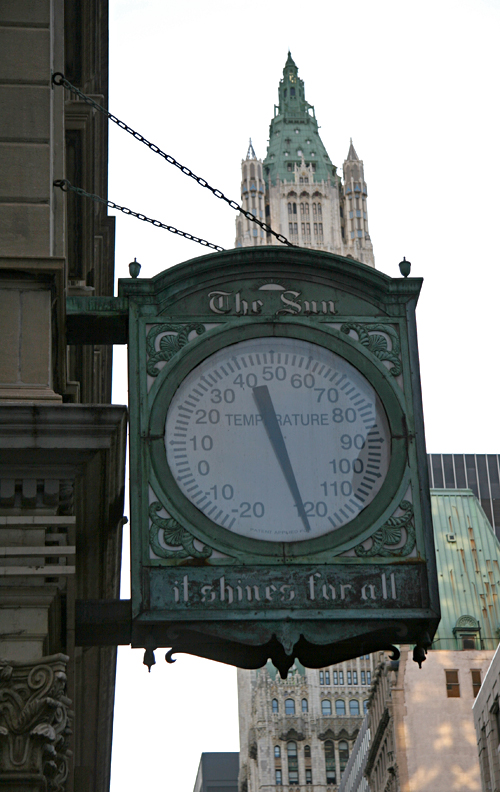
    Who can resist an antique bronze clock and thermometer with the slogan The Sun It shines for All, mounted against a historic landmark white marble building, on Broadway with the Woolworth Building as backdrop? Images of old New York and the romance of days past flood my mind with a vista like this one. Click here for a photo of the thermometer.

    The 7-story building is located at 280 Broadway at Chambers Street near City Hall. The white marble Italian palace was originally erected in 1846 as the A.T. Stewart Dry Goods Store – America’s first department store. This grand palace of commerce was quite dazzling at the time. The structure is of major historic architectural significance – it is one of the first Italianate commercial buildings in the United States. In 1917, it was taken over by the New York Sun. The bronze clock and thermometer were added in 1930. The Sun occupied the building until 1950; in 1970, it was taken over by the City of New York. Sadly, the building remained in shabby condition for many, many years, and the clock itself stopped functioning in 1967, was repaired, stopped working in 1987, and was repaired again. The building was renovated during the Giuliani administration. Now the sun, clock, thermometer, and building shine for all…


  • Loaded

    It occurred to me looking at this photo that NYC is really loaded – not just with money but also with icons. It explains why New Yorkers can be quite cynical – everywhere we look, there are spectacular vistas, frequently with MULTIPLE icons.

    In this shot alone (taken from DUMBO, Brooklyn) we have the Brooklyn Bridge, the Municipal Building, the Empire State Building, and last (and least), the Verizon Building. And there were numerous other notables in view but not framed by this photo (South Street Seaport, the Financial District, the Woolworth Building, and the Manhattan and Williamsburg Bridges). When leaving my office daily, I see the Chrysler Building framed by Grace Church looking north (click here) and the Woolworth Building to the south. Walking home through SOHO’s historic cast iron district, I see the Empire State Building framed by Washington Square Arch (click here). Only Paris comes to mind with such a plethora of notable places and things that are household names.

    There are numerous activities, industries, businesses, and services that NYC stands out as a center for – publishing, advertising, finance, music, dance, theater, film, law, fine arts, architecture, parks, street life, fashion, retailers, and dining (there are over 17,000 restaurants in Manhattan alone). We are used to superlatives – biggest, most, best. As far as being loaded in the classic money sense, we’ve got that too, of course. I remember being stunned by an article in the Wall Street Journal that gave the number of 10 figure annual bonuses in the city…


  • Brooding

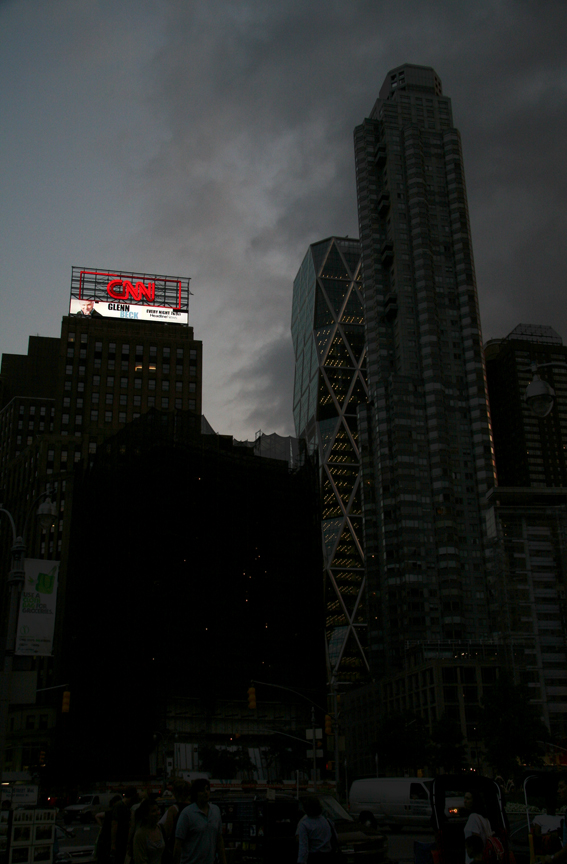
    It’s easy to ignore what little there is left of the natural world when in NYC. Sometimes. But we still have weather, and like everywhere else, weather sets the mood. Here, we have a storm threatening as seen from Columbus Circle, looking south – it really felt like Batman’s Gotham City. The building with the triangular windows is our friend, the Hearst Tower. The tall, thin tower is Central Park Place, a residential condominium built in 1988 by Davis Brody & Associates. The hulking, shrouded building barely visible in the center is the controversial 2 Columbus Circle by Edward Durell Stone from 1964, sometimes referred to as the Lollipop Building (Ada Louise Huxtable, then architecture critic of The New York Times, said it resembled “a die-cut Venetian palazzo on lollipops”). The building is to be occupied by the Museum of Arts and Design in 2008. Click here for this story.

    New York is a city of stark contrasts, and the relatively unpredictable nature of the climate in the Northeast (as opposed to the Southwest, e.g.) just adds one more variable to the mix. There’s nothing like a brooding NYC day to remind us that in spite of our abilities to create technologies and shape the world, we are still fundamentally powerless in the hands of Mother Nature…


  • Beacon Of Hope

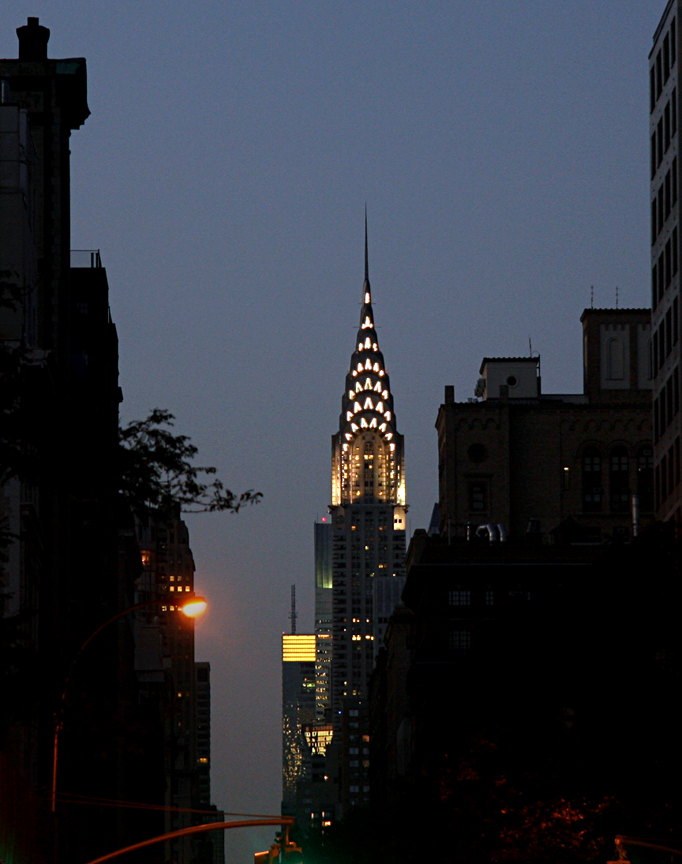
    I never tire of seeing the Chrysler Building, particularly in the evening when lit. I have posted numerous times on various aspects of the building, such as the gargoyles, elevators, lobby, murals, entrance, and the Trylon Towers. Since 9/11, most large office buildings have increased security, and in the case of the Chrysler Building (and Woolworth Building), they are off-limits entirely, unless one has specific business in the building.

    During Open House New York 2006, I was able to get into the lobby and stairwells and photograph at my leisure. For me, the Chrysler Building is many things: assurance that there is some permanence in a world of change, a link to old New York, a beautiful art deco masterpiece, a metaphor for our aspirations, dreams, and hopes with its gleaming stainless steel spire reaching upwards, and a reliable NYC icon, letting me know at a glance, without any doubt, of where I am…

    Chrysler Building Posts: Crown Jewel, Gargoyles, Stairwell, Back in Time, Mural, Going Up, Trylon Towers, Contrast


  • Cruising

    Depending on where one lives and where and how one travels and commutes, one can experience Manhattan as a maritime community or simply as one of the most exciting and culturally rich cities in the world. In a city like San Francisco or Portland, Maine, with hills and vistas, one is constantly reminded of the sea. In Manhattan, it is easy to become immersed in all that is here without a hint of its island nature. In recent years, the city’s waterfront has become progressively more and more reconstructed and utilized in ways that are sometimes very surprising, even to residents.

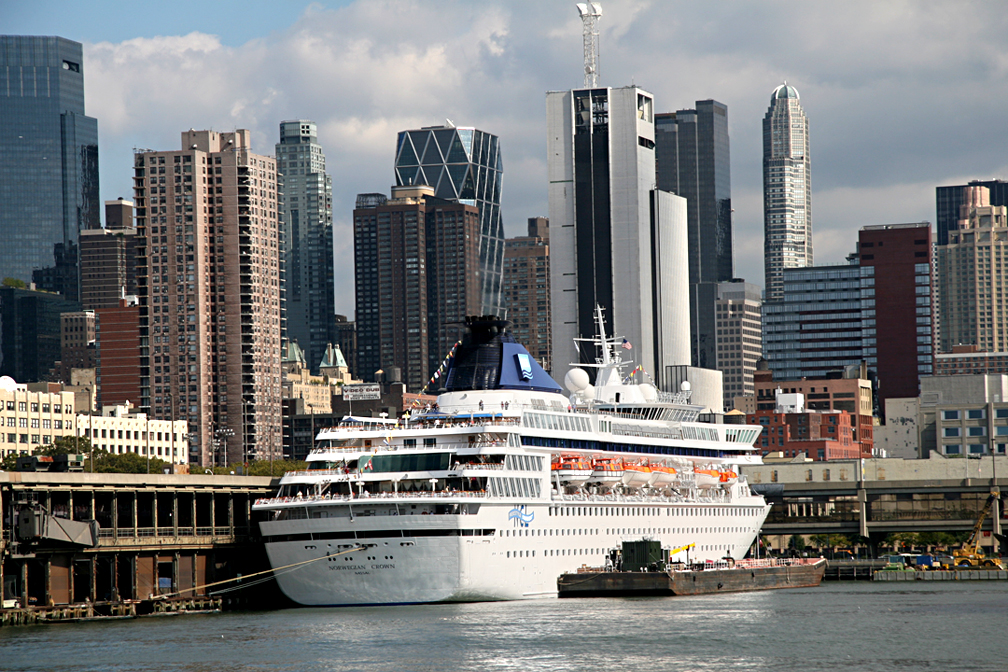
    I have posted on a number waterfront establishments, residences, and activities: Manhattan Island, kayaking in the Hudson River, the Water Club, the River Cafe (Brooklyn), Bargemusic (Brooklyn), the Frying Pan, the 79th Street Boat Basin, Christopher Street Pier, Battery Park City & promenade, art fest in DUMBO, Meier World, Coney Island and The Shore (with the Iceberg Athletic Club and the Coney Island Polar Bear Club), and the wonderful Mermaid Parade (also here). NYC also has a very active cruise ship business at the New York Passenger Ship Terminal (on the Hudson River at Piers 88, 90, 92, and 94 at 46-54th street). The city sees 1,000,000 passengers yearly. The cruise ship terminal is currently undergoing a $150 million renovation. In 2006, the Brooklyn Cruise Terminal opened at Pier 12 in the Red Hook area in Brooklyn.

    Notes about the photo: The glass building at the far left is the Time Warner Center. The articulated building in the center with triangular windows is the Hearst Tower.


  • Lonely Clock

    The Colgate Clock is not in NYC but in Jersey City, New Jersey, on the banks of the Hudson River. Although New Yorkers complain and joke about New Jersey, it plays an important part in the city’s economy, services, and labor supply. The New Jersey skyline is the dominant view from Manhattan’s west side, with the Colgate Clock readily visible from lower Manhattan. At 50 feet in diameter, the current clock is claimed to be the largest in the world. It is a replacement for the original clock (38 feet in diameter) from 1904, made by the Seth Thomas Company; it has been relocated to a Colgate factory in Clarksville, Indiana. The octagonal design was based on Colgate’s Octagon Soap. The toothpaste tube was added in 1983. Read more here.

    The clock is the last remnant of the site of the former headquarters of the Colgate-Palmolive consumer products conglomerate. In 1985, all the buildings on the site were leveled, and the entire operation was moved to Kansas and Indiana, leaving the clock alone, rather drab and dreary looking on an empty lot awaiting development…

    Photo Note: This photograph was taken on a neighborhood boat ride on the Hudson aboard the Queen of Hearts.


  • Risk Not Living

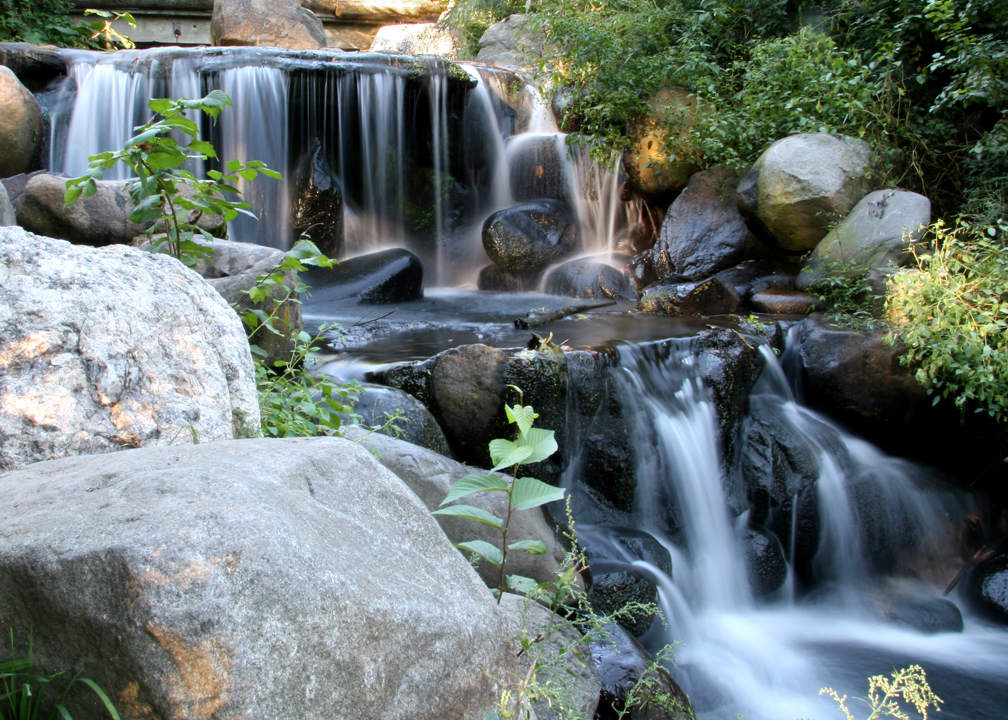
    The danger at these falls is not what you think I mean. Let me explain. I have not been particularly inclined to do nature photography. Perhaps seeing so much mediocre, ordinary, and cliched work (and not wanting to contribute more) or seeing extraordinary work (and not being able to create at that level) has left me on the sidelines.

    Of course, these feelings easily apply to other genres of photography as well, so it all comes down to what type of subjects and work inspires you – where your passion lies. Add to the mix living in a dense urban environment and getting away infrequently. So when I do get to a natural environment, I prefer just experiencing it, not through a camera. For me, this has been the danger of photography: seeing everything as one would through a lens and as a potential photograph. When habituated to this practice, one risks not living…

    Photo note: This photo was taken at Binnen Falls in Prospect Park, Brooklyn, near the Lullwater and Audubon Center. I have seen numerous photographs of waterfalls and streams using a long exposure, which creates a very interesting effect with the moving water. Seeing these falls inspired me to give it a try.


  • dinamic_sidebar 4 none

©2026 New York Daily Photo Entries (RSS) and Comments (RSS)  Raindrops Theme