• Category Archives Scenic NYC
  • Zeckendorf

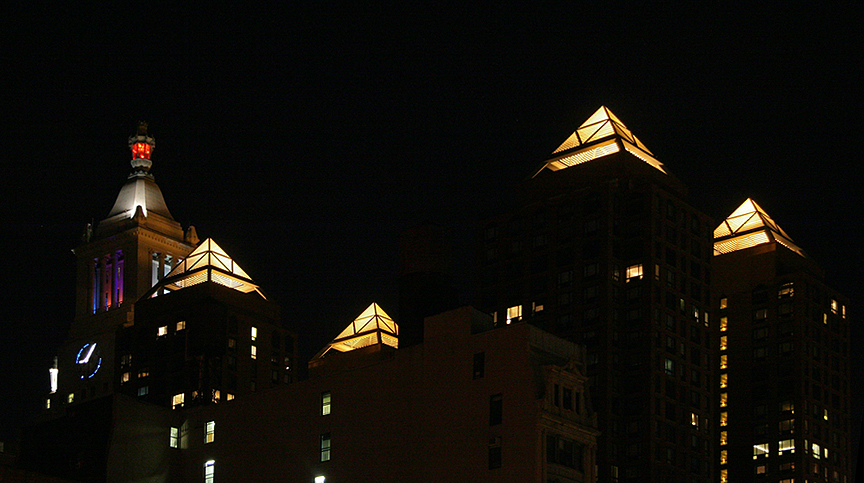
    Real estate developers, along with architects, define the look of a city, and the empire and legacy of William Zeckendorf Sr. (1905-1976), his son William Jr., and grandsons Arthur and William Lie continue to endure and impact New York. These are the Zeckendorf condominiums (read about them here) at One Irving Place, as seen from Union Square in the evening with the Con Ed tower. I have photographed these towers before for this website, but I have not shown all four in one photo. Real estate developers are typically not seen in a very positive light by the average citizen; rather, they are resented by many for their wealth and the power they have over the primary assets of a city – the land and buildings themselves. However, they are absolutely necessary to the city’s infrastructure, growth, and reconstruction, and when there is a good design aesthetic and sensitivity to appropriate architecture, they can be a force for the good.

    William Zeckendorf, Sr. is considered one of America’s foremost developers and has worked with architects I.M. Pei and Le Corbusier. He is credited with projects which were seminal in the redevelopment of troubled areas, such as these towers in Union Square and the Columbia at 96th Street on the Upper West Side. His most notable transaction was taking an option on 17 acres along the East River to build a dream city. Unable to exercise his option, and seeing the city about to lose the United Nations because it was unable to find a location for it, Zeckendorf called Mayor William O’Dwyer, who persuaded Rockefeller to buy the land for $8.5 million and then donate it to the U.N. In 1965, his company Webb & Knapp collapsed and went into bankruptcy. The family business was rebuilt with William Jr. at the helm.

    Style and personality also play a factor in the public’s view of a real estate mogul. Donald Trump, for example, is seen by many as a pompous, arrogant, egotistical media hound with a celebrity lifestyle surrounded by supermodels. Combine that with buildings known for their veneer, and one could understand why architecture critic Paul Goldberger once referred to his work as the “triumph of image over substance”…
  • The Watchtower

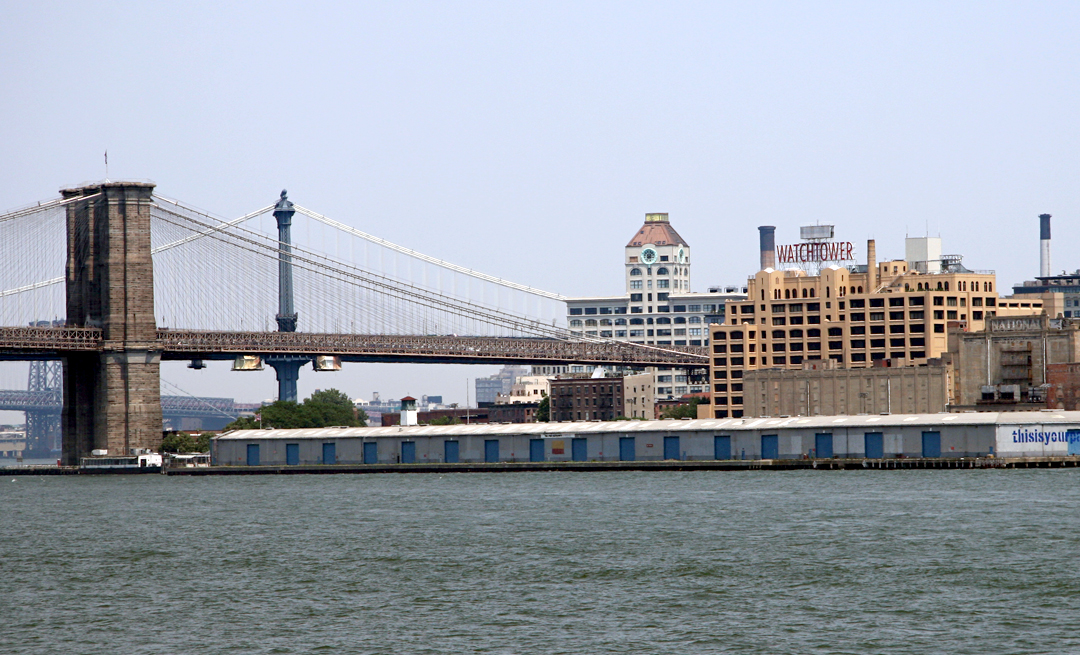
    The Watchtower sign on the Brooklyn waterfront is a site that nearly every New Yorker has seen – it’s visible from many vantage points. And most of us know that this is headquarters for the Jehovah’s Witnesses and their publication, Watchtower Magazine. The term Watchtower is a shortened version of the official name of the corporate entity in use by the religious organization and publishing division: The Watchtower Bible and Tract Society. The offices at 25 Columbia Street (where the sign is located) is not only the New York bethel but also world headquarters. The corporate entity is one of the 40 largest companies in NYC, with annual revenues of nearly 1 billion dollars.

    New Yorkers have also heard over the years that the religious organization owns much property in Brooklyn Heights – the subject of much controversy and covered in many articles over the years. As it turns out, this is true; they have been in the neighborhood since 1909 and own 18 properties there. They also own 12 properties in nearby Dumbo (click here). In 2004, they started divesting and selling off properties (they are selling 6 of the 18), including the Standish Arms Hotel on Columbia Heights and 360 Furman St., a former Bible-shipping facility (sold for $205 million) and being developed into luxury condos, One Brooklyn Bridge Park. The printing business has been consolidated to their Walkill, New York, facility. Click here for a photo tour through the properties, showing their printing facilities, residences (members live in a number of corporate owned buildings), the laundry building, etc.

    The religious beliefs of Jehovah’s Witnesses are quite a unique departure from mainstream Christianity. Only 144,000 will be chosen for immortal life. The wicked will be destroyed; the rest of mankind will live in earthly paradise during the Millennium…


  • Contrast

    Posted on by Brian Dubé

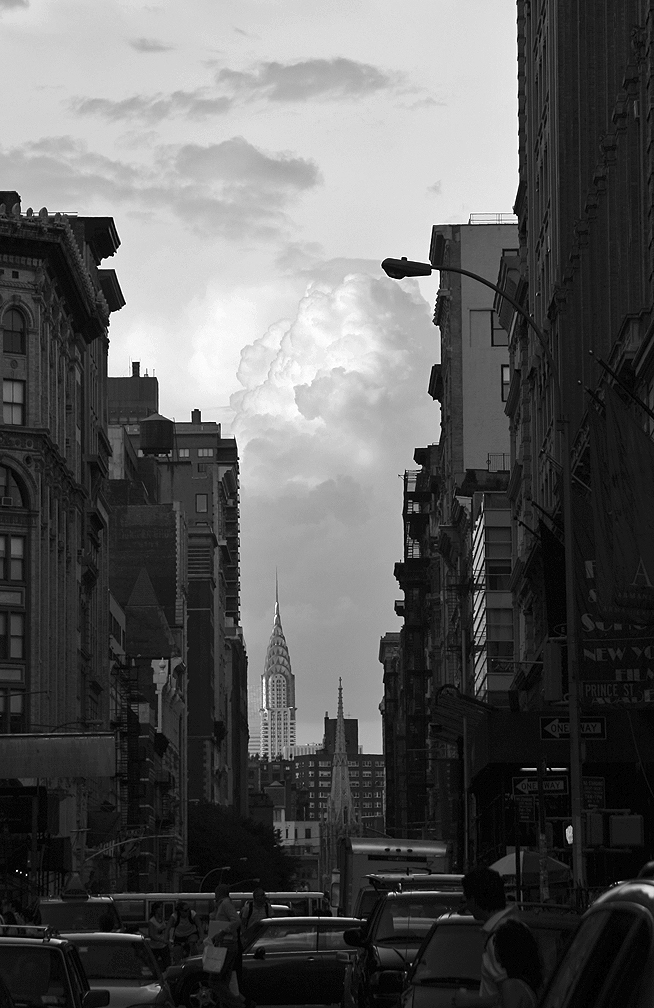
    As I have stated previously in this blog, it is easy to become inured to vistas, regardless of where or how dramatic, and it is no different in New York City. It frequently takes a change in mindset or perhaps conditions to jog ones perception and see something anew. I see the view in the photo on a daily basis – looking uptown from lower Broadway in SoHo, with the Chrysler building and Grace Church framed perfectly by the chasm formed by the buildings. Of course, I do notice, but I really don’t appreciate it the way an unfamiliar observer would.

    On this day however, the cloud formations were spectacular and moving rapidly. In the course of nine minutes, I had six very different photos. This kind of drama between clouds and buildings doesn’t occur that often, and even the jaded, hardened New Yorker can’t help but notice. On June 22, 2006, I posted a most remarkable cloud occurrence and provided a link to the Cloud Appreciation Society. No surprise, I suppose, that there are groups and websites exclusively oriented to clouds. Sorry, today there is no architectural dissertation, social commentary, history, or NYC factoids – just some cloud and vista appreciation. After all, this is supposed to be a photoblog 🙂

    Posted on by Brian Dubé

  • Paris in New York

    Posted on by Brian Dubé

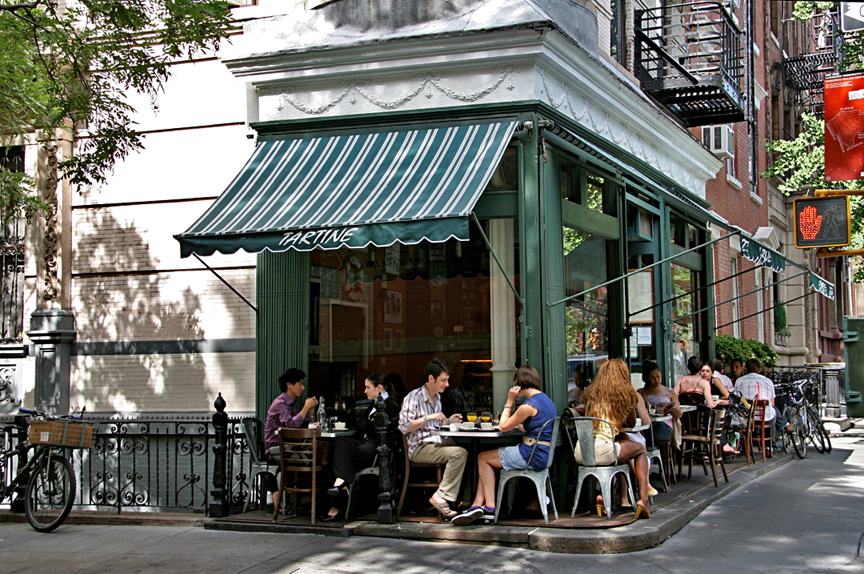
    One customer review complained of 1) a long wait, 2) a grossly small restaurant with people bumping into your chair every time they pass, 3) a rude and poorly trained staff with major attitude, and 4) a bus boy who thinks it’s okay to sweep and stack tables right beside you while you’re still eating. They take no credit cards, no reservations, have no liquor license (BYO), and yet they wait in line. Why? Many just love this place. NYC is a city of extremes, and this includes restaurant experiences and opinions. Tartine was started by Thierry Rorchard and Jean-Francois Bernard, two chefs who had worked several decades in large French restaurants.

    This wonderful small French bistro at 253 West 11th Street on the corner of 4th Street is probably in the most bucolic area of town – the West Village between 7th and 8th Avenues. I have written before of this neighborhood in 39 & 41 Commerce, Cherry Lane Theater, 17 Grove Street, and 121 Charles Street. Here, you will find the charm of being in the Latin Quarter of Paris. The stretch of West 4th Street from 7th to 8th has a number of restaurants discreetly hidden; these blocks are decidedly non-commercial, in part due to the Landmarks Preservation Commission, which has strict guidelines. I love al fresco dining, but I find most streets in Manhattan much too busy. Tree-lined West 4th street is the perfect place for a summer brunch. Be prepared to wait in line…

    Posted on by Brian Dubé

  • Light on Bobst

    Posted on by Brian Dubé

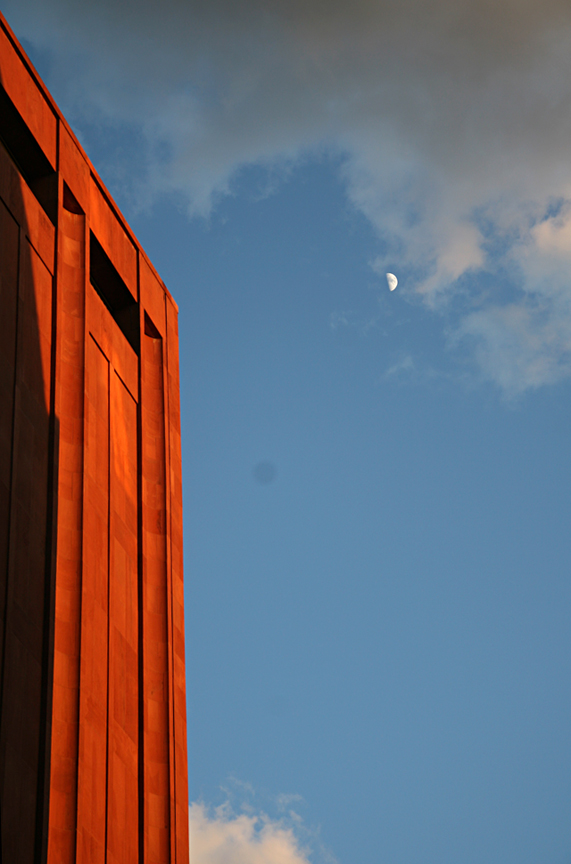
    My recent interest in the evening and night sky prompted this photo. It is remarkable how out of touch with the natural world city dwellers can be – there is a serious dearth of knowledge in subjects like plants, animals, insects, astronomy, etc. Recently, I have noticed some very brightly lit heavenly bodies, however, I was not able to find anyone who knew what these objects were (by studying some online star maps, I was able to confirm my suspicion that Venus was one of them). The photo was taken at sunset of the Bobst Library, which houses over 3 million volumes and is one of the largest academic libraries in the US.

    This massive red sandstone edifice on Washington Square South was designed by Philip Johnson for NYU (New York University) and was completed in 1972. It has been steeped in controversy since its construction:
    1) To begin with, there were substantial delays in its construction.
    2) There has been much criticism of its bulky, monolithic form and how it towers over Washington Square Park. The work of Johnson himself has been the subject of much criticism.
    3) The library was named after Elmer Holmes Bobst, who made a $6 million dollar contribution. There was embarrassment for the University, however, when it was learned that Bobst was a Nixon supporter, had been accused of a corrupt contribution to Nixon, and made antisemitic remarks.
    4) In 2003, Bobst made big news with two suicides in one month – students jumped from the open-air catwalks to the marble floor below.
    5) Steven Stanzak, an NYU student unable to afford his housing costs, became homeless and took up residence in the basement of the Bobst Library for eight months from 2003-2004…

    Posted on by Brian Dubé

  • New York Central Building

    Posted on by Brian Dubé

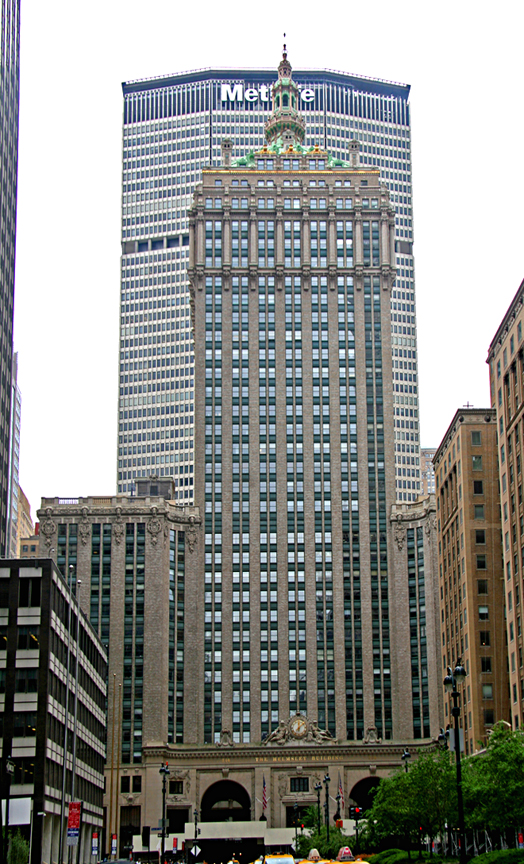
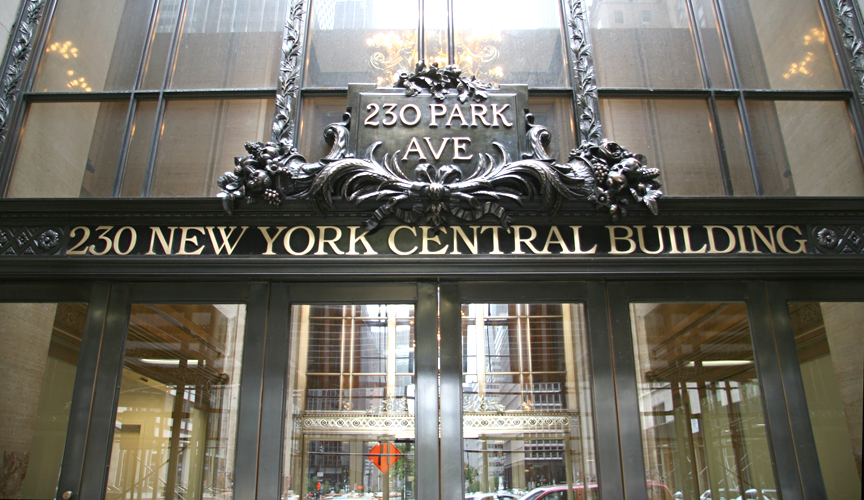
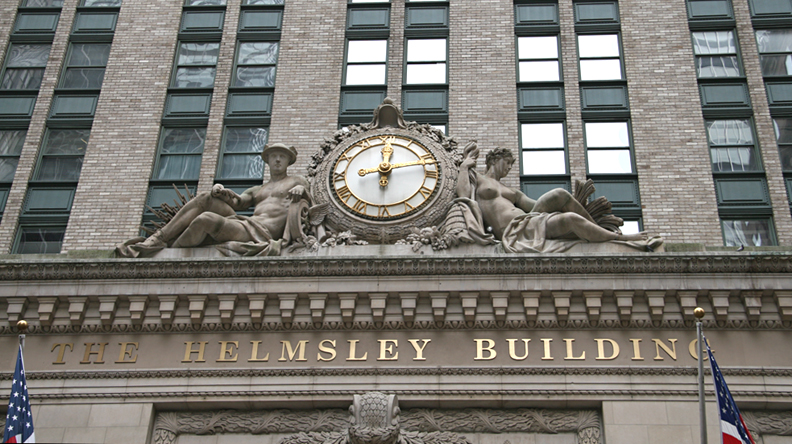
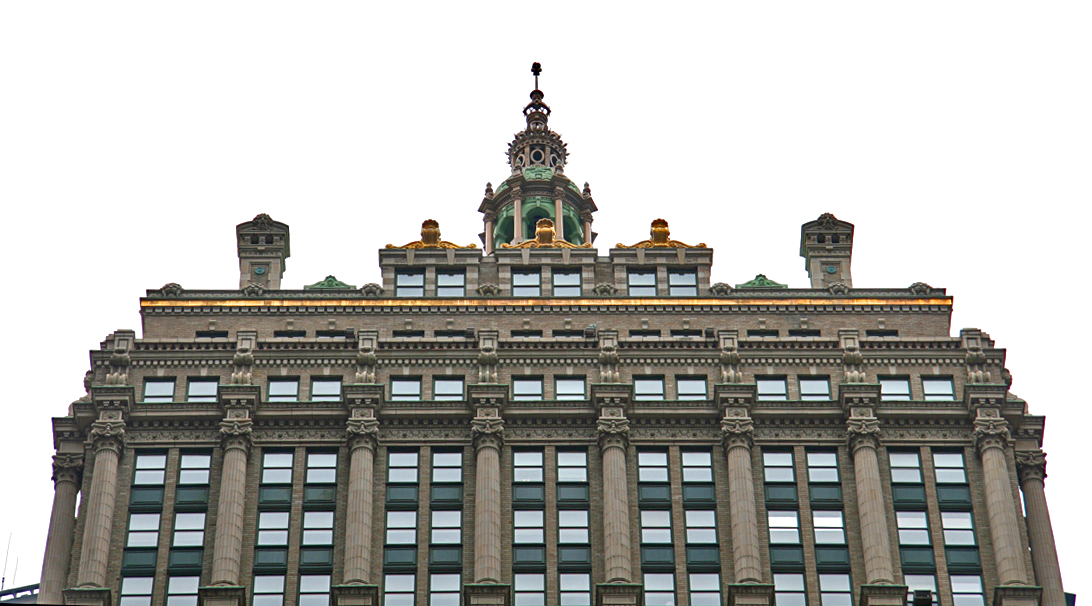
    What is perhaps most striking about this building is its superimposition over the MetLife building. Before construction of the MetLife (then the Pan Am) Building in 1963, the New York Central Building (now the Helmsley Building) at 230 Park Avenue (34 stories/560 feet) reigned supreme over the neighborhood and prestigious Park Avenue. It was the tallest structure in the Grand Central Terminal complex. Built in 1929 by the New York Central Railroad Company and designed by Warren and Wetmore, the building sits over the northern end of Grand Central and the southern end of Park Avenue at 46th Street.

    Traffic was beginning to become a problem at the time of its planning, and New York Central Railroad negotiated leases and easements for construction of the building. In exchange, they wove both lanes of Park Avenue through the building (and over Grand Central), creating a mini-raceway from 46th to 40th Street connecting to Park Avenue South and making it NYC’s favorite drive-through building. The large, cavernous openings for the two tunnels can be seen flanking the entranceway to the building, with an opulent, detailed lobby. The design echos elements of the Grand Central facade (click here) with ornamental clock and sculpture (click here). The chateau-like pyramidal roof is its most distinctive feature, with round dormer windows and crowned with a lantern cupola and spire…

    Posted on by Brian Dubé

  • Etched in Stone

    Posted on by Brian Dubé

    One of the great things in the city is to happen upon a juxtaposition of architecturally and/or historically important structures. It is surprising that we can still be awed and not jaded, even when exposed daily to vistas and landmarks. I think most New Yorkers still really do appreciate the things they see daily, such as crossing a bridge by car or subway. I always enjoy being in a part of town I do not frequent; it gives me that sense of newness one has as a visitor.

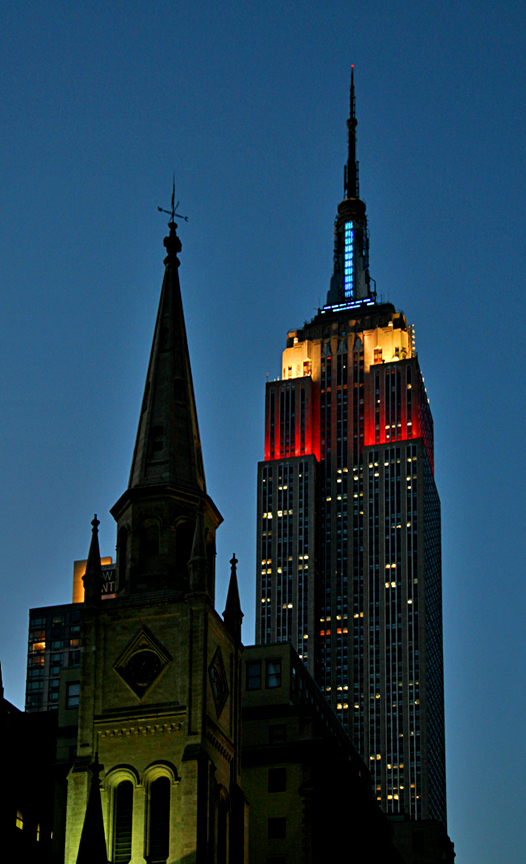
    This photo was taken on Fifth Avenue. In the background, we have, of course, the Empire State Building, clad in Indiana limestone and granite. In the foreground, at 29th Street and Fifth, you have the Marble Collegiate Church, a Romanesque/Gothic building constructed from white marble, a contemporary of Grace and Trinity churches (the term collegiate refers to the practice of churches sharing ministers as colleagues). Apart from having such a prime address with photo op potential, this church has a very interesting history. Marble Collegiate Church is the oldest Protestant organization in North America. The congregation was founded as the Collegiate Reformed Protestant Dutch Church in 1628; the building dates to 1854. Read about it here. The church is perhaps best known for pastor of 52 years, Norman Vincent Peale, the highly influential author of 46 books, including the bestseller The Power of Positive Thinking. Granite, limestone, marble – I love stone. And some things are just etched in it…

    Posted on by Brian Dubé

  • Manhattanhenge

    Posted on by Brian Dubé

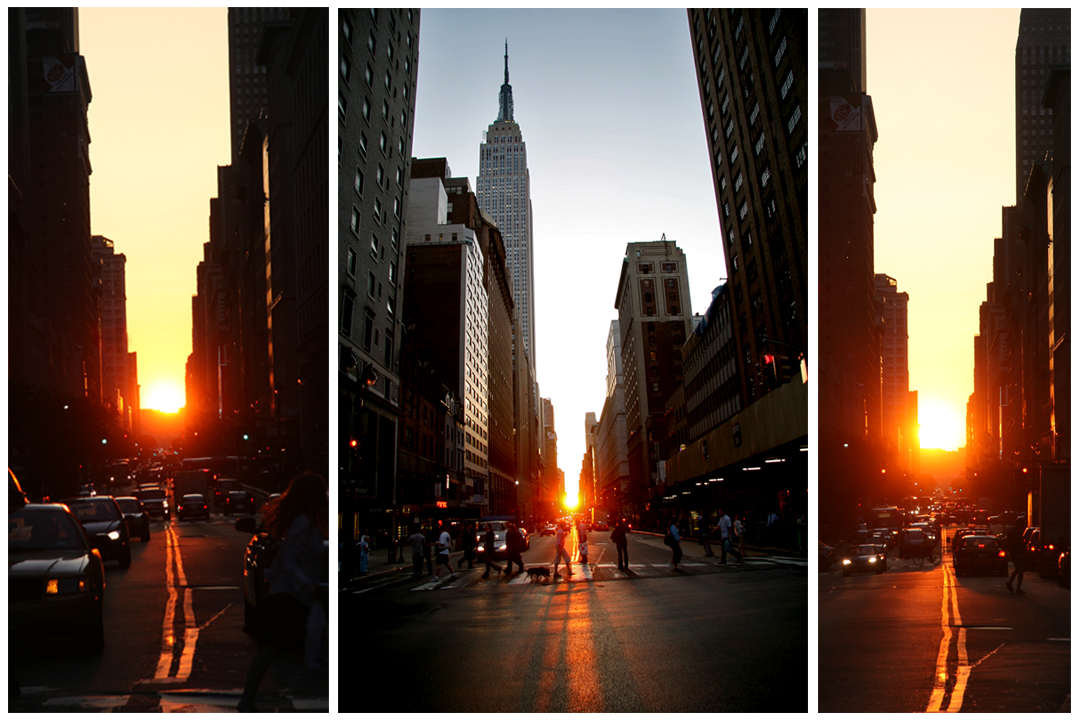
    Depending on your source, either yesterday or today is Manhattanhenge, a biannual occurrence where the setting sun aligns with the east-west streets of Manhattan’s main street grid (14th Street and farther north). Manhattan has two such days, generally cited as May 28th and July 12th, with some small yearly variation (there are also two days when the effect can be seen at sunrise: December 5 and January 8).

    The term Manhattanhenge was coined in 2002 by Neil deGrasse Tyson, an astrophysicist at the American Museum of Natural History, and is based on an analogous occurrence at Stonehenge, where, on the summer solstice, the sun rises in perfect alignment with several of the stones. On the Manhattanhenge days, the sun fully illuminates every cross street on the grid during the last fifteen minutes of daylight. The sun’s center sets exactly on the street’s center line, with the sun 50% above/below the horizon. The effect can be seen from river to river (and from Queens). The effect is good for a day or so on either side.

    Many people question the idea that this effect takes place simultaneously at every crosstown street in the grid, regardless of location. This may be counter intuitive, but it is true. The sun’s distance from the Earth at 93 million miles, in comparison to the length of the city’s grid of only a few miles, means that the sun’s rays are essentially parallel once reaching the earth – the deviation from parallel is too small to make a perceptible difference. Also note that Manhattan is rotated 29 degrees from geographic north. If the island’s grid was perfectly aligned with geographic north, Manhattanhenge would occur on the spring and autumn equinoxes.

    Viewing recommendations and photo notes: You still have time to see this effect in the next day or so. Recommended viewing is as far east as possible. However, keep in mind that many streets do not go clear through or have obstructions on the west side, the slight hilliness of the city may limit the view from First Avenue, and the actual horizon cannot be seen due to various buildings on the skyline in New Jersey. Queens or Roosevelt Island would also be good viewing areas. The photos were taken at 34th Street and Park Avenue – there was a fairly good crowd for the event. We dodged traffic, standing in the center of the street between changing lights.

    Posted on by Brian Dubé

  • Municipal Building

    Posted on by Brian Dubé

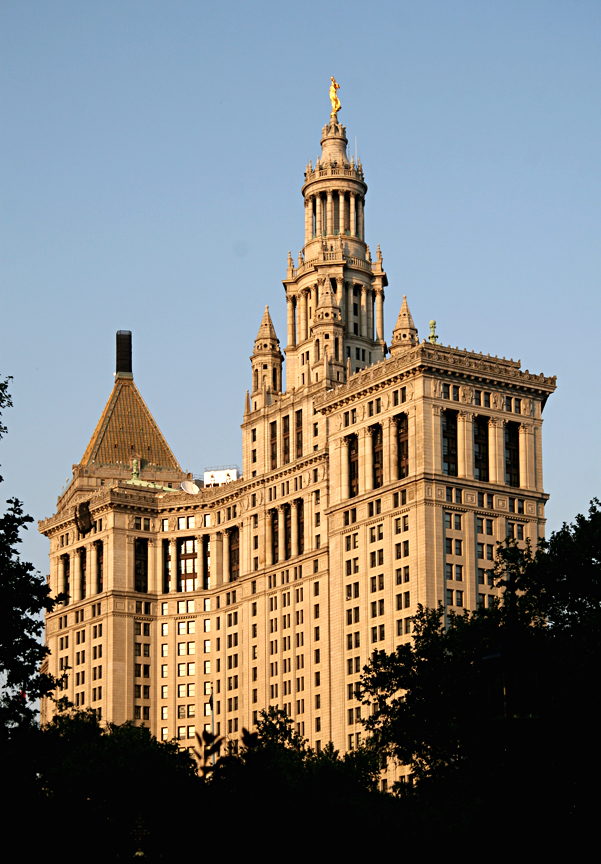
    This almost looks a little like Italy bathed in this afternoon light, doesn’t it? Not a total fantasy – architecturally, the Municipal Building’s design uses Imperial Roman, Italian Renaissance, and Classical styles.

    By 1884, New York City had surpassed the limited physical space in City Hall; many of its agencies were scattered throughout the city in various rented offices. Plans were made for a large civic building to accommodate the various city agencies, with four design competitions between 1888 and 1907. Twelve architectural firms submitted plans for the new building in the final competition, and the winning submission was from the firm of McKim, Mead and White, internationally renowned and the largest architectural firm in the world at the time. Construction started in 1909 (when NYC already included five boroughs and a population of 4.5 million) and was finished in 1914-15. It stands at 40 stories, 580 feet (177m).

    This building is of major architectural significance in NYC and was highly influential – Moscow University’s main building and other buildings in the Soviet Union were styled after it. The statue over the central tower is the heroic figure “Civic Fame” by Adolph Weinman in copper, 20 feet high, poised on a large copper ball (it’s the second largest statue in the city after the Statue of Liberty). A crown with five crenelations represents the five boroughs of the city, as do the five cupolas of the building. The Manhattan Municipal Building houses thirteen agencies – more than 28,000 New Yorkers get married here each year. It’s also where you can file for divorce – so convenient 🙂

    Posted on by Brian Dubé

  • Twist and Shout

    Posted on by Brian Dubé

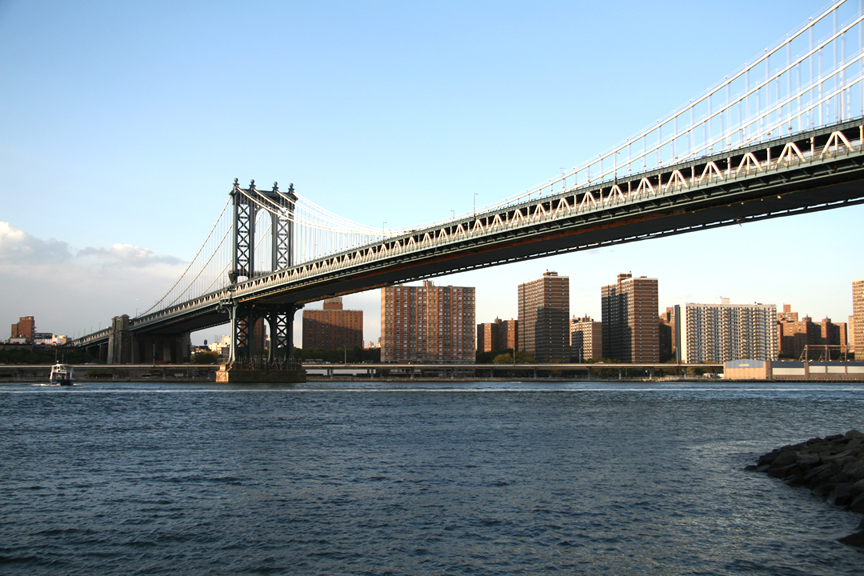
    The Manhattan Bridge was the last of the three great suspension bridges built across the East River (the other two are the Brooklyn and the Williamsburg). The bridge connects lower Manhattan (Canal Street) with Brooklyn (Flatbush Avenue). The photo is from the Brooklyn side in DUMBO. The bridge, completed in 1909, carries tremendous traffic: two roadways, upper and lower, with 6 lanes of vehicular traffic, subway tracks, a walkway, and a bikeway. It has, however, been plagued with problems from its inception, which were neglected until recently.

    The bridge designer, Leon Moisseiff, located the subway tracks on the outer sides of the roadway rather than in the center. The design flaw was discovered soon after construction: the bridge twisted whenever a train passed. The problem got worse; movement in the roadway (as much as several feet up and down) caused cracking. Crying out for repairs, the bridge was neglected with the NYC fiscal crisis in the 1970s. A major reconstruction finally began in 1982 and will only see completion in 2013 at a cost of $829 million.

    It is interesting that Moisseiff, known for his work on deflection theory allowing for lighter and more graceful structures, was engineer for the Benjamin Franklin Bridge, consultant for the Golden Gate Bridge, one of the designers for the San Francisco-Oakland Bridge, and primary designer for the Tacoma Narrows Bridge, which Moisseiff called the “most beautiful bridge in the world.” However, the bridge collapsed in a windstorm only four months after opening, leaving a damaged legacy…

    Posted on by Brian Dubé

  • Gothic Night

    Posted on by Brian Dubé

    I find monuments so exquisite when illuminated at night – this is one of the great things about cities like Paris. New York City has its small share of night time beauties, and Grace Church at night is one of them. This night was the perfect Gothic experience, with a near full moon over the starkly lit contrast of the church spire. The illuminated world of New York at night gives residents and visitors a whole other window of opportunity for activities normally relegated to the daytime – sightseeing, strolling, biking, even socializing and sitting in parks. A city that never sleeps must keep its lights on…

    Posted on by Brian Dubé

  • Union Square

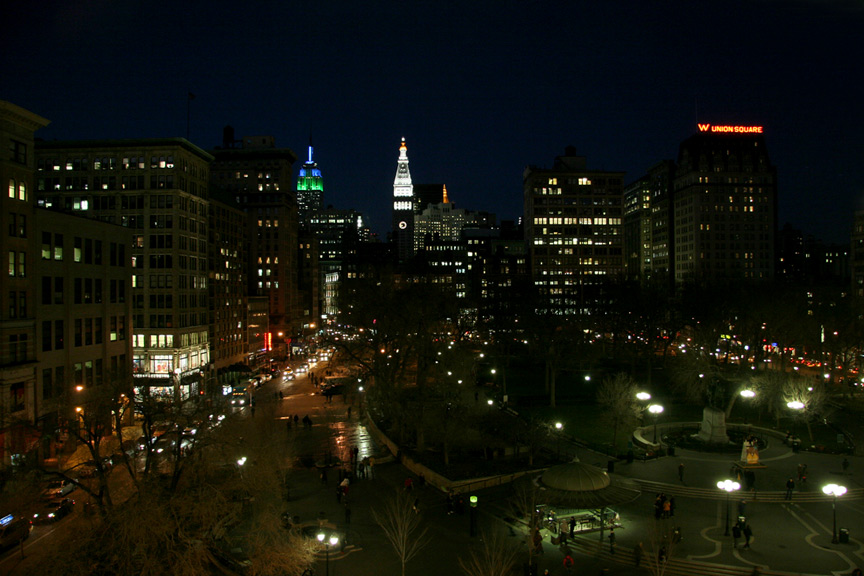
    This is Union Square at night from 14th Street looking north. Union Square is the nexus of Broadway, Park Avenue South, 4th Avenue, 14th & 17th Streets, University Place, and Union Square East and West, with Union Square Park as its centerpiece. It is a major subway station with 8 train lines (note the pagoda entrance bottom center).

    Union Square is its own neighborhood/district, with a breadth and depth of services that are hard to match. On the photo left, we have Union Square West, where you find various retailers and several notable restaurants such as Republic, the Coffee Shop, Blue Water Grill, and the Union Square Cafe (16th Street). The open area also on the left is the home of the famed Union Square Greenmarket, which operates three days a week.
    On the north side (photo top), there is the city’s largest Barnes and Noble superstore (occupying the entire 6-story, restored, former Century Building) and the W Hotel at Union Square. In the Park itself, we have the restaurant Luna Park, the Gandhi statue, dog runs, and playgrounds Just out of the frame on the far right is the first big development on the Square – Zeckendorf Towers.
    On the south side, from where the photo was taken, there is the Virgin Atlantic Megastore, Filene’s, a new behemoth Whole Foods market, and the public artpiece Metronome.

    A myriad of other retailers, services, and street vendors (such as Joe Ades) dot the perimeter of the park and the sidestreets. Check out the links throughout this posting to several of my posts on Union Square…


  • Equinox

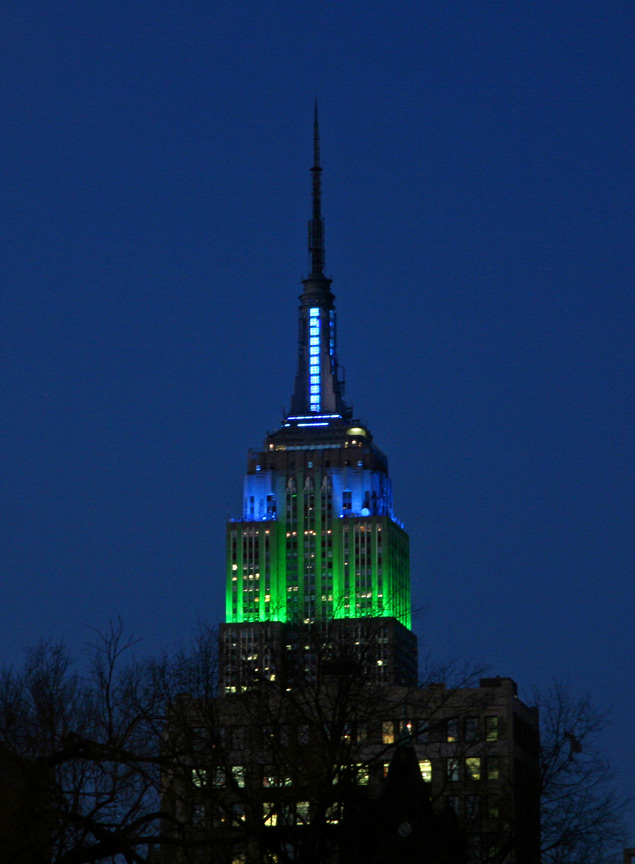
    This blue and green lighting at the Empire State Building last night was to celebrate Earth Day, which marks the exact moment of the Vernal Equinox occurs (the first day of spring in the Northern Hemisphere). This was last night at 8:07 PM EDT (on the equinox, night and day are the same length anywhere on earth). The idea of an international Earth Day was introduced in 1969 by John McConnell, and in 1971, UN Secretary-General U Thant signed a proclamation to that effect.

    There are actually two Earth Days – yesterday’s was the equinoctial Earth Day. The other Earth Day is on April 22. First celebrated in 1970, it started the environmental movement. The fact that there are two Earth Days can be somewhat confusing – if you would like to sort it out, click here for the equinoctial and click here for the April 22nd.

    The Empire State building has a sophisticated lighting system with hundreds of lamps and fixtures (see the site here). The building is lit in different color themes to celebrate various holidays, seasons, celebrations, and causes (it is lit white between color themes). Many wonder about the specific meaning of these themes – the official website maintains a schedule of tower light colors and their explanation. This photo was taken from 14th Street overlooking Union Square. I love night photography, tall buildings, blue, and springtime – this was the perfect photo op…


  • Impressionism

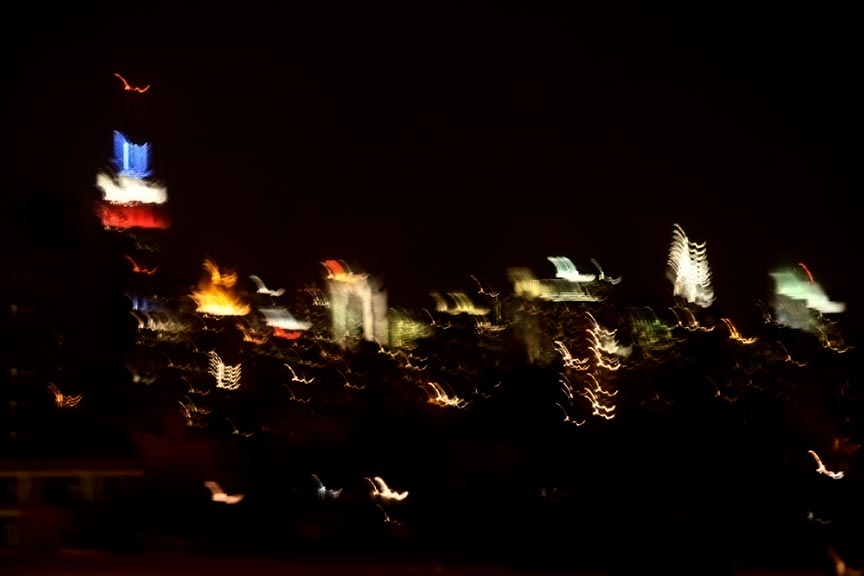
    The best views of the Manhattan skyline are from outside the borough – the Brooklyn Promenade, DUMBO, Queens, New Jersey, the Brooklyn-Queens Expressway, the Belt Parkway, and while traveling on the various bridges by car, subway, or on foot. A trip I often make is over the East River via the Manhattan Bridge. Coming from Brooklyn, there are several vantage points which offer spectacular views of many major building icons all at once – the Woolworth, the Municipal, the Empire State, the Chrysler, the Citicorp, the New York Life Tower, and the Con Ed, as well as the Statue of Liberty and the other bridges.

    Getting a photo is the challenge. I took this handheld at night while driving when traffic slowed to a halt. Even in this impressionistic view, many of the notable buildings can still be identified – the Empire State, Chrysler, Citicorp, and New York Life. In warmer weather, I plan to walk the East River bridges and do some photography. In the meantime, I recommend you take a trip across…


  • The East 50s

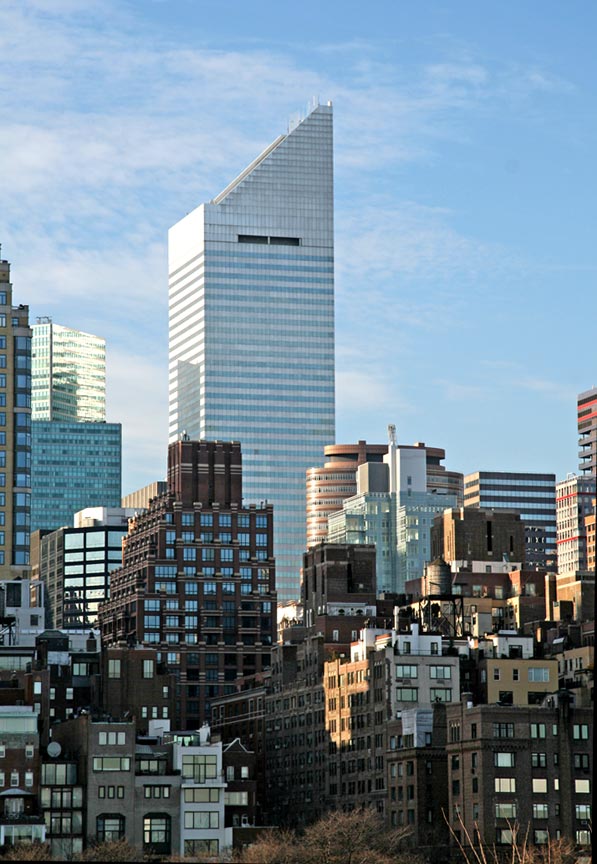
    The East 50s have long been regarded as one of the most fashionable districts in Manhattan, with some of the most well-known establishments – residences, hotels (the Waldorf-Astoria), retailers, and restaurants, with addresses such as Park Avenue, Madison Ave, Sutton Place, and Beekman Place. From the luxury condominium Veneto’s website: “Since the early 1920s, the East 50s have attracted the most influential and prominent members of New York’s society, from the Vanderbilts to the Rockefellers.”

    In the residental section close to the river, known as Turtle Bay, there have been many influential journalists, writers, and actors as residents, including the writers Alexander Woollcott, John Steinbeck (330 East 51st St.), John O’Hara (230 East 51st St.), Edgar Allan Poe, early feminist revolutionary journalist Margaret Fuller, and publisher Horace Greeley. Their lives and work have given the area the ambiance of the quintessential urbane, sophisticated NYC district and were important contributors to creating the Manhattan mystique that has drawn people from all over the country and the world.

    In this photo: the Citicorp Building with its distinctive angular roof line; to its lower right the oval shaped Lipstick Building (Philip Johnson); and at lower left, the northern end of Beekman Place. I guess we must say to residents there, vive la difference…


  • dinamic_sidebar 4 none

©2026 New York Daily Photo Entries (RSS) and Comments (RSS)  Raindrops Theme