• Category Archives Scenic NYC
  • The Real New York

    Posted on by Brian Dubé


    One of my favorite childhood toys was the homemade periscope. With this, one could spy, i.e. see other people secretly in a candid state. Media often tries to provide a periscopic look at the world with the investigative report, the behind the scenes inside look, and with programs such as 20/20 or 60 Minutes.
    We want to see people, places and things in their natural setting. We want it all and we want it unadulterated, unexpurgated, uncensored, uncut. We want to see what’s behind the curtain or that closed door.

    There is a New York City guidebook called Not For Tourists Guide to New York City, as well as a little tome I really enjoy from 2002: City Secrets – New York City. There are numerous websites promising to show you the hidden side of New York City: forgotten-ny, vanishing new york, Lost City, Ephemeral New York, Undercity, and Overheard in New York.

    In this website, I have endeavored to show you New York City in as real a light as possible. I am not a particularly private person and have revealed to you many aspects of my personal life, work, family, background, and interactions with others, as well as my personal perspectives and experiences in the city.
    Whether visitor or native, we grasp at all the things promising to show us the secrets because we want to see the Real New York – unvarnished, unsanitized, and uncolored by the Curse of Trade. The city we have read about, heard about, dreamed about, and portrayed in film. We want to see what lurks behind the shadows and fog and experience The Real New York…

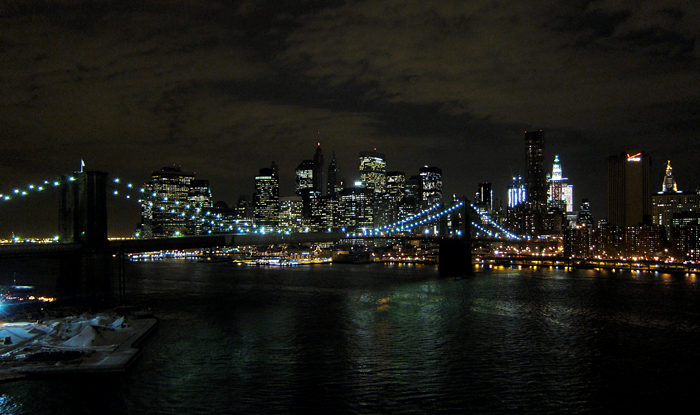
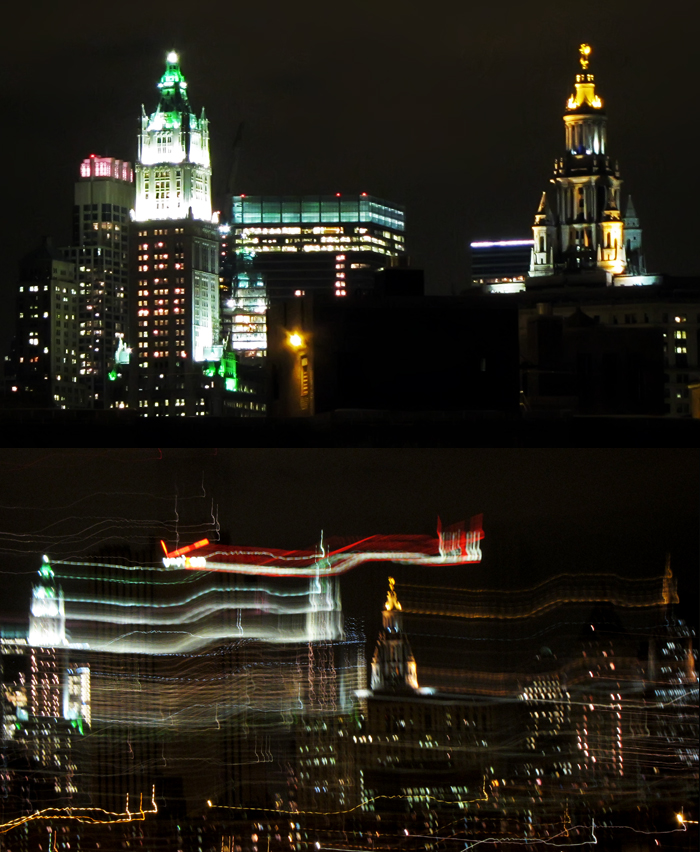
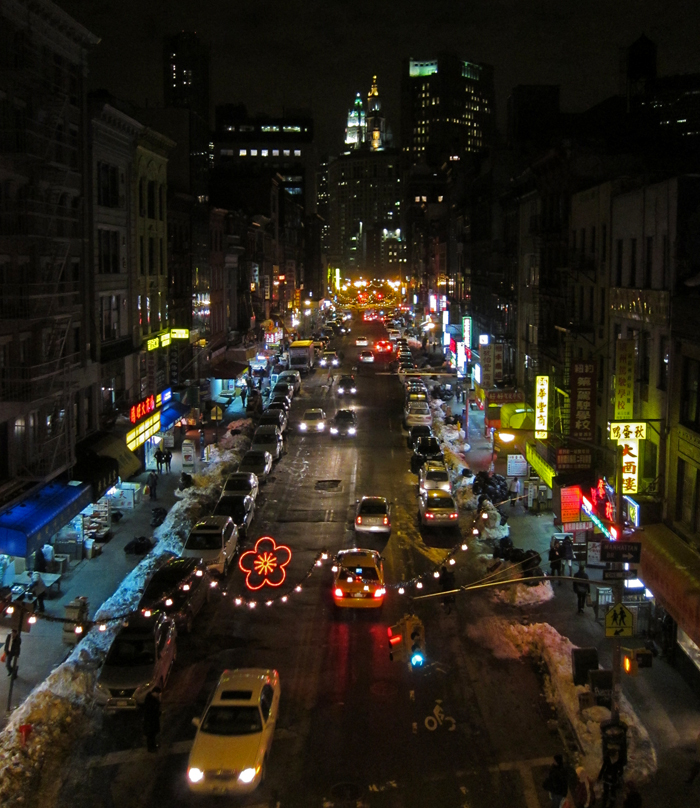
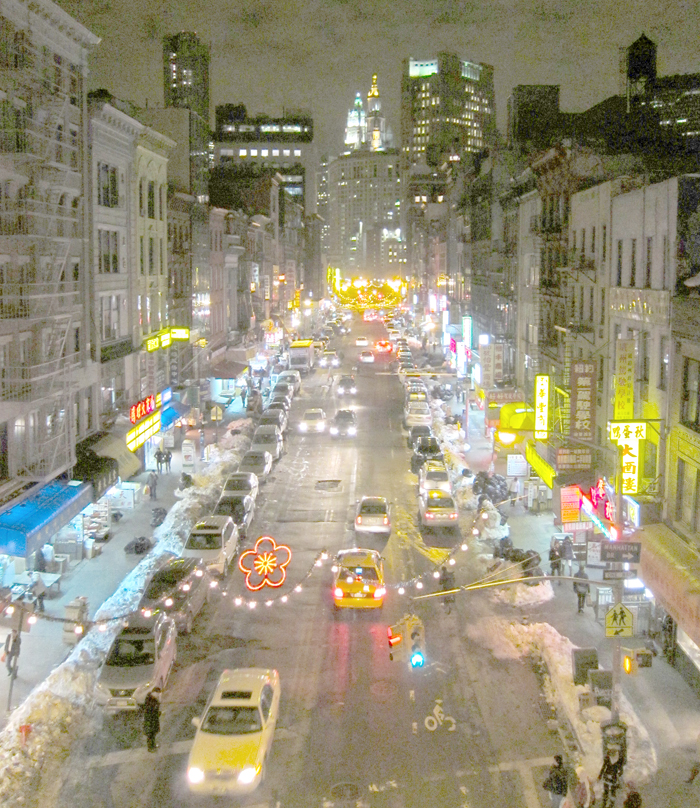
    Photo Note: this is a view looking south along East Broadway from the Manhattan Bridge. The two illuminated towers in the rear center are the Woolworth and Municipal Buildings. The photo effect was achieved using a Photoshop filter to remove the shadows and reveal all.

    Posted on by Brian Dubé

  • Not An Office


    A hamlet is a rural settlement that is considered too small to be a village. One distinction often made is that a hamlet does not have a church, whereas a village does. These details trouble me not, because I love hamlets and small villages. In England, the countryside abounds with small towns, villages, and hamlets, some so picturesque as to be incredulous. Places like Snowshill in the Cotswolds.
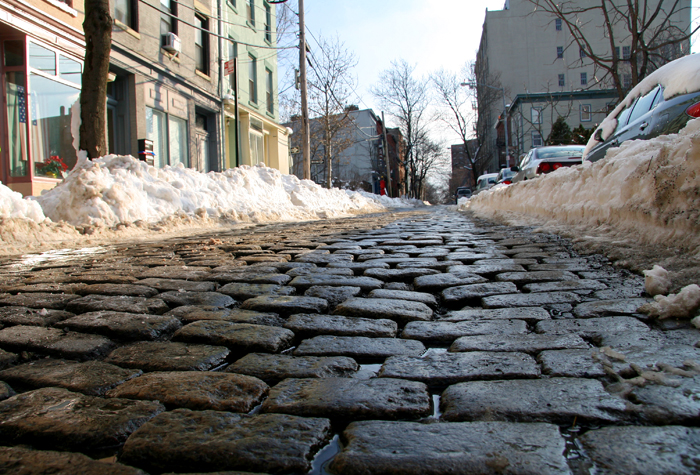
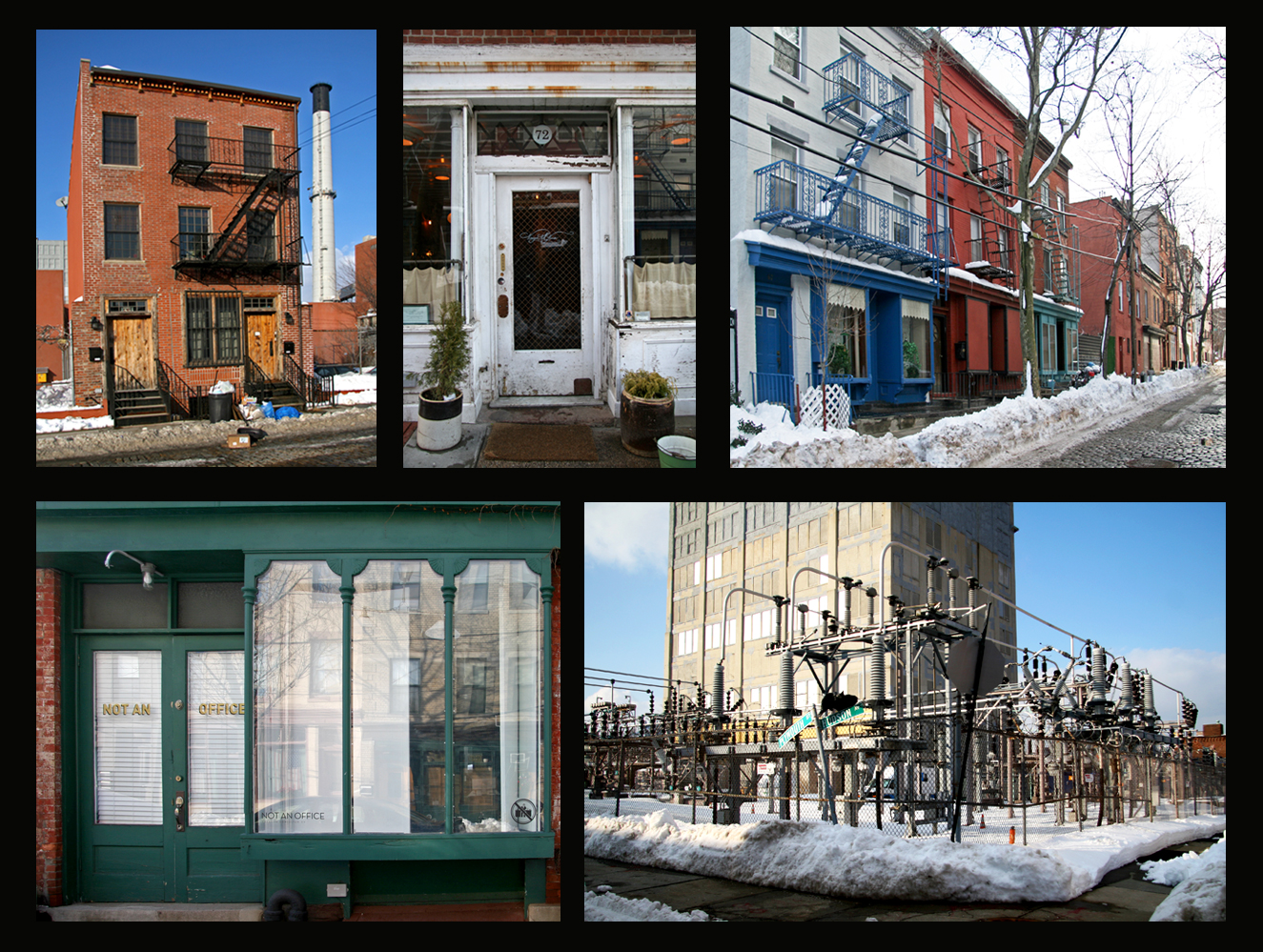
    However, I have never heard of anything in the confines of New York City referred to as a hamlet until I read an article in the New York Times about Vinegar Hill, Brooklyn. The very concept seems insane until you travel to this tiny enclave, only a few blocks in size, with cobblestone streets paved in Belgian Brick. See my full photo gallery here.

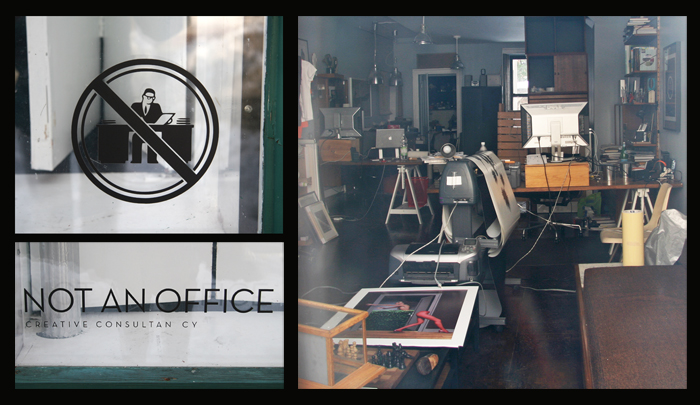
    The neighborhood is bounded by Bridge Street, the Brooklyn Navy Yard, York Street, and the river. The main thoroughfare is Hudson Avenue. There are virtually no shops, and one restaurant is open in the evening. At 54 Hudson, I ran across a business that identified itself as Not An Office. Peeking into the window, I did see evidence of a some sort of workplace.
    In spite of the snowfall, the neighborhood did exude charm, and I can easily see how some would be attracted to this place, which abuts Dumbo and the East River, only one stop from Manhattan on the F train.

    In 2010, the New York Times ran an article about Vinegar Hill called “The Little Town That Prices (Almost) Forgot.” Some readers were furious with all manner of accusations in the comments section, e.g. that the article would ruin the neighborhood and that the Times staff was out of touch with pricing.
    I think articles are more of a barometer of trends and messenger than trendsetters. Anyone investigating the area carefully will realize this place is going to appeal to very few – the serious dearth of services and high prices of real estate there will be a deal breaker for nearly all who chose to live in a city.

    Vinegar Hill feels almost like a hamlet. Almost, until you notice that the neighborhood is circumscribed by the Brooklyn Navy Yard, an huge Con Ed power generating plant, and the BQE (Brooklyn Queens Expressway). But this is New York City, and Vinegar Hill comes awfully close to a hamlet. It has no church, only one restaurant, and just when you think you have located a business, you find that it’s Not An Office 🙂


  • Big Secret on Little Street

    Streets, surprises, and secrets come in different sizes. What better combination is there than a big surprise and secret at the end of a little street? And what if that street is literally named Little Street?
    There is nothing wrong with the beautiful or wonderful that lies in plain view. But somehow it’s the secret discovery that really piques one’s interest and makes it even more special and its secretness feel like it is yours.

    When traveling in Europe, I was often astounded when finding major historical sites located in the midst of contemporary suburban settings. This is common there and, I imagine, is not seen as particularly shocking. When I first visited Versailles, I could not get over the experience of driving through an ordinary town, turning down a street, and seeing something as extraordinary as the palace of Versailles. Or the windmill in the neighborhood of Montmartre in Paris.

    One does get inured to the juxtapositions one lives among, and here, too, in New York City, I tend to overlook the outstanding architecture that I see daily – period homes dating 200 years old intermingled with buildings of every imaginable style and period. This city has a rich historical past, and the evidence is everywhere to be seen. 

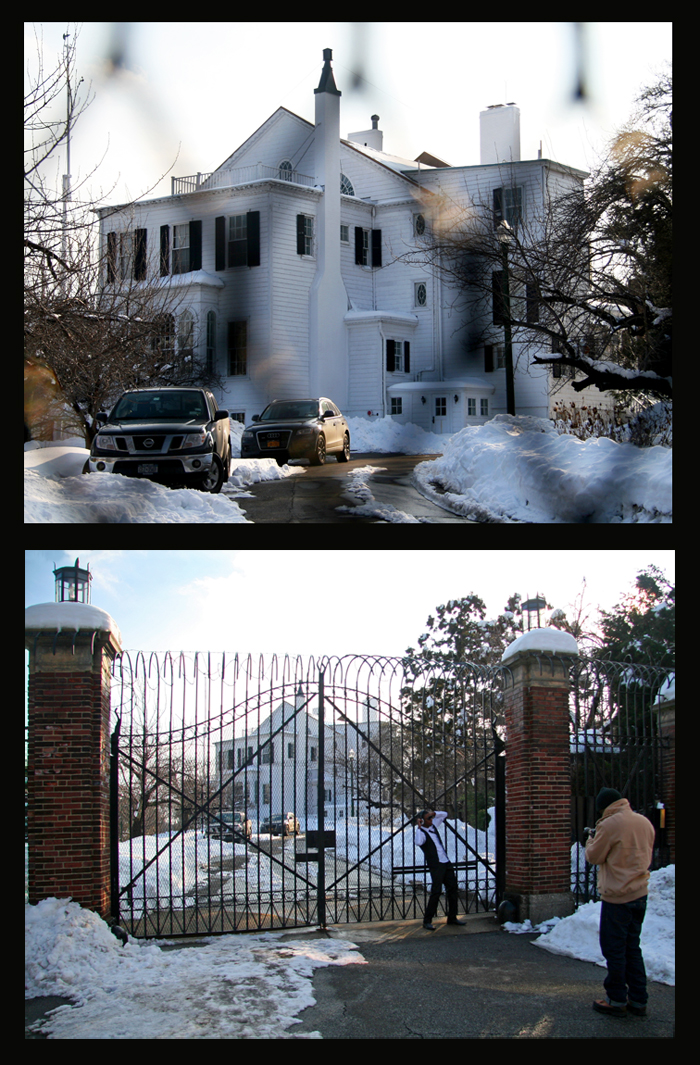
    While carousing through Vinegar Hill, Brooklyn, I plied my way to what appeared on my map to be the outer limits of the neighborhood. I was quite shocked to make a final turn from Evans Street at Little Street and be confronted with a gated mansion. A photographer and male model were busy at work, using this little known cul de sac as backdrop for their photo session. These streets abut the Brooklyn Navy Yard and the large white Federal style residence is Quarters A, the former residence of the commander of the Brooklyn Navy Yard, home to Commodore Matthew C. Perry at the time of his opening of Japan. In 2006, Christopher Gray did a story on the home in Streetscapes for the New York Times. From the article:

    In a New York of secret delights, the Commandant’s House at the Brooklyn Navy Yard is a secret secret. Built early in the 19th century, the big white house, formally known as Quarters A, is the yard’s oldest surviving structure, with exquisite Federal-style detailing.

    In private ownership since the Navy Yard closed in 1964, the three-story house can be glimpsed only in bits and pieces — over walls, through gardens and, distantly, past high gates. Its broad lawn offers a summer fantasy above the East River.

    Just don’t spread the news – that in Vinegar Hill, at the end of Evans Street, there’s a Big Secret on (a) Little Street 🙂


  • View Master

    I grew up with very few photographic images of any sort. We had no coffee table or travel books and few magazines. And, of course, we had no PCs or Internet, so moving images were limited to TV and movies. Our television reception was limited to 3 networks, one of which did not come in well at all. Programming was rather mundane from an imaging perspective – there was no Travel or Discovery Channel. There was no videotapes or DVDs. On rare occasion, we went to a movie theater or drive-in (see With Six You Get Eggroll here).

    There were a few family vacations to scenic destinations and the occasional family Sunday afternoon drive in the country. There was certainly nothing locally.

    Primarily, we had imagination, the world children live in, and it was a ripe fertile ground for me when growing up. And I had a View-Master.
    The only memory I have of any inspiring photos were those from a set of paper disks for my View-Master, with its remarkable stereo 3D images. I never tired of this small device and its ability to awe me with those three dimensional photos. Our collection of disks was small, and I remember viewing them repeatedly, particularly the disk of Switzerland and its alpine wonders.

    The occasional movie, such as Heidi with Shirley Temple, did much to cement my impressions of Switzerland as the dream alpine destination, only to be fulfilled much later in life on a whirlwind tour of Europe. In the 1980s, I made a number of trips to the West Indies, where I always looked for tropical mountains, explaining my obsession with the island of Dominica, as I wrote about in Miracles In Our Midst (see Part 2 here). It was always mountains and vistas – best, of course, were mountain vistas.

    On my recent excursion via the Manhattan Bridge to photograph the enigmatic 110 York Street, I decided to proceed across to the Brooklyn side, looping around and returning to Manhattan via the footpath on the south side of the bridge, affording spectacular views of the East River, Brooklyn Bridge, South Street Seaport, the Municipal and Woolworth buildings, and the financial district (see more photos here) with the American International Building and its mountain motif (see Magic Mountain here). If you enjoy panoramas, I do recommend a walk or bike ride across the Manhattan Bridge by day or night. You won’t need your View-Master 🙂


  • New York Rockies

    110 York Street – Part 2 (See Part 1 here.) (see complete photo gallery here)

    For years, on return trips home from Brooklyn to Manhattan via the Manhattan Bridge, I have observed this rooftop structure both by day and night. I promised myself that one day I would get to the bottom of this – a literal pursuit since this structure was atop a building located in Brooklyn, meaning I would literally have to venture down and explore under the Manhattan Bridge.
    What was particularly compelling about it was the four exposed white steel truss system on the roof of the building which was illuminated at night, bathed in blues, greens, purples, and reds.
    Recently, this came up in conversation with someone familiar with the structure – he told me that it was occupied by architects and located on York Street. This rekindled my interest to bring this mystery to a close. On my first excursion, I did a cursory drive-by to confirm its location – 110 York Street.

    On Sunday, I made a trip to Vinegar Hill, Brooklyn, with the intent of returning to Manhattan by foot over the Manhattan Bridge and taking a series of photos. I intended to time my afternoon so that I would cross the bridge after dark when the rooftop was illuminated. My return, however, was too early.
    But I was on a mission, and I decided that I would return the following day after work when dark to cross the bridge again by foot. I had a burning desire and intention with my own mantra: Neither snow, nor rain, nor ice, nor gloom of night stays this courageous ambassador from the swift completion of his appointed rounds.*
    There was snow and ice and gloom of night. But was I courageous?

    There are two pedestrian pathways on the Manhattan Bridge – the one the north side is for bicycles – this is the side I needed to view the York Street building. However, a chain link fence obstructs a clear line of sight most of the way, so I found it necessary to climb and stand on a railing for the taking of photos. The roar and vibration of vehicles and the elevated subway was bad enough, but worse was having to use two hands to stabilize the camera while balancing atop a 4″ wide steel railing which may or may not have been icy. See this in better detail at my photo gallery here.

    The building at 110 York Street serves as the offices for a number of construction firms and, most notably, Robert Scarano Architects, who originally occupied the top floor of this 100-year-old former factory building in Vinegar Hill. For a needed expansion, a 5,200-square-foot rooftop two story addition was designed by a member of the Scarano firm, Dedy Blaustein. The addition was completed in 2005. The lights used are a Color Kinetics LED system.

    Blaustein’s inspiration for the rooftop structure was the bridge: “We’re not the main thing here,” he says, gesturing toward the bridge. “That is the main thing here. It’s so dynamic. I had to do something crazy.” Some have referred to it as the “Jetsons Building.” In response to critics, he said: “I didn’t design it for people to like it, I designed it for people not to be able to ignore it.” The project received a 2005 Design Award from Metal Architecture magazine and a 2005 Certificate of Appreciation from the Brooklyn AIA. From the Sarano website:

    The Manhattan Bridge is the most visibly striking element of the site, running parallel to it only 20 feet away. For this reason, we designed an exposed steel truss system for the skeleton to intensify the dialogue between the structures. The design embodies a strong sense of dynamics. The structural axis is separated from the building exterior finish, providing a sense of movement, which is enhanced by the flying roof, sharp angles, and horizontal texture on the surface.

    My affair has finally come to a close. I feel quite worn, perhaps not unlike the mountain climber who finally tastes the bittersweet success of arriving at the summit. Driven by an illuminated outline not unlike that drawn by a friend to describe the mountains of Colorado (see Part 1), I found this journey’s end at 110 York Street in the foothills of the New York Rockies…

    *The original seen on the General Post Office building reads:
    “Neither snow, nor rain, nor heat, nor gloom of night stays these courageous couriers from the swift completion of their appointed rounds.”
    The sentence appears in the works of Herodotus, describing the expedition of the Greeks against the Persians under Cyrus, about 500 B.C.
    Note: The firm of Robert Sarano is the subject of much controversy – both acclaim and official censure. Robert Sarano is a New York City native, born in Brooklyn. He became a registered architect and started his own firm, Scarano Architects PLLC, in 1985. His academic credentials and awards are many. The firm has been responsible for over 600 buildings in New York City. However, sometimes referred to as the bad boy of architecture, Sarano has also seen a loss of self-certification privileges, loss of filing privileges, numerous lawsuits, and worker deaths on 3 of his projects and has been charged with violation of zoning or building codes on 25 projects in Brooklyn.


  • New York Rockies

    ColoradoPart 1 (see Part 2 here)

    I do so love the mountains, and here, in New York City, unlike perhaps San Francisco (a mountain lover’s dream city), I must make do with the skyscrapers of glass and steel. ‘Tis better, I suppose, than the lowlands of Holland. But it pales in comparison to the experience of the American West. I journeyed there in the early 1970s for the first time by car. I cannot imagine a more compelling road trip than going west by auto.

    Before leaving, I discussed my trip with a close friend who vividly described what I would see. “Do you know the way you drew mountains as a kid?” He illustrated with his finger in the air a typical jagged outline. “That’s what it will look like.” “As you drive through Colorado, it will be flat. And suddenly, the Rockies will pop up.” The whole image of a child’s jagged outline and mountains popping into view was burned in my mind forever.

    And it was all true. As we drove through eastern Colorado, the landscape was no different than the flats of Kansas which we had spent a day passing through. Heat waves rose from the road and landscape in a classic mirage. I squinted for hours for those Rocky Mountains, only to find an my eyes fooled in one way or another. It became very tiring. Then there appeared the faintest mountain outline, which did not disappear, but only grew in size, jagged and dramatic beyond belief.
    The first night, the wind howled in the trees with a certain sound only heard in the mountains. I still listen for that sound. Everything was so big and grand. Colorado was everything John Denver had promised in his song Rocky Mountain High.

    We examined our maps the next morning for the steepest roads, the ones marked dangerous for what I assumed would offer the most dramatic views. We navigated the narrowest, most precipitous two lane mountain roads I have ever seen. The unobstructed views through crisp clean air were absolutely astonishing. It seemed unbelievable that motorists would even be allowed to travel such roads at altitudes over 10,000 feet – one tiny error in judgement, and it was sayonara.

    More remarkable was our conversation that night with two fellow campers who were Colorado residents. When we expressed our harrowing but exciting journey of the day, they only laughed as they told how they enjoyed riding at night, driving as fast as possible on the most treacherous of roads. To me, this was sheer lunacy. Not only did one have to contend with serpentine roads and hairpin turns, but Colorado was also PITCH BLACK at night – there were no street lights in those mountains. I certainly was a risk taker, but this couple was truly out of their minds.

    We journeyed on through Wyoming, Oregon, and California that summer in a 30-day, 10,000 mile trip. To this date, it was the longest I have been away from New York City since 1970. For the resident here, spending long periods away from the city really gives a new, fresh perspective. Returning from that trip, I could see and feel its gritty, dirty, and very hard character. The mountains of Manhattan were different now.

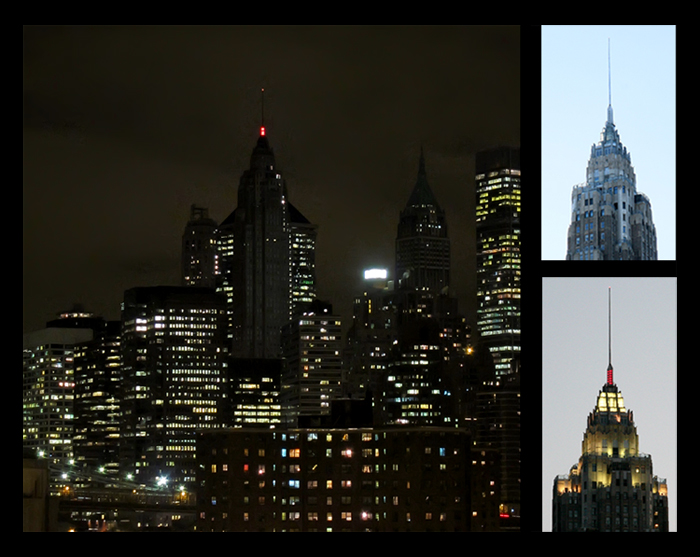
    On November 5, 2007, I wrote Magic Mountain, about the American International Building: “It is famous for its motif of a snow-capped mountain – the base of the building is clad in granite while the upper portion, clad in limestone, becomes lighter in color until one reaches the very top, where it is white.” The upper and lower right photos are from that story. A bit of the Rockies, popping up from the canyon floor of lower Manhattan.

    But the night vista from the Manhattan Bridge in today’s photo was not the reason I went on a journey as a Mountain Man, high in the New York Rockies…


  • White By Design 3


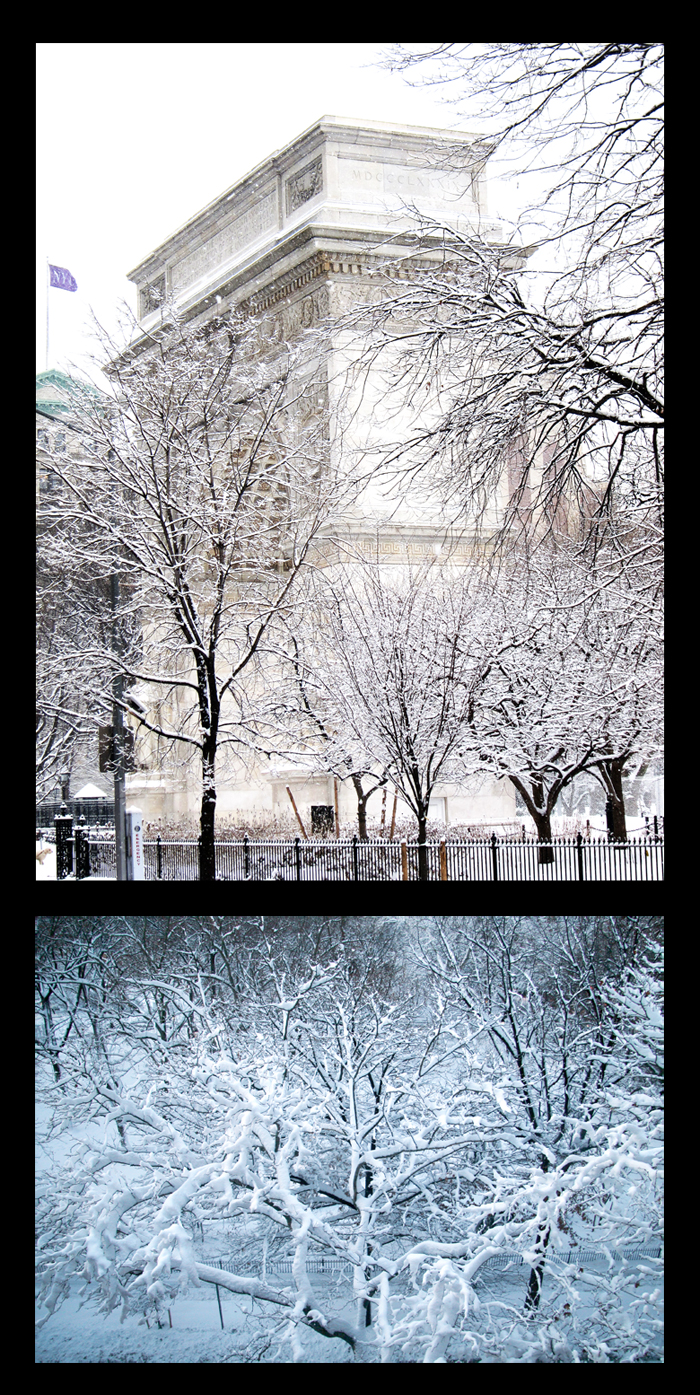
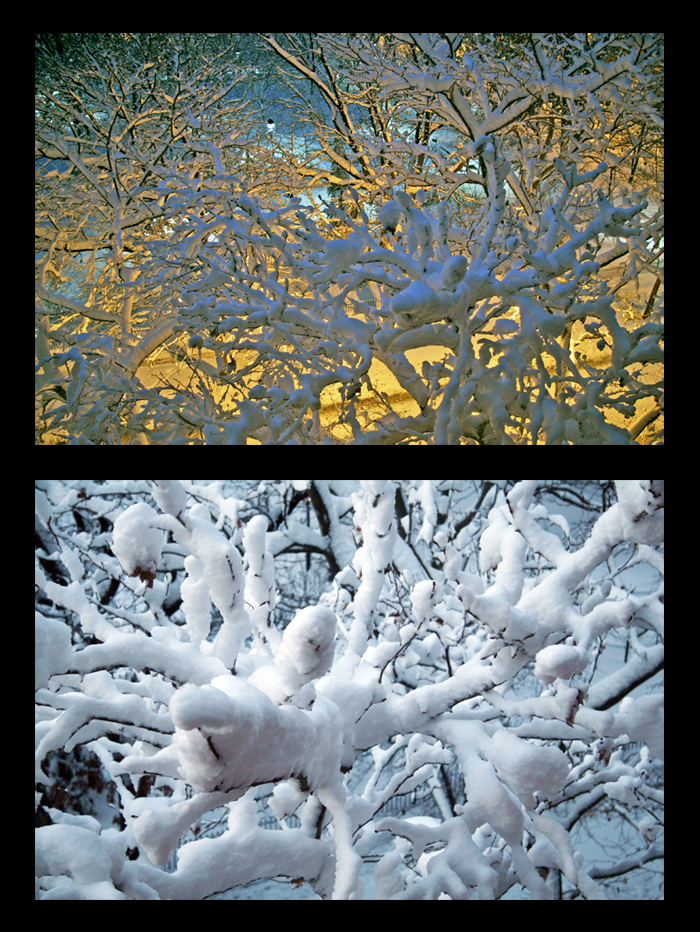
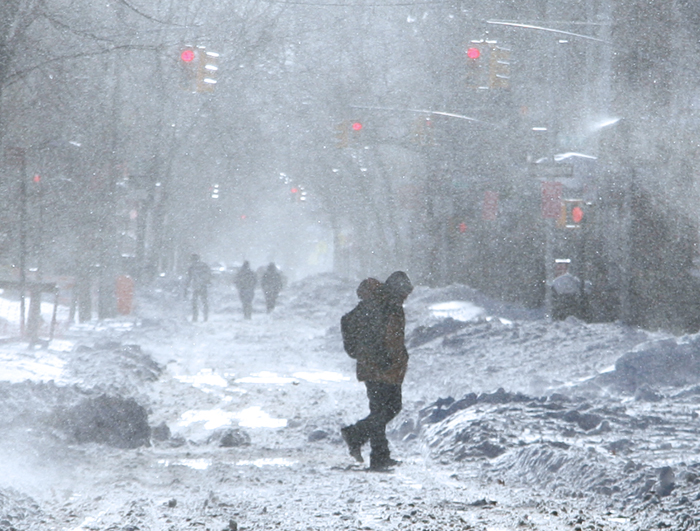
    Another blizzard. Last night I was called at midnight and informed there was a major snowfight going on in Washington Square Park. I was too lazy to bundle up and venture out for the photo op. However, I did begin taking photos yesterday, going into last night and into this morning.

    I have done many stories on this winter’s blizzards and past snowstorms in New York City. I have also done a series of stories called White By Design. See the links below.

    White By Design, White By Design 2, White By Desire, Blizzard, Friends P1, Friends P2, We Got Skiing Too, Shifting Gears, Snow Play, In Like a Lion, Gotta Shoot Village Cigars, Slush Fun


  • Gotta Shoot Village Cigars

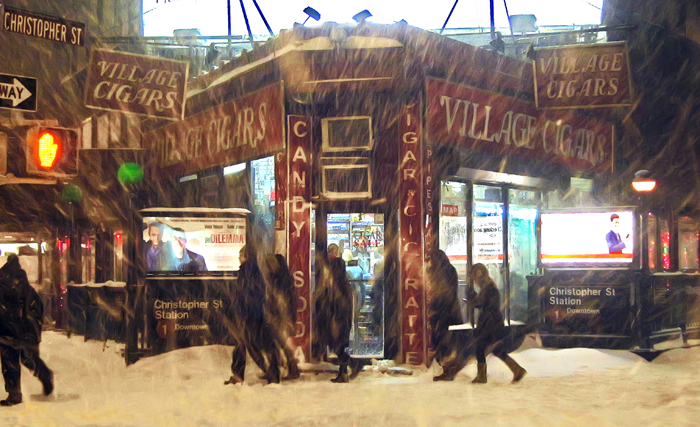
    There are many iconic photographic images of New York City. Typically I leave them alone – iconic for me translates as it’s already been done and done well, you probably won’t do it better or in a more interesting way. So, rather than look like a wannabe or copycat, I look elsewhere.

    However, there are many, many subjects in this city that, given the right time and conditions, will lure anyone with a camera. Photos like that of Village Cigars in a snowstorm by Igor Maloratsky. A mysterious Hess Family triangular mosaic is set in the sidewalk in front of Village Cigars (see my story and photo here).

    Village Cigars, at 110 7th Avenue South at the corner of Christopher Street, occupies a unique, tiny, one-story triangular building. This neighborhood landmark has been located there since 1922. It has been seen in film, and there have been numerous images taken over the course of its history, in a variety of seasons, available in both color and black and white, as stock photos for advertising, art prints, greeting cards, and photos sold on the streets to tourists.

    Try as one might to exorcise those legendary photos from ones mind, similar conditions often acts as a trigger. Caught in a snowstorm while walking down Christopher Street with a camera in hand? Gotta shoot Village Cigars 🙂


  • Friends – Part 2

    (see Part 1 here)

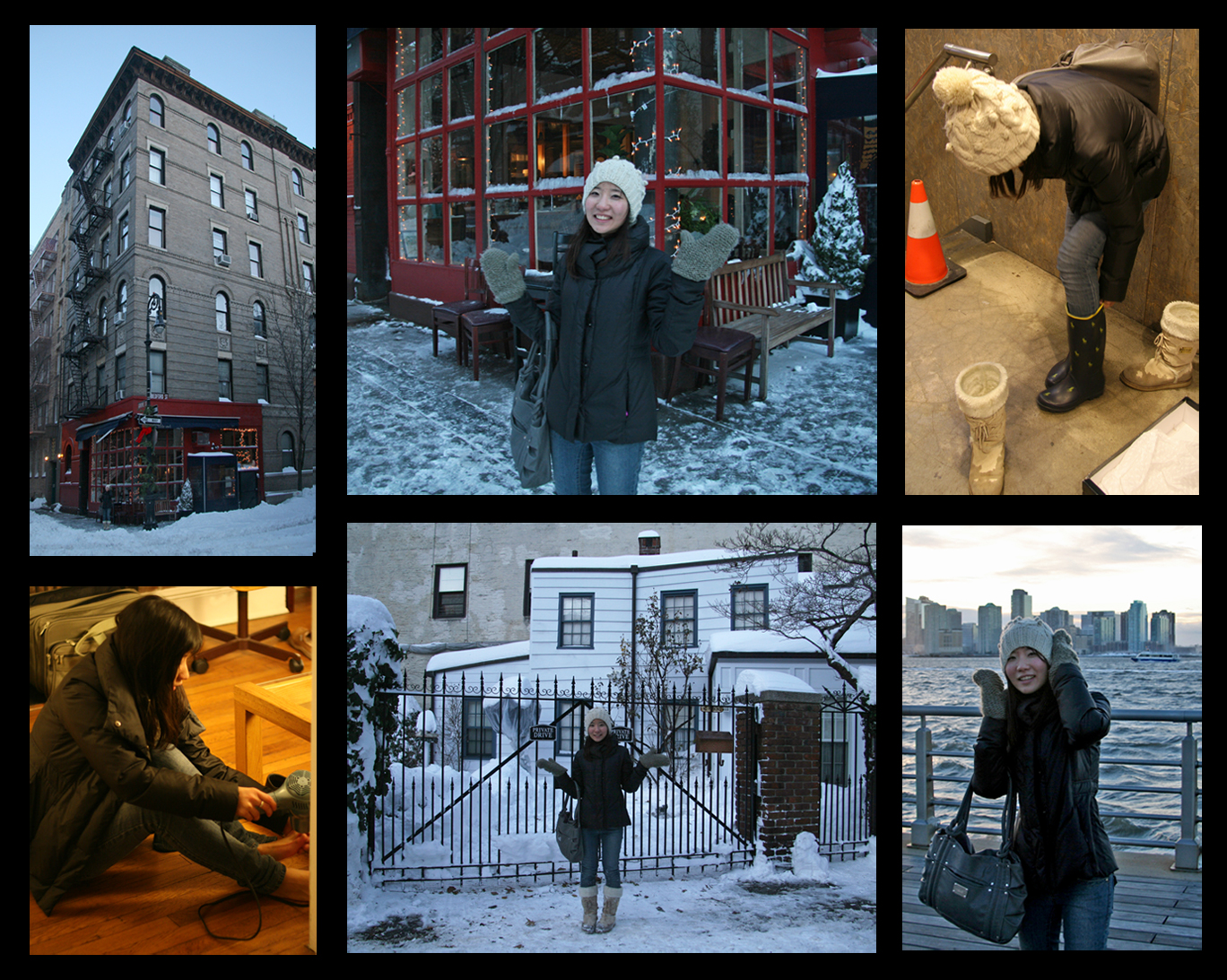
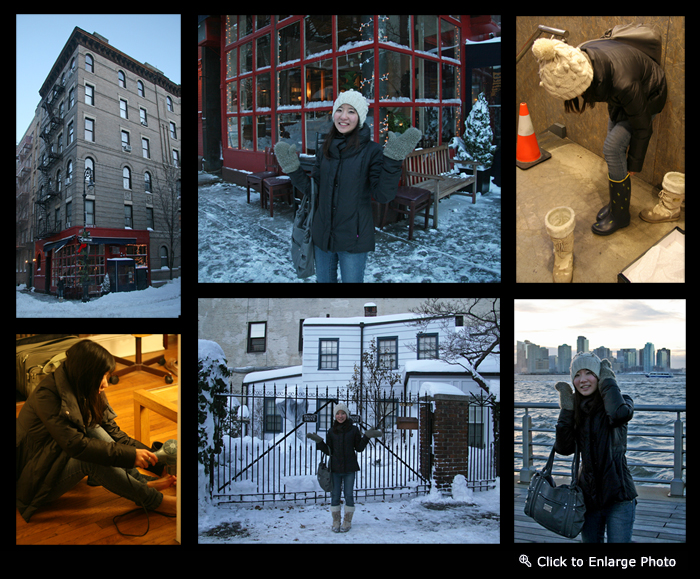
    Meet Su Jung and read about our serendipitous adventure together. See my complete photo gallery here.

    A young woman approached me, asking if could I take a photo of her in front of the building at the corner of Bedford and Grove Streets. As a photographer I always relish the opportunity to do this for a visitor. My puzzlement as to why this building was soon answered when she asked was this in fact the building used in the popular TV series Friends? I answered that I did not know (it turns out it is) but if so, it would certainly only be for the exterior shots only and that the balance would have been done in a studio. She appeared to be somewhat disappointed. This type of thing is a common quest and also the type of thing tours often feature. However, just seeing a building or location without the characters can often be a bit of a let down.

    My second question as to why she was alone, deep in the West Village in one of New York City’s biggest blizzards in history was also soon answered. Su Jung is a 22-year-old engineering student from Korea who was studying for one year in California, was visiting New York City for the Christmas weekend, and had been trapped in the city due to a cancelled plane flight. She did have friends in the city with her, but they were uninterested in making the pilgrimage in a blizzard to accompany her.

    Seeing an opportunity to brighten her day and at the same time have a companion, I explained my day’s mission and asked if she would like to come along. I got a resounding yes, so off we were into the streets and storm. I also told her of this website and asked if she would like to be a story. She was delighted, so my time with her also included photos punctuating our adventure.

    I now switched gears, turning this much more into a private tour, knowing full well that for me, any route would take me through snow laden environments and plenty of photo ops. I showed her my favorite spots, including Commerce Street, Cherry Lane Theater, Grove Court, and Washington Mews.
    However, I had planned to go all the way to the Hudson River, truly insane in this weather. Was she game? A resounding yes again. She did ask how far, and I explained that in Manhattan, the river was never that far, with the entire island being only 2 miles wide, and we were in fact only a few blocks away.

    We went to the Christopher Street Pier. The wind was howling with gusts over 50 miles per hour – absolutely frigid, cutting your face like a knife. The sun was setting, and the lighting and atmosphere was dramatic. I pointed out the Statue of Liberty, the Verrazano Bridge, the financial district, and New Jersey across the river where snow was being blown, looking like a sandstorm (see gallery). Su commented how waves were rolling in like the ocean. Even though she had a wool hat and mittens, she often felt it necessary to cover her ears.

    On our return, I took Su Jung by 121 Charles Street, on of my favorite anomalies in the entire city (lower center photo) and then down Bleecker Street, stopping in renowned guitar shop Matt Umanov and Murray’s Cheese. I followed with a jaunt through Washington Square Park, which she had not yet visited with its Christmas tree still up.

    I had a nagging problem, however – a girl with soaked, cold feet. Like many, she had purchased Ugg-styled boots not realizing these were not waterproof. In fact, they operate more like sponges than protective footwear in wet weather. The situation desperately ns eeded to be dealt with, and she said she would try to find a place to buy new boots. In this weather? I asked. Most stores were closed, and she did not know the city. If she liked, I could take her up Broadway toward Union Square, where most likely David Z or Shoemania would be open. Shoemania was living up to its name – it was a veritable zoo, with hundreds with the same dilemma shopping for footwear, appropriate for the storm.

    Su Jung made a quick decision but showed concern about my time waiting. No matter – I was committed to seeing her through this and out of those wet boots. She made her selection quickly but was worried that she was taking the last size 4 and another woman after her expressed interest. No matter, I replied. You were first and your feet are cold and wet. There were no appropriate socks, however, so back out into the cold in wet feet, with Su Jung saying she would deal with this at her hotel on the Upper West Side.

    I was bothered by this – my home was just a few blocks away, and I agonized about suggesting the obvious, which could certainly be misconstrued. But I asked – did she want to stop at my home, warm up, dry off, change her socks, and then go to her hotel? I was surprised to get the same charming yea that I had gotten the entire afternoon. Arriving at my home on Washington Square North, I explained my good fortune to live in such an historic building overlooking a park (and my reason for living in the same apartment for 30 years).

    Once inside, I attended to the first order of business: I gave Su Jung a selection of several pairs of socks and a hairdryer, suggesting she use it to dry her feet. She seemed very much at home, sitting in the center of my living room on the floor. When I suggested she could use a chair, she responded that she was quite comfortable there – she was Korean.

    Afterwards, we spent some time perusing my website. It was 8PM and we had been together nearly 4 hours. I suggested she may want to return to her hotel and friends. Another yea, and off we were to the subway, where I told her that she was to take the C train only. A parting hug and off she went.

    Overall, it was a remarkable day. Su Jung’s incredible trust as a newcomer to New York City gave me an unprecedented sense of responsibility. Her joyous and adventurous spirit was truly disarming. No need to find a special building on Bedford and Grove or watch a TV series if you’re looking for Friends

    Note: Here is the email I received from Su Jung the following day:

    It was the most awesome day in the last 3 days in NY. I couldn’t ever imagine I would meet Brian and have fun looking around the real NY life that I could ever get by myself. I was kind of deseparate from the calcellation of the flight to LA cause I’d been thinking Cali was much better than NY. It seems like Californian in spacious and quiet area by oceans can afford to enjoy their life more than New Yorkers in the packed city. The 3days’ itinerary was too short that I was traveling around only the main landmarks like Times Square and Wall street just crowded by tons of tourists around so I couldn’t reveal the charm of New York. However, yesterday’s journey changed my mind and I gotta love staying more days in NY thanks to the snow storm and it was ‘no pain no gain’:D. My feet were frozen by the watery ugg boots.

  • Friends, Part 1


    I learned many years ago that recruiting a companion to go out into a blizzard was an exercise in futility. Although many can perhaps be persuaded to see the reasons behind such a venture, apart from children, very few are going to voluntarily leave the cozy confines of one’s home to subject themselves to a blizzard. On one occasion, I had tried to persuade a girlfriend to go out into a blizzard with blinding wet snow, so strong it required goggles. The response was a very confident “no way” – understandable, I suppose. Arguments aside, the facts speak for themselves – there are good reasons that the city looks like a ghost town in these conditions.

    But my office was shut down, and although I had things to do indoors, this record-breaking snowfall really begged for some photography – a greatly added incentive to bundle up and venture out. A snowstorm this crippling is a rare phenomenon in New York City. Deserted streets. Even as a I write this, I have not heard a vehicle pass by in over one and a half hours.

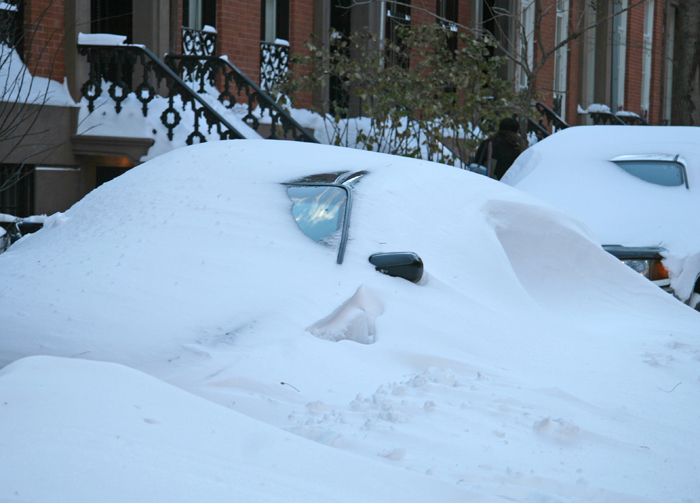
    I headed into the West Village, where I knew I would find the least adulteration of the snowfall. I was amply rewarded with sites that rivaled anything I have seen here in a long time. Cars completely buried and row houses so beautifully framed and adorned by snow, some still with Christmas decorations. See my photo gallery here.

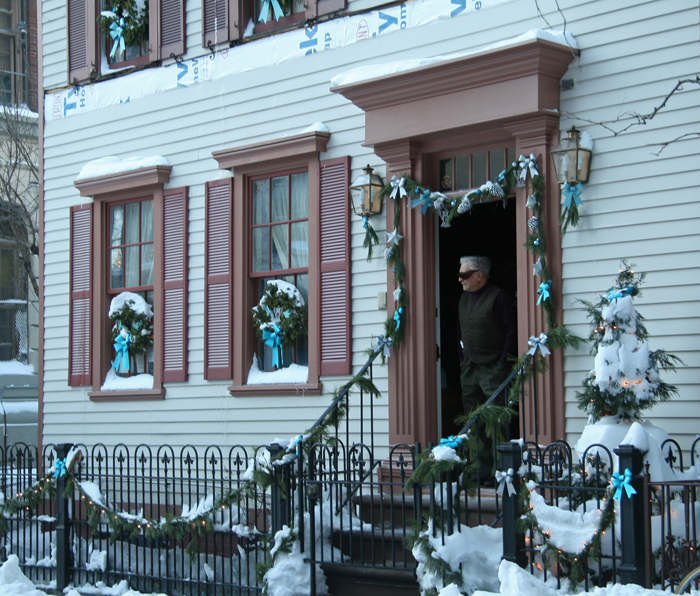
    At the corner of Bedford and Grove Streets, I stopped to take a photo of 17 Grove, which was so exquisite with its wreaths in every window adorned with blue bows, each frosted with snow. As an added bonus, the owner had taken a moment to open the doorway and admire the winter wonderland outside his home. We spoke briefly in a way that bespoke of two people meeting in a small rural town. I so love this part of New York City, and the snow just gave it an extraordinary ambiance.

    But this was not to be the day I thought it would be. Not at all. Across the street lies the building whose exterior was used for the filming of the TV series Friends. It is here that I would meet a lone traveler who would change my day (see Part 2 here)…


  • Coulda Been a Contender

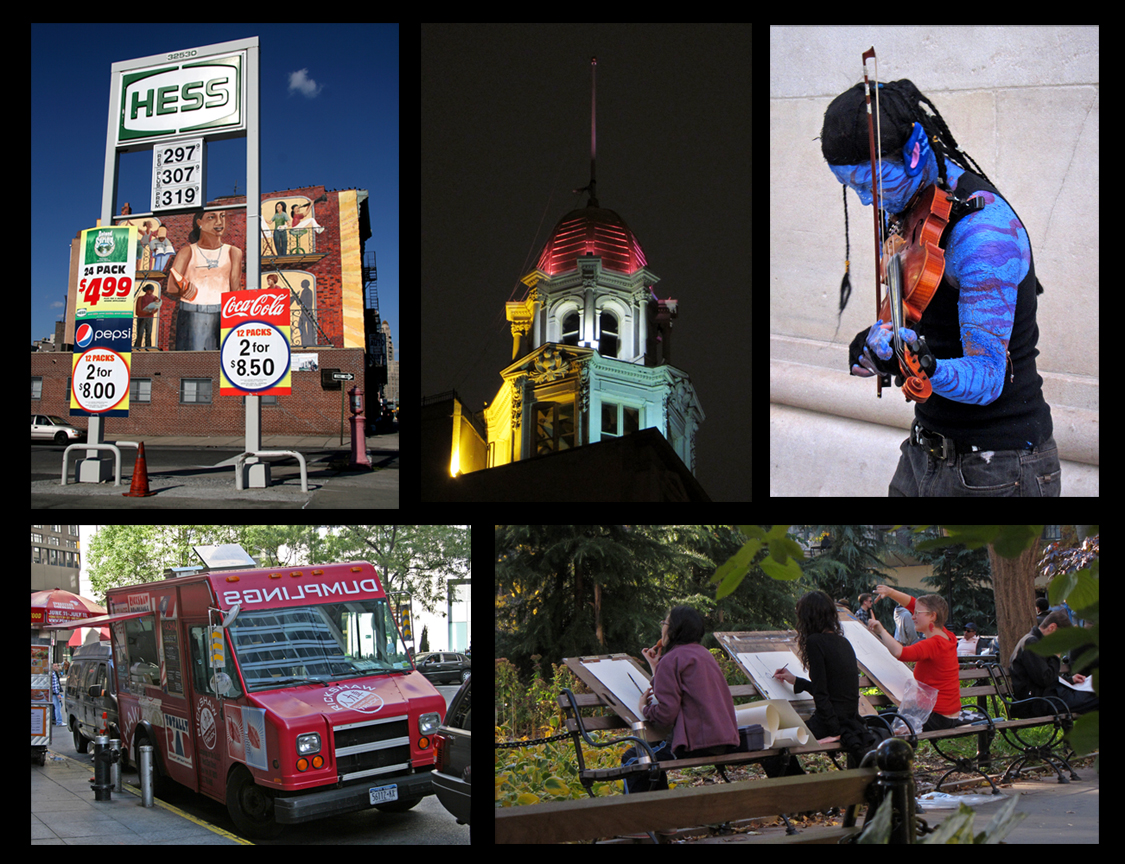
    In my travels throughout the five boroughs, I see and photograph many things, but I am unable to get adequate information about some of these subjects. For this and any other number of reasons, I may not feel that they lend themselves to the type of stories I have evolved to writing in this website. So, today I have assembled a collection of photos that did not quite make the grade as far as individual postings, but, in the words of Marlon Brando, any one of them Coulda Been a Contender

    Photos (Left to right, top to bottom): Hess Station and building mural on 4th Avenue Brooklyn, Sohmer Piano Building, blue violinist under Washington Square Arch, Dumpling Truck in the Financial District, students painting in Washington Square Park.


  • Ultimate Dream Machine

    Flying has always been a metaphor for me. In Umbrella and Chevy, I told of my childhood passion reaching the point where I resorted to jumping off my family’s Chevy with an umbrella, hoping for an uplifting experience but only getting a slower descent. Later in life, I did take a few flying lessons, but helicopters remained the impossible dream.

    The helicopter is the ultimate vehicle of transport – they are the most versatile vehicles in existence, giving complete access to three-dimensional space. They can fly virtually anywhere and can hover. However, there is a price to pay. These machines are very complex, difficult to fly, noisy, and require constant maintenance. It is possible for these aircraft to even vibrate themselves apart. In short, they are man’s triumph of brute force over nature. And expensive for all concerned.

    I was only in a helicopter once in Hawaii for a brief flight into the Kalalau Valley on the Island of Kauai. This was the ultimate adventure for the tropics lover – a pristine area of an extraordinary island in the Pacific accessed by man’s ultimate vehicle. The trip was short and expensive but exhilarating. The cliffs of the Na Pali coast on the north shore of Kauai are one of the world’s most beautiful natural spectacles. The only surprise – and disappointment – was the incredible noise. Hearing protective headsets were given to us at the beginning of the flight.

    So what better method of exodus and entrance to the crowded New York City metropolis than by helicopter, the only vehicle that can go from any point outside the city to the heart of Manhattan itself without suffering the slings and arrows of outrageous traffic? I once heard Bill Gates speak in Manhattan. As we waited his arrival, we were informed that he was being delivered via helicopter. Other major VIPs such as Donald Trump and the mayor are well-known for their use of helicopters, the ultimate transportation luxury. When the Concorde was flying into New York City, the flight included transport to and from the airport via helicopter.

    I journeyed to the VIP Heliport with a friend who is the only person I know who has traveled into the city by helicopter. I made a special trip specifically to 30th Street and the Hudson River for this story. Apart from the greenway along the Hudson River, it is rare that anyone would be this far west in this part of the city.

    At times, in spite of my love for this city, I do get island fever, and the island of Manhattan feels like a prison of sorts. At those times, in spite of noise, vibration, and danger of being in a complex contraption built by men using brute force over nature, I still fantasize about being picked up on the roof of my building and swept away in the ultimate dream machine 🙂


  • Afraid of Snakes

    If you have read my story Jungle Lovers, you know how I feel about the importance of guidance and influence of children and how disappointing my own experience was growing up in a blue-collar town, where New York City was feared likes snakes are, the streets were said to be riddled with pitfalls every step of the way, and con men could be found around every corner.

    I do not regret moving to New York City, I have not fallen into any pits that were too difficult to climb out of, and vistas like that in today’s photo are in fact what I have more often seen around many corners. And I like snakes. 

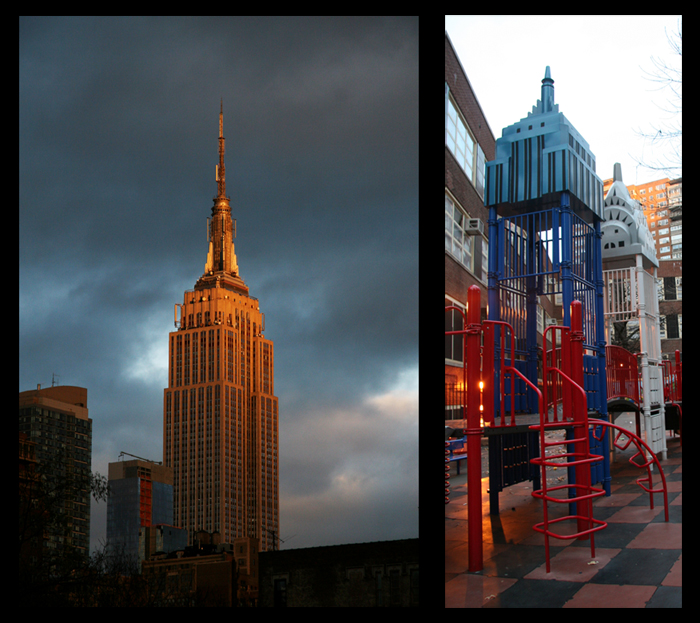
    Icons such as the Empire State and Chrysler buildings are visible from nearly everywhere. From 1931 until 1972, the Empire State Building was the tallest in the world. Although no longer the tallest building even in the United States, the Art Deco skyscraper still has icon status and is a metaphor for TALL (it is now the 3rd tallest in the USA and 15th in the world).

    After a time, any resident or visitor to the city can become inured to the vistas and architecture of New York. However, along with the people, the structures of the city define our metropolis. Interest in architecture itself is often eclipsed by the dynamism of New York’s many other attractions – restaurants, shops, clubs, bars, theater, parks, festivals, and street life. So, it was very uplifting to see this school playground in Chelse,a where models of the Chrysler and Empire State buildings are connected by bridges, decks, ladders, and slides and serve as part of the school’s outdoor recreation area.

    This children’s playground becomes a place to develop a familiarity with and appreciation of the architectural icons of New York City. And to learn that, at least in this jungle, if you’re careful, there is no reason to be Afraid of Snakes 🙂


  • Not Moving to Florida

    I recall an uncle extolling the virtues of living on Eagle Lake in Maine in the winter, telling me how wonderful it was, about ice fishing, and how you had the entire lake to yourself. Not to offend and retort aloud, I thought to myself – of course you have it to yourself, who would want Eagle Lake in the winter?

    Although not as extreme, the seasons of New York City are never pleasing to me (see Weather Means Whether). I look forward to the spring, the harbinger of all good things to come, but it is always a disappointment. It is often too wet, colder, and windier than I would like. Flying kites or trying to sit on a park bench seems to be an exercise in hand rubbing.

    But not to worry, summer is on the way, certainly the season we wait for and celebrate. Until we have a few unseasonably warm days in late spring and I realize that summer in the city will be oppressive and crowded with tourists and that there is no respite from the heat without leaving – autumn and winter look very appealing now. After all, the solution to cold is quite simple, is it not? Just add more clothing. Summer arrives, and all my worst fears and memories are realized. The teaming masses mixed with high humidity and relentless sun make New York City in the summer virtually unbearable. But summer is actually quite short, and autumn is just over the horizon.

    Autumn, however, is just a tease for what a perfect world might feel like (see Quito here) and a clear reminder that what nature giveth, it also taketh away. Days are often too cool to spend extended periods outdoors, and we now have more of the hand rubbing of spring. Leaves are falling, things are dying, and I am already fearful of the death grip of winter, which is fast arriving.

    Winter arrives, and although we are blessed with little snow in the city, it is more uncomfortable than I remembered. The respite from the heat I wished for in July and August looks foolish now – what was I thinking? The holidays do provide a much needed distraction before the bleak stretch of winter starting in January. Soon I am looking to spring again, only to reflect and reprimand myself for not enjoying what I had last year.

    As winter closes in and I realize that every season in New York City has its shortcomings, the thought of other, perhaps better, places, rather than other seasons, rears its head. But I am a little wiser now. I have been down that road too. No, best I enjoy images of a foliated New York in summer, because, at least for now*, I’m not moving to Florida 🙂

    *Interestingly, my aforementioned uncle, steadfast in his commitment to Maine and its hard winters, eventually became a snowbird and moved to Florida late in life where he lived out his life.

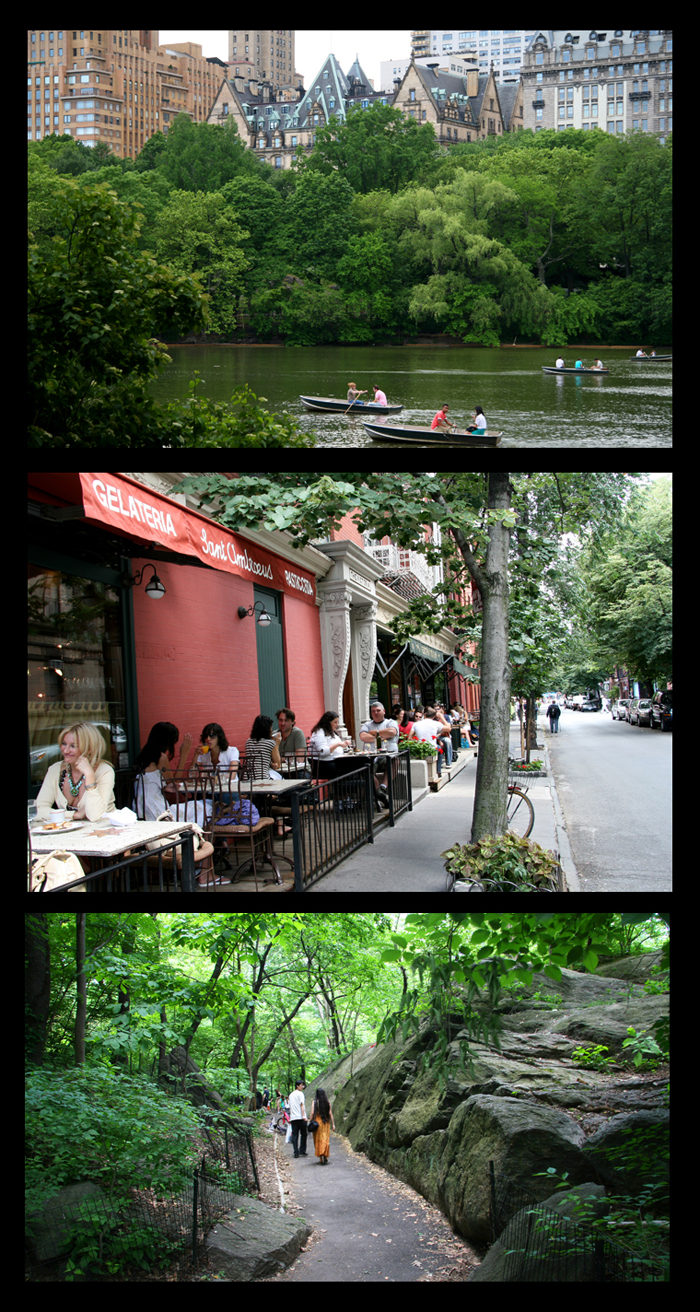
    Photo Notes: Top – The Dakota as seen from the Lake in Central Park. Center – West 4th Street. Bottom – the Ramble in Central Park.


  • Paused and Poised


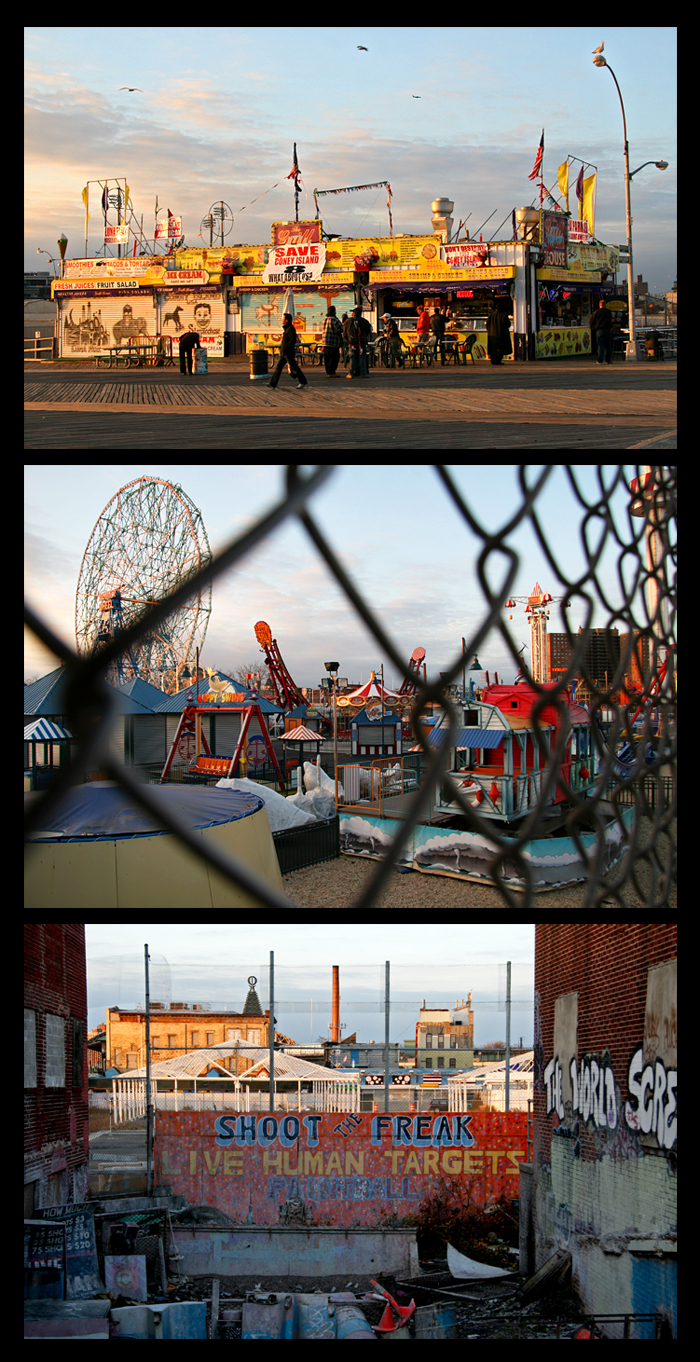
    I read articles, one after another, and yet I still have no idea what exactly is planned for Coney Island or what will actually come to fruition. Apparently, wide-scale development is coming. And, as might be expected, the sentiment is all over the spectrum – the detractors, the disgusted, and the hopeful.

    The passions are completely understandable. Coney Island is a very important piece of real estate, and it is amazing that beachfront property in New York City can sit fallow in such a disgraceful state for decades.
    You are also not just dealing with a piece of real estate here. Coney Island is, for many, a world of nostalgia, childhood memories, sights, sounds, smells, play, a world-renowned boardwalk, and for some, a neighborhood to call home. Many have memories of it as a world-class resort. And this is New York City, where multi-generational family is heralded and neighborhood pride runs deep.

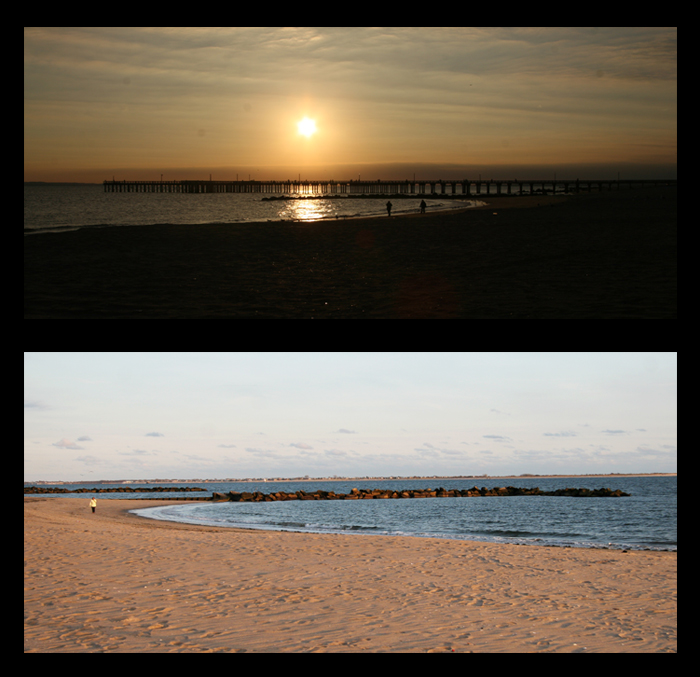
    I visited yesterday, a somewhat bleak but clear November afternoon. It was like a ghost town before sunset. A few photographers were setting up tripods for a sunset shot. Seagulls soared overhead. A few food concessions were open with a handful of patrons. The boardwalk was free of debris. The beach was empty as far as the eye could see, less one woman. The rides were eerily quiet – the various parks closed, the Cyclone and Wonder Wheel idle. Everything paused and poised…


  • dinamic_sidebar 4 none

©2026 New York Daily Photo Entries (RSS) and Comments (RSS)  Raindrops Theme