• Category Archives Scenic NYC
  • The Total Call

    Posted on by Brian Dubé

    There are things that are iconic about certain places – the Eiffel Tower, the Great Pyramid of Giza, the Great Wall of China, the Empire State Building, the Taj Mahal, Stonehenge, the Colosseum, or the Grand Canyon. Some things which are emblematic involve natural phenomena that may require special conditions and a particularly unique vantage point. These things are often seen in photos and rarely seen in person by the visitor, like the Golden Gate Bridge and San Francisco draped in fog.

    San Francisco is notorious for its fog and its myriad of variants around the city and its neighborhoods, with one of the most unique climatic conditions in the world. Known for its microclimates and submicroclimates, temperature conditions can vary by as much as 9°F (5°C) from one block to another. One neighborhood can be sunny and warm, another foggy and cool.

    On one vacation to San Francisco many years ago, on the recommendation of a native (see Weather Means Whether), I traveled north over the Golden Gate Bridge to Marin County to hike to the summit of Mount Tamalpais, the tallest hill in the county. Marin County is known for its natural beauty, protected natural environments, and spectacular views of San Francisco and the Golden Gate Bridge.

    On this day, I was extremely fortunate and was rewarded with one of the most spectacular things I have ever seen. Fog, as thick as a blanket, completely covered everything in view except for the uppermost sections of the two towers of the bridge.

    Observing this next to me was a fellow hiker, to whom I commented about this spectacular event. He responded, in a slightly hushed voice, with slang completely unfamiliar to me, “It’s the move, man, it’s the total call.” I had never heard the words “move” or “call” used in that way, but his intonation had an air of biblical gravity, and perhaps, not unlike Genesis 1:31, assured me that it was very good. I heartily agreed.

    Fog in New York City is much less common, and we certainly do not get the spectacular conditions seen in San Francisco. Recently, however, when driving on the Belt Parkway in Brooklyn, an unusual temperature drop and high humidity gave rise to an extremely dense fog, at times almost completely obscuring the Verrazano-Narrows Bridge, in conditions somewhat the inverse of the classic Golden Gate Bridge phenomenon. On July 8, 2008, I wrote about the Verrazano using photos taken under foggy conditions, but not nearly as heavy.

    Capturing today’s photos was particularly problematic, driving alone on an expressway with only a point-and-shoot camera. But opportunity was calling, so I took this photo blind with my arm extended up through an open sun roof.

    I hope someday you get to see the Verrazano Bridge like this. And I am sure you will agree that it’s the move, man, it’s the total call 🙂

    Posted on by Brian Dubé

  • New York City’s Brand

    Posted on by Brian Dubé

    If you were in Midtown Manhattan on a spring day, it would be easy to find no signs of spring other than air temperature and changed light. But as far as birds, bees, grass, flowers, trees, and any other living testaments to nature’s seasonal exuberance, you need to look further afield from the concrete jungle that my high school guidance counselor was apparently quite familiar with (see Jungle Lovers here).

    There are parks where nature reigns – Central Park, Prospect Park, Van Cortlandt, et. al. And there are neighborhoods and streets where nature shines. But, like most other living things in New York City, certain plants (and people) do much better than others. So, in aggregate, the city has its own brand of nature, often dominated with plants that are hardy survivors, such as the London Planetree, or the Callery Pear seen in today’s photo on lower Fifth Avenue in Greenwich Village looking north to the Empire State Building.

    A city and its people define its environment. And here, even Mother Nature yields to New York City’s brand …

    Related Posts: Spring Madness, Verdant Oasis, Spring Fever, Conflicted, While It Lasts

    Posted on by Brian Dubé

  • A Place Called Home

    When I drove a New York City taxicab in my college years, West End Avenue was just WEA on my trip log. A quiet, safe destination, with easy, traffic free driving along the wide, 4-lane, two way boulevard, and lots of big buildings.

    If you read about West End Avenue, you will encounter words and phrases like “quiet”, “convenient”,” stable”, “safe”, “community,” or “Park Avenue of the West Side.” This grand boulevard is an extension of 11th Avenue and runs north-south from 59th to 107th Street on the Upper West Side, parallel to Riverside Drive (and Riverside Park), which lies one block West. Upper Broadway, with its plethora of shops and transportation, lies one block east – hence the “convenient” part of the equation. The tenancy is very stable, with many families living here from generation to generation.

    Like its East Side analog, Park Avenue, West End Avenue is strictly residential, with virtually no businesses or commercial traffic except for trucks making local deliveries. There are no attractions here, and located so far west that very few, other than residents, ever find themselves here.

    The neighborhood, however, was not always the genteel place it is today. From the New York Times:

    For nearly 60 years in the middle of the 20th century, parts of West End Avenue were ”déclassé,” Mr. Salwen said. S.R.O. hotels, prostitutes and drug addicts became common on some cross streets. But by the 1980’s, the street had begun to recover its grandeur.

    Like Park Avenue, the street is dominated by large apartment buildings. Most buildings here are prewar and over ten stories tall, dating back to the early 20th century.

    From the Wikipedia entry for WEA: “The street is noteworthy for its almost unbroken street wall of handsome apartment buildings punctuated by brief stretches of nineteenth-century townhouses and several handsome churches and synagogues.”
    I agree, but do find the “almost unbroken street wall” of these large apartment buildings rather imposing. Having spent all of my adult life downtown in Greenwich Village, I find these hulking structures to be somewhat intimidating.

    However, prewar apartments are typically larger than average – once inside these solid buildings, the spaces are quite comfortable and make very pleasant, quiet residences. And although the buildings feel so out of scale with humans, a home is more than just a space in a building – it’s a personal place created by people. New York City has tremendous variety of residential structures, and whether small or large, short or tall, bright or dark, lavish or lean, in the Village or on WEA, inside every building in every apartment, for someone, there’s a place called home 🙂


  • White by Design 2

    The beauty of a new fallen snow is very short-lived in the city – this photo was taken as I was writing this, and already, most has melted. Nature doles out its pleasures when it sees fit, and in New York City, nature’s bounty is often tempered. With a warm infrastructure and the masses walking, white snow soon becomes brown mush and/or melts away. There is little land or surfaces where snow can rest untouched.

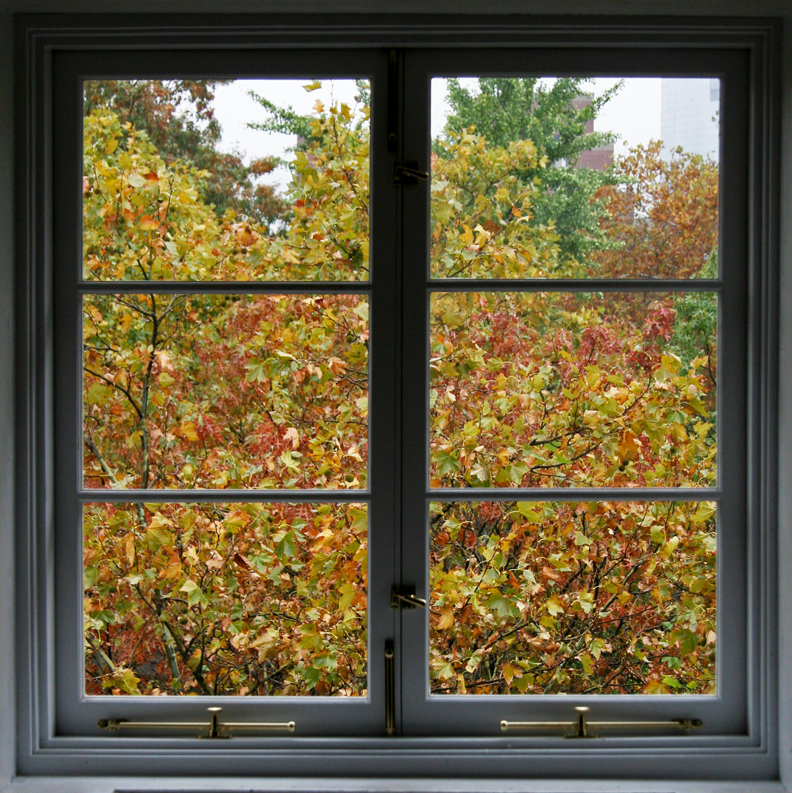
    On November 17, 2009, I wrote White By Design. That was, however, design by men and women. For the natural version, I invite you to enjoy this view from my window. Contrast it with the same vista taken in the autumn on October 29, 2009, when I wrote Wood, Glass, Brass and Trees. Catch, if you can, nature’s White by Design in New York City, because it is beautiful but fleeting 🙂

    For more White By Design, go here.

    More seasons: Signs of Summer, Enchanted April


  • Head for the Hills

    He was a little ungainly and awkward, like Basil Fawlty, John Cleese’s character in Fawlty Towers. But, unlike Basil, who, though incompetent, is basically harmless, my innkeeper had a slightly uncomfortably mysterious side, like Norman Bates of Alfred Hitchcock’s film Psycho.

    The inn, in Southern New England, was perched on a hilltop and had extraordinary views. Most local residents were not even aware that the place existed or that access to this hilltop with such exceptional vistas was possible, much less that an inn was perched atop the mountain. The place was atmospheric and had been hand-built in stone by the owner’s parents with a wonderful flagstone terrace.

    I was compelled to book a room there. I just love the mountains. The innkeeper appeared to be the only one present, and at night, he disappeared to some unseen cottage on the property, or so he said. There were only two rooms in the inn, and on my stay, only my room was occupied. The place was musty. Books were everywhere. At night it was pitch black everywhere and, though intrigued to explore, with my imagination running wild, I decided it best to stay in my room.

    I spoke at length with the innkeeper on one occasion about hill or mountain lovers, and he put it quite succinctly – there are hill people and valley people. If this is how humanity is divided, then I must be a hill person. I do love a mountain drive – the more precipitous, the better. If a Michelin map to a European country I am traveling in indicates a difficult and dangerous road, that’s the road I prefer.
    The hilltop perch is what first drew me to the Tibetan retreat on Lighthouse Hill in Staten Island. Very few visit this remarkable place, and, like my hilltop inn in New England, it is virtually unknown. See additional photos here.

    The Jacques Marchais Museum of Tibetan Art was founded in 1945 and officially opened in 1947 by Jacques Marchais (the professional name used by Jacqueline Klauber), a collector and expert in Tibetan art who acquired the largest collection in the Western world. She never visited Tibet during her lifetime and sadly passed away the year following its opening.

    The rustic complex of fieldstone buildings was designed by Marchais – the architecture, gardens, fish pond, and terraces resemble a Tibetan Buddhist mountain monastery, or gompah. You will also find sculptures on the grounds, as well as bright-hued prayer flags. It was the first Himalayan-style structure to be built in the United States and the first museum in the world devoted exclusively to Tibetan art. The Dalai Lama himself paid a visit in 1991. In addition to the museum’s display of art and objects, there are classes and special programs. My first visit was for a Tibetan festival.

    Of course, the love of mountains as a building site is far from being my exclusive passion – Lighthouse Hill, along with nearby Todt Hill, has some of the most opulent homes on Staten Island. The preference of hills and valleys is replayed around the world by the well-heeled. Some will live in the valleys or by the ocean, while others, with a penchant for drama, danger, and vistas, will head for the hills 🙂


  • Time Travel

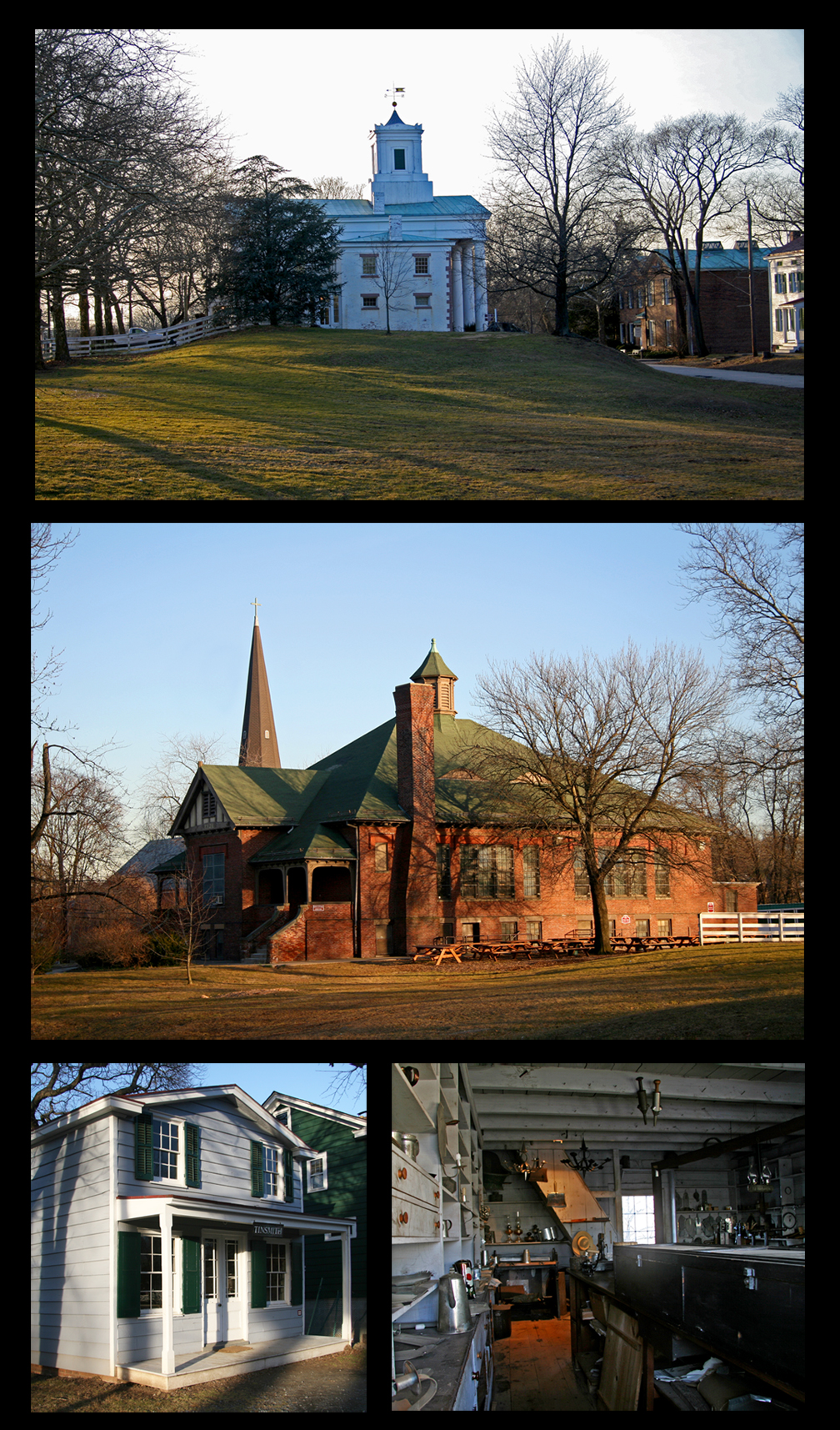
    If I asked if you thought this was colonial New England or the South, of course you would know it was a trick question; this is a website that features New York City exclusively. Nonetheless, it is a shocking set of images to imagine within the five boroughs of New York City, and I hope that, like me, you are scratching your head in amazement and wondering where this could be.

    For daily readers of this site, you may guess that we are in Staten Island – we just crossed the Verrazano Bridge yesterday. And you are correct.

    My real mission here involved a number of destinations, but Historic Richmond Town was unknown to me and was a complete surprise, suggested by a native when I asked if there were any historic areas. I expected to find a nice home or two – some small pocket or enclave.

    I had no idea that Historic Richmond Town (established in 1958) is one of America’s living history museums, like those found in Colonial Williamsburg or Old Sturbridge Village in Massachusetts, where my family visited when I was young. Richmond Town was the former county seat and commercial center of Richmond County (Staten Island).

    The concept of a living history museum goes back to open-air museums that appeared in Scandinavia in the late 19th century. The first was King Oscar II’s collection near Oslo in Norway, opened in 1881. The American style focuses more on lifestyle and generally depicts various trades and activities of the period recreated.

    Historic Richmond Town dates back over 300 years to the 1600s, very old by USA standards. There are 27 buildings in the 25-acre village on a 100-acre site. Some structures are original to the village, while others have been moved from other locations on the island. There are many styles of buildings here, including outstanding examples of Dutch Colonial and Greek revival architecture.

    There are many exhibits that can be seen in Historic Richmond Town – blacksmithing, tinsmithing, basketmaking, coopering, weaving, candlemaking, spinning, etc. There is the oldest standing elementary school in the United States. Here you will find a Dutch Colonial farmhouse, established in 1740, and the Print Shop, established in 1821. Historic Richmond Town houses one of the oldest operating printing presses in America. See their website here.

    When I visited, none of the buildings were open or exhibits operational. When the weather gets warmer and the growth greener, I plan to do a more thorough visit. I’ve always loved Time Travel 🙂


  • Secede


    There are a number of reasons why it has been nearly 4 years and I have not yet featured anything from the borough of Staten Island. It is far and inconvenient, and perhaps I was a little lazy. The photo explains another reason. The current fare going to Staten Island across the Verrazano Narrows Bridge is $11 one way (it is free on the return trip). That two-digit fare is just frightening. The bridge can be spectacular, however. See my posting on it here and an additional photo gallery here.

    Staten Island can be reached via a number of ways. By auto, there are 4 bridges: three from New Jersey and the Verrazano from Brooklyn. There are buses via Brooklyn (and from Manhattan). Access from Manhattan can be had via the Staten Island Ferry (the fare is now free). I have taken the ferry many times, most often just for the vistas, which I highly recommend.

    Staten Island is decidedly suburban in feel compared to the other boroughs, and it is the only borough without a subway system connected to the other boroughs – it is serviced by a fairly extensive bus system. But for real exploration of the hinterlands, it is best to have your own wheels.

    Staten Island has had an interest in secession from the city for some time, and in 1993, Staten Islanders actually voted to secede from New York City. Implementation was blocked in the New York State Assembly. In 2009, a new bill was introduced by state senator Andrew J. Lanza from Staten Island.
    New York City itself has dabbled with the idea of seceding from New York State. The issue of inequitable distribution of revenues back from the State is one of the primary motivations for these secession efforts. For Staten Island, the drama could well be called “If at first you don’t secede.”

    For the time being, Staten Island is still part of New York City, and there are a number of very worthwhile things to see in this borough, as well as a few big surprises. You will see that here this week 🙂

    Toll Note: Those using the E-Z Pass system get a discounted rate of $9.14, and Staten Island residents pay $5.48. There was some outrage in 2009 when the toll was raised, of course, but as we all know, you can’t fight City Hall or secede 🙂


  • Fire and Ice


    I have seen fire and ice, and it was spectacular.

    Sunsets are a bit like Japanese restaurants in New York City – everyone knows the best one. In the case of sunsets, everyone has seen the most spectacular at some special time and place. So I am not going to tell you that I have seen the best sunset ever. However, I will say that this was the most remarkable sunset I personally recall seeing in New York City. While taking these photos, a woman ran out of a neighboring building into the frigid cold with camera in hand to capture the fleeting moments. See my entire gallery of photos here.

    After a day of adventure seeking with a friend, Red Hook, Brooklyn, was on our late-day agenda. We were not looking for a sunset, but as we approached the waterfront at dusk, I had a sense that something good lurked around the low-rise building known as the Beard Pier Warehouse. We explored the southeastern side of the warehouse, which was extremely nice, but I was getting antsy knowing that the sun was rapidly setting on the other side.

    A UPS truck blocked our exit on the narrow roadway which flanks each side of the pier building. Waiting to back out of the one-way street was like watching the sands of time.

    Have you ever driven around a corner or bend in the road where an extraordinary vista is suddenly revealed? This was our experience as we crossed a small alley on to the west facing side on Beard Street Pier and nature’s full glory burst into view. As I scurried to the water’s edge, I was equally stunned to see what at first look appeared to be an array of white glass – they were, in fact, smooth stones covered with a layer of ice. The red-orange sun illuminated the arched cast iron doorways and red brick of the pier building. The whole set looked like an installation art piece entitled Fire and Ice


  • Veterans Memorial Pier

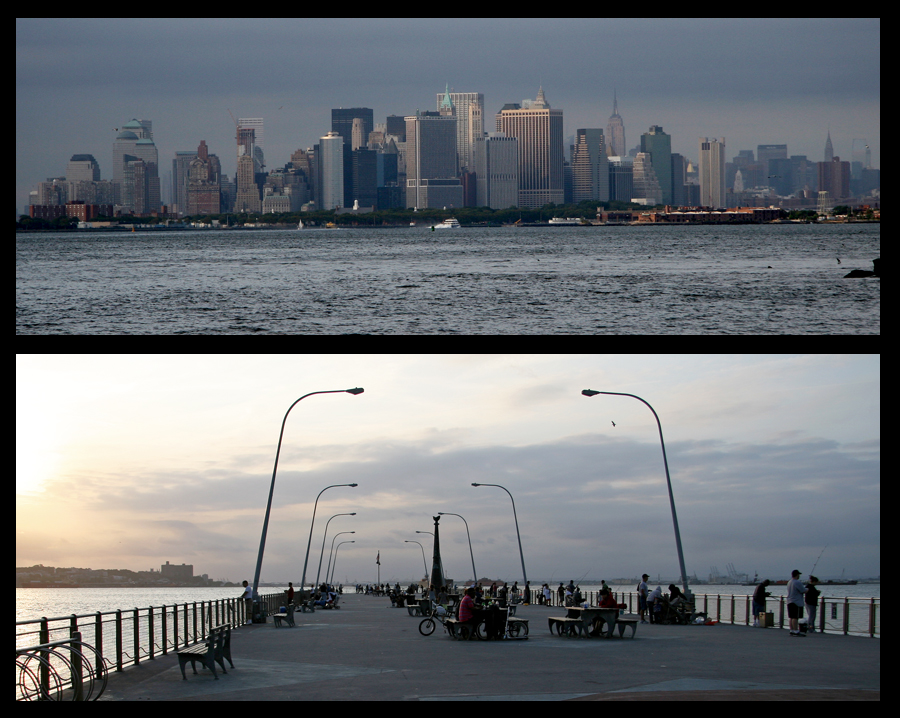
    The best views of Manhattan are from the boroughs of Brooklyn, Queens, and Staten Island (including the ferry), the East River Bridges, Roosevelt Island (and Tram), and New Jersey. In Brooklyn, the BQE coming towards the city affords some of the most dramatic views of New York City, as does the promenade in Brooklyn Heights, which is cantilevered over the highway.

    Recently, I was tipped off by a Brooklyn native of a spot relatively unknown to those in Brooklyn – the American Veterans Memorial Pier, aka the 69th Street Pier.
    In 2005, a memorial was installed to honor the 283 Brooklyn residents who were lost in the World Trade Center attack. Soaring 25 feet in the air, the “Beacon” memorial is shaped like a speaking trumpet. The device was once used by the volunteer fire brigades of New York City to transmit warnings to the crowd and orders to firefighters, as well as alerting neighbors of a crisis in progress. Made of bronze, the memorial features a beacon of light shining from the top that will be illuminated from 9:00 pm to 11:00 pm daily. The design, selected through a competition, was designed and built by Brooklyn artist Robert Ressler and cast from bronze at Bedi-Macky, a foundry in Greenpoint, Brooklyn – the oldest in New York City, best known for having cast the Iwo Jima Memorial.

    The pier is located opposite 69th Street in the Bay Ridge neighborhood of Brooklyn. Beautiful vistas can also be had from Owl’s Head Park, perched on a hillside overlooking the pier and the water.

    Fishing is a popular activity here. Unfortunately, with the downturn in the economy, many are fishing more for sustenance than for sport. Numbers of fishermen have increased substantially recently,  and some families are eating fish caught here several times per week – much more than what is recommended. Warnings have been made about the high PCB and mercury content in the fish.

    For decades, there was ferry service from the pier to Staten Island – service ended after the Verrazano Bridge opened in 1964. The pier was originally built in wood but was rebuilt in concrete in the 1980s and again in 2000. The pier can also be accessed by the pedestrian/bike path which flanks Shore Parkway and the Upper Bay…


  • Sun, Moon and Stars

    This is Christmas Eve, and for many children, it is a time of hope for wishes to be granted. For so many, New York City is a place for adults to find their wishes granted too, or for some, as a place they hope to see or live in. On October 11, 2007, I wrote Beacon of Hope, about the Chrysler Building as a metaphor for aspirations, dreams, and hopes.

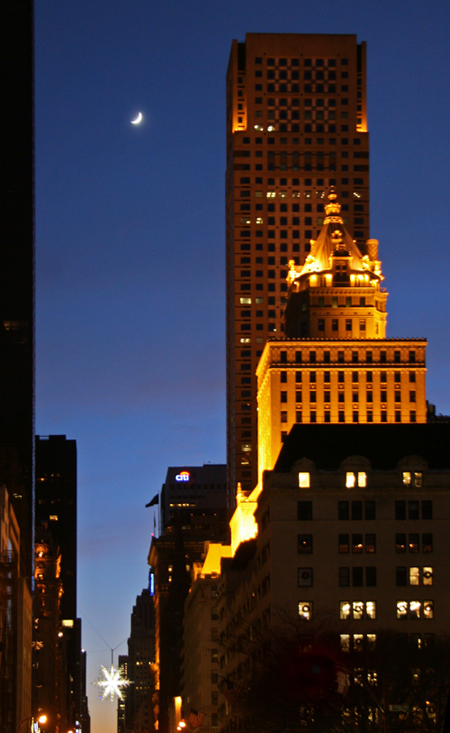
    While walking down Fifth Avenue, I was struck by this perfectly positioned moon, centered on the street above the baccarat crystal star designed by Ingo Maurer and complemented by the sunny gold of the illuminated Crown Building.

    The moon has a lot of competition in New York City, but at times like this, it still manages to get the awed respect it deserves. Friends and I have commented on many a summer or autumn night about a beautiful moon over the city skyline.

    This Christmas, I do not wish for things. There are so many larger problems that loom over and worry all of us all about our economy and world. But fundamentally, I am an optimist and have great faith in the resourcefulness of men and women to repair that which is broken, even in the eleventh hour.

    So today, I wish and believe in better times to come. If you encounter those who say do not be foolish and reach for the sun, the moon, and the stars, tell them you know someone who found them on Fifth Avenue 🙂


  • The Dark Time

    I felt a little embarrassed when I opened a Christmas gift from my late sister and found a travel guide to Finland with a note which said, “Go for it.”
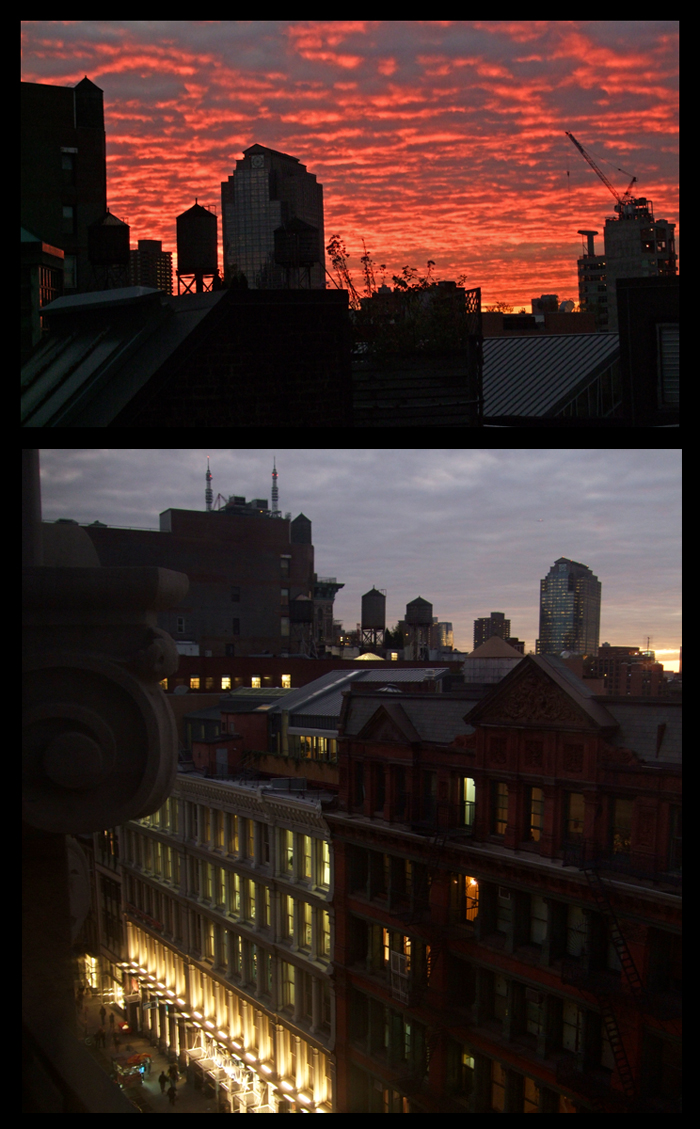
    This gift and note were fueled by my obsession at that time with something I had read – an article about an article. The article, in Whole Earth Review, referenced a New Yorker article regarding the “dark time” in northern Finland – that period of time in the winter where the sun does not rise for two months.

    The New Yorker article (which I never got to read) discussed the culture and how they dealt with this extraordinary situation – lanterns, various activities, etc.
    But as fascinating as all this was, I knew that I would not really travel to Finland in the winter to experience polar nights firsthand. I smiled after I opened that gift, but I felt guilty knowing that I would likely never use it. I still keep the book in my library.

    I am fascinated by extreme environments and how they affect culture, mindsets, etc. In many ways, New York City is an extreme environment, particularly given that four out of five boroughs are on islands.
    Of course, if you are going to indulge yourself in fantasies of heading to the extreme North in winter, a study of maps will be required, something which I am always happy to get lost in. I chose Finland because over 25% of its landmass is north of the Arctic Circle. I looked to the province of Lapland, where the northernmost village is Nuorgam, in the Utsjoki municipality. This is also the northernmost point in the EU. (I recently learned, however, that Knivskjellodden, Norway is further north – the northernmost point on the European continent.) This seemed to be the perfect travel destination for my dream of experiencing the dark time.

    Sunday, as every American knows, was the resetting of clocks to standard time, which means the sun sets an hour earlier than during Daylight Savings Time – currently at 4:50 PM. Not only does this mean that I rise before sunrise, but most of us also leave our workplaces after sunset. Most everyone I have spoken to is not enamored with the shorter days and early sunsets. Every year at this time, I think of the Arctic Circle and days with no sunshine, only twilight.

    Some may find occupying one’s mind with notions of polar nights, the Arctic Circle, and winter in Finland to be rather morose, adding insult to the injury of early sunsets and shortening days. But for me, when I contrast my life here with these remote, northern locales, I am happy that I do not really ever have to live in the Dark Time…

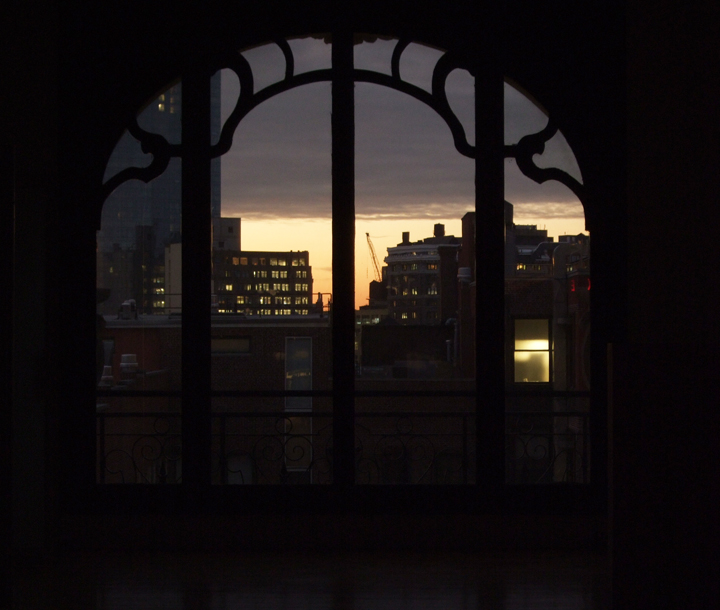
    Photo Note: I was granted access to a vacant floor in SoHo on Broadway with vistas west to the Hudson River. I took a series of photos during and after sunset. The photos were taken between 4:50 PM and 5:09PM. See additional photo here.


  • Wood, Glass, Brass and Trees

    I could have bought, I should have bought, I would have bought, but instead, I have rented my current apartment for 27 years. Many ask why I have not bought a residence, the quintessential American investment. I hope the photo helps answer that question. This is the view from my apartment overlooking a park. Only a handful of people in a city of millions are blessed with a vista like this every day.

    I overlook Washington Square Park in Greenwich Village, something which no money can buy because nothing is for sale on this square. Most property around the park is owned by New York University – the handful of residential apartments here are all rentals. I am not the only long-term renter on my street; tenants in my building have been here for 30+ years, as have other renters in the few neighboring townhouses which are not university owned.

    There is a very unique situation here in New York City that skews and exacerbates everything: rent regulation. Rent stabilization and rent control laws regulate rent increases, resulting in a market where unregulated apartments have dramatically outpaced rent-regulated ones.

    So, many city residents who have lived here for long periods of time have artificially low rents, often fractions of the market rate. Many assume that rental apartments in prime locations and buildings are extremely expensive and occupied by the wealthy and privileged. This can be true, but often, the ability to occupy such places is more a function of how long a long tenancy than of extreme wealth.

    This is not all that it seems, however, since there is a strong incentive for landlords to do as little work as possible in buildings and apartments where rent stabilization exists. Apartments are typically neglected and in disrepair.

    In my case, I have desperately needed new windows since I moved in, but frequent pleas to the landlord fell on deaf ears. Until this summer, when, for reasons unexplained, a man came to measure and, a short time later, scheduled the installation. Voilà – I had new French windows with solid brass hardware. At last it’s quieter and draft-free. All I see now is wood, glass, brass, and trees…


  • Eldridge Street

    In my story on January 12, 2009, Small Achievements, I wrote of those small, nagging, unresolved questions, not quite big enough to aggressively pursue, but not quite small enough to completely forget. They raise their head when a particular situation recurs, whereupon, enthused by the moment, you promise yourself that this time you will absolutely put the mystery to rest as soon as you get home.
    Of course, it is either then forgotten or put off to another time, unless you have a photo of the mystery you would like to feature on a website about New York City and, in fairness to your readers, you really must get to the bottom of this. Now you have that added impetus to get the doing done.

    One problem, however, with sharing a vista like this one is how you would go about taking a photo while driving in a moving vehicle. It’s easy when you return from Brooklyn on a beautiful day, everyone is on the road, and your vehicle is not moving because traffic is at a standstill, briefly interrupted with some inching forward.

    The bridges across the East River – Williamsburg, Manhattan, Brooklyn, and Queensboro – afford spectacular vistas of Manhattan, Brooklyn, Queens, Staten Island, and Roosevelt Island, along with streetscapes, waterscapes, the Statue of Liberty, Governor’s Island, and an articulation of buildings of the skyline of New York as far as the eye can see.

    Somewhere in all of this, there will be a glorious accident of perfect alignment. So it is with the vista from the western end of the Manhattan Bridge looking north, straight up this narrow one-way street, where you have a classic New York City juxtaposition: an unobstructed view of the Chrysler and Citicorp Buildings, framed by rooftop graffiti and the jingle jangle of the Lower East Side with a spattering of Chinatown. But the question for me has always has been, which street is that, so conveniently aligned?

    A little online forensic work identified the mystery thoroughfare, which runs eight blocks from Division Street at the base of the bridge to Houston Street and is wholly contained within the Lower East Side: Eldridge Street.

    Note: if you look carefully at the photo, you will notice a church on the right side – this is the Eldridge Street Synagogue, built in 1887 and a national historic landmark. It is one of the oldest synagogues in the United States built by Eastern European Jews. It is also home of the Museum at Eldridge Street, which presents the culture, history, and traditions of the great wave of Jewish immigrants to the Lower East Side with tours, exhibits, and public and educational programs.


  • The Rockaways

    Just a subway ride away on the A train, you will find not a bay, inlet, or river, but rather, the Atlantic Ocean. This is the Rockaways, a peninsula, most of which lies within the borough of Queens, New York.

    The beach has an active surfing community – there are three surf shops in the area. The approach of hurricane Bill was seen by most as worrisome, but surfers heralded the storm as a joyful rare opportunity to surf the big waves. So, this seemed the perfect time to take a trip out to the Rockaways to catch some waves with a camera. Beaches were closed to bathers but open to surfers. See more photos here.

    The 6.2 mile boardwalk is a huge feature of the area, extending from Beach 9th Street to Beach 126th Steet. The central area of Rockaway Beach is fronted with large, hulking public housing projects, many of which became riddled with crime. There are new apartment condominiums newly built and in the works. Strings of closed stores line 116th Street, the main shopping district.

    Driving from one end of Rockaways to the other through the varied communities – Belle Harbor, Far Rockaway, Arverne, Neponsit, Rockaway Beach, Rockaway Park, Breezy Point, and Edgemere – is one of the most shockingly diverse demographic ranges of humankind I have seen, from lower to upper middle class. Driving amongst the virtual mansions in Belle Harbor, the ramshackle nature of central Rockaway seemed a flawed memory.

    I missed many of the interesting areas, such as the historic bungalows off the boardwalk at Beach 108th St. that have become summer rentals and the scenic area at the end of the boardwalk from 121st to 126th Streets. I intend to return and explore more of the area on foot.

    This is truly the land of the haves and have-nots, but the ocean and the boardwalk looms large and mitigates much of the area’s depressed pockets. The ocean is a curative for the human soul, and I believe all feel fortunate to have such a fine strip of ocean, sand, and boardwalk…

    NOTE: The Rockaways have a rich history: from 1902 to 1985, there was a large amusement park called Rockaways’ Playland. See a photo history here.


  • Double Your Pleasure

    In America, we love numbers, bargains, more, and doubling. Two is such a convenient multiple for the real world – double your pleasure, double your fun, double your money, double your results, double down, double trouble.

    Washington, D.C. was the first big city I visited, and the Washington Monument was the first tall structure I ever saw. My obsession with it knew no bounds. I had many facts memorized, such as that it was 555 feet tall and 55 feet across the base.
    One of the beautiful things about the Washington Monument is positioning near the Lincoln Memorial Reflecting Pool. I love gazing in it and seeing the monument’s reflection, getting a visual bargain: two images for the price of one.

    When I moved to New York City, Greenwich Village was my first home, and the Washington Square Arch became the natural and perfect object for transference of my monument fixation. It was not as tall, but it was white, stone, also named after our first president, and had a lot of its own history and character. It also became a symbol for the neighborhood, with its bohemian and iconoclastic history, of which I believed myself a member.

    In the previous design of Washington Square Park, prior to its recent renovation, when the fountain was turned off, the water would drain completely within minutes. However, the new fountain’s system recirculates the water, and after being turned off (at approximately 10:30 PM), a shallow pool several inches deep remains. If the wind is light, the water stills and in a short time becomes a wavy mirror, reflecting the arch, any individuals sitting on the perimeter of the fountain and, if you are positioned correctly, the added bonus of the Empire State Building framed inside the arch itself.

    If you’re in Greenwich Village at night, take a stroll by the fountain, and the odds are very good that you may double your pleasure 🙂


  • dinamic_sidebar 4 none

©2026 New York Daily Photo Entries (RSS) and Comments (RSS)  Raindrops Theme