• Category Archives Scenic NYC
  • Coup de Grâce

    Irrespective of my interest in photography, sometimes I forget that we live in a world of color. This is easy – it is a full time job to take in all the sights and sounds of this great city. However, on occasion, a color op takes you by surprise and demands attention.

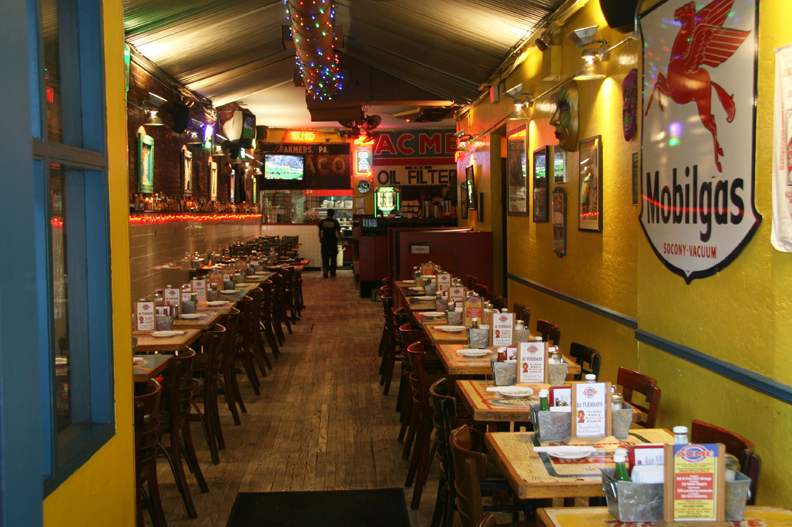
    And so it was on Sunday morning, passing by the Acme Bar and Grill at 9 Great Jones Street, where a number of elements conspired in a riot of color.* Early morning, before businesses start, is often a great time to visit a restaurant. Everything is clean and tidy before the masses arrive.  See the interior here.

    I entered to inquire about the aqua blue Chevrolet truck, assuming, like Caliente Cab, that this was an intentional decorative motif. It turns out that the truck was an employee’s vehicle. I complemented the staff member on the arrangement, but I received a rather nonplussed response – he was unaware of the fortuitous combination of elements that made their establishment so photo worthy.

    This was a tribute to reds and blues. Even the parking sign cooperated with its red lettering, as did the scaffolding and pink fire escape. And, unbeknownst to him, a man nearby with an aqua shirt provided the final coup de grâce…

    *Note on Riot of Color: Fellow photographer Bill Shatto shares a love of color – the phrase “riot of color” has become a frequently uttered pronouncement on our urban travels.

    Related Postings: Tale of Two ColorsHispanic Day Parade, Color Brigade, Flamboyant, Building Gone Wild, That’s Quite a Briefcase,  Fashion Forward, Taste,  Krishna Festival, Police Riot Concert, Narcissism Gone Wild, A Colorful LifeWho See the Red


  • Plum Beach

    Posted on by Brian Dubé

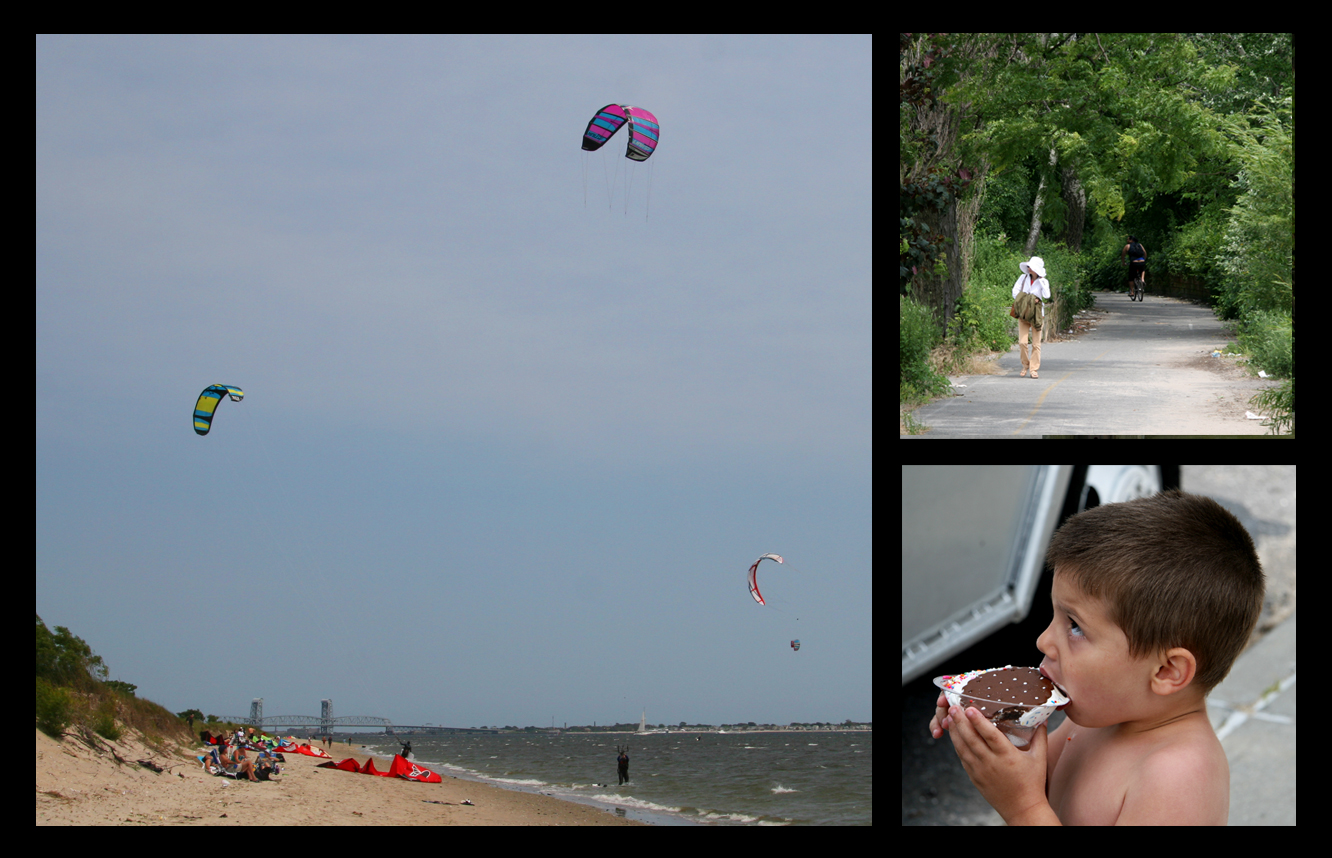
    The sight of kite surfers and the convenient access to Plum Beach from the Belt Parkway prompted a quick detour from my recent excursion to Floyd Bennett Field. Unfortunately, this convenience in a major metropolitan area, combined with relative isolation, has given Plum Beach a rather unsavory and spotted past.

    Older residents reminisce about days when Plum Beach was a lover’s lane. Since that time, it has become known as a gay spot. From a New York Times article from 2006, Deadly Days at a Lovers’ Lane:

    Decades ago, the beach’s parking lot was notorious as a lovers’ lane for the neighborhood’s besotted boys and girls. In recent years, the area has become better known as a gay trysting spot. The police say that the four men accused in the death of 29-year-old Michael Sandy of Williamsburg this month were aware of the area’s reputation when they lured him there.

    The incident refers to an attack by four men who lured the gay victim to Plum Beach using an Internet website. A planned robbery scheme derailed when the victim ran from his assailants onto the Belt Parkway, where he was struck by a car. Those familiar with the area also warn of drug use and needles on the beach. An article from Citynoise on Plum Beach in 2005 opens:

    Plum Beach is a grimy spit of sand that is just past Sheepshead Bay and part of Gateway National Park. It’s beautiful and filthy and therefore gloriously neglected, unkempt and various.

    The article goes on to discuss the various activities. Reading the comments, which span four years from 2005 to 2009, provides an informative history based on personal experiences.

    When I stopped at Plum Beach, I was not aware of any of this history or reputation. I also visited after a cleanup effort in April of 2009 by the American Littoral Society, so my visit was untainted by garbage, which apparently used to be a huge problem.

    The beach, named after the beach plums that grow there, is part of the Jamaica Bay Unit of the Gateway National Recreation Area, which includes the Jamaica Bay Wildlife Refuge (see here and here). There are many great beaches, along with great spots for nature and wildlife lovers in this area of Brooklyn and Queens. At Plum Beach, you will find kiteboarding and windsurfing – rare sights in New York City, and not what the average visitor is looking for. But, hey, we got the little stuff too* 🙂

    *This is my first use of a personal inside joke.

    Posted on by Brian Dubé

  • The Reservoir

    Posted on by Brian Dubé

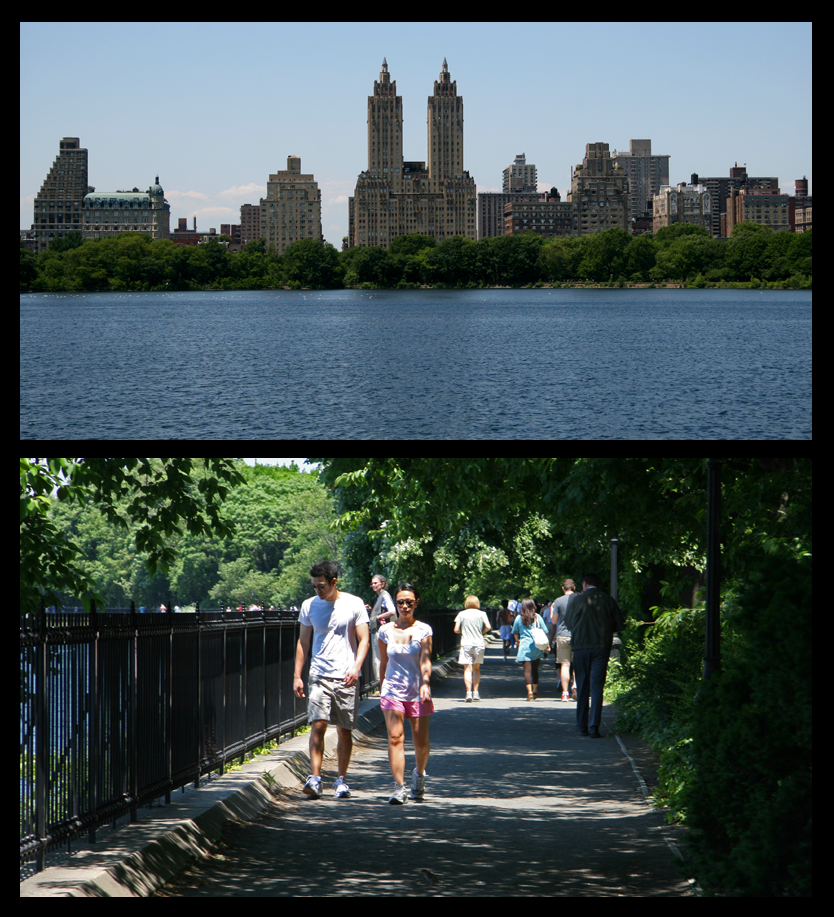
    Seeing the Central Park Reservoir for the first time is quite stunning. In the congested, densely packed borough of Manhattan, the last thing one expects to discover is such a enormous body of water. The reservoir covers 106 acres and holds over one billion gallons of water.

    This was built to the Olmstead and Vaux original plan for Central Park between 1858 and 1862, designed to receive water from the Croton Aqueduct and distribute it to Manhattan. It ceased functioning as a reservoir in 1993 when it was considered obsolete because of a new water main connecting to the New York City Water Tunnel No. 3.
    Anything this large and prominent in Manhattan is going to take on a life of its own, its use maximized. There is a 1.58 mile running track that completely circles it, on which there are weekly races sponsored by the New York Road Runners Club.

    Take a walk around all or part of the reservoir, and you will find many things – ornamental cherry trees, over 20 species of aquatic birds which have been sighted, three ornamental stone gatehouses designed by Calvert Vaux, three pedestrian cast-iron bridges that span the bridle path, ( one of which is the Gothic Bridge, one of the park’s most beautiful and distinctive), and, of course, vistas of the skyline surrounding the park.

    The photo was taken at the Engineers Gate entrance with the Purroy Mithcell Monnument. Looking across the Reservoir, you see Central Park West. The tall building in the center is the El Dorado, one of four twin-towered luxury apartment buildings designed by Emery Roth along Central Park West between 1928 and 1932: the El Dorado, the Beresford, the San Remo, and the Ardsley. Read Christopher Gray’s New York Times Streetscapes article about the El Dorado here.

    Note: The Central Park Reservoir is now officially known as the Jacqueline Kennedy Onassis Reservoir. The 1994 naming commemorated her contributions to New York City. Jacqueline, who had a Fifth Avenue residence, enjoyed jogging in the area.

    Posted on by Brian Dubé

  • City Island

    Posted on by Brian Dubé

    There are places which are a writer’s dream subject. If your reader is unfamiliar with the locale, it makes you look like a brilliant explorer who has uncovered a real gem. And visiting for the sake of a writing assignment is a real perk. The only real difficulty is avoiding the cliches which have been used ad nauseum.
    In this case, the place is City Island, Bronx, and the cliches are words and phrases such as “look and feel of a small New England fishing village,” “more like Cape Cod than New York,” “Nantucket,” “less Cape Cod, perhaps, than a tiny, Stephen King-like town on the lonesome Maine coast,” ” a constant reminder that this idyllic spot is not Nantucket but an island in the Bronx,” and “an active fishing village with a 718 area code.”

    The beauty of City Island is that it does live up to all the cliches, metaphors, and comparisons. I suggest a visit – you won’t be disappointed. If you don’t have access to a car, it is serviced by public transportation. However, you will need to take both a train and bus to get there.

    You are never more than a few blocks from the water. City Island is quite small – at 252 acres, it is only 1/3 the size of Central Park with 4520 residents. It is accessible to the Bronx mainland via the City Island Bridge. As would be expected, everything is defined by the ever present water – fishing, boating, shops with a maritime focus, and the Nautical Museum. We spent a pleasant time with proprietor and long-time resident John at Trader John (upper photo), 239 City Island Avenue, which specializes in new, used, and antique marine and nautical supplies.

    Seafood and seafood restaurants are abundant. We chose Tony’s Pier Restaurant at one end of the island (1 City Island Avenue), a fast food-styled place on the water (across the street from Johnny’s Famous Reef Restaurant). We ate our food to the sounds of the ocean and a huge population of seagulls. See my gallery of island photos here.

    I find a comfort and restorative experience being at the ocean. Instinctually, we all recognize its constancy and tremendous power – surrender to it and in that surrender, find comfort. Like being in the hands of a vigilant, caring doctor…

    Posted on by Brian Dubé

  • Big Bang

    Posted on by Brian Dubé

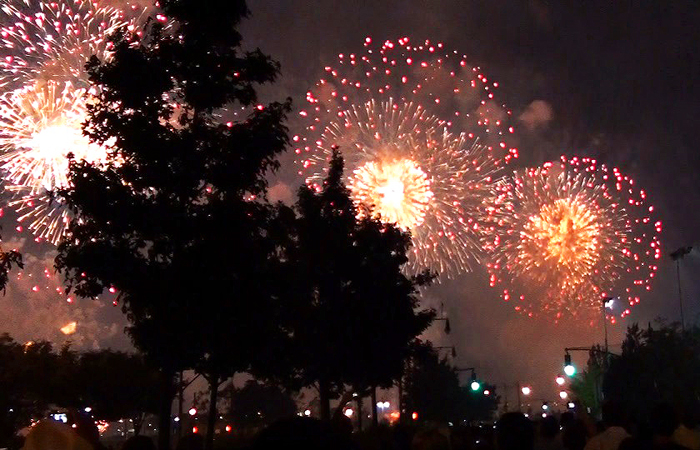
    I had not been to a Fourth of July celebration in New York City for many, many years, generally opting for seeing them on TV. This year, however, I was with a friend who had never been to a live fireworks display at all, so it seemed criminal not to take a short stroll to the river and let her witness the Big Bang, New York City-style.

    The display, sponsored by Macy’s since 1958, was originally over the Hudson River. Since 1976, Macy’s fireworks became a tradition over the East River. This year’s display was back over the Hudson and better than ever. The display lasted 26 minutes, with 40,000 shells fired from six barges, located opposite 23rd to 50th Streets in Manhattan, where the West Side Highway was closed to pedestrians for the event. A Hudson River display also affords views from New Jersey, with the added eye candy of the Manhattan skyline as backdrop.

    However, getting a viewing location was not as leisurely as one would hope. Police barricades restricted entry to just a handful of crosstown streets; frustrated crowds were directed to streets which in turn had also been closed. We paced up and down 10th Avenue to find entry to the West Side Highway, at last getting in at 24th Street. After a little jockeying for a good position for viewing/photography, we settled in for a spectacular display, on time as always. At the conclusion, traffic was snarled beyond belief – masochism by auto. I recommend seeing the NYC Independence Day fireworks in person, but the only way it makes sense to see any event of this size is by using a combination of subways and walking…

    Posted on by Brian Dubé

  • Sheepshead Bay

    Posted on by Brian Dubé


    The problem is simple – I have spent too much time looking for the Manhattan in Brooklyn. My travels there have focused on neighborhoods such as Park Slope or Brooklyn Heights – historic enclaves with row houses most similar to those in Manhattan.

    One will often hear a Brooklynite use the phrase “going into the city,” one of the prime examples of a city which is Manhattan-centric. In many ways, Manhattan does drive the city as an economic engine and is a mecca for culture and the arts. It is the center of the financial world and of many other industries for which New York City is known. However, Manhattan is not the only place on earth, with Brooklyn playing second fiddle – an attitude many Manhattanites share, as I did for most of my life here.

    Welcome to Sheepshead Bay, both a neighborhood and a bay separating the mainland of Brooklyn from the peninsula Manhattan Beach (see my previous article here). Sheepshead Bay is named for the sheepshead, an edible fish once found in the bay. Read more about the neighborhood here.

    On my recent excursion to the area, I crossed the footbridge (Ocean Beach Bridge) which spans the bay and connects Manhattan Beach to Sheepshead Bay’s commercial strip, Emmons Avenue. It is here that I also found Stella Maris, the last fishing and tackle shop in the area. The bridge is a must do – it affords great vistas of the bay, both neighborhoods, and the maritime activities. See my gallery of photos here.

    I think differently now. Brooklyn is steeped in character and history. Brooklyn has its own style and attitude. I am disappointed that I didn’t take better advantage of Brooklyn and really explore it when I was younger and had a few good friends there.
    But I am doing makeup work, busy discovering the neighborhoods of Brooklyn and learning things every Brooklynite always knew: Brooklyn is its own world.

    Posted on by Brian Dubé

  • Manhattan Beach

    Posted on by Brian Dubé

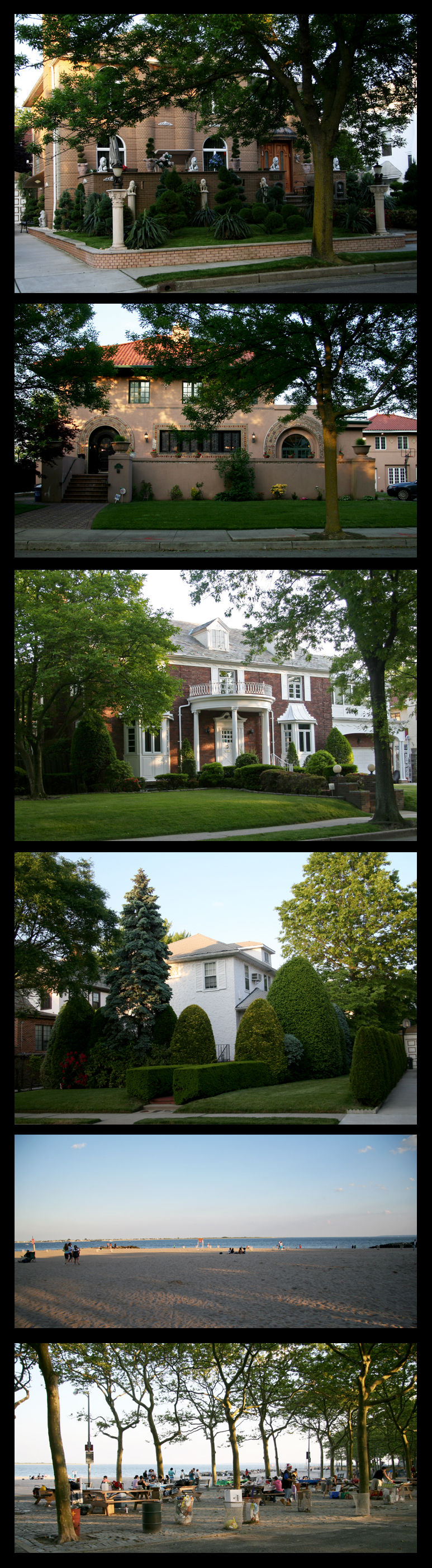
    This is New York City, not colonial Virginia. I was astounded on my recent excursion to the Manhattan Beach section of Brooklyn, which I had never really explored. This stately home is typical of many of the large residences in the area, mostly detached single-family homes with lawns and garages, some even with swimming pools. See my gallery of photos here. The environment feels more suburban than urban – atypical of New York City and unlike most of Brooklyn itself.

    Surrounded by water on three sides, the neighborhood is very much an enclave and one of the most expensive in New York City. Many residents are Jewish and/or Russian immigrants. There is very little shopping in the neighborhood, and on weekends and holidays during the summer season (May 15 to Sept. 15), parking is prohibited on nearly all Manhattan Beach streets, owing to the attraction of the beach. I found the expanse of rocky beach reminiscent of the Maine coast, certainly not typical of New York.

    Manhattan Beach Park offers a baseball field, playgrounds, tennis courts, basketball and handball courts, picnic areas, and rest rooms. Snacks are available from concession stands and pushcarts.
    Another very unique aspect of the neighborhood is that Kingsborough Community College, with a 70-acre campus and their own private beach, occupies the easternmost tip of the peninsula. The school, established in 1963, is part of the City University of New York (CUNY) system and has 30,000 students.

    I recommend a visit of the area, perhaps with Sheepshead Bay as a base for your explorations (subject of a future post). A footbridge crosses the bay, providing nice vistas and a connection to Manhattan Beach…

    Posted on by Brian Dubé

  • Please Be Gentle

    Posted on by Brian Dubé


    Yesterday, June 8, 2009, was the highly awaited grand opening of the High Line. All the top officials in city government were there for the ribbon cutting – Mayor Bloomberg; Amanda M. Burden, the city planning commissioner; Adrian Benepe, the parks commissioner; Scott M. Stringer, Manhattan borough president; and City Council speaker Christine C. Quinn.

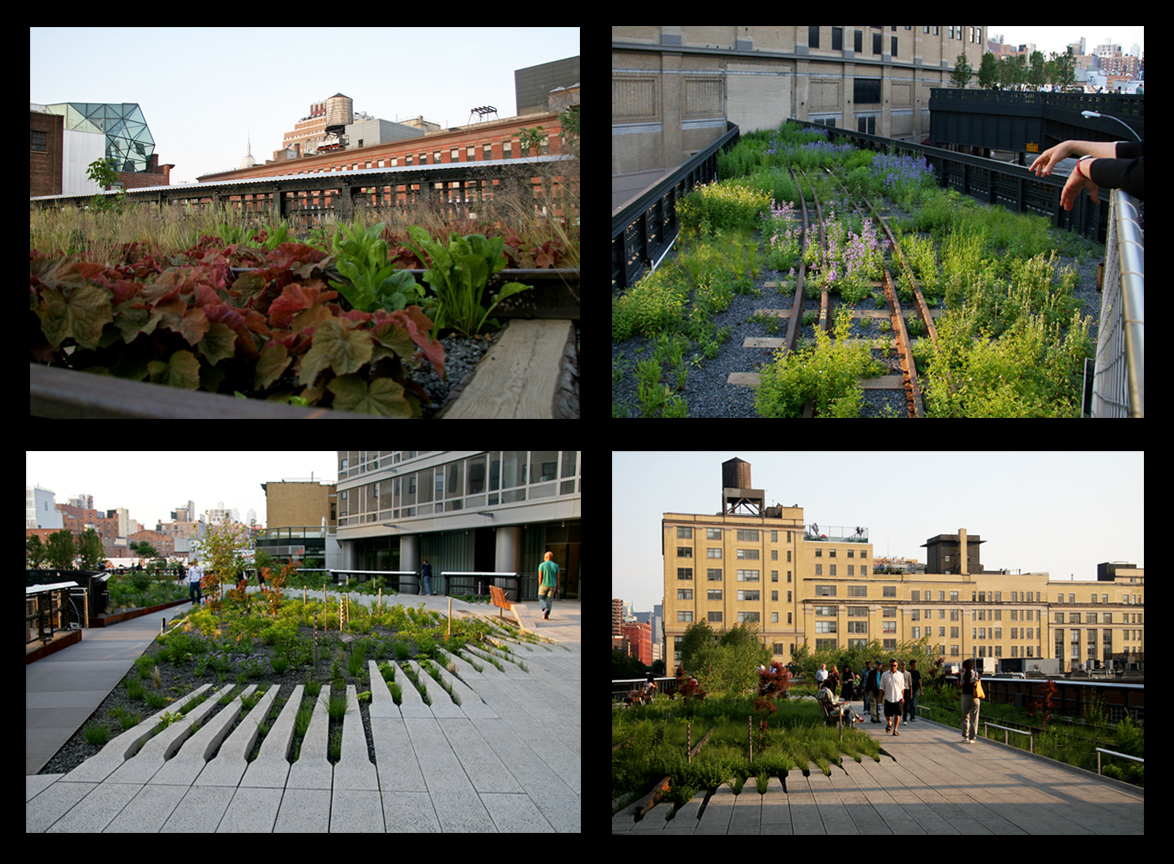
    This project was in the making for 20 years. The idea to save and restore the abandoned elevated freight railroad was first conceived in 1999 by Joshua David, a writer, and Robert Hammond, a painter. The project, named the High Line, broke ground in 2006 and is now an elevated park converted from a section of the West Side Line, built in the 1930s by the New York Central Railroad and unused since 1980. The railroad actually passed through several buildings – evidence of this still exists. See my entire photo collection here.

    The greenway is similar to the Promenade Plantée in Paris, a 4.5 km-long elevated park in the 12th arrondissement of Paris, France, constructed on an abandoned 19th-century railway viaduct. The High Line consists of three sections – the southernmost currently open runs from Gansevoort Street in the West Village to 20th Street. Upon completion, the entire park will extend to 34th Street.

    Over 30 projects are planned along its route, including a new branch of the Whitney Museum of American Art, designed by Renzo Piano.
    The design itself is the most artfully created public space I have seen in New York City. The High Line was designed by landscape firm Field Operations and architects Diller Scofidio and Renfro.

    Yesterday’s “soft” opening was pleasant, with a small number of visitors. Once its opening is generally known, there is a concern of overuse – the design work is beautiful yet delicate and rather fragile. The parkway is only 30 to 60 feet wide. If necessary, entry to the park may be limited. I recommend visiting – please be gentle…

    Posted on by Brian Dubé

  • Cello Class

    Posted on by Brian Dubé

    Some years ago, I fancied to learn the cello. New York City has some of the finest music schools in the country, and they all offer alumni lists of musicians ready, willing, and able to teach (at very reasonable prices). So, it was with this in mind that I found a great teacher/professional cellist, walking distance from my home, to teach me. This woman was both a Juilliard School and Manhattan School of Music graduate and had extensive performing and teaching experience, both privately and in a well-respected school for children.

    I was, however, somewhat remiss in my studies, barely getting through the lesson material each week. Learning a classical stringed instrument as an adult is a daunting task – practicing as I did at night after a day’s work. On one particular lesson, my instructor was getting rather frustrated with me. She asked what a particular note was as she placed a finger on one of her strings. I said that I did not know. She then asked, if one knew a note on one string (she gave an example), what was the note on a neighboring string? I did not know. Backtracking further, she then asked what was the interval between the strings on a cello? Embarrassed and panicked, I just said I did not know that, either (answer: one fifth apart).
    At this point, she said, “If you were one of my student children, I would insist that you learn this material. However, being that you are an adult, I strongly recommend that you learn it, unless you would rather pay me $25 per hour to learn in class what you should be doing at home.”

    This story came to mind on Sunday afternoon, as I strolled down the tree-canopied sidewalk on Fifth Avenue, flanked on one side by some of the finest residential buildings in the world and abutting Central Park on the other side. A walk here is one of the most extraordinarily beautiful, bucolic, and genteel experiences you will ever have in this city. The extra-wide pathway is shaded by mature trees, arching overhead to form a tunnel of green. Dappled light falls on the cobblestone and hexagonal pavers.

    If you were one of my children, I would insist that on the next warm, sunny day, you accompany me as we promenade down Fifth Avenue. But since you are not one of my children and rather an adult, I strongly recommend that you do this, unless you just want to read about this now, when you should be doing your life lessons outside of class 🙂

    Photo Note: The photo was taken between 94th and 95th Street. The stretch between 96th and 89th Streets is one of the quietest on Fifth Avenue. Parades do not go north of 86th Street. It becomes much busier starting at 89th Street (location of the Guggenheim Museum), followed by the Metropolitan Museum of Art at 82nd Street.

    Related Postings: Free Lunch, Cello, Bargemusic

    Posted on by Brian Dubé

  • Flash of Light

    New York Daily Photo started originally as a photoblog, a publishing format where postings are driven by photos rather than text. In time, however, with an interest in research, small descriptions grew to longer articles. With an interest in giving subjects a less clinical and more personal view, I have drawn from anecdotes in my life, and the writing in many postings may be better described as stories and are more about the story than the photo. Now there is an expectation, both on your part and subsequently on mine, of writing.

    I have come to really enjoy the writing of this blog, and recently, in reading about writing short works, I came across an entire genre of fiction which I was completely unaware of: flash fiction, aka sudden fiction, microfiction, nanofiction, micro-story, postcard fiction, or short short story. There are even types of fiction which use exact word counts: 55 Fiction (55 words), the Drabble (100 words), the Drouble (double Drabble or 200 words), and the 69er (as the name suggests). There is no better time for flash fiction with the growth of visual media, competition for everyone’s time, sound bites, and the decline of book reading.

    The bane of nearly every student of English in high school was the dreaded writing assignment where there was a word length requirement. For me, being somewhat verbose, these assignments were not quite as painful, but there still was always the concern that I would not have enough truly meaningful things to say. Certainly there is value in exposition and learning articulation skills, but there also is much to be said for using one’s words sparingly and not padding the writing. I am sure that flash fiction would have been heartily welcomed in my English classes.

    Flash fiction is, of course, not without its critics. In the same way that assignments with minimum word lengths may encourage verbosity, some feel that flash fiction with maximum or exact word lengths is no better, artificially paring a story down where perhaps a few more words may have improved the story. I think there is value, at the very least, to use flash fiction as a writing exercise.

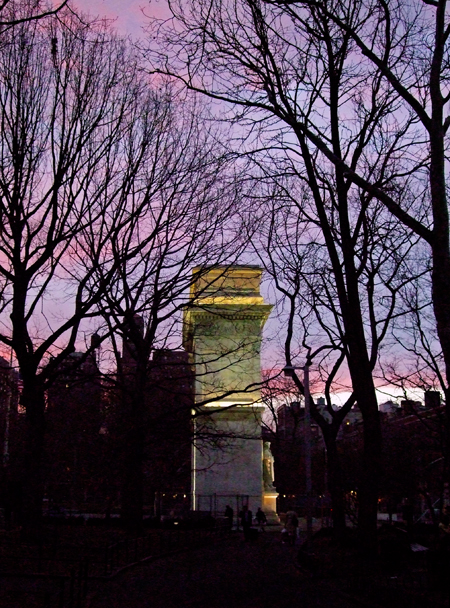
    I hope you enjoyed today’s unnecessary digression because, after all, not only is brevity the soul of wit, but this picture should also be able to speak for itself and be worth at least four hundred and one words 🙂

    PHOTO NOTE: I witnessed this dramatic pink and blue sky framing the Washington Square Park arch on Wednesday evening, March 11, 2009, at 6 PM.


  • Cabin Fever


    In cities like New York and Paris, where living spaces are smaller and street life is so vibrant, cabin fever and the craving for spring reach a level where people become irrational in their desire for warm weather activities and wardrobe. A hint of spring, and some are dressing for August – at 60 plus degrees, I am seeing flip-flop sandals, shorts, and T-Shirts. And beach goers. You get a feeling that their summer wear is waiting by their doors, lest they risk spending even a second outdoors in clothing even a bit too heavy for the day’s warmest moment.

    I am seeing tables dotting the sidewalks and people with coats on eating al fresco with temperatures in the 50s. The snowstorm of only one week ago is already forgotten.
    Preferences for climate and season are as varied as people themselves, but who is it that is not pleased by a coming spring? And what place is not improved by the onset of spring, a time synonymous with renewal?

    The photo was taken on the rocky beach in Dumbo at the foot of the Manhattan Bridge looking northwest towards Manhattan – you can read about it here with more photos. This area is one of the most scenic in New York City – both the neighborhood itself with buildings, cobblestone streets, the East River waterfront, our trinity of bridges (Brooklyn, Manhattan, Williamsburg), and vistas of the Manhattan skyline. That’s a lot of punch for your dollar, and these people were delighted to spend it 🙂

    Related Postings: Sink or Swim, Night in Bloom, Dumbo Arts Fest, Gallery View, One Front Street, Eagle Warehouse, The Watchtower, Loaded, Cuts One Way


  • 11101

    If you want the full spectrum of contrasts, head for Long Island City. Here you have a borough with an industrial history and the buildings to prove it. This is the westernmost neighborhood in Queens, flanking the East River, so the area affords some of the best views of the Manhattan skyline along with the 59th Street Bridge, which connects it with Manhattan. There are historic districts with beautiful row houses/brownstones. The Citicorp Building stands at 658 feet – the tallest building in Queens and outside Manhattan. On the waterfront, a former dock facility was converted to Gantry Crane State Park. Large-scale residential conversions and developments have been undergone, such as a building which formerly housed the Eagle Electric Manufacturing Company and in areas of LIC such as Hunter’s Point.

    Long Island City was formerly its own city, created in 1870, and became part of the City of Greater New York in 1898. The area has gentrified, and many of the factories have been converted to other uses. The former Silvercup Bakery, whose iconic sign can be seen from many vantage points, is now Silvercup Studios. This studio has been used to film many well-known music videos, commercials, films, and television series such as the Sopranos, Sex and the City, Gangs of New York, and 30 Rock.

    Artists have been resettling to LIC for many years. Art organizations as well as independent artists are located in the neighborhood. P.S. 1 Contemporary Art and Sculpture Center is located here. Isamu Noguchi converted a photo-engraving factory into a workshop, now a museum dedicated to his work. 5 Pointz: The Institute of Higher Burnin‘, is an artists’ residence in a converted warehouse. Graffiti is allowed there – the structure is a living collage of graffiti.

    The largest fortune cookie factory in the United States, Wonton Foods, is in LIC. Donald Lau writes the fortunes. For a fascinating anecdote about this company and good fortune, see Fun with Numbers below.

    Fun with Numbers: I found the zipcode for Long Island City, 11101, very interesting for a number of reasons. The number is a string of ones and zeros only, making it binary. In decimal, this is 29, which when totaling the digits becomes 11. Stripping out the zero in the zipcode, we have 1111. Numerologists believe that events linked to the time 11:11 appear more often than chance or coincidence. In May 2005, Wonton Foods printed a series of lucky numbers. Five our of six of these coincided with the winning numbers in a Powerball drawing. Because of the large numbers of cookies printed, 110 people (binary again) won approximately 100,000 each.* And my own zipcode? – 10011. 🙂

    *According to an article in the the New Yorker: “Lottery officials suspected a scam until they traced the sequence to a fortune printed with the digits “22-28-32-33-39-40” and Donald Lau’s prediction: ‘All the preparation you’ve done will finally be paying off.’ “


  • Duffy

    I appeared hungry for knowledge and some good conversation, which is why, many years ago, a business associate recommended that I contact a man named Duffy. I was told that this man, who owned a large manufacturing business in New Jersey, was a wealth of knowledge, had valuable insights, and was always willing to share his ideas.

    So, with great enthusiasm, I contacted him. He was everything I had been told, and in fact, I made a short journey to visit him and his factory in New Jersey. I had a great tour of his facility and some inspiring conversation which went way beyond business mentoring. At the time, I was working 6 days a week, taking no time off. In one phone conversation, I complained of this to Duffy. I mentioned how I was frequently squandering my time and that even though I was at my office in the evenings and weekends, I found myself becoming less productive and often using that time for personal phone calls and other non-business related activities.

    Duffy compared me to an uncle of his who was a workaholic but was very inefficient. He made a comment I will never forget – that if you don’t take a vacation, your mind will. He told me of how he made it a priority to take regular time off to recharge his batteries. I recounted to him a summer where, for a month, I took 3-day weekends and by Monday morning, I could barely remember my agenda but was fresh and ready to go. Duffy pointed out that this was a clear sign of recharging. It all rang quite true, and although I have not taken his advice to heart, when I really immerse myself in a different environment or physical activity, I do notice the mental health benefits.
    It is very easy to get caught in the work mechanism in New York City. Costs are high, so it is easy to justify work. And physical activities or communing with nature require more effort and travel. There are a plethora of services in walking distance of most New Yorkers’ residences. All good reasons why is not uncommon to find people who rarely travel out of their neighborhoods.

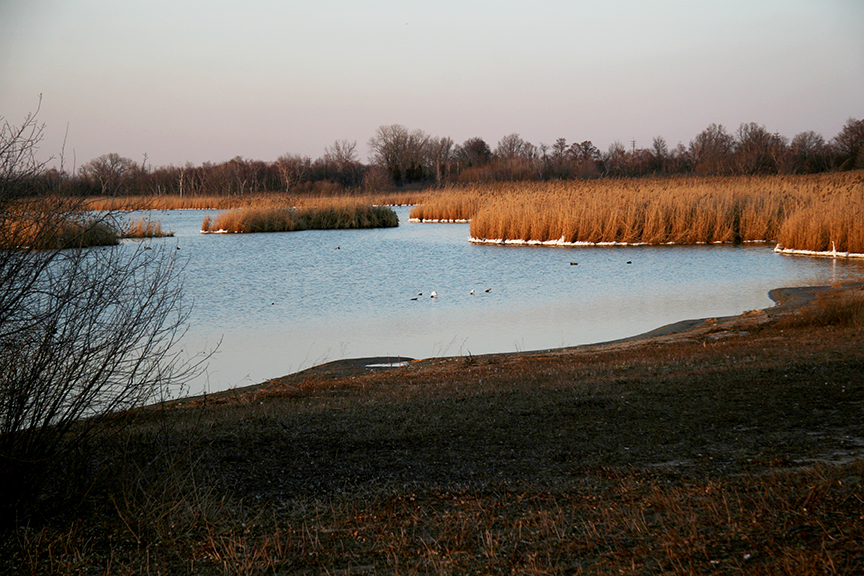
    These things passed through my mind on my recent (and first) trip to the Jamaica Bay Wildlife Refuge. This 9155-acre tract of land is part of Gateway National Recreation Area and is the only wildlife refuge in the national park system. This is one of the most important bird sanctuaries in the USA, and over 330 bird species have been sighted here – nearly half the species in the Northeast. It is one of the best places in New York City to observe migrating birds. There is also an array of native reptiles, amphibians, small mammals, over 60 species of butterflies, and one of the largest populations of horseshoe crabs in the northeast.

    There are beautiful walking trails and vistas of the bay, Manhattan, and Broad Channel. On my visit, I saw a number of aquatic birds, including what I believe to be an egret. The entire environment was pristine and quiet, yet remarkably, this refuge is accessible by subway.

    So if you want to recharge your batteries in New York City, this is the perfect place to do so. And I am sure Duffy would heartily approve 🙂


  • Who’s Getting Technical?

    The first time I went to the West Coast was by car, and it occurred to me at the time that one of the special new experiences to come was to see the sun set over the Pacific Ocean – the first time I would see a sunset over water. However, the assumptions regarding East Coast sunrises and West Coast sunsets over water are mistaken.
    Although it is not the rule, there are many places where it is possible to see sunsets over water on the East Coast (and sunrises over water in the West Coast). These do occur in special situations, such as bays and peninsulas. In these places, sunrises over water are also typically visible by making a short trip across the peninsula or island.

    In most cases, however, land is visible between the water and horizon, but there are locations where no land is visible at all and the sun sets entirely over water. The bay side of Cape Cod is one good example. Technically these sunsets are not over the open ocean, but when there is no land in sight, the experience is virtually the same.

    I thought I was the only one who gave serious consideration to the phenomenon of East Coast sunsets over water. But, surprisingly, there are others who share my interest, and I even found a blog on the subject it with locations, criteria, and discussions about horizons.

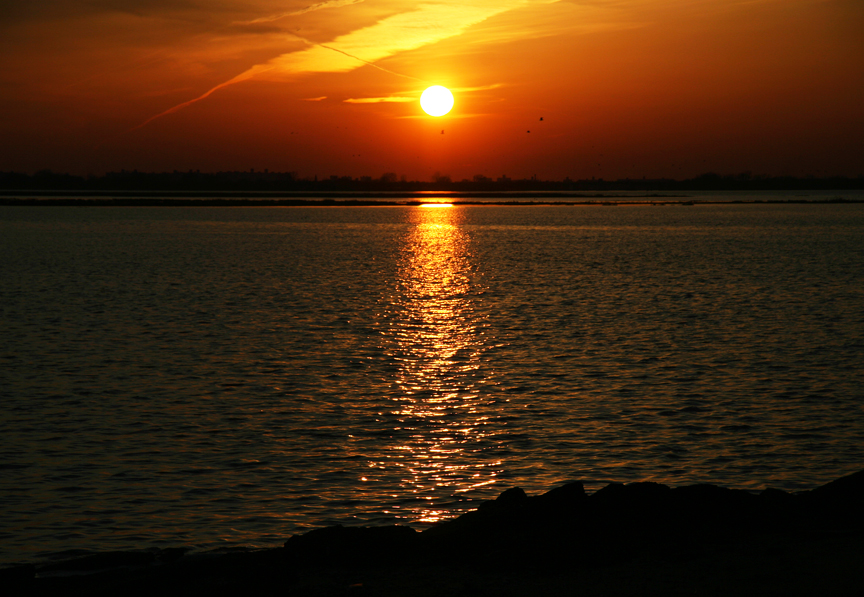
    I haven’t met a person that doesn’t enjoy a beautiful sunset, and on my recent excursion to Broad Channel, I was told that sunsets were some of the most spectacular. So it became an immediate agenda item for the afternoon. Being in the center of Jamaica Bay, surrounded by water, sunrises and sunsets over water can be enjoyed with a short stroll across town.

    When the sun sets at Broad Channel or at the Jamaica Wildlife Refuge, one can see land at the horizon, so for the sunset-over-water purists, Broad Channel does not strictly make the grade. But I doubt anyone really cares, because when it comes to sunsets like this, who’s getting technical?

    Note about the photo: Today’s photo was shot from the Jamaica Bay Wildlife Refuge and not in the town of Broad Channel itself.


  • Light and Lights

    One of the best locations to enjoy vistas of Manhattan and the surrounding waterways is from the promenade in Brooklyn Heights. Here you will find postcard views of lower Manhattan, South Street Seaport, the Brooklyn Bridge, the East River, and many of New York City’s iconic landmarks – the American International Building, the Empire State building, the Chrysler Building, the New York Life Insurance Building, and the Met Life Tower.

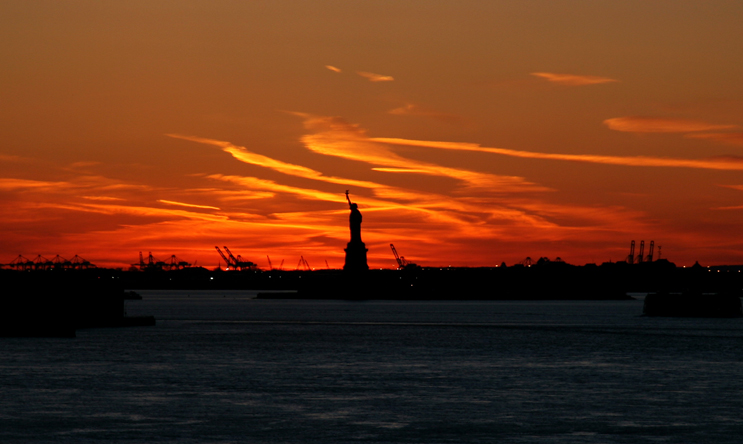
    An added bonus is that the promenade faces west, and that means sunsets. This is the time I would recommend visiting; during the evening, you have the best light and the gradual darkness coming over the city with a menagerie of lights. If you are fortunate, you will be rewarded with a sunset like this one – brilliant orange-red with streaks of yellow, all back lighting our Lady of Liberty. But I sell you no longer – I think the image speaks for itself…

    Note: If you look closely at this panorama, you will notice the silhouettes of container cranes, eerie and surreal. I have written before of the attractiveness that can be found in industrial landscapes in Hell’s Gate.


  • dinamic_sidebar 4 none

©2026 New York Daily Photo Entries (RSS) and Comments (RSS)  Raindrops Theme