• Category Archives Architecture
  • Squadron A Armory

    I try not to overuse the word juxtaposition, because if I was not vigilant in its use, I could easily justify using it ad nauseum in regards to the diversity of structures in New York City.

    One of the supreme examples of juxtaposition is the palace of Versailles and the town of Versailles in France. In the area neighboring the palace, one finds a town that is pleasant but nothing to prepare one for the grandeur of the palace.
    For the residents of Versailles, however, I imagine the palace becomes just another fixture, something one becomes inured to over time. At least that is the experience I have often in New York City. I certainly appreciate our iconic structures, but often it takes spectacular or unusual conditions to bring these things to one’s attention.

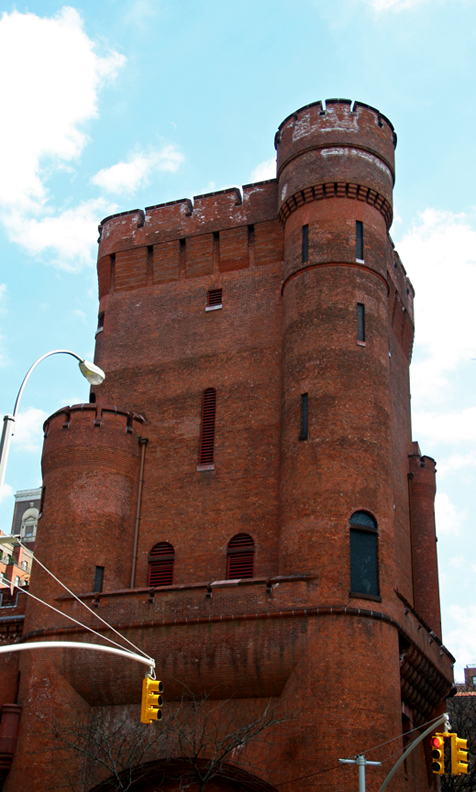
    Where else but in New York City could you discover something this large, having never been aware of its existence? I don’t recall even seeing this medieval behemoth, which occupies a full city block on Madison Avenue between 94th and 95th Streets. See 2nd photo here.

    This is the Squadron A Armory facade. Facade, because in 1966, demolition began to make way for a new junior high school and apartment complex. However, the Landmarks Preservation Commission intervened, and the demolition was stopped.
    Squadron A refers to an historic cavalry unit based out of New York City’s Upper East Side. It was formed by a group of wealthy young men with an interest in equestrianism. Read more here.

    If you travel up Madison Avenue, don’t be so distracted by all the high-profile boutiques that you miss Rhinelander’s Dream and the medieval ruins of Squadron A Armory…


  • Top of the Glass Staircase

    What is one of the most vexing problems for the visitor to New York City? Finding a bathroom. Because you need to use a bathroom. Or perhaps you are just tired and need to sit down and regroup. Sound familiar?
    It is no secret that New York City is not particularly bathroom-friendly. Signs abound proclaiming “Bathroom for customers only” or the ridiculous “No Bathroom” – does anyone actually believe that store employees work all day without a bathroom?

    New York City is an exciting wonderland for the resident and visitor. Like most large cities, most visitors will be traveling locally by a variety of methods other than their own vehicle – taxis, trains, buses, and by foot. All this trekking leaves your body in need of service.
    Most likely you have a base station (hotel) and you would like to go back to your room, but, unlike travel in the countryside, your room is not really very convenient, is it? It’s not just a quick drive away, and to go there is a bit of a hassle, taking time and energy. It also means leaving where you are – perhaps you have more to do.

    For the city resident, the situation is not much better – once out, we are even more reluctant to travel back to our homes just for bathroom use or to take a rest. Our only advantage is, occasionally, better knowledge of those places that are easy about use of their facilities. Some of the more upscale retailers are bathroom user-friendly – Whole Foods Markets, Starbucks, et al.
    But there is a better option if you are downtown. So, it is time for a quiz.

    Question: Where can you go in Manhattan and relax in a theater with upholstered seats in an award-winning skylit environment with clean bathrooms, relax as long as you like, and even get your email and access the Internet for free?

    Answer: The Apple Store on Prince Street in SoHo. I have previously written about this store. The theater, one flight up the glass staircase, is used for free presentations, as you can see in today’s photo. In my experience, however, the theater is generally unused. While you’re there, peruse the goods – the store is a mecca and meeting place. Please don’t abuse your privileges at the top of the glass staircase


  • The Total Call

    There are things that are iconic about certain places – the Eiffel Tower, the Great Pyramid of Giza, the Great Wall of China, the Empire State Building, the Taj Mahal, Stonehenge, the Colosseum, or the Grand Canyon. Some things which are emblematic involve natural phenomena that may require special conditions and a particularly unique vantage point. These things are often seen in photos and rarely seen in person by the visitor, like the Golden Gate Bridge and San Francisco draped in fog.

    San Francisco is notorious for its fog and its myriad of variants around the city and its neighborhoods, with one of the most unique climatic conditions in the world. Known for its microclimates and submicroclimates, temperature conditions can vary by as much as 9°F (5°C) from one block to another. One neighborhood can be sunny and warm, another foggy and cool.

    On one vacation to San Francisco many years ago, on the recommendation of a native (see Weather Means Whether), I traveled north over the Golden Gate Bridge to Marin County to hike to the summit of Mount Tamalpais, the tallest hill in the county. Marin County is known for its natural beauty, protected natural environments, and spectacular views of San Francisco and the Golden Gate Bridge.

    On this day, I was extremely fortunate and was rewarded with one of the most spectacular things I have ever seen. Fog, as thick as a blanket, completely covered everything in view except for the uppermost sections of the two towers of the bridge.

    Observing this next to me was a fellow hiker, to whom I commented about this spectacular event. He responded, in a slightly hushed voice, with slang completely unfamiliar to me, “It’s the move, man, it’s the total call.” I had never heard the words “move” or “call” used in that way, but his intonation had an air of biblical gravity, and perhaps, not unlike Genesis 1:31, assured me that it was very good. I heartily agreed.

    Fog in New York City is much less common, and we certainly do not get the spectacular conditions seen in San Francisco. Recently, however, when driving on the Belt Parkway in Brooklyn, an unusual temperature drop and high humidity gave rise to an extremely dense fog, at times almost completely obscuring the Verrazano-Narrows Bridge, in conditions somewhat the inverse of the classic Golden Gate Bridge phenomenon. On July 8, 2008, I wrote about the Verrazano using photos taken under foggy conditions, but not nearly as heavy.

    Capturing today’s photos was particularly problematic, driving alone on an expressway with only a point-and-shoot camera. But opportunity was calling, so I took this photo blind with my arm extended up through an open sun roof.

    I hope someday you get to see the Verrazano Bridge like this. And I am sure you will agree that it’s the move, man, it’s the total call 🙂


  • Come Together

    When one thinks of Europe or New England, as well as many parts of rural America, churches do come to mind. Traveling through New England, where I grew up, the center of many a small town, as well as its most architecturally significant and prominent structure, is a church.

    Churches are not the first thing that comes to mind when one thinks about or visits New York City – a place which is a national and international locus for so many activities and industries. On January 4, 2010, I wrote We Got Religion, and, of course, we have to have churches too. But a surprise to many is that New York City is home to two of the world’s largest cathedrals and churches: Riverside Church, seen in today’s photos, at 392 feet, is the tallest church in the United States (26th in the world), and the Cathedral of St. John the Divine is the world’s largest cathedral. These are not often seen by the visitor or resident, as they are located quite off the beaten path.

    Riverside Church prides itself on its interdenominational, interracial, and international congregation with a long history of activism, progressive causes, and political debate. It is affiliated with both the United Church of Christ and the American Baptist Churches. From their website:

    The Church commits itself to welcoming all persons, celebrating the diversity found in a Congregation broadly inclusive of persons from different backgrounds of characteristics, including race, economic class, religion, culture, ethnicity, gender, age, sexual orientation, family status and physical and mental abilities.

    Past speakers at Riverside have included Martin Luther King, Jr. voicing opposition to the Vietnam War, Nelson Mandela after being released from prison, Fidel Castro during one of his rare visits to the U.S. in 1999, and Kofi Annan, Secretary-General of the United Nations after the September 11, 2001 attacks.

    The Gothic structure was commissioned by John D. Rockefeller, Jr., in 1922 and designed by the architecture firm Allen, Pelton and Collens. The Gothic design is based on the 13th century Chartres Cathedral in France. The huge single bell tower is modeled after one of the towers at Laon Cathedral. The Carillon’s 20-ton Bourdon bell is the largest turned bell in the world. Church construction was begun in 1927 and completed in 1930. Riverside Church received New York City Landmark status in 2000.

    The church is located at one of the highest points of New York City in Morningside Heights, west of Harlem, between Riverside Drive and Claremont Avenue, between 120th and 122nd Street, overlooking the Hudson River.

    It is nice to see that whereas the dogma of organized religion is often divisive, Riverside Church has an articulated mission of getting people with very different perspectives to come together 🙂


  • Living With Legends

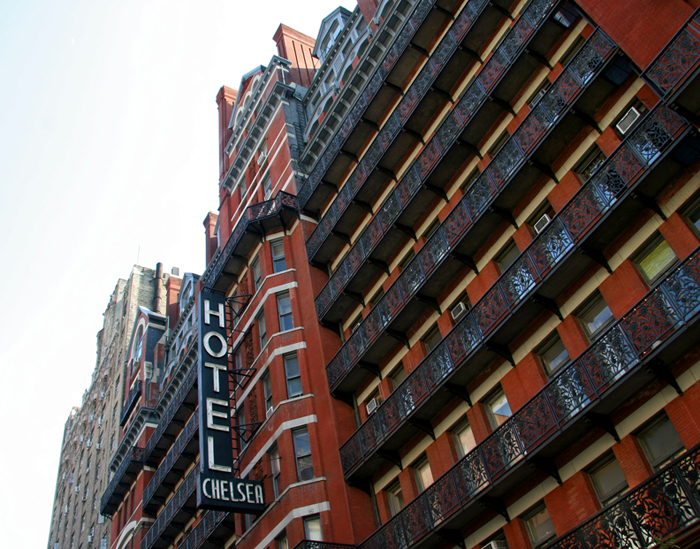
    Virtually every New Yorker has heard of the Hotel Chelsea, more commonly known as the Chelsea Hotel. The hotel is most well known for its roster of well known long-term residents – many living at the hotel for years. The hotel has been a home to writers, artists, actors and film directors.

    A short list includes: Mark Twain, O. Henry, Dylan Thomas, Arthur C. Clarke, William S. Burroughs, Arthur Miller, Quentin Crisp, Gore Vidal, Tennessee Williams, Allen Ginsberg, Jack Kerouac (who wrote On the Road there), Simone de Beauvoir, Robert Oppenheimer, Jean-Paul Sartre, Thomas Wolfe. Stanley Kubrick, Ethan Hawke, Dennis Hopper, Uma Thurman, Elliot Gould, Jane Fonda, The Grateful Dead, Tom Waits, Patti Smith, Dee Dee Ramone, Henri Chopin, Edith Piaf, Joni Mitchell, Bob Dylan, Alice Cooper, Janis Joplin, Jimi Hendrix, Sid Vicious, Leonard Cohen, Madonna, Robert Mapplethorpe, Robert Crumb, Jasper Johns, Willem De Kooning, and Henri Cartier-Bresson.

    From the Hotel Chelsea website:

    The hotel has always been a center of artistic and bohemian activity and it houses artwork created by many of the artists who have visited. The hotel was the first building to be listed by New York City as a cultural preservation site and historic building of note. The twelve-story red-brick building that now houses the Hotel Chelsea was built in 1883 as a private apartment cooperative that opened in 1884; it was the tallest building in New York until 1899. At the time Chelsea, and particularly the street on which the hotel was located, was the center of New York’s Theater District. However, within a few years the combination of economic worries and the relocation of the theaters bankrupted the Chelsea cooperative. In 1905, the building was purchased and opened as a hotel.

    Owing to its long list of famous guests and residents, the hotel has an ornate history, both as a birth place of creative modern art and home of bad behavior. Bob Dylan composed songs while staying at the Chelsea, and poets Allen Ginsberg and Gregory Corso chose it as a place for philosophical and intellectual exchange. It is also known as the place where the writer Dylan Thomas died of alcohol poisoning on in 1953, and where Sid Vicious of the Sex Pistols may have stabbed his girlfriend, Nancy Spungen, to death on October 12, 1978.

    Hotel Chelsea is also architecturally significant. The Victorian Gothic red-brick structure with its wrought iron balconies, located at 222 West 23rd Street in the Chelsea neighborhood of Manhattan, was listed on the National Register of Historic Places in 1977. One of the main attractions here is the art that graces the lobby and the 12-story stairway. The stairway is off limits to walk-in visitors (there is a monthly tour), however, the lobby is open to all.

    I cannot speak to the rooms here – I have never been in one, but the place does has a reputation for shabby chic. People stay here for the history and artistic clientele and ambiance, not for the ultimate in luxury or slick room furnishings. At the current time, there are approximately 250 rooms in the hotel – roughly half are still occupied by permanent residents. Long-term residency is no longer granted to newcomers, and as rooms of long-term tenants are vacated, they are converted to hotel rooms.

    The Hotel Chelsea is one of the most unique residences/hotels in New York City, if not the USA. For most of us, its past residents are a who’s who of American culture. For those who were fortunate enough to have stayed there in the past, it was living with legends…


  • Le Petit Chambord

    You are not going to see many sites like this in America. Every borough and many neighborhoods abound with interesting buildings and homes – architecture is of the best things that New York City has to offer.

    There are many magnificent architectural structures in this city – Grand Central Station, the Metropolitan Museum of Art, the New York Public Library, the Chrysler Building, St. Patrick’s Cathedral, St. John the Divine, the Dakota, the San Remo, the Beresford, Sherry Netherland Hotel, Waldorf Astoria, and countless others that I have photographed and written about for this website.

    Keeping a lower profile, neighborhoods such as Greenwich Village, Park Slope, Brooklyn Heights, Harlem, Chelsea, Fort Greene, et. al., have thousands of homes from 100 to nearly 200 years old. I am writing this from a period townhouse dating 1837.

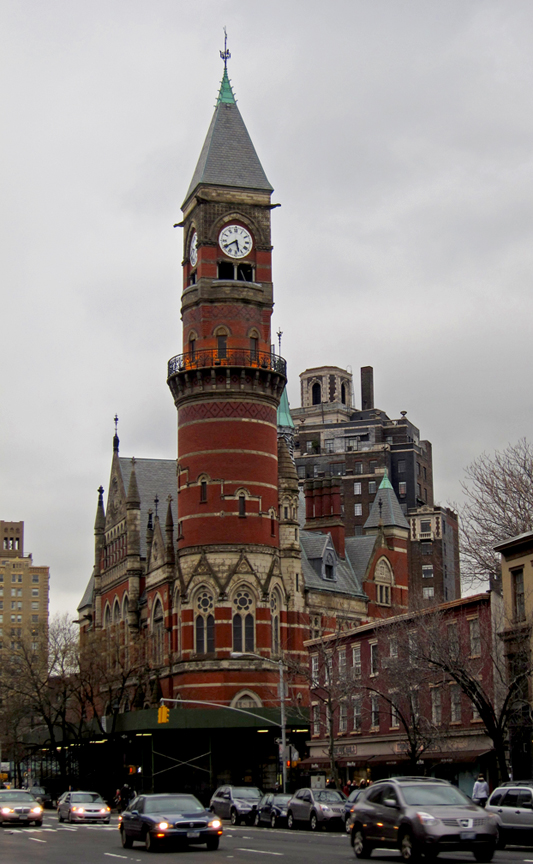
    The vista in today’s photo was pointed out to me by friend and photographer Bill Shatto as we were strolling down Avenue of the Americas in Greenwich Village. This is a familiar site to both of us, but the time of day, clouds, lighting, and vantage point all conspired in a dramatic tour de force. The Jefferson Market Library was backed by the prewar building at One Christopher Street and framed by period rowhouses along 6th Avenue. Extending upwards is a clock tower atop the library building (cropped out in this photo) – to see the entire structure, click here.

    One often misunderstood area in photography is the nature of outdoor lighting conditions. Although intuition would suggest that a bright sunny day would be ideal shooting conditions, in fact, it typically provides some of the worst conditions, producing photos with harsh shadows and overexposed highlights. Although there are many techniques to deal with these problems, in many cases, professional photographers and film makers avoid this time of day completely. A cloudy day, on the other hand, can provide some of the richest colors and most beautiful soft lighting conditions.

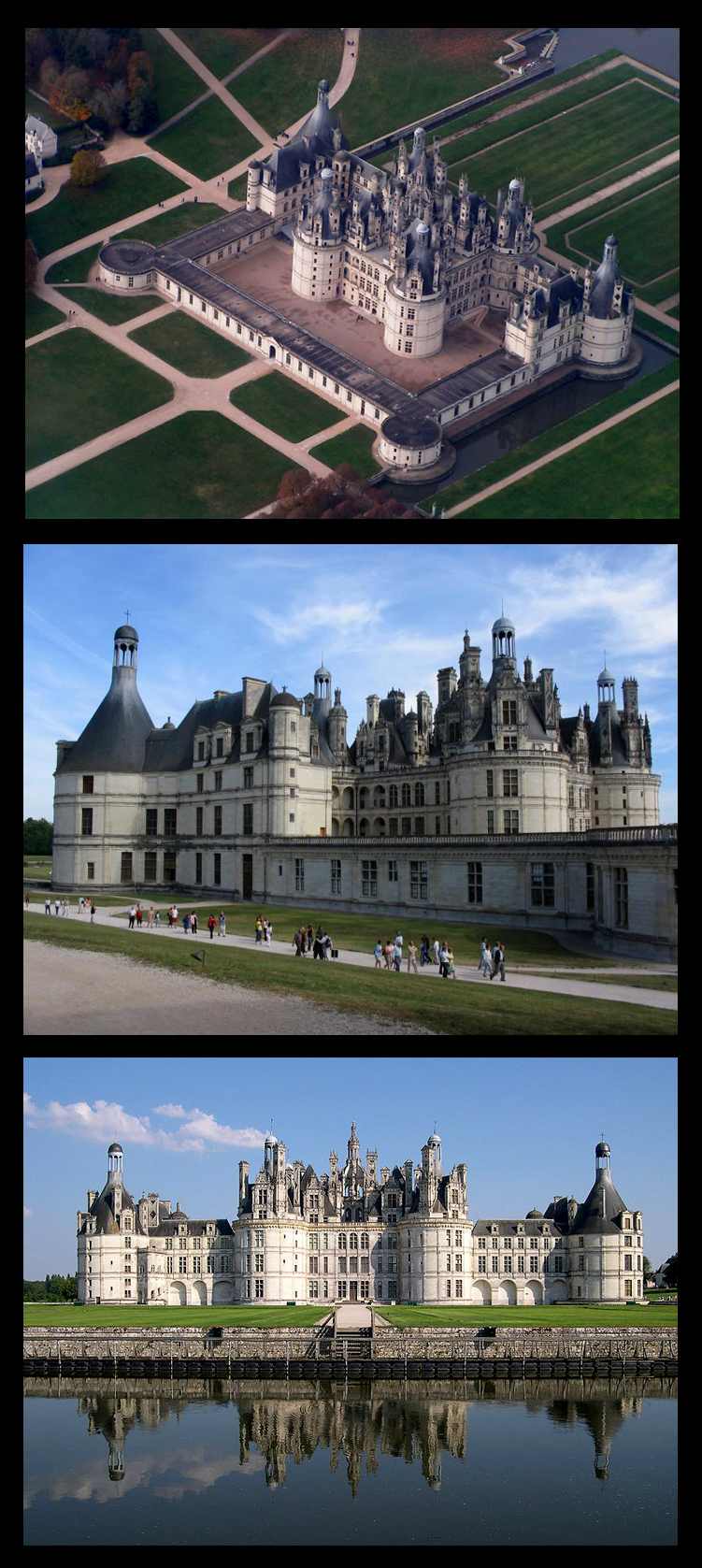
    The medley of rooftops reminded me of the Château de Chambord in France. If you are not familiar with this extraordinary French chateau, see here.

    Chambord was an indulgence, built by Francois I as a hunting lodge over a period of 20 years. It was never completed. The Jefferson Market Library building seems like it is in a perpetual state of repair – scaffolding has been around the base for seven years. Only another 13 years of renovation and we can rename it Le Petit Chambord 🙂

    About Chambord: Building was begun by Francis I in 1519 and completed in 1547 (with one hiatus). 1,800 men worked on its construction. It contains 440 rooms, 365 fireplaces, 84 staircases, and stables to accommodate 1,200 horses. The chateau stands in a 13,000 acre wooded park surrounded by a wall 20 miles in circumference.


  • For Whom the Knell Tolled

    Please listen to the audio while you read this …


    I recall being in a tiny village one morning in France and seeing the most extraordinary thing – an old man hanging a huge basket of flowers in the town center. Nothing about the deliberate act seemed practical at all. It looked like a lot of work, the kind of beautification effort rarely seen in New York City.

    In other medieval villages, there were old men playing boule and chatting. There were markets. And if I was lucky, there were church bells. There is nothing more evocative than being in a small town and hearing the peal of church bells. I am happy that I am not a devout atheist – it would be much more difficult to appreciate the great churches and temples of the world.

    I met author Terry Miller once, at a signing for the release of his book Greenwich Village And How It Got That Way. In speaking to him, I made a remark regarding the over-commercialization of many areas of Greenwich Village. He was quite quick to retort, “Where else are you going to live – Europe?”

    I have reflected on this for years. I don’t dislike the United States – as I have met people from other countries over the years, I have gotten to appreciate this country more. But I do love Europe. And I do believe that Greenwich Village has the closest thing in the United States to the ambiance of the older neighborhoods of cities and towns of Europe – the food, arts, culture, street life and architecture, with its hundreds of 19th century row houses.

    As I walked through the South Village along Thompson Street recently, I heard the ringing of church bells coming from St. Anthony’s Church (officially the Church of St. Anthony of Padua), which runs from Sullivan to Thompson Street along Houston Street. I ran hurriedly to record it, expecting only to get a few final rings for the 11th hour. The ringing, however, continued for quite some time. I discovered that there was a funeral being held, explaining the long ringing. I can not tell you for whom the death knell tolled, but it called to me and I went…

    Photo Note: The tall slim tower in the left photo is the bell tower.


  • Guastavino

    Would you like to do your grocery shopping in a space with the grandeur of a cathedral? Welcome to the Food Emporium at Bridgemarket, nicely tucked under the Manhattan approach to the 59th Street Bridge.

    The Bridgemarket was originally an open air market in the early 1900s until the the 1930s, when it became a New York City Department of Transportation facility. The vaulted space was designed by Austrian-American architect Henry Hornbostel and engineer Gustav Lindenthal. It languished unappreciated and unloved until 1977, when Hardy Holzman Pfeiffer Associates first presented plans for a market. Renovations were begun in 2000. It is now occupied by the Food Emporium (seen in the photo), Guastavino restaurant, a Conran furniture shop, and a public plaza.

    The real pièces de résistance here are the vaulted ceilings covered with Guastivino tiles. Rafael Guastavino (1842-1908), an architect from Barcelona, came to New York with his son in 1881 and, in 1889, founded the Guastavino Fireproof Construction Company. It was initially run by Rafael and later his son, with its final contract completed in 1962.

    The Guastavino tile arch system uses a timbrel, or Catalan vault of self-supporting arches and architectural vaults with interlocking terracotta tiles and mortar. The Guastavino company eventually held 24 patents for the system.

    Hundreds of historically and architecturally important buildings use his system – Grand Central Terminal (particularly the Oyster Bar), Grant’s Tomb, Carnegie Hall, the Cathedral of St. John the Divine, the Elephant House at the Bronx Zoo, and the Ellis Island Great Hall. Guastavino’s first major project was in 1888, when he was hired by McKim, Mead & White to produce the vaulting for the Boston Public Library.

    Using publicly available and architecturally beautiful structures for day-to-day tasks is one of the unique things about New York City – shopping in the old Scribners Bookstore on 5th Avenue, dining in a former bank with high ceilings the Blue Water Grill at Union Square like that occupied by Balducci in Chelsea, staying in historic hotels like the Waldorf Astoria or the Plaza, walking across the Brooklyn Bridge, or just catching a train in Grand Central Station. There are many things to see and do in New York City, but as I explore, I’m keeping an eye out for one name: Guastavino 🙂


  • Head for the Hills

    He was a little ungainly and awkward, like Basil Fawlty, John Cleese’s character in Fawlty Towers. But, unlike Basil, who, though incompetent, is basically harmless, my innkeeper had a slightly uncomfortably mysterious side, like Norman Bates of Alfred Hitchcock’s film Psycho.

    The inn, in Southern New England, was perched on a hilltop and had extraordinary views. Most local residents were not even aware that the place existed or that access to this hilltop with such exceptional vistas was possible, much less that an inn was perched atop the mountain. The place was atmospheric and had been hand-built in stone by the owner’s parents with a wonderful flagstone terrace.

    I was compelled to book a room there. I just love the mountains. The innkeeper appeared to be the only one present, and at night, he disappeared to some unseen cottage on the property, or so he said. There were only two rooms in the inn, and on my stay, only my room was occupied. The place was musty. Books were everywhere. At night it was pitch black everywhere and, though intrigued to explore, with my imagination running wild, I decided it best to stay in my room.

    I spoke at length with the innkeeper on one occasion about hill or mountain lovers, and he put it quite succinctly – there are hill people and valley people. If this is how humanity is divided, then I must be a hill person. I do love a mountain drive – the more precipitous, the better. If a Michelin map to a European country I am traveling in indicates a difficult and dangerous road, that’s the road I prefer.
    The hilltop perch is what first drew me to the Tibetan retreat on Lighthouse Hill in Staten Island. Very few visit this remarkable place, and, like my hilltop inn in New England, it is virtually unknown. See additional photos here.

    The Jacques Marchais Museum of Tibetan Art was founded in 1945 and officially opened in 1947 by Jacques Marchais (the professional name used by Jacqueline Klauber), a collector and expert in Tibetan art who acquired the largest collection in the Western world. She never visited Tibet during her lifetime and sadly passed away the year following its opening.

    The rustic complex of fieldstone buildings was designed by Marchais – the architecture, gardens, fish pond, and terraces resemble a Tibetan Buddhist mountain monastery, or gompah. You will also find sculptures on the grounds, as well as bright-hued prayer flags. It was the first Himalayan-style structure to be built in the United States and the first museum in the world devoted exclusively to Tibetan art. The Dalai Lama himself paid a visit in 1991. In addition to the museum’s display of art and objects, there are classes and special programs. My first visit was for a Tibetan festival.

    Of course, the love of mountains as a building site is far from being my exclusive passion – Lighthouse Hill, along with nearby Todt Hill, has some of the most opulent homes on Staten Island. The preference of hills and valleys is replayed around the world by the well-heeled. Some will live in the valleys or by the ocean, while others, with a penchant for drama, danger, and vistas, will head for the hills 🙂


  • Finger Painting


    I never really liked finger painting, but between K-12 in the public school system where I grew up, that was my first and only exposure to art. At the time I entered university in New York City, I had neither seen even one work of art nor was exposed to any form of classical music or opera. Music class in grade school consisted of mass embarrassment and faces buried in songbooks, with a handful singing and the rest lip-syncing.

    There were some art electives in high school, but not many boys are going to take an art class when the sciences are championed above all else and defended on the basis of utility. Of course, preparing for the future is sensible, but somewhere in the education of an American student, shouldn’t there be some exposure to the fine arts, if only that it is part of what makes an educated person in a civilized world?

    My first exposures to art in galleries and museums of New York City were not good. I did not understand what I was seeing or what art was. The explanations, interpretations, and definitions were more vexing than my initial frustration, so I became defensive, seeing the world of fine art as one of impostors and charlatans. The fact that many artists are iconoclastic made matters worse – the lack of definitions and ways to measure art made it seem all the more whimsical and arbitrary to anyone inclined to numbers.

    New York City has been a mecca for art and artists of every type for eons, and in time, a reasonable person begins to look at art seriously. Only the most obstinate can live in this city and maintain a militant anti-art posture for long.

    In the last decade, over 250 galleries have moved to Chelsea. Only vestiges remain in neighborhoods such as SoHo. The more recent exodus has been out of Manhattan entirely to areas such as Williamsburg and Red Hook in Brooklyn.

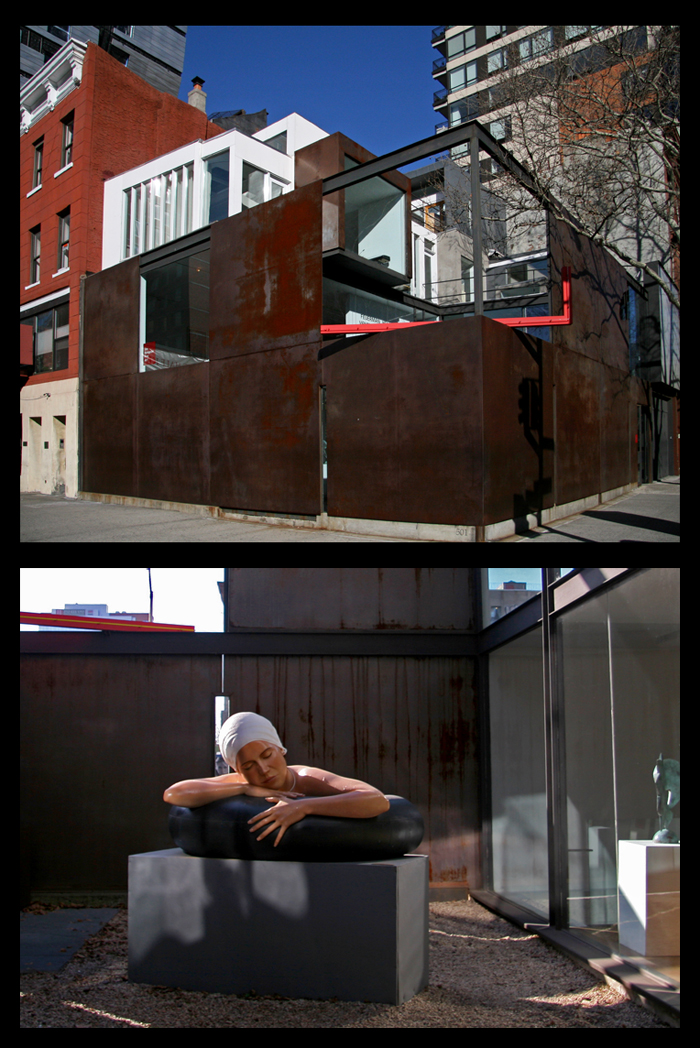
    The gallery in the photo is located at 501 West 23rd Street at Tenth Avenue and was the work of architects G. Phillip Smith and Douglas Thompson. The building was a work in progress over ten years, starting with a vacant lot. The design was inspired by the projecting balconies and walled courtyards Cairo houses of the 17th century. The exterior of the structure was built from sheets of cold-rolled steel and glass – the interior uses timber framing, stucco and fiberglass. See the New York Times article here.

    The building houses Jim Kempner Fine Art, which specializes in contemporary art in all media and has shown world renowned artists since its opening in 1997. The courtyard currently features the sculptural work The Survival of Sirena (seen in the photo) by Carole Feuerman, part of her exhibition Swimmers, Bathers, Nudes. I’m just really happy I can enjoy art in New York City and no longer have to do finger painting 🙂


  • Diamonds and Rust

    Perhaps real estate brokers confuse platitudes with beatitudes when they often tell a client, “There are only three things to know about real estate – location, location, location.” * This adage (or some variant) has become more of an irritant than a balm to the property hunter. If you are inclined to retort, tell them of the Hotel Earle on Washington Square.

    The Washington Square area has been one of the most desirable residential neighborhoods in New York City since the early 1800s, yet the Hotel Earle at 103 Waverly Place (at the corner of MacDougal Street) was in serious decline in the 1960s and early 1970s, with a reputation as a very seedy boarding house. No one I knew at that time had even set foot in the place. It took not years, but decades, to become the respectable place that it is now.

    The Paul family purchased the hotel in 1973 and progressively made improvements to the Art Deco-style 150-room hotel. In 1986, the name was changed to the current Washington Square Hotel. In 1992, Judy Paul opened North Square Restaurant, a first-class New York bistro at the hotel. From the Hotel’s press release in 2008:

    The Washington Square hotel was built in 1902 as a residential hotel named the Hotel Earle after its first owner, Earl S. L’Amoureux. The hotel occupied a single, 8 story, red brick building on Waverly Place, in the heart of affluent Greenwich Village, now an historic landmark district. In 1908, L’Amoureux built an identical, connecting building to create a grand apartment hotel, complete with reading rooms, restaurant, and banquet facilities. Four years later he added a ninth floor and, in 1917 he acquired an adjoining three story building, bringing the hotel to McDougal Street, at the northwest corner of picturesque Washington Square.

    Once a staid, affluent community, (as depicted in Henry James’ Washington Square and The Heiress), Greenwich Village was becoming the center of New York’s Bohemian counterculture; reflected by the Beat generation who gravitated to the coffee houses and jazz clubs. The once grand hotel was allowed to deteriorate into a shabby apartment hotel, making it an attractive address for struggling artists, actors, writers and musicians.

    Ernest Hemingway, Dylan Thomas, Joan Baez, Bob Dylan, Barbra Streisand, Bill Cosby, Phyllis Diller, Bo Diddley, P.G. Wodehouse, and the Rolling Stones are among the celebrities who have stayed at the hotel. Patricia Highsmith used the hotel as inspiration for her short story “Notes From a Respectable Cockroach.” Joan Baez stayed in room 305, with Bob Dylan, in the early 60s. In her love song, “Diamonds and Rust,” Baez says, “Now you’re smiling out the window of that crummy hotel over Washington Square.” John and Michelle Phillips of the Mamas and the Papas stayed at the Earle during a visit to New York City (which prompted them to write “California Dreamin'”). Norah Jones worked there previously as a waitress.

    Many former inhabitants of the olde Earle have seen both diamonds and rust…

    For the etymology of the phrase “location, location, location” as regards real estate, see the article here in the New York Times by wordsmith William Safire.


  • We Got Religion

    When I first met a friend several years ago, in the course of our initial conversation, he referred to himself as a card-carrying atheist. Of course, I never thought he meant this literally, but, in fact, he proceeded to show me his membership ID for the New York City Atheists.

    Incidents like this, as well as the urban environment with its iconoclastic populace, would lead one to believe that the religious in this city must be a much smaller percentage than that found in the United States population at large. Surprisingly, the percentages are not so different. A recent 346-page report, Religious Change Around the World, was released in October 2009 by the National Opinion Research Center at the University of Chicago (if you are interested in perusing the report, you can download the document here.) The massive study – the most comprehensive analysis to date of global religious trends – reveals that religious change around the world is very complex and that no simple conclusions can be drawn.

    The percentage of citizens who regularly attend religious services is typically quoted as 40%, a number gleaned from surveys such as the Gallup Poll. This number is now in question, however, as individuals polled often answer in a way to reflect what they would like others to hear and perhaps believe themselves. Some studies have shown that the real number may be closer to 20%.

    Although it is generally believed that scientists and doctors are less likely to believe in God or be particularly religious, the report shows, surprisingly, that the difference in religious belief between the scientific and non-scientific community is actually not that large. Also, in spite of declining church attendance and religious affiliation, studies show that there has been an increasing number of those who consider themselves to be spiritual. Many faiths are looking to repackage their religious practices to address the changing needs of their communities.

    There are thousands of places of worship in the five boroughs of New York City – churches, synagogues, mosques, etc. A small number are major attractions, such as St. Patrick’s Cathedral and the Cathedral of St. John the Divine. Others, either architecturally and/or by the nature of an unusual amount of free land surrounding them and manicured grounds, virtually demand the attention of passersby. The Gothic masterpiece Grace Church is a good example (see here as well).

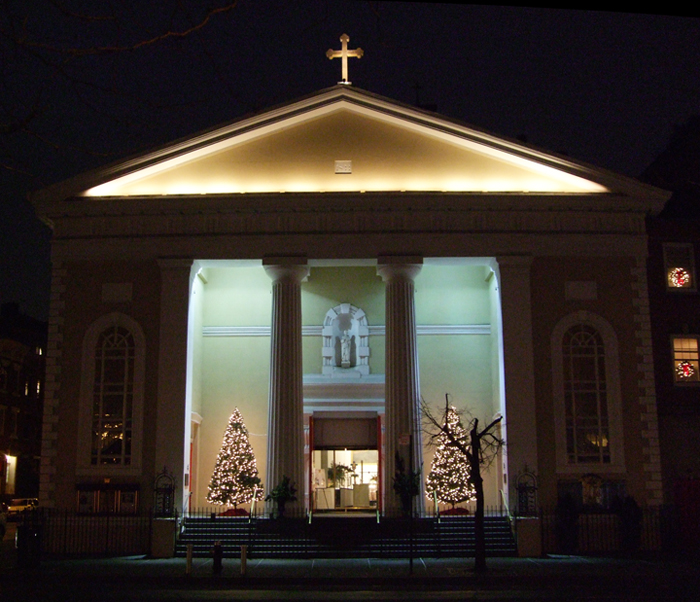
    However, unless the doors are open or perhaps the scene is graced with a spring or summer wedding precession, most houses of worship remained unnoticed, competing as they do with commercial establishments. The church in the photo, although architecturally striking, lies amidst the hustle and bustle of 6th Avenue in the Village. Unusual elements made it particularly photogenic on the night it was photographed: open doors, interior illumination, Christmas trees flanking its massive columns, and everything aglow, including the rooftop crucifix. In spite of changing definitions and practices, in New York City, like the rest of America, we got religion…

    About the Church: St. Joseph’s Church in Greenwich Village is the second oldest Catholic church in Manhattan. The Greek Revival structure was built in 1834. In 2005, NYU merged with St. Josephs, and the church is now known as the University Parish of St. Joseph & the Catholic Center at NYU. The Catholic Center at New York University, previously housed in the Holy Trinity Chapel on West 4th Street, has been demolished. The property, previously owned by the Archdiocese, was sold to NYU.


  • Rags and Riches

    I recall speaking to a young architect many years ago, expressing my dissatisfaction with NYU’s hulking Bobst Library on Washington Square South. She explained that from an architectural perspective, the nature of a library demands such an imposing structure. I was not thoroughly convinced that this particular library needed to have such an imposing presence on Washington Square, particularly such an enormous, monolithic, cubic design, but I did come to appreciate that certain types of institutions can instill confidence in their patrons by the nature of their structure. And what would be a better candidate than a bank, home and guardian for our money?
    From an article in the New York Times:

    Why build such evocative Greek temples to begin with? To inspire confidence. When the United States economy collapsed in the Panic of 1893, many people blamed banks for the depression that followed and withdrew their money.
    So, banks built in that era (until the end of the Great Depression, when banks began to demystify themselves with glass-fronted branches) were meant to suggest strength, as if they had been there forever.

    The Bowery Savings Bank, 130 Bowery at Grand Street, is an outstanding structure. It was designed by Stanford White (1853 – 1906) of the firm of McKim, Mead, and White, and built in 1895. The landmark building is adorned with Corinthian columns, Venetian glass, marble mosaic floors, and 65-foot ceilings.

    The Bowery Savings Bank, however, ran into serious financial difficulties and, in 1985, was sold to Richard Ravitch and others. Its current incarnation is Capitale, an upscale events space and popular wedding facility. To see a photo gallery of the beautiful interior spaces, see their website here.

    Equally remarkable is the building’s location on the Bowery, a street/area which, in recent history, has been quite impoverished, known as skid row and home for Bowery bums. Sections of the area have become gentrified. To walk the street is still a very uneven experience, with the lighting district, restaurant supply district, bits of Chinatown, an art museum, and Cooper Union. It is a rags and riches story…

    Note: The roster of works designed by McKim, Mead, and White is extraordinary. In New York City alone, they were responsible for the Harvard Club of New York, Madison Square Garden II, the Cable Building, Washington Square Arch, Columbia University’s Morningside Heights campus, The Morgan Library & Museum, the Manhattan Municipal Building, Bellevue Hospital Center, James Farley Post Office, the Town Hall, Savoy-Plaza Hotel, and the Villard Houses. The existing building replaced the original Bowery Savings Bank building of 1834.


  • Dreams

    There can be comfort in unrealized and unattainable dreams. A basket of these can provide a hidden agenda, and false hopes of realization can give one’s life purpose. These aspirations can be wielded in conversation: “One day I hope to…” And, perhaps, one is better without the realization, because not only is the dream lost, but also, with the accumulated expectations over time, the reality could be a disappointment.

    And so it has been for me with my love affair with Washington Square Arch, a monument which I have looked at nearly every day of my adult life and dreamed to enter and ascend to its roof. As a boy, I had the same passion for reaching the summit of the Washington Monument, which was an easily attainable goal: pay the admission fee and take the elevator.

    The Washington Square Arch stairway is rarely open to the public. Until recently. Late one night, I was informed by a park habituĂ© that the small door at the foot of the west end of the base of the arch was open – or, in fairness, I should say ajar. My first reaction was indignation – how dare I not be told about this opportunity! After waiting for decades, wasn’t I the most worthy?
    It soon occurred to me, however, that rather than spend time being self-righteous, perhaps I should consider taking advantage of this rare opportunity and actually entering the Arch. After all, goals are attained by those who act, not whiners.

    There was no sign of prohibition at the door. Many an opportunity is missed by overthinking, overplanning, and excessive worry, so with little fanfare or deliberation, I entered.

    An extremely narrow spiral staircase winds its way to the top. Fortunately, it was left lit, so my journey was easy enough. At the top, there is a large, cavernous chamber. A staircase ascends further to a skylight trap door, leading to the roof of the arch (photo lower left). It appeared to be easily opened, but I decided not to press my luck. I took several photos through the transparent domed roof hatch (photo lower right).

    There is not a tremendous amount of information about this interior Guastavino terra cotta tile staircase and upper chamber. Typically, the story of Marcel Duchamp and his cronies is told – see my story here. I have done nearly ten stories involving the arch (see the list of links below).

    What do you do when a small lifetime dream is realized? Just refine and redefine. After all, what I really wanted to do was to exit that domed hatch and go the roof. I am told that such a thing can be arranged if one speaks to the right people. When I do that, you will be the first to know 🙂

    Related Posts: Flash of Light, Comfort and Joy, Arch Rebels, Constant, Evening Arch, Cello, Nested Embraces, Singing Bowls


  • Mavericks

    The thing that bothers me most about the word maverick is that it appears to never be used by mavericks – only by established journalists or interviewers – and that it is typically used to describe business iconoclasts, another word rarely used by true iconoclasts.

    And so we can really never know solely by reading the accounts of reviewers how much of a maverick any person really is, such as Thom Mayne of Morphosis, designer of the new Cooper Union Building. In 2005, Mayne won the highly regarded Pritzker Architecture Prize, being the first American to have won it in 14 years. The NY Times article headline at the time was “American Maverick Wins Pritzer Prize.”

    There has been a lot of development in this immediate area of the East Village around Astor Place by NYU, Cooper Union, and private developers, with projects such as the Gwathmey residential tower (see here). I do empathize with all the critics of these projects and any displaced tenants. However, in fairness, there is also a lot of really hideous architecture in this largely seedy area. I find the massive scale of the new building a little daunting, but at this point, I find new work like this to be a visual relief from the abominations that abound. A replacement, designed by Japanese starchitect Fumihiko Maki for the building at 51 Astor Place, is in progress.

    The structure being replaced has been desribed as the “ugly beige eyesore connected to Starbucks.”
    The new Cooper Union engineering building at 41 Cooper Square (3rd Avenue), with its signature perforated metal exterior, is, of course, highly contentious with neighborhood residents; nearby graffiti proclaimed, “ALIENS! PLEASE PARK SPACECRAFT ELSEWHERE!” Architecture critics, however, including Nicolai Ouroussoff from the New York Times, generally like the building. For his article about the building along with a multimedia slide show, go here.

    My family loved to use the word cowboy to describe a wild and rebellious individual. Personally, I’ll take cowboy over maverick 🙂


  • dinamic_sidebar 4 none

©2026 New York Daily Photo Entries (RSS) and Comments (RSS)  Raindrops Theme