• Category Archives Architecture
  • American Radiator

    Many young people hated history class in my high school days – all the memorizing of facts. Even if your memory was quite good, why waste it leaning about things and events long gone, most with no remaining vestiges whatsoever? And things that seemingly had no relevance to our young lives.

    Growing up in a blue-collar factory town, there wasn’t much history to pique a young person’s interest anyway. Oh, I had plenty of interests: math, rocketry, German language, chess, origami, Africa, adventure, music, and books (and girls). I belonged to plenty of clubs. But history was not part of the agenda at all. Things started to change when I started traveling to Europe and when I moved to NYC. Here, history is alive and well – it’s with us everyday, everywhere you walk or look. To fully understand a building or place, one has to know the history, and it’s not long before one wants to know the history and likes history. Soon, you’re watching the History Channel (I wish my history teacher was alive to witness the success of this network).

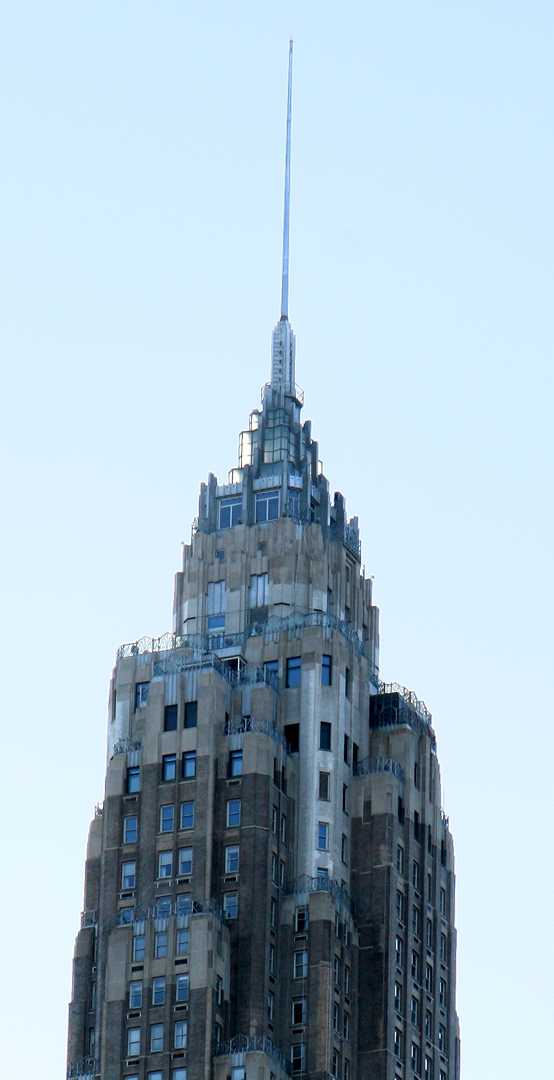
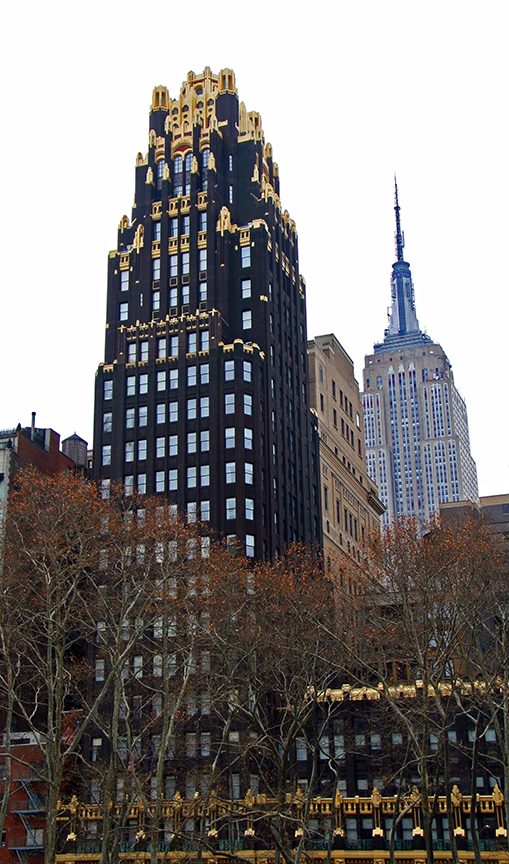
    Today’s photo is a great illustration of all this. The American Radiator Building, now the American Standard Building, was
    designed by architects Raymond Hood and John Howells and built in 1924 for the American Radiator and Standard Sanitary Company. It is based on the Chicago Tribune building. The building is located at 40 w. 40th Street on a block with many brownstones and Renaissance club facades from the turn of the century. It is on the south side of Bryant Park, thus affording unobstructed views of it from some distance. The stark contrast in colors is a distinguishing characteristic and a remarkable sight, well-known to city dwellers who frequent the area. The brick is black – Hood wanted the appearance of a large mass, unbroken by dark windows in a building typically constructed using lighter-colored stone. The building is topped with Gothic style pinnacles and terra-cotta friezes covered in gold. The design was to recall the furnaces of the time, with their black iron and glowing embers.

    Another important feature of this building is that it is set back from the lot line – unattached on all four sides. This freestanding construction permits architectural treatment all around and allows more natural light into the interior. The base is black granite with bronze plating, the lobby black marble. The building is landmarked and listed on the National Register of Historic Places. In 1998, it was sold and later converted to the Bryant Park Hotel. When you are in the neighborhood, make sure to take a look. This history serves us well, does it not?
  • Constant

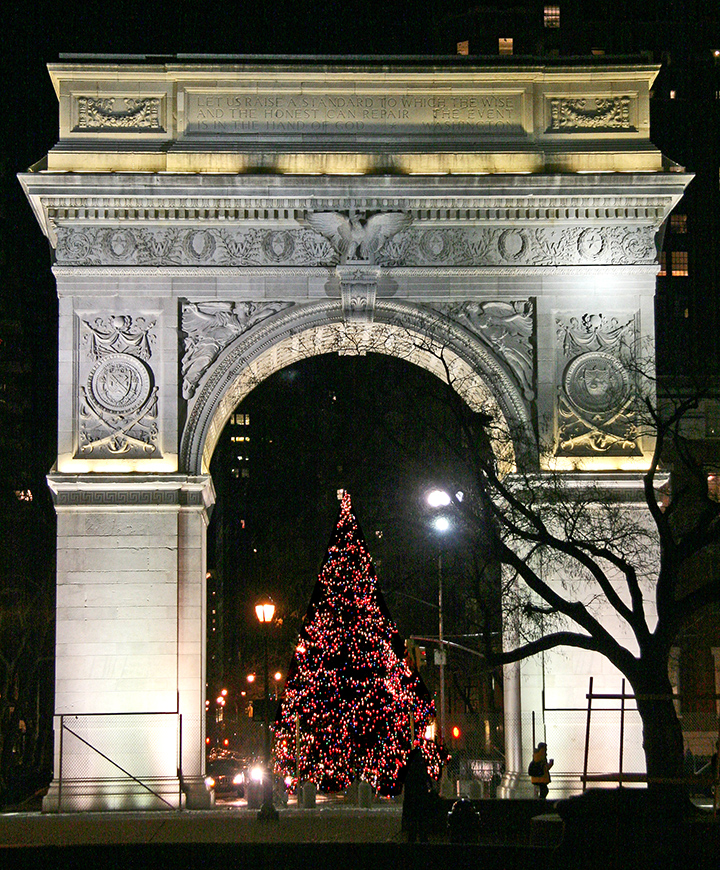
    In today’s assignment, I will briefly answer the question, “What does Washington Square Arch mean to me?” In the 60s – 70s, Greenwich Village had everything a young person wanted – freedom, excitement, diversity, the counterculture, permissiveness, liberalism, protest, and rebellion. Along with Berkeley/San Francisco, it was one of the preeminent areas in the country for the counterculture of the times. The stories read like a fantasy novel: music venues like the Electric Circus and the Fillmore East, Bob Dylan, seeing John Lennon and Yoko Ono at a local bike store, a friend calling Woody Allen from the dorm, Jimi Hendrix rehearsing down the block at Electric Lady Studios. Imagine coming to visit a place like this, never having been away from home or to the big city.

    One of my first memories of NYC (on a preliminary visit to NYU, where I had been accepted) was approaching this arch with musicians beneath it playing bongos and radicals distributing literature like the Berkeley Barb. And yes, there was sex, drugs, and rock and roll. But there were severe casualties for those who overindulged, as I wrote about in Summer of Drugs, a 40th anniversary reunion of the 1967 San Francisco Be-In. So this arch has a lot of meanings for me. I have lived in this neighborhood for nearly 4 decades, and the arch has been a constant in a world of change, symbolizing different things for different people and times. Recently, the arch was completely refurbished, with beautiful lighting installed. So now when I arrive at night, I know it’s home because I see the light has been left on for me…

    Other Postings on Washington Square Arch: Evening Arch, Singing Bowls, Cello, Arch Rebels


  • Air Rights

    I’m not a neo-Luddite – I do love much of what technology has brought us. Cell phones, the Internet, PCs, DVDs, VCRs, and ATMs are all things which have made our lives easier. But I do love natural things. One of the things I hate is the inability to open windows in high-rises or hotel construction. On a beautiful spring day, I want to throw the windows open, hear the birds, and smell the air, not watch it through a picture window like a television program.

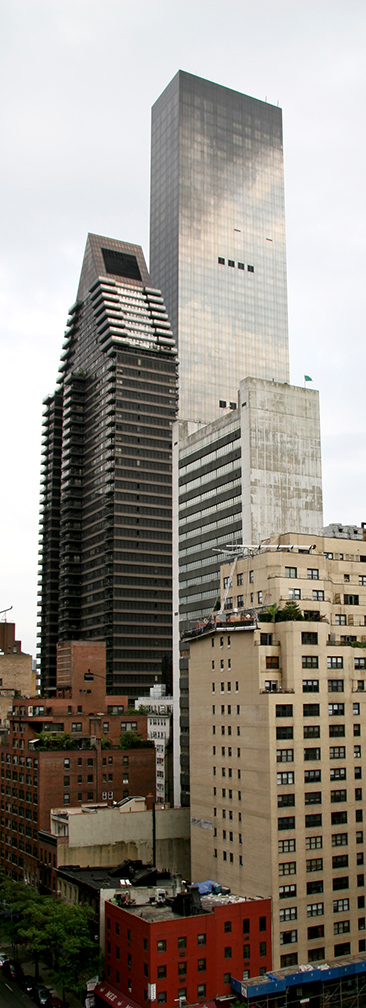
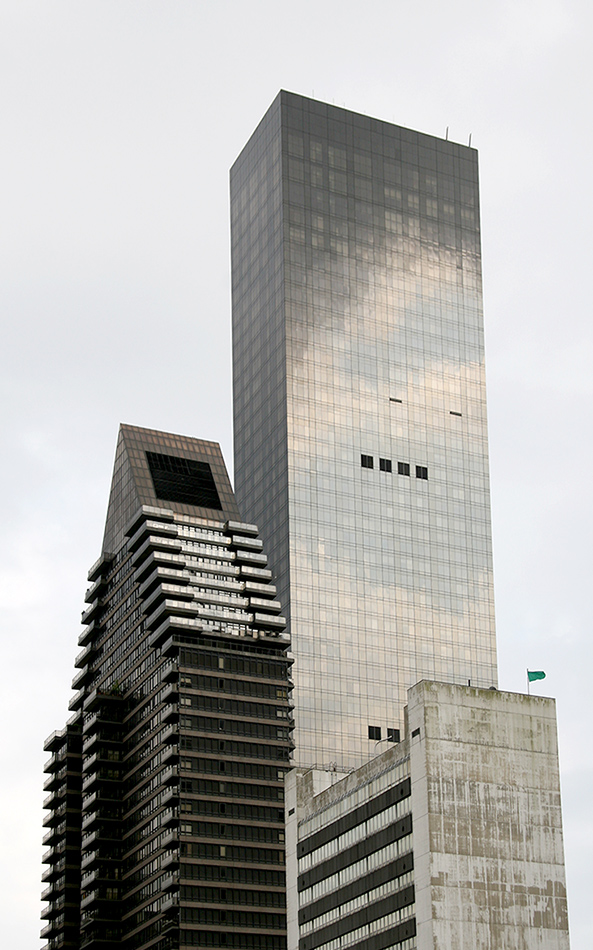
    That said, today I bring you two glass towers (two-for-one to carry you through the weekend). The building in the foreground is the 52-story 100 United Nations Plaza, a luxury condominium tower on the northwest corner of 48th Street and First Avenue, completed in 1986 (click here for 2nd photo). You can’t miss this one, with its signature wedge-shaped roof in eight steps, featuring penthouses with multiple balconies. The building is surrounded by a landscaped plaza with gardens and fountains. It was designed by Der Scutt, an architect with quite a pedigree who has done numerous NYC projects, including Trump Tower on Fifth Avenue, the Grand Hyatt Hotel, and the Corinthian luxury condominium.

    This building was the tallest in the area until it was eclipsed by the 72-story Trump World Tower (seen to its right in the photo) across First Avenue between 47 and 48th Streets. Surprisingly, I have read a number of positive reviews from architecture critics such as Herbert Muschamp. Designed by Polish architect Marta Rudzka and completed in 2001, it was built amid some controversy (of course) concerning its height and impact on views and neighboring buildings, particularly the United Nations. It is the tallest residential tower in the US and was worldwide until the completion of the 21st Century Tower in Dubai (2003) and the Tower Palace Three in Seoul (2004).

    It’s amazing what lawyers and money can do. If the law provides needed loopholes and maneuverable angles, lawyers will find them, and unless laws are changed, projects go though which may puzzle many and not be to the liking of residents. One of the most fascinating concepts is the Transfer of Development Rights (or TDR), a scheme introduced to the city in the 1980s for transferring the unused “air rights” of one building (or more) to another proposed structure, thus allowing for a much taller structure to be erected than the building’s plot alone would allow. Its intention was to save older historic buildings; rather than have to sell a property to capitalize on the value of its land, TDR allows the building to remain with the owner still profiting by selling air rights for the development of a taller structure on a neighboring plot. So Donald Trump gets to dot his i and cross his T again…


  • The Woolworth Building

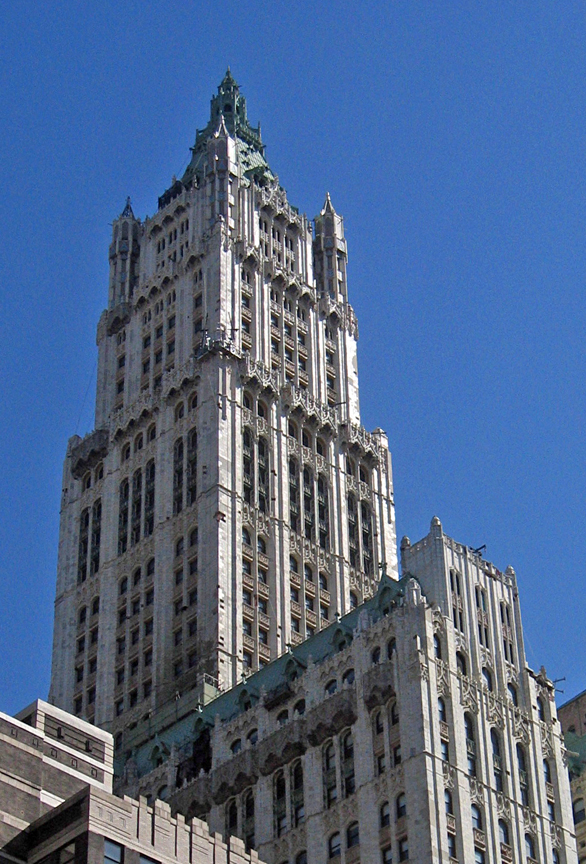
    The Woolworth Building, at 233 Broadway, is a personal favorite of mine – my business was located down the block on Park Place for 10 years, so I saw this building daily. The Gothic structure, with spires, arches, flying buttresses, and gargoyles, was designed by Cass Gilbert and built in 1913 for $13 million in cash by Frank Woolworth as his corporate headquarters (until their bankruptcy in 1997) for his chain of five and dime stores. At 792 feet, it was the tallest building in the world and remained so until 1930.

    One of the stellar attractions is the spectacular lobby. I have visited numerous times. However, as I have written several times before, here we have another case of heavily restricted access to a landmark building subsequent to 9/11. Prior to that event, guards were accustomed to visitors and welcomed them. At night, when it was quiet and the guards were not busy, showing interest in the lobby resulted in what amounted to a free personal tour, with a history of the construction of the building and explanation of the architectural and sculptural elements. They were always eager to point out the all the features of the magnificent vaulted lobby with blue and gold glass mosaics, murals, marble, and the sculptured caricatures, including Woolworth counting his nickels and dimes, Cass Gilbert holding a model of the building, and the structural engineer Gunvald Aus. Its exterior is also outstanding with limestone, granite, terra-cotta, and its signature pyramidal copper spire, now with a green patina.

    When first built, it was referred to as a Cathedral of Commerce, an appropriate description for this National Historic Landmark. Today, it is impossible to access the interior unless you have specific business in the building. So for now, I only have photos of the exterior to share with you…


  • Brutal

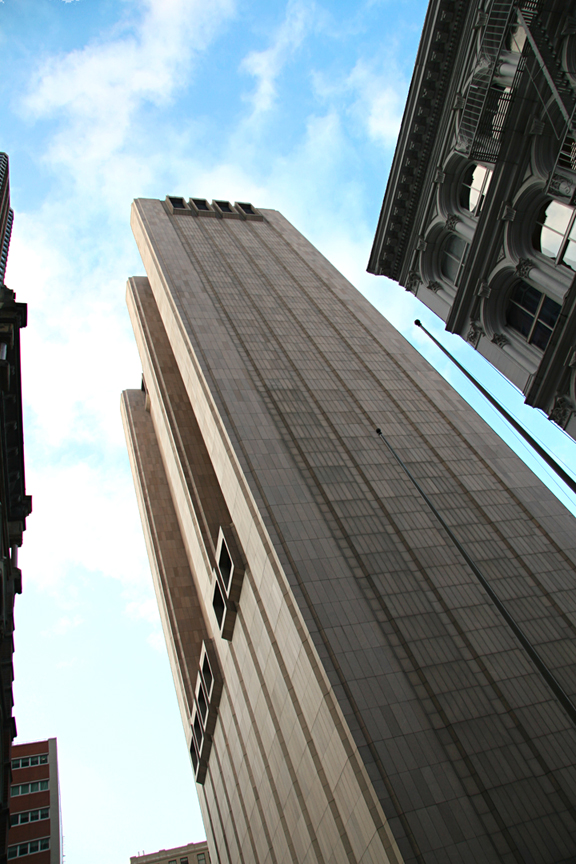
    Even the plain becomes interesting when it is extremely plain, and nothing beats the AT&T Long Lines Building at 33 Thomas Street for a bleak, monolithic structure. 550 feet with no windows. I have been fascinated by this building for over 20 years but never made a serious effort to learn anything about it until writing this article, when I decided to get to the bottom of it all. What’s going on in there? Plenty, just no people.

    The structure was designed by John Carl Warnecke and completed in 1974 as a telephone switching hub for AT&T, now used primarily by AT&T and Verizon. The floors are 18 feet tall – nearly double the height of a standard commercial building – so technically the building is only 29 stories. The exterior walls are made from concrete panels clad with pink-colored Swedish granite. The vertical protrusions are shafts which house the elevators, stairs, and ductwork. There are large, rectangular ventilation holes at the 10th and 29th floors. It is considered one of the most secure buildings in the US and was designed to resist a nuclear blast and be self-sufficient for up to two weeks.

    My understanding is that the building is essentially humanless, barring the occasional technician. On September 17, 1991, human error and power equipment failure resulted in the disabling of the central office switch. Over 5 million calls were blocked, and FAA phone lines were also interrupted, disrupting air traffic control to 398 airports serving most of the northeastern US. In researching for this posting, I saw the architectural style of this building categorized as both International Style II and Brutalism (French béton brut, or “raw concrete”).

    Don’t try to get any consensus as to its appearance – even critics are divided. Architecture critics for the NY Times, Paul Goldberger and Herbert Muschamp, both seem to like it. Goldberger says, “This is the only one of the several windowless equipment buildings the phone company has built that makes any sense architecturally – it is sheathed in a warm and handsome granite, and though it looks more like a mammoth piece of equipment than a conventional building, it, in fact, blends into its surroundings more gracefully than does any other skyscraper in this area.” Muschamp says, “The pink granite tower is forbidding, and it obstructs the river view I would enjoy if the building were demolished. But who cares? Obstructed views are part of what makes New York democratic. And Warnecke’s building starkly frames my view of midtown as if it were a sheer Grand Canyon wall: a neat special effect.” On the other hand, in one survey of architects and critics for the Ugliest Buildings in New York City, the building received the distinction of coming in 6th place…


  • Our Lady of Pompei

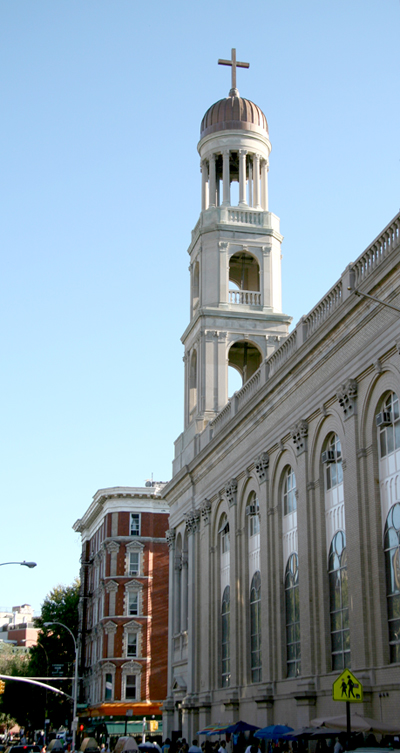
    This was looking like an average story of a nice-looking church. Until I read that this church was named after the Basilica of Our Lady of the Most Holy Rosary of Pompeii in Italy, which was founded by a former Satanist – Bartolo Longo (1841-1926). Read his story here. He was later beatified on October 26, 1980 by Pope John Paul II, who referred to him as the “Apostle of the Rosary.”

    The church in the photo (built in 1928), Our Lady of Pompeii, is located on the corner of Carmine and Bleecker Streets in the Village. It has very high visibility from nearby 6th Avenue and is a landmark in the area. I have shown it as viewed from behind (to the west) along Bleecker Street. Its construction was organized by Father Antonio Demo (born 1870 in Lazzaretto di Bassano, Italy, died in 1936 in New York City) to replace a former church where he was pastor.

    In an interesting side note, the former church is where St. Frances Xavier Cambrini worshipped and taught – she was the first American citizen to be canonised. The church was built in 1928 in Italian-Renaissance style with an interior graced by marble columns, frescoes, and murals. This area of the South Village still shows signs and remnants of its Italian heritage – the shops along Bleecker Street between 6th and 7th Avenues are a good example. Between 1880 and 1920, more than 50,000 Italian immigrants settled here. Father Demo’s legacy continued with the naming of the triangular plot across the street from the church: Father Demo Square


  • Housing Stock

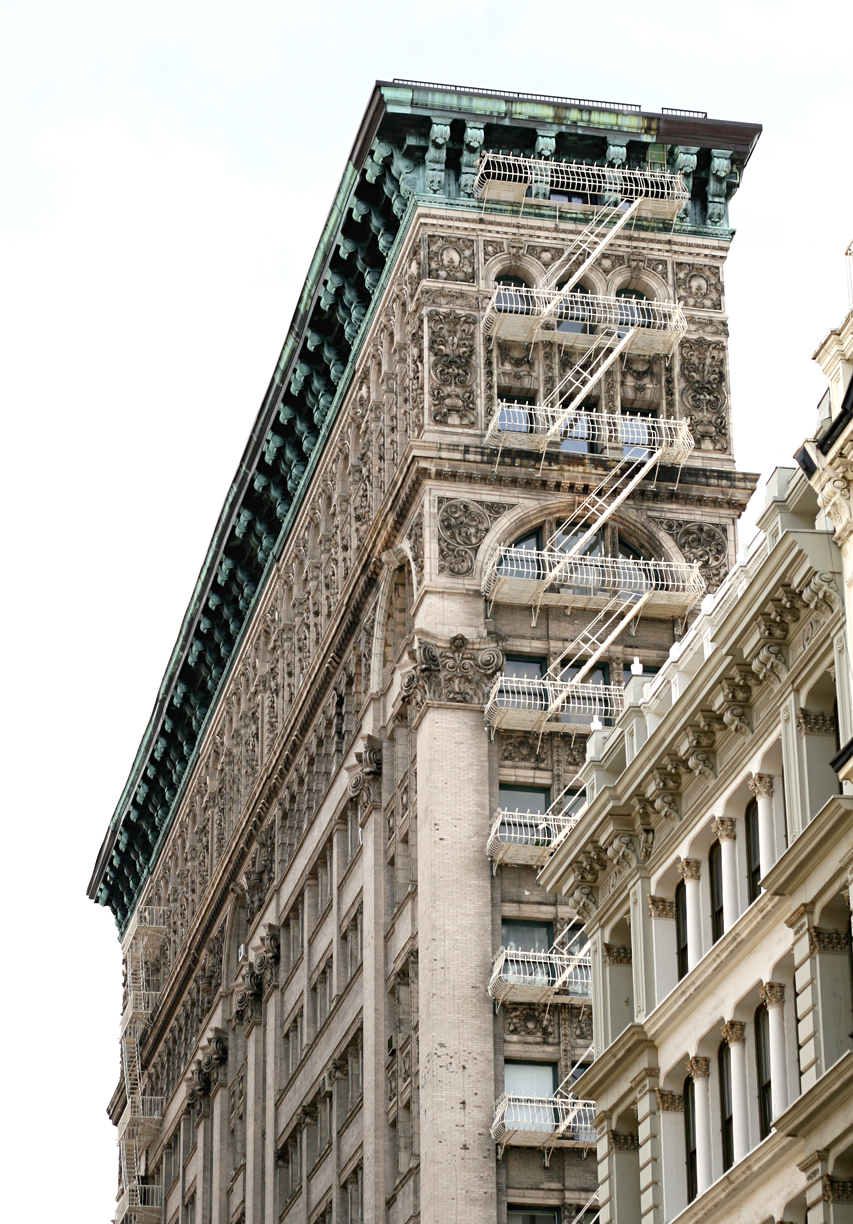
    This magnificent building at 451 Broome Street in the SoHo Historic District caught the eyes of a couple of photographer friends and myself on a recent walk. I could find no details on this building specifically. Amazing, since in another locale, something of this quality would be worthy of group tours. But SoHo is packed with quality structures, so a building has to really stand out in an extraordinary way architecturally or historically to make itself known.

    SoHo is bounded by Houston Street to the north, Lafayette Street to the east, Canal Street to the south, and Varick Street to the west. Like much of the city in the 1960s-70s, this industrial neighborhood was in decline and was discovered and populated by artists who found upper story floors (which became known as lofts) with their enormous spaces, large windows, and cheap rents to be very desirable. Most of the use of these spaces for living was technically illegal, however, the state of the neighborhood caused these violations to be overlooked.

    SoHo has also been known as the Cast Iron District – the ornate facades of many of these 19th-century buildings are done in cast iron. Like Tribeca and DUMBO, the quality of housing stock ultimately determines the degree of gentrification a place will attain. We see this all over the world with places like the Marais in Paris or Providence, Rhode Island, which is seeing a renaissance, driven by its old factory buildings. Contrast this with neighborhoods like Williamsburg, Brooklyn, or the East Village – they certainly have been gentrified, but I do not believe you will ever see these neighborhoods approach the level of SoHo, with Madison and Fifth Avenue retailers such as Louis Vuitton, Cartier, and Coach. Here, we had a centrally located neighborhood with beautiful architecture and cobbled streets. It was just a matter of time…

    Related postings: Bleecker Tower, Scholastic Building, Bayard Condict, The Wall, Jersey Girls, Stephanie, Hoopmobile, Gourmet Garage, Alidoro


  • It Shines For All

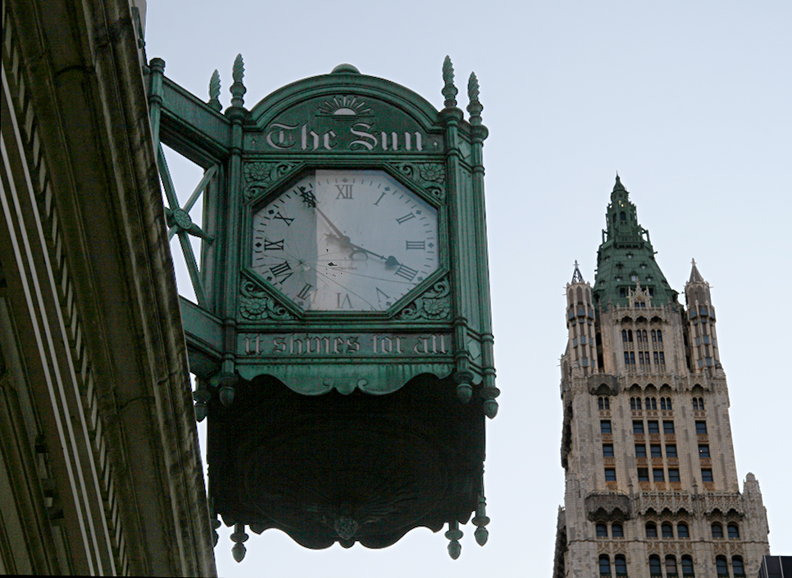
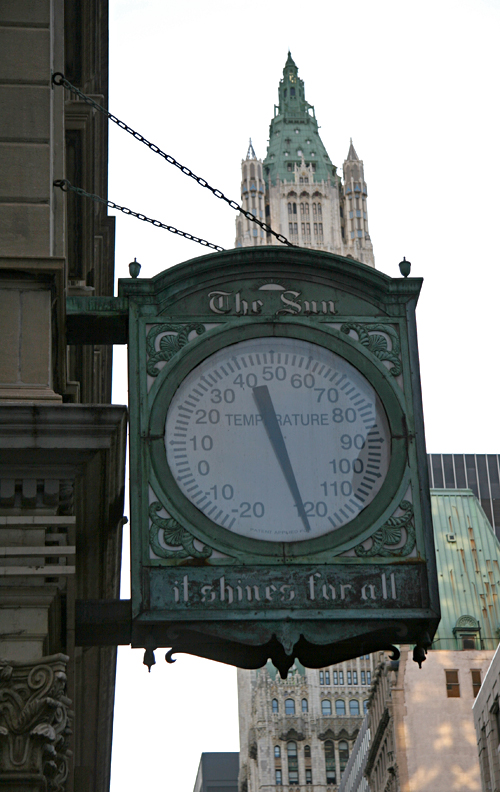
    Who can resist an antique bronze clock and thermometer with the slogan The Sun It shines for All, mounted against a historic landmark white marble building, on Broadway with the Woolworth Building as backdrop? Images of old New York and the romance of days past flood my mind with a vista like this one. Click here for a photo of the thermometer.

    The 7-story building is located at 280 Broadway at Chambers Street near City Hall. The white marble Italian palace was originally erected in 1846 as the A.T. Stewart Dry Goods Store – America’s first department store. This grand palace of commerce was quite dazzling at the time. The structure is of major historic architectural significance – it is one of the first Italianate commercial buildings in the United States. In 1917, it was taken over by the New York Sun. The bronze clock and thermometer were added in 1930. The Sun occupied the building until 1950; in 1970, it was taken over by the City of New York. Sadly, the building remained in shabby condition for many, many years, and the clock itself stopped functioning in 1967, was repaired, stopped working in 1987, and was repaired again. The building was renovated during the Giuliani administration. Now the sun, clock, thermometer, and building shine for all…


  • Magic Mountain

    The American International Building is located in the financial district at 70 Pine Street. At a quick glance, one might mistake it for something like the Empire State Building. This beautiful structure with its Gothic spire abounds with art deco details, yet is relatively unknown – surprising, isn’t it?

    One of the reasons is that it is difficult to really see from the canyons of the densely packed buildings in this area of Manhattan. The building is best appreciated from afar, as in this photo, which I took from the South Street Seaport area. It is famous for its motif of a snow-capped mountain – the base of the building is clad in granite while the upper portion, clad in limestone, becomes lighter in color until one reaches the very top, where it is white. There are limestone replicas of the building carved on the central columns at the entrances. The area is also not generally frequented by visitors or residents except for Ground Zero, South Street, and the ferries to Staten Island, the Statue of Liberty, and Ellis Island – destinations which are typically visited and left without exploring the neighborhood. Admittedly, it’s essentially a business district (dead on weekends) and will primarily appeal to architecture fans. The building itself was built for the Cities Service Company in 1930-32, the same time period of the construction of the Chrysler and Empire State buildings. At 952 feet, it was the tallest building downtown until the construction of the World Trade Center towers in the early 1970s. Since 9/11, it is again the tallest building downtown, the fifth tallest in NYC, and 14th in the US.

    The building has been used in many films, such as Spider-Man, The Gangs of New York, and Independence Day. The building is now owned by an insurance company – the American International Group. At one time, it was known as the 60 Wall Tower; there was a bridge at the 15th floor connecting it to a building at 60 Wall St (demolished when City Services vacated) – you can see lighter bricks where this bridge once was. There is an observatory at the top, unfortunately now closed to the general public but open to executives at lunch. Now that’s a nice perk…


  • Loaded

    It occurred to me looking at this photo that NYC is really loaded – not just with money but also with icons. It explains why New Yorkers can be quite cynical – everywhere we look, there are spectacular vistas, frequently with MULTIPLE icons.

    In this shot alone (taken from DUMBO, Brooklyn) we have the Brooklyn Bridge, the Municipal Building, the Empire State Building, and last (and least), the Verizon Building. And there were numerous other notables in view but not framed by this photo (South Street Seaport, the Financial District, the Woolworth Building, and the Manhattan and Williamsburg Bridges). When leaving my office daily, I see the Chrysler Building framed by Grace Church looking north (click here) and the Woolworth Building to the south. Walking home through SOHO’s historic cast iron district, I see the Empire State Building framed by Washington Square Arch (click here). Only Paris comes to mind with such a plethora of notable places and things that are household names.

    There are numerous activities, industries, businesses, and services that NYC stands out as a center for – publishing, advertising, finance, music, dance, theater, film, law, fine arts, architecture, parks, street life, fashion, retailers, and dining (there are over 17,000 restaurants in Manhattan alone). We are used to superlatives – biggest, most, best. As far as being loaded in the classic money sense, we’ve got that too, of course. I remember being stunned by an article in the Wall Street Journal that gave the number of 10 figure annual bonuses in the city…


  • Metropolitan Club

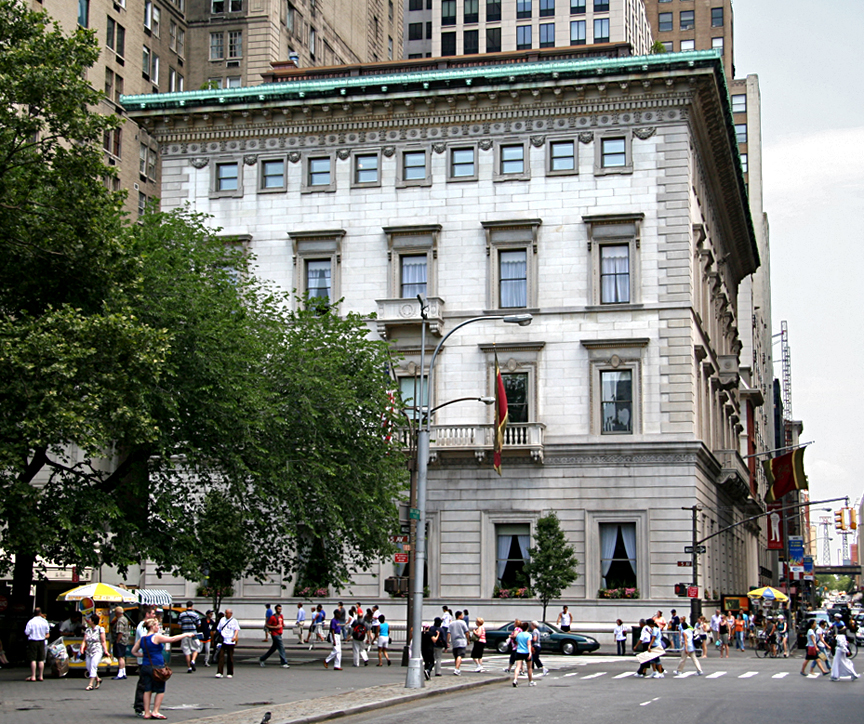
    What perhaps is most remarkable about the Metropolitan Club (like the Harmonie Club across the street) is how unknown it is to most visitors and residents, particularly given its prominent location – one of the finest in all the city –  at 60th Street and Fifth Avenue overlooking Central Park, as well as its prestigious neighbors. It abuts the Pierre Hotel, with the Sherry Netherland to the south, and sits across from Grand Army Plaza and the Plaza Hotel. One block south, we have the Apple store with its huge glass cube, and from there, the familiar, iconic Fifth Avenue flagship retail institutions: Bergdorf, Tiffany, Cartier, etc.

    The private club was organized by J.P. Morgan for his coterie of friends unable to gain admittance to other private clubs. The 1893 building is a McKim, Mead and White extravaganza with the feel of an Italian palazzo. I have not been inside, but I understand that the interior is quite grand, with Corinthian columns, scarlet carpeting, and a two-story marble hall with a double staircase. The entrance, at 1 East 60th Street, is colonnaded with a carriage entrance and courtyard (click here for photo)…

    Related Links: The Sherry, Apple and Sherry, Harmonie Club, Lotos Club


  • Brooding

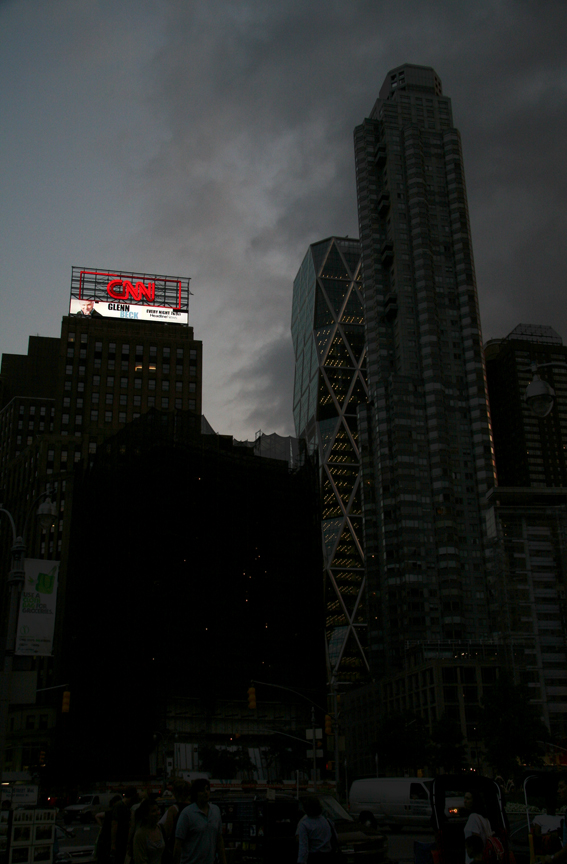
    It’s easy to ignore what little there is left of the natural world when in NYC. Sometimes. But we still have weather, and like everywhere else, weather sets the mood. Here, we have a storm threatening as seen from Columbus Circle, looking south – it really felt like Batman’s Gotham City. The building with the triangular windows is our friend, the Hearst Tower. The tall, thin tower is Central Park Place, a residential condominium built in 1988 by Davis Brody & Associates. The hulking, shrouded building barely visible in the center is the controversial 2 Columbus Circle by Edward Durell Stone from 1964, sometimes referred to as the Lollipop Building (Ada Louise Huxtable, then architecture critic of The New York Times, said it resembled “a die-cut Venetian palazzo on lollipops”). The building is to be occupied by the Museum of Arts and Design in 2008. Click here for this story.

    New York is a city of stark contrasts, and the relatively unpredictable nature of the climate in the Northeast (as opposed to the Southwest, e.g.) just adds one more variable to the mix. There’s nothing like a brooding NYC day to remind us that in spite of our abilities to create technologies and shape the world, we are still fundamentally powerless in the hands of Mother Nature…


  • Beacon Of Hope

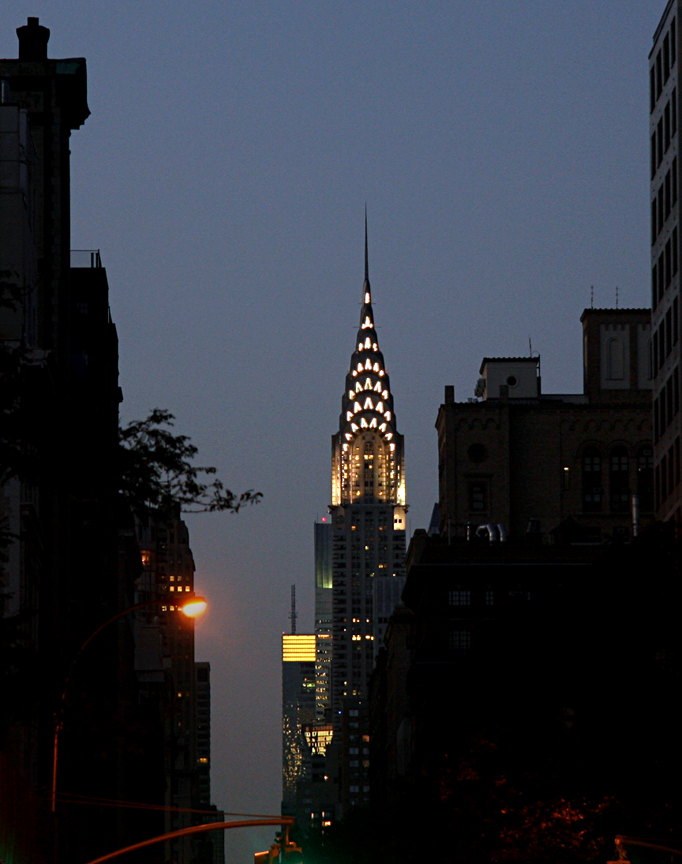
    I never tire of seeing the Chrysler Building, particularly in the evening when lit. I have posted numerous times on various aspects of the building, such as the gargoyles, elevators, lobby, murals, entrance, and the Trylon Towers. Since 9/11, most large office buildings have increased security, and in the case of the Chrysler Building (and Woolworth Building), they are off-limits entirely, unless one has specific business in the building.

    During Open House New York 2006, I was able to get into the lobby and stairwells and photograph at my leisure. For me, the Chrysler Building is many things: assurance that there is some permanence in a world of change, a link to old New York, a beautiful art deco masterpiece, a metaphor for our aspirations, dreams, and hopes with its gleaming stainless steel spire reaching upwards, and a reliable NYC icon, letting me know at a glance, without any doubt, of where I am…

    Chrysler Building Posts: Crown Jewel, Gargoyles, Stairwell, Back in Time, Mural, Going Up, Trylon Towers, Contrast


  • Building Gone Wild

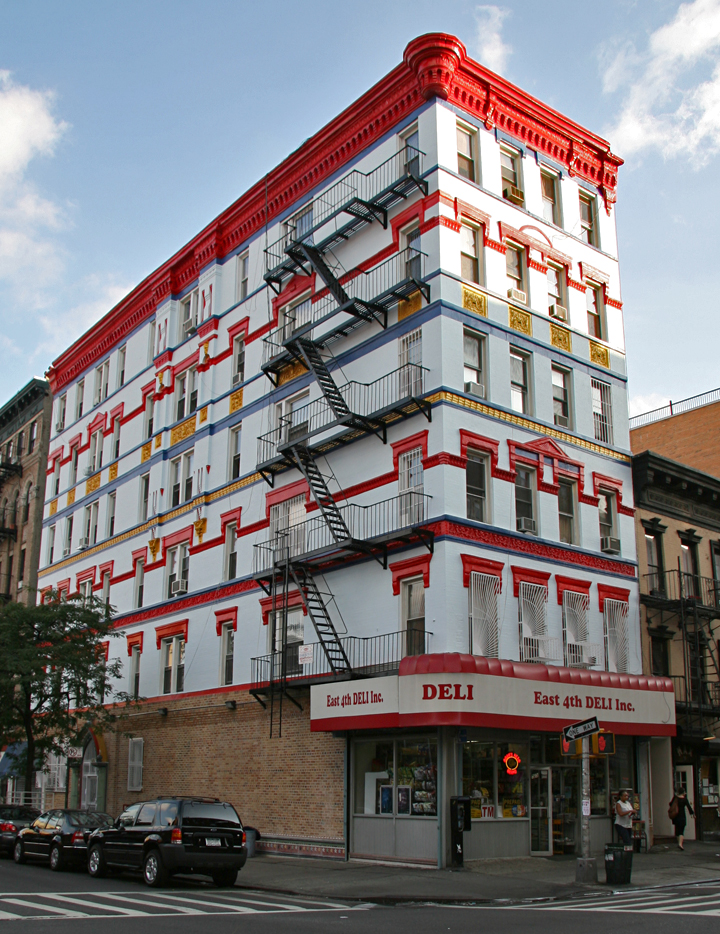
    The building in this photo, located at 246 East 4th Street at Avenue B in the East Village, is a mystery. The raison d’etre for the super bright colors, the history, the architecture with its friezes and exterior sculptures, etc. are unknown to me. The red, blue, gold, and white painted structure stands out dramatically from anything around it and screams for attention. There are virtually no references to it online. I did find two residents in a phone directory who are doing business from the building.

    I also found a reference to “Otnoob,” which appears to have a retail canopy (all I could find about the word “Otnoob” is a World of Warcraft character – a human, rogue). If you are interested in finding this place, the East 4th Deli at 53 Avenue B is located in the same building, but I don’t think you will miss it 🙂


  • The Beresford

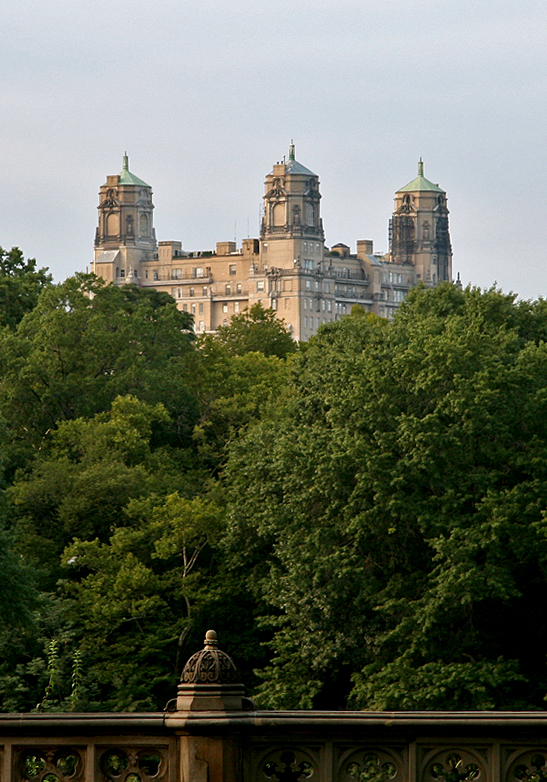
    Many find the subject of architecture “boring”, but as much as anything else, a great city is defined by its buildings. Say the word Paris or London, and images of the Arc de Triomphe, Eiffel Tower, Louvre, and the Tower of London come to mind. Architecture is the crystallization in a point in time of many things – the fashion, folly, trends, inspiration, and perspiration of the men and women who shaped it. To walk this city and appreciate its architecture is to live its history. So, I bring you the Beresford (named for the hotel it replaced), one of the world’s most prestigious residences, as seen from Central Park.

    This massive three-towered edifice occupies the corner of 81st Street and Central Park West and sports three lobbies (and addresses – 211 Central Park West and 1 and 7 West 81st Street). It overlooks the Museum of Natural History, the Hayden Planetarium, and Central Park. The building is a masterpiece of Emory Roth, the architect with the greatest number of buildings in NYC to his credit (click here for my posting on 17 State Street with links to Roth). It is also one of the three most prestigious apartments on Manhattan’s Upper West Side (all on Central Park West), along with the San Remo (also by Roth) and the Dakota. The building was completed a month prior to the stock market crash in 1929, so its early history as a luxury residence started off on rocky footing.

    Built in a late Italian Renaissance style, it has a rusticated limestone base, brick-clad upper floors, and terra cotta trim. There are 175 apartments on 22 Floors and a courtyard with a fountain and a garden. In design, the Beresford is executed in brick with limestone and terra cotta trim. The three towers have pyramid roofs capped with copper lanterns that are brightly lit at night. Click here for more about the building. Of course, the roster of residents reads like a who’s who list, with present and past superstars, celebrities, and moguls: Jerry Seinfeld, John McEnroe, Isaac Stern, Tony Randall, Helen Gurley Brown, Beverly Sills…


  • dinamic_sidebar 4 none

©2026 New York Daily Photo Entries (RSS) and Comments (RSS)  Raindrops Theme