• Category Archives Architecture
  • Zeckendorf

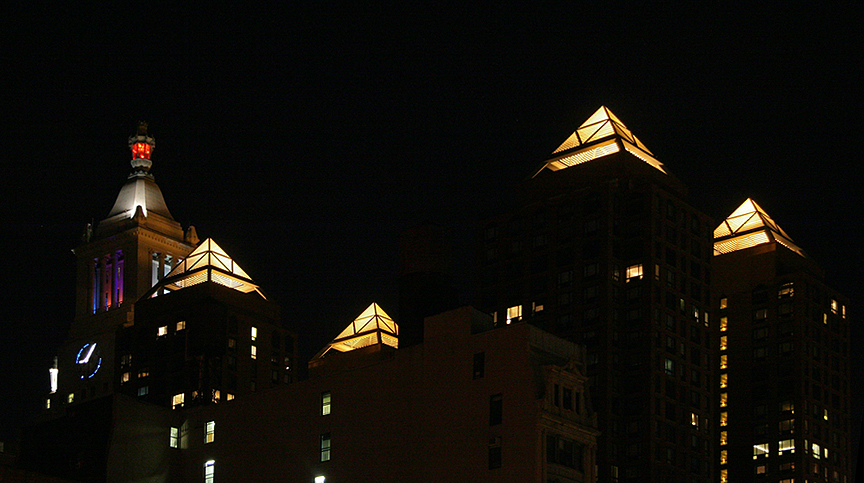
    Real estate developers, along with architects, define the look of a city, and the empire and legacy of William Zeckendorf Sr. (1905-1976), his son William Jr., and grandsons Arthur and William Lie continue to endure and impact New York. These are the Zeckendorf condominiums (read about them here) at One Irving Place, as seen from Union Square in the evening with the Con Ed tower. I have photographed these towers before for this website, but I have not shown all four in one photo. Real estate developers are typically not seen in a very positive light by the average citizen; rather, they are resented by many for their wealth and the power they have over the primary assets of a city – the land and buildings themselves. However, they are absolutely necessary to the city’s infrastructure, growth, and reconstruction, and when there is a good design aesthetic and sensitivity to appropriate architecture, they can be a force for the good.

    William Zeckendorf, Sr. is considered one of America’s foremost developers and has worked with architects I.M. Pei and Le Corbusier. He is credited with projects which were seminal in the redevelopment of troubled areas, such as these towers in Union Square and the Columbia at 96th Street on the Upper West Side. His most notable transaction was taking an option on 17 acres along the East River to build a dream city. Unable to exercise his option, and seeing the city about to lose the United Nations because it was unable to find a location for it, Zeckendorf called Mayor William O’Dwyer, who persuaded Rockefeller to buy the land for $8.5 million and then donate it to the U.N. In 1965, his company Webb & Knapp collapsed and went into bankruptcy. The family business was rebuilt with William Jr. at the helm.

    Style and personality also play a factor in the public’s view of a real estate mogul. Donald Trump, for example, is seen by many as a pompous, arrogant, egotistical media hound with a celebrity lifestyle surrounded by supermodels. Combine that with buildings known for their veneer, and one could understand why architecture critic Paul Goldberger once referred to his work as the “triumph of image over substance”…

  • Verizon

    You won’t find this in any tour books. In fact, I doubt that you would find this in any books at all. There is also virtually nothing online. There is very little reason for most visitors or NYC residents to be in this immediate area across from 1 Police Plaza, circumscribed by various thoroughfares and ramps for the Brooklyn Bridge and FDR Drive. The streets around it are relatively unknown, even to residents: Pearl Street, Madison Street, Avenue of the Finest, and St. James Place. Why would I want to blog this and bore you, the reader?

    For one, the hulking monolith at 375 Pearl Street, built in 1976 by Rose, Beaton, & Rose, has always intrigued me. And it has achieved a few distinctions – I have seen it on lists of the ugliest buildings in Manhattan. The huge, illuminated Verizon logo with its swoosh, visible for miles around from Brooklyn, parts of Manhattan, and other eastern approaches, is a point of contention with many who liken it to an enormous billboard that ruins views. The sign was installed in 2002, replacing the old bell logo from Bell Atlantic. Verizon was formed in 2000, the product of various mergers and acquisitions with GTE, Bell, and NYNEX. Efforts have been made to have the sign removed, but apparently it complies with the law. Frequently described as windowless, the building does appear to be so. However, closer examination reveals that the distinctive, dark vertical striations along its facade are actually created by columns of glass windows. The building was designed to be a switching hub, but there was difficulty in bringing the lines into the building, so it is used for administrative functions. For the wordsmiths among readers, Verizon is a portmanteau of the words veritas (the Roman goddess of truth) and horizon


  • Audubon Center

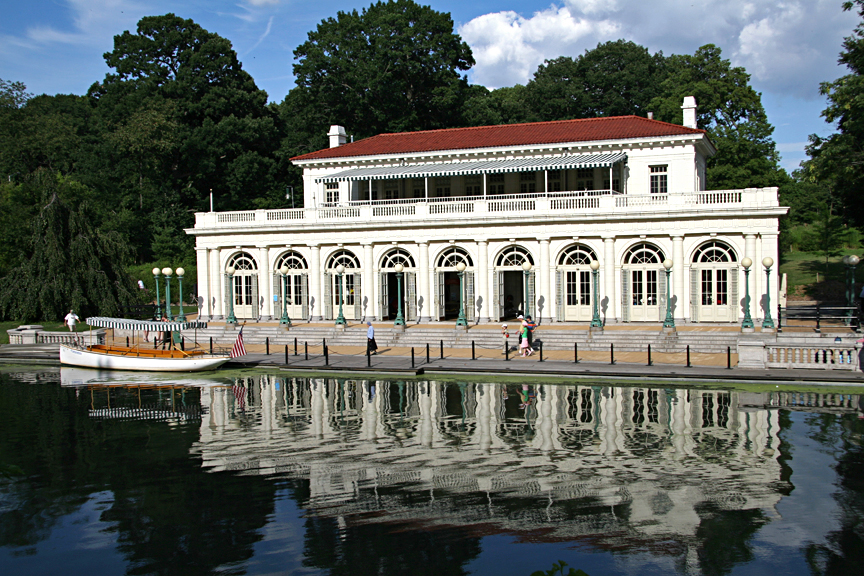
    Famed landscape architects Olmsted and Vaux, who designed Prospect Park in Brooklyn where this building is located, built the original Boathouse in 1876 as a rustic canopied structure on piers straddling the north end of the Lullwater. In 1905, it was replaced with the current Beaux-Arts structure seen in the photo. Its design was inspired by the lower story of Sansovino’s Library of St. Mark, built in 16th-century Venice. The white matte-glazed terra cotta facade is adorned with Tuscan columns capped with a balustrade. The building was relocated to the Lullwater’s eastern edge to provide a vantage point for sunset views over the water.

    Targeted for demolition in the 1960s, the building was saved through community protest. The City of New York granted it landmark status in 1968, and it was added to the National Register of Historic Places in 1972. The building underwent a four-year, five million-dollar renovation and opened as the nation’s first urban Audubon Center on April 26, 2002, the birthdate of both John James Audubon and Frederick Law Olmsted. The center is the first of 1,000 nature education facilities to be built across the country by the year 2020, with a goal of reaching one in four schoolchildren nationwide…


  • Gehry in Gotham

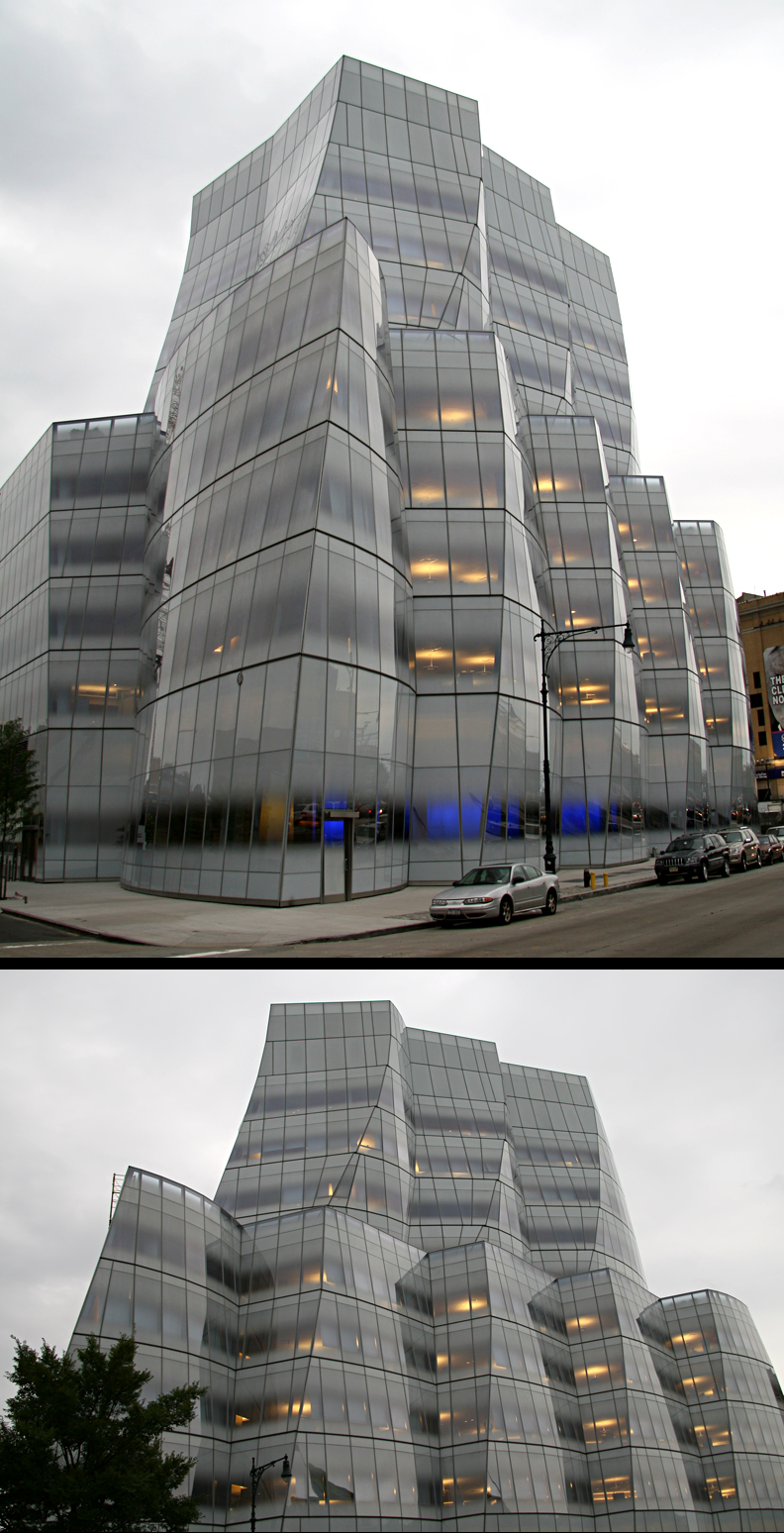
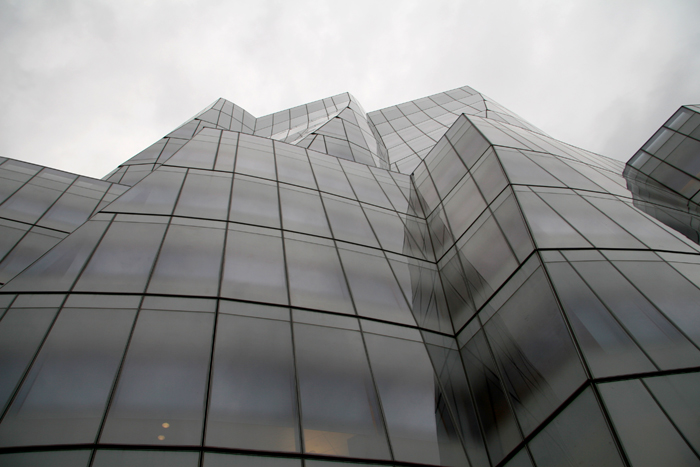
    Gehry is an internationally known starchitect and this is his first (long awaited) commission in NYC (click here for photos of the entire building. A quick review of his work will immediately tell you what all the controversy is about (such as the concert hall for Disney or this Dancing House). The recently completed IAC building shown in the photo is located in Chelsea at 19th Street and 11th Avenue and serves as world headquarters for the media and internet empire of Barry Diller. This work is rather tame by comparison to Gehry’s other work, typically very sculptural and characterized by warped, curved surfaces. His most well known work is the Guggenheim Museum in Bilbao, Spain.

    In spite of the critics, many do feel that works like Gehry’s are much needed in NYC, which has been plagued by essentially very conservative, bland, and utilitarian office buildings. I have written of a handful of other “starchitects” and their works in the city: Richard Meier and his residential towers in the West Village, David Rockwell and his renovation work at the W Hotel Union Square and at the Carlton, Philip Johnson and his Urban Glass House, and Charles Gwathmey and his 21-story glass residential condo at Astor Place. There are new projects by Santiago Calatrava and Jean Nouvel…


  • Lotos Club

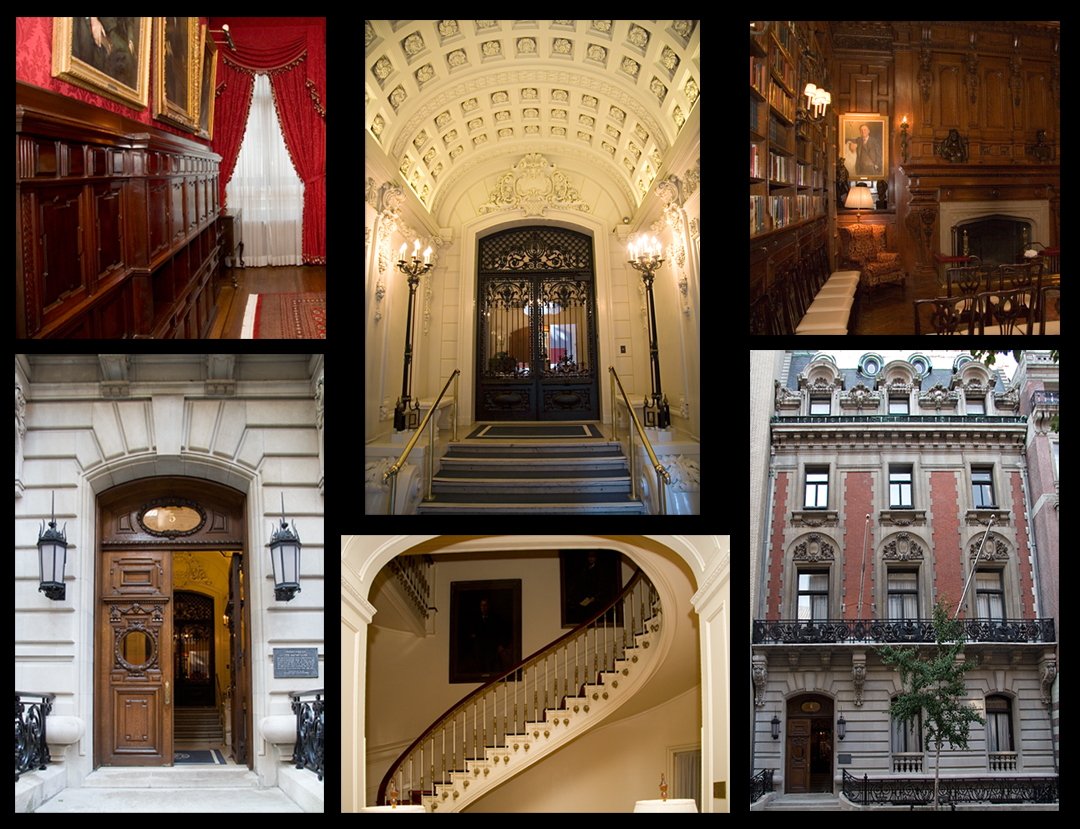
    I was fortunate yesterday to be able to attend a function (the wedding of a friend) at the Lotos Club, one of the oldest literary clubs in the U.S. This private club is located at 5 East 66th Street in a brick and limestone French Renaissance building, designed by Richard Howland Hunt and built in 1900 by the daughter of William H. Vanderbilt.

    The club dates back to 1870 when a group of young New York journalists met in the office of the New York Leader. These men were De Witt Van Buren of the Leader (the first president), Andrew C. Wheeler of the Daily World, George W. Hows of the Evening Express, F. A. Schwab of the Daily Times, W. L. Alden of the Citizen, and J. H. Elliot of the Home Journal. Previous failures at creating a strictly literary organization had demonstrated that this was not viable, so membership to a broader group was decided upon. The stated primary object of the club was “to promote social intercourse among journalists, literary men, artists, and members of the theatrical profession.” The club has a long list of well-known members, such as Mark Twain. It has had a number of locations, from its first home at 2 Irving Place off 14th Street to its current location at 5 East 66th Street.

    NOTE: The selection of the name The Lotos Club was to convey “an idea of rest and harmony.”. The spelling of Lotos comes from Alfred Lord Tennyson’s poem, The Lotos Eaters, two lines of which were selected as the motto of the club:

    In the afternoon they came unto a land
    In which it seemed always afternoon

    The endless afternoon setting provided the ideal atmosphere to indulge in creative and stimulating thought and conversation…


  • Gang Wars

    Between 1823 (with the formation of the New York Gas Light Company), and 1877, there were six competing gas companies in NYC – at times employees literally battling for customers in the streets, leading to the term “gas house gangs.” Add to this brew Edison’s invention of the electric light bulb in 1879 and the creation of Equitable Gas, backed by Rockefeller. The competing gas companies were forced to remarket and promote gas for other purposes. In 1884 came the inevitable merger of the six companies, forming the Consolidated Gas Company of New York. Offices were established at 4 Irving Place (where the current offices and tower are located) at the home of the Manhattan Gas Light Company in an Italianate brownstone. Acquisitions of various electric companies were made, including the New York Edison Company. In 1936, the name was changed to the Consolidated Edison Company.

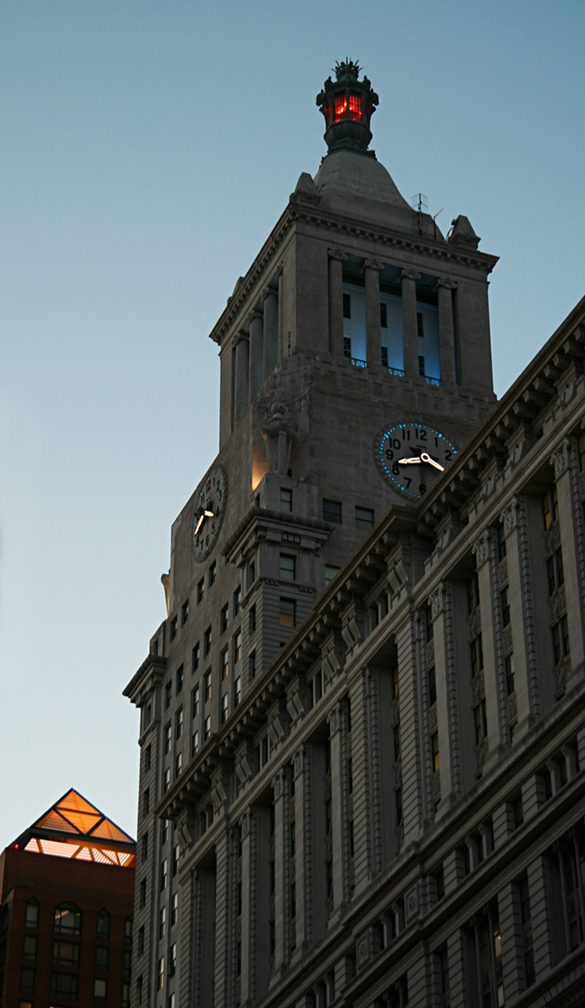
    ConEd is the product of acquisitions and mergers of more than 170 companies. The office buildings of ConEd are a assemblage of structures built at different times, starting with a 12-story building designed by Henry Hardenbergh in 1910 at 15th and Irving, culminating in the 26-story building (seen in the photo) designed by Warren and Wetmore, known for their Beaux-Arts work such as Grand Central. The limestone clad building is quite prominent in the night skyline of NYC with its numerous illuminated features: a 3-story tower with Doric colonnade, four clock faces, and a 38-foot bronze lantern. This is one of a handful of iconic Manhattan buildings which can be seen from many vantage points, along with the Met Life Tower, the New York Life Tower, the Chrysler Building, the Empire State Building, and the Zeckendorf Towers. Please learn your illuminated buildings – there will be a quiz 🙂


  • Pied-à-Aire

    There are many secret worlds in New York City, and rooftop houses are one of them. I am sure that having a private little Shangri-la in the city is a fantasy that many have had, but few realize that these pied-à-aires have been actualized by a fortunate few. I was somewhat surprised to find out how little information is available on this phenomenon – one would not expect a lot in print, allowing for the fact that photographing these properties is going to be difficult without an invitation, but typically one would expect a few feature articles. I found none (I do recall an article many years ago about a rooftop cabin).

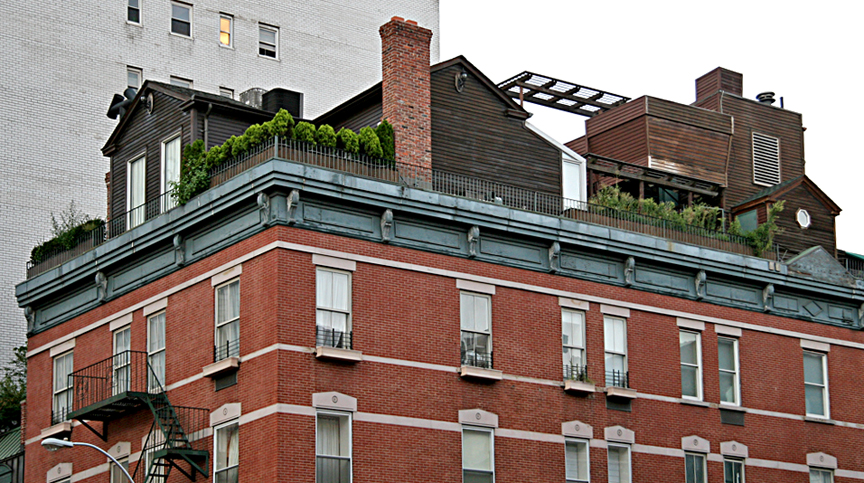
    The gabled structure in the photo is not strictly a rooftop house – it is an extension of a top-floor apartment. It sits atop the building at 203 East 13th Street on the corner of 3rd Avenue in the East Village. The building itself was built in 1910 and was converted to condominiums in 1986. In the early ’90s, the owner of the top floor apartment built the cedar-shingled structure. Originally, a spiral staircase led to a small rooftop room; this was torn down and replaced with the rooftop complex, which includes a master bedroom and bath, a small greenhouse, a darkroom, a hot tub, outdoor decks, and plantings. I wish I had closeups and interior photos of the property but alas, I could not find any…


  • Bayard Condict Building

    Posted on by Brian Dubé

    Please click here for more photos, since one photo does not do this building justice. With the plethora of street life, retailers, and other distractions in the Village, it is easy for the casual visitor or resident to miss this magnificent building. But it has not been missed by architects, architecture students, critics, or lovers of fine structures. The 13-story Bayard-Condict Bulding at 65 Bleecker Street has been designated both an official city landmark and a National Historic Landmark.

    This was renowned visionary Chicago architect Louis Sullivan’s only work in New York City. Sullivan (1856-1924), father of the skyscraper and Modernism, was trained at MIT and the École des Beaux Arts in Paris. He was the leading designer of the Chicago school and employer and teacher of Frank Lloyd Wright. He is credited with coining the term “form follows function.” This is interesting, since the ornate nature of this building shows how Sullivan was not dogmatic about his design ideas. Note the the terra cotta facade and spectacular ornamental elements and friezes under the cornices. At the time of its construction in 1898, the structure was considered very advanced – a very large percentage of the building wall is glass window. The building definitely deserves a good look if you are in the neighborhood…

    Posted on by Brian Dubé

  • The Sherry

    Posted on by Brian Dubé

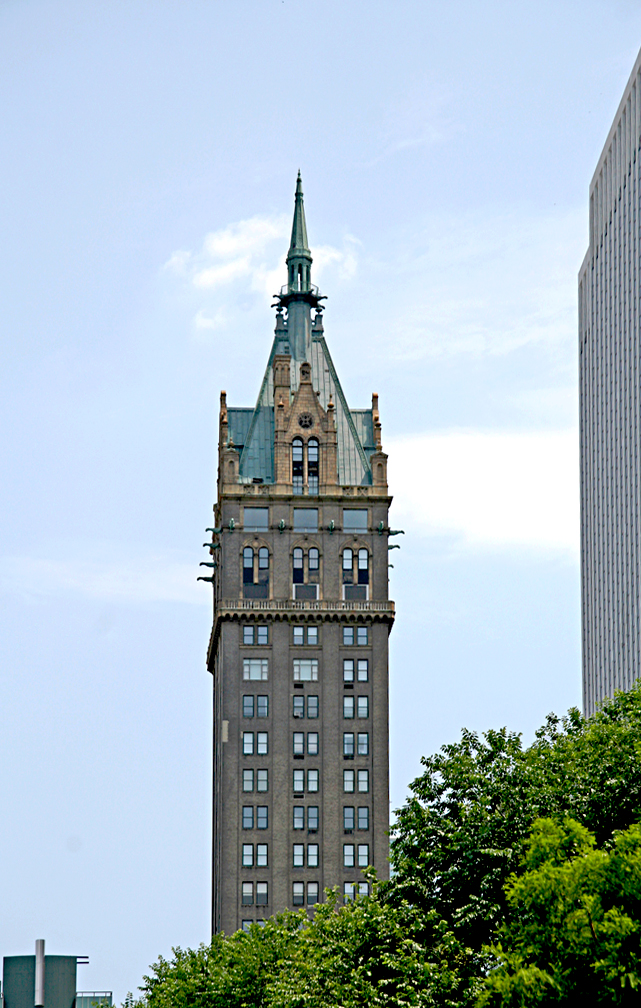
    This is the Sherry Netherland (as seen from Central Park), an absolutely exquisite and remarkable building in the finest location in NYC, at 59th Street and Fifth Avenue with immediate neighbors such as the Metropolitan Club and the Pierre and Plaza Hotels. If you are not familiar with it, this is maybe due to its somewhat understated elegance and small lobby, unlike that of the Waldorf Astoria, e.g. The Sherry does not even have a Wikipedia entry, yet many architects consider it one of the finest skyscrapers in NYC. Built in 1927, it stands at 570 feet/38 stories. The Sherry Netherland is an apartment hotel – there are 53 guest hotel rooms and 97 cooperative apartments ($1.3 – $13.5 million; cash only). Above the 24th floor, there is only one apartment per floor.

    The Sherry was designed by renowned architect Leonard Schultze, along with his partner, S. Fullerton Weaver. Their firm also designed the Pierre, the Waldorf, the Breakers (Palm Beach), and the Biltmore hotels in Atlanta, Coral Gables, and Los Angeles. The Sherry features travertine marble facing on the base and an elaborate Gothic-inspired minaret. Unique touches include the whimsical griffins with hanging lanterns that guard the exterior. Some of the finest retailers grace the street level, such as A La Vieille Russie and Domenico Vacca. The lobby was modeled after the Vatican Library. There are classical friezes rescued from the Cornelius Vanderbilt mansion one block south where Bergdorf Goodman now stands, vaulted ceilings, ornate mirrors, crystal chandeliers, hand-loomed French carpets (removed in the summer, allowing the beautiful marble floors to show), and antique furnishings. Corridors feature vaulted ceilings, as well as faux columns hand-detailed in gold leaf.

    They employ a full-time person to do nothing but reapply gold leaf to the hotel’s many architectural details and hand-paint the exquisite detail on the room numbers and elevators. Attendants are on duty 24 hours a day in the Sherry’s original wood-paneled elevators, embellished with hand-painted Renaissance scenes. Attendants wear full livery and use approximately 140 pairs of white gloves each week. Some of the bathrooms have crystal chandeliers. And then there are the rooms that face Central Park…

    Posted on by Brian Dubé

  • Arch Rebels

    Posted on by Brian Dubé

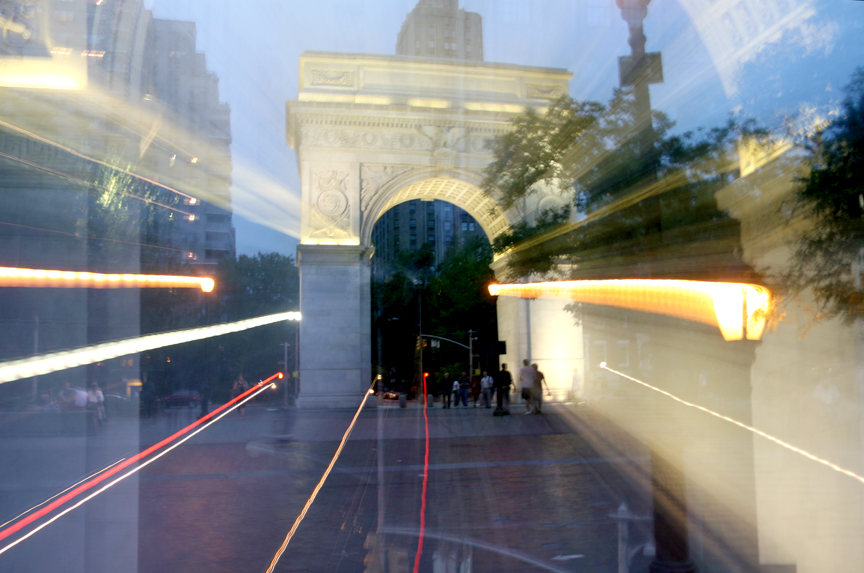
    The Washington Square Arch is one of my favorite subjects, and I have tried not to overuse it. However, I already have done at least 7 postings where all or part of the arch appears in the photo. Apart from the obvious – that it is one of just a handful of monuments in the city – it has gone through a recent restoration and is beautifully illuminated at night. This is is also the neighborhood where I live, so I see it numerous times daily. I have always been obsessed with monuments; as a child, my obsession was the Washington Monument. There is a small doorway in the west pier of the arch. Behind it is an interior stairwell there which ascends to the top, where there is a vacant chamber, and from there a trapdoor to the rooftop.

    One of the most often told stories is that of a snowy night in 1916, when artists Marcel Duchamp and John Sloan, along with 4 others (Gertrude Drick, Forrest Mann, Betty Turner, and Charles Ellis of the Provincetown Playhouse) snuck up to the top of the arch with Chinese lanterns, food, drink, balloons, and cap pistols. There, in a night of revelry, they read a declaration proclaiming the “free and independent republic of Washington Square.” They fired the toy pistols, let the balloons loose, and spent the night eating and drinking while a crowd gathered below. I have not done a posting on the arch per se because someday, somehow, in honor of those rebels, I will get inside and to the top. And when I do, there will be a proper posting and history with plenty of photos – inside, outside, staircase, chambers, rooftop with views – and you will see them here…

    More on the Washington Square Arch: Jeopardy, Nested Embraces, Cello, Singing Bowls, Evening Arch, One Fifth Avenue, Music for 9 Basses and 1 Cello

    Posted on by Brian Dubé

  • Harmonie Club

    Posted on by Brian Dubé

    Private clubs can really be private. Click here for the Harmonie Club’s website and you will see what I mean – no information of any sort, other than a few small photos and drawings. Read as I may and try as I did, I have no interior photos for you, no detailed history, no fascinating stories, and no idea about membership requirements. I have no idea what goes on there, who the members are, or what the dues are. In fact, until recently, they were so private that they did not want members who were open about their Jewishness. There was a book published in 1977, The Harmonie Club: One Hundred and Twenty-Five Years, 1852-1977 – a dealer’s description of the book says, “What is most interesting is that the words “Jew” and “Jewish” do not appear in this history.”

    The Harmonie Club is the second oldest private club in NYC. It was founded in 1852 as the Gesellschaft Harmonie by six German/Jewish immigrants (unable to gain admittance to the Union Club) for the purpose of “mutually beneficial social entertainment, occasional singing entertainments, lectures, etc.” The Harmonie distinguished itself from other all-men’s clubs by allowing women at dinner since its founding. Many of the members of the Harmonie Club were powerful Jewish families of the time, as chronicled in Our Crowd by Stephen Birmingham. The club building, a renaissance palace designed by McKim, Mead and White in 1906, is located at 4 W. 60th Street – just steps from Fifth Avenue, Grand Army Plaza, and Central Park. This location is probably the prime location in Manhattan. In 2001, prior to his campaign for mayor, Michael Bloomberg resigned from four private clubs, including the Harmonie Club. His reason was lack of diversity in membership. Not one of the 1200 members at the club was black…

    Posted on by Brian Dubé

  • Light on Bobst

    Posted on by Brian Dubé

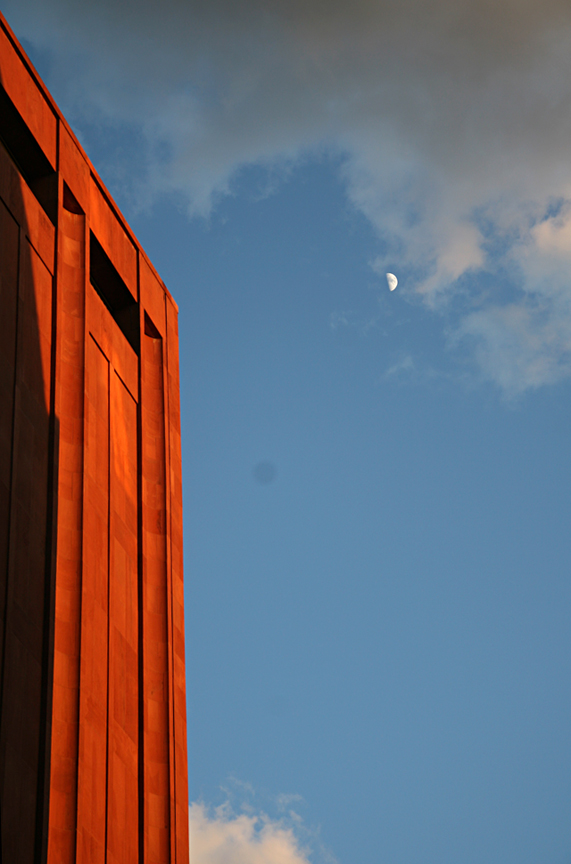
    My recent interest in the evening and night sky prompted this photo. It is remarkable how out of touch with the natural world city dwellers can be – there is a serious dearth of knowledge in subjects like plants, animals, insects, astronomy, etc. Recently, I have noticed some very brightly lit heavenly bodies, however, I was not able to find anyone who knew what these objects were (by studying some online star maps, I was able to confirm my suspicion that Venus was one of them). The photo was taken at sunset of the Bobst Library, which houses over 3 million volumes and is one of the largest academic libraries in the US.

    This massive red sandstone edifice on Washington Square South was designed by Philip Johnson for NYU (New York University) and was completed in 1972. It has been steeped in controversy since its construction:
    1) To begin with, there were substantial delays in its construction.
    2) There has been much criticism of its bulky, monolithic form and how it towers over Washington Square Park. The work of Johnson himself has been the subject of much criticism.
    3) The library was named after Elmer Holmes Bobst, who made a $6 million dollar contribution. There was embarrassment for the University, however, when it was learned that Bobst was a Nixon supporter, had been accused of a corrupt contribution to Nixon, and made antisemitic remarks.
    4) In 2003, Bobst made big news with two suicides in one month – students jumped from the open-air catwalks to the marble floor below.
    5) Steven Stanzak, an NYU student unable to afford his housing costs, became homeless and took up residence in the basement of the Bobst Library for eight months from 2003-2004…

    Posted on by Brian Dubé

  • New York Stock Exchange

    Posted on by Brian Dubé

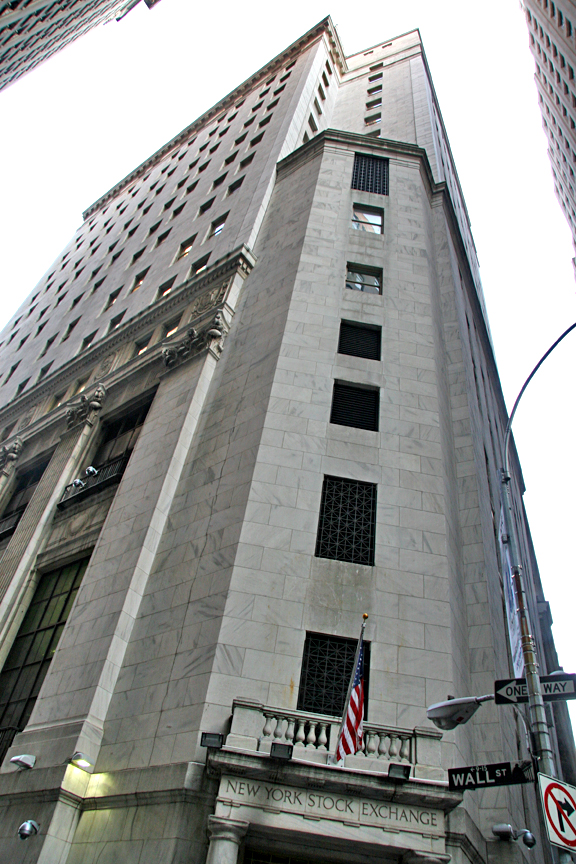
    The first thing to know about the New York Stock Exchange building is that it is not located on Wall Street (click here for photo) but rather around the corner at 18 Broad. The New York Stock Exchange (the world’s largest) traces its origins to 1792, when 24 New York City stockbrokers and merchants signed the Buttonwood Agreement outside 68 Wall Street under a buttonwood tree. In 1817, they drafted its first constitution. By the late 1800s, larger facilities were needed, and 8 NYC architects were invited to participate in a design competition for a new building. George B. Post’s neo-classical design won, and in 1903, the new Exchange building, with its six massive Corinthian columns, opened to fanfare and festivity, recognized from the first as an example of masterful architecture (the flag was draped in front of the building after 9/11).

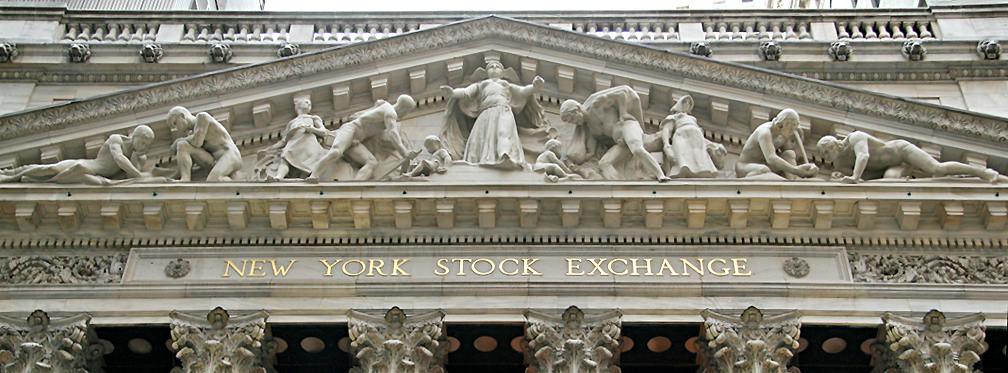
    Among some of its marvels (from the New York Stock Exchange website): The trading floor was one of the grandest spaces in the nation. It measured 109 x 140 feet and its marble walls rise 72 feet to meet the ornate gilt ceiling. The window wall: The entire front of the building is glass, making practically one stupendous window, 96 feet long and 50 feet high. Another window of the same size forms the New Street front. Skylight: The trading floor is surmounted by a vast skylight, 30 feet square. Air conditioning: The Stock Exchange building was one of the first structures in the world to employ it. There is even an emergency hospital with a physician in constant attendance. The great figural sculptures in marble on the NYSE building’s facade were designed by John Quincy Adams Ward and are among the building’s most recognizable features (click here). Entitled “Integrity Protecting the Works of Man,” the classical design depicts the 22-foot figure of Integrity in the center, with Agriculture and Mining to her left and Science, Industry, and Invention on her right, representing the sources of American prosperity. The waves on either extreme of the pediment symbolize the ocean-to-ocean influence of the Exchange (the pediment required replacement in 1936).

    In 1967, Yippie founder and activist Abbie Hoffman threw dollar bills on the trading floor to proclaim the Death of Money. It never came to pass 🙂

    Posted on by Brian Dubé

  • New York Central Building

    Posted on by Brian Dubé

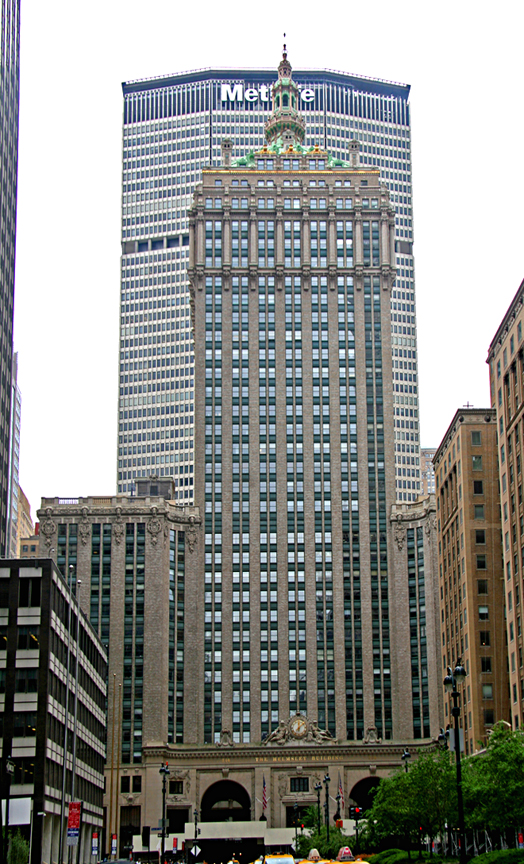
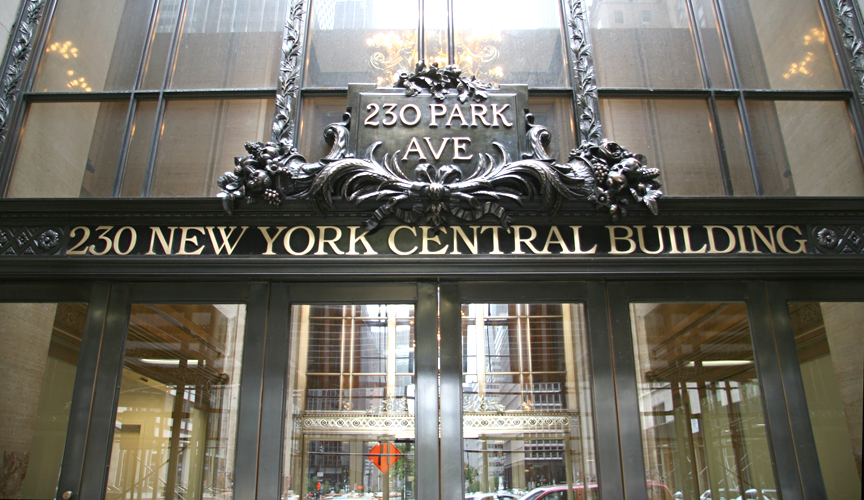
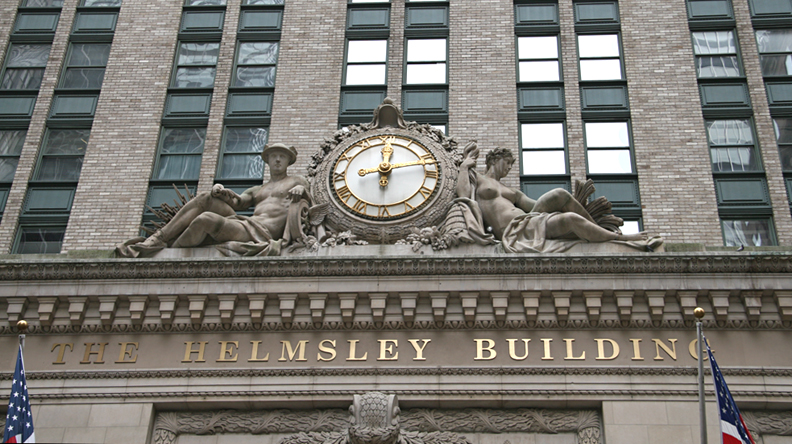
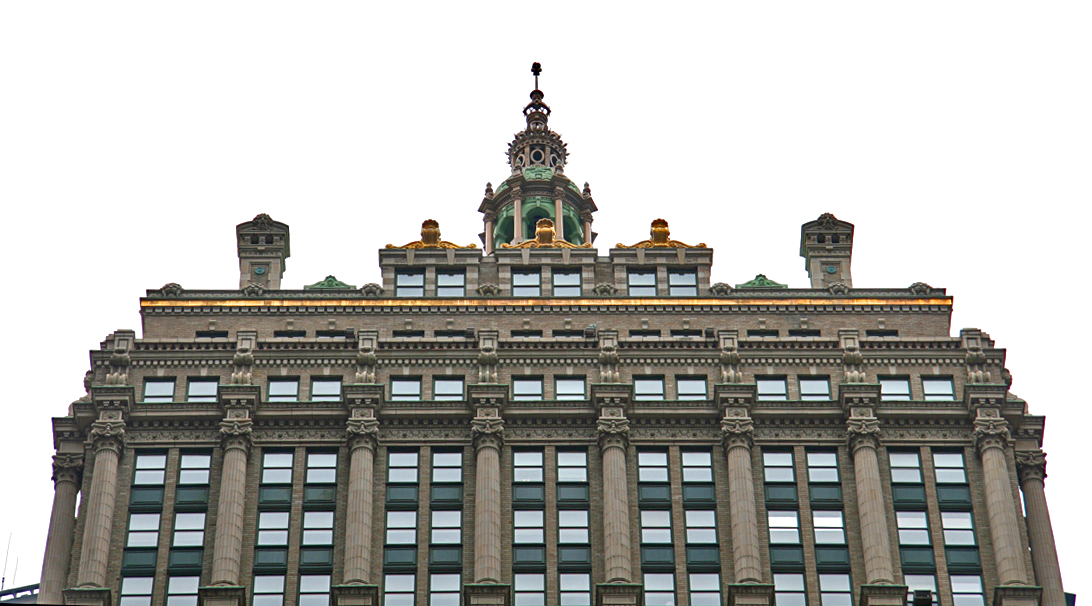
    What is perhaps most striking about this building is its superimposition over the MetLife building. Before construction of the MetLife (then the Pan Am) Building in 1963, the New York Central Building (now the Helmsley Building) at 230 Park Avenue (34 stories/560 feet) reigned supreme over the neighborhood and prestigious Park Avenue. It was the tallest structure in the Grand Central Terminal complex. Built in 1929 by the New York Central Railroad Company and designed by Warren and Wetmore, the building sits over the northern end of Grand Central and the southern end of Park Avenue at 46th Street.

    Traffic was beginning to become a problem at the time of its planning, and New York Central Railroad negotiated leases and easements for construction of the building. In exchange, they wove both lanes of Park Avenue through the building (and over Grand Central), creating a mini-raceway from 46th to 40th Street connecting to Park Avenue South and making it NYC’s favorite drive-through building. The large, cavernous openings for the two tunnels can be seen flanking the entranceway to the building, with an opulent, detailed lobby. The design echos elements of the Grand Central facade (click here) with ornamental clock and sculpture (click here). The chateau-like pyramidal roof is its most distinctive feature, with round dormer windows and crowned with a lantern cupola and spire…

    Posted on by Brian Dubé

  • Bleecker Tower

    Posted on by Brian Dubé

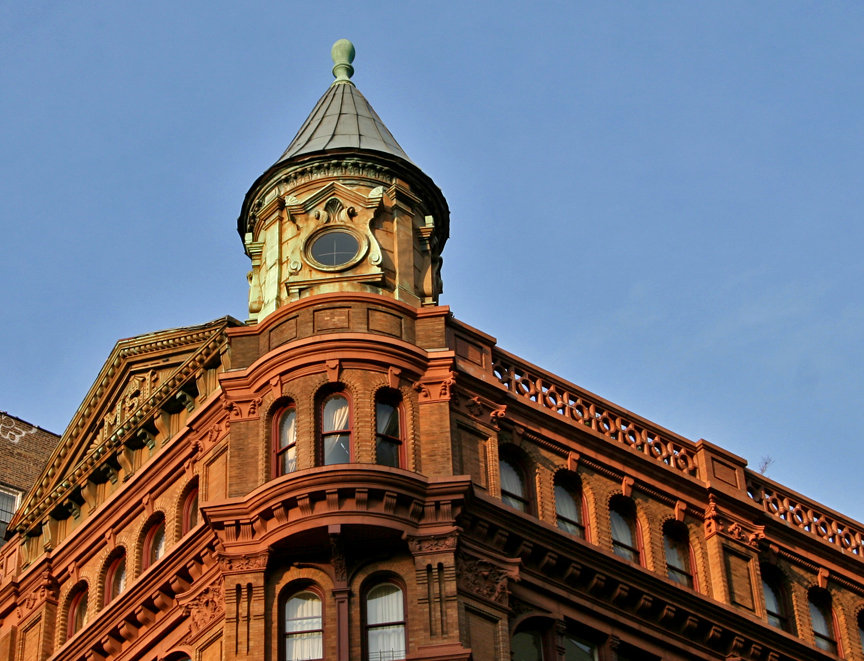
    It’s hard to imagine that this area of lower Broadway, part of what now is called NoHo (north of Houston), was pioneering ground in the early 1980s. The area was dominated by industrial businesses – leather distributors like Marap Leather, who occupied an entire building at 678 Broadway, or Commercial Plastics at 630 Broadway. In 1980, Unique Clothing Warehouse opened at 718 Broadway at Waverly Place (president Richard Wolland closed it and filed bankruptcy in 1991 with over $2 million in debt), beginning a wave of transition. In 1983, Tower Records opened at 4th Street and Broadway (recently closed). A few months later, the elegant Blue Willow restaurant opened at 644 Broadway in the building shown in the photo. Click here for more photos.

    This rock-cut brownstone, terra-cotta, and brick structure was built in 1889 for the Manhattan Savings Institution (hence the monogram “MSI” at the top) and designed by Stephen D. Hatch. The building was in serious disrepair after years of neglect, and in 1987, there was a complete restoration and conversion to residential loft apartments (known as the Bleecker Tower), already fetching millions of dollars in the late 1990s. It is alternately called the Atrium Building (not to be confused with The Atrium at 160 Bleecker), after clothing retailer Atrium, who now occupies the ground floor. When safe to do so in NYC, remember to look up…

    Posted on by Brian Dubé


  • dinamic_sidebar 4 none

©2026 New York Daily Photo Entries (RSS) and Comments (RSS)  Raindrops Theme