• Category Archives Art and Sculpture
  • Hoopmobile

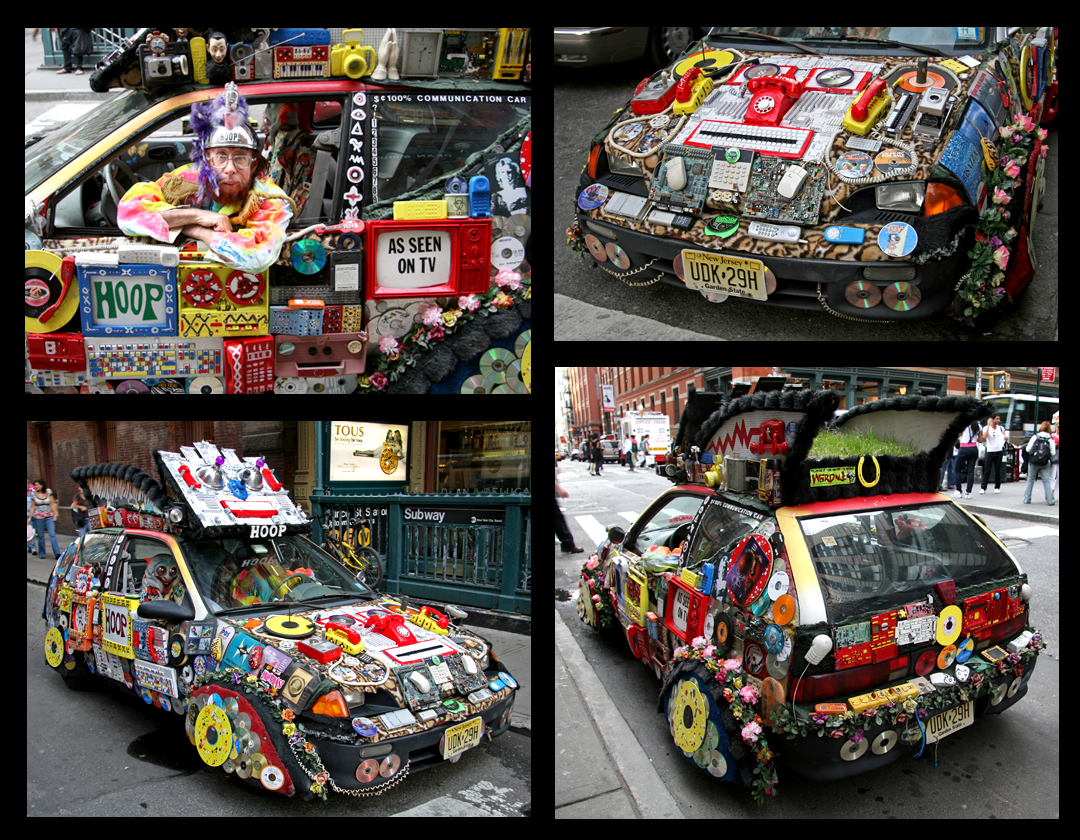
    Welcome to one of Hoop’s many Hoopmobiles and the world of art cars. Hoop refers to this incarnation as Techno Trash – an assemblage which he says represents ”all the transitions we’ve gone through over the years, from a needle on a record to a laser beam on a record.” Steven Hooper, or Hoop (the self-proclaimed King of Art) as he prefers to be called, started doing art cars in the East Village about 20 years ago, when he did hundreds of club performances and parties. His work has been featured in over 40 museums and gallery shows (Fusion Arts, Chelsea Art Museum, MOMA, etc.), television, and the news media. Click here for his story and photos of his vehicles. His motivation is to bring art to the average person on the street, whom he feels can’t name one living artist: “Warhol and Dali were the last of the household name artists.”

    Currently living in Clifton, New Jersey, where he grew up and now cares for his mother, Hoop makes frequent trips to SoHo (one of his old stomping grounds – he once had studios in Union Square and on Prince Street), where he parks and lets passersby ogle his street art.

    The art car movement goes back some time and has seen many incarnations: hippie themed VW buses (such as Furthur), Janis Joplin’s psychedelic Porsche, Lennon’s paisley Rolls Royce, and the Oscar Meyer Wienermobile. There is even a BMW series done by well-known artists such as Warhol and Lichtenstein. The Burning Man festival has had a strong representation. Harrod Blank has made several art cars, written books, and made documentary films on the subject. There are now numerous art car fests nationwide (see here). It’s a virtual industry…

  • Pen And Brush

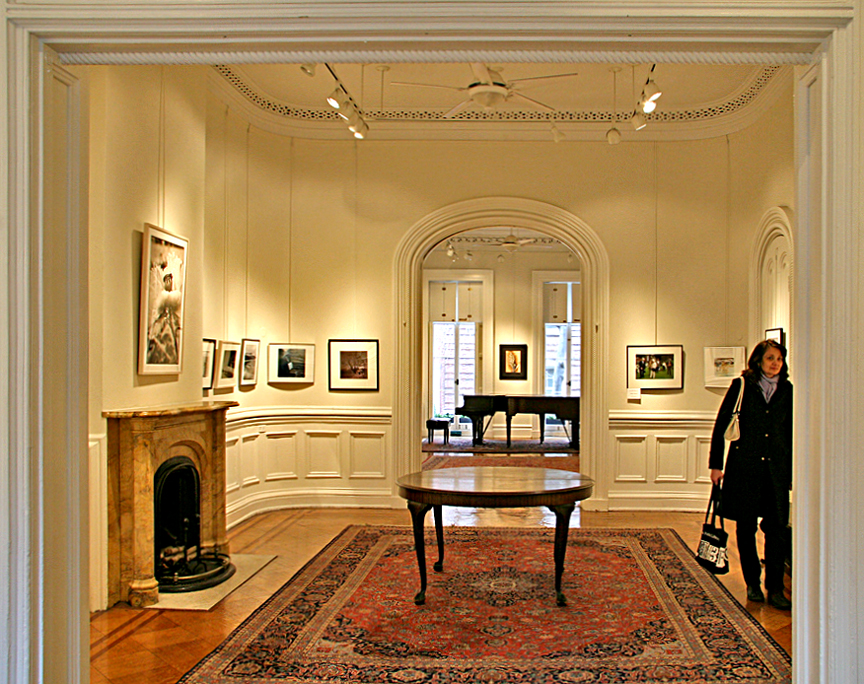
    This is the Pen and Brush Club, which has its home in the exquisite townhouse at 16 East 10th Street. In the 1890s, the arts were dominated by men, but women were beginning to gain prominence – many women artists had studios around the Washington Square area. In 1892, in response to the exclusionary climate towards women (the Salmagundi Club around the corner on 5th Avenue excluded women until 1973), the Pen and Brush Club was formed by painters Janet and Mary Lewis (sisters), who invited three other artists and eight writers to their studio in Chelsea. Early members included journalist Ida Tarbell, first ladies Eleanor Roosevelt and Ellen Axson Wilson, and Pulitzer Prize winner Pearl Buck.

    In 1923, the club purchased the 1848 Greek Revival townhouse which it has occupied ever since. As women became more accepted in the art world, the club became more insular. However, the art world is still relatively dominated by men, and director Janice Sands sees the club’s original mission to be just as relevant today. She has been on a campaign to expand exhibitions to outside non-member artists and recruit new members, shedding its older image and bringing in younger artists.

    The photo shows the exhibit space on the parlor floor with its intricate crown moldings, marble fireplaces, parquet floors, 16-foot ceilings, and its Steinway grand piano (read about the club and its facilities here). Its main rooms are open to the public, and the exhibits are always free of charge…


  • Gay Liberation Monument

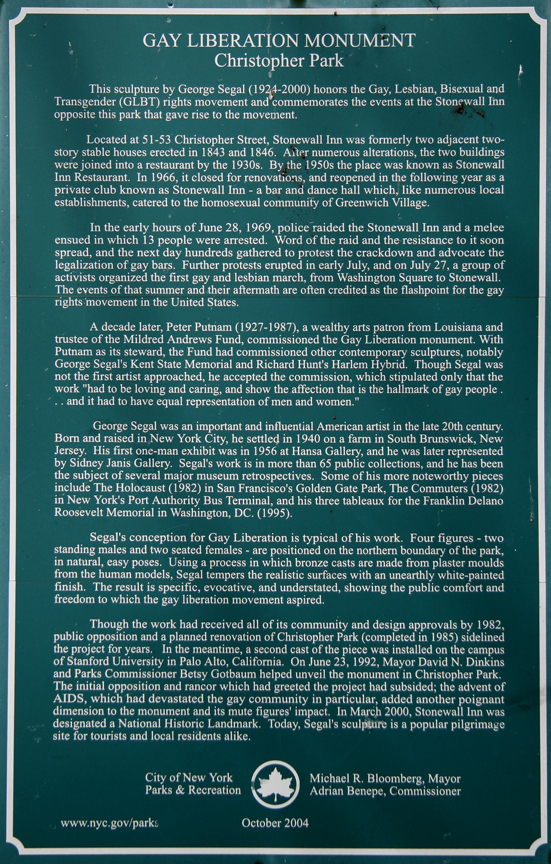
    “This sculpture by George Segal (1924-2000) honors the Gay, Lesbian, Bisexual and Transgender (GLBT) rights movement and commemorates the events at the Stonewall Inn opposite this park that gave rise to the movement.” Thus reads the plaque at the Gay Liberation Monument in Christopher Park in the West Village. George Segal (1924-2000) is a well-known sculptor, and this work was inaugurated in 1992 after a 12-year battle of controversy and opposition (a cast of the sculpture installed on Stanford University’s campus in 1984 faced a decade of vandalism and beatings). The Stonewall Inn is just out of view to the right in the photo. If you are unfamiliar with the Stonewall Riots of July 1969, you can read about them here. Many consider the events of that summer pivotal in the gay rights movement.

    It’s hard to imagine that 38 years ago, men were being arrested, harassed, and beaten by police simply for being gay – many of the arrests were made with charges for indecency. And yet arguments for legalization of homosexuality go back hundreds of years. English scholar Jeremy Bentham wrote an essay as early as 1785, at which time homosexuality was punishable by hanging. Much progress was made from 1860 to 1933 in Europe and Germany, with activists like Karl Heinrich Ulrichs, Magnus Hirschfeld, Ann Rüling, and Helene Stöcke, but most of the gains were lost with the rise of Nazism. Progress in human rights, unlike those in technology, can be very S L O W…


  • AIPAD

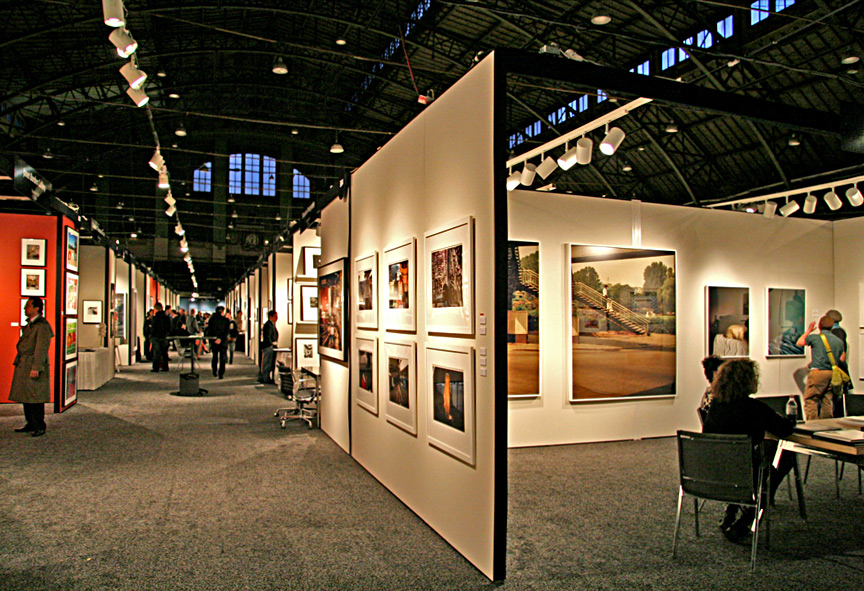
    AIPAD is the Association of International Photography Art Dealers, currently hosting the Photography Show 07. In its 27th year, the show includes more than 90 of the top dealers from around the world who specialize in fine art photography, featuring the earliest to the most contemporary images. Photos from many of the biggest names in photography can be found for sale: Steichen, Weston, Ansel Adams, Minor White, Margaret Bourke-White, André Kertesz, Brassai, Cartier-Bresson, Berenice Abbott, Salgado, and hundreds of others.

    I was accompanied by an artist and photographer – we were impressed and inspired by the quality presented. The show is a rare opportunity to see such a breadth of work all at one time under one roof. The show is held in the 7th Regiment Armory on Park Avenue and 67th Street, a great historic fortress (occupying a full city block) and a great space for this type of event. The exhibit runs from April 12 through the 15th. The $20 admission (which includes a 360-page color catalog) is well worth it…


  • The Question Mark

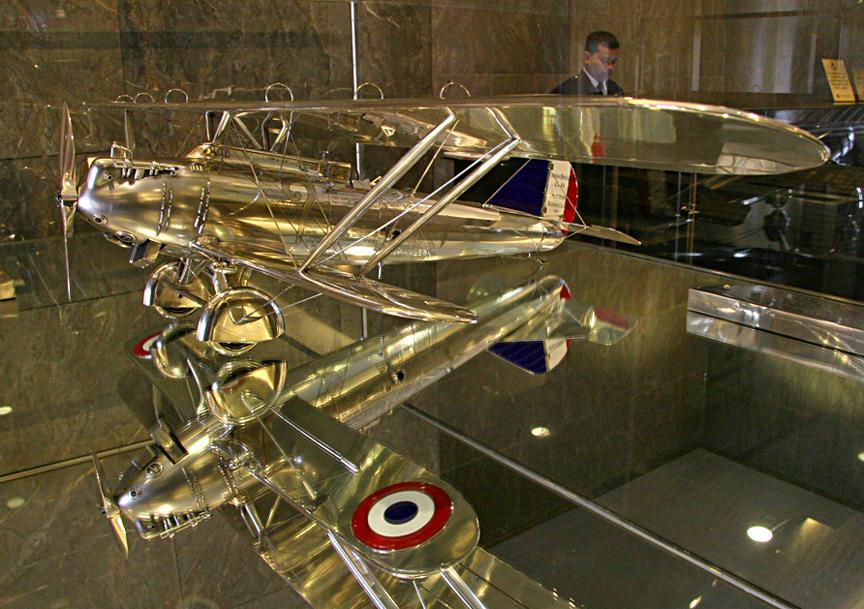
    If you enter the lobby of the French Building at Rockefeller Center from the side entrance (off the central channel gardens), you will find a showcase with a reproduction of a plane in sterling silver made by Cartier. There is a plaque with an inscription which reads:

    REPRODUCTION IN STERLING SILVER OF THE
    “QUESTION MARK”
    WHICH MADE THE FIRST NON-STOP FLIGHT FROM PARIS TO NEW YORK
    IN SEPTEMBER 1930, PILOTED BY THE FRENCH AVIATORS
    COSTES AND BELLONTE
    THIS GOOD-WILL FLIGHT WAS THE RETURN VISIT OF
    LINDBERGH’S HISTORIC FLIGHT TO PARIS IN 1927
    THIS REPRODUCTION, WHICH IS SCIENTIFICALLY CORRECT IN
    EVERY DETAIL, IS THE GIFT OF THE FRENCH GOVERNMENT TO
    ROCKEFELLER CENTER FOR LA MAISON FRANCAISE
    PRESENTED ON NOVEMBER 8, 1933
    BY THE FRENCH AMBASSADOR TO THE UNITED STATES.
    HIS EXCELLENCY MONSIEUR ANDRÉ LEFEVRE DE LABOULAYE
    EXECUTED BY CARTIER


    The plane was a variant of the Breguet 19, a Super Bidon single-engine biplane, which was built specifically for transatlantic flight. On September 1-2, 1930, Capt. Dieudonne Costes and Lt. Maurice Bellonte flew from Paris to New York City (3,852 miles) in 37 hours and 18 minutes, the first non-stop westbound fixed wing aircraft flight between Europe and America. The conclusion of a message to American president Herbert Hoover from French President Gaston Doumergue read, “…in forming one more tie between France and the United States, will contribute greatly to the development of their friendship of centuries.” I guess those were better times as far as American/French relations…


  • Sylvette

    Posted on by Brian Dubé

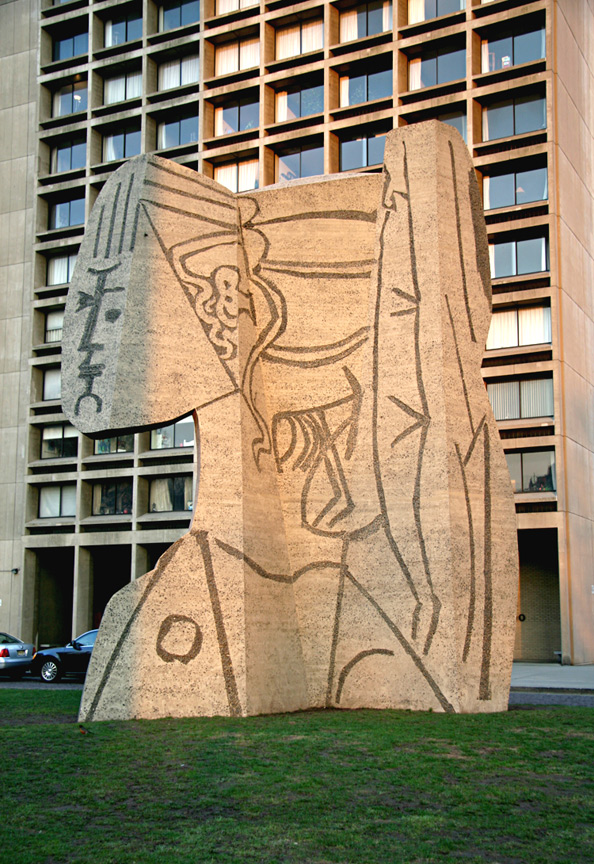
    This is the Bust of Sylvette, an enlarged version of an original sculpture, Portrait of Sylvette, done by Picasso in 1954. The new piece, 60 tons and 36 feet tall, was reinterpreted/executed by Norwegian sculptor Carl Nesjär in 1967. The sculpture sits in the courtyard of Silver Towers development (originally University Village), a complex of three 32-story apartment buildings – two used as NYU faculty housing (Silver Towers) and one a middle-income coop. One of these towers is seen in the photo. The sculpture was commissioned by architect I. M. Pei, who designed the buildings in 1966 for New York University.

    I find this small plaza and its surrounding buildings somewhat bleak, however, architectural reviews generally seem quite favorable, citing many unique features of the design and construction of the towers. The sculpture’s concrete was made with a Norwegian black stone aggregate, sandblasted to recreate the etched black lines of the original. Picasso was involved in the scaled translation, material, and its placement in the plaza. In 1972, Christo (the environmental installation artist who did the Gates of Central Park numerous other works) did a wrapping of the sculpture, Wrapped Sylvette

    Posted on by Brian Dubé

  • Scrap Yard

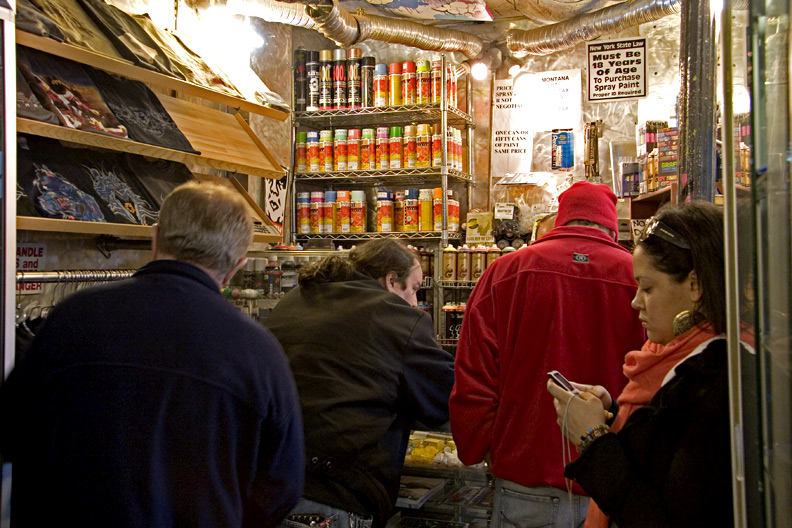
    Until recently, I did not know there was a retail graffiti business. I assumed that the purveyors of the activity availed themselves of the various supplies from art and hardware stores. Like anything else, however, if there is a demand, someone will provide a supply. This small shop, the Scrap Yard at 300 West Broadway in SoHo just north of Canal Street, is owned and operated by Mark Awfe. It carries the requisite materials (paints, spray caps, etc.) and many other items such as T-shirts, hats, DVDs, books, magazines, mixed tapes, fat caps, video graff, collectibles – all related to graffiti. Click here for a peek inside.

    In reading about graffiti, I found a world with its own language/grammar, images, and culture. All of it foreign to me – the conversation on various graffiti sites was essentially unintelligible. There are many famous graffiti artists, like the mysterious Cost and Revs, whose work has appeared citywide. There are websites such as 12ozProphet (originally a magazine from 1993), akanyc, and fourthehardway. Although the term graffito (plural graffiti) means to inscribe or scratch and goes back to Roman times, the term graffiti now generally implies vandalism – art done on a public surface without permission of the owner. I am seeing references in reading to legal graffiti, a strange concept since the essence of graffiti has been its outlaw rebel element. It will be interesting to see if this activity will morph in some way to become benign and more commercial…


  • Cigar Store Indian

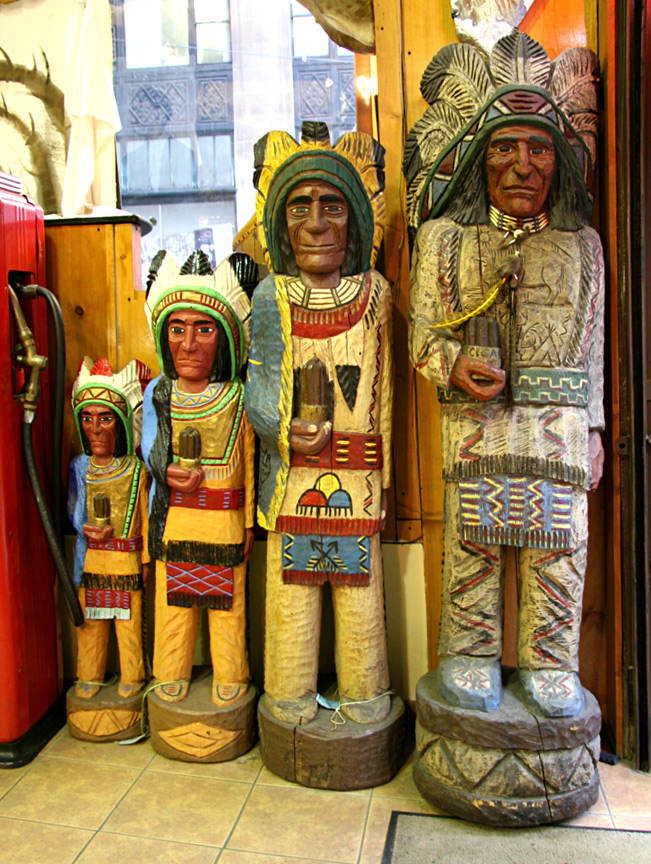
    The wooden cigar store Indian is still found in front of cigar/tobacco shops in NYC. Because Indians had introduced Europeans to the use of tobacco, Indian figures soon came to be used as an emblem of the tobacconist (the first ones appeared in England in the early 1600s and were referred to as Virginie Men).

    Visual emblems for shops were common at the time – e.g. barber poles for barber shops, gold balls for pawn shops, scissors for tailors, and Indians for tobacco shops. Many reasons have been cited for this, among them illiteracy of the populace and immigrants unable to read English. It’s surprising to still see these in the city, since some find this icon racially offensive in nature, similar to the black lawn jockey. I found this group in Western Spirit, a large Western Shop at 395 Broadway. There is an active trade in these in the antique market, with some fetching as much as six figures…


  • Waterworld

    Posted on by Brian Dubé

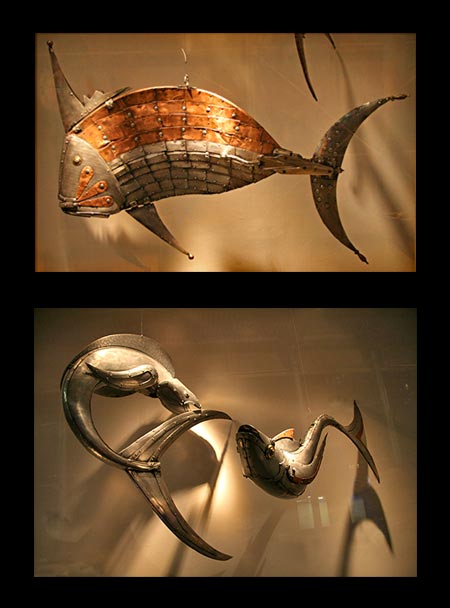
    NYU provides two window galleries for public viewing of art: Broadway Windows and Washington Square Windows (previously featured on this site).  Both spaces are lit 24 hours a day.

    Broadway Windows, located at East 10th Street and Broadway, is currently featuring Waterworld by Bates Wilson. Wilson salvages scrapped metals and abandoned objects to create metal-finned fabricated fish that swim through the imagined waters of an otherworldly urban aquarium. One can find sun-fish, crested sail-fish, and striped flying fish. “These fish are organicistically constructed of sheet metals, found objects, and rivets. They have the feel of Jules Verne and could swim in the oceans of the metropolis. The idea is to make something new out of things old; to take that which is discarded and renew the life that it once had. Art should allow for a continuous evolution of materials and ideas.” It’s a pleasant surprise to happen upon displays of art like this while walking in the city…

    Posted on by Brian Dubé

  • Soot of Armor

    Posted on by Brian Dubé

    This is an archival photo taken on November 26, 2006 on East Third Street opposite the Hell’s Angels clubhouse, where I made several recent visits with the intention of a doing a post. I have been fascinated for years with the Hell’s Angels in NYC and their apparent ability to operate with virtual impunity regarding the law – members have been reported to perpetrate random acts of violence and engage in various criminal activities (click here for New York Times article), yet charges have frequently been dropped due to improper searches, lack of witnesses, etc. And they rule that city block. I had been warned of the potential danger of being caught shooting their building – they have six surveillance cameras. On a previous visit, I asked a block resident for his advice on taking a photo, and he said, “I wouldn’t do it. Don’t be a hero.”

    On my last visit with a friend, I approached a club member going into the building and asked permission to take photos (technically I didn’t need it). He let me know that they owned the building and the sidewalk and that he didn’t want to be on my blog (with a few expletives thrown in). I decided that is was not worth the risk to have a camera wrapped around my head by a Hell’s Angel, so I slunk back across the street where my friend was waiting and took the above photo. It’s interesting that all this occurred just before the recent major incident at the clubhouse – making all the news media (click here for Gothamist’s coverage). So, instead of the Hell’s Angels clubhouse, we have a miniature suit of armor with red horns in a window gate AC cage with skulls hanging from it. I have no idea if there is some hidden meaning here or visual pun. Any ideas?

    Posted on by Brian Dubé

  • Mural

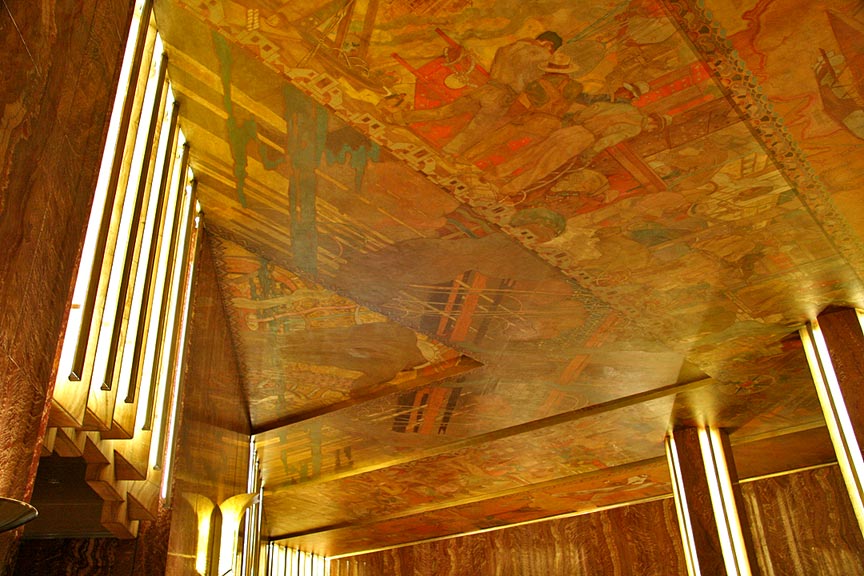
    This is a section of the ceiling mural in the lobby of the Chrysler Building, done by Edward Trumbull in 1930. Click here for second photo. Considered the largest mural in the world, it measures 100 x 96 square feet. Entitled “Transport and Human Endeavor,” it depicts energy and man’s application of it to the solution of his problems. The mural’s central image is a male figure who was described in a 1930s building brochure as a ”muscled giant whose brain directs his boundless energy to the attainment of the triumphs of this mechanical era.” There are images of fire, lightning, electricity, heat and steam, the telegraph, telephone, radio, ocean liners, trains, airplanes, buildings, and scenes of construction workers building the Chrysler Building and from the Chrysler assembly line.

    In the 1970s, the mural was essentially damaged by the application of a polyurethane coating; in addition, recessed lighting was cut into the mural itself. In 1999, a thorough restoration was done with an estimated 10,000 hours of labor. The urethane was removed, the spotlight fixture holes repaired (filled with plaster), new canvas attached, and images recreated using archival photos. In a time when the dumbing down of America is a popular refrain, it is heartening to see the widespread movement of architectural restoration and preservation in this country…


  • Offerings

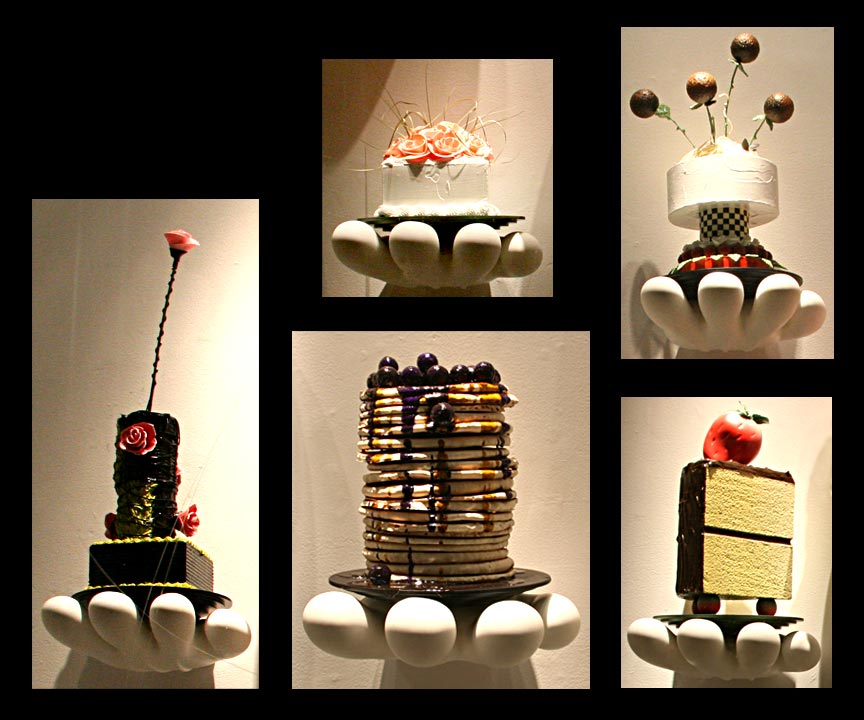
    New York University has a number of window spaces that are used to show works of art. On the east side of Washington Square Park are three windows called Washington Square Windows. Currently there is an exhibition of sculpture by Bolek Niedzwiecki entitled Offerings (Feb 9 – April 9, 2007). The work is quite whimsical, and since it features confections, it attracts quite a bit of attention. Cakes, confections, and other edibles are offered on outstretched, white-gloved hands. They are formed from squeezed acrylics.

    Says Niedzwiecki: “No underlying messages, no esoteric descriptions, no political commentary, just good old-fashioned aesthetics and whimsy is what Offerings is all about. These cartoonishly comical cakes are made using the same squeeze-bag and knife techniques that you would find at your favorite corner bakery. The only difference is these cakes are made of acrylic paint. Let me indulge your fancy with an offering of cake.” The exhibit is visible from the street and lit 24 hours a day, so if you are in the area, have a look…


  • The End Of History

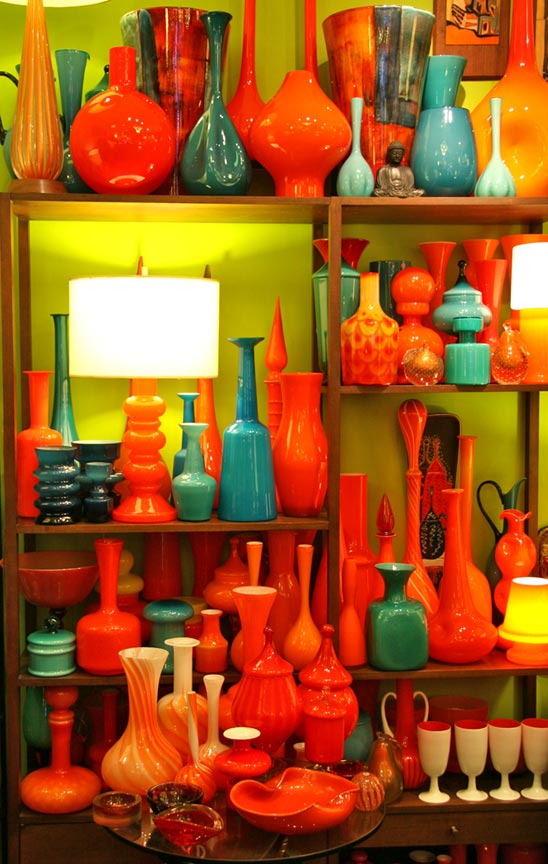
    The End of History is a small shop at 548 1/2 Hudson Street that sells vintage glass, ceramics, and furniture. Their tag line is “the world’s largest collection of 1950s & 60’s glass. Also selling furniture, lighting, and ceramics of the same period.” Owner Stephen Saunders describes his shop as “very Ice Storm” and says that ”Venetian glass is my big love.”

    I immediately was taken by the visual impact – the sun coming through all the varied colors has a striking effect and drew me into the store. The Italian, Scandinavian, and American glass objects are arranged by color, rather than price, origin, etc. See this additional photo showing some other color groupings of glass. This is one of those very specialized shops which exists only in NYC. These artifacts may be, as the store name implies, the pinnacle of accomplishment in this area of glass art, and they really do signify the End of History…


  • Seize sur Vingt

    It is not very often that one finds an automobile parked in a small retail shop in Manhattan. Groupe16sur20 at 267 Elizabeth Street in NoLita is a fashion cooperative started by James and Gwendolyn Jurney, founders of high-end clothing label Seize sur Vingt (meaning 16 out of 20 – a French school grade which equals an “A”), which is sold here along with their other line, Troglodyte Homunuclus. Apparently, something artsy is happening on Elizabeth Street.

    Similarly to the post I did recently on the Elizabeth Street Gallery (across from 11 Spring Street), fusion again rears its head. In this case, clothing meets art, performances, and autos. From a January 8, 2007 article in the New York Times: “Groupe 16Sur20, a cousin of the NoLiTa store Seize sur Vingt that is perhaps New York’s only gallery/clothing emporium/used car lot, even has its own curator, who’s put together shows by the likes of Nan Goldin and Larry Clark. They share space with the stock of men’s polo shirts, soccer jerseys, and a Lamborghini.” Currently, a yellow 1987 Ferrari Testarossa (shown in the photo) is being offered for $90K…


  • Art Bikes

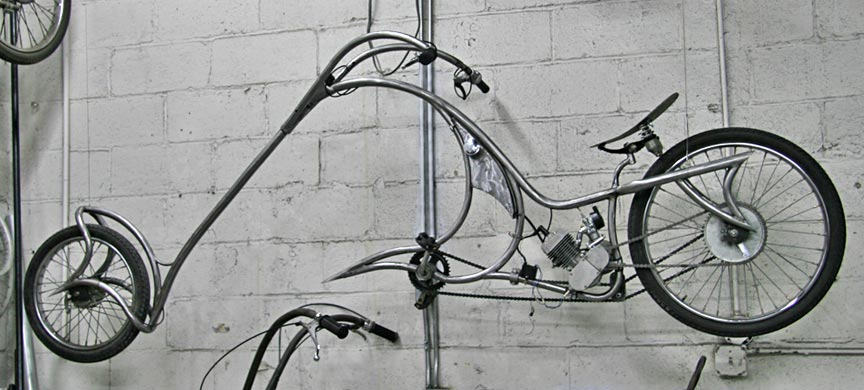
    This is the story you have not heard and the place you have not seen. In a signless, nondescript, windowless 1-story garage workspace in SoHo, bicycles are being made (see here). These creations are the work of Josh Hadar, born in Maplewood, New Jersey, and a NYC resident since 1983. A Boston University film major, Josh was, until recently, a family partner in Studio 54. With a little friendly persistence, he was kind enough to permit me a short interview and these exclusive photos (click here).

    The bikes are hybrids – they can either be pedaled or run on a small gas or electric motor. They are all handmade. A lot of cutting, tube bending, grinding, and welding goes into these graceful, chopperlike vehicles – about 4 to 5 weeks’ time goes into each one. Only a dozen or so have been made over the last two years. He has a number of newer designs not yet completed, which he asked that I not photograph. Josh assured me that a couple of these are street-ridden in the city, but I have never seen one. Keep a very sharp eye out for a rare sighting…


  • dinamic_sidebar 4 none

©2026 New York Daily Photo Entries (RSS) and Comments (RSS)  Raindrops Theme