• Category Archives Art and Sculpture
  • Think Big

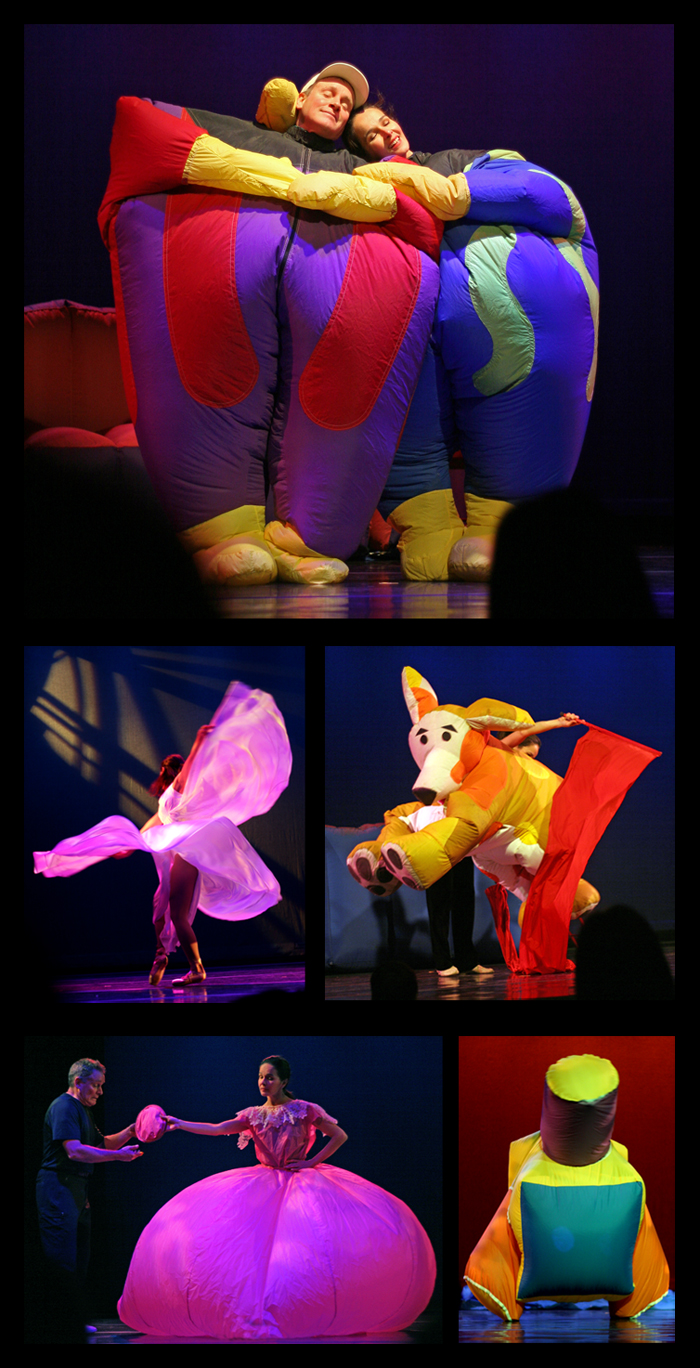
    In 1979, Think Big opened in SoHo. This shop was started by Phyllis Prinz and Robert Malkin, who created a product line of oversized replicas of a variety of products – tennis rackets, Crayola crayons, paper clips, pencils, postage stamps, toothbrushes, etc. I frequented the shop often and was once gifted an oversize Bayer aspirin. The shop was a roaring success, closing in 1994 (and later rejuvenated as an online shop by Jeff Bruette as Great Big Stuff). There was a man, however, where the concept of the oversize had also been brewing for a much different reason: Fred Garver (aka Fred Garbo) of South Paris, Maine.

    I have known Fred Garbo for 35 years – he is, in fact, one of my oldest customers and quite a unique individual. His credits, like his talents, are myriad. I do not say this lightly. In 1980, Fred auditioned for the Broadway show Barnum. The part called for acting, dancing, singing, acrobatics, playing an instrument, and juggling – Fred was chosen over 500 auditioners.

    Since our very first interactions, I became aware how Fred has always been very focused on the VISUAL impact of any stage prop and its SIZE. This became a virtual obsession, explaining the evolution of his show of 18 years and his invention and utilization of large inflated props/characters. His character, Led Zeplin, and his inflated suit have been the envy of many a performer and have also spawned a few imitators.

    His partner in his show is Daielma Santos, who was born in Sao Paulo, Brazil, and is a graduate of the Royal Academy of Dance in London. She has worked as a professional ballet dancer and teacher. Having met while Fred was touring, Daielma became fasicnated with his inflatable suit. A partnership soon followed. A number of pieces in their act showcase Daielma’s dance talents. Her grace, fluidity, and charm are arresting both on stage and off.

    Last week I was called by a friend who informed me that the Fred Garbo Inflatable Theater Company was performing on Saturday, January 8th, at Symphony Space in New York City. She invited me to accompany her, her husband, and their 3-year old child to the show.

    Fred is a resident of Maine, where he originally moved to study and train with his mentor, the late Tony Montanaro of Celebration Mime Theater. He railed against the stereotypical and overdone illusions of mimes at that time and developed his own unique brand of physical theater, incorporating his skills and training in juggling, mime, acrobatics, and clowning.

    The Inflatable Theater show involves juggling, dance, and a large variety of inflated objects and characters moved through the acrobatics of Fred and Daielma inside. The show is highly polished and very successful, a great pleaser of children and adults worldwide.

    During the time that Fred worked in Barnum, Fred lived in New York City. We formed a closer relationship at that time – in addition to his performing, Fred became a teacher of juggling in my studio. A lover of nature and Maine, I was astonished at how quickly Fred adapted to New York, navigating its shoals undaunted and learning about it so quickly. In 1983, Fred, along with Bob Berky and Michael Moschen, created Foolsfire, an Obie Award winning 3-man show, which I had the privilege of seeing. He was also the man inside Sesame Street’s Barkley the Dog. I have always considered him to be an honorary New Yorker. It’s seems so appropriate for a man who adapted to city life so readily and whose life’s philosophy has always been to Think Big 🙂
  • Surfaces and Surfing

    One of the things I don’t like about websites is the lack of transparency. It is virtually impossible to get a sense of the depth and breadth of the content. With New York Daily Photo, for example, each visitor comes into one single page. I have, however, done over 1,400 stories. How many will be read? Who will take the time to explore the archives or search on keywords? Many of my best stories and photos are buried.

    Of course, there are ways of redesigning a site to optimize and encourage exploration of previous content, and I intend to do that. With print media, however, with just a cursory examination, you immediately get a lay of the land. If someone hands you a 3,000 page catalog, you only need to rifle through it briefly to get a good sense of its offerings and areas of specialty. But a website may have 100 products or one million, and only lots of digging will reveal that. Superior graphics may give the illusion that one company has more to offer than it really does.

    Walking the streets of New York observing people is much like surfing the web, seeing only their first page. To get a sense of a person’s content, you’re going to have to stop, meet, and dig deeper.
    I have been doing that for nearly five years now, and as readers of this site can attest, the depth, breadth, eccentricity, and brilliance of many unassuming people that inhabit the streets of New York City is extraordinary. Of course, not every person possesses even one of these superlative attributes, and even fewer could be fairly said to have all, but there are enough to make contacts with people in New York City an unending journey into the world of surprises.

    This city is a magnet for those driven for success in many arenas, as well as an important brewery for artists of all persuasions. Although electronic media and communication have decentralized the arts somewhat, only a very large city is going to provide ample opportunities for many – painters, musicians, dancers, and other performers, etc. who really need to interact and interrelate in person. Despite the online world, there is still a dynamism and synergy when people are physically together.

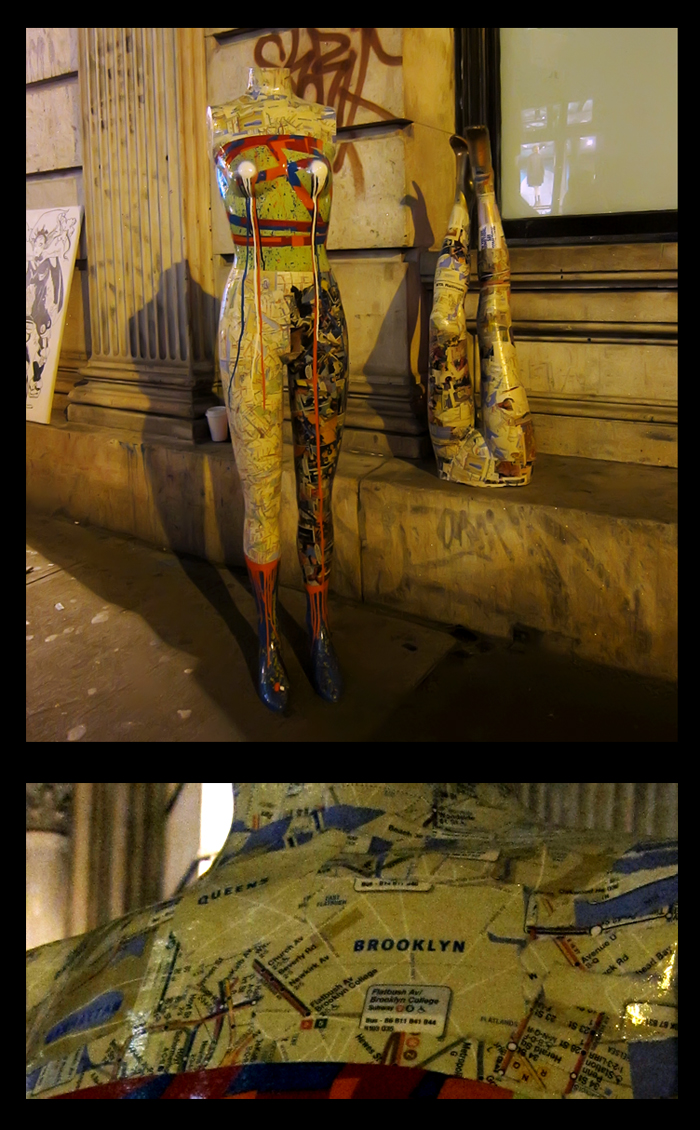
    I have often seen the sculptures of Sidi Abdul near my office at Spring Street and Broadway. I stopped to talk to him briefly last night as he was packing up. We exchanged contact information. I asked Sidi about the nature of his work, and he informed me that buyers purchased his work and displayed them as art pieces in homes, etc.

    When I receive his biographical information, I will update this posting. For now, enjoy what you see. I love the elegance of his work. There is more on his Flickr site here. Notice the use of New York City subway maps in the construction of these sculptures. I have often been critical on this website of examples where appearance reigned over substance. However, there are many things where genuine beauty lies on the surface. Surfaces and surfing are not always a bad thing 🙂


  • Joe Plourde

    This website would not be complete if I did not mention Joe Plourde. I have ruminated for some years as to whether to include him. You will never meet Joe Plourde, nor will you read of him anywhere. He is, in many ways, an ordinary man of ordinary means. He has seen hardship with an austere upbringing. Appropriately, he lives in a town called Plainville.

    But in other ways, Joe is an extraordinary man. He is disarmingly friendly and loved by everyone he meets. He is, like my family, of French Canadian ancestry, but unlike my parents who were born in Maine, he is from the Province of Quebec, moving to Maine and then later to Connecticut. It was in Hartford that he met my family when they made the same move and helped us find our first apartment.

    I have written a number of times about the demonizing of the present and the praising of the past. That many believe that everything has been dumbed down and that the best was in times past. In Better When, I quoted from Jill Eisenstadt’s New York Times article about this very topic. However, with all due respect to Jill, she (or I for that matter) is not someone who left home at 14 years old from the woods of Canada.

    Joe is quite direct and not always politically correct, but he is a fair and reasonable man and not materialistic at all. He does not champion the past. On one occasion he told my father, “Al, you know what they can do with the good old days. The can shove ’em where the sun don’t shine.” A bit vulgar, but a point I have never forgotten. The few pleasures of the simpler life of days of old did not outweigh the hardships he endured – he much prefers his modern life with simple comforts, like central heating and indoor plumbing.

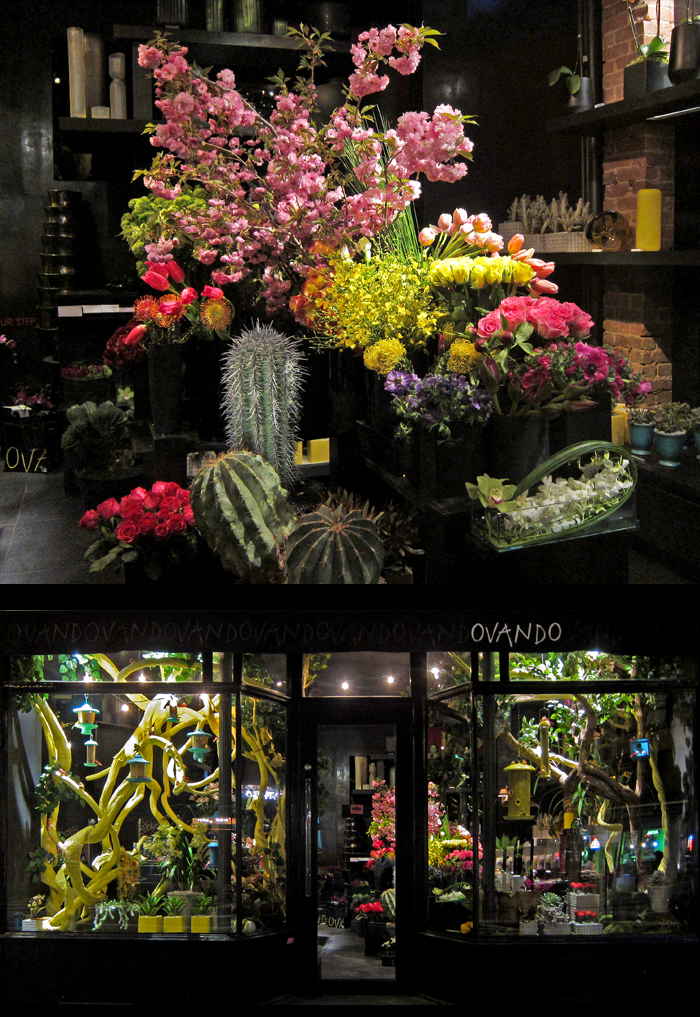
    Flower shops have been around for a long time, and Ovando Flowers, at 337 Bleecker Street, is a good example of how many retailers today excel in the quality of goods offered and presentation. Ovando’s extraordinary window display is itself a tourist attraction. From their website:

    The owner, Sandra de Ovando, was born in Mexico City to Spanish and Russian parents. Sandra fell in love with nature, flowers and bold colors at a very young age when she often spent weekends gardening with her mother.

    Later, in her travels throughout Europe and Asia, Sandra discovered exotic flowers, plants and fruits which she began incorporating into her designs – hence was born the signature style that today defines Ovando’s dynamic compositions.

    Intent on indulging her bright passion for flowers and design, Sandra moved to New York where she soon after opened Ovando in 2003.

    Today, Ovando has blossomed into a full-service Floral and Event Design Company. Sandra’s unique approach, the culmination of her life’s journey, has made her the favorite floral designer of New York’s elite, including celebrities, high-end restaurants, fashion houses and boutique hotels. From stunning bouquets, moody lighting, and the full-scale construction of breathtaking displays and environments, Ovando is a dazzling celebration of form, function, and flowers.

    I don’t expect to find Joe Plourde there, but I know he would like it 🙂


  • Gotta Shoot Village Cigars

    There are many iconic photographic images of New York City. Typically I leave them alone – iconic for me translates as it’s already been done and done well, you probably won’t do it better or in a more interesting way. So, rather than look like a wannabe or copycat, I look elsewhere.

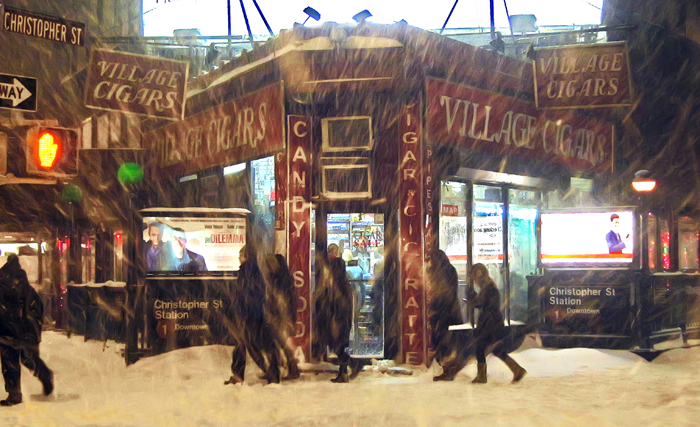
    However, there are many, many subjects in this city that, given the right time and conditions, will lure anyone with a camera. Photos like that of Village Cigars in a snowstorm by Igor Maloratsky. A mysterious Hess Family triangular mosaic is set in the sidewalk in front of Village Cigars (see my story and photo here).

    Village Cigars, at 110 7th Avenue South at the corner of Christopher Street, occupies a unique, tiny, one-story triangular building. This neighborhood landmark has been located there since 1922. It has been seen in film, and there have been numerous images taken over the course of its history, in a variety of seasons, available in both color and black and white, as stock photos for advertising, art prints, greeting cards, and photos sold on the streets to tourists.

    Try as one might to exorcise those legendary photos from ones mind, similar conditions often acts as a trigger. Caught in a snowstorm while walking down Christopher Street with a camera in hand? Gotta shoot Village Cigars 🙂


  • Kind Of

    I am pleased to learn that although my photographic talents are not in the league of Henri Cartier-Bresson and Ansel Adams, at least my thinking is. In 1952, Cartier-Bresson published his book Images Ă  la sauvette. The English edition was titled The Decisive Moment, not The Machine Gun.

    It is easy to fall into a machine gun approach, a style favored by so many photographers today, particularly with digital photography, where shooting is essentially free. For many, there is a secure in thinking that if you take enough photos, you will assuredly get a good one.

    Remarkably, Bresson believed in composing his photographs completely in the camera’s viewfinder, not in the darkroom – nearly all his photographs are printed only at full-frame and completely free of any cropping or other darkroom manipulation. Ansel Adams was notorious for his patience and circumspection in waiting for the right moment to take a photograph.

    In addition, the entire process of shooting in a machine gun approach and reviewing hundreds of photos is mind numbing and works against the production of interesting photographs. When shooting events like parades, I am lured into this practice, seeing the event as an opportunity at cataloging and results that show it, with very few, if any, memorable photos.

    I recall having a conversation with a student at a major art school in New York City who was near completion of a degree in photography. When I asked about Ansel Adams, I was told they were not familiar with his work and had only “kind of” heard of him – they did not study him at school. I found it incredulous, really. This is not an issue of likes or dislikes. How can you give someone a degree in photography and not do at least a cursory examination of Ansel Adams?

    The black-and-white photographs of the American West by Ansel Adams are recognizable around the world. With Fred Archer, Adams developed the Zone System, still in use by some today and applicable to color and digital photography. He has been the subject of a Ric Burns PBS documentary. In 1932, Adams formed Group f/64 with Edward Weston. Adams played a key role in the establishment of the first museum department of photography, at the Museum of Modern Art in New York City. You can find the websites of Ansel Adams here and here. The website of Henri Cartier-Bresson is here.

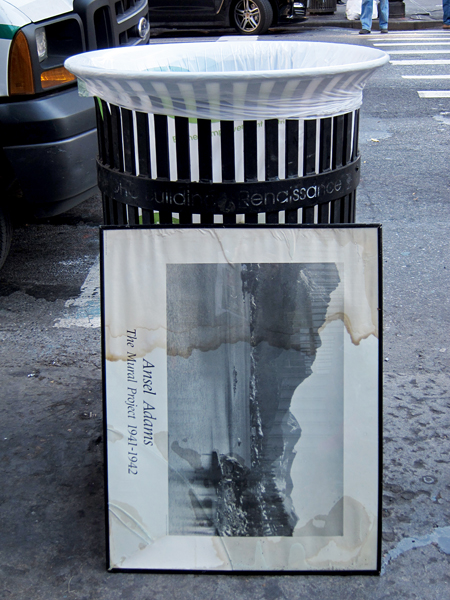
    The conversation with the photography student prompted me to notice the framed poster in today’s photo, placed prominently near a garbage can on Broadway in NoHo. Apparently the owner had heard of Ansel Adams, and disposing of this poster was due to the apparent water damage and not any “kind of” statement about Adams 🙂


  • 5 Pointz


    Note: Please see my full gallery of photos here.

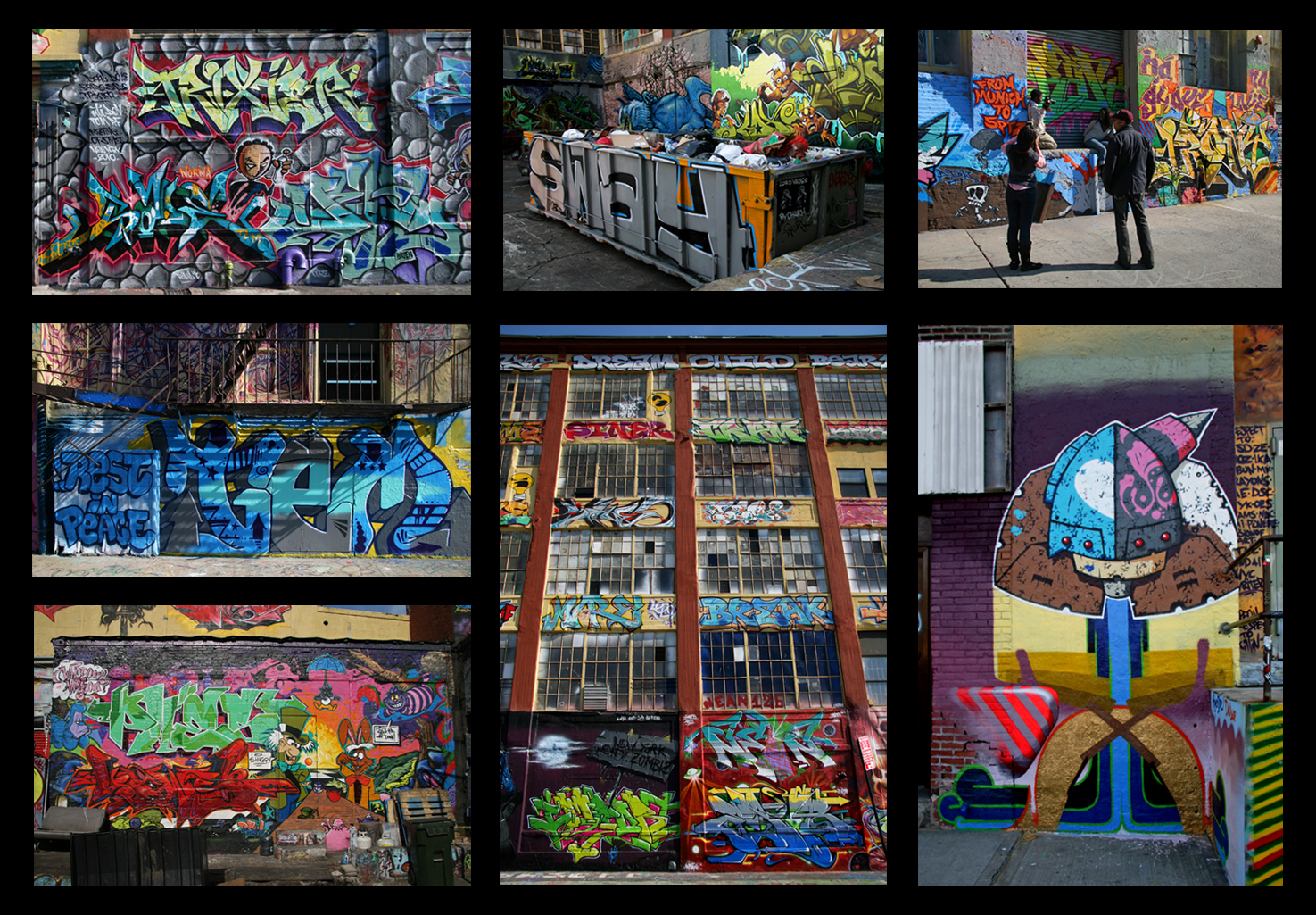
    I recently showed my posting, Unconditional Love, to a coworker*, who commented, “Do you know that building in Long Island City, Queens, with all the graffiti?” To which I replied, “What building?” A search brought up the building in question immediately: 5 Pointz.

    I visited on a Sunday morning virtually alone. I was told by the manager of the property that I was fortunate because tour buses frequently make the a visit, bringing massive crowds. Painters were already on the scene, however, at various locations.

    I was astounded by the work, brilliant color, and mammoth size. All the surfaces of the block long, 200,000-square-foot (19,000 m2) factory building complex, are covered. The building itself is owned by Long Island real estate developer Gerald Wolkoff, who sanctions the work.
    The property was the vision of Jonathan Cohen, aka Meresone. Originally Phun Factory, the property is now known as 5 Pointz: “The Institute of Higher Burnin’ ”

    In chatting with the manager, he made an important and valid distinction between graffiti and what is being done here, echoed by Cohen: ”Graffiti is a label for writers who vandalize. Aerosol art takes hours and days. It’s a form of calligraphy.” Signature tagging is typically unsanctioned. What goes on at 5 Pointz goes through an approval process. New work goes over old. The length of time a piece stays up is at the discretion of the managers, with considerations for quality of work and time in creation. From the 5 Pointz website:

    The name 5Pointz signifies the five boroughs coming together as one but, because of its reputation as an epicenter of the graffiti scene, the industrial complex has actually united aerosol artists from across the world. Legendary writers from Canada, Switzerland, the Netherlands, Japan, Brazil, and all over the United States have painted on the building walls.

    5 Pointz is also in use as a location for work by photographers, filmmakers, musicians, and artists. See my gallery of photos here. If you want to see the last word in aerosol art in a New York City industrial setting, take a trip to 5 Pointz 🙂

    *Thanks to Naomi D for making me aware of 5 Pointz!


  • Fashion Trash

    I was getting a sewn product from Asia and was looking to do a variety of colors. The prospect of getting samples and small production runs was not good, and I decided to try a novel approach – buy fabric samples in the garment district and get a recommendation for a local sewing factory. Armed with my pattern and fabric, I made a visit to a factory at 38th and 8th Ave.

    The owner quickly assessed the situation, asking for the pattern and fabric and if I had time to wait. I had samples within minutes, something that would have taken weeks sourcing outside the country. I now fully understood the beauty of local sourcing and manufacturing, at least for the sample phase. And in my case, this man’s prices were actually competitive to do production for us.

    Many worry that there is less being created or produced in the United States and that the country is becoming more and more a service economy. With soaring real estate costs, New York is even more in danger of becoming a place defined by tourism, consumption, and little production. Where, as said, we are in danger of becoming a place where we sell one another ice cream cones or rent one another motel rooms.

    Fashion is one of the surviving industries, not just the design, showroom, and sales side, but there are still factories and production in the garment district. New York City is the fashion capital of the world. There are more than 5,000 active showrooms (more than any other city in the world), over 6,000 wholesale and design businesses, 58,000 industry workers, and annual sales of $38.7 billion. There are educational institutions with well-known design schools – Pratt Institute, Parsons New School for Design, and Fashion Institute of Technology (FIT).

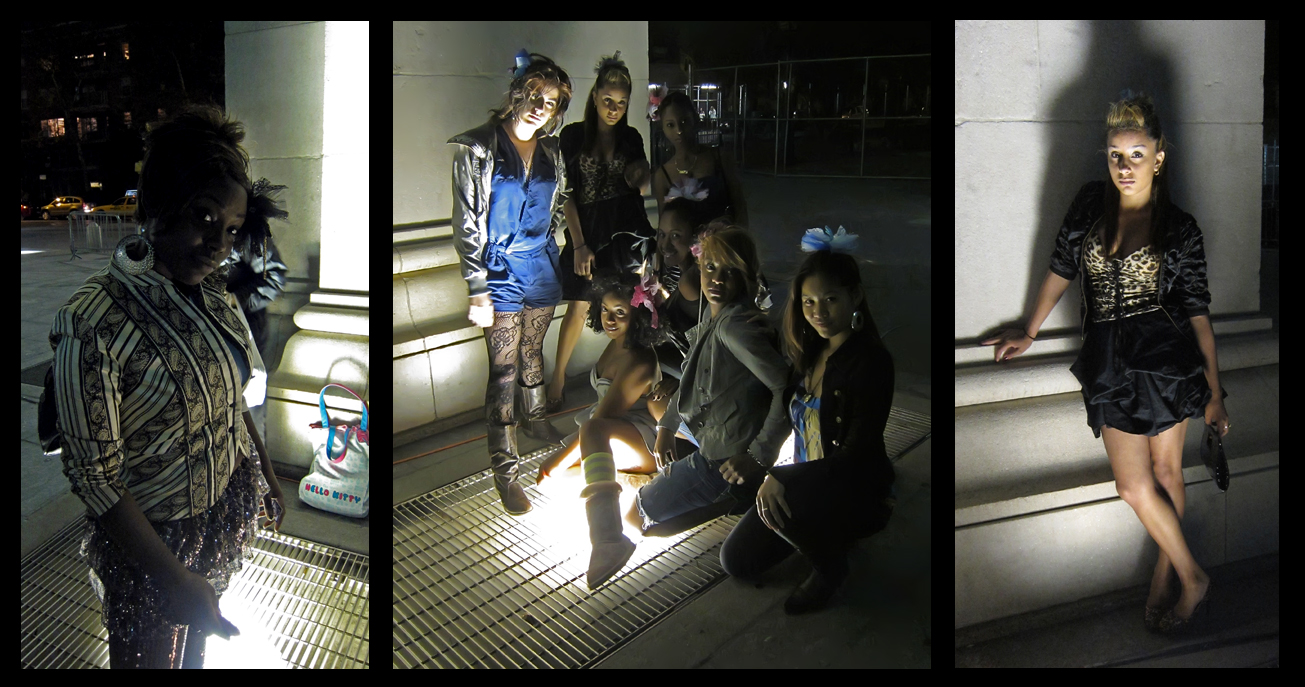
    As I wrote in Creative Expert, I am forever running across people who identify themselves as fashion designers. Recently, I ran across a group of women modeling at night in the harsh spotlights used to illuminate the Washington Square arch. I once posted a story about an amazing couple performing singing bowls under the same light.

    This group was the model entourage of Latesha Pryer, a designer from Jersey City, with her company Fashion Trash and clothing lines such as Dumpster Rags.
    I was encouraged to see young people interested in production of goods, even if they are not the engines of industrial manufacturing. Rather than selling one another ice cream, better to see some Fashion Trash 🙂


  • Unconditional Love

    There are subjects which easily ignite controversy, and graffiti is one of them. To read an article about the subject along with its comments is to witness a war of words. In 2009, the New York Times ran an article, A Sociologist’s Look at Graffiti, which reviewed a book, Graffiti Lives: Beyond the Tag in New York’s Urban Underground, by a Professor of Sociology in New York City at Baruch College. The book author was crucified by some of the readers in the comments area. Most see the problem as vandalism, pure and simple. My story, Scrap Yard, was one of my most commented, with all the classic arguments and positions on the activity.

    What complicates the matter, however, is that like anything else, there is a spectrum of quality – some of the work is extraordinary. See this group of images of graffiti in Long Island City. However, if I owned a building, I would not be pleased to have it painted without my permission. Some of the buildings are in industrial neighborhoods, have stood unoccupied for decades, and are dreadful looking – drab architecture, no exterior maintenance, and a dismal setting. And often they are vastly improved by aerosol paint. But, nonetheless, these buildings are not “public” property.

    However, many building owners permit the work to be done. This seems to be a growing trend. And, in Long Island City, 5Pointz Aerosol Art Center, Inc., “The Institute of Higher Burnin’,” is an outdoor art exhibit space which is considered to be the world’s premiere “graffiti Mecca,” where aerosol artists from around the globe paint colorful pieces on the walls of a 200,000-square-foot factory building. The founder says, however, that “Graffiti is a label for writers who vandalize. Aerosol art takes hours and days. It’s a form of calligraphy.”

    The building in today’s photo is the home of Gratz Industries at 1306 Queens Plaza South. I spoke to someone today at Gratz (a fascinating business in itself) and was told that this is an instance where artists asked the owners for permission. Certainly cooperation is best for all, allowing more time for better work and even working with the owners for things like incorporation of company signage elements.

    To meander around Long Island City and suddenly happen across something like this is quite stunning. For those who enjoy the finer works of graffiti but suffer pangs of guilt knowing how they got there, take a trip to 1306 Queens Plaza South, 5Pointz, or anywhere else where cooperation is at play, and enjoy a new world of unconditional love 🙂


  • Pyramid Power

    New York City is no stranger to the occult or new age practices and beliefs. Samuel Weiser Books, established in 1926 on book row, is the oldest and probably the most famous occult bookstore in the United States. It moved a number of times and is no longer a retail operation. However, I did visit their shop many times in the 1970s, when they were located at 734 Broadway in the Village.

    In the early 1970s, pyramid power became the rage. Claims were made about their paranormal properties – pyramids were said to preserve foods, maintain the sharpness of razor blades, improve health, function “as a thought-form incubator,” trigger sexual urges, and a myriad of other effects. Models were made and sold in a variety of materials. I had one myself.

    One of the seminal forces in this phenomenon, was New Yorker Max Toth, born in 1937. He a background in electroneurophysiology and was one of the first neurosurgical technicians. He built high-gain amplifiers for research purposes for neurosurgeons.
    While living in Bellerose, Queens, Toth began manufacturing foldable cardboard pyramids. In 1976, the highly influential book Pyramid Power, authored by Toth, was published. An estimated 1 million copies have been sold. Other books and other pyramids were manufactured in a variety of materials, becoming a virtual mini-industry.

    Frenchman Antoine Bovis, a pendulum dowser in the 1930s, originated the idea that pyramidal shapes can preserve food. Karel Drbal, a Czech radio engineer, patented a razor blade sharpening pyramid based upon the earlier paranormal experiments of Bovis.
    Sheiler and Ostrander, authors of Psychic Discoveries Behind the Iron Curtain Authors, published in 1970, had met Drbal and devoted a chapter of their book to pyramid power.

    Today, pyramid power and pyramidology are all but forgotten and considered pseudosciences. But whenever I see pyramids, particularly those sitting atop the Zeckendorf Towers (or even the Gothic spire of Grace Church), I can’t help but be reminded of Pyramid Power…


  • Sukkah City


    I have found it remarkable that everyone I have spoken to, including those who grew up outside the United States, has participated in what appears to be one of the most universal past times of children – the building of makeshift structures to hide and play in. An amalgam of anything available – sheets, cardboard, etc. are utilized to make a mini-home or fort. Perhaps it should be no surprise, owing that shelter is such a primal need of every human. Also no surprise that George Costanza of the TV series Seinfeld, in order to impress a woman, lies about his work, claiming that he is an architect.

    Architecture is certainly an endeavor where the ingenuity, brilliance, resourcefulness, and creativity of the human mind can be seen. One needs no further evidence than the recent international design competition, Sukkah City. There were 624 entries from 43 countries.
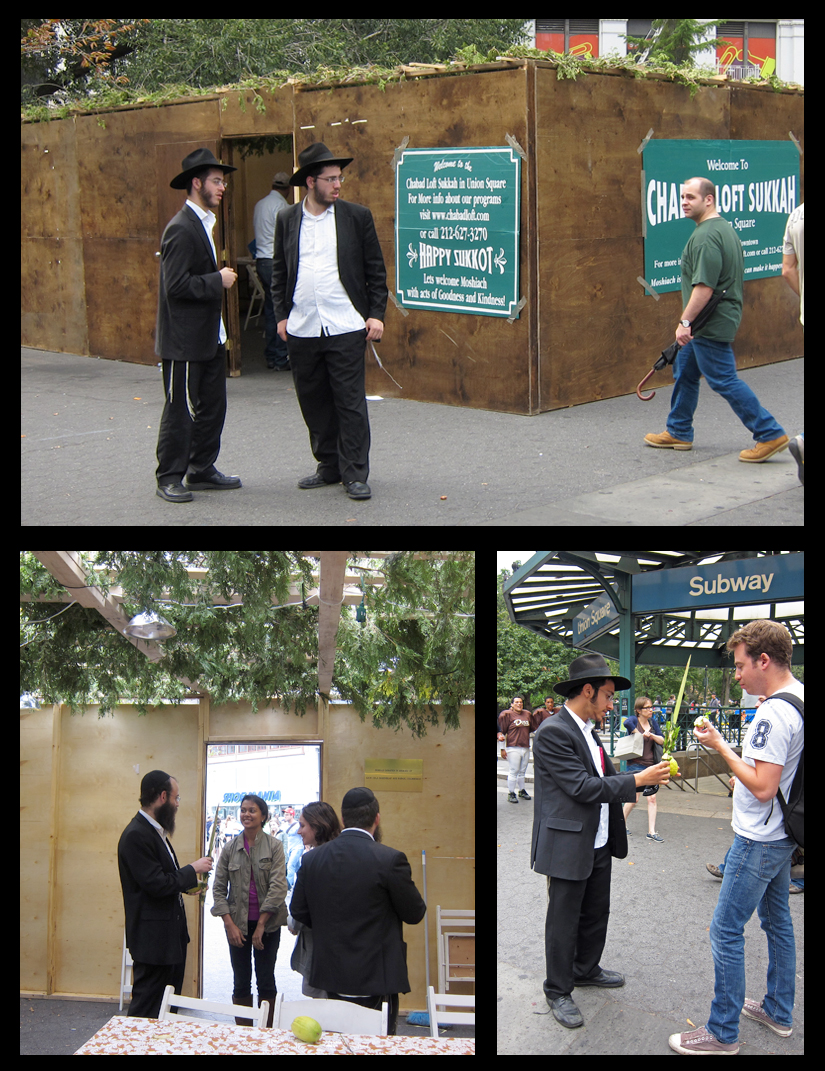
    Every imaginable material and fabrication method was used to build Sukkahs*, as long is they conformed to the rules of construction. Twelve of the finalists were displayed in Union Square for two days (September 19 & 20), and the finalist, shown in today’s top photo, remains there for the entire week of Sukkot. See second photo here.

    The designs are beautiful, evocative, and inspiring. All twelve sukkah finalists are on sale, with proceeds benefiting Housing Works, an organization fighting AIDS and homelessness. For the Jew or non-Jew, those with a home and those without, all can find inspiration in Sukkah City 🙂

    *A sukkah is a temporary “booth” (the Hebrew translation) to live in during Sukkot, a week long festival that commemorates the forty-year period during which Israelites lived in temporary shelters while wandering in the desert after their exodus from Egypt. There are many rules governing the construction and use of the sukkah: It must have two and a half walls (two full and one partial). The roof needs to be made of organic materials and sparse enough to let rain in and preferably to let the stars be seen from inside. Although Jews are required to eat all their meals and sleep in the sukkah, they do not need to do so if they are uncomfortable or during rain. See my photos here of a traditional sukkah typically found during this holiday in various locations around the city.

    Note: The event was sponsored and organized by a number of firms, including the AIA center of New York City, located at 536 LaGuardia Place. A Sukkah City exhibition is on view from September 22, 2010 – October 30, 2010.


  • Never Cut a Board

    I have nothing against wood. In fact, I did carpentry work for years. But there is a permanence to working in stone and steel that I always admired and envied. Perhaps this is what led Tony Soprano’s Uncle Junior to once correct Tony, because Tony believed his grandfather was a carpenter. Proud of their lineage as Italian stone cutters and knowing that the family’s work would stand for even thousands of years, Uncle Junior admonished him: “He never cut a board in his life – he was a stone mason.”

    Sculptures in bronze and buildings in masonry certainly have a permanence that makes the design considerations a serious matter. And yet, with this and all the hoops that sculptors and architects must go through, it is often amazing the types of projects which are finally approved, executed, and installed as public art, or built as residential or commercial structures.

    I developed tremendous respect for I. M. Pei after seeing a documentary which showed how seriously he took his commission to build the glass pyramid entrance for the Louvre Museum in Paris. He understood full well his responsibility for generations to come, the multitudes and masses who would see this work every day juxtaposed against the Louvre museum, and images which would undoubtedly be found everywhere. After receiving the commission, Pei asked French President François Mitterrand if he could take several months off to study French history.

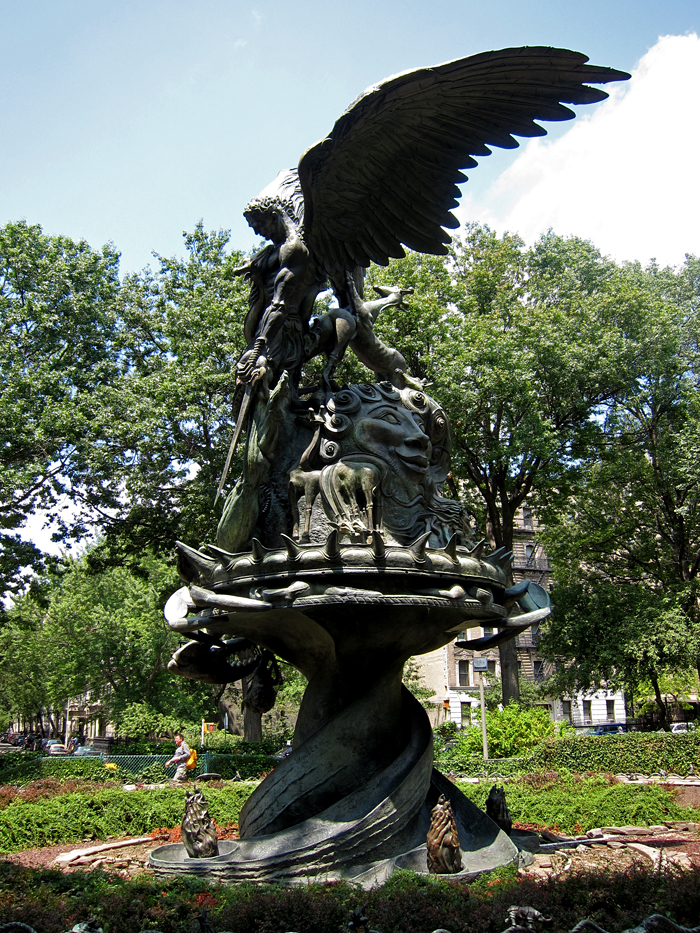
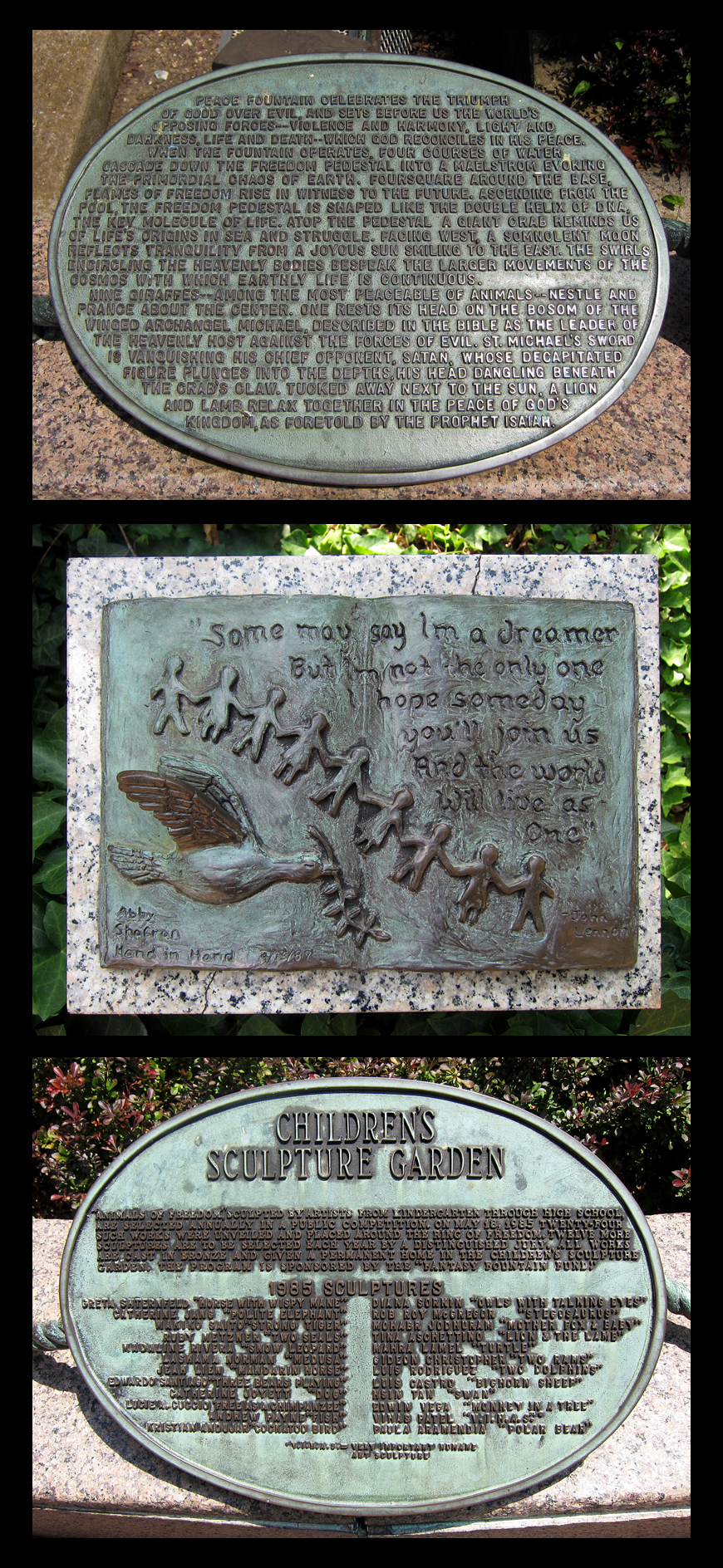
    Adjoining the the Cathedral of St. John the Divine in a small plaza is Greg Wyatt’s Peace Fountain. The bizarre work in bronze is 40 feet tall and is an amalgam of various figures, including giraffes, a sun and moon face, a crab, lion, and lamb, all resting on a base shaped like a DNA double helix. A figure of the archangel Michael, who has just finished beheading Lucifer, stands in the center. The sculpture represents the triumph of good over evil. For a full explanation, read the inscription and see additional photos here.

    The area around the fountain is surrounded by various plaques depicting various artists, philosophers, and thinkers, most accompanied by a quote by the individual. There is also a children’s sculpture garden with various animal figures created by school children.

    I wonder if I.M Pei or Greg Wyatt are the types of men who have never cut a board?


  • All Is Not Lost

    Much of the art and music world in New York City has disappeared, but all is not lost. In the East Village and the outer boroughs, the arts live on, the product of tenacity and resourcefulness. If you are looking for arts on a smaller scale than the major museums, or for music on a smaller scale than Lincoln Center, then you will have to look a little harder and concentrate your efforts in neighborhoods such as DUMBO and Williamsburg in Brooklyn and the East Village and Lower East Side in Manhattan.

    The East Village still has a substantial number of community gardens, art galleries, music clubs, and other small venues. I have featured a number of community gardens here, and more recently, the Nuyorican Poets Cafe. These types of places are virtually nonexistent elsewhere in the city.

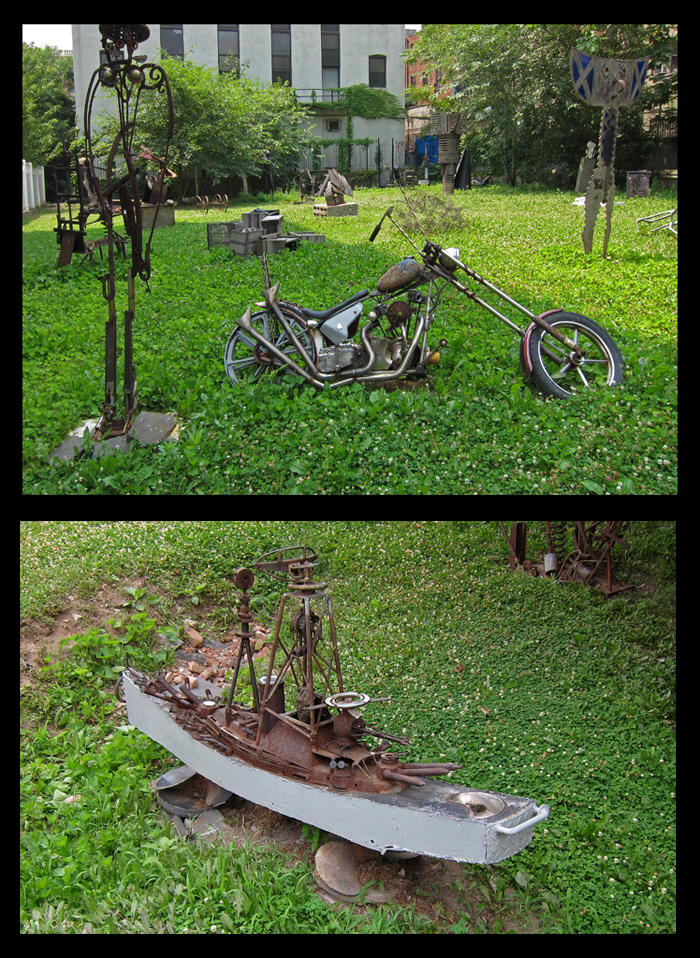
    The KenKeleba House Sculpture Garden spans an entire city block from East 2nd and 3rd Streets.

    Kenkeleba House Garden has an extraordinary mix of large African sculptures as well as local sculptures made out of scrap, or bricolage, a specialty of the Lower East Side art scene since the 1970s. Situated in a large plot, the net effect is that of viewing an outdoor museum with both permanent and temporary pieces on exhibit. Some of the outdoor pieces on loan are from local artists who used to belong to the much beloved Rivington Street Sculpture Garden, which had two incarnations in the neighborhood before it was pushed out by a new apartment building.

    Double back to Avenue B, continue south for one block, and turn left onto to East 2nd Street. Since the whole garden runs from East 3rd to East 2nd between Avenue B and Avenue C, closer to Avenue B, it needs to be approached from both sides. The separate planted garden area, can be accessed from the East 2nd Street side entering during the designated posted hours when the garden gate is open. At other times, take a look around to see if anyone is in the gallery at 219 East 2nd Street who could open the garden for you. It is worth trying to gain entry to the planted garden, particularly since this also allows entry to the sculpture garden.

    All is not lost…


  • Paint by Number

    There is nothing that seems to make an artist bristle more than paint by number* or anything remotely resembling it. It is useful to know what is best left to subjective human judgement. However, it is also good to know what is best done by using numbers, as well as where using numbers is more efficient and does not degrade the human experience.

    I recall a documentary on the illy coffee company of Italy. What really impressed me was the balance between the subjective and objective in their coffee production process. There are things better done using science and technology and things better done by the human senses, and the illy family knows when to use what.

    Numbers lie behind most things, and ultimately, given fine enough resolution, many analog things can be reduced to a digital file with satisfying results. Music is a good example. Most musicians have embraced digital recordings. Whether or not they are absolutely identical to an analog recording and whether there are any audible differences are moot points for most – the digital files communicate well the feelings intended by the composer and performers, the primary feature being the ability for flawless reproduction.

    There are things that appear to resist reduction to digital reproduction and are controversial. Stradavarius, Guarneri, and Amati violins are a good example – these instruments are highly coveted by violinists. However, tests have been done using antique and new instruments, with mixed results as to the ability of some of the world’s greatest musicians and experts to distinguish the old from the new by listening alone.

    Along with music, imaging and photography have been most greatly impacted by the digital process. The fact that a scene like that in today’s photo can be effectively communicated with a digital file is remarkable. I stumbled upon this exquisite little gingerbread cottage while driving through the Lighthouse Hill neighborhood in Staten Island. The home, at 298 Lighthouse Avenue, neighbors the Tibetan Museum and shares the same hillside and vistas (see second photo here). Built in 1899, the house is only 968 square feet. Its diminutive size and idyllic charm is communicated easily, whether you take photos, brush by instinct, or paint by number 🙂

    *About Paint by Number: The 1950s in America saw a rise in prosperity and leisure time. “For critics, the paint-by-number phenomenon provided ample evidence of the mindless conformity gripping national life and culture. The making of the fad is attributed to Max S. Klein, owner of the Palmer Paint Company of Detroit, Michigan, and to artist Dan Robbins, who conceived the idea and created many of the initial paintings. Palmer Paint began distributing paint-by-number kits under the Craft Master label in 1951. By 1954, Palmer had sold some twelve million kits. Popular subjects ranged from landscapes, seascapes, and pets to Leonardo da Vinci’s The Last Supper. Paint-kit box tops proclaimed, ‘Every man a Rembrandt!’ ” Read more here.


  • Pink Flamingos

    I was once gifted the book The Encyclopedia of Bad Taste, many parts of which I found hilarious. The writers, Michael and Jane Stern, have selected the most egregious infractions on good taste in American culture. There are chapters on Easy Cheese (in a spray can), Spam, Velvet Paintings, Chia Pets, celebrity death cars, lava lamps, etc. One article highlighted lawn ornaments.

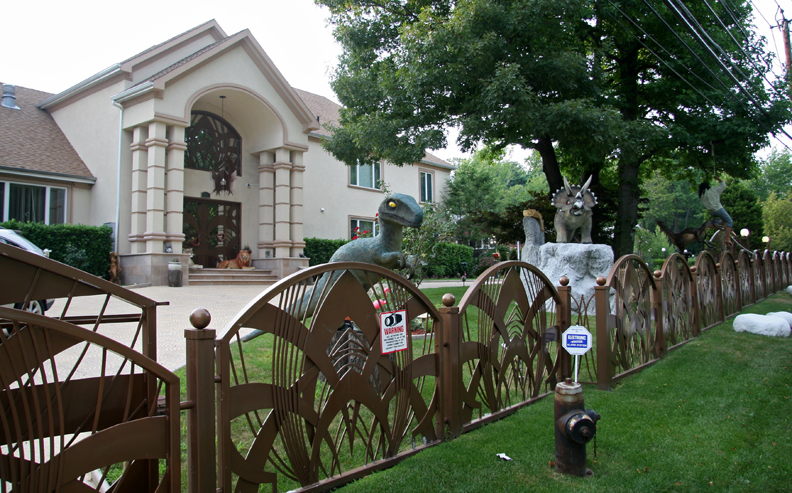
    Most of us have seen a lawn display featuring classics such as the plastic flamingo. I thought I was well-versed in lawn displays (particularly after seeing the Dyker Heights Christmas displays). That is, until I saw the display in front of the mansion of Alla and Alex Shchegol at 724 Todt Hill Road, Staten Island.

    I was happy to find a little information online about the house and the Shchegols, who have been collecting these lawn statues for years. However, I was not prepared to find a small uproar in Dongan Hills/Todt Hill, Staten Island, one of the wealthiest communities in New York City. An article in SI Live voices the concerns some have about the danger of distraction to motorists. It certainly comes as very startling to drive by this property and encounter Tarzan hanging from a tree over a lawn full of statues in a loosely themed jungle and Jurassic Park. There are dinosaurs, jungle animals, and other creatures.

    The many comments to the SI Live article range the gamut – see the article and comments here. Some say the huge ornaments are terribly distracting and dangerous, while other locals say the concerns are exaggerated. The vast majority of naysayers are just horrified at what they consider to be one of the supreme examples of tacky, bad taste.

    Actually, I was very surprised to read about the congeniality of the owners. Apparently, many passersby stop, some even knocking on the door for information about the display. Others ask permission to take photos with their children on the various animals, which the owners typically grant. A number of people, like the Shchegols themselves, just see this as harmless fun and encourage the outraged to lighten up.

    Most will agree, however, that no Encyclopedia (or lawn) of Bad Taste would be complete without Pink Flamingos 🙂


  • World of Sheep

    I once dated a woman just after college for a short time. A very short time. Actually, if I recall, it may have been only one date. This woman had been highly affected by her readings of the existentialists. I can’t say I liked her much, and I remember very little, except her assertion that “people were sheep.” She suggested, “Let’s do something different,” as if difference, in and of itself, insured a better experience. I vaguely recall her quoting some French philosopher, a role model of hers I imagine, to substantiate her negative views of humankind and extemporaneous living as the only antidote.

    Had it been 2010, her life would be considerably more difficult, if not near impossible. She would be a very unhappy camper for sure. Flash mobs, Twitter, email, texting, Facebook, satellite TV, blogs, ezines – everything conspires to disseminate information, literally at the speed of light. Whether it’s the latest, greatest neighborhood, product, or event, no stones are left unturned. Nothing of any interest to anyone remains secret for very long.

    In 2007, when I first heard about the biannual solar event coined Manhattanhenge by astrophysicist Neil deGrasse Tyson, I really felt privy to a very special near-secret event. And although I was not the lone photographer my first time seeing this spectacular New York City occurence, the experience I had in midtown Manhattan did not have the flavor of a feeding frenzy fueled by electronic networking or the feeling that one was part of a flock of sheep.

    I created a photo triptych which I posted along with my article on this blog on May 21, 2007. The photo collage was picked up and featured by Gothamist online. This year, I see a massive amount of imaging online – it is doubtful now that any given photo would be easily singled out for a media feature as mine was in 2007. B & H Photo now organizes an annual Manhattanhenge Gathering for photographers. On the photosharing website Flickr.com, there are two special photogroups for Manhattanhenge alone (2009 and 2010), and a search of images returns over 3000 results. Websites abound with stories, photos, and information about this natural occurrence.

    I have, of late, become very enamored of sheep – they are wonderful animals that do really appear to love the company of people. They may not be known as independent thinkers, but perhaps they are the new paradigm for our fast-moving world. I have not given up completely on creative or independent work, but I am preparing for the future and learning as much as I can now about the world of sheep 🙂

    Photo Note: I stumbled across this year’s Manhattanhenge unknowingly. The photo was taken just before sunset, looking west down 23rd Street.


  • dinamic_sidebar 4 none

©2026 New York Daily Photo Entries (RSS) and Comments (RSS)  Raindrops Theme