• Category Archives Art and Sculpture
  • Street Poet

    If you were guiding a young person and making a list of things not to plan on doing for a livelihood, writing poetry would be somewhere near the top. So, poets must think out of the box and, in doing so, take it to the streets. There are many benefits to taking your writing to the sidewalks of New York City: no persuading agents of the merit of your work, you receive 100% of the proceeds, and payment is immediate.

    And often, skills and arts honed on the streets, for an audience of passersby who are cynical and jaded, will fare well in a more conventional venue. Many well-known performers worked the streets early in their careers. Their material is the product of sifting out the unsuccessful material, leaving that which grabs and holds an audience, frequently with many other options.

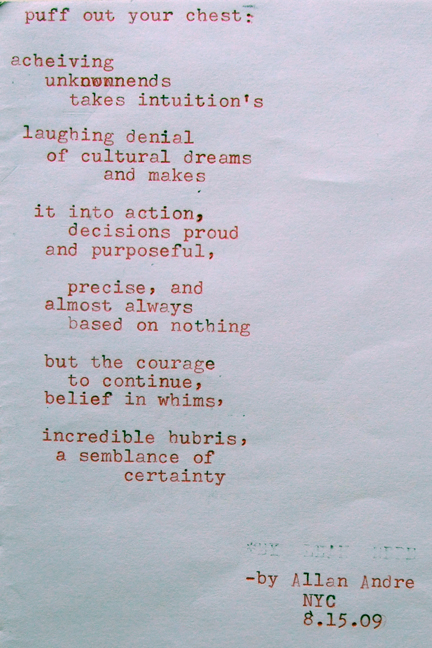
    Allan Andre hails from New York City. Online searches, however, find him plying his trade in other locales, including San Francisco. I met him in Washington Square Park and offered the subject “indecision.” Only some minutes later, typing away on a manual typewriter with a carbon copy, he offered me his poem. I made a contribution. See the text of my poem here.

    As novel as this enterprise may sound, Allan is not the first or only to try his hand at Poetry While You Wait. Only a few blocks away, on University Place near Union Square, is the Poem Shop of Anayvelyse. German poet William Chrome was also found on the streets of New York City.

    Outside of New York, Typing Explosion was a Los Angeles team of three who wrote poetry with the audience choosing titles. They worked regularly from 1998 to 2004. Zach Houston worked in San Francisco and inspired William Chrome to do the same in New York.

    I recall reading a quote by a former French President that he could not imagine going to bed at night without reading some Verlaine. Difficult to imagine this as de rigueur for many of our former White House residents. But perhaps the proliferation of street poets is a harbinger of times to come…

    Interesting Note: If you type “Verlaine” into Wikipedia, the search only returns Verlaine, the municipality in Belgium. To get the poet, you must enter Paul Verlaine. Is this the result of a poor search engine or commentary of the importance of poetry? 🙂


  • Columbo, Monk and CSI

    Posted on by Brian Dubé

    Very often, one hears an accusation of someone or something being boring. However, it is often the one making the claim who is just not digging deep enough or bringing anything to the table.
    In the last three and a half years of writing and doing the photography for this website, I have learned to examine things more closely by reading and researching. In doing so, I have been most often surprised by what lies beneath the book’s cover.

    Part of this process has been taking greater interest in things that have been part of the New York City landscape, seemingly forever like a virtual white noise. One of these things is urban art or graffiti. Artists like Keith Haring started their careers using building surfaces as their canvas. Remnants of these works can be seen from time to time, like the graffiti of two of the most prolific in the city’s history: Cost and Revs (whose identity still goes unknown).

    I was startled recently when I came across this mural in a SoHo parking lot. I had never seen it in its entirety – it is typically occluded by any number of vehicles. On this walk, however, it was very early in the morning before opening, and so I was rewarded with a unique, unobstructed view of the entire mural. Seeing this reminded me of how the murals, I Am the Best Artist by René, were everywhere in the 1980s & 90s in SoHo.

    Typical of graffiti artists, the facts about René are shrouded in mystery. The New York Times ran one article about René’s war over wall space with French artist Le Pointre. René refers to himself on his website as René IATBA or I.A.T.B.A. (an acronym for I Am The Best Artist.) He appears to have grown up in Venezuela, according to his website, which itself is layered in abstruse writing and design elements. It is as enigmatic as the man.
    If you want to learn the details of a street artist, be prepared to become an amateur forensic scientist. You will enjoy the work, if like many, you are a fan of Columbo, Monk, or CSI 🙂

    Posted on by Brian Dubé

  • Makes Me Stronger

    Posted on by Brian Dubé

    Generally speaking, steps are a means to an end, not an end in itself. But this is New York City, where the minutiae of life are often elevated to iconic status. New York is the most densely populated city in the United States, and Manhattan, being an island, is a place where every square inch is examined, coveted, utilized, and maximized. So when you have a place as important as the Metropolitan Museum of Art that occupies so much space, you know it will loom much larger than life in every way.

    The Met is the largest museum in the Western Hemisphere, with over 5 million visitors per year – that’s a lot of foot traffic. Add to the formula one of the best locations in the city (Fifth Avenue and Central Park) with an enormous set of steps, and what you get is the stoop of all stoops – the ideal perch or porch for relaxing and/or the watching of people and performers. The steps are legendary, and a sunny Sunday afternoon here is a classic way for a New Yorker or visitor to pass some very enjoyable time.

    For the performing artist, the streets are an ideal venue to hone his or her skills. Many well known entertainers have worked the streets and these steps early in their career. The streets, subways, and parks are ready for immediate work – no agents or bookings required.

    Of course, it is rough and tumble battling the competition, weather, ambient noise, hecklers, property owners, neighborhood residents, and law enforcement. Those who can weather these elements become much stronger performers. They have learned to earn and hold spectators against adverse conditions – no captive audience here.

    I once introduced a much younger coworker to a variety of country music, including some very old recordings of Roy Acuff from the 1930s. This coworker was a very open-minded and tolerant musician, but I feared that this genre, particularly Acuff, might be trying his patience, so I asked him if listening to this music was too irritating. He responded, with a smile, “Don’t worry, it just makes me stronger.” So it is with the steps of the Met – for museum patrons or stoop sitters, it can be a stairway to heaven; for performers, it is a place that just makes them stronger 🙂

    Related Articles: Street Magic, Artiste Extraordinaire

    Posted on by Brian Dubé

  • The Guggenheim

    Posted on by Brian Dubé


    What I find most fascinating about a place like the Guggenheim Museum is that it stands as a supreme example of how virtually anything can be defended, praised, or condemned intelligently with words. Conflicting arguments abound about works of architecture, art, film, music, dance, etc. I once asked an architect after seeing a particularly hideous structure what she would make of a building which every lay person hated but was lauded by architecture critics. The answer she gave: “Then architecture is a failure.”

    I have cited examples in this blog of things which have become iconic in spite of their being considered an abomination by many at the time of completion, such as the Eiffel Tower. The Guggenheim is one of those places – time has softened those aspects that perhaps have offended many.

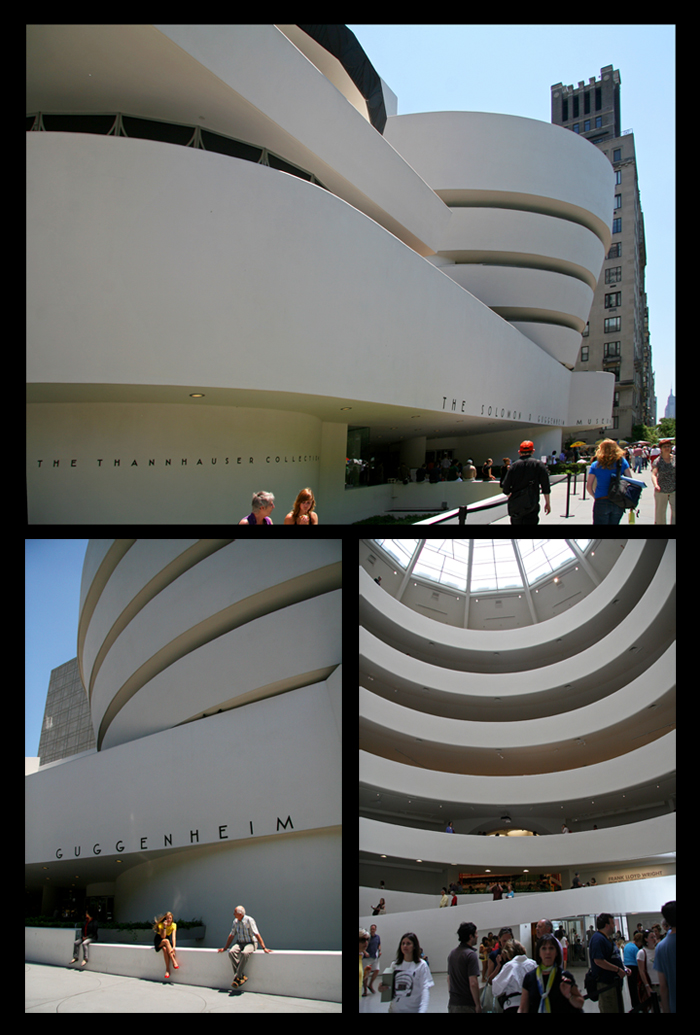
    The Solomon R. Guggenheim Museum, designed by Frank Lloyd Wright and completed in 1959, is considered one of the city’s major architectural landmarks. It is located on in Manhattan’s Upper East Side at 89th Street and Fifth Avenue, overlooking Central Park. Second photo here. It houses Impressionist, Post-Impressionist, early Modern, and contemporary art. The collection was seeded by Solomon Guggenheim, an art collector whose foundation funded the establishment of the museum.

    The building, which looks like a stacked white ribbon, was extremely controversial at the time of its completion. Inside, the main gallery is a helical spiral, rising from the ground level to the top, crowned with a skylit rotunda. Here are some of the conflicting reviews as reported in Time Magazine in 1959:

    “A war between architecture and painting, in which both come out badly maimed,” declared Art Critic John Canaday on Page One of the New York Times; “The most beautiful building in America,” retorted Critic Emily Genauer in the New York Herald Tribune. “A building that should be put in a museum to show how mad the 20th Century is,” editorialized the New York Daily Mirror. “Mr. Wright’s greatest building, New York’s greatest building.” said Architect Philip Johnson, “one of the greatest rooms of the 20th century.” “Frank has really done it,” snapped one artist. “He has made painting absolutely unimportant.”

    The criticisms revolve around several aspects of the building. One is that the museum design is a distraction from the art itself. The sloping ramp provides no level base for a viewer’s reference. The small exhibition rooms off the main spiral are small and windowless – the walls are angled and make hanging paintings difficult. Prior to its opening, twenty-one artists, including Willem de Kooning, signed a letter protesting the display of their work in the museum. Wright replied that the old rectilinear frame of reference was “a coffin for the spirit” and admonished them to wait and see. Paintings were to be tilted backward, “as on the artist’s easel.” Wright had proposed “one great space on a continuous floor.” “An atmosphere of the unbroken wave—no meeting of the eye with angular or abrupt changes of form.”

    When the building opened, Robert Moses said that it looked like “an inverted oatmeal dish.” Wright retorted, “It’s going to make the Metropolitan Museum look like a Protestant barn.” Others referred to it as a “snail,” “an indigestible hot cross bun,” and “a washing machine.”
    Snails, barns, coffins, oatmeal dishes, washing machines, ribbons, unbroken waves – The Guggenheim.

    Posted on by Brian Dubé

  • Unemployed

    Posted on by Brian Dubé

    Union Square has been a site for social and political activism since the 1800’s. In 1861, after the fall of Fort Sumter, there was a patriotic rally with an estimated 250,000 people, considered the largest public gathering in North America up to that time. Since that time, Union Square has continued its role as a locus for protests and gatherings.

    On Sunday, May 17, the Veggie Pride Parade ended in the north plaza. At the same time, Reverend Billy appeared at the NYC Plastic Bag Protest. There were various activities – crafts, street theater, advocacy, and petitioning. A number of characters were present, such as the Plastic Bag Monster seen in the photo and No Impact Man.

    I applaud the efforts being made here, as reduction is the biggest key to this problem. As I wrote in White Christmas, substitution of disposable materials or recycling is not an effective solution with the volume of bags being used, which is why complete bans are being enacted worldwide.

    In 2002, Bangladesh became the first country to ban plastic bags. Taiwan prohibits not only plastic bags but also disposable plastic cups, plates, and cutlery used by fast food vendors (threats of fines have resulted in a 70% reduction in the use of plastic bags, and a 25% cut in landfill waste.) A number of African countries have banned plastic bags, such as Uganda, Kenya, and Tanzania. London has banned giving out free bags, and Ireland has levied a tax. Paris has banned them, and France plans to ban them nationwide by 2010.

    In 2007, San Francisco became the first US city to ban plastic bags. Other US cities have followed – Maui, Hawaii, and Westport, Connecticut. New York City is considering its own initiative. The plastic bag problem has really hit critical mass, and the list of countries, states, and cities is constantly changing. I think the Plastic Bag Monster will be joining the ranks of the unemployed soon 🙂 

    Related Postings: The Plastic Infinite, Consumption, Picture New York, Reverend Billy, Union Square, Union Square Greenmarket, Metronome

    Posted on by Brian Dubé

  • Storefront

    Posted on by Brian Dubé

    As the world becomes more crowded and technology becomes more advanced, our spaces, places, and things become smaller. Waste and efficiencies are critical issues, particularly in a city like New York.
    Add our economic environment to the mix, and one can see why lavish indulgence is nearly a mortal sin. So what better icons for our time than the iPod Nano or a micro gallery like the Storefront for Art and Architecture?

    Storefront was founded in 1982 by Kyong Park as a nonprofit organization committed to the advancement of innovative positions in architecture, art, and design, with a program of exhibitions, artists talks, film screenings, conferences, and publications.

    This place is easy to miss – it is not only small but also off the beaten path. Storefront is located in a unique triangular ground-level space on Kenmare Street at a nexus of three very different cultural neighborhoods: Chinatown, Little Italy, and Soho. The space is nearly 100 feet long and tapers from 20 feet to 3 feet. Its most striking feature is the unique exterior wall with articulating panels which are rotated to open the space to the street.

    In 1993, Storefront commissioned a collaborative building project by artist Vito Acconci and architect Steven Holl. The project replaced the existing facade with a series of twelve panels that pivot vertically or horizontally to open the entire length of the gallery directly onto the street. The project blurs the boundary between interior and exterior and, by placing the panels in different configurations, creates a multitude of different possible facades. Now regarded as a contemporary architectural landmark, Storefront is visited by artists, architects and students from around the world.

    The Storefront has received many accolades from the media and art community. My posting Performance Z-A depicts a celebration of Storefront’s 25th anniversary in 2007 which was set in the Ring Dome Pavilion…

    Posted on by Brian Dubé

  • traPt

    Posted on by Brian Dubé

    Pratt Institute is considered one of the finest art schools in the United States, known for its programs in architecture, art, fashion, photography, design, illustration, interior design, and digital arts. Unlike NYU or Hunter College in Manhattan, whose campuses are essentially the city of New York, Pratt is cloistered – the campus is completely closed and gated. Add to this its location in Clinton Hill, Brooklyn, which at one time was one of the most dangerous neighborhoods in the city, and you can appreciate how clever I thought a student’s T-shirt was that he was brandishing some years ago. It read “traPt” – an anagram of the word Pratt which was indicative of how some students have felt. Nearby Myrtle Avenue was nicknamed Murder Avenue in the 1990s.

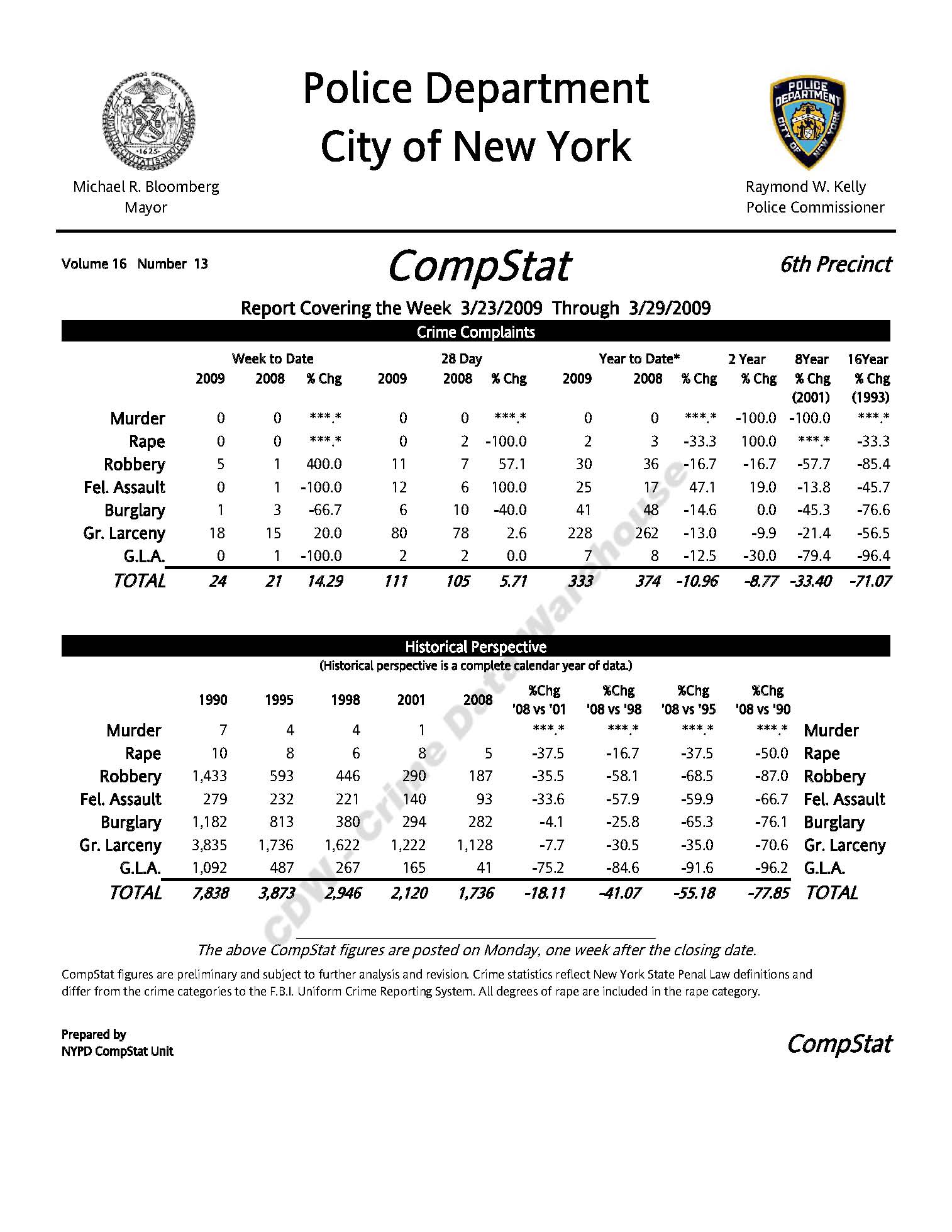
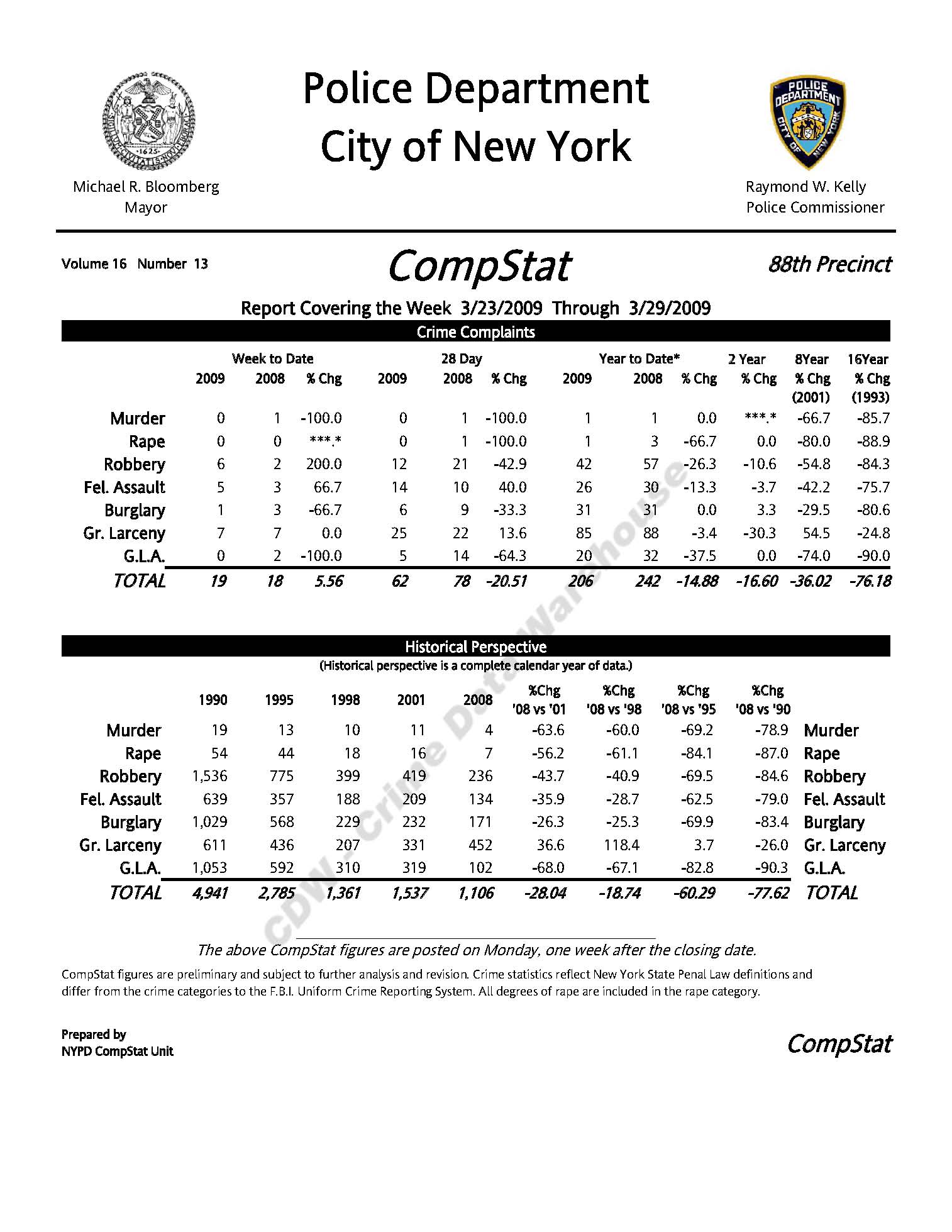
    Certainly the neighborhood has gentrified significantly over the years and has benefited by a tremendous reduction of crime city-wide, attributed to the NYPD’s Compstat program and an increase in the numbers of police officers in NYC, starting in 1990. I was curious about the actual crime statistics in the neighborhood, so rather than rely on perceptions or anecdotal evidence, I decided to go right to the source – the NYPD website – and look at the Compstat statistics for the 88th precinct, which covers Pratt Institute. I compared it to the 6th precinct in Greenwich Village, home of NYU. I expected to see a much greater disparity but was surprised to see that the crime statistics were not that disparate. You can see them here: the 6th Precinct and the 88th Precinct.

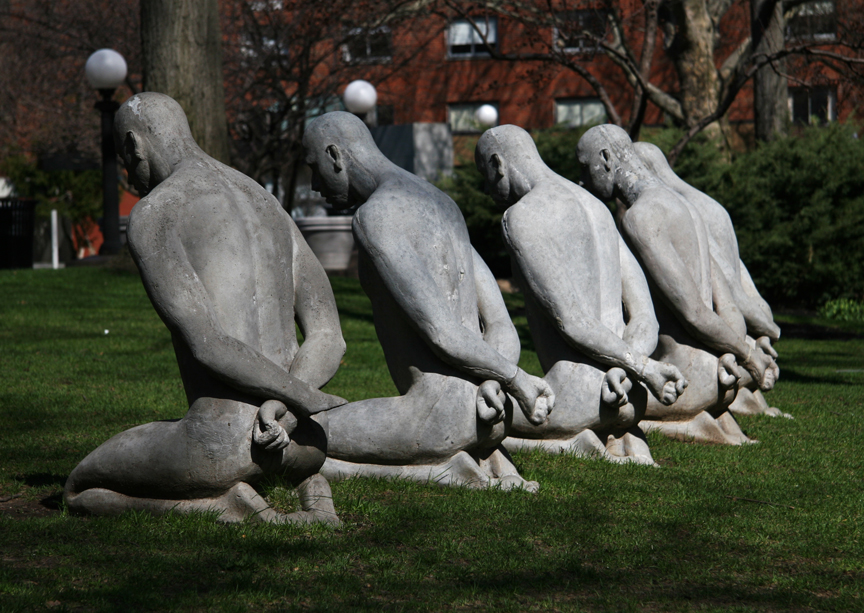
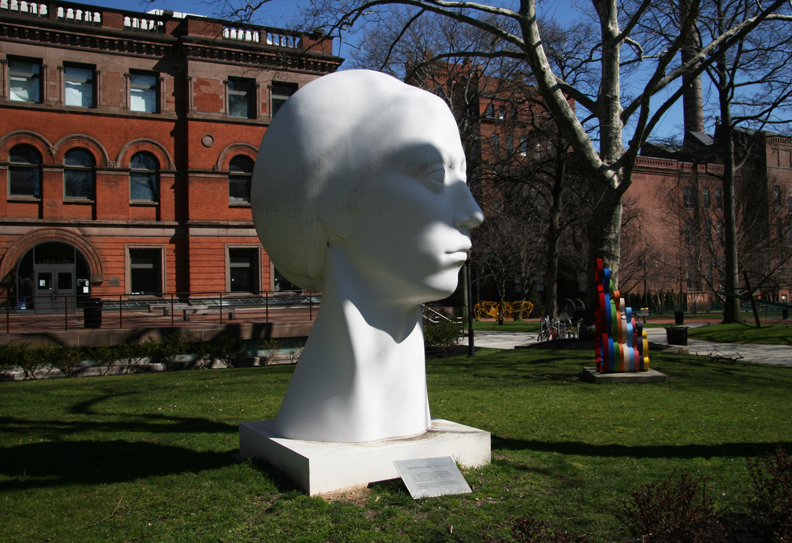
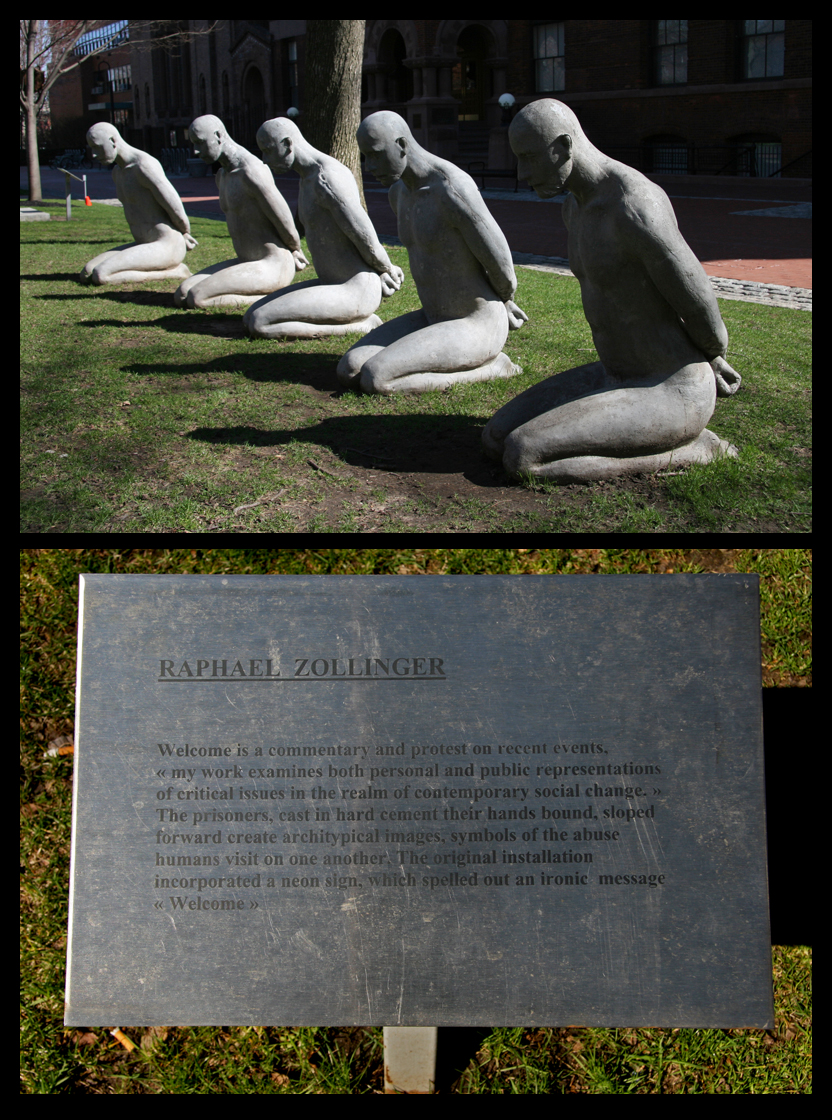
    The atmosphere of a real university campus is quite special in New York City, and Pratt is graced with 25 acres, which includes a sculpture garden featuring a variety of works. The work in the photo, Welcome II by alumni Raphale Zollinger, is one of the most arresting, along with Philip Grausman’s large idealized white female fiberglass head, Leucantha. Welcome II’s 5 naked prisoners are cast in concrete. See front view and read the the plaque here.

    An ironic work for such a beautiful garden – perhaps relics of feeling traPt…

    Posted on by Brian Dubé

  • Bovine Love

    Posted on by Brian Dubé

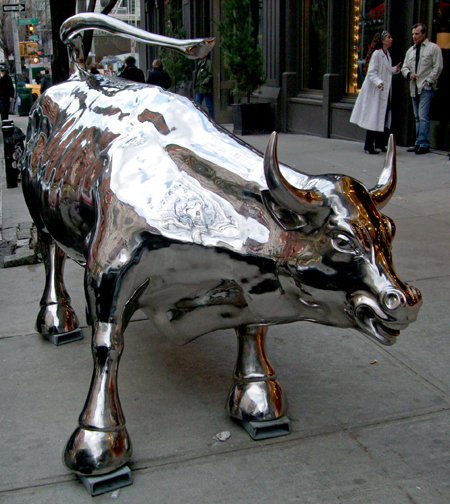
    Generally speaking, you do not walk down a familiar street and expect to be greeted by a newly installed massive steel bull. This fellow was in front of Cipriani’s in SoHo on West Broadway, discovered after an expedition to the Peter Lik gallery just up the street.

    Speaking to a waiter at the restaurant, I was informed that this was the work of Arturo Di Modica and that it just mysteriously appeared on the sidewalk with no explanation.

    Di Modica is best known for his charging bull in the financial district. That bull was originally installed after the 1987 stock market crash. It was placed in front of the New York Stock Exchange by the artist on December 15, 1989 without permission as a Christmas gift to the city. It was seized by the police but, due to public furor, was reinstalled downtown in the plaza at Bowling Green. The bull is extremely popular as a photo subject, often with visitors on, besides, or grasping the bull in some manner.

    There seems to be a fascination with the bovine family. In 2000, the streets of New York City were graced with cows as part of an international public art exhibit. This is an interesting choice of animal, since I have not thought of cows as being seen as particularly charming or attractive. The concept for the Cow Parade originated in Switzerland with art director Walter Knapp and sculptor Pascal Knapp, who holds the copyrights to the various cow shapes seen in the exhibits. Perhaps the Swiss connection provides some explanation of the choice of cows as animal subject.

    When confronted with the Di Modica sculpture on West Broadway, I, like many others, was seized with the inexplicable desire to embrace a bull and be photographed by a friend. There’s just something about a bull that makes you want to hug him, especially when he is frozen in time and unable to charge 🙂

    Posted on by Brian Dubé

  • Peter Lik

    America’s image is synonymous with self-empowerment. However, even in the land of opportunity, there are reasonable limits on what a person can do. It is unlikely that a person in his/her 40s can become a competitive gymnast or that someone with an average GPA will get into Stanford University and become a research physicist. The idea that you can be or do anything in the USA is oversold. Most of the late-night self-improvement televangelists are just not being honest. The world is built on the backs of ordinary people, working hard and doing ordinary things. Starting a business and entrepreneurism is something in your blood. A workshop or book will not turn a company man or woman into a business tycoon. And that’s good – someone has to do the heavy lifting and keep the engine of our country operating.

    Photography is a field where making a living is quite difficult, particularly if one wants to find work other than weddings or functions. There has been criticism of photography educational programs – very few graduates will ever make a living working in the field. And to sell substantial amounts of work is not a small achievement.

    However, it is good to think outside the box and not take the advice of naysayers and self-defeatists to heart. And for the driven, ambitious, talented, and tireless self-promoter, the land of opportunity and streets paved with gold does exist.

    I happened across a new gallery of photographer Peter Lik in the heart of SoHo by accident and was drawn in by what appeared to be work of extraordinary craftsmanship and detail.
    I was told that Lik is the most awarded landscape photographer in history as well as the most financially successful – Peter has leveraged his skill set quite remarkably. I watched a number of videos on his site and was absolutely astounded to learn that Lik has 13 galleries worldwide and grossed $35 million dollars in 2008, with expectations for greater revenue in 2009.

    Peter Lik was born in Australia of Czech immigrant parents. He currently lives in Las Vegas, Nevada, which he uses as a jumping off point for his photographic excursions of the American west. He shoots panoramas with a Linhof 617 Technorama camera, using Fuji Velvia film and a Hasselblad with digital back. He uses drum scans and prints his photos on a Silver Halide Fuji Crystal Archive paper. Careful examination of his work will reveal an astounding level of detail, color saturation, and luminosity. Some have criticized his work for heavy post-processing. In his defense, however, I think one has to judge art photography by the result. Darkroom manipulation of photos has been going on since the beginning of photography. I recommend a visit to one of his galleries; even if you cannot afford his work, it is interesting to see Lik’s photographs in person, and many book collections of his work are available…

    Please note: Comments for this posting have been suspended due to controversy over Peter Lik’s work and his organization.


  • Of Bikes and Things

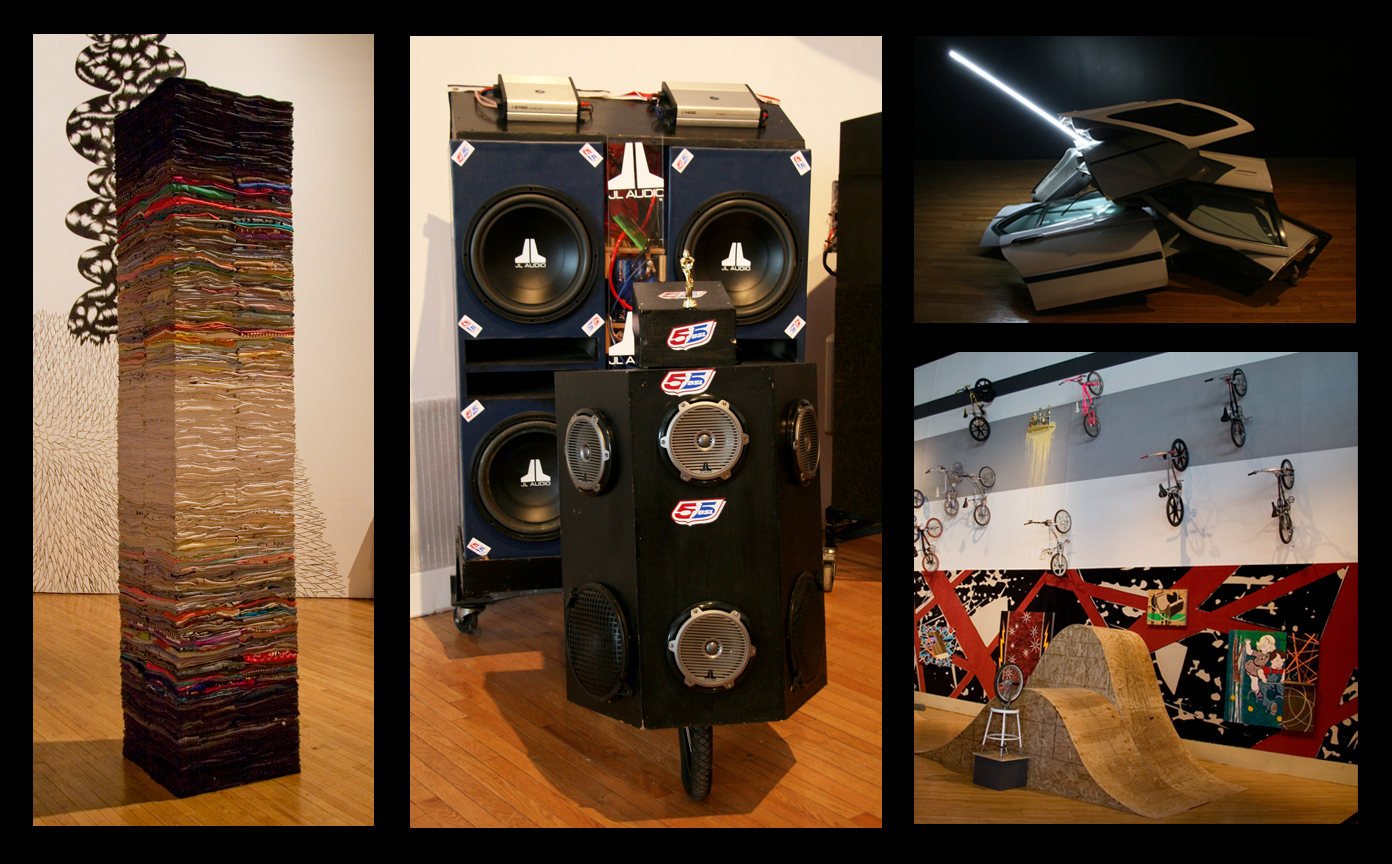
    This collage will give you an idea of the range of exhibits that is typically found in the Queens Museum of Art. The focus here is much more community involvement, with many displays of installation art and multimedia creations. When I was there most recently, Derick Melander was busy working with children to create a piece like that on display (left photo), Flesh of my Flesh.

    Articles of second-hand clothing were being neatly folded and stacked according to color value – darkest at the bottom and top, with a white center. The overall effect of the tower of colored clothing was quite striking, and the involvement of adults and children was a great success.

    In a small side gallery, an assemblage of car doors with a neon tube, Door Pile, by Corey D’Augustine, was being shown. In the main exhibit room, a number of BMX-style bikes affixed to the walls and skateboard ramps was featured.

    I was fascinated with the display of the stereobikes, Basszilla and Trebblezilla, made by Future Shock (center photo), made by a group of Trinidadians from Richmond Hill, Queens. The construction of these monster radio bikes is a popular hobby in Trinidad. Some of these can cost as much as $4000 and emit 5000 watts. Gangs of riders roam the streets of Richmond Hill. One report says that the police have been lenient with boom bikes, owing to their appreciation of the workmanship involved in making these things. These are obviously contentious creations, heralded by some as art and condemned by others as more unneeded contributions to a city already laden with noise pollution.

    In an ironic twist, on the exit ramp from the main exhibit room, we found a plaster cast of Pietà – a plaster cast of Michelangelo’s original work, which in 1964 was transported from the Vatican and displayed at the World’s Fair…


  • Rocket Thrower

    The thing about public sculpture is that once it is created, it isn’t going away, and when it is a large work, it really can’t be ignored.

    Regardless of criticism, a work can take on a life and persona of its own, due to its pure existence, irrespective of aesthetics. Even a work that may generally be regarded as an abomination will often take on a certain charm and, in time, become loved like an ugly duckling. The Eiffel Tower is an excellent example. Considered an eyesore by many at the time of its construction, it weathered quite well. Here is a comment made at the time by William Watson’s U.S. Government Printing Office publication of 1892’s Paris Universal Exposition: Civil Engineering, Public Works, and Architecture:

    “And during twenty years we shall see, stretching over the entire city, still thrilling with the genius of so many centuries, we shall see stretching out like a black blot the odious shadow of the odious column built up of riveted iron plates.”

    The Eiffel Tower was originally built in 1889 as the entrance for the Exposition Universelle, a World’s Fair marking the centennial celebration of the French Revolution. Plans were to have it torn down, but it remained. It is now generally seen in a positive light, and its presence is a major icon on the Parisian skyline.

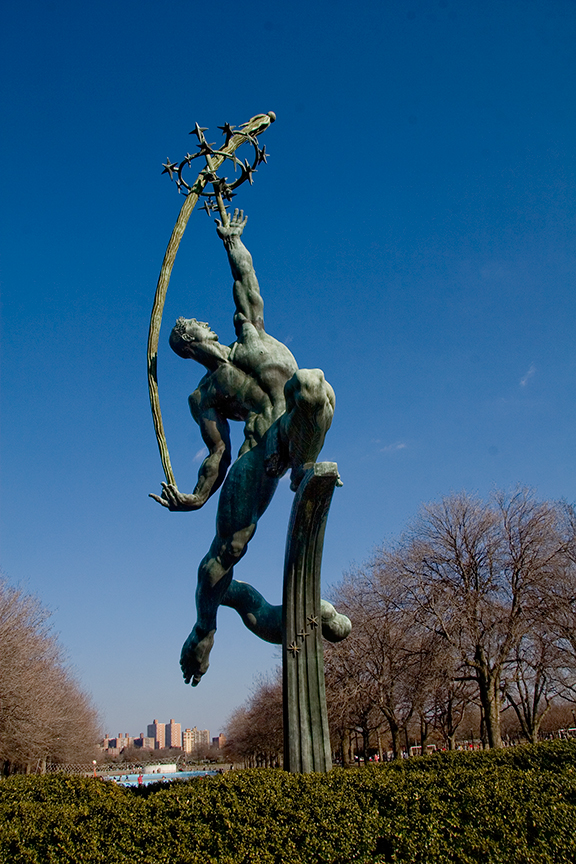
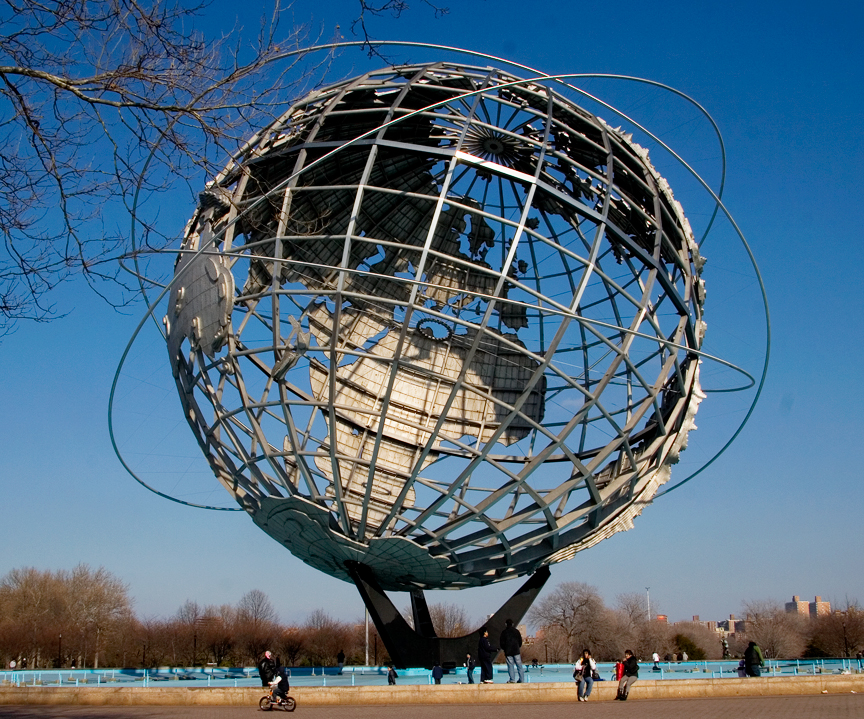
    The Rocket Thrower in the photo was created for the 1964 World’s Fair and is located in Flushing Meadows-Corona Park, just a stroll away from the Unisphere.
    It was designed by Donald De Lue. From the NYC parks website:

    “He designed the Rocket Thrower as a heroic, 43-foot high bronze figure hurling a rocket heavenward with his right hand, and reaching for a constellation of gilded stars with his left; this version was based on designs for the theme of man conquering space …”

    This sculpture was met with mixed reviews. The New York Times art reviewer John Canaday found the piece to be “the most lamentable monster, making Walt Disney look like Leonardo Da Vinci.” Robert Moses (organizer of the Fair), attempting to bolster the artist’s fragile ego, consoled De Lue by remarking, “This is the greatest compliment you could have…[Canaday] hates everything that is good . . .” Read more about it here.

    When I happened upon this sculpture, I found it quite striking and not at all a lamentable monster. But perhaps I have become inured to bad sculpture or I am not art critic enough…


  • Remembering

    Imagine being 13 and not having seen much of the world at all.
    Imagine also living at a time when technology was on the cusp of the truly fantastic – with mainframe computers, transistors and integrated circuits, the Moog synthesizer designed by Robert Moog, and the A-11 aircraft, capable of sustained flight of 2000 mph being announced. And the biggest technological achievement of our time, as promised by JFK during his 1960 presidential campaign, was soon to come: we were going to the moon, literally.

    1964 was also the year of the British Invasion, with the arrival of the Beatles in the USA. In the world of civil rights, Malcolm X announced his break with the Nation of Islam, the formation of a black nationalist organization, and met Martin Luther King, who won the Nobel Peace Prize. President Lyndon Johnson signed the Civil Rights Act of 1964 into law, abolishing racial segregation in the United States. The Vietnam War was heating up and we saw the first demonstrations. Feminism and the sexual revolution were in full swing, and the Vatican condemned the birth control pill.

    So it was in this time that my family took our first trip to New York City to visit the 1964 World’s Fair. I remember only a little from that trip, but what I do remember was something that was truly fantastic, a spectacle larger and grander than I ever imagined possible. The exhibits were amazing and way ahead of their time. The audio-animatronics used by Disney are still in use today – Disney’s It’s a Small World was unveiled at the Pepsi pavilion. IBM displayed handwriting recognition. General Electric sponsored Progressland, where the audience was seated and revolved around an auditorium with numerous audio-animatronic presentations of the progress of electricity in the home. The General Motors Futurama had visitors moving on seats through an exhibition of the world of the future. The entire fairground was as large as a small city. Fountains were everywhere – it was true pageantry.

    The most memorable icon for this fair was the Unisphere, which is still standing in Flushing Meadows-Corona Park, the site of the fair (and the previous 1939-40 fair). The theme was Peace Through Understanding, and the Unisphere represented global interdependence. Built to celebrate the beginning of the space age, it was dedicated to “Man’s Achievements on a Shrinking Globe in an Expanding Universe.”
    The Unisphere was built in type 305L stainless steel by the US Steel Corporation and erected on the same structural foundation that supported the 1939/1940 New York World’s Fair’s Perisphere. At 12 stories (140 feet), it remains the world’s largest globe and has become one of the few permanent remaining structures from the fair and an unofficial symbol for Queens.

    I am sorry that those of you unable to attend will have to imagine and that I have the privilege of remembering …

    Note about the fair: The 1964 World’s Fair was actually mired in controversy. In order to be profitable, the fair organizers, headed by Robert Moses, decided that the fair would need to run for two 6 month seasons (1964 & 1965). However, the rules of the BIE (Bureau of International Expositions), headquartered in Paris, stated that an international world’s fair run for one six-month period only and only one exposition per 10-year period in a host country. The USA did not meet these requirements, and a visit by Moses to Paris was not successful. Moses made his disdain for the organization’s decision public. The BIE retaliated by requesting member nation’s not participate. Hence, the roster of participants was primarily smaller nations and a large number of industrial firms.


  • Maps and Models

    I have always loved maps and architectural models. As a child, I built a bird feeder modeled after my family’s home. My crude rendering was applauded by all who saw it, as would be expected when your primary reviewers are family members. As an adult, maps have always been my number one priority before traveling to any destination, and I have collected them for years. I love the color-coded Michelin maps in three different scales.

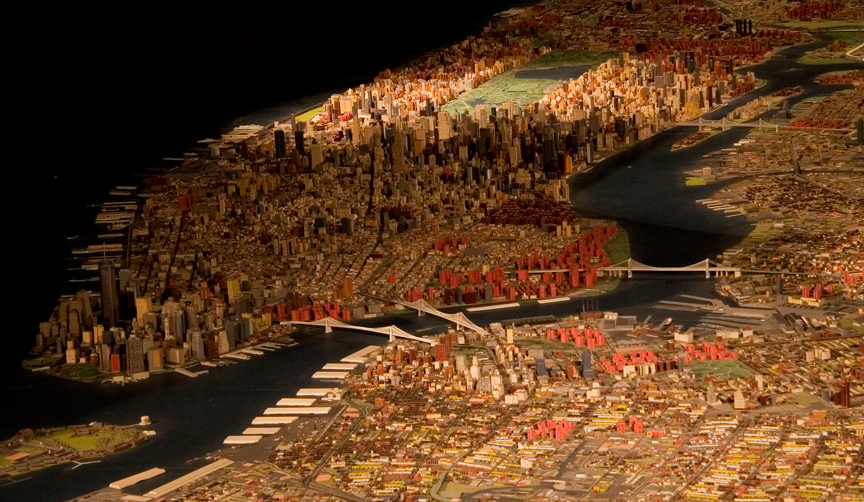
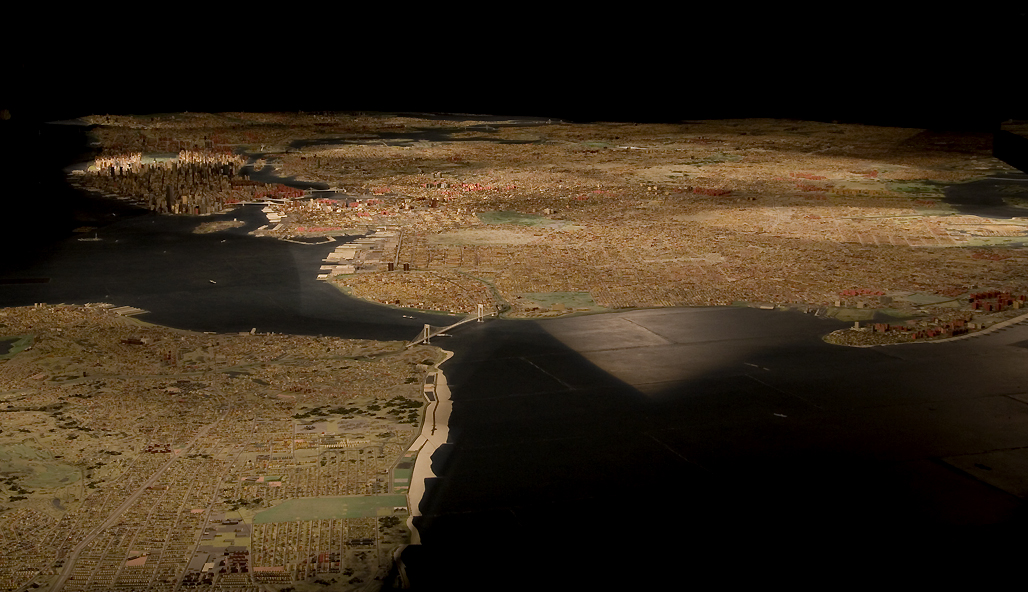
    So the Panorama of the City of New York, housed at the Queens Museum of Art, is particularly special for me, with a map and model all rolled into one. This scale model (1″ = 100 feet) of the five boroughs of New York is one of the most remarkable and little known exhibits in the entire city. See second photo here. A passion for maps and models, however, is not necessary to fall in love with this creation. Museum visitors soon become mesmerized, picking out their homes, favorite spots, landmarks, or perhaps just show off their orienteering skills to companions.

    The Panorama was commissioned by Robert Moses for the 1964 World’s Fair. This 9,335-square foot architectural model is the world’s largest model of a city. It includes every single building constructed before 1992* in all five boroughs – a total of 895,000 individual structures. During the Fair, the Panorama was one of the most popular attractions, with an average of 1,400 visitors per day. The original exhibit was designed to give a simulated helicopter ride over the city – visitors traveled the periphery of the model in fake helicopter cars for a 9-minute tour while listening to a narration by the newscaster Lowell Thomas.

    From the Queens Museum website:

    “The Panorama was built by a team of 100 people working for the great architectural model makers Raymond Lester Associates in the three years before the opening of the 1964 World’s Fair. In planning the model, Lester Associates referred to aerial photographs, insurance maps, and a range of other City material; the Panorama had to be accurate, indeed the initial contract demanded less than one percent margin of error between reality and the model.”

    The museum building was originally built to house the New York City Pavilion at the 1939 World’s Fair and is the only structure surviving from that fair. Between 1946 to 1950, it was home to the General Assembly of the newly formed United Nations (in 1950, it moved to its current home in Manhattan). The model has been part of the permanent exhibit since the Queens Museum opened in 1972.

    You should see this magnificent model in person. Admission to the Queens Museum is only $5 and a subway ride away – why not take a ride and see for yourself?

    *Model and Museum note: The model was updated in 1992 with over 60,000 structures modified (the original Twin Towers of the World Trade Center, however, still remain). A recent new upgrade includes lighting for audiovisual presentation. For information about the museum, directions, hours, and exhibits, see their website here.


  • Acquired Taste

    New Yorkers can be extremely ethnocentric. I have frequently had discussions about popularity of the arts in the United States, and many believe, for example, that opera is very popular in America. If you stood in Lincoln Center on a night where Placido Domingo, Jose Carreras, and Luciano Pavarotti were singing and tickets were nowhere to be found, of course it appears that opera is very popular. If you go to the Metropolitan Museum of Art on a nice weekend day, it appears that the masses are interested in fine art.

    But the reality is that fine arts, classical music, ballet, and opera are haute cuisines and that many, such as opera, are consumed by a very small, rarefied, older, well-heeled audience or students. These facts escape many New Yorkers who only see the world through very special glasses. Travel through America and you will find how few have ever attended an opera or even know who Puccini is.

    Admittedly, these fine arts are not a necessity, but like any form of education or culture, they greatly improve a person. They are not practical. Unfortunately, most things in this country fall to a common denominator – that which can be quantified or used as a tool to do something that can be quantified. So the sciences are always favored over the arts, which are routinely cut from school programs. I say this as someone who saw himself as strictly a science and math person when younger – the last thing I expected in life was that I would be doing photography or writing.

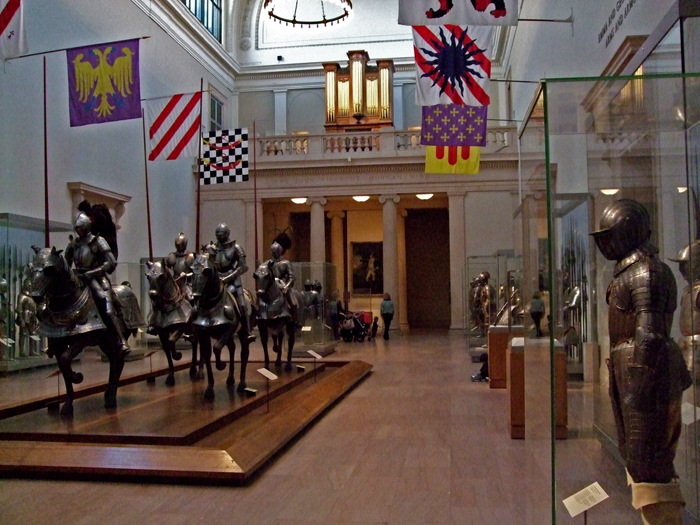
    Like it or not, to get most people interested in the arts, you need a hook, and for most, a little drama will serve as that hook. Something large, incredibly ornate, or very expensive usually provides the drama needed. So to take someone to the Metropolitan Museum of Art who has no particular love of art, my first choices are the Egyptian wing and medieval armor (seen in the photo). People understand armor, and most are fascinated by weaponry and other accoutrement of the world. The large imposing figures on horseback are very compelling. With some luck, this experience may served as an appetizer, possibly leading to larger meals of art later on.

    Now many would say, why force feed a person with these things? If something is not immediately satisfying, why bother? Because I believe that art, like many finer things, is an acquired taste. Appreciation and love comes with exposure over time. The full depth and breadth of Beethoven’s work can not be instantly appreciated, which is difficult for many to understand in a world of immediate gratification. But the pleasure which one can derive from something more sophisticated can be great. For most people, if they look back over their lives, they see incremental improvements in taste and standards, with no desire to go back. Enjoying finer things and haute cuisine are not snobbery for its own sake, just a different perspective of those with an acquired taste…


  • Unconditional Love

    I made an assertion in yesterday’s posting about the Temple of Dendur at the Metropolitan Museum of Art concerning harsh critics. Look at some of the following excerpts from Paul Goldberger, architecture critic for the New York Times. This is from an article which appeared in 1990 at the end of a 23-year construction program with the Museum working with architect and master designer Kevin Roche.

    “Now, 23 years later, Mr. Roche’s work, one of the longest-running and most ambitious construction programs of any museum, is finally done. … It’s not news that most of these efforts have ranged from disappointing to downright awful. Somehow, Mr. Roche and the museum have never quite brought out the best in each other; their relationship has been like one of those marriages that don’t end but don’t soar, either.”

    His critique included the new American Wing and courtyard and the Temple of Dendur. You can read the entire article here. You see what we are dealing with here in New York City?

    I am not a trained architect or critic, but these seem like very harsh words for spaces which everyone I know seems to love, including many educated in the arts.

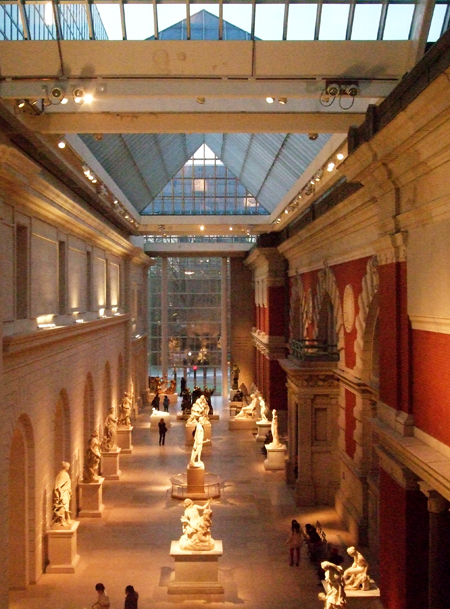
    Today’s photo is one of my favorite spaces in the whole museum – the Carroll and Milton Petrie European Sculpture Court. This also did not escape Mr. Goldberger’s article, but he seemed to love this space:

    “But now, at the end of it all, comes at last an occasion to celebrate. The brand-new sculpture court is an oddly likable place, as close to a magnificent folly as the Metropolitan has ever produced.”

    Of course, compliments from an architecture critic must be filled with caveats, reservations, conditions, and qualifications, so we also find:

    “The sculpture court is rather too tall and narrow, and these wrong proportions make its success all the more fascinating: few things in architecture are more pleasing than watching an architect get away with breaking the rules.”

    How about just an unequivocally good review? A joyous celebration with unrestrained applause? Ok, I don’t have a critic’s reputation to maintain, so, I am not afraid to say that I love that space and all the others in the museum. It’s a joy to walk through the Met and see all the works of art, sculpture, and antiques in the variety of environments created for them. And I say this with unconditional love 🙂


  • dinamic_sidebar 4 none

©2026 New York Daily Photo Entries (RSS) and Comments (RSS)  Raindrops Theme