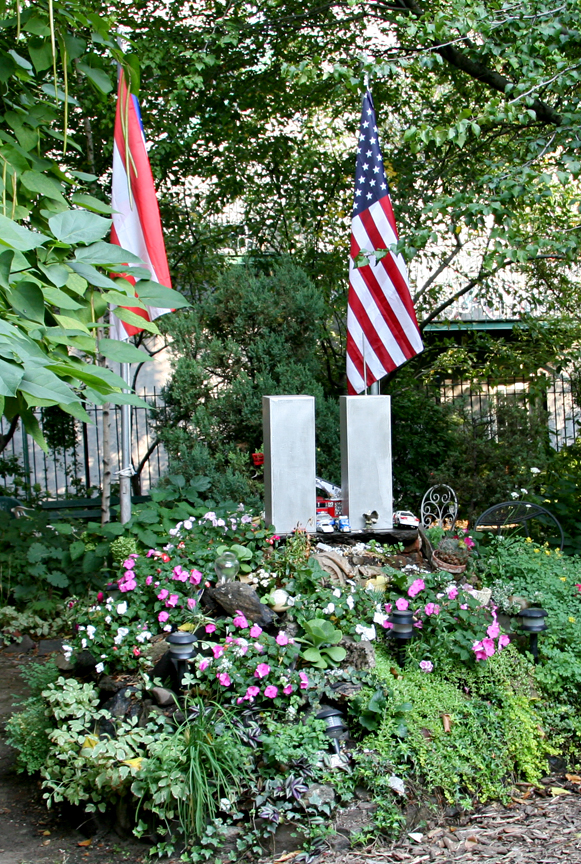
 I came across this memorial with a friend in the 9th Street Community Gardens on Avenue C. We liked the simple, homemade assemblage. It makes a thoughtful statement without fanfare. Today, I let the photo speak for itself.
- Category Archives Art and Sculpture
-
911
-
Knotted Gun
 The United Nations is one of those places perhaps visited once (at best) by residents and perhaps not at all by the independent visitor not on a tour. I vaguely remember visiting and touring long ago as part of a high school trip before I lived in the city. The image of the United Nations itself has become somewhat tarnished as time passes, with various issues and problems – enforcement of Security Council resolutions, bureaucratic inefficiency, etc. – leaving even less reason to find itself on the visitor’s list. But it is still worth a visit.
The large complex is unusually spacious for NYC and abuts the East River. In addition to the vistas and various buildings (which can be toured), there are gardens and outdoor sculptures. The work shown in the photo of a 45-caliber revolver with its barrel knotted is titled Non-Violence and is frequently referred to as the “knotted gun.” It was created by Swedish sculptor Carl FredrikReutersward in 1980. A cast metal version was gifted by Luxembourg to the United Nations in 1988. The piece makes an immediate impression, with its message quite clear. The inspiration for the piece was the death of John Lennon, a friend of the sculptor’s…
-
High Line Portrait Project
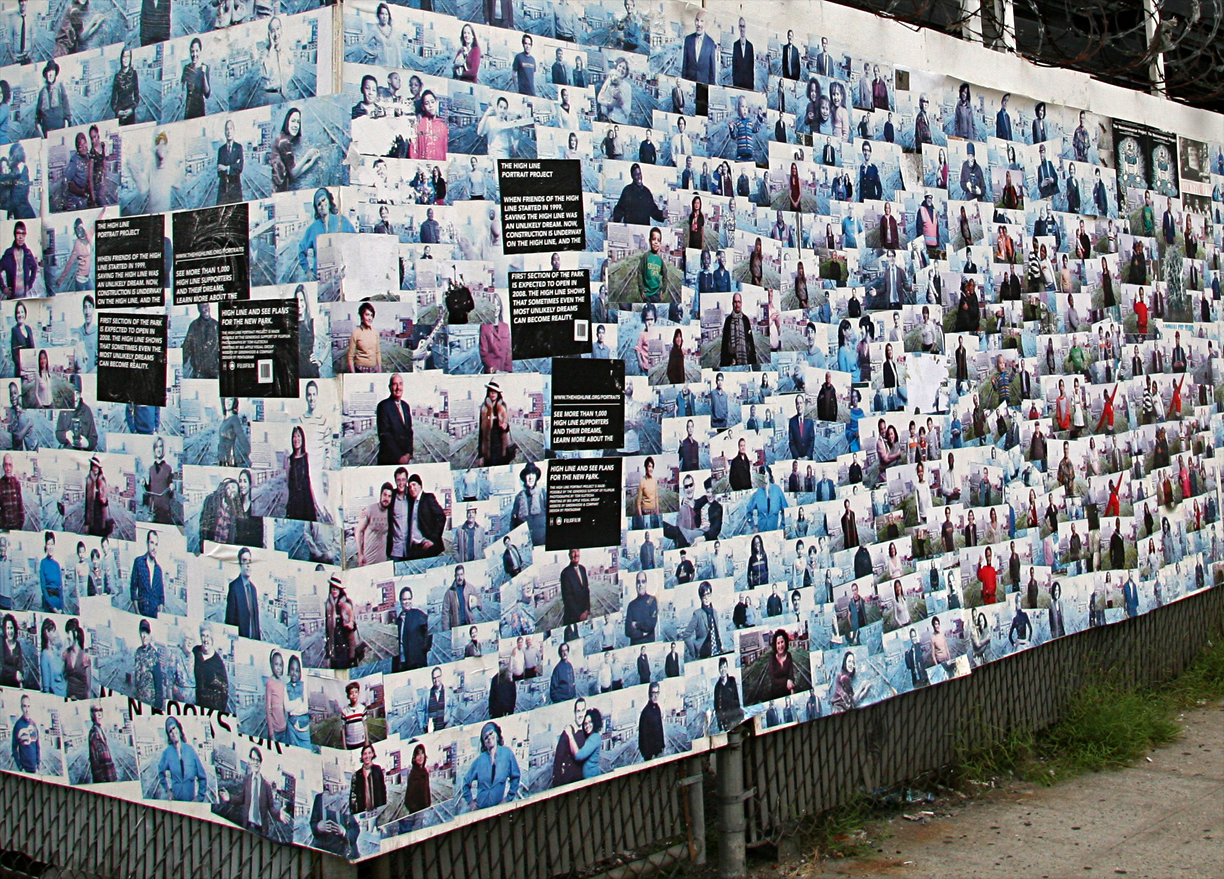
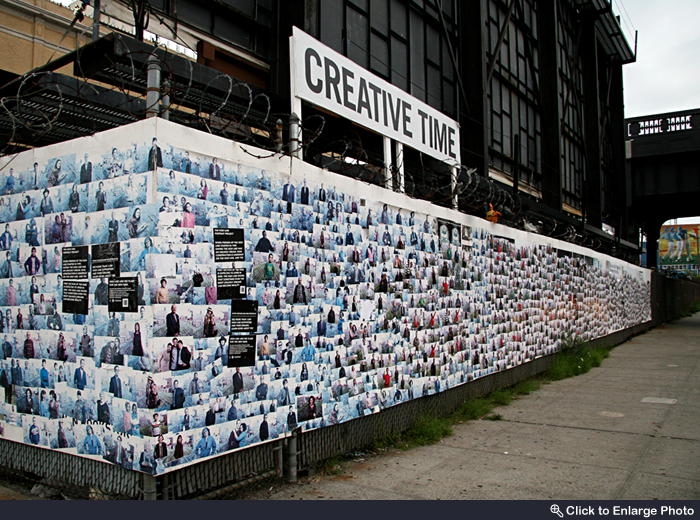 I ran across this display unexpectedly while carousing Chelsea on 10th Avenue near the High Line, a 1.45 mile elevated rail structure running through the west side of Manhattan from the Meatpacking District all the way to 30th Street. Click here to see a short film. This rail line was originally built in the 1930s to elevate trains from the city streets. The line, which has been unused since 1980 and which left an abandoned elevated structure overgrown with weeds, is being converted to a huge park to open in 2008. Until recently, the High Line has been unknown to many New Yorkers and visitors, but this unique project promises to be a major contribution to parkland and quality of life in the city. It can be easily seen overhead on 10th Avenue in Chelsea. From the projects website:
“The High Line Portrait Project was inspired by the many High Line supporters who have helped bring the project from an unlikely dream to a reality. When Friends of the High Line was founded in 1999, the High Line was a rusty industrial relic under threat of demolition. Now construction is underway to transform the structure into a one-of-a-kind public open space, the first section of which is expected to open in 2008. Photographer Tom Kletecka created portraits of more than 800 High Line supporters in front of a backdrop by Joel Sternfeld. Each participant was asked to share his or her dream.”
-
Figment
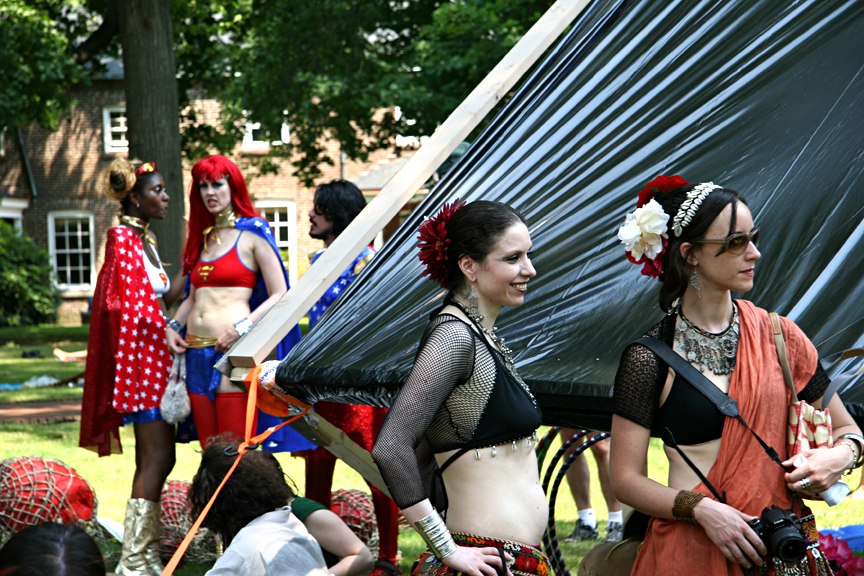
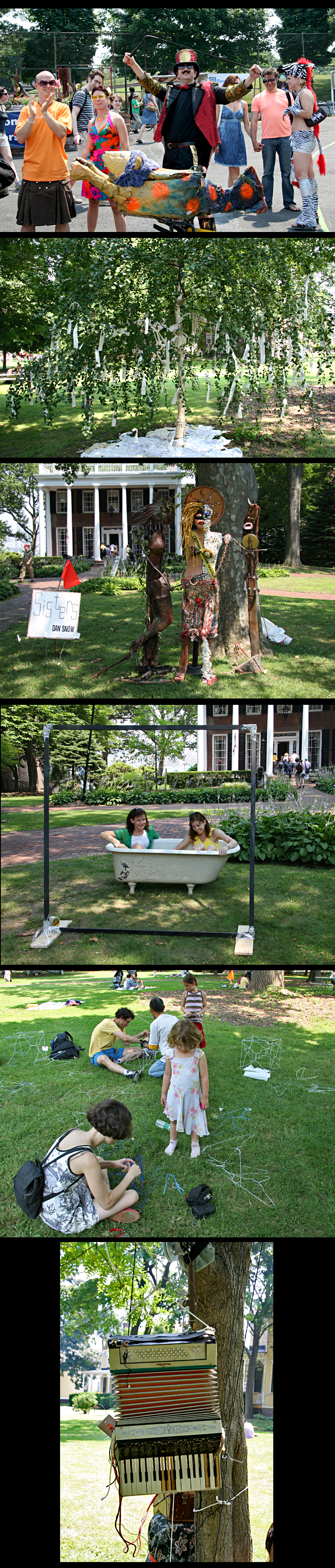
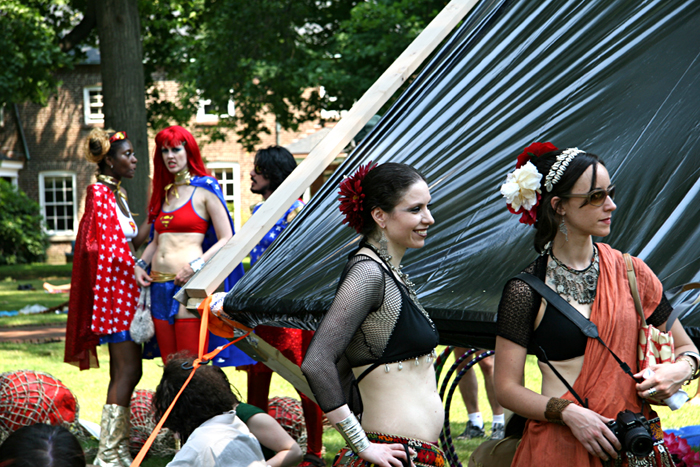 Figment was a one-day arts festival held on Governors Island (click here for more photos). There was a sense that this was to be a New York-style Burning Man – many of yesterday’s participants have attended, and the organizers have themselves have referenced Burning Man as an influence. The event took place at Nolan Park, a historic district with a shaded green surrounded by period homes. Attendees were encouraged to bring projects, contribute, and participate (at the Burning Man festival, being a spectator is discouraged in keeping with their 10 principles: radical inclusion, gifting, decommodification, radical self-reliance, radical self-expression, communal effort, civic responsibility, leaving no trace, participation, and immediacy.) Over 50 exhibitors attended, with names such as Misericordiam, Limbonade Stand, Krinkl-O-Torn, Groovehoops, Sisters, Earth Paint Tree, the Tub Project, Wish Tree, Zenbend Hanger Reuse Project, etc.
From the Figment website: ” Expect a dizzying array of fabulous art and activities, spanning a variety of imaginative possibilities ranging from ambitious sculptures to exquisite performance to wild costuming to edgy arts and crafts and beyond.” The goals of Figment would not appear to be so ambitious for a first year festival, given NYC’s large population and arts community. However, although having the fest on Governor’s Island has its merits, having to transport everything and everyone by ferry definitely had a substantial impact. The free 10 minute ferry ride to Governors Island (the subject of a future posting) turned out to be somewhat harrowing. The lines for the ferry were huge, with waits of over an hour – by days end it was clear there would not be enough ferry space and crossings to carry everyone – only 6 ferries were scheduled between 10AM and 3PM. But I imagine this festival will build momentum and I look forward to seeing its growth in future years. Note: The events name “Figment” was inspired by an Andy Warhol quote stating that he would like his own tombstone to be blank: “No epitaph, and no name. Well, actually, I’d like it to say ‘figment’ “
-
Waldorf Astoria Clock
 There is nothing that quite epitomizes the luxurious, elegant, classic, and iconic New York like the main lobby of the Waldorf Astoria Hotel. It’s a study in comfort, with soft lighting from table lamps, dark wood, potted palms, and sumptuous seating – I could sit in those beautiful Art Deco chairs for hours watching the ebb and flow of people. Visitors feel like they have sneaked into the world of the privileged, and in a way, they have. Dominating this lobby is the famed, ornately carved, bronze Waldorf Astoria clock, set on an octagonal base made from marble and mahogany and topped with a Statue of Liberty. It is well-known enough to have become a meeting place, much like the clock in Grand Central Station.
A small plaque below the clock reads:
“The Waldorf Astoria Clock was executed by the Goldsmith Company of London for exhibition at the Chicago World’s Fair in 1893. It was purchased by the Waldorf Astoria and was the focal point outside the Rose Room of the original hotel at Fifth Avenue and 34th Street. This clock weighs approximately two tons and stands nine feet tall. Around the eight sides of the base are likenesses of Cleveland, Harrison, Washington, Grant, Lincoln, Franklin, Jackson, and Queen Victoria. Under these are bronze plaques depicting various sports and scenes. Westminster chimes ring on the quarter hour.”
There is a feeling of safety and stability here – the lobby is deep in the center of the city block edifice, and the place just feels like it’s been there forever and will go on unfettered by the changing times…
-
Physical Graffiti
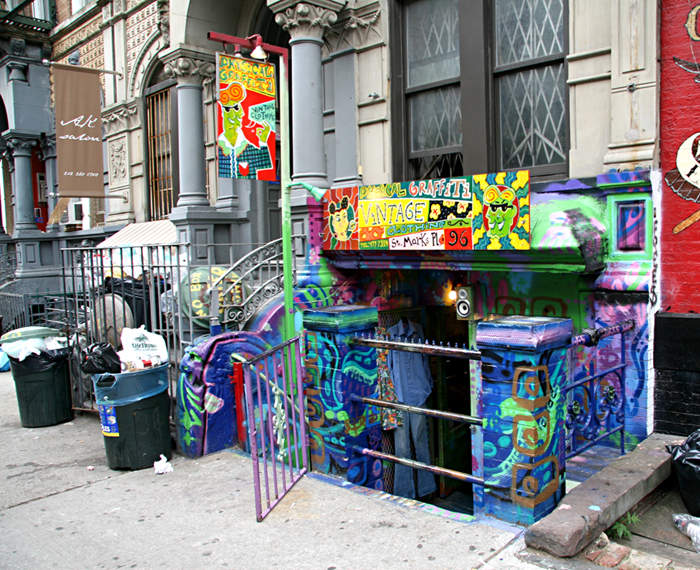 Physical Graffiti is both the name of a small vintage clothing boutique at 96 St. Marks Place shown in the photo and a Led Zeppelin album which used the very same building and the adjoining building at 98 St. Marks Place for the album’s cover (click here for photo). The building was also used as backdrop for a Rolling Stones music video for Waiting on a Friend. This shop abuts the subject of a previous post, Cappuccino and Tattoo, part of which can be seen on the right. Is this an obsession with St. Marks Place on my part? Not really. New Yorkers know that St. Marks Place has been NYC’s (and one of the country’s) epicenter of a number of counter-cultural movements. Dominated by retail, the concentration of shops on St. Marks Place reflects the current flavor. The street has been home to hippies, yippies, punks, political activists and protest marches, renowned bookstores, music stores and clubs (e.g. Electric Circus), graffiti artists, cafes, clothing shops, restaurants, bars, theaters, gangsters, and St. Marks Church. Physical graffiti well describes the street itself.
Footnote: Let the (Internet) reader beware. Misinformation has always been a problem, but the ease of copying text using the Internet has caused viral proliferation. In researching this post, I found numerous references (including Wikipedia) that the Anarchist Switchboard was previously located at 96 St. Marks Place – an interesting tidbit for this posting, except that it appears to be incorrect. The New York Times misreported this on Feb. 18, 2007 and printed a correction on March 21. I also found a number of references to the building’s address for the album cover as 97 St. Marks Place instead of 96 & 98 (97 is on the opposite side of the street – on east-west streets in Manhattan, even numbers are on the south side, odd numbers are on the north). Rolling Stone has the addresses as 94 & 96. You will probably find these erroneous pieces of info everywhere in perpetuity now when doing online searches…
-
Shona Gallery
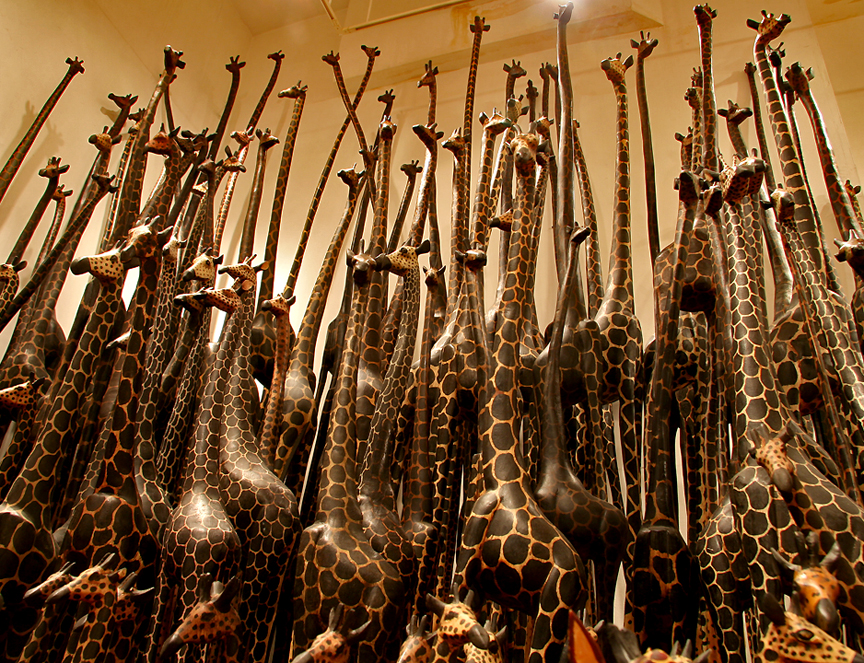
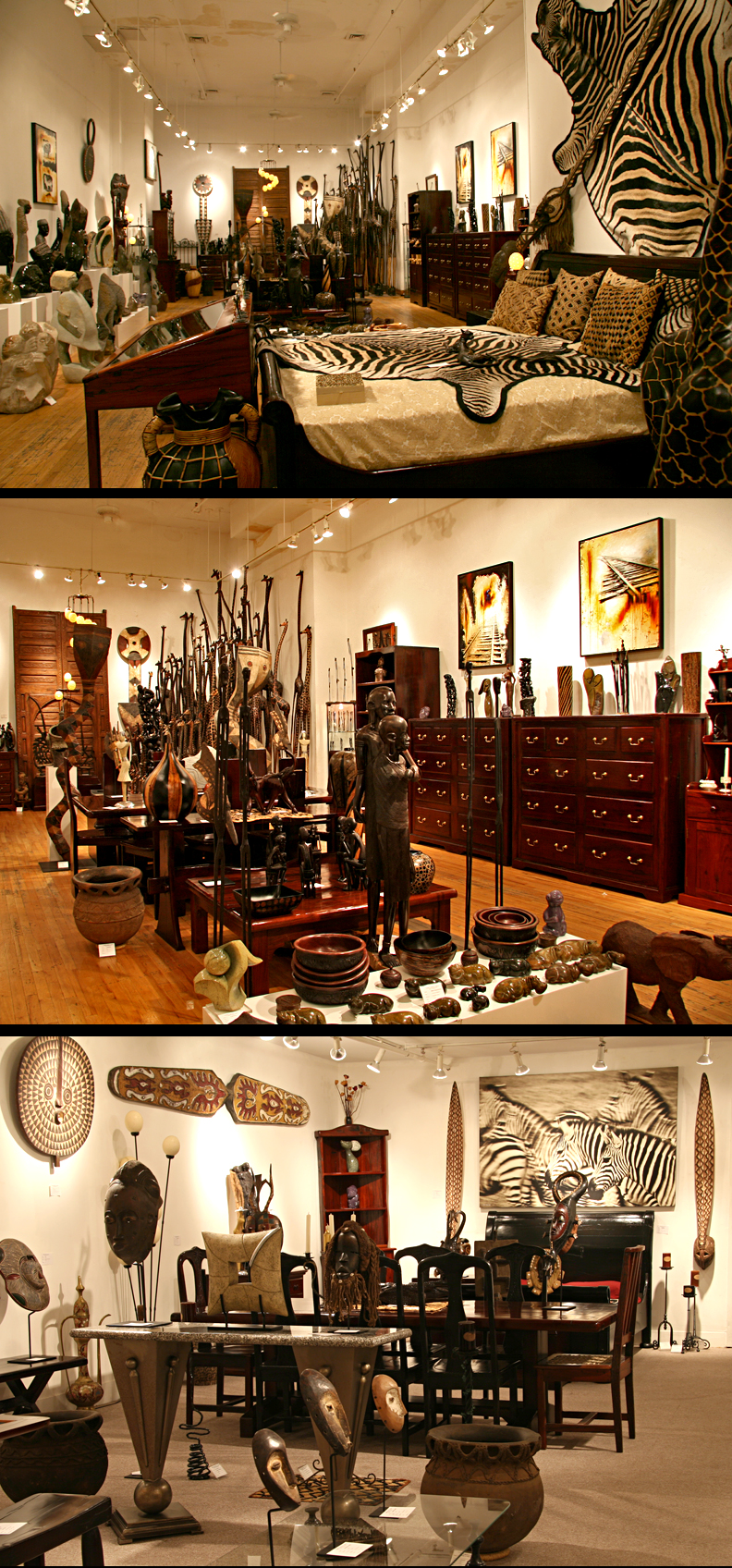
 For years I have passed by York’s Shona Gallery at 99 Spring Street and enjoyed seeing a large group of carved teak giraffe towering in their window – who doesn’t love giraffe? The window display is now different, but the giraffe (from one to 14 feet tall) can now be found in the main gallery, along with other African art objects. Click here for more photos of the gallery. The owner, Michael Ahuja, hails from New Delhi. His has been in this business since 1978 and opened the gallery at its current location in 1985.
Shona houses an impressive collection of imported African art works from places like Zimbabwe, South Africa, and Kenya: paintings, fabrics, masks, jewelry, instruments, crafts, and iron and wooden sculptures. And an array of furniture carved from recycled African railroad sleeper bunks – these pieces are made from Jarrah, a species of Eucalyptus unique to the southwest of Western Australia. I love the furniture made from this spectacular hardwood known for its remarkable durability, extreme density, and warm, deep mahogany-red color. Once seasoned, Jarrah is very tough (impossible to work with regular tools) and has been used for bridges, wharves, railway cross ties, ship building, and telegraph poles. There are other reclaimed sources for the wood besides African railroad sleepers. Also, a small supply of regrowth Jarrah is logged from a 5 million-acre farm owned by the Australian Government and carefully controlled by the Department of Conservation and Land Management. The volume of timber harvested annually is closely monitored…
-
Mosaic Man
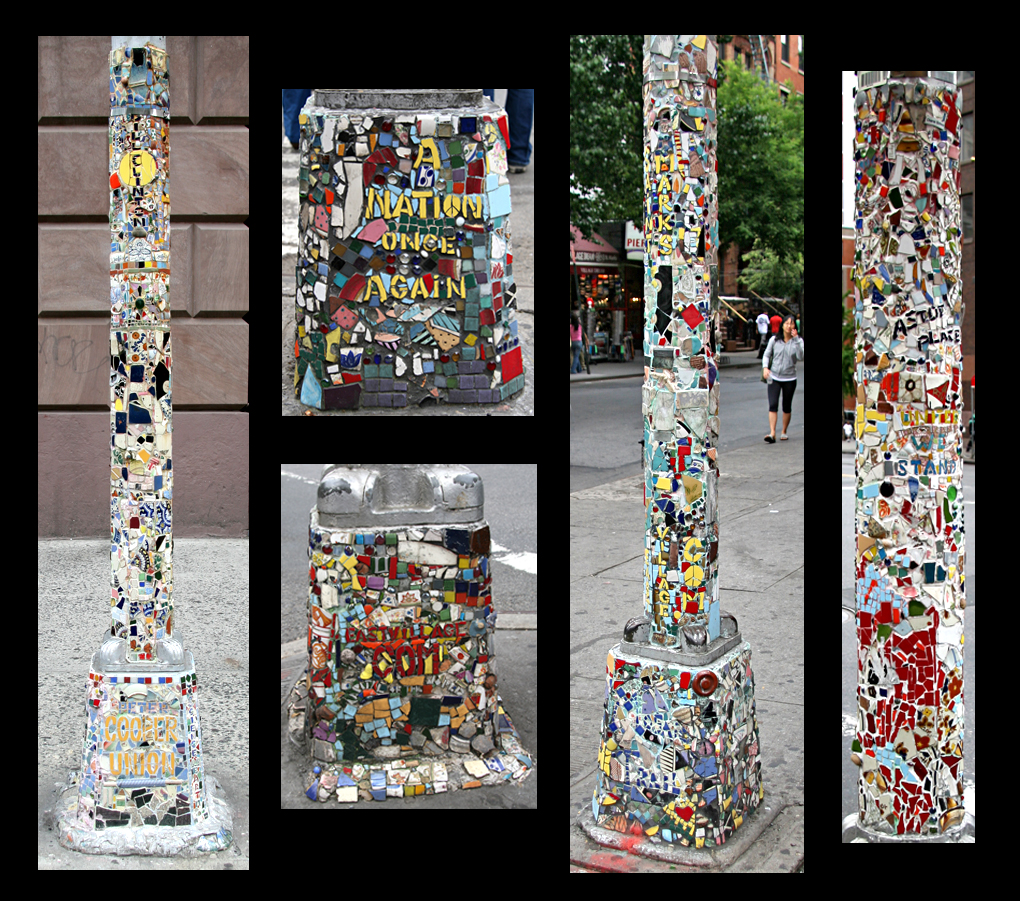
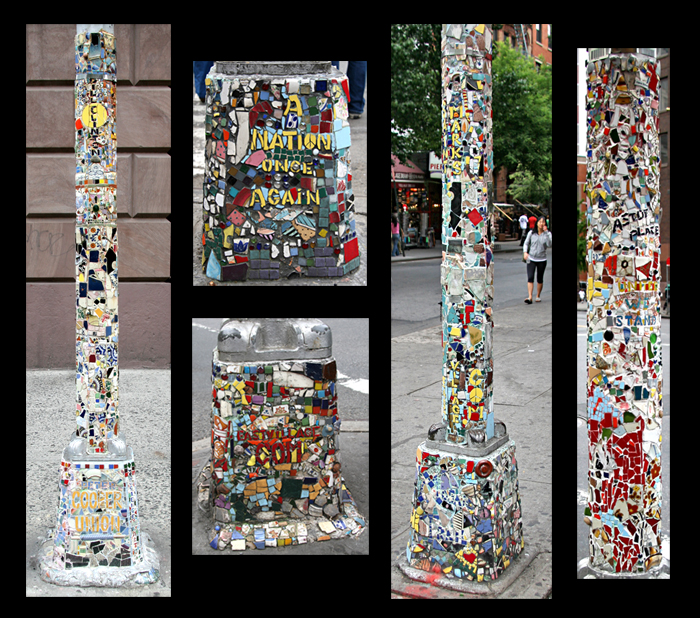 This story about Jim Power, aka Mosaic Man, has been told and retold. In fact, a paper was written by Eric Miller, Ph.D candidate in folklore and folklife at UPenn (click here). In 2004, he won a City Lore People’s Hall of Fame Award. Power is part of the fabric of the East Village – he has also been an activist artist. His first foray into public mosaic work was in 1985, when he made mosaic planters around tree trunks in Astor Place. He began decorating lampposts with mosaics in 1988. After an altercation with the police, Power negotiated a settlement with the Department of Transportation which permitted him to do 80 lampposts. Last count, there are 67 which can be found in a loop – starting at 8th Street and Broadway, across St. Marks Place to Avenue A, down Avenue A to 4th Street, across 4th Street, and back up to 8th Street. The lamppost mosaics are themed, many of which commemorate events.
Power came to the US from Waterford, Ireland. After a two-year stint in Vietnam, he held a number of positions – blues/jazz guitarist, Con Edison worker, carpenter, and stone mason – as a stone mason, he earned as much as $2700 per week. His interest in art and injuries from his prior work led him to pursue this passion and give up his livelihood. He has since lived on the fringes of society accompanied by his dog, squatting and crashing in a variety of locales, including the Cave collective. There are typically thousands of tiles on a lamppost; it takes as long as 3-4 months to complete one. The tiles themselves are a medley of ones purchased and donated. Although I remember some controversy and range of opinions regarding his approach initially, I think time has done well for his work. In a period where there is substantial gentrification and influx of store chains and mass merchandisers, the mosaics provide a break in the homogeneous direction the city has been moving in…
-
Federal Hall
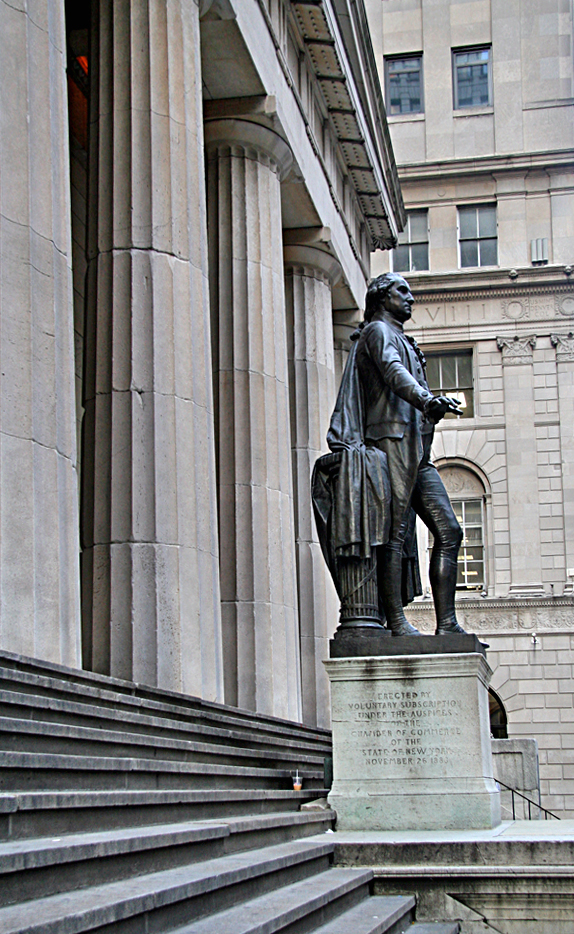
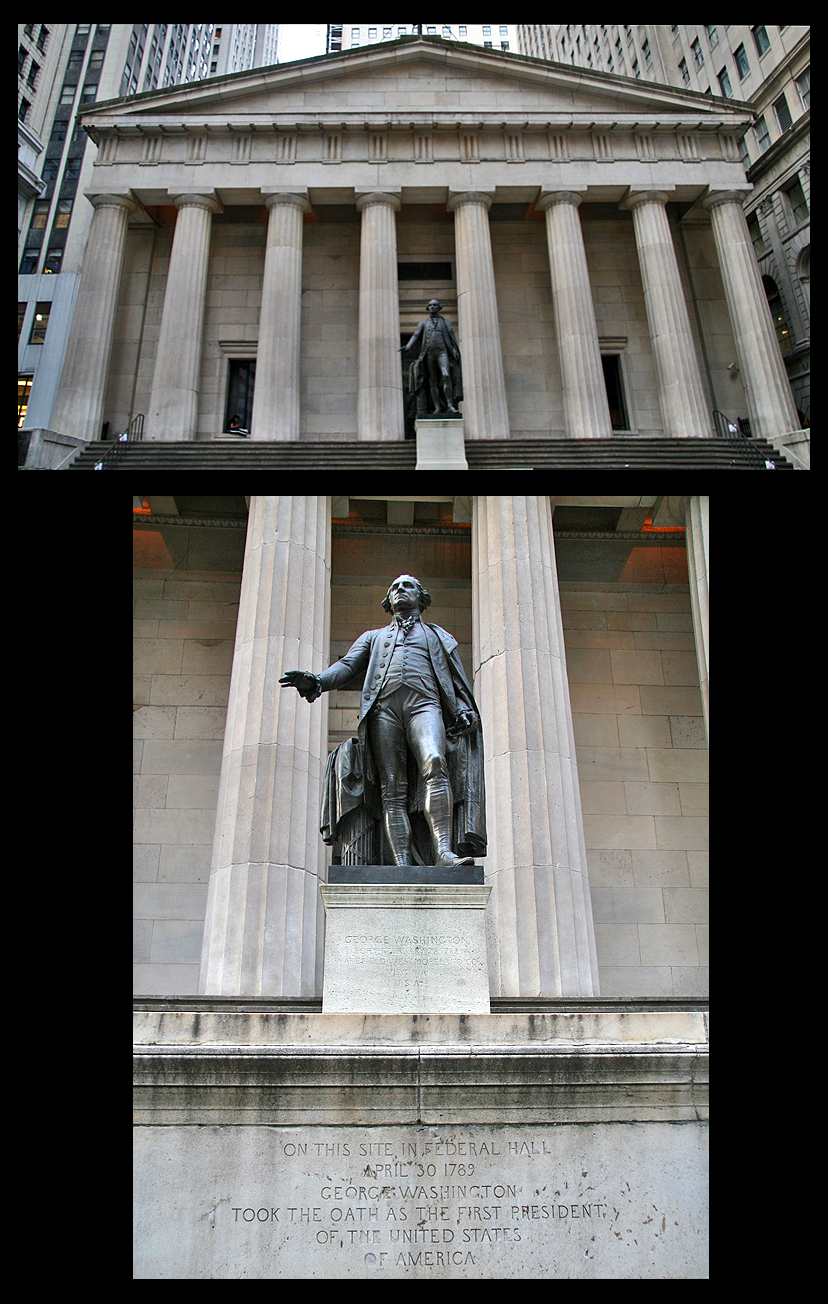
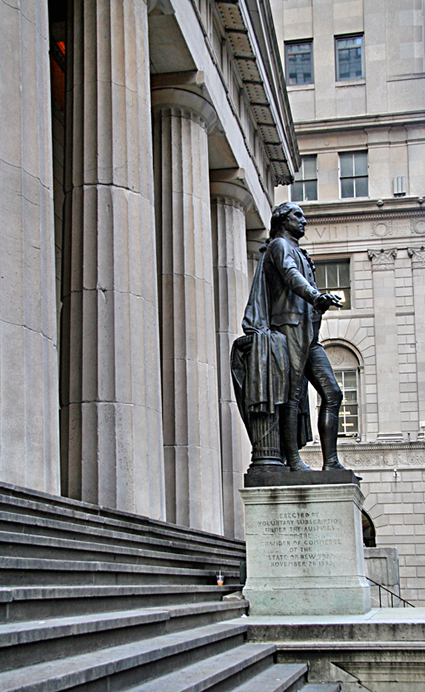 Overshadowed by the New York Stock Exchange across the street, and with all there is to do and see in NYC, Federal Hall at 26 Wall Street is easily overlooked. This beautiful, Doric-columned Greek revival structure with a simplified Parthenon facade is carved from marble; inside is a rotunda. Click here for more photos.
National monuments are more often the agenda of Washington D.C. visitors than NYC ones, but this is definitely worth a visit. It actually is one of the most important buildings in U.S. history and just completed a renovation in November 2006 (it had been closed since 2004). The site has played a part in American government for over 300 years. 26 Wall Street was the location of New York’s City Hall, built in 1700. After the American Revolution, the Continental Congress met at City Hall. When the Constitution was ratified in 1788, New York remained the national capital. Pierre L’Enfant was commissioned to remodel City Hall for the new federal government, when it was renamed as Federal Hall.. The First Congress met in the new Federal Hall and wrote the Bill of Rights. George Washington was inaugurated here as President on April 30, 1789. When the capital moved to Philadelphia in 1790, the building again housed city government until 1812, at which time Federal Hall was demolished.
The building that stands here now was built in 1842 as the country’s first Customs House. It was designed by Alexander Jackson Davis, one of the most important architects of his generation, who worked in the classical style. His was the winning entry in an 1833 competition. In 1862, Customs moved to 55 Wall Street, and the building became the U. S. Sub-Treasury. Millions of dollars of gold and silver were kept in the basement vaults until the Federal Reserve Bank replaced the Sub-Treasury system in 1920. The building is now run by the National Park Service and serves as a museum and memorial to the first President and the beginnings of the United States of America…
-
Sheridan
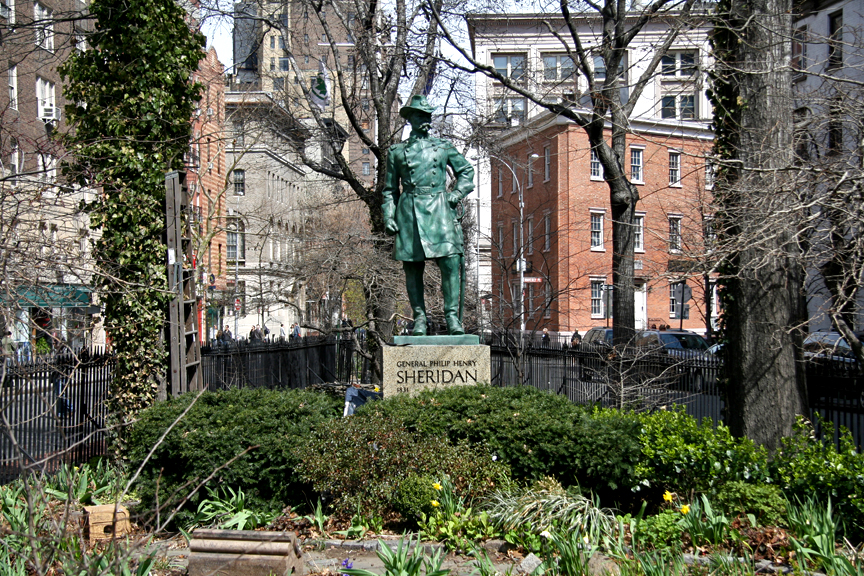
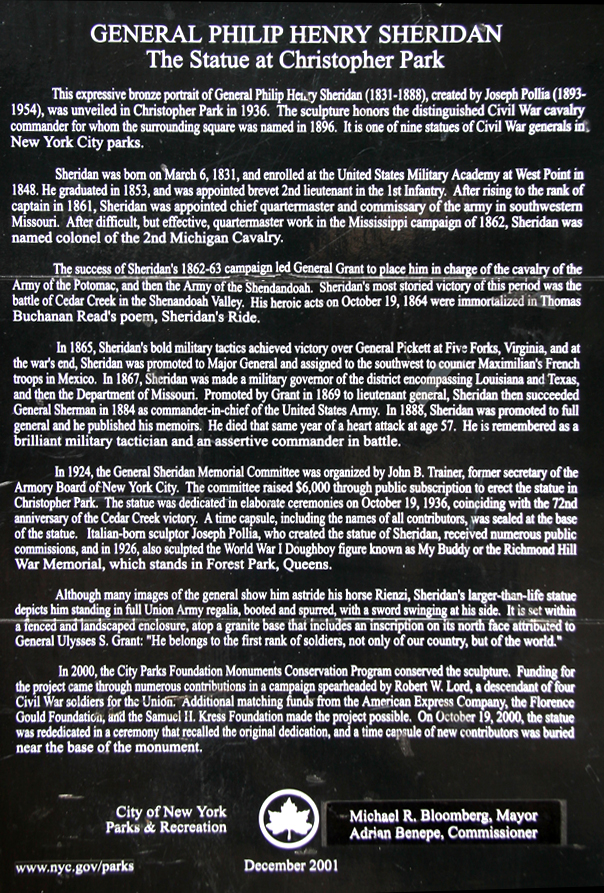
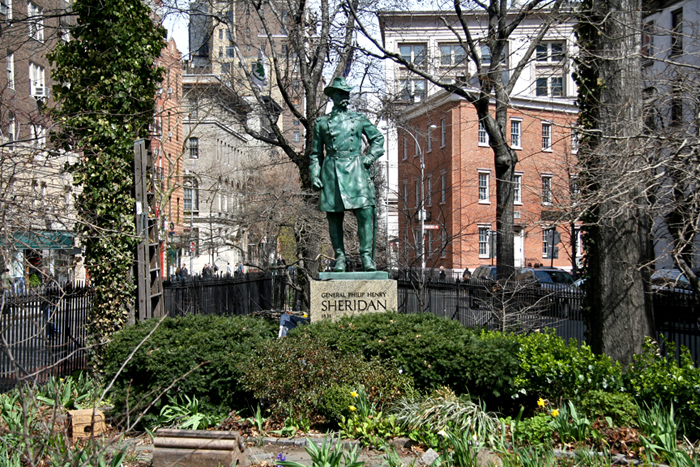 I am not a Civil War or military buff, but I have been going by this statue of General Philip Henry Sheridan (1831-1888) and the park it is in for decades, and I should really know more about him. This man, who rose from near obscurity to the highest rank in the military (Major General) very quickly, is a controversial figure, especially when viewed from our own time. A Civil War cavalry commander, Sheridan graduated from West Point and went on to a myriad of military achievements – Cedar Creek in Shenandoah, Appomattox, etc.
In my readings for this post this morning, I found it very interesting to compare writings about him with information on the plaque in the park (click here). A quote from General Ulysses S. Grant appears on the pedestal: “He belongs to the first rank of soldiers, not only of our country, but of the world.” Grant ranked him with Napoleon and Frederick the Great. The plaque describes him as a “brilliant military tactician.”
However, he has also been described as a brutal, violent, and very prejudiced man. After the Civil War, Sheridan became commander of the Army of the West and led the campaign against the Indians of the Great Plains, seen by some as near-genocidal and thereby tainting Sheridan’s reputation. The pejorative “The only good Indian is a dead Indian” is a common variant on a quote attributed to Sheridan during his encounter with Comanche Chief Tosawi during the Indian Wars in 1869. “Me Toch-a-way, me good Indian.” Sheridan reportedly smirked and replied, “The only good Indians I ever saw were dead.” The bronze statue was created by Italian Sculptor Joseph Pollia in 1936.
Note: This statue is actually in Christopher Park, often mistaken for Sheridan Square, which is around the corner, previously a traffic island which was converted into a beautiful viewing garden in 1982. It is interesting to note that Sheridan was only 5 feet 5 inches tall. Abraham Lincoln once described him as “a brown, chunky little chap, with a long body, short legs, not enough neck to hang him, and such long arms that if his ankles itch he can scratch them without stooping.”
-
Taschen
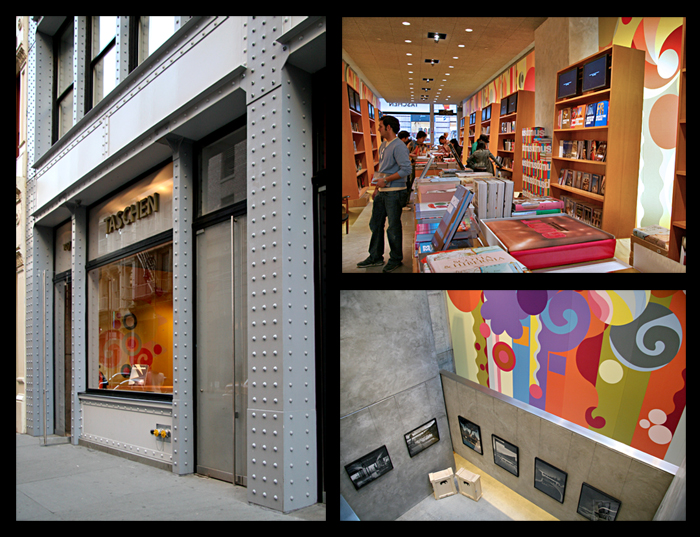 This is Taschen’s NYC flagship store at 107 Greene Street in SoHo. Taschen is an art book publisher started by Benedikt Taschen in 1980 in Cologne, Germany, as Taschen Comics. His esoteric comic book company was saved when Taschen purchased and sold 40,000 remaindered books on Rene Magritte. With the profits, Taschen then ventured into art and photography books, first publishing a book of the photography of Annie Liebowitz. For a fascinating history of the company, click here.
Now, Taschen publishes works on art, architecture, design, fashion, film, fetishistic imagery, photography, and erotica/sex – what’s unique is to see explicit sex sitting alongside mainstream art books. Their books are unique in many other ways. Helmet Newton’s SUMO is the largest book published in the 20th century. It’s so big, in fact, that it comes with a special table designed by Philippe Starck. And then there is GOAT – Greatest Of All Time (a book about Muhammad Ali) – which sells for $12,500 (collector’s edition). Yet they also pride themselves as a publisher which brings forth quality art books at popular prices; many of their books sell for only $10, befitting the the word “pocket” (translation of the German “taschen“).
The store, with its concrete floors, was designed by Frenchman Philippe Starck; wall murals were done by the Brazilian artist Beatriz Milhazes. There are floating bookshelves with hi-def video monitors along the top. The rear of the store has a staircase to a lower gallery/event space. From their myspace site: “I have a quiet gallery space with furniture by Tenriero, some sleek Eames chairs, and a buttery leather Arne Jacobson Egg chair.” A must-visit. I look forward to their upcoming book signing with Santiago Calatrava!
-
The Plastic Infinite
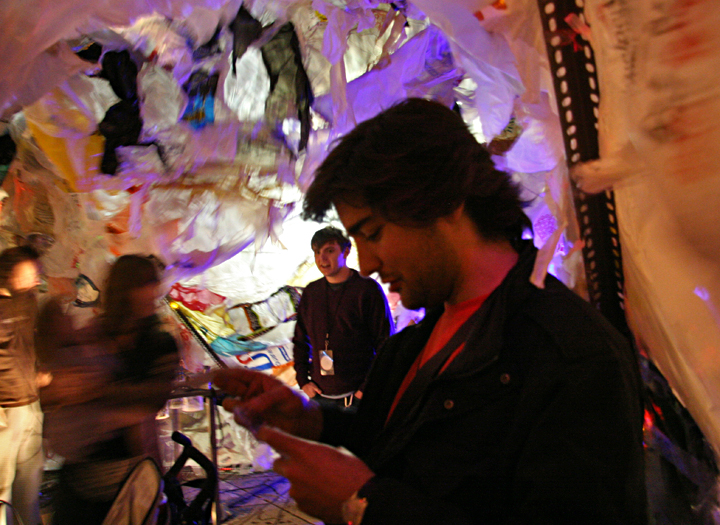
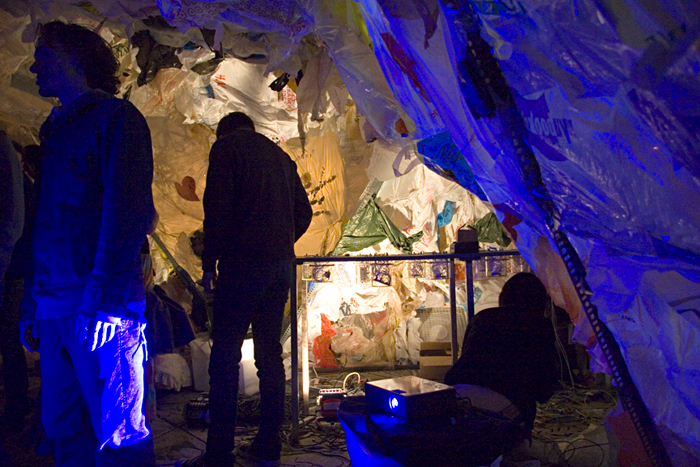 A friend alerted me yesterday to some goings on in Washington Square Park. Activities are not well-covered here, so it took some involvement to find out what was going on. What initially appeared to be a trash heap of plastic shopping bags over tetrahedral frames, turned out to be an architectural project conceived by U.K. architect Usman Haque, who has created many interactive installations and mass-participation performances. More photos here.
Initially titled Project Unspecified: “The NYU Program Board Performing Arts Committee has invited architect Usman Haque to design and oversee the construction of The Plastic Infinite. Members of the public are invited to come together to design, construct and inhabit a temporary inflatable structure in Washington Square Park, New York City. In the tradition of “barn raising”, where members of a community gather to build a structure for a new family, The Plastic Infinite is a collaborative event for the city. The park will be transformed into a playground for creative exchange.”
In addition, Tali Hinkis and Kyle Lapidus of LoVid added video to the installation. It actually was quite a bit of fun getting inside the structure – people were coming and going all day and night. The space became a place of social interaction. Inside while shooting, I struck up a conversation with someone who, initially unbeknownst to me, was the architect himself. I found him very approachable, congenial, and down to earth – we had an interesting conversation about architects and architecture…
-
Flora
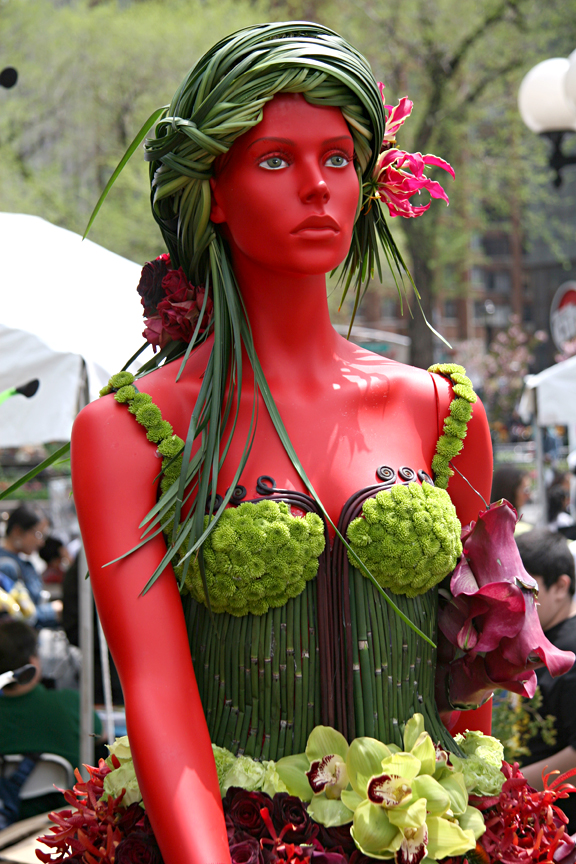
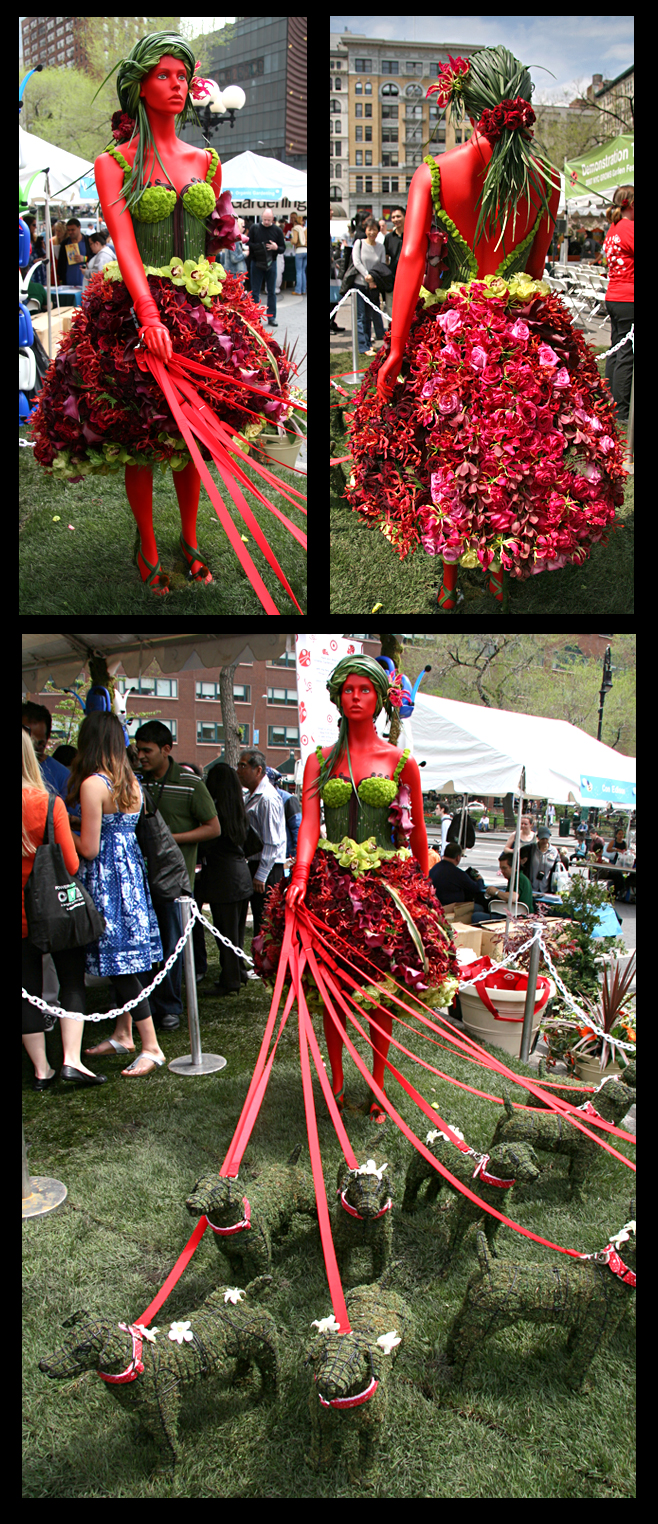
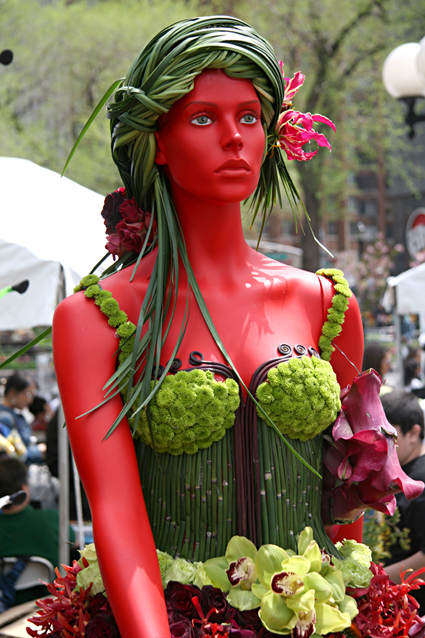 Yesterday was the NYC GROWS Garden Festival, which was held in Union Square. This event was NYC’s celebration of National Garden Month. Our lady in the photo was created by Target, who sponsored the event. She was a big hit, with visitors taking photos of each other with her as backdrop. I thought she was beautifully done, with all manner of plants/flowers so cleverly used and her bevy of topiary dogs. Click here for more photos.
I am not a gardener, but I can understand the benefits of being connected to something as important as plant life and seeing living things grow. In a time where everything is about speed and immediate gratification, gardening is a useful antidote by teaching patience – involvement in a process that can’t be rushed, where one MUST wait for results. A useful metaphor, for many of the things of value in life take time to come to fruition. I asked a Target rep if she had a name, and sadly, she did not. After considering many options this morning, I thought Flora might be an appropriate choice…
-
The Brooklyn Museum
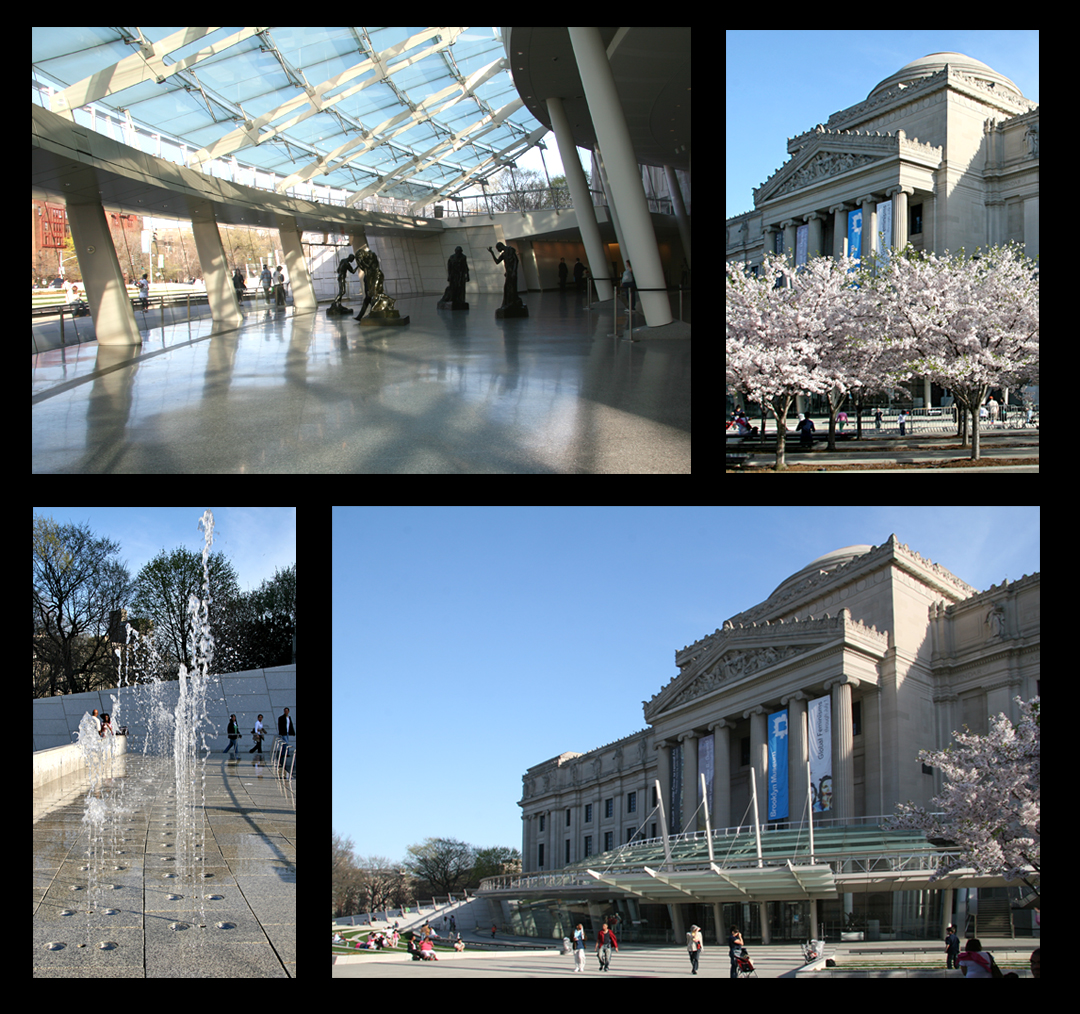
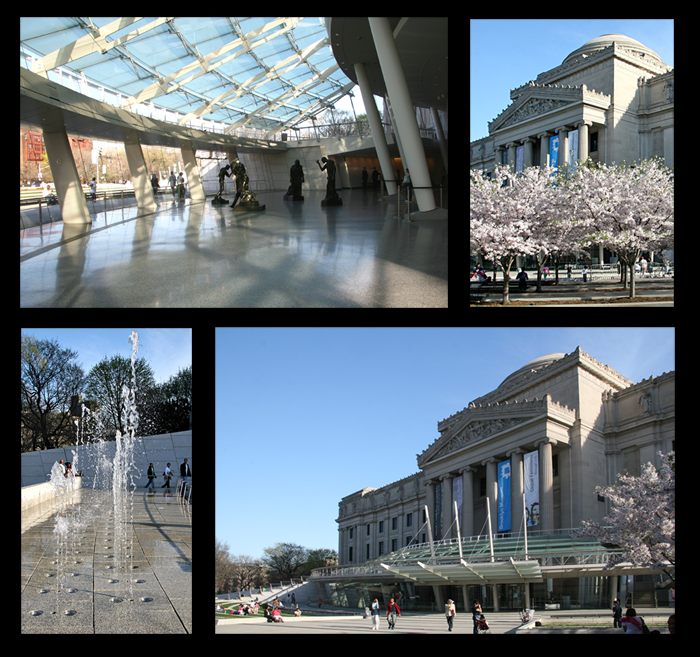 For most visitors and many residents, New York City is Manhattan. And with all there is in Manhattan, Brooklyn can be easily overlooked. But this borough, the largest of the 5 that make up the city, is a world unto itself, with many treasures, both large and small. The Brooklyn Museum is one of the largest and most comprehensive art museums in the country. With permanent collections of more than a million objects, its holdings include objects ranging from ancient Egyptian masterpieces to contemporary art and represent almost every culture.
The Museum is housed in a 560,000-square-foot landmark Beaux-Arts building designed by McKim, Mead & White. It is located in central Brooklyn, a half-hour from midtown Manhattan, with its own subway stop. The Brooklyn Museum is set on Eastern Parkway, one block from Grand Army Plaza, in a complex of parks and gardens conceived in the 19th century, that is also home to Prospect Park, the Brooklyn Botanic Garden (with which the Museum shares a parking lot), the Prospect Park Zoo, and the central branch of the Brooklyn Public Library. In 2004, a $63 million dollar renovation was completed. The museum also has very diverse exhibits atypical for an art museum, which I believe makes it more accessible to a broader audience. Even if you are not an art museum goer, I highly recommend a visit…
-
Little Lady Liberty
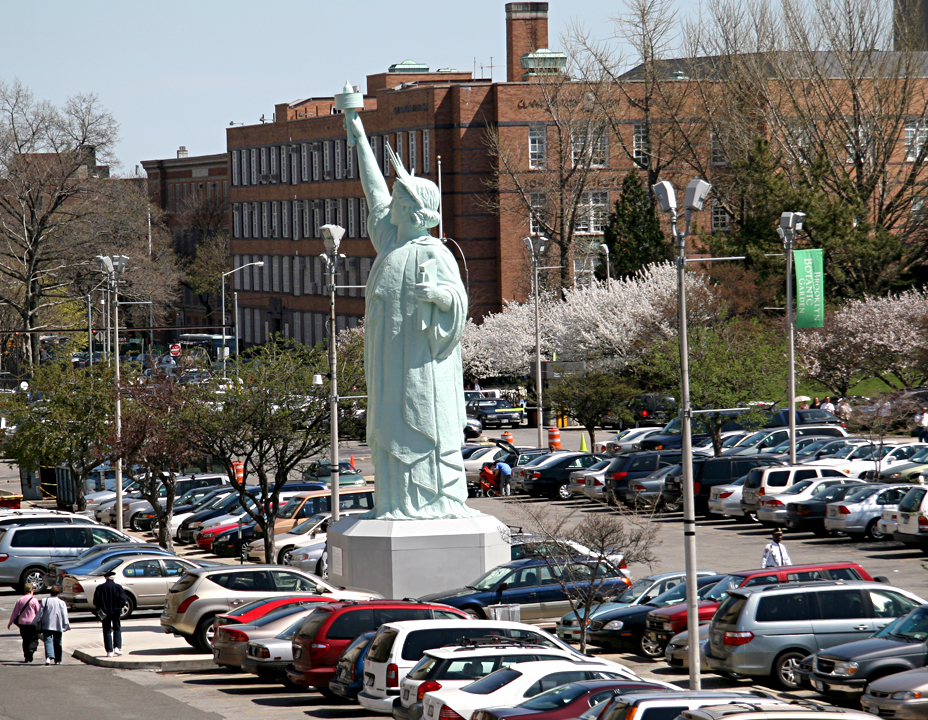
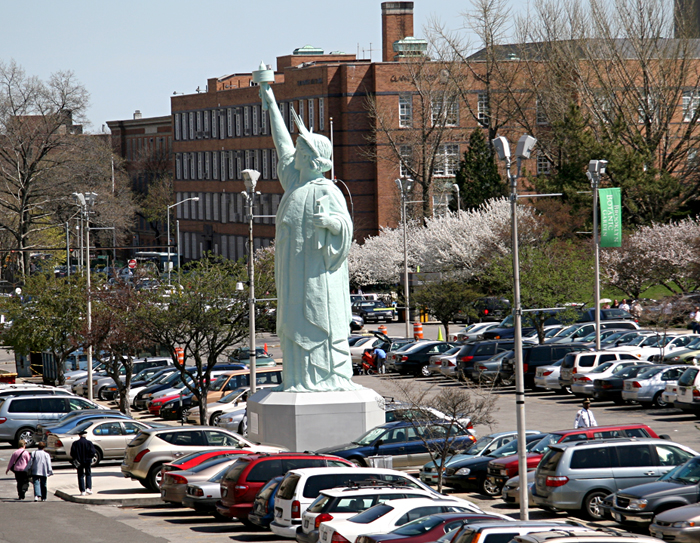 While at the Brooklyn Botanic Garden for Hanami (cherry blossom viewing), I noticed the most bizarre sight – a huge replica of the Statue of Liberty in their parking lot. I took a photo, not really intending to use it, but investigation led to the most fascinating story.
The statue was built and installed in 1902 by William H. Flattau, a Russian-born auctioneer who, proud of his newly adopted country, wanted a replica of the 151-foot original (created by the French sculptor Frédéric-Auguste Bartholdi) to grace the roof of his eight-story Liberty Warehouse. The warehouse, located at 43 W. 64th Street, was built by Flattau in 1891. The statue, galvanized steel over an iron framework, was made in Akron, Ohio, cut in half (to ship through the railroad tunnels), and rewelded. Until 1912, visitors could climb a circular staircase to an opening at the top of the statue’s head (much like the original on Bedloe Island), affording views of the area.
The statue sat on top of the building for over 100 years until 2001, when the Athena group announced plans to develop the building into coop apartments, adding 4 floors and removing the 30-foot statue. In 2002, it was donated to the Brooklyn Museum of Art in honor of the police officers, firefighters, and other emergency workers killed on September 11, 2001. Conservation work has been completed. And that’s how it got where it is…