• Category Archives Food and Restaurants
  • Roots of Pizza

    Posted on by Brian Dubé

    The variations in the human food palate is remarkable. I perused the 241 reviews on John’s Pizzeria at the Yelp.com website which ranged from 1 to 5 stars. You will find every permutation of good, mediocre, and bad for both service and food. If you don’t agree with any given reviews, you could dismiss them as being written by people who have limited experience with pizza or who have not tasted better. However, a closer examination of the reviewers will reveal many long time NYC pizza aficionados who actually have sampled the wares from iconic places such as DiFara’s, Lombardi’s, Grimaldi’s, Totonno’s, or Nunzio.

    One problem with a place like John’s that makes such a large volume of pizza and serves so many people is that it is possible to have genuinely different experiences either with the food or service. Combine an off night for both with high expectations, and the range of reviews become more understandable.

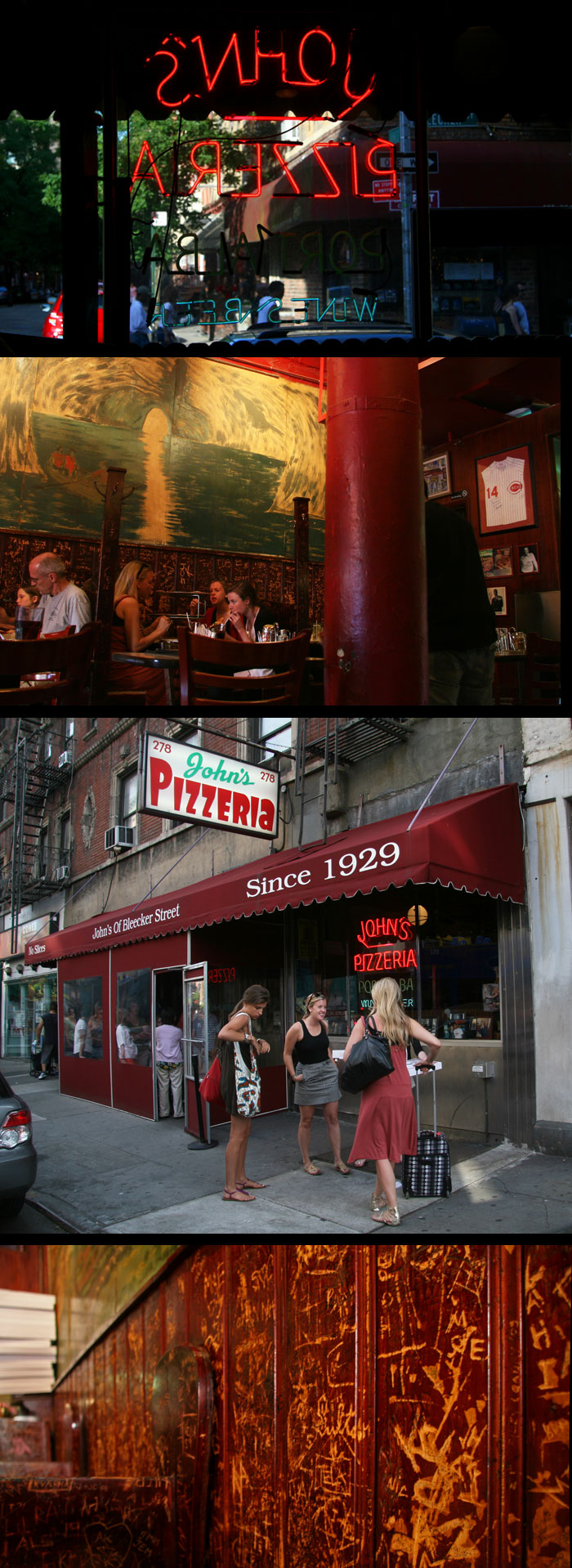
    John’s Pizzeria, at 278 Bleecker Street in the West Village, was started in 1929 by John Sasso. Current proprietor Bob Vittoria is a relative of the original owner. John’s is one of the few pizzerias in New York City to use a coal-fired brick oven, introduced to the city by Gennaro Lombardi. Anthracite coal is still shoveled daily from the basement to pizzeria’s oven. A coal oven can reach temperatures in excess of 800 degrees F.
    John’s crust is thin and crispy. According to an article in The Villager:

    Vittoria attributes the restaurant’s steadfast popularity to the special brick oven that reaches over 800 degrees and crisps the homemade crust to perfection, and the fresh, high-quality meats, produce and cheese. He buys his meat from down the street at Faicco’s Pork Store, open since 1927 at 260 Bleecker St.

    You will never get a consensus on a place like this – pizza is one of the most contentious food subjects in New York City. Like sushi, everyone seems to have a favorite or know the best place. The styles and ingredients vary substantially – very cheesy, thinner or thicker crusts, crispy or chewy, oily or dry, ovens used, classic red sauce, white sauce, and non-traditional styles with toppings like pesto.

    I had not been to John’s in many, many years. My recollection was that I had found it overrated and somewhat disappointing. Since that time, I have primarily frequented places which serve gourmet or non-traditional styles, such as that of Two Boots or Ray’s on Prince Street. On my recent visit to John’s, however, I found the classic red sauce a refreshing change. Like going back to the roots of pizza …

    Note: John’s virtually always has huge lines, although they do more fairly quickly. They do not serve slices (only whole pies) and do not take credit cards.
    More Photos – See Here.

    Posted on by Brian Dubé

  • Buzz and Bling

    Posted on by Brian Dubé

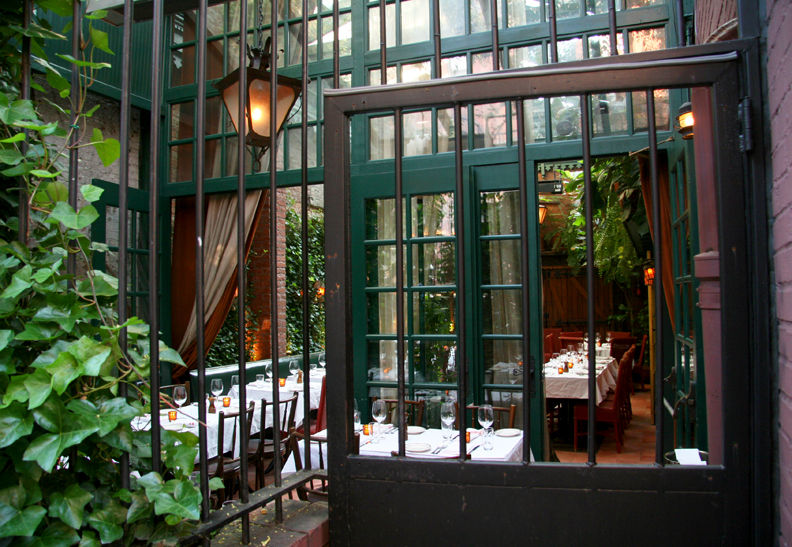
    In France, I have seen lines to get into small restaurants which look empty. The first time I saw this, I was quite puzzled. A little examination, however, revealed what every seasoned restaurant goer already knows: they were waiting for tables outside. Al fresco dining and the search for pleasant garden space is a quest made by diners around the world. In New York City, we are not blessed with very many pleasant streetside cafe spaces (see Insult to Injury here and this great New York Times article: “Curbside, We’ll Never Have Paris”).

    This is the time of year where many relish being outdoors, so if you want a really pleasant al fresco meal insulated from the elements of urban assault, a back garden is the place to find. Often, these places are completely hidden from view – a front sign may or may not be present announcing the garden’s existence. So for those of us who like urban adventure and the process of discovery, this is not the technique best employed. Better to do a bit of research prior to meal time.

    In the case of The Waverly Inn and Garden, at 16 Bank Street, the garden has a side entrance visible from Waverly Place. The location is in the heart of prime West Village, one of the most charming and bucolic areas in the entire city of New York. I have written of this neighborhood several times before (see the links below).
    Regarding the restaurant itself, I have not eaten there, but I enjoyed reading the reviews, which range from 1 to 5 stars. If you want to have fun, read some of the 74 reviews here at Yelp.com. Apparently, this place is a magnet for the rich and famous, and many of the very negative reviews reflect customer experiences with snobbery, service, and attitude. On August 12, 2008, the New York times wrote an article: “An Insiders’ Clubhouse (Apply at the Door).” One of the owners is Vanity Fair editor Graydon Carter; some have referred to the establishment as “Graydon’s private club.”

    The article speaks of the “combination of billionaires, movie stars, intellectuals and fashion designers, with a rock icon or sports legend thrown in” who frequent there. “There are still powerful folk who would rather dine uptown at the Four Seasons, Michael’s or Le Cirque. But for celebrity power deep enough to lure paparazzi night after night, few outposts in New York today rival the Waverly Inn.”

    This historic place exudes charm inside and out. For now, it appears it’s the got the buzz and bling 🙂

    Related Posts: 121 CharlesGrove Court, Cherry Lane Theater, The Garden at St. Lukes, 17 Grove Street, Paris In New York

    Posted on by Brian Dubé

  • Chefs and Plumbers

    Posted on by Brian Dubé

    Trades in America are largely devalued. However, as big an advocate as I am of higher education, not every one is suited for white-collar jobs, and someone has to do the plumbing. Clerks, drivers, and service jobs cannot all be filled with college students and immigrants, and I am not sure that such a world would be desirable. And these jobs cannot be outsourced or automated.

    In New York City, complaints have been made about taxi drivers for time immemorial. The problem is that there is no serious training for this job. The test for a taxi license is laughable – virtually anyone who can drive can get a license. In London, for example, a cabdriver candidate must complete two years of full-time study. I am fascinated by Les Compagnons, French trade guilds dating back to the Middle Ages. See a New York Times article on the Compagnons here.

    Many find the level of craftsmanship in New York to be deplorable – stories abound regarding the poor workmanship in jobs done. Many have horror stories of their own. The problem is that many individuals doing blue-collar work are not trained or poorly trained. The workers are not professionals, as is the case with many waiters, who are working while pursuing other life goals and careers or perhaps feeling that they have no better options.

    None of this is the case at the French Culinary Institute, located in SoHo at 462 Broadway. This extraordinary school provides an intense training in the culinary arts on a par with schools in Europe – many of the faculty and deans are European, trained, renowned chefs. The school offers a very broad spectrum of classes.

    Employment needs are often cyclical. As need develops for a given skill set, people train for those opportunities. Often, an over supply develops, with shortages in other fields. I often speculated that skill tradespeople may see their time come in a world where manual labor is looked down upon and everyone trains for white-collar work. I have often joked that in a world full of web developers, plumbers may rule.
    I love the scene in the film Moonstruck where we have revenge of the tradesman. A couple, needing bathroom work done and lacking knowledge about construction, are persuaded by contractor Cosmo Castorini to buy the most expensive solution:

    “There are three kinds of pipe. There’s aluminum, which is garbage. There’s bronze, which is pretty good, unless something goes wrong. And something always goes wrong. Then, there’s copper, which is the only pipe I use. It costs money. It costs money because it saves money.”

    The future of technology rapidly evolves – who knows what future generations will need and where the jobs may lie? But most likely, there will always be a need for chefs and plumbers 🙂

    Photo Note: This shot was taken on Grand Street, where French Culinary students were on a break from classes. The sight of so many chefs in classic white uniforms on this street is quite startling. The school also runs a highly regarded restaurant – L’Ecole, located at street level at the same address.

    Posted on by Brian Dubé

  • Comin Up Comin Up

    Posted on by Brian Dubé

    Before the hegemony of the Korean green grocers, there were far fewer dealers of produce in New York City. And then, as now, many immigrants did the heavy lifting in this city. This was the case in the 1970s on Greenwich Avenue near Avenue of the Americas, where there was a very prominent fruit and vegetable store run by Arabic men. As immigrants are inclined to do, these men had acquired a smattering of American colloquialisms, patched together to make what they thought was the salesman’s perfect proverbial call to action. So a passerby was often subjected to their pitch: “Comin up Comin up. Strawberry. Three for a dollar. Who can believe it.” Hear my impression here. Ironic, because, of course, nothing was being prepared, and hence nothing really was really “comin up.” And often, given the quality of the strawberries, three for a dollar was easy to believe.

    Their intonation and sense of urgency was a great source of amusement for many of us at the time, and I have recounted this story to many close friends who now find opportunity at every moment possible to inject “comin up comin up” or “who can believe it” into any situation where it can possibly be justified – there are many, many moments in daily life where either phrase can be easily worked in.
    But where to use such a story for a photoblog of New York? These men and their fruit stand will not be resurrected. So this experience had been filed away in the recesses of my mind, waiting for an opportunity.

    Fast forward one week ago to a street fair on Waverly Place. As I walked by a seller of watermelon in cups, the man behind the table barked, “Watermelon. Two dollar. Helloooooo!” Hear my version here. The use of Hello with an elongated “o” is recent slang, similar in meaning to “wake up and smell the coffee.”
    So there it was – the perfect analog in our time and place to “comin up comin up.” And as I pulled out my camera, the vendor happily obliged and volunteered a smile with two fingers for two dollars.

    So if you think you recognize me around town and see me walking towards you, you now have the secret password. Just say “comin up comin up” and I’ll be sure to respond “Who can believe it!” 🙂

    Posted on by Brian Dubé

  • Whole Earth Bakery

    Posted on by Brian Dubé


    If you read the quote from my article on the Veggie Pride Parade, you know you will not find French chef Anthony Bourdain patronizing Whole Earth Bakery in the East Village. However, you will find a vibrant business at this historic shrine for veganism and vegetarianism, in business since 1978. This is the type of place New Yorkers have grown to expect. However, it is hard to imagine a place like this, catering to such a niche clientele, existing anywhere else.

    Peter Silvestri and his mother Filomena started the bakery at 70 Spring Street; in 1991, they moved to their current location at 130 St. Marks Place. There are cakes, cookies, and many other confections. In addition, there are soups, salads, and vegetarian pizza with whole grain crust.
    To be fair, I believe the degree to which many individuals like the foods there is largely a function of how important dietary concerns are to them. It is tough to compare the baked goods here with fine French or Italian pastries.

    Veganism and other variants on vegetarianism have reached mainstream society, but Whole Earth Bakery dates back to the days of late hippiedom and countercultural movements – back to the land and natural living.
    The bakery staved off the threat of eviction in 2006 and continues to live on. If you are in the area, drop in and be you own judge 🙂

    Note: Filomena Silvestri died in 2006 at the age of 94. She is survived by three children, five grandchildren, and great-grandchildren.

    Update: As of December 2012, Whole Earth Bakery is now closed.

    Posted on by Brian Dubé

  • Butter and Ice Cream

    Posted on by Brian Dubé

    Sunday was Veggie Pride Parade II. I wrote about this in 2008 – you can read about it here. I was a practicing vegetarian for decades and have experimented with numerous diets, so I am sympathetic to the cause. I was a raw foodist in the early 1970s, drinking gallons of carrot juice per week. I have a library of books on extreme dietary practices, many rarely encountered today: fruitarianism, macrobiotics, mucusless diets, liquidarianism, raw veganism, and the ultimate in dietary deprivation: breatharianism (yes).

    I have a quote from chef Anthony Bourdain which I would like to share with you and which, although quite extreme, does express the feelings of many non-vegetarians. For those of you who are vegetarians, I suggest you skip this section.

    Vegetarians, and their Hezbollah-like splinter-faction, the vegans, are a persistent irritant to any chef worth a damn.
    To me, life without veal stock, pork fat, sausage, organ meat, demi-glace, or even stinky cheese is a life not worth living.
    Vegetarians are the enemy of everything good and decent in the human spirit, an affront to all I stand for, the pure enjoyment of food. The body, these waterheads imagine, is a temple that should not be polluted by animal protein. It’s healthier, they insist, though every vegetarian waiter I’ve worked with is brought down by any rumor of a cold.
    Oh, I’ll accommodate them, I’ll rummage around for something to feed them, for a ‘vegetarian plate’, if called on to do so. Fourteen dollars for a few slices of grilled eggplant and zucchini suits my food cost fine.
    — Anthony Bourdain

    I can’t say I embrace this statement, but it does point out one problem with most vegetarian diets – they are driven primarily by health concerns, ethics, religious beliefs, or animal rights, philosophies which involve deprivation and do not revolve around the palate. This is why ultimately, most do not stay with diets like veganism for very long. The vegan movement has become quite trendy in recent years – read my article here.

    Food is one of the most important parts of any culture, and any dietary practices that restrict one from partaking in those foods will, for most, become intolerable over time. Gradually, more taboo foods are introduced. Semi-vegetarian diets attempt to straddle both sides of the aisle with variations such as lacto, ovo, lacto ovo, pollo, pesco-vegetarianism, and flexitarianism.

    I have sat at many a dinner table or restaurant only to nibble or eat side orders. A trip to France became, as one vegetarian observer put it, “avoiding the omelet.” My diet now is more oriented towards health and less dogmatic.

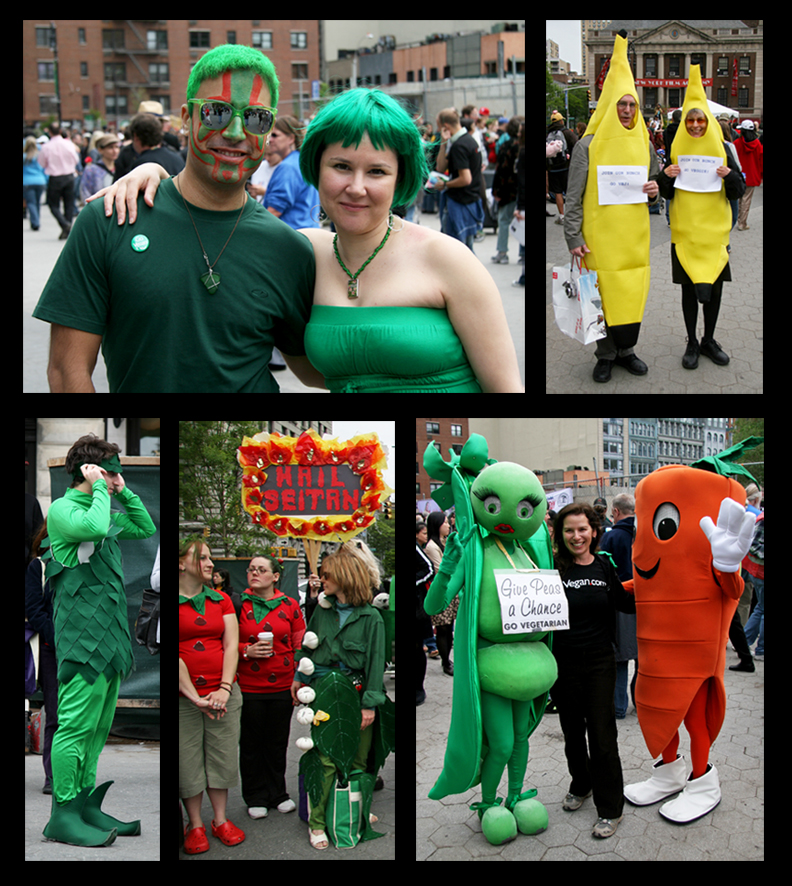
    The 2009 parade was not particularly large – I think that at this point in time, the message falls on deaf ears. Most will not make the sacrifices to become vegetarian, and many of the valuable contributions made by the vegetarian movement have been absorbed into mainstream culture. Large supermarkets now have an extensive line of natural food products – unthinkable 30 years ago. Successes like Whole Foods Market, the retailing natural foods international chain, demonstrate that peas have been given a chance but most still want butter and ice cream from time to time 🙂

    About the Photo: There were some fun creative characters. Many important fruits and vegetables were represented: Join Our Bunch (banana costumes), Give Peas a Chance, Hail Seitan, Warning Hunters, Unicyclists Against Animal Abuse, Meatrix, Jolly Green Giant, and a host of green.

    Posted on by Brian Dubé

  • White Castle

    Posted on by Brian Dubé

    Not so long ago, you had to make a pilgrimage to find a fast food restaurant. In 1970, there were no McDonalds in Manhattan. When I first moved here to attend university, a group of us traveled to the Bronx to have the White Castle experience. Eating those little square inexpensive hamburgers (known as sliders – officially Slyders) was the perfect novel activity for a college student. White Castle was an alien experience – something more akin to the suburbs or outer boroughs. Its white porcelain enamel exterior with crenelated roofline resembled a medieval castle (said to be modeled after the Chicago Water Tower.)

    The protective romantic attachment that some had surrounding White Castle has all the earmarks of the New York City landmark institution, such as egg creams or Coney Island. Perhaps its length of time in the city (there has been a White Castle in Bayside, Queens, since 1932) and the fact that it predates any other fast food chains here give it a false sense of being a New York original, akin to Nedick’s or Nathan’s. And New Yorker’s are used to taking credit for many firsts, so why not White Castle?

    But, in fact, White Castle is a national chain and was started in 1921 in Kansas by partners Walter A. Anderson and cook Billy Ingram. However, the chain has maintained a much lower profile and rate of expansion than other fast food restaurants – to date, it has 380 plus locations nationwide, compared to 13,000 for McDonald’s.
    From the New York Times:

    Few people seem to realize that White Castle was America’s original fast-food chain: its first outlet opened in 1921, 27 years ahead of McDonald’s. Indeed, White Castle was the key player in turning the hamburger into America’s national meal.

    Its little square burgers and turreted restaurants have become something of a pop-culture punch line, stuck somewhere between white-trash chic and ironic kitsch.

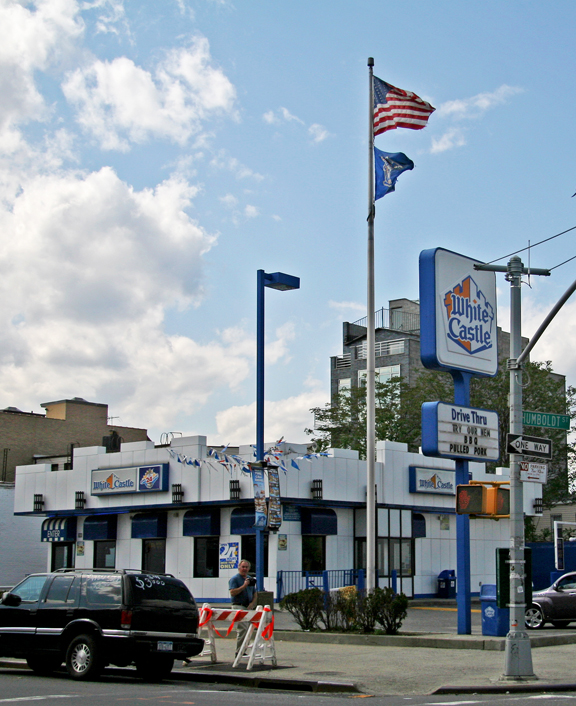
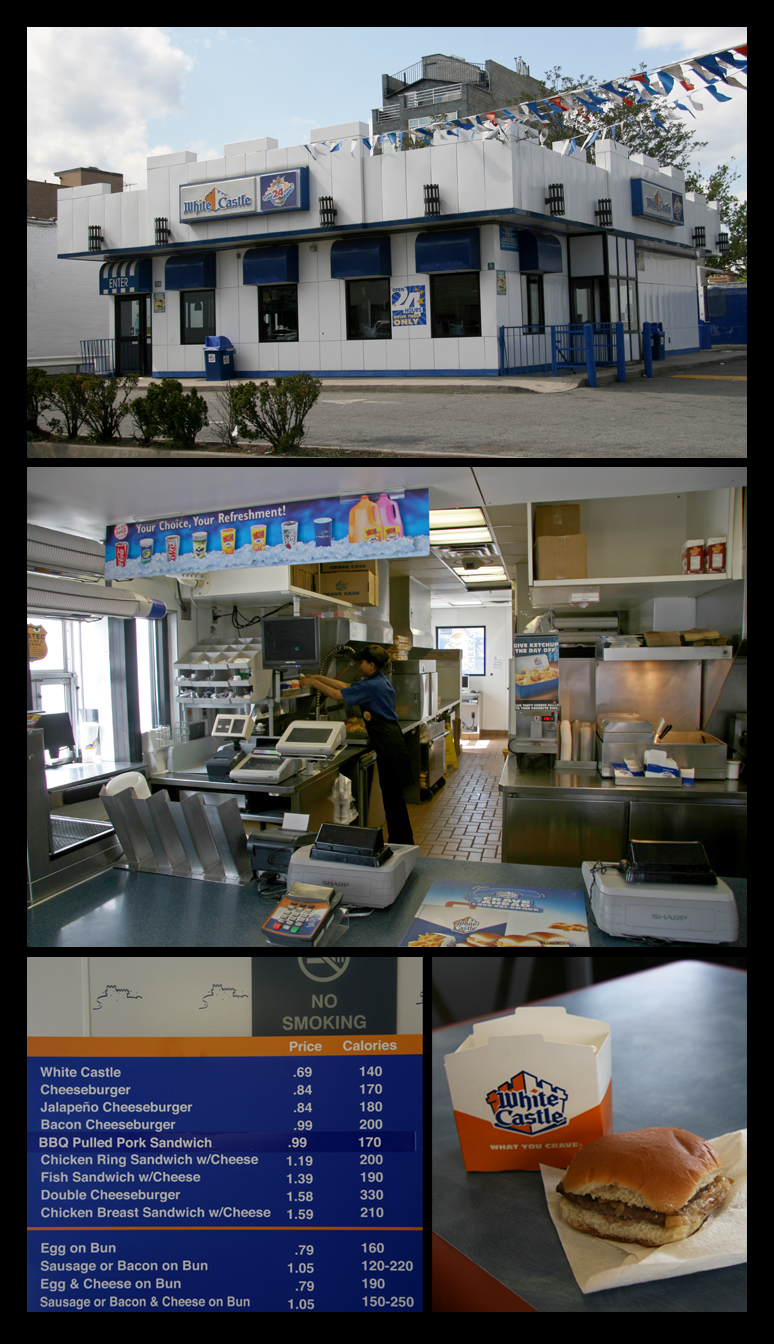
    So it was last weekend on our adventure to Jackson Heights that we came across this White Castle at the corner of Metropolitan Avenue and Humboldt in Brooklyn – more photos here. A few mandatory burgers were consumed by my companions as I sampled some French fries. In all, the place was clean and tidy and the staff extremely friendly. It was a good first White Castle experience for one of our group who was new to the food chain. Our hats are off to the management here…

    Posted on by Brian Dubé

  • Fresh Meat

    Posted on by Brian Dubé

    I was told that meat hanging on hooks streetside in the Meat Packing District was a thing of the past. However, many things are said, not all of which are true, so this morning at 6AM, I left my home with camera in hand to find the truth. I rarely venture out in the morning to shoot for a posting on the same day, but it seemed appropriate that fresh photos accompany fresh meat. Questioning a number of delivery men in the area produced the same answers: I would not find meat hanging on hooks.
    Still not believing what I was told, even by local workers, I began to wander the neighborhood. Sure enough, I arrived to see Weichsel Beef at 525 West Street unloading a delivery of pigs from a refrigerated truck. The owner, Sam Farella (top center in the photo collage), was on the scene and informed me that a large trailer of beef was due to arrive and that I was welcome to take photos, but no photos inside the warehouse. I returned a little later to a huge truck full of beef being unloaded.

    The neighborhood is lined with warehouses – nondescript 2- and 3-story windowless concrete buildings. Most have metal awnings which use conveyor systems, hand pulleys, and hooks to move meat from the trucks to the warehouse. When warehouses in the area are converted for retail use, the distinctive metal awnings are typically restored, but without the hooks.

    Sam was quite congenial and accommodating. He told me of other photographers who have shot around his place – the harsh and edgy look of raw beef is often used for photos with models and advertising where the juxtaposition creates a harsh contrast. He allowed me to step briefly inside his warehouse, an enormous, cold room filled with all manner of hanging carcasses and men at work.

    Weichsel Beef has been in business for over 70 years. Sam started his career as a butcher and has been in the meat packing district since 1957. He has owned Weichsel Beef for over 33 years. The company butchers meat to be resold to shops, restaurants, and retail customers. He also told me that he was a member of the Gun Club on MacDougal Street – a fascinating and curious place that I wrote of in 2007 (see Secret Society here).

    The Meatpacking District is officially known as the Gansevoort Market. By 1900, it was home to over 250 slaughterhouses and packing plants. In the 1980s, it was a center for drug dealing and prostitution (particularly transsexuals), as well as sex clubs such as the Hellfire Club, the Anvil, and the Mineshaft.

    Since that time the area has been gentrified – only a handful of meat processors survive. Weichsel is the last place to get deliveries with full-size carcasses delivered using a hook and conveyor system. Clothing boutiques, nightclubs, bars, restaurants, and other retailers started began to establish themselves in the area in the 1990s. Diane von Furstenberg, Christian Louboutin, Stella McCartney, and numerous others line the Belgian block-cobbled streets. Popular spots include the bar Hogs and Heifers and the restaurant Pastis. One of the most famous area establishments was the French diner Florent, the first restaurant in the area, opened in 1985 by Florent Morellet and closed in 2008.

    The Gansevoort Historic District was established in 2003. If you are looking for action, the neighborhood is teeming with live humans at night. Early morning is the time for fresh meat…

    Note: See Photo Collection Here

    Posted on by Brian Dubé

  • One Short Block

    One of the most interesting and eclectic group of retailers in New York City lives on Bleecker Street between 6th and 7th Avenue. On this one short block, you will find a surprising number of legendary businesses, several of which I have previously written about. Here is a brief highlights walking tour:

    At the corner of 6th Avenue, Carmine Street, and Bleecker Streets, you have Father Demo Square, Trattoria Spaghetto, and the beautiful Our Lady of Pompei church. Starting on the North Side of Bleecker, we have the vinyl (& CD) music emporium – Bleecker Street Records, a kind of bookend to Bleecker Bob’s just across 6th Avenue. Then we have Rocco’s Pastry, L’Occitanea Provence, and Oliviers &Co, an olive oil store.

    At 259 Bleecker lies the former home of Zito’s bakery, a legendary local business for 80 years (1924-2004) that many say fell victim to the anti-carbs movement (along with rising rents). At 269, we have the Neighborhood Church, and at 273 Bleecker Street, we have Matt Umanov Guitars, opened in 1965 and known worldwide with world-class clientele. I personally met Richie Havens there (who opened the 1969 Woodstock Festival). Finishing the block on the north side is Ottomanelli’s Butcher Shop (specializing in wild game).
    Crossing over to the South Side at 7th Avenue, there is Caliente Cab Co – subject of a controversial incident.

    The south side of Bleecker has a number of fish and seafood establishments. Appropriately named, Fish is an excellent restaurant which also retails fish. I have eaten there twice and highly recommend it. At 278 Bleecker, we have John’s, one of the most legendary pizza places in the city. You won’t be able to miss this place with its perennial lines. It was founded in 1929 by John Sasso, and some say this thin crust, coal-fired brick oven pizza is the best in the city (or even the world). Others find it overrated.
    At 272, there is Cones (an artisanal ice creamery), and at 270, there is the Risotteria restaurant, a specialist in Risotto. Aphrodisia is an amazing shop, a survivor since 1967 with a huge selection of herbs, spices, and oils. Next is Trattoria Pesce & Pasta followed by two more vintage operations: Faicco’s Sausage Shop – since 1927 – and Murray’s Cheese Shop – since 1940.

    Rounding out the block is Amy’s Bread and The Lobster Place, seen in today’s photo. The Lobster Place, at 252 Bleecker, was started in 1974 by Roderick and Joan MacGregor, who were inspired to bring the Downeast (Maine) seafood experience to Manhattan. Now retired to Maine, the business has been taken over by their son Ian. I’m looking forward to the whole smoked trout I purchased there on my last visit.

    Don’t be dissuaded by any naysayers who allege the destruction of Bleecker Street through gentrification. Nearly all of the stores on this block are still single location, mom-and-pop type operations. Of course, there have been several newer upscale retailers who have moved to the block. But the impact is nothing like the malling of many areas in the city, like on Broadway in SoHo. You would be hard pressed to find such a varied collection of shops like this (including many legacy businesses) in one short block anywhere in the world…

    Related Postings: Murray’s Cheese, Matt Umanov, Time Misspent, Father Demo Square, Our Lady of Pompei, Donato, Bleecker Bob’s, Bleecker Street, Le Figaro Cafe


  • Little Stuff

    Do not think that all of New York City is paved with gold. There are plenty of ordinary people whose income is modest as well as many minimum wage earners. Seeing this shelf of Spam in Manhattan reminds me of a private joke between a friend and me whose punchline we never tired of using whenever we could.

    When I was much younger, another friend and I were fascinated with fireworks, particularly bottle rockets. Although we did occasionally buy firecrackers, we never were interested in the heavy noise found with M-80s or Cherry Bombs. As foolish as we were, we had a sense of their much more dangerous nature. Also, we did not enjoy extraordinary explosive noise. We were interested in rocketry.
    At the time, at New Year’s Eve or Chinese New Year, fireworks were easily purchased in the city. Vendors were all over the streets in neighborhoods such as the East Village and Chinatown, selling their wares out of garbage cans, auto trunks, bags, etc. The city was much less aggressive about enforcement.

    One night searching for some rockets, all three of us came across a street vendor barking a list of his wares, of course featuring his big stuff. When I asked if he had bottle rockets, he seemed rather taken aback and, with enormous pride and smug confidence, responded, “Hey, we got the little stuff too.” Apparently we were to know that he was a full service retailer. So, that’s the punchline. It loses much in translation because one of the keys here is the delivery – a combination of the very smug, macho posturing with a Brooklyn/Queens accent.

    Thereafter, anytime a conversation provided opportunity to reaffirm the merits of the diminutive and share some insider humor, we added, “We got the little stuff too,” along with our best interpretation of that fireworks vendor.

    This is not an Andy Warhol art piece. This shelf of Spam at a local supermarket tells us that people buy and use the product. We still have large numbers of homeless. Fast-food restaurants and deep discount retailers dot the city. These are not just the haunts of price conscious millionaires, flaunting frugality and good shopping skills, but also the places where many of lesser means shop. New York City requires the same services as anywhere else, and someone has to work those jobs – clerks, gas station attendants, waiters, etc. These positions do not pay the wages of investment bankers or attorneys. Twenty-three percent of New Yorkers live below the poverty line.

    So to those who think the city is only comprised of exclusive high-end retailers, fashion boutiques, costly apartments, expensive restaurants, and gourmet foods, I would like to remind you – we got the little stuff too 🙂

    Note: One night, we witnessed a woman whose hand covered a bleeding eye from being hit by a stray bottle rocket in Chinatown. This convinced us that even bottle rockets had inherent dangers and that fireworks are best kept out of the hands of recreational users.


  • That Color

    Before this site was launched in March of 2006, I had already decided to feature Vesuvio Bakery as my very first posting. There were a number of reasons.
    This place was so absolutely iconic – it had history and charm and was family-owned by a member of the Italian community surrounding it. And it carried a good product. In short, I could think of nothing that could better represent an aspect of the city that New Yorkers love. Its image graced many brochures, along with my business card for this website. Today it becomes the first establishment I feature twice, as an obituary of sorts – Vesuvio closed in February 2009.

    Vesuvio Bakery was opened in 1920 by Nunzio and Jennie Dapolito. Their son Anthony was born the same year on nearby Houston Street. He was the oldest of five boys and began delivering bread from a horse-drawn bread wagon (in 1937, the family acquired a truck). Anthony ran the bakery until 2002, when he sold it to Lisa and Christine Gigante (his sisters-in-law), who reopened it as a bakery/cafe, adding a few tables and small menu. Their bread continued to be baked in their coal oven.

    Anthony became a well-known political activist, carrying the unofficial title “Mayor of Greenwich Village.” His bakery became an informal meeting place for community members. He served on the community board and fought for numerous causes, including work with Jane Jacobs against the highly controversial NYC urban planner Robert Moses.
    Anthony died at age 82 in 2003.

    And I must admit one of the many secret reasons that I (and many others) love this place: that color…


  • Pick Two

    Many years ago, while waiting in line at Corinne Offset at 737 Broadway to pick up a small printing job, my eye caught a sign which expressed a concept unique to me at the time. It said: “Pick two out of three: Fast Good Cheap.”

    As I pondered the possible combinations of two, I saw the cleverness of this trinity of attributes. Make something Fast and Good, but then it will not be cheap.
    Fast and cheap, but it will not be good. Good and cheap but it will take a long time. In design and engineering, the concept of a triangle built on these three constraints is known as the Project Triangle (the Project Management Triangle uses Scope, Time, and Cost.) In these triangles, the constraints are interrelated, and it is not possible to optimize all three.

    With businesses, I do believe it is possible to find all three at a high level, and when you do, these are the places that are exalted. B&H Photo is an example where you can get Good, Fast, and Cheap – that’s why so many love shopping there.

    In the world of restaurants, the Zagat Survey of restaurants grades restaurants with four criteria: Food, Decor, Service, and Cost. However, you could grade restaurants using a Project Triangle by ignoring decor. Many rate restaurants this way, especially where a customer is not looking for a true dining experience.

    L’Annam at 121 University Place has been in business for 7 years. The owner/manager, Michael Zhao, is from China, the host, John, is from Malaysia, and the cook is Vietnamese. It gets some very mixed reviews. Many of the complaints are due to lack of authenticity. Your eating experience there will be much more enjoyable if you do not expect something like authentic Pho – for that, perhaps you should head elsewhere.

    Most agree that this place is Fast and Cheap. How Good the food is is where the disagreements lie. For a place in this price range, I find the atmosphere very roomy and pleasant. I am always treated cordially by host John, with a perpetual smile and whom I have now nicknamed the Happy Man. If you visit, see how it stacks up in the Project Triangle…

    Some Fun: Variations have been applied to many human endeavors.
    College: Work, Sleep, or Play – Pick two
    Men: Handsome, High-Earner, Faithful – Pick two
    Bicycles: Strong, Light, Cheap – Pick two

    Update: L’Annam has since closed.


  • Time Misspent

    A travel book I much enjoyed was Europe Through the Back Door by Rick Steves. It became popular enough to spin off a TV series. Rick has a listing of “Bad Towns & Tourist Traps.” He prefaces it by saying that he is reluctant to make such a list but feels that his readers/travelers likely have too little time, and his list will help avoid time misspent.
    There is merit to this argument, particularly when a place is prominent and likely to be seen by a visitor in his/her travels.

    The same applies to restaurants. There are only so many meals to be had in a day, and it is a shame when a visitor spends time and money only to be disappointed and a much better choice could as easily have been made, had he or she only been forewarned.

    Caliente Cab Co., at 61 7th Ave South, was established in 1984 (the company also franchises, so you may come across other locations). At the Yelp site, there were 65 customer reviews, including too many one-star reviews to dismiss as atypical or the writing of an eccentric. Those who loved the place tended to favor the oversized margaritas and party atmosphere. If you would like more particulars regarding this Greenwich Village Mexican restaurant, read the Yelp reviews here.

    Perhaps more interesting than the food or drinks is an incident in 2007 after the Gay Pride Parade, when a woman, Khadijah Farmer, was thrown out of a women’s bathroom by an employee bouncer who acted on a complaint that there was a man in the women’s bathroom. From the story in the New York Times (see it here):

    “He began pounding on the stall door saying someone had complained that there was a man inside the women’s bathroom, that I had to leave the bathroom and the restaurant,” Ms. Farmer said. “Inside the stall door, I could see him. That horrified me, and it made me feel extremely uncomfortable. I said to him, ‘I’m a female, and I’m supposed to be in here.’ After I came out of the bathroom stall, I attempted to show him my ID to show him that I was in the right place, and he just refused to look at my identification. His exact words were, ‘Your ID is neither here nor there,’ which means that my ID didn’t matter to him.” … “She said the bouncer followed her up the stairs and back to the table, asked her party to pay for the appetizers they had already eaten, and then made them leave the restaurant.”

    According to the article, Farmer experiences being mistaken for a man on a daily basis, but she has never needed to offer identification.

    So if your are lured by the large sculpture, colorful graphics, outdoor seating, the mustachioed 1950s Studebaker taxi, loud music with a party atmosphere, sports TV, and a happy hour with oversized margaritas, and you don’t need to eat or use a bathroom, Caliente Cab Co. may be for you 🙂

    Update: In May 2008, the Khadijah Farmer lawsuit was settled. Farmer was paid $35,000 in damages. $15,000 was also paid to the Transgender Legal Defense and Education Fund, which handled the case.


  • Ray’s

    There are subjects which are complex and extremely difficult to understand, such as theoretical physics and abstract mathematics. And some have taken the already difficult a step further, like Wittgenstein, Hegel, and Jacques Derrida – try fathoming their writing and you can see why they have been accused of deliberate obscurantism.

    Mix the already complex with deliberate obscurantism, and what do you get? The saga of Ray’s Pizza. Residents know, and visitors quickly become aware of the endless parade of Ray’s Pizzas and their variants in this city: Ray’s Original Pizza, Famous Ray’s Pizza, World-Famous Original Ray’s Pizza, and even Not Ray’s Pizza.

    I have dug into this story, giving myself adequate time to study the details. It does appear that Ray’s Pizza at 27 Prince Street (in Little Italy) is the first NYC pizzeria bearing that name. It has been in business since 1959, and according to an investigative article in the New York Times in 1991, Ray’s Pizza was first listed in the 1960 Manhattan telephone book. On my recent visit, a red banner strung indoors proclaimed their 50th anniversary. A faded photo of Joe DiMaggio hung near a framed, yellowing front page from the New York Times, all in the understated style characteristic of Cuomo’s pizzeria.

    Ray’s was opened by Ralph Cuomo, the 22-year-old son of immigrants from southern Italy, using his mother’s recipe. Problems began when Rosolino Mangano began opening Ray’s around town. According to the 1991 article in the New York Times:

    “In the early 1960’s he [Ralph Cuomo] briefly had another Ray’s Pizza at 1073 First Avenue near 59th Street, but he sold that, and in 1964 it ended up in the hands of . . .
    A Ray Named Rosolino. The expansionist era began with Rosolino Mangano, an immigrant from Sicily, who used that First Avenue Ray’s to found an empire which now includes a dozen Famous Original Ray’s pizzerias in Manhattan, each adorned with a coat of arms featuring tomatoes, wheat and a cow.”

    And then there was a Ray named Gary:

    “In 1981 Mr. Mangano sold a Ray’s pizzeria at Second Avenue and 51st Street to Gary Esposito, who grew up in Floral Park, Queens. Mr. Esposito opened five more Original Ray’s pizzerias on Long Island and in New Jersey, but he showed one remarkable bit of restraint. ‘I have never said that I am Ray,’ he declared last week. ‘That’s my claim to originality.’ “

    For more of this fascinating story, see the original Times article here.

    The pizza? Excellent and one of my favorites in New York City, along with Two Boots. I love the pesto…

    Ray’s features six types of pizza: Pesto with Basil and Black Olives; Fresh Tomato, Garlic & Ricotta; White Pie with Spinach Mushrooms & Ricotta; Black Olives & Tomatoes, Pepperoni & Ricotta, and Ray’s Special – Pepperoni, Mushrooms, Sausage, Onions, & Peppers.


  • Foraging and the Hunt

    In August 2007, I wrote an article, Lunch Limbo, about the perennial dilemma regarding lunch in the city: what to eat. We are spoiled with the plethora of foods here, but in time, we still become bored with the choices: the deli counter, the salad bar, or perhaps the classic New York fall back: a “slice” (of pizza).

    Restaurant delivery is an option, but then you have all that planning, ordering by phone, and the waiting. Bringing your own is an intelligent strategy – you get just what you want the way you want it and without paying wildly inflated prices. This however, requires advance planning, preparation, and the schlepp.

    Often, nothing seems really satisfying without foraging or the hunt in the concrete jungle. Enter the food cart – a great solution that satisfies these desires rather nicely. However, finding a quality food cart is not easy. There was a cap on vendor licenses instituted in the 1980s; permit holders typically have just held on to them, and most vendors sublease their permits.

    In Lunch Limbo, I did mention Calexico’s food cart in the heart of SoHo at the corner of Prince and Wooster Streets. Lines there quickly become extraordinarily long, so my experience with them in 2007 was singular. The cart was opened during the summer of 2006 by three Vendley brothers: Jesse (an ad copywriter), Brian (a graphic designer), and David (a musician). They hail from Calexico, California, where their experience growing up with carne asada inspired the venture. Original plans for a restaurant were derailed by a visit to the Vendy Awards competition, and the Calexico cart was born. In 2008, Calexico won their own Vendy Award.

    They have since opened a second cart at the corner of Broome Street and Broadway. Here, they offer an abridged version of the the full menu of the Wooster Street cart. Although the lines at the new location can also get long, they have a very efficient system of collecting orders and giving you a time estimate. I typically take a stroll of some minutes, return, and voila – my food is waiting.

    I had been critical of the lines and overall hoopla until I started eating there regularly and found out why they won the Vendy award, not the Trendy award. The food is excellent, and the guys have gone the extra mile or two to make a quality product. Their meat is marinated overnight and their rub had been customized by a professional spice mixing company. That’s what their patrons are waiting for. See their website here.

    These photos were taken a short time ago when there was still some snow on the ground. As you can see, frigid weather does not daunt the serious, hungry New Yorker from foraging or the hunt 🙂

    Related Posts: Street Cuisine (NY Dosas), Trucks and Things (Van Leeuwen Artisan Ice Cream)Bon Appetit (the Dessert Truck), No Folding Required (Vinny Vincenz Pizza), Soup Kiosk


  • dinamic_sidebar 4 none

©2026 New York Daily Photo Entries (RSS) and Comments (RSS)  Raindrops Theme