• Category Archives Food and Restaurants
  • Mystery Meat

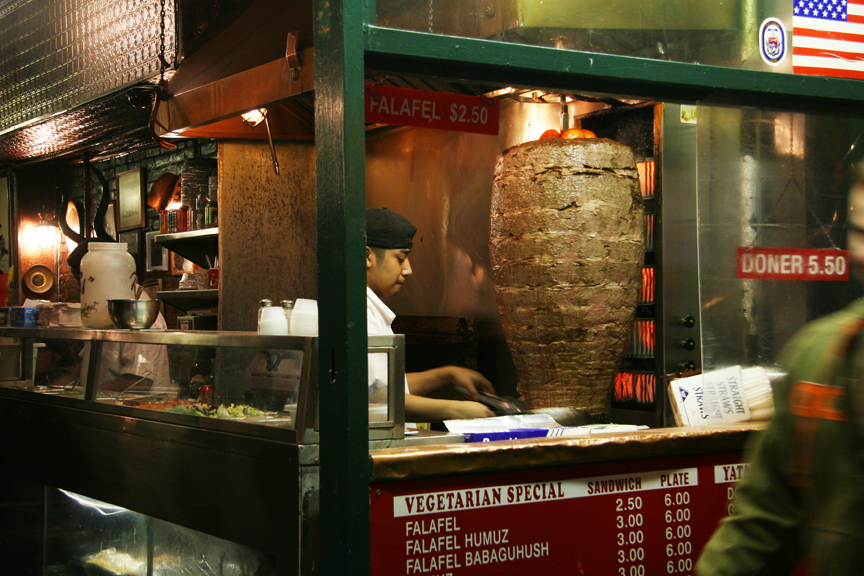
    My brother-in-law is pretty fussy, particularly about food. In the 1980s, he and my sister made frequent visits to the city. Although our budgets were much more limited at the time, there was no way that he was going to eat anything that was called Shawarma or looked like the hunk of meat on a spit in the photo. No “mystery meat” for him. On a hot summer’s eve, strolling down trash-littered MacDougal Street, eating a food like this being sold streetside was a line he would not cross. In his defense, I must agree that that spit of meat on MacDougal Street has never been very appealing.

    To this day, shawarma is a great little source of humor between us, and the mere use of the word will elicit chuckles, if not guffaws. But shawarma is a serious food served in countries around the world.
    Shawarma is a middle Eastern Arabic sandwich. The meat may be lamb, mutton, beef, goat, or chicken (and occasionally mixtures). It is skewered and roasted on a long spit and served in a pita, typically with tomatoes, onions, and yogurt sauce. There are a myriad of spellings* and the sandwich is similar to others in the region, such as the Gyros of Greece or döner from Turkey. Yatagan, at 104 MacDougal Street, serves the Turkish variant known as döner kebab.

    I keep an open mind and in reading various food reviews from many different sources, I find that numerous diners love a good shawarma or döner, and Yatagan appears to please. Comparison reviews of their döner kebab with others in the immediate area appear favorable. The falafels here are also touted by many to be superior to that of Mamoun’s, a village standby.

    However, there is more mystery here than in the meat. According to the New York Times, on October 22, 1987, the owner of the Yatagan Kebob House, Gultekin Ismihanli, went beserk:

    “A 42-year-old restaurant owner barricaded himself inside his Greenwich Village apartment last night, fired six shots from a .45 pistol into the air and held the police at bay for eight hours before surrendering early today, officials said. No one was wounded in the incident, which began around 4:25 P.M. when the man, Gultekin Ismihanli, fired the shots out of the second-floor window of his apartment at 106 Macdougal Street at Bleecker Street, the police said.”

    No reason was given for the incident. Perhaps my brother-in-law was right and there is something to fear in that amalgam of twirling mystery meat 🙂

    *Note about Shawarma: The word, which means turning in Turkish, is an Arabic transliteration, and like most middle eastern foods, the spellings are many: Shawerma, Shwarma, Shoarma, Shaorma, etc.

  • Continental Divide

    Most likely you have never been to Corona, Queens, and most likely you will never visit either. You will not read of any gentrification movements there or of an exodus of disenfranchised Manhattan artists discovering the neighborhood. This is a working-class neighborhood – at one time predominantly Italian and now 75% Hispanic. Like many area of Queens, the neighborhood has a broad ethnic diversity – Mexicans, Dominicans, Bolivians, Ecuadorians, Colombians, Guatemalans, Peruvians, Asians, Pakistanis, and Italians.

    I say you will likely not travel there because the rivers of this city that separate the boroughs are in many ways like the Great Wall of China. A body of water can be a big cultural divide – it separates countries, states, cities, and, in New York City, the boroughs.

    The rivers of New York City are also a tremendous mental impasse. With the exception of commuters, most will rarely cross one even if the distance and travel time is short. Central Park seems nearer to a downtown Manhattan resident than a closer destination in Brooklyn. So there must be a very good reason to leave your borough, and visiting Corona will not usually be a good reason.

    Each borough, and even each neighborhood, is a world unto itself, and many find little reason to leave it except for work. The population density of New York City supports an incredible range of services in a small area. Many Manhattan residents get much of what they need in walking distance of their home – a great luxury and convenience. Step out of your apartment, and there is a universe of goods and services a short stroll away. This is true to a lesser extent in the boroughs, where you have larger tracts of residential housing without commercial establishments. However, every neighborhood is like a small town, and its center typically has its own set of services.

    Many of the neighborhoods in the outer boroughs are dominated by one or more ethnic groups; traveling to these lesser known neighborhoods can be culture shock. There are signs in other languages, unfamiliar foods, and unusual dress. The pace is slower. And here, extravagance is out of place. Money is real and careful husbandry the rule.

    So, with a sudden break from our frigid weather and temperatures in the 50s, Sunday seemed the perfect time to sample the goods without waiting until summer. I am sure I was the only person who drove from Manhattan to Queens to sample Italian ices at the Lemon Ice King of Corona (which is open all year). The ices have been made by Pete Benfaremo for 58 years at the same location.

    It was chillier than expected, and a friend and I found ourselves alone when we arrived at the Lemon Ice King at 108th Street and 52nd Avenue. I felt a little awkward and foolish. The clerk apparently did not share my enthusiasm or spirit of adventure.
    There were few patrons, and I did not know that there was no indoor space for customers. So, after choosing our flavors from a selection of 20 plus flavors at the street counter, we ate our ices standing on a blustery side street while seeking as much sunshine and as little wind as possible. See here for a peek inside.

    And did the ices live up to their legendary status? Honestly, we both found them too sweet, virtually killing the flavors. But perhaps I will try again on a warm summer’s eve and when I am in the mood to travel across a continental divide…


  • No MSG

    At one time in New York City, MSG and its avoidance were big dining concerns. In April 1968, Robert Ho Man Kwok wrote a letter to the New England Journal of Medicine and coined the term “Chinese restaurant syndrome.”
    In 1969, an article appeared in Science Magazine which linked the syndrome to MSG. Many symptoms were attributed to the Chinese Restaurant Syndrome, such as numbness, chest pain, headache, nausea, rapid heartbeat, drowsiness, and weakness. The whole issue is extremely contentious – glutamate is an amino acid which occurs naturally in many foods. Scientists are divided, and no definitive studies have linked MSG specifically with these symptoms.

    In NYC, we have the largest Chinatown in the USA, and Chinese food has been one of New York City’s most popular cuisines. So, understandably, amid all this, concern for MSG reached a fever pitch particularly when eating Chinese food – consumers were worried and waiters were interrogated about the presence of MSG in meals. Restaurants responded, and soon the phrase “No MSG” appeared on Chinese restaurant windows and menus everywhere, a counterpoint to the ubiquitous “No Radio” in automobile windows on the streets (see my story here).

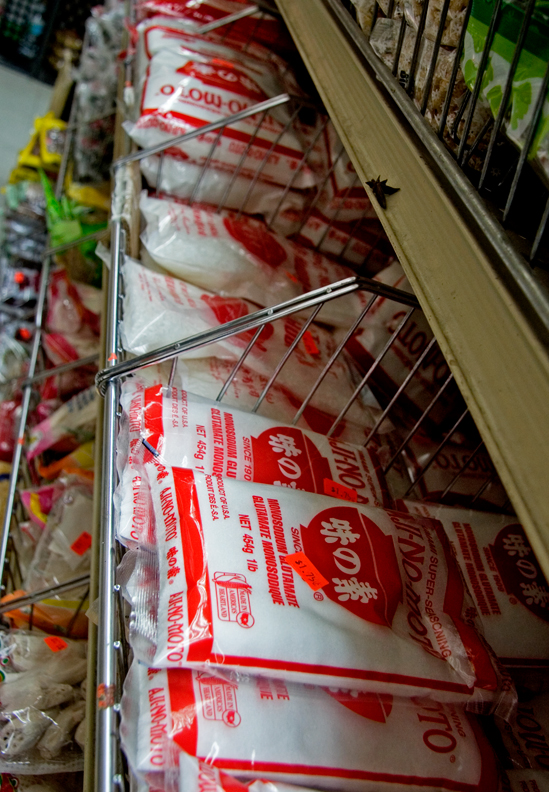
    But there is an unbridled audacity here in New York City, and even with heightened sensitivity to many issues, many will act in opposition to prevailing attitudes and practices. I once saw a woman in a vegetarian restaurant wearing a full-length fur. So I should not have been surprised that even after 4 decades of anti-MSG sentiment, I would walk into a store in Chinatown in 2009 and find a virtual MSG section. This store is apparently completely unfazed by any concerns about MSG. It was not a small inventory of a branded version like Accent or a few containers hidden discreetly.

    No, here at Tan Tin Hung at 121 Bowery, you could find a long shelf of the white powder in clear plastic bags with generic type in bright red prominently displayed in the first aisle. There were variants in granular size and bag weights. You can buy it by the pound here.
    This is America, and although it is getting more difficult to poison ourselves and others, we still have the right to have headaches if we want 🙂


  • Stemming the Tide

    There is a nervousness in this country like nothing I have ever seen. Worry runs deep, and New York City, with all its wealth, has not escaped. It is difficult to find places where all feels well, and even in affluent neighborhoods, many retailers do not look or feel well. Even the Haves worry about the plight of the Have-Nots, because, perhaps, for the first time, some of the Haves see a possibility of joining the ranks of the Have-Nots.

    Yesterday was Inauguration Day, and President Barack Obama takes the helm at one of the worst times in this country’s history. In spite of a renewed hope fueled by a new, young administration, the markets plunged over 4%. There had been an expectation of a nice bounce, but the realities outstripped any false euphoria. Everyone realizes that this is a very grave situation. Today’s New York Times headline reads “After a Day of Crowds and Celebration, Obama Turns to Sober List of Challenges.” Sober is the operative word.

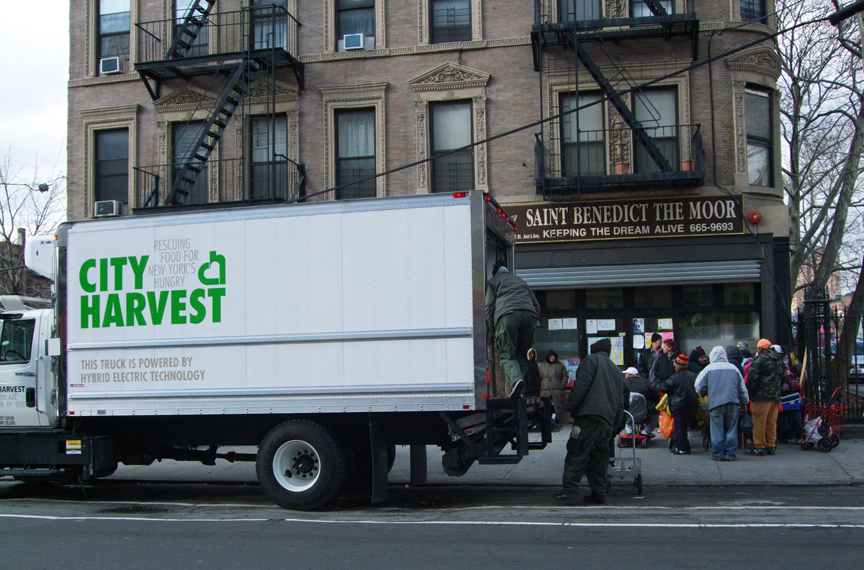
    City Harvest, founded in 1982, is the world’s first and New York City’s only food rescue program. The organization rescues 60,000 pounds of food per day, delivers to more than 600 community food programs throughout the five boroughs of New York City, and serves over 260,000 people weekly.
    Even the soup kitchens and food pantries themselves have problems – a shortage of donations of food supplies and an increase in the numbers of people using food services. An article in the New York Times last November reports a steep rise of between 20-40% of demand for food aid nationwide.

    I do believe, however, in the resourcefulness of humankind as well as our ability, when inspired and focused, to achieve the unexpected and stem the tide. A president can only do so much, but a good leader goes a long way to provide impetus. Let us hope that President Obama is that man…

    Photo Note: This photo shows a City Harvest delivery of food to the soup kitchen St. Benedict the Moor Center at 283 St. Ann’s Avenue in the Bronx.


  • Pierogi

    I have written often lately of diners and comfort food. And for pure classic comfort, it’s hard to beat the Ukrainian/Polish/Russian diners in the East Village, with names such as Ukrainian East Village, Kiev (closed), Polonia, Little Poland, Odessa, Teresa’s, B & H Vegetarian (formerly B & H Dairy), Stage Restaurant, and Neptune.

    Honestly, I am no longer a big fan of food like this. This cuisine’s popularity with young people is built around bulk and value. At one time, I went through a phase, which many New Yorkers do, where the lure of inexpensive and large quantities was irresistible. But over time, the appeal of food based primarily on value loses its appeal.

    Inexpensive starchy foods fit the bill for the hungry, cost-conscious diner. And a virtual necessity with a visit to any Eastern European diner is the pierogi (or pirogie, as well as other spelling variants).
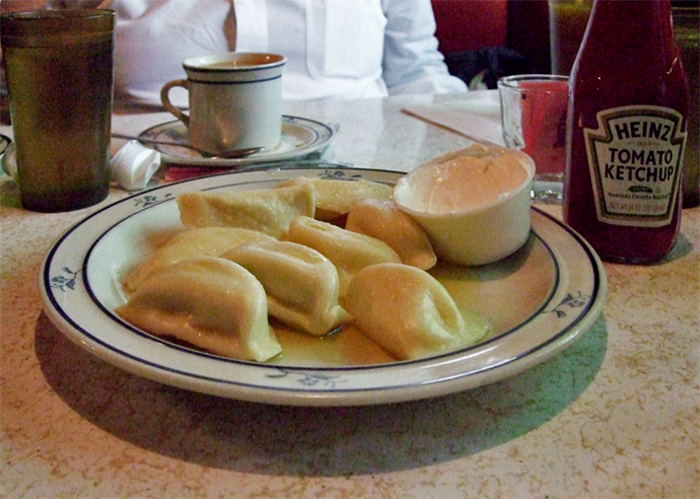
    So, with a number of friends, I recently went on an excursion to Odessa’s, a Ukrainian diner at 119 Avenue A between 7th St & St. Marks Pl in the East Village, with the pierogi as an unarticulated, assumed part of the brunch mission. One of my compadres ordered plates of both boiled and fried pierogies. I only had one in stages of halves – that was adequate to satisfy my appetite.

    For those unfamiliar, the pierogi is an Eastern European dumpling made of unleavened dough, served boiled or pan fried and filled with any number of items – potato and cheese is very popular, served with butter and sour cream. They are eaten by the Polish, Ukrainians, Russians, Belarusians, Lithuanians, Latvians, and Slovaks, with the pierogi sometimes going by different names.

    The menu also features items  such as kasha varnishkas, blintzes, potato pancakes, and challah bread. If you want to wage war on the dietary guideline of no more than one starch per meal, head for Odessa or one of its kin and you can make a meal of nothing but starches 🙂


  • Greasy Spoon

    The same friend who introduced me to bankfacing money is the man who, one morning during my first college days, asked if I wanted to eat at the greasy spoon next door. To which I replied, of course, “What’s a greasy spoon?” I was informed that it was basically a diner and that the term greasy spoon suggested a place where utensils might not be as clean as one might hope for. But I had a sense that this was to be an authentic, edgy, New York experience and another small rite of passage to the city. So we went, and it was fun.

    Memories like these and the desire for simple pleasures can drive one to nostalgize, romanticize the past, and make the mistake of trying to recapture those feelings by recreating the experiences. The new experiences, however, do not often measure up to the past memories, and one wonders whether the past was as good as one remembers (see the great quote from Jill Eisenstadt in my posting Better When).

    Certainly some diners are better than others, and my breakfast with my aforementioned friend at Joe Jr’s on a recent visit of his to the city was fun. And what choice do you have but to eat breakfast at a diner when a Brooklynite comes back to town to visit and he’s the man that introduced you to greasy spoons? This outing, as well as recent postings on Joe Jr’s and the Anthora coffee cup, inspired my recent visits to local diners.

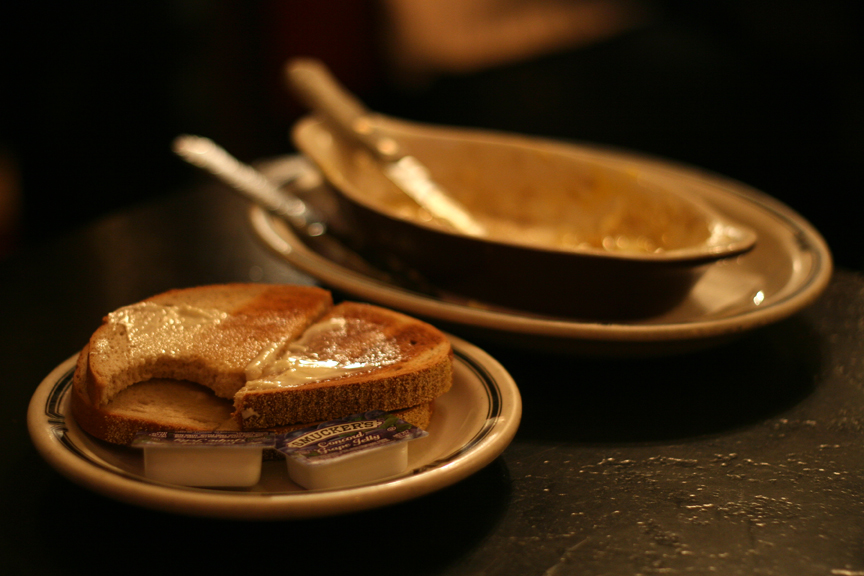
    My expectations of diners are realistic, and I am capable of adjusting my food standards. I have also learned lessons from the past and realize that one should narrow one’s choices to those things diners do best, or should I say those things diners do least poorly, like burgers (which I don’t eat), fries (which I love but try to avoid), and eggs (which I eat rarely). So, I opted for Eggs Benedict. A mistake. Sauces, like hollandaise, should also be avoided in a diner. The whole meal became rapidly unappetizing – eating it became a test of will. Everything was so salty, including the butter on the toast.

    What does all this have to do with New York City? Although we have some extraordinary dining establishments, many like comfort food and diners too. And much of the diner food here is just as bad as diner food elsewhere. I couldn’t even finish that toast…

    Want to know where I had this unappetizing meal? Read more here.


  • No Folding Required

    I don’t think I am going too far out on a limb to say I truly have never met anyone who doesn’t like pizza or will not eat it. I can’t say that about any other food. The appeal crosses cultures and countries. Perhaps because every culture has some variation on bread or pasta/noodles, pizza is not so alien. Unlike delicacies such as partially fertilized eggs (southeast Asia), blood pudding, fried grasshoppers, or any one of the variations of animals’ feet, all will take some mental and intestinal fortitude for the uninitiated.

    In many countries, pizza has become the most popular fast food. In New York City, it is a staple and is the perfect food to be eaten on the run. Fold lengthwise and you can eat it one-handed – now you can be easily mistaken for a New Yorker. Pizza is everywhere in this city – it is one of the most durable foods, resistant to the slings and arrows of food fancy and trends. There have been gourmet players such as Two Boots, but basic New York pizza has been remarkably immune to change. The plain slice is still the staple of many, churned out in parlors in every neighborhood in the five boroughs.

    I was quite surprised to see Vinny Vincenz’s mobile operation. Making pizza out of a truck seems like quite an ambitious venture, but Vinny has actually installed a full-sized, gas-fired pizza oven. I did not try a slice, but online reviews seemed quite favorable. Vinny was born in Carrol Gardens, Brooklyn, and has been making pizza since he was a young boy. He started his pizza enterprise with the parlor located at 231 1st. Avenue. His truck can be found on Union Square, where this photo was taken.

    Regular readers of this blog know that I am a big fan of street food, particularly quality operations where ethnic cuisine is cooked on the spot such as New York Dosas, which can be regularly found on Washington Square South.

    Vinny specializes in Sicilian-style pizza, perfect for the New Yorker or visitor on the go – no folding required…

    Related Postings: Two Boots, Street Cuisine, Lunch Limbo, Soup Kiosk, Trucks and Things, Bon Appetit (Dessert Truck)


  • Waldorf Salad

    I have a relatively restrictive diet these days, so it is hard for me to justify spending $95 on a brunch. But if I did feel that I could take advantage of the offerings, I would certainly try the Sunday brunch at the Waldorf Astoria hotel. I have written of this hotel a number of times before – if you have not been there, I highly recommend a visit. Seeing the public lobby space is a voyage to a time gone by.

    Staying at this grand dame is not as rarefied an experience as one might expect. It has become the hotel of choice for my family’s occasional visits to New York. With Internet discount websites, very good deals can be had on rooms at the Waldorf.

    In the course of my visits there, I have watched the magnificent spectacle that is the Sunday brunch. This minor weekly event is served in the Main Lobby of the hotel, so the nonparticipant can easily see the offerings in what has to be one of NYC’s finest brunches. Diners are seated in the Peacock Alley restaurant (opened in 1931) and private dining salons.

    The sumptuous brunch is put together by French chef Cedric Tovar, who earned his reputation at legendary, Michelin-starred Parisian restaurants such as La Tour D’Argent and Plaza Athénée Hotel Paris. I’m impressed that such quality can be maintained in a large, buffet-style meal. Buffets can very frequently become feeding at the trough – selecting food can feel like picking over someone else’s leftovers and quite unappetizing. At a first-class offering like this, however, you can put any of these concerns aside.

    The food choices themselves are, of course, spectacular, both in quality and range. Everything imaginable is available. Not to mention that technically, this is a no holds barred, all-you-can-eat affair with no restrictions. I doubt, however, that this brunch attracts the typical all-you-can-eat urban or suburban forager.
    And yes, unlike Fawlty Towers*, they do serve Waldorf salad…

    *For those unfamiliar, Fawlty Towers was a brilliant British sitcom from the 1970s starring John Cleese. Only twelve episodes were made but a lasting legacy remains. In one episode, “Waldorf Salad,” an American guest is frustrated in his inability to order a Waldorf Salad. Proprieter Basil Fawlty, unfamiliar with the salad or ingredients, feigns knowledge – the skit quickly escalates, with Basil going into an outrageous charade. Highly recommended, as are all the episodes.

    Related Postings: The Plaza, Waldorf Astoria Clock


  • Phoenix Rising

    West Eighth Street is an anomaly is this city. As one New York Times writer said, this one block seems to be defying the laws of gentrification. The center Village is one of the most expensive and desirable neighborhoods in New York City with multimillion dollar apartments as the norm, yet West Eighth Street’s merchants are a motley crew of businesses that cater primarily to tourists. Once known as the “shoe block,” the street sported dozens of shoe stores. Only a handful remain.

    The most telltale sign of trouble are the closed stores. Depending on the day, it is possible to see as many as 20 plus stores vacant on one city block.
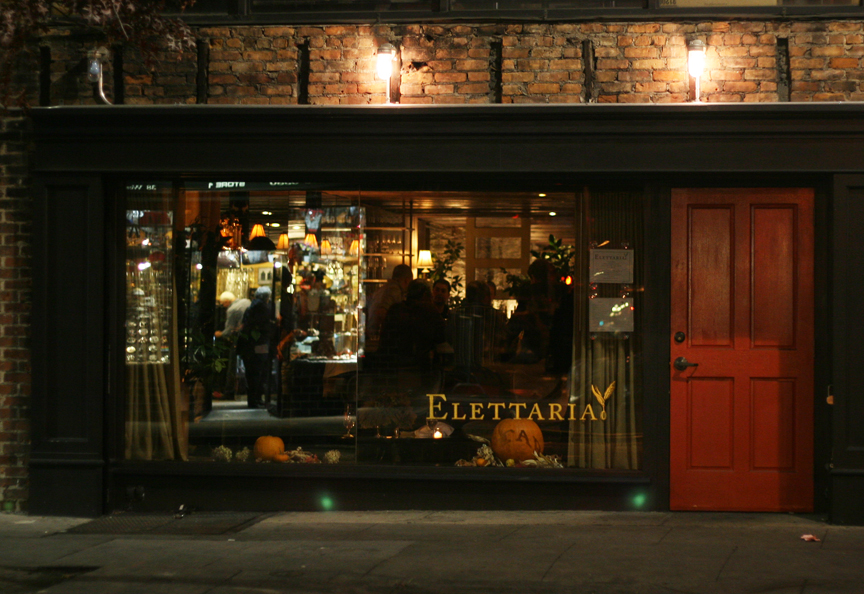
    But lately, there have been signs of hope that West Eighth Street may rise again, with the opening of two cafes, a winebar, and Elettaria at 33 West Eighth Street.

    We residents hope for this, not because we embrace gentrification and rising rents, but because we would like to see quality businesses, at least some of which provide useful services to the neighborhood.
    Elettaria does not exactly fit this description, but it could be one of the first signs of a break from the type of retailers this street has seen for as long as one can remember. The restaurant has had a lot of buzz and media coverage. It is extraordinarily upscale and chic for the street, albeit even a little intimidating. Until recently, it didn’t even post a menu in the window. The food reviews are generally quite good, with articles appearing this year in both the New Yorker magazine and the New York Times. The menu is unique: an Indian/Filipino/American fusion. Chef Akhtar Nawab and partner Noel Cruz have pedigrees that include the Gramercy Tavern, French Culinary Institute, and Craftbar. Negative reviews appear to be primarily leveled at the service.

    There was a time where Eighth Street and its environs actually had the types of places emblematic of its artistic heritage. The original Whitney museum was here, as was the New York Studio School of Drawing, Painting, and Sculpture (still operating). In the early 1900s, the area was already an established art district (see my posting on MacDougal Alley). From 1900-1950, there was a community of some 200 artists who lived and worked in the two blocks north of Washington Square (see Left Bank New York). Elettaria’s space was formerly a club, the 8th Wonder, where Hendrix and others played in the 1960s. Hendrix’s Electric Lady Studios is still in business on the block.

    One neighborhood activist I know predicts that Eighth Street will rise again. I hope so…

    Note about the restaurant: The name Elettaria is a species of cardamom, one of the world’s most expensive spices. You can visit the restaurant’s website and menu here (Update 1/9/12: Link no longer works).


  • Fisherman’s Widow

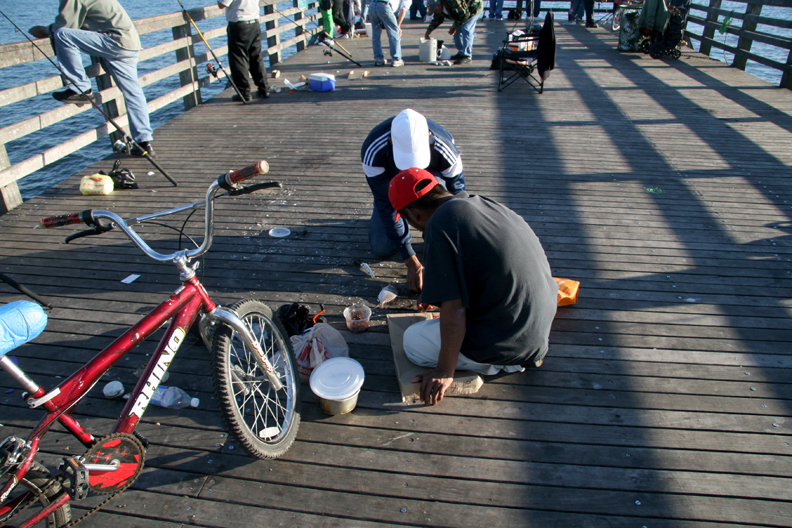
    Yes, this is New York City, and yes, we have fishing, too. On my recent excursion to Coney Island, we made the requisite trip to the pier from the Coney Island boardwalk (I have seen it referred to as Steeplechase Pier).
    There are actually many spots around the city, even Manhattan, where fishing is permitted, and with the waterways becoming progressively cleaner, much of the fish is now edible. This catch of Porgies was being sold for $10.
    I see that it is a relaxing way to spend a beautiful day amidst the natural elements – sun, sand, sky, water, and fresh sea air.

    Although the sight of dying fish is not the most pleasant one, this is perhaps more shocking to the city dweller who is very divorced from the entire process of bringing fish and meat to the dinner table. After all, fish don’t just appear filleted on a dinner plate – they need to be caught, cut, and cleaned. Many urbanites have probably never even witnessed anything other than fish being cooked and served. Baiting is part of the process, too, and the pier was dotted with fishermen cutting fish for bait or putting their catches into plastic pails (see here).

    I am not a fisherman, but my father was, and over time I have learned to understand the passion for this activity. For some, it becomes an obsession, occupying virtually all of a fisherman’s mind. I recall traveling with my family and seeing some beautiful vista which had a body of water, and my father’s first thought and immediate comment was that there was probably good fishing to be had there. At one extreme, there are men so addicted to fishing that many of their estranged wives have become known as “fisherman’s widows”…


  • Moveable Feast

    There are healthy measures (and medicines) one should take. But most are not enjoyable – they all involve some degree and elements of deprivation, denial, restriction, discipline, and holding one’s nose. One of the great joys of living in this city is that many of the things one should do or see are very enjoyable. It’s like waking up one day to the New York Times and reading that the American Medical Association has just found that the healthiest thing you can do is eat Häagen-Dazs chocolate ice cream every day.

    Here is why we do it – the answer to what is so perplexing to many visitors – why we would endure such hardship to live here, where ordinary tasks can become such large endeavors. The answer is that living here can be like being a boy or girl in a candy store, with its plethora of culture and activities, all so convenient, typically a walk or short subway ride away. And, like any good shop, there are new products and the old standbys.

    Visiting Palm Court at the Plaza Hotel is to sample one of those delectable confections New York has to offer. As many an old standby (the Plaza dates to 1907), traditions remain, and one is the afternoon tea, which has been recently been brought back to the Palm Court – a magnificent room with a European flair.
    Welcome to a world with harp and classical guitar, tables with the finest linen, crystal, Bernaudaud-Limoges china, Christoffle silver, outstanding floral arrangements, high-backed blue velvet upholstered chairs, and memories of fictional character Eloise (who lived in the hotel). Ellen Easton serves as tea consultant, and pastries are made by Executive Pastry Chef Nicole Kaplan, named as one of the top ten pastry chefs in the USA.

    Dine under the Palm court’s recently recreated stained-glass laylight while surrounded by palm trees. The Palm Court tea menu will set you back $60, so if you don’t have a desire to finance a meal here, at least drop in and feast your eyes…

    Related Posts: The Plaza, Stairway to Heaven


  • Curriculum Vitae

    Intellectually, I understand the consumption and love of hot chili peppers. I have read that the ingredient responsible for a pepper’s heat, capsaicin, will release endorphins, explaining the euphoria that many pepperheads have attributed to the consumption of chills. And I imagine, like any drug, one can develop a tolerance and desire for a stronger drug.

    But at a gut level, I cannot understand how people actually enjoy peppers so hot that they can entirely numb one’s mouth and lips or require special handling. There are cases where unchewed chilis have been known to perforate the bowel.

    There is a Scoville scale that rates the hotness of peppers by the level of capsaicin (based on parts per million) from 0 to 15,000,000 units (pure capsaicin). Habanero peppers are extremely hot and have a Scoville rating of 100,000 to 580,000 units (Red Savina Habanero).

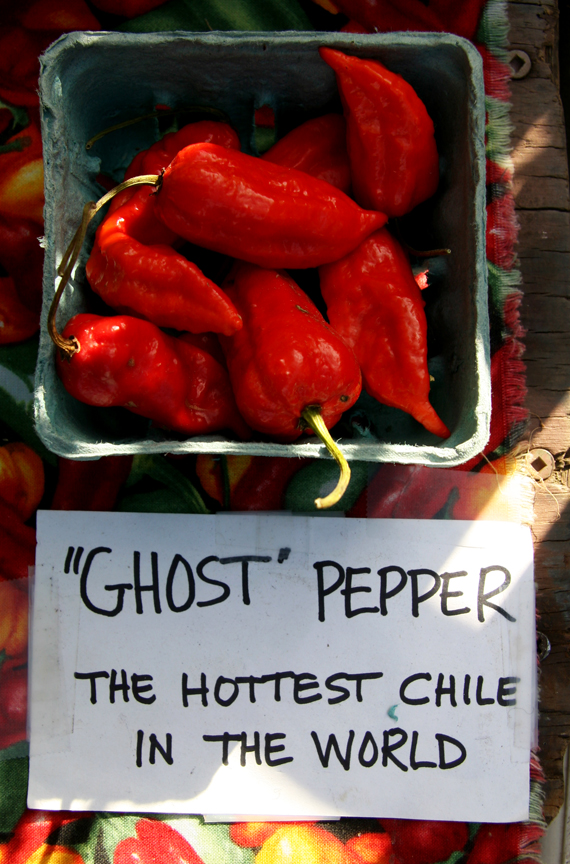
    In 2006, the Ghost Pepper (Naga Jolokia or Bhut Jolokia) was discovered in India. Testing revealed a Scoville rating of over 1,000,000 units, making it the hottest chili pepper in the world.
    This is fascinating, but does any one need a chili pepper three times as strong as the average Habanero? In a country that loves to quantify, and where bigger is better, I suppose it would be a badge of honor to have this chili in your curriculum vitae…

    Photo Note: This photo was taken at the Union Square Greenmarket at the Eckerton Hill Farm produce stand – they always have a tremendous array of chili peppers. See more Union Square Greenmarket links in my posting on Heirloom tomatoes.


  • Hot Dogs and Fries

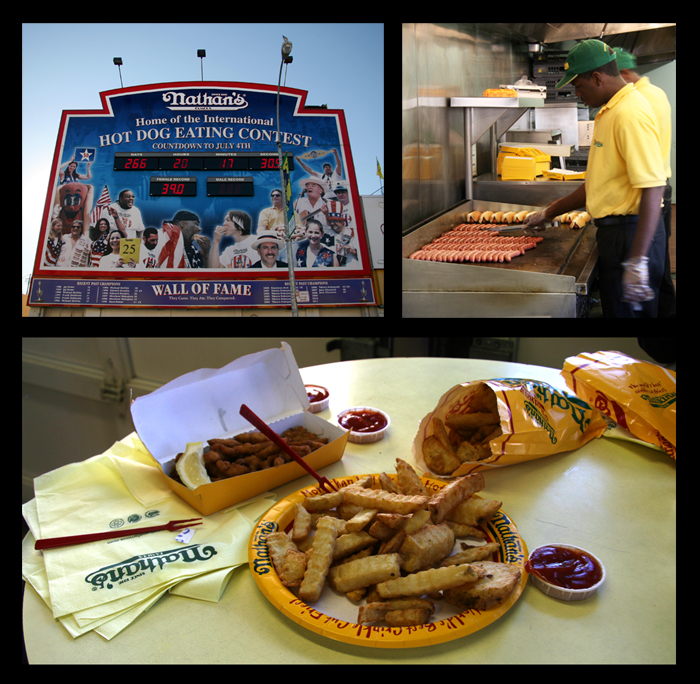
    As a child, I loved hot dogs. In fact, were it not for dietary concerns, I would still be eating them. And as you descend the slippery slope of fast food and stratospheric calories, you might as well throw in some French fries. On my recent pilgrimage to Coney Island, which I wrote about yesterday, four of us decided to stop by the original Nathan’s Famous on Surf and Stillwell Avenues in Brooklyn, started in 1916 by Nathan Handwerker. I wrote of Nathan’s in 2006 (see here).
    We had decided to snack only and ordered French fries and fried clams. For myself, since I eat fries so infrequently, there are only good fries or very good fries.

    What’s more American than hot dogs and fries? Eating to excess, so a hot dog eating contest is the perfect American sport. Since 1916, Nathan’s has been sponsoring a hot dog eating contest. In 2007, the Japanese hegemony was finally broken by Joey “Jaws” Chestnut, eating 59 dogs in 10 minutes, beating Takeru Kobayashi, who had held the record for 6 years straight.

    I learned today that competitive eating is actually an official sport with an organization: International Federation of Competitive Eating (IFOCE). They sponsor more than 100 international eating events. Personally, I find eating contests rather disturbing. At a time where health consciousness, obesity, and food-related illnesses are paramount, I do not see embracing a sport like this as sending the right messages to society. But perhaps if it were found that eating large amounts of French fries or ice cream was actually a health benefit…


  • Joe Jr’s

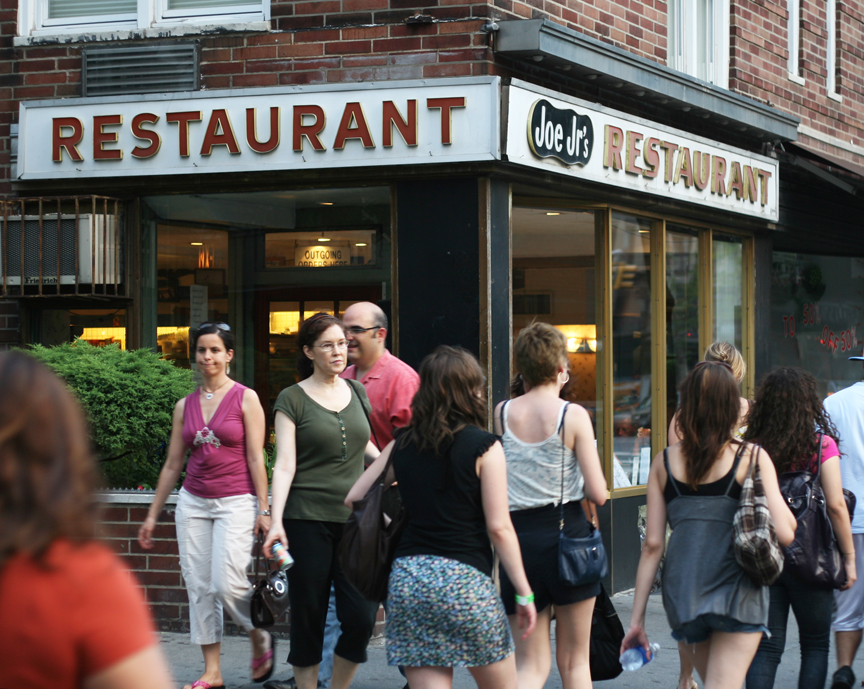
    Many New Yorkers enjoy comfort food as much as their suburban brethren, and in America, the restaurant of choice for comfort food is the diner. These places appeal to Americans for so many fundamental reasons: large portions, low prices, long hours (many are open 24/7), fast service, and typically an enormous, extensive menu of virtually every staple in the American diet – even breakfast items can be had all day.

    Of course, in New York, we just love those legendary places, and iconic diners are no exception, with places such as the Market Diner in Chelsea and Moondance in SoHo, which made big news when it was sold and completely moved to Wyoming in 2007.

    Food reviews at diners are mixed. Much depends on individual tastes and also the type of dish ordered. Food quality can vary more than in a typical restaurant – a place may be good for burgers and breakfast but not great for filet of salmon. The safe bet is to go with simple, low risk, “standard” fare.

    Joe Jr’s Restaurant gets rave reviews, with numerous patrons calling it the “best diner on earth” and other superlatives. I have only eaten there a couple of times, so I leave you to be the final arbiter. Joe Jr’s has two locations – the one in the photo is at 482 6th Avenue, and the second location is at 167 3rd Avenue in the East Village. These establishments have been around since the 1930s and have stood the test of time…


  • Main Street

    I don’t go to cafes often. In over two and a half years of writing for this blog, I have never done a real cafe. The reason? Because there are virtually no “real cafes.” And it is not so much that all the good ones have gone out of business – there were really very few good ones in the many years in which I have lived in New York City. The Figaro Cafe, for example, (recently closed) was never all that great – it certainly was not intimate, charming, or romantic. I would imagine that it was an interesting haunt when it opened over 50 years ago. Most places have been quickly over run by a stampede of tourists. So a person always had to either know of places or hunt and forage.

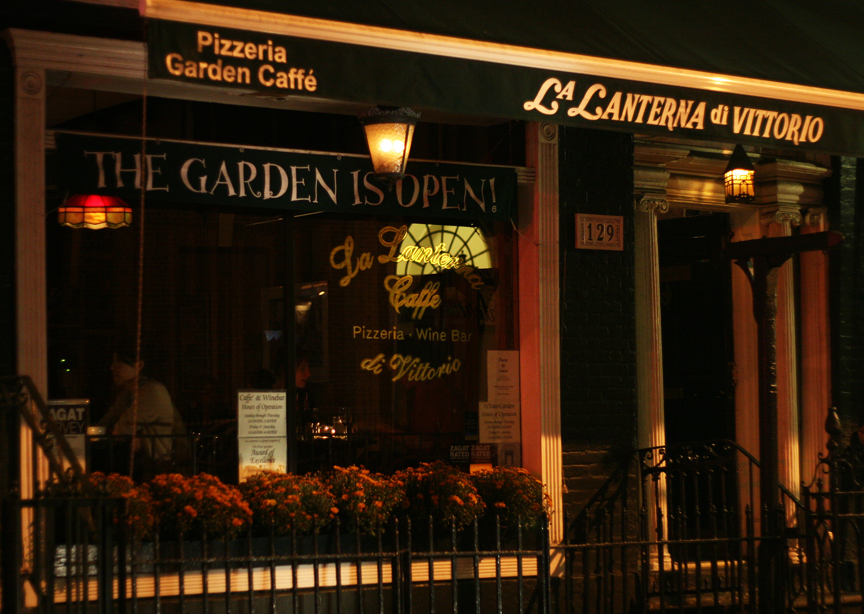
    For me, ambiance is a necessary condition for a cafe, and La Lanterna is one of the most atmospheric cafes I have been in. Two floors each with a fireplace, dark woods, low lighting, and a beautiful year-round garden. Reviews characterize it as frequented by students from neighboring NYU. I cannot attest to this, however, Lanterna is not a real inexpensive place, and the cafe is extremely well-maintained. La Lanterna does not attract a boisterous crowd, and any student traffic is well behaved. Contrast to a place like Think Coffee, for example, which is essentially under assault by students.

    La Lanterna di Vittorio at 129 MacDougal Street was opened in 1976. It offers an excellent selection of pastries, gelato, the requisite coffees, and a wine list. The menu also has a pretty extensive selection of food, enough for a light meal – pizzas, bruschetta, salads, soups, panini, crostini, calzone, carpacci, fish, and cheese. See their website and menu here.

    My only disappointment is that I can not tell you that it dates to the 1800s with a history like that of Les Deux Magots in Paris, or that it is on a wonderful romantic sidestreet like Commerce Street (don’t be put off by the name) or Grove Street. It is certainly not in a secret, off-the-beaten-path location. Ironically, it is located on MacDougal street, a block north of MacDougal’s primary commercial block between West 3rd and Bleecker Streets (if you venture on that block, be prepared for to enter one of the most conspicuously unattractive and touristy streets in the Village.) Perhaps this is one reason that it is often overlooked.

    It’s fine to look in the nooks and crannies, corners, and crevices of New York City for the undiscovered gems – I love that. Just don’t miss Main Street…


  • dinamic_sidebar 4 none

©2026 New York Daily Photo Entries (RSS) and Comments (RSS)  Raindrops Theme