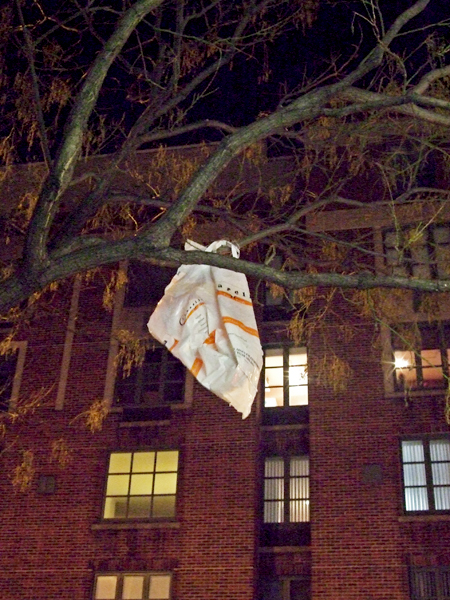
 Decorations of white for the holiday season? Hardly. Plastic bags being blown into trees is a serious problem worldwide. See how extreme it can become in this gallery of photos here. Astounding, isn’t it?
New York City has more than 500,000 trees – candidates as bag magnets. As Clyde Haberman points out in his New York Times article NYC; In Winter, Trees Bear Plastic Fruit: “In summer, leaves obscure snarled plastic. The leaves are also splendid, parks people say, at repelling the polymerized intruders before they can land.” Like chewing gum on the streets, once you start looking for these “plastic fruit,” you start to notice them more.
There is a global movement to reduce/eliminate the use of plastic bags, particularly for grocery checkout. The only really effective way to change behavior with issues such as this one appears to be a financial disincentive. City or country bans on plastic shopping bags usually involve a tax, unfortunately. In Ireland, a €0.15 levy on plastic shopping bags was instated on March 2, 2002 – there was a subsequent 90% reduction in use of plastic bags. China has banned the use of ultra-thin plastic bags. San Francisco has banned non-compostable bags. Much of Europe has various tax levies or bans. Mayor Bloomberg is proposing a $.06 tax on plastic shopping bags. However, this move is controversial – many see it primarily as a revenue-raising scheme disguised as a green effort.
Plastic bags are such a complex issue – any simple assertions concerning their use usually miss some key points. The lists of pros and cons of paper versus plastic are quite long. Paper is not a clear winner – apart from trees, energy is require to produce paper bags, dioxins are released in production, and they do not decompose in landfills. Also, many reuse the bags for trash at home or cleaning up after their dogs, so reduction of plastic shopping bags may result in an increase in the purchase of plastic garbage bags. The best solution is a reduction in the use of bags to begin with.
The reusable shopping bag is a good idea, however, in New York City, this is a problem due to the general lack of use of cars for shopping. Carrying reusable shopping bags is not realistic for most residents, and unplanned shopping also precludes their use.
I think in the end, a real net reduction of energy and materials will require a wholesale change in behavior and habits regarding bags and trash. In years to come, I hope this is not a new interpretation for Irving Berlin’s I’m Dreaming of a White Christmas…
Photo Note: This tree was on Waverly Place near 6th Avenue. The bag was from Citarella, a gourmet food market. At least our tree trash is first class 🙂