• Category Archives Slings and Arrows of NYC
  • Every Inch Has a Price

    Posted on by Brian Dubé

    We price apartments and commercial space in dollars per square foot. We pay for loss factors (unusable space not usable but included as rentable space). Messengers squeeze through tiny spaces (see story here). Subways are overcrowded. Cars are jockeyed in lots and garages at extraordinary rates. People have been murdered over parking spots on the street.

    Some store pots and pans in the oven. Why not leave them in the dishwasher? Who has room for a dishwasher? We move the toaster a few inches to make space for the blender to make space for the dish rack.
    Bicycles hang from hooks in the ceiling. Many pay for off site storage. There is typically no room for washer/dryers in apartments, so most carry their laundry to a laundromat. There are very few tennis courts and rates can run to $100 per hour.

    In New York City, every inch is spoken for, and in that type of environment, every inch has its price – a hefty price. Everything is designed around space constraints. We think vertically. Everything is stacked – apartments, businesses, and their contents. Air rights are bought and sold.

    Hot dog vendors pay extraordinary fees to operate outside the Metropolitan Museum of Art. This is the premier spot in the entire city for street vending of hot dogs. Pasang Sherpa contracted for $642,702.19 per year to the New York City parks department for the right to sell hot dogs there (to close shortly after opening). Then, in 2007, disabled Vietnam veteran Dan Rossi set up shop, acting on an 1894 state law that allows disabled veterans to sell in restricted areas. For free. On a recent visit to the Metropolitan Museum steps (see story here), I spoke to Jose Cabrera, who works for Rossi. Jose is also a disabled vet, having served two tours in Iraq.

    Of course, other veterans have followed suit, and the whole situation is a mess. The city claims that there is room for only one vendor. From the New York Times:

    …there is room for only one vendor because of regulations regarding the location of the carts and because bus and taxi boarding zones must be kept clear.

    Two weeks ago, officers began handing out summonses, in most cases saying the carts were too far from the curb. Vendors said they were in a bind: If they were near the curb, they would be ticketed for obstructing the bus and taxi stops, and if they were farther out on the sidewalk, they would be ticketed for being too far from the curb.

    Dan Rossi has weathered the police ticketing and hot dog vendor battles. Recently, however, the city has been looking to diversify the food options outside the Met and has leased vendor space to Cake & Shake of Long Island City, Queens for $659,350 for a five year period. Read the whole New York Times story here.

    I assumed once someone acquired a license to vend on the streets, they would not be hampered by space constraints most New Yorkers face. But even in the great outdoors of New York City, every inch is spoken for and every inch has a price

    Note: The name Sgt. David Gonzales across the top of the cart is not the owner’s name, but rather that of a Vietnam vet killed in action and friend of cart owner Dan Rossi.

    Posted on by Brian Dubé

  • Philanderers with Fruiterers

    Posted on by Brian Dubé

    There was a fruit vendor on the corner near my office. The fruit and pricing was good and the location very convenient, so my coworkers and I soon developed a relationship as regulars.

    Relationships have certain key elements. Mutual trust, respect, and love. Fulfilling mutual needs. Responsibilities and obligations. A fruit vendor relationship is no different. Often, however, there is a price to pay for the conveniences found in New York City.

    Our vendor was a small and frail man from Pakistan, and we soon referred to him as “the little man.” He was very poor and spent long days in the hot summer sun. We all liked supporting him. Our fondness for him grew. However, like many relationships, there were problems, and the relationship became strained.

    Things were pleasant as long as we purchased the quantity he wanted us to buy. If we wanted a half pound of cherries, too bad – he refused to sell less than a pound. When we asked for a pound, one and a quarter was put on the scale, and it was suggested that we take two. This was four times what we really wanted. And did we want some nice bananas or peaches to go with the cherries? His recommendations were in his hand and being added to our bag, only to be stopped by virulent protest.

    We soon wearied of the daily battles defending our fruit needs and consumption. We could no longer trust him, he had no respect for us, and our love for him had faded. No need for counseling. We were looking for divorce, or at least a trial separation.
    Separation, however, was not so easy. Walk by the fruit man and expect to be greeted, or should I say apprehended. Why didn’t we want any fruit today?

    We were in the worst breakup scenario where, due to circumstances, both parties are forced to continue to make daily contact. Like coworkers or neighbors who have had an affair.
    We found ourselves crossing the streets to avoid him and hiding food purchases from him as best we could. But he was crafty and observant, often hailing us from afar and offering our favorite fruit. But we were steadfast in our avoidance. We had no desire to become like victims of battered spouse syndrome who become trapped in abusive relationships.

    He became angry. Were we seeing someone else? Yes, we were. No use hiding it any longer. He knew our dirty secret. And although the relationship was over for us, in his mind, we were nothing but philanderers with fruiterers 🙁

    About the photo: A real instance of philandering with fruiterers. I patronized this second man for years, however, I now typically shop for fruit with other needs at larger nearby markets. I still buy from him on occasion. I am sure that he knows I am cheating, but he is always pleasant. Some tolerate philandering better than others 🙂

    Posted on by Brian Dubé

  • Quite Refreshing, Really

    Posted on by Brian Dubé

    I am not sure that I buy the idea that “opposites attract,” a phrase often used to defend the pairing of individuals who go together like salt on a wound. On the other hand, I once had a conversation with a friend which I will never forget.

    This individual was very meticulous in his work – he was known for precision in both his practice routines and performance. I also understood that he was very tidy in his personal life. He had lived in a number of places and was a recent transplant to New York City, a place that did not seem very fitting to his temperament.
    One evening, standing in the vestibule of my apartment building, we did some catching up, and he told me why he had moved to the city – for a woman. We exchanged notes about relationships and the difficulties in people accommodating each others styles. The subject quickly turned to living habits and neatness. Knowing this man’s style, I was assured that his girlfriend was like himself.

    However, I was shocked to learn that she was nothing of the kind. She was, in fact, an absolute mess, disorganized, and forgetful. I asked him how he could possibly tolerate living with a woman like that, and his answer was just riveting – “I find it quite refreshing, really.”

    This had a profound effect on me, and subsequent to that conversation, I noticed how being around someone who was easier about the minutiae of life could often be liberating. This is not always successful, of course. I am reminded of the film The Way We Were, where the ability of two very different people (Robert Redford and Barbra Streisand) to get along is painfully tested and results in a parting of ways. In the end, Redford explains that his decision to separate is due to their different styles.

    Having the ability to let go is of tremendous value in a place like New York City. This is not the most hospitable environment for control freaks or perfectionists who want things just so. The city is built on diversity – the beautiful and ugly, the noisy and serene, the rough and polished, planned and spontaneous events. Anyone hoping for a pristine environment conforming to his or her wishes, obsessions, or compulsions is in for a trying time and neuroses. You will be tested at every turn. Give a little, and whether you are looking at violet Veronicas or in the subway, you might find the city’s diversity quite refreshing, really 🙂

    Confession: Today’s posting demonstrates only a half step to full abandon. At one time, I would have felt compelled to know the exact species of plant in this photo, which I do not. However, I did not feel comfortable letting the photo stand on its own without identifying the flowers, so I did email today’s image to a friend and regular reader of this blog to at least get the genus – Veronica, aka Speedwell. The bed of flowers is located in Washington Square Park.

    Posted on by Brian Dubé

  • Tired of Crumbs

    I have a long-time friend who, like I, has been self-employed for his entire adult life. He was a carpenter and, like any freelancer and unlike a small business owner, constantly needed to hunt for future jobs. From time to time, I would inquire about his existing work prospects. If he was between big jobs and only had small jobs here and there, he would just comment that all he had were “crumbs, just crumbs.” Crumbs became our private metaphor for those things which are relatively inconsequential to life. Akin to panning for gold in a world of miners.

    There has been lots of talk lately about gold as an investment and store of value in a time of economic uncertainty. Many have come to America and New York City to stake their claim.
    The very nature of New York City is a place of transients. People come and go for a variety of reasons. Many find that it is not to their liking or fulfilling the dreams they had. The streets are not paved with gold but rather with gold ore, and now require lots of mining.

    Perhaps the prospect of finding gold is one reason I came to New York City, but like any gold strike, e.g. the Internet, the easy money has been made, and little gold will be found lying in plain view. Panning for gold has given way to higher technology. Mining in the modern world and extracting precious metals from ore is going to be competitive and will require special equipment, training, expertise, and investment in tools. Otherwise, if you’re lucky, you are going to get crumbs.

    Of course, in any boom town, the crumbs will be much better than crumbs elsewhere. Street performers, as others, can make much more here than anywhere else. The lure is a mirage and a bit of a catch-22. The potential earnings from vending in a boom town are offset by the cost of living there. Perhaps you can sell eggs for a dollar a piece, but come time to eat, you’re in the same predicament as everyone else. There is opportunity to pick up a few dollars for the wanderer passing through, but how is he or she to live here for any extended time? There are very few margins left to live in.

    At first, the prospect of easy and immediate cash is very appealing, as is a life without a 9-to-5 job routine or other obligations. However, the free spirits that pass through New York City find out very quickly how inhospitable the city is to the less-than-well-heeled. And soon they will see those dollars in their hat or suitcase, just like my friend and me. They, too, will be tired of crumbs…


  • Knock, Knock.

    New York is a city of immigrants, very unlike the rest of the country. It is estimated that approximately 40% of the city’s population is foreign-born, as contrasted with only 11% of the United States overall.
    New York has always been a point of entry for a multitude of immigrants. One need look no further than Ellis Island – 12 million people entered the United States in a period of 62 years.

    There has been a substantial growth in the immigrant population – in 1970, the proportion of foreign-born in New York was less than 18%. The 40% number of immigrants in New York City today has not been seen since 1910, at the peak of the 1880-1920 wave of immigration.
    Many attribute this in part to the growing divide between the haves and the have-nots worldwide, with many people from underdeveloped nations looking to emigrate to the United States and other more economically advanced countries.

    Dealing with immigration has been an eye opening process. Like everything else, there is theory and there is practice, and the reality of immigration, citizenship, green cards, visas, etc. are academic until you are somehow involved.

    Recently, I accompanied a friend for an interview with the USCIS at 26 Federal Plaza. The process was very bureaucratic, as would be expected – the immigration official was looking for very specific things and was rather dismissive of the evidence provided.

    Of course, then there is the very real world of immigrants. Speaking to attorneys working in the field and immigrants themselves, it surprised me to learn that even when an immigrant has illegal status and this is known by the immigration authorities, in New York City, these immigrants will generally not be pursued. Unless the individual is arrested for other reasons, deportation is unlikely. On April 11, 2006, I photographed and wrote about a demonstration of illegal aliens and immigrants. It was both surprising and ironic to see people whose very status was illegal make this known publicly by their active participation in a march.

    Historically, the United States has been a Beacon of Hope and a magnet for those seeking opportunity and a better life. Recently, however, I have heard a number of people both here and outside the country say that there is greater opportunity now in parts of Asia than here at home.

    I know of individuals who have left to return home. I have read other articles about how America will never be the same, that our economic hegemony is finished. Perhaps our Lady of Liberty is a little tarnished, the magnet no longer pulls as hard, and when a land of opportunity says Knock, Knock, we may have to answer, Who’s There?


  • Down on His Luck


    I was not a regular watcher of the popular Western TV series Bonanza, but recently, while surfing TV, I stopped to watch a portion of an episode. I was curious as an adult to see the quality of the writing and acting. In this particular episode, the father, Ben Cartwright, was admonishing a son for being critical of a man who was “down on his luck.”

    Growing up in a family where excuses were rarely tolerated and in a society where taking responsibility for your own life and avoiding victim and entitlement mentality are mantras and truisms, the admonition in that show gave me pause for reflection and has precipitated a rethinking of human misfortune. Certainly many individuals can do more for themselves, and cheaters exist. But sometimes, there are mitigating circumstances, and there is such a thing as bad luck. Without really knowing the details behind an individual’s descent into the streets, it is unfair to make blanket condemnations.

    In New York City, with frequent exposure to the homeless and disadvantaged, it is easy to become inured with their plight. If you read stories of the homeless, some of the life circumstances that led to where they are do give reason for thought. I have become more acutely aware of my good fortune.
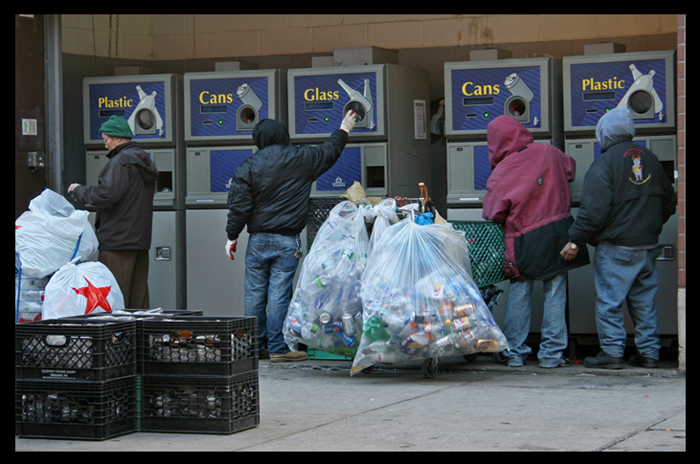
    The can collection center in the photo is located in Harlem at 144th Street and 8th Avenue (Frederick Douglass Boulevard) at the rear of a Pathmark supermarket. This was a no-nonsense group of men working in frigid 14 degree weather with focus and fervor.

    I was never drawn into the survival reality TV shows – no matter what “hardships” are meted out, there are no real serious consequences. For a real glimpse of survival, try the can redemption center, where there is no helicopter waiting to deliver a pizza as a reward for the winner. Surely there must be at least one man there who is Down on His Luck


  • Dwanna

    Her name was Dwanna – a twist on Dwayne because her father had really wanted a boy. She was my sales rep for my catalog printing for some time, and I had occasion to meet her once in person while she was on a business trip to the city.
    When she called to tell me she was moving to New York City, I was quite happy. This could become a nice friendship. She would even be living with her boyfriend in my neighborhood. She had that southern charm but was also an aggressive business woman, and she had plans to make some serious money here.
    But she was gone before I even had time to meet her here once. When I asked her why she was leaving so quickly, her answer could be summarized in two words – too hard.

    I was shocked, really – this was not an unambitious woman at all. But she said it was just too hard. Every little thing which used to be easy, whether laundry, getting groceries, traveling, etc. was just more work than she ever imagined. It wasn’t worth it to her.

    If you live in New York City, you know exactly of what I speak. If you want to live here, you had better be ready for an adjustment. Unless you have enormous wealth, you will be making a number of big changes – you will be walking and lugging, unloading packages from a car or taxi in the rain, walking up flights of stairs, suffering unbearable heat on a subway platform in mid summer, and worrying about your valuables wherever you go.

    The typical, successful New Yorker who has adapted to life here is a survivor – resourceful, tough, and able to switch gears quickly and turn on a dime. Someone who can see and leverage opportunity. That’s why when the weather breaks for one day, musicians will gather in the park just like it’s a summer day. We had a 50-degree sunny day on Sunday, and these musicians turned up in holiday red. Today’s photo captured them doing a spirited rendition of Jingle Bells.

    The question is not Clint Eastwood’s “Do I feel lucky?” but rather “is it worth it?” Luck won’t go that far here when it comes to day-to-day life.

    Whenever I have a tough time, tire of the machinations of ordinary tasks, or think of leaving New York City for an easier lifestyle, I think of Dwanna


  • Shifting Gears

    At one time, I was just fascinated with learning to drive a manual transmission. My first inquiry into the subject was while riding in a car with a 4-speed manual transmission. When I asked the driver what I could learn as a passenger, she said that one of the keys was to work a gear, never lug it. Many neophytes, nervous about when to shift, will often shift too early, lugging and dragging the motor.

    Some people say that they love four seasons and that they would not want to live in a climate which has little variation in temperature. I was never completely convinced, suspecting that these may be individuals who suffer the ability to admit that California is just a nicer place to live. I have known numerous people who have moved west or south and have expressed no desire to move back to the Northeast.

    On the other hand, strongly delineated seasons do require shifting gears, and the change in weather conditions can be enervating – watching snow fall, drinking cider in Union Square in the autumn, awaiting spring’s new blooms, and summer’s outdoor activities. The difficulty, however, is getting through winter. I do not look forward to this season, and like many, my mind turns to tropical dreams when the cold hits. Rather than embrace the season, I resist it.

    My business has brought me in contact with thousands of people from around the world, and I often indulge in conversations with those from remote locales. I once spoke with a woman who lived in the interior of Maine, where winters are harsh and long. This was of particular interest, since my family is from northern Maine and moved long ago to southern New England with no regrets.

    I asked her how she could survive an environment where snow can fall in September and not melt until May, where sub-zero temperatures can run weeks and vehicles need battery heaters to start. She said that the secret was working on indoor projects. A good strategy if this is not just busy work to pass the time and survive mentally.

    Even in New York City, with all its distractions and easy access to places, the winter, with its occasional blizzard, does impose its will. Some will, of course, don the proper apparel and frolic in the snow, but for most, the winter means additional time indoors and a more shut-in lifestyle and degree of reflection and introspection.

    So as we shift gears into winter, perhaps we can heed the advice of a woman from the depths of Maine and a driver teaching how to drive a with a stick shift – always work a gear, never lug it🙂

    Related Posts: First Snow, First Flakes, Winter Walks, Small Gestures


  • Not Good At All

    I am extremely distracted today. Rather than feign holiday cheer and give a Christmas story with photos of holiday windows (of which I have many), I have decided it best to tell my tale of woe.
    It was not a good morning at all. My Macbook Pro desperately needed more storage, so I made the decision to replace the internal hard drive. This is not considered a user-replaceable item by Apple, but thousands have done it, and complete kits and online tutorials are available.

    On December 11, 2007, I wrote Foolish Crash. I would say that today’s event is far from foolish – my drive was completely cloned and backed up. This alone was a nine-hour procedure. To replace the drive itself, I worked with a kit purchased from an Apple Macintosh vendor who has been in business for years. Instructions in their online video were followed meticulously. I even drew a layout on paper indicating the location of every screw removed.
    However, at one point, a cable needed to be removed from the motherboard. When attempting to reinstall the cable, it would not reconnect.

    On close examination, I noticed some extremely tiny objects which appeared to be debris. On much closer examination, I noticed that these were, in fact, minuscule pins which were pulled out when the cable was removed. You can see the pins along with the socket showing the spots for the missing pins.

    During the writing of this article, I have made calls to the best Mac repair specialists in New York City. The news, as you might expect, is not good at all…


  • Pull Ahead

    Sooner or later, a visitor or resident of New York City, regardless of whether he/she owns a car or not, will most likely have to deal with one of the least favorite activities here: parking. Visitors unfamiliar with the situation should be ready for sticker shock.

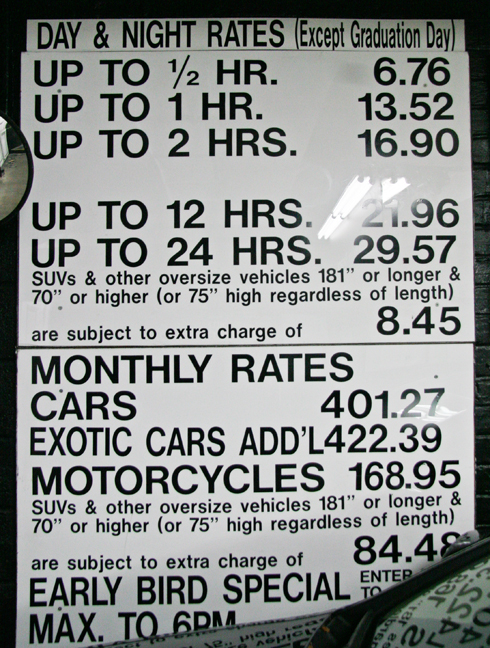
    A careful and resourceful individual can shop most any commodity or service in this city and find a broad range of pricing. However, anything requiring the rental of SPACE is going to cost you dearly here – there is only so much to go around. The garage in today’s photo is $400 per month, with an additional $422 per month for exotic cars. See the rate sign here.

    One fascinating development is automated parking garages. Manhattan’s first is in Chinatown, at 123 Baxter Street. Here, beneath 24 condos, are 74 parking spots in an automated garage. The system is the work of AutoMotion Parking Systems, an American subsidiary of Stolzer Parkhaus of Strassburg, Germany, which has built 28 automated garages in 11 countries since their first in 1996 in Kronach, Germany. Benefits include reduced cost due to reduction of personnel and more efficient packing of autos. See the New York Times article here.

    The wildest twist on parking is a German company, CarLoft (carloft.de), which is building an apartment tower in Berlin that permits residents to park their cars on their balconies. Similar ideas are brewing Manhattan. From the New York Times article:

    A German company, CarLoft (carloft.de), is building an apartment tower in Berlin that lets residents park their cars on their balconies. A New York architect, Annabelle Selldorf, has offered a similar vision for a Manhattan building with elevators that would let tenants drive their cars into garages next to their high-rise apartments.

    There are many other recent developments in the city to reduce cost, increase efficiency, and provide consumers with more information. There are Zipcars for short-term rentals, Internet sites to find parking spots, websites for comparison shopping, and competitive bidding for monthly garage space.
    Some may argue for elimination or drastic reduction of cars altogether. Within city limits and nearby suburbs, the subway or train system is the best method of travel.

    One problem lies with travel to areas outside New York City with no public transportation at all, which is quite common in the United States, even in parts of the Northeast with a high population density. For example, I grew up in Bristol, Connecticut, with a population over 60,000 (the eleventh largest city in the state), but there is no public transportation. Getting there will require car travel at some point in the journey.

    Rail travel is much more deeply implemented in many developed countries outside the US. Here, buses are, by default, the public transportation of choice for many destinations. The Chinatown bus revolution, led by Fung Wah, has brought pricing to much more attractive levels.

    Personally, I always thought a good online rideshare/carpool system would be useful for trips out of the city, not just for commuting to work. There are so many people who travel alone by car – it seems such a waste of resources. My online searches, however, yield few promising results. I think there is a critical mass at work here – without a substantial number involved, there just isn’t enough momentum to make it viable. The websites I found had a serious dearth of rides offered or wanted. Safety with unknown passengers is a big issue here – perhaps one of the biggest impasses.

    There are many problems with automobiles, parking, congestion, and public transportation. There are also many proposed solutions. I hope for successful implementation in the near future, so we can truly Pull Ahead 🙂


  • Babies

    I once asked a friend living in California, transplanted from upstate New York and who had traveled extensively, whether he found that the perception of weather was a relative thing – i.e. did Californians appreciate their mild weather, or did they adjust and reset their thermostats? He answered that it was absolutely relative. He found that those living in California for some time became babies in regards to weather – a slight chill was as daunting to them as a cold Arctic blast was to us in the Northeast.

    I have long claimed that one of the things I like about living in New York City is that the winter does not affect our lifestyles as greatly as it does our suburban and country brethren. That philosophy was tested this weekend when winter finally hit. Until then, New York City has not yet felt the slap of winter’s hand.

    I confess that I had become quite accustomed to our pleasantly warm and very tolerable autumn. I was a bit of a baby this weekend, not wanting to go outside any more than someone living in Maine.  Perhaps less so, because those environments do not tolerate babies.

    Peering out my window, it is bleak, dreary, windy, and cold. People are wearing down coats, hoods, gloves, and scarves. There is no stroll or whimsy in their gait but rather a sense of purpose and direction. In fact, because New York is such a walking environment, something I have long championed and loved, it makes it all the more difficult to brave and acclimate to the onset of winter. Nearly everyone here does substantial walking, even in the winter season – I walk nearly one mile to work daily, irrespective of the season or weather. Even those taking the subways daily must walk both to and from the stations to their destination. There are no autos to shield the wind, garage door openers, or heated seats.

    Winter has not officially started yet, and I certainly cannot stay indoors until the start of spring. I don’t want to be slapped going outside – I prefer the caress of blankets, the sizzle of steam, and the cozy atmosphere of home. But I have some work to do. I need to go out there and demonstrate how this city is just as robust, dynamic, and fun to explore in the winter as any other time. And it wouldn’t hurt to stop being a baby 🙂


  • Luray Caverns

    My first big family trip was to Luray Caverns and the Blue Ridge Mountains in Virginia. For wide-eyed children, the trip met all of our expectations, with the unexpected perk of Southern hospitality, which we all found so disarmingly wonderful that the family still talks of it today, decades later.

    Of course, after a long ride down, a road stop was in order for a hungry family. There was a spirit of vacation esprit, and I was able to order the deluxe breakfast, which, if I recall, was somewhere in the order of 50 cents and came with everything. My father, whose capacity for coffee knew no bounds, was delighted with the unlimited refills policy, something which he had not experienced before. We were all in heaven and had not even set foot in the caverns yet.

    The commercial cavern was an astounding display of dripstone – limestone formations created by the deposit of minerals which precipitate from dripping water. I learned about stalagmites and stalactites and how to remember the difference (“g” for ground, “c” for ceiling).

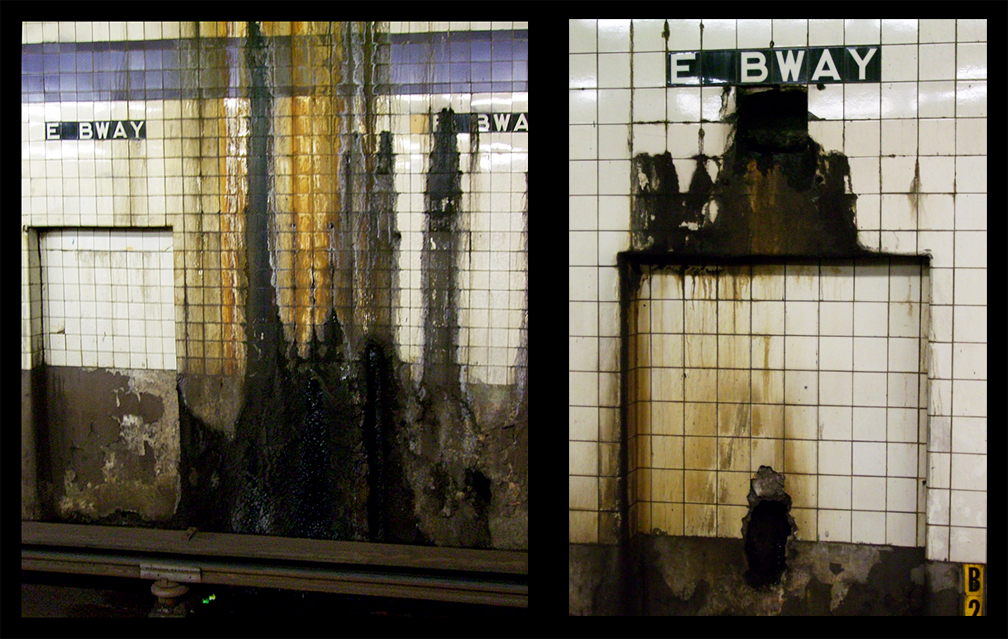
    While looking at the black ooze coming from openings in the hideous walls in the East Broadway subway station while waiting for the F train in New York City, it occurred to me that the same type of mineral sedimentation might be occurring. A conversation with two friends who have worked for a long time at the Transit Authority said the black ooze was a sedimentation of sorts, specifically insulation. They explained the reasons for this in detail – the construction of the walls, tunnels, rainfall, water accumulation, saturation, and oozing.

    The display is certainly not as dramatic or colorful as the world’s renowned show caves, and I doubt that anyone will be running tours. But the black color is so appropriate for a New York City subterranean gothic feel. Our own secret Luray Caverns 🙂


  • Law School

    If you want to be confused and perplexed, try wading through the regulations regarding vending on the streets of New York City. If you want to be disheartened, try looking at some of the facts and figures regarding the vending of merchandise. And if you want to be discouraged from earning a living this way, look at the costs of vending, fines, confiscation of goods, and the uneven application of the law.
    Welcome to the circle of confusion: the world of street vending, where laws are difficult to understand by both vendors and police alike.

    In this economic climate, jobs are difficult to nonexistent. Street vending is a way to earn a living and, for some, a way into the world of business. The costs involved in setting up a retail establishment are prohibitive in New York for most individuals. Many well-known businesses in New York City started on the streets, such as Bloomingdales, Macy’s, Cohen’s Fashion Optical, and Goldman Sachs.

    There are approximately 12,000 street vendors in New York City. There are four categories of vendors: food vendors, general merchandise vendors, veteran vendors, and First Amendment vendors, who may sell newspapers, magazines, cd’s, books, and art on the street without a vending license. There certainly are abuses with First Amendment vendors – a lot of merchandise is sold under this class to avoid the difficulties in dealing with vendor’s licenses and permits, which are extremely difficult to get and have created a black market.

    It is virtually impossible in New York City to get a general merchandise vendor’s license. In 1979, City Council created a cap of 853 on the number of merchandise licenses. There is such a long waiting list that the Department of Consumer Affairs has not taken new names since 1992.

    Food vendors need a license, on which there is no limit. However, they also need a Department of Health permit, which are limited at about 3,000 city-wide. Lotteries are held every few years to distribute any excess permits, but the average wait is still many years. Many food vendors who do not have their own permits enter into relationships with permit holders to use their permits for a fee. There are no limits on veterans’ permits.

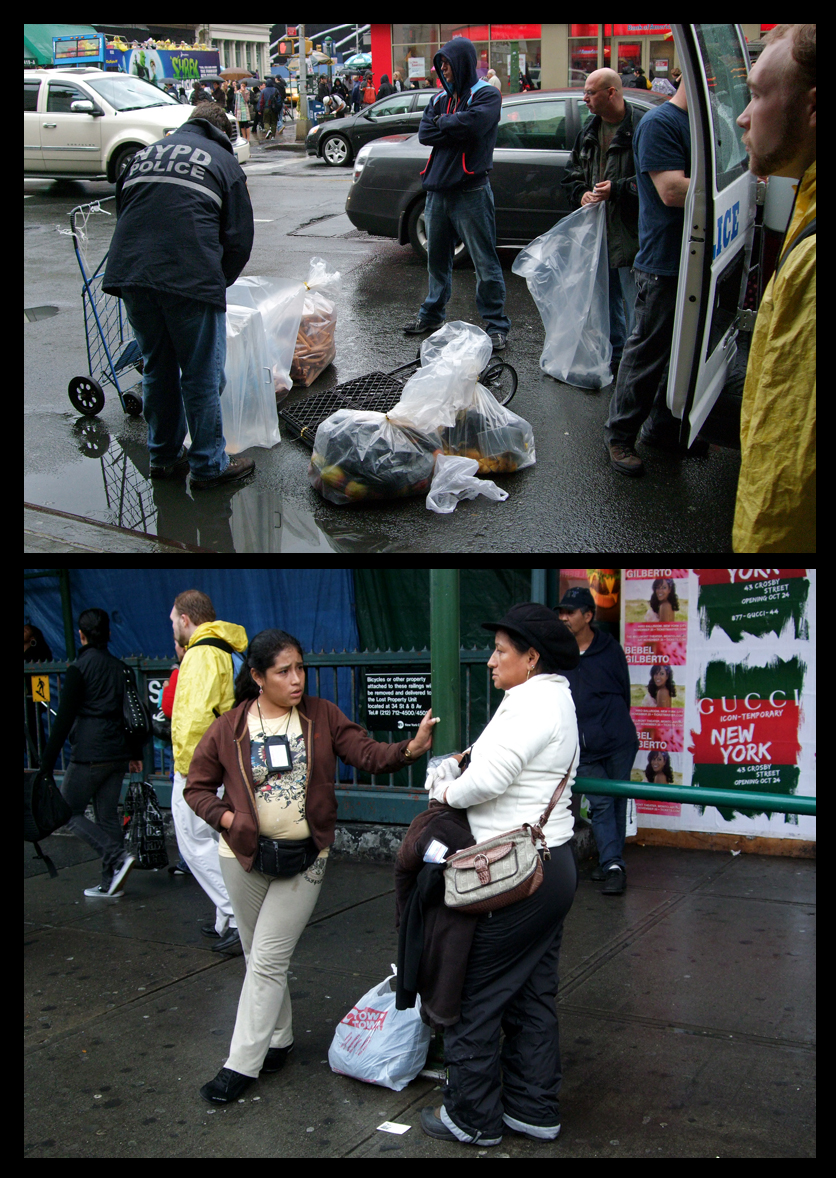
    The women in the photo (on Canal Street) had a vendor’s license but not a food permit to sell fruit. In addition to fines, their merchandise was hauled away by the police. Each year in New York City, approximately 50,000 tickets are issued and 7,000 vendors are arrested. In 2005, the Bloomberg administration raised maximum fines from $250 to $1000.

    There are regulations regarding where and how you can sell: The sidewalk must be at least 12 feet wide (veterans are exempt), and you must be at least 20 feet from any store entrance, 10 feet from a crosswalk, 5 feet from a bus shelter, 20 feet from a sidewalk cafe, and less than 18 inches from the curb. You can not set up over a ventilation grill or touch a fire hydrant or lamp post. There are also regulations regarding the vending table’s size as well as other details. See here for a brochure outlining the facts and regulations.

    Everything considered, a little more money and study will get you a civil service job or admission to law school 🙂


  • One Screw

    I knew times had changed when hardware stores stopped selling screws one at a time and began packaging them. No matter that you don’t want or need twenty pieces of a #8 x 3/4″ machine screw – you’re getting them all anyway. These days, we are happy just to find a hardware store.
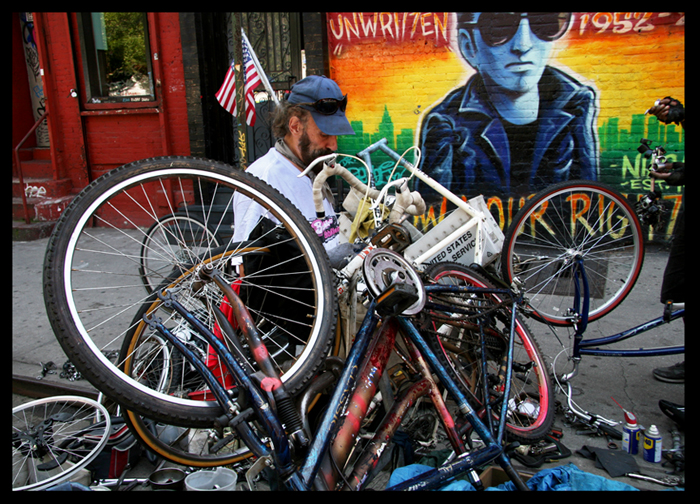
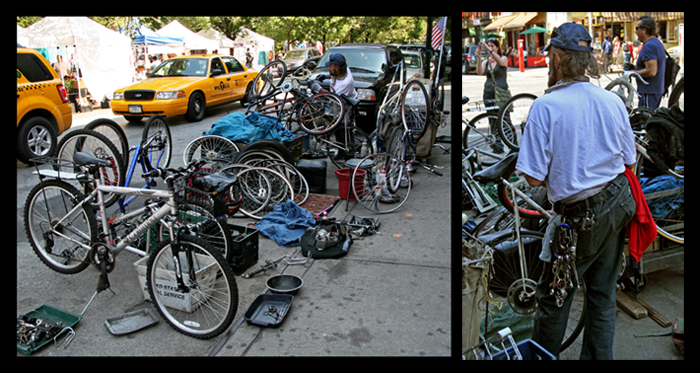
    On the corner of 7th Street and Avenue A, abutting Tompkins Square Park, you will find an outdoor bike repair shop with parts, tools, and bicycles in various states of repair spread curbside on the street. The Bike Man has plied his trade, off and on, in the East Village since the mid-1970s. (He is not alone, however. Natividad Zirate, who hails from California and is homeless, repairs bikes at 2nd Avenue and Houston Street.)

    There are many unanswered questions in New York City, and talking to the Bike Man raises many more. The Bike Man, aka Peter Corbin, is not eager to share many details of his life or background. The New York Times was able to glean a few:

    “At 51, Mr. Corbin is likewise a lifelong bike tinkerer, a vocation that began with his first bike, which he rode for a delivery job when he was a teenager in Springfield, Mass. Unlike Mr. Zirate, he is married, not homeless and claimed to be unaware of any rival shop nearby. His wife Charlotte helps him move his substantial number of spare parts, tools and half-completed jobs to and from their $450 a month apartment on Avenue C to his corner on Avenue A. ‘She works pretty hard,’ he said.”

    Technically, someone like the Bike Man should not be vending without a permit. But permits are virtually impossible to get. There is currently a cap of 853 permits for non-food vendors. The city has a waiting list and is not taking any more names.

    There is often a tolerance and sensitivity by the police in New York City to the character of a community and commonplace activities there. When someone is in violation of the law and the “crime” is essentially victimless, particularly where there is a history of a type of activity, the police may turn a blind eye. And there is great sympathy when someone is working hard and trying to earn a livelihood. Who wants to take someone’s job away?

    A retail shop, paying substantial rent and taxes, is not going to be enamored to compete against street vendors who sell the same goods opposite them, paying no rent, charging no sales tax, and reporting no income. However, New York City has lost many essential services. Who wants Peter Corbin’s work, and who can afford to provide it? Who’s going to sell you that one one screw?

    Note Regarding Vendor Permits from the New York Times: “Veterans are exempt from the permit cap; there are currently 1,678 licensed veteran vendors, according to the city. There is also a First Amendment exception to the licensing process for selling books, art and other speech-related items.” See my story of the Bubble Man here.


  • Great Minds and Fools

    If you have lived in this city long enough, you find your mind often contemplating the consequences of leaving things of value out in the open. It’s not necessarily the product of a criminal mind, but rather one of seeing too much vandalism and too many break-ins. I lived here through a long period of time when “no radio” signs in car windows were an everyday sight.

    The inflexible rule of thumb when parking a vehicle in New York City is to leave nothing in plain view in your vehicle at all. On July 29, 2009, I wrote of this in Urban Coral Atoll, as well as that many owners of luxury vehicles may leave their doors unlocked and “convertibles, top down, parked unattended in the streets of New York City, a clear signal to potential miscreants that there is absolutely nothing of value in this vehicle.” Recently, I saw what appeared to be this anti-vandalism effort mirrored.

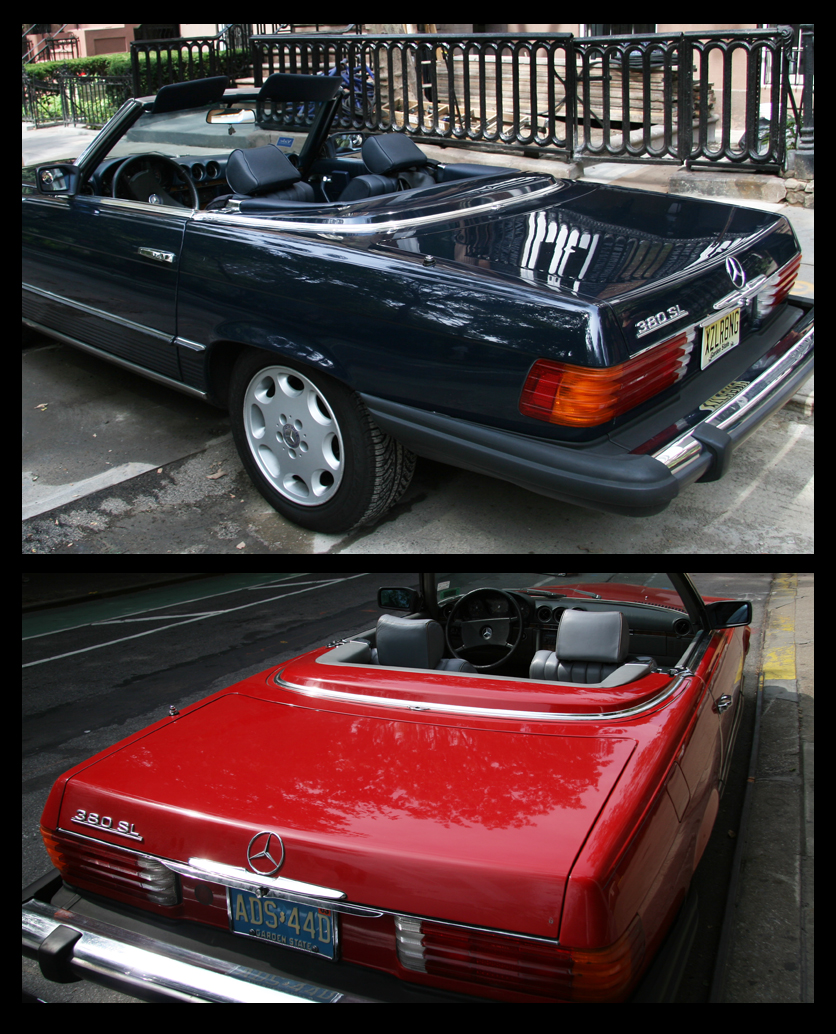
    Walking along Washington Square North, I saw a Mercedes 380SL convertible with its top down – a perfect photo opportunity to illustrate this proactive anti-vandalism parking approach in action. What was more surprising was that just a short distance away, I found another Mercedes 380SL convertible with its top down. Both bore New Jersey license plates. It seemed likely that the owners were friends who shared a passion for the same vehicle and came into the city together for a romp around town.

    Counter measures notwithstanding, owning a luxury vehicle and street parking it in New York City requires intestinal fortitude and some degree of reckless abandon. I have seen owners of Rolls Royces, Ferraris, and Lamborghinis park on the street, even in front of fire hydrants and other no parking zones. If your vehicle is towed, there is the risk of damage in the towing process. Not to mention, of course, the cost of a parking ticket and towing fee, now $185 plus tax.

    However, no matter how you plan or prepare, vandalism is always a possibility, and to leave a luxury vehicle on the streets of New York City is unfathomable to me. At times, I feel badly and assume that the owner may just be a visitor, naive regarding the realities of the streets of New York. At other times, I imagine that the owner may be a conspicuous consumer, flaunting the sign value of his car, as if to say, “Don’t worry. I have enough money that if I am towed, a few hundred dollars means nothing. If the car is damaged, I’ll just have it repaired. And if is stolen, I will just buy another one.”

    Is parking two Mercedes convertibles with tops down on the streets of Manhattan a case of Great Minds Think Alike or Fools Seldom Differ? 🙂


  • dinamic_sidebar 4 none

©2026 New York Daily Photo Entries (RSS) and Comments (RSS)  Raindrops Theme