• Category Archives Slings and Arrows of NYC
  • Urban Coral Atoll

    Posted on by Brian Dubé

    Those inexperienced with urban auto break-ins will often leave valuables in plain view in a parked car on the streets of New York City. If warned, their corrective behavior is often to only leave things of no value, perhaps in a bag. But the problem is that only they know it contains nothing of value. Anything with contents that cannot be seen by others is also a target. Thieves will break into an car if there is virtually anything of any value (or anything which may contain something of value) in plain view.

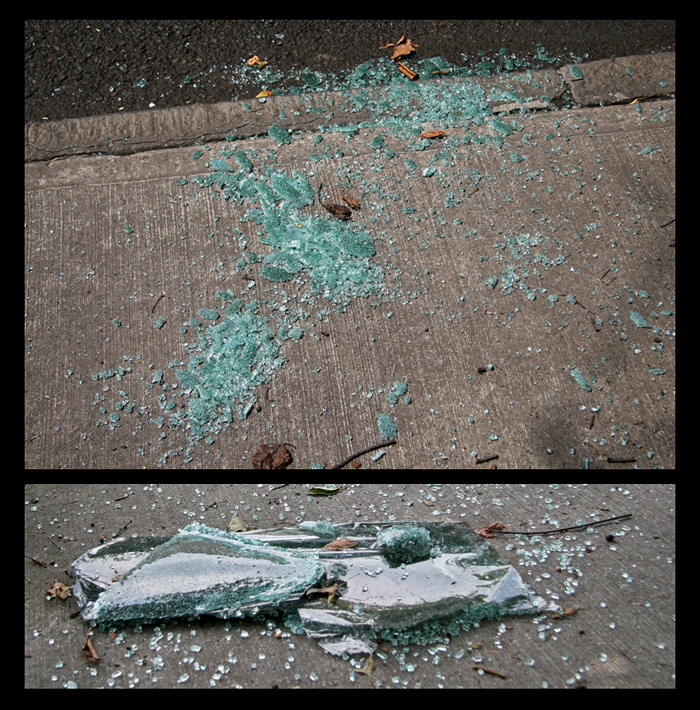
    Breaking a window is a quick and easy way to find out. The telltale evidence of an auto break-in is the small broken round or cuboid bits of glass (a safety feature of tempered glass used in automobile windows) found curbside.

    In much of Manhattan, this is now seen very infrequently, compared to the 1970s-80s, when this was an all too familiar sight. Car radios were a frequent target, resulting in the ubiquitous “No Radio” signs. Many installed removable radio and cassette player systems, while others removed them completely. Convertibles were often slashed.

    Many owners of luxury cars opt to leave cars unlocked in order to avoid damage to their vehicles. You will occasionally see luxury convertibles, top down, parked unattended in the streets of New York City, a clear signal to potential miscreants that there is absolutely nothing of value in this vehicle.

    At one time, in an anemic attempt to prevent break-ins, alarms were a standard in virtually every car. Car alarms are virtually useless. Studies have shown they are essentially no deterrent; thieves hit and run before any response to an alarm is possible. Plus, alarms are most often triggered by the rumble of passing trucks, thunder, or any other number of events other than theft or vandalism. The sounds of alarms going off was a regular occurrence, a hated urban cacophony.

    In the outer boroughs, auto break-ins with sidewalks of broken glass is still a common occurrence, as I learned on Sunday, walking down Southern Boulevard near the entrance to the Bronx Zoo. I was surprised to see this on such a major thoroughfare along the zoo property. Not just one, but a chain of broken windows, like islands and islets in an urban coral atoll…

    Posted on by Brian Dubé

  • No Fusilli

    Posted on by Brian Dubé

    Things start well enough on Sunday – my mother calls to wish me Happy Birthday, and from my window, I see a partly sunny day. I suggest to my girlfriend that we go to the Bronx Zoo, something which I had not done in years.
    We opt for public transportation – the subway has a zoo stop.  A short distance outside, however, and it is clear that this is going to be a hot and very humid day. But I remain optimistic – trains are air-conditioned, and the zoo is shaded and also has indoor exhibits.

    This trip requires two trains, a local to the express. When we get to Astor Place, however, the local train is not running at all. Out to the street for a six-block walk to Union Square for the express train.
    Signs indicate that the number 5 train is also not running for the weekend. We jump in the first express train which arrives quickly – things are starting to look up.

    But once we arrive in the Bronx, I notice the stops don’t look quite right. That’s because only the number 5 runs to the zoo, not the 4 which we had taken. A brief conversation with a passenger confirms my mistake and that I will have to take a bus across Fordham Road. We exit the train, armed with our Metro Cards, expecting a free transfer.
    However, the bus driver indicates that we need to go back to the machine on the street and purchase reduced price tickets at $1.10 each for this BX12 bus.
    Off the bus. Buy tickets. Back on the bus. The ride across Fordham Road is quite depressing.

    Our stop is Southern Boulevard, and the driver tells me I have a choice of two entrances. I forget the East Fordham Road entrance is the main one, which is quite beautiful. Instead, we traipse nearly twice as far down Southern Boulevard for what feels like an interminable distance in the heat to finally arrive at the side entrance. We see “The Complete Experience” listed for $27 per person, with no posting of general admission prices. This already smells of a zoo sadly doing badly. Being late in the day, we opt for general admission at $15 each.

    The day’s humidity is almost unbearable, even in the shaded areas of the zoo. We quickly learn that many of the best exhibits are part of The Complete Experience and can be purchased ala carte. $6 more gets us into the Congo Gorilla Forest – can’t miss that. We watch a movie, and the screen lifts to a live panorama of gorillas.

    I overhear a disappointed father of a family asking his wife who is reading a map – “No elephants?” (there are only two left which can only be seen from the Bengali Express monorail). We decide to purchase a drink after building up a thirst and $2.75 buys a small bottle of water.

    A zoo employee tells me that the zoo closes at 5:30 PM, so I pace myself for that. However, an announcement at 5PM tells us the zoo is now closed, so we barely get to the gardens and exhibits at the main entrance, which I was saving until last.

    We exit and make our way back to the Fordham Road bus stop. We purchase those silly tickets for the crosstown BX12 and wait at the bus stop, confident that we have the system mastered. The bus arrives quickly, but it stops inexplicably some distance before the stop and we miss it. Not to be fooled, we move, and the next bus stops behind us. A quick jog in the heat with camera equipment in tow, and we just make the bus.

    The train ride itself is uneventful. But at our final stop, I notice a man with a VERY wet umbrella – he confirms a torrential downpour outside. This provides a most amazing photo opportunity and, of course, a wet journey home. The streets are littered with downed tree branches.

    We decide to go Indian for a birthday dinner. The place I frequent is typically nearly empty, but tonight the place is packed, and there are a couple of huge parties. We are seated at one of the few remaining tables. We wait for some time, but I have a bad feeling that this will be a painfully slow process, so we leave as gracefully as possible.

    My spirits pick up as we opt for Trattoria Spaghetto just a few short blocks away. They are also unusually crowded, and the only remaining table is sandwiched between the kitchen and the service exit to the street used by the waiters. Not daunted by eating on a super highway, we sit and get our menus. I do not need to even open mine, because I am ready to order my favorite dish here: Fusilli Puttanesca. However, our waiter informs me that he is sorry, because tonight there is no fusilli 🙁

    Posted on by Brian Dubé

  • Mad as Hell, Part 2

    Posted on by Brian Dubé

    (See Part 1 here)

    Life does imitate art – the end of this story was remarkably like the classic scene in the Academy Award-winning 1976 film Network, where news anchor Howard Beale is so angry, he persuades TV viewers across the nation to stick their heads out of a window and scream, “I’m as mad as hell, and I’m not gonna take this anymore!” If you are not familiar with it, I suggest you see it here before you continue this story.

    Trust me when I tell you that in all the decades I have lived in this city, I have seen many hostile interventions during street performers’ acts. Very belligerent heckling, some nearly stopping the show. But I have never seen anything like this.
    An older woman appeared with her dog in tow, stood prominently in the center of the group, and began screaming “SHUT UP” repeatedly to the audience and the singers. The group, not to be upstaged, continued singing.

    This woman was SCREAMING at the top of her lungs – shrieking, clenching her fists, and shaking. I was genuinely concerned that she would have a heart attack and that her next battle with noise would be with an ambulance siren.
    She would not stop, and when audience members began responding that they were enjoying a quality performance, she screamed, “Take them home with you.” She vehemently stated that she was a neighborhood resident living across the street, facing the area where the singers and crowd were located. She further claimed that they had been singing for at least 6 hours per day for three days in a row and that she was at wits end – apparently she was mad as hell and was not gonna take it anymore.
    After some time, one of the singers apologized to her and the audience, stating that her wishes should be respected. Another one of the singers told her to calm down and assured her, “You win”.

    I spoke for a short time to this woman. I expressed my understanding of the dilemma and told her that I also was a long-time neighborhood resident living over a park and have had my own issues with noise. I, along with others, pointed out that this is New York City. Worse, it was Greenwich Village on Bleecker Street. If she lived on the Upper East Side on a side street, I am sure that she would have the quiet enjoyment she is entitled to. But this is Greenwich Village, and I would guess she chose this neighborhood for its iconoclastic nature, but with that comes a price. It is a mecca for culture, the arts, and entertainment, with clubs, restaurants, theaters, galleries, shops, and plenty of street life. This environment will attract both tourists and performers.

    There is also a lot of noise and a greater tolerance by all, including the police. I asked if she ever called the police. She said she has but nothing happens. My own personal solution is to plan around noisy events – I often will just leave my home. Principle and rights are one thing, but City Hall opens on Monday morning, and this is Saturday night. Accuse me of resignation or of being a man unwilling to fight for his rights. I’m a pragmatist, and being mad as hell will get me nowhere.

    Posted on by Brian Dubé

  • Mad as Hell, Part 1

    Posted on by Brian Dubé

    Occasionally, you can have it all, and Sunday was one of those days – perfect weather, a dinner better than expected (with no line where there usually is one), and then free, first-class entertainment on the street on a summer evening. Spontaneous and varied street life is one of the perks of living in New York City and is what many visitors have heard about and anticipate in their meanderings around the streets. Clear evidence that You’re Not in Kansas anymore.

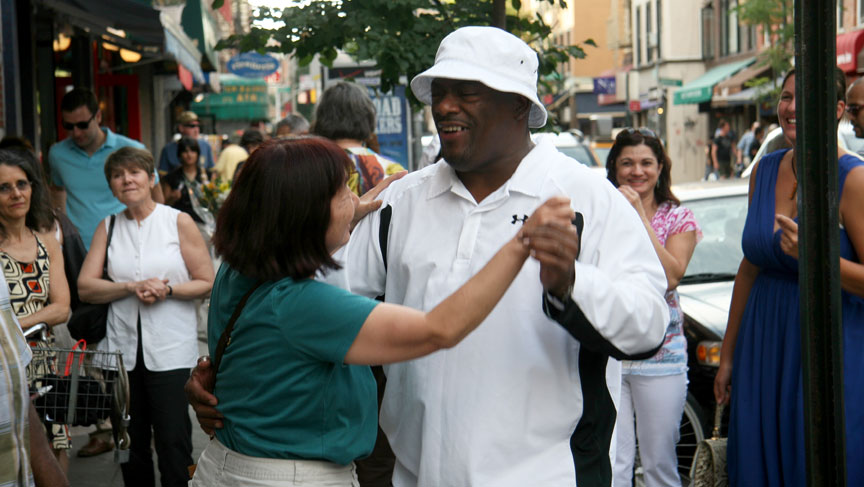
    The group of singers in today’s photo, calling themselves Select Blendz, was performing on Bleecker Street, accompanied by one acoustic guitarist. The songs were primarily 50s, 60s, doo-wop, and soul – all classics immediately recognized by the audience. Little encouragement was needed for any type of audience participation, whether rhythmic clapping or singing choruses. The crowd flowed off the sidewalk into the heavily trafficked thoroughfare. The vibe was absolutely infectious, and there literally was dancing in the street.

    At one point, one of the singers took a highly animated woman for a dance. Others were moved to shake, rattle, and roll. The tip bucket was brimming with bills – I saw one five dollar tip and even a $20 dollar tip being given. If the public votes with its dollars, these guys were clearly the consumer’s choice.

    I couldn’t help thinking about a juice bar I used to frequent on my way to my office on Houston Street called Lucky’s. A place just brimming with youthful enthusiasm, positive feelings, and a great affirmation scrawled on a chalkboard above the menu items which explained the name of the store: Lucky to be Alive.

    But not every story has a happy ending, and there was rain on this parade – stay tuned tomorrow (see Part 2 here), when I explain why, in the second and final shocking episode of this real-life mini soap opera, someone is Mad as Hell…

    Posted on by Brian Dubé

  • Cosmetics

    Posted on by Brian Dubé


    What is more unsettling than contact with a crustie? How about a crustie wearing a pet rat? (If you are not familiar with crusties, see my previous posting here). Take a close look at the photo, and you will see that this girl is sporting a white rat under her hair on the back of her neck. A crustie’s dreadlocks typically goes unwashed, so I imagine her hair provides not only a secluded spot for her companion but also a nesting ground for a variety of flora, fauna, and other edibles.

    You expect many strange things in New York City – it is a magnet for the fringe elements of society. But there are things that shock even a seasoned New Yorker. For me, a crustie with a rat around her neck was one of them.
    People know the city is extremely liberal and, most of all, tolerant. There are individuals involved in all manner of activities in public; frequently, authorities and law enforcement just turn a blind eye. Two nights ago, two mounted police officers observed the onset of a fight, one individual wielding a guitar as a weapon. The officers left – no one knows why. The fight escalated, and one individual was knocked unconscious, required an ambulance, and was taken to a hospital. Those of us who witnessed the occurrence are convinced that in any other locale, there is no way that someone that menacing would have been left unchecked.

    One issue is, of course, that many activities which are disturbing or distasteful are technically not against the law, and individuals here are brazen enough to have tested the law many times, risking arrest. Many criminals are quite street savvy and know exactly what is required to be arrested. Even those who are technically engaging in activities for which they can be arrested are a problem; most are released the next day and are back out on the street. My contact with crusties has been rather benign, but they have been a serious problem – see this New York Times article here.

    But what to do with the “undesirables” or homeless? It would seem that outreach programs would make sense, but I rarely see or hear of any efforts like this anymore. Many homeless prefer the freedom of the streets to shelters or programs, so there is resistance to being helped.

    New York City is a center of fashion, and even the homeless often have a sense of style, putting together an outfit from whatever is available. I like our crustie’s earpiece made from a small twig and flower…

    Note: One posting that many readers commented on was about Stephanie, a young homeless woman who lived on Spring Street for quite some time. I saw Stephanie using makeup a number of times – somewhat repellent to watch and sad, but in another way heartening to see that the girl still had human dignity and enough pride to make an effort using cosmetics.

    Posted on by Brian Dubé

  • Five Dollars

    Posted on by Brian Dubé


    As far as money goes, New Yorkers are like most other Americans – they like a deal, and FREE screams loudest to them.
    People at trade shows collect enormous numbers of brochures they will never read and wait in huge lines for premiums and freebees worth virtually nothing. I have seen adult men and women practically brawl over free T-shirts thrown into an audience at a Macworld convention.
    With free food it is even worse. At the Japan Festival in Central Park on Sunday, people were in lines hundreds deep, waiting in the hot sun for free noodles or a free dumpling.

    When it comes to tunnels, bridges, and other roadway tolls, many seasoned New Yorkers consider it a matter of principle and a source of pride to avoid paying a toll. Ironically, in most other ways, New Yorkers spend huge amounts of money for conveniences – prices for items at a green grocer can be substantially more for identical items at a supermarket a few extra steps away. There are endless examples of this behavior. But put the same people behind the wheel of a car and give them the option to wait in horrendous traffic to avoid paying a toll, and they will.

    If you are coming from the outlying neighborhoods of Brooklyn by car, you will most likely use the Belt Parkway or Prospect Expressway and then a leg of the Gowanus Expressway. If you are heading to Manhattan, you have a big life altering decision to make: do you take the Brooklyn Battery Tunnel for FIVE DOLLARS, or do you cram into the bumper-to-bumper traffic on the BQE (Brooklyn Queens Expressway) and take one of the bridges for FREE?

    By now the answer is obvious, n’estce pas? Any self-respecting New Yorker takes the free road and saves five dollars (perhaps to spend it whimsically soon after at Starbucks). Admittedly, five dollars is quite a bit of money for a short tunnel ride. However anyone driving a car into Manhattan is already indulging in a luxury that most can not afford, so why not spend five dollars and go in style?

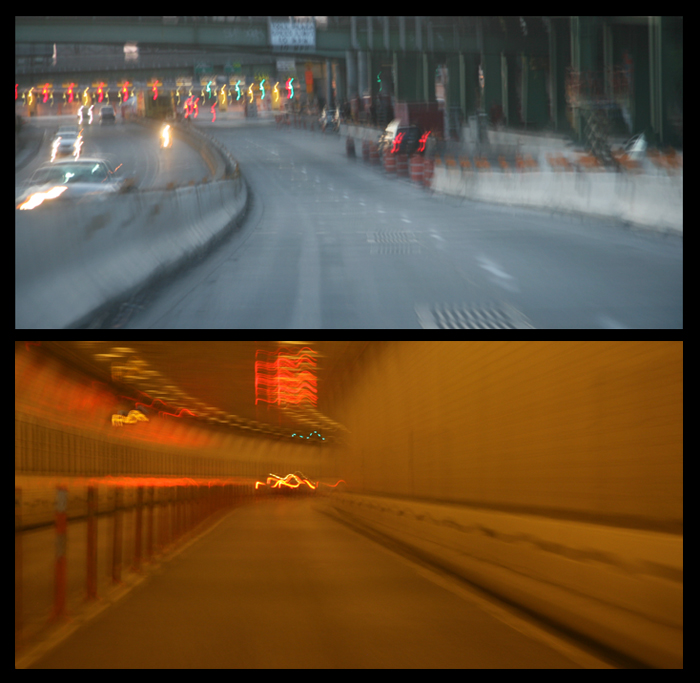
    These were my thoughts on Saturday evening when, coming back from my adventures in Brooklyn after an exhausting day of driving, I decided to do the unthinkable and spend five dollars for the tunnel experience. It was extraordinary. The highway spur to the tunnel (top photo) and the tunnel itself (bottom photo) were virtually empty.
    I was back in Manhattan in a few short minutes, while thousands jammed onto the BQE. Of course, many of these travelers were not headed to Manhattan, but trust me on this – if there were no toll for that tunnel, I would have had plenty of company. And, of course, an extra five dollars…

    Photo note: Against better judgement, these photos were taken one-handed while driving. Camera shake, shutter speed, aperture – no time for these considerations. After spending $5, I was feeling rather reckless anyway 🙂

    Posted on by Brian Dubé

  • Unemployed

    Posted on by Brian Dubé

    Union Square has been a site for social and political activism since the 1800’s. In 1861, after the fall of Fort Sumter, there was a patriotic rally with an estimated 250,000 people, considered the largest public gathering in North America up to that time. Since that time, Union Square has continued its role as a locus for protests and gatherings.

    On Sunday, May 17, the Veggie Pride Parade ended in the north plaza. At the same time, Reverend Billy appeared at the NYC Plastic Bag Protest. There were various activities – crafts, street theater, advocacy, and petitioning. A number of characters were present, such as the Plastic Bag Monster seen in the photo and No Impact Man.

    I applaud the efforts being made here, as reduction is the biggest key to this problem. As I wrote in White Christmas, substitution of disposable materials or recycling is not an effective solution with the volume of bags being used, which is why complete bans are being enacted worldwide.

    In 2002, Bangladesh became the first country to ban plastic bags. Taiwan prohibits not only plastic bags but also disposable plastic cups, plates, and cutlery used by fast food vendors (threats of fines have resulted in a 70% reduction in the use of plastic bags, and a 25% cut in landfill waste.) A number of African countries have banned plastic bags, such as Uganda, Kenya, and Tanzania. London has banned giving out free bags, and Ireland has levied a tax. Paris has banned them, and France plans to ban them nationwide by 2010.

    In 2007, San Francisco became the first US city to ban plastic bags. Other US cities have followed – Maui, Hawaii, and Westport, Connecticut. New York City is considering its own initiative. The plastic bag problem has really hit critical mass, and the list of countries, states, and cities is constantly changing. I think the Plastic Bag Monster will be joining the ranks of the unemployed soon 🙂 

    Related Postings: The Plastic Infinite, Consumption, Picture New York, Reverend Billy, Union Square, Union Square Greenmarket, Metronome

    Posted on by Brian Dubé

  • Not Going Anywhere

    Posted on by Brian Dubé

    This is the first time I have seen wrestling in a park in New York City. I found it an appropriate metaphor – living in New York City is often a contact sport, and in many respects we do wrestle our way through life here. Much of my life seems to be finding ways to navigate the shoals, looking for ways to soften the blows of the city. There are great conveniences living here; the depth and breadth of products, food, entertainment, and culture is perhaps unequaled. However, it does come at a price, and the population density both giveth and taketh away. A New Yorker I know, born and bred in Brooklyn, once said that New York City was the punishment for living. A bit harsh, perhaps. She now lives in California.

    Why do New Yorkers do it? What type of people would want to live here, bear the slings and arrows, and fight their way through daily life? Perhaps the individual’s T-shirt in the photo, which reads “Psych Ward,” offers a possible answer.

    I am reminded of a business owner who was asked the question, “Do you ever think of selling your business?” to which he answered, “Every day.” For those of us who are business owners, this is stating the obvious. I might speculate that on a similar note, I have often been asked, in response to my whining about some aspect of the city, particularly real estate costs and lack of space, “Do you every think of moving out of the city?” My answer is, I would guess, the same as that of many fellow residents: “All the time.”

    The number of times that I have “planned” to move from the city, fantasized, or looked at homes all over the planet are innumerable. Most residents I know speak of moving with a smugness about how easy it would be and often with an assuredness of how they will be doing this soon. I remember a Brooklyn resident who had returned from Santa Barbara, California. He was on a rant about why there was no good reason not to move there immediately. Except that he would not.

    But all this is just retelling the obvious, and although some move away and others retire elsewhere, the biggest obvious fact to many of us here about these whiners and malcontents is that like most dyed-in-the-wool New Yorkers, they are not going anywhere

    Posted on by Brian Dubé

  • Little Stuff

    Do not think that all of New York City is paved with gold. There are plenty of ordinary people whose income is modest as well as many minimum wage earners. Seeing this shelf of Spam in Manhattan reminds me of a private joke between a friend and me whose punchline we never tired of using whenever we could.

    When I was much younger, another friend and I were fascinated with fireworks, particularly bottle rockets. Although we did occasionally buy firecrackers, we never were interested in the heavy noise found with M-80s or Cherry Bombs. As foolish as we were, we had a sense of their much more dangerous nature. Also, we did not enjoy extraordinary explosive noise. We were interested in rocketry.
    At the time, at New Year’s Eve or Chinese New Year, fireworks were easily purchased in the city. Vendors were all over the streets in neighborhoods such as the East Village and Chinatown, selling their wares out of garbage cans, auto trunks, bags, etc. The city was much less aggressive about enforcement.

    One night searching for some rockets, all three of us came across a street vendor barking a list of his wares, of course featuring his big stuff. When I asked if he had bottle rockets, he seemed rather taken aback and, with enormous pride and smug confidence, responded, “Hey, we got the little stuff too.” Apparently we were to know that he was a full service retailer. So, that’s the punchline. It loses much in translation because one of the keys here is the delivery – a combination of the very smug, macho posturing with a Brooklyn/Queens accent.

    Thereafter, anytime a conversation provided opportunity to reaffirm the merits of the diminutive and share some insider humor, we added, “We got the little stuff too,” along with our best interpretation of that fireworks vendor.

    This is not an Andy Warhol art piece. This shelf of Spam at a local supermarket tells us that people buy and use the product. We still have large numbers of homeless. Fast-food restaurants and deep discount retailers dot the city. These are not just the haunts of price conscious millionaires, flaunting frugality and good shopping skills, but also the places where many of lesser means shop. New York City requires the same services as anywhere else, and someone has to work those jobs – clerks, gas station attendants, waiters, etc. These positions do not pay the wages of investment bankers or attorneys. Twenty-three percent of New Yorkers live below the poverty line.

    So to those who think the city is only comprised of exclusive high-end retailers, fashion boutiques, costly apartments, expensive restaurants, and gourmet foods, I would like to remind you – we got the little stuff too 🙂

    Note: One night, we witnessed a woman whose hand covered a bleeding eye from being hit by a stray bottle rocket in Chinatown. This convinced us that even bottle rockets had inherent dangers and that fireworks are best kept out of the hands of recreational users.


  • Snow Temples

    Snow mounds in New York City are like shag carpeting in a cheap motel – better not look too deep inside, because the contents are not pleasant at all. And no need to, because soon, when melted, all will be revealed.

    To some, mounds of snow appear to be a good place to discard all manner of trash and for their dogs to do any business. As if somehow the refuse will take on the properties of snow and melt along with it or, perhaps, seeing dirty piles of snow as sanctioned trash receptacles, permit them to add to it incrementally.

    Whatever the case, when snow accumulates in this city (and it does from time to time) and is shoveled and plowed, remaining piles can become temporary embalming sites.
    For a time, dirty mountains of snow become temples for garbage. Trash pickups are reduced by the city and street sweeping delayed until snow is gone. Bags of garbage accumulate to adorn the mountains of dirty snow.

    Just as autumn leaves require certain conditions for optimal fall foliage color, ideal conditions for large captures within snow temples also exist – amount of snow, length of time on the street, and temperatures during various periods with adequate time where the snow is soft enough to swallow and entomb any trash deposited on it. A nice freeze gives the whole thing the aura of secret treasure until the days of melting. I’m reminded of the 50 cent secret prize of childhood that you could order, guaranteed to be of greater value than 50 cents. That prize, unlike the treasures entombed in the gray snow temples of New York City, was worth waiting for 🙂


  • Lights on Broadway

    Posted on by Brian Dubé

    [LightsOnBroadway700.jpg]The city daily photo concept was started by journalist Eric Tenin of Paris in March 2005 with Paris Daily Photo. The original idea was to show a daily slice of life in Paris. The idea spread to now include hundreds of cities worldwide. The idea is a noble one, but most readers do not want to be privy to all the mundane chores of everyday living, so Eric’s site, like most of the others, show a side of daily life of interest to outsiders, which includes a spectrum of the more known to the lesser-known.

    There are many things which are both unique and so commonplace in many locales that they are part of the fabric of that city or town but perhaps not blogworthy or worthy of inclusion in a travel guide. The establishments every resident knows and uses. One of those places in New York City is Duane Reade, a local chain of stores that dominates the pharmacy business and is part of the love-hate relationship many New Yorkers have with this city.

    At one time, there were only TWO all-night drug stores in Manhattan. A late-night pharmacy was a huge deal. Now Duane Reade is ubiquitous and New Yorkers are spoiled; we all just assume that a Duane Reade is a few steps away. And they are, with over 240 locations throughout the five boroughs and nearby suburbs, 59 of which are open 24 hours (5 with a 24-hour pharmacy). Two locations offer walk-in medical care.

    However, although on paper these places seem like a godsend, many tend to fall down in service and overall management. Like many discount operations in New York City, getting good help at low wages who will take their jobs seriously is difficult. The experience in this chain tends to be uneven. There is even a blog, I Hate Duane Reade.
    But the situation is really quite similar to the arrival of big box behemoths such as Home Depot or Kmart. While many bemoan their presence, complaining of service and quality of product, many secretly appreciate the pricing, selection, and hours.

    One of the big factors in this equation is the walking nature of the city. In the suburbs, most customer patronage of retail stores is not so much a function of proximity to one’s home or neighborhood. Bad service or better pricing, and customers will just drive elsewhere.
    But in NYC, neighborhood delis and drugstores have virtual captive audiences – most residents will shop at the most convenient location to their home or office. Add competitive pricing and late hours to the mix, and you can see why service is overlooked.

    The quality of the Duane Reade establishments themselves vary quite a bit – some are newer and more spacious than others. I was surprised with this one in the Times Square area, appropriately (but atypically) with neon-framed windows. Quite visible to the person in need, but invisible to the visitor awed by the other lights on Broadway…

    NOTE ABOUT THE NAME: Duane Reade was named after their first location in 1960 on Broadway between Duane and Reade streets.

    Posted on by Brian Dubé

  • Survival Guide

    Posted on by Brian Dubé

    I intended to tell you what I knew for sure. However, after reflection, I realize that it would only be what I thought I knew. So, I will tell you what I saw.

    What am I talking about? I was drinking a juice on the second floor of Whole Foods Market on Union Square at 10PM. The second floor has tables and has been designated as a space for eating food purchased by customers. It is a very casual cafe type of atmosphere.

    The place was abuzz with nearly every table occupied, even at that late hour. A man who had two overfilled bags knocked into my table while stepping on my foot. His canvas bags were stuffed with all manner of goods, including what appeared to be an empty paper coffee cup.

    The most noticeable thing about this man was his enormous bulk from his layers of coats. He removed his large outer coat and went off briefly, leaving his bags unattended. He returned rather quickly with a paper plate of pasta. However, it felt too quick for him to have gone through the Whole Foods line. So this is where I started to pay attention.

    He took his plate of food to the microwave provided by Whole Foods for reheating of food. I say reheating because a sign was clearly posted that the microwave was for reheating only. After pondering this for some time, I realized that due to the volume of people and with what appears to be no one policing the floor, the space and services offered are most likely used by the homeless – warm places to sit, water fountains, and bathrooms – with some perhaps preparing meals from foods brought from outside.

    The mechanics of survival of the homeless, quasi-homeless, and severely disadvantaged are seen by most of us in sight bites. I am sure that there is an undocumented survival guide known by many of the have-nots who enumerate the soup kitchens, public bathrooms, and best places to pass time, such as bookstore cafes and public spaces (libraries, bus and train stations), places to sleep, and how to get or recycle food. I am reminded of stories I have read of the old Horn & Hardart automats of New York City, where poor writers often made tomato soup from ketchup and hot water or bought tea with bread and made pickle relish sandwiches.

    The man ate and left as quickly as he came. I have made an assumption about him – I could be very close or very far from the truth. I have seen him frequently in public parks. Knowing the source of that pasta would have told me much more…

    Note: The 2nd floor at Whole Foods at Union Square is a superb place to have a snack with great vistas of Union Square Park, all the activities in that area, the Empire State Building, and the Met Life Tower.

    Posted on by Brian Dubé

  • Toronto

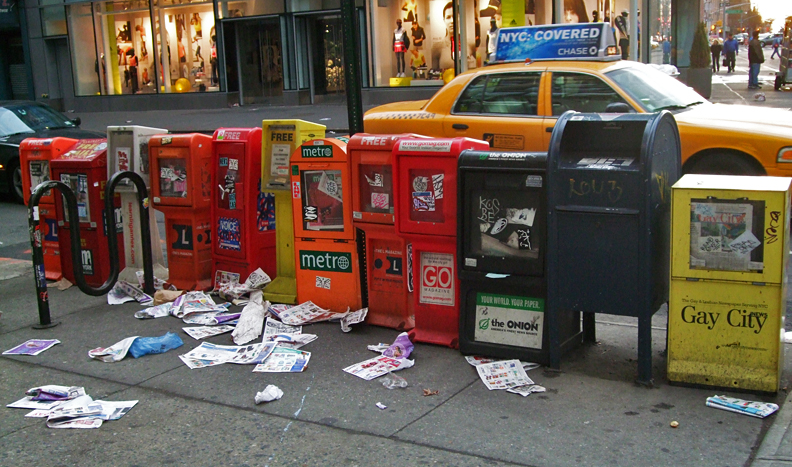
    On October 16, 2007, I wrote of a solution to one of my personal dislikes: the array of newsboxes that clutter the city streets. However, at the time, I did not have a photo which well represented the ugly side.

    Broadway can, at times, become a virtual wind tunnel. Recently, on a particularly windy day at Broadway and Houston Streets, huge gusts of wind created trash tornadoes, perfectly complementing the hideous newsboxes. Why hideous? Because the garish melange of these boxes looks like everything possible has been done to offend the eye – they are different shapes, heights, colors, and designs and are covered with stickers and ads, poorly maintained, and dirty. I have seen empty ones even used as trash receptacles. Many are chained to lampposts and various other structures.

    Regular readers know that I am all for street life, however, the issue here for me is aesthetic. In my story Very Practical, I wrote of how the practical tends to triumph in this city. I would reword that to say that practical and business interests tend to trump the aesthetic. I highly doubt that you would see a motley crew of newsboxes in this condition in most European cities.

    In researching this story, I saw articles going back 15 years in the New York Times concerning the problems and solutions with the boxes, which were even referred to as eyesores. But in any bureaucracy, inefficiency is the rule of thumb and a snail’s pace is the rate of progress, so the boxes remain while improvements slowly inch their way towards adoption.

    But many defend the edginess and grit of New York City as important, defining characteristics. I remember reading an article years ago speaking to this. The article was defending the edginess and made a suggestion for those who did not see the grit’s charm: “There’s a place for you. It’s called Toronto.”

    Related Postings: Garbage a la Mode, White Christmas, Jungle Gym, Unguent, Gummed Up


  • Jump for Joy

    One area where a huge city like New York can fall down is service. We have lip service, of course – the beatitudes and platitudes recited by employees as instructed by policy manuals from the corporate office. But I mean real service, where the salesperson puts him or herself on the other side of the counter, sees another human who has a need, and, within reason, does what is required to satisfy that need without attitude.

    I often find myself in a retail store looking for a salesperson, eventually to find a number of them congregated for what appears to be happy hour. Any effort to intrude is seen as an annoyance, taking them away from what appears to be more important matters to render service begrudgingly. A customer starts to feel guilty for disturbing the sales staff.

    One can find good service in New York City, but it is just not like the experience of being in a very small town, where it feels like politeness and great service are universal. You have a sense that it is assumed that this is the normal human condition. I yearn for these signs of humanity in New York City, and when I find them, I jump for joy.

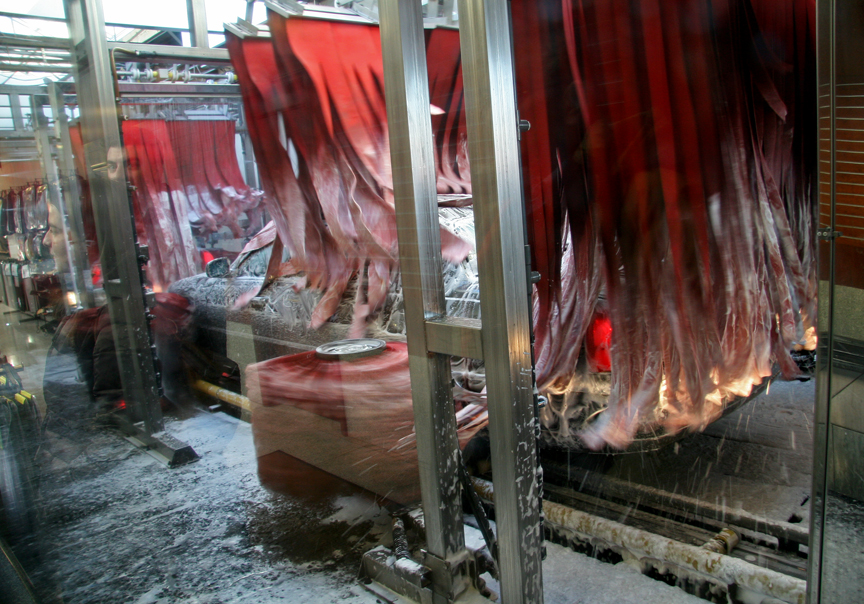
    Saturday I jumped for joy at the LMC Car Wash & Lube at 36-21 21st Street in Long Island City. The first thing I noticed was how clean this place was, particularly in light of traveling many blocks on a very blighted stretch of road. My car was in dire need of a was. Like many, the inconvenience of a few minutes and a few dollars usually seems too much to bear, spoiled as I am with the extraordinary conveniences of the modern world.

    At LMC, after prep work, the car goes through its wash and dry cycles unoccupied – customers get to watch the entire process from behind the glass wall of their retail shop, which is stocked with all manner of auto supplies and accouterments. There were bottles of many hued liquids with the afternoon sun shining through them. Everything was in its place with a place for everything. Tidy, clean, and efficient, with good service and entertainment – watching your car get scrubbed clean is so much fun. All of this may be the standard for retail establishments outside the city, but in New York, people will tolerate some very rough edges.

    Perhaps many would consider my exuberance over a car wash to border on lunacy, and maybe it is. Call it what you may, but when I find a place like LMC, I want to jump for joy…


  • White Christmas

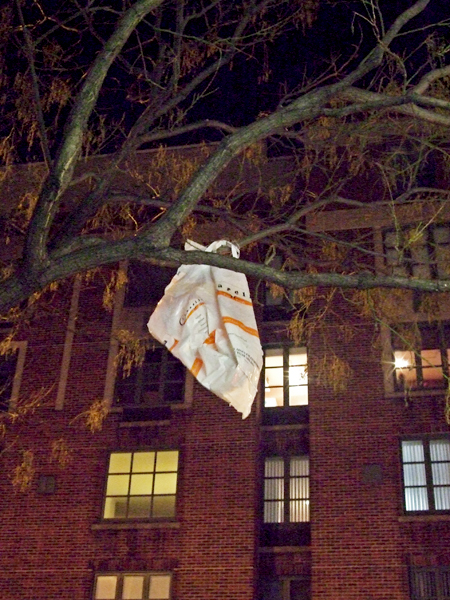
    Decorations of white for the holiday season? Hardly. Plastic bags being blown into trees is a serious problem worldwide. See how extreme it can become in this gallery of photos here. Astounding, isn’t it?

    New York City has more than 500,000 trees – candidates as bag magnets. As Clyde Haberman points out in his New York Times article NYC; In Winter, Trees Bear Plastic Fruit: “In summer, leaves obscure snarled plastic. The leaves are also splendid, parks people say, at repelling the polymerized intruders before they can land.” Like chewing gum on the streets, once you start looking for these “plastic fruit,” you start to notice them more.

    There is a global movement to reduce/eliminate the use of plastic bags, particularly for grocery checkout. The only really effective way to change behavior with issues such as this one appears to be a financial disincentive. City or country bans on plastic shopping bags usually involve a tax, unfortunately. In Ireland, a €0.15 levy on plastic shopping bags was instated on March 2, 2002 – there was a subsequent 90% reduction in use of plastic bags. China has banned the use of ultra-thin plastic bags. San Francisco has banned non-compostable bags. Much of Europe has various tax levies or bans. Mayor Bloomberg is proposing a $.06 tax on plastic shopping bags. However, this move is controversial – many see it primarily as a revenue-raising scheme disguised as a green effort.

    Plastic bags are such a complex issue – any simple assertions concerning their use usually miss some key points. The lists of pros and cons of paper versus plastic are quite long. Paper is not a clear winner – apart from trees, energy is require to produce paper bags, dioxins are released in production, and they do not decompose in landfills. Also, many reuse the bags for trash at home or cleaning up after their dogs, so reduction of plastic shopping bags may result in an increase in the purchase of plastic garbage bags. The best solution is a reduction in the use of bags to begin with.

    The reusable shopping bag is a good idea, however, in New York City, this is a problem due to the general lack of use of cars for shopping. Carrying reusable shopping bags is not realistic for most residents, and unplanned shopping also precludes their use.

    I think in the end, a real net reduction of energy and materials will require a wholesale change in behavior and habits regarding bags and trash. In years to come, I hope this is not a new interpretation for Irving Berlin’s I’m Dreaming of a White Christmas

    Photo Note: This tree was on Waverly Place near 6th Avenue. The bag was from Citarella, a gourmet food market. At least our tree trash is first class 🙂


  • dinamic_sidebar 4 none

©2026 New York Daily Photo Entries (RSS) and Comments (RSS)  Raindrops Theme