• Category Archives Stores
  • Going Through Rehab


    One of the most disappointing features of a post-war “modern” apartment is that in most cases, when you enter, you are typically dumped right into a living room with an an immediate sense of the lay of the land. Cookie cutter and boxy, no foyers, no “frivolous” use of space. There are no surprises around the corner, because there are not many corners or ways to meander.

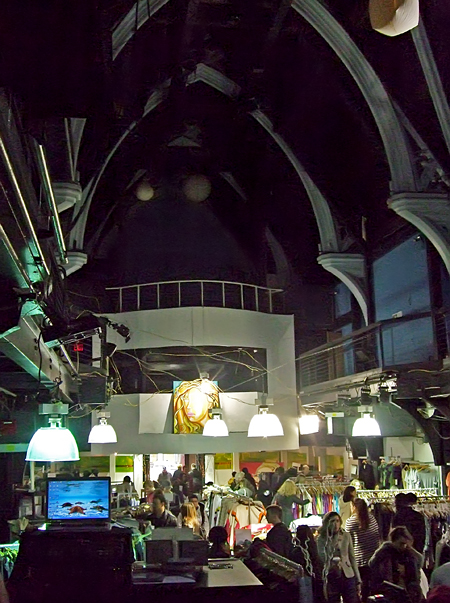
    If you like a labyrinthine experience in a Gothic environment, you may enjoy the Limelight, previously a church built in 1846 and, after 1973, used as a rehab center, various night clubs – most notably The Limelight – and now a shopping emporium.
    A nightclub in a Gothic church should be a dramatic, exciting experience. But it was not. I neglected to mention that some had nicknamed the club “Slimelight.” I visited once in the 1980s, and the novelty of crawling through the maze of chambers in low light wore off quickly. Slimelight it was. I wrote about the sorry state of the Limelight on May 30, 2008 in Model for Decorum.

    Its various reincarnations were not much better. On March 14, 2009, I visited again and found a large flea market of sorts – very disappointing. The photos I took remained unused. You can see an interior photo here.
    After a $15 million dollar renovation, the building reopened in May 2010 as the Limelight Marketplace, a assemblage of over 60 upscale shops, eateries, and outdoor cafe. See my photo gallery here.

    Although some critics are not particularly enamored with this incarnation, and I do not champion the view that commerce heals all wounds, it certainly is refreshing to see the cleanup after going through rehab…
  • Tools of the Trade

    In the 1980s, I frequently came home to spent whippet* cartridges on the stoop of my building. In the parks, used needles were not an uncommon sight.

    Most activities have their requisite equipment. Users range the gamut, from those who take a strictly utilitarian view, often fashioning their own tools when possible, to those for whom the tools can become an end in itself, some taking on a near fetish quality.
    Most users strike a middle ground – buying a reasonable number and quality of tools, typically without the time, interest or skills to enter the world of DIY. Some pursuits lend itself to the do-it-yourself or makeshift approach, other fields such as photography being near impossible to fashion one’s own equipment, barring pinhole cameras. Photography is a classic field for equipment hounds, aka “shutter bugs” or “camera bugs.”

    There are other activities where the coveting and collecting of tools rarely becomes an end in itself, i.e. where the pleasure in use vastly outweighs any possible pleasure of ownership, such as the world of hedonistic indulgences of sex, drugs, and food. Cameras maybe purchased, admired and unused, and books maybe collected and unread, but I have never heard of anyone buying scales or bongs to sit idly on a shelf.
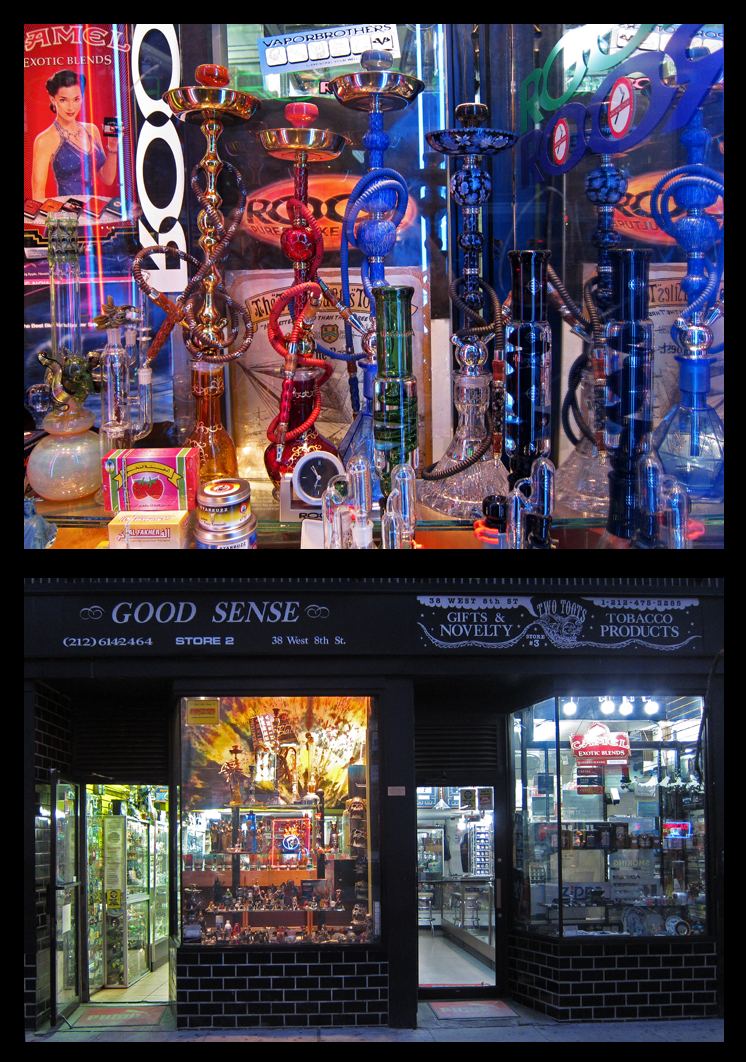
    New York City, particularly the East and West Village, has been home to the head shop for as long as I came remember – many decades. Head shops carry all manner of drug paraphernalia, such as bongs (water pipes), roach clips, glass pipes, coke spoons and mirrors, pipe screens, vaporizers, rolling papers and machines, scales, and legal substances such as whippets.

    Head shops have varying legal statuses worldwide. In the United States, they exist in a gray area, since the items sold can be used for illegal and legal substances. In the 1990s, the Giuliani administration made efforts to crack down on these shops with numerous raids and confiscation of goods. However, with a mix of merchandise and many of the items not specifically drug related, this was a short-lived campaign.

    The ones in today’s photos were taken in the West Village on 8th Street and 6th Avenue. The names of the stores themselves often obfuscate or hint at the real uses for the products sold. In the photo, you can see Two Toots, a play on a cocaine user’s word toot, while Good Sense is a play on sensimilla – a very strong and high-quality breed of marijuana that produces no seeds.

    With the decriminalization of marijuana in many states, head shops are making a comeback. Like alcohol, drugs are here to stay, and for those that indulge, there will always be sellers of tools of the trade

    *Whippets are nitrous oxide cartridges used in refillable whipped cream canisters. They can also be used as a drug for getting high through inhalation.


  • One Size Too Small

    There may be comfort in old shoes, but not in my old shoes. I have a beautiful pair of white bucks by Cole Haan, one of the few impulsive extravagances of my life. The purchase was encouraged by my sister and her husband on a Madison Avenue shopping spree while visiting New York City. Buy them, they said. You never do anything good for yourself. True, but not a full size too small. What was I thinking?
    The shoes have been professionally stretched several times. To no avail. So, lest I want to become crippled, they will stay in my closet. On another occasion, while trying on a new pair of shoes, a salesman just glancing at me from afar told me that the shoe size I had selected was definitely too small. I purchased them anyway.

    Why would I do such a thing? I am convinced it is a family obsession, inherited from my mother, who was adamant about not wearing shoes that are too big. Pondering this over many years, I have a suspicion that this may have come from being brought up in a poor household and the stigma of hand-me-downs. But I don’t care how tight they are. I’m not giving up those Cole Haans.

    I just read an article: Nobody wants your old shoes: How not to help in Haiti. This had to do with the ineffectiveness of the transport and distribution of goods in a relief situation. However, I am sure the title would be heartily embraced by my family. They are happy donors but, outside of family members, no old shoes for them.

    Many individuals are not enamored with the prospect of wearing other people’s shoes or clothing, but for those who are, there can be tremendous value in shopping for used merchandise. The world of fashion is built around newness. In the case of technology, the quest for the new leaves mountains of yesterday’s products (like CRT computer monitors), often for the taking.

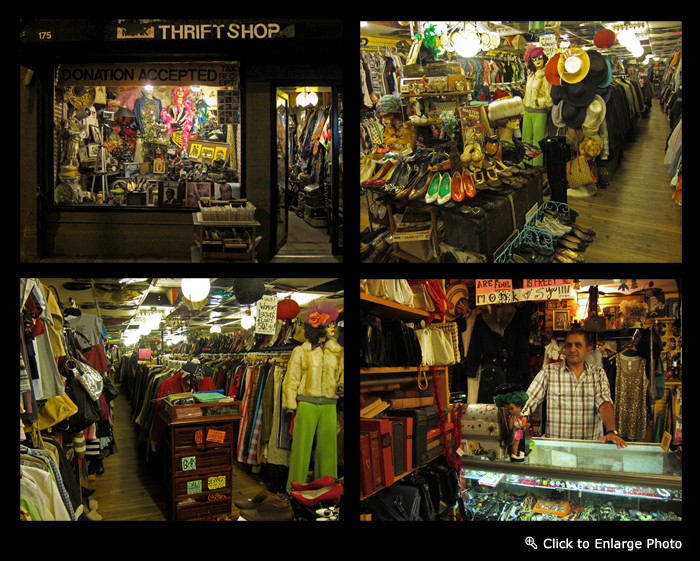
    Although it is a seemingly unlikely place for thrift shops, they do exist in New York City. Salvation Army had a location on 8th Street in the Village which recently closed. Monk, at 175 MacDougal, has been a fixture in Greenwich Village since 1993. One of three stores, it is owned by Tarek from Egypt. All donations are accepted – things not used in the store are donated to churches.
    In Consumption, I wrote of the three Rs of waste management – Reduse, Reuse, Recycle. Unfortunately, in a culture where shopping is a national pastime, the first two Rs are largely ignored, and the third R, recycling, has numerous logistic problems and dubious benefits overall (see Recycling is Garbage from the New York Times).

    I just recently was given a number of beautiful new shoes by my father. The good news is that we are the same size. The bad news, as you probably guessed, is that my father seems to have the same affliction that I have. We have shuffled undersized shoes between us for decades. Family visits and the holidays might be better called The Tight Shoe Exchange.

    While the nation struggles with a mountain of debt, my father and I struggle with a hill of undersized shoes. As long as we keep buying those unwearable shoes, we are making no inroads with that second R of waste management (Reuse). I think my father and I should open a shoe shop. Look for a place called The Tight Shoe Exchange or One Size Too Small 🙂


  • Collection Day

    We were so naive. One day, when I was in college, a roommate said he had learned something incredibly invaluable: the city streets were a virtual bazaar of quality goods on the sidewalks at night before bulk trash collection days. The explanation was that there were people of enormous wealth in areas such as the Upper East Side who, due to whimsy and boredom, put out quality items they no longer fancied. And all we had to do was know the collection days and scavenge the streets the night before.
    Nothing could have been further from the truth. Do you think that expensive, high-quality merchandise would be 1) thrown out and 2) survive on the sidewalks of New York City for more than one second? Obviously, this merchandise would be given away to friends, family, sold at auction or to dealers, or donated to charity. Very little of real value makes it to the streets.
    That’s why we have auctions houses, used merchandise dealers, and flea markets.

    In a way, flea markets in New York City are redundant – the city itself is a virtual open-air bazaar. Perhaps that is why these places can be easily overlooked, as well as why I have never been through the NoHo market at 688 Broadway, even though it is located a stone’s throw from my home and I have passed it thousands of times.
    Despite soaring real estate in the city, permanent open air and indoor flea markets still exist, even in Manhattan. You can find every spin imaginable as far merchandise goes – used, antique, new, arts and crafts. Remarkably, the NoHo market sits in an open lot in prime real estate territory, flanked by large buildings on either side.

    The huge city population provides for the seemingly endless array of goods available at low prices. For city residents, the issue becomes not only do I need it or want it, but also do I have a place to put it? At one time, I had some interest in collecting in a few areas, predominantly books. My mother, a compulsive cleaner and person who enjoys getting rid of things, made a comment that we are just passing through and temporary caretakers of our things. Over the years, the truth in this has settled in my mind, and I now get more joy from getting rid of things than I do from collecting them.

    There are values to be found in flea markets, and if this is your cup of tea, you can find online lists of hundreds of flea markets in the five boroughs (see listing here). It certainly will save you the work of scavenging the sidewalks of the Upper East Side at night before collection day 🙂


  • Keuffel and Esser


    There was nothing that struck fear in the hearts of many high school students like the slide rule. I could never really understand, because I loved mathematics and my slide rule. But so many seemed terrified. Perhaps it was all those numbers.

    Admittedly, the whole device is rather arcane looking – scales with tiny divisions and numbers completely cover both sides. The slide rule is an analog device, and numbers can be read to only three significant digits without any reference to magnitude. In other words, 123 is the same as 12.3, 1.23, .123, etc. So interpretation of answers requires keeping note of and calculating (often just using memory) the magnitude of the answer, which is only a series of digits – i.e., you need to know where to put the decimal point.

    The slide rule was used for multiplication, division, and for functions such as roots, logarithms, and trigonometry, but not for addition or subtraction. These are precision instruments and require careful use – unlike a digital calculator, answers can vary depending on the skill of the user. Keuffel and Esser introduced them to the United States, and I am proud to own one.

    The Keuffel & Esser Co. was founded in 1867 at 79 Nassau Street by two German émigrés, Wilhelm Johann Diedrich Keuffel and Herman Esser, as importers and jobbers of European drawing and drafting materials.

    Early on, the firm was successful and continually expanded, moving locations several times. 4 K&E tentatively started manufacture and published its first instruments catalogue in 1870; opened its first retail store with a showroom in Manhattan in 1872; transferred its manufacturing to Hoboken, N.J., in 1875; moved its headquarters to 127 Fulton Street in 1878; and constructed a new factory building in Hoboken in 1880-81 (which was expanded in 1884, 1892, and 1900). The firm was incorporated in 1889, with Keuffel serving as president until his death. K&E, which had introduced imported slide rules in 1880, began their first American manufacture in 1891. The company became strongly associated with the product as the nation’s foremost manufacturer, credited with popularizing slide rules in the United States. In 1892-93, K&E constructed a new building at 127 Fulton Street to serve as its retail salesrooms and general offices.

    K&E played a nationally significant role in the technological development of the United States. K&E products, which included measuring tapes and compasses, were used in countless construction and engineering projects, such as the Brooklyn Bridge, of the post-Civil War boom years, and K&E surveying equipment is considered to have been critical to the westward expansion and development of the country.

    K&E’s offices and salesrooms had been located at 127 Fulton Street since 1878. This address was close in proximity to the financial district and the offices of many architects and engineering firms. Over the next 13 years,“business increased, doubling and redoubling in volume, year after year,” leading the firm to require larger quarters. In May 1891, the architectural firm of De Lemos & Cordes filed for a new 8-story (plus basement) Keuffel & Esser Co. Building, to house the company’s primary retail salesrooms and general offices. The nearly 25-foot-wide, fireproof steel-and-cast-iron-framed structure was completed in February 1893.

    By 1930, the K&E catalogue carried over 5,000 items. You can read more about the building, its history, and the company here.
    The 8-story building’s upper stories are clad in buff brick and terra cotta. The base has an historic 2-story cast-iron storefront, framed by colonettes with spandrels bearing small shields, the company’s initials, and representations of its products. K&E vacated the premises in 1961. The property will be converted to residential condos.

    A slide rule was the engineer’s tool and companion, often carried in a leather case which could also be used as a belt holster. You can see my original Keuffel and Esser slide rule and molded leather case in the photo. After reading the history of K&E, I am duly impressed, and I have a newly acquired reverence for that slide rule I have, made by Keuffel and Esser 🙂


  • The Last to Know

    There are many kinds of surprises, and one type is that which is caused by Tunnel Vision, a common ailment with New Yorkers. The perennial joke that Village residents never go north of 14th Street is not an exaggeration, only a New York City variant – people who don’t even look past their neighborhoods.

    We typically see ourselves as inventors, or at least very early adopters, but certainly not the last to know. There are a few exceptions – the things we don’t want or the things we just can’t have due to space limitations. Big box stores such as Home Depot were very late comers here, and there is no Wal-Mart in New York City. Large behemoth retailers have had to scale down their operations, shoehorning and tailor-fitting them to the biggest spaces they could find.

    A California resident told me about the opening of Trader Joe’s first store in New York City, on 14th Street in Manhattan, on March 17, 2006. I was informed that the place had a cult following and was known for their sharp pricing, good quality, and a fan base for their house brand (80% of Trader Joe’s product line is their own brand). The product line is very green conscious, with health oriented foods, including gourmet foods, organic foods, vegetarian items, and an extensive line of frozen and imported foods.

    I assumed that this new opening was a case where New York City was privileged to get a specialty shop that had a location or two elsewhere on the West coast. However, I learned today of the mammoth scale of this retailing operation, with 344 stores nationwide.
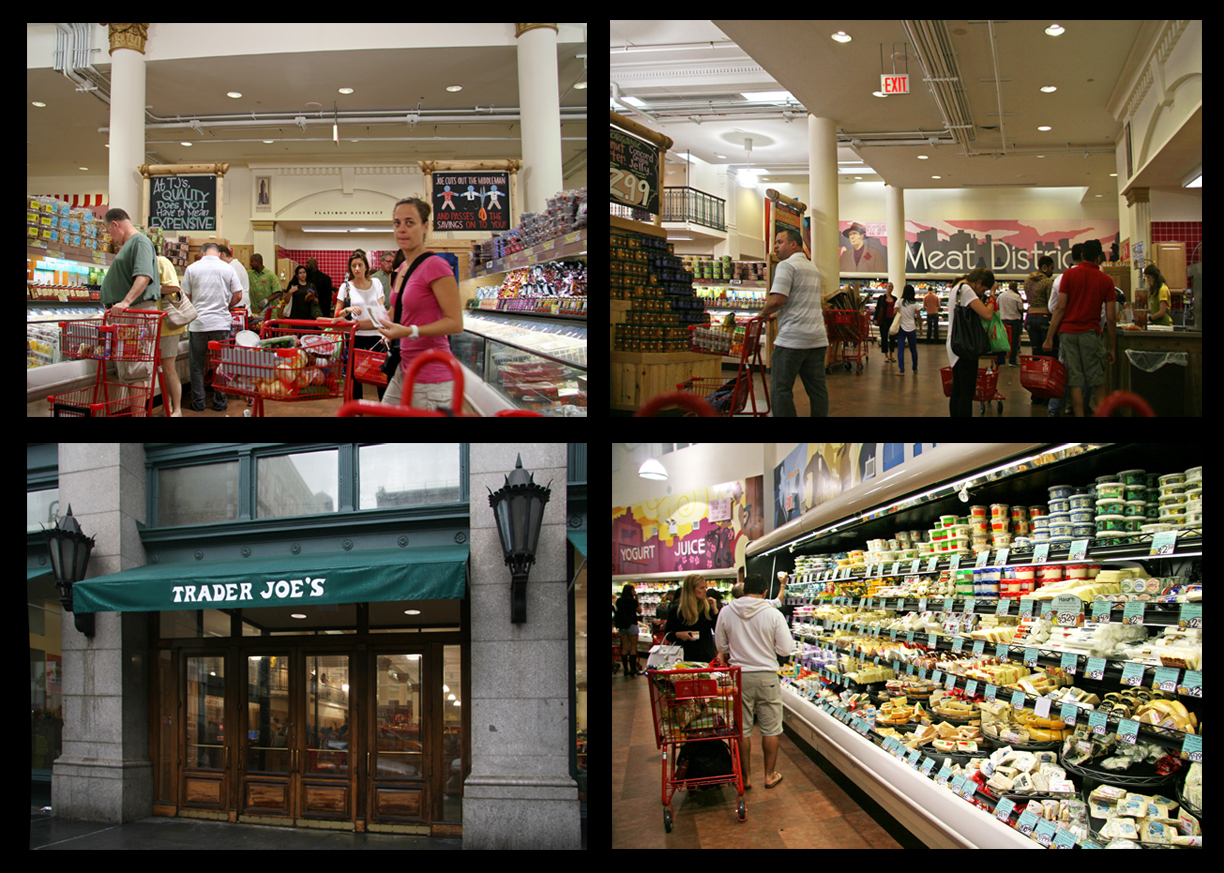
    New York City’s first location at 142 East 14th Street opened to much fanfare, with long lines to enter. Recently, however, a new location opened at 20th Street and 6th Avenue (seen in the photos), with a much roomier feel and large aisles. Shopping here is an adventure, particularly for Manhattanites, for whom food shopping in a large space is such an anomaly. Customers push shopping carts around like their suburban brethren.

    So, if a New Yorker brags to you about the wonderment that is Trader Joe’s, as if it were a city creation, humor them and let them believe it. Why spoil the fun and tell us the truth – that actually we are the last to know? 🙂

    About the Company: Trader Joe’s was started in 1958 by Joe Coulombe as the Pronto Market chain in the Los Angeles area. The South Seas motif was inspired while Joe was vacationing in the Caribbean, and the first shop with the Trader Joe’s name opened in 1967 in Pasadena, California. The company expanded, and in 1979, it was purchased by the late Theo Albrecht, one of two brothers behind the German supermarket chain, Aldi. The Aldi chain is comprised of two separate businesses, Aldi Nord (owned by Karl Albrecht) and Aldi Sud (owned by Theo Albrecht). Aldi Nord has stores worldwide, including 1000 locations in the USA. However, Trader Joe’s is owned by Aldi Sud, so there is no business connection between the Aldi stores in the US and Trader Joe’s.


  • Top of the Glass Staircase

    What is one of the most vexing problems for the visitor to New York City? Finding a bathroom. Because you need to use a bathroom. Or perhaps you are just tired and need to sit down and regroup. Sound familiar?
    It is no secret that New York City is not particularly bathroom-friendly. Signs abound proclaiming “Bathroom for customers only” or the ridiculous “No Bathroom” – does anyone actually believe that store employees work all day without a bathroom?

    New York City is an exciting wonderland for the resident and visitor. Like most large cities, most visitors will be traveling locally by a variety of methods other than their own vehicle – taxis, trains, buses, and by foot. All this trekking leaves your body in need of service.
    Most likely you have a base station (hotel) and you would like to go back to your room, but, unlike travel in the countryside, your room is not really very convenient, is it? It’s not just a quick drive away, and to go there is a bit of a hassle, taking time and energy. It also means leaving where you are – perhaps you have more to do.

    For the city resident, the situation is not much better – once out, we are even more reluctant to travel back to our homes just for bathroom use or to take a rest. Our only advantage is, occasionally, better knowledge of those places that are easy about use of their facilities. Some of the more upscale retailers are bathroom user-friendly – Whole Foods Markets, Starbucks, et al.
    But there is a better option if you are downtown. So, it is time for a quiz.

    Question: Where can you go in Manhattan and relax in a theater with upholstered seats in an award-winning skylit environment with clean bathrooms, relax as long as you like, and even get your email and access the Internet for free?

    Answer: The Apple Store on Prince Street in SoHo. I have previously written about this store. The theater, one flight up the glass staircase, is used for free presentations, as you can see in today’s photo. In my experience, however, the theater is generally unused. While you’re there, peruse the goods – the store is a mecca and meeting place. Please don’t abuse your privileges at the top of the glass staircase


  • We Don’t Do Windows

    We live a world of immediate gratification, but not if you are in manufacturing. Generally speaking, you are going to be dealing with lead times, whether it is for sampling or production. You also cannot expect the level of customer service that you will find in the retail sector, where salespeople wait to indulge your every whim.
    The best manufacturers are going to be busy, which often means that contact with key personnel may be difficult. Unreturned phone calls are not uncommon. Thick skin and tenacity are necessary attributes to being successful. Face-to-face meetings can often solve problems and move projects along quickly.

    However, not only has manufacturing eroded in the United States, but in New York City, it is virtually nonexistent – most of my suppliers are located out of the region or country. The prospect of finding manufacturing suppliers in New York City is virtually nil.
    Or so I thought.

    I recently was acquainted with two plastics manufacturers, both in the Bronx, who had the capability to make products for me – Streamline Plastics and Pulse Plastics. Streamline had given me tremendously aggressive price quotations, so I was hopeful that we could do business together. They supply companies who distribute novelty items, many made in Asia. Amazing, really.

    A new project at Streamline, however, had stalled a bit over various details, so I scheduled a meeting in person. When I arrived, there was concern that I had street parked – Streamline has their own parking. Barbed wired and the absence of windows did worry me.
    It was immediately clear on meeting the owner that this was a no-nonsense operation. His cell phone was ringing nonstop – this was a man in business to make products. Samples were waiting for me in the conference room. After just a short meeting with all the details worked out, Joe Bartner asked how many pieces I wanted and if I wanted him to run the job now.

    I was perplexed. I asked what he meant by now – like right now? He said yes – a machine was free, and he could run 8,000 pieces of plastic as we spoke. And so he did. The very next day, I was informed that the order was ready to go – how did I want it shipped?

    I also had arranged to meet with Pulse Plastics, located across the Bronx. This company breaks the rules and delivers on the unattainable trinity – Fast, Good, and Cheap (well, at least very reasonable, as I wrote in Pick Two on April 27, 2009). After 35 years in business, Pulse is on my short list of top suppliers and is a contender for the Congeniality Award. Our office staff loves them – great service, good quality parts, the president is always available by phone, and they often run production the same day an order is received.

    When I arrived, there was concern again that I had parked on the street – the owners routinely parked inside on the factory floor. I had previously discussed security issues in operating a business in many areas of the Bronx.
    When I showed dismay about the prospect of being in windowless buildings, owner Al Backleman laughed and joked that businesses don’t have windows in the Bronx. Perhaps I should call the Bronx borough president and suggest a new slogan – Welcome to the Bronx – We Don’t Do Windows 🙂


  • Solid as a Rock

    I have written a number of times about the very rough side of New York City – you see this in living conditions, the street, businesses etc. In a city with such a wide range of resources and income with the people and businesses, you will see plenty of appropriation, improvisation, and salvage. It often can be surprising or even shocking what can be seen in a place like New York City (see Very Practical and The Dark Ages).

    Many New York City neighborhoods are in transition, often with a mix of of old and new. In time, gentrification usually rules the day and a transformation ensues. Occasionally, there are surviving holdouts due to special situations – long leases or building ownership. But even in the case of property ownership, the lure of big money by cashing in on the real estate becomes too great, and owners ultimately sell. A good example is Grand Machinery Exchange, the last of 40 dealers of machinery in the SoHo/Canal Street area. Sale of their buildings brought a small fortune.

    In today’s photo, the Chess Shop at 230 Thompson Street managed to scavenge discarded chess table tops in concrete with a steel banding from Washington Square Park, still under renovation in Phase 2. See the chess playing area here, prior to demolition. It is surprising how often one can see something quite edgy like this, often juxtaposed with the much more upscale.

    Add piles of cinder blocks for bases, and you have some very durable chess tables for a long time to come. I asked the shopkeeper what they do with these after closing, but I had forgotten that there is no closing – the shop is open 24 hours, so there is no need to bring the tables in from the street.

    Of course, a chess shop is not the type of business with the income to indulge in lavish furnishings, so this solution to their al fresco chess playing needs makes sense. No worry about damage, vandalism, or theft. The tables may not be pretty, but like the Manhattan schist that this city is built on, they’re solid as a rock 🙂


  • Miracles In Our Midst, Part 2

    (see Part 1 here)

    At one time, Greenwich Village and SoHo had a large number of independent natural food stores, virtually all of which have closed. Whole Foods (no relation to the existing national chain Whole Foods Market), at 117 Prince Street, stood for 3 decades, from 1970 to 2000. This and a second Upper West Side location were owned by Charles Rosenblum. The Prince Street location was the largest natural foods store in New York City in dollar sales and became a mini mecca of sorts. My own business was located only a few short blocks away and my walk to work took me by the shop daily, so I frequented it often over many years.

    It was here in the early 1990s that I met David Miller, a man who worked the vitamin department. He was extraordinarily and curiously knowledgeable – the reason became immediately apparent once I learned that his intention was to enter medical school. At a later point, while in medical school, the demand for his expertise became even greater for David in vitamins at Whole Foods.

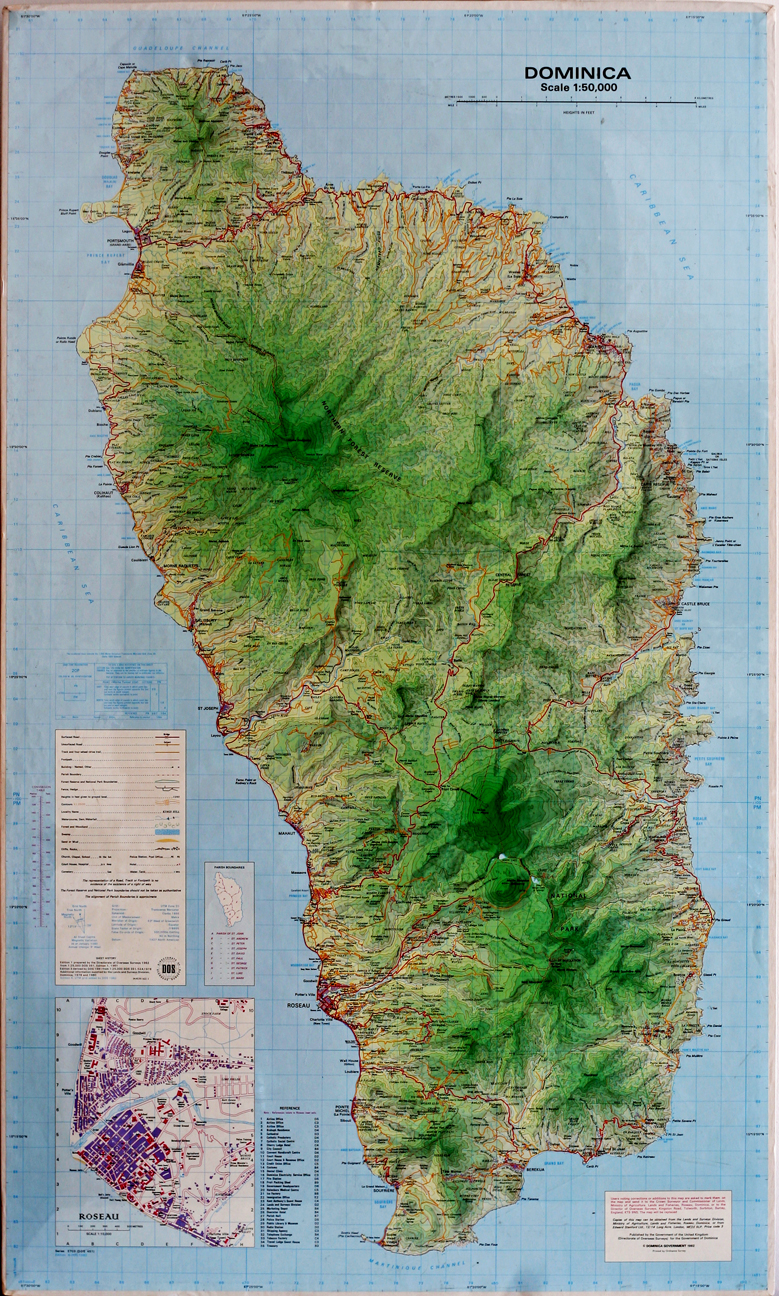
    David appeared to have a West Indian accent, so I inquired as to his background. I was stunned when he told me he was from Dominica. If you have read Part 1 of this story, you know of someone rather obsessed with this island nation. The tiny population of the island made it unlikely that I would ever meet a native by chance in New York City, so this discovery was a major event. Of course, I told him of my romance with the island, but words are cheap, and it is easy to imagine that I might be perhaps trying to ingratiate myself with him.

    How was I to demonstrate the sincerity of my special interest in Dominica? Quite simple – exhibit A from Part 1 of this story should do rather nicely, so I announced to David that I would return the following day with something special that I assured him he would never see in New York City.

    The next day, I strolled buoyantly down Prince Street with my 24″ x 41″ British Ordinance Survey map of Dominica and showed it to David. He was astounded and said he had not seen a map like that outside of the classroom when growing up on the island. That day cemented our unique connection.

    Recently, after 10 years of losing contact, I ran across David in a white lab coat with his stethoscope at Lifethyme, a natural foods shop in the Village. I was pleased to learn that he is now Dr. David I. F. Miller, M.D., a graduate of Ross School of Medicine in Dominica, and is currently looking for a residency. David works at the shop several days per week, helping hundreds of individuals who query him on every imaginable ailment.

    In the time I was in the shop to take photos of him, I spoke with a long time devotee who championed David as no less than a miracle worker, having helped him through ailments. He detailed to me his medical treatment at Memorial Sloan-Kettering and the improvements he saw with David’s recommendations. He knew of many others who had similar experiences.

    In an amazing twist, David told me of a recent discovery in Dominica. There are 22 centenarians out of the island’s almost 70,000 population – three times the average incidence in developed countries. The reasons for this phenomenon are the subject of current research at the Ross University School of Medicine.

    Perhaps this was the island Eden I was searching for. But with a doctor from Dominica dispensing free advice, why look so far from home when we have miracles in our midst? 🙂

    Note about David: Dr. David I. F. Miller, M.D. was born in Roseau, Dominica in 1966. After the devastating Hurricane David of 1979, David lived for a time in Montserrat, West Indies. He moved to the US in 1987 and returned to Dominica, where he attended Ross School of Medicine from 2004-2008. He currently is married and living in Brooklyn, New York.


  • Miracles In Our Midst, Part 1

    Part 2 of the story is here.

    In the 1970s, New York City was not particularly hospitable to the vegetarian or natural foods devotee. Granted, it was better than the suburbs, where anyone with such a dietary regime was regularly cross examined as to the reasons why. Vegetarianism did not have the cache it does today, where Hollywood stars adopt it as the latest fashion, like a pair of Birkenstocks or Buddhism.

    Natural food stores and a handful of vegetarian restaurants existed, but outside of these outposts, natural foods did not permeate the fabric of the American culture the way is does today. Soy milk, tofu, brown rice, whole grain cereals, bottled smoothies – these items are common today in virtually every grocery shop and deli in New York City, but at that time, they were hard to come by and had to be ferreted out, tantamount to panning for gold.

    There were books such as Survival Into the 21st Century (over 1 million copies sold) by Viktoras Kulvinskas and Man’s Higher Consciousness by Hilton Hotema, which became nearly biblical with the vegetarian community and members of the health food movement. The authors espoused various dietary philosophies such as fruitarianism, mucusless diets, liquidarianism, sproutarianism, raw foodism, veganism, and even breatharianism. On occasion, one of these gurus might visit the city for a presentation of sorts. There were health expos at the convention centers.

    This environment, along with the idealism of youth and a desire for an idyllic Eden, led to my long obsession with tropical islands, where I dreamed a person might live on the fruits of nature. Stories of dietary extremists such as Johnny Lovewisdom and his attempt at recreating a paradisaical life in the Andes of South America were the inspiration for many.

    Cold, dreary New York City winters seemed antithetical to visions of tropical paradise, and soon I needed to claim my own Eden, even if for only 10 days at a time. However, my flavor of Eden included hot showers, air conditioning (or at least fans), and flush toilets. So, I opted for tropics close to home with some modcons – the West Indies. I visited many of these islands over several years, but none had the impact of Dominica (not to be confused with the Dominican Republic). This lush island was home to rain forests, rare birds, waterfalls, daily rainbows, and mountains – Morne Diablotins rises to 4,747 feet – quite dramatic for an island of only 291 square miles.

    It was the botanic garden I had been searching for, and I made three visits. I had the island virtually to myself – the scarcity of beaches is one of the primary reasons that the island is little known and the least visited of the Caribbean islands (around nearly the entire island, green covered mountains plunge to the sea). You can read more about this remarkable little island gem here.

    Is there a stronger connection between Dominica and New York City than my ruminations and obsession? Yes, there certainly is, but for that, you have to meet David Miller. We will do that tomorrow in Part 2 🙂

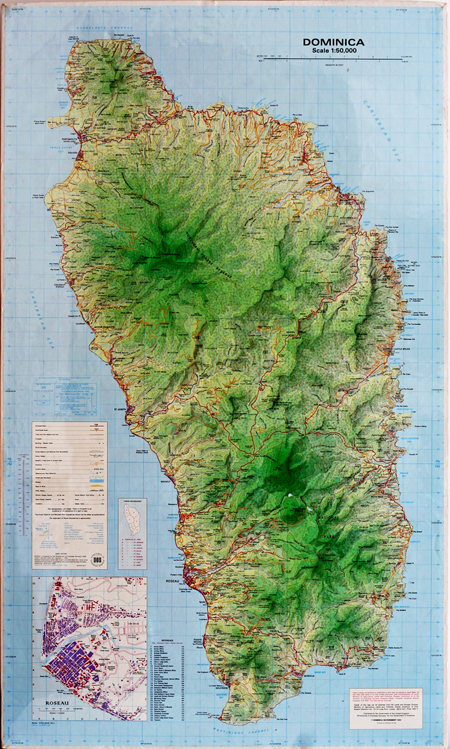
    Photo Note: This is a British Ordinance survey map of the island, dated 1982. I purchased this large map (24 in. x 41 in.) on one of my visits to the island and, on my return, had it mounted on foam core.


  • Guastavino

    Would you like to do your grocery shopping in a space with the grandeur of a cathedral? Welcome to the Food Emporium at Bridgemarket, nicely tucked under the Manhattan approach to the 59th Street Bridge.

    The Bridgemarket was originally an open air market in the early 1900s until the the 1930s, when it became a New York City Department of Transportation facility. The vaulted space was designed by Austrian-American architect Henry Hornbostel and engineer Gustav Lindenthal. It languished unappreciated and unloved until 1977, when Hardy Holzman Pfeiffer Associates first presented plans for a market. Renovations were begun in 2000. It is now occupied by the Food Emporium (seen in the photo), Guastavino restaurant, a Conran furniture shop, and a public plaza.

    The real pièces de résistance here are the vaulted ceilings covered with Guastivino tiles. Rafael Guastavino (1842-1908), an architect from Barcelona, came to New York with his son in 1881 and, in 1889, founded the Guastavino Fireproof Construction Company. It was initially run by Rafael and later his son, with its final contract completed in 1962.

    The Guastavino tile arch system uses a timbrel, or Catalan vault of self-supporting arches and architectural vaults with interlocking terracotta tiles and mortar. The Guastavino company eventually held 24 patents for the system.

    Hundreds of historically and architecturally important buildings use his system – Grand Central Terminal (particularly the Oyster Bar), Grant’s Tomb, Carnegie Hall, the Cathedral of St. John the Divine, the Elephant House at the Bronx Zoo, and the Ellis Island Great Hall. Guastavino’s first major project was in 1888, when he was hired by McKim, Mead & White to produce the vaulting for the Boston Public Library.

    Using publicly available and architecturally beautiful structures for day-to-day tasks is one of the unique things about New York City – shopping in the old Scribners Bookstore on 5th Avenue, dining in a former bank with high ceilings the Blue Water Grill at Union Square like that occupied by Balducci in Chelsea, staying in historic hotels like the Waldorf Astoria or the Plaza, walking across the Brooklyn Bridge, or just catching a train in Grand Central Station. There are many things to see and do in New York City, but as I explore, I’m keeping an eye out for one name: Guastavino 🙂


  • Benefactors of History

    Although black and white photography is clearly a result of the historical/technological development of photography, it is interesting to note that its continued use has not been solely related to the momentum of historical precedence or the cost. Color photography dates back to 1861, black and white to 1822. Black and white continued to dominate even after color film was readily available. Cost was a big factor, but there is a classic look preferred by many photographers for certain applications,  such as portraiture, and for its use in film or TV, such as film noir or Rod Serling’s Twilight Zone.

    There is certainly a cult phenomenon around black and white and those who shun color for what they believe is an artistic superiority of the media. Many devotees find color a distraction from the subject and that the lack of color forces the viewer to look at other elements more closely – form, line, etc. Also, many see black and white as more dramatic and better at capturing a mood than color. Portraiture, weddings, and head shots are areas where black and white still continues to have an important role, often supplementing color.

    Of course, many of those hope that the use of black and white will immediately confer a sense of authenticity and historical significance to their photos.

    Typically, advancing technology improves a craft. Sometimes, however, the early limitations of a technology conspire for the greater good. People hearken back to that early technology, not only for romantic reasons but also because under certain conditions, the older tools and techniques produce a superior result to newer technology. This can be seen in many areas. I am certainly not saying that black and white is superior to color – I love color and prefer to shoot in color. The world is in color. But there is a place for black and white, and we are the benefactors of history…

    About the Photo: Pylones is a gift shop featuring housewares, inspired by the elements of childhood – bright colors, bugs – with a strong cuteness factor. Here you will find an creative selection of items for the office, kitchen, beauty, decoration, jewelry, tools, and, of course, for children. Pylones is a small international chain founded in France in 1985 by Alan Ceppos and FrĂ©dĂ©ric Rambaud. There are 5 shops in the US (all in New York City), as well as locations in Brazil, Asia, and Europe. They also distribute their product to other shops. You can see their website here.

    I don’t think Pylones or its products work in black and white 🙂

    Related Postings: Coup de Grâce , Tale of Two Colors, Hispanic Day Parade, Color Brigade, Flamboyant,Building Gone Wild, That’s Quite a Briefcase, Fashion Forward, Taste, Krishna Festival, Police Riot Concert, Narcissism Gone Wild, A Colorful Life, Who See the Red


  • BAPE, Wangsters and Hypebeasts

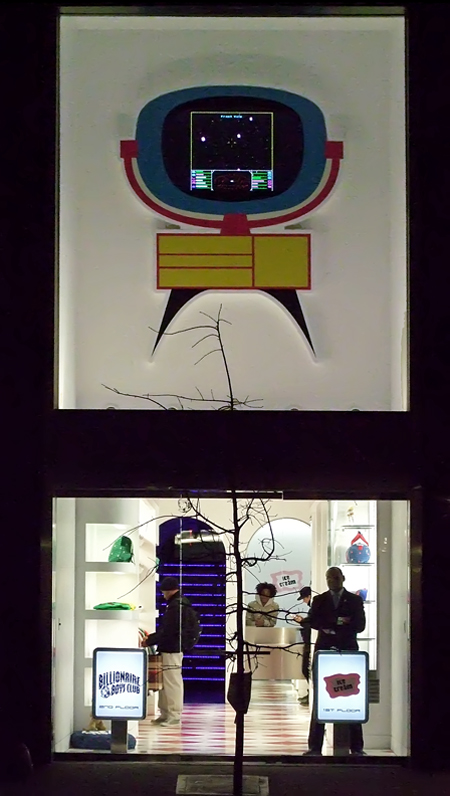
    A story was already forming in my mind as soon as I saw this Billionaire Boys Club shop in SoHo at 456 West Broadway. I was going to write how, in my experience, you can not manufacture or create a cachet, a sense of exclusivity, or a cult following. These things have to develop organically over time, with proven product or content.

    The name of this store reminded me of Members Only jackets and the belief that the mere proclamation of exclusivity was enough to confer it. Ironically, I have learned that there is a cult following for Members Only jackets.

    But perhaps the nature of time itself has changed, as well as the definition of natural evolution. There is a lot of talk online amongst marketers about creating BUZZ – i.e. the very thing that traditionally was something that came naturally as a product, service, or company proved itself over time. But no one has the time or patience for natural evolution. And there is the reality of an extremely dynamic world market with rapidly changing tastes, global competition, love of new things, and technologies to display everything instantaneously.

    Can you brand, market, and, with enough muscle, jump start an image and reputation? It certainly has been tried, with varying degrees of success. One big key, of course, is the leverage applied using notable figures, either as customers or as the company ownership. Another technique is to limit quantities and sell at high prices. These ingredients obviously do not guarantee success, but as a business model, it makes more sense than a me-too approach and competing on price against established merchants.

    Billionaire Boys Club and Ice Cream are two lines of high-end sportswear established in 2005 by Pharrell Williams of The Neptunes and Nigo, designer of the clothing line BAPE and founder of the company in 1993. So, to further complicate this story, we do have some legacy here, not just overnight buzz.

    In reading reviews about the Billionaire Boys Club and Ice Cream, I became lost in an endless chain of hypertext links of brands, products, stores, people, and words unknown to me. A review from Yelp.com:

    Yes folks, this even outdoes the BAPE toilet paper as an all time low. … A virtual ghost town of hypebeast products and overstaffed employees was all I witnessed.

    So I need a new vocabulary. I learned that BAPE, A Bathing Ape, is a clothing line, SoHo store and an adjective, and I learned the meaning of hypebeast, but my education is far from complete. Looking up BAPE in the Urban Dictionary returns seven definitions, including:

    A Played out Brand by Nigo from Japan, rocked by wangsters and hypebeast.

    Now I had to learn what wangsters are. Fortunately, I have review sites, forums, blogs, and the Urban Dictionary. I have a lot of reading to do 🙂

    Note about the store: The ground floor features Ice Cream, and the second floor, which resembles the interior of a space ship, carries the Billionaire Boys Club line. The prices are extremely high – Tees for $80-$100, hoodies for over $200…


  • Welcoming Committee


    There is no doubt that the ambiance of shops in New York City will not often be like that of the small rural or suburban town. Places where you are spoken to on a first named basis, your preferences are remembered, the owner is on hand, expertise looms large, and people really go the extra mile.

    However, I said not often, not nonexistent – I have featured many of these mom and pop establishments in this website over the last four years. You will find this type of place more often in the neighborhood shops in the outer boroughs where, with a few visits, you are treated like a valued regular. I seek them out – the extra level of humanity makes New York City so much more livable.

    Do you want that treatment as soon as you walk in the door? Head to the Mandolin Brothers at 629 Forest Avenue in Staten Island.
    The accolades for this place, from amateurs and music stars to major media, border on the unbelievable. Things like: “One of the best guitar shops in the world,” from The Boston Globe.

    I visited here recently because I had been hearing about the place for years. It was immediately clear on entering what all the fuss was about. Walking through the door, I had an experience of the welcoming committee. The shop was extremely well staffed with friendly, knowledgeable sales people at every turn. I was encouraged to hang my coat and peruse and sample the wares by the owner himself, Stan Jay, who started the shop in 1971. The inventory is amazing, and the roster of customers reads like a who’s who of music. Read more about them at their website here.

    You will find attentive staff at some of the chain stores with, however, two major differences – sales pressure and lack of expertise.
    From the Mandolin Brothers website:

    Widely known as one of the largest dealers in the world of vintage and new American fretted instruments, we are frequently recommended by Gibson Guitar Corp., Nashville, TN, when they receive inquiries about vintage and used instruments, and also by Martin, Fender, Guild, Gretsch, National, Taylor, Dobro, PRS and many other manufacturers …. We are recommended by many local music stores around the country and by manufacturers, libraries, museums, magazines, search engines and newspaper columnists. In business since 1971, we service the needs of over 225,000 players and collectors of American fretted instruments all over the globe.

    Visiting Mandolin Brothers’ showroom is like no other retail store experience you have ever had. It’s as comfortable as being home, if your home were stocked with many hundreds of exceedingly high quality, original condition fretted instruments. Your questions are answered accurately and completely — our greatest goal is to educate our customers to the differences between brands, models, styles, woods and appointments, so that they can make up their own minds based on having the information required to do so.

    We treat every customer like a friend of the company.

    It’s all true. Like moving to a small town and getting the welcoming committee 🙂


  • dinamic_sidebar 4 none

©2026 New York Daily Photo Entries (RSS) and Comments (RSS)  Raindrops Theme