• Category Archives Stores
  • The Lomo Look

    I do believe that there can be great value in de-emphasizing the tools in many endeavors. Technology has advanced so far that in many fields, it is very easy to get lost in the tools of the trade. In photography, particularly, the number of devices and accoutrement is extraordinary, and many photographers do become obsessed with the gadgetry.

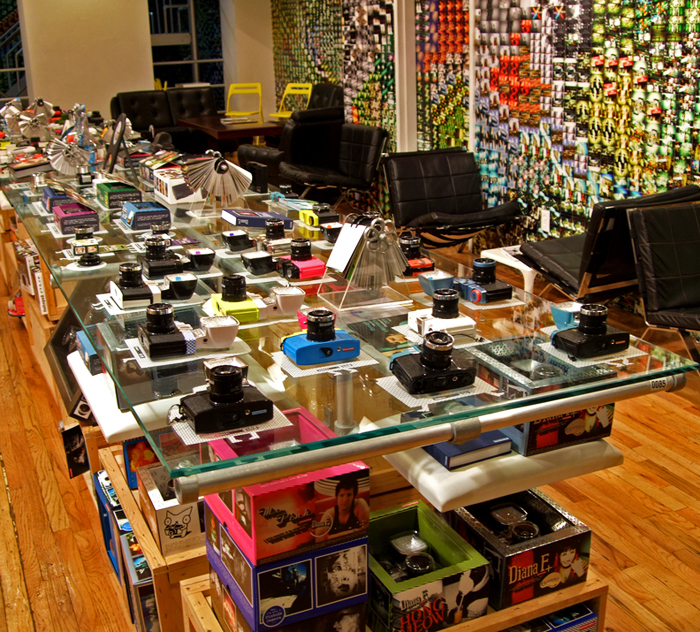
    There are numerous cameras in the “toy” camera category which have found favor with members of the photographic community and students. They typically were inexpensive plastic cameras, many produced as novelties, which often produce strange and unpredictable results. Some cameras in this class will even display evidence of light leaks. Many, like the Holga, Diana, and Lomo, have developed cult followings, owing to these photographic effects. The Diana was originally produced in the 1960s in Hong Kong and was a predecessor to the Holga, which was made in China (first appearing in Hong Kong in 1982).

    In 1991, two Austrian marketing students discovered the LOMO LC-A, a camera introduced in 1984 by a state-run optics company in St. Petersburg, Russia. They became enchanted with the photographic results of the Lomo camera, which will show any combination of bright colors with somewhat garish, contrasty images, often with blurring and vignetting.

    Use of low fidelity toy cameras can be a very useful exercise in learning to focus on the art of photography, training the eye, and playing down the technology. There is no question that good work can be produced using low tech camera equipment and conversely that poor work can be done with top equipment. Some award-winning photos were created using Lomos and other cameras of this class.

    However, the bottom line with this type of camera is that you give up a lot of control. Using it becomes an exercise in working with (or around) the camera’s “flaws.” If you are interested in controlling depth of field for portraiture, shooting in very low light with high ISO, achieving sharpness with high quality lenses, exposure compensation, white balance, etc., these types of cameras will show their limitations. However, the lack of control is not only their weakness but also the appeal of these cameras. The fact there is a very distinctive Holga or Lomo “look” is a result of these cameras’ anomalies or limitations.

    Lomography is the trademark of Lomographische AG, founded by the two Austrian students, who, in early 1995, negotiated exclusive distribution of the Lomo LC-A. Lomography also distributes a number of low cost analogue cameras, such as the Diana and the Holga.

    The photo is from their new shop located at 41 West 8th Street. Lomography has 20 retail store/galleries worldwide – the New York City shop is currently the only location in the United States. The shop sells cameras, film, accessories, and books. It will be introducing on-site film processing. They offer classes, workshops, and meetings each month. The store also features North America’s largest LomoWall, with 35,000 Lomographs on display. If you visit, you can see the equipment, as well as examples of the photography, and decide for yourself what you think of the Lomo Look 🙂


  • A Small World

    I have often dreamed of living in some small French village where everything is on a very human scale. Where old men gather in the town center and play boule, there is no traffic, everyone knows everyone, and even the outsider is greeted like family. Where people really care and will go that extra mile to help. And the quality of one’s life is measured by his or her relationships.
    A place where time is stopped, there is no sense of urgency, and things are done deliberately.

    There are many places like this, and I have seen them. However, to live in a small town, I would miss all the things New York City has to offer. So at times, foolish that I am, I try to find a microcosm like that in New York City. If you look hard, you can find a place where it’s a small world after all.

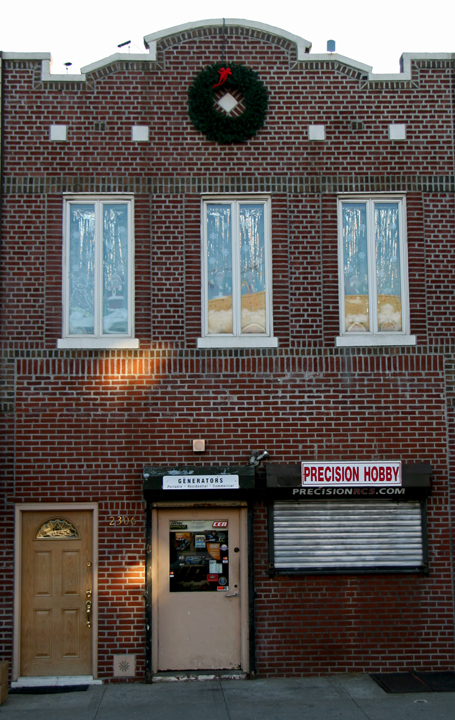
    At Precisions RCs, the metaphor becomes literal – the diminutive size of the place is matched by its scale models, mostly radio-controlled (RC), for the serious hobbyist. Here, in this tiny shop, you will find an inventory of radio-controlled airplanes, cars, helicopters, and boats. There are also trains, rockets, and plastic models. The owner carries a line of current models, has an online business, and also specializes in many discontinued models – of interest to the aficionado. I accompanied a friend from out of town who has an interest in RC planes and purchased an out-of-production wood frame model.

    Technology has made a huge impact in this hobby, as in most other areas of our lives. Although nitro-powered engines are still manufactured and sold here, there has been a shift to electric engines/motors for many types of RC models, fuel- and maintenance-free.

    The value for the dollar is amazing – the result of a combination of technological advances and Asian manufacturing. The owner demonstrated an amazing little RC helicopter which can be flown indoors (photo lower right), controlled by a sophisticated multi-channel radio – all for only $100.

    What I enjoyed most was the clubhouse atmosphere with valuable floor space given over to regular visitors. When we arrived, four men were sitting at tables in the tiny shop. We were immediately welcomed and included in the conversations. Many of the customers are members of the flying club which meets at Floyd Bennett Field.

    Everything conspired to send one message – that even in New York City, you really can find a small world 🙂

    Note: Precision RC is located in a small two-story building (see the outside here) at 2306 Bath Avenue in the Bath Beach neighborhood of Brooklyn. Bath Beach is located in southwestern Brooklyn along Gravesend Bay.


  • Substance Abuse

    In a city like New York, there is a lot of substance abuse. But it takes many forms, and one that may not immediately come to mind is the company that oversells and underdelivers by taking what quality it has and abusing it through excessive marketing.

    I want to believe that behind great companies lie great products. That reputations are built on merit. That marketing is a recent addition. That the maxim most businesses want to follow is the pithy undersell and overdeliver. That they understand the disappointment and bad taste left by a product where the operative was to oversell and underdeliver.

    However, when a few raise their voices at the dinner table, soon everyone must do the same to be heard, and a screaming match ensues. And so it is with an overcrowded marketplace of products and services. To undersell is perhaps to risk not being heard at all, regardless of the quality you have to offer. Developing a cult following for a product through word of mouth and evangelism is not the easiest to orchestrate. Companies such as Apple have done well, however, this approach is often initially an organic process, not part of a marketing plan.

    Louis Vuitton is a company that was built on merit – quality of product and innovation. I cannot speak for the quality or durability of the products today. They are so pricey, and I would be frightened to use them – its stores display their wares more as works of art in a contemporary museum than as products to be used. Bags run $1000 to $2000 dollars, and their signature piece of luggage in leather is $6000. In my recent travels seeking out holiday windows, I decided to drop in to the Vuitton flagship store at 5th Avenue and 57th Street. The store is sleek and modern.

    Louis Vuitton was born in France and began designing flat-bottomed trunks in the 1850s. Even at that time, his distinctive designs were copied, and the problem of counterfeiting remains today. Vuitton employs a full-time team of lawyers and investigators just to curtail piracy. Read more about the company here.

    It is difficult, if not impossible, to find any company that flies by the quality of their content or products alone. Marketing and branding is absolutely part of the business model today, even more so with a legacy brand name. The question is whether any product lives up to its marketing. Perhaps some of you have experience with Louis Vuitton products and can let us know – is this still a quality product or a case of substance abuse?


  • Have a Witty Holiday!

    In New York City, the vast majority of residents are still largely Christian, but the percentage of non-Christian groups is quite significant and in numbers that translate easily to over one million people.

    Outside of the city, (in New England, for example, where I am writing this), meet and greets with family and friends at this time of year always include “Merry Christmas” and a handshake. In the city, I try to be much more conscious of the implications of Christmas in my greetings and the possible religious affiliation of those I greet.

    The increasingly secular nature of the holiday certainly makes this aspect of Christmas in the city more comfortable – wishing others a Merry Christmas without knowing their religious background is much less likely to offend. I am often inclined to use “Happy Holidays” in my cards enclosing the numerous gratuities I give at this time of year.

    The festive nature of the holiday and time off from work is enjoyed by many. Although this may not be embracing the original meaning of Christmas, it is a reality that most practicing Christians accept in a country founded on religious tolerance.

    The non-religious emphasis is particularly noticeable in the holiday window displays. The more traditional displays, such as that of Saks, Bloomingdales, Lord and Taylor, and Macy’s, do show gifts and the occasional Christmas tree. Others, such as Bergdorf Goodman, have windows that are devoid of any holiday or even seasonal themes, using the holiday season as time for an extravaganza.

    I had been told that Barney’s at 660 Madison Avenue had a particularly creative window display. A trip there confirmed that, however, I was surprised to see such a non-Christmasy Saturday Night Live theme, with the greeting “Have a Witty Holiday!” In its heyday, this TV show was legendary and its relationship to New York City known to everyone. The opening of each show, “Live From New York, it’s Saturday Night!” made it very clear. The windows were done by Simon Doonan, creative director of window dressing for Barney’s since 1986.

    As I write this, I look out to a snow-covered landscape – the white Christmas that Bing Crosby and Irving Berlin dreamed of. The day ahead will be one of socializing with family and friends, exchanging gifts, and a holiday dinner.

    For those of you who celebrate, I wish you a merry Christmas – for everyone else, have a witty holiday 🙂


  • Fantastic Windows

    On a recent second excursion to the Upper East Side to see more holiday windows, my travels took me back to 5th Avenue, across the street from Bergdorf Goodman’s main store, where their men’s store is located. These window displays were drawing the attention of passersby, virtually all of whom were compelled to stop and look with focused and studied attention. And for a good reason. Twelve windows are being used to feature these meticulously crafted, very detailed figures, which were used in the film The Fantastic Mr. Fox, adapted from the work of Roald Dahl. See my gallery of photos here.

    The windows were a collaboration between 20th Century Fox and the Bergdorf design team. From the press release:

    The holiday windows at Bergdorf Goodman, one of New York City’s premier seasonal delights, will feature the sets from Wes Anderson’s film, “Fantastic Mr. Fox,” based on the children’s classic by Roald Dahl. The windows will debut on the evening of November 10th. David Hoey, Bergdorf Goodman’s Senior Director of Visual Presentation partnered with the film’s production team to adapt sets from the stop motion animation film for the windows. They will include the character puppets made by the UK’s acclaimed puppet makers, Ian MacKinnon and Peter Saunders. This collaboration marks Bergdorf Goodman’s first-ever partnership with a major film production for its holiday windows. The twelve windows of Bergdorf Goodman Men’s Store located on Fifth Avenue and along 58th Street will feature the “Fantastic Mr. Fox” sets through January 4, 2010…

    Mackinnon and Saunders was founded in 1992 and has since been responsible for some of the finest stop-motion puppets in the world – see their website here. Their award-winning work has been used in film and television, with the likes of Tim Burton on Corpse Bride.

    Peter Saunders worked as a puppet maker on Jim Henson’s live action movie The Dark Crystal. Subsequently, he learned to adapt and miniaturize animatronic techniques, which enabled him to create highly sophisticated stop-motion puppets.

    The display will be up until January 4. There is still time to view these Fantastic Windows 🙂


  • Bendel

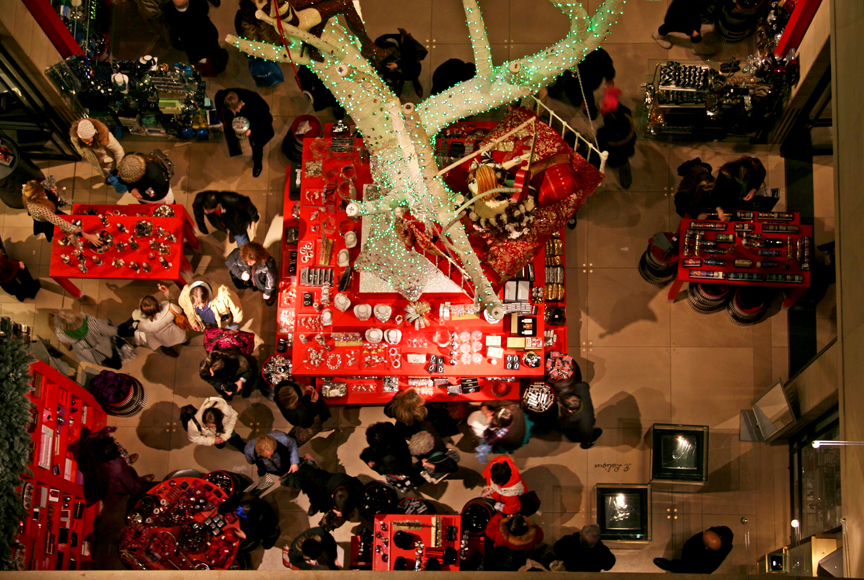
    Bendel’s has been one of New York City’s upscale retailers for over 100 years. In December 2008, I did a photo shoot of their windows at Christmas time.

    Bendel’s was established in 1895 by Henri Bendel, a milliner. They were originally located at 10 West 57th Street and moved to their current location at 712 Fifth Avenue near 56th Street in 1990. The store occupies two landmark buildings, the Rizzoli Building (712 Fifth Avenue) and Coty Building (714 Fifth Avenue), along with a new five-story building. Lalique windows were discovered during the restoration. The store has four stories, a lower level and an atrium with balconies. See the view from the top down here.

    However, even quality products and a legacy cannot stop changes in consumer habits or a poor economy. In 2009, Bendel’s decided to stop selling clothing. According to the New York Times:

    Several employees briefed on the plans said on Thursday that they were told that Bendel had decided to eliminate the fashion departments because there was no sign of a turnaround in the sale of high-ticket items, but that beauty and gift products were selling well and typically with much higher margins. About 8 percent of the employees will be laid off, including sales clerks and executives in its buying office, these people said. About 250 people work at Bendel.

    Luxury stores like Neiman Marcus, Saks Fifth Avenue and Barneys New York have all eliminated hundreds of jobs and scaled back their orders from designers in reaction to the economy. Sales of $1,000 dresses and cashmere sweaters began to plummet last October.

    Bendel’s, famous for its “store of store” shops and signature brown-and-white striped shopping bags, hatboxes, and matching line of cosmetics bags, will focus more on branding and merchandising. They have been opening stores nationwide since 2004 and currently have 10 locations, many in upscale shopping malls.

    I have never shopped at Bendel, but it is rather saddening to see a historic company go in this direction. In 1986, the store was sold to Limited Brands. What worries me most is that at the rate of change we are seeing in stores here, New York City’s merchants will become less unique every day. As one reader commented recently, it is the amalgam of all things in New York City that makes it unique. I hope he is right and that we do not just become the biggest mall in America…

    Note: Henri Bendel has a special significance to me – the reason will be revealed in a future story, if I can get the interview and photo opportunity with a particular individual. Look for Because I’m the Best.


  • Gotham City

    It is harder and harder to find products and shops unique to New York City or any other. The architecture of the city itself, of course, cannot be duplicated.

    But as I endeavor to ferret out things unique about this city, I am often surprised when it comes to merchandise and food. The influences have become a two-way street. Many of the products once exclusive to this city are often available in the suburbs or countryside. And New York City has seen the influx of stores which are now part of the national landscape. Places such as Whole Foods Natural Market are no longer the exclusive domain of the urban dweller. A quick search online will show how many of their stores are now located in the suburbs. I am careful to boast about any services, products, or restaurants that we might have in this city – all too often, the response I get is that “we have that too.”

    The world really is becoming smaller. The Internet and electronic media have leveled the playing field for nearly everything and everyone. New products, information, music, film, and TV no longer take years to seep out from cultural centers in a slow migration. People are instantly informed of anything. I have met people across the world who watch HBO regularly and are familiar with programs such as Sex and the City.

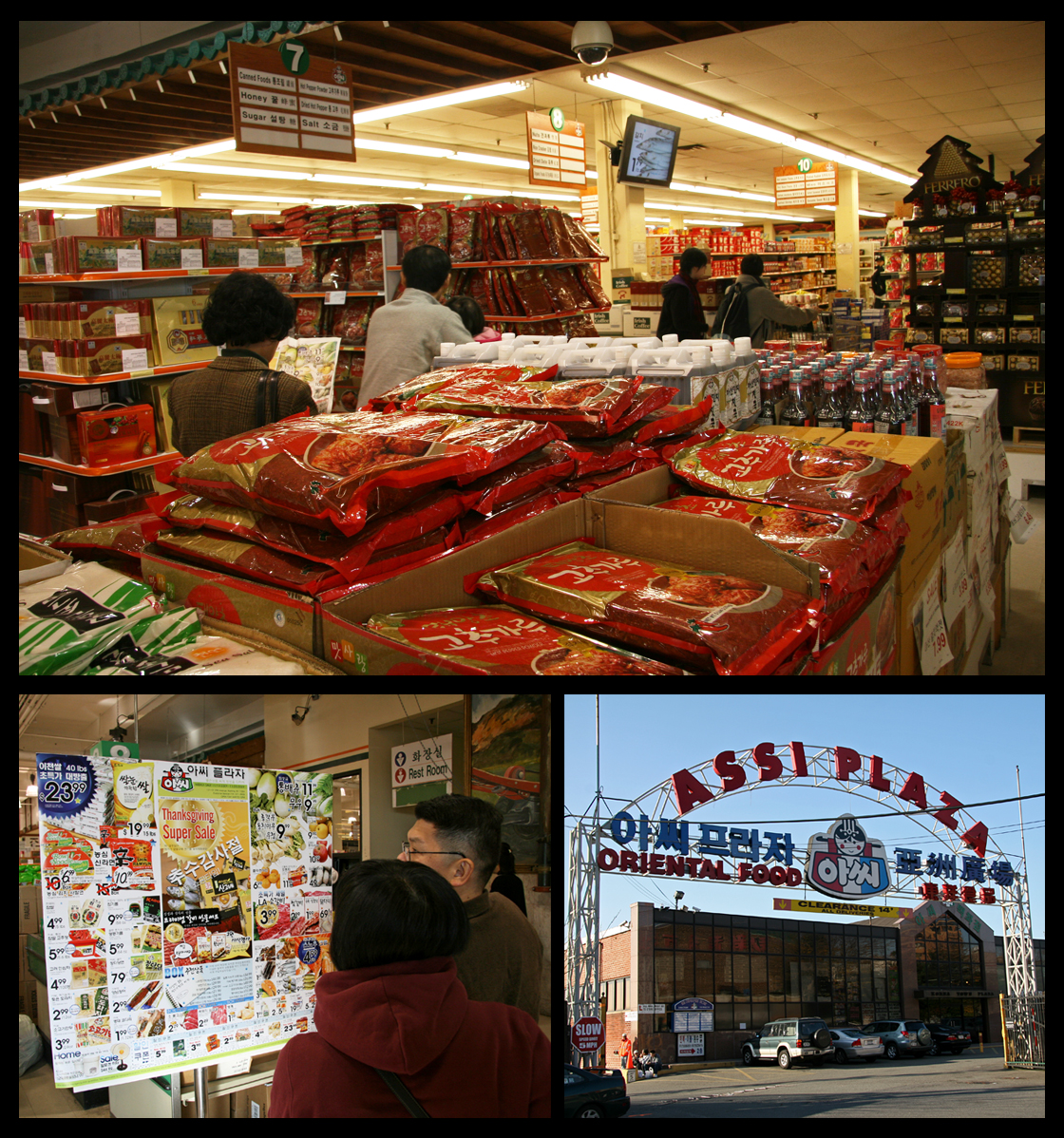
    I thought that this enormous Korean supermarket in Flushing, Queens, Assi Plaza, most certainly had to be something exclusive to New York City or perhaps a city in California. Flushing has a large Korean population, estimated at 10%. However, visiting the Lotte Assi Plaza website shows 13 stores nationwide, with the company having been established in Maryland in 1976. Of course, overall, this is not to say that neighborhoods like Flushing, or even Assi Plaza, are going to be an everyday experience for the average American, but this is everyday life for someone living in the city.

    When you narrow the focus, that’s where New York City shines brightest. But it is still quite a challenge to find food products and restaurants that are very special and unique to this city. Even looking at a very specific ethnic group such as the Korean Americans, I was surprised to find a list of over 200 Korean supermarkets in the United States, not all of them in large cities.

    But I will continue to narrow the focus as tightly as necessary and, in that light, illuminate the unique things I find that either loom large or hide in the cracks and crevices of Gotham City…


  • Released from Captivity

    There is a book I enjoyed very much – French or Foe, written by Polly Plat, an American expatriate living in France. The book is oriented towards those who will be in France for extended periods, living or working there. However, it is of value to the armchair traveler as well or to those who just want a window into the French culture, much like the Culture Shock! series of books. In French or Foe, each chapter examines and explores a different facet of French culture.

    In one section, Platt explains how to navigate the bureaucracies of France, which can be quite vexing. The secret, according to her, is to develop a relationship with an employee. Individuals in those positions can certainly pull strings and make things happen.
    In many ways, the concept is applicable on this side of the Atlantic anywhere you have a public agency or in the private sector, where you have a captive audience. How can that be in New York City, with so much competition?

    In Manhattan, the business environment has become very difficult, even prior to the economic downturn. Vacancies are everywhere. However, there are still plenty of merchants in many sectors – there is no shortage of clothiers or restaurants. Where there is a particular dearth of merchants, however, is in essential services, where markups are limited and luxury pricing is not doable (laundromats, shoe repair shops, lumber yards, and hardware stores), and in industrial supplies, due to both real estate costs and lack of customers, since most industry has left the city.

    With industry gone, many industrial/commercial supply houses have also left or gone out of business, such as Tunnel Machinery, Commercial Plastics, Space Surplus Metals, Victor Machinery, and Zelf – a fascinating place in SoHo that offered rental of heavy machinery.

    But industrial/commercial suppliers are still needed by the trades. Ordering online is not always desirable; often repairs and work cannot wait for shipment. As I wrote in No Students After One, most suppliers to the trade in the city operate at street level and are subject to patronage by retail customers, many who are very unfamiliar with the product line and would be better suited shopping elsewhere. Compound this with the dwindling number of these places, and you have all of the basic ingredients for a captive audience with impatient salespeople and brusk, occasionally abusive, service.
    The solution is much like dealing with the French bureaucracies: develop a relationship with someone there, earn his/her respect, and you can be treated like a customer.

    This area was once home to forty dealers of machinery, now gone when the last dealer, Grand Machinery Exchange, relocated to Long Island in 2006. Some suppliers to the trade remain, such as Faerman Cash Register and Lendy Electric Supply, located at 176 Grand Street in Chinatown/Little Italy (seen in the photo). Lendy’s atmosphere is unmistakably one to the trade. There is no self-service or browsing aisles – the customer takes a number and waits in line to be served. Products are brought to you as you ask for them, so you need to know what you want and what it is called. At times, the place can become quite crowded, but here you will find a knowledgeable staff with products you can trust – the bulk of the customers are contractors. You will get honest dealings and no-nonsense recommendations. Upselling is not going to work here.

    I found my recent visit there quite pleasant and my salesperson very informative and accommodating. Lendy’s has a broad range of hardware and electrical items, including many unique specialty products which are nearly impossible to find in the city. However, they do not take advantage of their captive audience and punish the customer. If you go there, you will find, as I did, a French tutorial will not be needed. At Lendy Electric, you are released from captivity 🙂


  • White by Design

    In the beginning, I would take the conversations seriously. By seriously, I mean attentively, with a reasonable expectation that I would get different responses regarding suggestions for color. Soon, however, I realized that each of my best friend’s answers would be presented and argued differently but the preferred color in almost any situation was the same: white.

    It became a private joke between this long-time friend and other close friends. Her design choice appeared to always be white. Drapes, wall color, clothing – anything that was available in white was usually chosen or recommended.

    With absolute serendipity, many years later, I discovered a hardcover book: White By Design by Bo Niles (published in 1984 and still in print). It was a virtual tribute to white and its use for interior decoration. The perfect gift. But, alas, I was too lazy to purchase it. One of life’s small regrets.

    White is so important to visual artists. It is the color of light itself, and artists love and need light – it is one of their primary tools. I remember how surprised and disappointed I was when Apple Computer went from their six-color rainbow logo to white in 1998. Eventually, even their pioneering success in translucent color iMacs gave way to white. Now I love the white that dominates the color theme for Apple’s packaging, graphics, and product line.

    White has an elegance when used well as a decor choice. It not only gives a clean look but also allows other objects to shine. Used badly, white can be a horrific choice – everything is mercilessly revealed with white. It is also deliberately and conspicuously impractical, making a statement about luxury and the ability and willingness for maintenance. The decision to use white in an unforgiving city such as New York makes a particularly strong statement.

    White has cultural significance and is associated with purity, freedom, and cleanliness. There is a litany of positive associations in so many areas of life. We have white sugar, pure sand, snow, cotton, clouds, milk, white uniforms, white rooms, the White House, the white dove of peace, white robes of clergy, white bridal dresses, and white magic.

    This shop in SoHo, the Cyrus Company, was arresting in its use of white. I was reminded, however, of the book I never purchased. But then, as now, there is always time, because the world never tires of white. In many ways, much of our world is White by Design 🙂

    For more White by Design, go here and here.

    Related Postings: That’s Quite a Briefcase, Who See the Red?, Coleur du Jour, Tale of Two Colors, A Colorful Life, Color Brigade, Eye Candy


  • No Students After 1

    I would guess that you will not find another sign like this in New York City. Students are typically afforded privileges, and their regular business is encouraged – student loans, student discounts, etc. (These days, student discounts are ironic. In New York City, many students appear to be better off than many of the residents.)

    In the garment district, you will often see signs which read “wholesale only” – a warning that business is open only to manufacturers and the trade, not to retail customers. This is strictly a business issue – merchants posting signs such as this one work on smaller profit margins and are not interested in selling a yard or fraction of a yard of fabric. They cater to those who buy one or more entire bolts of fabric at discounted pricing.

    Being a wholesaler/distributor in the city, however, poses a unique problem for many vendors since they often occupy ground floor spaces on streets with retailers and foot traffic. Even neighborhoods which at one time were predominantly commercial or industrial now have many residential tenants and visitors.

    At Kaufman Shoe Repair Supplies at 346 Lafayette, even though the business caters to the shoe repair industry, many of the products are of interest to the consumer or art student and are sold in sizes and quantities reasonable to someone outside the trade. Items such as foam crepe rubbers, specialty leathers, dyes, and adhesives are virtually nonexistent elsewhere in the city.

    Kaufman opens at 6:30 AM and closes at 2 PM. In their final hour of business, there is no time for casual shoppers and perusers of merchandise. You must know what you want and not make it difficult to service regular accounts who come just before closing. I have done business with Kaufman from time to time over the last 30 years and have found them professional and helpful overall.

    I am reminded, however, of an incident which is indelibly branded in my mind as one of the most hostile retail encounters I have ever witnessed in New York City. I was waiting for service in a very busy lumberyard whose core business was the contracting trade but was certainly open to retail. Dealing with customers who are often unsure of what they want or what they are doing can be tiring to someone accustomed to tradespeople who know exactly what they want, and one salesman in particular was at the breaking point. With a room full of customers, he glared at an individual who was asking too many questions and said, “Sir, this is not a f**king university! If you don’t know what you want, leave.” I wonder, would this mean no students after 1?


  • Take Two

    I was recently looking for a Vietnamese herbal formula for a friend. Extensive searching online found neither the product itself nor anything like it in the USA, even though the manufacturer was a well-known company in Asia with a large product line.

    I took a printout of ingredients from the company’s website to Kamwo Pharmacy, where a very helpful staff member, fluent in English, Chinese, and online searching, quickly identified the ingredients and their Chinese names and said that the formula could be easily reverse engineered.

    Kamwo Pharmacy, located at 211 Grand Street on the border of SoHo, Little Italy, and Chinatown, is the largest herbal pharmacy on the East Coast. They stock a huge inventory of herbs and packaged products, but their real forte is the creation of custom formulations from a selection of over 1000 herbal substances from throughout Asia, including exotic ingredients such as dried seahorses, cicadas, deer antler, and geckos.

    The herbs for each formulation are taken from drawers which line the wall, weighed on balance scales hanging overhead, crushed or sliced, and wrapped in crisp white sheets of paper. Hundreds of orders are filled per day from around the country. The shop also has an online store.

    The staff at Kamwo is extremely diverse. Here, you will not only find employees who have received training in traditional Chinese medicine. Others in the organization come from the ranks of business, science, and western medicine, with degrees from many of the country’s finest schools in graphic design, hotel management, pharmacy, nursing, computer engineering, business administration, marketing, and biology.

    The owner, Thomas N. Leung, has a Bachelor of Science in Pharmacy from the State University of New York. Tom is a 4th generation herbalist. His father, Shan Leung, founded Kamwo Pharmacy in 1973. This training in both traditions gives him a special expertise in the trade.

    Few health-conscious individuals remain purists. Over time, diets and treatments for ailments evolve to a utilitarian, balanced approach – eating what is reasonable and using treatments that work. When the time comes to deal with a serious ailment, most, like Thomas Leung, will take a real world approach and turn to the products or modalities best suited for the job, be it Eastern, Western or the two.

    Tom feels that herbs are better at treating the underlying cause of a problem, while western medicine treats the symptoms. “I always tell people, if I have a headache, I’ll take a Tylenol, no questions asked. But if I have a persistent sore throat, I’ll take herbs.”


  • Get Well Curve

    There is a peculiar variety of retailing in New York City. This is where sales people are actively involved in an anti-sales approach. I’m not talking about ignoring customers. I refer to sales people who actually argue with a customer, preferring that he/she buys nothing rather than buying a product which they do not consider worthy of consideration, even if they stock it.

    As a long-time resident, I have become used to this flavor of arrogance which can be found in certain businesses, particularly ones in a highly specialized niche market, often with high-end products.

    Welcome to Bicycle Habitat at 244 Lafayette Street in SoHo, a store where bike aficianados both shop and work. Complaints here range from being ignored (with sales people chatting among themselves, an all too common scenario these days) to outright rudeness. My experience there on one occasion is illustrative.

    I was interested in a Dahon folding bike. Bicycle Habitat was a dealer for Dahon at the time, but there were none on display. When I asked the salesman, who, judging by his attire, was a serious bicyclist, whether I could see one, he said if I really insisted, he could go downstairs and get one. However, he was quite reluctant and instead asked why I would want to spend money on a folding bike when I could buy a “real” bike for the same money? I answered that I had a “real” bike in storage which I never used and that if I had a folding bike, I could store it in my home and actually use it. The conversation ended here – there was apparently no use in him discussing the matter further with someone willing to compromise.

    A review site I visited shows 21 reviews for this shop. The distribution of 1 to 5 star reviews is an almost perfect inverted bell curve or well curve. Startling, isn’t it? Service here is typically experienced by the customer as great or horrific, with virtually no middle ground.
    The secret to a shopping in a place like Bicycle Habitat is to be knowledgeable about the products and on the same page as the staff. These are the customers who have positive experiences.

    Is it worth the trouble dealing with a place like this? Often, a customer has no choice, where the vendor is virtually the only one of its type, such as Canal Rubber. We have specialty stores here which exist nowhere else and where, often, the staff is extraordinary in their knowledge and expertise. Customers are very appreciative that such a place exists at all.

    Not every business with a dominance or captive audience abuses the privilege. Places such as B&H Photo treat customers very well in spite of their virtual hegemony in their retail niche.
    But for some, the get well curve, even in recessionary times, appears to be based on the philosophy there’s no business like no business 🙂


  • Accept the Invitation

    I have always loved bookstores. A great wave of comfort comes over me when I enter one – all of those books with the wisdom of the ages just waiting to be tapped.
    When traveling, I have found a city or town’s bookstore a good barometer of a place: the type of bookstore, atmosphere, inventory, patrons, and perhaps most importantly, whether a town has a bookstore at all. A small town with one or more bookstores says a lot about a community. They have a lot of readers. I grew up in a blue-collar town of 40,000 people with no bookstore to be found. Moving to New York City was like nirvana.

    When I first moved here, there were no bookstore cafes. It was rumored that somewhere out West, perhaps in Boulder, Colorado, there was a place where one could sit, read, relax, and even have snacks and beverages. But this was really a dream, a mirage. Certainly such a phenomenon would never come to pass in New York City, where magazine stands posted signs which said “No Reading.”
    Now bookstore cafes are a standard – customers expect them, along with unlimited browsing, reading, WiFi access, and laptop use. People park themselves for hours with stacks of books and magazines, often making notes or studying. The bookstore has become a library of sorts.

    One of the most inviting spaces is Housing Works Bookstore Cafe at 126 Crosby Street in SoHo, a used bookstore, literary hub, and concert/events venue. The bookstore is stocked entirely by donated books, music, and movies and is staffed primarily with volunteers. See more photos here.

    Apart from the bookstore cafe, Housing Works runs a chain of nine thrift shops (with lots of used designer clothing), a catering company, and a screen printing business as social enterprises to support their work and reduce their dependence on grants and donations. Earned income from these businesses accounts for approximately 90 percent of their revenue.

    Housing Works, Inc. is the largest community-based AIDS organization in the United States and operates more than 50 facilities in the five boroughs of New York City, Albany, NY, and Washington, DC.
    Housing Works was founded in 1990 by Keith Cylar, Charles King, Eric Sawyer, and Virginia Shubert. The organization has provided housing, medical and mental health care, meals, job training, drug treatment, HIV prevention education, and social support to more than 20,000 homeless and low-income New Yorkers living with HIV and AIDS. Learn more at their website here.

    The colors are so warm and the atmosphere so inviting – why not accept the invitation?


  • One Screw

    I knew times had changed when hardware stores stopped selling screws one at a time and began packaging them. No matter that you don’t want or need twenty pieces of a #8 x 3/4″ machine screw – you’re getting them all anyway. These days, we are happy just to find a hardware store.
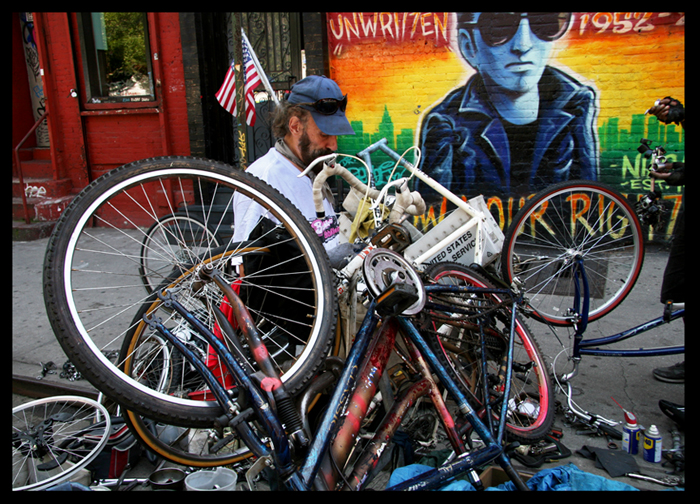
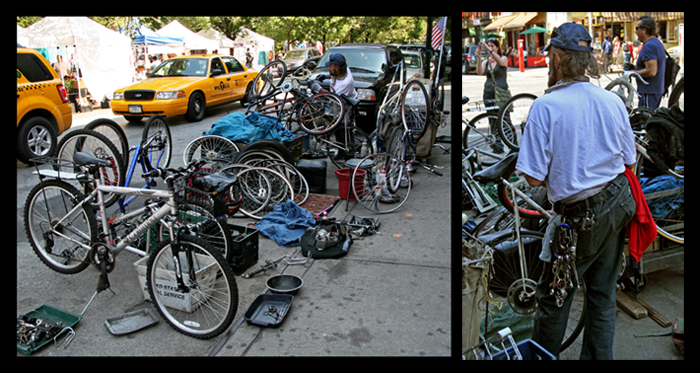
    On the corner of 7th Street and Avenue A, abutting Tompkins Square Park, you will find an outdoor bike repair shop with parts, tools, and bicycles in various states of repair spread curbside on the street. The Bike Man has plied his trade, off and on, in the East Village since the mid-1970s. (He is not alone, however. Natividad Zirate, who hails from California and is homeless, repairs bikes at 2nd Avenue and Houston Street.)

    There are many unanswered questions in New York City, and talking to the Bike Man raises many more. The Bike Man, aka Peter Corbin, is not eager to share many details of his life or background. The New York Times was able to glean a few:

    “At 51, Mr. Corbin is likewise a lifelong bike tinkerer, a vocation that began with his first bike, which he rode for a delivery job when he was a teenager in Springfield, Mass. Unlike Mr. Zirate, he is married, not homeless and claimed to be unaware of any rival shop nearby. His wife Charlotte helps him move his substantial number of spare parts, tools and half-completed jobs to and from their $450 a month apartment on Avenue C to his corner on Avenue A. ‘She works pretty hard,’ he said.”

    Technically, someone like the Bike Man should not be vending without a permit. But permits are virtually impossible to get. There is currently a cap of 853 permits for non-food vendors. The city has a waiting list and is not taking any more names.

    There is often a tolerance and sensitivity by the police in New York City to the character of a community and commonplace activities there. When someone is in violation of the law and the “crime” is essentially victimless, particularly where there is a history of a type of activity, the police may turn a blind eye. And there is great sympathy when someone is working hard and trying to earn a livelihood. Who wants to take someone’s job away?

    A retail shop, paying substantial rent and taxes, is not going to be enamored to compete against street vendors who sell the same goods opposite them, paying no rent, charging no sales tax, and reporting no income. However, New York City has lost many essential services. Who wants Peter Corbin’s work, and who can afford to provide it? Who’s going to sell you that one one screw?

    Note Regarding Vendor Permits from the New York Times: “Veterans are exempt from the permit cap; there are currently 1,678 licensed veteran vendors, according to the city. There is also a First Amendment exception to the licensing process for selling books, art and other speech-related items.” See my story of the Bubble Man here.


  • One Word

    There are many things performing vanishing acts in New York City – one is the single-business district and another is manufacturing. At Bari Equipment at 240 Bowery, both are alive and well.

    A unique feature of Manhattan has been the single-business district: diamond, flower, lighting, restaurant supply, photo, sewing machine, meatpacking, fur, and the garment district. Some of these districts are no longer, while others have all but disappeared. A handful still operate, such as the restaurant supply district on the Bowery between Houston and Delancey Streets. Here, you will find New York City’s primary marketplace for restaurant equipment – this is one of the most well-known restaurant supply districts in the country, offering some of the best pricing.

    The Bowery is Manhattan’s oldest thoroughfare, a part of the Lenape footpath prior to European settlement. In the 19th century, the Bowery became known for its music halls and theaters. By the 1920s-30s, the area was known as impoverished and remained a slum until late in the 20th century with the gentrification of the Lower East Side and East Village.

    If you have noticed the brand of pizza ovens while waiting for a slice in New York City, then most likely, you are familiar with the name Bari. Established in the 1940s by Nicola Bari, the business is still family-owned and -operated. It spans the better part of a block of the Bowery and now employs over 50 people. The company makes pizza ovens and refrigeration units used worldwide. Bari also supplies a broad range of restaurant equipment and supplies.
    The ovens are still manufactured in an adjoining building at their Bowery location. The deck oven, lined with stone, is the one typically seen in New York City pizza parlors.

    In the 1980s, I purchased an expensive racing bicycle from a real biking aficionado. Uneasy about making such a substantial purchase and fretting over the nuances and components, he assured me that becoming knowledgeable in the world of bicycles was easy. He told me, “You only need to know one wordCampagnolo.” Perhaps in the world of pizza ovens, you only need to know one word – Bari 🙂

    Note: Campagnolo is a high-end manufacturer of bicycle components from Vicenza, Italy. They have an unbroken record of winners of the Tour de France using Campagnolo from 1968 to 1998.


  • dinamic_sidebar 4 none

©2026 New York Daily Photo Entries (RSS) and Comments (RSS)  Raindrops Theme