• Category Archives War Against Wheels
  • You’re Not in Nevis

    In the early 1980s, I was obsessed with tropical islands and was visiting the Caribbean nearly every winter. Often, I would island hop, traveling to two islands in one trip on a 10-day vacation.
    In December 1983, I was with my sister and brother-in-law, visiting both Nevis and Monsterrat. We arrived at the Nevis airport, and I proceeded to rent a car. I wrote about my experience in The Point of Impact on October 25, 2010:

    I was completely dumbfounded when, in renting a car at the tiny airport, I was only asked when I would return. There was no paperwork or contracts, the only requirement to show a drivers license. The owner of the vehicle confirmed our agreement as to the rate ($25 per day), asked when I would return the car, and just handed me the keys.

    Upon arriving at my inn, the first question I had was to the inn owner about this car rental transaction – the most puzzling and lackadaisical I have ever seen in my life. He said to be assured, the owner would know my whereabouts at any given moment. I asked how that was possible. He told me that Nevis was a very small place (the island nation only has a population of 12,000), and everyone knew everything. I asked how any problems would be resolved. He assured me that everything would be fine, just don’t have an accident. This was not comforting at all.

    What I did not mention in this story is the larger issue of theft. Effectively there was none, for the same reasons the renter of the car was unconcerned about details of who I was. If everyone knows everyone in a small island, stealing will be difficult to accomplish without getting caught. If I steal your TV, how will I keep it a secret without living a cloistered life? Word travels like wildfire and learn of the theft immediately, all eyes will be on the lookout, and invariably, someone will learn of its new home.

    This is not unlike the small rural town in an isolated area, where the Golden Rule is even a more powerful operative, perhaps more so than the threat of punishment in being found out. In New York City, however, we have the polar opposite situation. This is a place where thieves can easily mix without fear of discovery. Opportunity knocks at every turn, and every prudent New Yorker never lets their guard down completely. Rituals and habits become second nature – without conscious effort, we guard our handbags, lock our doors, and never leave anything in sight in an automobile. We rotate watch over belongings in restaurants as turns are taken to use the bathroom.

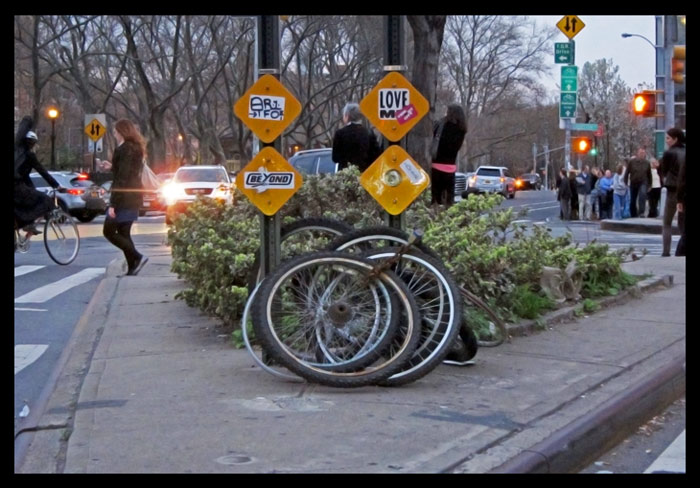
    And we chain our bikes. However, chaining by one wheel will not do the job – a bike less one wheel is a worthy candidate for theft. Best to lock both wheels and the frame altogether, or the frame and one wheel, carrying the other wheel with you. Even a wheel alone may be stolen.
    There are places, such B&H Photo, where you know You’re Not in Kansas. In today’s photo, we have a cluster of front and back bicycle wheels chained together. A bit of a mystery, but one thing for sure – one glimpse and you know You’re Not in Nevis 🙂

    Related Posts: Last to See the Future, With Impunity, One Screw, Street Cred, Orange You Glad

  • My Ride With AndrĂ©

    I loved My Dinner With André. This award winning film is a two-hour conversation between two individuals in a restaurant in New York City. On the basis of the premise, it might appear that such a film would be boring, but quite the contrary. I found it very engaging and at times, even riveting.
    Good conversation is often overlooked as an activity or reason to get together, even by those who greatly enjoy it and engage in the most impassioned interactions imaginable.

    When I was in college, invariably someone would interrupt a very animated discussion with “So what are we doing?” meaning, of course, What are we doing tonight? Where are we going?, etc. He or she would get little response as the rest of us would be completely immersed in conversation. The question would come up again and again, sometimes others joining in the mix, round-robin style. There was a nagging quality to the desperate plea, the asker irritated that no one was listening to the question, everyone was wasting time, and no decision as to the night’s plan was being made. Yet no one appeared to see the irony of the situation. Our impassioned conversation(s) were likely more interesting than anything we would find outside.
    One evening, having had enough of this chronic scenario, I made a statement, something like “Hey, don’t you guys get it? THIS is what we are doing.” Everyone acknowledged the merit of my assertion, but to no avail. It was a welcome bit of comic relief, but regardless of how engaging and fulfilling our conversation might be, we still needed something “to do.”

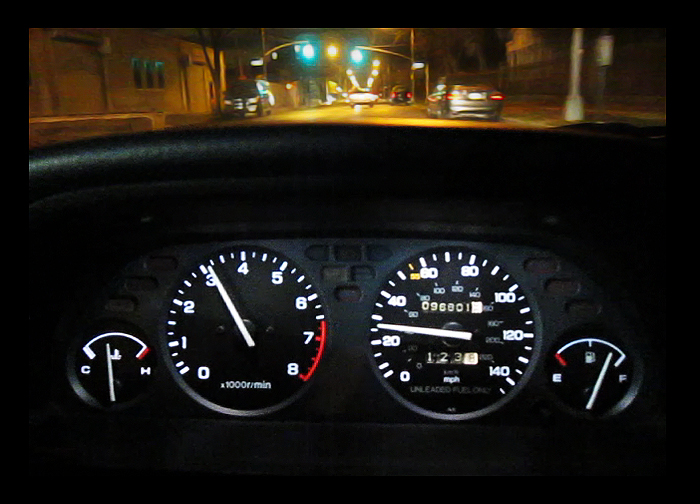
    Recently, I returned by car from Woodside, Queens, to Manhattan. I decided, as I had in Wild Ride, to video record while driving the streets of New York City. On this trip, however, I was not alone but rather accompanied by several friends. Lively conversation ensued, and I recounted a number of stories from my life experience in New York City as we whipped down Atlantic Avenue. All can be seen and heard in the video below. My entourage appeared to enjoy the ride and the lively banter. It was like a sequel, My Ride With André 🙂

    Posts referenced in the video: I’ll Kill You, Sittin’ On Top of the World


  • $57.50, Part 2

    (see Part 1 here)

    Driving back into Manhattan at night, a friend and I decided to drop into a local cafe on 8th Street, just a half block from my parking garage. However, it was cold, the street was virtually empty, and parking was legal – it was after 10 PM and one no longer even had to pay for metered parking. So, why not park right in front and drop the car at the garage later?

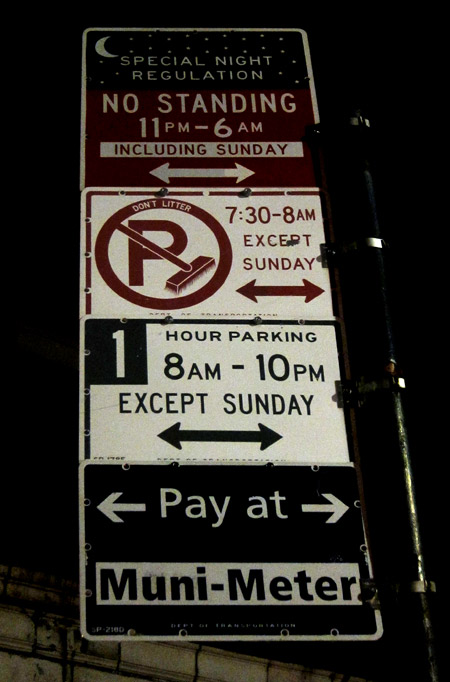
    I examined and reviewed the signs. The upper sign, Special Night Regulation, made no impression. Unlike the white backgrounds typically used for signs (in the two center signs in Part 1), this one was like a graphic black hole – the sign used white type on a dark red and black background.

    I ignored it because parking does not become more restrictive after becoming less restrictive. So I was looking at the white sign showing the end of metered parking. If you can park legally from 8AM to 10PM (using the Muni-Meter), and after 10PM for free, why would you suddenly be unable to park or stand one hour later, starting at 11PM? You see the logic? This is New York City parking 101.

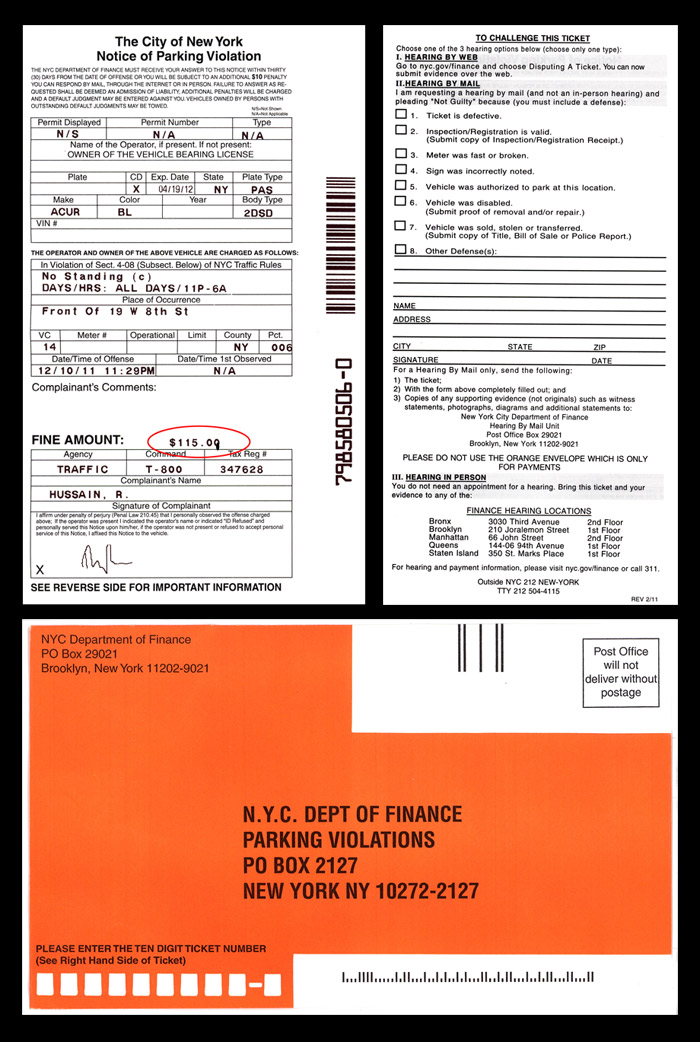
    So, at 11:29PM, as I exited Gizzi’s Cafe, I was greeted with a traffic police officer just completing my parking ticket for $115. Perfect timing – he did not need to place the ticket under the windshield wiper, just hand it to me for the added personal touch. I was LIVID.

    With disgust, I grabbed the ticket and threw it in my back seat. I told the officer how I was furious and that I have lived in the neighborhood for over 40 years and never heard of such a night regulation. He responded that if I lived there so long, I should know of the regulation. Point well made.

    Best I reign it in and quit talking, so I left. However, I DO know the neighborhood and its parking regulations. I just do not street park much nowadays, and apparently, the night regulation is relatively new. I learned from a neighbor that this added regulation was acquired by the Village Alliance to minimize late-night carousing by visitors, who often park on the street and make a ruckus until late hours, disturbing residents.

    Coincidentally, this neighbor has also worked for me. She is a long-time graphic artist and agreed that these night regulation signs virtually become invisible, owing to their graphic design. Many leave their cars after 11PM and are ticketed, expecting that parking is permitted after meter usage is no longer required.

    When I got home, I was still fuming. It took a full two hours to calm down. You can buy a very nice Blu-Ray DVD player for $115. Money well spent is one thing, but nothing infuriates many a New Yorker like a parking ticket. These extremely high fines are mostly revenue enhancers for the city of New York, which now collects nearly a billion dollars annually from parking tickets.

    I plotted and schemed of how I could beat this ticket, which I read front and back. I read online. I went back to examine the group of stacked signs. I did notice that on this pole, the Night Regulation sign is the only one that does not display “Department of Transportation.”

    As I calmed down and my thinking became more mature, I began to accept that I would likely have to pay the ticket and just see it as an expensive lesson learned. Then it occurred to me that I could do a story about the incident and get something for my $115. Better yet, I thought, I will write a two-part story and amortize my expense over two parts. A bit childish, and really a rather elaborate way to justify a mistake made. But it was the best lemonade I could squeeze from the lemon handed to me on December 10, 2011 at 11:29 PM, and each cup was going to cost a hefty $57.50 🙂

    Related Posts:  I’ll Kill You, The Agony and the Ecstasy, Nice Move, Kid, Eternal Vigilance and Tenacity, Pull Ahead, Great Minds and Fools, Itching and…


  • $57.50, Part 1

    I need to brag just a little so that you fully understand the impact of an episode which occurred on December 10, 2011.

    I drove a taxi for about one and a half years and have owned a car in NYC for most of my life. I understand New York City parking regulations and signs. I have street parked for years. I interpret signs and help others understand them whenever possible. I even did a story on the logic of parking regulations and signage.

    And, most importantly, I DON’T GET PARKING TICKETS (the only parking ticket I recall receiving was over 30 years ago). I rarely stand in No Standing or stop in No Stopping zones. I check parking signs religiously and read and reread them if necessary. With the exception of momentary loading or unloading (while double parking), I never leave my car illegally parked and unattended for more than a moment.

    I park within 12 inches of the curb. I never park within 15 feet of a fire hydrant or in front of a driveway. And I garage my car, so my street parking within New York City is limited. I use the vehicle primarily for excursions to the outer boroughs or out of the city entirely.

    I was LIVID on Saturday night. I was FUMING. I had thoughts of RETALIATION against the New York City Department of Transportation. Of course, I was being childish, indignant, and self-righteous – LIKE ANYONE WHO GETS CAUGHT. It took me a couple hours to calm down, and only because I started to formulate a plan and a way to make use of the experience for this website. I am a Lemonade Maker, and in Part 2, I will tell you why the cost of today’s lemonade will most likely be $57.50…

    Related Posts: I’ll Kill You, Nice Move, Kid, Eternal Vigilance and Tenacity, Great Minds and Fools, Itching and…


  • Wild Ride

    Wednesday night, returning from Brooklyn, I was feeling a little wild, as is sometimes the case when I find myself driving in New York City and life is GOOD. Then the city just ELECTRIFIES me – I can feel its high voltage coursing through my body. Everything is RIGHT and I know I am in the world’s most exciting city.

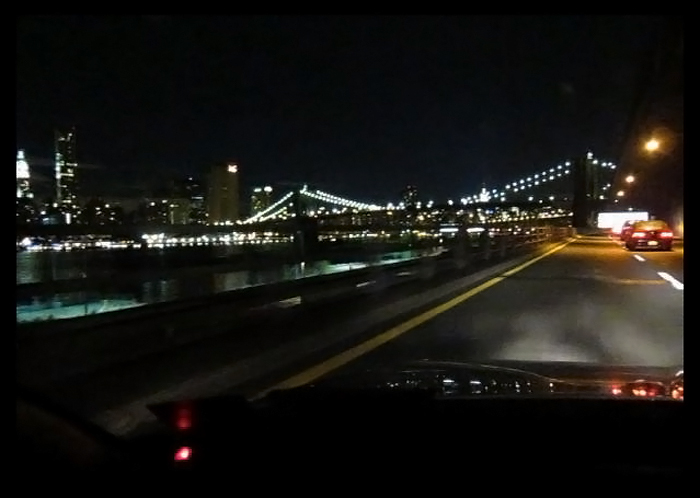
    With no prior plan to do so, I suddenly just decided to pull out a camera and video record a leg of my journey with stream of consciousness narration as I drove. See the NYC skyline from the BQE. Cross the Manhattan Bridge with me, and then cruise the streets of Lower Manhattan, NoHo, and the Village. The footage is raw, jumpy, and a little out of focus at times. It’s not reality TV – it’s the REAL DEAL while on a Wild Ride >>>

    Posts referenced in the video: 212 and 2:12, New York Rockies, Sittin’ On Top of the World, No Sir, Pull Ahead, Childhood’s End, Public Theater, Astor Place Cube


  • I’ll Kill You

    Children soon learn the power of words, even if they do not know the full meaning. Take the ever popular “I’ll Kill You.” Adults often dispense with the words and just perform the act. Particularly when angry. And nothing enrages a New Yorker more than a breech of certain types of urban etiquette, particularly street parking etiquette. And yes, there is such a thing.

    Many non-residents of New York City imagine this metropolis to be a lawless land with no rules. Not at all. If you doubt my words, try taking a parking spot deemed to be someone else’s. There is a protocol here, but I can’t tell you exactly what it is.
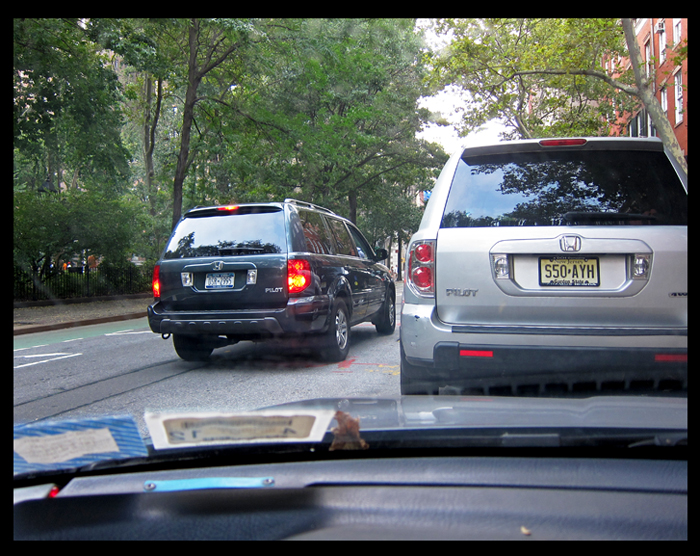
    I street parked for years, and one of the best techniques, rather than cruising, is to stake out part of a block and WAIT. Cruising for a spot in a crowded neighborhood is very tricky. First, as you cruise, you will be encountering others who have staked out territory. And you will also have to be exactly where someone is leaving – empty spots are snagged immediately. In today’s photo, I had only stepped into my car when someone pulled up and double parked ahead of me in anticipation of my leaving. Waiting for what, in this city, is like a nugget of gold to the panner: the parking spot.

    Of course, the waiting and staking out territory strategy has its problems, too. It is a generally accepted practice to stake out a portion of a block, lay claim to it and wait. If someone pulls out, it’s yours and yours only. However, there are many instances where someone unaware of you or of the protocol will just pull into a spot within your turf. A confrontation will typically ensue, with the offending party backing off, apologizing, and leaving.

    A piggish thief may snag the spot and refuse to back off. However, if the thief has not executed his parking quickly and properly, such as pulling in front first, he is subject to the offended party pulling up quickly and blocking the thief from completing his parking, resulting in a stand off. This precise scenario was the subject of a Seinfeld episode, The Parking Space.

    But there is a simpler solution for a victim in this predicament. Many years ago, I read an article in the Village Voice about exactly this scenario. Someone snatched a parking spot before a man who had been staking out the block could get to it. He pulled up to the thief, rolled down his window, pulled out a gun and shot and murdered him.* An enraged adult needs not to waste any time with “I’ll Kill You.”

    *This is not an isolated incident. There have been numerous assaults and other fatalities involving fights over parking spaces.

    Related Posts: The Agony and the Ecstasy, Shortly Before Execution, Pull Ahead, Great Minds and Fools, Get a Life, Itching and…, Who See the Red?


  • 212 and 2:12

    Many non-residents cannot fathom why New Yorkers tolerate so many extreme hardships, while life outside the city is in many ways so much easier and less expensive. I have created a category for some of my stories called Slings and Arrows, which illuminates many of these day-to-day dramas. In Dwanna, I told of how one new resident (who hailed from Tennessee) left nearly as quickly as she got here, even though she was ambitious, hard-working, and successful in finding a good job and housing. Her reason for leaving? Life was just too hard.

    But yet there are so many extraordinarily wonderful things about this city, many arguably not found anywhere else, particularly in such close proximity. It is this density of services and culture that led me to coin the phrase Sirens of Convenience to describe the city’s lure in spite of rocky shoals. So therein lies the key to understanding this whole perplexing situation:  New York City is not a place of moderation, it’s one of extremes, and for most, it’s a Love/Hate thing. When Love overrides Hate, then you’re a New Yorker. When Hate overrides Love, you don’t want to live here. Or, in the case of a long-time resident, he or she may be inclined to leave.

    Many New Yorkers who truly love the city obsess over iconic minutiae, such as having a 212 area code. This area code is one of the oldest in the United States, created in 1947. It was assigned to New York City because it could be dialed fastest with a rotary dial (at that time, 0 and 1 were not allowed as the first digit, the second digit was either 0 or 1, and the third digit could not be the same as the second digit).

    Hence, there’s a cachet to 212: it is historic, with implied roots and stability of the owner of the number, both residential or business. New phone numbers with the area code 212 are no longer available; someone interested in the area code must rely on getting a recycled number via luck or purchase such numbers through specialized websites. This prestige associated with a 212 area code was even used as a minor plot thread in a Seinfeld episode, The Maid. So, New Yorkers Love 212. As a long time resident of the city, I am pleased that my home and office numbers all have 212 area codes.

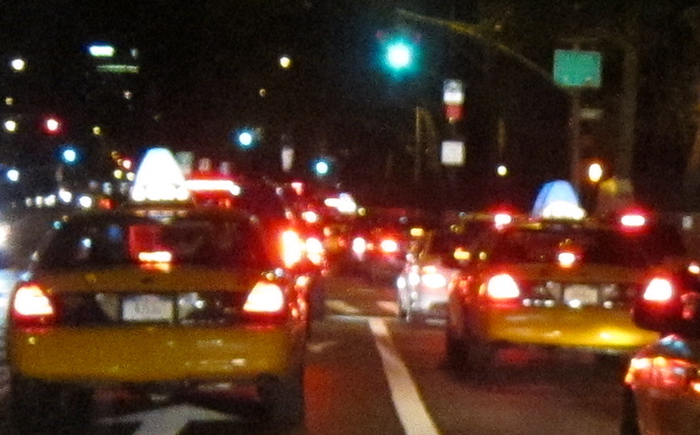
    But this weekend, I even found Love/Hate sides to 212. Saturday night, I was returning to Manhattan via the Manhattan Bridge, which courses up Chrystie Street. I was exhausted, and there was bumper-to-bumper traffic. Incredibly, it was after 2 AM, adding insult to injury. I just wanted to get home and sleep, but I was forced to slog up Chrystie and across Houston Streets behind a sea of yellow cabs and the cars of late night revelers, commuters, and what have you.
    In reviewing the photos this morning for exact time, I found in a serendipitous numerological twist that the exact time my photos were taken was 2:12 AM. I always knew the currency used to pay for New York City was a two-sided Love/Hate coin. Now, carefully examining both sides, I discovered it clearly marked: 212 and 2:12  🙂


  • Segway, Anyone?

    In 2001, geeks were abuzz, speculating on the secret invention of Dean Kamen, an award-winning design engineer with hundreds of patents and revolutionary products. The invention was codenamed IT or Ginger and had received the endorsement of Steve Jobs of Apple and Jeff Bezos of Amazon. No small achievement.

    IT turned out to be as rumored: an electric, self-balancing human transporter with a complex, computer-controlled gyroscopic stabilization and control system. The remarkable device senses and responds to subtle body movement and can even be controlled hands-free. Kamen claimed that the Segway “will be to the car what the car was to the horse and buggy.” Many predicted a billion-dollar industry overnight and nothing short of a world-changing technology.

    Perhaps the only thing more arrogant than the claims of Dean Kamen about the future impact of the Segway was my email to him, explaining point by point why the Segway would fail in cities and certainly in New York. I received a return email confirmation stating that they would follow up and answer my objections, which they did not do.

    I say arrogant because I am not an engineer, nor do I claim to be an expert prognosticator of such events. There have been numerous analyses as to the reason for the Segway’s failure when viewed in hindsight. But even at the time of the product launch, my gut feel told me that there were way too many obvious problems which would prevent the Segway from large-scale adoption anywhere, particularly in a place like New York City.

    One was price – $5000. This will make it a deal breaker for nearly everyone. After all, this is not an enclosed vehicle capable of carrying a load and passengers. It is just a motorized two-wheel device. I also believed that people would vandalize them and steal them.

    Another big issue was weight – 80 pounds. There are many stairways in New York City. Who will carry an 80-pound device up and down them?
    The vehicle did not have a very long battery life. Charging for most people would be burdensome here.

    Then there is the huge problem of what to do at your destination. This is has been a problem for bicyclists for as long as I have lived in this city. How many will want to leave a $5000 vehicle on the streets? Will offices and retailers allow these to be brought inside? Hardly.

    Also, regardless of claims to the contrary, there is no way these will be allowed to be used on crowded streets and sidewalks in New York City. They may be compact and marvelously maneuverable, but the sidewalks are often too packed, even for unencumbered pedestrians. How will the Segways fit in?

    The Segway did turn out to be a commercial failure, relegated to a small number of users in niche situations – some postal carriers on certain routes, etc. In 2009, Time Magazine declared it one of the 10 biggest tech failures of the decade.

    All the claims of Kamen seemed so obviously made by someone devoid of any real world experience of living in New York City. This wealthy, inventive genius and visionary lives in a mansion in a small town in New Hampshire, with his own helicopter hangared in his garage. He owns his own private island off the coast of Connecticut – North Dumpling Island – and travels there using his helicopter. This is a highly privileged life in remote, unpopulated locations.

    Perhaps once a year I may see someone cruising the streets of New York City on one of these devices. Segway, anyone?

    Other Transportation-Related Posts: Nice Move, Kid, Water Taxi, Jet Ski, Bikes, The Tram


  • Follow the Crowd


    The best things about having driven a taxi in New York City are 1) street cred and 2) the stories. The stories, because if you drive long enough in a big city and pick up an average of 30 passengers per work shift, eventually you will have experiences worth telling. Such is the fodder that prompted the award winning HBO TV documentary series, Taxicab Confessions, which originated in New York City.

    As regular readers here already know, I did a stint of about one and a half years as a taxi driver in the early 1970s, a very rough time in the city. Picking up the severely drunk passengers was one big problematic scenario. It can have entertainment value, but most likely, the ugly side of drunkenness will reveal its head sooner or later – typically not later than the end of the ride.
    Often friends will stuff a drunk friend in a taxi, thereby transferring responsibility and care taking to a taxi diver, with a sigh of relief, I am sure.

    As one reader pointed out in my story, Flailing and Hailing, there are downsides to taxi travel outside Manhattan. A rider should know how to get to their destination. Many drivers are severely deficient in their knowledge of the boroughs, don’t carry maps or use GPS. Taxis are expensive and you don’t want a driver to be learning NYC geography at your expense.

    However, there is risk to the driver too. Although the passenger is paying for distance traveled, the most money is not made by wandering aimlessly in hopes that the passenger will at last remember how to get home or where they live. More money is earned in a given time period by getting passengers to their destination as quickly as possible, not crawling around unknown neighborhoods.

    On one night, I picked up a passenger who was visibly inebriated. He did not have an address, but assured me that he could navigate to his home. As we approached the first fork in a roadway and I asked “left or right?”, he responded “follow the crowd.” This became the refrain at every juncture, where conveniently it appeared that our destination was in the direction of the greater traffic flow.

    Until there was no crowd.

    I realized I was in trouble when at one junction with no cars in front of us, I was again told to follow the crowd. This was time to turn around completely and interrogate. Did he or did he not know where he was going? I was in the middle of nowhere, no people around, no clear address, and only his assurance that he could direct me to his home.

    I don’t recall where I left him, only that I ordered him out of my taxi right there, which took some doing. At this point in my life, I would do more. Perhaps drive to a populated area and look for a police car or ask for a police station to drop him off. But I was young, intolerant, frustrated and broke. Time is money for the taxi driver. You need to know where you are going, not heed the directions of a drunk man whose directions consist solely of “follow the crowd.” 🙂

    Related Posts: Leave the Driving to Us, Nice Move, Kid, The Point of Impact, Flailing and Hailing, Sittin’ on Top of the World, What numba Kissena?


  • Leave the Driving to Us

    There are a number of ways to approach driving a car in New York City. If you bring ideas of expediency and reliable travel times to the table, you are in for a very stressful time. Compulsive lane changing to gain small advantages, agonizing over every sanitation truck working ahead of you, screeching and lurching to maximize speed only to get to a traffic light earlier – all these things will just eat at your soul.

    There are ways, times, and routes to minimize trip time, of course. However, one must always be prepared for one or even an unending series of traffic snarls, mishaps and poor choices which you could not have foreseen. These things are not incidents, they are a way of life. For those inclined to eastern disciplines, learning to live with New York City traffic and not get ruffled is one of most difficult forms of moving meditation and ultimate exercises in letting go.

    I have owned a car for most of the 42 years I have lived in New York City, and I am not daunted by city traffic or driving. But if you value your time and your mind, the subway is the way to travel in New York City. The train traveler generally avoids the slings and arrows of outrageous traffic. There are subway delays, reroutings, dropped service, etc., but generally this will be the best way to travel the city.

    However, sometimes you just don’t feel like traveling underground, particularly on beautiful days like we have had lately, when it seems like a crime to descend to the subterranean depths. You have no car or access to one, and you do not want to break the bank taking a taxi. If you have the time, for destinations in a straight line within one borough (crosstown bus connections are free but add even more time to an already slow journey) and during daylight or evening hours, you can’t beat a bus. Here, as in auto travel, your skills in letting go will also be tested – buses deal with the same traffic issues as cars and make stops every couple blocks, making what for many will feel like an interminable journey.

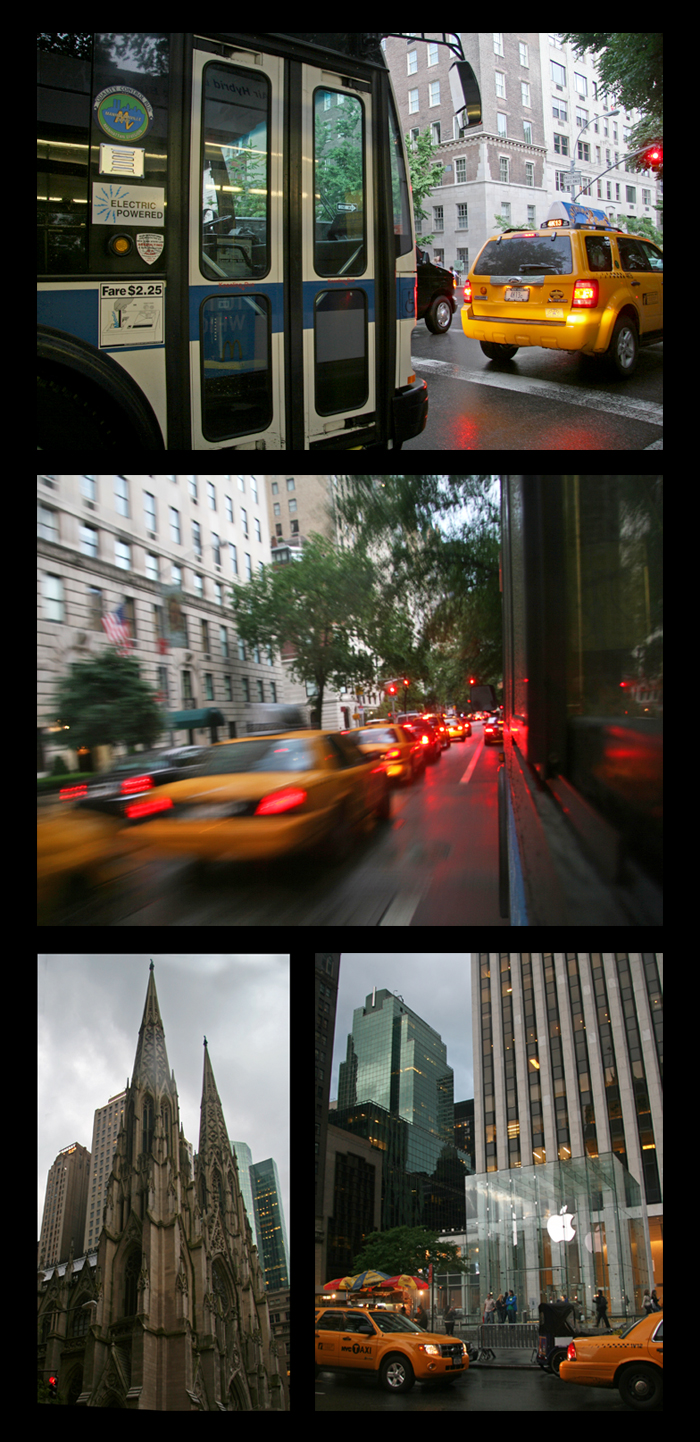
    There are many reasons people opt for buses in New York City including safety and no need to climb stairs. But my biggest plus is the tremendous sightseeing for the cost of bus fare. There is probably no better bus ride in New York City than a trip down Fifth Avenue, any time of year.

    I recently embarked at 80th Street heading downtown to the Village. North of 59th Street, on the left side, you are treated to the world of privilege with some of the world’s finest apartment buildings and museums. On the right side, Fifth Avenue flanks Central Park. At 59th Street, we have the Sherry Netherland, the Plaza Hotel, the distinctive glass cube of the Apple store and the start of an endless parade of flagship shops of some of the world’s finest retailers. At 50th Street, we have St. Patrick’s Cathedral (see here and here) and Rockefeller Center. Later, we pass the Empire State Building, Madison Square Park, the Met Life Tower, and the Flatiron and New York Life Insurance Buildings. Evening is a great time to travel as the lights begin to glimmer and glow.

    Carry the spirit of the traveler or explorer who knows there will be obstacles, hurdles and other unexpected difficulties, but has no time table or tight schedules. If we meet and I have my car, I’ll take you for a ride. Otherwise, jump on the bus and in either case, relax, let go and leave the driving to us 🙂

    Related Posts: A Bottle of Schweppes, Cello Class, Ice Skating in October, 23 Skidoo, Saks Fifth Avenue, Apple and Sherry

    Other Driving Related Posts: Nice Move, Kid, The Point of Impact, Flailing and Hailing, Sittin’ on Top of the World, What numba Kissena?


  • Nice Move, Kid

    I was sweating bullets. It was the road test for my driver’s license, I was 16, and this was the major right of passage into a future of independence and adulthood. There were the responsibilities of driving a motor vehicle with the inherent risks of bodily harm to oneself and others, but most important to a teenager, you now had wheels. And that meant a new found freedom. As long as you had access to a vehicle, of course.

    A road test at that time in the suburbs was remarkably simple, virtually a formality. The expectation was that one would pass unless otherwise proven incompetent. My test consisted of driving a couple roads, a simple turn, and parking in a wide open lot on return.

    However, this still was a major event, and it would be a tragedy to fail. When my examiner asked for a simple right turn, I drove over the curb. His response is engraved in my mind, and I sometimes still hear it to this day: “Nice move, kid.”
    He might as well have said, “Step out, you’re finished.” The rest of the very short road test was trying to live through the embarrassment and humiliation. Upon my return to Motor Vehicles, my instructor told me to go inside the office. He left without saying whether I had passed or failed. I assumed someone inside would be the harbinger of bad news. At the counter, I asked if I had failed. The clerk appeared perplexed and said that she was only told to process my license. Apparently examiners allowed for extreme nervousness.

    Fortunately, parallel parking was not part of the exam. This is a skill that many living outside a city never learn or need to. I have watched many visitors to New York City try to parallel park in a very roomy spot, yet leave in frustration after repeated failed attempts to get in.

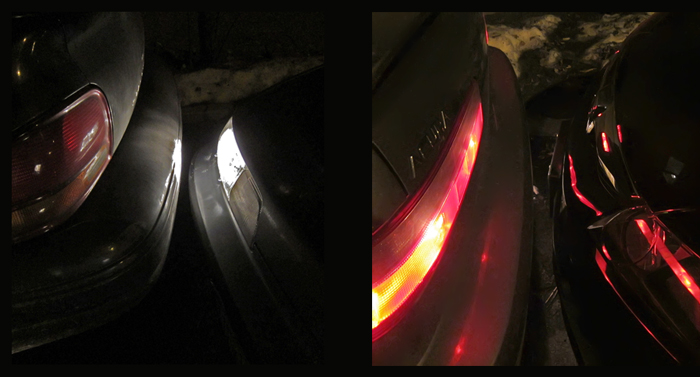
    On a recent journey to Brooklyn, I had great difficulty finding a parking spot. The only thing available within blocks of my destination was a spot so tight that there was only an inch or two of additional space over the length of my car. But duty called. In these tight spots, the first cut you make steering is critical. The rest is finessing mixed with tedium. In a parking space this tight, gentle bumping the other vehicles with every move forward and back is required. Regardless of how gentle you are, best the owners of the neighboring cars are not there to witness this process.

    More extreme circumstances arise where no spot large enough can be found. Can you park in a spot shorter than your vehicle? Yes. I have seen large heavy cars park in spaces like this by pushing and moving cars in front and in back with each iteration as they wedged themselves in.

    A honed skill at parallel parking brings street cred and bespeaks of a seasoned New Yorker. Get it right with a perfect first cut, a minimum of jockeying, and leaving your car within inches of the curb, and perhaps you will hear from an observer what I once did, but without the sarcasm – “Nice Move, Kid.” 🙂


  • Everything Yes


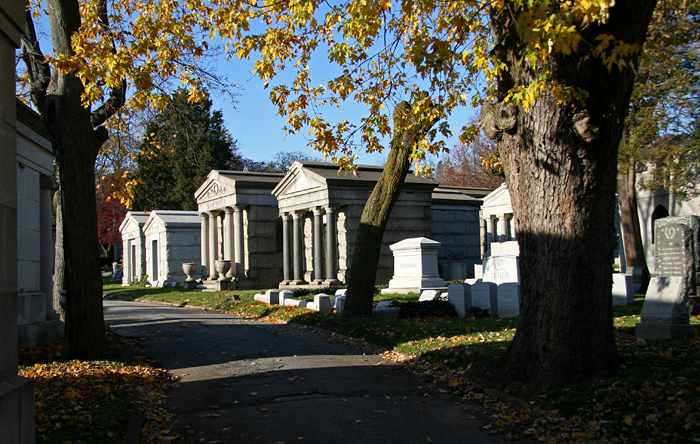
    While driving through Queens, on the way to somewhere else, I happened upon the most extraordinary cemetery. Or, cemeteries. Seventeen cemeteries to be exact, straddling the Brooklyn/Queens border. The first, with its exquisite rows of undulating white headstones, turned out to be a cemetery of tremendous historic importance, the Cypress Hills National Cemetery, one of the original fourteen national cemeteries (top photo).

    Cypress Hills Cemetery was established in 1849 as a nonsectarian burial ground. In 1862, during the Civil War, 2.7 acres were authorized by the private cemetery to be used by the United States federal government as burial spot for Veterans who did in New York City. There are over 21,000 interments in the cemetery. You can read more about it here.
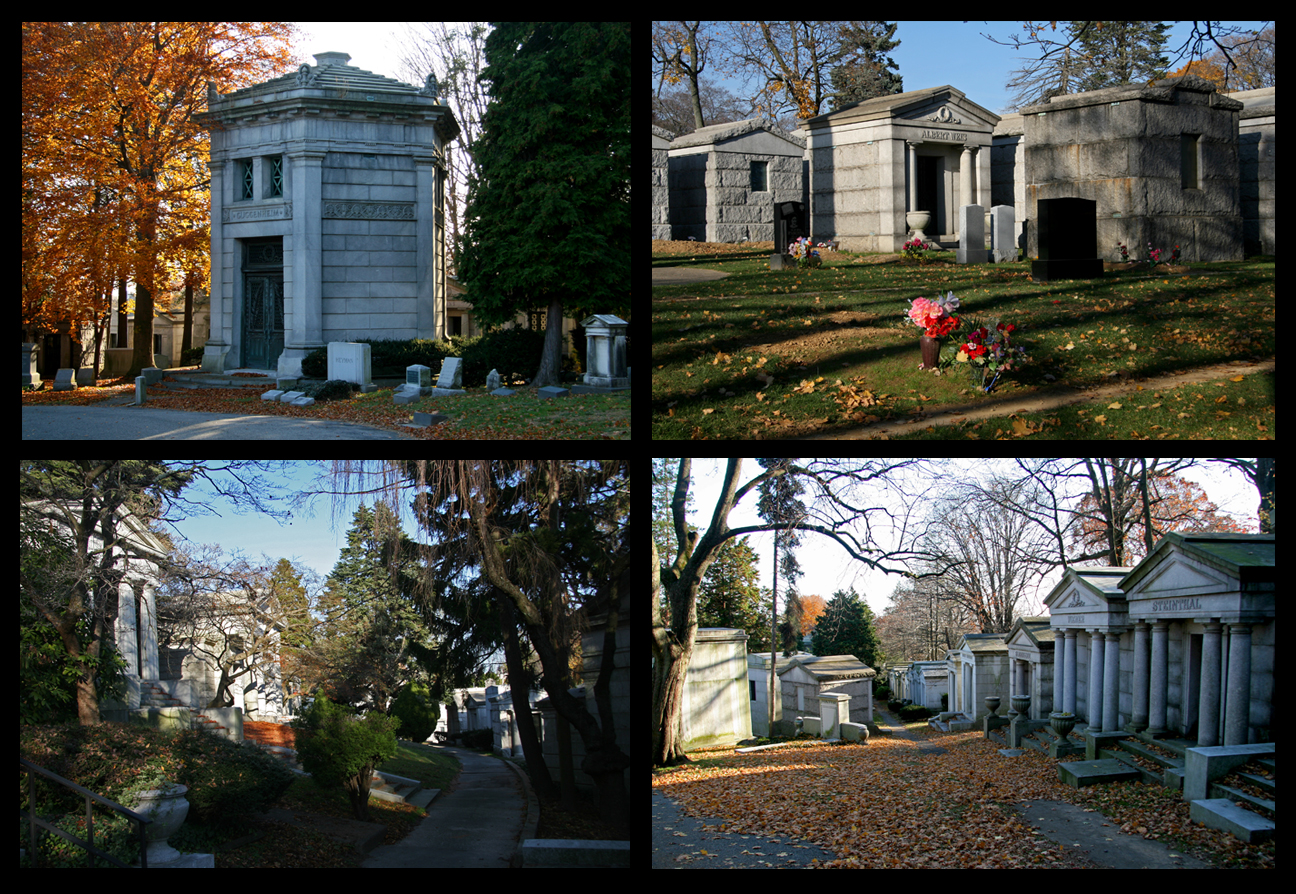
    Abutting these grounds, I noticed a number of very large mausoleums. As I was leaving, I saw that the main entrance at the corner of Jamaica and Hale Avenues was open and unguarded, so, completely unfettered, I decided to drive in. I discovered the most extraordinary cemetery I have ever been in (center and bottom photos). See my gallery of photos here.

    Some of the structures were the size of small homes. Many of the names were quite familiar – Guggenheim, Goldman, Fox, Shubert, etc. Could this possibly be the Guggenheim? The Fox of Twentieth Century Fox? The Shubert of theater fame?
    Yes they are. Salem Fields Cemetery at 775 Jamaica Avenue in Brooklyn, was founded in 1852 by the Central Synagogue and is the resting place for many prominent Jewish families in New York City. Salem Fields has been compared to places like the Père Lachaise Cemetery of Paris. The Guggenheim family mausoleum was modeled after the Tower of the Winds at Athens.

    The weather, with a cool crisp air, was exquisite, the light perfect, the autumn colors beautiful. I was the lone visitor, touring with complete freedom, stopping at every photo opportunity. Unlike many things in New York City, riddled with security procedures, lines, reservations, or admission costs, Salem Fields could well have hung a sign for the day – everything yes 🙂


  • Eternal Vigilance and Tenacity


    I know a man who has trained domestic cats that do an entire circus act, including jumping through hoops of fire*. Remarkable, really. I have had a number of cats in my lifetime, and as anyone can attest, they are extremely difficult to train or discipline. Much as it has been said that the price of freedom is eternal vigilance – it is also the price of having a disciplined feline. Cats are extraordinarily persistent, patient, and unrelenting in getting what they want and ultimately will wear an owner down the moment he or she relaxes.

    New York City is also quite unrelenting. Thieves never give up, new measures to secure property are foiled, drug dealers move back into areas cleaned up, and new variants on vandalism arise. Only massive diligence and constant attention have a permanent effect. Few areas of the city get that kind of attention. When things do improve, the tendency is to relax. And then that damn cat is back on the kitchen counter.

    There is a lot of whining and howling from bicyclers in New York City who want to see a more bike-friendly city. Understandable, since on the surface of it, bicycling would seem like a wonderful mode of transport, like it is elsewhere. Efficient, clean, lean, and green. I love bicycles and have always had one in the city, although I use it much less frequently now.

    However – and New York is the city of howevers – bicycling in New York has had a plethora of problems and roadblocks, daunting to all but the toughest and most tenacious. The dangers and deaths are realities (see the ghost bike of Derek Lake here). Two of my coworkers are regular bikers and commute from Brooklyn to Manhattan daily. One has pledged that she is essentially boycotting the city’s transit system due to cost. It requires the use of heavy locks, chains, and bravery to navigate the streets of New York.

    Bicycling has seen numerous setbacks and obstacles to progress. In other parts of the United States and Europe, we see many innovative and progressive ideas regarding bicycle use and storage. Hearing of things like The Yellow Bike Project of Portland Oregon or the BikeValet Automated parking system of Europe (there are plans to install this in NYC) just adds insult to injury for the New York cyclist who only aspires to getting from here to there safely and parking without their bike being stolen or vandalized.

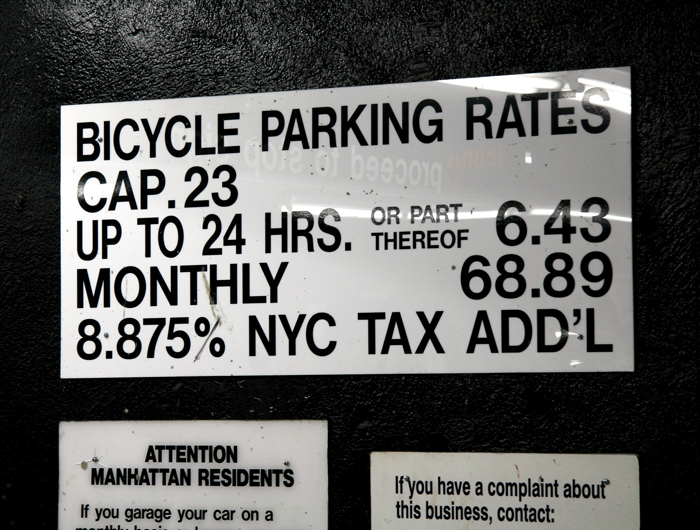
    But the bike community in New York City is militant and relentless. Recently, a number of steps forward have been taken. Bike lanes have been more seriously implemented, and new legislation has been passed: buildings with freight elevators are required to allow employees to bring their bikes upstairs and parking garages of certain sizes are now required to offer parking for bicycles (see the NY times article here). Many question, though, whether $68.89 per month is progressive or draconian. Rates as high as $160 per month have been reported.

    Ultimately, improvements and positive change in New York City are incremental and arduous as we move two steps forward and one step back. Whether cats, freedom, crime, or bicycles in New York, the price is always eternal vigilance and tenacity…

    *The act is known as Dominique and his Flying House Cats. Dominique LeFort performs regularly at Westin Pier for Sunset Celebration adjacent to Mallory Square in Key West, Florida. Valery Tsoraev with Clyde Beatty-Cole Bros Circus has an act with trained house cats. Yuri Kuklachev, a clown with the Bolshoi Circus, created the Moscow Cats Theatre featuring 120 domestic cats. Gregory Popovich started Comedy Pet Theatre with 14 cats, eight dogs, three rats, and two pigeons.

    Other Bicycling Posts: Derek Lake (ghost bike), Orange You Glad, Get Well Curve, Jungle Gym, Left For Dead, Urban Bike Polo, Wild Crash, Art Bikes, Penny Farthing


  • Abandon All Preconceived Notions Ye Who Enter Here

    The Story of Driss Aqil

    There should be a sign at every tunnel or bridge approaching New York City, at every NYC airport, bus, and train station, and on the door of every New York City taxicab, which boldly proclaims:
    Abandon All Preconceived Notions Ye Who Enter Here.

    If you are unwilling to heed this admonition, be prepared to have all your stereotypes, biases, racial or ethnic profiling, and distinctions made by class or job seriously challenged.
    Of course, generalities do generally apply. Typically, you don’t find an adjunct professor of Mathematics and Ph.D candidate driving a taxi. But I said typically, not a very useful word in New York City.

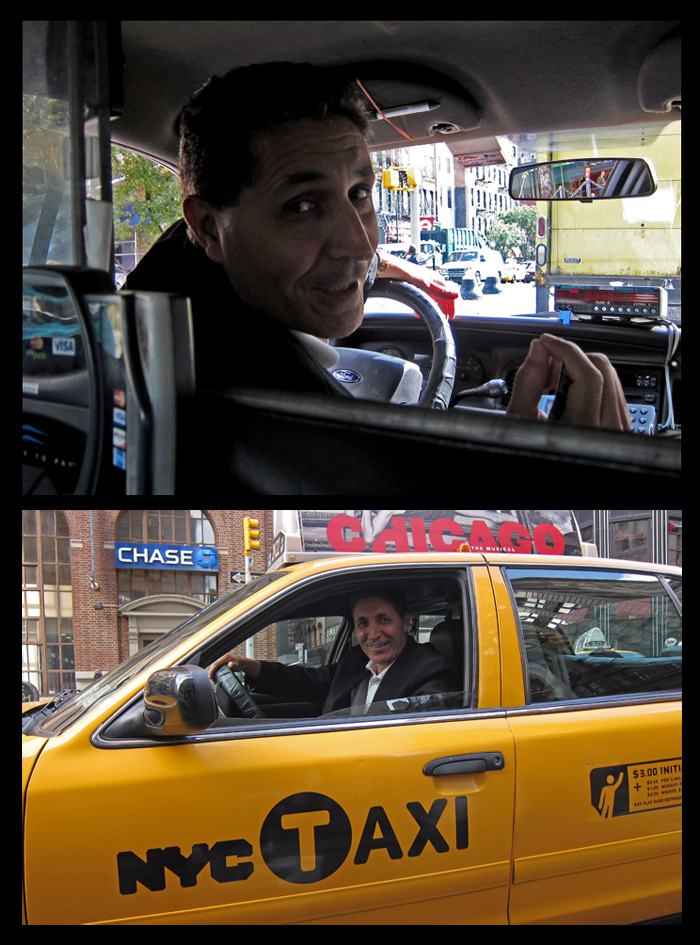
    I rarely take taxis these days unless I have to transport heavy objects or loads, which was the case on Thursday, October 14th. I often strike up conversation with drivers, and this driver seemed particularly astute. There was attention and intention when he listened to my destination address. I had the sense that his whole demeanor was saying – Ok, I know where you are going and the best way to get you there. Like an expert surgeon performing a routine task, lie back and leave the cutting to me. We cut through traffic as we conversed.

    I became engrossed with the details of his life and accomplishments in the United States of this Moroccan immigrant. We were both excited to meet – he commented he had more conversation with me in a few short minutes than he had in the last 10 years. However the taxi ride was very short, so we agreed that he would follow up with the details of his life by email – he wrote his name, Driss Aqil, and email address clearly on a receipt.

    I was very disappointed when my first email to him was bounced back. A number of friends examined his name and concluded that I misread the q as g in Aqil. However, although the following emails were not bounced, they were not answered either. Until last night. They had gone into his spam box. He answered the questions I had outlined. Here are some bullet points of the bio Driss emailed me:

    Born in Fquih Ben Salah a small town situated about 3 hours from Casablanca. Worked in Morocco in oil drilling and exploration for about 8 years. Came to the USA in 1989. Lived in the YMCA on 34 street in Manhattan for a few weeks. Worked at LTR Jeans as a stock boy, became warehouse manager and store manager shortly after.

    Moved to Bay Ridge (Brooklyn), Astoria (Queens), and finally moved to Bensonhurst when married.
    Drove a a New York City taxi since 1996 till now.

    Education in USA:
    – Associate in computer Sciences( Honors) Phi Theta Kappa, NYCCT, CUNY. Bachelor in financial applied mathematics. Magna Cum Laude, Tau Sigma Honors NYCCT,CUNY. Masters in Applied Mathematics, Queens College, CUNY. Post- Baccalaureate program from Queens College, certified as secondary school mathematics teacher. Currently an adjunct professor of mathematics.

    Of course, there were tales of various celebrities Driss picked up and other stories while driving a taxi. He also had two articles published in the inaugural issue of City Tech Writer: A Thought on “The Struggle for Existence from the Point of View of the Mathematicians” and The Anchor Effect Discussed in A “Mathematician Plays the Stock Market”

    And finally, Driss says in his email:

    “Driving a Taxi allowed me to accomplish my studies. My goal is to get my PHD in mathematics in the near future, write a book about my experiences in driving the taxi in NYC.”

    Another installment in New York City’s live drama, Abandon All Preconceived Notions Ye Who Enter Here 🙂


  • The Point of Impact


    It was December 1983, and I was with my sister and brother-in-law in Nevis, West Indies. I was completely dumbfounded when, in renting a car at the tiny airport, I was only asked when I would return. There was no paperwork or contracts; the only requirement was to show a drivers license. The owner of the vehicle confirmed our agreement as to the rate ($25 per day), asked when I would return the car, and just handed me the keys.

    Upon arriving at my inn, the first question I had was to the inn owner about this car rental transaction – the most puzzling and lackadaisical I have ever seen in my life. He said to be assured, the owner would know my whereabouts at any given moment. I asked how that was possible. He told me that Nevis was a very small place (the island nation only has a population of 12,000), and everyone knew everything. I asked how any problems would be resolved. He assured me that everything would be fine, just don’t have an accident. This was not comforting at all.

    Equally discomforting was a comment made about the safety of motorcycles by a good friend I had in high school who owned many bikes. I have written about him before in Pork and Power. My impression of motorcycles was that of a vehicle which left the driver incredibly vulnerable, sheer lunacy to travel on vehicular roadways completely unprotected. I asked his opinion about the safety of riding such a thing, and his answer still rings in my mind whenever I see a biker on the road: “A motorcycle is the safest vehicle on the road up to the point of impact.”

    Up to the point of impact. What the hell did that mean? What it means, quite simply, is that the prospects for those in a motorcycle accident are indeed grim and, like renting a car in Nevis, the best advice is just don’t have an accident.

    On Sunday, on returning from Queens in a car on the Long Island Expressway, I witnessed the most outrageous and terrifying display of motorcycle mania I have ever seen. Hundreds of bikers, many in costumes, absolutely clogged the road with every manner of maneuvers imaginable. Screeching, squealing, weaving only inches between vehicles, driving between lanes, and jettisoning sideways across lanes with no margin for safety. The smell of burning rubber lingered in my car after the episode.

    I desperately wanted to tell them two very important things I had learned: just don’t have an accident and, although they appeared extraordinarily skilled, their skills would only be good up to the point of impact


  • dinamic_sidebar 4 none

©2026 New York Daily Photo Entries (RSS) and Comments (RSS)  Raindrops Theme