• Category Archives War Against Wheels
  • Flailing and Hailing

    One of the most frustrating things for me to observe are people in the streets uselessly trying to hail a taxi, either by a) standing with an arm outstretched a la Our Lady of Liberty or b) frantically flailing their arms, when there is either no taxi in site or there are no taxis which are both unoccupied and on duty. I am convinced that very few understand the roof light system in use and its permutations. However, most have better things to do than study the New York City Taxi and Limousine Commission (TLC) rules and regulations files, which run hundreds of pages. So, as a former New York City taxi driver, let me extract the most salient pieces that actually impact the use of taxis, including roof lights.

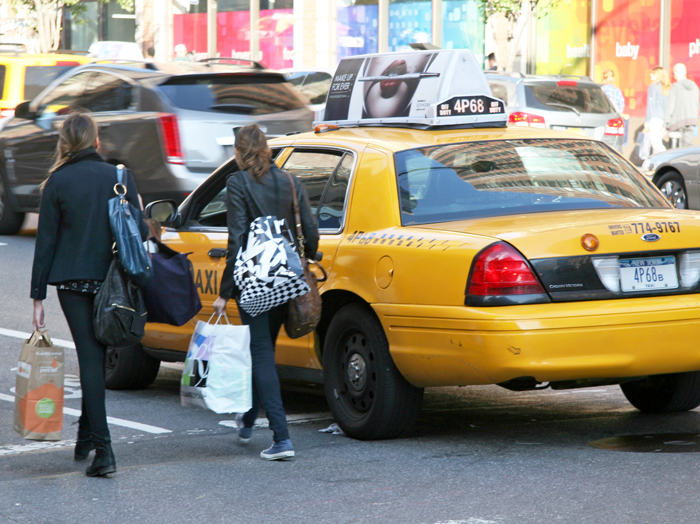
    On the roof of every taxi, there is a 4-digit taxi license number. When lit, the taxi is available, when unlit, it is occupied. On either side, there are the words “off duty.” When lit, technically the cab is off duty, typically heading back home; when unlit, the cab is available for hire or hired. What no one explains is that these lights can be lit or unlit in all four combinations and their meanings. So in the spirit of Pascal’s Wager, I offer:

    1) Number lit, Off Duty unlit: This is your main target. The taxi is on duty and unoccupied/available.
    2) Number lit, Off Duty lit: Off duty and unoccupied. This is the thorny one. Technically the driver can pick you up if your destination is on route to his garage or home. If you are aggressive and approach a driver who is headed roughly in your direction, he may oblige. However, this is also the scam setting – many drivers will do this in order to be selective about who they pick up and where they will go, a violation of TLC rules.
    3) Number unlit, Off Duty lit: The taxi is occupied as a result of condition 2.
    4) Number unlit, Off Duty unlit: Typical occupied condition. The taxi is on duty and has a passenger.
    Rule of thumb – keep an eye out only for taxis with the center number lit, and in the case of those also with the Off Duty lit, try to grab their attention and negotiate.

    Another important thing to understand is that a yellow medallioned NYC taxi must take you anywhere you want to go in the five boroughs of New York City and by any route you choose. The women in the photo were heading to Brooklyn. The first cab they approached turned them down after they indicated they wanted to go to Brooklyn. It is not necessary to ask a driver on the street if he or she will go to your destination. Get in and tell him where you want to go. In the event of any refusal or other problem, make a note of his ID number, call 311, and report him.
    From the TLC website:

    §2-50 Refusals.

    (a) A driver shall not seek to ascertain the destination of a passenger before such passenger is seated in the taxicab.
    (b) A driver shall not refuse by words, gestures or any other means, without justifiable grounds set forth in §2-50(e) herein, to take any passenger to any destination within the City of New York, the counties of Westchester or Nassau or Newark Airport. This includes a person with a disability and any service animal accompanying such person.

    I hope this mini taxi guide will keep you from unnecessary flailing and hailing 🙂

    Cool Taxi Posts: Taxicab Fever, Garden in Transit, Insults to Injury, Jersey Girls, What numba Kissena, Sea of Yellow


  • Drive-by Shooting

    Silvercup Studios, with its huge iconic sign, has been an elusive enemy of mine for some years. On February 7, 2007, I did a story on the studios located at at 42-22 22nd Street in Long Island City, Queens, and its history as a conversion of the former Silvercup Bakery building (circa 1920). However, all the photos from that time were taken from across the river in Manhattan. I had yet to see the sign and studios close up.
    My experience of war and enemies is limited to Avalon Hill board games, such as Stalingrad and chess or Go, both of which I played in high school and where circling the enemy is an effective, if not necessary, strategy. So Sunday, armed with cameras for shooting, flashcards as ammunition, and board games as experience, I hunted that sign down.

    Fortunately, for the inexperienced warrior that I am, Silvercup Studios is a very slow moving target, and a drizzly Sunday is the perfect time to go to Long Island City. The neighborhood is very quiet, essentially deserted. Public transportation will get you there easily, but covering large tracts of the outer boroughs becomes impractical by foot – best is by bicycle or car. If you have the luxury of a car, driving is a breeze, and parking is everywhere to be found on Sunday.

    There are many subjects in New York City that, for any number of reasons, are best photographed from an automobile. Many vistas and vantage points are from roadways – often, stopping is not even an option – so shooting through an open driver’s or passenger’s window, open sunroof, or straight through the windshield becomes the modus operandi. However, if not limited to necessary situations, this can become a dangerous habit, leading to a lazy style of photography which I like to call drive-by shooting.

    There are numerous good vantage spots for shooting the Silvercup Studios sign, and I explored the options, combining the few skills I have and what I know, past and present, about capturing the enemy by circling the building and neighborhood numerous times in my covered wagon for an afternoon of drive-by shooting 🙂

    Note: The ultimate view of the sign is from the on ramp to the upper roadway of the Queensboro Bridge, returning to Manhattan. Here, the road makes a complete 360 degree circle completely around Silvercup, affording close views of the sign from front, back, and side. However, this busy traffic loop is somewhat treacherous to drive one-handed while shooting with the other. Another time, perhaps.


  • Sittin’ on Top of the World

    Manhattan has a coordinated traffic signal system. Avenues run north/south and are generally one way, like the majority of crosstown streets. These avenues have traffic lights that are timed progressively so that traffic can move without stopping. In theory. The lights move in a wave – a green wave of about 5 lights traveling below speed limit, sandwiched between red lights behind and in front of this green wave. Driving these avenues is urban surfing – wait for a wave, catch the wave, ride the wave as long as possible, and don’t get caught in the soup. I have often ridden a wave like this for miles down an avenue.

    On other major avenues that are two way, such as Park Avenue, Central Park West, and 11th and 12th Avenues, lights are timed to change simultaneously. This means that the faster you go, the more lights you can make before stopping.

    I drove a taxi in college, as did nearly all of my best friends. On one occasion, the wildest driver of the bunch asked me how many blocks I could make on Park Avenue. I believe he said he could make somewhere in the vicinity of 27 blocks. Without going through the mathematics, I can assure you – that is some fast driving on city streets, somewhere in the neighborhood of at least 60 miles per hour. Unfortunately, a few of us took this as a challenge, later comparing results. Fortunately, there were no fatalities in this short-lived reckless contest.
    The speed limit in Manhattan is 30 mph. Traveling at 60 plus miles per hour on crowded city streets is lunacy. The reason for high auto insurance for those under 25 is abundantly clear.

    Today’s photo was taken looking north from the last Park Avenue mall. The small park extends from 96th to 97th streets, where the Metro North train tracks emerge from underground to travel on an elevated trestle along Park Avenue. Looking at this now, I realize that I could have challenged my college friend to see if, in French Connection style*, he could outrun a commuter train.

    I, however, will keep away from all temptation that Park Avenue may offer, opting instead for First or Second Avenue with the gentle waves of the progressive lights, where, with good conditions, I can catch a wave and ride it all the way. That thrill makes me feel like the ultimate Beach Boy, because in New York City, if you can catch a wave and ride it all the way, you feel like you’re really sittin’ on top of the world* 🙂

    *The French Connection (1971) has what many consider of the greatest car chase scenes ever filmed. The chase was between a hitman on an out-of-control train on an elevated section of a subway line in Bensonhurst, Brooklyn, and a police officer in a car on the streets below the train. Most of the chase sequence was real and filmed without permission from the city of New York. It includes an accidental car crash, which was left in the film.

    *From the Beach Boys song Catch a Wave, with the refrain: “Catch a wave and you’re sittin’ on top of the world.”


  • No Sir

    Last evening, I was discussing the disarmingly polite ways of the southern American with a friend who has recently been vacationing there regularly (see my story, Luray Caverns, about my first experience there as a child). When working with customers on the phone, as I have over the years, I have noticed that with men from the South, every question I have asked in respect to their order has been answered with “Yes, Sir,” or “No, Sir.” Perhaps they have not traveled the roadways of New York City, where they may quickly want to trade their polite phraseology for some more appropriate expletives.

    There are vistas common to New Yorkers who travel by car which are not often seen in photos, as they can only be seen by a vehicle on a roadway. The photo was taken in Brooklyn from the Brooklyn-Queens Expressway, heading north with views of the Brooklyn Bridge and Manhattan with the Empire State Building. The Brooklyn Heights promenade (with similar views of the city) looms overhead to the upper right. This view is particularly beautiful at night.

    Prudent or not, I have resorted to shooting while driving to capture images with varying results. Digital cameras with various auto settings and the ability to immediately review shots make getting an acceptable “Hail Mary” possible.

    On a recent excursion to Staten Island, a photographer friend was giving me a first ride in his new Mini Cooper. With its diminutive size, it is a popular car around New York City. My atypical position as passenger and the challenge of shooting overhead with no sunroof begged for at least an attempt at getting an acceptable photo while moving.

    The vista in today’s photo is one known to every Brooklynite or traveler who has plied his or her way between Brooklyn, Manhattan, and Queens, using the infamous BQE. The beautiful views are rare and welcome eye candy and respite from a city plagued with unattractive, utilitarian highways usually snarled with traffic.

    The BQE, the FDR, the Cross Bronx, the LIE, the Van Wyck, the Grand Central, the Prospect, and the Belt. If you live and travel in this city, an acronym or truncated name for a highway is more than adequate to identify these common roadways. Any highway in New York which gives as much trouble to and tries the patience of the traveler, as these roads typically do, does not need to be addressed any more politely than with the shortest possible title. No Sir 🙂


  • Absolution and Indulgences

    Posted on by Brian Dubé

    There are things that are fundamentally unpleasant, and apart from death, serious physical injury, or absolute calamity, about one of the most unpleasant experiences you can have in New York City is to have your vehicle towed.

    As bad as going through any city bureaucracy can be, there is typically some sense of accomplishment, even if it is only renewing a license, obtaining a permit, or having a package shipped via USPS. But the entire premise of the towed vehicle adventure is only to have returned to you what is yours to begin with.

    The “tow pound” is located at Pier 76 at West 38th Street & 12th Avenue, along the Hudson River, so the towee has to make a journey to a very inconvenient location. No one is pleased. Not the police, who have been given the particularly ugly job of towing and have to perform this duty for all to watch on the streets of New York City. Nor are the clerks at the tow pound, who often must battle with inflamed vehicle owners, many of whom have some defense which, as they will learn, will never do them any good at all. Not here at the tow pound.

    The premise is very simple – pay your fines in full, or you do not get your car. The clerk does not have the ability to negotiate or reduce fines. I have been to the tow pound once to retrieve a vehicle and witnessed every manner of negotiation, all to no avail. Regardless of their culpability, everyone feels wronged.

    What is astonishing is the cavalier attitude that visitors have about street parking in New York City, erroneously assuming leniency. But this is a low tolerance situation. The risk is just too high – never leave an auto in New York in an illegal parking spot.

    In a twist unfamiliar to me, I recently watched a very puzzling police action. A number of vehicles were towed but only relocated to a neighboring block. The vehicles were parked on a street, legal for that time but superseded by paper “No Parking Sunday” signs tied below street signs for the annual Gay Pride parade. Filming, festivals, events, and parades often require the clearing of streets. The NYPD adds paper signs on sign posts indicating the temporary change in parking regulation.

    This vehicle relocation policy is relatively unfamiliar to many vehicle owners, particularly visitors, and the Police Department website gives virtually no details.

    I have read of one incident where an individual parked legally (at the time he parked) and no special event signs had yet been posted. When he returned to a missing vehicle, he called the police, and no information was available. He was told that if a vehicle was relocated, look in a 5-block radius, and if he could not find it, call them back.

    The city has gotten more congested over the years, and unless you really need to have a vehicle in the city, using public transportation and taxis will go a long way to providing a much more relaxed time here, not fraught with the continuing stresses and worry associated with parking. Especially in a city where no absolution is given and no indulgences are sold 🙂

    Posted on by Brian Dubé

  • Train of Thought

    Posted on by Brian Dubé

    New Yorkers can become obsessed in the minutiae of this city. Where and why else would you find a nine-page article on the typeface used in subway: “The (Mostly) True Story of Helvetica and the New York City Subway” (see story here)? The use of Helvetica is now the official typeface for the New York Subway system, but only recently. In 1966, the subway’s design group, Unimark International, headed by Milanese graphic designer Massimo Vignelli, originally chose Standard (aka Akzidenz Grotesk) as the official typeface. Helvetica later crept into the system for technical reasons.

    To any curious individual riding a New York City subway, it does not take much time at all before they will begin to wonder about the letter and number designations for the numerous lines. Are they all used? Which are, which are not, and why?
    As one might expect, many have gone into great depth of study over these questions. However, I was shocked to learn that every letter and number in use in the NYC subway system has its own individual Wikipedia page. A separate page discusses unused New York City subway service labels. Currently, 17 letters of the alphabet are being used, and nine letters are not in use: H I K O P T U X Y.

    How technical or nerdy do you want to be? By making a distinction that some of the unused letters do appear on the flipdots/rollsigns of the R32/R38 subway cars or the side signs of the R44/R46 cars (they may not be officially used, but they could be displayed and may occasionally be by accident)?

    Recently, on a trip back from Brooklyn, in a fortuitous moment, I saw the F and G trains pass by (albeit in reverse alphabetical sequence). So I have begun to wonder, what is the longest string of trains one could see in alphabetical sequence without riding?
    The West 4th Street station services the A, B, C, D, E, and F. One could, with a fair amount of stair sprinting, see and photograph all six trains in letter sequence. Or try to ride all the New York City trains in letter and/or number sequence. A noble mission for Sesame Street, perhaps, but my ride on this train of thought ends with the F and G 🙂

    Posted on by Brian Dubé

  • Sleep Paralysis


    Have you ever woken up from sleeping but your body felt paralyzed? Your mind was awake but your body still asleep? The ensuing terror and panic in those seconds or minutes that feel like an eternity can easily be understood, as one finally wrests free and fully wakes up.

    Welcome to sleep paralysis , an enigmatic condition that has been documented for hundreds of years in a myriad of cultures, steeped in folklore. I have had this condition off and on since childhood, and, like many others, I thought that I was unique and that it was a sign of a serious disorder.

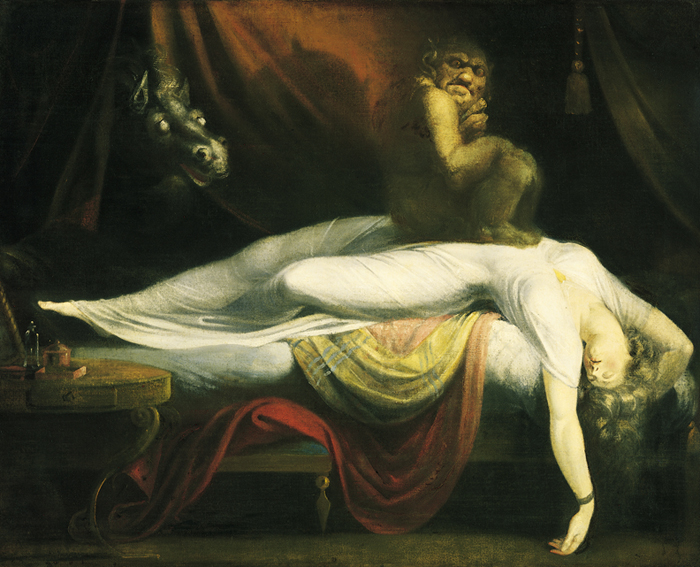
    Studies show more and more how common this condition, REM atnonia, actually is and how much folklore has been attributed to it. Some scientists now attribute alien abductions and encounters with ghosts to sleep paralysis. The demon on the body of a sleeping woman in ”The Nightmare,” by Johann Heinrich Füssli (seen above), is typical of one type of sensation described by people who suffer from sleep paralysis.

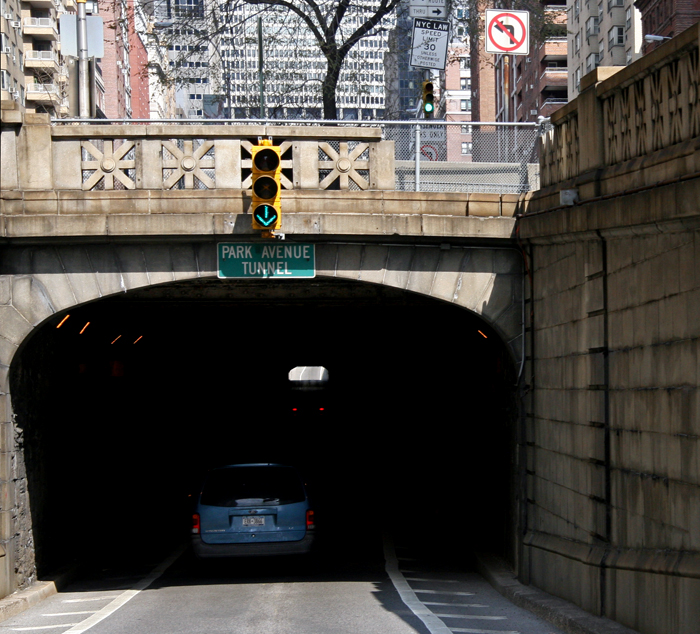
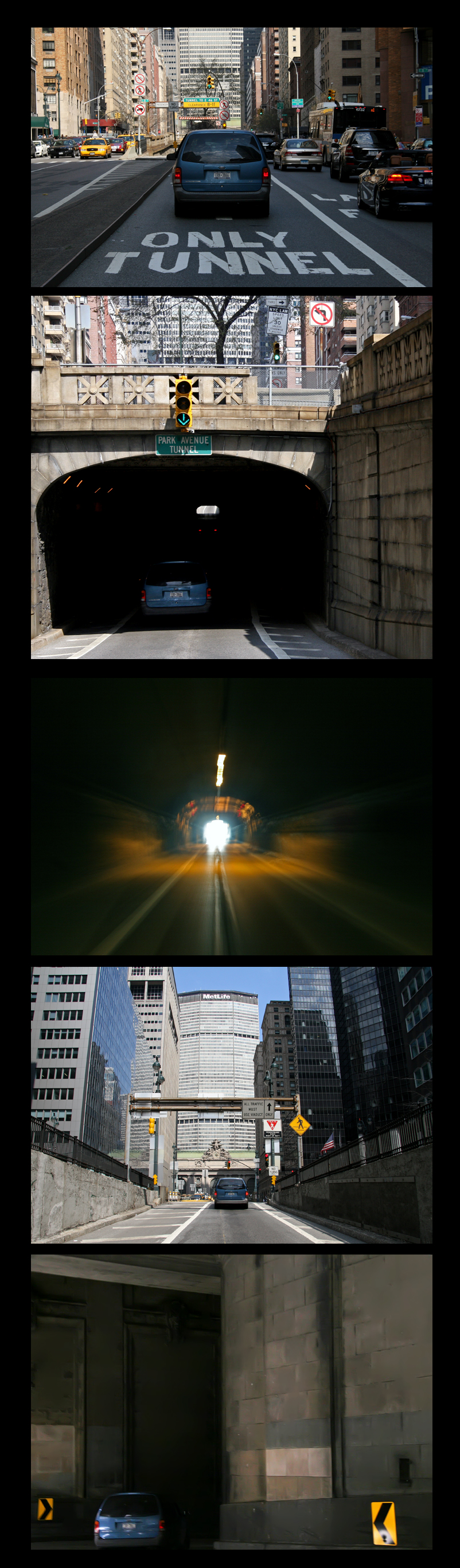
    Like claustrophobia, sleep paralysis is not the type of condition well suited to a New York City resident. To be stuck in a tunnel can feel a little to close to REM atonia. Today’s photo is of the Park Avenue Tunnel – one of only two such underpasses in midtown Manhattan, the other being the First Avenue Tunnel near the United Nations.

    I have always relished the opportunity to drive through the Park Avenue Tunnel. Going north, the tunnel starts at 33rd Street and exits at 40th Street, connecting to the Park Avenue viaduct. This elevated roadway goes directly towards Grand Central Terminal, wraps around the Terminal and MetLife buildings, and descends through the Helmsley Building to reconnect to Park Avenue at 46th Street. Read more about the tunnel here.

    Many drivers take the opportunity to indulge in a rare moment of being an automobile racer – tires screeching as cars snake around the buildings’ roadway are sounds often heard. See the entire journey with my photo gallery here.

    It has always been a freeing experience and one of New York City’s small thrills to travel this length of road (23 blocks) with only one traffic light. Luckily, I have never been trapped in a traffic jam, and I hope never to get stuck in that tunnel or viaduct. With my vehicle not moving and my mind awake, it’s a little to close to the trapped horror of sleep paralysis…

    More about Sleep Paralysis: This condition afflicts normal individuals and those with conditions such as narcolepsy and cataplexy. During sleep, the body essential turns off, a form of sleep atonia. In sleep paralysis, the mind awakens before the body. Read a New York Times article about it here.

    Frightening twist: Among the Hmong, an Asian ethnic group from the mountainous regions of Vietnam, Laos, Burma and Thailand, sleep paralysis is known as “dab tsog” or “crushing demon.” A number of American Hmong have died in the United States from Sudden Unexpected Nocturnal Death Syndrome (SUNDS), a term created by the Centers for Disease Control. This condition is now believed to be a genetic disease, known as Brugada Syndrome, not sleep paralysis.


  • Lemonade Maker

    This story was going to be called Switchin’, but on reflection, I realized that this would do a disservice to our subject. Let me explain.

    One day, in the 1980s, I found myself with a California real estate broker in his luxury automobile. He was showing off his hands-free cell phone mounted to the interior of his car – a big deal at the time. He received a call from his office regarding a particularly difficult situation with a client. Not to worry, he said, because he was adept at turning lemons into lemonade.

    It was the first time I had heard this old saying, and I loved it. The broker could be perhaps better characterized as someone who could sell refrigerators to Eskimos, but nonetheless, turning lemons to lemonade became a popular code phrase in my office when help was needed in dealing with a particularly difficult customer situation. When these calls were forwarded to me, I liked the challenge of making lemonade.

    Subway service disruption is one of the most frustrating things that NYC commuters face on weekends. You can read about the reasons for this here. On Saturday evening, a friend and I decided to travel to Bay Ridge, Brooklyn, by subway (rather than drive) to eat at First Oasis Restaurant, which is conveniently located on a subway line. Weekend travel on the train can actually be relaxing. However, no sooner had we started our journey that the service disruption monster raised its head, with a litany of arcane and sometimes unintelligible instructions barked from a poor speaker system over the ambient din.

    Our fellow rider seen in the photo (who we learned on parting was Reverend Branch) immediately volunteered a translation and interpretation. He was going our way, and soon we were taken under his wing. He was a warm, avuncular human being and we took to him immediately. He parsed all the subway speak and disruption details and informed us of every train change and switching option. Switching trains (local to express and vice versa, etc.) from one track to another across station platforms is a common strategy used by experienced riders to save travel time.

    At one point, the Reverend proposed running across the platform to catch another train that was pulling in, and we happily followed. Soon we were criss-crossing platforms, with the Reverend explaining every possible scenario and station detail. Where many would groan about disruption, the Reverend was turning lemons into lemonade, and we were drinking as fast as we could. This was actually fun.

    Never believe what you hear about New Yorkers. Reach out when the opportunity presents itself, and I will guarantee that most often you will find warm humans and, if you are lucky, a Lemonade Maker 🙂

    About Reverend Branch: The Reverend is Community Liaison for the High School of Sports Management Celebrity/Charity Softball Game.

    Note: I certainly do not want appear insensitive to those commuters who have to put up with subway service disruption on a regular basis. I know that our journey was not fraught with the anxiety of getting to work or another destination in a timely manner.


  • Manhattan Island

    One of my favorite t-shirts was designed with a tropical motif, including palm trees blended with a New York City skyline. Below it were the words Manhattan Island. Perfect. I love the tropics, islands, and New York City. The shirt is long gone, but the spirit of Manhattan Island remains.

    However, there is always a price to pay for the island experience, and that is getting on and off, by bridge, tunnel, boat, or for those who can afford it, by plane. One of my favorite places in the Northeast is Cape Cod, including Martha’s Vineyard and Nantucket. But the bridge to Cape Cod can be horrific during summer weekends, and smart travelers who drive there plan their vacation around bridge traffic.

    Manhattan has limited entrance and egress from the west (via New Jersey): the Holland Tunnel, the Lincoln Tunnel, and the George Washington Bridge. The choices are further limited by destination in the city and place of origin. The GW Bridge is located at the northernmost tip of Manhattan and is not typically used coming into midtown Manhattan unless one is coming from a northern point. For most others, the Holland or Lincoln Tunnel is the only option.

    At some point in a New Yorker’s life, he/she will see and experience something that looks much like what we see in today’s photo – waiting at the entrance to the Lincoln Tunnel.
    Manhattan is an island. Four of the five boroughs of New York City are islands or part of islands – only the Bronx is on the mainland. Tunnels and bridges are a way of life here. Smooth sailing requires experience and strategy. A journey made easily without getting caught in traffic is a source of personal pride and justifiable bragging rights. People who drive into and around New York City become strategic planners, or they will, over time, slowly lose their minds.

    The Lincoln Tunnel was designed by Ole Singstad and consists of three tubes – the first built between 1934 and 1937, the second completed in 1945, and the third in 1957. The approach roadway makes a full circle coming in, so the traffic congestion is a surprise for the motorist as he or she comes around the final bend. One of the busiest tunnels in the world, it sees approximately 120,000 vehicles per day. The XBL (exclusive bus lane) concept was one of the first.

    They only thing missing for me is the tropical climate and palm trees. But better off without them – imagine the traffic trying to get into a tropical Manhattan Island 🙂


  • Agony and Ecstasy

    This is the view of Manhattan while traveling on the BQE. If you examine a map of Brooklyn and Queens carefully, you will find that there are not really a great number of highways, particularly in light of the fact that there are nearly 5 million residents between the two boroughs combined. For the highways that do exist, of course, that means TRAFFIC.

    I have written before of the fear and anxiety that many have of driving in and around New York City. The Brooklyn-Queens Expressway justifies those fears – it is everything you don’t want in a highway. It is not pretty, it has sharp curves, it’s dangerous to drive on, it’s confusing, there are no shoulders or places to stop, and for most of the roadway, the speed limit is 45 mph – if you’re lucky. It divides, connects to, and blends with other highways, bridges, and tunnels. You had better know what you are doing, or you may be going where you don’t want to go and/or miss where you intended to go.

    The construction of this highway dates back to 1937 with the Brooklyn-Queens Connecting Roadway. The highway is 11.7 miles long – extending from the Brooklyn Battery Tunnel in Brooklyn to the Grand Central Parkway in Queens. It was built to accommodate both commercial and non-commercial traffic and was intended not only to relieve congestion on local streets but also to aid industry and business by shortening transportation time between the boroughs.

    The project was fully completed in 1964 under the helm of controversial urban planning czar Robert Moses (1888–1981), chairman of the Triborough Bridge and Tunnel Authority.
    In the 1980s, the roadway was under construction. For long time residents, the BQE has had a history of agony. But there are pleasures in riding the BQE, such as the vistas of Manhattan, by day or night. The nicest stretch is driving north under the cantilevered section of the expressway, which forms the Brooklyn Heights Promenade above. Here, the views of Manhattan are magnificent, both from the highway and from the esplanade above. Perhaps it is a bit of a stretch of road, but can we call the experience agony and ecstasy?

    Photo Note: This image was taken traveling south on the BQE in the central section near the Long Island Expressway. Looking west in the evening light, you can make out the outlines of the Empire State, Chrysler, and Citicorp Buildings.


  • Pull Ahead

    Sooner or later, a visitor or resident of New York City, regardless of whether he/she owns a car or not, will most likely have to deal with one of the least favorite activities here: parking. Visitors unfamiliar with the situation should be ready for sticker shock.

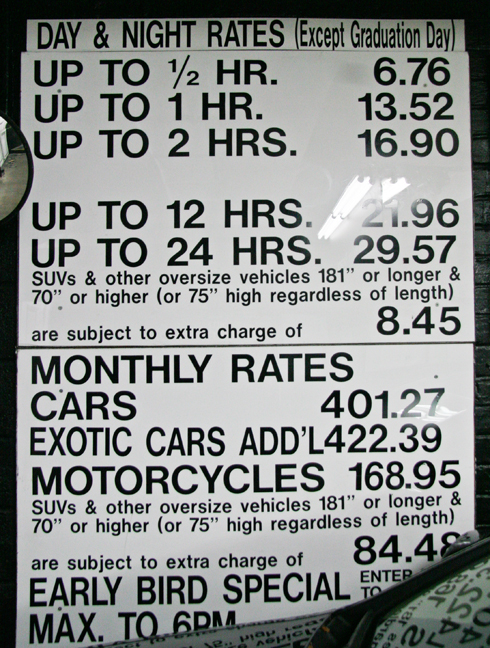
    A careful and resourceful individual can shop most any commodity or service in this city and find a broad range of pricing. However, anything requiring the rental of SPACE is going to cost you dearly here – there is only so much to go around. The garage in today’s photo is $400 per month, with an additional $422 per month for exotic cars. See the rate sign here.

    One fascinating development is automated parking garages. Manhattan’s first is in Chinatown, at 123 Baxter Street. Here, beneath 24 condos, are 74 parking spots in an automated garage. The system is the work of AutoMotion Parking Systems, an American subsidiary of Stolzer Parkhaus of Strassburg, Germany, which has built 28 automated garages in 11 countries since their first in 1996 in Kronach, Germany. Benefits include reduced cost due to reduction of personnel and more efficient packing of autos. See the New York Times article here.

    The wildest twist on parking is a German company, CarLoft (carloft.de), which is building an apartment tower in Berlin that permits residents to park their cars on their balconies. Similar ideas are brewing Manhattan. From the New York Times article:

    A German company, CarLoft (carloft.de), is building an apartment tower in Berlin that lets residents park their cars on their balconies. A New York architect, Annabelle Selldorf, has offered a similar vision for a Manhattan building with elevators that would let tenants drive their cars into garages next to their high-rise apartments.

    There are many other recent developments in the city to reduce cost, increase efficiency, and provide consumers with more information. There are Zipcars for short-term rentals, Internet sites to find parking spots, websites for comparison shopping, and competitive bidding for monthly garage space.
    Some may argue for elimination or drastic reduction of cars altogether. Within city limits and nearby suburbs, the subway or train system is the best method of travel.

    One problem lies with travel to areas outside New York City with no public transportation at all, which is quite common in the United States, even in parts of the Northeast with a high population density. For example, I grew up in Bristol, Connecticut, with a population over 60,000 (the eleventh largest city in the state), but there is no public transportation. Getting there will require car travel at some point in the journey.

    Rail travel is much more deeply implemented in many developed countries outside the US. Here, buses are, by default, the public transportation of choice for many destinations. The Chinatown bus revolution, led by Fung Wah, has brought pricing to much more attractive levels.

    Personally, I always thought a good online rideshare/carpool system would be useful for trips out of the city, not just for commuting to work. There are so many people who travel alone by car – it seems such a waste of resources. My online searches, however, yield few promising results. I think there is a critical mass at work here – without a substantial number involved, there just isn’t enough momentum to make it viable. The websites I found had a serious dearth of rides offered or wanted. Safety with unknown passengers is a big issue here – perhaps one of the biggest impasses.

    There are many problems with automobiles, parking, congestion, and public transportation. There are also many proposed solutions. I hope for successful implementation in the near future, so we can truly Pull Ahead 🙂


  • What numba Kissena?

    I have previously written here of my experience as a New York City taxi driver when I was a university student. Nothing beats cab driving for a crash course in New York City and learning about its geography, boroughs, and people. There are many taxi cab stories which I have exchanged with others. In the course of driving nights, a driver will inevitably run across some outrageous situations. This has been the subject of the film documentary Night on Earth and the TV series Taxicab Confessions.

    I was introduced to driving by a college friend, an interloper into our university lives who was a native New Yorker and a few years older than we were. He was not a student, and to us at that time, he was a man of the world. He introduced me to many things in New York City, such as Wo Hop, the legendary Chinese restaurant at 17 Mott Street.

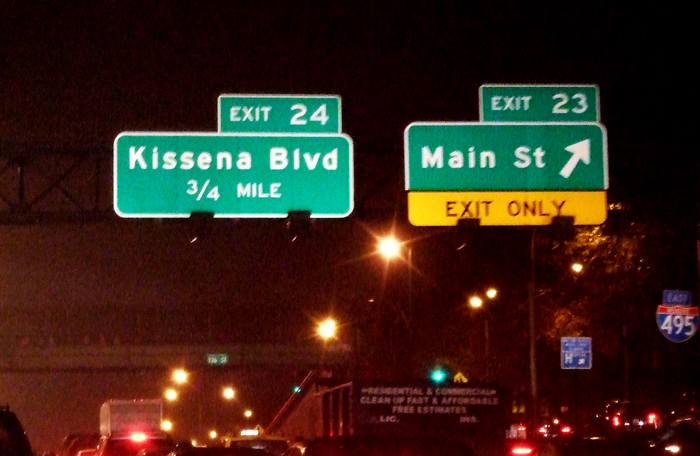
    I was new here and very naive and innocent. I was wide-eyed and easily impressed. On one particular night while driving a taxi, I was lost in Queens, looking for a particular address on Kissena Blvd. I was tired, it was dark, and the print on my borough map was getting too small and painful to decipher. An older driver was standing outside his cab – if I recall, he was eating a sandwich. He looked seasoned, so I asked, “Do you know where Kissena Blvd is?’
    To which he replied in classic New Yorkese, “What numba Kissena?”

    Wow. Can you imagine? This man did not only know the location of Kissena Blvd, but apparently, he was able to give specific directions to a particular address based on its street number alone! This seemed to be an incredible feat to me at the time, like some brilliant memory act using mnemonic devices. Or perhaps he was a savant with special abilities to know everything about street addresses.

    In hindsight, however, nothing of the sort is necessary. In fact, Kissena Blvd uses the block numbering system common to Queens and developed in 1911 by Charles U. Powell, a chief engineer in the topographical bureau, who modeled it after the Philadelphia grid system. There is a method to the madness or what the New York Times referred to as the “vexing vortex of the Queens street system.”

    Plan or no plan, however, the system is still vexing. Any number may exist as an avenue, road, place, lane, street, drive, or any combination. Even Queens residents are often helpless and resort to just asking for directions. If they are lucky, they get someone who is a street savant and can retort with something like “What numba Kissena?” 🙂

    Related Posts: New Yawk Style, Sea of Yellow


  • No Lipitor

    If you live in New York City, sooner or later you are most likely going to end up enjoying a ride on the Long Island Expressway (aka the L.I.E.) and learning why this roadway has become known as the world’s largest parking lot. Many also feel that the acronym LIE is appropriate for a thoroughfare that represents itself as an expressway.

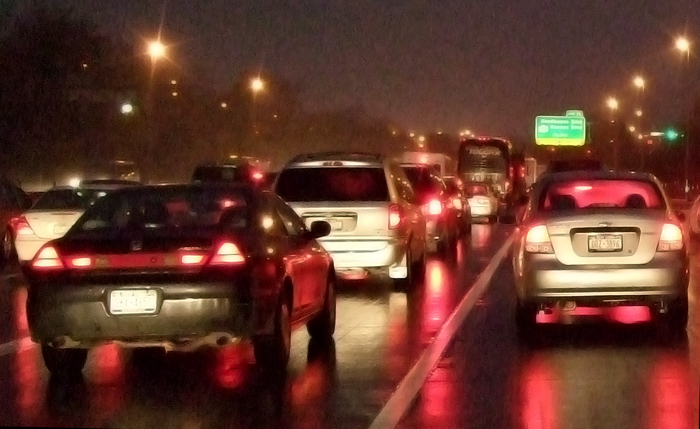
    The photo was taken during my recent journey to visit a friend in Roslyn, Long Island, a distance of under 20 miles from Manhattan. What could, under ideal conditions, have been a 30-minute ride, turned out to be a painful 90- minute crawl.

    This highway is the major artery running east from Manhattan (via the Queens Midtown Tunnel) and servicing the Long Island suburbs of New York City. It extends 71 miles, going through Queens and nearly the entire length of Long Island.

    We have the largest island in the contiguous United States and the largest city in the US, all serviced by essentially one major highway. And that means trouble. Compound this with the fact that we are talking about islands, and that means limited access. For the traveler who is experienced with all of the alternate routes and is able to assess the situation based on conditions, time of day, weather, etc., the expressway can be avoided. There are various alternate routes which parallel the LIE for various distances – the Northern State Parkway, the Southern State Parkway, and Sunrise Highway. Others who are particularly averse to traffic can resort to local routes, such as Northern Boulevard.

    But not everyone has the stomach for tactical maneuvering, and most will just take the simplest route and travel the clogged artery. For this one, we have no Lipitor…


  • Dead Man Walking

    A few years ago, while crossing the intersection at West 4th Street and Washington Square East, I was hit with a glancing blow to my side by a car, swept completely off my feet, bounced off the hood, landed feet first, and continued walking without breaking my stride one bit. I turned while walking and scowled at the driver, who looked like he recognized the massive impending doom to come. But, to his and the onlookers’ amazement, I only kept walking.
    The expectation was, of course, that there would be the confrontation and requisite berating. There would be exchange of personal details, the police, implicit threat of lawsuits, claims of pain, and suffering with symptoms both real and imagined. The fun would be all mine – there could be no defense in hitting a pedestrian. And I was even in the crosswalk, with the walk light in my favor.

    I am not a hero or Superman, only very lucky. After landing on my feet, I just knew instinctively that I was not injured, so why not enjoy a bit of self-righteous arrogant indignation, with the world and perpetrator all on my side? How often does an opportunity like this present itself – to look like a victim and a hero at the same time?

    An anecdote like this does not, however, make a case for walking in the streets with reckless abandon, jay walking, or other pedestrian transgressions. Or walking up the center of Broadway in rush hour traffic, as seen in the photo.

    At times, the sidewalks of Manhattan are jammed with teaming masses and are almost unwalkable. No one likes traffic, and most drivers will strive to take shortcuts and alternate routes to avoid congestion. Often, however, for both the pedestrian or automobile driver, only one road leads to Rome, and we must suffer that route.

    Pedestrians do have other options, though – take it to the streets and walk curbside. This style, along with walking diagonally across streets and through intersections rather than perpendicular at crosswalks, is a good indicator that the individual is a New Yorker. Tourists will rarely walk in such a manner – only when absolutely necessary, but certainly not as the regular habit common with so many city residents.

    For the long time New Yorker on the go, the crawl of pedestrians at rush hour, the hordes of shoppers, and the amble of tourists in awe of our great city are all just irritants. Walking in the streets is the balm to soothe. Many would say that life has numerous irritants, crowds, and traffic, and that dealing with congestion is part of the contract which one signs to be in New York City in the first place. And to flaunt with traffic is to be nothing less than a Dead Man Walking

    Photo Note: This was taken in the evening rush hour from the center of Broadway in SoHo looking north. The Chrysler Building can be seen in the distant center. I do not walk in the center of a street or avenue long or often – in this case, for only a moment to capture the photo. I received no honking horns or other admonitions from drivers.

    “Dead Man Walking” is slang used by prison guards when escorting death row prisoners from their cells to the execution chambers. Dead Man Walking is also the title of a 1995 film starring Sean Penn.


  • Del Floria’s


    There were many things I saw growing up which sold me on this city. One was watching the TV series The Man From U.N.C.L.E. This program (from 1964-8) was about a fictional secret intelligence agency, U.N.C.L.E., with headquarters in New York City. The entrance itself was secret, located in the rear of Del Floria’s, a tailor/laundry shop located somewhere below street level in a brownstone in the East 40s near the United Nations. See video of the opening trailer here.

    As a boy, I was riveted to images of the show’s opening sequence, determined to glean enough details to find Del Floria’s at some future time. So I could never understand the fear and dislike for the city. At the very least, didn’t you want to find Del Floria’s Tailor shop?
    But rather than fascination, most New Englanders whom I grew up with had feelings about New York City that ranged from being afraid to being terrified. When I say terrified, I mean a nearly pathological fear that transcends any rational explanation. A fear of being lost in the black hole of New York City’s highways, byways, cloverleafs, on ramps, off ramps, bridges, tunnels, and one-way streets, apparently never to return.

    However, I must admit that the roadways of New York City can be daunting and unforgiving. The Triborough Bridge, shown in the photo, is a good example of what could be a traveler’s nightmare. This bridge is actually a complex of three bridges connecting Manhattan, Queens, and the Bronx.

    There is often no humanity on the roads of New York City. Make a mistake and you will pay the price, sometimes literally. In most cases, if you mistakenly find yourself approaching a bridge or tunnel, I have bad news for you – you’re going through it or over it, with no opportunity for turning around. I was furious for years over an incident where, while driving in Brooklyn, I missed the last exit and was forced to travel over the Verrazano Narrows Bridge to Staten Island and pay an exorbitant toll.
    In spite of space for an easy turnaround, I was not allowed and was forced to pay the toll, exit, and return. Begging the toll officer was of no avail – better luck negotiating with the man from U.N.C.LE.

    In some ways, I enjoy successfully navigating the maelstrom of New York City, so for me, this has always been a challenge to meet, not a cross to bear. And when I find Del Floria’s, you’ll see it here…

    Note about the photos:
    Top Photo: This is the base of the Triborough Bridge (built in 1936 and renamed the Robert F. Kennedy Bridge in 2008) as seen from Ward’s Island. For more info, see here.
    Bottom Photo Collage: Sequence showing Del Floria’s Tailor Shop and method of entry to U.N.C.LE. headquarters.


  • dinamic_sidebar 4 none

©2026 New York Daily Photo Entries (RSS) and Comments (RSS)  Raindrops Theme