• Category Archives War Against Wheels
  • Left for Dead

    Posted on by Brian Dubé

    The Segway was heralded by inventor and design engineer Dean Kamen as a transport device that “will be to the car what the car was to the horse and buggy.” Go here if you are not familiar with Kamen or the Segway.
    There was tremendous buzz and speculation before its release – Steve Jobs claimed that it would be “as big a deal as the PC.” After the product release and its grandiose claims, I had a gut feeling it would be a failure, at least in urban areas like NYC, for many reasons: cost ($5000), regulations, traffic, weight, and parking (where would you put this thing?). I even emailed Kamen himself, addressing all the problems I saw, along with the biggest issue of all: VANDALISM.

    Kamen spoke of all the sophisticated security devices to prevent theft, but in my opinion, he missed the problem of vandalism, not theft. Perhaps he doesn’t know New York. Why would someone vandalize something that they could not steal? For many reasons (such as taking parts), as well as perhaps one reason not understandable to outsiders: because they can.

    I’m sure that people will take parts they do not know they have use for because they are there.
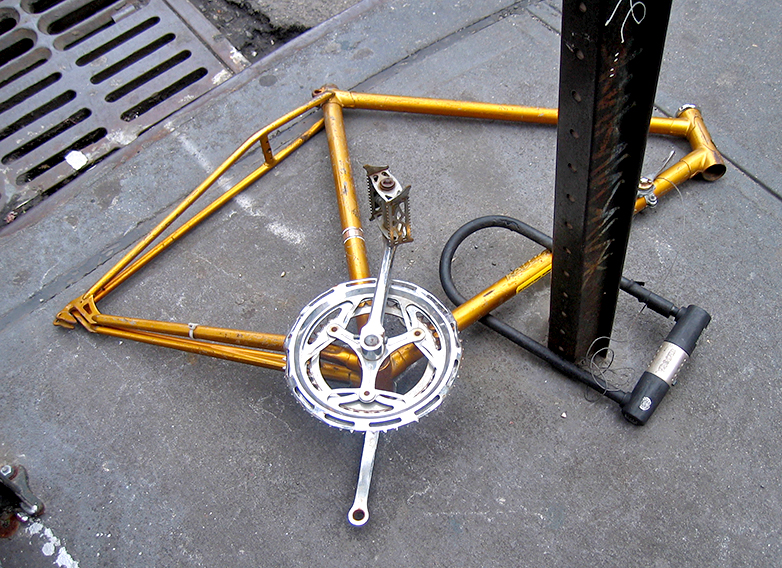
    Manhattan is a graveyard for abandoned bicycles, like the one in today’s photo taken on Spring Street. Many bikes are stolen, even with special locks like the Kryptonite, and if they can’t steal the bike, they will steal unlocked parts (yes, there are ways of locking individual components, like seats).
    When you arrive to see your bike stripped like that in the photo, I imagine it is rather disheartening. What’s the point in taking the frame, and where will you dispose of it anyway?

    In 2005, sculptor David Shapiro did an outdoor exhibit, Left for Dead, at the Socrates Sculpture Park in Long Island City. A melange of twisted abandoned bikes in various states were salvaged from the streets of the city. In the exhibit, Shapiro attached them to sign posts, embedded in the ground. And a thief was found to have attempted to steal a seat from an exhibited bike.

    The whole scenario starts to resemble soldiers who stole gold fillings from corpses in times of war. Even the dead are not safe…
    Posted on by Brian Dubé

  • Disruption

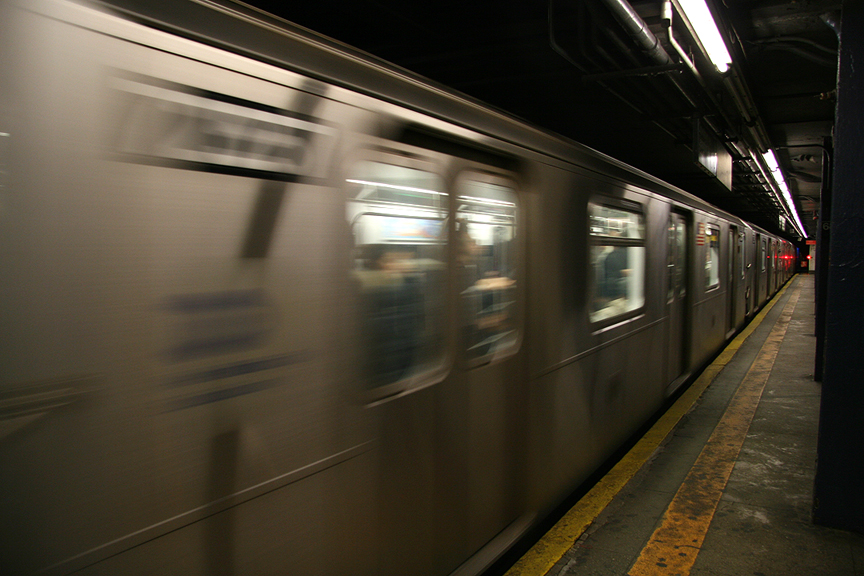
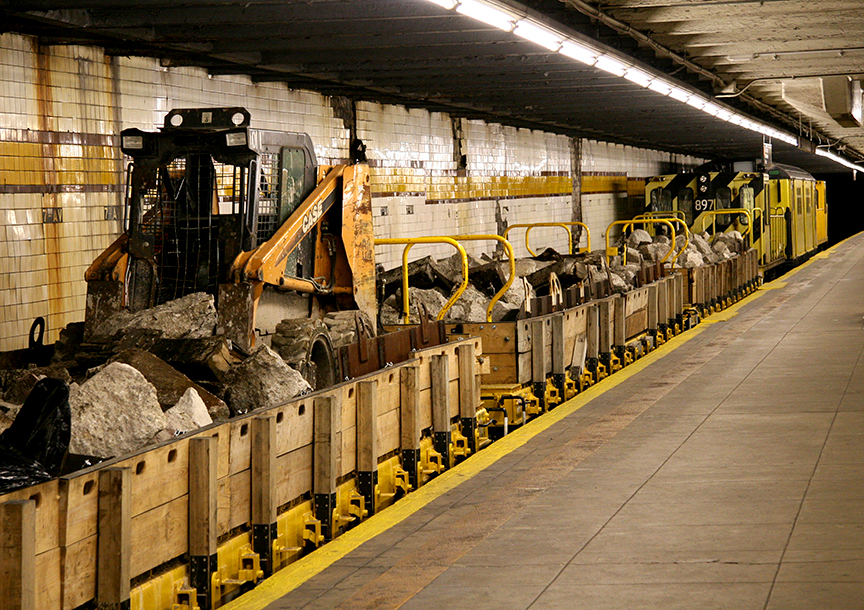
    One of the biggest frustrations of daily commuters or frequent users of the New York Subway System is what feels like the constant disruption in services. Skipping stops, delays, rerouting, stalled trains, and variations. Unlike other cities, New Yorkers really depend on the transit system. For most, there is no other transportation option – few New Yorkers own a car, and travel by car during the business day (with parking costs) is really not feasible.

    I had the opportunity to ask the question “Why?” to two acquaintances – one working for the MTA, the other a retired engineer who had been in management. What I was told makes sense, albeit not satisfying to those who bear the brunt of disruption. Here’s what they said: The primary problem is that the NYC transit system, unlike others, runs 24/7. Hence, repairs and maintenance must be made while the system is operating, not to mention in narrow, tight, confined spaces. There is no parallel system which can be used during repairs.

    Add to this that 1) The system is extremely old and everything about it is antiquated, 2) It is one of the largest systems in the world with hundreds of miles of track, 3) It is one of the most heavily used systems in the world with over 5 million passengers on a work day, 4) Most subway lines are operating at or near maximum capacity, 5) During various periods (1970s-80s), when the city was less prosperous, the system was seriously neglected so now we have to play catchup, and 6) It is a public entity with all the bureaucratic inefficiency and inertia. There is a tendency to do things the same old way.

    With such a massive around-the-clock system, every effort at overhaul or service becomes a big ordeal. My bet (not my wish) is that disruption is here to stay…

    Photo note: I took this photo at the 7th Avenue stop on the F line in Brooklyn. I thought it would show evidence that work really is being done. I imagine, however, that it could be a decoy, driven and parked throughout the system to make it appear that work is being done 🙂


  • Machine

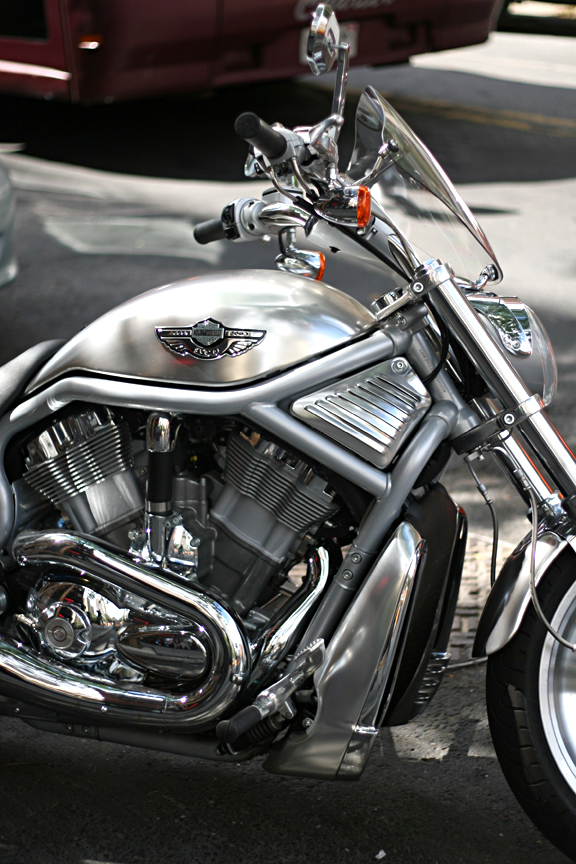
    I am not a biker or part of the biker culture. And I do not enjoy the deafening roar of bikes with straight pipes – a sore point with many city residents. However, I do appreciate a well-engineered and pleasant-looking machine. And this Harley, with its gleam and striking satin finish parked on the Lower East Side, is partly that. Partly, because there are aspects of the engine and bike engineering that are archaic and could be improved (actually, some changes are being made with newer models), but due to the strong cult phenomenon which has grown around Harley, many aspects of the early design have been kept.

    Harley-Davidson as a company is a fascinating story. Founded in 1903, the company was nearly bankrupt by 1969 – the image of the outlaw biker was partly to blame, along with deteriorating quality and proliferation of Japanese motorcycles which were less expensive, better-made, and had superior performance. In the 1980s, the company was resold and, under new management, began its ascent. Rather than attempting to compete with the Japanese, the company marketed Harley’s retro factor. There are many things associated with Harleys: chopper customizations, the unique “potato-potato” sound of the engine, hardtails, etc.

    The marketing of the historic aspect of a product brand is a smart move seen with many legacy businesses such as Levis, Coca Cola, Disney, Lego, etc. It also readily lends itself to product line extension and licensing (Harley sells accessories and apparel). In the late 1990s, there were waiting lists as long as a year for some models. The bike has become an American icon with a certain symbolic iconoclasm. The median age of Harley buyers is now nearly 50, with many affluent, well-known, or powerful individuals as owners: Jay Leno, investor Jim Rogers, etc….


  • Bikes

    Posted on by Brian Dubé

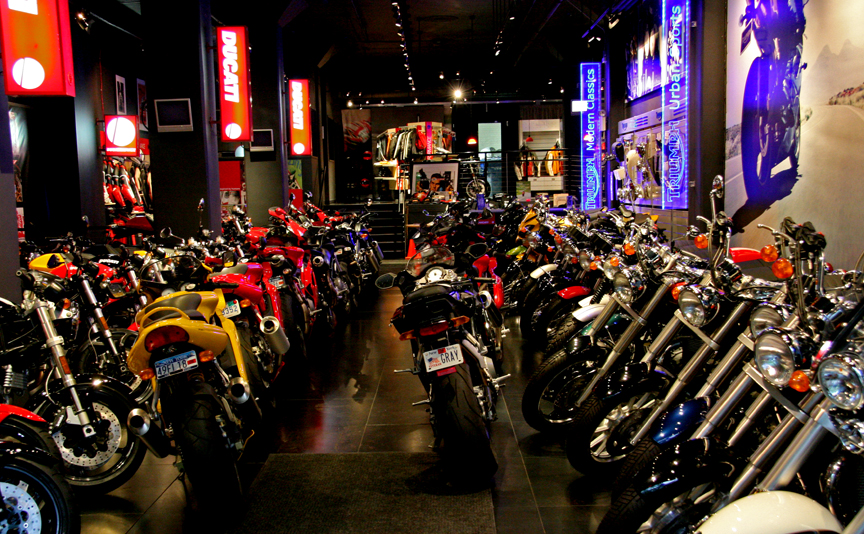
    I am not a motorcycle enthusiast and have never owned one, but I was always impressed by this Ducati/Triumph showroom display visible from street level in SoHo. It is quite interesting that as I write this and look at their website, I see that they have won national showroom awards. And as is typical with many fine European products, design aesthetic and attention to detail stand out in this display.

    It has always appeared to me as an outsider that the design of motorcycles was much more important to the owner than automobiles. Although there are many finely engineered and designed autos, the percentage of very uninteresting and utilitarian products (many of which are strictly price-driven, like the Yugo) seems to be much greater than that in the motorcycle world. This makes sense, since a motorcycle is not as practical as an automobile as far as transportation – the motorcyclist chooses this vehicle for many reasons other than transportation. The experience of being on a bike is one of integration with one’s environment, as opposed to the experience of being in a car, which can be likened to watching TV in comparison. And then there is the issue of power, speed, and exhilaration, again intensified by lack of separation with the environment.

    However, many types of subcultures have developed around biking, and the image of the outlaw biker is strong in people’s minds. There is more risk in riding a motorcycle – the accident rate is nearly 5 to 1 over cars. And in NYC (and elsewhere), the reputation of motorcycles has been further tarnished by those that ride with straight pipes – illegal exhaust systems where noise reducing baffles have been removed and create noise of deafening proportions…

    Posted on by Brian Dubé

  • Nice and Olds

    Posted on by Brian Dubé

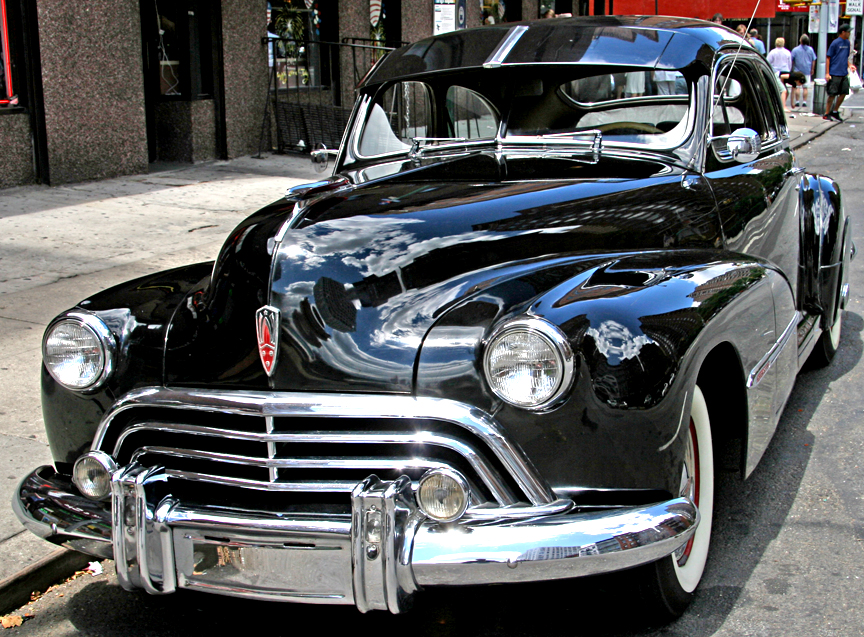
    Here’s a new twist. While walking up to B&H Photo with a photographer friend, we came upon this antique 1947 Oldsmobile on 9th Avenue. The owner, Brian Atkins, was taking photos of passersby (for a small charge) who wanted to pose with the vehicle. In conversation with him, we agreed that cars make great subjects for photography. I recently shot a number of autos in an antique car show I happened upon in Connecticut, but I have not posted them here since they were not in NYC.

    I am not a car enthusiast, but I love the chrome, sweeping curves, shiny lustrous finish, reflections, interiors, and overall design work of many of these classic American icons. The beauty of the designs of these antique autos is not strictly a romantic passion for all things past. Many antique automobiles were some of the finest examples of industrial design. Raymond Loewy (1893-1986), for example, was probably the greatest and well-known industrial designer of the 20th century. His prolific career involved a long relationship with the U.S. automaker Studebaker. If you are not familiar with Loewy and his work, I would highly recommend some reading about him and his work – you’ll be amazed. He was responsible for everything from the Hoover logo to NASA Skylab interior…

    Posted on by Brian Dubé

  • Wild Crash

    Posted on by Brian Dubé

    On Thursday night, while strolling near Washington Square Park in the Village, I observed rerouting of traffic and a helicopter hovering overhead – not typical at all. Suspecting a serious crime scene, I walked towards Eighth Street and University Place to find a taped off intersection with a badly crumpled bicycle, smashed cars, police vehicles, ambulances, and television equipment and crew.

    A stolen van had lost control while being pursued by police (driving an undercover car disguised as a taxi). The van made a hard right at the intersection, hitting a vehicle, a bicyclist, and parked cars, and nearly careening into a glass-enclosed dining area in the front of the Dallas BBQ restaurant. Apparently the scene in the restaurant was pandemonium – people seeing the oncoming van, afraid it was going to collide, began running, with plates and food flying and the restaurant shaking. There was flying glass from the collision, injuring one pedestrian. The good news? A bystander, Sherwin Caton, chased and tackled the driver as he was trying to escape. And, amazingly, there were only minor injuries…

    Posted on by Brian Dubé

  • Yellow Fever

    Posted on by Brian Dubé

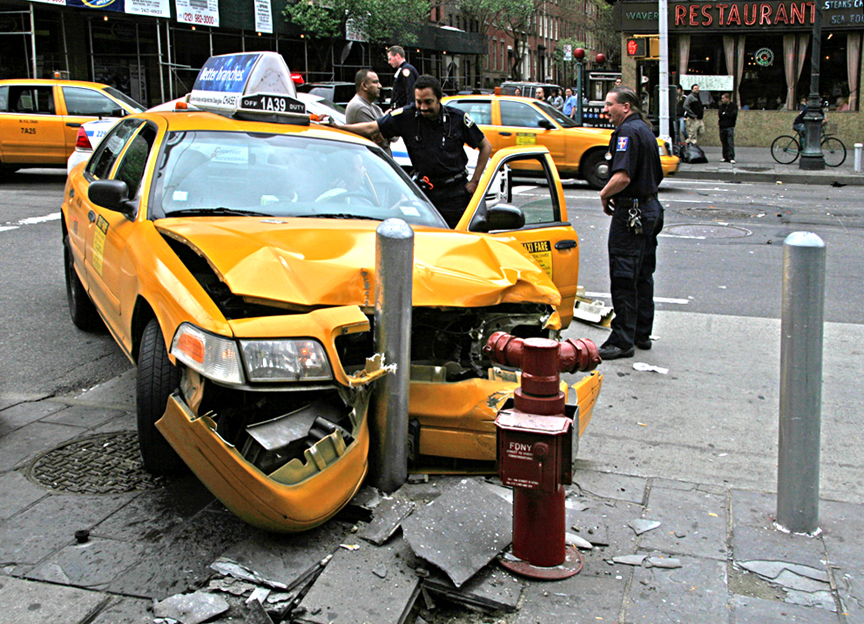
    In 2005, there were 71,167 automobile accidents in NYC, with 328 fatalities: 101 drivers killed, 46 passengers killed, 159 pedestrians killed, and 21 bicyclists killed (and 1 “other”). 25-30% of accidents involve one vehicle striking objects, like that seen in the photo. I’m not sure what happened here, but I would guess that avoidance of a vehicle or pedestrian was likely. It appeared that no one was injured.

    There are 12,779 taxis in NYC, and many are involved in accidents. Unfortunately, since business is involved, what is best for making money is not best for safety. Taxi fares are based primarily on distance (idle time meter charges are much less profitable than distance). So, the faster you get there, the more money you make. Add long hours, many inexperienced drivers, and road rage, and the picture is not good.

    The good news is that after huge increases in taxi and livery accidents in the 1990s, regulations became much stricter, and rates have actually come down. Click here for a Taxicab Fact Book. Contrary to public perception, it is actually safer to ride in a taxicab than in other vehicles (crash rates per million passenger miles are less for taxis – click here for article). It appears that, at least for the time being, yellow fever has been contained…

    Posted on by Brian Dubé

  • Hoopmobile

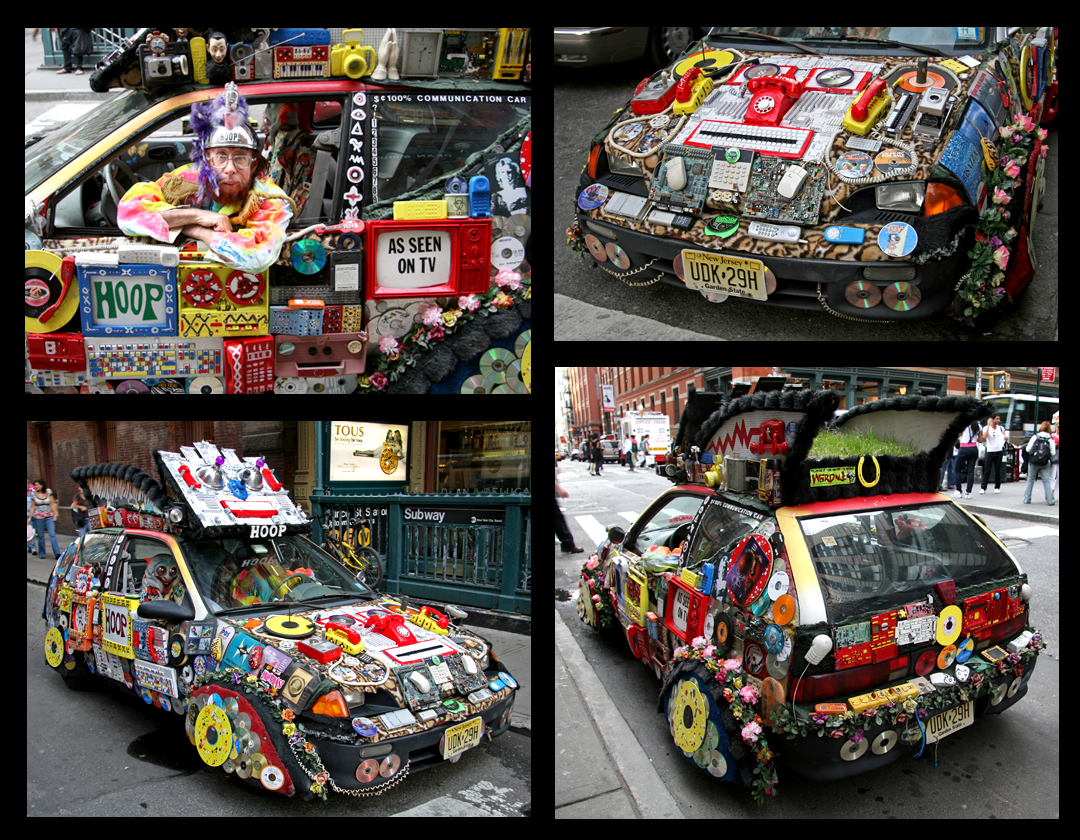
    Welcome to one of Hoop’s many Hoopmobiles and the world of art cars. Hoop refers to this incarnation as Techno Trash – an assemblage which he says represents ”all the transitions we’ve gone through over the years, from a needle on a record to a laser beam on a record.” Steven Hooper, or Hoop (the self-proclaimed King of Art) as he prefers to be called, started doing art cars in the East Village about 20 years ago, when he did hundreds of club performances and parties. His work has been featured in over 40 museums and gallery shows (Fusion Arts, Chelsea Art Museum, MOMA, etc.), television, and the news media. Click here for his story and photos of his vehicles. His motivation is to bring art to the average person on the street, whom he feels can’t name one living artist: “Warhol and Dali were the last of the household name artists.”

    Currently living in Clifton, New Jersey, where he grew up and now cares for his mother, Hoop makes frequent trips to SoHo (one of his old stomping grounds – he once had studios in Union Square and on Prince Street), where he parks and lets passersby ogle his street art.

    The art car movement goes back some time and has seen many incarnations: hippie themed VW buses (such as Furthur), Janis Joplin’s psychedelic Porsche, Lennon’s paisley Rolls Royce, and the Oscar Meyer Wienermobile. There is even a BMW series done by well-known artists such as Warhol and Lichtenstein. The Burning Man festival has had a strong representation. Harrod Blank has made several art cars, written books, and made documentary films on the subject. There are now numerous art car fests nationwide (see here). It’s a virtual industry…


  • The Subway

    New Yorkers love to complain about the subway, but actually, the system is quite remarkable, especially allowing for the fact that it services a city that is not known for efficiency. We are all familiar with the negatives: rats, filth, litter, oppressively hot stations in the summer, no bathrooms, crowding, delays, rerouting, etc. After all, the system has to service 1.5 billion riders a year (5 million a day) with the world’s largest fleet of subway cars (6,400).

    But look at some of the positives: it is one of the most extensive systems in the world, with 660 miles of track and 468 stations in four boroughs. In conjunction with buses, one can get reasonably close to any two locations, and that’s an achievement given the area involved. One can travel as far as 31 miles on the A train without a change of trains (207th Street Manhattan to Far Rockaway in Queens). Service is 24/7 – one of the few in the world and a tremendous convenience we take for granted. I remember a trip to Paris and being surprised that their system closed at 1 AM and having to find a taxi.

    Fares are good for trips of any length with free transfers – many other transit systems charge on the basis of distance traveled. Some stations have amenities such as magazine stands and food. Musical entertainment can be found at some of the larger stations. If you are interested in more details, click here for the transit’s official site. I know – I should have written this after being stuck on a train during rush hour or being rerouted on the F 🙂


  • Pedicabs

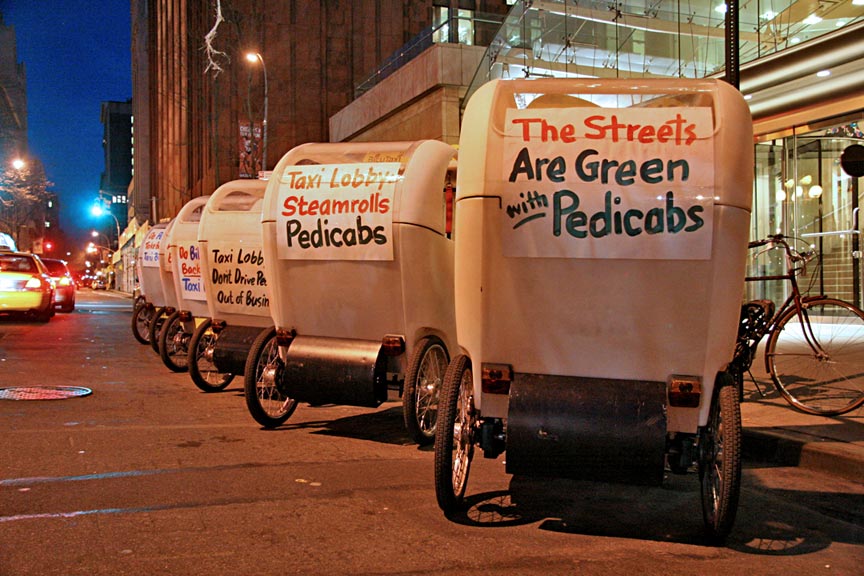
    Legislation was recently passed regulating the pedicab industry. And, of course, it is fraught with problems – disagreements, protests (even free rides are being offered), and threat of a lawsuit. The key elements of the new bill are requirement of liability insurance, limitation on total number which can operate in the city (325), ban on electric motors, ban on operation in Midtown from Nov. 12 through Jan. 7, and ability for police to restrict them in situations where there is heavy traffic, parades, etc.

    Essentially, pedicabs are being brought to a level of regulation similar to the taxicab industry – the primary opposition. Taxi drivers allege that they cause congestion, are dangerous, and should be limited and regulated; pedicab drivers feel that they are eco-friendly and that the legislation is anti-environment and anti-small business. There is a novelty element riding in a pedicab, somewhat like a horse and carriage, but they can be pricey. Recently, I was returning home with a large number of packages. I thought I might take a ride and support the team. I was quoted $15 for 10 blocks (about $5 in a taxi). I decided to walk…


  • The El

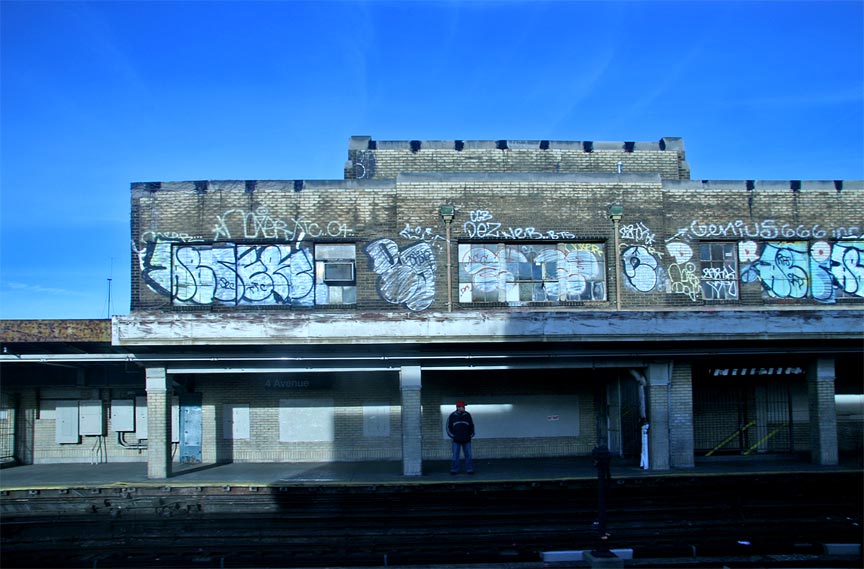
    Although it is referred to as the SUBway, the NYC train system does travel above ground on various lines in parts of the boroughs. These stretches of elevated tracks are frequently shortened to L or el. This photo was taken along the elevated section of the F Train between Brooklyn and Manhattan, at the 4th Avenue stop. This ride across a trestle affords some nice views of the city, particularly if you like the gritty side of urban landscapes. The break from underground travel is welcome, especially on a sunny day. The ride outside also allows wireless access, so it is common to see riders seizing the opportunity to make short calls on their cellphones.

    Riding on the L reminds me of the famous chase scene in The French Connection (1971), which many feel is the greatest car chase ever filmed (the chase was between a cop in a car and a hitman on an out-of-control train on a section of the L in Bensonhurst, Brooklyn). Most of the chase sequence was real and filmed without permission from the city. It includes an accidental car crash, left in the film. Only in New York…


  • Mint Condition

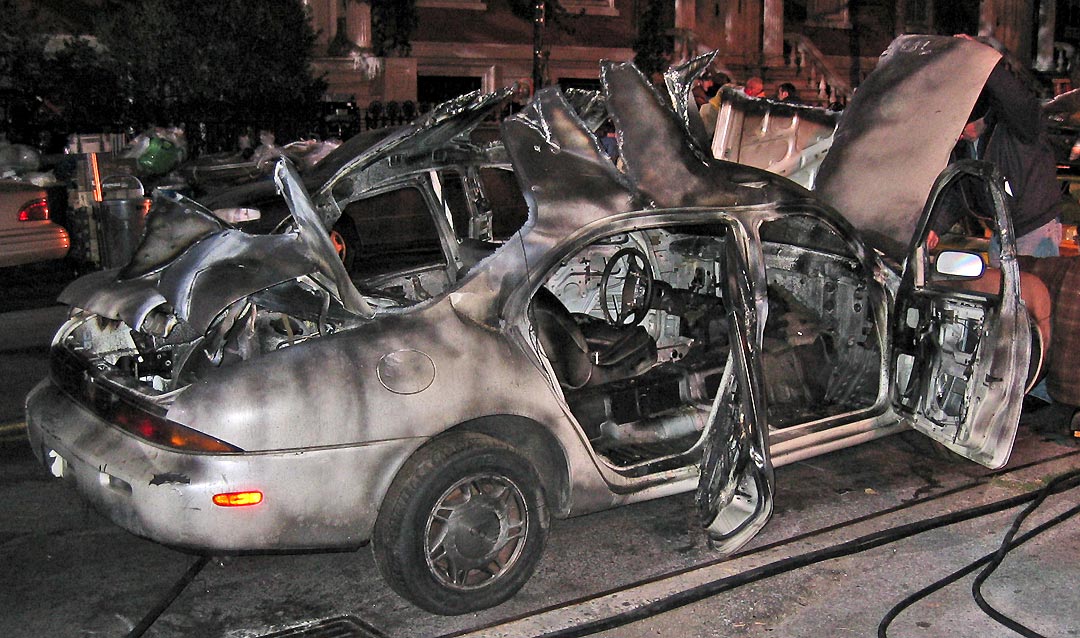
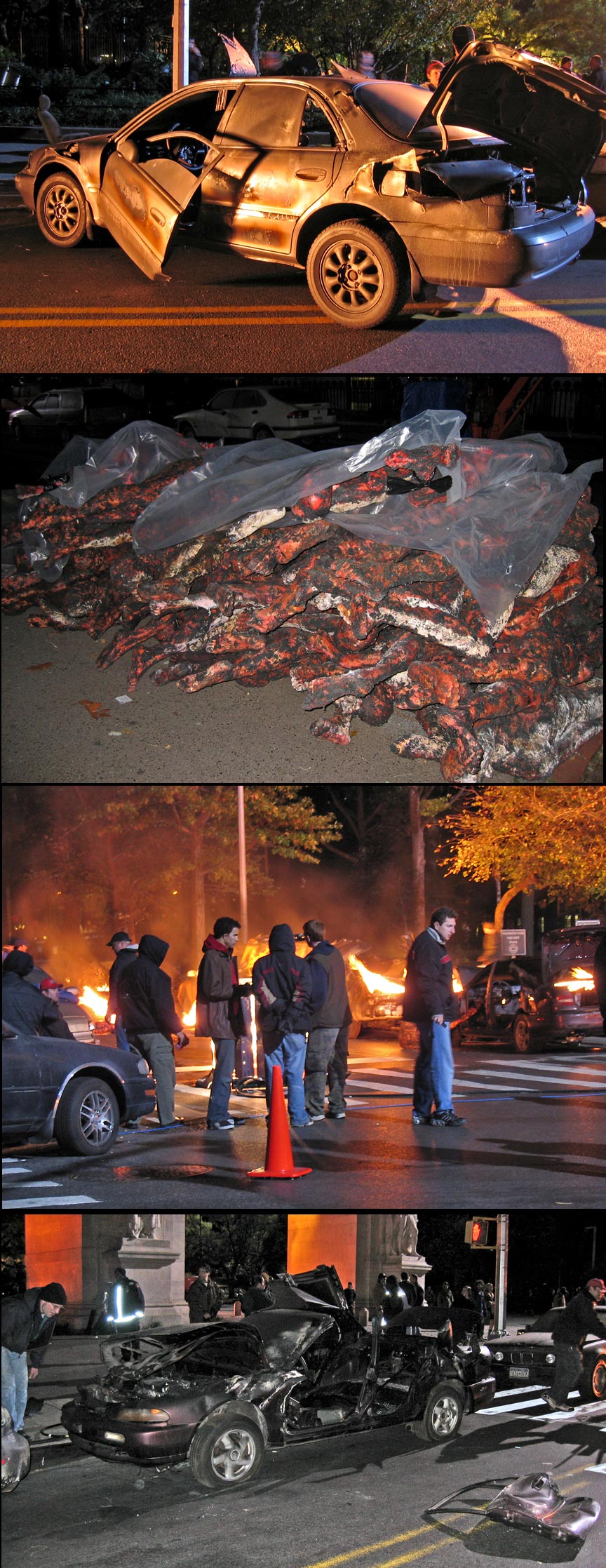
    These are the last days of the filming of I Am Legend in Washington Square Park. Last night, onlookers were greeted with some surprises. There were piles of charred bodies, demolished autos like the one in the photo, and fires burning in the park and street (click here for more photos). The fire department was on the scene with a firetruck, apparently to be on site during the use of fire in the filming. The film, due out in 2007, is based on the novel of the same name by highly acclaimed author Richard Matheson.

    This car actually was in mint condition from the filmmaker’s perspective – I met the individual who did the work. He had no idea what it cost to create an authentic wreck like this, but we both agreed that it had to be a lot more than what most new cars would cost…


  • Twelve Tribes Arrive

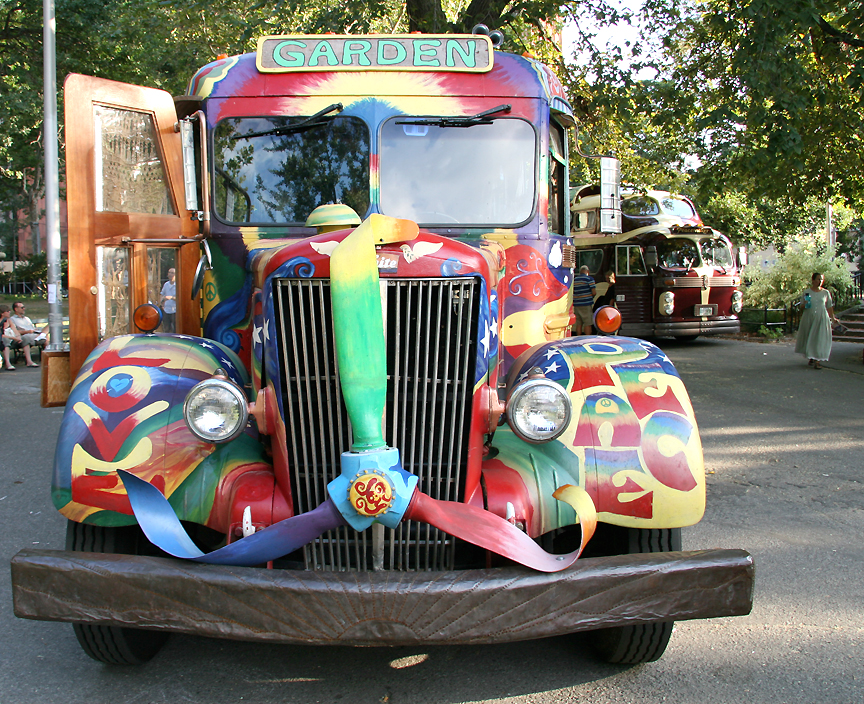
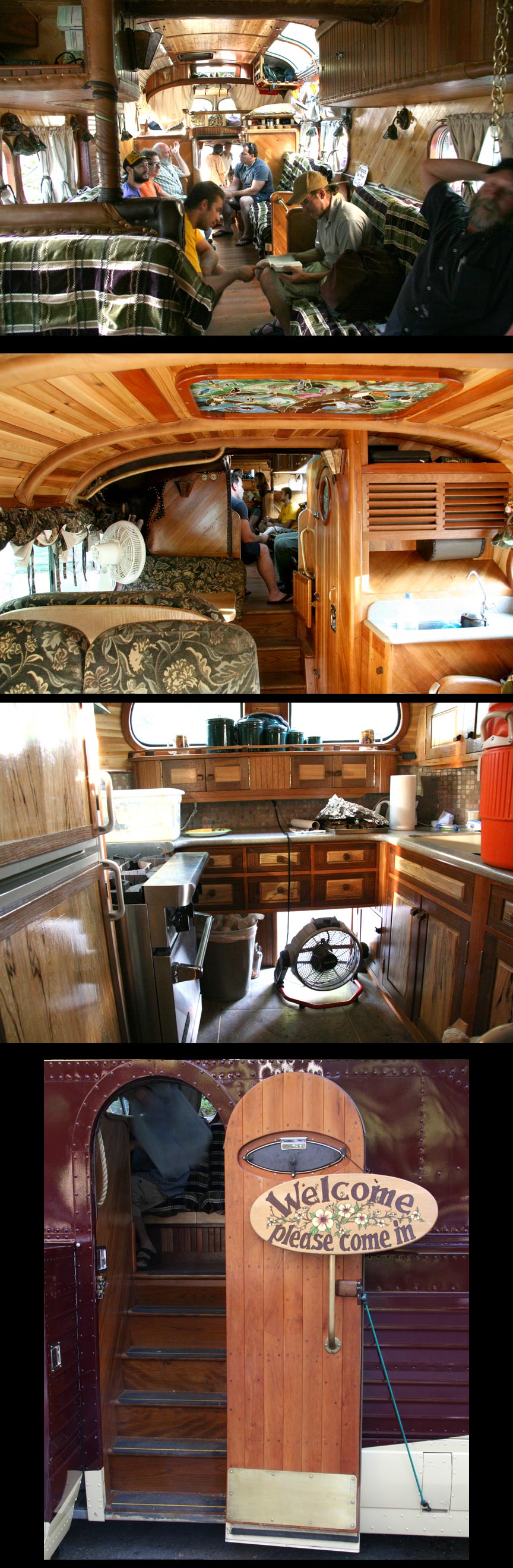
    A friend called me at work to let me know that three Twelve Tribes buses were parked in Washington Square Park, so I made a quick journey to see and record the event. Vehicles of this size are rarely allowed IN the park – apparently their permit for assembly was confused with another group, and they were ushered in and allowed to remain.

    Twelve Tribes is an unusual religious group – kind of a fusion of the unrealized dreams of hippies with fundamentalist Christianity. They live communally in various locales in nine countries. The journey to NYC was part of their Merrymakers Caravan Tour. The bus in the photo, Garden (another photo here), was modeled after the Furthur bus of the Merry Pranksters of the 1960s. Click here for some photos I took of the interior of their Peacemaker bus, which sleeps 17. I did as much reading as possible on their sites and others before this posting. There has been some controversy regarding aspects of their practices, but I have chosen to be as neutral as possible and leave it to you, if you are interested, to investigate on your own and draw your own conclusions…


  • The Tram

    Posted on by Brian Dubé

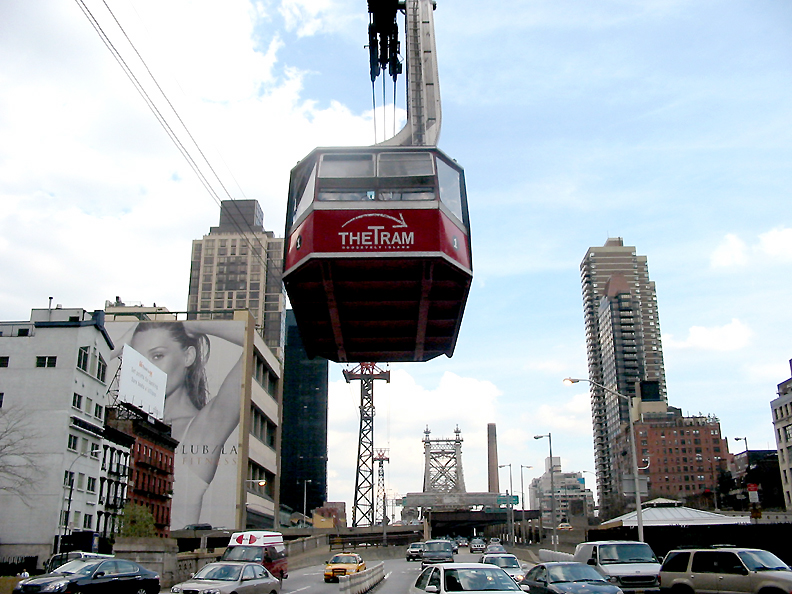
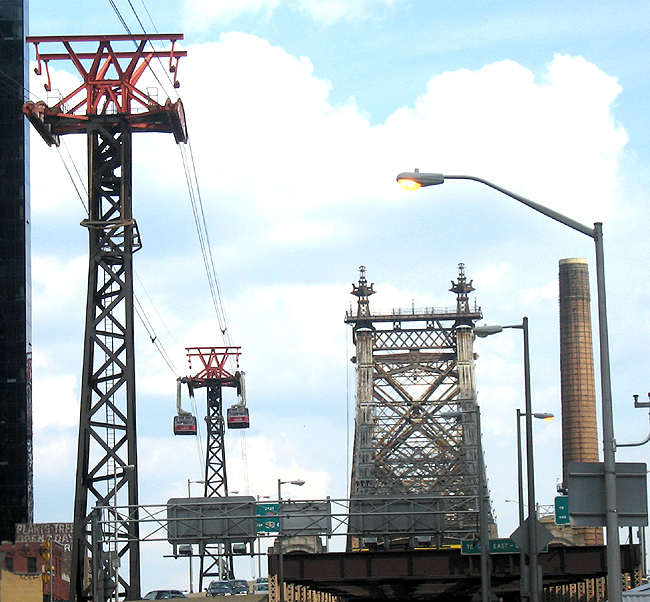
    The Roosevelt Island Tramway provides aerial transportation between Manhattan and Roosevelt Island, with two cable cars crossing simultaneously (see here), running adjacent to the Queensboro Bridge. It is the only commuter cable service in North America. It was put into operation in 1976 to accommodate newly built housing on Roosevelt Island; new subway service was finally inaugurated to the island in 1989. However, the Tram is still extremely popular, providing great views of both islands and the river. I highly recommend it.

    This photo was taken April 15, 2006, just three days before the trams were put out of service – the trams were stuck over the East River for seven hours. Read about the Tramway and the incident here. Service was to be resumed, but so far…(update: Service was resumed in September 2006.)

    Posted on by Brian Dubé

  • Derek Lake

    Posted on by Brian Dubé

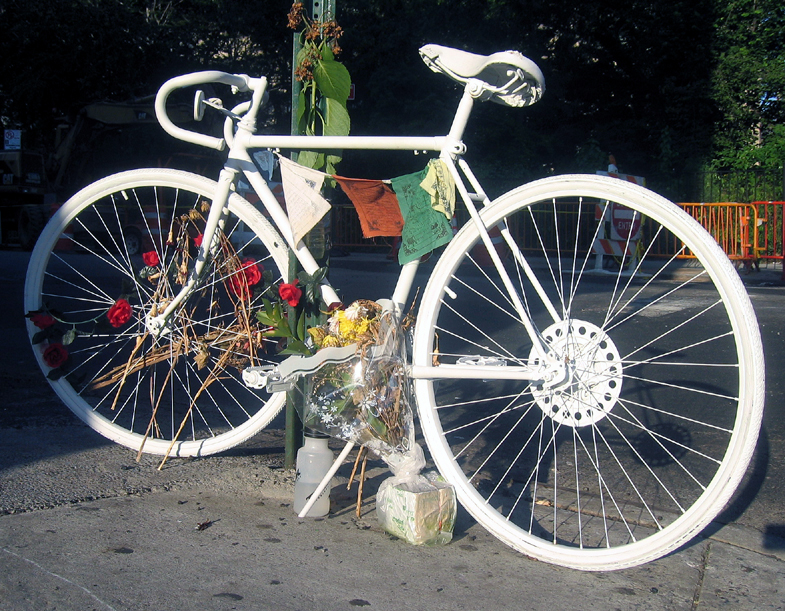
    Bicycling in NYC is very dangerous – many experienced bikers I know no longer do it. The congestion and aggravation battling with traffic are reasons enough. But a bicycle is a great way to get around any city, and efforts are always being made to improve cycling conditions.

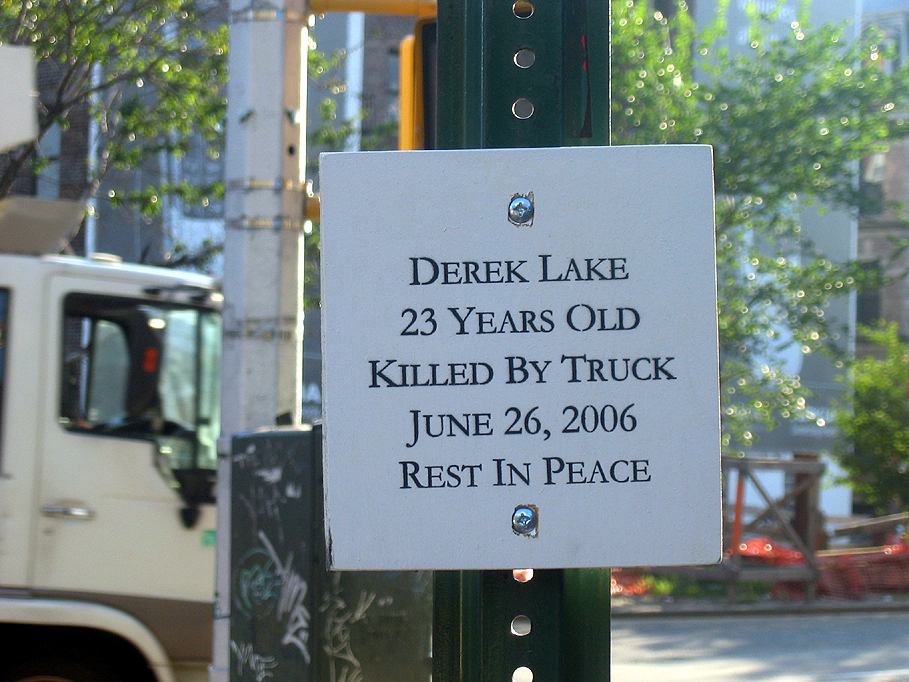
    Derek Lake, a 23-year-old film school grad, was a huge proponent of biking – he commuted from Brooklyn to Manhattan by bicycle daily. Sadly, he was recently hit and killed on Houston Street, a major cross street in the Village/SoHo, currently under major reconstruction. He was the 3rd to be killed on Houston Street in the last year. I had some reservations about posting this, but I thought this memorial was striking and beautiful – I see it every day (see posted sign here). And, unfortunately, this type of incident is an all too common part of city life, and I promised to bring you that.

    Posted on by Brian Dubé


  • dinamic_sidebar 4 none

©2026 New York Daily Photo Entries (RSS) and Comments (RSS)  Raindrops Theme