• Category Archives Natural NYC
  • Pecking for Pita

    On April 27, 2010, I wrote Tired of Crumbs about the plight of many street performers and other independent artists. However, for many other members of the animal kingdom, crumbs are more than a metaphor, and living off the discards of others is literally the means of survival. In a city with as large a population as New York, the amount of refuse disposed is enormous, affording life support for many.

    A lover of Middle Eastern food, I was pleased to have the good fortune to run into Damascus Bakery while strolling through the Vinegar Hill neighborhood of Brooklyn. It was Sunday, so the business operation was closed, however, just outside the factory, there were a large number of pigeons busy atop dumpsters covered with heavy tarps. They seemed particularly industrious, and I had suspicions as to what was going on. Lifting up a corner of one tarp revealed exactly what I expected – the dumpster was entirely filled with pita bread, all polybagged, which I assume had been disposed of for a good reason.

    The pigeons were undaunted by the tarp and had successfully pecked holes through it and the plastic bags holding the pita. Perhaps not as dramatic as the Hawk Fest I witnessed on my window ledge in 2007, but nonetheless, this was a food fest.

    Damascus Bakeries is a 3rd generation business, currently run by Edward Mafoud, grandson of Hassan Halaby, who started the business on Atlantic Avenue in 1930 and introduced Syrian bread, aka pita, to America. In addition to a variety of flavors and sizes of pita, the bakery also produces Lavash Wraps, Panini, and Roll Ups. I hope to visit and tour their factory in the future.

    In New York City there are many means of survival. At the corner of Gold and Water Streets in Brooklyn, for these pigeons, it’s Pecking for Pita 🙂


  • White By Design 3


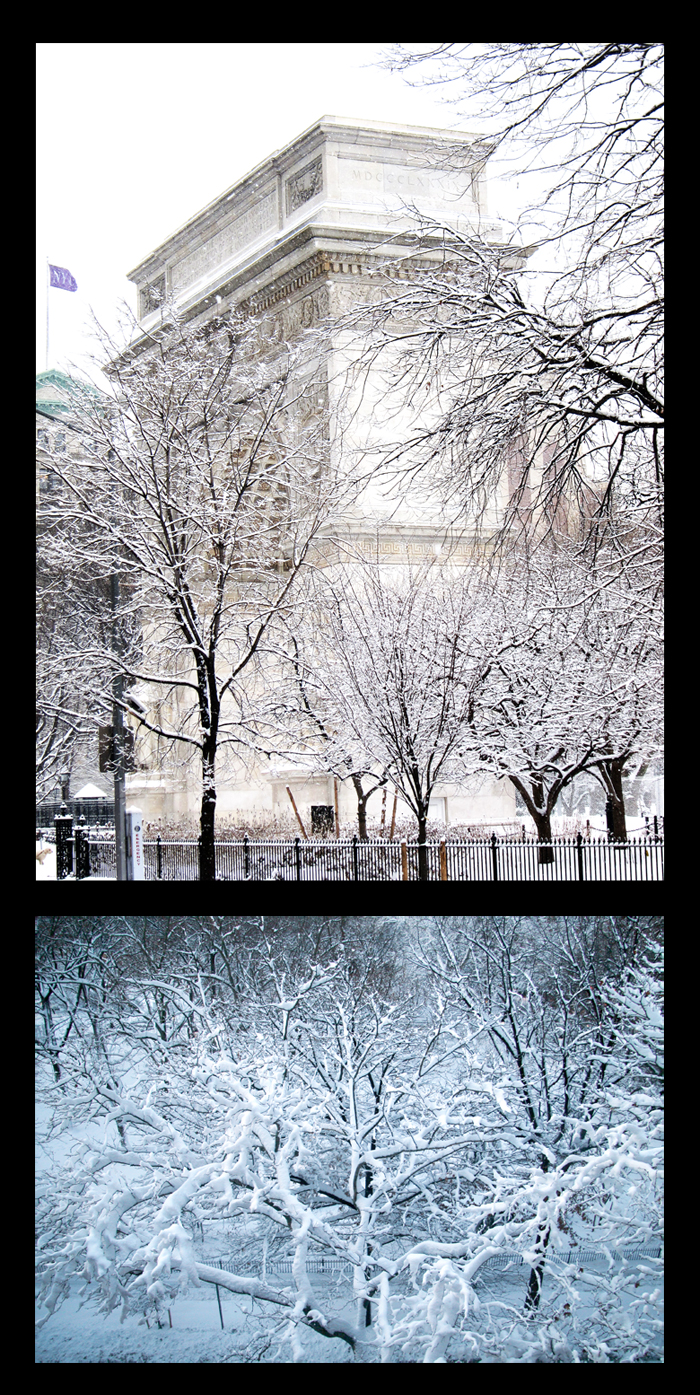
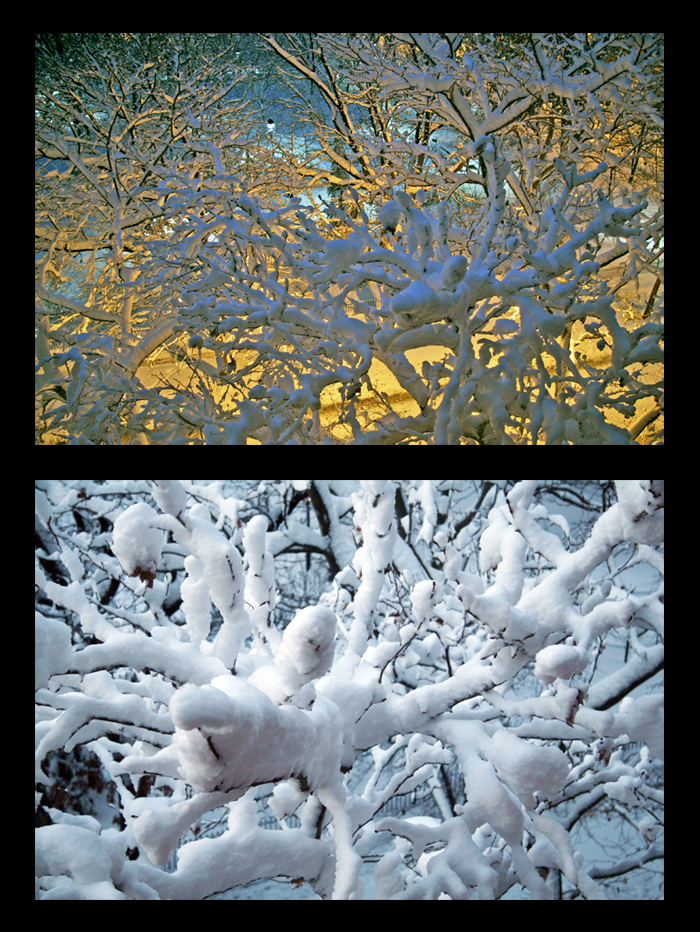
    Another blizzard. Last night I was called at midnight and informed there was a major snowfight going on in Washington Square Park. I was too lazy to bundle up and venture out for the photo op. However, I did begin taking photos yesterday, going into last night and into this morning.

    I have done many stories on this winter’s blizzards and past snowstorms in New York City. I have also done a series of stories called White By Design. See the links below.

    White By Design, White By Design 2, White By Desire, Blizzard, Friends P1, Friends P2, We Got Skiing Too, Shifting Gears, Snow Play, In Like a Lion, Gotta Shoot Village Cigars, Slush Fun


  • We’ve Got Skiing Too

    Most New Yorkers have limited exposure to elements of the natural world. It is possible, particularly in Manhattan, to live and work and never see a tree or blade of grass. There are times, however, when Mother Nature shows her hand and makes her power and presence known, and no urban environment stands in her way in times of blizzards, rain, blistering heat, intolerable humidity, frigid cold, astronomical events, and dramatic lightning (see Back To Our Main Feature here).

    There are many physical activities that depend on certain natural environments that make all but impossible to partake of in New York City. However, for the willing, extremes of winter weather occasionally provide a tiny window of opportunity to indulge in snow play. But only if one is willing to seize that opportunity immediately when available.

    Today, there were ideal conditions for cross-country skiing in Manhattan. Much snow-related fun can be seen in the parks of this city – building snowmen, snowball fights, sledding – but I have witnessed some extraordinary activities in new fallen snow on the streets, immediately following a blizzard, before vehicles, plows or people have had any opportunity to disturb the white powder. The two most memorable are the making of snow angels in the middle of 7th Avenue South and a man in business attire skiing down lower Broadway to what I assumed was his office.

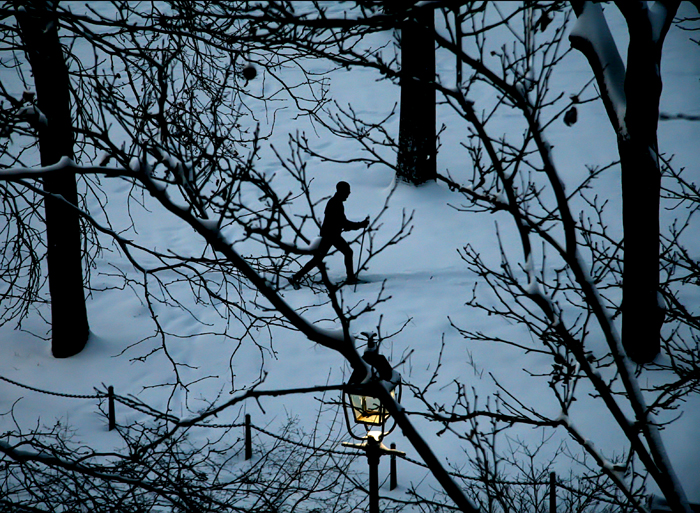
    This morning, shortly after sunrise, while gazing out my window, I observed a man circumnavigating a large lawn in Washington Square Park on cross-country skis. He had the entire area to himself, and the snow was a pristine white, undisturbed except for his lone circular track.

    The phrase moving meditation is an overused cliche, but at times, it is valid. I found myself mesmerized while watching the skier make his rounds. The soothing quality of the white blanket of new fallen snow was enhanced by the circular repetitive movement of this lone skier at dawn. There are many great things about New York City, and sometimes you may find, if you are poised, that we’ve got skiing too 🙂


  • Joe Plourde

    This website would not be complete if I did not mention Joe Plourde. I have ruminated for some years as to whether to include him. You will never meet Joe Plourde, nor will you read of him anywhere. He is, in many ways, an ordinary man of ordinary means. He has seen hardship with an austere upbringing. Appropriately, he lives in a town called Plainville.

    But in other ways, Joe is an extraordinary man. He is disarmingly friendly and loved by everyone he meets. He is, like my family, of French Canadian ancestry, but unlike my parents who were born in Maine, he is from the Province of Quebec, moving to Maine and then later to Connecticut. It was in Hartford that he met my family when they made the same move and helped us find our first apartment.

    I have written a number of times about the demonizing of the present and the praising of the past. That many believe that everything has been dumbed down and that the best was in times past. In Better When, I quoted from Jill Eisenstadt’s New York Times article about this very topic. However, with all due respect to Jill, she (or I for that matter) is not someone who left home at 14 years old from the woods of Canada.

    Joe is quite direct and not always politically correct, but he is a fair and reasonable man and not materialistic at all. He does not champion the past. On one occasion he told my father, “Al, you know what they can do with the good old days. The can shove ’em where the sun don’t shine.” A bit vulgar, but a point I have never forgotten. The few pleasures of the simpler life of days of old did not outweigh the hardships he endured – he much prefers his modern life with simple comforts, like central heating and indoor plumbing.

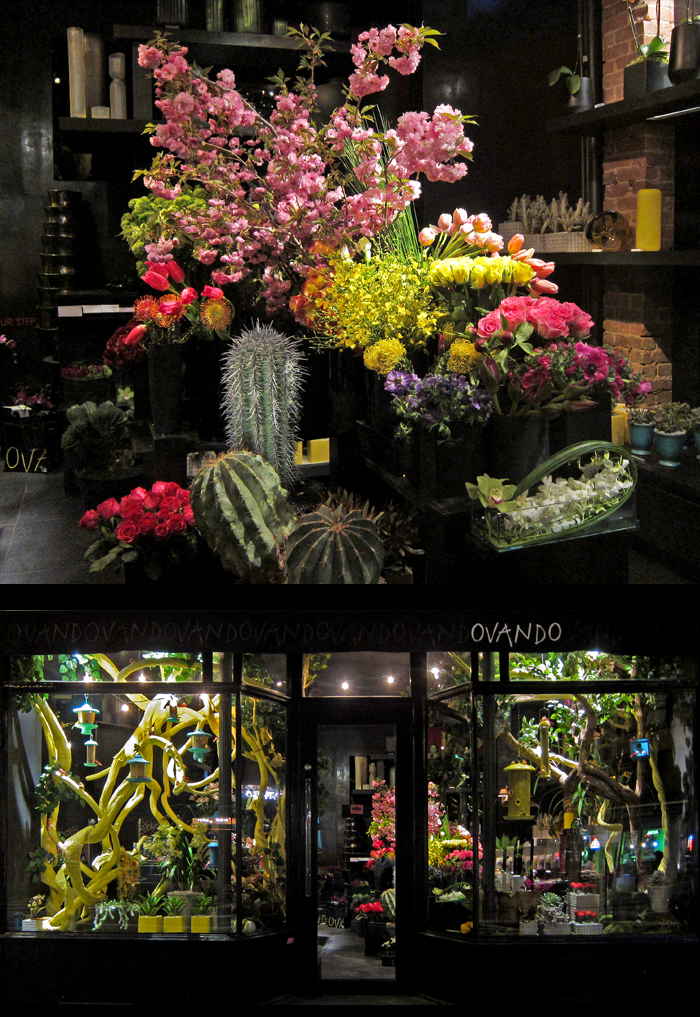
    Flower shops have been around for a long time, and Ovando Flowers, at 337 Bleecker Street, is a good example of how many retailers today excel in the quality of goods offered and presentation. Ovando’s extraordinary window display is itself a tourist attraction. From their website:

    The owner, Sandra de Ovando, was born in Mexico City to Spanish and Russian parents. Sandra fell in love with nature, flowers and bold colors at a very young age when she often spent weekends gardening with her mother.

    Later, in her travels throughout Europe and Asia, Sandra discovered exotic flowers, plants and fruits which she began incorporating into her designs – hence was born the signature style that today defines Ovando’s dynamic compositions.

    Intent on indulging her bright passion for flowers and design, Sandra moved to New York where she soon after opened Ovando in 2003.

    Today, Ovando has blossomed into a full-service Floral and Event Design Company. Sandra’s unique approach, the culmination of her life’s journey, has made her the favorite floral designer of New York’s elite, including celebrities, high-end restaurants, fashion houses and boutique hotels. From stunning bouquets, moody lighting, and the full-scale construction of breathtaking displays and environments, Ovando is a dazzling celebration of form, function, and flowers.

    I don’t expect to find Joe Plourde there, but I know he would like it 🙂


  • Slush Fun


    Right now, the New York City streets and landscape are defined by the aftermath of the recent snowstorm. Invariably, talk of snowstorms here will include the dreaded melting and slush, analogous to the Mud Season of northern New England. So, it is befitting to end this week of snow-related postings with the last phase of a snow accumulation now underway, with the “blessing” of warmer temperatures.

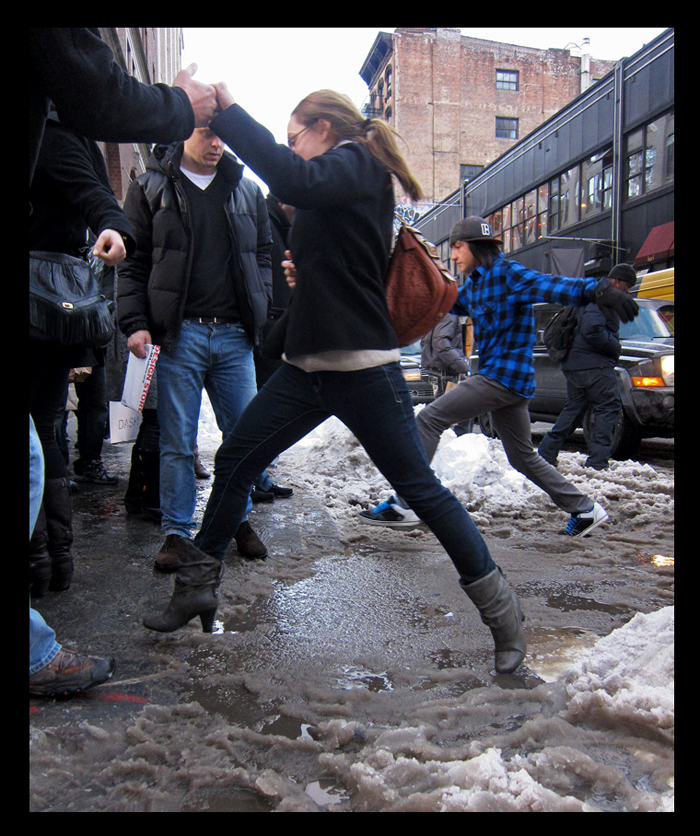
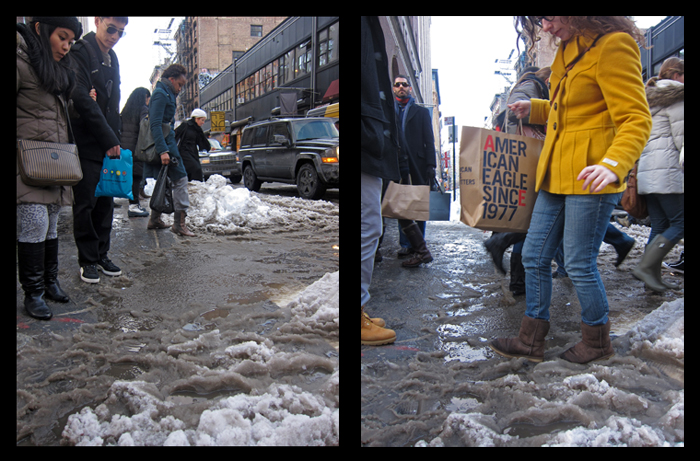
    At intersections across the city, pedestrians confront slush puddles, often large and deep enough to approach lake size and be quite daunting – it is common to see people standing in contemplation, paralyzed with indecision. There is jumping, pond skipping, circumnavigation while trying to locate firmer ground, or even abandoning a particular intersection and trying another. For those attired in tall rubber boots, there is just walking through without concern.

    However, extensive walking is the norm here, and sidewalks are largely navigable without waterproof shoes, so for many, lugging a pair of shoes to change into or the prospect of wearing boots all day at the office are all unappealing. So, many tread the streets with footwear that really is inadequate for a world of slush.

    As the slush to snow ratio becomes larger towards the end of a big melt, there is also the danger of heavy splashing as vehicles careen through slush. An unpleasant surprise, now you can enjoy the day looking like a mutant dalmatian. The seasoned native practices scanning and defensive walking and has learned long ago that there is no such thing as walking too far from the curb.

    For someone living in New York City, there is a building and adopting of many defensive strategies, whether it is where to keep your wallet, chaining bicycles, protecting against auto vandalism (as I wrote about in No Radio), window glass etching (see here), or how to navigate on slush days. To the native, these become second nature, automatic reflexes. To the visitor or outsider, this panoply of life strategies is unfathomable, and to many new residents, the aggregate number of inconveniences can be too much to endure, as I wrote in Dwanna.

    Even for the seasoned New Yorker, there is certainly a level of internalized stress that is often not recognized until one leaves, temporarily or permanently. A close friend who moved from the city described this period of readjustment as decompression.

    For those committed to being here, Happy New Year and join the Slush Fun 🙂


  • Friends, Part 1


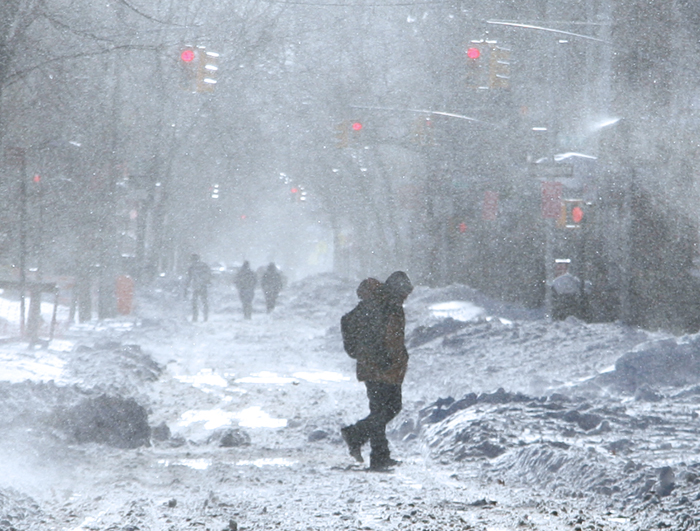
    I learned many years ago that recruiting a companion to go out into a blizzard was an exercise in futility. Although many can perhaps be persuaded to see the reasons behind such a venture, apart from children, very few are going to voluntarily leave the cozy confines of one’s home to subject themselves to a blizzard. On one occasion, I had tried to persuade a girlfriend to go out into a blizzard with blinding wet snow, so strong it required goggles. The response was a very confident “no way” – understandable, I suppose. Arguments aside, the facts speak for themselves – there are good reasons that the city looks like a ghost town in these conditions.

    But my office was shut down, and although I had things to do indoors, this record-breaking snowfall really begged for some photography – a greatly added incentive to bundle up and venture out. A snowstorm this crippling is a rare phenomenon in New York City. Deserted streets. Even as a I write this, I have not heard a vehicle pass by in over one and a half hours.

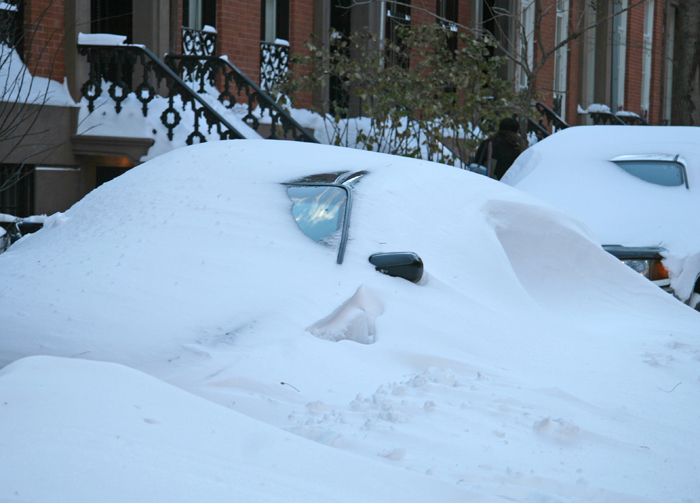
    I headed into the West Village, where I knew I would find the least adulteration of the snowfall. I was amply rewarded with sites that rivaled anything I have seen here in a long time. Cars completely buried and row houses so beautifully framed and adorned by snow, some still with Christmas decorations. See my photo gallery here.

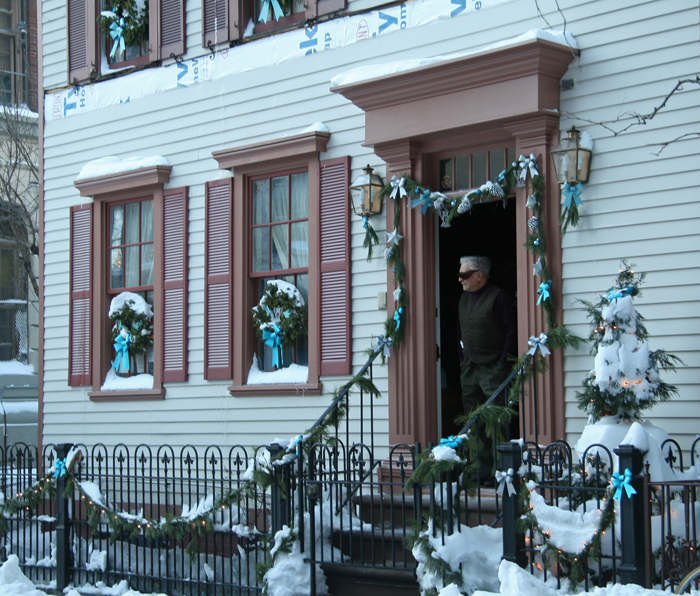
    At the corner of Bedford and Grove Streets, I stopped to take a photo of 17 Grove, which was so exquisite with its wreaths in every window adorned with blue bows, each frosted with snow. As an added bonus, the owner had taken a moment to open the doorway and admire the winter wonderland outside his home. We spoke briefly in a way that bespoke of two people meeting in a small rural town. I so love this part of New York City, and the snow just gave it an extraordinary ambiance.

    But this was not to be the day I thought it would be. Not at all. Across the street lies the building whose exterior was used for the filming of the TV series Friends. It is here that I would meet a lone traveler who would change my day (see Part 2 here)…


  • Blizzard

    In a city of extremes and superlatives and one that is a bit of a drama queen with a tremendous ego, a blizzard is one of many events that lets the world know – hey, we got that too. It’s a media bonanza with tales of the stranded and acts of stoicism in a city that is virtually shut down.

    We can however, only take credit for surviving it because, like it or not, this is mother nature’s call and we don’t control the weather yet. So the event does not go as planned. Today’s blizzard is a record breaker, the sixth largest in New York City history. We experienced high winds, 17 continuous hours of snow, heavy accumulations, 3-5 feet of drifts, and even thundersnow. Central Park reported 20 inches.

    For the first time in memory, none of my coworkers have been able to get to the office. Service on some subway and bus lines have been suspended. People have been stranded in trains and in cars on highways. Some cannot exit their homes because of snow drifts. Streets are not plowed. Sidewalks are not cleared. Some have spent hours getting to their workplace in Manhattan only to find them closed, then returning home.

    And, of course, there is the day off for many, an unexpected perk after a Christmas holiday and extending the weekend. For those not inconvenienced, and there are many who have been trapped in airports, trains, and cars, it is an opportunity to hole up at home.

    Once behind us and all is well again, it will be another feather in the cap of the New Yorker. That even here, we can survive a blizzard…


  • Hanging Around


    When I was in grade school, I became intrigued with the hangman’s noose. It was easy to get the attention of fellow classmates presenting such a macabre artifact. It is extremely simple to tie, but its very nature would keep most from even trying. Who would learn to make such a thing and why?

    The entire subject of hanging is fascinating to some and its lure perplexing to others. The facts of hanging, its history, tools, technology, and the anatomical and biological aspects of the condemned are all mired in speculation, exaggeration, mystery, misinformation, and urban myths. The acquaintance I wrote about in my story Power once claimed he had the hangman’s formula – a supposed equation for calculation of rope length based on a person’s body weight. In fact, such a thing does exist as the British Table of drops. The original table of the “Long Drop” or measured drop was worked out by William Marwood in 1872. A revised table was issued in 1913. In is still in use by a few countries to this day. You can read more and see the tables here.

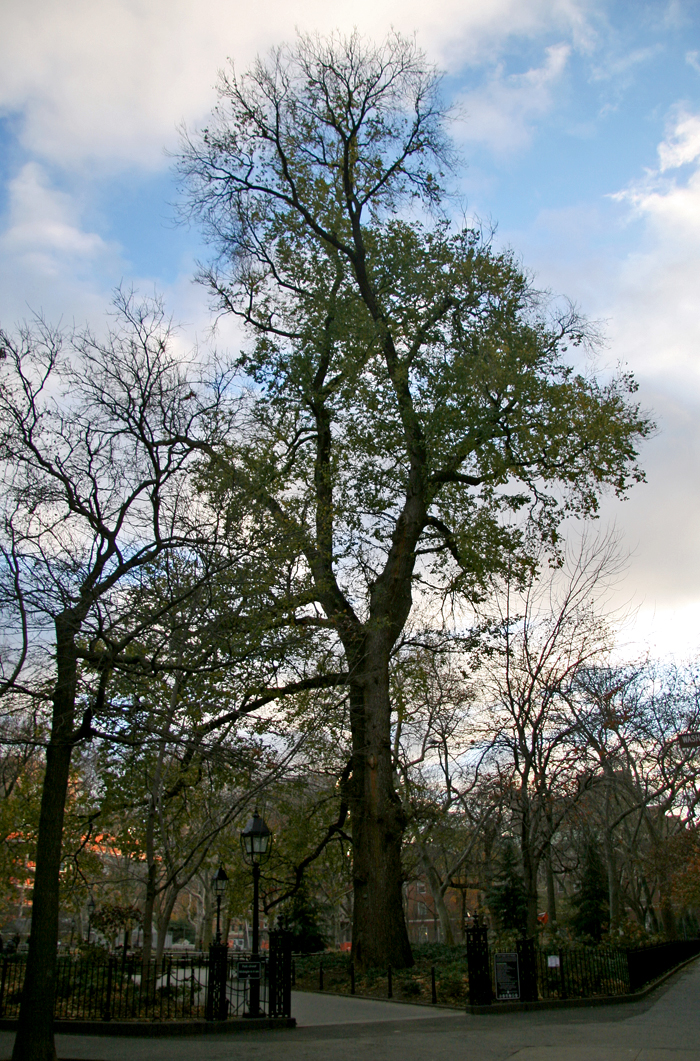
    The best case in point regarding the interest in hanging in New York City is the Hangman’s Elm located in the northwest corner of Washington Square Park which stands 110 feet tall. In 1989, the New York City Department of Parks and Recreation determined that this massive English Elm dates back to 1679, making it over 330 years old and the oldest known tree in Manhattan.

    It is still unclear how many, if any, individuals were hung from this elm in public executions, which did occur in a nearby gallows – the only recorded execution was of Rose Butler, in 1820, for arson. An article in the New York Times sees some hangings there as likely, but other sources cite it all as urban mythology. But the fascination with hanging still exists, and the belief that this elm was used for hanging persists. It all makes for a great sound bite or tour factoid, giving the neighborhood just that much more historical color.

    I have the privilege of seeing this tree from my home daily and much like the cat who brings home the dead mouse as a macabre gift for its owner, I offer my fellow readers this story and photo of the Hangman’s Elm. Whether it’s a tree, a noose, or the Long Drop table, the fascination with this style of execution just keeps hanging around…


  • Not Moving to Florida

    I recall an uncle extolling the virtues of living on Eagle Lake in Maine in the winter, telling me how wonderful it was, about ice fishing, and how you had the entire lake to yourself. Not to offend and retort aloud, I thought to myself – of course you have it to yourself, who would want Eagle Lake in the winter?

    Although not as extreme, the seasons of New York City are never pleasing to me (see Weather Means Whether). I look forward to the spring, the harbinger of all good things to come, but it is always a disappointment. It is often too wet, colder, and windier than I would like. Flying kites or trying to sit on a park bench seems to be an exercise in hand rubbing.

    But not to worry, summer is on the way, certainly the season we wait for and celebrate. Until we have a few unseasonably warm days in late spring and I realize that summer in the city will be oppressive and crowded with tourists and that there is no respite from the heat without leaving – autumn and winter look very appealing now. After all, the solution to cold is quite simple, is it not? Just add more clothing. Summer arrives, and all my worst fears and memories are realized. The teaming masses mixed with high humidity and relentless sun make New York City in the summer virtually unbearable. But summer is actually quite short, and autumn is just over the horizon.

    Autumn, however, is just a tease for what a perfect world might feel like (see Quito here) and a clear reminder that what nature giveth, it also taketh away. Days are often too cool to spend extended periods outdoors, and we now have more of the hand rubbing of spring. Leaves are falling, things are dying, and I am already fearful of the death grip of winter, which is fast arriving.

    Winter arrives, and although we are blessed with little snow in the city, it is more uncomfortable than I remembered. The respite from the heat I wished for in July and August looks foolish now – what was I thinking? The holidays do provide a much needed distraction before the bleak stretch of winter starting in January. Soon I am looking to spring again, only to reflect and reprimand myself for not enjoying what I had last year.

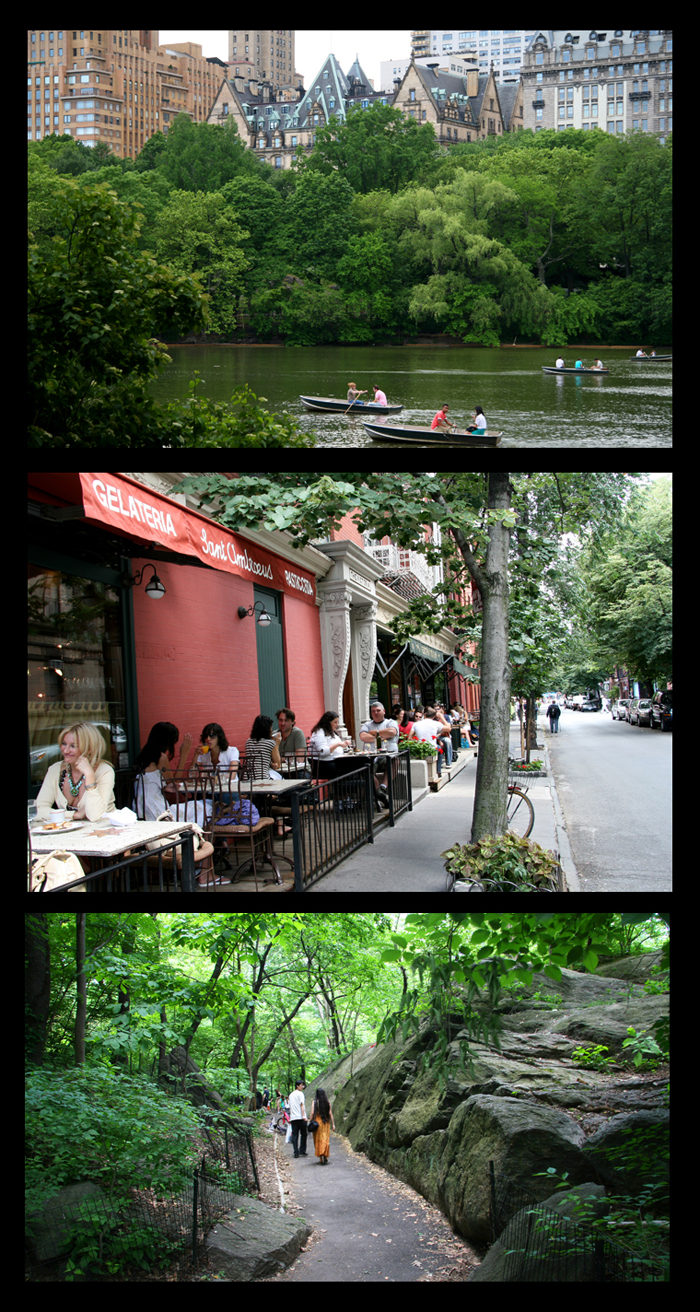
    As winter closes in and I realize that every season in New York City has its shortcomings, the thought of other, perhaps better, places, rather than other seasons, rears its head. But I am a little wiser now. I have been down that road too. No, best I enjoy images of a foliated New York in summer, because, at least for now*, I’m not moving to Florida 🙂

    *Interestingly, my aforementioned uncle, steadfast in his commitment to Maine and its hard winters, eventually became a snowbird and moved to Florida late in life where he lived out his life.

    Photo Notes: Top – The Dakota as seen from the Lake in Central Park. Center – West 4th Street. Bottom – the Ramble in Central Park.


  • White Birch Canoe

    I am disheartened to read “How the city hurts your brain” from the Boston Globe, January 2, 2009 (see it here). Many nature lovers both in and out of the city have, of course, long maintained that the city was injurious to mental health while nature was restorative. And city lovers have extolled the benefits of a stimulatory environment rich in culture and the deadening of suburban and rural life.

    However, there are now scientific studies which demonstrate that just being in an urban environment impairs our mental functions. The Boston Globe article cites these studies, including that of Marc Berman, a psychologist at the University of Michigan. “Just being in an urban environment, they have found, impairs our basic mental processes.” “This new research suggests that cities actually dull our thinking, sometimes dramatically so.” This is of increasing concern, since the number of people in cities now exceeds that in the country.

    And, although stimulation can be a good thing, there can always be too much of a good thing, and apparently New York City provides just that:

    “The mind is a limited machine,”says Marc Berman, a psychologist at the University of Michigan and lead author of a new study that measured the cognitive deficits caused by a short urban walk. “And we’re beginning to understand the different ways that a city can exceed those limitations.”
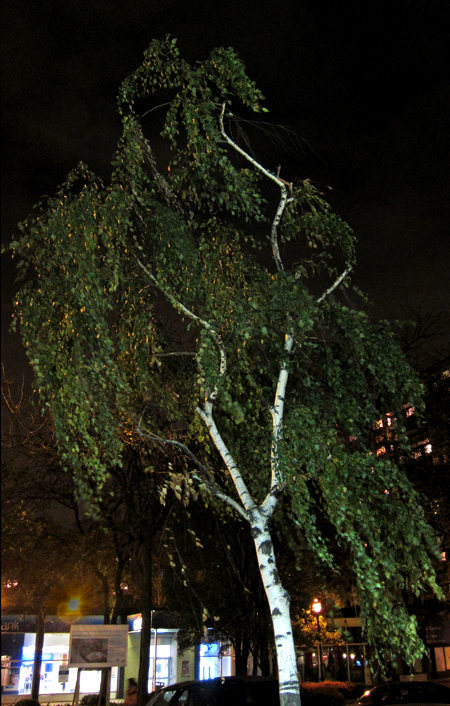
    Perhaps this was the reason that a friend and regular reader of this blog (Mary P) chose to feast her newly functioning eye1 on this lone white birch tree2 last night at dinner. As she described her fascination with the gentle motions of the branches in the wind, my mind traveled. The window was not just a clichéd metaphor, but it also provided a literal view of a tree which was for me, in turn, a vehicle to other times and places – my upbringing and frequent travel in New England and the birch forests there.

    I reflected on my love of white birch trees, their distinctive bark and the wood, influenced no doubt by my father’s occupation as a wood cutter in Maine with his love of fly fishing and birch bark canoes. We had discussed many times the beauty of the white bark. Its gracefulness with delicate branches and slender trunk were never spoken of, but I could see that now, contrasted with the concrete urbanity around it.

    I pledge to get out of the city more often – the Boston Globe article jogged what my subconscious mind must already know and desire. But until then, I’m going to take a ride in a birch bark canoe 🙂

    1) Mary P has has recently undergone laser eye surgery (one eye at a time) for her deteriorating eyesight. She is finding the new and vastly improved vision in one eye a new lease on life. Enjoy, Mary.

    2) The white birch is relatively rare in New York City. The 10 most common trees are: 1. London plane tree (15.3%) 2. Norway maple (14.1%), 3. Callery pear (10.9%), 4. Honey locust (8.9%), 5. Pin oak (7.5%), 6. Little leaf linden (4.7%), 7. Green ash (3.5%), 8. Red maple (3.5%), 9. Silver maple (3.2%), 10. Ginkgo (2.8%)


  • Blessing of the Animals

    Where would you expect to see llamas, cows, pigs, turtles, snakes, iguanas, horses, rabbits, goats, geese, donkeys, raptors, sheep, ferrets, dogs, and cats walking or being carried down the center aisle of a Gothic cathedral? At St. John the Divine’s annual Blessing of the Animals. Unfortunately, I missed this grand daddy celebration – I only became aware of it after its occurrence, when told by a friend who correctly assumed that this would be something I would not miss and would share with readers here.

    When New Yorkers decide to embrace something, they pull out all the stops, for an over-the-top, quintessential, nonpareil event. The huge population of the city in tandem with a no-holds barred spirit virtually guarantees this. The old adage applies to New Yorkers quite well – If you’re going to do something, you might as well do it right.

    Blessing of the Animals honors St. Francis of Assisi, patron saint of animals. This is celebrated by many Catholic and Episcopalian churches on the Sunday on or about his feast day, October 4th. Legend has it that St. Francis spoke to birds, tamed a wolf that was terrorizing a small village, and on his deathbed, thanked his donkey for carrying and helping him throughout his life, and his donkey wept.

    St. John the Divine has been celebrating Blessing of the Animals since 1985. The highlight is the procession of the animals, with as many as 4,000 creatures making the journey down the aisle with their owners for a ritual blessing. Every imaginable species is represented. One year, an 8,000 pound elephant from Ringling Brothers Circus made the walk.

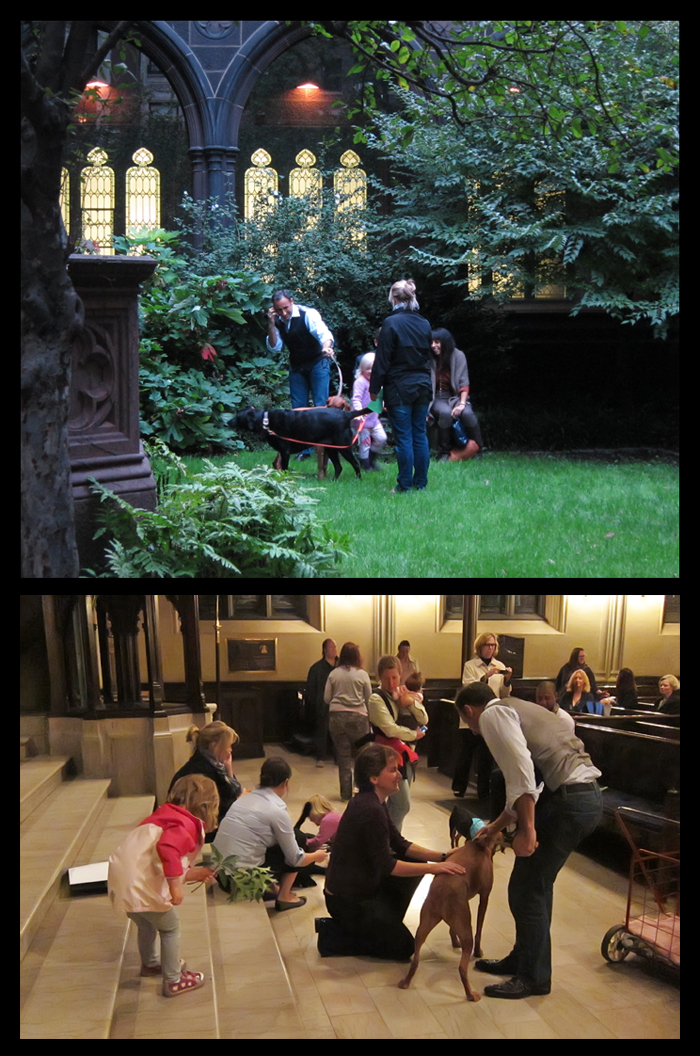
    I did discover, however, that a local church, the First Presbyterian at 12th Street and Fifth Avenue, was conducting a ceremony on Wednesday the 6th, affording me the opportunity to attend a ceremony for the first time. It was quite a surprise to see our furry friends sharing the pews. The number attending was much smaller, of course, than St. John’s extravaganza, but for those attending with their beloved pets, blessings do not come in sizes 🙂


  • When Jungles Collide

    I have often likened New York City to a jungle and am certainly not the first to do so. But this overused metaphor typically refers to the concrete jungle of man’s creations. However, at certain times in certain places, there are small pieces of the natural world to be discovered for urban explorers.

    In many of the New York City parks and gardens, surprises abound in the world of flora and fauna. In 2009, there was even a New York City Cricket Crawl, described as an aural expedition and a celebration of life in the leafy jungles of urban and suburban NYC and surrounding area.

    I’ve been listening to the sounds of summer for years, never knowing my cicadas from my katydids. But at least I know crickets. Some New Yorkers appear to be so out of touch with the natural world that they cannot even hear the natural sounds around them or perhaps have tuned them out. One evening, I pointed out the incredible din of crickets in Washington Square Park to a friend. Surprisingly, they could actually not hear what I was talking about. Perhaps inured to the sound or perhaps unable to isolate from the city’s ambient hum.

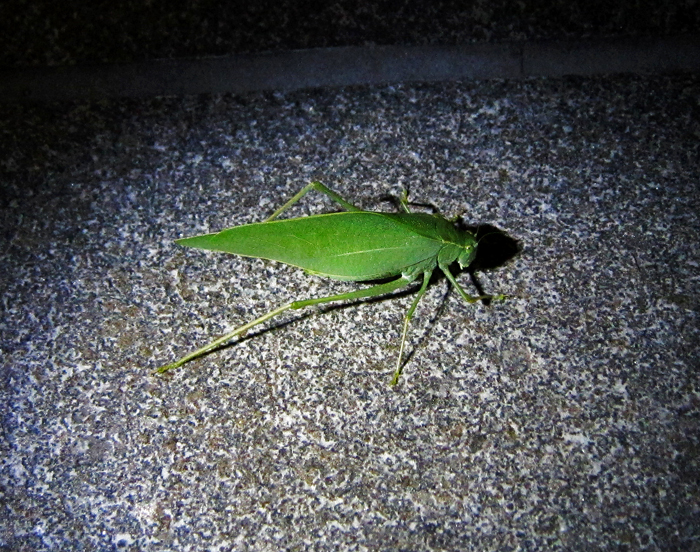
    Last night, as a number of us watched the amazing magic of Constantin, a katydid came jettisoning through the Washington Square arch. I followed it, not expecting to see it at rest, but it did light nearby on the cobblestone. I signaled to others to come observe this rare event. The katydid appeared to be stunned, perhaps lost from the foliated areas of the park. One of our group was able to produce a flashlight and illuminate our subject. I captured this photo, and we then moved the katydid to a garden area of the park and he (or she) flew off.

    For a few moments with a katydid on granite, we saw, well-illuminated by spotlight, the ultimate juxtaposition when jungles collide 🙂


  • Enjoy These Photos

    A visitor or even long-time resident may be puzzled by the reason for nursery or garden centers in Manhattan or for gardening supplies in hardware stores. One of the secrets of New York City, particularly Manhattan, is that there is a lot more green than one might imagine. This world will rarely be seen unless one has access to a view.

    The impression one might get while walking the streets is that the city is a fusing of buildings. The Concrete Jungle is an apt description for much of Midtown Manhattan and the Financial District, where steel, glass, and concrete is the norm. Any green space is limited and in plain view such as pocket parks, atria, etc.
    However, in residential neighborhoods, particularly those dominated with rowhouses such as the Village and Chelsea, gardens spaces are located behind every house. These backyard gardens abut each other, often resulting in unbroken green space for an entire city block from avenue to avenue. The best way to see this is using the satellite view of an online search engine’s mapping feature. Locate a neighborhood such as Greenwich Village (try zipcode 10011, e.g.), zoom in, and pan around. You will see a surprising amount of green space. Note the interior garden spaces behind the buildings.

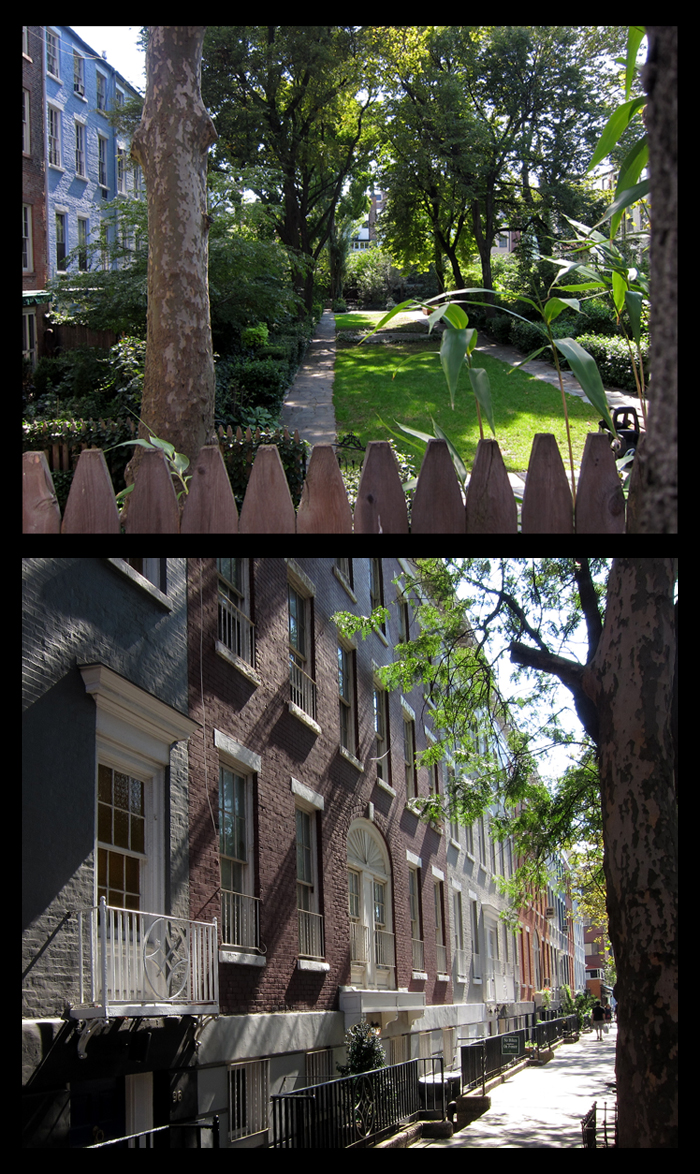
    The lush green oasis in today’s photo is a rare view of the communal greenspace behind the Macdougal-Sullivan Garden District. From the website of the Greenwich Village Society for Historic Preservation:

    This small enclave planned around a private central garden became a prototype for related developments of the 1920s. In 1920 the Hearth and Home Corporation purchased 22 deteriorated Greek Revival Row Houses, built between 1844 and 1850. It commissioned a rehabilitation from the architects Francis Y. Joannes and Maxwell Hyde who removed the stoops and gave the two street facades a Colonial Revival appearance, as well as communal backyards.

    The development served as a model for several other redevelopment projects in the South Village in the 1920’s and 30’s, where older buildings (often tenements) were joined together to create communal spaces and more “modern” appearances for their buildings. This was in many ways reflective of the changes in the neighborhood in the inter-war years: foreign immigration had subsided, but the area was increasingly of interest to Americans of a creative or bohemian bent.

    Older housing, such as rowhouses and tenements were considered by some obsolete. However, this communal style of redevelopment reflected a valuing of the neighborhood’s quaint features, even as landlords and new residents sought modern amenities and collectively enjoyed light, air, and open space.

    These gardens are not open to the public, so unless you have the rare privilege to know a resident, you will have to enjoy these photos 🙂


  • U Thant Island

    I love islands. No matter how small or how close to another land mass, an island always has a feeling of being its own intimate world. When inhabited, there is typically a focused energy, the opposite of suburban sprawl. There is a precious quality to a place where resources and space are very limited and boundaries are well-defined. If desirable, this precious quality can reach a fever pitch, where every inch is taken. Like Manhattan.

    On the flip side, the uninhabited island is virtually synonymous with remoteness and isolation. And in New York City, you can find both extremes just a stones throw apart.

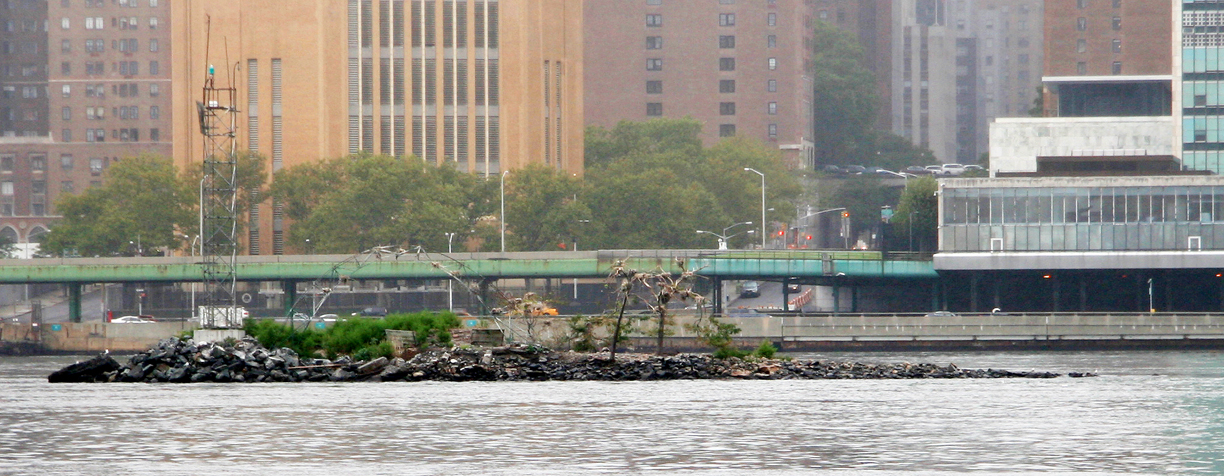
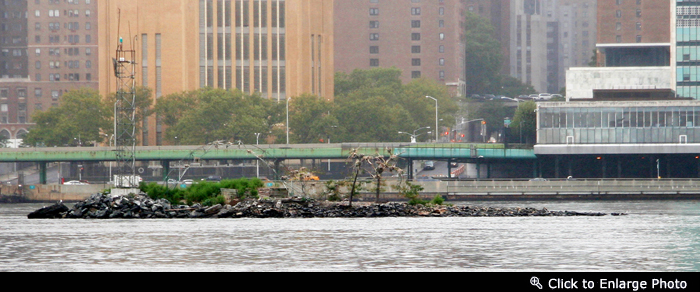
    U Thant Island is New York City’s smallest island (100 x 200 feet) and sits only about 1000 feet from Manhattan in the East River, opposite the United Nations and just south of Roosevelt Island. It is diminutive in size but not small in history or fascinating lore.
    Belmont Island, as it was known at one time, was built on the granite outcrop Man of War Reef in the East River from landfill during the construction of the Steinway Tunnels. The landfill was removed from a shaft dug down the reef to the tunnels.

    On February 25, 1885, a group of prominent Long Island businessmen incorporated the East River Tunnel Railroad Co. to construct a tunnel railroad from Ravenswood, north of Long Island City, Queens, to Manhattan as a direct connection between the Long Island Rail Road and the New York Central & Hudson River Railroad. At one point, new money was needed to invest in the project, and one of the men who became interested was Mr. William Steinway, founder of the Steinway & Sons Piano Co. He owned a sizable part of Long Island City real estate & owned the Steinway and Hunter’s Point Railroad, which was a local horse car line. By obtaining control of the tunnel company, it would increase the value of his properties. He died in 1896 before the project was completed.

    In 1902, August Belmont, Jr. began to take an interest in the project. Belmont was German-born, a banker who had inherited his fathers vast fortune in 1890, and also a friend of Steinway. The trolley tunnels were finished in 1907 and sold to the city in 1913. The tunnels are still in use today for the number 7 subway Flushing line.

    Forgotten for over 70 years, in 1976, a group of employees of the United Nations who were followers of Buddhist guru Sri Chinmoy began to lease the land from New York State for $20 a year. They renamed it U Thant Island, after U Thant, a Burmese diplomat, 3rd UN Secretary General from 1961 to 1971 and friend of Sri Chinmoy. Flowers, bushes, and trees were planted and a 30-foot-high steel peace arch constructed. Reportedly, there is also a time capsule including pictures and speeches of U Thant.
    In 1999, though, the group erected a sign for U Thant, which reads: “Compassion: Home. Dedicated to world peace. Simplicity was U Thant’s life. Sincerity was U Thant’s mind. Purity was U Thant’s heart. His was the approach of serene and illumined dignity.”
    The island was used occasionally used for meetings and meditation.

    In 2004, NYC artist Duke Riley, under the influence of rum, rowed a boat in darkness with a friend, landed on U Thant Island, proclaimed it a sovereign nation, and hoisted a 21-foot-long pennant flag up the island’s navigation tower. On their return to land, they were apprehended by the coast guard but were not arrested. The adventure was videotaped and entitled “Belmont Island (SMEACC)” – it can be seen here.

    Currently, the island is not accessible to the public and is a sanctuary for migrating birds, including a colony of Double-crested Cormorant. I’d like to tell them how lucky they are to have access to U Thant Island 🙂

    Photo Note: I have been obsessed with this small island for ages, and it has been in my cross hairs for this website since its inception. Only recently, however, on the pier at Gantry Plaza State Park in Queens, was I able to get a reasonably good vantage point from which to take a photo (upper photo mine, lower photo public archives). I hope to get closer to it one day by boat.


  • Sittin’ on Top of the World

    Manhattan has a coordinated traffic signal system. Avenues run north/south and are generally one way, like the majority of crosstown streets. These avenues have traffic lights that are timed progressively so that traffic can move without stopping. In theory. The lights move in a wave – a green wave of about 5 lights traveling below speed limit, sandwiched between red lights behind and in front of this green wave. Driving these avenues is urban surfing – wait for a wave, catch the wave, ride the wave as long as possible, and don’t get caught in the soup. I have often ridden a wave like this for miles down an avenue.

    On other major avenues that are two way, such as Park Avenue, Central Park West, and 11th and 12th Avenues, lights are timed to change simultaneously. This means that the faster you go, the more lights you can make before stopping.

    I drove a taxi in college, as did nearly all of my best friends. On one occasion, the wildest driver of the bunch asked me how many blocks I could make on Park Avenue. I believe he said he could make somewhere in the vicinity of 27 blocks. Without going through the mathematics, I can assure you – that is some fast driving on city streets, somewhere in the neighborhood of at least 60 miles per hour. Unfortunately, a few of us took this as a challenge, later comparing results. Fortunately, there were no fatalities in this short-lived reckless contest.
    The speed limit in Manhattan is 30 mph. Traveling at 60 plus miles per hour on crowded city streets is lunacy. The reason for high auto insurance for those under 25 is abundantly clear.

    Today’s photo was taken looking north from the last Park Avenue mall. The small park extends from 96th to 97th streets, where the Metro North train tracks emerge from underground to travel on an elevated trestle along Park Avenue. Looking at this now, I realize that I could have challenged my college friend to see if, in French Connection style*, he could outrun a commuter train.

    I, however, will keep away from all temptation that Park Avenue may offer, opting instead for First or Second Avenue with the gentle waves of the progressive lights, where, with good conditions, I can catch a wave and ride it all the way. That thrill makes me feel like the ultimate Beach Boy, because in New York City, if you can catch a wave and ride it all the way, you feel like you’re really sittin’ on top of the world* 🙂

    *The French Connection (1971) has what many consider of the greatest car chase scenes ever filmed. The chase was between a hitman on an out-of-control train on an elevated section of a subway line in Bensonhurst, Brooklyn, and a police officer in a car on the streets below the train. Most of the chase sequence was real and filmed without permission from the city of New York. It includes an accidental car crash, which was left in the film.

    *From the Beach Boys song Catch a Wave, with the refrain: “Catch a wave and you’re sittin’ on top of the world.”


  • dinamic_sidebar 4 none

©2026 New York Daily Photo Entries (RSS) and Comments (RSS)  Raindrops Theme