• Category Archives Natural NYC
  • Little in the Middle

    More and more, there seems to be less and less of the middle. Certainly a city like New York is a place where people come for the edges and largely leave the middle behind. But now it feels like feast or famine. There are complaints of the loss of the middle class – people seem to be living either in multimillion dollar apartments or on the streets homeless.

    Heat is particularly frustrating – your home or office is either freezing or stifling. It is remarkable at how poor the services can be in a place like New York City, even when you are spending good money.

    In the 1980s, I was renting commercial space in lower Manhattan in a small five-story commercial building. Inadequate heat was a constant battle with management. I recall one occasion where we were absolutely frigid and the superintendent and his helper came by to investigate.

    They arrived wearing insulated winter jackets and, after a few moments, proclaimed that it felt comfortable to them. Of course it is comfortable – you have been active and have winter coats on. Why don’t you try taking them off, sit down, and type for a few hours?

    I am stunned that people would voluntarily sit and dine on the streets in the winter. It is amazing the number of people that to me appear grossly under dressed (or overdressed) for the weather.

    The photo on the left was taken after 9 PM, with a temperature in the 50s. People are in T-shirts. This is not strictly a function of alcohol and the St. Patrick’s Day celebration – I have seen people in shorts, tees, and flip-flops for a couple of weeks now. People in the parks in beach chairs sunning themselves. A quick run across the street to the bank is one thing, but sunbathing in the park or eating al fresco in March?

    The photo on the right was taken today, the following morning at 8:45 AM. The temperature is about 50 degrees, and this man is eating his yogurt and reading on a park bench. At least he has a jacket on.

    Nothing drives people to extreme behavior like the first warm spell in spring. After a winter’s diet of cabin fever, people are just dying to get outside. It would be perhaps more prudent to wait for warmer weather for dining at night al fresco or at least wear warmer clothes, but not in a city where there is little in the middle…

    Related Posts: Spring Fever, Spring MadnessWeather Means Whether


  • Someone is There

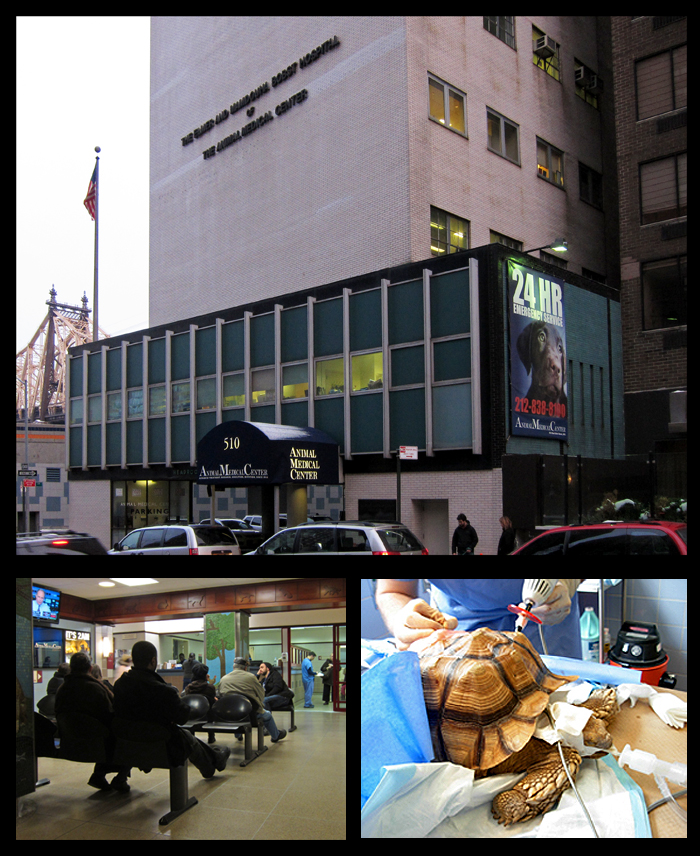
    If today’s photos look rather unassuming, welcome to another episode of Content is King. This is one of New York City’s best examples of all work and no fanfare.

    This nondescript, 9-story building at 510 East 62nd Street, sandwiched between the back of the Bentley Hotel and the FDR Drive, is home to the Animal Medical Center, a place that for the last hundred years has been “the place to go” for emergency animal care and treatment of exotic pets. It has been best known for those who want to treat their pets and for whom money is no object.

    The Animal Medical Center is not just a veterinary clinic. It is is a full-blown hospital with MRIs, CT scans, radiation therapy, cancer treatment, hemodialysis clinic for pets with kidney disease, and a rehabilitation clinic with an underwater treadmill. There is a full range of specialties – dermatology, diabetes, endocrinology, hematology, neurology, oncology, radiology, etc. There is an Avian and Exotic Pet Service, which treats birds, rabbits, ferrets, guinea pigs, turtles, snakes, lizards, and small rodents.

    One of the huge pluses here is that the hospital is open 24/7, and anyone can walk in for emergency care at any time without an appointment. Until very recently, the center has essentially been the only game in town. But recently, competitors have entered the arena: NYC Veterinary Specialists and Fifth Avenue Veterinary Specialists, both offering a 24-hour emergency room and high-tech equipment. See a New York Times article here on the competition.

    Experiences at Animal Medical Center are extremely varied – pet owner reviews range the gamut. Many feel that the center has rested on its laurels a bit too long. Some are furious, while others sing nothing but the highest praises. With so many vets, interns, and patient load, it can be expected that patient experience will vary. A frequent complaint is the high fees generally incurred there. However, it should be understood that many of the procedures taken are not typically done for pets at all and have the same costs as those done for human patients. Ironically, I also see many negative reviews and similar complaints for the NYC Veterinary Specialists, surprising for the new man on the block.

    Pet owners are a very touchy bunch. Many are intolerant of anything less than the best care and attention. AMC is a large facility and definitely has a bureaucratic feel, with layers between the pet owner and doctors. Long hours in the waiting room, a more impersonal reception, and surprises at the cashier’s window, although not excusable, are also not surprising with such a large operation in a big city and an international reputation. News has it that there will be a campaign to improve patient relations.

    Everything said and done, it is still comforting that places like this exist and that day or night, when there is an emergency, someone is there…

    Photo Note: The photo at the lower right is from the AMC website.


  • Snow Play

    A child provides one of the best excuses to play in snow, and I often wonder whether adults may be more excited by the prospect of building snowmen and sledding than their children. But it is of no matter, because no law is being broken by adults who want to partake in this perennial rite of winter and enjoy all things snowy in New York City.

    As I wrote in White By Design 2, tracts of unadulterated snow are few and short-lived here, so those wanting to reenact their play days of childhood must, unlike our country brethren, act quickly with no deliberation.
    As I passed through Washington Square Park in the early morning after our recent heavy snowstorm, families had already been busy with their handiwork. Snowmen were everywhere to be found.

    Growing up in New England, playing in snow was one of our favorite activities. As a child, I was bundled in a snowsuit and, thoroughly insulated, was sent out into that white winter wonderland for endless hours of frolicking. I would make snow men, snow angels, and igloos, ride a sled, or I would just run, jump, and throw myself with reckless abandon into nature’s plush, deep, white cushion.

    All my antics and creations were applauded by family members who remained indoors, watching behind windows in their cozy habitat, signaling with gestures of encouragement and approval over any small thing or act. As I grew older, I became an audience member for my younger sisters, enjoying their play from the warmth of our kitchen.

    Certainly, snow is inconvenient and troublesome, particularly its removal in a large city such as New York. But I am going to put those practical thoughts aside for now, because as I write this, I am watching a parent pull his child in a sled through my window, from the cozy comfort of my home, as I secretly encourage them in all manner of snow play 🙂


  • White by Design 2

    The beauty of a new fallen snow is very short-lived in the city – this photo was taken as I was writing this, and already, most has melted. Nature doles out its pleasures when it sees fit, and in New York City, nature’s bounty is often tempered. With a warm infrastructure and the masses walking, white snow soon becomes brown mush and/or melts away. There is little land or surfaces where snow can rest untouched.

    On November 17, 2009, I wrote White By Design. That was, however, design by men and women. For the natural version, I invite you to enjoy this view from my window. Contrast it with the same vista taken in the autumn on October 29, 2009, when I wrote Wood, Glass, Brass and Trees. Catch, if you can, nature’s White by Design in New York City, because it is beautiful but fleeting 🙂

    For more White By Design, go here.

    More seasons: Signs of Summer, Enchanted April


  • Shifting Gears

    At one time, I was just fascinated with learning to drive a manual transmission. My first inquiry into the subject was while riding in a car with a 4-speed manual transmission. When I asked the driver what I could learn as a passenger, she said that one of the keys was to work a gear, never lug it. Many neophytes, nervous about when to shift, will often shift too early, lugging and dragging the motor.

    Some people say that they love four seasons and that they would not want to live in a climate which has little variation in temperature. I was never completely convinced, suspecting that these may be individuals who suffer the ability to admit that California is just a nicer place to live. I have known numerous people who have moved west or south and have expressed no desire to move back to the Northeast.

    On the other hand, strongly delineated seasons do require shifting gears, and the change in weather conditions can be enervating – watching snow fall, drinking cider in Union Square in the autumn, awaiting spring’s new blooms, and summer’s outdoor activities. The difficulty, however, is getting through winter. I do not look forward to this season, and like many, my mind turns to tropical dreams when the cold hits. Rather than embrace the season, I resist it.

    My business has brought me in contact with thousands of people from around the world, and I often indulge in conversations with those from remote locales. I once spoke with a woman who lived in the interior of Maine, where winters are harsh and long. This was of particular interest, since my family is from northern Maine and moved long ago to southern New England with no regrets.

    I asked her how she could survive an environment where snow can fall in September and not melt until May, where sub-zero temperatures can run weeks and vehicles need battery heaters to start. She said that the secret was working on indoor projects. A good strategy if this is not just busy work to pass the time and survive mentally.

    Even in New York City, with all its distractions and easy access to places, the winter, with its occasional blizzard, does impose its will. Some will, of course, don the proper apparel and frolic in the snow, but for most, the winter means additional time indoors and a more shut-in lifestyle and degree of reflection and introspection.

    So as we shift gears into winter, perhaps we can heed the advice of a woman from the depths of Maine and a driver teaching how to drive a with a stick shift – always work a gear, never lug it🙂

    Related Posts: First Snow, First Flakes, Winter Walks, Small Gestures


  • Babies

    I once asked a friend living in California, transplanted from upstate New York and who had traveled extensively, whether he found that the perception of weather was a relative thing – i.e. did Californians appreciate their mild weather, or did they adjust and reset their thermostats? He answered that it was absolutely relative. He found that those living in California for some time became babies in regards to weather – a slight chill was as daunting to them as a cold Arctic blast was to us in the Northeast.

    I have long claimed that one of the things I like about living in New York City is that the winter does not affect our lifestyles as greatly as it does our suburban and country brethren. That philosophy was tested this weekend when winter finally hit. Until then, New York City has not yet felt the slap of winter’s hand.

    I confess that I had become quite accustomed to our pleasantly warm and very tolerable autumn. I was a bit of a baby this weekend, not wanting to go outside any more than someone living in Maine.  Perhaps less so, because those environments do not tolerate babies.

    Peering out my window, it is bleak, dreary, windy, and cold. People are wearing down coats, hoods, gloves, and scarves. There is no stroll or whimsy in their gait but rather a sense of purpose and direction. In fact, because New York is such a walking environment, something I have long championed and loved, it makes it all the more difficult to brave and acclimate to the onset of winter. Nearly everyone here does substantial walking, even in the winter season – I walk nearly one mile to work daily, irrespective of the season or weather. Even those taking the subways daily must walk both to and from the stations to their destination. There are no autos to shield the wind, garage door openers, or heated seats.

    Winter has not officially started yet, and I certainly cannot stay indoors until the start of spring. I don’t want to be slapped going outside – I prefer the caress of blankets, the sizzle of steam, and the cozy atmosphere of home. But I have some work to do. I need to go out there and demonstrate how this city is just as robust, dynamic, and fun to explore in the winter as any other time. And it wouldn’t hurt to stop being a baby 🙂


  • Winter Walks

    Here is something I like best about living in New York City: winter does not subsume us. There are a number of reasons for this. The city is a pedestrian place, and our mobility is not so strongly influenced by seasonal weather. Walking goes on, relatively unfettered by rain, cold, or the occasional snow. We stroll to restaurants and window shop in virtually the same manner all year. Subways run primarily underground, so, there again, we do not deal with Mother Nature. Also, the city which we see daily is primarily man-made, so in many areas and neighborhoods, the appearance of the city changes little or not at all.

    I grew up in New England, and the coming of winter really changes the collective mindset. The visuals change dramatically, with denuded trees and withering grass. Out come the rakes and snow shovels. Snow tires are checked, gutters cleaned, storm windows positioned, deck furniture put away, swimming pools drained and covered – an entire litany of annual rituals and chores indelibly imprinted in our minds, emblematic of the season. And these changes are not reversed in a warm spell – pools are neither filled with water for the day nor are picnics planned. Apartment dwellers do not have to deal with any seasonal preparations or chores. For most of us, we just put on a heavier coat.

    The worst part of New England winters was that feeling of being shut in. There are seasonal activities for those who partake – bike riding, hiking, skiing, apple picking, etc, but after childhood’s end, I found it really too cold to want to do much outdoors.

    I found comfort that I am not alone in these thoughts and feelings; I came across an article in the New York Times, Winter Walks on Country Roads, written in 1879 about New England winters. Here is the first paragraph:

    Even the faintest gleam of sunlight, and the shortest period of freedom, are inexpressibly welcome to a prisoner. Now we are all prisoners; we are shut in doors by an inclement season; we live six months in fear and trembling; we dread the Winter air as we ought to dread the wrath to come. To a certain extent this feeling is justified, for our Winter storms are both disagreeable and exhausting. But we are generally our own jailers in this confinement; for the dread of the bad days lingers over the good ones, and keeps us from the freedom and sunshine that we can safely enjoy during nine-tenths of the Winter days. The injury this confinement works on our national health is certainly worth consideration; and every amusement that tends to bring us out-doors in the Winter should be practiced with persistent enthusiasm. Walking is without question the exercise that is the best, the safest and the most practicable, for everybody. Anybody who can walk can dissipate the gloom of Winter, enliven his blood till it tingles, and secure buoyant health and vigor. In a word, the walker can enjoy all the benefits of out-door life on the snow just as well as on the turf or gravel.
    C.H.F. The New York Times, 1897.

    In New York City, if there is a spate of atypically warm weather in the winter, people respond instantly, and for a brief period of time, it’s like winter never existed. Out come the people in the dress and with the accoutrement of spring and summer. Street performers, vendors, sitting on park benches, sunbathing, picnicking, reading, Frisbee – virtually every warm weather activity can be found.

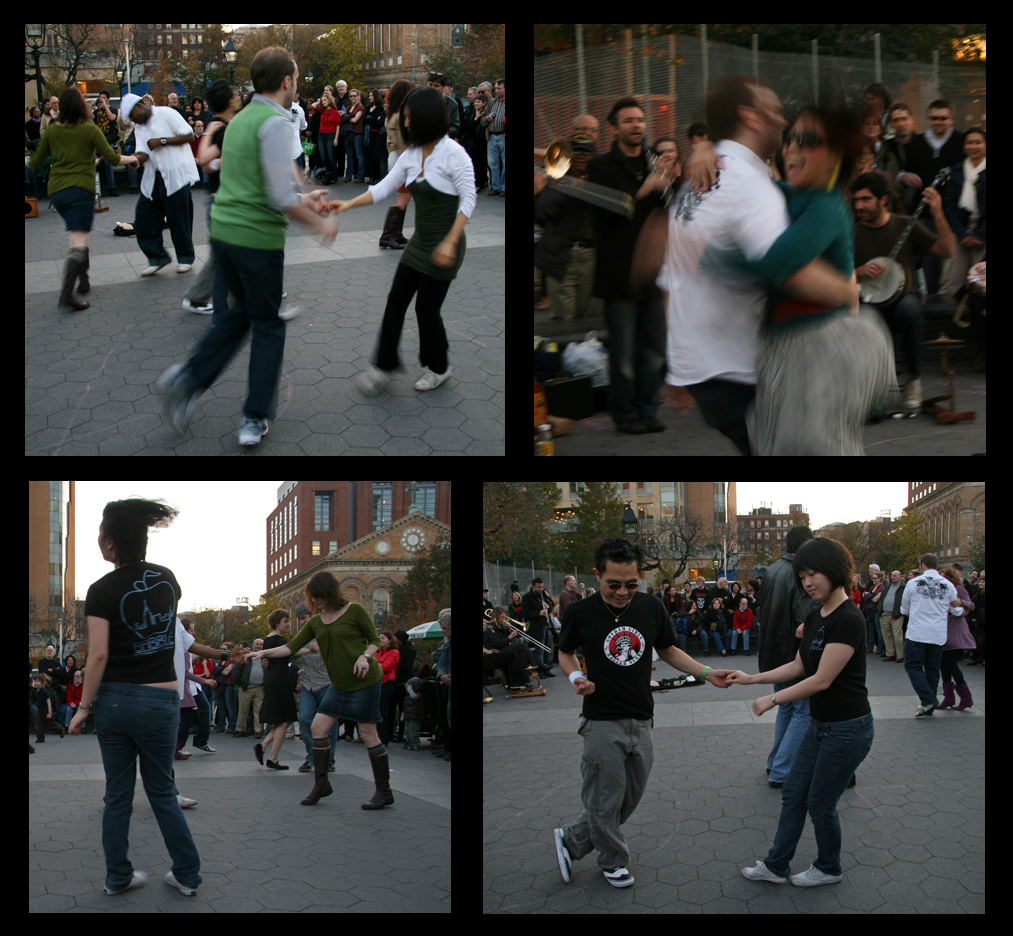
    On our recent run of warm weather last weekend, the Baby Soda Jazz Band appeared, performing their eclectic street jazz with influences ranging from New Orleans brass bands, jug music, southern gospel, and jazz. The music was infectious, and people took to literally dancing in the streets (or in the park).

    Of course, there are wonderful winter activities and holidays, and the prudent person does well to embrace the season rather than resist it. For now, though, I choose to resist as long as possible and join the dancers in the streets 🙂


  • The Dark Time

    I felt a little embarrassed when I opened a Christmas gift from my late sister and found a travel guide to Finland with a note which said, “Go for it.”
    This gift and note were fueled by my obsession at that time with something I had read – an article about an article. The article, in Whole Earth Review, referenced a New Yorker article regarding the “dark time” in northern Finland – that period of time in the winter where the sun does not rise for two months.

    The New Yorker article (which I never got to read) discussed the culture and how they dealt with this extraordinary situation – lanterns, various activities, etc.
    But as fascinating as all this was, I knew that I would not really travel to Finland in the winter to experience polar nights firsthand. I smiled after I opened that gift, but I felt guilty knowing that I would likely never use it. I still keep the book in my library.

    I am fascinated by extreme environments and how they affect culture, mindsets, etc. In many ways, New York City is an extreme environment, particularly given that four out of five boroughs are on islands.
    Of course, if you are going to indulge yourself in fantasies of heading to the extreme North in winter, a study of maps will be required, something which I am always happy to get lost in. I chose Finland because over 25% of its landmass is north of the Arctic Circle. I looked to the province of Lapland, where the northernmost village is Nuorgam, in the Utsjoki municipality. This is also the northernmost point in the EU. (I recently learned, however, that Knivskjellodden, Norway is further north – the northernmost point on the European continent.) This seemed to be the perfect travel destination for my dream of experiencing the dark time.

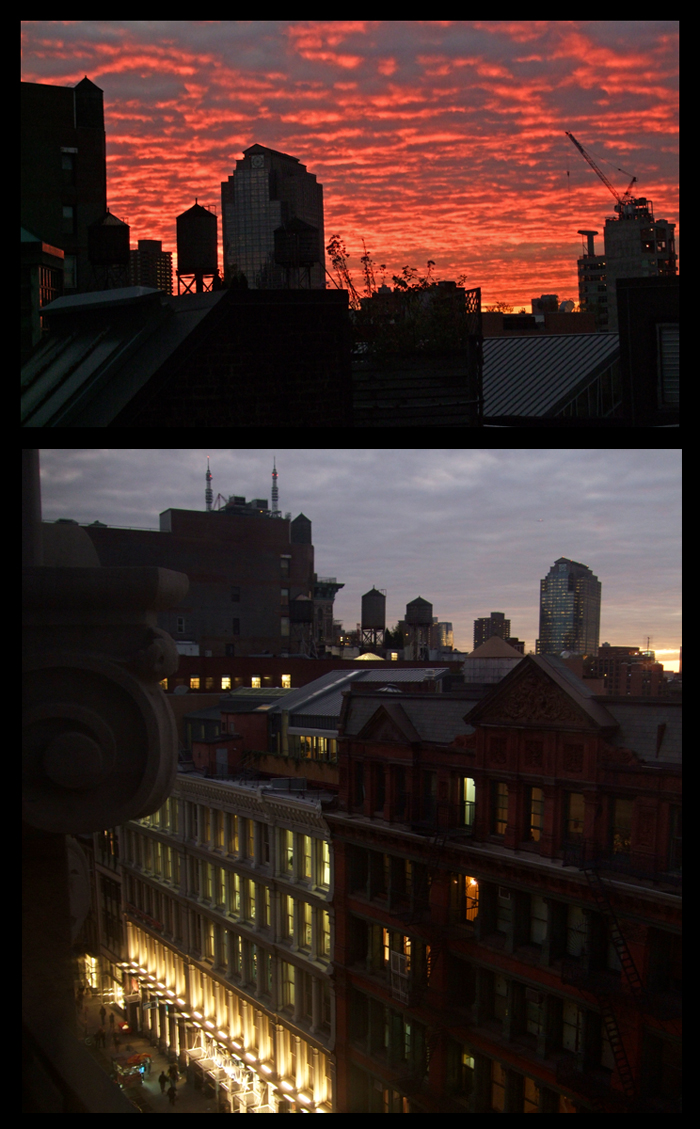
    Sunday, as every American knows, was the resetting of clocks to standard time, which means the sun sets an hour earlier than during Daylight Savings Time – currently at 4:50 PM. Not only does this mean that I rise before sunrise, but most of us also leave our workplaces after sunset. Most everyone I have spoken to is not enamored with the shorter days and early sunsets. Every year at this time, I think of the Arctic Circle and days with no sunshine, only twilight.

    Some may find occupying one’s mind with notions of polar nights, the Arctic Circle, and winter in Finland to be rather morose, adding insult to the injury of early sunsets and shortening days. But for me, when I contrast my life here with these remote, northern locales, I am happy that I do not really ever have to live in the Dark Time…

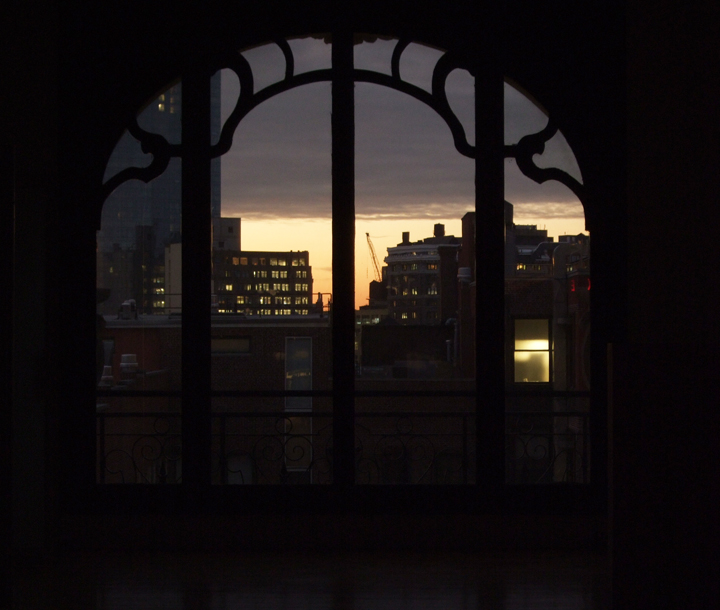
    Photo Note: I was granted access to a vacant floor in SoHo on Broadway with vistas west to the Hudson River. I took a series of photos during and after sunset. The photos were taken between 4:50 PM and 5:09PM. See additional photo here.


  • Wood, Glass, Brass and Trees

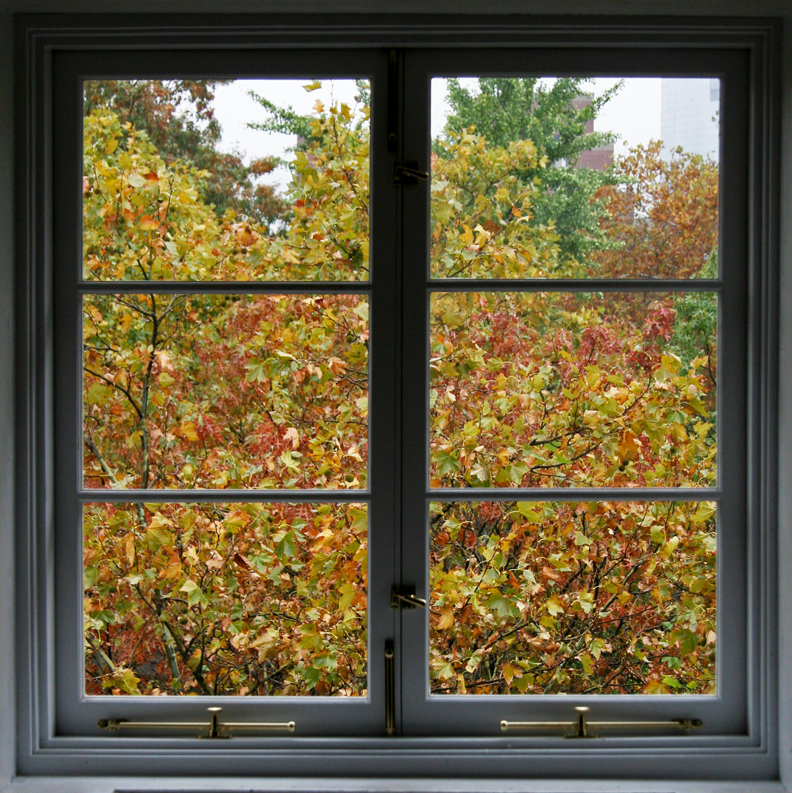
    I could have bought, I should have bought, I would have bought, but instead, I have rented my current apartment for 27 years. Many ask why I have not bought a residence, the quintessential American investment. I hope the photo helps answer that question. This is the view from my apartment overlooking a park. Only a handful of people in a city of millions are blessed with a vista like this every day.

    I overlook Washington Square Park in Greenwich Village, something which no money can buy because nothing is for sale on this square. Most property around the park is owned by New York University – the handful of residential apartments here are all rentals. I am not the only long-term renter on my street; tenants in my building have been here for 30+ years, as have other renters in the few neighboring townhouses which are not university owned.

    There is a very unique situation here in New York City that skews and exacerbates everything: rent regulation. Rent stabilization and rent control laws regulate rent increases, resulting in a market where unregulated apartments have dramatically outpaced rent-regulated ones.

    So, many city residents who have lived here for long periods of time have artificially low rents, often fractions of the market rate. Many assume that rental apartments in prime locations and buildings are extremely expensive and occupied by the wealthy and privileged. This can be true, but often, the ability to occupy such places is more a function of how long a long tenancy than of extreme wealth.

    This is not all that it seems, however, since there is a strong incentive for landlords to do as little work as possible in buildings and apartments where rent stabilization exists. Apartments are typically neglected and in disrepair.

    In my case, I have desperately needed new windows since I moved in, but frequent pleas to the landlord fell on deaf ears. Until this summer, when, for reasons unexplained, a man came to measure and, a short time later, scheduled the installation. Voilà – I had new French windows with solid brass hardware. At last it’s quieter and draft-free. All I see now is wood, glass, brass, and trees…


  • Handle With Care

    Don’t give something important to citizens if you ever plan to take it away – people do not respond well to “temporary.” A good example is the rent stabilization and rent control laws of New York City – highly contentious legislation between landlords and tenants, slowly and painfully being phased out. Regardless of very specific historical reasons for such laws and irrespective of whether they are any longer fair or reasonable, the past is now irrelevant to those who are reaping the benefits.

    In 1999, to quell public uproar and facing three lawsuits, Mayor Rudolph Giuliani negotiated to sell 63 gardens to the Trust for Public Land, a national private conservation group. Decades ago, when the city was plagued with urban decay and was in severe financial condition, the city permitted community groups to transform vacant lots into gardens as part of an open-ended agreement. The Giuliani administration ended that agreement by attempting to auction the plots of land to developers, but he ultimately sold the plots to the Trust for Public Land for $3 million.

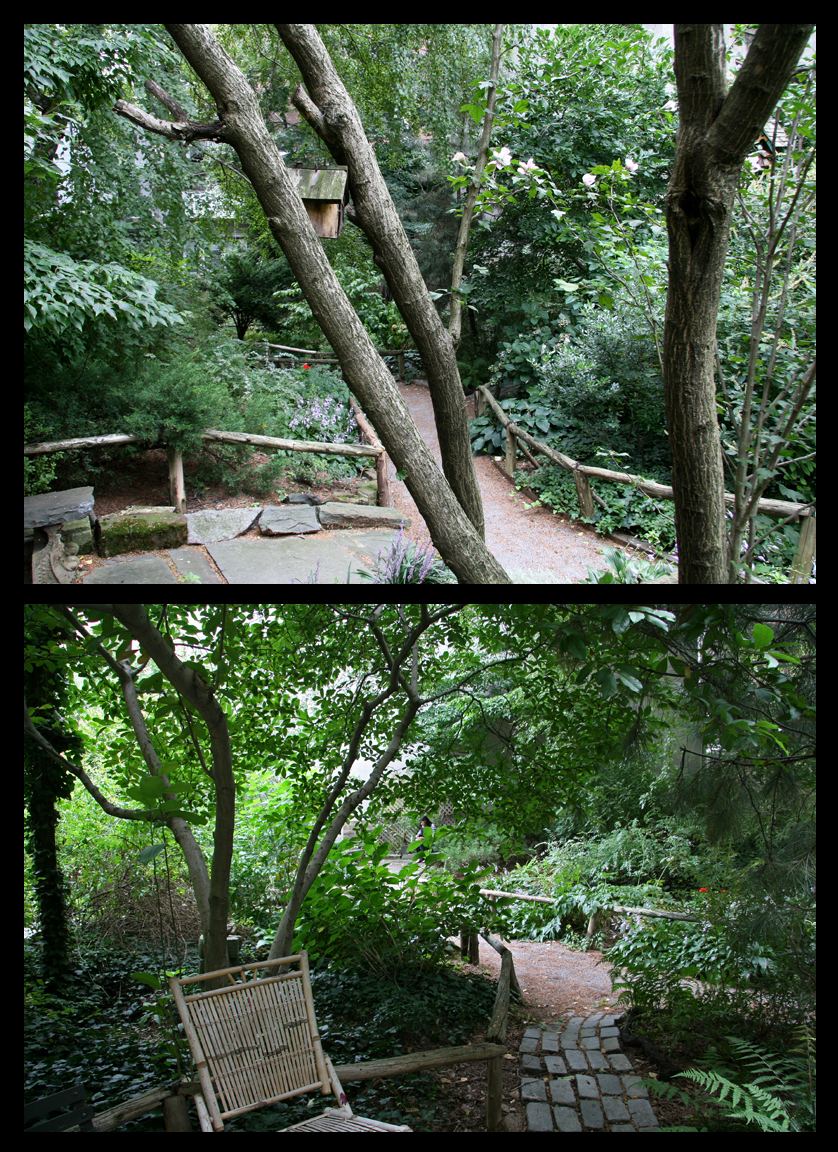
    The garden in today’s photo is the Parque de Tranquilidad, located at 314-318 East 4th Street between Avenues C & D in the East Village on the site of a former synagogue. The garden is located directly across the street from the much larger El Jardin del Paraiso.

    This verdant oasis is carefully and beautifully manicured – it is one of the most meticulously maintained public gardens I have seen. It is a densely planted haven with winding stone pathways, wood fencing, flower gardens, and birdhouses.

    This minipark is arguably the best example of the design work of the late urban garden pioneer Liz Christy, of the Council on the Environment of New York City. Christy is widely known for starting the first New York City community garden in 1973 at Bowery and Houston streets, now named in her honor. TPL expects to convey the entire garden to the Manhattan Land Trust in 2009.

    Not everything can or should be reduced to a business proposition. In a city with so much concrete, park land really provides important respite from the urban environment. To some, seeing prime real estate like this being used as a small park or community garden may appear to be a colossal waste of resources or a lost investment opportunity. But consider that any new housing built here would accommodate very few tenants at market prices. In aggregate, even if all of these gardens were converted to residential properties, they would only house a tiny number of people and make relatively no impact on the housing crisis, which involves those seeking lower cost housing and not the affluent.

    Although a human being has basic needs for survival, the human spirit needs care too…

    Related Posts: Guerillas in our Midst, Shangri-La, Devil’s Playground, La Plaza Cultural Garden, Grapes, Stay Lean Stay Hungry, Urban Oasis, Alberts Garden, West Side Community Garden, Bird Country, Hua Mei Bird Garden


  • Take Two

    I was recently looking for a Vietnamese herbal formula for a friend. Extensive searching online found neither the product itself nor anything like it in the USA, even though the manufacturer was a well-known company in Asia with a large product line.

    I took a printout of ingredients from the company’s website to Kamwo Pharmacy, where a very helpful staff member, fluent in English, Chinese, and online searching, quickly identified the ingredients and their Chinese names and said that the formula could be easily reverse engineered.

    Kamwo Pharmacy, located at 211 Grand Street on the border of SoHo, Little Italy, and Chinatown, is the largest herbal pharmacy on the East Coast. They stock a huge inventory of herbs and packaged products, but their real forte is the creation of custom formulations from a selection of over 1000 herbal substances from throughout Asia, including exotic ingredients such as dried seahorses, cicadas, deer antler, and geckos.

    The herbs for each formulation are taken from drawers which line the wall, weighed on balance scales hanging overhead, crushed or sliced, and wrapped in crisp white sheets of paper. Hundreds of orders are filled per day from around the country. The shop also has an online store.

    The staff at Kamwo is extremely diverse. Here, you will not only find employees who have received training in traditional Chinese medicine. Others in the organization come from the ranks of business, science, and western medicine, with degrees from many of the country’s finest schools in graphic design, hotel management, pharmacy, nursing, computer engineering, business administration, marketing, and biology.

    The owner, Thomas N. Leung, has a Bachelor of Science in Pharmacy from the State University of New York. Tom is a 4th generation herbalist. His father, Shan Leung, founded Kamwo Pharmacy in 1973. This training in both traditions gives him a special expertise in the trade.

    Few health-conscious individuals remain purists. Over time, diets and treatments for ailments evolve to a utilitarian, balanced approach – eating what is reasonable and using treatments that work. When the time comes to deal with a serious ailment, most, like Thomas Leung, will take a real world approach and turn to the products or modalities best suited for the job, be it Eastern, Western or the two.

    Tom feels that herbs are better at treating the underlying cause of a problem, while western medicine treats the symptoms. “I always tell people, if I have a headache, I’ll take a Tylenol, no questions asked. But if I have a persistent sore throat, I’ll take herbs.”


  • Guerrillas in our Midst


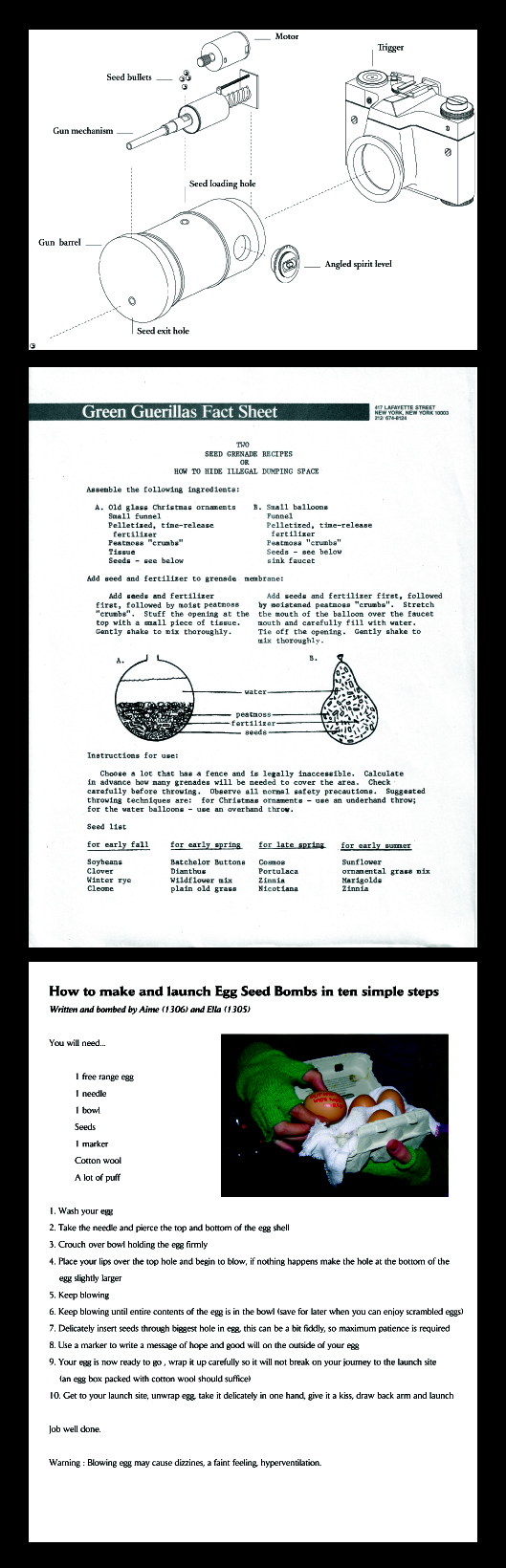
    There is a type of war being fought which has a very pleasant outcome, and unlike the war on drugs, it has been quite successful. I speak of the guerrilla gardening movement. They have weapons too – in addition to books, videos, and websites, guerrilla gardeners have cool gadgets such as seedbombs (which come in a least 6 varieties – classic clay seed ball, NYC grenade, Kabloom Seedbom, explosive eggs, seed balloon, and seed pills which can be shot from a camera), automatic seed shoes, and even a subversive gardener attache case. See drawings here.

    This is now an international effort. In 2004, Richard Reynolds started GuerrillaGardening.org, a blog regarding his solo efforts at gardening outside Perronet House, a residential apartment complex in London. In 2008, his book On Guerrilla Gardening was published, describing activities in 30 countries. Visit his website here.

    And right here in the midst of Manhattan, we have the origins of the modern movement and the term guerrilla gardening. Liz Christy and her Green Guerrilla group, who formed in 1973, are generally credited with the first use of the term. The group transformed a vacant lot into what would end up becoming a community garden. The plot is an entire city block in length on Houston Street, extending from Bowery to 2nd Avenue.

    I have seen this garden for decades, but it is the massive tree and sharing it on this blog that finally drew me in, entering a world much larger than I ever imagined. See more photos here.
    The garden has a small pond which is home to fish and turtles, a wildflower habitat, beautiful wooden furniture, a grape arbor, a grove of weeping birch trees, fruit trees (including an an ornamental orange tree), vegetable gardens, berries, herbs, hundreds of varieties of flowering perennials, and its pièce de résistance that drew me there: the towering dawn redwood.

    This massive tree is one of a handful in New York City. A native to the Sichuan-Hubei region of China, the Dawn Redwood (Metasequoia glyptostroboides) was introduced to the United States in 1948. The one at the Liz Christy Garden is 30 years old, stands at about 110 feet tall (estimated to grow to 150 feet), and can be seen from many blocks away.

    To all those who have worked hard to bring some green to our urban world, I salute those guerrillas in our midst 🙂

    Historical Note: There were earlier “guerrilla gardeners,” most notably, Gerrard Winstanley of the Diggers in Surrey, England (1649), and John “Appleseed” Chapman in Ohio (1774 – 1845).


  • Paraíso


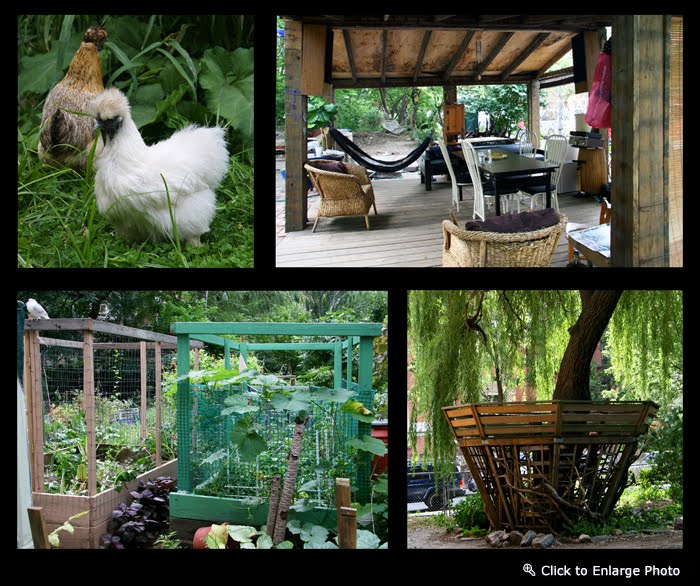
    Where can you find a rooster, chickens, ducks, rabbits, a turtle pond, a dog, herbs, grapes, tomatoes, and other produce being grown locally, with an octagonal tree house built at the base of a willow tree? In Manhattan, at El Jardin del Paraiso on East 5th Street between Avenues C and D.

    Normally, this area, deep in the heart of the very East Village, will be not be visited by visitors or residents of New York City. Even outsiders, slumming in the neighborhood, will not typically venture further east than Avenues B & C.

    The East Village is a mecca for community gardens. Many of these are absolutely extraordinary, idyllic urban oases. Some small, some larger – El Jardin is very large, extending through 5th to 4th streets, with an entrance at both streets. There is an open air cabana with a table, seating, and a hammock. Numerous awards and achievements have been bestowed upon El Jardin del Paraiso, including The National Wildlife Award and the Molly Parnis Dress Up Your Neighborhood Award. Read more at the East Village Parks Conservancy garden’s website here.

    In my tour of the garden, I encountered Cano, a local resident who was taking matters into his own hands. He complained of lack of progress on the part of those who manage the community garden. I have been witness to this type of community infighting and stalled efforts, so my sympathies were with him. He has invested over $10,000 of his own money to date and has recruited a few others to rehab the garden, which is now in a state of disrepair. He did not appear to be a power-hungry local activist spinning information to wrest control of the garden.

    A visit to the Jardin’s website shows a last update in 2006, so I got a sense that whatever visions and projects there were for this plot, momentum and drive do appear to have been lost. There is still a calendar, however, of events/activities in the garden.

    They say paraíso, I say paradise 🙂

    Photo Note: The white bird is a Silkie, a breed of chicken with unique, fluffy feathers. The chicken is known for its docile nature and is often kept as a pet. The flesh is dark blue/black and. although somewhat unappealing to the Western palate, is considered a delicacy in Asia.
    Origin of the Silkie is China/Asia.

    Visit the following related links: Shangri-La, Devil’s Playground, La Plaza Cultural Garden, Grapes, Stay Lean Stay HungryUrban Oasis, Alberts GardenWest Side Community GardenBird Country, Hua Mei Bird Garden


  • Hua Mei Bird Garden

    My excitement in learning about the existence of the Hua Mei Bird Garden in Sara Delano Roosevelt Park was greeted with skepticism, particularly by those I know who are very familiar with Chinatown. Sara Delano Roosevelt Park is a ribbon of green extending from Houston to Canal Street, flanked along its length by Chrystie and Forsyth Streets and straddling both the Lower East Side and Chinatown.

    In these neighborhoods, however, most visitors, both New York City residents and tourists, do their business and leave – that business in Chinatown being primarily eating on or near Mott Street, Chinatown’s central artery, or shopping by day and visiting clubs by night in the Lower East Side’s vibrant community.

    The park here, however, is not a destination. The 7.8 acres is much more of a utilitarian urban space dominated by areas designated to various activities – basketball, roller skating, soccer, etc. The center of the park is cut by Delancey Street. On the south side, you will find the Hua Mei Bird Garden. See more photos here.

    In 1995, three men, a Chinese banker and two former waiters, approached Anna Magenta, who, with Federico Sabini, had started the Forsyth Street Garden Conservancy in 1994 to improve the park. With her help, they petitioned the Parks Department, and in 1995, the Hua Mei Bird Garden was hatched. Bird gardens are common in China, and there are even restaurants that cater to patrons with their birds in tow.

    Every morning, a group of Chinese men gather with their songbirds, finches, sparrows, and blue jays among them. But the raison d’être of this garden is the Hua Mei with its songs. On weekends, the population of men and birds reaches its zenith, with dozens of cages along the walkway and hanging from lines. Most of the birds’ owners are retired Chinese men.

    The Hua Mei is a fighting song thrush – in the company of other males, it fights, and for females, it sings. The distinguishing physical feature is a white line that circles the eye and extends towards the back of the head. The birds are kept in ornate handmade bamboo cages, frequently with a white cloth covering the cage to shield them from the impact of the city. The birds are imported from China and Vietnam – they are quite costly, requiring quarantine before being brought into a domestic environment.

    The gathering is a social one for both the owners and the birds. The Hua Mei needs exercise, and the owners take the opportunity to introduce the birds to each other while bird talk dominates the conversation…


  • Affront To Dignity

    If there was a God of New York City, wasting space would be a mortal sin. In this city, we are obsessed with space. To find a convenient parking spot is considered a major achievement – worthy of announcement, with an expectation of hearty congratulations. Floor space, whether commercial, industrial, retail, or residential, is one of the key features of a place. For the city dweller, a visit to a museum is often as much about indulgence in space as it is about the art collection. In our homes, most of us optimize for efficient use of limited space. This is not a world known for foyers, entrance hallways, garages, basements, attics, and extra guest bedrooms. We even sell air rights in New York City – every cubic inch of 3D space is accounted for (see my story here).

    I recall having a conversation once with a relative who owned an industrial space in the suburbs and needed to expand. The solution was simple: tear down a wall and just build out. That seemed miraculous and inconceivable to me at the time, like a suprahuman act of creation.

    A terrace or garden is the ultimate spacial luxury in this city, as we add nature and the outdoors to sweeten the pot. Many high-rise apartments in New York City have tiny concrete slabs which, for the purposes of the real estate sales and promotion, are called “terraces.” This is laughable – you can see thousands of these affronts to human dignity dot the skyline of New York City. I’ve never seen anyone on them; often, they are used for storage and become aerial eyesores. It would be hard to argue that lack of use of these terraces is a wasted resource.

    However, in today’s photo, I submit to you evidence of a real space wasted. This wood-decked terrace is as large as many apartments, overlooks a quiet alley, and has good light, trees, plantings, and views of the Empire State Building. The terrace is attached to a two-floor apartment in an 1837 landmark brownstone. I know the tenants of this apartment and was told many years ago by the husband of the couple who lived there that he had not set foot in the space for 14 years.
    This outdoor space is still infrequently used. Most New Yorkers just drool at the prospect of an outdoor garden like this and fantasize about all the wonderful uses they would make of it. Some may argue that all outdoor terraces or gardens subject the users to a fishbowl effect -that there is virtually no privacy from the prying eyes of other apartment dwellers within eyeshot. I think in this case, many a New Yorker would welcome this invasion of privacy and find it no affront to dignity  🙂

    Related Posts: Seven Deadly Sins, Air Rights


  • dinamic_sidebar 4 none

©2026 New York Daily Photo Entries (RSS) and Comments (RSS)  Raindrops Theme