• Category Archives Street Performing
  • Float Master, Part 2

    Posted on by Brian Dubé

    Anything Can Happen (See Part 1 here)

    If you want to explore what New York City has to offer, you will have to mingle among the people. Unfortunately, this means all the people, regardless of income, hygiene, scrupulousness, or sanity. Unless you make an extraordinary effort at insulation, you will encounter the broadest range of haves and have-nots imaginable on the streets, in the subways, shops, restaurants, parks, and festivals.

    In just the last five years authoring this website, I have encountered: a woman with a rat resting on her shoulder under her matted dreads, a man who pushes the limits of gender and fashion, a woman who eats bugs for a living at the Coney Island Sideshow, Walid Soroor – an Afghani Rock Star, an Alaskan Tlingit Indian musician on the road for 10 years, women who wear rooster feathers as fashion, Jenn – a very gothic woman whose circle of family and friends are subway conductors, Dr. Robert Gurland – a Professorial superstar, Will Galison – an unassuming guitar player who I later learned is legendary with an entire wikipedia entry of credits, Ferris Butler – a man who redefines quirky and is likely the inspiration for the film Ferris Bueller’s Day Off, a man wearing militaristic regalia with a solitary spike of hair, a tattooed and pierced ex-marine sporting plaid shorts who at one time was pursuing a masters in theology, an Albino Burmese Python slithering on the street, Water Sprites, an Urban Wood Nymph and an older man so grotesquely tattooed and pierced that I could not bring myself to photograph him.

    On one occasion, I stopped to talk to a homeless man who was collecting bottles, acknowledging how his task of collection and redemption appeared to be rather exhausting. Angrily, he replied, “Don’t patronize me.” Gotcha. I was guilty as charged. Here, beware of the homeless, who are often educated, intelligent, astute, sometimes insane, and/or angry and frustrated.

    A peaceful afternoon in the park or strolling the streets, may or may not be peaceful. If you play chess at the various parks, expect every manner of kibitzing and trash talk. Or, as I once witnessed, someone drawing a gun and firing it at someone previously involved in a drug deal to even the score, with only a momentary break in playing the game – see Chess Monsters here.

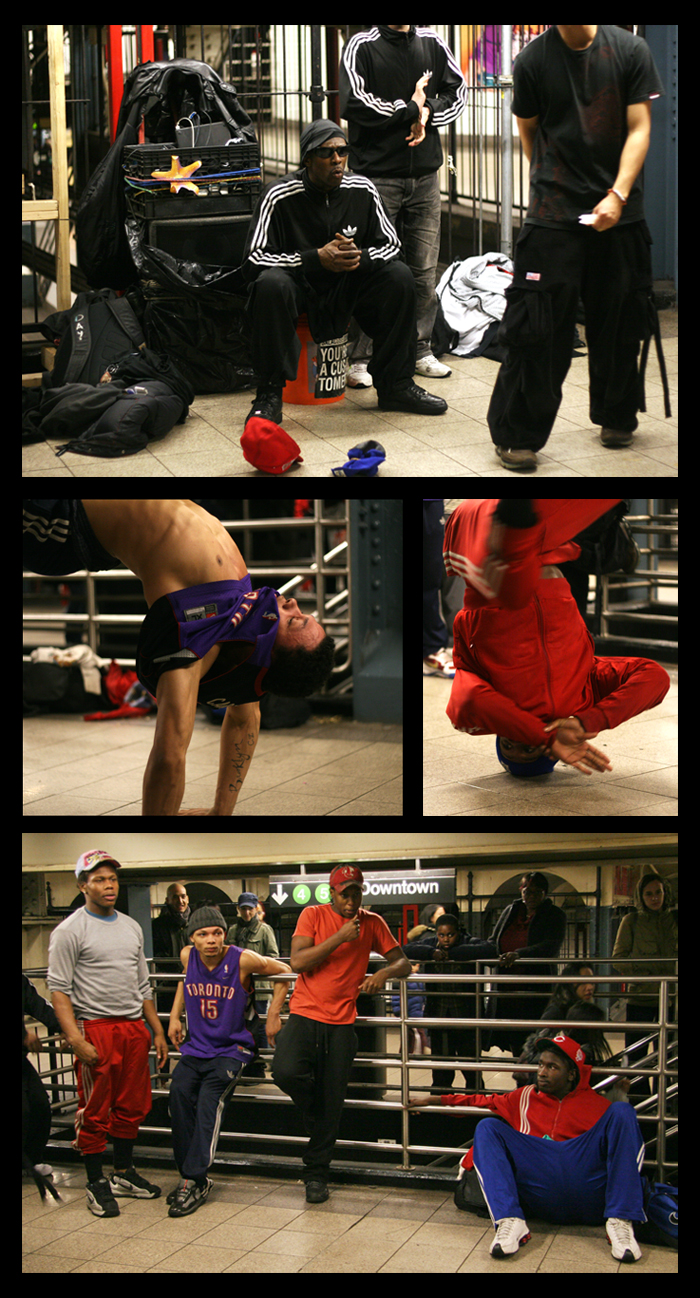
    If you are going to street perform in New York City, you had better be prepared for every manner of intrusion and disruption, including but not limited to verbal abuse, physical assault, or being upstaged by a lunatic. During the breakdancing show (see Part 1 here), a man from the crowd became very animated by the music and performers. I have no idea why he was wearing a full-length white fur in the middle of April, nor why nearly every article of his wardrobe was white. As he began to dance, the audience egged him on, and with little encouragement, he did his best at an impromptu performance:

    Although some may see the display as an effort to upstage, John Rich and his posse looked on in amusement, realizing that this was just another day in New York City, where, Float Master or not, Anything Can Happen 🙂

    Related Posts: Ferris Butler Part 1, Professor Gurland Part 1, Gaby Lampkey Part 2, Jenn Kabacinski Part 1, Birds of a Feather Tied Together Part 1, Fashion Forward
    Posted on by Brian Dubé

  • Float Master, Part 1

    Posted on by Brian Dubé

    No Smoking


    I recall the first time someone referred to one of my products as “bad.” Initially insulted, I later was informed that bad meant good. However, I just could not fully accept that a word could mean the same as its opposite. It took some years before I saw and heard enough examples to really get it – intonation and context is critically important to conveying this meaning. To this day, it is used sparingly and only a certain type of good seems to be bad. It was one of my first forays into urban slang in New York City, the capital of urban culture.

    I never stop to see anything resembling b-boying, aka breakdancing. Born in the Bronx and Harlem, it has been done to death on the streets of New York for decades, often by those moderately skilled and certainly eclipsed by serious gymnasts or acrobatic performers. However, the group which meets regularly at the Union Square subway station main platform on Saturdays, is something else. I decided to stop and bring myself up to date on the hardest of the hardcore – acrobatic hip-hop dancers working on concrete in the New York City subway system, risking fines.

    This group’s leader is “Float Master” John Rich, born in East Harlem where he still lives. He is 46 years old and has been dancing since the age of eight. John has done gigs worldwide and a commercial for Puma. At this time, he prefers working New York City. Although most street performers barely survive or just supplement their incomes, never underestimate what a savvy top street performer can earn in this city – John makes as much as several hundred dollars on a good day and earns a living dancing on the streets, supplemented with occasional party jobs. He is currently attending New York institute of Technology, working towards a bachelor’s degree in computer science.

    I was impressed by John’s act, the finale of the show, with his skilled dancing and signature routine – manipulation of a lit cigarette with his mouth. At one point, John inverts the cigarette, completely enveloping it and proceeds to blow smoke in tune with his movements. It is best understood live (John’s routine is at the end of the clip):

    The skill level of the various acts was extraordinary. A standard has been set and only a fool with poor skills would enter the fray.

    No brand of New York City street activity would be authentic without attitude and John Rich has plenty of that – cool, confident and exuding that smugness that nothing impresses a New Yorker. Certainly not a group of young men defiant enough to risk ticketing or feature a routine with cigarette smoking in the subway system, often with the police watching. Depending on the size of the audience the performance attracts and any other number of variables, the group is often ticketed and shut down, whereupon they take their show elsewhere.

    I met John at the end of the show. He was quite personable, excited that I would be featuring him here and quite amused when I told him that I would be calling the story No Smoking. But after reviewing the photos and video, I recalled how this particular show was punctuated by a surprise impromptu visitor. In Part 2, you will meet the bizarre man who apparently thought that he too, was a Float Master

    Related Posts: Tired of Crumbs, Makes Me Stronger

    Posted on by Brian Dubé

  • Crooks and Perverts

    Posted on by Brian Dubé


    On November 17, 1973, during a televised question and answer session with the press, President Richard Nixon said:

    People have got to know whether or not their President is a crook. Well, I’m not a crook. I’ve earned everything I’ve got.

    Crook is a bit outdated, the kind of word you may have heard around my home during my childhood, along with other words like floozy, gallivanting, tramp and shindig. Today, a crook seems rather benign, perhaps someone prone to petty crimes like swindling a customer or shoplifting.

    In a world of alternative lifestyles and extreme behaviors, pervert is also much less meaningful than it once was, bordering on the quaint.

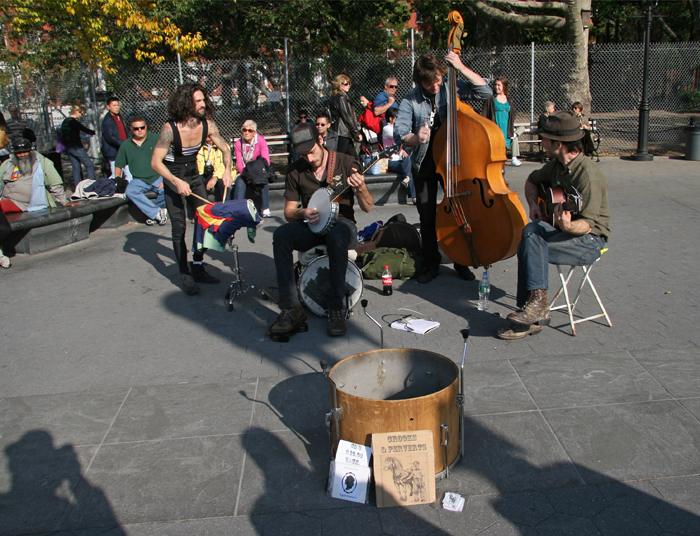
    Coming up with a good name for a music group is difficult – akin to finding a catchy dotcom not yet registered. There are inanimate objects – The Doors, The Cars and Rolling Stones; insects – The Beatles, The Crickets, The Hornets, Iron Butterfly, Adam Ant, Hungry Locust, Spiders from Mars; automobiles – R.E.O.Speedwagon, The Cadillacs, The BelAirs, Fleetwood Mac; animals – The Monkees, The Animals, The Byrds, The Eagles, The Turtles, Stone Ponies, The Black Crowes. The categories, single word names and simple phrases are endless, including the vulgar, irreverent, angry, defiant, lovely, ironic and nonsensical – The Sex Pistols, Led Zeppelin, Leftöver Crack, Pavement, Mötley Crüe, et. al.

    When I first heard Crooks and Perverts play, they immediately exuded a feeling of authenticity. When I spoke to them, I learned that their members are from Georgia. They have a unique blend of authentic southern roots, rough country boys with an urban sensibility and musical sophistication – I recently saw them in Matt Umanov Guitars sampling the wares.

    However, regardless of changing times and mores, I would still be wary of anyone who calls themselves a crook or pervert 🙂

    Note: Crooks and Perverts are now based in Bedford-Stuyvesant, Brooklyn, and can be seen playing the streets of New York City. You can find their website here with music samples, videos, etc.

    Related Posts: The Real Peel, Tired of Crumbs, Street Poet, Makes Me Stronger, Famine and Feast, Sieve, Street Magic

    Posted on by Brian Dubé

  • The Curse of Trade

    I carry two quotes with me in my wallet from Walden by Thoreau. One is quite well known and often cited – a portion was in fact used in the film Dead Poet Society (see it here). The other, concerning the nature of business, seems so often applicable to my daily life as to lead me to be frequently disturbed:

    But I have since learned that trade curses everything it handles; and though you trade in messages from heaven, the whole curse of trade attaches to the business.

    I once witnessed an incident at the origami convention held annually at the Fashion Institute of Technology that illustrated this all too well, and I have never forgotten it. I had a passion for origami at one time – as a young boy, I borrowed the World of Origami from the local library. In the small blue collar town I grew up in, origami was virtually unknown, and my folded creatures were as fascinating to others as they were to me. I once gifted a girl a small bag of origami animals. It made quite an impression.

    There is a small area for vending at the origami convention. A married couple left their table, leaving their son in charge. While gone, this very young boy handled the sales quite adeptly, perhaps too much so. I sensed he had sold often and had learned his trade well, likely imitating his parents. I saw in him the desire to sell, irrespective of what was really being sold – selling to people who did not really want to buy anything, buy origami items or specific things he was trying to sell. I could sense that whether the things he was saying were true or not was secondary to the sale. Not a mortal sin, but it was just that he looked like a huckster hawking his wares. And so young. What was particularly upsetting was that I saw myself in that boy, and that Thoreau quote reared its ugly head again and immediately came to mind.

    That quote is a very strong assertion, one that many, particularly those in business, will bristle at. I have shown it to both business owners and non-owners and I have gotten a variety of reactions. One man, an owner of a prominent New York City architectural firm said, “I don’t agree with that at all.” I was not surprised by his reaction. Architecture is a noble profession, and the prospect that the work could be seriously compromised by commerce is, I am sure, quite distasteful.
    I fully understand the sentiment, however, finding something distasteful or disagreeable does not make it untrue, much as the harsh tenets of a particular religious faith do not, in itself, make that faith or its doctrine invalid.

    I have been in business or self-employed my entire adult life. I well understand the necessity of commerce and even some sales and marketing. How else to keep the machinery of businesses running to make the goods we actually do need? But as my business has grown, I have become aware how the nature of business shapes my decisions and my daily activities. When I first started and my business was more an adjunct to a hobby, I had the luxury of indulging my whims.

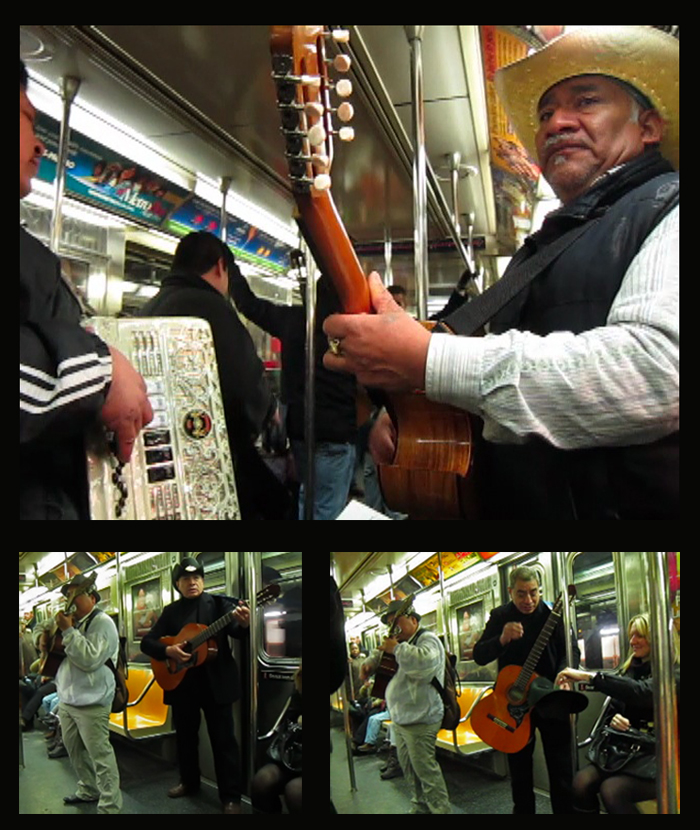
    I reflect on this problem often, as I did on the subway recently when a group of Mexican musicians entered my car. Their playing and money collection was extremely routinized, virtually stripping any joy or entertainment from the process. Their playing seemed to be nothing other than a way of legitimizing their collection of money:

    But these men need to make a living too, and perhaps music is what they do best. As they moved hurriedly to the next car, only to repeat the process, I was saddened and could not help but think that they too, were doing their best to trade in songs from heaven but at least in some small way, their business of entertaining riders suffered from the curse of trade…


  • Africa

    I was standing on the base of a light post on Broadway, looking for breaks in traffic to get a good photo of the Cable Building (see here), when a man driving in the rush hour traffic shouts out to me. It took a few moments to place him. It was Michael Ahuja, the owner of Shona Gallery, a SoHo business owner whom I had befriended and written about with a shop selling African art objects and furniture. On my way home from my office, I would often drop into his shop and chat, usually about Africa.

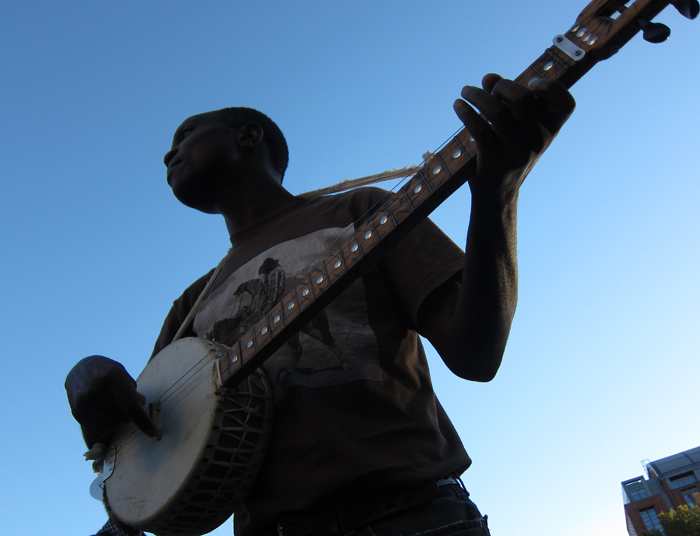
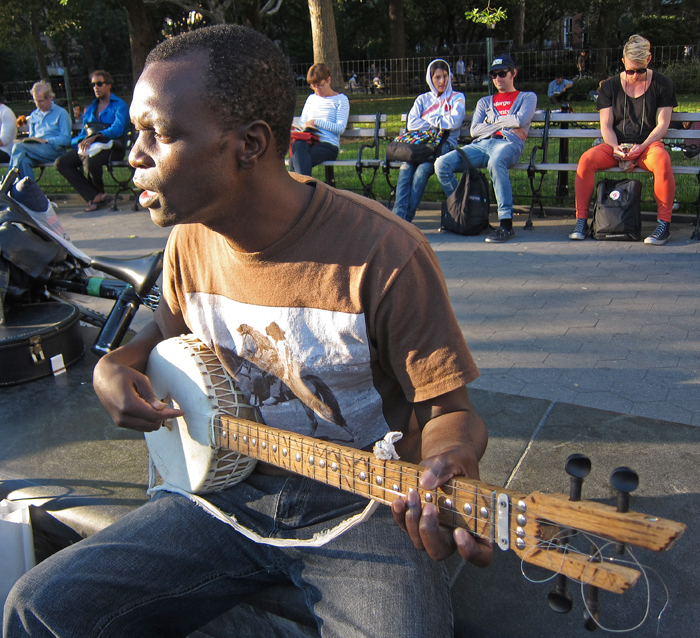
    When I met Essau Pwelle and found out he was from Tanzania, I was quite excited and eager to tell him of my passions for Africa. Essau, who hails from Yenzebwe Village, has been a resident of the USA since 2003 and currently resides in New York City. He is a 4th generation banjo maker and, in conversation, told me of the African roots of the banjo. He has played banjo since he was 14 and is also a singer, songwriter, performance artist, and event organizer.

    Even in a place as large as New York City, it never ceases to amaze me how many acquaintances in common there are between people that I encounter. In conversation, I found out Essau knew Michael Ahuja. I told Essau that all with all this passion, it was still unlikely that I would ever go to Africa. “Why?,” he asked. “Fear of the known and unknown,” I answered. There is an aura of mystery surrounding Africa, fueled by books with titles like Heart of Darkness and phrases like Henry Stanley’s “Dark Continent.” He assured me, as did Michael Ahuja, that I would find Africa to be to my liking.

    When I had occasionally spoken to Michael in our chats about any of my business difficulties or stresses, he suggested that I liquidate and move to Africa. Surely this was insanity, but he assured me that I would find it the palliative I needed. He described an idyllic life in various places, as did Essau, who spoke of those he knew who found great joy in Tanzania and made their residence there.

    When I asked to photograph Essau, he was quite accommodating, moving into various positions. Unsatisfied with the various conventional shots I was getting (see here), I crouched down, shooting upwards for a silhouette. After all, as I told Essau and others around us, we need some drama – this is not a man from New Jersey, this man is from Africa 🙂


  • Curse of the Mouth Trumpet


    It was September 25, 2005, and and I had the good fortune to be told about the first annual Bluegrass Reunion in Washington Square Park.

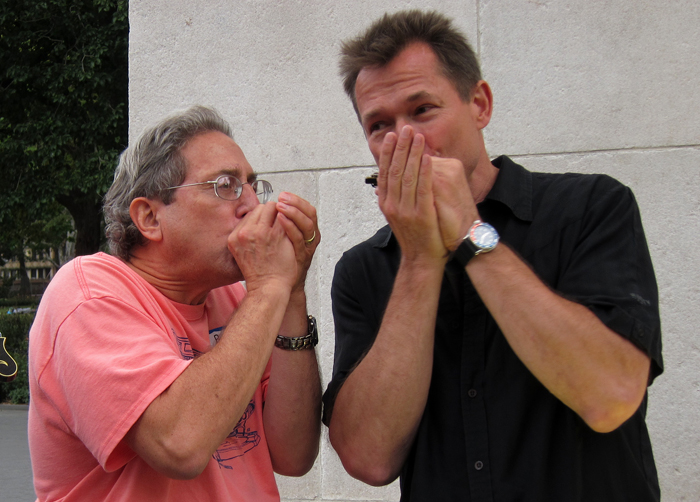
    I was astonished to see the “mouth trumpet” technique of Bob Gurland. As an added bonus, I learned that, unbeknownst to me, the woman he began to engage with in a duet was Maria Muldaur. Conveniently, my point and shoot digital camera at the time had video capability. What an opportunity to capture a bit of spontaneous music history! Or so I thought.

    I noticed just before they had nearly completed their duet, that I was not recording at all. I immediately enabled the video recording but only got 15 seconds of them together. This was also the total video footage of Bob :

    I did get to chat with Bob and complemented him on his unique and amazing skill. He told me he had performed and recorded with a number of music bands, including one of the earliest heavy metal groups, Blue Cheer. His name appears on the credit list for their album Oh! Pleasant Hope.

    I am, however, very tenacious, and I never forgot my aborted video. So it was with great pleasure that after 5 years, I saw Bob again at the recent 6th Bluegrass Reunion. Here, I was quite confident. I had much more experience with photo equipment and had several cameras, including a Sony HD camcorder, which I did not bother bringing. The video function of today’s point and shoots is excellent, and I was lazy, sure that I was adequately prepared with my new Canon S90. Or so I thought.

    I was very relaxed, shooting Bob in a number of segments, and even introduced myself and got him to do a short video clip alone. However, there appeared to be a peculiar tinting to all the video. No time to research this now, as I was sure it was a screen display issue. It was not. In making this Canon camera very user friendly, some functions are much too easily changed by brushing against a small function wheel. I had accidentally changed the mode from standard to color accent and color swap. In my panicky state, I tried to find the functions settings for video, to no avail. Once I was home, I learned how childishly simple the mode change is. Too late.

    So, if you would like to enjoy Bob and his fellow musicians in a variety of lurid skin tones and other color abominations, here is my video montage:

    Next time, I am determined to prevail over the Curse of the Mouth Trumpet 🙂

    Photo Note: Bob Gurland is on the left with Trip Henderson on harmonica on the right. Both are New York City residents.

    Related Posts: Izzy and Art, Bluegrass Reunion


  • New York is Bluegrass Country

    I was once discussing prominent blues musicians struggling to make a living with a jazz musician, who concurred and told me that he had often seen world-class jazz musicians playing to near empty bars. So, if you like meeting and mingling with life’s movers and shakers in music, just shift your interest from mainstream popular genres.

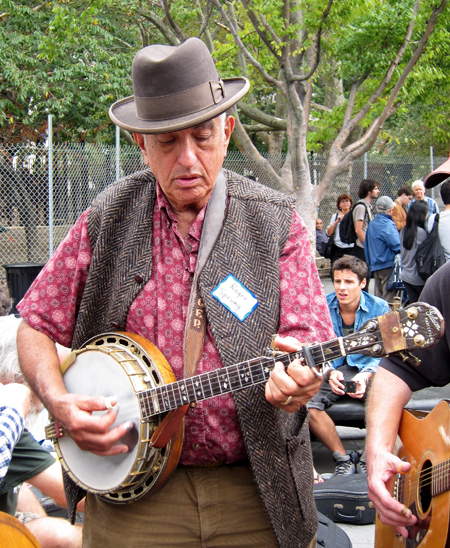
    In rock music, a man like Roger Sprung would be most likely layered with security and screeners with little hope of a meeting. At the 2010 annual bluegrass reunion on Sunday, September 26, in Washington Square Park, Roger was easily approachable between sets.

    Roger was born in Manhattan in 1930. A pioneer and the father of Newgrass banjo, he is credited with introducing authentic banjo music to the North. He was introduced to piano at age seven by his nanny and took lessons at age 10. Subsequently, his interest turned to guitar and then banjo, which he taught himself by listening to recordings of legends such as Earl Scruggs.

    Starting in 1947, Roger was introduced to the folk country scene in Washington Square Park by his brother George. In 1950, he made the first of what was to be many trips to bluegrass country, starting in Asheville, North Carolina. In Folk Songs of Greenwich Village in the 1950’s and 1960’s, bluegrass historian and performer Ralph Lee Smith wrote, “Banjo player Roger Sprung almost single-handedly introduced Southern bluegrass music to New York through his playing in Washington Square.” Roger has performed with a myriad of legendary musicians in a number of venues as well as on television. He is currently a resident of Connecticut, and his website can be found here.

    Interest in bluegrass music has been growing in New York City with local players like Sheriff Bob, who has run the weekly bluegrass jam for years (formerly at the Baggot Inn, now at the Grisley Pear), Gene Tambor of Minetta Creek, and guitar virtuoso Scott Samuels, who in recent years has added more bluegrass to his repertoire. New York City is ripe with bluegrass activities in various clubs, bars, parks, and outdoor festivals. Classes can be readily found, along with equipment in various shops.

    Bluegrass aficionados, performers, and enthusiasts abound, and for those who want a taste or a full meal of bluegrass music need not look further afield than than this city. With a feather in your cap like Roger Sprung, it is easy to aver that, along with all the other great things about this city, New York is bluegrass country 🙂

    Postings featuring Bluegrass: Sheriff Session, Bluegrass Reunion, Paddy Reilly’s, Pockets of Joy


  • Impossible

    There are people who are so hypercritical, so persnickety, so picky, so cynical, and such perfectionists, that to see them at dinner, whether it be fast food or haute cuisine, will result in a virtual forensic investigation of the dish’s ingredients. Rather than embrace life, they appear to have a disdain for it, because it almost never meets their standards. Their negativity fills the air like a heavy cloud. Laughter itself is carefully meted out, only at worthy moments. I have met such people, and perhaps you have also.

    There are people who have a joie de vivre that permeates everything they see and do. For them, life is wonderment, and their love is absolutely infectious. Most who are fortunate enough to be around them are happy to be infected. They befriend everyone, and most welcome the friendship. They are truly alive and easily become the life of the party. Laughter is their signature, and they are perpetually signing life’s events.

    I have met such people too, and although some may find their unbridled enthusiasm wearing, better a night spent with the life affirmer than walking on eggshells and having your balloons deflated by the disgruntled life disdainer. Although personalities and people are complex mixtures and do not fit these two boxes so conveniently, those at the polar ends of the spectrum do approach these characterizations rather well.

    Constantin is from the Ukraine and is currently performing at Webster Hall in its Saturday night show, Circus. He approached us unexpectedly while sitting in Washington Square Park and asked if he could demonstrate some magic. Fortunately for him, he had just approached a group of life affirmers and had an audience poised for applause. We were hungry to show our love and appreciation.

    I have seen a number of professional magicians, but Constantin’s presence and speed was something to behold. A member of our group, JoSsS, is one of the world’s great life affirmers, and you can see him in the video I shot that night (look for the man with the curly white hair). 1 minute and 20 seconds into the video, you will see his ebullient, effusive, effervescent reaction to a particularly amazing trick, where, incredulous at the outcome, he repeats, “Impossible!” over and over, with his charming manner and Argentinian accent. I know he loves that word, and it is so appropriate, because for a life affirmer, a day without love, hugs, and laughter is like a day without critical examination for the life disdainer – impossible 🙂


  • On The Road

    If you are not familiar with what I do for a livelihood, click here before reading this story. Also see the related links at the bottom.


    Note: Please click and play the audio link to accompany your reading of this remarkable tale.


    In a typical evening ritual, I circumnavigated the central plaza of Washington Square Park looking for a music jam. I had a number of choices, but I was drawn to this particular man who I had never seen before. He looked like a man passing through.

    His voice was very good, his playing style confident and his repertoire quite extensive. The more I listened, the more I liked him, so I decided to make a commitment and sit down. I took a few photos.

    Between songs, a number of friends and I learned a few things about him – he was a native Alaskan on the road. A broken G string offered the opportunity to dig deeper.
    He seemed extremely accommodating, and as we spoke, I took out paper and pen and began making notes about the details of his life. I slowly began to feel that there is a good story here. But nothing as good as what was to come.

    At one point, I told him that I hoped he did not mind, but he was going to be the subject of the next day’s story. He appeared pleased, and I was also, so now with a green light, I filled in the details of his life.

    Gaby Lampkey is 54 years old and was born in Juneau, Alaska, to a Filipino father and a Tlingit mother* who busied herself raising nine children. Gaby is a member of the Raven Tribe, Seagull Clan. His family moved to Los Angeles when he was young. He served in the Coast Guard for 6 years, where he worked as a captain’s cook, and was married for 13 years and has two girls.

    Gaby has been on the road for 10 years, with no real home, living by his wits and sleeping wherever he can (he plans to move into the Manhattan hostel on the Upper West Side). His income of tribal dividends is supplemented by work as a street musician playing guitar. We spoke of hobos and trains, which was not his preferred mode of travel – he is an itinerant hitchhiker. Gaby described himself more as a traveling hippie, a participant in the annual Rainbow Gatherings and a recent attendee of the 41st anniversary of Woodstock, where he performed. He said he was an avid reader and read everything he could get his hands on, including the sides of iodine bottles.

    In a very surprising shift, he said he was a juggler and spoke of how juggling changed his life with anecdotes. I acknowledged his experiences, only half hearing them, my mind intoxicated with the possibility of the obvious connection. If this was going were I think it was, it would be as astonishing as Walid Soroor .

    But play your cards slowly, I thought – don’t reveal them now, go for the knockout punch.

    I have a hard time keeping a secret or containing my enthusiasm, but while Gaby spoke, I contained myself and very casually reached into my bag for a stack of business cards.
    I handed him one and asked him if he had heard of the company. He immediately responded, yes indeed, and that Brian Dubé was the person that made him his first set of juggling clubs.

    He recounted how, for most things in Juneau, he had to order from a catalog. He had poured over the Dubé Juggling Equipment catalog as a boy and ordered his first set of juggling clubs. He also told me, that unlike most other products that did not live up to catalog imagery, when his new clubs arrived, they were just like those pictured, and he worshipped those objects which he kept in his room. I was beaming.

    You have him now, I thought, no need to belabor this any longer. Deliver the one-two punch.

    I asked offhandedly if he knew Brian Dubé. He answered that he had never met Brian personally. I said, “Yes you have, you have been talking to him for the last two hours.”

    Gaby and a handful of friends around me who were privy to this conversation were just stunned and burst into a virtual applause. This was a connection just too amazing to believe, and we spent quite some time exchanging more notes, anecdotes, mutual friends, and acquaintances. I expect to see him again and give a copy of this story. Only in New York with a fortuitous set of circumstances and an intersection in time and space with a man who is on the road

    *The Tlingits are a matrilineal indigenous people from the Pacific Northwest Coast. You can read more about the Tlingits here.

    UPDATE: For an update on Gaby’s life, go here.

    Related Posts: Supercute!, Signature, Juggle This, Spinning, Artiste Extraordinaire, Fish and Ponds


  • The Bathroom Closes in 20 Minutes

    There are innumerable thankless jobs, and many of us worked them when we were young. But for those of us who were college-bound, doing these jobs in high school, no matter how distasteful, was made tolerable by seeing light at the end of the tunnel – knowing full well that this was only a temporary position on a journey to an easier life. There was hope.

    But the masses of the work force are employed in jobs knowing that despite any late-night self-improvement evangelists, the reality is that the thankless job that they have is the end of the tunnel. Despite patronizing platitudes such as “every job has worth,” who of those with a good job and pay will trade it for the thankless job with its purported dignity? “Make the best of it,” we are told, but few of us have the temperament to make lemonade from these kinds of lemons for a lifetime.

    John Henry Black is a maintenance worker in Washington Square Park. He not only has a great attitude, but he also makes a real difference for those who enjoy the park. Complaints about odors emanating from a sewer area where hot dog vendors dump their refuse water daily has John preparing and adding a cleaning solution to douse the odoriferous offensive waters. He is known to warn women tourists to look out after their handbags or to suggest to others that they should move from the bench they are sitting on since it is located below roosting pigeons. John is also a harmonica player and will often take a few moments to join a music jam.

    He is best known for his mantra, which he belts out in the evening making his final rounds: “The bathroom closes in 20 minutes. If you gotta go, you better go.”* We who spend time there regularly find his words and routine to be a palliative, a familiar soothing balm. And, of course, many do appreciate these announcements, which were never made in the past, leaving those in need of a bathroom and unfamiliar with park policy unpleasantly surprised that Washington Square Park is open long after its bathrooms close.

    John Black hails from Florence, South Carolina, and has lived in New York City for 25 years, currently a resident of Harlem. His job as park maintenance worker is seasonal. In the late fall, he fills in his off time with other jobs until the following spring. When I asked his full name, he proudly smiled and answered, “Black.” Seeing that I was doubtful, he produced official identification that did indeed identify him as John Black.

    Today, on Labor Day, September 6, 2010, I nominate John Henry Black for candidate as poster child for the American Worker, an inspiration to make the best you can of what you do. But don’t wait too long, because the bathroom closes in 20 minutes 🙂

    *John actually starts with a series of announcements, typically an hour before, changing his mantra to reflect the time remaining.


  • Pockets of Joy

    Unless you are a saint, someone who has achieved nirvana, satori, or samadhi, or perhaps one of those individuals who is blessed as an eternal optimist, emotional life is an up and down affair. Life is good, but not always that good.
    For those of us mere mortals, it is more reasonable not to expect a life of constant euphoria and bliss, even in New York City, which has so much to offer, but rather, to look for pockets of joy in a less than perfect world.

    One of the unique things about New York, which I have never experienced anywhere else, is that no matter what your interests, passions, ethnicity, color, creed, or education, if you look, you can find others of a similar persuasion. Immerse yourself with these people, and you may find one of New York City’s many pockets of joy.

    For those who love music, this is an easy task. Head to Washington Square Park, and often you will find numerous groups playing at the same time – make the rounds and sample the goods. The New York Times has recently done two articles on the activities here.

    As of late, the park has been invaded by a large group of drummers. Although the experience is rather entrancing to the participant and has added musical variety, it has, however, made the rest of the central plaza difficult for other musicians to play and be heard, such as regulars like Joe Budnick or guitar virtuoso Scott Samuels. Regular street performers add to the din. Hence, splinter groups form on the lawns, on pathways, or tucked away in the folds of foliage. The musical entertainment seeker is well advised to circulate a bit, as I did on Saturday.

    A great number of musicians here are professional, some playing in the park for unstructured musical fun, others looking to play or rehearse outdoors on a beautiful day.
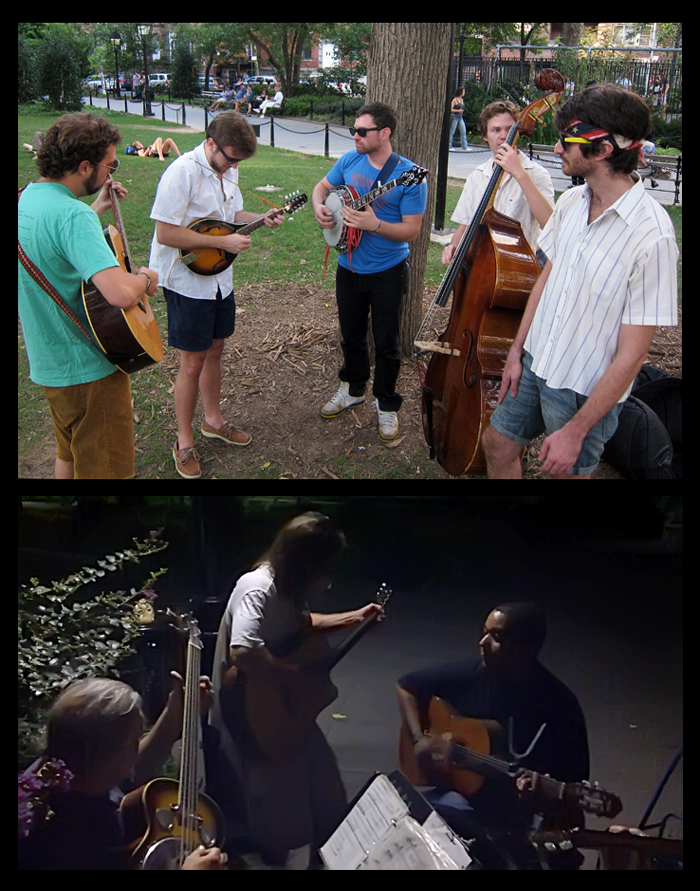
    Some form spontaneous groupings, some play together regularly, and yet others have established bands and work together professionally outside the park. The latter was the case with a bluegrass group, the Bella Boys, whom I encountered on one of the lawns, away from the central plaza hubbub. These boys were quite bella, and their command of repertoire was astounding to me, as was the familiarity of several members with numerous instruments. At various junctures, the mandolin, banjo, and guitar were passed around like musical chairs. I learned that one of the members was leaving for Europe for four months, so I had fortuitously run into them on their last get together for quite some time.

    Later that night, I ran across another grouping (Sage, Peter, Jimmy, and Joe – bottom photo), which included regulars I have known for some time. The singer, Sage, has a masterful, trained, and natural voice, and his occasional forays into the park are always a welcome addition to any group (Sage plays a dozen instruments and has a collection of 100). I had the good sense to record video of these events:

    At one point during the bluegrass jam, I noticed the hair on my arms standing up – a clear sign that life was indeed good and that I had found one of the city’s many pockets of joy 🙂

    Related Music Posts: Sieve of Darwin, Music Speaks for Itself, Sounds of Summer, Police Riot Concert, Bluegrass Reunion, The Conductor


  • Whet Their Appetites

    Posted on by Brian Dubé

    For two weeks, ending July 5, 2010, 60 pianos will be located in the public parks, plazas, and streets in all five boroughs of New York City. All are welcome to play. I visited a number of these and witnessed all manner of players, listeners, and playing skills.

    Play Me, I’m Yours is an art installation resented by Sing for Hope. The idea was created by British artist Luke Jerram, who has been touring the project globally since 2008 (London is being presented simultaneously with New York).

    The comments on forums online vary wildly – some individuals are in love with the idea and its efforts to bring music to the people. Others are infuriated or just highly cynical. Why are they located primarily in affluent areas, where they are least needed? What about vandalism? Who will tune them? How will chaining them to a cinder block prevent theft? Why did they allow painting of the keys themselves, which will affect playability? Some see its approval by the Bloomberg administration as posturing to feign support of street artists.

    There are certainly worse things to do with people’s time and money. In the few instances I watched at various locations, there were a number of highly skilled pianists and children with audiences. Learning to play a musical instrument is a long process requiring substantial time on a consistent basis. I wish these could be permanent installations, indoors and out, installed in all communities, particularly where there is a real need. The availability of these instruments would go a long way to making an impact and fostering musical interest.

    For those who can already play, this installation provides for many impromptu performances and summer fun. For those who don’t play, perhaps some moments with all that ivory will whet their appetites 🙂

    More about the installation: The 60 pianos will be available to play across New York City from 9am-10pm each day. The pianos are attended by individuals who lock and unlock the keyboards daily. Plastic tarps are on hand for protection from rain. On July 5th, to celebrate the culmination of the Play Me, I’m Yours, the street piano at Lincoln Center’s Damrosch Park will be brought to life by some of New York City’s most talented artists. A map with locations can be found here.

    Posted on by Brian Dubé

  • Catch Em If You Can

    Posted on by Brian Dubé


    When you happen upon a hand balancing act on the street and are reminded of the Alexis Brothers* from Cirque du Soleil, you know you are seeing world-class professional talent. I have done many stories on street performers, particularly in Washington Square Park, including a recent one on street acrobats. In the interest of variety of subject and setting, I try to limit posts on a particular topic.

    However, watching the duo in the park on Sunday afternoon, shown in today’s photo, it was immediately apparent that this was not your average street show. The display of strength, skill, movement, and presentation was remarkable in this hand balancing act with Rudi Macaggi and Lea McGowan. The audience was transfixed.

    Rudi is a third-generation entertainer and acrobat from Milan, Italy, who has traveled the globe, performing on stage since the age of 7. He has worked venues in Las Vegas and Atlantic City and has had national television appearances on Penn and Teller’s Sin City Spectacular and The Tonight show with Jay Leno. In 2006, Rudi won first place in the Crazy Caliber category of the TV show America’s Got Talent.

    Rudi’s one-man show has been seen around New York City at clubs such as the Slipper Room and the Box (both in the Lower East Side). The Acromedian does a one and a half-hour show – an amalgam of visual comedy, hand balancing, acrobatics, story telling, and standup, peppered with his famous quip, “I like you.”

    His street show featured his hand balancing routine with Lea along with a number of stunts, such as doing a one-armed handstand while dribbling a basketball, as well as his finale of a back somersault landing in a one-armed handstand. Always on the move, catch ’em if you can 🙂

    *Note: If you have never seen the hand balancing act of brothers Marco and Paulo Lorador, who performed in Cirque du Soleil’s shows Saltimbanco and Mystère, you can see a video from their act here.

    Posted on by Brian Dubé

  • Tired of Crumbs

    I have a long-time friend who, like I, has been self-employed for his entire adult life. He was a carpenter and, like any freelancer and unlike a small business owner, constantly needed to hunt for future jobs. From time to time, I would inquire about his existing work prospects. If he was between big jobs and only had small jobs here and there, he would just comment that all he had were “crumbs, just crumbs.” Crumbs became our private metaphor for those things which are relatively inconsequential to life. Akin to panning for gold in a world of miners.

    There has been lots of talk lately about gold as an investment and store of value in a time of economic uncertainty. Many have come to America and New York City to stake their claim.
    The very nature of New York City is a place of transients. People come and go for a variety of reasons. Many find that it is not to their liking or fulfilling the dreams they had. The streets are not paved with gold but rather with gold ore, and now require lots of mining.

    Perhaps the prospect of finding gold is one reason I came to New York City, but like any gold strike, e.g. the Internet, the easy money has been made, and little gold will be found lying in plain view. Panning for gold has given way to higher technology. Mining in the modern world and extracting precious metals from ore is going to be competitive and will require special equipment, training, expertise, and investment in tools. Otherwise, if you’re lucky, you are going to get crumbs.

    Of course, in any boom town, the crumbs will be much better than crumbs elsewhere. Street performers, as others, can make much more here than anywhere else. The lure is a mirage and a bit of a catch-22. The potential earnings from vending in a boom town are offset by the cost of living there. Perhaps you can sell eggs for a dollar a piece, but come time to eat, you’re in the same predicament as everyone else. There is opportunity to pick up a few dollars for the wanderer passing through, but how is he or she to live here for any extended time? There are very few margins left to live in.

    At first, the prospect of easy and immediate cash is very appealing, as is a life without a 9-to-5 job routine or other obligations. However, the free spirits that pass through New York City find out very quickly how inhospitable the city is to the less-than-well-heeled. And soon they will see those dollars in their hat or suitcase, just like my friend and me. They, too, will be tired of crumbs…


  • Friendly Extortion

    Posted on by Brian Dubé

    Like most activities, there has been an evolution in street performing. Historically, one of the difficulties has been to get audiences to take working on the streets seriously and not see it as begging or panhandling. In New York City, I believe this stigma has been largely overcome – many people do understand that street performing is a legitimate art form and a way that many artists begin their careers, supplement their income, or support themselves entirely.
    One of the elements that has evolved dramatically has been the money collection process and focus. This has been honed to an art and science by some, refining the techniques that work best.

    A seasoned street performer realizes that, left to their own, many audience members will walk away at the end of a show without making a donation, irrespective of whether of not they understand that this is a means of livelihood – perhaps they believe that somehow this show was otherwise funded or done for fun. So how is the performer to remind them of their duty as patron of the arts?

    There are many techniques to collect money from an audience, with varying degrees of aggressiveness and effectiveness. The method of choice for optimum results on acts with dramatic finishes is to hold back the finale and collect before it. Often, the collection becomes part of the act itself, with a variety of comedic solicitations. This can escalate to mass manipulation by some acts. One group I know of routinely spends as long as 25 minutes collecting money before their grand finale.

    The tumbling and acrobatic act in the photo is a typical, classic example. The act’s finale, where Tylon Moore (Hip Hop Acrobat) performs an incredible forward somersault over seven audience members, is set up with deliberation. Audience members are chosen to stand in a line, lean over, and hold this position while the money-collection process begins. There is certainly an element of pressure to donate and guilt for those who do not – this is manipulated to varying degrees, sometimes explicitly.

    With other acts, I have witnessed a virtual bidding induced style of collection, where a New York City borough competition is created with announcements being made as to the donation amount and the residence of the donor. Challenges are then made to other borough residents to up the ante. Properly handled, exceptional amounts of money can be generated this way, in something we could perhaps call friendly extortion 🙂

    Posted on by Brian Dubé


  • dinamic_sidebar 4 none

©2026 New York Daily Photo Entries (RSS) and Comments (RSS)  Raindrops Theme